gpt-5-mini (chosen from majority vote of a three-model LLM ensemble)
Short Digest
4af327f2a30c2d40
Response Measures
None
Description
OCR typos in some articles (Willeox -> Willcox) corrected.
Events (2)
1.January 10, 1921Suspension
Cause
Government Action
Cause Details
Closed by order of state auditor/bank examiner after being declared insolvent and overloaned.
Newspaper Excerpt
The Central Bank of Willeox is in the hands of the state auditor... ordered the bank closed.
Source
newspapers
2.January 11, 1921Receivership
Newspaper Excerpt
Appointment this week of a receiver for the Central Bank of Willcox... appointment of a receiver is expected; bank declared insolvent and ordered closed the following day.
Source
newspapers
Newspaper Articles (21)
1.January 10, 1921El Paso HeraldEl Paso, TX
Click image to open full size in new tab
Article Text
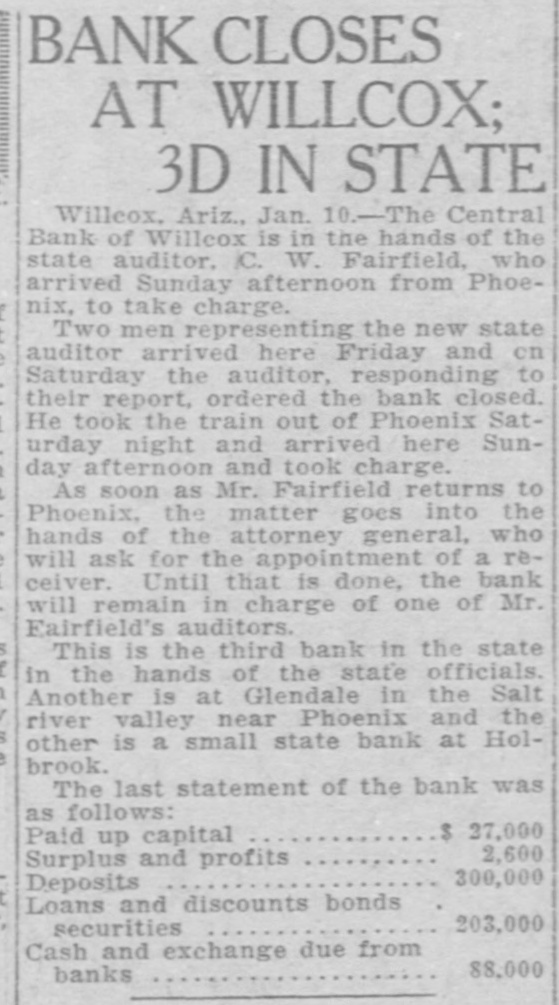
BANK CLOSES AT WILLCOX; 3D IN STATE Willeox. Ariz., Jan. 10.-The Central Bank of Willeox is in the hands of the state auditor. C. W. Fairfield, who arrived Sunday afternoon from Phoenix, to take charge. Two men representing the new state auditor arrived here Friday and en Saturday the auditor, responding to their report, ordered the bank closed. He took the train out of Phoenix Saturday night and arrived here Sunday afternoon and took charge. As soon as Mr. Fairfield returns to Phoenix, the matter goes into the hands of the attorney general, who will ask for the appointment of a receiver. Until that is done, the bank will remain in charge of one of Mr. Fairfield's auditors. This is the third bank in the state in the hands of the state officials. Another is at Glendale in the Salt river valley near Phoenix and the other is a small state bank at Holbrook. The last statement of the bank was as follows: $ 27,000 Paid up capital 2,600 Surplus and profits 300,000 Deposits Loans and discounts bonds 203,000 securities Cash and exchange due from 88,000 banks
2.January 12, 1921Pueblo ChieftainPueblo, CO
Click image to open full size in new tab
Article Text
ARIZONA BANK ANNOUNCED CLOSED Phoenix, Ariz., Jan. 11.-Closing of the Central Bank of Willcox, Arizona, rumors concerning which had been current for several days, was announced today by State Auditor Charles Fairfield, who returned from Willcox. He said the bank was closed by order of H. C. Bradford, state bank examiner, and his assistant. H. M. Moritz, said application would be made for appointment of a receiver. An overloaned condition was said to have been responsible for the bank's close. Willcox is a center of livestock Interests.
3.January 12, 1921Bisbee Daily ReviewBisbee, AZ
Click image to open full size in new tab
Article Text
Receiver To Be Named For Willcox Bank This Week, Is Report Of State Examiner DOUGLAS Ariz., Jan. 11.-Appointment this week of a receiver for the Central Bank of Willcox, this county, is expected. according to information tonight from H: M. Moritz, deputy state bank examiner in charge of the institution, which was closed last Saturday. Representatives of the state auditors' office reached Willcox on Friday and the bank. declared insolvent, was ordered closed the foldowing day. State Auditor C. W. Fairfield and Bank Examiner E. C. Bradford returned to Phoenix tonight from Willcox.
4.January 16, 1921Tombstone EpitaphTombstone, AZ
Click image to open full size in new tab
Article Text
RECEIVER TO BE NAMED FOR WILLCOX BANK THIS WEEK. IS REPORT OF STATE EXAMINER DOUGLAS, Ariz, Jan. 11.-Appointment this week of a receiver for the Central Bank of Willcox, this county. is expected. according to information tonight from H. M. Moritz. deputy state bank examiner. in charge of the institution. which closed last Saturday. Representatives of the state auditor's office reached Willeox Friday and the bank, declared insolvent, was ordered closed the following day. State Auditor C. W. Fairfield and Bank Examiner E. C. Bradford returned to Phoenix tonight from will cox.
5.January 16, 1921Tombstone EpitaphTombstone, AZ
Click image to open full size in new tab
Article Text
NO APPLICATION YET FOR RECEIVER. Although a dispatch from Phoenix states application for a- receiver for the Central Bank of Willeex will be filed in the Superior Court in Tombstone, nothing as yet has been filed in the local court. according to info: mation this afternoon. H. H. Moritz deputy state examiner has been place ed in charge at Willcox pending the filing of the application, the report stated.
6.June 2, 1921Bisbee Daily ReviewBisbee, AZ
Click image to open full size in new tab
Article Text
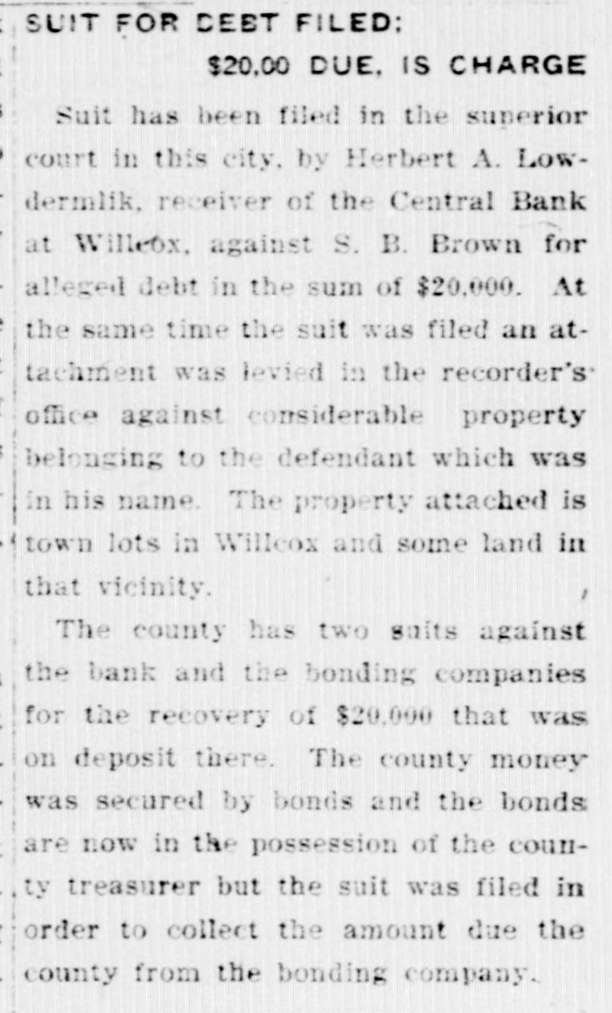
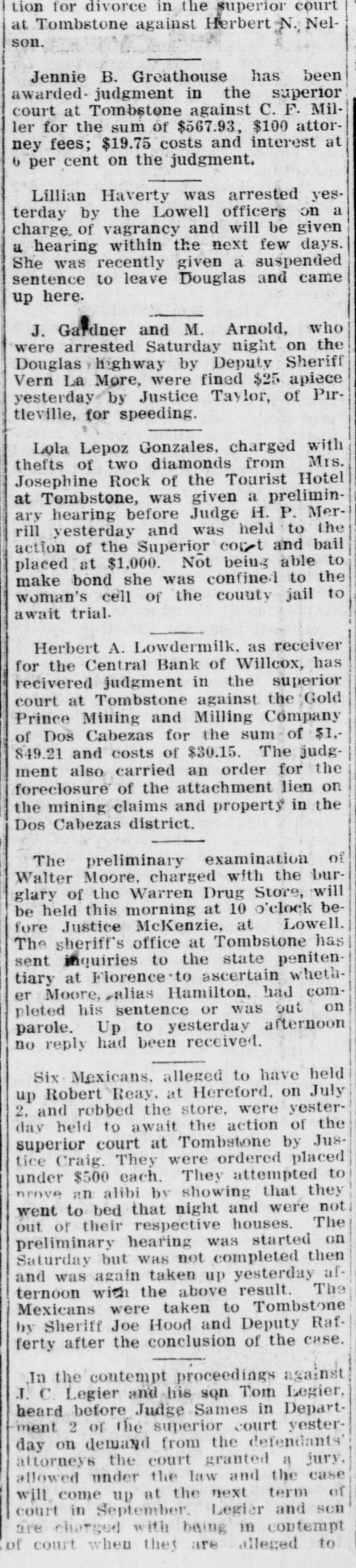
Property Attached DOS CAREZAS-According to notices posted here the property of the Gold Prince Mining Company has been placed under attachment by the sheriff's office. The attachment was levied as a result of a suit filed in the superior court at Tombstone by Herbert A. Lowdermilk, as receiver for the Central Bank of Willcox, to collect the sum of $1,849.21. Seven mining claims and improvements thereon have been placed under the attachment.
7.June 29, 1921Bisbee Daily ReviewBisbee, AZ
Click image to open full size in new tab
Article Text
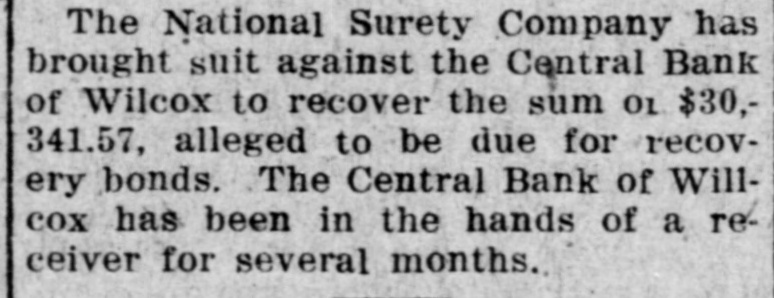
The National Surety Company has brought suit against the Central Bank of Wilcox to recover the sum of $30,341.57, alleged to be due for recovery bonds. The Central Bank of Wilcox has been in the hands of a receiver for several months.
8.August 18, 1921Bisbee Daily ReviewBisbee, AZ
Click image to open full size in new tab
Article Text
n theCount Herbert A. Lowdermilk, receiver for the Central Bank of Willcox, has brought suit in the superior court at Tombstone against J. J. Fagan and J. H. Reid to recover the sum of $6003.49 alleged to be due the bank.
9.September 28, 1921Bisbee Daily ReviewBisbee, AZ
Click image to open full size in new tab
Article Text
Less Than 10 Per cent WILLCOX--upon his return here yesterday 110m Tombstone, where he nad been to secure judgment in a couple of suits in the superior court, nerver A. Lowaermilk, receiver 101 the Central Bank of this city, made the announcement that the depositors irom present indications, would receive less than ten per cent of the money that they had on deposit at one time the bank failed.
10.October 2, 1921Tombstone EpitaphTombstone, AZ
Click image to open full size in new tab
Article Text
WILLCOX BANK RECEIVER HERE. Herbert A. Lowdermilk, receiver of the Central Bank of Willcox, was in Tombstone today accompanied by his attorney, John Gung'l. Their visit here was for the purpose of securing two judgments from debtors of the defunct bank. Mr. Lowdermilk stated that at present it looks as if the depositors of the bank will receive less than 10 per cent of their money.
11.November 3, 1921Bisbee Daily ReviewBisbee, AZ
Click image to open full size in new tab
Article Text
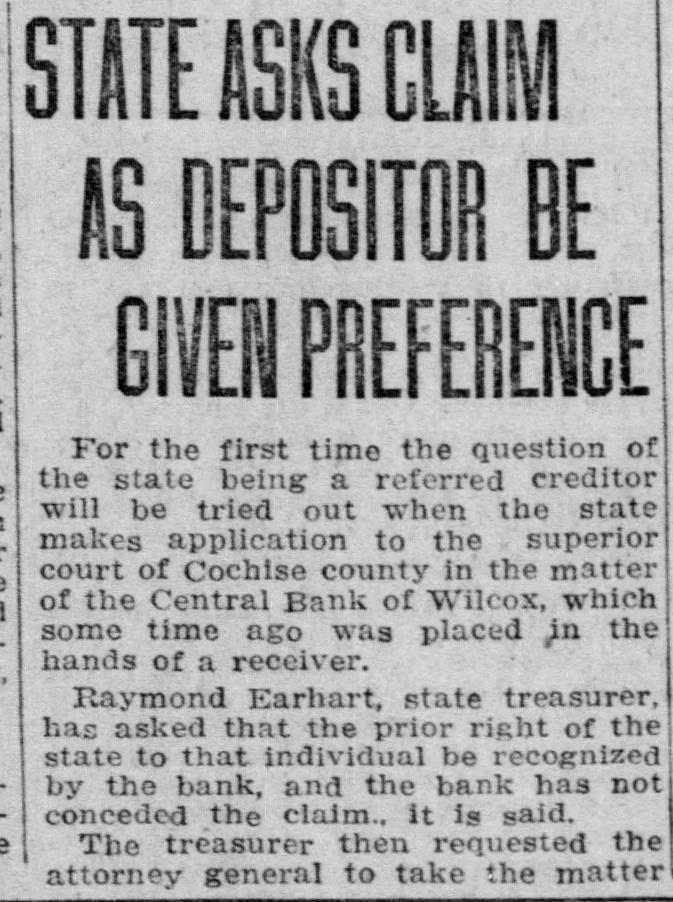
State Wins First Round TOMBSTONE - The state won the first preliminary in its efforts to secure recognition as a preferred creditor of the Central Bank of Willcox when the superior court of Cochise county restrained the received, Herbert Lowdermilk from taking any action until further conters of the court. After the announcement made by Receiver Lowdermilk that the bank would pay 10 cents on the dollar the state filed an application asking that the state be given preferred right.
12.December 18, 1921Tombstone EpitaphTombstone, AZ
Click image to open full size in new tab
Article Text
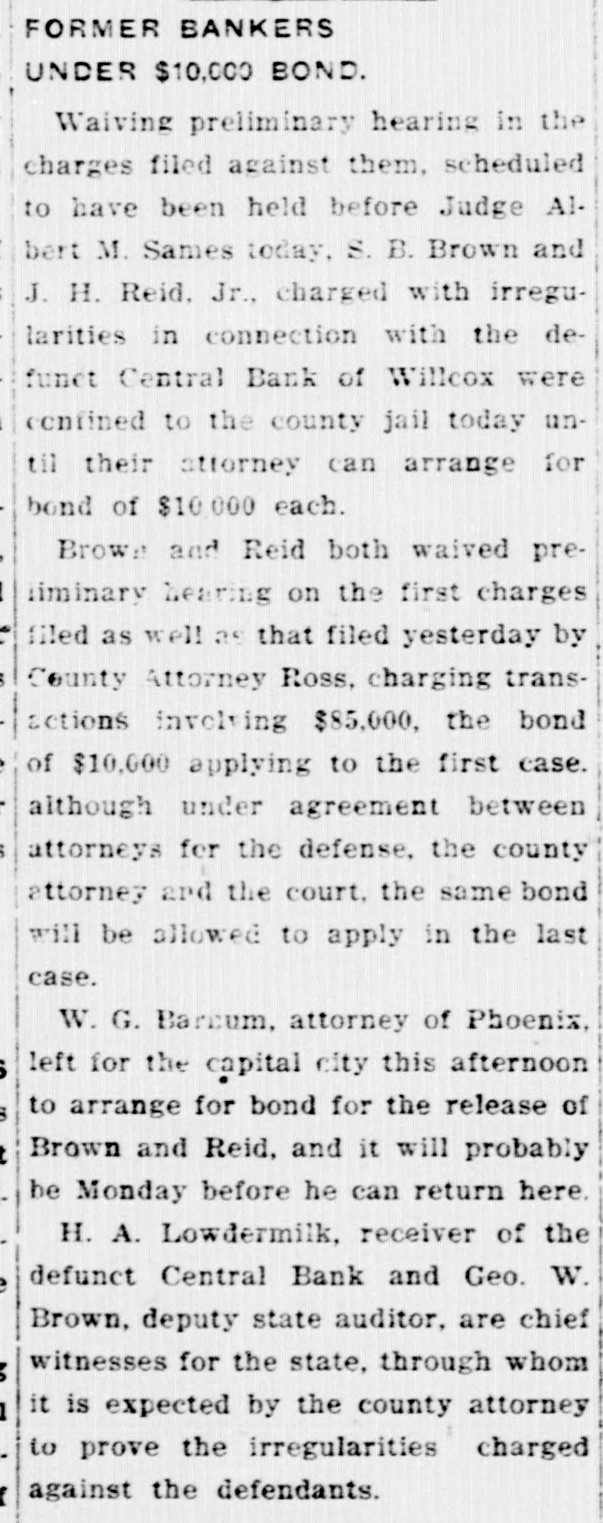
FROM WILLCOX. Atorney G. C. Gung'l and Herbert Lowdermilk receiver of the defunct Central Bank of Willeox. are in Tombstone. having come here for the preliminary of S. B. Brown and J. C. Reid. charged with falsifying records of the bank. which will be held here tomorrow
13.March 19, 1922Tombstone EpitaphTombstone, AZ
Click image to open full size in new tab
Article Text
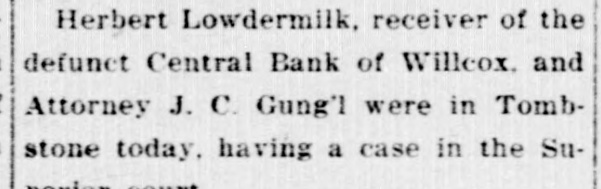
Herbert Lowdermilk, receiver of the defunct Central Bank of Willcox, and Attorney J. C. Gung'l were in Tombstone today, having a case in the Superior court.
14.April 14, 1922Bisbee Daily ReviewBisbee, AZ
Click image to open full size in new tab
Article Text
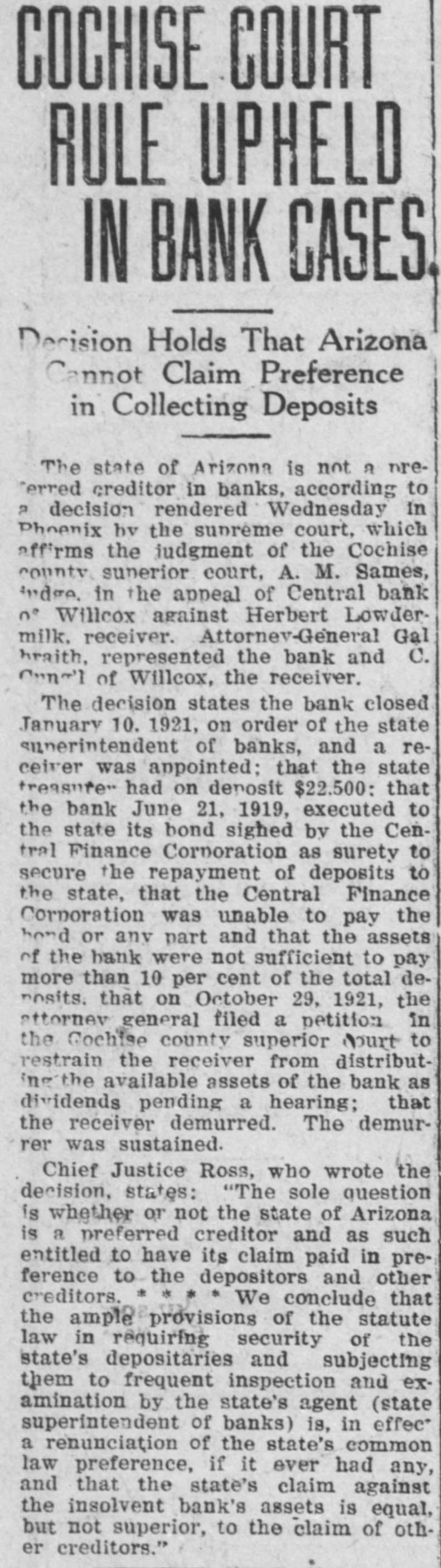
COCHISE COURT RULE UPHELD IN BANK CASES Decision Holds That Arizona Cannot Claim Preference in Collecting Deposits The state of Arizona is not a nreTerred creditor in banks, according to a decision rendered Wednesday in Phoenix by the supreme court, which affirms the judgment of the Cochise county sunerior court, A. M. Sames, india in the appeal of Central bank nยฐ Willcox against Herbert Lowdermilk, receiver. Attorney-General Gal braith, represented the bank and C. Cunn't of Willcox, the receiver. The decision states the bank closed January 10. 1921, on order of the state sunerintendent of banks, and a receiver was appointed; that the state treasure" had on deposit $22.500: that the bank June 21, 1919, executed to the state its bond sighed by the Central Finance Corporation as surety to secure the repayment of deposits to the state, that the Central Finance Corporation was unable to pay the bond or any part and that the assets of the bank were not sufficient to pay more than 10 per cent of the total deposits. that on October 29, 1921, the attorney general filed a petition in the Cochise county superior court to restrain the receiver from distributing the available assets of the bank as dividends pending a hearing; that the receiver demurred. The demurrer was sustained. Chief Justice Ross, who wrote the decision, states: "The sole question is whether or not the state of Arizona is a preferred creditor and as such entitled to have its claim paid in preference to the depositors and other creditors. We conclude that the ample provisions of the statute law in requiring security of the state's depositaries and subjecting them to frequent inspection and examination by the state's agent (state superintendent of banks) is, in effect a renunciation of the state's common law preference, if it ever had any, and that the state's claim against the insolvent bank's assets is equal, but not superior, to the claim of other creditors."
15.April 22, 1922Bisbee Daily ReviewBisbee, AZ
Click image to open full size in new tab
Article Text
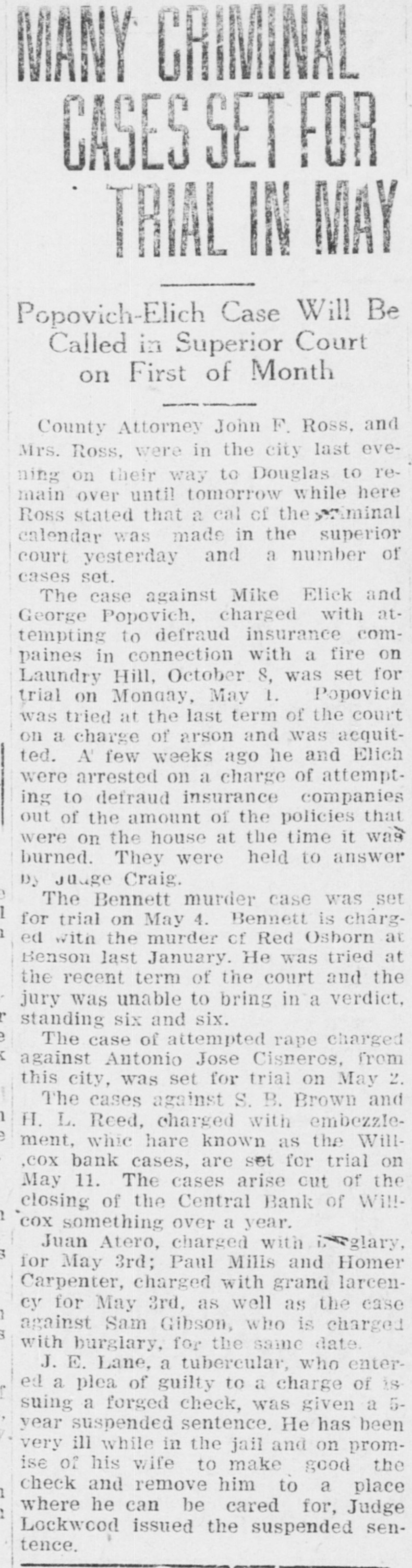
CRIMINAL MANY CASES LASES SET FOR MAY IN TRIAL Popovich-Elich Case Will Be Called in Superior Court on First of Month County Attorney John F. Ross, and Mrs. Ross, were in the city last evening on their way to Douglas to remain over until tomorrow while here Ross stated that a cal of theariminal calendar was made in the superior court yesterday and a number of cases set. The case against Mike Elick and George Popovich, charged with attempting to defraud insurance compaines in connection with a fire on Laundry Hill, October 8, was set for trial on Monday, May 1. Popovich was tried at the last term of the court on a charge of arson and was acquitted. A' few weeks ago he and Elich were arrested on a charge of attempting to defraud insurance companies out of the amount of the policies that were on the house at the time it was burned. They were held to answer Dy Judge Craig. The Bennett murder case was set for trial on May 4. Bennett is charged with the murder of Red Osborn at Benson last January. He was tried at the recent term of the court and the jury was unable to bring in a verdict, standing six and six. The case of attempted rape charged against Antonio Jose Cisneros, from this city, was set for trial on May 2. The cases against S. B. Brown and H. L. Reed, charged with embezzlement, whie hare known as the Will.cox bank cases, are set for trial on May 11. The cases arise cut of the closing of the Central Bank of WillCOX something over a year. Juan Atero, charged with inglary, for May 3rd; Paul Mills and Homer Carpenter, charged with grand larcency for May 3rd, as well as the ease against Sam Gibson, who is charged with burglary, for the same date. J. E. Lane, a tubercular, who entered a plea of guilty to a charge of is suing a forged check, was given a 5year suspended sentence. He has been very ill while in the jail and on promise of his wife to make good the check and remove him to a place where he can be cared for, Judge Lockwood issued the suspended sentence.
16.May 14, 1922Bisbee Daily ReviewBisbee, AZ
Click image to open full size in new tab
Article Text
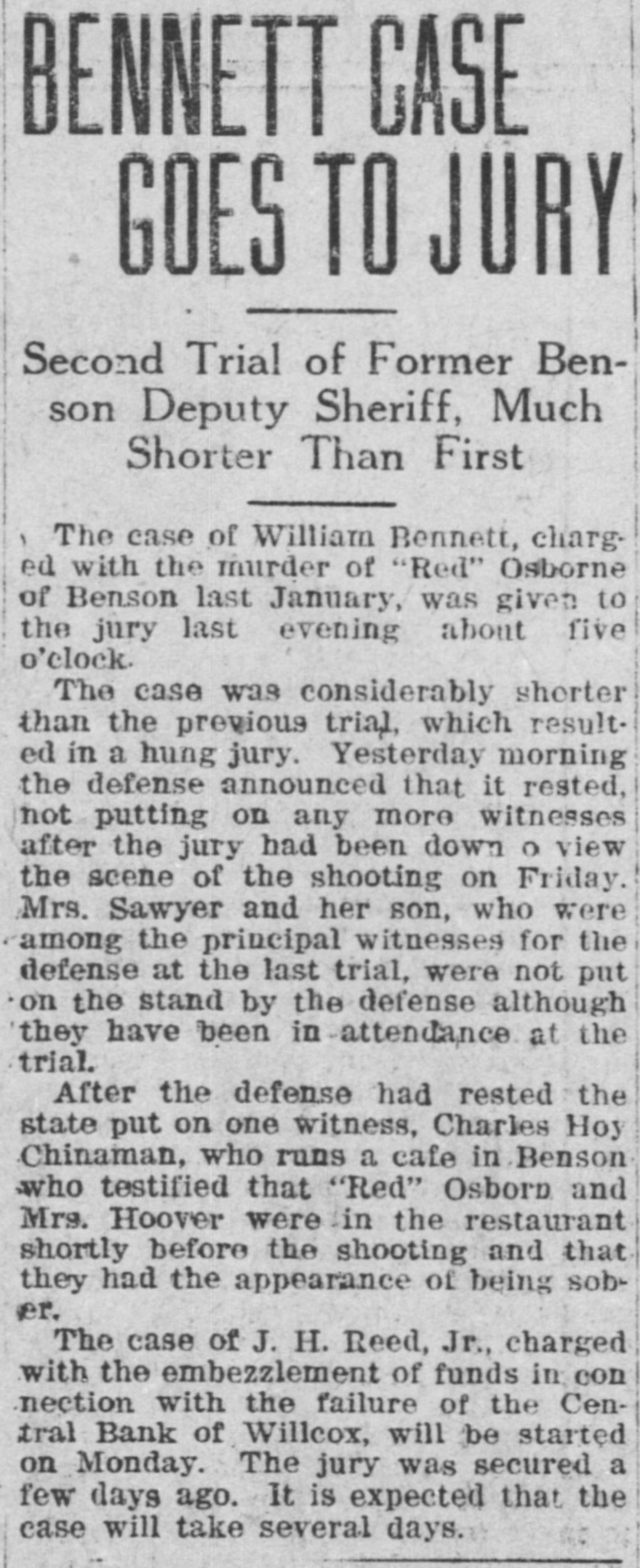
# BENNETT CASE
# GOES TO JURY
Second Trial of Former Benson Deputy Sheriff, Much Shorter Than First
The case of William Bennett, charged with the murder of "Red" Osborne of Benson last January, was given to the jury last evening about five o'clock.
The case was considerably shorter than the previous trial, which resulted in a hung jury. Yesterday morning the defense announced that it rested, not putting on any more witnesses after the jury had been down o view the scene of the shooting on Friday. Mrs. Sawyer and her son, who were among the principal witnesses for the defense at the last trial, were not put on the stand by the defense although they have been in attendance at the trial.
After the defense had rested the state put on one witness, Charles Hoy Chinaman, who runs a cafe in Benson who testified that "Red" Osborn and Mrs. Hoover were in the restaurant shortly before the shooting and that they had the appearance of being sober.
The case of J. H. Reed, Jr., charged with the embezzlement of funds in connection with the failure of the Central Bank of Willcox, will be started on Monday. The jury was secured a few days ago. It is expected that the case will take several days.
17.May 16, 1922Bisbee Daily ReviewBisbee, AZ
Click image to open full size in new tab
Article Text
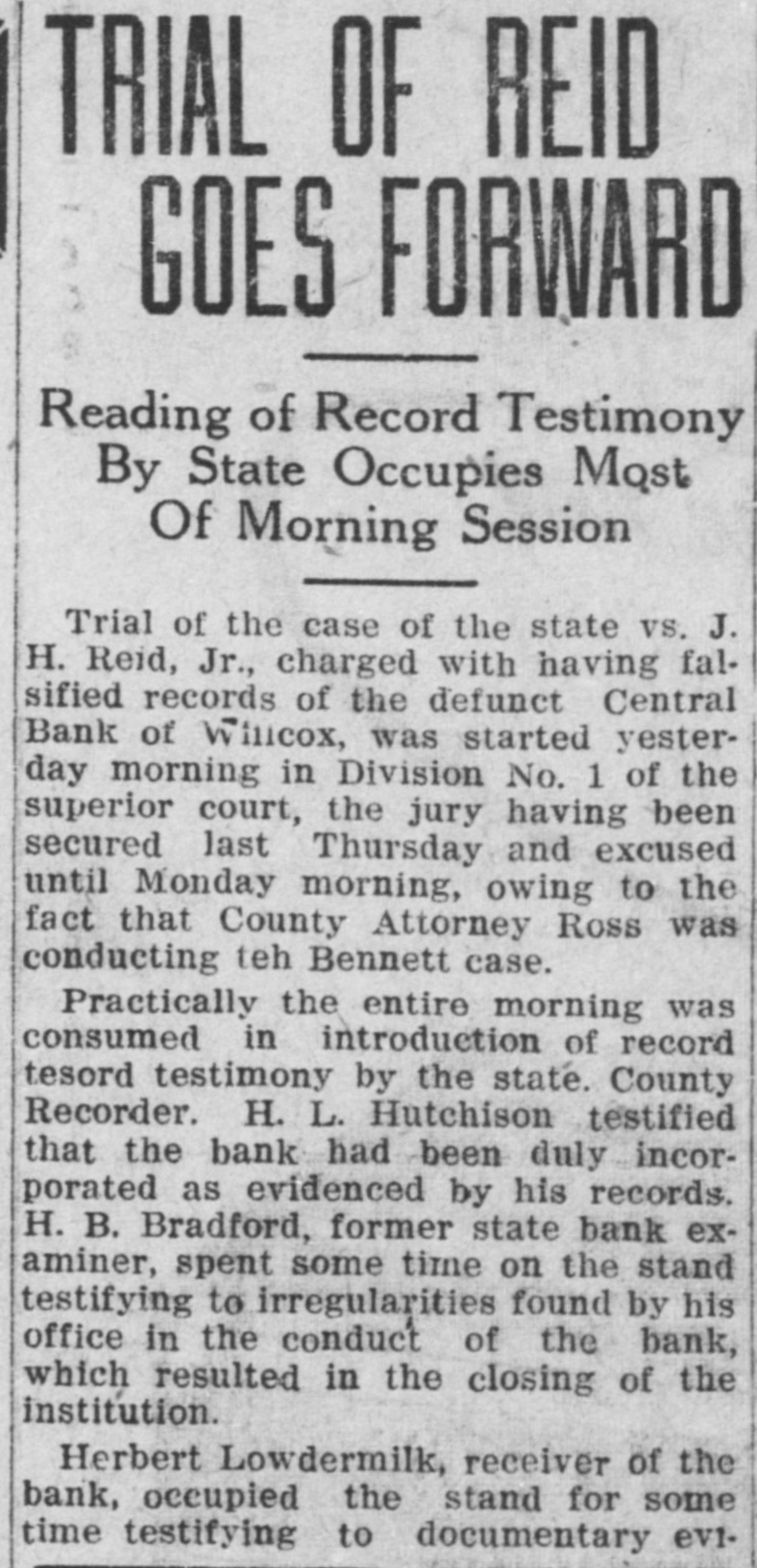
# TRIAL OF REID
# GOES FORWARD
Reading of Record Testimony
By State Occupies Most
Of Morning Session
Trial of the case of the state vs. J.
H. Reid, Jr., charged with having fal-
sified records of the defunct Central
Bank of Wincox, was started yester-
day morning in Division No. 1 of the
superior court, the jury having been
secured last Thursday and excused
until Monday morning, owing to the
fact that County Attorney Ross was
conducting teh Bennett case.
Practically the entire morning was
consumed in introduction of record
tesord testimony by the state. County
Recorder. H. L. Hutchison testified
that the bank had been duly incor-
porated as evidenced by his records.
H. B. Bradford, former state bank ex-
aminer, spent some time on the stand
testifying to irregularities found by his
office in the conduct of the bank,
which resulted in the closing of the
institution.
Herbert Lowdermilk, receiver of the
bank, occupied the stand for some
time testifying to documentary evi-
18.May 19, 1922Bisbee Daily ReviewBisbee, AZ
Click image to open full size in new tab
Article Text
ATTORNEYS IN LIVELY TILTS IN BROWN CASE Two Witnesses are Examined Yesterday in Trial of Former Bank Official Slow progress was made yesterday in the trial of S. B. Brown in the Std. perior court at Tombstone on a charge afleged irregularities in the handling of funds of the Central Bank of Willcox. Only two witnesses were put on the stand by the state. One of the witnesses was Ed. C. Bradford, who was a state bank examiner at the time of the closing of the bank in January, 1921. He testified to the records of the bank and the condition that he found the bank in at the time. The records of the bank, the books, etc., were finally admitted in evidence. During the testimony of Bradford there were several lively tilts between County Attorney Ross, for the state, and W. L. Barnum, attorney for the defendant. The argument became to lively that the court had to admonish both of the attorneys and threaten them with contempt of court. H. A. Loudermilk, receiver for the bank. will be the first witness called to the stand this morning. He will be followed by G. W. Brown, accountant, who has been working on the cases for the county attorney's office for the past two months and who prepared the records for the trial. The jury that is trying the case is composed of the following: Hugh H. Kelly, J. R. Fitzpatrick, Lawrence Marriman, H. White, John P. Steffes, J. A. Golding, John M. Johnson. Pete Caretto, Caleb Wolfe, Wilmer Lindquist, W. A. Morris, J. H.
19.May 21, 1922Tombstone EpitaphTombstone, AZ
Click image to open full size in new tab
Article Text
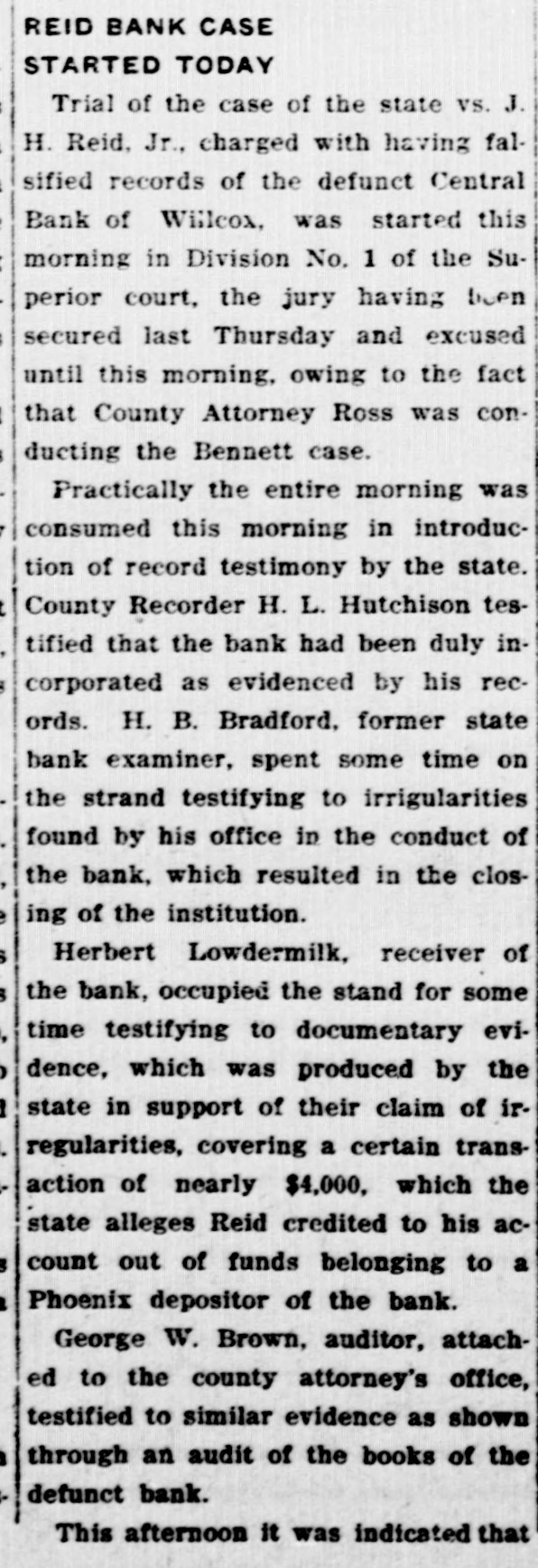
REID BANK CASE STARTED TODAY Trial of the case of the state vs. J. H. Reid, Jr., charged with having falsified records of the defunct Central Bank of Willcox, was started this morning in Division No. 1 of the Superior court, the jury having been secured last Thursday and excused until this morning, owing to the fact that County Attorney Ross was conducting the Bennett case. Practically the entire morning was consumed this morning in introduction of record testimony by the state. County Recorder H. L. Hutchison testified that the bank had been duly incorporated as evidenced by his records. H. B. Bradford, former state bank examiner, spent some time on the strand testifying to irrigularities found by his office in the conduct of the bank, which resulted in the closing of the institution. Herbert Lowdermilk, receiver of the bank, occupied the stand for some time testifying to documentary evidence, which was produced by the state in support of their claim of irregularities, covering a certain transaction of nearly $4,000, which the state alleges Reid credited to his account out of funds belonging to a Phoenix depositor of the bank. George W. Brown, auditor, attached to the county attorney's office, testified to similar evidence as shown through an audit of the books of the defunct bank. This afternoon it was indicated that
20.June 1, 1922Bisbee Daily ReviewBisbee, AZ
Click image to open full size in new tab
Article Text
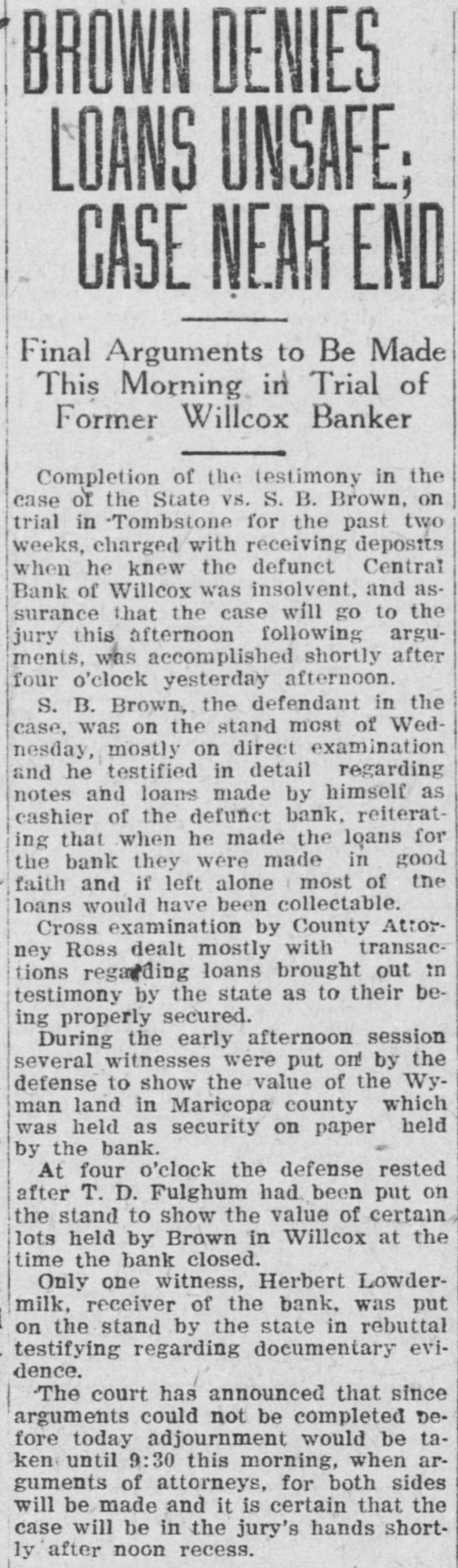
# BROWN DENIES
# LOANS UNSAFE;
# CASE NEAR END
Final Arguments to Be Made
This Morning in Trial of
Former Willcox Banker
Completion of the testimony in the case of the State vs. S. B. Brown, on trial in Tombstone for the past two weeks, charged with receiving deposits when he knew the defunct Central Bank of Willcox was insolvent, and assurance that the case will go to the jury this afternoon following arguments, was accomplished shortly after four o'clock yesterday afternoon.
S. B. Brown, the defendant in the case, was on the stand most of Wednesday, mostly on direct examination and he testified in detail regarding notes and loans made by himself as cashier of the defunct bank, reiterating that when he made the loans for the bank they were made in good faith and if left alone most of the loans would have been collectable.
Cross examination by County Attorney Ross dealt mostly with transactions regarding loans brought out in testimony by the state as to their being properly secured.
During the early afternoon session several witnesses were put on by the defense to show the value of the Wyman land in Maricopa county which was held as security on paper held by the bank.
At four o'clock the defense rested after T. D. Fulghum had been put on the stand to show the value of certain lots held by Brown in Willcox at the time the bank closed.
Only one witness, Herbert Lowdermilk, receiver of the bank, was put on the stand by the state in rebuttal testifying regarding documentary evidence.
The court has announced that since arguments could not be completed before today adjournment would be taken until 9:30 this morning, when arguments of attorneys, for both sides will be made and it is certain that the case will be in the jury's hands shortly after noon recess.
21.November 5, 1922Tombstone EpitaphTombstone, AZ
Click image to open full size in new tab
Article Text
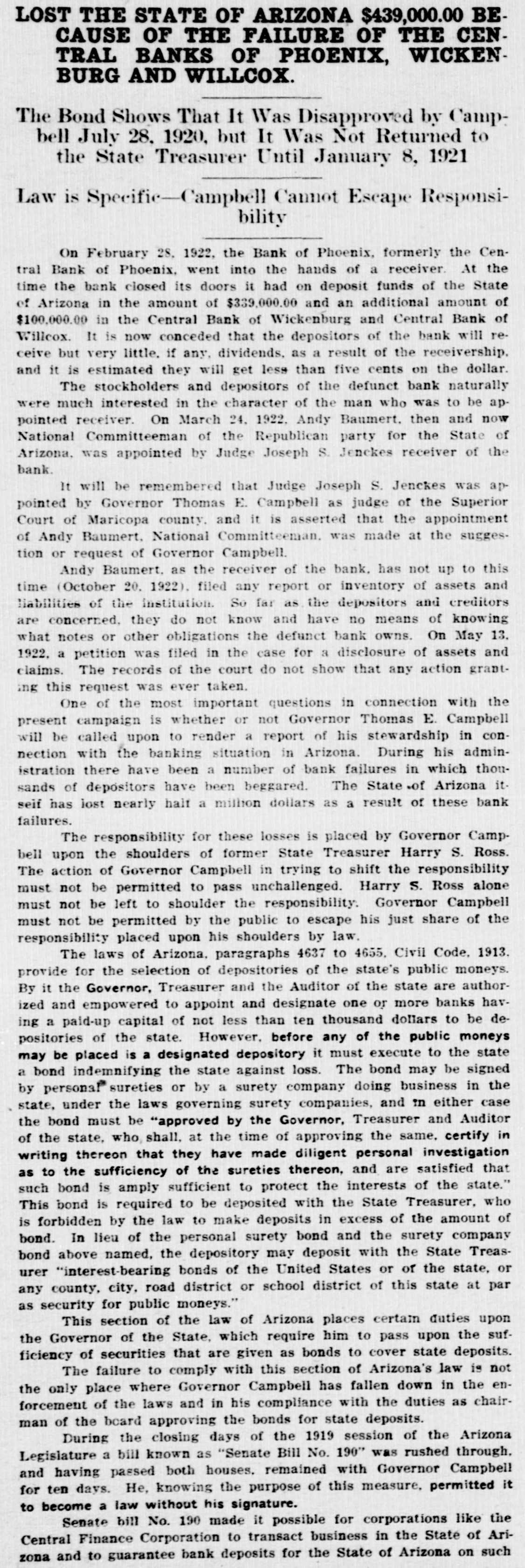
LOST THE STATE OF ARIZONA $439,000.00 BECAUSE OF THE FAILURE OF THE CENTRAL BANKS OF PHOENIX, WICKENBURG AND WILLCOX. The Bond Shows That It Was Disapproved by Campbell July 28, 1920, but It Was Not Returned to the State Treasurer Until January 8, 1921 Law is Specific-Campbell Cannot Escape Responsibility On February 28, 1922, the Bank of Phoenix, formerly the Central Bank of Phoenix, went into the hands of a receiver. At the time the bank closed its doors it had on deposit funds of the State of Arizona in the amount of $339,000.00 and an additional amount of $100,000.00 in the Central Bank of Wickenburg and Central Bank of Willcox. It is now conceded that the depositors of the bank will receive but very little. if any, dividends, as a result of the receivership. and it is estimated they will get less than five cents on the dollar. The stockholders and depositors of the defunct bank naturally were much interested in the character of the man who was to be appointed receiver. On March 24, 1922. Andy Baumert. then and now National Committeeman of the Republican party for the State of Arizona. was appointed by Judge Joseph S. Jenckes receiver of the bank. It will be remembered that Judge Joseph S. Jenckes was appointed by Governor Thomas E. Campbell as judge of the Superior Court of Maricopa county. and it is asserted that the appointment of Andy Baumert, National Committeeman. was made at the suggestion or request of Governor Campbell. Andy Baumert, as the receiver of the bank. has not up to this time (October 20. 1922). filed any report or inventory of assets and liabilities of the institution. So far as the depositors and creditors are concerned. they do not know and have no means of knowing what notes or other obligations the defunct bank owns. On May 13. 1922. a petition was filed in the case for a disclosure of assets and claims. The records of the court do not show that any action granting this request was ever taken. One of the most important questions in connection with the present campaign is whether or not Governor Thomas E. Campbell will be called upon to render a report of his stewardship in connection with the banking situation in Arizona. During his administration there have been a number of bank failures in which thousands of depositors have been beggared. The State of Arizona it. seif has lost nearly half a million dollars as a result of these bank failures. The responsibility for these losses is placed by Governor Campbell upon the shoulders of former State Treasurer Harry S. Ross. The action of Governor Campbell in trying to shift the responsibility must not be permitted to pass unchallenged. Harry S. Ross alone must not be left to shoulder the responsibility. Governor Campbell must not be permitted by the public to escape his just share of the responsibility placed upon his shoulders by law. The laws of Arizona, paragraphs 4637 to 4655. Civil Code, 1913. provide for the selection of depositories of the state's public moneys. By it the Governor, Treasurer and the Auditor of the state are authorized and empowered to appoint and designate one or more banks having a paid-up capital of not less than ten thousand dollars to be depositories of the state. However, before any of the public moneys may be placed is a designated depository it must execute to the state a bond indemnifying the state against loss. The bond may be signed by personal* sureties or by a surety company doing business in the state, under the laws governing surety companies, and in either case the bond must be "approved by the Governor, Treasurer and Auditor of the state, who shall, at the time of approving the same, certify in writing thereon that they have made diligent personal investigation as to the sufficiency of the sureties thereon, and are satisfied that such bond is amply sufficient to protect the interests of the state." This bond is required to be deposited with the State Treasurer, who is forbidden by the law to make deposits in excess of the amount of bond. In lieu of the personal surety bond and the surety company bond above named, the depository may deposit with the State Treasurer "interest-bearing bonds of the United States or of the state, or any county, city, road district or school district of this state at par as security for public moneys." This section of the law of Arizona places certain duties upon the Governor of the State, which require him to pass upon the sufficiency of securities that are given as bonds to cover state deposits. The failure to comply with this section of Arizona's law is not the only place where Governor Campbell has fallen down in the enforcement of the laws and in his compliance with the duties as chairman of the board approving the bonds for state deposits. During the closing days of the 1919 session of the Arizona Legislature a bill known as "Senate Bill No. 190" was rushed through. and having passed both houses. remained with Governor Campbell for ten days. He, knowing the purpose of this measure, permitted it to become a law without his signature. Senate bill No. 190 made it possible for corporations like the Central Finance Corporation to transact business in the State of Arizona and to guarantee bank deposits for the State of Arizona on such
Bank runs are almost always and everywhere a deterioration of bank fundamentals.
But not for you.
You are the measure-zero exception: great fundamentals, solid bank, and yet the Diamond Dybvig fairy spread its rumor. Depositors woke up. Your collateral was not prepositioned. The Clearinghouse had it for you.
Do not pass Go. Do not collect $200. Go directly to jail… or worse.