Mercantile Bank (Denver, CO)

Episode Information

Episode UID
9147493791123
Episode Type
Suspension → Closure
Bank Type
private
Bank ID
914749379 hash
Start Date
July 18, 1893
Location
Denver, Colorado (39.739, -104.985)

Metadata

Model
gemini-3-flash-preview (chosen from majority vote of a three-model LLM ensemble)
Short Digest
1a24ec04987df602

Response Measures

None

Description

The bank suspended because its clearing agent, the Union National Bank, failed during a city-wide panic.

Events (2)

1. July 18, 1893 Other
Newspaper Excerpt
W. F. Robinson formerly Treasurer of the Republican Publishing Company... has been made assignee.
Source
newspapers
2. July 18, 1893 Suspension
Cause
Correspondent
Cause Details
The bank was forced to close because its clearing agent, the Union National Bank, failed to open.
Newspaper Excerpt
The Mercantile Bank. a private institution with a capital stock of $100,000, closed its doors at noon. The failure was caused by the failure of the Union National Bank, through which it cleared.
Source
newspapers

Newspaper Articles (21)

Article from The Evening World, July 18, 1893

Click image to open full size in new tab

Article Text

PANIC ON IN DENVER. Four More Banks Close Their Doors To-Day. Runs Started on All the ClearingHouse Institutions. several Kansas Banks Go Down. with One in Ada. Ohio. DENVER, Col., July 18.-The Union National Bank, of which R. W. Woodbury is President, failed to open its doors this morning. The capital is $1,000,000. No statement can be had. A run is now being made on the City National, German National, First National. Colorado National and all the Clearing-House banks. The panic is on. LATER.-The Commercial National Bank has closed its doors. A notice says: "This bank has gone into liquidation by order of the Board of Directors." The National Bank of Commerce has also closed. Ex-Gov. Job A. Cooper is President of this bank. The Mercantile Bank. a private institution with a capital stock of $100,000, closed its doors at noon. The failure was caused by the failure of the Union National Bank, through which it cleared. C. C. Girda, the City Auditor, is President. W. F. Robinson formerly Treasurer of the Republican Publishing Company. one of the oldest and most respected individuals in the State, has been made assignee. President Woodbury is of the opinion that the Union National Bank will reopen and continue business as before. It is one of the oldest banks in Denver, and has always been regarded as one of its solid ones. The failure of the Chamberlin Investment Company a few days ago affected the Union National, the Company having become indebted to the bank about $50,000. The Commercial National Bank was in bad shape. It has a capital stock of $250,000. and only had $2,000 in cash in the bank. TOLEDO, July 18.-The Citizens' Bank of Ada, O., the most prominent one in Hardin County, failed to open its doors this morning. Its owner, Peter Ahifield, has controlled it for over a quarter of a century, and is one of the wealthiest men of that section. No statement of assets and liabilities, or the cause of failure, can be obtained. FORT SCOTT, Kan. July 18.-The First National Bank, of this city, the oldest financial institution in Southeastern Kansas, has suspended payment. TOPEKA. Kan., July 18.-State Bank Examiner Breidenthal this morning received notice of the failures of the Citizens' Bank, of Kansas City, Kan., of the Bank of Richmond and of the Farmers and Merchants' Bank. at Ossawattomie. The concerns all did a small business. Statements are unobtainable. The opinion is expressed that other institutions throughout the State will soon go under. The Denver bank failures reported above are in addition to the three reported in the same city yesterday, which were as follows: People's Savings Bank: assets, $1,125,667.55; liabilities, $966,996.88 Colora do Savings Bank: assets over liabilities, $73,063.62. Rocky Mountain Dime and Savings Bank: assets, $156,803.53; liabilities. $105, 654.32. The seriousness of the situation is quite evident from the collapse of all f these institutions.

Article from The Indianapolis Journal, July 19, 1893

Click image to open full size in new tab

Article Text

This bank closed by order of the! board of drectors. Those inside were forced into the street with curses on their lips, while those outside raved about the doors. attracting a crowd that extended far down the thoroughfare. People began to ask when would it all end, when they learned that the Mercantile Bank. recently incorporated with a capital stock of $100,000. and located in the Mining Exchange Building, had closed its doors, with W. F. Robinson as assignee. C. E. Gard, the present city auditor. is the president of the bank, and the directors of the concern were considered as being among Denver's most substantial business men. The suspension of payment here was brought about by the closing of the Union National Bank, through which the Mercantile had made clearances. It was stated that the bank's depositors will receive every dollar due them. This bank had been in operation only a few months and had comparatively few depositors. RUNS ON THE OTHER BANKS. At the Colorado National there was no run at all. The City National officials an. nounced after the run that they had paid out about $30,000 more than what had come in., At the same hour, nearly. the run was stopped at the First National. The officials said not more than $10,000 was paid out above receipts. At the State National all those standing in line were inside the doors at o'clook. and it was estimated that $100,000 had been paid out. The run was practically broken at 2 o'clock. At the German National there Was a long line reaching far out on the sidewalk, but not a business man was seen in the line. At 2:15 the crowd was still in line. but many were tiring and droppingout. About $70.000 had been paid ent, mostly in small amounts. The run was still on at 3 P. M., the regular closing hour. A run was re. ported on the Deaver National, but 16 proved a mistake. The crowd was composed of the Union Pacific employes and others from the Grant smelter with their checks. There was no run. The City National Bank met all demands and exPresident Barth said if the depositors wanted to keep the run up for the next two months, the bank would still be meeting demands on presentation. At the Denver Savings Bank, the only savings bank now open. there was a run in the morning which was over by noon. It refused to pay out, taking advantage of the time loan limit. The excitement and demand on the banks after money continued unabated until about 2 o'clock, when it almost entirely ubaided at all the banks except the Utab State National and the German National. where the line of depositors seemed to increase instead of diminish. This bank is said to have a special train on the way from Kansas City bearing $490,000


Article from Richmond Dispatch, July 19, 1893

Click image to open full size in new tab

Article Text

DENVER BANK RUNS. The Withdrawers of Money, However, All Small Depositors. (B3 telegraph to the Disbatch.1 DENVER. COL., July 18.-No such scene was ever witnessed in all the West as could be seen here this morning shortly after 10 o'clock. when the banks were supposed to open their doors for business. The failure of three savings banks yesterday had affected the masses as the smell of blood would affect wolves, and at the hour of opening the streets were crowded with anxious depositors. The eleven clearinghouse banks, located within four blocks of each other. were surrounded and far into the streets the crowds gathered until officers and special police were called out to clear the way for traffic. At 10 o'clock the Union National with a capital of $1,000,000. posted a notice that they would not open their doors. This started a panic, and the Commercial National posted a similar notice, and then the National Bank of Commerce; and people asked, Where will this stop?" A run was immediately started on all the other banks, though to no great extent upon the People's National. The First National appears to be the soundest of all, they having over 60 per cent. of their deposits on band, with a private fund of $1,500,000 in addition to draw upon. making it impossible to close their doors. The Colorado National and seve. ral others are in equally as good condition. The mob withdrawing their money are all small depositors. the large holders being satisfied to let their accounts remain in the banks. The banks are paying all demands except on time certificates, they demanding that these remain until the expiration of the time. As every bank 13 crowded the clearing.house is rendering no assistance, each institution being compelled to stand upon its OWB foundation. The Commercial National Bank closed its doors within a few minutes after the opening, because it was apparent from the size of the crowd in front of the bank that a run was to be inaugurated. A notice was posted on the door: 'Closed for liquidation. by order of the directors." The bank was in bad shape. It had a capital stock of $250,000. and only had $2.000 in cash in the bank. The Mercantile Bank, a private institution, with a capital stock of $100,000. closed its doors at noon. The failure was caused by the failure of the Union Na. tional Bank. through which it cleared. C. C. Girda, the City Auditor, is president. W. F. Robinson, formerly treasurer of the Republic Publishing Company, one of the oldest and most respected individuals in the State, has been made assignee.


Article from The Morning News, July 19, 1893

Click image to open full size in new tab

Article Text

DENVER'S BANKS RAIDED. Small Depositors Get Scared and Rush For Their Money. Denver, Col., July 18.-No such scene was ever witnessed in all the west as could be seen here this morning shortly after 10 o'clock when the banks were supposed to open their doors for business. The failure of three savings banks yesterday had affected the masses as the smell of blood would wolves, and at the hour of opening the streets werecrowded with anxious depositors. The eleven clearing house banks, located within four blocks of each other, were surrounded, and far into the streets crowds gathered, until officers and special police were called out to clear a way for traffic. THREE CLOSED THEIR DOORS. At 10 o'clock the Union National, with a capital of $1,000,000, posted a notice that they would not open their doors. This started a panic and the Commercial National posted a similar notice, and then the National Bank of Commerce, and A people asked "where will this stop." run was immediately started on all the other banks, though to no great extent upon the Peoples' National. The First National appears to be the soundest of all, they having over sixty per cent of their deposits on hand, with a private fund of $1,500,000 in addition to draw upon, making it impossible to close their doors. The Colorado National and several others are in equally as good condition. ALL SMALL DEPOSITORS. The mob withdrawing their money are all small depositors, large holders being satisfied to let their accounts remain in the banks. The banks are paying all demands except on time certificates, they demanding that these remain until the expiration of the time. As every bank is crowded, the clearing house is rendering no assistance, each institution being compelled to stand upon its own foundation. TWO MORE CLOSE. The Commercial National Bank closed its doors within a few minutes after opening, because it was apparent from the size of the crowd in front of the bank that a run was to be inaugurated. A notice was posted on the door reading: "Closed for liquidation by order of the directors.' The bank was in a bad shape. It had a capital stock of $250,000, and only had $2,000 in cash in the bank The Mercantile Bank, a private institution, with a capital stock of $100,000, closed its doors at noon. Its failure was caused by the failure of the Union National Bank, through which it cleared. C.C. Girda, city auditor, is president. W. F. Robinson, formerly treasurer of the Republic Publishing Company, one of the oldest and most respected individuals in the state, has been made assignee. A SURPRISE TO THE CONTROLLER. Washington, July 18.-News of the Denver bank crash caused some surprise in the controller's office, for it was believed there that the worst was over and that national banking matters would soon resume their normal condition.


Article from The Daily Morning Astorian, July 19, 1893

Click image to open full size in new tab

Article Text

SEVERE RUN ON DENVER BANKS Several of Them Compelled to Close Their Doors. SMALL DEPOSITORS EXOILED And Entirely Responsible for the Condition of Affairs-The Worst Thought to Be Over. au Associated Press. Alter Denver, July 18.-No None was ever witnessed here before like that of this morning. shortly after the hour when the banks opened for business. The failure three savings banks yesterday had excited the masses, and at the hour of opening the streets were crowded with anxious depositors, The eleven clearing house banks, located within four blocks of each other, were surrounded, and far into the streets the crowd gathered until the police were called to clear a way for traffic. At 10 the Union National, with a capital of $1,000,000, posted a notice that they would not open their doors. This started a panic, and following quickly the Commercial National posted a similar notice, and then the National Bank of Commerce A run was immediately started on all the other banks, although to no great extent upon the Peoples' National. The First National appears in unexceptionable conditon, having over sixty per cent of its deposits on hand, with a private fund of a million and a half in addition to draw upon, making it impossible to close their doors. The Colorado National and several others are equally good. The mob wthdrawing money are all small depositors. The banks are paying all demands except time certificates, der manding that these remain until the expiration of their time. President J. A. Thatcher, of the clearing house, says: "I am confident today will see the worst of this, and that the people will come to their senses." Denver, July 18.-The Mercantile Bank, a private institution, with a capital of $100,000, failed at noon. The failure was caused by that of the Union National, through which it cleared. Denver, Col., July 18.-The Union National Bank has closed. It has a capital of a million dollars. No statement has been made as yet. A run is now being made on the City National, German National, First National, Colorado, National, and all of the eleven clearing house banks. A veritable panic is on. Denver, July 18-The Commercial National Bank has closed its doors. Denver, July 18.-The National Bank of Commerce has closed. Topeka, July 18.-State Bank Eyaminer Briedenthal this morning received notice of the failure of the Citizens' Bank at Kansas City, Kas., the Bank of Richmond and the Farmers' and Merchants' Bank of Ossawattomie. The concerns are all sma.1. No statements have been male. Other similar failures throughout the state are expected Fort Scott, Kan., July 18.-The First National Bank, the oldest financial institution in this part cf the State, has failed. Toledo, Ohio, July 18.-The Citizens' Bank of Ada, the mose prominent bank in Hardin county, failed this morning. No statement hss as yet been made.


Article from The Providence News, July 19, 1893

Click image to open full size in new tab

Article Text

THE PANIC AT DENVER. Situation Today Appears to be Slightly Improved. BUSINESS MEN STILL ANXIOUS. Four Banks and Several Other Establishments Went Down in Yesterday's CrashFailures in Kansas and Ohio-Business Troubles from Many Quarters. DENVER, July 19.-The business situa. tion here shows little hope for the better. No failures have been reported so far today, but there is a look of anxiety on the face of every business man, and no one knows where the next blow will fall. Many regard it as only the calm before the storm. The failures of yesterday have spread consternation throughout the city. The long expected panic is believed to have come at last. President Woodbury is of the opinion that the Union National bank, which suspended yesterday, will reopen and continue business as before. It is one of the oldest banks in Denver and has alway ys been regarded as one of its solid ones. The failure of the Chamberlin Invest ment company a few days ago affected the Union National, the company having become indebted to the bank about $50,000 The Commercial National bank, which was the second to fail yesterday, was in bad shape. It has a capital stock of $250,000, and only had $2,000 in cash in the bank. The failure of the Mercantile bank, 8 private institution, with a capital stock of $100,000, was caused by the failure of the Union National bank, through which it cleared. C. C. Girda, the city auditor, is president. W. F. Robinson, formerly treasurer of the Republican Publishing company, one of the oldest and most respected individuals in the State, has been made assignee. The Commercial National bank did not reopen its doors at all, preferring to avoid the inevitable run. This notice was posted "This bank has gone into liquidation by order of the board of directors." There was not much excitement. Those who stopped to read the sign chatted quietly about the prospects and all seemed confident of an ultimate settlement in full. It is believed by financiers that yester day's run will result in the people having more confidence in the strong banks; that the money withdrawn will at once be redeposited, and a better feeling be established in financial circles, which will make money easier. The suspended banks expect to resume business in a short time. The constant strain on the banks by scared depositors is what brought about the crisis. It is stated by bankers than no less than $8,000,000 has been drawn from the banks during the last three months. Of this, $3,000,000 has gone to the east in regular lines of business but there is $5, 000,000 hoarded in the city. The safety deposit vaults are full and there is reason to suppose that the homes of workingmen contain secret places in which their savings are hidden. If one. fifth of that amount was let into circula. tion, the stringency in Denver would cease.


Article from Evening Journal, July 19, 1893

Click image to open full size in new tab

Article Text

EARLY NEWS SUMMARY. Held Responsible for Deaths in the Cold Storage Fire. THE JURY RENDERS A DECISION. Director of Works Burnham, Fire Marshal Murphy. President Skinner and Secretary McDonald, of the Hercules Iron Company. That Built the Building, Found{Guilty. The coroner's jury investigating the Cold Storage fire disaster held Director of Works Burnham, Fire Marshal Murphy, President Skinner, of the Hercules Iron Company, that built the building, and Secretary McDonald, of the same com pany, responsible for the deaths. 4 Denver Bank Failures, The Union National, National Bank of Commerce, Commercial National and Mercantile banks, of Denver, failed and the McNanara dry good house and several other business houses went under owing to the financial panic there. Crusade Against Colored People. Founder Bradley, of Asbury Park, has begun a crusade against the col ored people who monopolize the seats on the beach and pavilions. A Celebrated Case Decided. Judge Acheson in the United States Circuit Court at Erie decided the cele brated case of the Stonemetz Printing Machinery Company vs. the Brown Fold ing Machinery Company in favor of the former. Paid $600,000 in Gold. The New York Sub-Treasury was debtor at the Clearing House to the extent of $669,000, and Treasurer Jorden ordered that the difference should again be paid mostly in gold. Of the total amount $600,000 was paid over in gold and the balance in currency notes. Oldest Bank in Kansas Falls. The First National Bank of Fort Scott, Kan., the oldest financial institution in Southeastern Kansas, suspended payment and the Citizens' Bank at Kan. sas City, the bank of Richmond and the Farmers' and Merchants' Bank at Ossa wattomie have also failed. Prominent Club Man a Forger. : Lloyd Aspinwall, the New York club man, is confined in Yorkville prison, N Y., in default of $5.000 bail, upon the charge of forgery. It is charged that he forged the name of William Aspinwall in indorsing a check. 1 A World's Fair Tradgedy. Miss Emma Garrett, of Philadelphis, who has charge of the Pennsylvania ex t hibit of the work of pupils in institu tions for the blind at the Fair, became 0 insane from overwork and killed herself f by jumping from the fifth story of a hotel. a Meyer, the Poisoner, Arraigned. Dr. Henry C. W. Meyer, the alleged wholesale poisoner, was arraigned be fore Judge Cowing in New York to plead to the indictment charging him with murder. At the request of Lawyer v Joseph Moss. the prisoner's counsel, the judge allowed the case to go over until Thursday.


Article from St. Paul Daily Globe, July 19, 1893

Click image to open full size in new tab

Article Text

Trouble - Yesterday's Calamities. DENVER, Col., July 18.-The Union National bank, of which R. W. Woodbury is president, failed to open its doors this morning. The capital is $1,000,000. No statement can be had. A run is now being made on City National, German National, First National, Colorado National and all the eleven clearing house banks. The McNamara dry goods house, one of the largest institutions of the kind, failed this morning. The liabilities are placed at $260,000. The assets at this not known. on an time brought are by attachment The failure served was on the house at 10 o'clock this morning by the Union National bank, which failed to open its doors this morning, for $71,780, and the Colorado National bank for $20,847.74. The president of the latter bank had a private claim of $25,000, and D. Sheedy, an officer in the Denver National bank, one for $40,000. The failure was not unexpected, but it had been hoped that money would be easier and that the firm would be able to pull through. The stringency in the money market and inability to place securities or secure an extension from the banks, aided by the closing of three savings banks yesterday, was the direct cause. Had the banks which closed yesterday been able to secure cash with which to carry it over the "hard spots" the failure would not have occurred. Nearly the entire amount falls on Denver banks and commercial houses. Hyman & Co., proprietors of the Bee Hive store; McWhirter & Dipps, dealers in mantels and tiles, and Engle & Harris, dry goods, have just assigned today. No statements available, but amounts probably not large. The Mercantile bank, with a capital of $100,000, has assigned to W. F. Robinson. The Mercantile bank, a private institution, with a capital stock of $100,000, closed its doors at noon. The failure was caused by the failure of the Union National bank, through which it cleared. C.C. Mird, the city auditor, is the president. W. A. Robinson, formerly treasurer of the Republican Publishing company, one of the oldest and most prominent men in the state, has been named as assignee. DENVER, July 18.-The Commercial National bank has closed its doors. A notice says: "This bank has gone into liquidation by order of the board of directors." DENVER. Col., July 8.-The National Bank of Commerce has closed its doors. Ex-Gov. John F. Cooper is president of this bank. DENVER, July 18.-The excitement and demand upon the banks for money continued unabated till about2 o'clock when it had almost entirely subsided at all the banks except the State National and the German National, where the line of depositors seemed to increase instead of diminish. This bank is understood to have a special train on the way from Kansas City bearing $490,000, and that it will reach here early tomorrow morning. The First National bank received $170.000 at a little after 1 o'clock today. and $250,000 more at the closing hour. This came from New York. It was money due President Moffatt for bullion he had sold. Just before the close the failure of the


Article from The Representative, July 19, 1893

Click image to open full size in new tab

Article Text

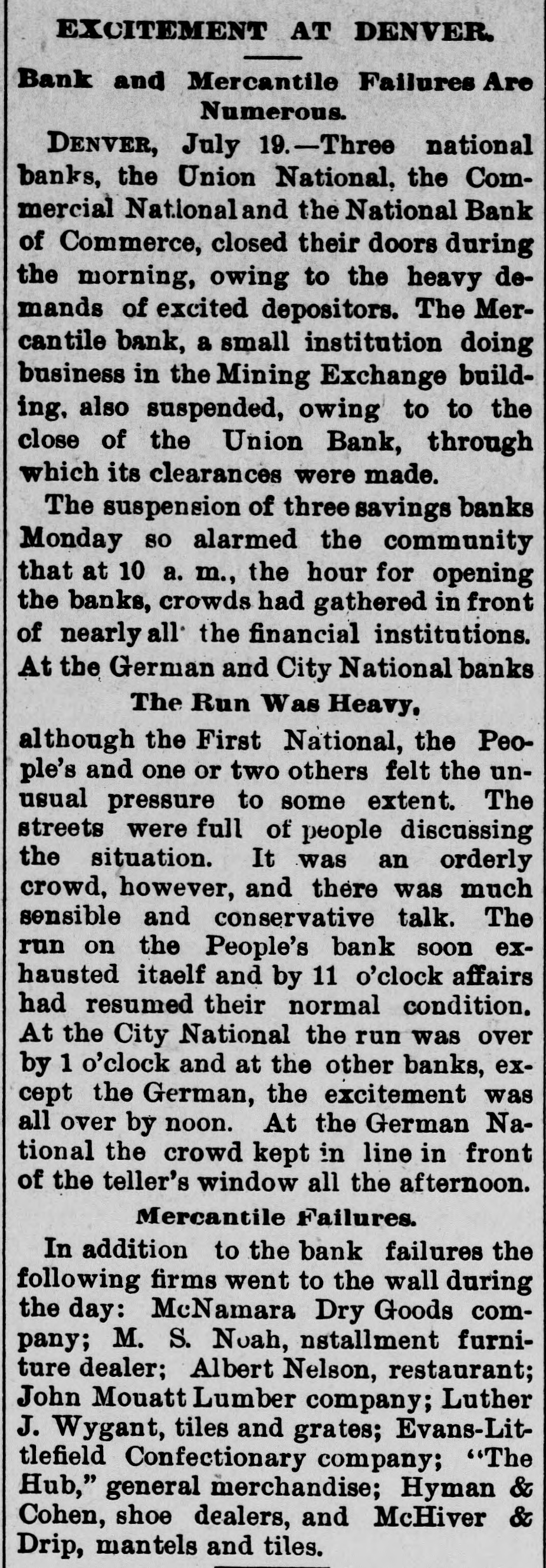
EXCITEMENT AT DENVER. Bank and Mercantile Failures Are Numerous. DENVER, July 19.-Three national banks, the Union National, the Commercial National and the National Bank of Commerce, closed their doors during the morning, owing to the heavy demands of excited depositors. The Mercantile bank, a small institution doing business in the Mining Exchange building, also suspended, owing to to the close of the Union Bank, through which its clearances were made. The suspension of three savings banks Monday so alarmed the community that at 10 a. m., the hour for opening the banks, crowds had gathered in front of nearly all the financial institutions. At the German and City National banks The Run Was Heavy, although the First National, the People's and one or two others felt the unusual pressure to some extent. The streets were full of people discussing the situation. It was an orderly crowd, however, and there was much sensible and conservative talk. The run on the People's bank soon exhausted itaelf and by 11 o'clock affairs had resumed their normal condition. At the City National the run was over by 1 o'clock and at the other banks, except the German, the excitement was all over by noon. At the German National the crowd kept in line in front of the teller's window all the afternoon. Mercantile Failures. In addition to the bank failures the following firms went to the wall during the day: McNamara Dry Goods company; M. S. Noah, nstallment furniture dealer; Albert Nelson, restaurant; John Mouatt Lumber company; Luther J. Wygant, tiles and grates; Evans-Littlefield Confectionary company; "The Hub," general merchandise; Hyman & Cohen, shoe dealers, and McHiver & Drip, mantels and tiles.


Article from Echo De L'ouest, July 20, 1893

Click image to open full size in new tab

Article Text

Faillites de Banques et antres depuis quelques jours -Le Schleisinger Syndicate de Nigaumee, Mich, representant des millions de dollars de capital allemand a fait faillite. Les pertes des créanciers seront énormes. W.H. Rush et H, M. Tabor de Denver, Col., ont deposé leur bilan. Passif 650000 dollare. La Bank of Springfield, Mo, a fermée ses portes. C'est la premiè re fois qu'une banque fait faillite dans la ville. Passif 256,000 dollare. Fermée est la Bank of Garnet, Kan. Les déposants perdront énormé ment et le comté 23,000 dollare que le tréforier y avait déposés. Trois faillites de banques de New-York, celles de MM. C. H. Bunell, celle de M. H. S. Tober et enfin celle de M. W. Barrow. La Philadelphia Mutual Life Insurance Company de Harris burg, Pa., et la Keyatone Benefit Association de Beaver Falls, Pa., sont insolvables. O. E. Nettleton banquier de Deeham, Mass., a dépost son bilan. Le "Universal Order of Coope ration" de Philad-lphie va être mis entre les mains d'nn syndic. Harris Bros de New York ont suspendu leurs paiements. Passif 100,000 dollars. La N W Jersey Sheep & Wool Company de Trenton N. Y. a fermé ses portes. En faillite auesi dans le Kansas La "Bank of Balter and Double Bay de Columbus" la "City Bank" de Johnson City, et la "Book of Weir City" La Peoples Savings Bank de Denver, Col., a ferme see portee. Passif 350,000 dollare. La Rocky Mountain Dime et Dollar Bank de la même ville a suspendu ees paiements. Il en est de même de la Colorado Savings Bank. La Missouri National Bank et la Grande Avenue Bank de Kan888 City ont fait faillite. Passif 250,000 dollars. Et la liste eat loin d'être épuisée. Enfin les banques "Union National," "Commercial National," "National Bank of Commerce" et "Mercautiie Bank" de Denver, Col., ont aussi sombré. Il en est de même de la "Citizen's Bank" de Kansas City, de la "Bank of Richmond" et de la "Farmers et Merchants Bank" de Oaawatomie, Kan., ainsi que de la "First National Bank" de Fort Scott et de la "Armourdale CitiZons Bind," Kansas. On va bien sous le régime démocratique.


Article from The Goodland Republic, July 21, 1893

Click image to open full size in new tab

Article Text

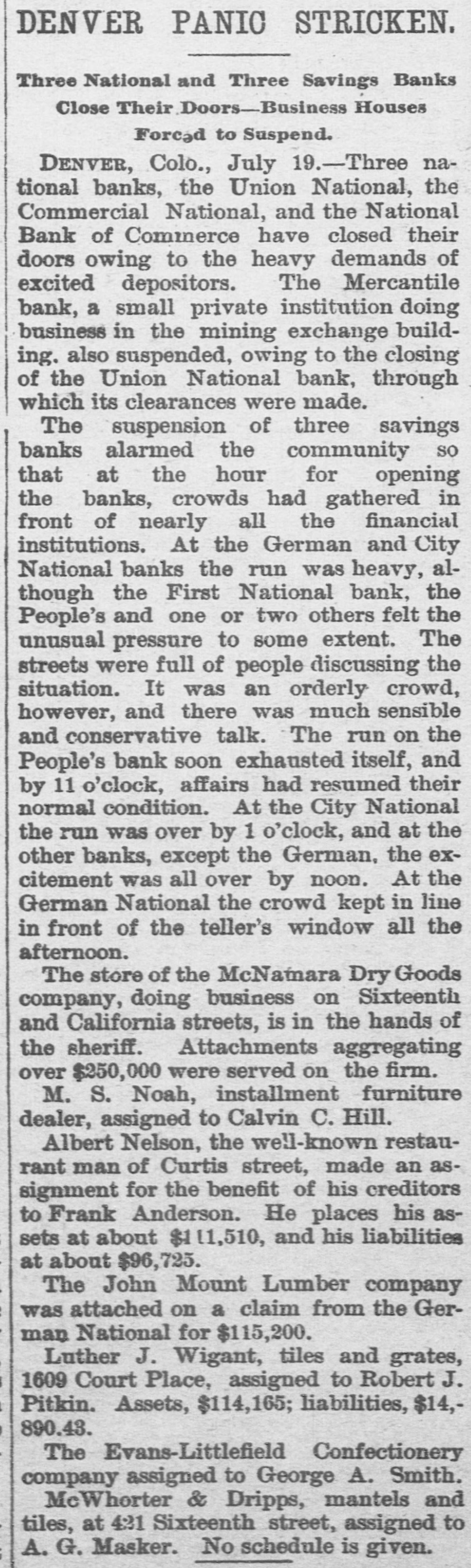
DENVER PANIC STRICKEN. Three National and Three Savings Banks Close Their Doors-Business Houses Forcad to Suspend. DENVER, Colo., July 19.-Three national banks, the Union National, the Commercial National, and the National Bank of Commerce have closed their doors owing to the heavy demands of excited depositors. The Mercantile bank, a small private institution doing business in the mining exchange building. also suspended, owing to the closing of the Union National bank, through which its clearances were made. The suspension of three savings banks alarmed the community so that at the hour for opening the banks, crowds had gathered in front of nearly all the financial institutions. At the German and City National banks the run was heavy, although the First National bank, the People's and one or two others felt the unusual pressure to some extent. The streets were full of people discussing the situation. It was an orderly crowd, however, and there was much sensible and conservative talk. The run on the People's bank soon exhausted itself, and by 11 o'clock, affairs had resumed their normal condition. At the City National the run was over by 1 o'clock, and at the other banks, except the German, the excitement was all over by noon. At the German National the crowd kept in line in front of the teller's window all the afternoon. The store of the McNamara Dry Goods company, doing business on Sixteenth and California streets, is in the hands of the sheriff. Attachments aggregating over $250,000 were served on the firm. M. S. Noah, installment furniture dealer, assigned to Calvin C. Hill. Albert Nelson, the well-known restaurant man of Curtis street, made an assignment for the benefit of his creditors to Frank Anderson. He places his assets at about $111,510, and his liabilities at about $96,725. The John Mount Lumber company was attached on a claim from the German National for $115,200. Luther J. Wigant, tiles and grates, 1609 Court Place, assigned to Robert J. Pitkin. Assets, $114,165; liabilities, $14,890.43. The Evans-Littlefield Confectionery company assigned to George A. Smith. McWhorter & Dripps, mantels and tiles, at 421 Sixteenth street, assigned to A. G. Masker. No schedule is given.


Article from Oakes Weekly Republican, July 21, 1893

Click image to open full size in new tab

Article Text

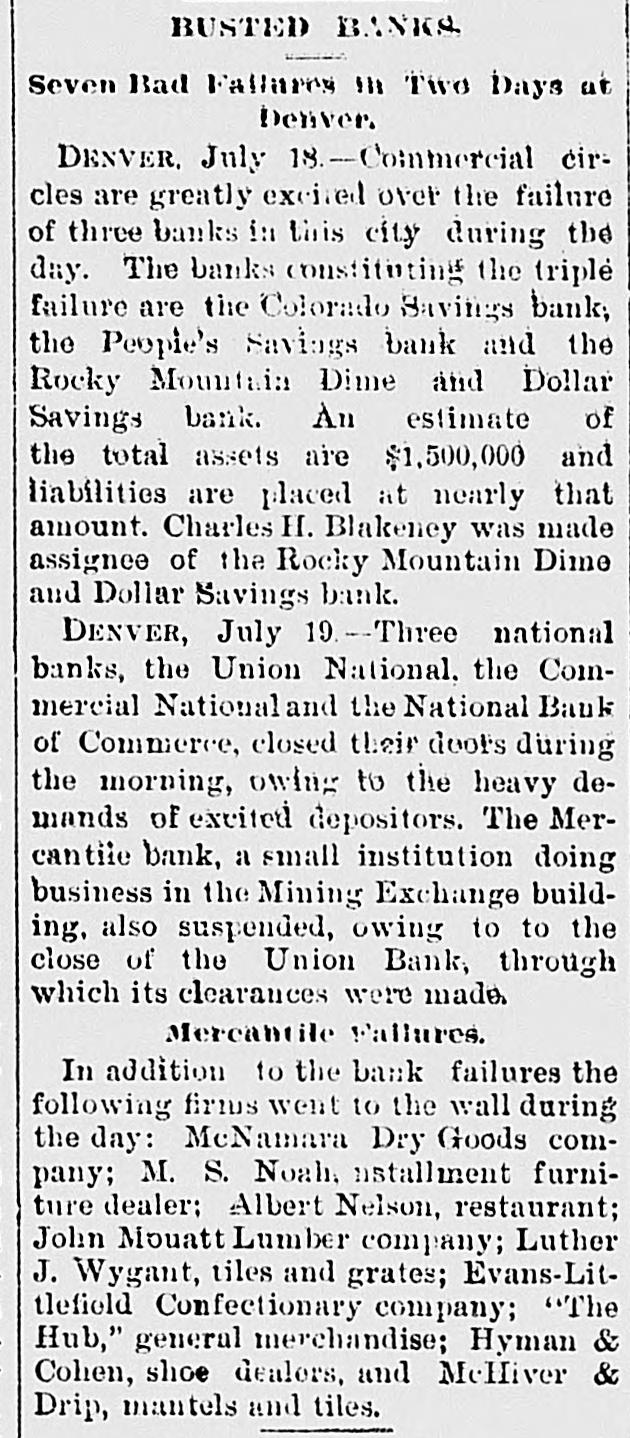
BUSTED BANKS Seven Bad Fallares III Two Days at Denver. DENVER. July 18. --Commercial - circles are greatly excited over the failure of three banks in this city during the day. The banks constituting the triple failure are the Colorado Savings bank; the People's Savings bank and the Rocky Mountain Dime and Dollar Savings bank. An estimate of the total assets are $1,500,000 and liabilities are placed at nearly that amount. Charles H. Blakeney was made assignee of the Rocky Mountain Dime and Dollar Savings bank. DENVER, July 19.--Three national banks, the Union National. the Coinmercial National and the National Bank of Commerce, closed their doors during the morning, owing to the heavy demands of excited depositors. The Mercantile bank, a small institution doing business in the Mining Exchange building, also suspended, owing to to the close of the Union Bank, through which its clearances were made. Mercantile vallures. In addition to the bank failures the following firms went to the wall during the day: McNamara Dry Goods company; M. S. Noah. installment furniture dealer: Albert Nelson, restaurant; John Mouatt Lumber company; Luther J. Wygant, tiles and grates; Evans-Littlefield Confectionary company; "The Hub," general merchandise; Hyman & Cohen, shoe dealors, and McHiver & Drip, mantels and tiles.


Article from The Dalles Times-Mountaineer, July 22, 1893

Click image to open full size in new tab

Article Text

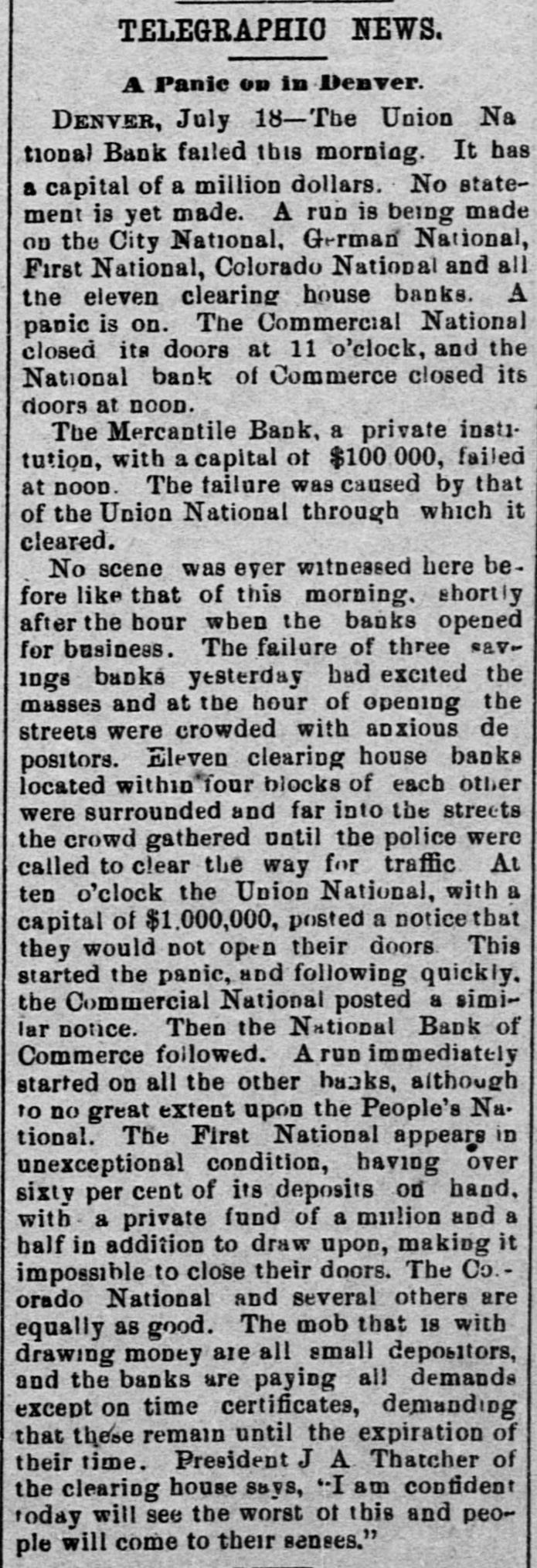
TELEGRAPHIC NEWS. A Panic on in Denver. DENVER, July 18-The Union Na tional Bank failed this morning. It has a capital of a million dollars. No statement is yet made. A run is being made on the City National, German National, First National, Colorado National and all the eleven clearing house banks. A panic is on. The Commercial National closed its doors at 11 o'clock, and the National bank of Commerce closed its doors at noon. The Mercantile Bank, a private institution, with a capital of $100 000, failed at noon. The tailure was caused by that of the Union National through which it cleared. No scene was eyer witnessed here before like that of this morning. shortly after the hour when the banks opened for business. The failure of three savings banks yesterday had excited the masses and at the hour of opening the streets were crowded with anxious de positors. Eleven clearing house banks located within four blocks of each other were surrounded and far into the streets the crowd gathered until the police were called to clear the way for traffic At ten o'clock the Union National, with a capital of $1,000,000, posted a notice that they would not open their doors This started the panic, and following quickly. the Commercial National posted a similar nonce. Then the National Bank of Commerce followed. Arun immediately started on all the other hanks, although to no great extent upon the People's Na. tional. The First National appears in unexceptional condition, having over sixty per cent of its deposits on hand, with a private fund of a mulion and a half in addition to draw upon, making it impossible to close their doors. The Co.orado National and several others are equally as good. The mob that 18 with drawing money are all small depositors, and the banks are paying all demands except on time certificates, demanding that these remain until the expiration of their time. President J A Thatcher of the clearing house says, "I am confident today will see the worst of this and people will come to their senses."


Article from Mineral Point Tribune, July 22, 1893

Click image to open full size in new tab

Article Text

Denver, July 18.-The Union National bank has failed. It has a capital of $1,000,000. No statement is yet made. A run was made on the City National, German National, First National, Colorado National, and all the clearing house banks today. A general panic is on. The Commercial National has closed its doors. The National Bank of Commerce has also closed its doors. Ex-Governor J. A. Cooper is president of the bank. The McNamara Dry Goods company, one of the largtst houses in the world, was closed by attachment this morning. Liabilities a. $250,000; assets unknown. President J. A. Thatcher, of the clearing house says: "I am confident today will see the worst of this and the people will come to their senses." At the State National bank quite a run progressed. The officers appeared in the best of humor, and say they are confident they can weather the storm. The Commercial National closed its doors when it became evident a run would be inaugurated, and a notice was posted: "Closed for liquidation, by order of board of directors." It has a capital stock of $250,000 and only $2,000 cash on hand. At the American National small depositors, who are not numerous, made the run. The bank has $1,000,000 capital, and deals largely with men who handle big sums of money. The Mercantile bank, a private institution, with a capital of $100,000, failed at noon. The failure was caused by that of the Union National. Hyman & Company proprietors of the Beehive store, and McWhirter & Dipps, dealers in mantels and tiles, and Eagle & Harris, dry goods, have assigned. The excitement and demand upon ne banks continued unabated until about 2 o'clock when it subsided at all the banks except the Utah State National and the German National where the depositors seemed to increase instead of diminishing. Just before the close the failure of the Mercantile Savings bank with a capital of $100,000 was announced. Its assets are sufficient to pay all liabilities in time. The constant drain on banks by scared depositors brought about a crisis. It is stated by bankers that no less than $8,000,000 has been drawn from banks in the last three months. Of this at least $5,000,000 is locked up in this city. Late this afternoon two more savings banks assigned. The North Denver Savings bank and the private bank of Stephens & Hanchett, known as the Capital Savings bank.


Article from The Star, July 26, 1893

Click image to open full size in new tab

Article Text

CASH WANTED AT DENVER. Security Plentiful, But Unsatisfactory Only a Temporary Panic. Three national banks-the Union National, the Commercial National and the National Bank of Commerce-closed their doors at Denver. Col., owing to the heavy demands of excited depositors. The clamor was mostly confined to small depositors, the larger ones expressing confidence in the banks' ability to pay in full. The Mercantile bank. a small private institution doing business in the Mining Exchange building, also suspended, owing to the close of the Union bank. through which its clearances were made. The liabilities are stated at $100,000. The suspension of three savings banks on M onday so alarmed the community that at 10 o'clock Tuesday morning, the hour for opening the banks, crowds had gathered in front of nearly all of the financial institutions. The streets were full of people discussing the situation. It was an orderly crowd, however. and there was much sensible and conservative talk.


Article from The Enterprise, July 26, 1893

Click image to open full size in new tab

Article Text

CLOSED THEIR DOORS. Dollapse of Three National Banks and a Big Dry Goods House at Denver, ColNearly a Panic Prevails in the City. DENVER, Col., July 19.-Never in the history of commercial and mercantile life in the Rocky Mountains has such a state of financial affairs existed as now prevails in Denver and throughout Colorado. Yesterday morning it was hoped that the banks which had weathered Monday's financial storm would be in such a position as to probably cope with all demands made upon them by their depositors. This hope unfortunately was short-lived. It was dissipated by the announcement in quick succession of the failure of the National Bank of Commerce, the Union National bank and the Commercial National bank. The depositors in the different banks have become almost completely panic-stricken and long lines of people are pushing and crowding each other in order to get access to the paying tellers' windows of the dozen remaining banks that they may secure their money on deposit. To add to the excitement, the failure of the McNamara Dry Goods Company, with liabilities of $260,000, was announced. The amount of assets are not stated, but are believed to more than equal the liabilities. The failure was precipitated by the filing of anattachment for $71,780 in favor of the Union National bank. This attachment was served at 1 o'elock Tuesday morning, and shortly before business hours another attachment for $20,847 in favor of the Colorado National bank was served upon the company and the doors were closed. The First National bank appears to be on the best footing of all the banks. It claims to have on hand over 60 per cent. of their deposits, and have a private fund of $1,500,000 in addition to draw upon, making it impossible for any demand to go unattended. The Colorado National bank and several others claim to be equally well fortified against any run. Over 90 per cent. of the people who are clamoring for their money are small depositors. The large holders express confidence in the banks ability to successfully ride the storm. As every bank is crowded, the clearing house is rendering no assistance, and each bank is compelled to stand upon its own resources. The Mercantile bank failed yesterday. C. C. Gird, city auditor, is its president. The failure was caused by the collapse of the Union National, with which bank the Mercantile cleared. The liabilities are $100,000.


Article from The Middleburgh Post, July 27, 1893

Click image to open full size in new tab

Article Text

# CASH WANTED AT DENVER. Security Plentiful, But Unsatisfactory Only a Temporary Panic. Three national banks-the Union National, the Commercial National and the National Bank of Commerce-closed their doors at Denver. Col., owing to the heavy demands of excited depositors. The 'clamor was mostly confined to small depos- itors, the larger ones expressing confidence in the banks' ability to pay in full. The Mercantile bank, a small private institution doing business in the Mining Exchange building, also suspended, owing to the close of the Union bank, through which its clearances were made. The liabilities are stated at $100,000. The suspension of three savings banks on Monday so alarmet the community that at 10 o'clock Tuesday morning, the hour for opening the banks, crowds had gathered in front of nearly all of the financial institu- tions. The streets were full of people dis- cussing the situation. It was an orderly crowd, however, and there was much sens- ible and conservative talk.


Article from The Weekly Union Times, July 28, 1893

Click image to open full size in new tab

Article Text

NUMBER 30. BANKS SMASHING IN DENVER. Three National Banks and suree Pri. vate Concerns Go Under. DENVER, Col.-Three national banks -the Union National, the Commercial National, and the National Bank of Commerce-closed their doors Tuesday morning owing to the heavy demands of excited dapositors. The Mercantile Bank, a small private institution doing business in the Mining Exchange building. also suspended, owing to the close of the Union bank, through which tis clearances were made. A WHOLE STRING OF BANKS FAIL.. DENVER, COL.-The J. B Whaling Banking Company thospieness the same of Storting, Start lug, Cel., ac.d the Bank of Loveland, Col., have assigned. No statements a sets or liabilities have been issued. TWO OKLAHOMA BANKS. OKLAHOMA CITY, O. T.-The Bank of Oklahoma City and the Oklahoma Na. ti hat Bank closed their doors. There was a heavy run on the First National but it withstood it all right. The statements are unobtainable now, TWO MORE BANKS. TOPEKA, KAN.-Information has been r de ved at the office of the State commissioner of the failure of Bank of dodepn


Article from The Weekly Union Times, July 28, 1893

Click image to open full size in new tab

Article Text

NUMBER 30. BANKS SMASHING IN DENVER. Three National Banks and Three Private Concerns Go Under. DENVER, CoL.-Three national banks -the Union National, the Commercial National, and the National Bank of Commerce-closed their doors Tuesday morning owing to the heavy demands of excited dapositors. The Mercantile Bank, a small private institution doing business in the Mining Exchange building. also suspended, owing to the close of the Union bank, through whichits clearances were made. A WHOLE STRING OF BANKS FAIL. DENVER, Col.-The - J. B. Whaling Banking Company, the pioneer bank of Asheum 061; the Bank of Sterling, Sterling, Col., and the Bank of Loveland, Col., have assigned. No statements of a sets or liabilities have been issued. TWO OKLAHOMA BANKS. CKLAHOMA CITY, O. T. -The Bank of Oklahoma City and the Oklahoma Nati hal Bank closed their doors. There was a heavy run on the First National but it withstood it all right. The statements are unobtainable now. TWO MORE BANKS. TOPEKA, KAN.Information has been r ce ved at the office of the State bank commissioner of the failure of the Bank of Parker, Lith county, and Woodson State Bank, of Yates Woods on edulty. Both et


Article from Idaho County Free Press, July 28, 1893

Click image to open full size in new tab

Article Text

A PANIC IN DENVER. A Run on All the Banks, Over Half of Which Close. Denver, July 18.-The Union National Bank failed this morning. It has a capital of a million dollars. No statement is yet made. A run is being made on the City National, German National, First National, Colorado National and all the eleven clearing house banks. A panic is on. The Commercial National closed its doors at 11 o'clock, and the National bank of Commerce closed its doors at noon. The Mercantile Bank, a private institution, with a capital of $100,000, failed at noon. The failure was caused by that of the Union National, through which it cleared. No scene was ever witnessed here before like that of this morning, shortly after the hour when the banks opened for business. The failure of three savings banks yesterday had excited the masses and at the hour of opening the streets were crowded with anxious depositors. Eleven clearing house banks located within four blocks of each other were surrounded and far into the streets the crowd gathered until the police were called to clear the way for traffic. At ten o'clock the Union National, with a capital of $1,000,000, posted a notice that they would not open their doors. This started the panic, and following quickly, the Commercial National posted a similar notice. Then the National Bank of Commerce followed. A run immediately started on all the other banks, although to no great extent upon the People's National. The First National appears in unexceptional condition, having over sixty per cent of its deposits on hand, with a private fund of a million and a half in addition to draw upon, making it impossible to close their doors. The Colorado National and several others are equally as good. The mob that is withdrawing money are all small depositors, and the banks are paying all demands except on time certificates, demanding that these remain until the expiration of their time. President J. A. Thatcher of the clearing house says, "I am confident today will see the worst of this and people will come to their senses."


Article from Fisherman & Farmer, July 28, 1893

Click image to open full size in new tab

Article Text

LATER NEWS. A DINNER was given in honor of James H. Eckels, Controller of the Currency, at the Union League Club, New York City. THE corner stone of the Odd Fellows' Temple, which will cost $1,000,000. was laid at Philadelphia, Penn., with impressive ceremonies. MISS EMMA GARRETT. of Philadelphia, who with her sister. Miss Mary S. Garrett, had charge of the Pennsylvania blind children's exhibit at the World's Fair. committed suicide by leaping from a window at the Briggs House. THREE Denver (Col.) National banks-the Union National, the Commercial National and the National Bank of Commerce-closed their doors, owing to the heavy demands of excited depositors. The Mercantile Bank. a small private institution, also suspended, owing to the closing of the Union Bank. URUGUAY'S exhibition in the Agriculture Building, World's Fair. was thrown open to the public view, and was visited by large crowds. IT was reported that the warship Mohican was disabled on June 25 by a shot from the seal-poaching steamer Alexandria passing through her machinery ; the story was discredited in Washington. THE Navy Department formally accepted the cruiser Detroit and authorized the payment to the builders of reserved funds amounting to about $225,000. IN the court-martial of the officers of the Victoria, at Valetta. Maita, Flag-Lieutenant Gilltord and Staff-Commander Hawkins Smith testified that Vice-Admiral Tryon said immediately after the Camperdown struck the Victoria, "It was all my fault." BRIGANDS raided the village of Lipkaey, Bukowina. The villagers killed five of them and wounded several more. The villagers were finally routed and the place looted.