Keystone Bank (Philadelphia, PA)

Episode Information

Episode UID
9166653591092
Episode Type
Run โ†’ Suspension โ†’ Closure
Bank Type
state
Bank ID
916665359 hash
Start Date
December 2, 1890
Location
Philadelphia, Pennsylvania (39.952, -75.164)

Metadata

Model
gpt-5-mini (chosen from majority vote of a three-model LLM ensemble)
Short Digest
fb2b55049b6b80f6

Response Measures

None

Description

Comptroller-ordered closing and receiver appointed after a December run and discovery of large defalcations.

Events (4)

1. December 2, 1890 Run
Cause
Bank Specific Adverse Info
Cause Details
Run followed disclosure/knowledge of the bank's weak condition and large deficits (president Lucas' deficit noted later).
Measures
Paid up to $100 in cash; issued clearing-house due bills for balances.
Newspaper Excerpt
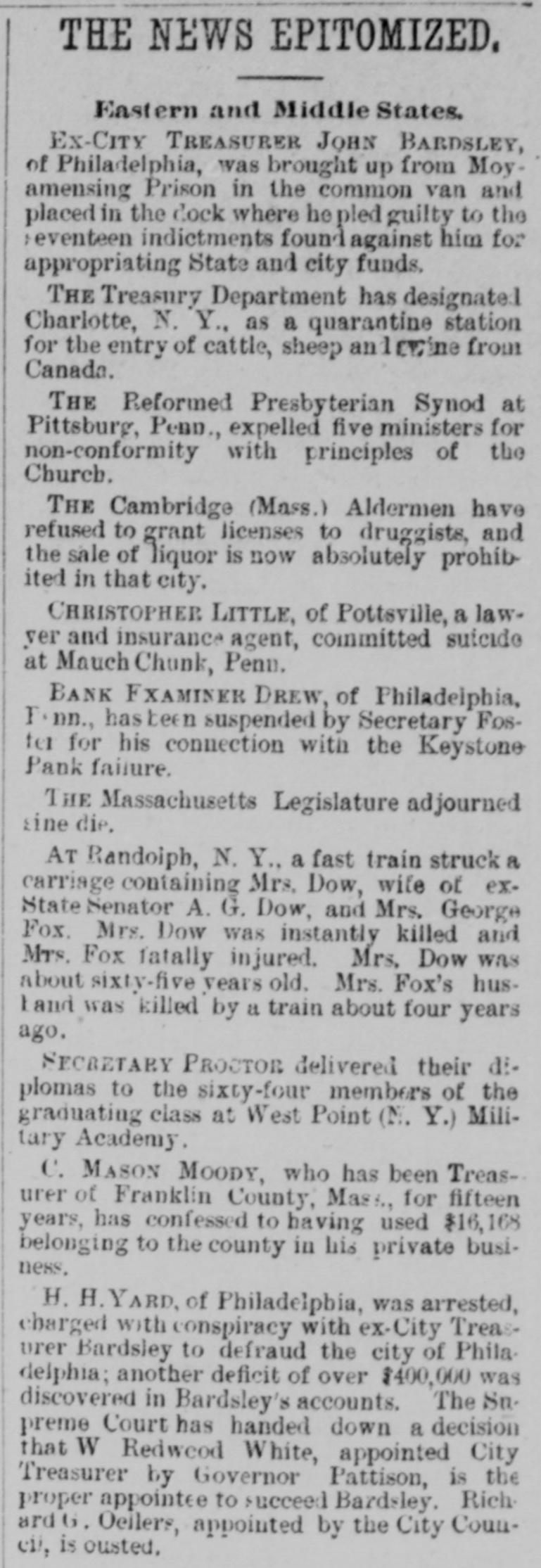
The run on the Keystone Bank continues. All persons presenting checks for $100 or less are paid in currency, but any whose demands exceed that amount are paid only $100 in cash and are given clearing house due bills for the balance.
Source
newspapers
2. March 16, 1891 Suspension
Cause
Government Action
Cause Details
Comptroller of the Currency ordered closure/suspension after examinations revealed large deficits and weak condition.
Newspaper Excerpt
The suspension of the Keystone Bank, of Philadelphia ... the comptroller telegraphed Drew to visit the bank in the morning. Next morning he received instructions to close it.
Source
newspapers
3. June 3, 1891 Receivership
Newspaper Excerpt
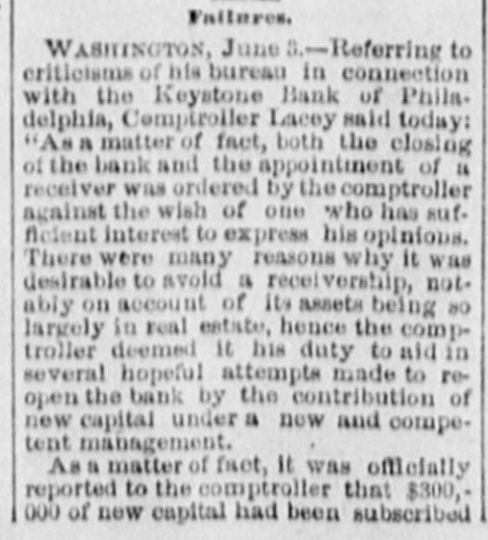
Referring to criticisms of his bureau in connection with the Keystone Bank of Philadelphia, Comptroller Lacey said today: '... the closing of the bank and the appointment of a receiver was ordered by the comptroller ... ' (June report).
Source
newspapers
4. August 25, 1892 Other
Newspaper Excerpt
On Monday there will be a sale of the surplus effects of the Keystone bank and the receiver expects to pay a dividend of 10 per cent. to the creditors.
Source
newspapers

Newspaper Articles (25)

Article from Deseret Evening News, December 2, 1890

Click image to open full size in new tab

Article Text

Run on the Keystone Bank. PHILADELPHIA, [Dec. 2. - The run on the Keystone Bank continues. All persons presenting checks for $100 or less are paid in currency, butany whose demandsexceed that amount are paid only $100 in cash and are given clearing house due billsfor the balance. These will be honored at any bank.


Article from Los Angeles Herald, December 3, 1890

Click image to open full size in new tab

Article Text

The Keystone Bank. PHILADELPHIA, Dec. 2.-The run on the Keystone bank continued today. All persons presenting checks for $100 or less were paid in currency, but any whose demands exceed that amount are paid only $100 in cash and given clearing house due bills for the balance. These will be honored at any bank.


Article from The Wilmington Daily Republican, March 21, 1891

Click image to open full size in new tab

Article Text

THE MARKETS Quotations from the Philadelphia and New York Exchanges. PHILADELPHIA, March:00--The -- market was dull and unsettled. There was no feature, and thesuspension of the Keystone bank was the principal topic of discussion in the Stock Exchange. Following were the closing hids:


Article from The Wheeling Daily Intelligencer, March 23, 1891

Click image to open full size in new tab

Article Text

THE Suspension of the Keystone Bank, The suspension of the Keystone Bank, of Philadelphia, is another reminder that it is well to cut the garment according to the cloth, dangerous to do a business out of proportion to the capital. There is another reminder, and this is that the eye of the Government of the United States is on the national banks. Fortunately the trouble in this one bank shows no sign of extending. The general condition of the banks of the country is good.


Article from Daily Kennebec Journal, May 22, 1891

Click image to open full size in new tab

Article Text

Failure of Keystone Bar k Swamped Him. PHILADELPHIA, May 21 -John Bardsley, city treasurer who had $400.000 of the city's funds in the Keystone Bank when it failed, and resigned his office has assigned.


Article from The Morning Call, May 24, 1891

Click image to open full size in new tab

Article Text

BARDSLEY ARRESTED. Heavy Discrepancy in the Accounts of Philadelphia's City Treasurer. PHILADELPHIA, May 23.-The affairs of City Treasurer John Bardsley were brought to a crisis by his arrest at his home in Germantown. He is sick in bed and two detectives are guarding his roomi. Expert accountants discovered a discrepancy of $30,000 in his accounts shortly before noon to-day. Within a month Bardsley is said to ave appropriated $39,000 to his own use. Bardsley's personal deposit with the suspended Keystone Bank amounted to $606,000. It is said the State cannot lose more than $250,000 by reason of Bardsley's shortcomings.


Article from New-York Tribune, June 1, 1891

Click image to open full size in new tab

Article Text

A BUILDING ASSOOFATION GONE. The Totowa Order of Home Builders, a building and loan association of Paterson, N. J., has been compelled to suspend operations owing to the failure of the Keystone Bank of Philadelphia. The association kept all its funds in the latter institution. The president, W. B. Wood, and the treasurer, Gideon W. Marsh, of the Philadelphia bank, were directors in the Home Builders. The organization has 125 members, who are largely


Article from Deseret Evening News, June 4, 1891

Click image to open full size in new tab

Article Text

Failures. WASHINGTON, June 3.-Referring to criticisms of his bureau in connection with the Keystone Bank of Philadelphia, Cemptroller Lacey said today: "As a matter of fact, both the closing of the bank and the appointment of 14 receiver was ordered by the comptroller against the wish of one who has sufficient interest to express his opinions. There were many reasons why it was desirable to avoid a receivership, notably on account of its assets being 80 largely in real estate, hence the comptroller deemed it his duty to aid in several hopeful attempts made to reopen the bank by the contribution of new capital under a new and competent management. As a matter of fact, It was officially reported to the comptroller that $300,000 of new capital had been subscribed


Article from Rock Island Daily Argus, June 15, 1891

Click image to open full size in new tab

Article Text

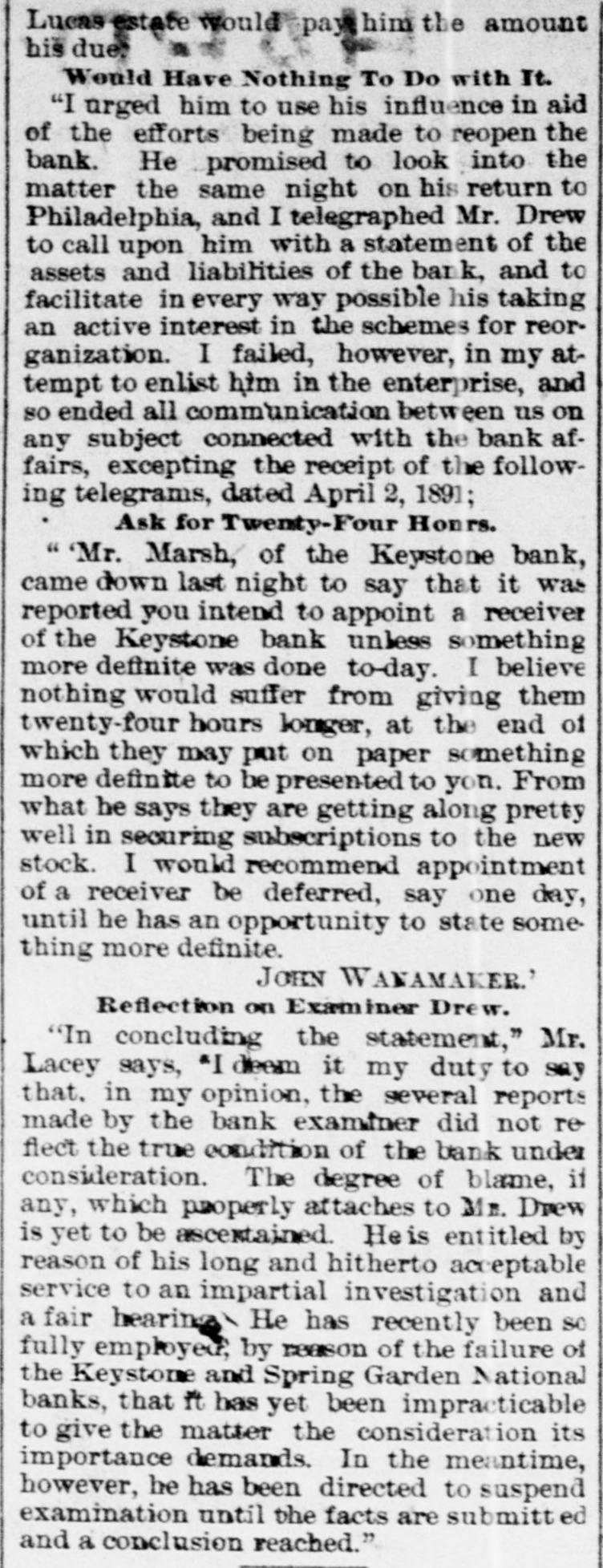
Lucas estate would pays him the amount his due: Would Have Nothing To Do with It. "I urged him to use his influ nce in aid of the efforts being made to reopen the bank. He promised to look into the matter the same night on his return to Philadelphia, and I telegraphed Mr. Drew to call upon him with a statement of the assets and liabilities of the bank, and to facilitate in every way possible his taking an active interest in the schemes for reorganization. I failed, however, in my attempt to enlist him in the enterprise, and so ended all communication between us on any subject connected with the bank affairs, excepting the receipt of the following telegrams, dated April 2, 1891; Ask for Twenty-Four Honrs. " 'Mr. Marsh, of the Keystone bank, came down last night to say that it was reported you intend to appoint a receiver of the Keystone bank unless something more definite was done to-day. I believe nothing would suffer from giving them twenty-four hours longer, at the end of which they may put on paper something more definite to be presented to yon. From what he says they are getting along pretty well in securing subscriptions to the new stock. I would recommend appointment of a receiver be deferred, say one day, until he has an opportunity to state something more definite. JOHN WANAMAKER.' Reflection on Examiner Drew. "In concluding the statement," Mr. Lacey says, "I deem it my duty to say that. in my opinion, the several reports made by the bank examiner did not re flect the true condition of the bank under consideration. The degree of blame, if any, which properly attaches to Mr. Drew is yet to be ascertained. Heis entitled by reason of his long and hitherto acceptable service to an impartial investigation and a fair hearing) He has recently been S0 fully employed, by reason of the failure of the Keystome and Spring Garden National banks, that It has yet been impracticable to give the matter the consideration its importance demands. In the meantime, however, be has been directed to suspend examination until the facts are submitt and a conclusion reached.'


Article from Perrysburg Journal, June 20, 1891

Click image to open full size in new tab

Article Text

LACEY'S STATEMENT Regarding the Course Pursued by Him with the Keystone Bank. Bank Examiner Drew's Conduct Explained and Commented Upon-Mr. Wanamaker Failed to Effect a Recognition of the Bank Although Very Anxious to Do So. WASHINGTON June 15.-The statement by Comptroller Lacey to Mayor Stuart of on the course pursued and sent prepared by him Philadel- with the bank of that was here last night. made phia Keystone public The Bank city state- Exincluded the letter of Drew of January 28 the aminer him ment of $600,000 defalcation notifying of In Lucas, this president of the bank. Mr. Drew explains how the letter late by of adroit the manipulation of the accounts of bank Lucas, with the assistance Marsh, the former cashier of the bank, abstracted large sums of money from real the bank to use in speculations in estate. Marsh, he reported, was ignorantly led into these transactions and promised Lucas when the latter was on his death-bed to continue the deception under representations that the money abstracted would soon be returned to bank from the result of Lucas' enterprises. the Drew also reported that there was no evidence that Marsh had profited by these irregularities. Later on January 27, Mr. Drew, Wash- in an with the comptroller at and interview stated that in his judgment house ington, the opinion of the clearing to committee, in the property conveyed bank by the Lucas estate was equal had the value to the indebtedness which event in concealed, and that in any entirely been creditors of the bank were connecthe also, that to sever Marsh's suspicsafe; with the bank would excite retion and that Marsh was thoroughly earnest ion, and was actuated by an assist pentent to do all in his power to which desire bank in recovering any sums it. Mr. the been improperly taken from the bank had says he did not close had no lawLacey for the reason that he the facts then authority to do SO upon reason ful submitted, and for the further bank examadvised by the the bank iner, that he Drew, was that the capital of was unimpaired and later reports from Bank Further Drew convinced the comptrol- were Examiner the board of directors satisfacler that putting matters in a he levied slow condition, in so on March 7th the tory of $250,000 upon the coman (assessment on the promise of that the mittee of be paid shareholders directors of the bank within a assessment would Drew comOn March 14th Mr. from the week. of little active support re-habitate the plained in the effort to on directors reached the comptroller closed the the bank. 16th This and three days later he bank. comptroller states never that Postmas- directly The General Wanamaker solicited any ter indirectly suggested the or bank, nor in or delay in the closing of of a receiver, except hereinafter the appointment by the telegram met him but as appears In fact. I have and that quoted. during the present year, day of March once was on the 21st the presence of meeting suggestion and in then acting secat the A. B. Nettleton, This interview Hon. of the treasury. Keystone bank was was retary the closed day and after the the failure was the fully indiscussed. substantially confirmed Mr. Marsh, he held as a "He I received from certifibank and in the them and cates formation stock said representing that Keystone about surrender 2,500,000 pledge shares that un- the of had declined to would pay him his of the he the Lucas estate urged him to use being his influence in, the bank. the He same night less amount made to reopen due. the aid matter I efforts promised I failed, in to enlist him to look his return into attempt Philadelphia. to commuon in my ended all however. and SO subject between bank's affairs, with the following: nication nected the enterprise, the of us on except- coning the receipt DEPARTMENT POST OFFICE OF ASHINGTON. April Mr. Marsh WASHIN Comptroller night to of HON the Keystone reported you you bank unless I believe someE. was S. LACEY, bank Keystone came down intend last to appoint say that for the done to day. them twenty thing a suffer from the end of more detithey presented a'on. nothing four receiver hours may would put longer. definite on paper at was to something you. giving well From which in would what securing time re he commend day. nite they to be are getting new stock desays subscriptions appo 10 n the ment until of he has ferred. to state say. something one more statement." Nir "In concluding **I deem the it my several duty reports to say Lacey says, opinion, the did not retrue The made that, in by my the bank condition examiner of degree the bank of flect the consideration. which properly ascertained. attaches if any, to be he has the under to blame, Mr. Drew, yet ho wever, examinationlusion until been reached." directed In the facts meantime, to are suspend submitted and a


Article from The Helena Independent, June 23, 1891

Click image to open full size in new tab

Article Text

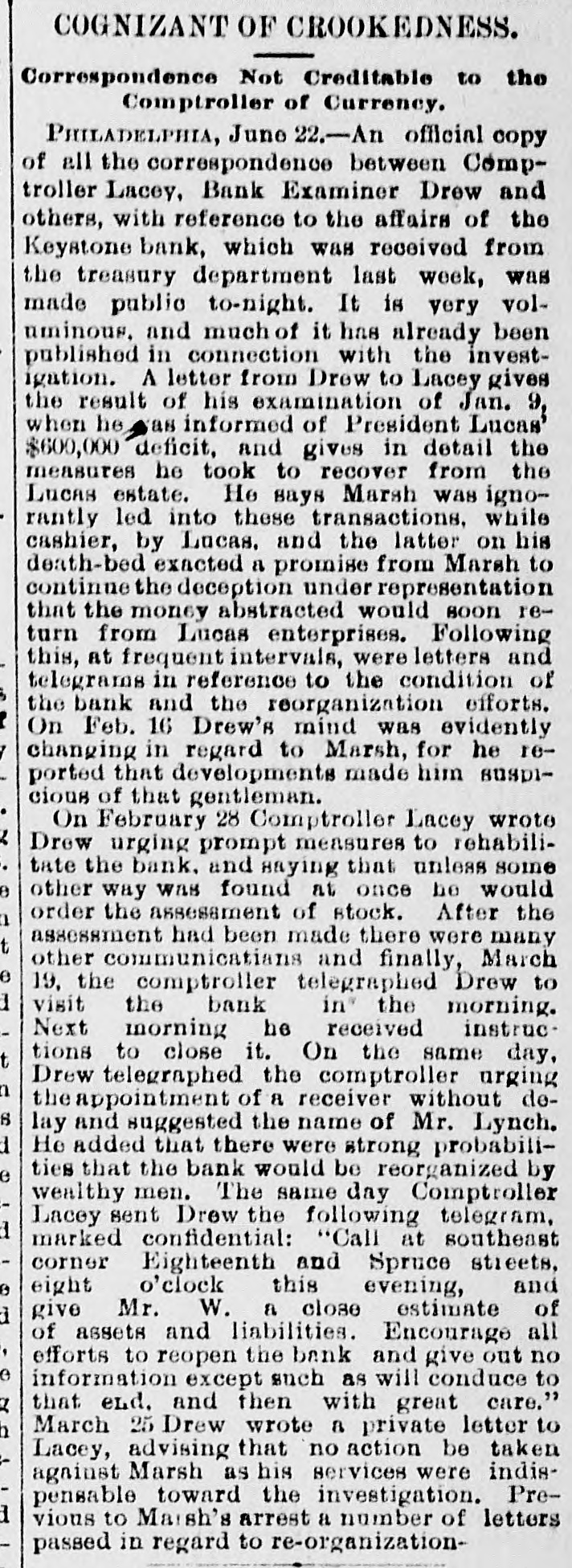
COGNIZANT OF CROOKEDNESS. Correspondence Not Creditable to the Comptroller of Currency. PHILADELPHIA, June 22.-An official copy of all the correspondence between Comptroller Lacey, Bank Examiner Drew and others, with reference to the affairs of the Keystone bank, which WaH received from the treasury department last week, was made public to-night. It is very voluminous. and much of it has already been published in connection with the investigation. A letter from Drew to Lacey gives the result of his examination of Jan. 9, when he as informed of President Lucas' $600,000 deficit, and gives in detail the measures he took to recover from the Lucas estate. He Bays Marsh was ignorantly led into these transactions, while cashier, by Lucas, and the latter on his death-bed exacted a promise from Marsh to continue the deception under representation that the money abstracted would BOON return from Lucas enterprises. Following this, at frequent intervals, were letters and telegrams in reference to the condition of the bank and the reorganization efforts. On Feb. 16 Drew's mind was evidently changing in regard to Marsh, for he reported that developments made him BUSDIcious of that gentleman. On February 28 Comptroller Lacey wrote Drew urging prompt measures to rehabilitate the bank. and Haying that unless some 8 other way was found at once be would order the assessment of stock. After the assessment had been made there were many other communications and finally, March e 19, the comptroller telegraphed Drew to visit the bank in the morning. Next morning he received instructions to close it. On the same day, t Drew telegraphed the comptroller urging n theappointment of a receiver without de8 lay and suggested the name of Mr. Lynch. He added that there were strong probabilities that the bank would be reorganized by e wealthy men. The same day Comptroller Lacey sent Drew the following telegram, a marked confidential: "Call at southeast corner Eighteenth and Spruce streets, 0 eight o'clock this evening, and give Mr. W. a close estimate of of assets and liabilities. Encourage all efforts to reopen the bank and give out no e information except such as will conduce to that end. and then with great care." March 25 Drew wrote a private letter to Lacey, advising that no action be taken against Marsh as his services were indispensable toward the investigation. Prea vious to Marsh's arrest a number of letters passed in regard to re-organization-


Article from The Salt Lake Herald, June 23, 1891

Click image to open full size in new tab

Article Text

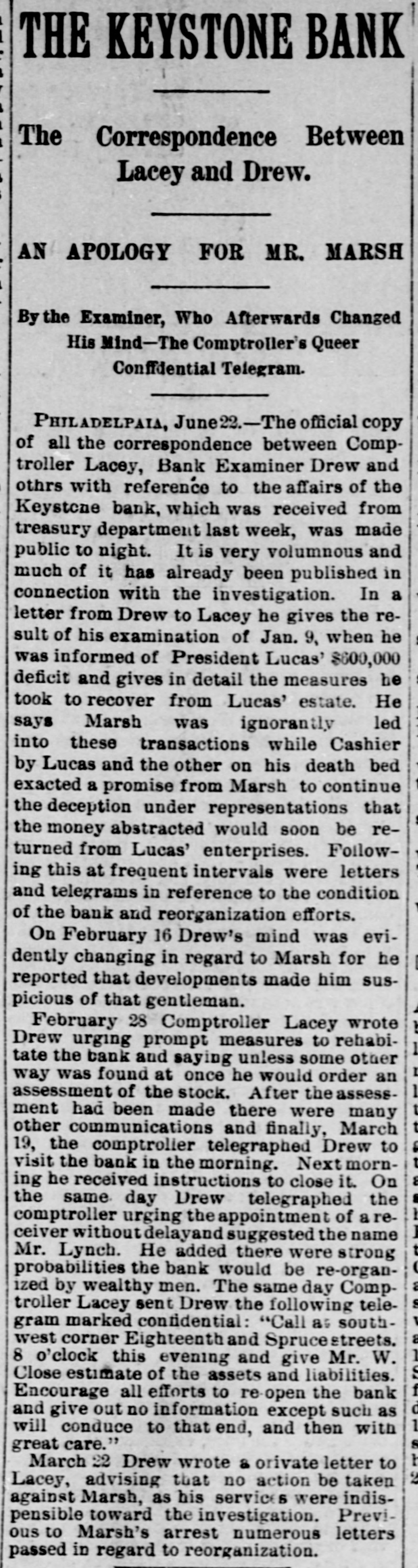
THE KEYSTONE BANK The Correspondence Between Lacey and Drew. AN APOLOGY FOR MR. MARSH By the Examiner, Who Afterwards Changed His Mind-The Comptroller's Queer Confidential Telegram. PHILADELPAIA, June22.-The official copy of all the correspondence between Comptroller Lacey, Bank Examiner Drew and othrs with reference to the affairs of the Keystcne bank, which was received from treasury department last week, was made public to night. It is very volumnous and much of it has already been published in connection with the investigation. In a letter from Drew to Lacey he gives the result of his examination of Jan. 9, when he was informed of President Lucas' $600,000 deficit and gives in detail the measures he took to recover from Lucas' estate. He says Marsh was ignorantly led into these transactions while Cashier by Lucas and the other on his death bed 1 exacted a promise from Marsh to continue the deception under representations that the money abstracted would soon be returned from Lucas' enterprises. Following this at frequent intervals were letters and telegrams in reference to the condition of the bank and reorganization efforts. On February 16 Drew's mind was evidently changing in regard to Marsh for he reported that developments made him suspicious of that gentleman. February 28 Comptroller Lacey wrote Drew urging prompt measures to rehabi1 tate the bank and saying unless some other way was found at once he would order an assessment of the stock. After the assessment had been made there were many t other communications and finally, March 8 19, the comptroller telegraphed Drew to visit the bank in the morning. Next morning he received instructions to close it. On the same day Drew telegraphed the comptroller urging the appointment of a re] ceiver without delayand suggested the name t Mr. Lynch. He added there were strong probabilities the bank would be re-organized by wealthy men. The same day Comptroller Lacey sent Drew the following telegram marked contidential: "Call at southwest corner Eighteenth and Sprucestreets. 1 8 o'clock this evening and give Mr. W. Close estimate of the assets and liabilities. Encourage all efforts to re-open the bank a and give out no information except such as 1 will conduce to that end, and then with S great care." h March 22 Drew wrote & orivate letter to 2 Lacey, advising that no action be taken against Marsh, as his services were indispensible toward the investigation. Previous to Marsh's arrest numerous letters passed in regard to reorganization.


Article from The Record-Union, July 28, 1891

Click image to open full size in new tab

Article Text

Keystone Bank Failure. PHILADELPHIA, July 27.-An evening paper asserts that Bank Examiner Drew has forwarded to the Secretary of the Treasury a lengthy statement, showing that he kept the Comptroller of Currency fully advised of the condition of the Keystone Bank, and before the run in December called attention to its weak condition.


Article from Los Angeles Herald, July 28, 1891

Click image to open full size in new tab

Article Text

Examiner Drew's Wail. PHILADELPHIA, July 27.-An evening paper asserts that Bank Examiner Drew has forwarded to the secretary of the treasury a lengthy statement showing that he kept the comptroller of the currency fully advised of the condition of the Keystone bank and before the run in December called attention to its weak condition.


Article from The Salt Lake Herald, July 28, 1891

Click image to open full size in new tab

Article Text

Examiner Drew to Foster. PHILADELPHIA, July 27.-An evening paper asserts Bank Examiner Drew has forwarded to the secretary of the treasury a lengthy statement showing he kept the comptroller of the currency fully advised as to the condition of the Keystone bank and before the run in December cailed attention to its weak condition.


Article from The Evening Herald, August 18, 1891

Click image to open full size in new tab

Article Text

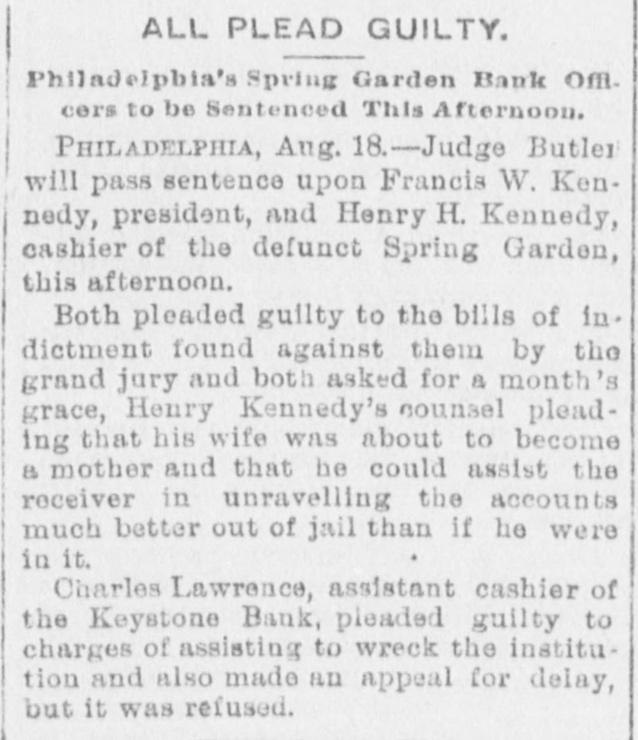
ALL PLEAD GUILTY. Philadelpbia's Spring Garden Bank Officers to be Sentenced This Afternoon. PHILADELPHIA, Aug. 18.-Judge Butler will pass sentence upon Francis W. Kennedy, president, and Henry H. Kennedy, cashier of the defunct Spring Garden, this afternoon. Both pleaded guilty to the bills of in. dictment found against them by the grand jury and both asked for & month's grace, Henry Kennedy's counsel pleading that his wife was about to become B mother and that he could assist the receiver in unravelling the accounts much better out of jail than if he were in it. Charles Lawrence, assistant cashier of the Keystone Bank, pleaded guilty to charges of assisting to wreck the institution and also made an appeal for delay, but it was refused.


Article from The Evening Herald, August 19, 1891

Click image to open full size in new tab

Article Text

Eight Years for is Bank Wrecker, PHILADELPHIA, Aug. 19.-Charles Lawrence, ex-assistant cashier of the Keystone Bank, who pleaded guilty to the indictments found against him of complicity in wrecking the bank, was sentenced to eight years' imprisonment. The sentences of Francis W. Kennedy, president, and Henry H. Kennedy, cashier of the suspended Spring Garden Bank, were suspended until Sept. 8.


Article from Waterbury Evening Democrat, August 19, 1891

Click image to open full size in new tab

Article Text

Eight Years for a Bank Wrecker. PHILADELPHIA, Aug. 19.-Charles Lawrence, ex-assistant cashier of the Keystone Bank, who pleaded guilty to the indictments found against him of complicity in wrecking the bank, was sentenced to eight years' imprisonment. The sentences of Francis W. Kennedy, president, and Henry H. Kennedy, cashier of the suspended Spring Garden Bank, were suspended until Sept. 8.


Article from Alexandria Gazette, August 20, 1891

Click image to open full size in new tab

Article Text

Government officers yesterday examining the assets of the suspended Keystone Bank, Philadelphia, found a tin box in the bank vault, supposed to have belonged to Gideon W. Marsh, the fugitive president of the bank, and containing a clearing-house due bill, issued by the Spring Garden Bank, for $25,000, and a draft of the Spring Garden Bank on the Chase National Bank, of New York, for $25,000.


Article from Alexandria Gazette, September 18, 1891

Click image to open full size in new tab

Article Text

As SECRETARY FOSTER has from the first asserted that the Treasury has a large surplus, for the sake of his own reputation, as well as for that of Postmaster General Wanamaker, he should have prevented the suspension of the investigation of the affairs of the broken Keystone Bank of Philadelphia.


Article from Evening Journal, August 1, 1892

Click image to open full size in new tab

Article Text

Philadelphia to Sue Yardley. PHILADELPHIA, Aug. 1.-Philadelphia will sue Receiver Yardley of the Keystone bank for $52,359.77, which Bardsley received the day before the failure.


Article from Richmond Dispatch, August 2, 1892

Click image to open full size in new tab

Article Text

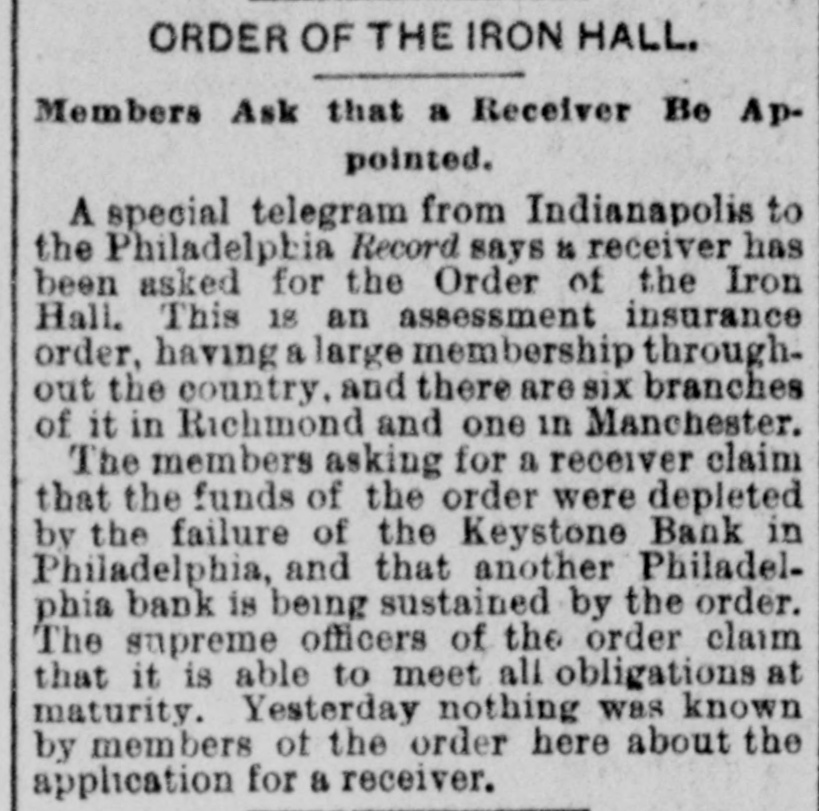
# ORDER OF THE IRON HALL. Members Ask that a Receiver Be Appointed. A special telegram from Indianapolis to the Philadelphia Record says a receiver has been asked for the Order of the Iron Hall. This is an assessment insurance order, having a large membership through-out the country, and there are six branches of it in Richmond and one in Manchester. The members asking for a receiver claim that the funds of the order were depleted by the failure of the Keystone Bank in Philadelphia, and that another Philadelphia bank is being sustained by the order. The supreme officers of the order claim that it is able to meet all obligations at maturity. Yesterday nothing was known by members of the order here about the application for a receiver.


Article from Connecticut Western News, August 4, 1892

Click image to open full size in new tab

Article Text

Philadelphia to Sue Yardley. PHILADELPHIA, Aug. 1.-Philadelphia will sue Receiver Yardley of the Keystone bank for $52,369.77, which Bardsley received the day before the failure.


Article from Freeland Tribune, August 4, 1892

Click image to open full size in new tab

Article Text

Philadelphia to Sue Yardley. PHILADELPHIA, Aug. 1.-Philadelphia will sue Receiver Yardley of the Keystone bank for $52,369.77, which Bardsley received the day before the failure.


Article from Evening Journal, August 25, 1892

Click image to open full size in new tab

Article Text

A Keystone Bank Dividend. Philadelphia, Aug. 25.-On Monday there will be a sale of the surplus effects of the Keystone bank and the receiver expects to pay a dividend of 10 per cent. to the credtors.