Irish American Bank (Minneapolis, MN)

Episode Information

Episode UID
9185743591153
Episode Type
Run β†’ Suspension β†’ Closure
Bank Type
state
Bank ID
918574359 hash
Start Date
January 15, 1896
Location
Minneapolis, Minnesota (44.980, -93.264)

Metadata

Model
gpt-5-mini (chosen from majority vote of a three-model LLM ensemble)
Short Digest
123604385ecdfb26

Response Measures

None

Description

Bank closed and placed in assignee/receiver hands after run; later receiver appointed and litigation followed.

Events (4)

1. January 15, 1896 Run
Cause
Local Banks
Cause Details
Heavy withdrawals precipitated by the failure/suspension of the City Bank in Minneapolis.
Newspaper Excerpt
its few remaining depositors commenced to withdraw yesterday when the City Bank suspension was announced.
Source
newspapers
2. January 16, 1896 Other
Newspaper Excerpt
later in the day made an assignment to Frank R. Hubacheck, of the law firm of Rea, Hubacheck & Healy.
Source
newspapers
3. January 16, 1896 Suspension
Cause
Local Banks
Cause Details
Bank closed at noon following the run triggered by the City Bank failure; bank examiner placed in charge.
Newspaper Excerpt
The Irish-American Bank ... closed its doors at noon. Bank Examiner Kenyon is now in charge.
Source
newspapers
4. March 12, 1896 Receivership
Newspaper Excerpt
Mr. Hubachek is removed as receiver of the Irish-American bank, Minneapolis, and Judge Maheny succeeds him.
Source
newspapers

Newspaper Articles (23)

Article from Evening Star, January 16, 1896

Click image to open full size in new tab

Article Text

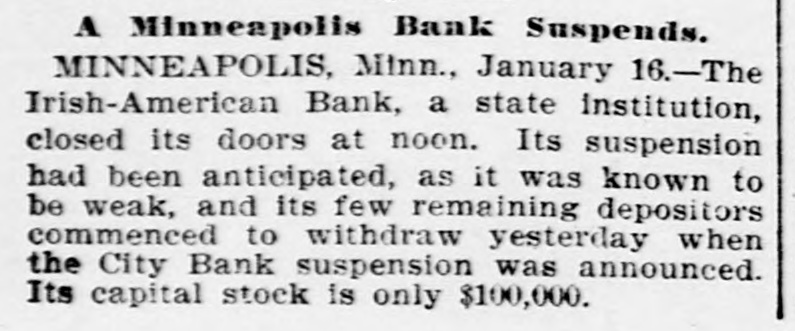
A Minneapolis Bank Suspends. MINNEAPOLIS, Minn., January 16.-The Irish-American Bank, a state institution, closed its doors at noon. Its suspension had been anticipated, as it was known to be weak, and its few remaining depositors commenced to withdraw yesterday when the City Bank suspension was announced. Its capital stock is only $100,000.


Article from Deseret Evening News, January 16, 1896

Click image to open full size in new tab

Article Text

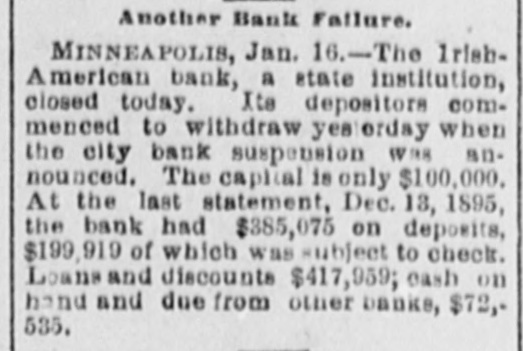
Another Bank Failure. MINNEAPOLIS, Jan. 16.-The IrishAmerican bank, a state institution, closed today. Its depositors commenced to withdraw yes orday when the city bank suspension was announced. The capital is only $100,000. At the last statement, Dec. 13, 1895, the bank had $385,075 on deposits, $199,919 of which was subject to check. Loans and discounts $417,959; cash on hand and due from other banks, $72,535.


Article from The Record-Union, January 17, 1896

Click image to open full size in new tab

Article Text

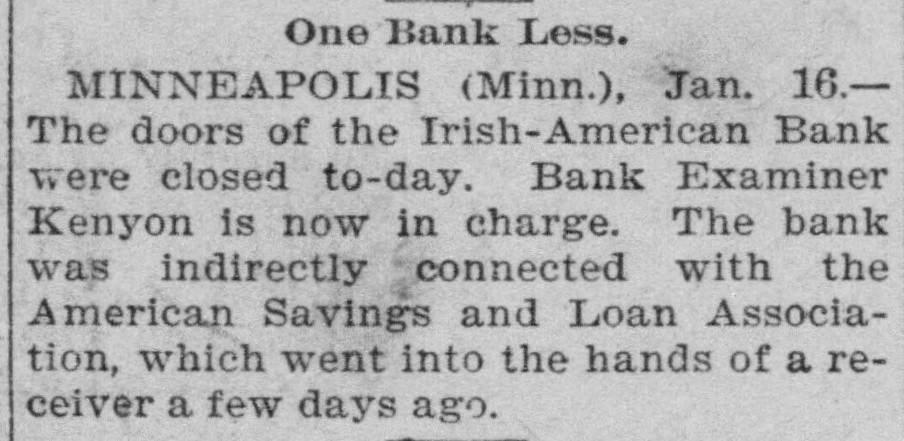
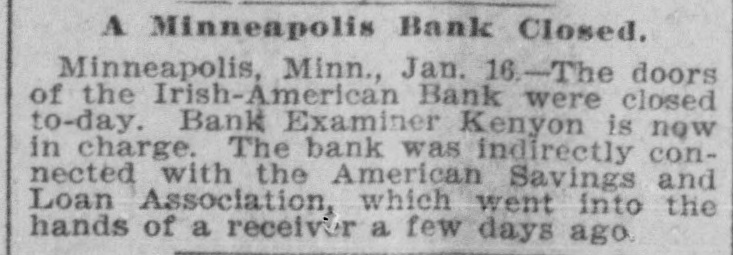
One Bank Less. MINNEAPOLIS (Minn.), Jan. 16.The doors of the Irish-American Bank were closed to-day. Bank Examiner Kenyon is now in charge. The bank was indirectly connected with the American Savings and Loan Association, which went into the hands of a receiver a few days ago.


Article from Birmingham State Herald, January 17, 1896

Click image to open full size in new tab

Article Text

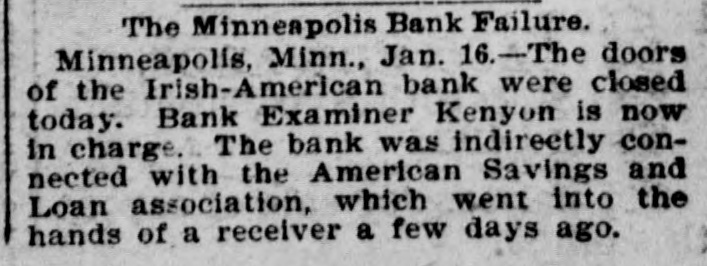
The Minneapolis Bank Failure. Minneapolis, Minn., Jan. 16.-The doors of the Irish-American bank were closed today. Bank Examiner Kenyon is now in charge. The bank was indirectly connected with the American Savings and Loan association, which went into the hands of a receiver a few days ago.


Article from The Morning News, January 17, 1896

Click image to open full size in new tab

Article Text

A Minneapolis Bank Closed. Minneapolis, Minn., Jan. 16.-The doors of the Irish-American Bank were closed to-day. Bank Examiner Kenyon is now in charge. The bank was indirectly connected with the American Savings and Loan Association, which went into the hands of a receiver a few days ago.


Article from Great Falls Weekly Tribune, January 17, 1896

Click image to open full size in new tab

Article Text

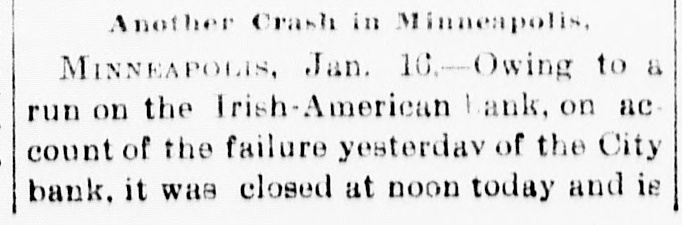
Another Crash in Minneapolis, MINNEAPOLIS, Jan. 16.- Owing to 8 run on the Irish-American I ank, on account of the failure yesterdav of the City bank. it was closed at noon today and ie


Article from The Copper Country Evening News, January 17, 1896

Click image to open full size in new tab

Article Text

Another Minneapolis Bank Fails. MINNEAPOLIS, Jan. 17.-The IrishAmerican bank, a weak state Institution, closed its doors at noon Thursday. Its suspension had been anticipated, as it was known to be weak and its few remaining depositors commenced to withdraw Wednesday when the City bank suspension was announce1. Its capital stock is only $100,000


Article from The Madison Daily Leader, January 17, 1896

Click image to open full size in new tab

Article Text

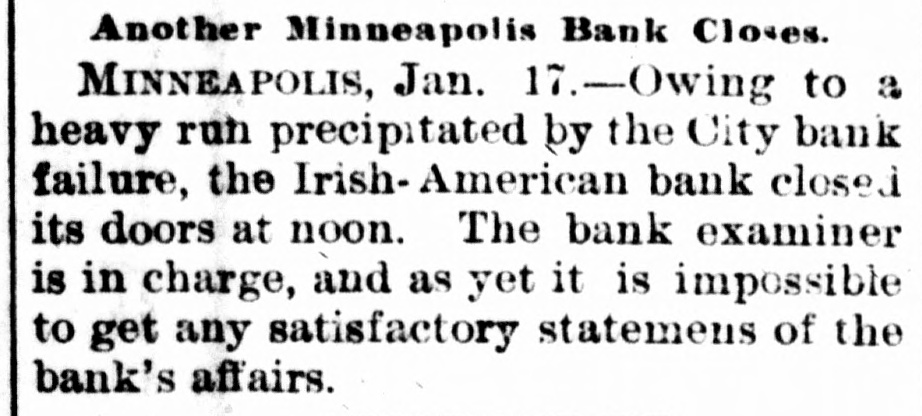
Another Minneapolis Bank Closes. MINNEAPOLIS, Jan. 17.-Owing to a heavy run precipitated by the City bank failure, the Irish- American bank close.i its doors at noon. The bank examiner is in charge, and as yet it is impossible to get any satisfactory statemens of the bank's affairs.


Article from The San Francisco Call, January 17, 1896

Click image to open full size in new tab

Article Text

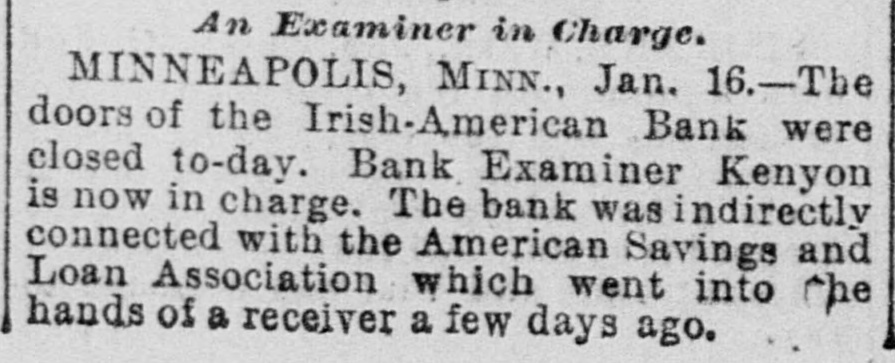
An Examiner in Charge. MINNEAPOLIS, MINN., Jan. 16.-The doors of the Irish-American Bank were closed to-day. Bank Examiner Kenyon is now in charge. The bank was indirectly connected with the American Savings and Loan Association which went into the hands of a receiver a few days ago.


Article from Richmond Dispatch, January 17, 1896

Click image to open full size in new tab

Article Text

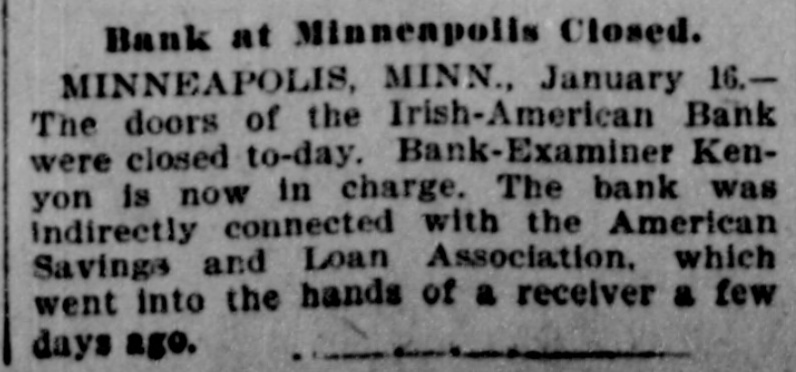
Bank at Minneapolis Closed. MINNEAPOLIS, MINN., January 16.The doors of the Irish-American Bank were closed to-day. Bank-Examiner Kenyon is now in charge. The bank was indirectly connected with the American Savings and Loan Association. which went into the hands of a receiver a few days ago.


Article from The Irish Standard, January 18, 1896

Click image to open full size in new tab

Article Text

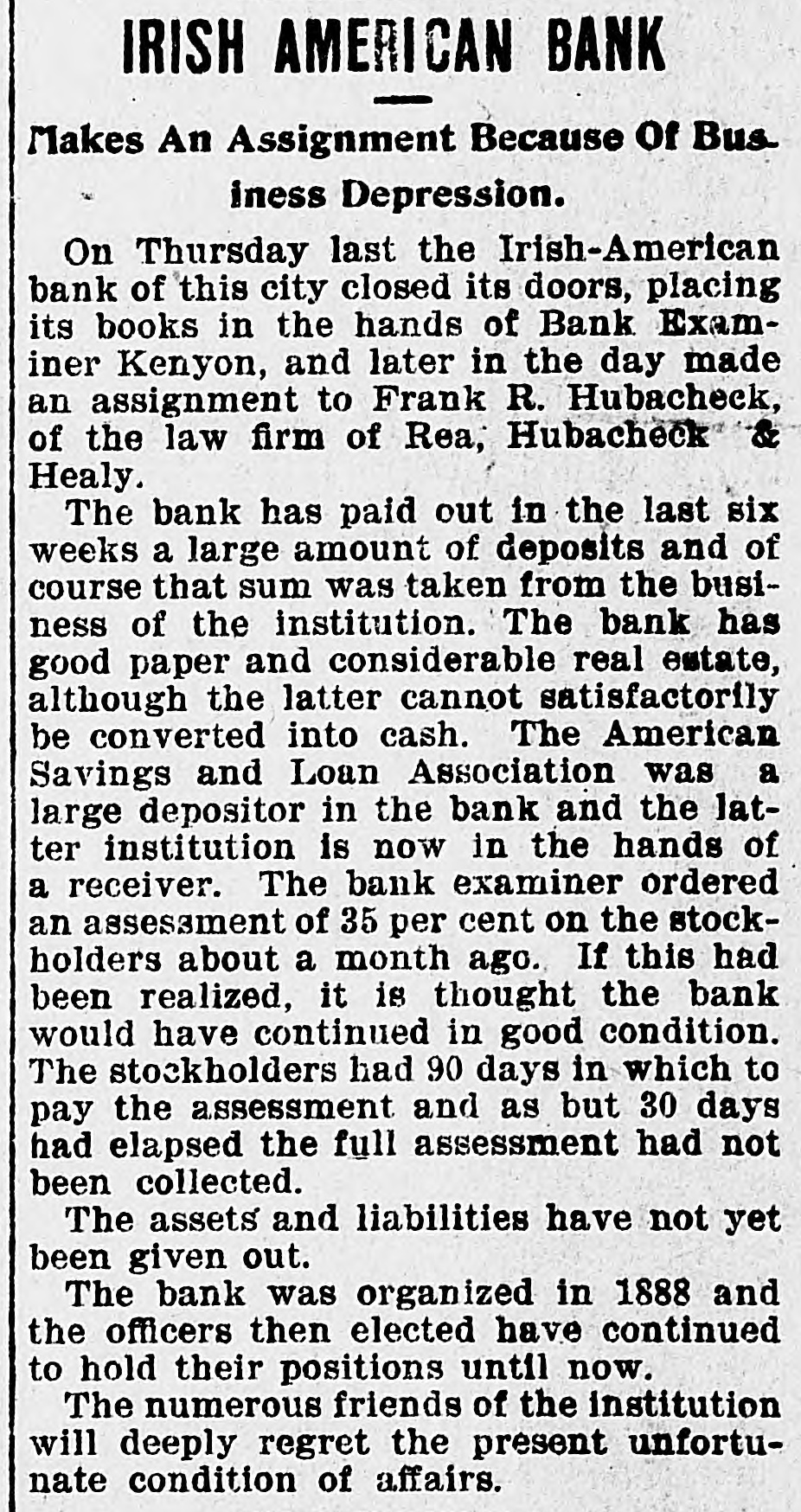
IRISH AMERICAN BANK I Makes An Assignment Because Of Bus. iness Depression. On Thursday last the Irish-American bank of this city closed its doors, placing its books in the hands of Bank Examiner Kenyon, and later in the day made an assignment to Frank R. Hubacheck, of the law firm of Rea, Hubacheck & Healy. The bank has paid out in the last six weeks a large amount of deposits and of course that sum was taken from the business of the institution. The bank has good paper and considerable real estate, although the latter cannot satisfactorily be converted into cash. The American Savings and Loan Association was a large depositor in the bank and the latter institution is now in the hands of a receiver. The bank examiner ordered an assessment of 35 per cent on the stockholders about a month ago. If this had been realized, it is thought the bank would have continued in good condition. The stockholders had 90 days in which to pay the assessment and as but 30 days had elapsed the full assessment had not been collected. The assets and liabilities have not yet been given out. The bank was organized in 1888 and the officers then elected have continued to hold their positions until now. The numerous friends of the institution will deeply regret the present unfortunate condition of affairs.


Article from The Weiser Signal, January 23, 1896

Click image to open full size in new tab

Article Text

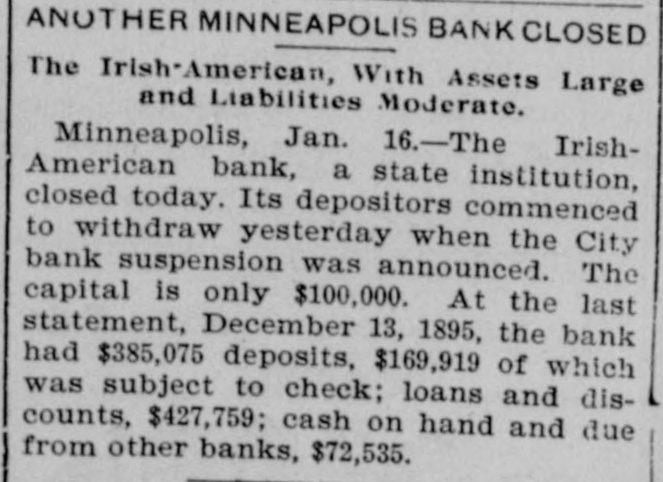
ANOTHER MINNEAPOLIS BANK CLOSED The Irish'American, With Assets Large and Liabilities Moderate. Minneapolis, Jan. 16.-The IrishAmerican bank, a state institution, closed today. Its depositors commenced to withdraw yesterday when the City bank suspension was announced. The capital is only $100,000. At the last statement, December 13, 1895, the bank had $385,075 deposits, $169,919 of which was subject to check; loans and discounts, $427,759; cash on hand and due from other banks, $72,535.


Article from The Pioneer Express, January 24, 1896

Click image to open full size in new tab

Article Text

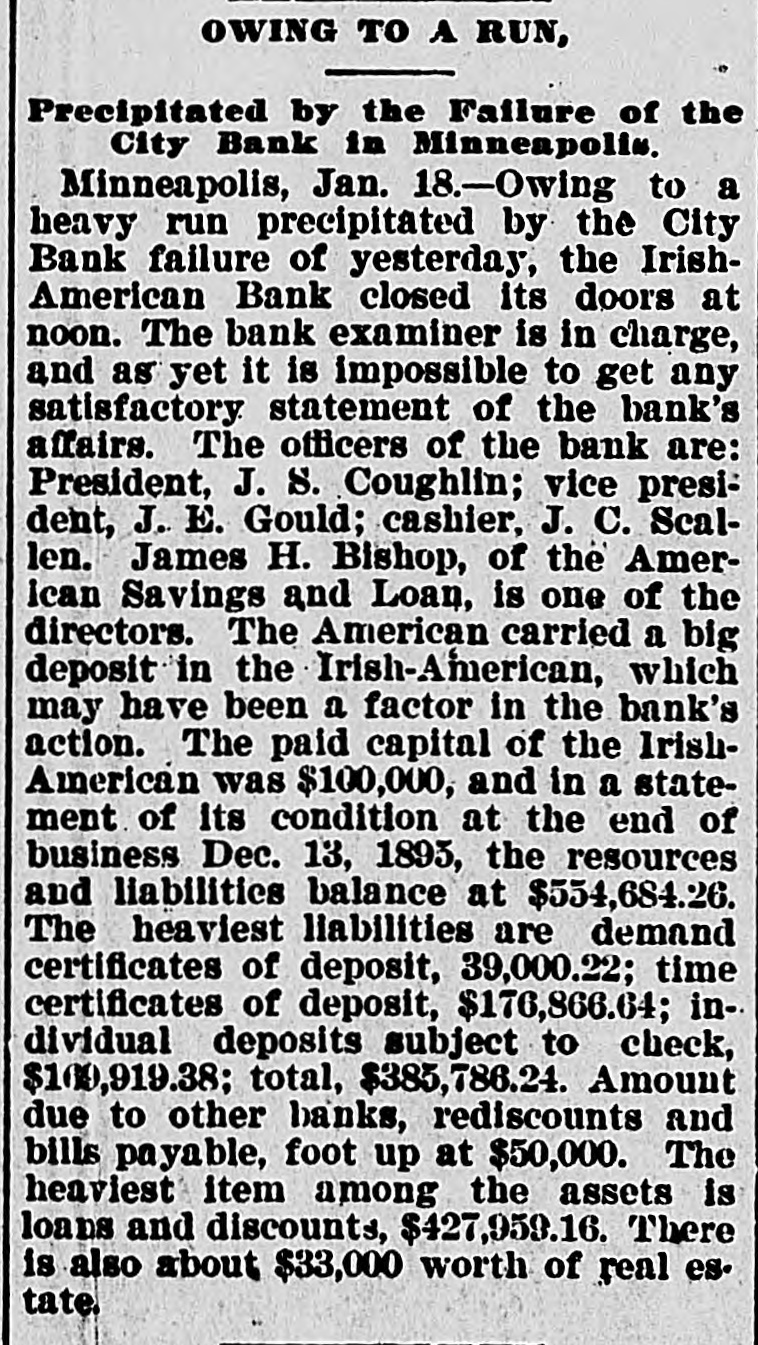
OWING TO A RUN, Precipitated by the Failure of the City Bank in Minneapolis. Minneapolis, Jan. 18.-Owing to a heavy run precipitated by the City Bank failure of yesterday, the IrishAmerican Bank closed its doors at noon. The bank examiner is in charge, and as yet it is impossible to get any satisfactory statement of the bank's affairs. The officers of the bank are: President, J. S. Coughlin; vice president, J. E. Gould; cashier, J. C. Scallen. James H. Bishop, of the AmerIcan Savings and Loan, is one of the directors. The American carried a big deposit in the Irish-American, which may have been a factor in the bank's action. The paid capital of the IrishAmerican was $100,000, and in a statement of its condition at the end of business Dec. 13, 1893, the resources and liabilities balance at $554,684.26. The heaviest liabilities are demand certificates of deposit, 39,000.22; time certificates of deposit, $176,866.64; individual deposits subject to check, $109,919.38; total, $385,786.24. Amount due to other banks, rediscounts and bills payable, foot up at $50,000. The heaviest item among the assets is loans and discounts, $427,959.16. There is also about $33,000 worth of real es. tate.


Article from St. Paul Daily Globe, January 28, 1896

Click image to open full size in new tab

Article Text

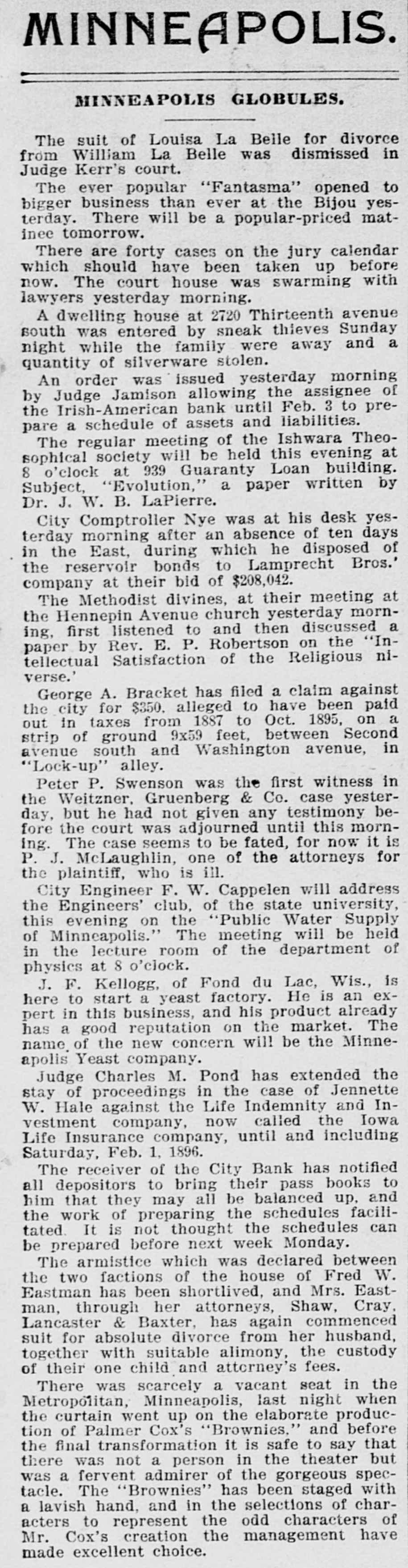
MINNEAPOLIS. MINNEAPOLIS GLOBULES. The suit of Louisa La Belle for divorce from William La Belle was dismissed in Judge Kerr's court. The ever popular "Fantasma" opened to bigger business than ever at the Bijou yesterday. There will be a popular-priced matinee tomorrow. There are forty cases on the jury calendar which should have been taken up before now. The court house was swarming with lawyers yesterday morning. A dwelling house at 2720 Thirteenth avenue south was entered by sneak thieves Sunday night while the family were away and a quantity of silverware stolen. An order was issued yesterday morning by Judge Jamison allowing the assignee of the Irish-American bank until Feb. 3 to prepare a schedule of assets and liabilities. The regular meeting of the Ishwara Theosophical society will be held this evening at 8 o'clock at 939 Guaranty Loan building. Subject, "Evolution," a paper written by Dr. J. W. B. LaPierre. City Comptroller Nye was at his desk yesterday morning after an absence of ten days in the East, during which he disposed of the reservoir bonds to Lamprecht Bros.' company at their bid of $208,042. The Methodist divines, at their meeting at the Hennepin Avenue church yesterday morning, first listened to and then discussed a paper by Rev. E. P. Robertson on the "Intellectual Satisfaction of the Religious niverse.' George A. Bracket has filed a claim against the city for $350, alleged to have been paid out in taxes from 1887 to Oct. 1895, on a strip of ground 9x59 feet, between Second avenue south and Washington avenue, in "Lock-up" alley. Peter P. Swenson was the first witness in the Weitzner, Gruenberg & Co. case yesterday, but he had not given any testimony before the court was adjourned until this morning. The case seems to be fated, for now it is P. J. McLaughlin, one of the attorneys for the plaintiff, who is ill. City Engineer F. W. Cappelen will address the Engineers' club, of the state university, this evening on the "Public Water Supply of Minneapolis." The meeting will be held in the lecture room of the department of physics at 8 o'clock. J. F. Kellogg, of Fond du Lac, Wis., is here to start a yeast factory. He is an expert in this business, and his product already has a good reputation on the market. The name of the new concern will be the Minneapolis Yeast company. Judge Charles M. Pond has extended the stay of proceedings in the case of Jennette W. Hale against the Life Indemnity and Investment company, now called the Iowa Life Insurance company, until and including Saturday, Feb. 1, 1896. The receiver of the City Bank has notified all depositors to bring their pass books to him that they may all be balanced up, and the work of preparing the schedules facilitated. It is not thought the schedules can be prepared before next week Monday. The armistice which was declared between the two factions of the house of Fred W. Eastman has been shortlived, and Mrs. Eastman, through her attorneys, Shaw, Cray, Lancaster & Baxter, has again commenced suit for absolute divorce from her husband, together with suitable alimony, the custody of their one child and attorney's fees. There was scarcely a vacant seat in the Metropolitan, Minneapolis, last night when the curtain went up on the elaborate production of Palmer Cox's "Brownies," and before the final transformation it is safe to say that there was not a person in the theater but was a fervent admirer of the gorgeous spectacle. The "Brownies" has been staged with a lavish hand, and in the selections of characters to represent the odd characters of Mr. Cox's creation the management have made excellent choice.


Article from St. Paul Daily Globe, February 4, 1896

Click image to open full size in new tab

Article Text

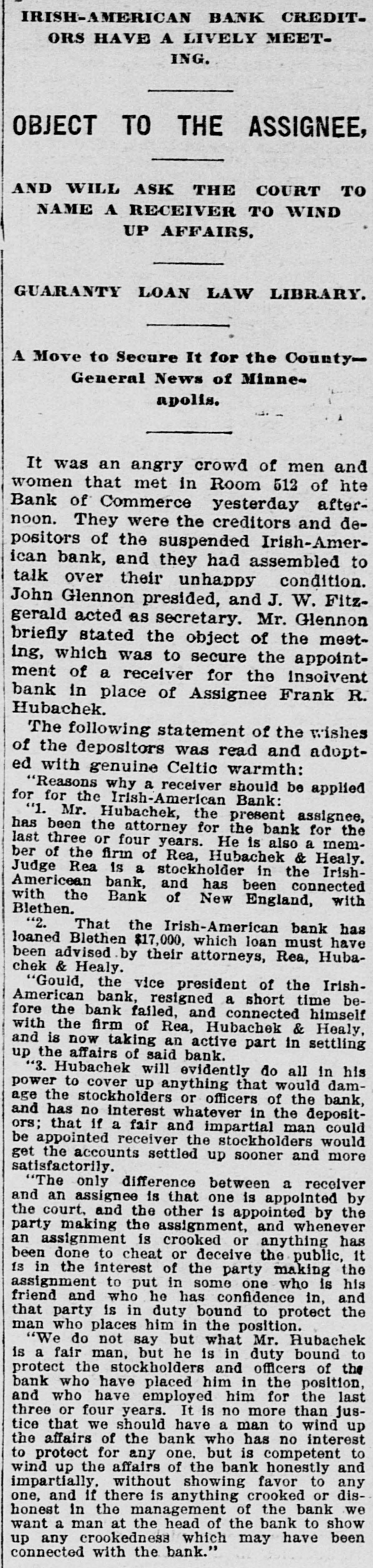
IRISH-AMERICAN BANK CREDITORS HAVE A LIVELY MEETING. OBJECT TO THE ASSIGNEE, AND WILL ASK THE COURT TO NAME A RECEIVER TO WIND UP AFFAIRS, GUARANTY LOAN LAW LIBRARY. A Move to Secure It for the CountyGeneral News of Minneapolis. It was an angry crowd of men and women that met in Room 512 of hte Bank of Commerce yesterday afternoon. They were the creditors and depositors of the suspended Irish-American bank, and they had assembled to talk over their unhappy condition. John Glennon presided, and J. W. Fitzgerald acted as secretary. Mr. Glennon briefly stated the object of the meeting, which was to secure the appointment of a receiver for the Insolvent bank in place of Assignee Frank R. Hubachek. The following statement of the wishes of the depositors was read and adopted with genuine Celtic warmth: "Reasons why a receiver should be applied for for the Irish-American Bank: "1. Mr. Hubachek, the present assignee, has been the attorney for the bank for the last three or four years. He is also a member of the firm of Rea, Hubachek & Healy. Judge Rea is a stockholder in the IrishAmericean bank, and has been connected with Blethen. the Bank of New England, with "2. That the Irish-American bank has loaned Blethen $17,000, which loan must have been advised by their attorneys, Rea, Hubachek & Healy. "Gould, the vice president of the IrishAmerican bank, resigned a short time before the bank failed, and connected himself with the firm of Rea, Hubachek & Healy, and is now taking an active part in settling up the affairs of said bank. "3. Hubachek will evidently do all in his power to cover up anything that would damage the stockholders or officers of the bank, and has no interest whatever in the depositors; that if a fair and impartial man could be appointed receiver the stockholders would get the accounts settled up sooner and more satisfactorily. "The only difference between a receiver and an assignee is that one is appointed by the court, and the other is appointed by the party making the assignment, and whenever an assignment is crooked or anything has been done to cheat or deceive the public, 1t 18 in the interest of the party making the assignment to put in some one who is his friend and who he has confidence in, and that party is in duty bound to protect the man who places him in the position. "We do not say but what Mr. Hubachek is a fair man, but he is in duty bound to protect the stockholders and officers of the bank who have placed him in the position, and who have employed him for the last three or four years. It is no more than justice that we should have a man to wind up the affairs of the bank who has no interest to protect for any one. but is competent to wind up the affairs of the bank honestly and impartially. without showing favor to any one, and if there is anything crooked or dishonest in the management of the bank we want a man at the head of the bank to show up any crookedness which may have been connected with the bank."


Article from St. Paul Daily Globe, February 11, 1896

Click image to open full size in new tab

Article Text

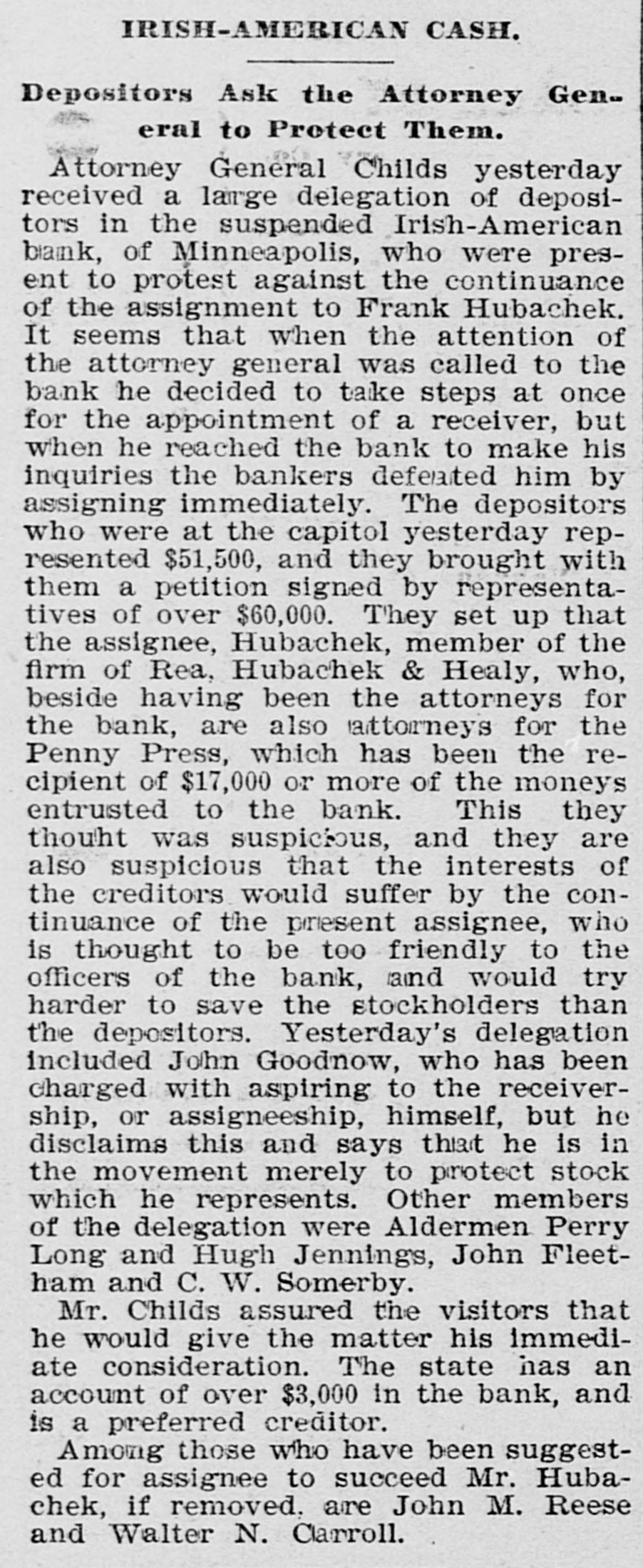
IRISH-AMERICAN CASH. Depositors Ask the Attorney General to Protect Them. Attorney General Childs yesterday received a large delegation of depositors in the suspended Irish-American bank, of Minneapolis, who were present to protest against the continuance of the assignment to Frank Hubachek. It seems that when the attention of the attorney general was called to the bank he decided to take steps at once for the appointment of a receiver, but when he reached the bank to make his inquiries the bankers defeated him by assigning immediately. The depositors who were at the capitol yesterday represented $51,500, and they brought with them a petition signed by representatives of over $60,000. They set up that the assignee, Hubachek, member of the firm of Rea, Hubachek & Healy, who, beside having been the attorneys for the bank, are also attorneys for the Penny Press, which has been the recipient of $17,000 or more of the moneys entrusted to the bank. This they thouht was suspicious, and they are also suspicious that the interests of the creditors would suffer by the continuance of the present assignee, who is thought to be too friendly to the officers of the bank, and would try harder to save the stockholders than the depositors. Yesterday's delegation included John Goodnow, who has been charged with aspiring to the receivership, or assigneeship, himself, but he disclaims this and says that he is in the movement merely to protect stock which he represents. Other members of the delegation were Aldermen Perry Long and Hugh Jennings, John Fleetham and C. W. Somerby. Mr. Childs assured the visitors that he would give the matter his immediate consideration. The state has an account of over $3,000 in the bank, and is a preferred creditor. Among those who have been suggested for assignee to succeed Mr. Hubachek, if removed, are John M. Reese and Walter N. Clarroll.


Article from St. Paul Daily Globe, February 11, 1896

Click image to open full size in new tab

Article Text

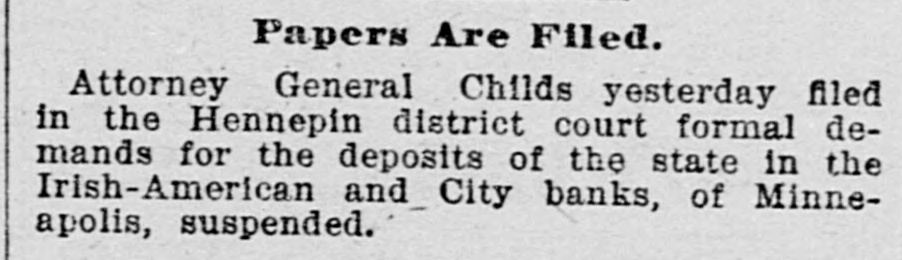
Papers Are Filed. Attorney General Childs yesterday filed in the Hennepin district court formal demands for the deposits of the state in the Irish-American and City banks, of Minneapolis, suspended.


Article from The Irish Standard, February 15, 1896

Click image to open full size in new tab

Article Text

$442,831.62 $255,946.07 SUMMARY OF LIABILITIES. $86,748.98 Individual deposits Certificates of deposit-demand 66,406.19 171,959.38 Certificates of deposit-time 3,872.29 Due county banks Certified checks outstand1,671.00 ing 14.00 Dividends unpaid Assessment account 2,275.00 8.39 Accounts payable 296.64 Balance account Labor account 245.83 Re-discounts 3,500.00 $386,997.70 On Thursday afternoon Assignee Hubachek filed with the clerk of the court the statement of assets and liabilities of the Irish American Bank. The showing that this report makes is not as bad as it was expected to be. It has been common talk on the streets that the liabilities would exceed $550,000, while the report of the assignee makes the amount $337,000, a difference in favor of the creditors of $213,000. The face value of the assets is $442,000, but these when scaled down to an actual cash value foot up $255,946.07, leaving an actual shortage of $82,000 in the amount necessary to pay the bank's liabilities in full at the present time Mr. Hubachek will endeavor to realize in the shortest time possible as much as possible on the assets as set forth and believes that very favorable results can be obtained. After collecting in all that can be secured from those owing the bank, the stockholders will be called upon to pay up the amounts they are liable for according to law. In the summary of assets It will be noticed that the face value of bills receivable is $218,000. This amount, which consists mainly of notes due the bank has been cut down to an actual cash value of $63,000, showing an apparent loss of $155,000 since the bank commenced business, presumably caused by a number of bad loans at different times, while it is possible that of this amount something may yet be realized, it is evident that the assignee is not over confident in that direction. Another large item of the assets is the $156,000 in notes given to the American Building and Loan Association as security on loans made by the bank from that institution. As this amount is scaled down but $12,000 to make the cash value it is very evident that the American Building and Loan Association amply secured itself for the amount of cash it furnished the bank. The Building and Loan Association being now in the hands of a receiver, W. D. Hale, that gentleman has been made defendant in a suit brought by Asisgnee Hubachek for the recovery of these securities, and with every hope of success. If these securities are returnable to the bank where they properly belong it is thought that before the end is reached the creditors will stand a good show of being paid almost in full. In view of the charges that have been made by a number of the creditors of the bank, a detailed examination of the scedules is interesting. The first list of assets includes the notes and bills in the bank. Thomas E. Bishop has several notes there amounting to $5,008.79. These are secured by 23 shares of IrishAmerican bank stock. Alden J. Blethen and Rose A. Blethen have notes of $426 29. $47. 80 and $95.60. These are secured by note of William B. Murray for $2,000, dated March 14. upon which $1,566.06 has been paid; also life insurance policies. @ Other notes are given by the Penny Press Publishing Company, by Peter Sutherland and A. J. Blethen, to the amount of $15,000. The actual value of these is placed at $5,000 in the schedule. They are secured by bonds 1 to 60 of the Penny Press Company, claimed to be worth $30,000, and by policy number D. 54,690, Fidelity Mutual Life Company, and No. 63,906 Massachusetts Benefit Life. Among the notes left with the American Savings and Loan Association is one for $15,000 given by George S. Canfield, city editor of the Penny Press. This is secured by mortgage of $15,000 on town and city lots. The taxes for the last four years on this property amount to $1,228.07. One note of James H. Bishop is for $2,764. The bank also holds notes given by J. R. Corrigan and Alice Corrigan for $7,940, secured by life insurance policies. Other notes amounting to .430.52 are given by the Minneapolis Envelope Company, by J. H. B,shop, president, the valne of which is stated at $3,500. Other interesting notes are those given by Matt Walsh and the Matt Walsh Wine Company. amounting in all to $24,165. They are secured by trust deed to J. H. Bishop, trustee. The personal liability of Matt Walsh and the wine company has been released. Edward Walsh has notes there for $13,330, secured by 150 shares in the Matt Walsh Wine Company. The list of notes held by the bank is too lengthy to publish, but the following are some of the larger credits which the bank has: John Allison $55.07 Dr. John P. Barber 5,000.00 Π». C. Bausman 57.80 Morris J. Hartinet 45.23 L. 0. Leonard 17.50 A. J. Boardman 1,025.00 F. H. Boardman 3,097.00 1,367.00 W M. Brackett W. M. and Emily Brackett 616.00 400.00 The Builder Publishing Company Clark Dickinson Furniture Com8,000.00 pany D. C. Cole 2,500.00 B. Cloutier and Ellen Cloutier 1,300.00 1.435.00 F.E. Crary C.W. Darling 1,233.00 Diamond Lithographing Com-


Article from St. Paul Daily Globe, February 18, 1896

Click image to open full size in new tab

Article Text

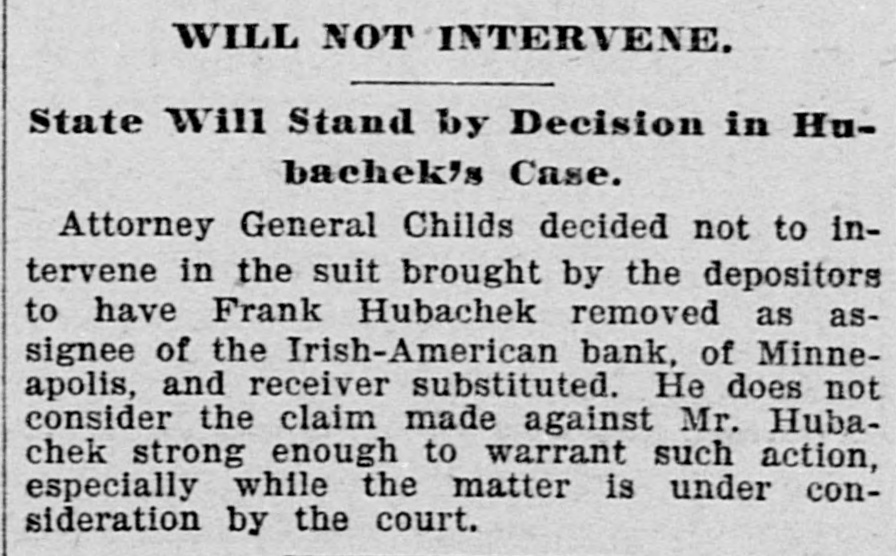
WILL NOT INTERVENE. State Will Stand by Decision in Hubachek's Case. Attorney General Childs decided not to intervene in the suit brought by the depositors to have Frank Hubachek removed as assignee of the Irish-American bank, of Minneapolis, and receiver substituted. He does not consider the claim made against Mr. Hubachek strong enough to warrant such action, especially while the matter is under consideration by the court.


Article from Willmar Tribune, March 10, 1896

Click image to open full size in new tab

Article Text

NEWS IN MINNESOTA A Rebekah lodge has been established at Amboy. Sisters of St. Benedict will build a new hospital at Duluth. Williard S. Dennis, a leading cigar dealer of St. Paul, has assigned. The senate bill giving Fergus Falls a federal building has been reported favorably. The ladies of St. Paul will begin a war against high hats at theatrical performances. A lamp explosion in the postoffice at Minneota considerably damaged the mail on hand. An interesting immigration convention was held at Fergus Falls. J. J. Hill and E. V. Smalley were among the speakers. George W. Somerville, a prominent attorney of Sleepy Eye, announces himself a candidate for congress from the Second district. State Auditor Dunn has gone to Hot Springs, Ark., in the hope that he will recover from the effects of a severe attack of the grip. A letter received from Young America, Ind., says that a large colony is being organized there to emigrate to the Red Lake Indian reservation. The grand encampment of Minnesota Odd Fellows was held at Minneapolis. W. W. Trafton of Faribault was elected grand patriarch of the grand lodge. William E. Lee, formerly warden of the St. Cloud reformatory, has announced his candidacy for the Republican nomination for governor of Minnesota. Congressman Towne has secured favorable report from the war department upon the proposed construction of a bridge across the Mississippi river at Aitkin. Dr. David Day is seriously ill at his residence in St. Paul. He has been long afflicted with chronic bronchitis, which of late has become complicated with an ailment of the heart. John A. Hartigan, grand regent of the grand council, Royal Arcanum of Minnesota, has issued a circular, calling the annual meeting of the grand council at the Bowiby block, St. Paul, March 24. United States Marshal O'Connor has appointed Robert G. Beaulieu of White Earth deputy marshal in the place of E. H. Funk, who has resigned. Deputy Beaulieu will have charge of some of the work in the Indian reservations. The directors of the State Agricultural school will hold a summer school for girls, with a term of six weeks, beginning April 28. Accommodations will be provided for between 200 and 300 girls. The six judges of the Hennepin district court have united in a decision removing F. R. Hubachek as assignee of the Irish American bank, and have appointed Judge Mahoney in his place. The opinion scores the management of the bank. The Minneapolis term of the United States courts has been postponed from March 3 to March 17, and the Fergus Falls term to April 6. Judge Thomas of Deadwood, S. D., will open the Minneapolis term of court in the absence of Judge Nelson. The Swedish Lutheran church of Worthington has expelled 10 members for belonging to the A. O. U. W., it being contrary to the tenets of the church for members to belong to secret societies. There is much bitter feeling over the matter. A peculiar pension bill was passed by the senate, pensioning Christopher Schmidt, a private citizen of St. Paul, at $40 per month because of blindness resulting from a shot striking him while he chanced to pass before the rifle range at Fort Snelling. The remaining indictment against M. Kauffman and Dave B. Yezner, the Ely merchants, who were indicted on a charge of securing from St. Paul merchants goods on credit on the strength of misrepresentations alleged to have been made regarding their financial condition, has been dismissed. Preparations are being made by the state game and fish commission for an active warfare against those who fish during March and April. All fishing during those months is prohibited in this state and the commissioners will enforce the law rigidly this year. Previously a great deal of leniency has been shown, but it will not be so this season. The law allows dealers five days in which to dispose of stock on hand


Article from Mineral Point Tribune, March 12, 1896

Click image to open full size in new tab

Article Text

DOMESTIC. Archbishop Kendrick, St. Louis, is dead, aged 83. Charles L. Colby, the railroad man, died in New York. Lord Dunraven is expelied by the New York Yacht club. President Cleveland is to have a duck preserve of his own. The Seventh district immigration convention is a "hummer." The old receivers of the Northern Pacific filed their last report. Prohibition is killed for five years, at least, by the Iowa house. At Sleepy Eye, Minn J. N. Montgomery, aged 71, is dead. Republican National Committeeman Campbell, of Illinois, is dead. Horseless mail wagons will shortly be used in all the large cities. Considerable snow comes down in Montana and the Dakotas. Much damage has been inflicted along the Hudson by an ice gorge. Arthur Gough has been appointed postmaster at Chippewa Falls, Wis. Judge Ewing, of Chicago, rules that a city can fix fares on street railroads. Richard Little, who was injured in the mines at Houghton, Mich., has died. A fire at Stockton, III., destroyed many business houses and residences; loss $40,000. Frank Bates, of Stanford Station, Conn., shot and killed himself in Bridgeport. The official dock trial of the torpedo boat Ericsson was begun at New London, Conn. The postoffice at Footville, Wis., was broken open by unknown thieves, who secured $275 in stamps. The house committee on agriculture has begun hearings in opposition to the anti-option bill. A [ lke is threatened on the street car lines of all the grΓ©at eastern cities, Chicago and Milwaukee. There are only 200 cats at the New York show. Trick cats are a feature. The prizes amount to $1,500. At Cloquet, Minn., Benj. Dietz, manager of the slate quarry, was fatally injured by a dynamite explosion. Geese and ducks in large swarms have been seen flying north in the last few days all over the northwest. Aristide Griffel. of La Crosse, Wis., pleaded guilty to incendiarism and was given a sentence of six years. President N. C. Hill, of Jewell Lutheran college, Iowa, is dead. He was active in educational work for years. At Olivia, Minn., Strong & Miller's elevator and flat house were consumed by fire and 5,000 bushels of grain was lost. Mr. Hubachek is removed as receiver of the Irish-American bank, Minneapolis, and Judge Maheny succeeds him. Theodore Harper, aged fourteen, of Astoria, N. Y., accidentally discharged a rifle and killed his younger brother, Fletcher. A mass meeting of labor people and others in New York protest against the proposed appropriation for coast defenses. At Joliet, III., a jury has been secured in the Preston-Curtin murder trial and witnesses are being examined. President Cleveland presided at the mass meeting in New York in the interest of the Presbyterian home missions. Resolutions recognizing the Cubans as belligerents are reported in the house and received with much enthusiasm. Rev. J. H. Lippard. of Rockford. has accepted a call to the pastorate of the First Congregational church at Shopiere, Wis. Captain J. E. Braden, founder of the Northern Indiana regulators, has called the survivors to meet in Ligonier. April 15. Andrew Wharton murdered his wife Louisa, in St. Louis, cutting her throat while she was asleep. Jealousy was the cause. Clara Barton writes that she is given a cordial welcome and that much is being done by officials to help her mission. Congressman Tawney fails in an at-


Article from Wood County Reporter, March 12, 1896

Click image to open full size in new tab

Article Text

TELEGRAMS IN BRIEF. DOMESTIC. Archbishop Kendrick, St. Louis, is dead, aged 83. Charles L. Colby, the railroad man, died in New York. Lord Dunraven is expelled by the New York Yacht club. President Cleveland is to have a duck preserve of his own. The Seventh district immigration convention is a "hummer." The old receivers of the Northern Pacific filed their last report. Prohibition is killed for five years, at least, by the Iowa house. At Sleepy Eye, Minn J. N. Montgomery, aged 71, is dead. Republican National Committeeman Campbell, of Illinois, is dead. Horseless mail wagons will shortly be used in all the large cities. Considerable snow comes down in Montana and the Dakotas. Much damage has been inflicted along the Hudson by an ice gorge. Arthur Gough has been appointed postmaster at Chippewa Falls, Wis. Judge Ewing, of Chicago, rules that a city can fix fares on street railroads. Richard Little, who was injured in the mines at Houghton, Mich., has died. A fire at Stockton, III., destroyed many business houses and residences; loss $40,000. Frank Bates, of Stanford Station, Conn., shot and killed himself in Bridgeport. The official dock trial of the torpedo boat Ericsson was begun at New London, Conn. The postoffice at Footville, Wis., was broken open by unknown thieves, who secured $275 in stamps. The house committee on agriculture has begun hearings in opposition to the anti-option bill. A & rike is threatened on the street car lines of all the great eastern cities, Chicago and Milwaukee. There are only 200 cats at the New York show. Trick cats are a feature. The prizes amount to $1,500. At Cloquet, Minn., Benj. Dietz, manager of the slate quarry, was fatally injured by a dynamite explosion. Geese and ducks in large swarms have been seen flying north in the last few days all over the northwest. Aristide Griffel, of La Crosse, Wis., pleaded guilty to incendiarism and was given a sentence of six years. President N. C. Hill, of Jewell Lutheran college, Iowa, is dead. He was active in educational work for years. At Olivia, Minn., Strong & Miller's elevator and flat house were consumed by fire and 5,000 bushels of grain was lost. Mr. Hubachek is removed as receiver of the Irish-American bank, Minneapolis, and Judge Maheny succeeds him. Theodore Harper, aged fourteen, of Astoria, N. Y., accidentally discharged a rifle and killed his younger brother, Fletcher. A mass meeting of labor pèople and others in New York protest against the proposed appropriation for coast defenses. At Joliet, III., a jury has been secured in the Preston-Curtin murder trial and witnesses are being examined. President Cleveland presided at the mass meeting in New York in the interest of the Presbyterian home missions. Resolutions recognizing the Cubans as belligerents are reported in the house and received with much enthusiasm. Rev. J. H. Lippard, of Rockford, has accepted a call to the pastorate of the First Congregational church at Shopiere, Wis. Captain J. E. Braden, founder of the Northern Indiana regulators, has called the survivors to meet in Ligonfer, April 15. Andrew Wharton murdered his wife Louisa, in St. Louis, cutting her throat while she was asleep. Jealousy was the cause. Clara Barton writes that she is given a cordial welcome and that much is being done by officials to help her mission. Congressman Tawney fails in an attempt to have a $100 a month the year through appropriated for members' clerks. A joint resolution authorizing the erection of a statue of Francis E. Spinner at the treasury department has passed the house. Ellis Jacobs, aged eleven, fearing a promised whipping, ran away from his


Article from The Irish Standard, April 18, 1896

Click image to open full size in new tab

Article Text

IRISH-AMERI AN BANK Further Matters in Connection With the Defunct Institution. Ever since the Iriah-American bank assigned, creditors of the defunct instituto have heard something of a large tion of real estate said to be transferred lot one of the directors during the year It and by a half preceding the assignment. has been hinted that Assignee Mahoney bewould give the matter his attention the estate was finally settled up in fore effort to secure the setting aside of an It is probable that he will dow the trouble. Monday Wm. C. Baxter, who recently the be saved deeds. began afternoon the of sensational suits against the directors the corporation, secured a writ of attach- the ment on the property and filed it with register of deeds. This writ is directed against Jerry Rea, Coughlin, Michael W. Nash, John P. Frank W. Shaw, James H. Bishop, Thos. E. E. Bishop, Joseph Scallen and John Gould. In the affidavit, the plaintiff from sets "the debts due the plaintiff and each up the that said defendants, of the them, part fraudulently contracted on and that Nash, has of ant, was said Michael defendants, assigned, the defend- secrety ined and disposed of his property with tent to delay and defraud his creditors." The property attached includes a number of lots in Bradford & Lewis' addition and in Atwater's addition. The amount at of the claim of the plaintiff is fixed in $30,000, and the same amount stated the action, and the property is said to be of about the same or of more value. The suit commenced by Baxter was sensational, in that it charged the directors and officers of the bank with having acted fraudulently and with having misrepresented the condition of the bank to a such an extent that he deposited of money. It was him large to sum directors commenced on individually against the the these grounds. The attachment of real estate property will involve several be important questions. First, it will required to show that the original transNash and others was fraudand it is claimed ulent fer from or illegal, M. thing that to this do. will be a somewhat difficult that the will arise or not If the it question is shown transfer whether is void, the claim of Baxter is a valid one, and whether or not the property should be inclosed in the estate of the insolvent bank, or is individually that of the directors. The step is an important one in the Irish-American bank litigation, and will be watched with interest by stockholders and creditors. Mr. Nash denies many of the allegations made in the above complaint and says he proposes to commence an action without delay. He has secured the services of Frank Hubachek, and on Tuesday they were in the office of the county treasurer after evidence. They propose going after W. C. Baxter and others who it is claimed traduced Nash, and make them suffer to the extent of several thouMr. Nash claims that his have made accusers sand dollars. statements will that are utterly false, and he says he prove of them so. He they has transferred his every say he word property claims and to his family, when he has not done so, in proof of this he waived a large bundle of tax statements which show that he pays taxes upon more than $100,000 worth of city property, and that the property deeded to his daughters does not exceed $5,800 in value. Nash claims that he owns a piece on First street of worth every cent of Mr. property and $75,000, Nicollet be12 quarter-acre pieces sides avenue inside $100,000, of Ninth avenue south, worth which the assessor values on his lists at $83,000. In the face of this he says his traducers secure attachments against him, and papers print the fact repeatedly, after it has become news that is old. "I am in this city to stay," said Mr. Nash, "and I am going to live and die here. This has got to stop. I have lived here for 36 years and never owed a man a dollar, and never had one judgment against me, and I intend to see if people I can jump on me as if I was a criminal. have suffered on account of the IrishAmerican bank, and I intend to stand loss like a man, which is more than some my of these people are doing. I had no ] time to attend to its matters because for the public, and seeing needs were properly that was its working several attended thou- to For that reason I have lost sand dollars. I will fight this matter now, and see what they think of that."