Atlanta Bank (Atlanta, GA)

Episode Information

Episode UID
91890190669
Episode Type
Run Only
Bank Type
state
Bank ID
9189019 hash
Start Date
September 25, 1855
Location
Atlanta, Georgia (33.749, -84.388)

Metadata

Model
gpt-5-mini (chosen from majority vote of a three-model LLM ensemble)
Short Digest
1733f699109908b0

Response Measures

None

Description

Multiple reports describe organized redemptions from Chicago and protested notes; no clear evidence of a formal suspension or receivership in these items.

Events (1)

1. September 25, 1855 Run
Cause
Local Banks
Cause Details
Organized demands and large shipments of Georgia/Atlanta notes from Chicago and other Western banks forcing redemption at Atlanta
Measures
Paid large redemptions in specie when presented; counted and partially paid demands during banking hours
Newspaper Excerpt
We have just put the Atlanta under protest for $4,900... they closed the bank, leaving unpaid $4,900
Source
newspapers

Newspaper Articles (12)

Article from Washington Sentinel, October 4, 1853

Click image to open full size in new tab

Article Text

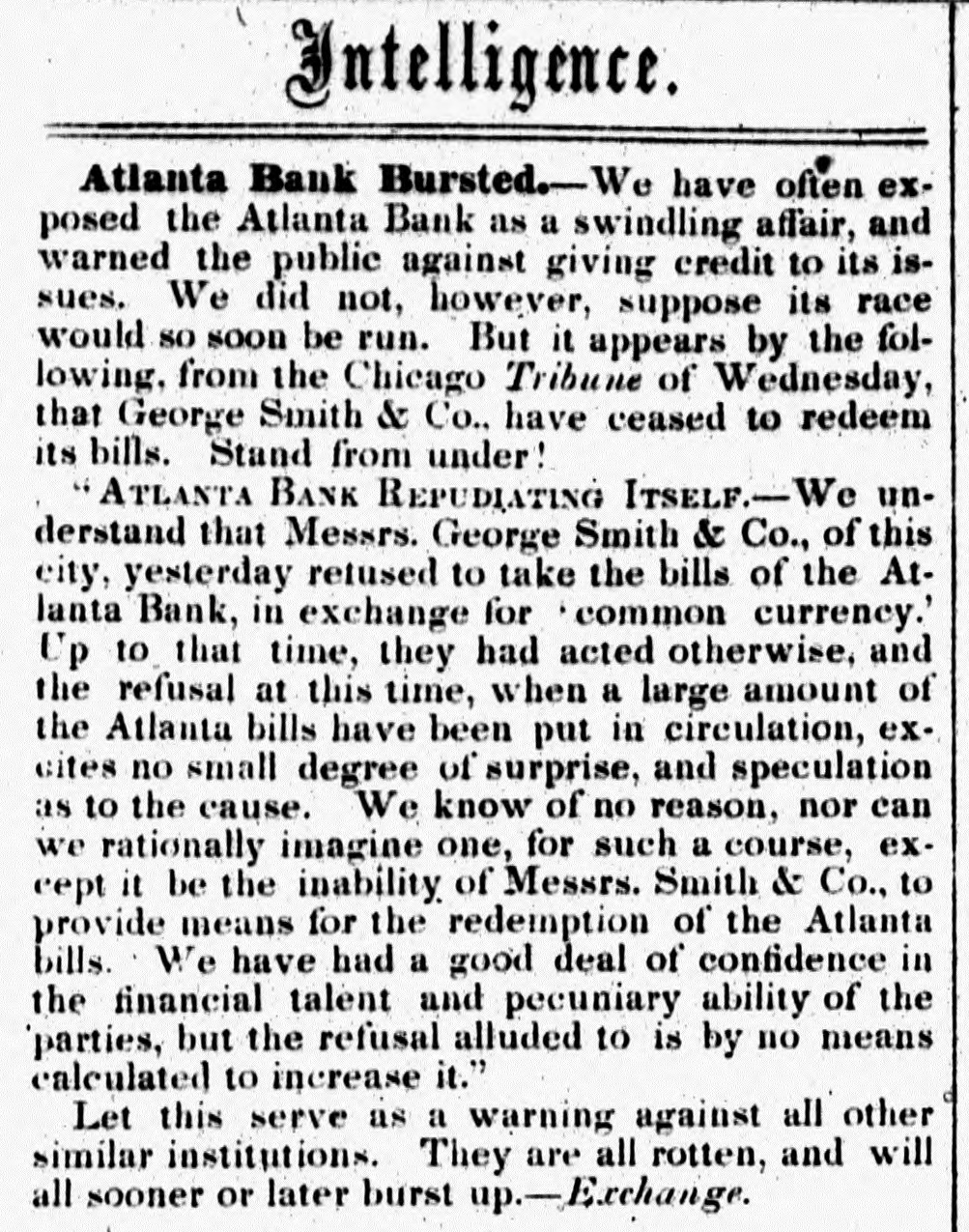
Intelligence. Atlanta Bank Bursted.-We have often exposed the Atlanta Bank as a swindling affair, and warned the public against giving credit to its issues. We did not, however, suppose its race would so soon be run. But it appears by the following, from the Chicago Tribune of Wednesday, that George Smith & Co., have ceased to redeem its bills. Stand from under! "ATLANTA BANK REPUDIATING ITSELF.-We understand that Messrs. George Smith & Co., of this city, yesterday retused to take the bills of the Atlanta Bank, in exchange for common currency.' Up to that time, they had acted otherwise, and the refusal at this time, when a large amount of the Atlanta bills have been put in circulation, excites no small degree of surprise, and speculation as to the cause. We know of no reason, nor can we rationally imagine one, for such a course, except it be the inability of Messrs. Smith & Co., to provide means for the redemption of the Atlanta bills. We have had a good deal of confidence in the financial talent and pecuniary ability of the parties, but the refusal alluded to is by no means calculated to increase it." Let this serve as a warning against all other similar institutions. They are all rotten, and will all sooner or later burst up.-Exchange.


Article from Minnesota Weekly Times, October 3, 1854

Click image to open full size in new tab

Article Text

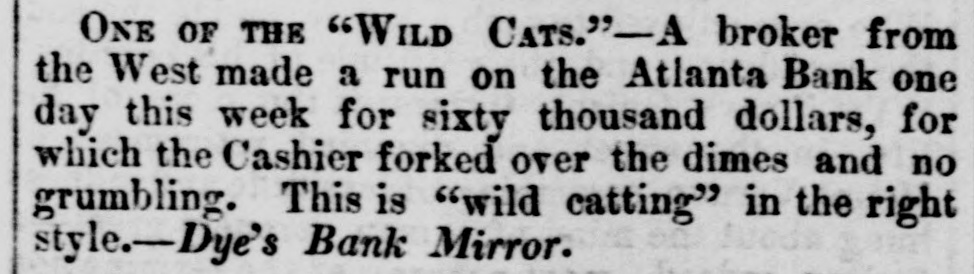
ONE OF THE "WILD CATs."-A broker from the West made a run on the Atlanta Bank one day this week for sixty thousand dollars, for which the Cashier forked over the dimes and no grumbling. This is "wild catting" in the right style.-Dye's Bank Mirror.


Article from The Daily Minnesota Pioneer, December 12, 1854

Click image to open full size in new tab

Article Text

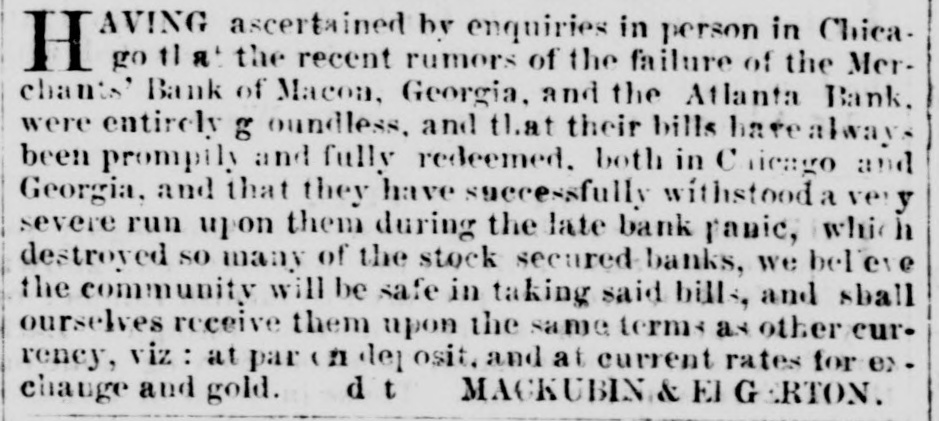
AVING ascertained hv enquiries in person in Chica. H go 11 a' the recent rumors of the failure of the Merchants' Bank of Macoa, Georgia, and the Atlanta Bank. were entirely g oundless, and that their bills have always been promptly and fully redeemed. both in Chicago and Georgia, and that they have successfully withstood a ver y severe run upon them during the late bank ranic, whi h destroyed so many of the stock secured banks, we bel'eve the community will be safe in taking said bills, and shall ourselves receive them upon the same terms as other currency, viz : at par on de and at current rates for ex MACKUBINA El G RTON. change and gold.


Article from Daily Davenport Gazette, August 24, 1855

Click image to open full size in new tab

Article Text

Atlanta Bank. The R. I. Adv. of Wednesday contains the following paragraph. Atlanta money, so sbundant recently, is becoming scarcer in our city. We pr sume its basis is quite as firm as any of the Georgia issues, and regret that we have not good Iowa bank notes to take its place: "A gentleman from Chicago, whose in formation is undoubted and whose veracity is unquestionable, informs us that the run on the Atlanta Bank is a thoroughly organized affair, embracing an amount of means and influence, under which the bank muet yield, and withdraw its circulation, at least. Two hundred and fifty thousand dollars of its notes are now on the way from Chicago to Atlanta for redemption, and three hundred thousand more are lying in Chicago awaiting the recovery of the bank, so that they also can be sent. The object is not to break the institution, but to force it to wind up. Its circulation is two millions of dollars for which the bill holder has no security except George Smith, and that only so long as he chooses to own the charter ! He may sell it at any moment and the bank may be. come worthless. We deem our duty to place the public here upon its guard in this matter."


Article from The Weekly Minnesotian, August 25, 1855

Click image to open full size in new tab

Article Text

STAND FROM UNDER.-It is currently reported that demands to a large amount are being constantly made upon the ATLANTA BANK for a redemption of its present bi'ls in specie. Thus far the requisitions have been promptly met, we learn. by this Institution, which we presume has the means at command to sustain itself against a more extended run upon its circulation, though there are but few who can tell how far its distance is to the end of the rope. Of course, this parent of all the Georgian wild cats will endeavor to sustain its own ex+ istence, though it be at the expense of the entire litter of the younger brood, and hence we consider it sane advice to suggest to our friends to keep as clear as possible from entangling alliances with this species of moneyed representation. It may do to pass, but we do not consider it over safe to keep.-Chi. Journal.


Article from Demoine Courier, August 30, 1855

Click image to open full size in new tab

Article Text

Mr. George Smith seems to be experiencing considerable trouble with bis Atlanta Bank. The institution is lo cated in Georgia, but its business is trunsacied in Chicago, where the people are running home the circulation. The manager of the office there, it seems, re. deems, too, notes with Exchange, charging for the latter a higher rate of premium than other banks. This kind of redemption the people very properly protest against. Mr. Smith's Banking must be profitable, otherwise he would not persevere 80 fiercely against the public opinion.-Cin. Gazette.


Article from Minnesota Weekly Times, September 4, 1855

Click image to open full size in new tab

Article Text

A Chicago paper announces that a run has been commenced on the Atlanta Bank, and will be continued until all the Georgia shinplasters are driven out of circulation. $147,900 has already been drawn, and $250,000 more will soon be demanded. The Bank of Galena and the Bank of Mineral Point are the main drawers. They are backed by two leading houses in Chicago.


Article from Weekly Hawk-Eye and Telegraph, September 19, 1855

Click image to open full size in new tab

Article Text

GEORGIA MONEY.-The run continues on the Interior and Atlanta Banks. Upwards of half a million have been sent home during the past week. How this will result we are not able to determine. If it should introduce a safer and better corrency the people will be satisfied; but if it creates a panic, and depree ates the value of produce which it is likely to do, the mischief will be immense.-[Sterling Times.


Article from Daily Davenport Gazette, September 24, 1855

Click image to open full size in new tab

Article Text

GEORGIA Money.-The run continues on the Interior and Atlanta Banks. Upwards of halfa million have been sent home during the past week. How this will result we are not able to determine. If it should introduce a safer and better currency the people will be satisfied; butif it creates & panic, and depreciates the value of produce which it is likely to do, the mischief will be immense.


Article from The New York Herald, October 2, 1855

Click image to open full size in new tab

Article Text

40 per cent, and there are people who hold New York Central now at 95 per cent, who a year or two hence will not touch it at 75 per cent. Confidence is a very important element in the stock market, and many a stock has been sustained by it long and long after its real value had been extracted by the speculating leeches who fastened upon it in its early days. The Sub-Treasury is steadily drawing specie into its vaults. The Assistant Treasurer reports to-day as follows:Paid on Treasury account $55,139 82 Received do. 120,845 51 Balance do. 7,225,383 24 Paid on disbursing checks 94,853 56 The payments to-day include $45,000 on California drafts. Telegraphic dispatches were received on Saturday to the effect that the notes of the Atlanta Bank had been protested. Under what circumstances will be seen by notes from the two parties:ATLANTA, Ga., Wednesday, Sept. 26. To Geo. Smith & Co.-A quantity of notes were present. ed yesterday morning by Washburn. We counted and paid $29,000. At the close of banking hours the balance uncounted was protested. We are advised by the best legal counsel in the city that we have claim for heavy damages. Shall we hold Washburn to bail? S. C. HIGGINSON, President. ATLANTA, Tuesday, Sept. 25, 1855. We have just put the Atlanta under protest for $4,900, We presented of this money for payment to-day $33,865, and gave notice that we should insist upon that amount being paid to us during banking hours. Of this they only counted $10,000 before dinner; and when the bank opened in the afternoon, (2 o'clock,) we took a notary to the bank, who demanded the payment of the balance of the amount before the closing of the bank. They then proceeded to count very slowly until 4 o'clock, when they closed the bank, leaving unpaid $4, 900; which the notary is now protesting. When protested it will be expressed to you to have suit instituted against the owners. At the time of closing they ordered us out of the bank. The Washburn referred to is the Hon. E. B. Washburn, member of Congress from Illinois. The Chicago Tribune of the 22d of September, has the following items about " poor money going and good money coming:"A gentleman from Galena left here on Thursday even. ing for Atlanta, with a big sack full of Georgia notes, going home for redemption. The amount taken, we are informed, was $178,000. They will keep this matter going until every dollar of Atlanta and interior money is sent home. Arrangements have been made by parties in Chicago for bringing here to loan to grain dealers and others, $250 of the notes of sound, specie paying banks, to take the place of Atlanta that is going out. The Wisconsin banks are increasing their circulation to fill the gap left by the withdrawal of Georgia; and our own banks are plucking up courage and putting out their own paper in lieu of the depreciated currency that has heretofore circulated so freely. Since the run on Georgia commenced, several bank presidents from New England have been here to see upon what terms their money could be loaned; and all, so far as we are informed, have gone home entirely satisfied that ample security can be given for all they have to spare. The most important matter connected with the finances of our railroads is the extent of the actual operating expenses, compared with their gross earnings. This is a subject upon which the community and even those most interested are profoundly ignorant, and it is the fixed determination of the managers of our railroads to keep their stockholders completely in the dark as long as possible. Bankruptcy which has for years existed is in this way kept secret, and it is only when the company's liabilities have reached a sum too unwieldy for the financiers to manage that the public get an insight into these dark and mysterious operations. Such an exposรฉ destroys at once the company's credit, and the investigations which follow show a condition of things almost surpassing belief. It is really astonishing for what a length of time these shrewd managers will disguise and cover up the insolvency of a railroad for what a length of time they will continue to pay six, seven and eight per cent dividends, without earning one half of the amount paid. Instances have been known where they have actually increased the per cent dividend from year to year, when it was afterwards shown that even the lowest rate had not been earned. The New York Central Railroad Company reported, last year, that fifty-two per cent of its receipts were paid for operating expenses. This we believe to be consideraly under the actual rate. The average in the State last year, according to the State Engineer's report, was 60 per cent. For the purpose of arriving at the amount expended, without regard to the per cent on receipts, we have taken as data the calculations of our most experienced engineers, and with that we arrive at results much more in accordance with the views we have always entertained regarding railroad expenses than can be obtained from official reports. NEW YORK CENTRAL RAILROAD. 2,117,038 1854, Fept. 30.-Miles run by passenger trains 1,200,240 Miles run by freight trains 3,317,278 Total miles during the year According to the standard adopted by engineers and other scientific men, the actual cost of every mile run by . locomotive on the road of each company is one dollar. This standard is so well established that the profitable railroads of the country can be selected by It. It is the opinion of those who have devoted a great deal of time to the examination of this subject that no railroad company which does not earn gross at least two dollars for every mile run by Its locomotives cannot earn a dividead on Its stock. The New York Central's locomotives ran during the year ending Sept. 20, 1864, 3,317,278 miles, which must have cost, according to the rule, 88,317 instead of $3,088,041 as reported in the official returns. The gross earnings of the company in the same year amounted to $5,918,334. which is equal to $1 T8 per unite. If it cost one dollar to run each mile, as estimated, the company could have netted but seventy-eight cents per mile during the year. which would actually give it but 2,587,474 84 net instead of $2,830,293 27, a differonce against the company of $242,818 43. The standard of expenses referred to has proved nearer correct than any other. There is no way of avoiding the expendi ture when enumerated in this way. The actual cost of running a locomotive a mile is something An engine may be run up and down a road alone without & train of ears attached, but the expense of its movements cannot be taken away. An outlay is fuel, oil, labor, wear and tear, & & has actually been incurred, and it must be provided for. For the purpose of placing this princi.
Article from The Jeffersonian, October 4, 1855

Click image to open full size in new tab

Article Text

Reported Bank Failure. NEW YORK, Sept. 28.-A rumor is prevalent in the street to-day that the Atlanta Bank, at Atlanta, Ga., has failIt is known that there has been a ed. run upon the institution, but we have no confirmation of the report of its failure.


Article from The Evansville Daily Journal, October 5, 1855

Click image to open full size in new tab

Article Text

The Atlaanta (Ga). Bank. COLUMBIA, S. C., Sept. 28.-6 P. M. Our correspondent at Augusta learns in refference to the rumored failure of the Atalanta Bank, that certain parties at Chicago have recently drawn heavily upon its specie, and that some of the bank's notes have been protested. We have seen a private dispatch from a respectable source, dated at Macon, Ga., to-day, which states that the rumors to the prejudice of the bank are without foundation.