First National Bank (New York, NY)

Episode Information

Episode UID
92300885
Episode Type
Suspension → Reopening
Bank Type
national
Bank ID
9230 national
Charter Number
923
Start Date
September 24, 1873
Location
New York, New York (40.714, -74.006)

Metadata

Model
gpt-5-mini (chosen from majority vote of a three-model LLM ensemble)
Short Digest
33bbdbb44ff7f4ec

Response Measures

None

Receivership Details

Date receivership started
1907-10-25
Date receivership terminated
1908-02-10
OCC cause of failure
Losses

Events (5)

1. March 21, 1865 Chartered
Source
historical_nic
2. September 24, 1873 Suspension
Cause
Macro News
Cause Details
Systemic financial crash/panic in New York (Sept. 1873) that led New York banks to suspend payments
Newspaper Excerpt
At 3 o'clock, on Saturday, the Banks of New York suspended payment, closed their doors
Source
newspapers
3. October 25, 1907 Receivership
Source
historical_nic
4. February 10, 1908 Restored To Solvency
Source
historical_nic
5. November 22, 1928 Voluntary Liquidation
Source
historical_nic

Newspaper Articles (6)

Article from Wilmington Daily Commercial, September 22, 1873

Click image to open full size in new tab

Article Text

BANKS SUSPENDED — At 3 o'clock, on Saturday, the Banks of New York suspended payment, closed their doors and advised their customers to invest their funds in those beautiful lots on 9th, 10th, Clayton and Dupont Streets., on next Saturday Sept, 27th, 1873, at Reynolds & Co's sale.


Article from Wilmington Daily Gazette, September 22, 1873

Click image to open full size in new tab

Article Text

BANKS SUSPENDED.—At 2 o'clock on Saturday, the Banks of New York suspended payment, closed their doors, and advised their customers to invest their funds in those beautiful lots on 9th, 10th, Clayton and du Pont streets, on next Saturday, Sept. 27th, 1873, at Reynolds & Co.'s sale.


Article from South Branch Intelligencer, October 3, 1873

Click image to open full size in new tab

Article Text

Ex-President ANDREW JOHNSON had sixty thousand dollars on deposit in the First National Bank in New York when it suspended. Should the Bank be unable to discharge its obligations, a contingency which is not improbable, Mr. JOHNSON will be left almost penniless.


Article from National Republican, October 4, 1873

Click image to open full size in new tab

Article Text

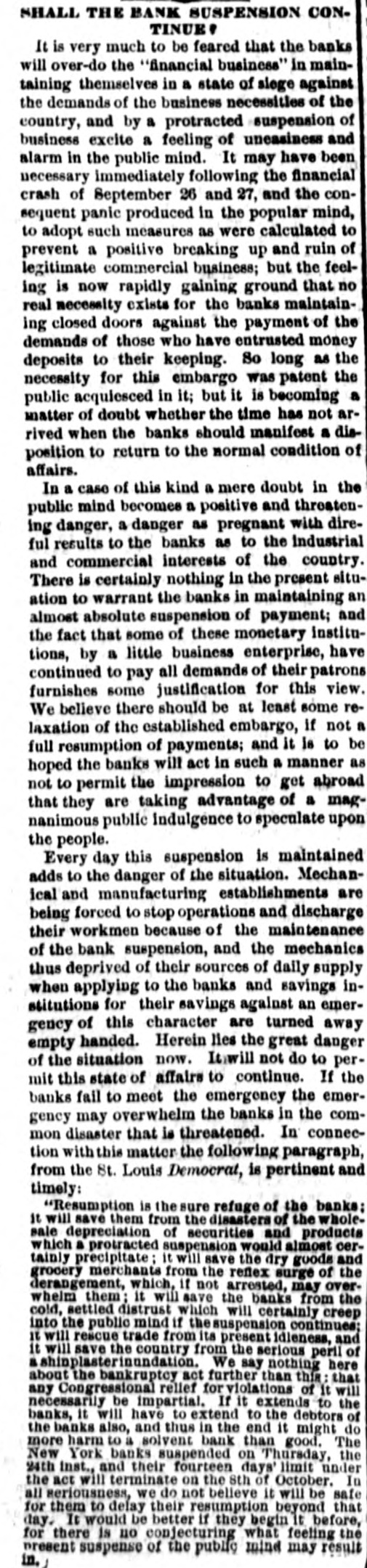
SHALL THE BANK SUSPENSION CONTINUE? It is very much to be feared that the banks will over-do the "financial business" in maintaining themselves in a state of siege against the demands of the business necessities of the country, and by a protracted suspension of business excite a feeling of uneasiness and alarm in the public mind. It may have been necessary immediately following the financial crash of September 26 and 27, and the consequent panic produced in the popular mind, to adopt such measures as were calculated to prevent a positive breaking up and ruin of legitimate commercial business; but the feeling is now rapidly gaining ground that no real necessity exists for the banks maintaining closed doors against the payment of the demands of those who have entrusted money deposits to their keeping. So long as the necessity for this embargo was patent the public acquiesced in it; but it is becoming a matter of doubt whether the time has not arrived when the banks should manifest a disposition to return to the normal condition of affairs. In a case of this kind a mere doubt in the public mind becomes a positive and threatening danger, a danger as pregnant with direful results to the banks as to the industrial and commercial interests of the country. There is certainly nothing in the present situation to warrant the banks in maintaining an almost absolute suspension of payment; and the fact that some of these monetary institutions, by a little business enterprise, have continued to pay all demands of their patrons furnishes some justification for this view. We believe there should be at least some relaxation of the established embargo, if not a full resumption of payments; and it is to be hoped the banks will act in such a manner as not to permit the impression to get abroad that they are taking advantage of a magnanimous public indulgence to speculate upon the people. Every day this suspension is maintained adds to the danger of the situation. Mechanical and manufacturing establishments are being forced to stop operations and discharge their workmen because of the maintenance of the bank suspension, and the mechanics thus deprived of their sources of daily supply when applying to the banks and savings institutions for their savings against an emergency of this character are turned away empty handed. Herein lies the great danger of the situation now. It will not do to permit this state of affairs to continue. If the banks fail to meet the emergency the emergency may overwhelm the banks in the common disaster that is threatened. In connection with this matter the following paragraph, from the St. Louis Democrat, is pertinent and timely: "Resumption is the sure refuge of the banks; it will save them from the disasters of the wholesale depreciation of securities and products which a protracted suspension would almost certainly precipitate; it will save the dry goods and grocery merchants from the reflex surge of the derangement, which, if not arrested, may overwhelm them; it will save the banks from the cold, settled distrust which will certainly creep into the public mind if the suspension continues; it will rescue trade from its present idleness, and it will save the country from the serious peril of a shinplaster inundation. We say nothing here about the bankruptcy act further than this; that any Congressional relief for violations of it will necessarily be impartial. If it extends to the banks, it will have to extend to the debtors of the banks also, and thus in the end it might do more harm to a solvent bank than good. The New York banks suspended on Thursday, the 24th inst., and their fourteen days' limit under the act will terminate on the 8th of October. In all seriousness, we do not believe it will be safe for them to delay their resumption beyond that day. It would be better if they begin it before, for there is no conjecturing what feeling the present suspense of the public mind may result in."


Article from The Portland Daily Press, October 10, 1873

Click image to open full size in new tab

Article Text

WASHINGTON. The Currency. WASHINGTON. Oct. 9.—The treasury reserves are now being daily drawn on to pay only the actual expenses of the government. There are no apprehensions at the department—that the drafts upon the $44,000,000 will be very heavy in the ordinary course of business. The outstanding legal tenders, now shown to be over $356,000,000, will be reduced again to those figures at the earliest practicable moment, it may be before the issue of the next public debt statement. All ideas that it is the intention of the Secretary to make any permanent inflation of currency are erroneous. The Secretary emphatically asserts that the outstanding legal tenders are not to exceed the minimum figures a day more than the absolute demands of the government requires. The Yellow Fever and the Postal Business. The ravages of yellow fever South are causing the Postoffice Department much embarrassment. The quarantine has practically interrupted all through Southern mail routes.—Southern mails have been ordered to be despatched along the western boundary of Texas. The government will not interfere with the State quarantine laws. Treasury Balances. The following are the Treasury balances today: Currency $2,673,581; special deposits of legal tenders for redemption of certificates of deposit $11,325,000; coin $79,948,110, including $39,938,400 in coin certificates; outstanding legal tenders $358,966,488. The Senate Chaplaincy. It is said that Rev. Dr. Newton, Chaplain of the United States Senate, will not return from his inspection of consulates during the present year. This will render necessary the election of a new chaplain. Concerning Caterpillars. The Agricultural Department has issued a circular to all its correspondents in the southern States, asking for information relative to the use of paris green and other poisons in destroying caterpillars. It is stated that the total loss by the common caterpillar sometimes amounts to $40,000,000 or $50,000,000 in a year, and that the loss of a quarter of a million of balls in a year when insects prevail would be deemed a light infliction. Paris green and flour, mixed, have proved very efficacious in destroying the potato bug. The same mixture has been used for the cotton insect, but with what result is not established. The Polaris Survivors. The United States steamer Tallapoosa arrived at Washington navy yard last evening and was anchored in the stream. No communication is permitted from the shore with the Polaris survivors. The Buddington Party. The Secretary of the Navy, accompanied by a personal friend, arrived at the navy yard this afternoon. He proceeded to the headquarters of Commodore Patterson and after a short conference was driven to the wharf where the Tallapoosa is lying, where he was received by Capt. McRitchie of that vessel and shown into the cabin where Capt. Buddington and party were assembled. After some conversation of a general character, the Secretary stated that the members of the party must be exceedingly careful as to their statements and say nothing but what they were willing to swear to. After about twenty minutes conversation, the Secretary had a brief private correspondence on shore with Capt. McRitchie, after which he left the yard. Capt. McRitchie informed Captain Buddington and his men that the Secretary had placed no special restriction over their movements and that they were all at liberty to go ashore if they desired, but they would be expected to return "clean and sober by eight o'clock to-morrow morning." Soon after Dr. Bessel came down the gang plank with a long leather covered map case strung over his shoulder, and left the yard. When accosted by a reporter he answered quickly and hurried away as if desirous of evading all questions. The Secretary of the Navy, in a conversation to day, said he did not credit the reports that Capt. Hall's death was the result of foul means. It appears that all who were present at the former investigation are convinced that the commanding officer's death was from natural causes alone. Indian Council. The Commissioner of Indian Affairs, under date of Fort Sill, 7th, telegraphs that the council with the Kiowas and Comanches is still proceeding and he has intended to leave Fort Sill for Caddo to-day. The President and the Cooke Failure. NEW YORK, Oct. 9.—A despatch from Washington denies the rumor circulated lately that the President had a special deposit in the First National Bank of that city. He was not allowed interest on his balance and his amount covered his salary, which the bank drew and placed to his credit, to be checked out precisely like any other deposit. Three days before the suspension of the bank his accounts showed an over draft of $71. This over draft has since been paid to the receiver and the account closed. The President never had a little tin box on deposit, and he was in Pittsburg the day it is said to have been carried over to the White House by him. He did have, however, a box in the bank of Jay Cooke & Co., containing his private valuable papers, among other things registered Rawlins bonds, which he holds in trust, but not a dollar in money. The box was taken away the week after the bank closed.


Article from Daily Kennebec Journal, October 16, 1873

Click image to open full size in new tab

Article Text

GENERAL NEWS. Frederick Chase Hutchinson, one of the family of singers, is dead. Pere Hyacinthe has been elected one of the three cures in Geneva by the Old Catholics. It is expected that the New York banks will resume currency payments next week. Newton has decided to cast off its swaddling clothes and become a city, the 17th in Massachusetts. The King of Italy has presented to the Empress of Austria a costly set of jewelry made in Rome. Christian Unity was practically illustrated in New York last Sunday. An Episcopal Bishop administered the Sacrament in a Presbyterian Church. T. Parkin Scott, Judge of the Supreme Bench of Maryland, died at Baltimore Monday morning, aged 70. The Chicago Post says that "if a son of Henry H. Wise is making speeches against his father, he must find himself compelled to change his politics several times a day." Many delegates to the Evangelical Alliance visited Philadelphia Monday and were entertained with a public reception and a banquet at the Continental Hotel, by the Philadelphia branch of the Alliance. The Cincinnati banks resumed payment of currency Monday. There were no runs and no excitement, and business men are very cheerful over the result. Most of the banks received more on deposits than they paid out. The republicans of the French Assembly paid M. Thiers a congratulatory visit Monday. The meetings of the several factions for the designation of members of the general committee of management will be held at various times next week. They have a calf out in Oregon who sports a nice little pair of wings. These ornamental appendages are about the size of turkey wings and crop out just behind the shoulders. Thomas A. Ridgely, formerly Medical Director on General Grant's Staff, was on Monday sentenced to three years' imprisonment in State Prison for breaking into a dwelling house in the daytime and stealing books, which he sold for liquor. "You ought to let me pass here free of charge, considering the benevolent nature of my profession," said a physician to a toll-gate keeper. "Not so," was the reply, "you send too many dead heads through here now." The doctor did not stop to argue the point, but paid his toll and passed on. In the naval battle off Cartagena thirteen men were killed and forty-seven wounded on the rebel fleet. Senor Mayer, a member of the Junta, was killed on board the Numancia. The Richmond Enquirer is attempting, at this late day, to fire the Virginia heart by printing, day after day, in capitals, such par-