Click image to open full size in new tab
Article Text
FINANCE AND TRADE.
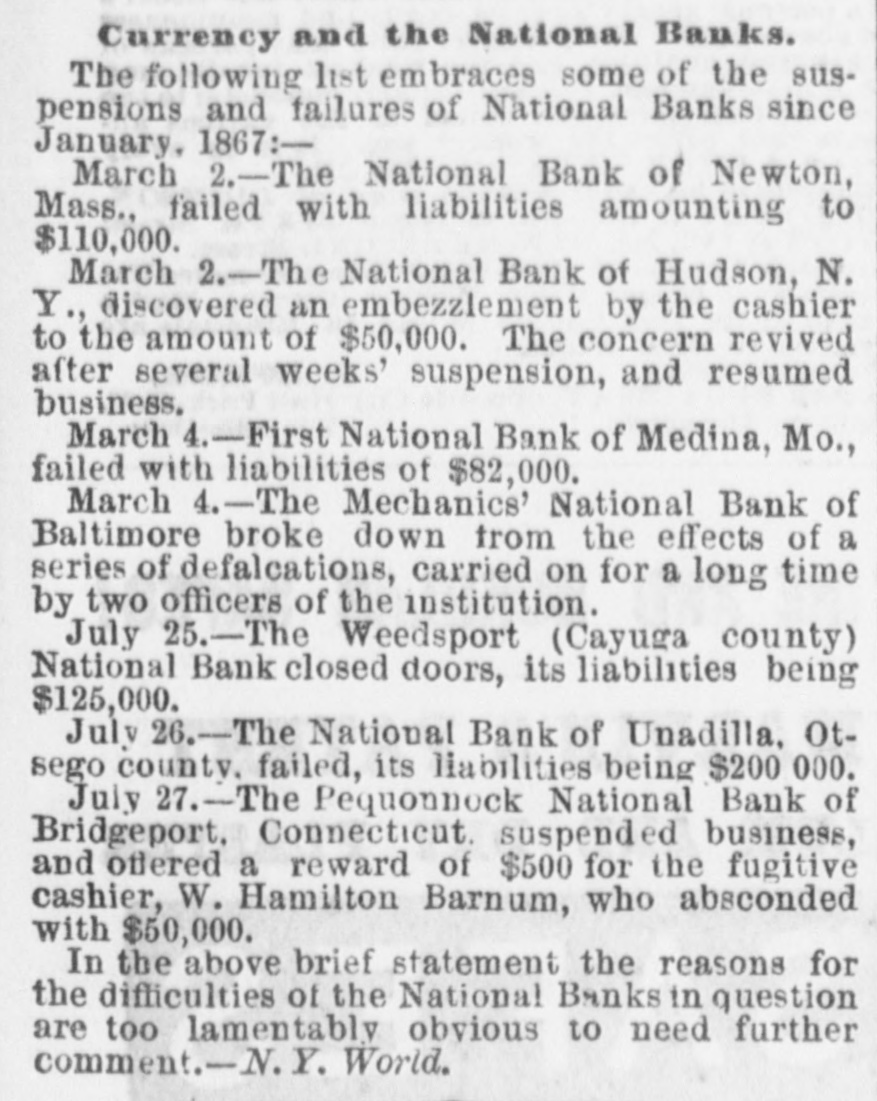
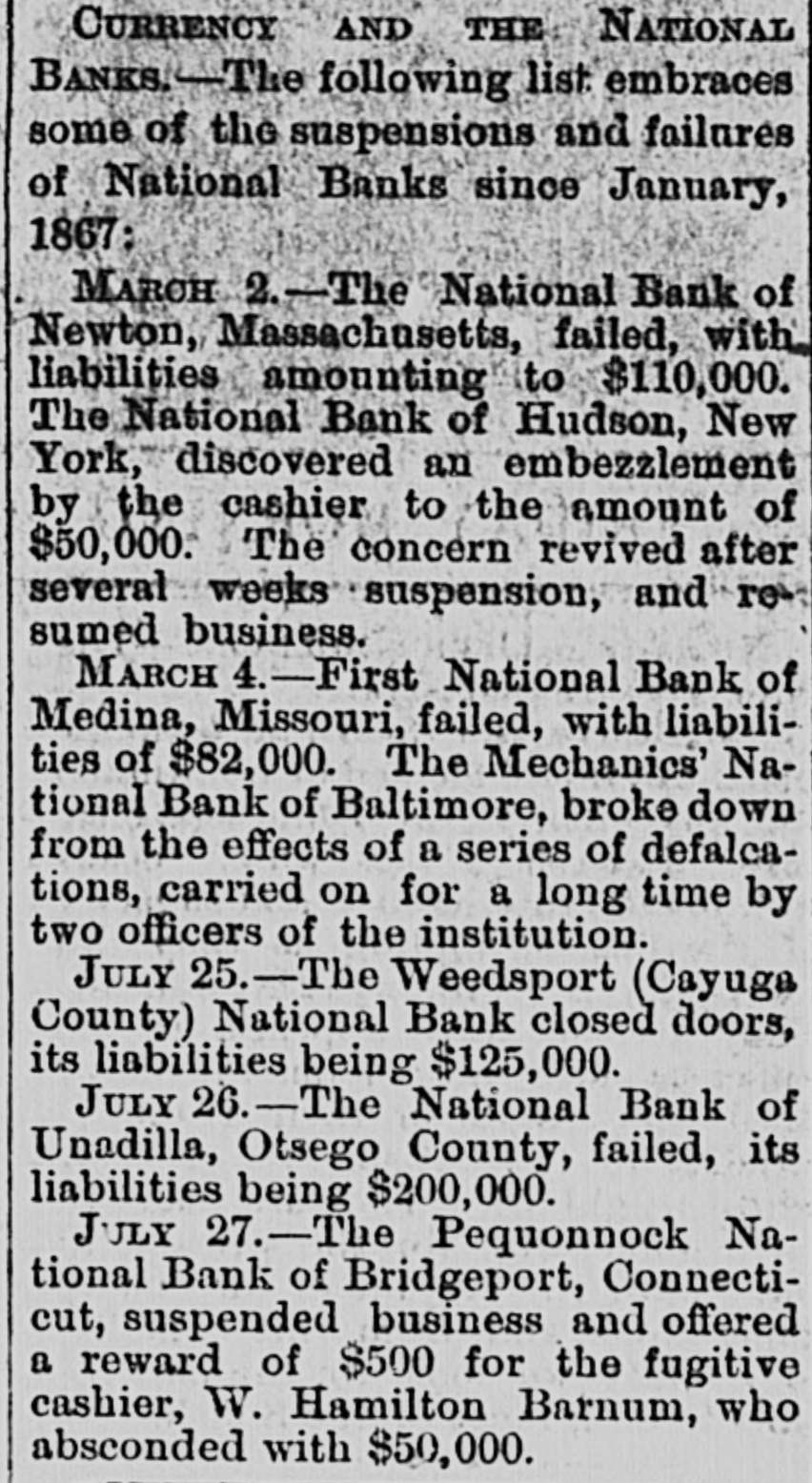
Commercial and Financial. The following list embraces some of the suspensions and failures of National Banks since January, 1865:
March 2.—The National Bank of Newton, Mass., failed with liabilities amounting to $110,000.
March 2.—The National Bank of Hudson, N. Y., discovered an embezzlement by the cashier to the amount of $50,000. The concern revived after several weeks suspension, and resumed business.
March 4.—First National Bank of Medina, Mo., failed with liabilities of $82,000.
March 4.—The Mechanics' National Bank of Baltimore, broke down from the effects of a series of defalcations, carried on for a long time by two officers of the institution.
July 25.—The Weedsport (Cayuga County) National Bank closed doors, its liabilities being $125,000.
July 26.—The National Bank of Unadilla, Otsego County, failed, its liabilities being $125,000.
July 27.—The Pequonnock National Bank of Bridgeport, Conn., suspended business and offered a reward of $500 for the fugitive cashier, W. Hamilton Barnum, who absconded with $50,000.
The New York Journal of Commerce says: The possibility of domestic troubles during the elections soon to occur, has deterred many operators from commencing fresh engagements, and is having a material effect upon the demand for goods to distribute through the West. After the election, if political affairs are more settled, we may hope for some revival of business. The wheat and rye harvested, and the corn not yet matured, alike rejoice in the dryer atmosphere beneath the sunny sky. Even potatoes have been small and hard, owing to the great prevalence of wet weather. A few such summer's suns will work wonders for all the crops, and good crops are as essential to financial and commercial prosperity as a good government.
The Milwaukee Journal of Commerce, in a late article upon the legal tender question, said:
We do not know that the constitutionality of the legal tender act, as it is called, will ever be brought fairly and squarely before the Supreme Court. We have no wish to see it done at present, so as to unsettle all the relations of debtors and creditors as now adjusted to the paper currency; but, for the sake of its importance as a precedent, we do hope that at some time, perhaps after specie payments have been resumed, it will be brought before that august tribunal for its solemn decision. We believe that if this is done after popular passion has subsided, the Court will pronounce a verdict against the act, and that this will give general satisfaction to the people. We have never insisted that Congress cannot order money to be coined or stamped of paper, leather, or any other substance of its choice, and declare the same a legal tender. Webster always insisted that under the Constitution nothing could be made a legal tender for debt but coins of gold or silver, but we waive that question now. The point we established, and which has never been assailed by either reason or argument, is that the present paper issues were not stamped or coined as money; are merely promises to pay money; and therefore show upon their face their want of conformity to the constitutional requirement. When this is fairly considered by the Supreme Court, free from the pressure of financial excitement, we have little doubt in regard to the decision.
The following extract is from the money article of the Age of Wednesday: The demand for money from speculative borrowers continues moderately active, but there is comparative little inquiry for purposes of legitimate business. Call loans are made on stock collaterals at 4a5 per cent., and there are exceptional transactions in large sums upon government securities at 3 per cent. The best commercial paper is readily placed at 6a7 per cent. per annum discount. The dry goods market during the past week, although by no means active, has shown a material improvement from the previous dullness and unsettled feeling. Considerable preparation is being made for an early opening of business. The extremely low point to which prices have been forced has brought in a number of buyers, who intend holding for an advance. Trade has been stimulated by orders from the interior to supply demands for consumption. Prices are still unchanged, ruling very low, but an early improvement is confidently looked forward to by many.
The statement of our Philadelphia banks for the present week clearly indicates the dullness in business prevalent at this season. All the leading items, except legal tenders, are lower than in the preceding report. Loans fell off $36,091; specie, $8,626; deposits $830,769, and circulation $3,892. Legal tenders