Article Text
FREIGHT TRAFFIC SHOWS INCREASE FOR MONTANA
Peak Reached in 1919 With Low Slump in 1922
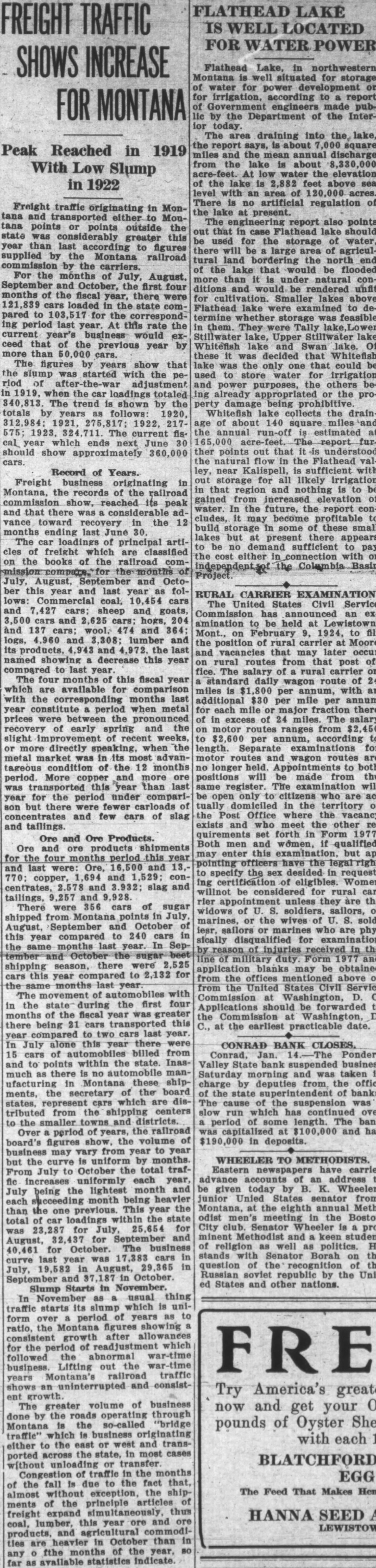
Freight traffic originating in Montana and transported either to Montana points or points outside the state was considerably greater this year than last according to figures supplied by the Montana railroad commission by the carriers.
For the months of July, August, September and October, the first four months of the fiscal year, there were 121,839 cars loaded in the state compared to 103,517 for the corresponding period last year. At this rate the current year's business would exceed that of the previous year by more than 50,000 cars.
The figures by years show that the slump was started with the period of after-the-war adjustment in 1919, when the car loadings totaled 340,813. The trend is shown by the totals by years as follows: 1920, 312,984; 1921, 275,817; 1922, 217,575; 1923, 324,711. The current fiscal year which ends next June 30 should show approximately 360,000 cars.
Record of Years.
Freight business originating in Montana, the records of the railroad commission show, reached its peak and that there was a considerable advance toward recovery in the 12 months ending last June 30.
The car loadings of principal articles of freight which are classified on the books of the railroad commission compare, for the months of July, August, September and October this year and last year as follows: Commercial coal, 10,454 cars and 7,427 cars; sheep and goats, 3,500 cars and 2,625 cars; hogs, 204 and 137 cars; wool, 474 and 364; logs, 4,960 and 3,308; lumber and its products, 4,943 and 4,972, the last named showing a decrease this year compared to last year.
The four months of this fiscal year which are available for comparison with the corresponding months last year constitute a period when metal prices were between the pronounced recovery of early spring and the slight improvement of recent weeks, or more directly speaking, when the metal market was in its most advantageous condition of the 12 months period. More copper and more ore was transported this year than last year for the period under comparison but there were fewer carloads of concentrates and few cars of slag and tailings.
Ore and Ore Products.
Ore and ore products shipments for the four months period this year and last were: Ore, 16,500 and 13,770; copper, 1,694 and 1,529; concentrates, 2,578 and 3,932; slag and tailings, 9,257 and 9,928.
There were 356 cars of sugar shipped from Montana points in July, August, September and October of this year compared to 240 cars in the same months last year. In September and October the sugar beet shipping season, there were 2,525 cars this year compared to 2,132 for the same months last year.
The movement of automobiles with in the state during the first four months of the fiscal year was greater there being 21 cars transported this year compared to two cars last year. In July alone this year there were 15 cars of automobiles billed from and to points within the state. Inasmuch as there is no automobile manufacturing in Montana these shipments, represent cars which are distributed from the shipping centers to the smaller towns and districts.
Over a period of years, the railroad board's figures show, the volume of business may vary from year to year but the curve is uniform by months. From July to October the total traffic increases uniformly each year, July being the lightest month and each succeeding month being heavier than the one previous. This year the total of car loadings within the state was 23,287 for July, 25,654 for August, 32,437 for September and 40,461 for October. The business curve last year was 17,383 cars in July, 19,582 in August, 29,365 in September and 37,187 in October.
Slump Starts in November.
In November as a usual thing traffic starts its slump which is uniform over a period of years as to ratio, the Montana figures showing a consistent growth after allowances for the period of readjustment which followed the abnormal war-time business. Lifting out the war-time years Montana's railroad traffic shows an uninterrupted and consistent growth.
The greater volume of business done by the roads operating through Montana is the so-called "bridge traffic" which is business originating either to the east or west and transported across the state, in most cases without unloading or transfer.
Congestion of traffic in the months of the fall is due to the fact that, almost without exception, the shipments of the principle articles of freight expand simultaneously, thus coal, lumber, this year ore and ore products, and agricultural commodities are heavier in October than in any of the months of the year, so far as available statistics indicate.
FLATHEAD LAKE IS WELL LOCATED FOR WATER POWER
Flathead Lake, in northwestern Montana is well situated for storage of water for power development or for irrigation, according to a report of Government engineers made public by the Department of the Interior today.
The area draining into the lake, the report says, is about 7,000 square miles and the mean annual discharge from the lake is about 8,330,000 acre-feet. At low water the elevation of the lake is 2,882 feet above sea level with an area of 120,000 acres. There is no artificial regulation of the lake at present.
The engineering report also points out that in case Flathead lake should be used for the storage of water, there will be a large area of agricultural land bordering the north end of the lake that would be flooded more than it is under natural conditions and would be rendered unfit for cultivation. Smaller lakes above Flathead lake were examined to determine whether storage was feasible in them. They were Tally lake, Lower Stillwater lake, Upper Stillwater lake, Whitefish lake and Swan lake. Of these it was decided that Whitefish lake was the only one that could be used to store water for irrigation and power purposes, the others being already appropriated or the property damage being prohibitive.
Whitefish lake collects the drainage of about 140 square miles and the annual run-off is estimated at 165,000 acre-feet. The report further points out that it is understood the natural flow in the Flathead valley, near Kalispell, is sufficient without storage for all likely irrigation in that region and nothing is to be gained from increased elevation of water. In the future, the report concludes, it may become profitable to build storage in some of these small lakes but at present there appears to be no demand sufficient to pay the cost either in connection with or independent of the Columbia Basin Project.
RURAL CARRIER EXAMINATION
The United States Civil Service Commission has announced an examination to be held at Lewistown, Mont., on February 9, 1924, to fill the position of rural carrier at Moore and vacancies that may later occur on rural routes from that post office. The salary of a rural carrier on a standard daily wagon route of 24 miles is $1,800 per annum, with an additional $30 per mile per annum for each mile or major fraction thereof in excess of 24 miles. The salary on motor routes ranges from $2,450 to $2,600 per annum, according to length. Separate examinations for motor routes and wagon routes are no longer held. Appointments to both positions will be made from the same register. The examination will be open only to citizens who are actually domiciled in the territory of the Post Office where the vacancy exists and who meet the other requirements set forth in Form 1977. Both men and women, if qualified, may enter this examination, but appointing officers have the legal right to specify the sex desired in requesting certification of eligibles. Women will not be considered for rural carrier appointment unless they are the widows of U. S. soldiers, sailors, or marines, or the wives of U. S. soldiers, sailors or marines who are physically disqualified for examination by reason of injuries received in the line of military duty. Form 1977 and application blanks may be obtained from the offices mentioned above or from the United States Civil Service Commission at Washington, D. C. Applications should be forwarded to the Commission at Washington, D. C., at the earliest practicable date.
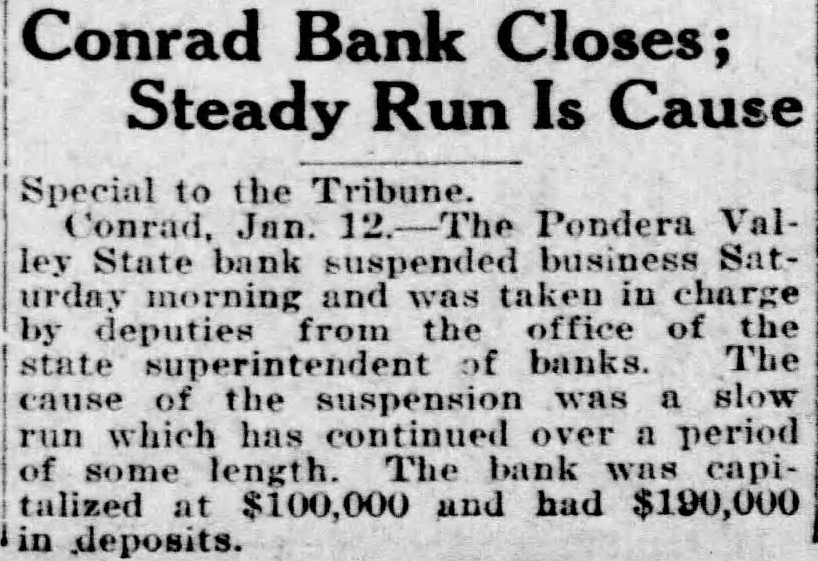
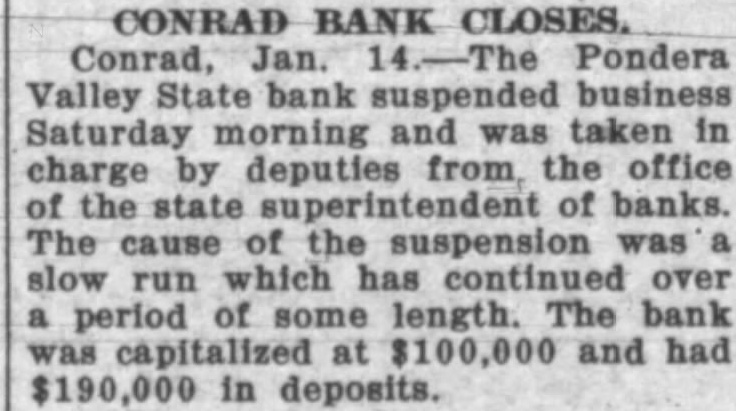
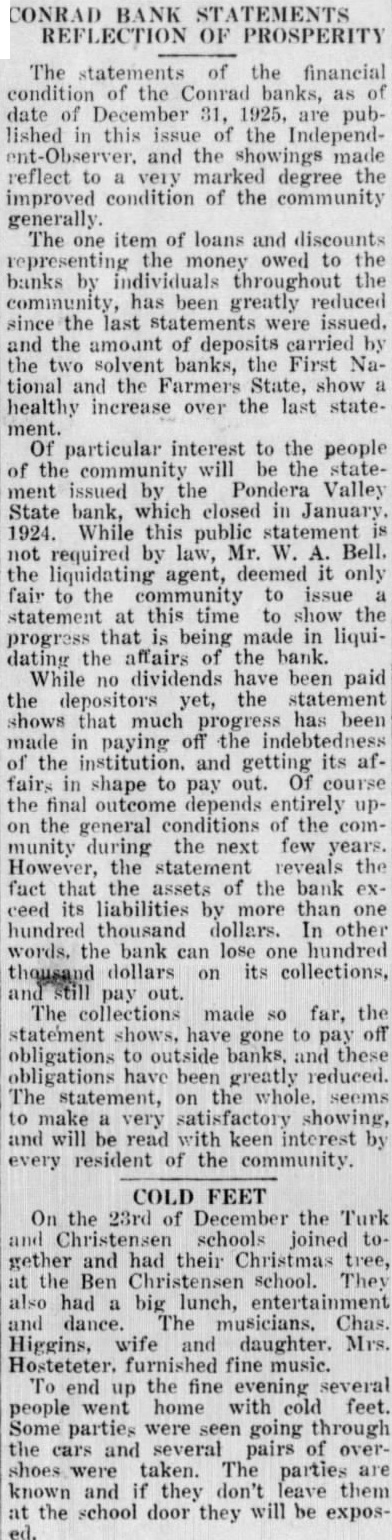
CONRAD BANK CLOSES.
Conrad, Jan. 14.—The Pondera Valley State bank suspended business Saturday morning and was taken in charge by deputies from the office of the state superintendent of banks. The cause of the suspension was a slow run which has continued over a period of some length. The bank was capitalized at $100,000 and had $190,000 in deposits.
WHEELER TO METHODISTS.
Eastern newspapers have carried advance accounts of an address to be given today by B. K. Wheeler, junior United States senator from Montana, at the eighth annual Methodist men's meeting in the Boston City club. Senator Wheeler is a prominent Methodist and a keen student of religion as well as politics. He stands with Senator Borah on the question of the recognition of the Russian soviet republic by the United States and other nations.