Melstone State Bank (Melstone, MT)

Episode Information

Episode UID
93021571470
Episode Type
Suspension β†’ Closure
Bank Type
state
Bank ID
9302157 routing
Routing Number
93-0215
Start Date
June 23, 1922
Location
Melstone, Montana (46.599, -107.872)

Metadata

Model
gpt-5-mini (chosen from majority vote of a three-model LLM ensemble)
Short Digest
b09bdaaf8c5c5ba7

Response Measures

None

Description

Closure appears driven by insolvency: inability of president to meet assessment and outside lienholders selling collateral.

Events (3)

1. June 23, 1922 Suspension
Cause
Bank Specific Adverse Info
Cause Details
Former president unable to meet $9,000 assessment and Minneapolis bank moving to sell local securities held as collateral, leaving no local capital for reorganization.
Newspaper Excerpt
it was finally decided not to further attempt a reopening of that institution... a receiver will, no doubt, be appointed in the near future.
Source
newspapers
2. January 10, 1925 Receivership
Newspaper Excerpt
let out Receiver John Oliver of the Citizens State Bank. Also let out Receiver Lukes of the Melstone State Bank and turned that bank over to Receiver Cornwell of the Vananda and Lavina banks.
Source
newspapers
3. March 20, 1926 Receivership
Newspaper Excerpt
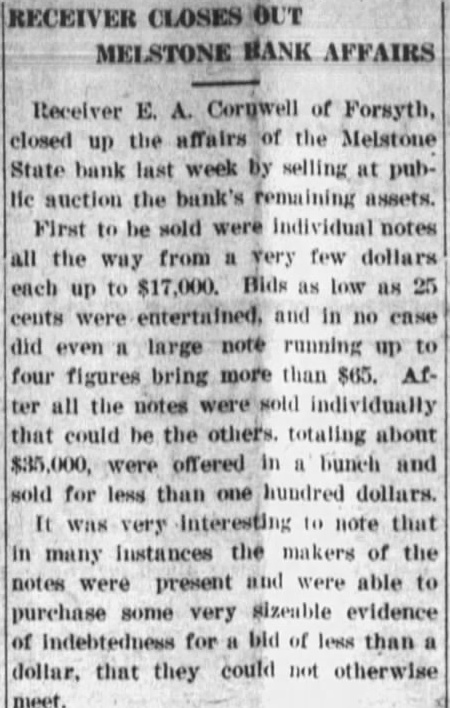
Receiver E. A. Cornwell of Forsyth, closed up the affairs of the Melstone State bank last week by selling at public auction the bank's remaining assets.
Source
newspapers

Newspaper Articles (9)

Article from The Powder River County Examiner and the Broadus Independent, June 23, 1922

Click image to open full size in new tab

Article Text

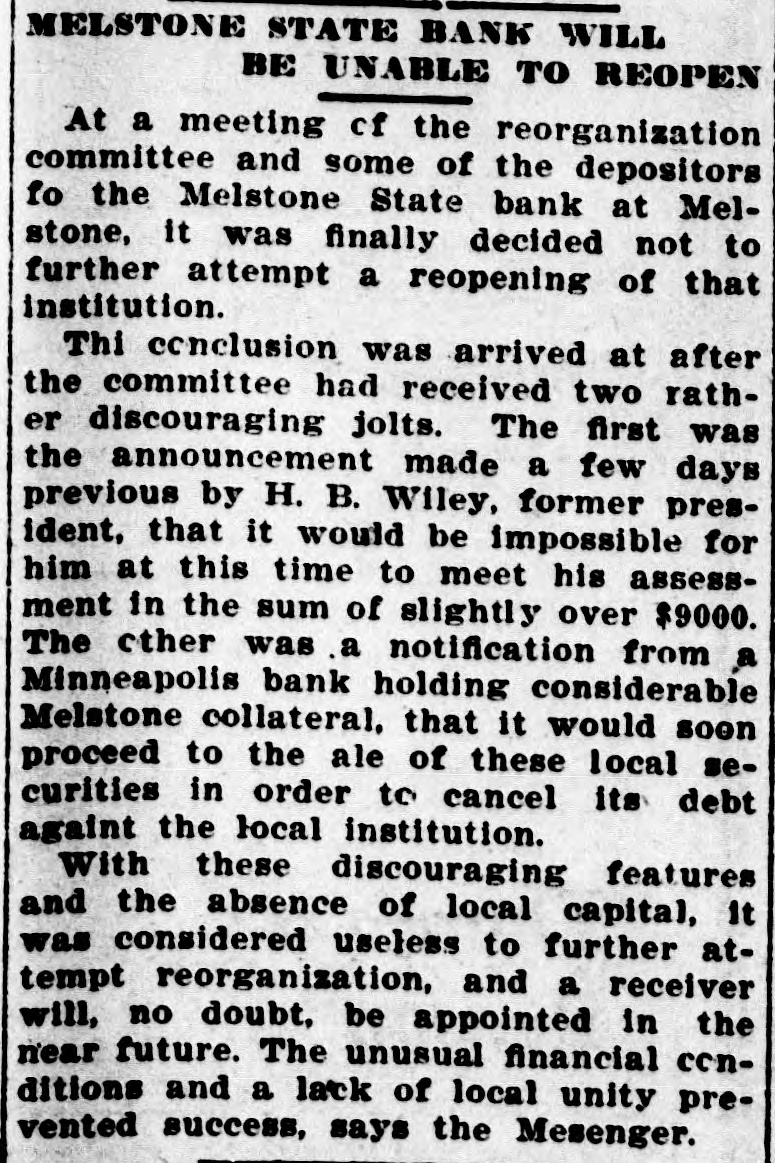
MELSTONE STATE BANK WILL BE UNABLE TO REOPEN At a meeting of the reorganization committee and some of the depositors fo the Melstone State bank at Melstone, it was finally decided not to further attempt a reopening of that institution. Thi conclusion was arrived at after the committee had received two rather discouraging jolts. The first was the announcement made a few days previous by H. B. Wiley, former president, that it would be impossible for him at this time to meet his assessment in the sum of slightly over $9000. The other was a notification from a Minneapolis bank holding considerable Melstone collateral, that it would soon proceed to the ale of these local securities in order to cancel its debt againt the local institution. With these discouraging features and the absence of local capital, It was considered useless to further attempt reorganization, and a receiver will, no doubt, be appointed in the near future. The unusual financial conditions and a lack of local unity prevented success, says the Mesenger.


Article from The Roundup Record, December 28, 1923

Click image to open full size in new tab

Article Text

CONTRACT WITH W. A. PENNINGTON DECLARED VOID ENFORCEMENT FUND OF $800 ALSO SAID TO HAVE BEEN ILLEGALLY WITHDRAWN State Examiner's Report Says County Attorney Should Make Restitutionβ€”Report Discloses Musselshell County Has $278,930.90 in Closed Banks. The contract entered into by the board of county commissioners of Musselshell county with W. A. Pennington whereby the latter was engaged to prosecute certain cases against former members of the board is declared to be without legal authority according to a report filed this week with County Clerk and Recorder Volney J. Hain by F. E. Williams, a deputy state examiner, who conducted an examination of the affairs of the county in October. A claim filed by Mr. Pennington for $300 for services performed in accordance with the terms of the contract and paid by the board, is stated to be illegal. It is pointed out in the report that both the contract and claim are illegal for the reason that the law provides that the board may provide the county attorney with additional help when necessary. The payment of $800 to County Attorney Chas. F. Huppe by the board for the purpose of financing detectives engaged in gathering evidence for the enforcement of the prohibition laws, is also declared by the report to be illegal and the money so paid should be returned to the county. In this connection the report says: "The using of this fund in this manner is entirely illegal, and the board of county commissioners should immediately direct that this fund be turned in to the county treasurer. Chapter 116 of the session laws of 1923, amends section 11,071, 11,075 and 11,079 of the revised codes of 1921, and you are referred to section 11,084 of this chapter, which defines the method of distributing the net proceeds of the fine and to what funds, viz., 50% to the general fund of the county and the remaining 50% to the law enforcement fund to be remitted by the county treasurer to the state treasurer. This law became effective March 7, 1923. All monies collected and credited since that date to the general school fund should be transferred to the general fund. You are requested to read carefully the said chapter 116." The report discloses the fact that Musselshell county has on deposit in closed banks an enormous sum, the names of the banks and the amounts being as follows: First National, Roundup........$55,055.78 Lavina State Bank................ 24,128.86 Melstone State Bank.............. 18,933.48 Roundup National Bank.......... 32,910.50 Musselshell State Bank.......... 63,702.28 Citizens State Bank.............. 70,274.81 In addition to the above there was $13,925.19 deposited in the Farmers & Merchants Bank of Ryegate, which closed its door since the examination was made, bringing the total amount of funds deposited in banks that are now closed to $278,930.90. The report commends all the county officials for the efficient manner in which the books and records of their respective offices are kept up. Criticism is confined almost entirely to irregularities of claims, such as failure to itemize properly or failure to sign or endorse. A new law passed by the last legislature provides that the examiner's report be made a part of the commissioners' minutes at the meeting following its receipt and that it must be published in the official county paper in full as a part of the proceedings.
Article from Ingomar Independent, January 10, 1925

Click image to open full size in new tab

Article Text

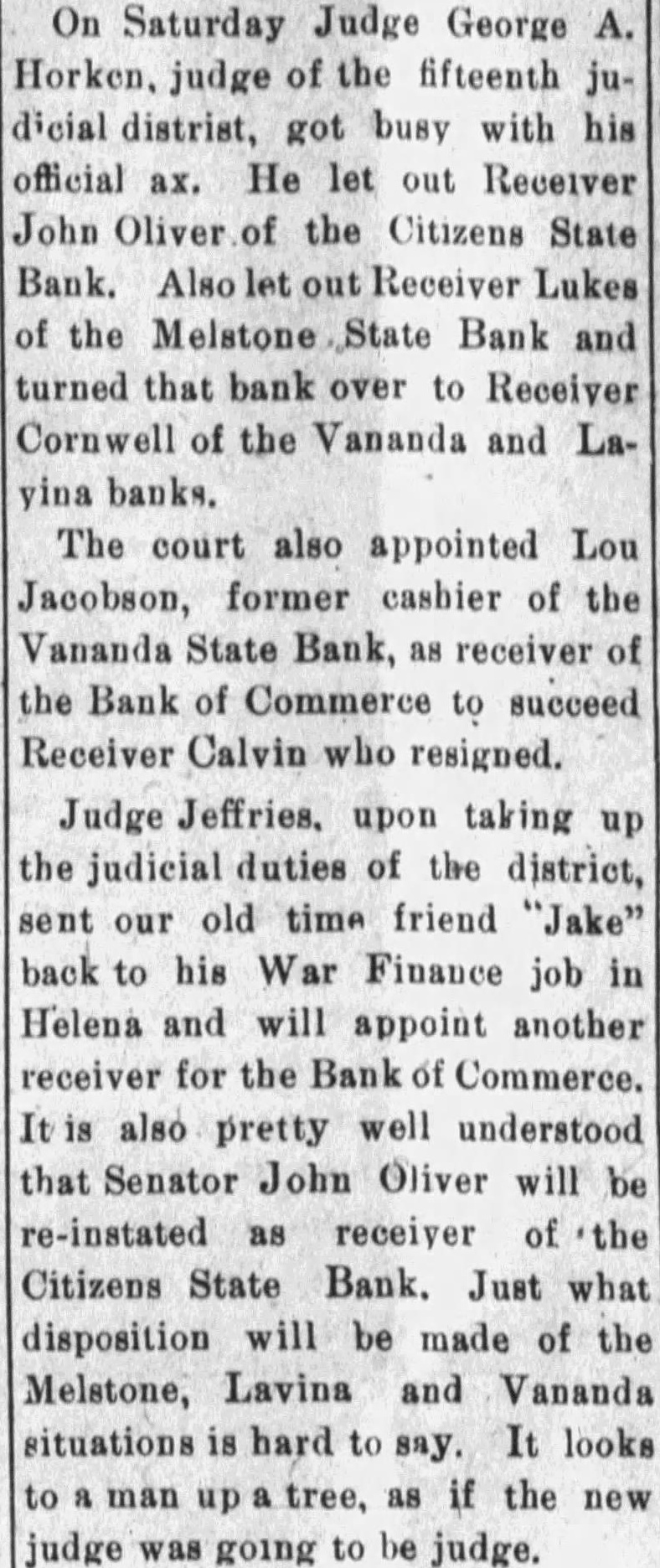
On Saturday Judge George A. Horken, judge of the fifteenth judicial distrist, got busy with his official ax. He let out Receiver John Oliver of the Citizens State Bank. Also let out Receiver Lukes of the Melstone State Bank and turned that bank over to Receiver Cornwell of the Vananda and Layina banks. The court also appointed Lou Jacobson, former casbier of the Vananda State Bank, as receiver of the Bank of Commerce to succeed Receiver Calvin who resigned. Judge Jeffries, upon taking up the judicial duties of the district, sent our old time friend "Jake" back to his War Finance job in Helena and will appoint another receiver for the Bank of Commerce. It is also pretty well understood that Senator John Oliver will be re-instated as receiver of 'the Citizens State Bank. Just what disposition will be made of the Melstone, Lavina and Vananda situations is hard to say. It looks to a man up a tree, as if the new judge was going to be judge.


Article from The Forsyth Independent, January 15, 1925

Click image to open full size in new tab

Article Text

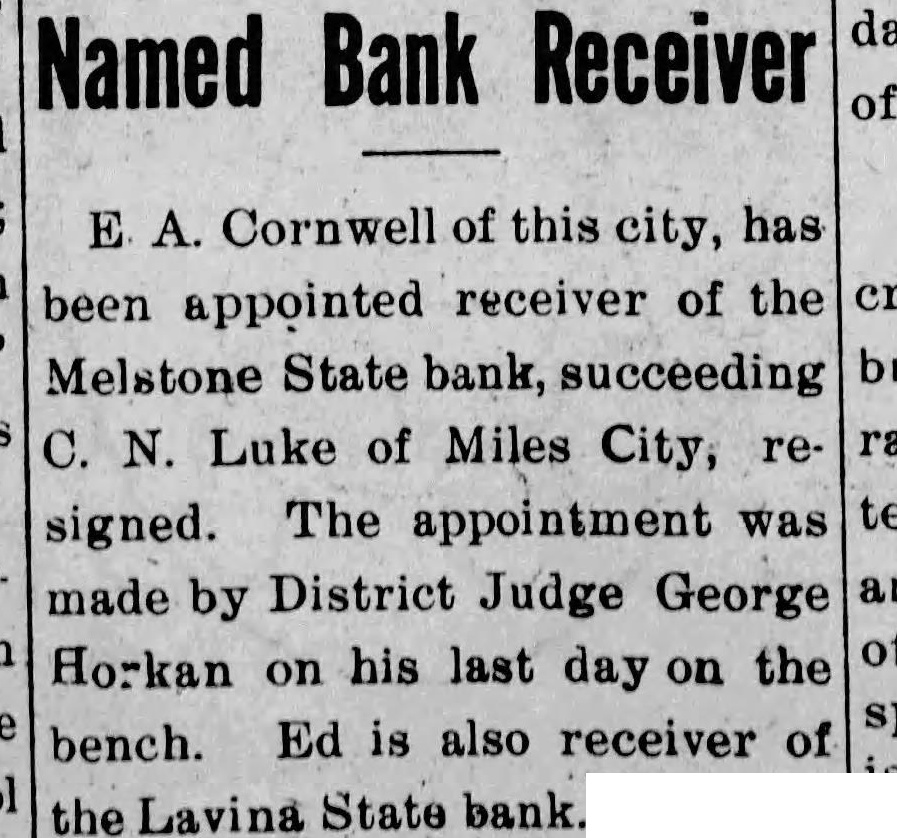
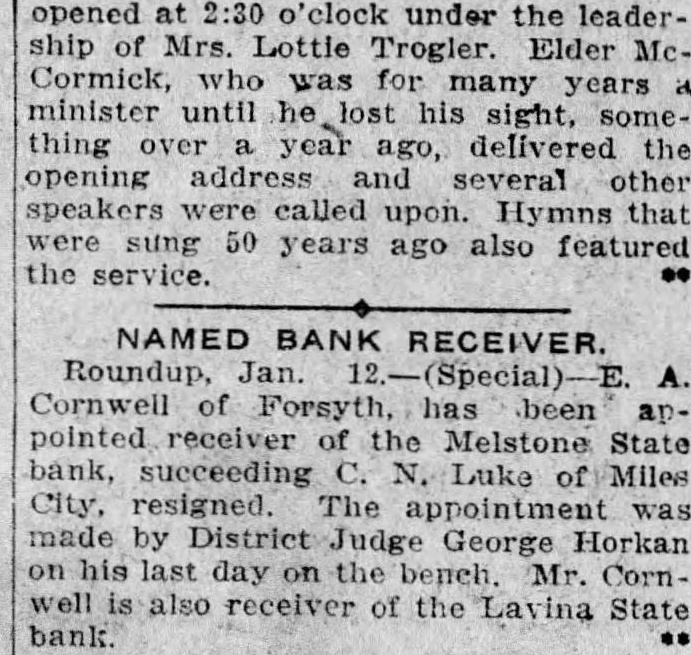
Named Bank Receiver E A. Cornwell of this city, has been appointed receiver of the Melstone State bank, succeeding C. N. Luke of Miles City, resigned. The appointment was made by District Judge George Horkan on his last day on the bench. Ed is also receiver of the Lavina State bank.


Article from The Melstone Messenger, January 15, 1925

Click image to open full size in new tab

Article Text

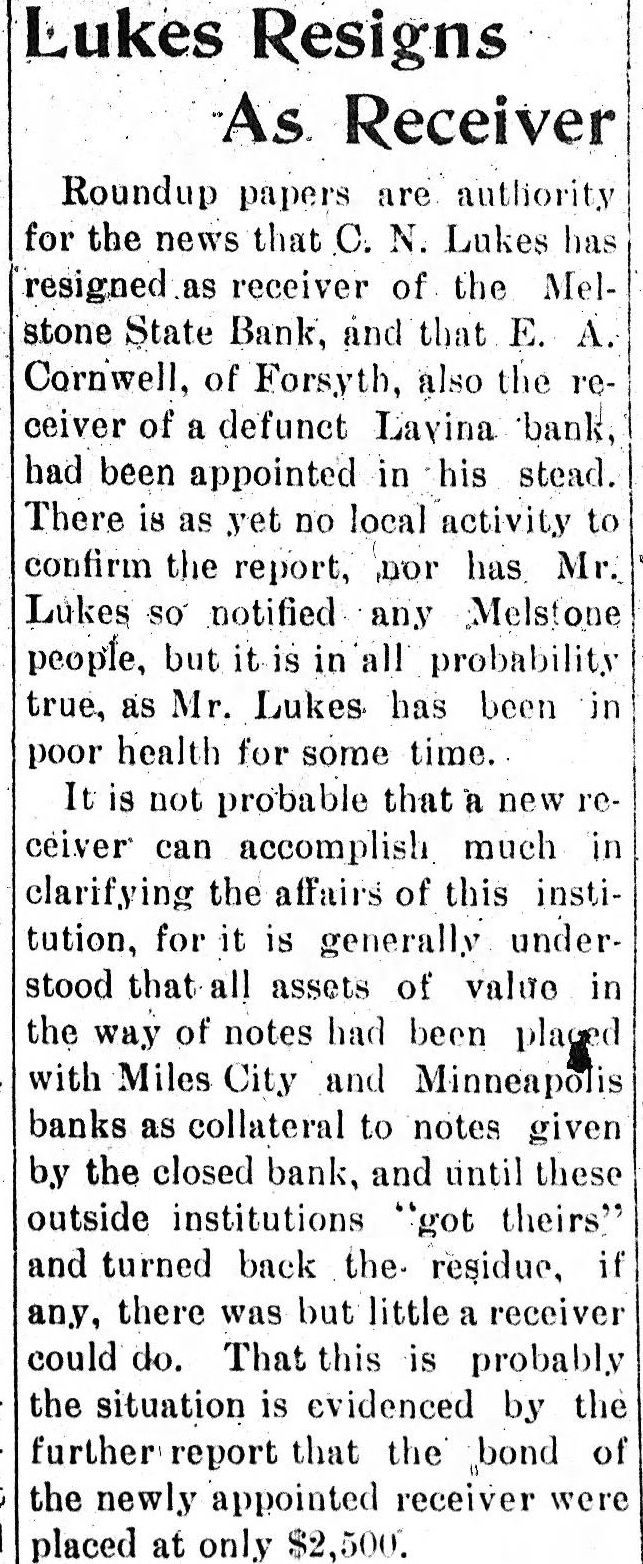
Lukes Resigns As Receiver Roundup papers are authority for the news that C. N. Lukes has resigned as receiver of the Melstone State Bank, and that E. A. Cornwell, of Forsyth, also the receiver of a defunct Lavina bank, had been appointed in his stead. There is as yet no local activity to confirm the report, ,DOR has Mr. Lukes SO notified any Melstone people, but it is in all probability true, as Mr. Lukes has been in poor health for some time. It is not probable that a new receiver can accomplish much in clarifying the affairs of this institution, for it is generally understood that all assets of value in the way of notes had been placed with Miles City and Minneapolis banks as collateral to notes given by the closed bank, and until these outside institutions "got theirs" and turned back the residue, if any, there was but little a receiver could do. That this is probably the situation is evidenced by the further report that the bond of the newly appointed receiver were placed at only $2,500.


Article from Miles City Star, January 18, 1925

Click image to open full size in new tab

Article Text

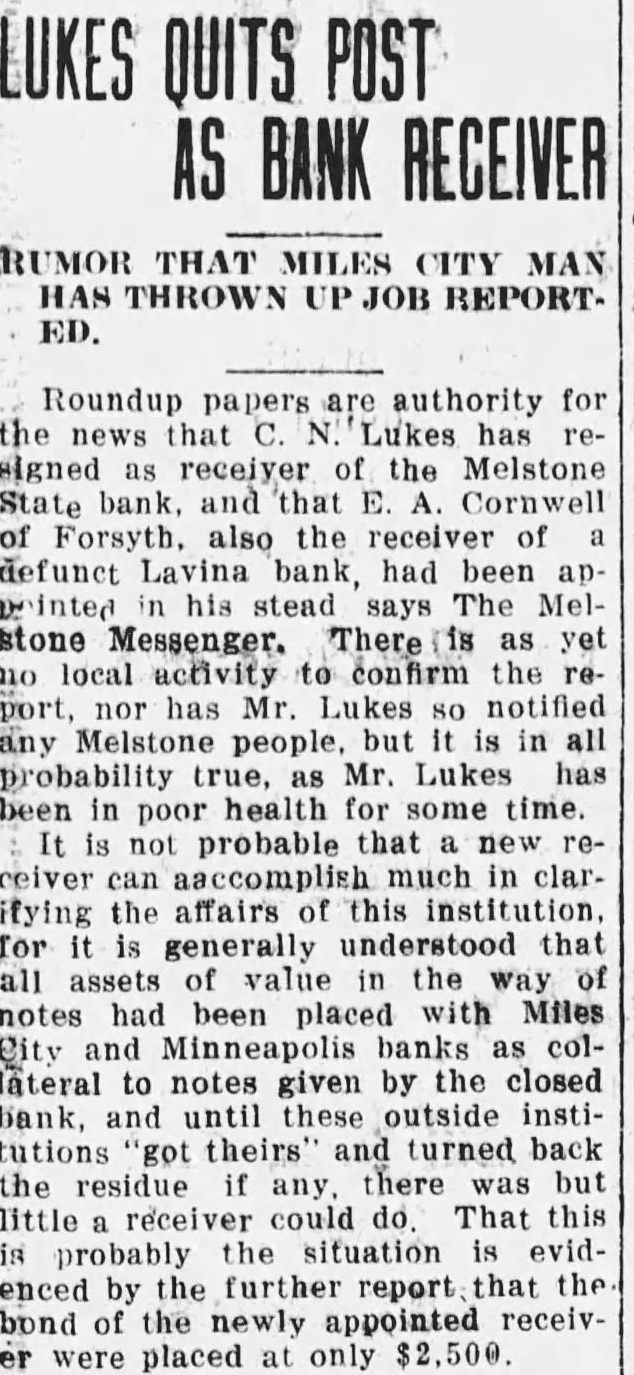
LUKES QUITS POST AS BANK RECEIVER RUMOR THAT MILES CITY MAN HAS THROWN UP JOB REPORTED. Roundup papers are authority for the news that C. N. Lukes has resigned as receiver of the Melstone State bank, and that E. A. Cornwell of Forsyth, also the receiver of defunct Lavina bank, had been apDrinted in his stead says The Melstone Messenger. There is as yet no local activity to confirm the report, nor has Mr. Lukes so notified any Melstone people. but it is in all probability true, as Mr. Lukes has been in poor health for some time. It is not probable that new rereiver can aaccomplish much in clarifying the affairs of this institution. for it is generally understood that all assets of value in the way of notes had been placed with Miles City and Minneapolis banks as collateral to notes given by the closed bank, and until these outside institutions "got theirs' and turned back the residue if any. there was but little receiver could do That this is probably the situation is evidenced by the further report that the bond of the newly appointed receiver were placed at only $2,500.


Article from The Melstone Messenger, April 9, 1925

Click image to open full size in new tab

Article Text

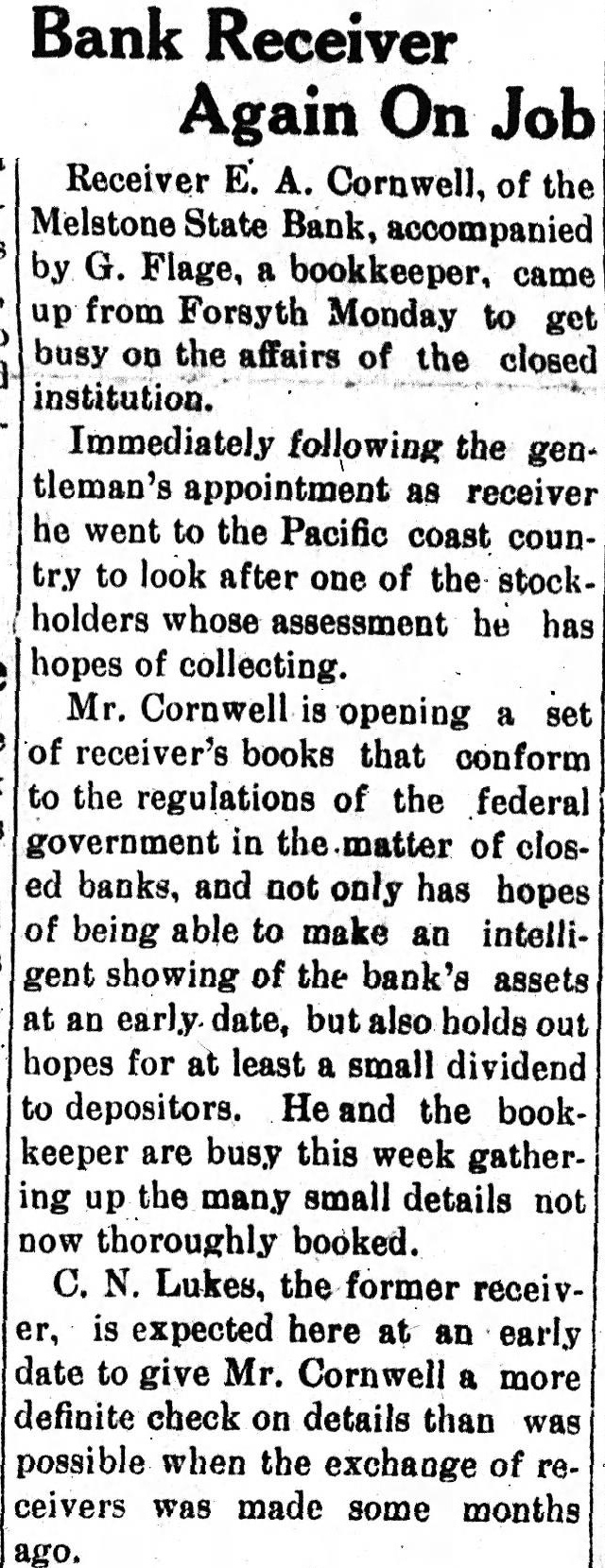
Bank Receiver Again On Job Receiver E. A. Cornwell, of the Melstone State Bank, accompanied by G. Flage, a bookkeeper, came up from Forsyth Monday to get busy on the affairs of the closed institution. Immediately following the gentleman's appointment as receiver he went to the Pacific coast country to look after one of the stockholders whose assessment he has hopes of collecting. Mr. Cornwell is opening a set of receiver's books that conform to the regulations of the federal government in the matter of closed banks, and not only has hopes of being able to make an intelligent showing of the bank's assets at an early date, but also holds out hopes for at least a small dividend to depositors. He and the bookkeeper are busy this week gathering up the many small details not now thoroughly booked. C. N. Lukes, the former receiver, is expected here at an early date to give Mr. Cornwell a more definite check on details than was possible when the exchange of receivers was made some months ago.


Article from Ingomar Independent, March 20, 1926

Click image to open full size in new tab

Article Text

RECEIVER CLOSES OUT MELSTONE BANK AFFAIRS Receiver E. A. Cornwell of Forsyth, closed up the affairs of the Melstone State bank last week by selling at pubHe auction the bank's remaining assets. First to be sold were individual notes all the way from a very few dollars each up to $17,000. Bids as low as 25 cents were entertained, and in no case did even a large note running up to four figures bring more than $65. After all the notes were individually that could be the others. totaling about $35,000, were offered in a bunch and sold for less than one hundred dollars. It was very Interesting to note that in many instances the makers of the notes were present and were able to purchase some very sizeable evidence of indebtedness for a bid of less than a dollar, that they could not otherwise meet.


Article from The Garfield County Journal, March 20, 1926

Click image to open full size in new tab

Article Text

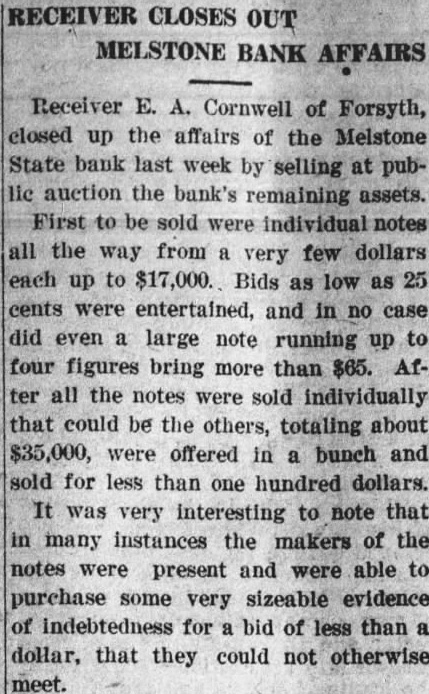
RECEIVER CLOSES OUT MELSTONE BANK AFFAIRS Receiver E. A. Cornwell of Forsyth, closed up the affairs of the Melstone State bank last week by selling at public auction the bank's remaining assets. First to be sold were individual notes all the way from a very few dollars each up to $17,000. Bids as low as 25 cents were entertained, and in no case did even a large note running up to four figures bring more than $65. After all the notes were sold individually that could be the others, totaling about $35,000, were offered in a bunch and sold for less than one hundred dollars. It was very interesting to note that in many instances the makers of the notes were present and were able to purchase some very sizeable evidence of Indebtedness for a bid of less than a dollar, that they could not otherwise meet.