First State Bank (Ovando, MT)

Episode Information

Episode UID
93027971458
Episode Type
Suspension → Closure
Bank Type
state
Bank ID
9302797 routing
Routing Number
93-0279
Start Date
June 16, 1921
Location
Ovando, Montana (47.020, -113.133)

Metadata

Model
gpt-5-mini (chosen from majority vote of a three-model LLM ensemble)
Short Digest
c75f1f4bafd49c2a

Response Measures

None

Description

One article misnames the bank as 'First National Bank of Ovando' (likely OCR or reporting error).

Events (2)

1. June 16, 1921 Receivership
Newspaper Excerpt
D. D. Johnson was appointed receiver and when he resigned May 2, 1922, Cummins was appointed; E. J. Cummins, receiver of the First State bank of Ovando ... (receiver actions described).
Source
newspapers
2. June 16, 1921 Suspension
Cause
Government Action
Cause Details
Closed by the state superintendent of banks on June 16, 1921.
Newspaper Excerpt
The bank was closed by the state superintendent of banks June 16, 1921.
Source
newspapers

Newspaper Articles (10)

Article from Great Falls Tribune, August 4, 1921

Click image to open full size in new tab

Article Text

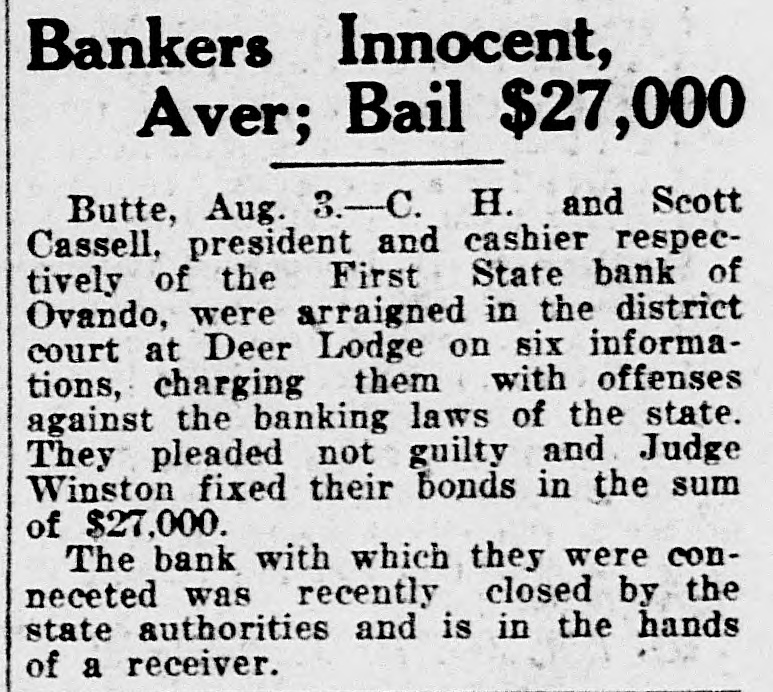
Bankers Innocent, Aver; Bail $27,000 Butte, Aug. 3.-C. H. and Scott Cassell. president and cashier respectively of the First State bank of Ovando, were arraigned in the district court at Deer Lodge on six informations, charging them with offenses against the banking laws of the state. They pleaded not guilty and Judge Winston fixed their bonds in the sum of $27,000. The bank with which they were conneceted was recently closed by the state authorities and is in the hands of a receiver.


Article from The Montana Record-Herald, December 24, 1923

Click image to open full size in new tab

Article Text

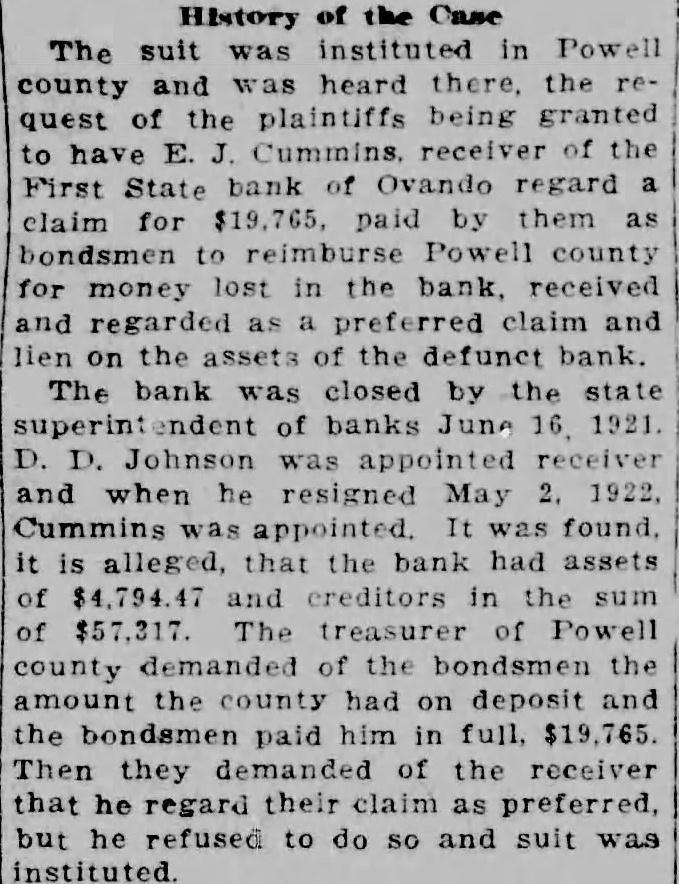
History of the Case The suit was instituted in Powell county and was heard there, the request of the plaintiffs being granted to have E. J. Cummins, receiver of the First State bank of Ovando regard a claim for $19,765, paid by them as bondsmen to reimburse Powell county for money lost in the bank, received and regarded as a preferred claim and lien on the assets of the defunct bank. The bank was closed by the state superintendent of banks June 16, 1921. D. D. Johnson was appointed receiver and when he resigned May 2, 1922, Cummins was appointed. It was found, it is alleged, that the bank had assets of $4,794.47 and creditors in the sum of $57,317. The treasurer of Powell county demanded of the bondsmen the amount the county had on deposit and the bondsmen paid him in full, $19,765. Then they demanded of the receiver that he regard their claim as preferred, but he refused to do so and suit was instituted.


Article from The Montana Record-Herald, December 24, 1923

Click image to open full size in new tab

Article Text

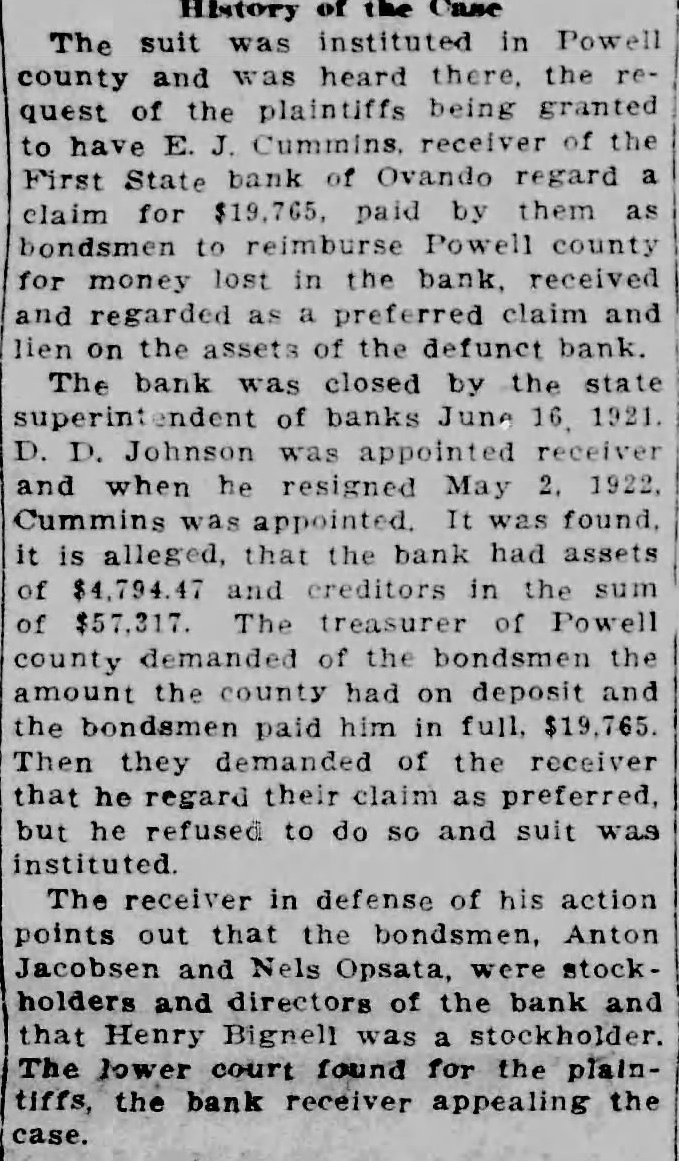
History of the Case The suit was instituted in Powell county and was heard there, the request of the plaintiffs being granted to have E. J. Cummins, receiver of the First State bank of Ovando regard a claim for $19,765, paid by them as bondsmen to reimburse Powell county for money lost in the bank, received and regarded as a preferred claim and lien on the assets of the defunct bank. The bank was closed by the state superintendent of banks June 16, 1921. D. D. Johnson was appointed receiver and when he resigned May 2, 1922, Cummins was appointed. It was found, it is alleged, that the bank had assets of $4,794.47 and creditors in the sum of $57,317. The treasurer of Powell county demanded of the bondsmen the amount the county had on deposit and the bondsmen paid him in full, $19,765. Then they demanded of the receiver that he regard their claim as preferred, but he refused to do so and suit was instituted. The receiver in defense of his action points out that the bondsmen, Anton Jacobsen and Nels Opsata, were stockholders and directors of the bank and that Henry Bignell was a stockholder. The lower court found for the plaintiffs, the bank receiver appealing the case.


Article from Great Falls Tribune, December 25, 1923

Click image to open full size in new tab

Article Text

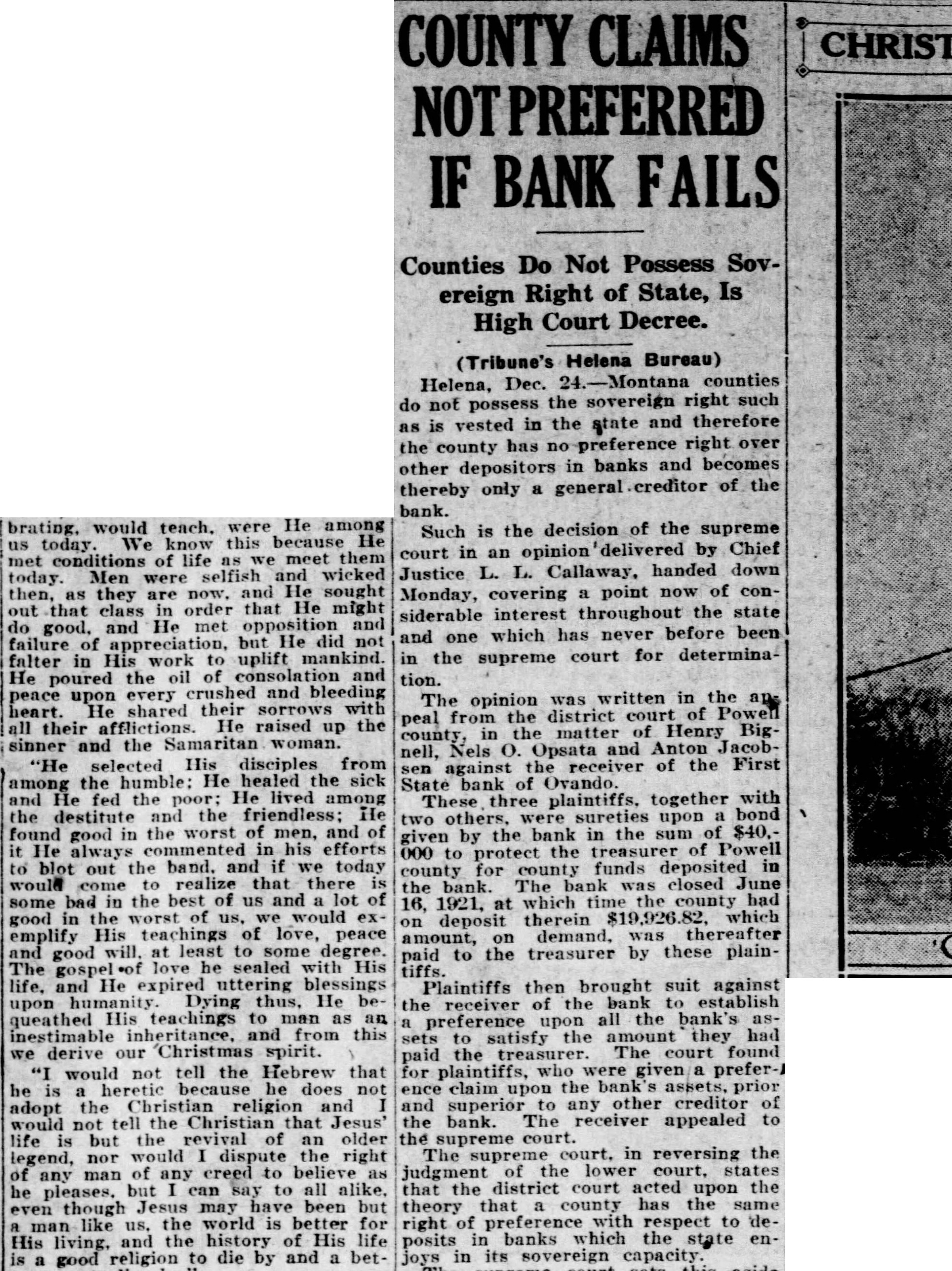
COUNTY CLAIMS NOT PREFERRED IF BANK FAILS Counties Do Not Possess Sovereign Right of State, Is High Court Decree. (Tribune's Helena Bureau) Helena, Dec. 24.—Montana counties do not possess the sovereign right such as is vested in the state and therefore the county has no preference right over other depositors in banks and becomes thereby only a general creditor of the bank. Such is the decision of the supreme court in an opinion delivered by Chief Justice L. L. Callaway, handed down Monday, covering a point now of considerable interest throughout the state and one which has never before been in the supreme court for determination. The opinion was written in the appeal from the district court of Powell county, in the matter of Henry Bignell, Nels O. Opsata and Anton Jacobsen against the receiver of the First State bank of Ovando. These three plaintiffs, together with two others, were sureties upon a bond given by the bank in the sum of $40,000 to protect the treasurer of Powell county for county funds deposited in the bank. The bank was closed June 16, 1921, at which time the county had on deposit therein $19,926.82, which amount, on demand, was thereafter paid to the treasurer by these plaintiffs. Plaintiffs then brought suit against the receiver of the bank to establish a preference upon all the bank's assets to satisfy the amount they had paid the treasurer. The court found for plaintiffs, who were given a preference claim upon the bank's assets, prior and superior to any other creditor of the bank. The receiver appealed to the supreme court. The supreme court, in reversing the judgment of the lower court, states that the district court acted upon the theory that a county has the same right of preference with respect to deposits in banks which the state enjoys in its sovereign capacity.


Article from The Billings Gazette, December 25, 1923

Click image to open full size in new tab

Article Text

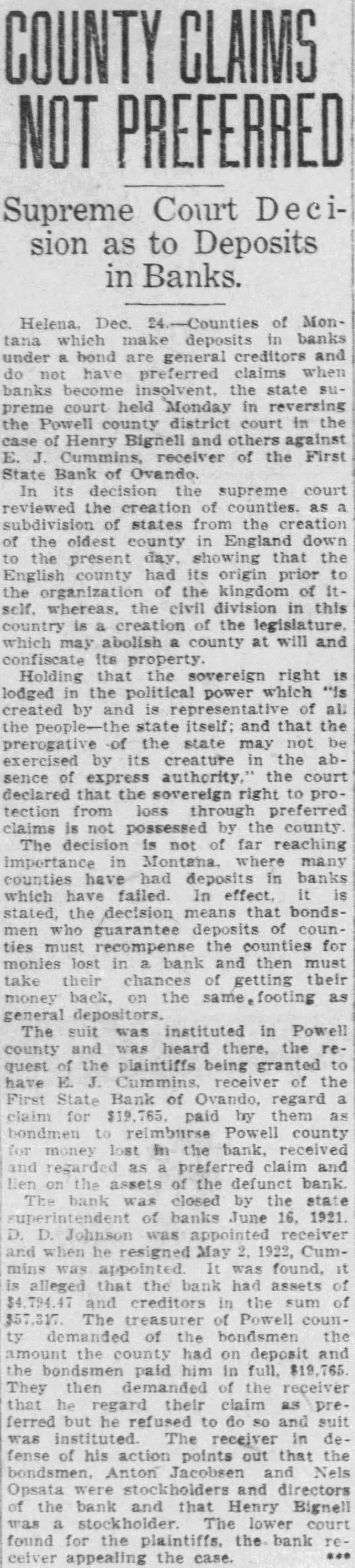
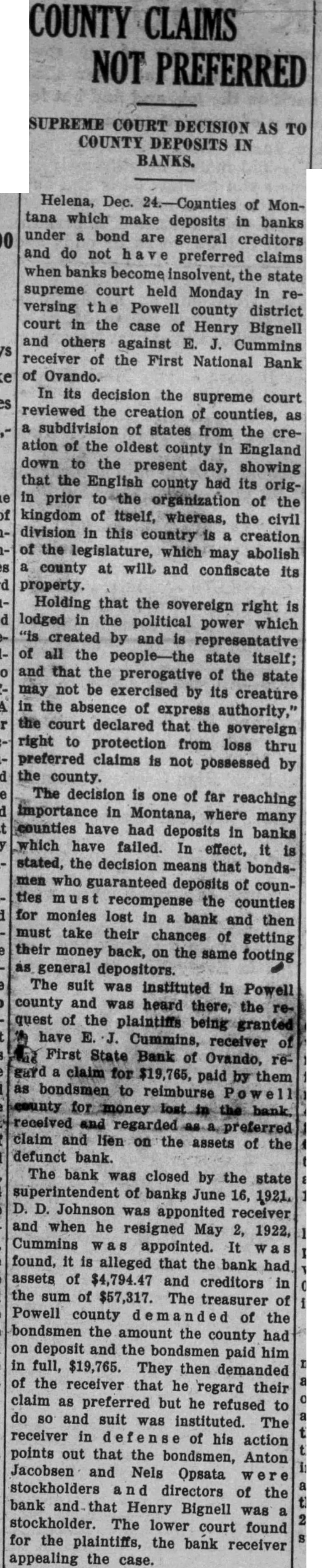
COUNTY CLAIMS NOT PREFERRED Supreme Court Decision as to Deposits in Banks. Helena, Dec. 24.—Counties of Montana which make deposits in banks under a bond are general creditors and do not have preferred claims when banks become insolvent, the state supreme court held Monday in reversing the Powell county district court in the case of Henry Bignell and others against E. J. Cummins, receiver of the First State Bank of Ovando. In its decision the supreme court reviewed the creation of counties, as a subdivision of states from the creation of the oldest county in England down to the present day, showing that the English county had its origin prior to the organization of the kingdom of itself, whereas, the civil division in this country is a creation of the legislature, which may abolish a county at will and confiscate its property. Holding that the sovereign right is lodged in the political power which "is created by and is representative of all the people—the state itself; and that the prerogative of the state may not be exercised by its creature in the absence of express authority," the court declared that the sovereign right to protection from loss through preferred claims is not possessed by the county. The decision is not of far reaching importance in Montana, where many counties have had deposits in banks which have failed. In effect, it is stated, the decision means that bondsmen who guarantee deposits of counties must recompense the counties for monies lost in a bank and then must take their chances of getting their money back, on the same footing as general depositors. The suit was instituted in Powell county and was heard there, the request of the plaintiffs being granted to have E. J. Cummins, receiver of the First State Bank of Ovando, regard a claim for $19,765, paid by them as bondsmen to reimburse Powell county for money lost in the bank, received and regarded as a preferred claim and lien on the assets of the defunct bank. The bank was closed by the state superintendent of banks June 16, 1921. D. D. Johnson was appointed receiver and when he resigned May 2, 1922, Cummins was appointed. It was found, it is alleged that the bank had assets of $4,794.47 and creditors in the sum of $57,317. The treasurer of Powell county demanded of the bondsmen the amount the county had on deposit and the bondsmen paid him in full, $19,765. They then demanded of the receiver that he regard their claim as preferred but he refused to do so and suit was instituted. The receiver in defense of his action points out that the bondsmen, Anton Jacobsen and Nels Opsata were stockholders and directors of the bank and that Henry Bignell was a stockholder. The lower court found for the plaintiffs, the bank receiver appealing the case.


Article from Laurel Outlook, December 26, 1923

Click image to open full size in new tab

Article Text

COUNTY CLAIMS NOT PREFERRED Supreme Court Hands Down Important Decision As To Deposits In Banks. Helena, Dec. 24.—Counties of Montana which make deposits in banks under a bond are general creditors and do not have preferred claims when banks become insolvent, the state supreme court held Monday in reversing the Powell county district court in the case of Henry Bignell and others against E. J. Cummins, receiver of the First State bank of Ovando. In its decision the supreme court reviewed the creation of counties, as a subdivision of states from the creation of the oldest county in England down to the present day, showing that the English county had its origin prior to the organization of the kingdom of itself, whereas, the civil division in this country is a creation of the legislature, which may abolish a county at will and confiscate its property. Holding that the sovereign right is lodged in the political power which "is created by and is representative of all the people—the state itself; and that the prerogative of the state may not be exercised by its creature in the absence of express authority," the court declared that the sovereign right to protection from loss through preferred claims is not possessed by the county. The decision is of far reaching importance in Montana, where many counties have had deposits in banks which have failed. In effect, it is stated, the decision means that bondsmen who guarantee deposits of counties must recompense the counties for monies lost in a bank and then must take their chances of getting their money back, on the same footing as general depositors. The suit was instituted in Powell county and was heard there, the request of the plaintiffs being granted to have E. J. Cummins, receiver of the First State bank of Ovando, regard a claim for $19,765, paid by them as bondsmen to reimburse Powell county for money lost in the bank, received and regarded as a preferred claim and lien on the assets of the defunct bank. The bank was closed by the state superintendent of banks June 16, 1921. D. D. Johnson was appointed receiver and when he resigned May 2, 1922, Cummins was appointed. It was found, it is alleged that the bank had assets of $4,794.47 and creditors in the sum of $57,317. The treasurer of Powell county demanded of the bondsmen, the amount the county had on deposit and the bondsmen paid him in full, $19,765. They then demanded of the receiver that he regard their claim as preferred but he refused to do so and suit was instituted. The receiver in defense of his action points out that the bondsmen, Anton Jacobsen and Nels Opsata were stockholders and directors of the bank and that Henry Bignell was a shareholder. The lower court found for the plaintiff, the bank receiver appealing the case.


Article from The Independent, December 27, 1923

Click image to open full size in new tab

Article Text

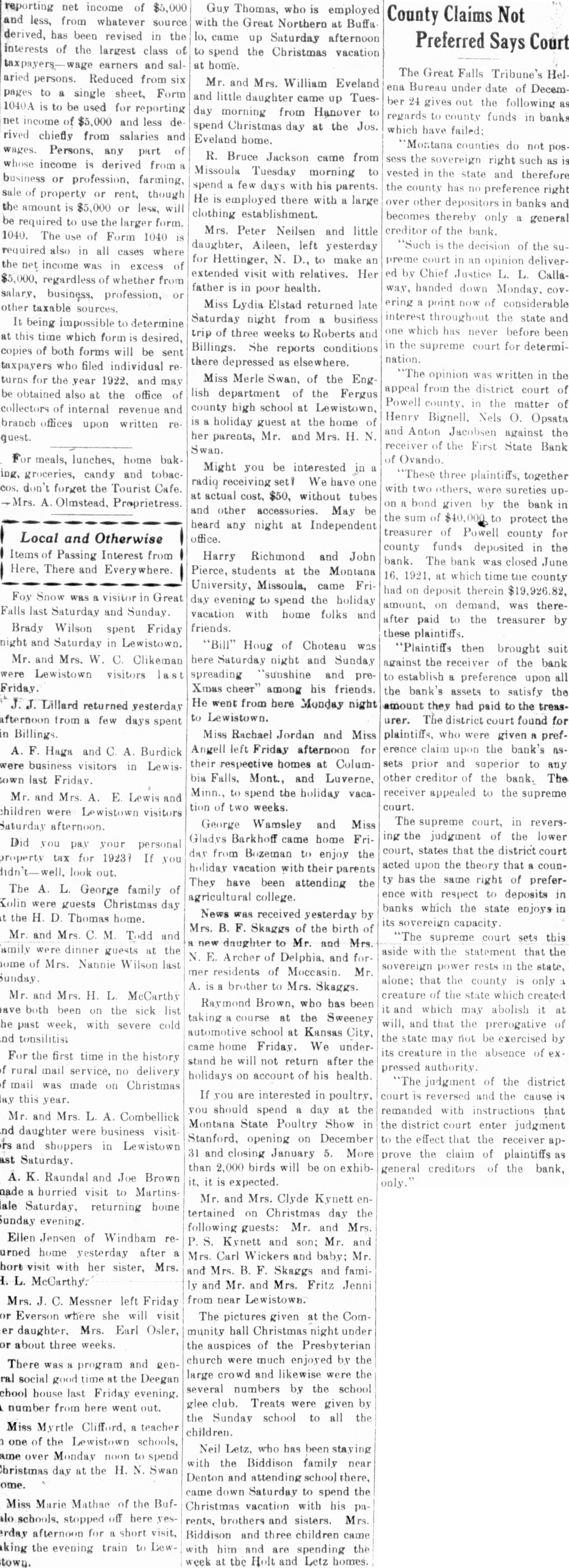
reporting net income of $5,000 and less, from whatever source derived, has been revised in the interests of the largest class of taxpayers—wage earners and salaried persons. Reduced from six pages to a single sheet, Form 1040A is to be used for reporting net income of $5,000 and less derived chiefly from salaries and wages. Persons, any part of whose income is derived from a business or profession, farming, sale of property or rent, though the amount is $5,000 or less, will be required to use the larger form, 1040. The use of Form 1040 is required also in all cases where the net income was in excess of $5,000, regardless of whether from salary, business, profession, or other taxable sources. It being impossible to determine at this time which form is desired, copies of both forms will be sent taxpayers who filed individual returns for the year 1922, and may be obtained also at the office of collectors of internal revenue and branch offices upon written request. For meals, lunches, home baking, groceries, candy and tobacco, don't forget the Tourist Cafe.—Mrs. A. Olmstead, Proprietress. Local and Otherwise Items of Passing Interest from Here, There and Everywhere. Foy Snow was a visitor in Great Falls last Saturday and Sunday. Brady Wilson spent Friday night and Saturday in Lewistown. Mr. and Mrs. W. C. Clikeman were Lewistown visitors last Friday. J. J. Lillard returned yesterday afternoon from a few days spent in Billings. A. F. Haga and C. A. Burdick were business visitors in Lewistown last Friday. Mr. and Mrs. A. E. Lewis and children were Lewistown visitors Saturday afternoon. Did you pay your personal property tax for 1923? If you didn't—well, look out. The A. L. George family of Kolin were guests Christmas day at the H. D. Thomas home. Mr. and Mrs. C. M. Todd and family were dinner guests at the home of Mrs. Nannie Wilson last Sunday. Mr. and Mrs. H. L. McCarthy have both been on the sick list the past week, with severe cold and tonsilitis. For the first time in the history of rural mail service, no delivery of mail was made on Christmas day this year. Mr. and Mrs. L. A. Combellick and daughter were business visitors and shoppers in Lewistown last Saturday. A. K. Raundal and Joe Brown made a hurried visit to Martinsdale Saturday, returning home Sunday evening. Ellen Jensen of Windham returned home yesterday after a short visit with her sister, Mrs. H. L. McCarthy. Mrs. J. C. Messner left Friday for Everson where she will visit her daughter, Mrs. Earl Osler, for about three weeks. There was a program and general social good time at the Deegan school house last Friday evening. A number from here went out. Miss Myrtle Clifford, a teacher in one of the Lewistown schools, came over Monday noon to spend Christmas day at the H. N. Swan home. Miss Marie Mathae of the Buffalo schools, stopped off here yesterday afternoon for a short visit, taking the evening train to Lewistown. Guy Thomas, who is employed with the Great Northern at Buffalo, came up Saturday afternoon to spend the Christmas vacation at home. Mr. and Mrs. William Eveland and little daughter came up Tuesday morning from Hanover to spend Christmas day at the Jos. Eveland home. R. Bruce Jackson came from Missoula Tuesday morning to spend a few days with his parents. He is employed there with a large clothing establishment. Mrs. Peter Neilsen and little daughter, Aileen, left yesterday for Hettinger, N. D., to make an extended visit with relatives. Her father is in poor health. Miss Lydia Elstad returned late Saturday night from a business trip of three weeks to Roberts and Billings. She reports conditions there depressed as elsewhere. Miss Merle Swan, of the English department of the Fergus county high school at Lewistown, is a holiday guest at the home of her parents, Mr. and Mrs. H. N. Swan. Might you be interested in a radio receiving set? We have one at actual cost, $50, without tubes and other accessories. May be heard any night at Independent office. Harry Richmond and John Pierce, students at the Montana University, Missoula, came Friday evening to spend the holiday vacation with home folks and friends. "Bill" Houg of Choteau was here Saturday night and Sunday spreading "sunshine and pre-Xmas cheer" among his friends. He went from here Monday night to Lewistown. Miss Rachael Jordan and Miss Angell left Friday afternoon for their respective homes at Columbia Falls, Mont., and Luverne, Minn., to spend the holiday vacation of two weeks. George Wamsley and Miss Gladys Barkhoff came home Friday from Bozeman to enjoy the holiday vacation with their parents. They have been attending the agricultural college. News was received yesterday by Mrs. B. F. Skaggs of the birth of a new daughter to Mr. and Mrs. N. E. Archer of Delphia, and former residents of Moccasin. Mr. A. is a brother to Mrs. Skaggs. Raymond Brown, who has been taking a course at the Sweeney automotive school at Kansas City, came home Friday. We understand he will not return after the holidays on account of his health. If you are interested in poultry, you should spend a day at the Montana State Poultry Show in Stanford, opening on December 31 and closing January 5. More than 2,000 birds will be on exhibit, it is expected. Mr. and Mrs. Clyde Kynett entertained on Christmas day the following guests: Mr. and Mrs. P. S. Kynett and son; Mr. and Mrs. Carl Wickers and baby; Mr. and Mrs. B. F. Skaggs and family and Mr. and Mrs. Fritz Jenni from near Lewistown. The pictures given at the Community hall Christmas night under the auspices of the Presbyterian church were much enjoyed by the large crowd and likewise were the several numbers by the school glee club. Treats were given by the Sunday school to all the children. Neil Letz, who has been staying with the Biddison family near Denton and attending school there, came down Saturday to spend the Christmas vacation with his parents, brothers and sisters. Mrs. Biddison and three children came with him and are spending the week at the Holt and Letz homes. County Claims Not Preferred Says Court The Great Falls Tribune's Helena Bureau under date of December 24 gives out the following as regards to county funds in banks which have failed: "Montana counties do not possess the sovereign right such as is vested in the state and therefore the county has no preference right over other depositors in banks and becomes thereby only a general creditor of the bank. "Such is the decision of the supreme court in an opinion delivered by Chief Justice L. L. Callaway, handed down Monday, covering a point now of considerable interest throughout the state and one which has never before been in the supreme court for determination. "The opinion was written in the appeal from the district court of Powell county, in the matter of Henry Bignell, Nels O. Opsata and Anton Jacobsen against the receiver of the First State Bank of Ovando. "These three plaintiffs, together with two others, were sureties upon a bond given by the bank in the sum of $40,000 to protect the treasurer of Powell county for county funds deposited in the bank. The bank was closed June 16, 1921, at which time the county had on deposit therein $19,926.82, amount, on demand, was thereafter paid to the treasurer by these plaintiffs. "Plaintiffs then brought suit against the receiver of the bank to establish a preference upon all the bank's assets to satisfy the amount they had paid to the treasurer. The district court found for plaintiffs, who were given a preference claim upon the bank's assets prior and superior to any other creditor of the bank. The receiver appealed to the supreme court. The supreme court, in reversing the judgment of the lower court, states that the district court acted upon the theory that a county has the same right of preference with respect to deposits in banks which the state enjoys in its sovereign capacity. "The supreme court sets this aside with the statement that the sovereign power rests in the state, alone; that the county is only a creature of the state which created it and which may abolish it at will, and that the prerogative of the state may not be exercised by its creature in the absence of expressed authority. "The judgment of the district court is reversed and the cause is remanded with instructions that the district court enter judgment to the effect that the receiver approve the claim of plaintiffs as general creditors of the bank, only."
Article from Judith Basin Press, December 27, 1923

Click image to open full size in new tab

Article Text

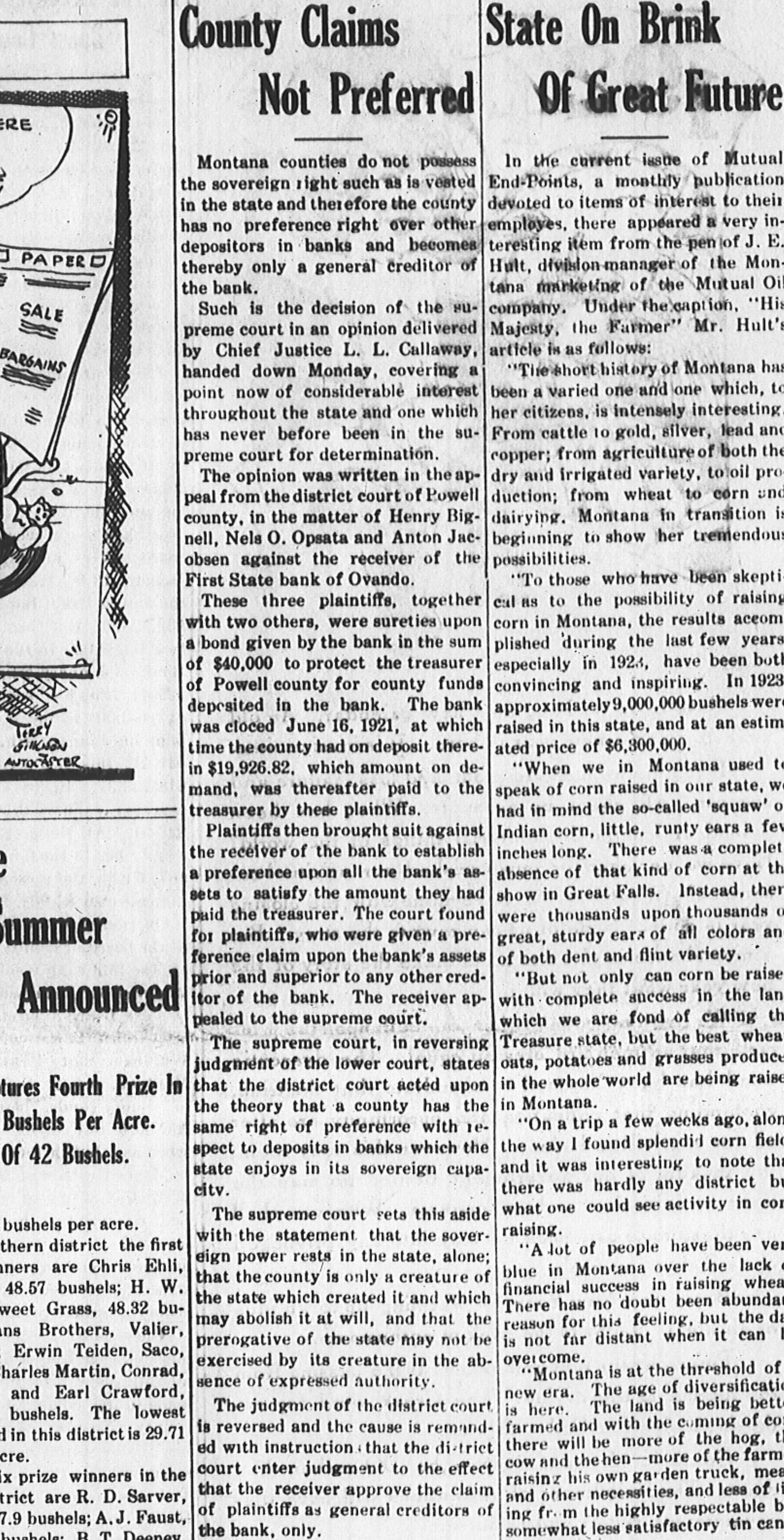
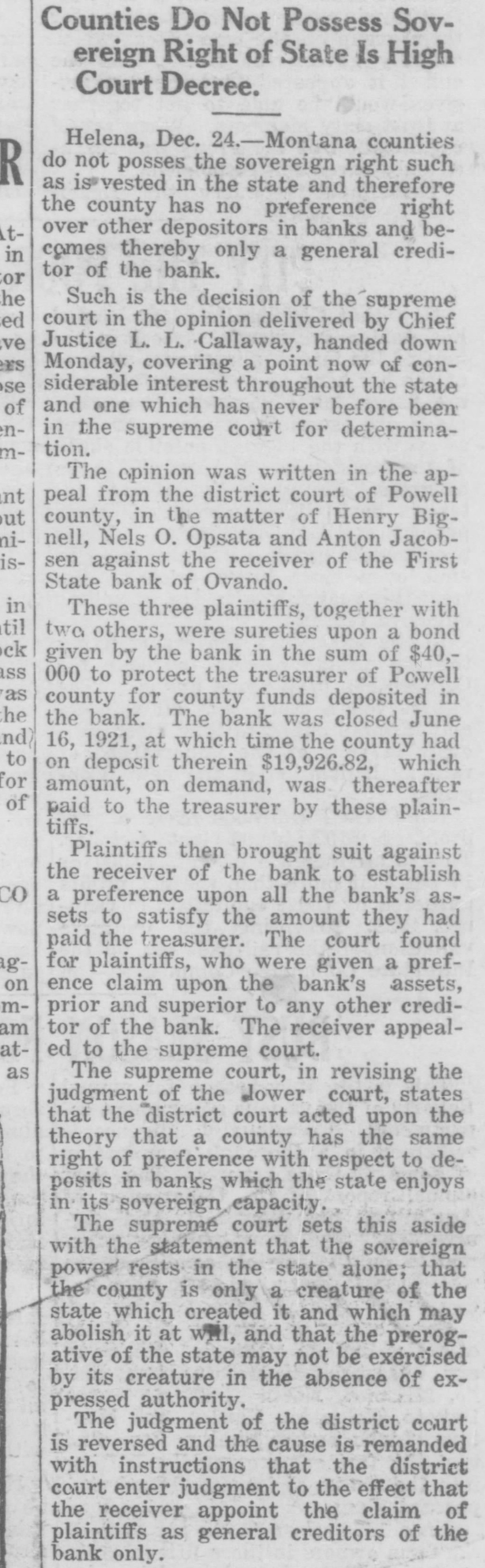
County Claims Not Preferred Montana counties do not possess the sovereign right such as is vested in the state and therefore the county has no preference right over other depositors in banks and becomes thereby only a general creditor of the bank. Such is the decision of the supreme court in an opinion delivered by Chief Justice L. L. Callaway, handed down Monday, covering a point now of considerable interest throughout the state and one which has never before been in the supreme court for determination. The opinion was written in the appeal from the district court of Powell county, in the matter of Henry Bignell, Nels O. Opsata and Anton Jacobsen against the receiver of the First State bank of Ovando. These three plaintiffs, together with two others, were sureties upon a bond given by the bank in the sum of $40,000 to protect the treasurer of Powell county for county funds deposited in the bank. The bank was closed June 16, 1921, at which time the county had on deposit therein $19,926.82, which amount on demand, was thereafter paid to the treasurer by these plaintiffs. Plaintiffs then brought suit against the receiver of the bank to establish a preference upon all the bank's assets to satisfy the amount they had paid the treasurer. The court found for plaintiffs, who were given a preference claim upon the bank's assets prior and superior to any other creditor of the bank. The receiver appealed to the supreme court. The supreme court, in reversing judgment of the lower court, states that the district court acted upon the theory that a county has the same right of preference with respect to deposits in banks which the state enjoys in its sovereign capacity. The supreme court sets this aside with the statement that the sovereign power rests in the state, alone; that the county is only a creature of the state which created it and which may abolish it at will, and that the prerogative of the state may not be exercised by its creature in the absence of expressed authority. The judgment of the district court is reversed and the cause is remanded with instructions that the district court enter judgment to the effect that the receiver approve the claim of plaintiffs as general creditors of the bank, only. State On Brink Of Great Future In the current issue of Mutual End-Points, a monthly publication devoted to items of interest to their employes, there appeared a very interesting item from the pen of J. E. Hult, division manager of the Montana marketing of the Mutual Oil company. Under the caption, "His Majesty, the Farmer" Mr. Hult's article is as follows: "The short history of Montana has been a varied one and one which, to her citizens, is intensely interesting. From cattle to gold, silver, lead and copper; from agriculture of both the dry and irrigated variety, to oil production; from wheat to corn and dairying, Montana in transition is beginning to show her tremendous possibilities. "To those who have been skeptical as to the possibility of raising corn in Montana, the results accomplished during the last few years, especially in 1923, have been both convincing and inspiring. In 1923 approximately 9,000,000 bushels were raised in this state, and at an estimated price of $6,300,000. "When we in Montana used to speak of corn raised in our state, we had in mind the so-called 'squaw' or Indian corn, little, runty ears a few inches long. There was a complete absence of that kind of corn at the show in Great Falls. Instead, there were thousands upon thousands of great, sturdy ears of all colors and of both dent and flint variety. "But not only can corn be raised with complete success in the land which we are fond of calling the Treasure state, but the best wheat, oats, potatoes and grasses produced in the whole world are being raised in Montana. "On a trip a few weeks ago, along the way I found splendid corn fields and it was interesting to note that there was hardly any district but what one could see activity in corn raising. "A lot of people have been very blue in Montana over the lack of financial success in raising wheat. There has no doubt been abundant reason for this feeling, but the day is not far distant when it can be overcome. "Montana is at the threshold of a new era. The age of diversification is here. The land is being better farmed and with the coming of corn there will be more of the hog, the cow and the hen—more of the farmer raising his own garden truck, meat and other necessities, and less of living from the highly respectable but somewhat less satisfactory tin can."


Article from The Producers News, December 28, 1923

Click image to open full size in new tab

Article Text

Counties Do Not Possess Sovereign Right of State Is High Court Decree. Helena, Dec. 24.—Montana counties do not possess the sovereign right such as is vested in the state and therefore the county has no preference right over other depositors in banks and becomes thereby only a general creditor of the bank. Such is the decision of the supreme court in the opinion delivered by Chief Justice L. L. Callaway, handed down Monday, covering a point now of considerable interest throughout the state and one which has never before been in the supreme court for determination. The opinion was written in the appeal from the district court of Powell county, in the matter of Henry Bignell, Nels O. Opsata and Anton Jacobsen against the receiver of the First State bank of Ovando. These three plaintiffs, together with two others, were sureties upon a bond given by the bank in the sum of $40,000 to protect the treasurer of Powell county for county funds deposited in the bank. The bank was closed June 16, 1921, at which time the county had on deposit therein $19,926.82, which amount, on demand, was thereafter paid to the treasurer by these plaintiffs. Plaintiffs then brought suit against the receiver of the bank to establish a preference upon all the bank's assets to satisfy the amount they had paid the treasurer. The court found for plaintiffs, who were given a preference claim upon the bank's assets, prior and superior to any other creditor of the bank. The receiver appealed to the supreme court. The supreme court, in revising the judgment of the lower court, states that the district court acted upon the theory that a county has the same right of preference with respect to deposits in banks which the state enjoys in its sovereign capacity. The supreme court sets this aside with the statement that the sovereign power rests in the state alone; that the county is only a creature of the state which created it and which may abolish it at will, and that the prerogative of the state may not be exercised by its creature in the absence of expressed authority. The judgment of the district court is reversed and the cause is remanded with instructions that the district court enter judgment to the effect that the receiver appoint the claim of plaintiffs as general creditors of the bank only.


Article from The Roundup Record, December 28, 1923

Click image to open full size in new tab

Article Text

COUNTY CLAIMS NOT PREFERRED SUPREME COURT DECISION AS TO COUNTY DEPOSITS IN BANKS. Helena, Dec. 24.—Counties of Montana which make deposits in banks under a bond are general creditors and do not have preferred claims when banks become insolvent, the state supreme court held Monday in reversing the Powell county district court in the case of Henry Bignell and others against E. J. Cummins receiver of the First National Bank of Ovando. In its decision the supreme court reviewed the creation of counties, as a subdivision of states from the creation of the oldest county in England down to the present day, showing that the English county had its origin prior to the organization of the kingdom of itself, whereas, the civil division in this country is a creation of the legislature, which may abolish a county at will and confiscate its property. Holding that the sovereign right is lodged in the political power which "is created by and is representative of all the people—the state itself; and that the prerogative of the state may not be exercised by its creature in the absence of express authority," the court declared that the sovereign right to protection from loss thru preferred claims is not possessed by the county. The decision is one of far reaching importance in Montana, where many counties have had deposits in banks which have failed. In effect, it is stated, the decision means that bondsmen who guaranteed deposits of counties must recompense the counties for monies lost in a bank and then must take their chances of getting their money back, on the same footing as general depositors. The suit was instituted in Powell county and was heard there, the request of the plaintiffs being granted to have E. J. Cummins, receiver of the First State Bank of Ovando, regard a claim for $19,765, paid by them as bondsmen to reimburse Powell county for money lost in the bank, received and regarded as a preferred claim and lien on the assets of the defunct bank. The bank was closed by the state superintendent of banks June 16, 1921. D. D. Johnson was appointed receiver and when he resigned May 2, 1922, Cummins was appointed. It was found, it is alleged that the bank had assets of $4,794.47 and creditors in the sum of $57,317. The treasurer of Powell county demanded of the bondsmen the amount the county had on deposit and the bondsmen paid him in full, $19,765. They then demanded of the receiver that he regard their claim as preferred but he refused to do so and suit was instituted. The receiver in defense of his action points out that the bondsmen, Anton Jacobsen and Nels Opsata were stockholders and directors of the bank and that Henry Bignell was a stockholder. The lower court found for the plaintiffs, the bank receiver appealing the case.