Seventh Ward Bank (New York, NY)

Episode Information

Episode UID
9347450790745
Episode Type
Suspension โ†’ Reopening
Bank Type
state
Bank ID
934745079 hash
Start Date
January 1, 1862*
Location
New York, New York (40.714, -74.006)

Metadata

Model
gpt-5-mini (chosen from majority vote of a three-model LLM ensemble)
Short Digest
074e2ed9cd048fd9

Response Measures

None

Description

Articles describe the state-charter bank suspending and subsequently reorganizing as a national bank; timing/wording (retired from business) could reflect reorganization rather than permanent failure.

Events (3)

1. January 1, 1862* Suspension
Cause
Voluntary Liquidation
Cause Details
State charter expired in 1862; suspended active business while maintaining charter and redeeming notes
Newspaper Excerpt
In 1862, when its State charter expired ... It suspended active business for a time, but kept its charter alive by sending a clerk to the Clearing House every day to redeem its notes
Source
newspapers
2. September 6, 1864 Other
Newspaper Excerpt
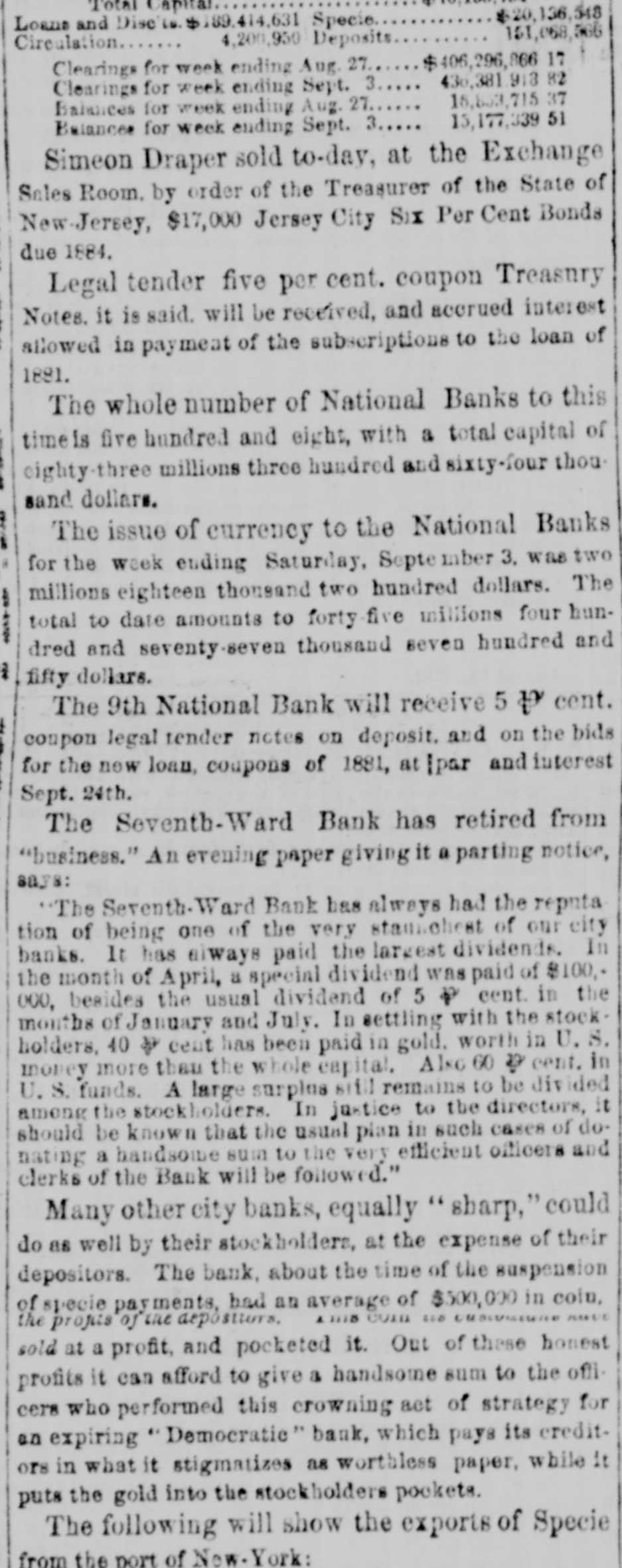
The Seventh-Ward Bank has retired from business. ... In settling with the stockholders, 40 P cent has been paid in gold ... A large surplus still remains to be divided among the stockholders.
Source
newspapers
3. January 1, 1865* Reopening
Newspaper Excerpt
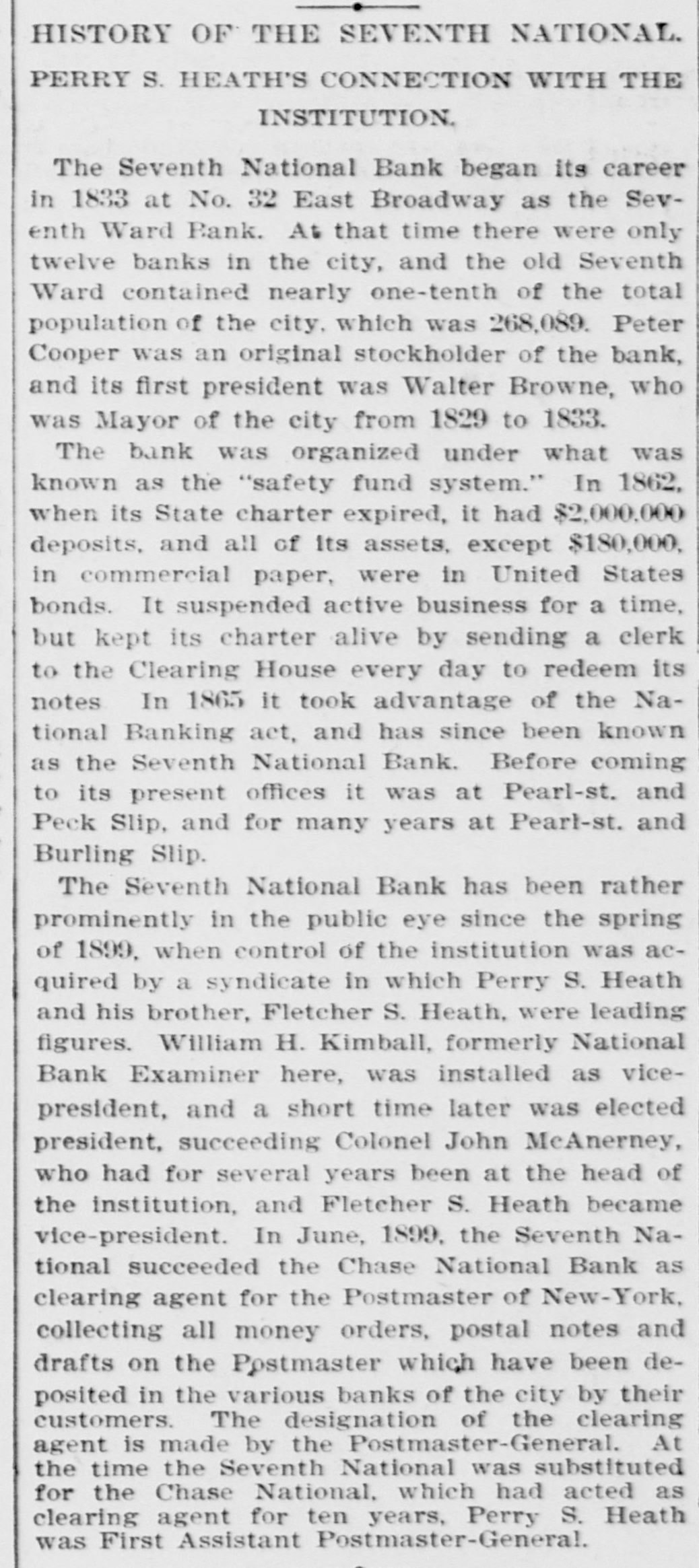
In 1865 it took advantage of the National Banking act, and has since been known as the Seventh National Bank.
Source
newspapers

Newspaper Articles (2)

Article from New-York Daily Tribune, September 6, 1864

Click image to open full size in new tab

Article Text

$20,136,548 Loans and Disc' $189,414,631 Specie 151,068,566 4,200,950 Deposits Circulation $406,296,866.17 Clearings for week ending Aug. 27 436,381,918 82 Clearings for week ending Sept. 3 16,553,715 Balances for week ending Aug. 27 15,177,339 Balances for week ending Sept. 3 Simeon Draper sold to-day, at the Exchange Sales Room. by order of the Treasurer of the State of New-Jersey, $17,000 Jersey City Six Per Cent Bonds due 1884. Legal tender five per cent. coupon Treasury Notes. it is said. will be received, and accrued interest allowed in payment of the subscriptions to the loan of 1881. The whole number of National Banks to this timei five hundred and eight, with a total capital of eighty-three millions three hundred and sixty-four thousand dollars. The issue of currency to the National Banks for the week ending Saturday, September 3, was two millions eighteen thousand two hundred dollars. The total to date amounts to forty-five millions four hundred and seventy-seven thousand seven hundred and fifty dollars. The 9th National Bank will receive 5 P cent. coupon legal tender notes on deposit. and on the bids for the new loan, coupons of 1881, at Ipar and interest Sept. 24th. The Seventh-Ward Bank has retired from "business." An evening paper giving it a parting notice, says: "The Seventh-Ward Bank has always had the reputa tion of being one of the very stamoliest of our city banks. It has always paid the largest dividends. In the month of April, a special dividend was paid of $100,000, besides the usual dividend of 5 cent. in the months of January and July. In settling with the stock. holders, 40 P cent has been paid in gold. worth in U. S. money more than the whole capital. Also 60 V cent. in U. S. funds. A large surplus sitil remains to be divided among the stockholders. In justice to the directors, it should be known that the usual plan in such cases of donating a handsome sum to the very efficient officers and clerks of the Bank will be followed." Many other city banks, equally sharp," could do as well by their stockholders, at the expense of their depositors. The bank, about the time of the suspension of specie payments, bad an average of $500,000 in coin, 110 COID 1118 the projus of the depositurs. sold at a profit, and pocketed it. Out of these honest profits it can afford to give a handsome sum to the officers who performed this crowning act of strategy for an expiring Democratic" bank, which pays its creditors in what it stigmatizes as worthless paper, while it puts the gold into the stockholders pockets. The following will show the exports of Specie from the port of New.York:

Article from New-York Tribune, June 28, 1901

Click image to open full size in new tab

Article Text

HISTORY OF THE SEVENTH NATIONAL. PERRY S. HEATH'S CONNECTION WITH THE INSTITUTION. The Seventh National Bank began its career in 1833 at No. 32 East Broadway as the Seventh Ward Bank. At that time there were only twelve banks in the city, and the old Seventh Ward contained nearly one-tenth of the total population of the city, which was 268,089. Peter Cooper was an original stockholder of the bank, and its first president was Walter Browne, who was Mayor of the city from 1829 to 1833. The bank was organized under what was known as the "safety fund system." In 1862, when its State charter expired, it had $2,000,000 deposits, and all of Its assets, except $180,000, in commercial paper, were in United States bonds. It suspended active business for a time, but kept its charter alive by sending a clerk to the Clearing House every day to redeem its notes In 1865 it took advantage of the National Banking act, and has since been known as the Seventh National Bank. Before coming to its present offices it was at Pearl-st. and Peck Slip, and for many years at Peart-st. and Burling Slip. The Seventh National Bank has been rather prominently in the public eye since the spring of 1899, when control of the institution was acquired by a syndicate in which Perry S. Heath and his brother, Fletcher S. Heath, were leading figures. William H. Kimball, formerly National Bank Examiner here, was installed as vicepresident, and a short time later was elected president, succeeding Colonel John McAnerney, who had for several years been at the head of the institution, and Fletcher S. Heath became vice-president. In June, 1899, the Seventh National succeeded the Chase National Bank as clearing agent for the Postmaster of New-York, collecting all money orders, postal notes and drafts on the Postmaster which have been deposited in the various banks of the city by their customers. The designation of the clearing agent is made by the Postmaster-General. At the time the Seventh National was substituted for the Chase National, which had acted as clearing agent for ten years, Perry S. Heath was First Assistant Postmaster-General.