Produce Exchange Trust Company (New York, NY)

Episode Information

Episode UID
9359753591200
Episode Type
Run β†’ Suspension β†’ Reopening
Bank Type
trust
Bank ID
935975359 hash
Start Date
December 18, 1899
Location
New York, New York (40.714, -74.006)

Metadata

Model
gpt-5-mini (chosen from majority vote of a three-model LLM ensemble)
Short Digest
417f8d710464ca1e

Response Measures

None

Description

Contemporary reports cite both damaging loans/illiquid securities and circulating rumors that precipitated withdrawals.

Events (3)

1. December 18, 1899 Run
Cause
Bank Specific Adverse Info
Cause Details
Rumors about the company's unstable condition combined with heavy withdrawals driven by large illiquid loans and syndicate exposures.
Measures
Directors sought offers of emergency advances (Edwin Gould offered $500,000); clearing house/market lending support arranged by banks.
Newspaper Excerpt
These latest rumors precipitated a run on the company during the past few days which made it impossible
Source
newspapers
2. December 18, 1899 Suspension
Cause
Bank Specific Adverse Info
Cause Details
Inability to convert securities into cash to meet sudden abnormal demand after withdrawals; precautionary suspension pending examination.
Newspaper Excerpt
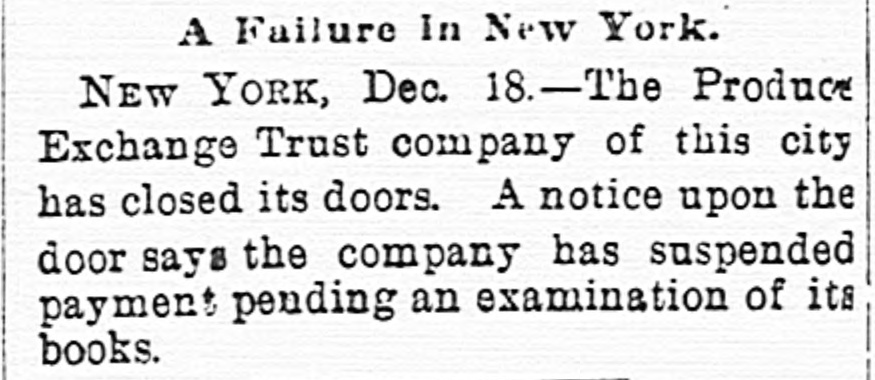
The Produce Exchange Trust company of this city has closed its doors. A notice upon the door says the company has suspended payment pending an examination of its books.
Source
newspapers
3. January 10, 1900 Reopening
Newspaper Excerpt
The Produce Exchange Trust Co., which suspended Dec. 18, resumed today.
Source
newspapers

Newspaper Articles (21)

Article from El Paso Daily Herald, December 18, 1899

Click image to open full size in new tab

Article Text

By the Failure Of a Big Trust Company WILDCAT FINANCIERING Has Brought the Inevitable Reckoning And Good Will Come Of It. NEW YORK, Dec. 18.-The failure of the Produce Exchange Trust company caused a eemi-panic in Wall street this morning. The stock market which has been nervous and weak could not withstand the shock and declines ranging from 3 to 5 percent were general. Strong houses quickly sent in supporting orders and the slump was stayed, though the market continued feverish and unsettled throughout the morning. The failure of Henry Allen & Co., brokers, added to the excitement and stocks were thrown on the market wildly. The liabilities and assets of the Produce Exchange Trust company are estimated in the street at about $10,000,000. The embarrassmentis said by well informed bankers to have been caused by big loans on securities to the flour trust and the International Banking and Trust company. After 1:30 this afternoon the market again went to emash. Call money went soaring, atone time reaching 70bid, and this caused the market to go to pieces. Declines ranged from 2 to 12 and were general. Sugar lost 8, American tobacco 7 and Tennessee Coal and Iron 9. These were the heaviest losers in industrials. In railroad stocks Rock Island fell 5 and Burlington and New York Central 3. Brooklyn Rapid Transit fell 7 and Metropolitan street railway 12. Long stock was dumped on the market in huge blocks and this helped the bears to batter values to pieces. At this time the market was wildly excited with each bid bringing prices lower and lower. At 2:30 p. m. money on call was 100 per cent bid. Shortly after 2:30 J. Pierpont Morgan sent $1,000,000 into the market to loan at 50. Money on call had reached 125 bid when the Morgan money was thrown on the market. The clearing house committee of associated banks got together and as a result $10,000,000 additional money was loaned on change.


Article from Evening Journal, December 18, 1899

Click image to open full size in new tab

Article Text

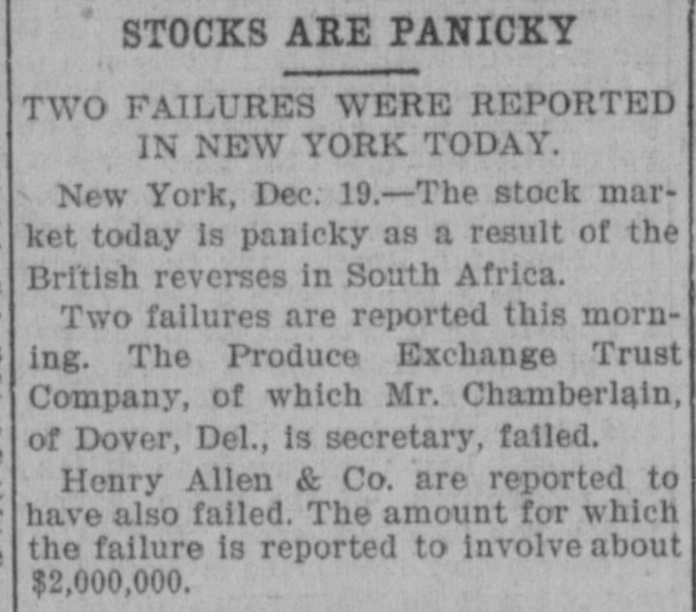
STOCKS ARE PANICKY TWO FAILURES WERE REPORTED IN NEW YORK TODAY. New York, Dec. 19.-The stock market today is panicky as a result of the British reverses in South Africa. Two failures are reported this morning. The Produce Exchange Trust Company, of which Mr. Chamberlain, of Dover, Del., is secretary, failed. Henry Allen & Co. are reported to have also failed. The amount for which the failure is reported to involve about $2,000,000.


Article from The Portland Daily Press, December 19, 1899

Click image to open full size in new tab

Article Text

FINANCIAL AND COMMERCIAL Quotations of Staple Products in the Leading Markets. New York Stock, Money and Grain Market Review. (Price, McCormick & Co., 216 Middle street.) New York, Monday, December 18. Stocks-Today's market requires very little comment. It opened rather heavy with no indications of panic. However, the pressure to sell increased when it became known that the Produce Exchange Trust company had failed and liquidation became still more pronounced at the announcement of the suspension of Henry Allen & Co. Towards 12 o'elook it became evident that there was little or no money to loan. Rates were gradually bid up from 6 to 100 per cent, the latter quotation being the last one made. Naturally this has resulted in a panio which is certainly the worst the street has seen since the Venezuelan panic, and has possibly run further than it did then. So far, no news is obtainable as to the action of the hanks, but it is believed that between now and the opening of the market tomorrow eteps will be taken for the issue of Clearing House certificates. That such steps should have been taken before is the opening of the whole street.


Article from Arizona Republican, December 19, 1899

Click image to open full size in new tab

Article Text

HENRY J. ALLEN & CO. New York, Dec. 18.-The suspension of the firm of Henry J. Allen & Co., bankers and brokers, has been announced. The Produce Exchange Trust company also has closed its doors.


Article from New-York Tribune, December 19, 1899

Click image to open full size in new tab

Article Text

reconsider his determination on the promises that certain interests, which had been identified with the company would withdraw at the annual meeting in January. He had the hope that, in case the company could be properly managed in the mean time. It could weather the storm and be put on a better basis. The run on the company, which precipitated action by the State Examiner, made It impossible to carry out his plans for securing the proper management of the concern. As late as this morning he offered to advance $500,000. as long as needed. dependent on the resignation of two men, whom he considered responsible for the bad loans and unsafe banking methods of the company. Mr. Gould is bitter because, as his friends assert, while the actual condition of the Trust company was known to President Beall and Mr. McIntyre as early as a week ago Saturday, nothing was said about it to him by Messrs. Beall and McIntyre until Saturday noon, after Mr. Judson, the Bank Examiner. had the books, when they admitted to him that the bank was in a bad way. Then it was that he made the flat offer. it is said. that if Messrs. Beall and McIntyre would retire from the company at once, he would lend the company $500,000 for as long a time as needed. His proposition was not accepted. "The stockholders and depositors of the Produce Exchange Trust Company will get their money." said Mr. Gould, when asked about the possible losses on account of the failure of the bank. adding: "It is nonsense to try to make a panic out of the present stringency."


Article from The Salt Lake Herald, December 19, 1899

Click image to open full size in new tab

Article Text

HEAVY FAILURE OF A TRUST COMPANY Unable to Convert Securities Into Cash to Meet Demands. New York, Dec. 18.-The Produce Exchange Trust company of this city has closed its, doors. A notice upon the door says that the company has suspended payment pending an examination of its books. The officers of the company declined to see anybody or to give anything for publication beyond this supplementary notice, which was posted on the doors some time after 11 o'clock: "The immediate cause of the suspension of the company is its inability to convert its securities into cash in time to meet the sudden and abnormal demand made upon it. A statement of the company's affairs at the close of business on Saturday last in round figures is as follows:


Article from Daily Kennebec Journal, December 19, 1899

Click image to open full size in new tab

Article Text

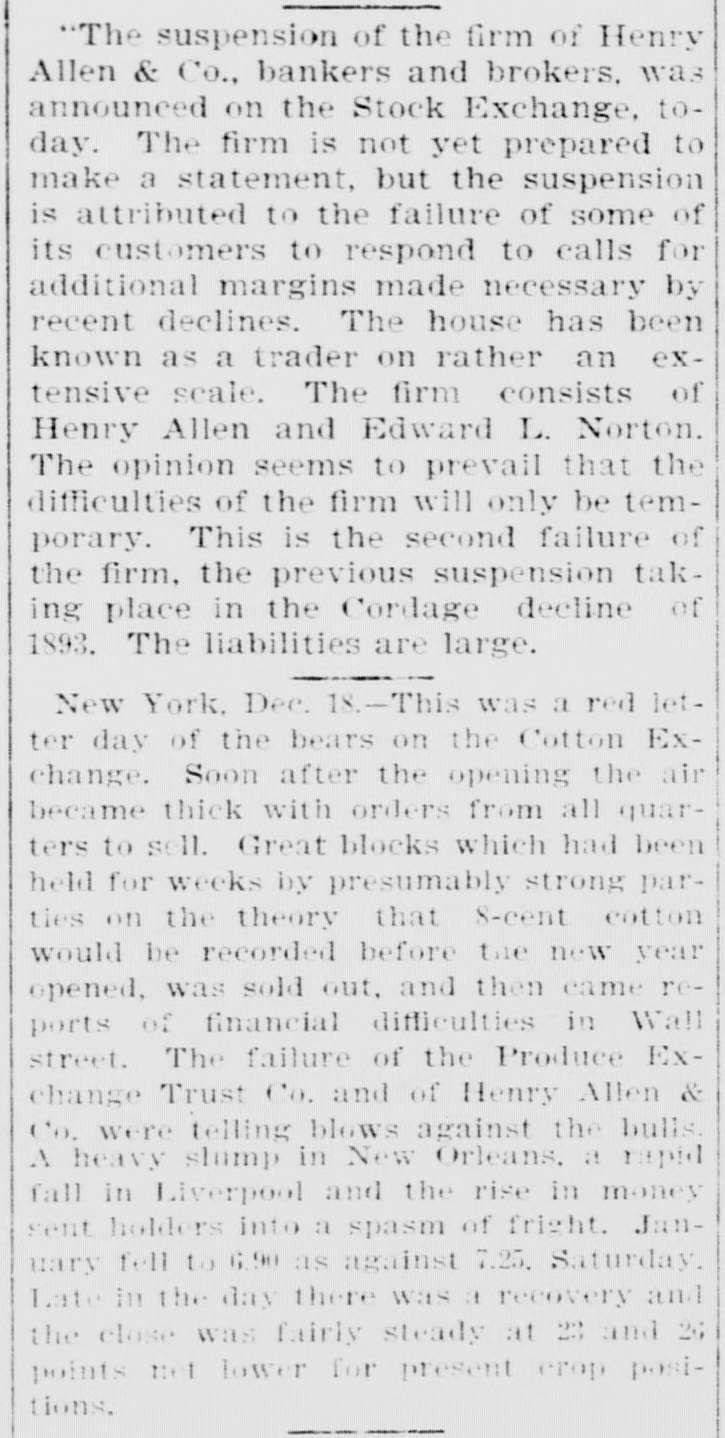
"The suspension of the firm of Henry Allen & Co., bankers and brokers, was announced on the Stock Exchange, today. The firm is not yet prepared to make a statement, but the suspension is attributed to the failure of some of its customers to respond to calls for additional margins made necessary by recent declines. The house has been known as a trader on rather an extensive scale. The firm consists of Henry Allen and Edward L. Norton. The opinion seems to prevail that the difficulties of the firm will only be temporary. This is the second failure of the firm, the previous suspension taking place in the Cordage decline of 1893. The liabilities are large. New York. Dec. 18.-This was a red letter day of the bears on the Cotton Exchange. Soon after the opening the air became thick with orders from all quarters to sell. Great blocks which had been held for weeks by presumably strong parties on the theory that 8-cent cotton would be recorded before the new year opened, was sold out, and then came reports of financial difficulties in Wall street. The failure of the Produce Exchange Trust Co. and of Henry Allen & Co. were telling blows against the bulls. A heavy slump in New Orleans, a rapid fall in Liverpool and the rise in money sent holders into a spasm of fright. January fell to 6.90 as against 7.25. Saturday. Late in the day there was :1 recovery and the close was fairly steady at 23 and 26 points net lower for present crop positions.


Article from The Sun, December 19, 1899

Click image to open full size in new tab

Article Text

Before noon the doors of the Trust Company's offices were placarded with the following notices: All checks of the National Bank of Orange county, Goshen. N. Y., on the Produce Exchange Trust Company, will be paid at the Mercantile National Bank. All checks drawn by the New Haven County National Bank. New Haven, Conn., on the Produce Exchange Trust Company, will be paid at the Mercantile National Bank. The Now York National Exchange Bank. Chambers street and West Broadway. will take up drafts drawn on the Produce Exchange Trust Company. by the National Bank of Orange county, Goshen. N. Y. Please present to the Hanover National Bank for payment. checks drawn on the Produce Exchange Trust Company by the following banks: Bank of Chateaugay. Chateaugay, Y.; Citizen's National Bank, Manafield, O.; Bank of Summit. Summit. Miss.: People's Bank. Hanover. Pa. Later in the day, Frederick D. Kilburn. Superintendent of the State Bank Department. gave out the following statement in reference to the condition of the company and certain facts leading up to its suspension of business: "A special examination of the Produce Exchange Trust Company was made by the banking department as of the 7thday of December. This examination was because of rumors in regard to the company which were in circulation in and about Wall street. It was completed on the 9th. and I had an interview with the President. Mr. Beall, and the Vice-President. Mr. Seudder. on that day with reference to the company's condition. I told them that they were in a precarious condition. and that immediate steps should be taken to fortify themselves against large with trawals. which I believed would result on account of the rumors about the company. Ieriticised the socalled syndicate loans very severely. and pointed out the fact that they had not sufficient quick assets with which to meet the demand which would probably he made. "I learned last night that Mr. Beall did not communicate my suggestions to his Board of Directors and, except one or two who had learned something from other sources as to the condition of the company. none of the directors was informed of its true condition until Saturday afternoon or yesterday evening. The resuit was that not sufficient time remained to make arrangements. which I believe otherwise could have been made. to tide the company over. I have no doubt that all depositors will be paid in full." Edwin Gould made a statement explaining his connection with the Produce Exchange Company. He said he had been with it only a short time. having come into it upon the strength of statements made to him about the assets and liabilities of the company. as well as statements regarding the business done. He found out after he had become a director and first Vice-President that the statements made to him were misleading and that the assets were not at all of the character which had been represented to him. He therefore resigned on Sept. 17 director and vice-president. The Board of Directors did not immediately act upon the resignation but set to work to induce him to recall it. This he did on Nov. 28 upon promises that certain interests in the company would withdraw at the annual meeting in January and that a reorganization would be effected. He believed. he said, that if these promises were made good. and the company were properly managed in the meantime. it could weather the storm that was threatening it. and could be put on a sound and paying basis. Rumors which were set afloat about the condition of the company several days ago ed to an examination of the books of the encern by Albert C. Judson. the State Bank Examiner. and when this examination was completed. fresh rumors about the instability of the concern were started. These latest 'umors precipitated a run on the company luring the past few days which made it impossible for him to carry out at the time his plans for reorganizing the concern. He said hat he had believed. however. up to yesterday norning. that it would not be necessary or the company to suspend and he ad offered to advance $500,000 to be held by the company as long as was needed. providing two officers of the ompany whom. he considered responsible for ad loans and unsafe banking methods. resigned immediately. No resignations were innounced yesterday. In connection with this of M. Gould's which bei


Article from The Madison Daily Leader, December 20, 1899

Click image to open full size in new tab

Article Text

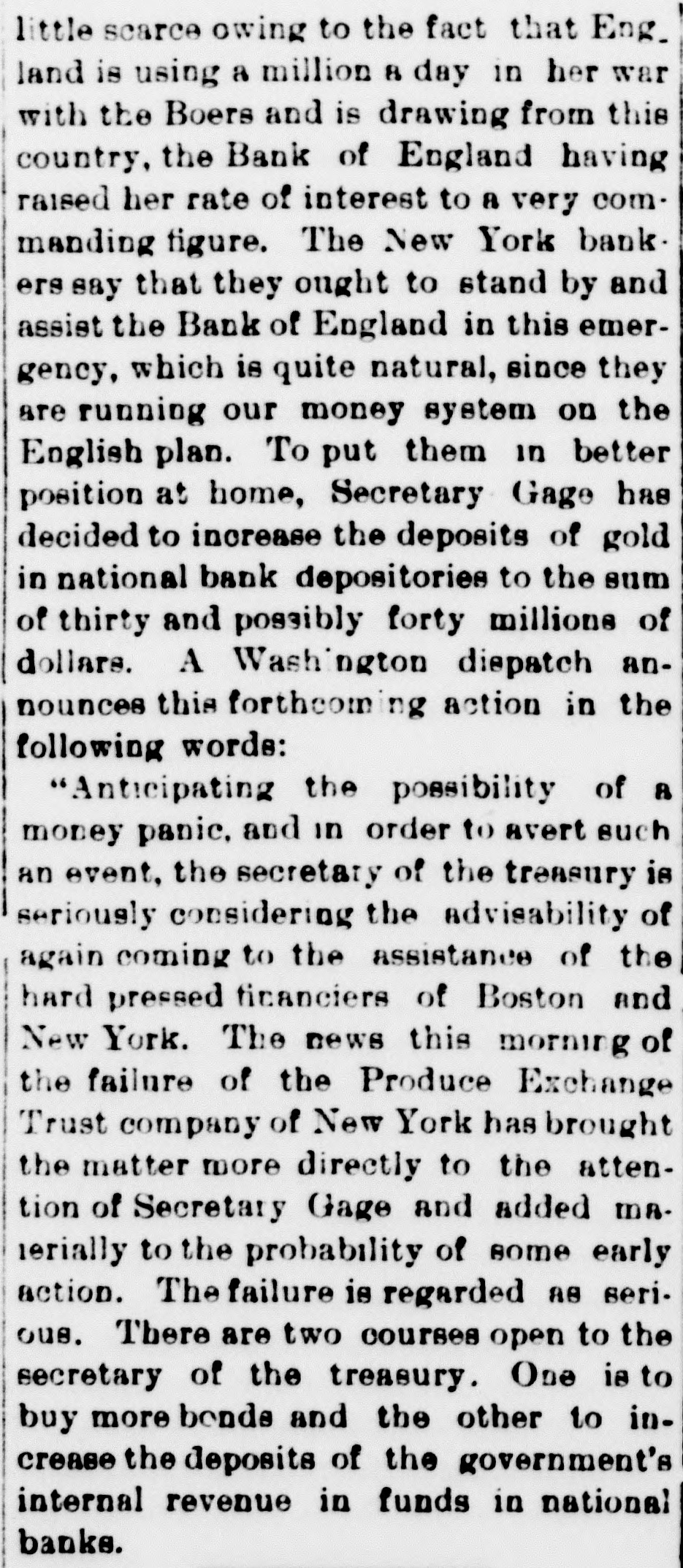
little scarce owing to the fact that Eng. land is using a million 8 day in her war with the Boers and is drawing from this country, the Bank of England having raised her rate of interest to a very commanding figure. The New York bank. ers say that they ought to stand by and assist the Bank of England in this emergency, which is quite natural, since they are running our money system on the English plan. To put them in better position at home, Secretary Gage has decided to increase the deposits of gold in national bank depositories to the sum of thirty and possibly forty millions of dollars. A Washington dispatch announces this forthcoming action in the following words: "Anticipating the possibility of a money panic, and in order to avert such an event, the secretary of the treasury is seriously considering the advisability of again coming to the assistance of the hard pressed financiers of Boston and New York. The news this morning of the failure of the Produce Exchange Trust company of New York has brought the matter more directly to the attention of Secretary Gage and added materially to the probability of some early action. The failure is regarded AS serious. There are two courses open to the secretary of the treasury. One is to buy more bonds and the other to increase the deposits of the government's internal revenue in funds in national banks.


Article from The Manning Times, December 20, 1899

Click image to open full size in new tab

Article Text

A Failure In New York. NEW YORK, Dec. 18.-The Produce Exchange Trust company of this city has closed its doors. A notice upon the door says the company has suspended payment pending an examination of its books.


Article from Shepherdstown Register, December 21, 1899

Click image to open full size in new tab

Article Text

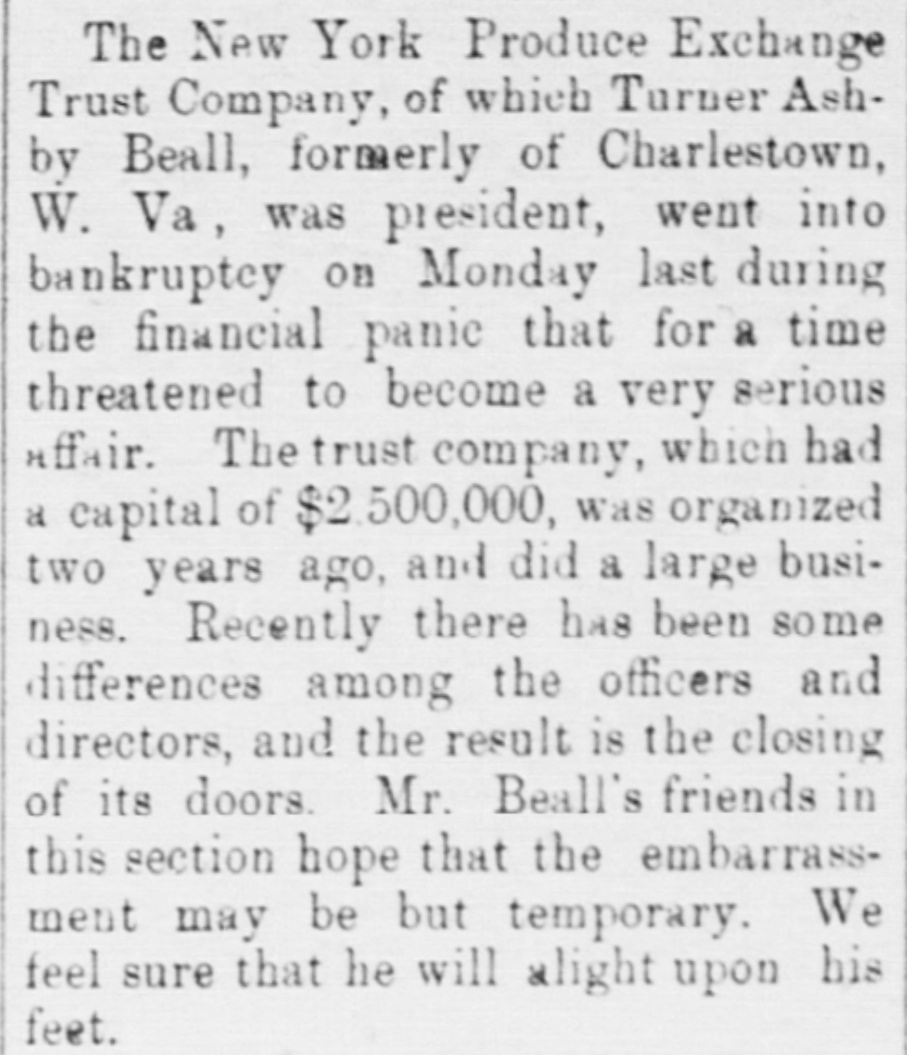
The New York Produce Exchange Trust Company, of which Turner Ashby Beall, formerly of Charlestown, W. Va, was president, went into bankruptey on Monday last during the financial panie that for a time threatened to become a very serious affair. The trust company, which had a capital of $2,500,000, was organized two years ago, and did a large business. Recently there has been some differences among the officers and directors, and the result is the closing of its doors. Mr. Beall's friends in this section hope that the embarrassment may be but temporary. We feel sure that he will alight upon his feet.


Article from The Hocking Sentinel, December 21, 1899

Click image to open full size in new tab

Article Text

Excitement Causes Failures. Excitement in Wall street caused the suspension of two large trading housesβ€” the Produce Exchange Trust Company and Henry Allen & Co., bankers and brokers.


Article from The News & Observer, December 21, 1899

Click image to open full size in new tab

Article Text

RAILROAD MONOPOLY. The people of all the South Atlantic States have viewed with gratification the organization of three strong railroad systems connecting New York with Tampa. The Southern Railway running through Piedmont, North Carolina, the Seaboard through the Central and the Atlantic Coast Line running through the Eastern section of the State promised to give adequate through facilities, insuring at least some measure of competition. The re-organization and consolidation of the Seaboard system, which W.I.S to be completed this month, has meΕ₯ the powerful opposition of the Southern Railway in every conceivable way, culminating in the panie in New York on Monday when the Produce Exchange Trust Company, one of the syndicate financing the Seaboard Air Line consolidation, was forced to the wall. The interest Raleigh and North Carolina feels in this contest is to prevent monopoly. It wants both these systems of roads and would regard it as a great calamity to see either one swallow the other. For that relason the people of North Carolina hope the delay caused by the Ryan litigation and other hostile efforts will not be able to prevent the consolidation of the Seaboard system. It promises to aid greatly in Southern development and as a compact system under the present progressive management it will be one of the greatest agencies in the prosperity of the South Atlantic States. It is gratifying to be assured by President Williams and Vice President St. John that the recent events will not prevent the realization of the great idea which has dominated them and other progressive business men.


Article from Virginian-Pilot, December 22, 1899

Click image to open full size in new tab

Article Text

RESISTING A COMBINATION. As If a fresh example were necessary, the managers of the Produce Exchange Trust Company, of New York, have made a free display of their ignorance of the uselessness" of kicking against a combination. One of the chief causes that led up to the suspension of the company was its futile effort to defy every single bank and Trust Company in New York; refuse to enter into an agreement, but to fight it out. The result was not contrary to anticipation. Every bank doing a big business at times loans nearly all its available funds. If at such time a "run" be made upon it for cash or a heavy demand, although rich in good merchantable, bankable paper, it cannot pay without the aid of other banks, who lend the cash for the time being. Such was the case of the Produce Exchange Trust Company. With $2,500,000 in New York city bonds and $80,000 in cash it quietly closed its doors because its directors became panicstricken at the very idea of a run. It was almost criminal In the directors, yet the result is the same. It was not believed that other banks would help out the "kicker." The facts in the matter are that a few months ago the New York banks declined to collect any more "country" paper except for a proper compensation. All the banks joined in the combine except the Produce Exchange Trust Company, which, of course, left the Clearing-house. The result of that act is shown in the failure of the institution and is another example of the uselessness of private effort against any combine; be It what it may.


Article from The Democratic Advocate, December 23, 1899

Click image to open full size in new tab

Article Text

WALL STREET EXCITED. Call Money Commanded 186 Per Cent-Beltimore Firms Go Under, &c. Monday, December 18, will long be remembered in Wall street, New York, as on that day the record in stock selling was the next highest ever known. The New York correspondent of the Philadelphia Ledger at the close of business Monday says: One bad failure was announced. that of the Product Exchange Trust Company, and one suspension, that of Henry Allen & Co. Loanable money was withdrawn from the Stock Exchange. Bids for loans advanced as high as 186 per cent. without attracting offers Loans were called right and left. Securities were thrown on the market in large blocks Prices broke with a violence, such as was witnessed only on the days of the Baring and 1893 panics and the memorable Venezuelan slump. At half-past 2 the situation looked grave, indeed, and Wall street men looked each other in the face anxiously and asked "When will this thing end At this point relief came, and the course of the panie was checked. J. Pierpont Morgan is generally credited with having initiated the relief measures. Besides throw. ing on the market a large sum of his own money, he called the attention of F. B. Tappen, the veteran President of the Gallatin National Bank and member of the Clearing House Committee. to the advisability of the banks taking steps to relieve the strain. Calling to his assistance J. Edward Simmons, President of the Fourth National Bank. ho was associated with him on the famous Loan Committee of 1891, Mr. Tappen, with his accustomed energy. undertook the task. The two bankers immediately called & meeting of bank Presidents In ten minutes about a dozen of the Presidents were is session, and it was instantly resolved to offer $8,000,000 to $10,000,000 in loans in the Stock Exchange. Nine banks agreed to form a pool. with a million dollars each, for this purpose. Mr. Frothingham, the well known loan broker, was intrusted with the mission of placing this money on the market. At twenty minutes to 3 be began to offer loans, starting at so per cent. and reducing the rate rapidly to6. The closing rate was 8 per cent. This action had the desired effect of checking the demoralization in the market, and prices closed generally with considerable recovery from the lowest quotations. Some of the Losses. An idea of the severity of losses may be gained from a few specifications. Thus, American Tobacco fell all extreme 21Β½, Metropolitan 20%, People's Gas 14, Sugar 1236, Continental Tobacco 113/6, Tennessee Coal 17, Manhattan 9 and Leather preferred 9% all in the list of Industrials. In the railroad list such stocks as New York Central, Great Northern preferred, Rock Island, Southern Pacific, the Union Pacifics, the Northern Pacifics, Atchison preferred, and, in fact, the most prominent and active railroad stocks in the whole list showed losses all the way from 4 to 9 points. The rallies, with the final offerings of the money rate down to 6 per cent., ran from S to 10 points. The day's transactions ran up to a total of nearly 1,650,000 shares, which is the record for & day's business. The excitement was intense all day. Seems to be a Bad Failure. The failure of the Produce Exchange Trust Company appears to be & bad one, although Thomas A. McIntrye, who has been its most active promoter. says that he is confident it can pay dollar for dollar, and that without much delay. But the statement made by Edwin Gould, the Vice President of the company, is not reassuring. Mr. Gould says that since his election as Vice President, on September 20, he made an examination, and found matters in connection with the concern for which he did not care to assume responsibility. He has found that large sums of money have been tied up in aiding the underwriting of certain industrial enterprises, until the amount so invested, together with what the company has agreed to furnish if called upon, equals nearly, if not quite, the combined amounts of the capital and surplus. This was written by Mr Gould to the Executive Committee on December 5. He said in addition that he felt that the condition of the company was such as to render the mangement subject to criticism unless radical changes were made. During the past few weeks there has been a heavy withdrawal of deposits, developing almost into a run. The company is one of the newer concerns, but had several well known persons connected with it. Its first President was Dr. James H. Parker, formerly President of the United States Bank, and a man of standing in the Street. He resigned last January because of dissatisfaction with its management. He objected to a concern having $1,000,000 capital loaning to one syndicate $3,000,000. After he left and as late as July, the capital was increased to $5,000,000. President Nash, of the Corn Exchange Bank, also resigned. and the death of A. T. Pouch, of Brooklyn, deprived the company of another powerful Director. Mr. Gould was only recently brought in-
Article from Rock Island Argus, December 28, 1899

Click image to open full size in new tab

Article Text

Will Reopen Jan. 10. New York. Dec. 28.-The Produce Exchange Trust company. which suspended on Dec. 19. will reopen for business under what will practically be new capital on Jan. 10 next,


Article from The Anaconda Standard, December 28, 1899

Click image to open full size in new tab

Article Text

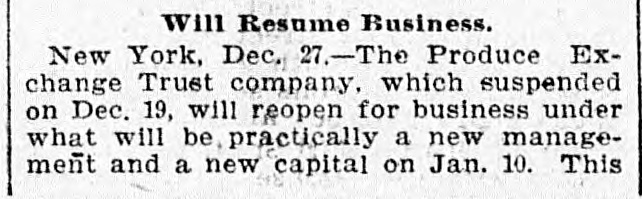
Will Resume Business. New York, Dec. 27.-The Produce Exchange Trust company. which suspended on Dec. 19, will reopen for business under what will be practically a new management and a new capital on Jan. 10. This


Article from Richmond Dispatch, December 29, 1899

Click image to open full size in new tab

Article Text

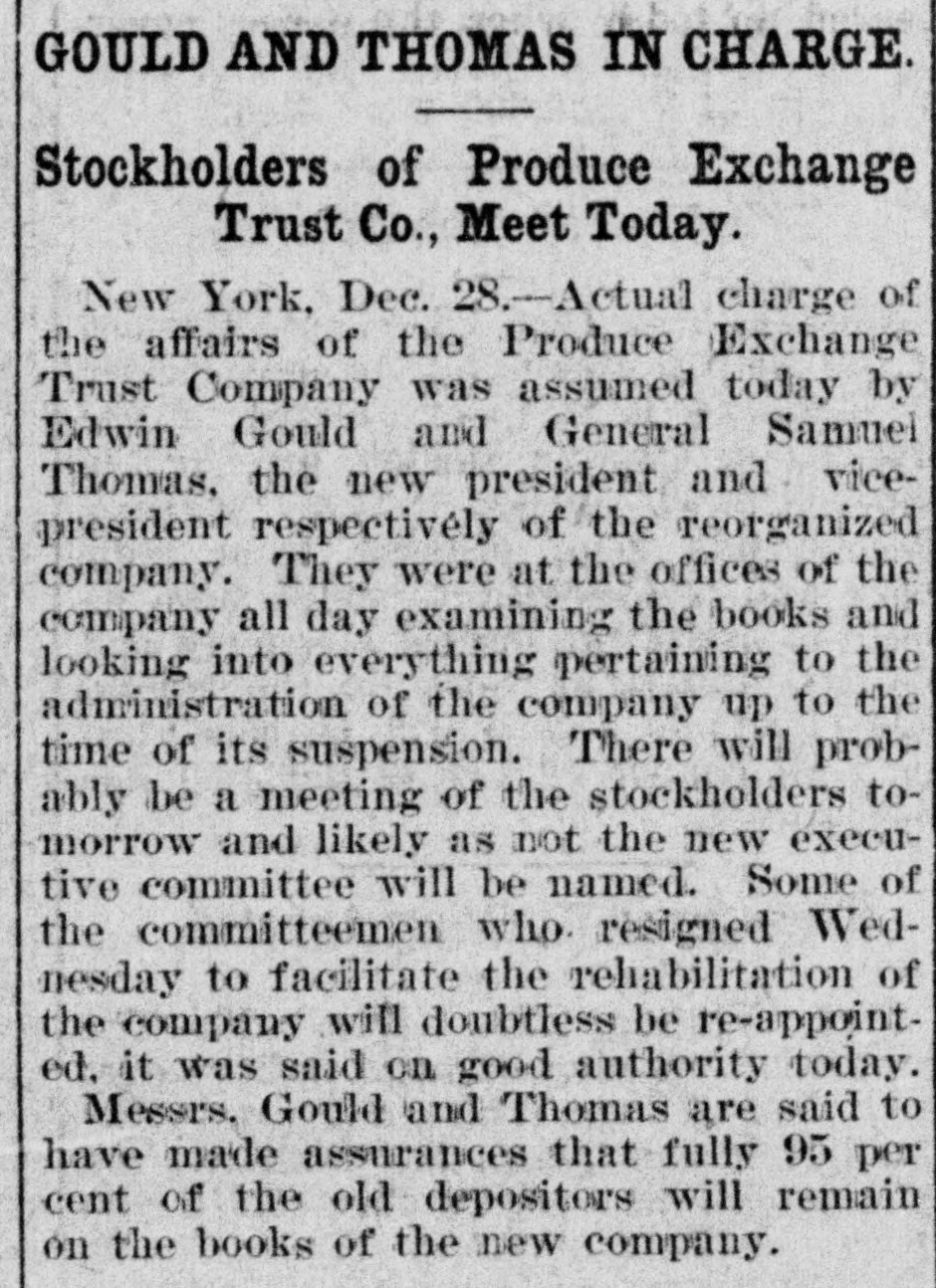
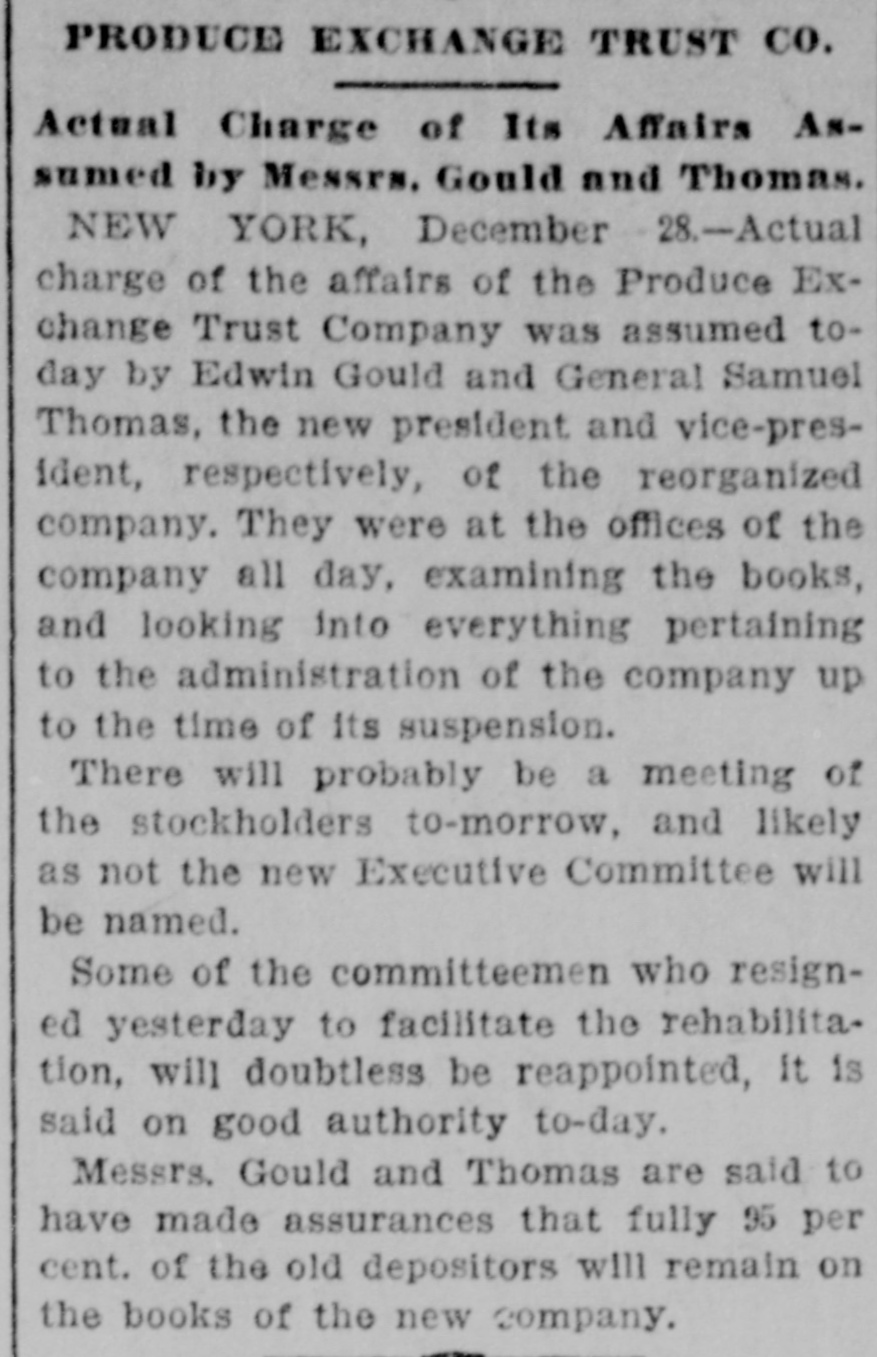
PRODUCE EXCHANGE TRUST CO. Actual Charge of Its Affairs Assumed by Messrs. Gould and Thomas. NEW YORK, December 28.-Actual charge of the affairs of the Produce Exchange Trust Company was assumed today by Edwin Gould and General Samuel Thomas, the new president and vice-president, respectively, of the reorganized company. They were at the offices of the company all day, examining the books, and looking into everything pertaining to the administration of the company up to the time of its suspension. There will probably be a meeting of the stockholders to-morrow, and likely as not the new Executive Committee will be named. Some of the committeemen who resigned yesterday to facilitate the rehabilitation, will doubtless be reappointed, It is said on good authority to-day. Messrs. Gould and Thomas are said to have made assurances that fully 95 per cent. of the old depositors will remain on the books of the new company.


Article from Barre Evening Telegram, January 10, 1900

Click image to open full size in new tab

Article Text

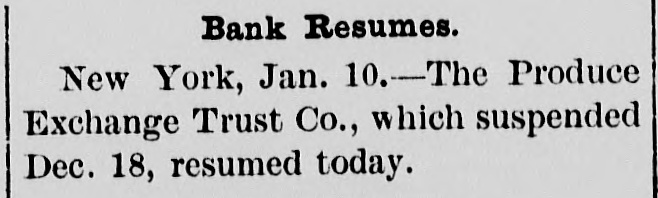
Bank Resumes. New York, Jan. 10.-The Produce Exchange Trust Co., which suspended Dec. 18, resumed today.


Article from The Morning Astorian, January 11, 1900

Click image to open full size in new tab

Article Text

RESUMED BUSINESS. NEW YORK, Jan. 10.-The Produce Exchange Trust Comparity, which suspended December 18, resumed business today. The company has been entirely reorganized. Edwin Gould becomes president and General Thomas, vice-president.


Article from Evening Bulletin, January 21, 1900

Click image to open full size in new tab

Article Text

Bank Resumes Business. New York, Jan. 10.-The Produce Exchange Trust Company, which suspended on December 18, resumed business today. The company has been entirely reorganized, the old officers, including T. A. Beall and Vice President T. A. McIntyre are taken by Edwin Gould and General Thomas, respectively.