Click image to open full size in new tab
Article Text
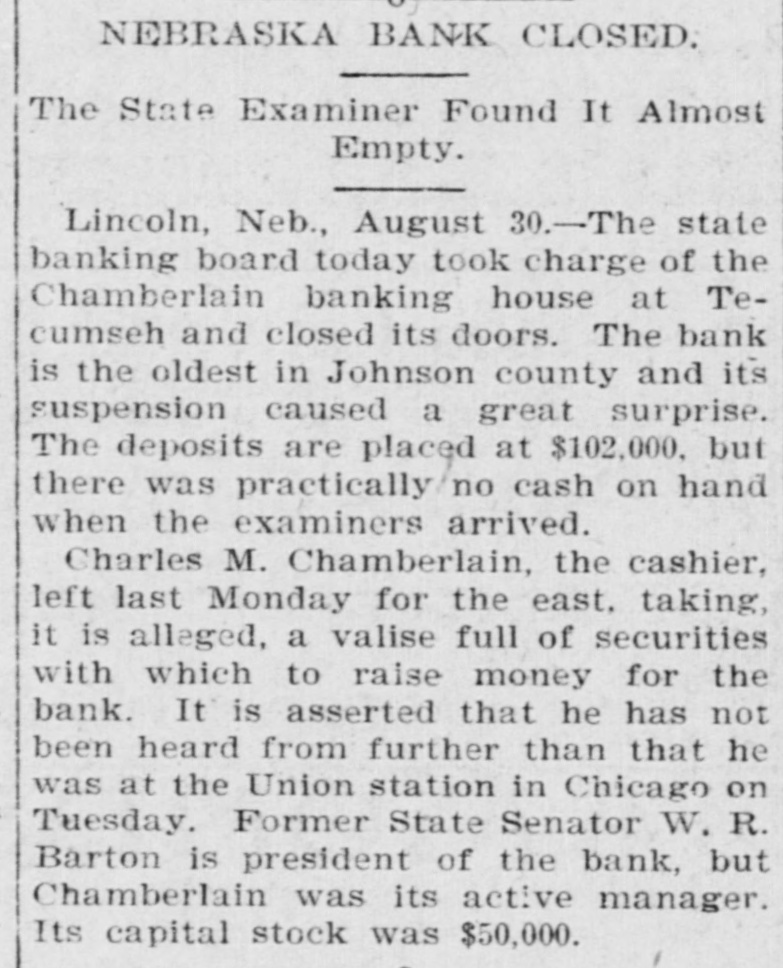
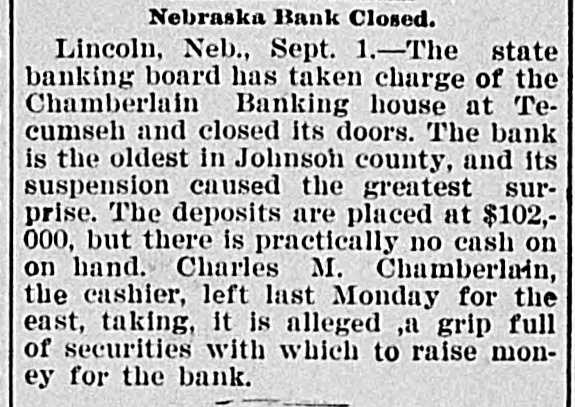
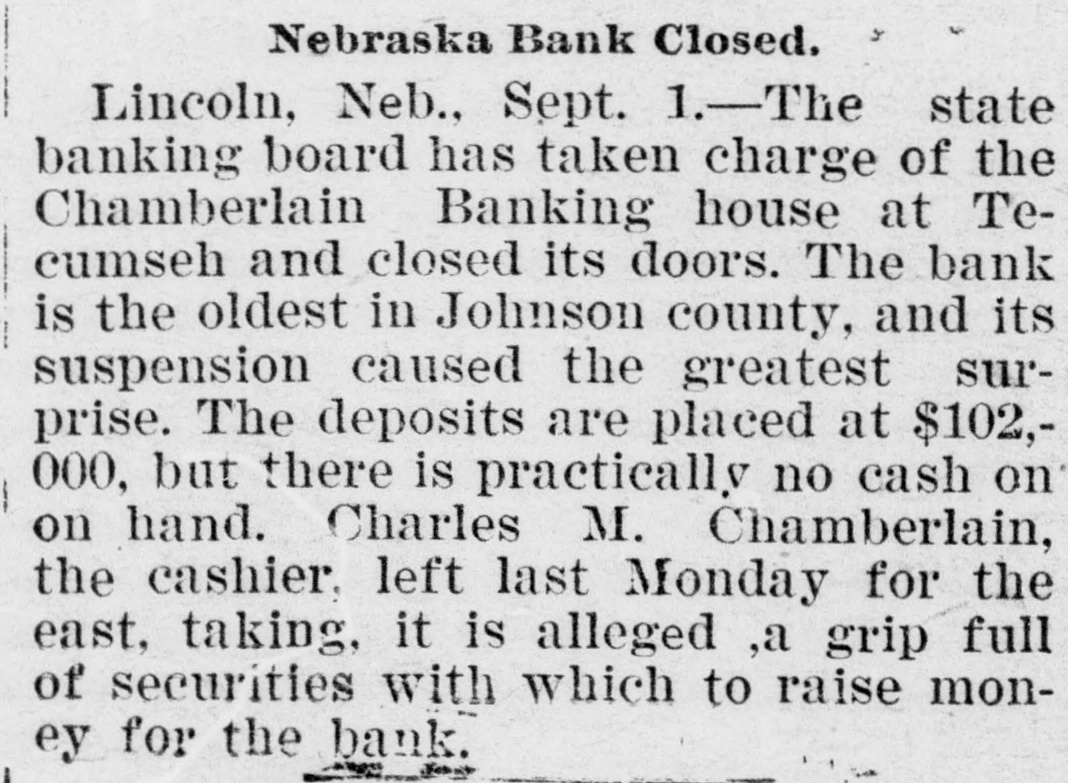
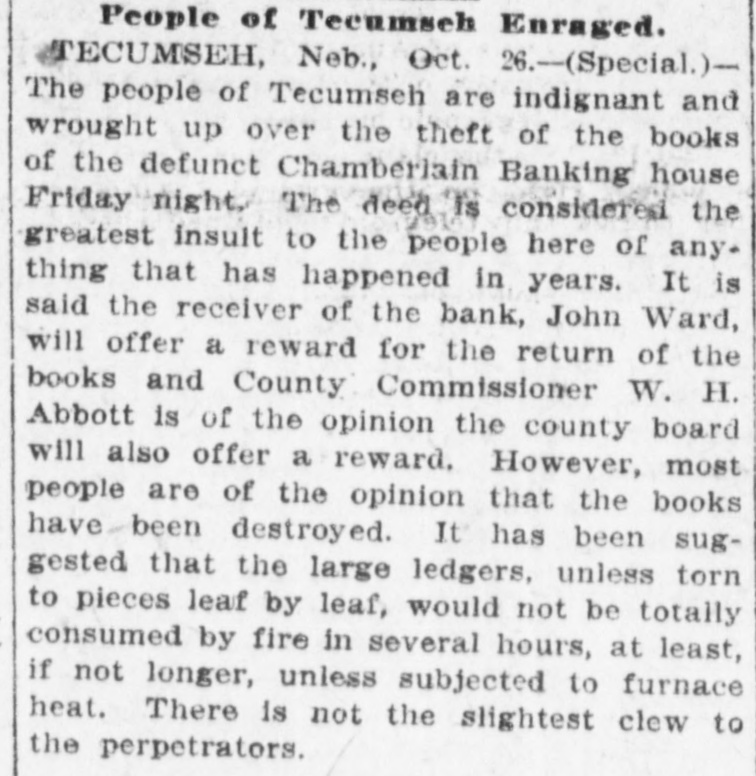
Arnold. "Mr. Chamberlain was a man of strong, likes and dislikes. If he took a fancy for a man he would tend him an unreasonable amount of money, not even exacting security. But if he disliked a man and that man was absolutely reliable and able to pay back at the appointed time, Chamberlain wouldn't lend him a cent. He was continually helping his friends out of trouble. He conducted his business more upon a sentimental basis than upon a purely business one. He is impulsive. He didn't know what he was going to do ten minutes hence. He acted as the spirit of the occasion prompted him."
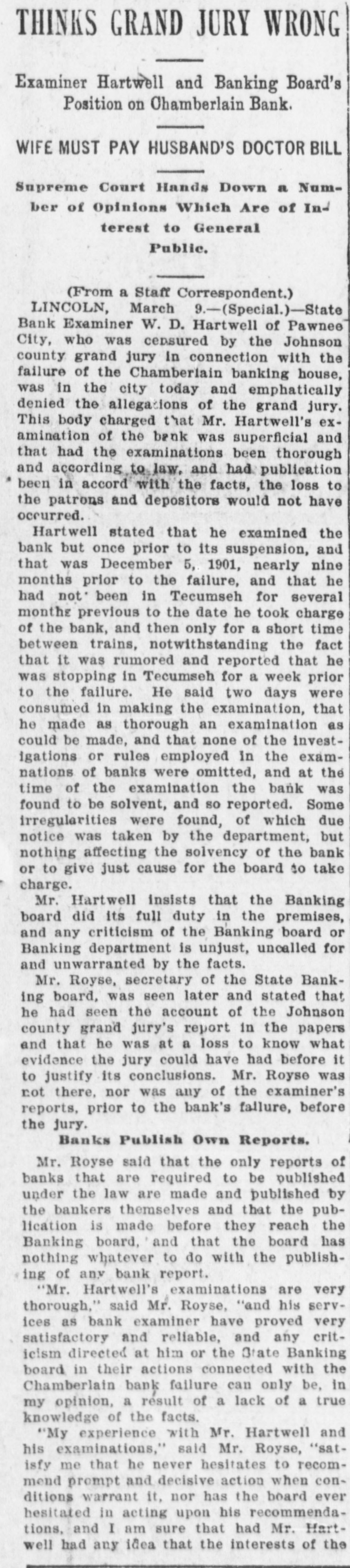
Mr. Arnold and others who have been here investigating the affairs of the institution do not attach any blame to the state banking supervision. "I know that the banking department was after Chamberlain pretty hard for some things that were apparent in the examination, but the true condition was not shown by the books and records," said Mr. Arnold. "The bank examiners were not at fault."
S. M. True, the clerk in the bank, is also conceded to be innocent of any crooked work. He knew nothing of the true condition until after the bank had closed and the investigation made. Chamberlain dissipated considerable during his latter months in Tecumseh. He showed interest in horse racing and it is said that he spent money freely. It is also talked around Tecumseh that he paid undue attention to women during the last year or so.
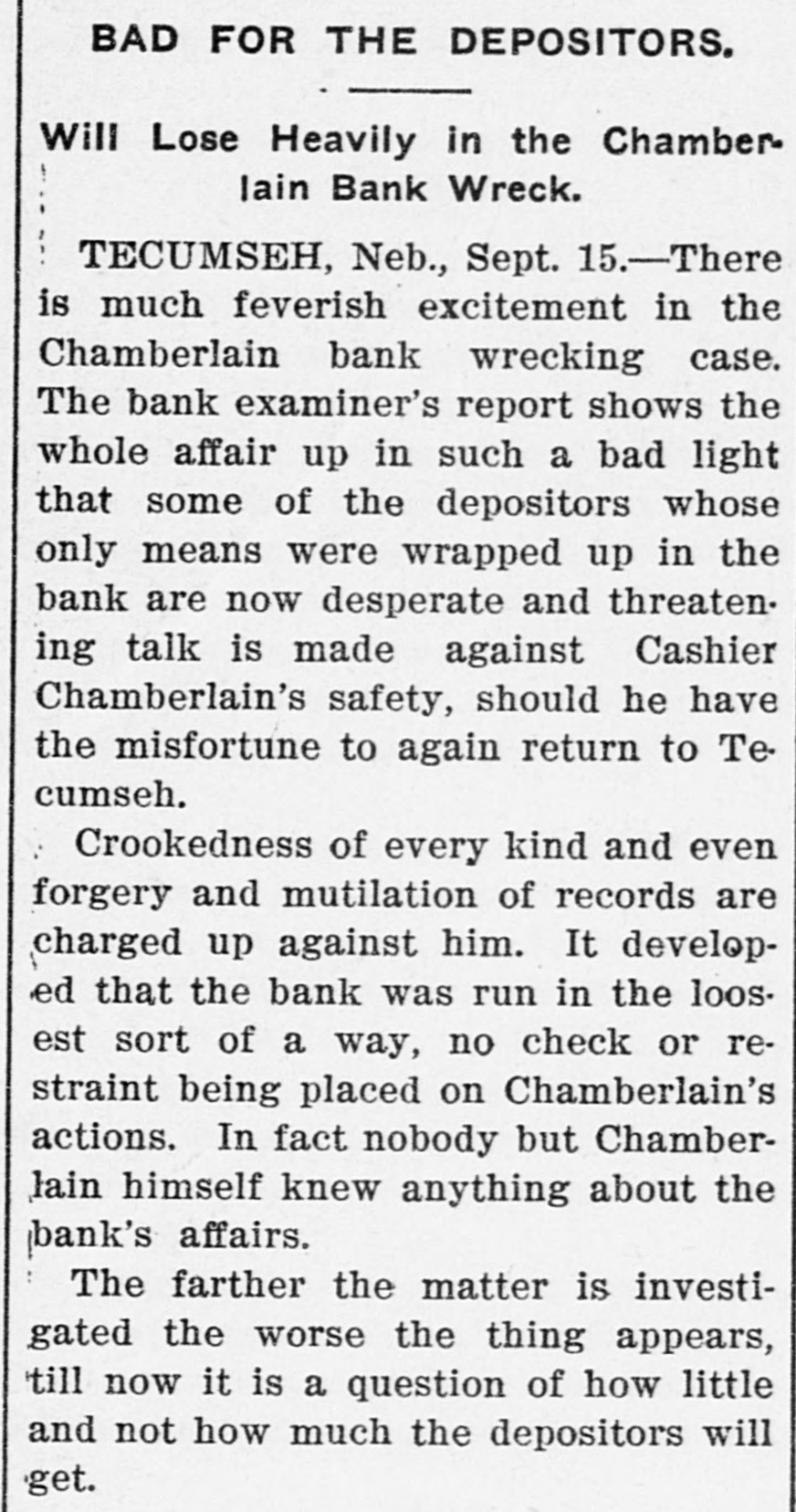
The deposits in the Chamberlain banking house were all of small denominations, made up mostly of the savings of farmers and the poorer class of citizens in town. Some deposits ran up as high as $3,000 or $4,000, but there were not many that exceeded $1,000. Because of the character of the deposits the loss will fall particularly hard.
One Angered Depositor.
P. S. Jones, who conducts a restaurant, became offended at one of the other banks in Tecumseh about a month ago, withdrew his money from the institution and deposited it in the Chamberlain banking house. Immediately after the failure "of the latter Jones went before a justice of the peace and got out a warrant for the arrest of Bookkeeper True. Friends dissuaded him from continuing the prosecution and the warrant was never served. Jones feels keenly the loss, for the deposit formed a large part of his fortune. It amounted to about $1,000. Of Johnson county's funds $6,700 is on deposit in the bank and the county's only security is the treasurer's bond whose sureties, or nearly all of them, are the stockholders in the broken bank.
Riley Tucker sold his farm a few miles south of the city and put the greater portion of the money derived from the sale in the Chamberlain banking house, pending an investment in a western ranch. The deposit was approximately $2,100. William Hinton, an employe in the electric power house, had $800 in the bank. Rev. McMann of the Baptist church was caught for $750, and there are scores of others of the same nature.
Outside of Tecumseh Chamberlain's reputation has not been so good, some people having gone so far as to denounce him as a trickster. These accusations often found their way to the ears of the bank's depositors, but they were not believed.
One Ugly Story.
Even the burning of the flour mill several years ago did not shatter their confidence in the head of the bank. Testimony given in the hearing of Michael Yorty on the charge of attempting to burn the mill involved Chamberlain, with Lawyer Osgood of Lincoln, to the extent of having employed Yorty to do the work. Yorty said he was hired to set fire to the mill and Chamberlain's house and barn. He was told to apply the torch to the first mill near the railroad track east of the depot. Yorty got the directions confused and by mistake started the fire at the first mill on the west side of the railroad station. Had the alleged plan been carried out successfully Chamberlain and Osgood would have been the beneficiaries because of the insurance they held on the property. No information whatever has been found regarding Chamberlain's whereabouts and no effort has been made to trace him since last Saturday. He is gone that much is certain and it is the general belief that the robins will be nesting long before he returns. The bank that lived through the panic, that held the confidence of its patrons for fifteen years, is now in ruins. There are two other banks in Tecumseh and both are strong. They experienced no trouble because of the failure, in fact their deposits began to increase the day the Chamberlain banking house closed its doors.
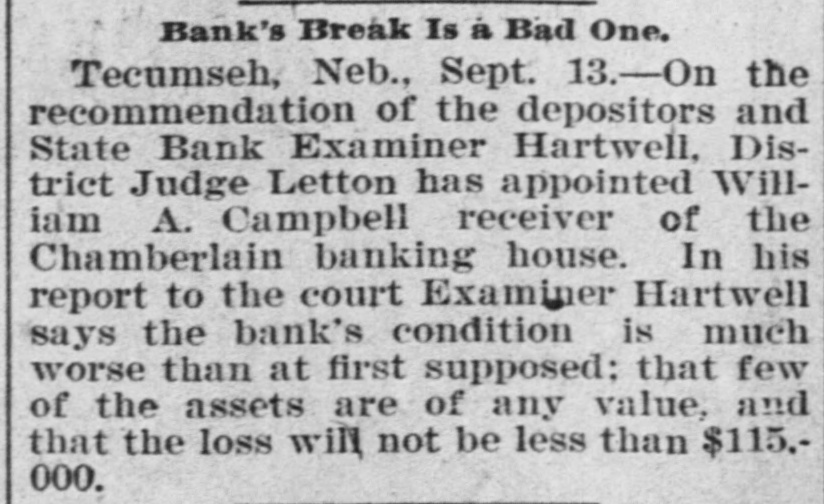
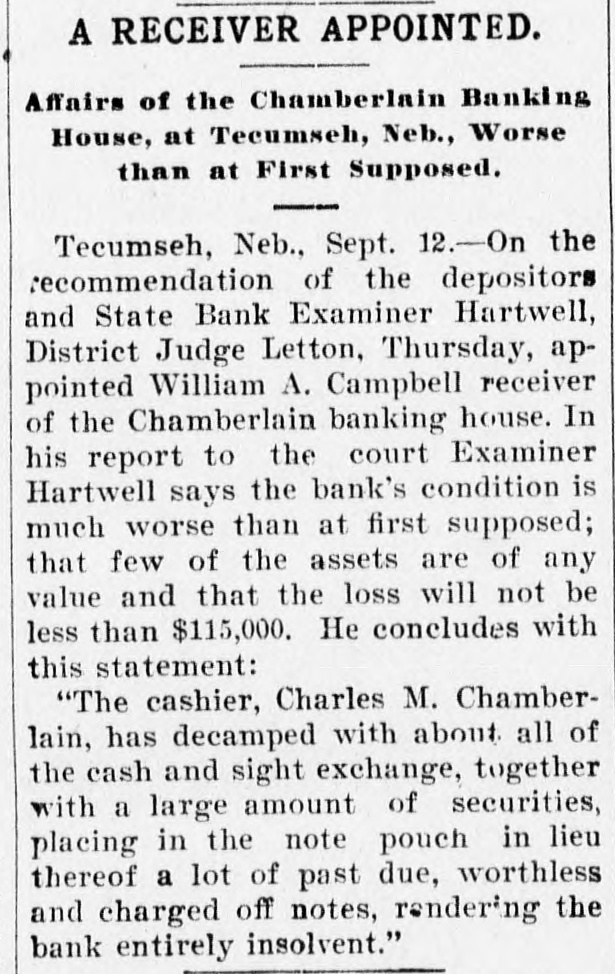
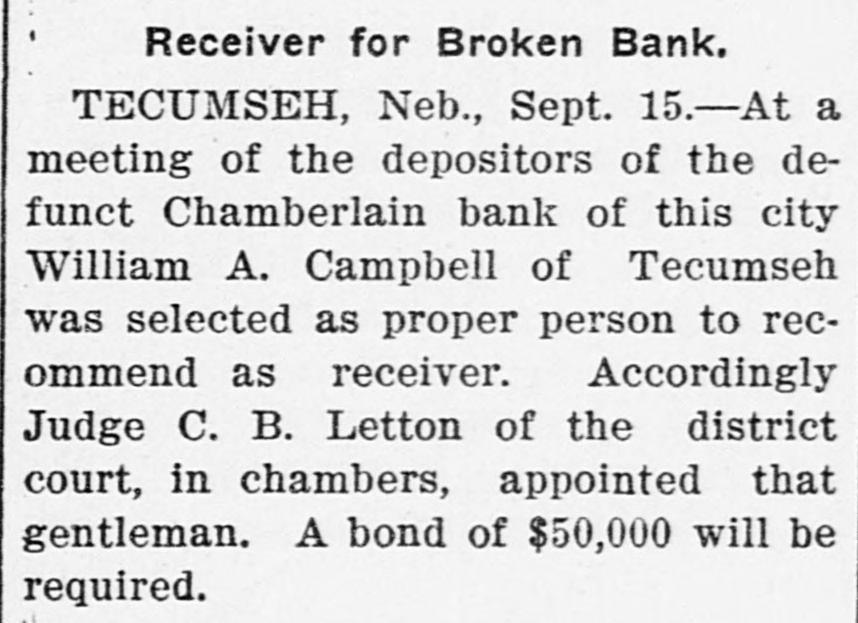
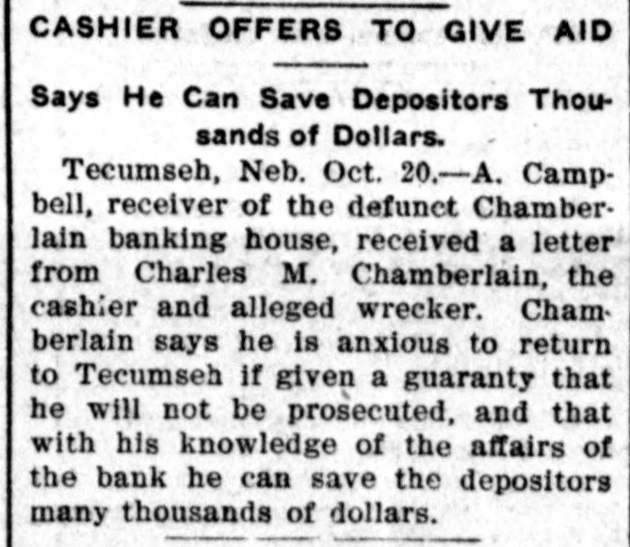
It is impossible to determine who are the stockholders in the latter bank. Certificates of stock were issued indiscriminately, without being recorded upon the books of the bank. Chamberlain himself did not own a controlling interest, but he had complete and undisputed management of the bank's affairs. President W. P. Barton and Vice President F. A. Taylor were heavy stockholders, but they took no part in the management of the institution. It is said that Cashier Charles M. Chamberlain of the defunct Chamberlain bank of this city was seen on the streets of Lincoln Friday afternoon of last week. E. F. Jones, formerly of Tecumseh, who now operates a fruit stand at the corner of O and Eleventh streets in the capital city, says he saw Mr. Chamberlain at his place of business the day mentioned. Mr. Chamberlain left Tecumseh Monday and the bank closed Saturday.
CHURCHES MAY BE REUNITED