Topeka Savings Bank (Topeka, KS)

Episode Information

Episode UID
9499636491155
Episode Type
Suspension โ†’ Closure
Bank Type
savings
Bank ID
949963649 hash
Start Date
March 2, 1896
Location
Topeka, Kansas (39.048, -95.678)

Metadata

Model
gemini-3-flash-preview (chosen from majority vote of a three-model LLM ensemble)
Short Digest
1b42c49495a57d1f

Response Measures

None

Description

The bank entered voluntary liquidation on March 2, 1896, and was later managed by a receiver (L. G. Beal).

Events (2)

1. March 2, 1896 Suspension
Cause
Voluntary Liquidation
Cause Details
The bank ceased to be a going concern and entered voluntary liquidation.
Newspaper Excerpt
the bank was no longer a going concern, that it had gone into voluntary liquidation on the 2nd of March, 1896
Source
newspapers
2. March 10, 1899 Receivership
Newspaper Excerpt
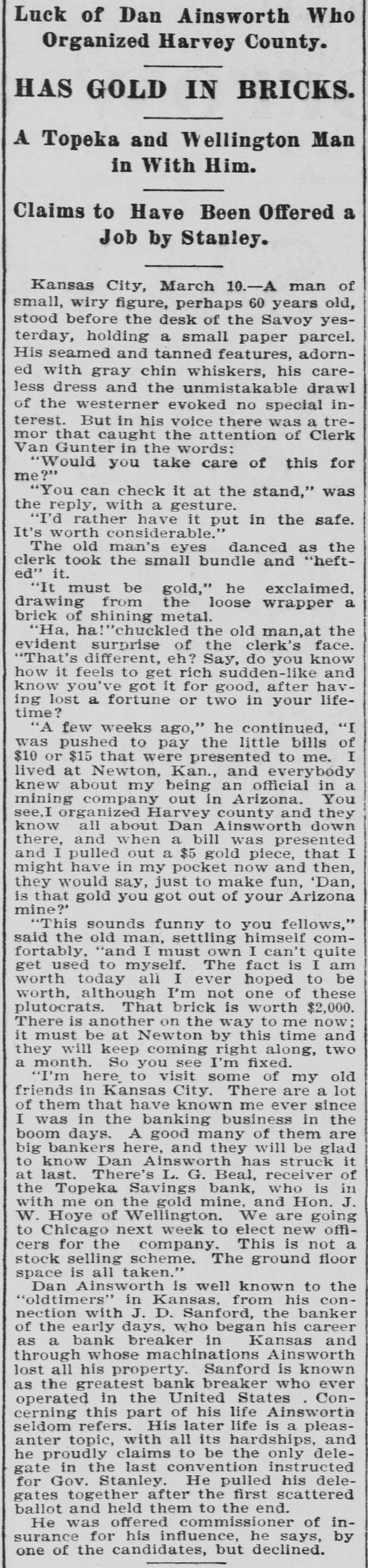
L. G. Beal, receiver of the Topeka Savings bank
Source
newspapers

Newspaper Articles (3)

Article from The Topeka State Journal, March 10, 1899

Click image to open full size in new tab

Article Text

Luck of Dan Ainsworth Who Organized Harvey County. HAS GOLD IN BRICKS. A Topeka and Wellington Man in With Him. Claims to Have Been Offered a Job by Stanley. Kansas City, March 10.-A man of small, wiry figure, perhaps 60 years old, stood before the desk of the Savoy yesterday, holding a small paper parcel. His seamed and tanned features, adorned with gray chin whiskers, his careless dress and the unmistakable drawl of the westerner evoked no special interest. But in his voice there was a tremor that caught the attention of Clerk Van Gunter in the words: "Would you take care of this for me?" "You can check it at the stand," was the reply, with a gesture. "I'd rather have it put in the safe. It's worth considerable." The old man's eyes danced as the clerk took the small bundle and "hefted" it. "It must be gold," he exclaimed. drawing from the loose wrapper a brick of shining metal. "Ha, chuckled the old man,at the evident surprise of the clerk's face. "That's different, eh? Say, do you know how it feels to get rich sudden-like and know you've got it for good, after having lost a fortune or two in your lifetime? "A few weeks ago," he continued, "I was pushed to pay the little bills of $10 or $15 that were presented to me. I lived at Newton, Kan., and everybody knew about my being an official in a mining company out in Arizona. You see,I organized Harvey county and they know all about Dan Ainsworth down there, and when a bill was presented and I pulled out a $5 gold piece, that I might have in my pocket now and then, they would say, just to make fun, 'Dan, is that gold you got out of your Arizona mine?' "This sounds funny to you fellows," said the old man, settling himself comfortably, "and I must own I can't quite get used to myself. The fact is I am worth today all I ever hoped to be worth, although I'm not one of these plutocrats. That brick is worth $2,000. There is another on the way to me now: it must be at Newton by this time and they will keep coming right along, two a month. So you see I'm fixed. "I'm here to visit some of my old friends in Kansas City. There are a lot of them that have known me ever since I was in the banking business in the boom days. A good many of them are big bankers here, and they will be glad to know Dan Ainsworth has struck it at last. There's L. G. Beal, receiver of the Topeka Savings bank, who is in with me on the gold mine, and Hon. J. W. Hoye of Wellington. We are going to Chicago next week to elect new officers for the company. This is not a stock selling scheme. The ground floor space is all taken." Dan Ainsworth is well known to the "oldtimers" in Kansas, from his connection with J. D. Sanford, the banker of the early days, who began his career as a bank breaker in Kansas and through whose machinations Ainsworth lost all his property. Sanford is known as the greatest bank breaker who ever operated in the United States Concerning this part of his life Ainsworth seldom refers. His later life is a pleasanter topic, with all its hardships, and he proudly claims to be the only delegate in the last convention instructed for Gov. Stanley. He pulled his delegates together after the first scattered ballot and held them to the end. He was offered commissioner of insurance for his influence, he says, by one of the candidates, but declined.


Article from People's Voice, March 14, 1899

Click image to open full size in new tab

Article Text

the room it needs on the first floor. This will be much more acceptable to the secret societies, as 50x60 feet will hardly give them the desired room. The dimensions should be about 50x100 feet. The building would then extend back nearly to the jail, and would allow room on the first floor for a council room, mayor's office, clerk's office, police judge's office and marshal's office. The city could, in addition, afford to buy the 25 foot lot on the north and construct a suitable frame or sheet iron structure for the use of the fire department. At the rate the city is at present paying for rental of a city building, a new building could be paid for in ten or twelve years. Friday morning's Kansas City Journal contains a lengthy interview with Dan Ainsworth, formerly of Newton, who has struck a rich gold mine in Arizona and claims to be richer than Stanford ever was. Ainsworth is resting in KansasCity visiting friends and waiting the arrival of John Haughey of Wellington, and L. G. Beal, receiver of the Topeka Savings bank, who are interested in the mine, when the three will proceed to Chicago in the interest of the mines. The article in the paper goes back to the early history of Ainsworth and digs up a little of the history of the Merchants & Drovers bank at Caldwell and a bank at Hunnewell and connects Ainsworth with the failure of the banks. The workman often eats his lunch on the same bench where he does his work. The office man turns his desk into a dining table. Neither gets the out of door exercise be needs, neither takes the proper time for eating. It is small wonder that the digestion of both gets out of order. In such cases Dr. Pierce's Pleasant Pellets come to their assistance by aiding nature to take care of the food. The cause of nine-tenths of the sickness of the world is constipation. From this one cause come indigestion disorders of the stomach. liver and kidneys; biliousness, headaches, flatulence, heartburn, impurity of the blood and the serious complications that follow. To begin with, constipation is a little thing, and a little thing will cure it. The "Pleasant Pellets" are tiny, sugar coated granules. They will perfectly cure the worst case of csnstipation and indigestion. If the drugs gist trials to sell you some other pill that pays him a greater profit, just think what will best pay you. Sheriff Heskett claims the honor of discovering the whereabouts of F. H. Teale, the absconding traveling representative of the Parkhurst-Davis Grocery company. 'A Los Angeles paper received by a lady from California who is boarding with Mrs. Frances Millard, contained a half column write-up of Teale, who was cutting quite a dash in Los Angeles. The paper was given to Al Brumley and he in turn gave it to Sheriff Heskett. The sheriff sent the paper to Topeka, and the grocery firm wrote him that if he would goafter Teale and bring him back they would give him $100 and pay his expenses, providing Teale was convicted. The sheriff refused the offer, fearing that a conviction would not result, and the sheriff of Harper county was sent after the embezzler. It seems that Teale's lengthy write-up in the Los Angeles paper was the result of an old score held against him in Los Angeles, when he held some kind of an official clerk-


Article from The Topeka State Journal, November 9, 1901

Click image to open full size in new tab

Article Text

SAVINGS BANK CASE. Stockholders Were Not Relieved From Liability. A mistake was made in the report of Judge Hazen's decision in the Topeka Savings bank cases and the stockholders, according to the court's ruling, are liable for their subscriptions. David Overmyer has made the following explanation of the decision on the motions: Some time ago the Topeka Savings bank which went out of business eight years ago instituted actions against several of the stockholders for their unpaid subscriptions to stock. To this the stockholders set up seven distinct defenses. The first defense in each case being a general denial need not be noticed as that might be made in any case. The second pleaded the three year statute of limitations, but the court held that as this action was upon a contract the three years' statute had no application, the plaintiff having five years in which to bring an action from the time the cause of action accrued. This became the important question, the plaintiff bank contending that the cause of action did not and could not accrue under the terms of the contract until a call was made upon the stockholder, the defendants maintaining for their third defense that the bank might have made a call earlier than it did, that it was its duty to make the call when it might have made it, and that consequently the statute of limitations would run from the date at which the call might have been made, which was alleged to have been the first day of December, 1892. The court, however, held that the bank was not obliged to make the call simply because it might have made it; that the question of time and the propriety of the call was for the bank to decide, and that as the bank could not maintain an action upon the subscription until it made the call, therefore, no cause of action accrued until the call was made, and the statute of limitations could not begin to run until a cause of action accrued. The fourth defense set up by the defendants was upon the ground that the general banking act of 1891 by its terms made all of the unpaid subscriptions of the Savings bank due. The bank, however, contended that the act had no application and that if it should be construed as applying to the Savings bank it would be unconstitutional as impairing the obligation of the contract. The court held that the act of 1891 had no application to Savings banks previously organized. The fifth defense set up by the defendants was upon the ground that as the Savings bank had ceased to do business in March, 1896, that it then became the duty of the bank to call for all unpaid subscriptions. The bank, however, contended that as no action accrued until the call was actually made, therefore, the statute of limitations could not apply, and the mere fact of the bank ceasing to be a going concern could have no effect whatever upon the right of the bank to make the call at its own discretion, and this contention was sustained by the court. The sixth defense questioned the capacity of the bank to bring an action, it being no longer a going concern, but as the court said, this was not seriously insisted upon and was easily disposed of as the statutes of Kansas make ample provisions for just such cases. The seventh defense set up the fact that the bank was no longer a going concern, that it had gone into voluntary liquidation on the 2nd of March, 1896; that it had injudicious use of its assets, and that but for such injudicious use of its assets its bills could all have been paid, and that there would be no occasion for a call upon the stockholders, and that therefore and for these reasons the stockholders became liable to pay when the bank closed its doors as a business institution, and that calls could not thereafter be lawfully made, and that the statute of limitations therefore and for those reasons ran from March 2, 1896. Again, the bank invoked the principle that the stock could not be made payable until the bank should call for payment, and that as the bank could not collect until it made a call, therefore the statute of limitations could not run against it upon the stock subscripion until the bank itself had made a call. The bank's contention as to the seventh defense was also sustained by Judge Hazen, grounding his decision upon the decisions of the supreme court of the United States, which was held in many cases that where calls are provided for in a contract between a corporation and a stockholder, there is no liability of the stockholder to pay until the call is made and consequently that the statute of limitations cannot run upon the contract of subscription until a call is made by the corporation. Thus all of the defenses except the mere general denial set up by the stockholders were denied and overruled by the court, and the contention of the Savings bank was sustained at every point. The defendant prayed an appeal to the supreme court and pending the settlement of the question in that court in the case of defendant West, it was agreed between the parties that the other cases should remain in abeyance. Judge Hazen remarked in delivering his opinion that the case was the most thoroughly argued of any case that was ever presented for his consideration. The arguments were made by David Overmyer, of the firm of Overmyer, Mulvane & Gault, for the Savings bank, defendant West was represented by Garver & Larimer and E. A. Austin. Football at Chicago.