Eighth Avenue Bank (New York, NY)

Episode Information

Episode UID
950705890658
Episode Type
Suspension โ†’ Closure
Bank Type
state
Bank ID
95070589 hash
Start Date
October 6, 1854
Location
New York, New York (40.714, -74.006)

Metadata

Model
gpt-5-mini (chosen from majority vote of a three-model LLM ensemble)
Short Digest
3609a0f6dd8a2c57

Response Measures

None

Description

Articles report suspension/failure in Oct 1854 and later appointment of a receiver in 1856.

Events (3)

1. October 6, 1854 Other
Newspaper Excerpt
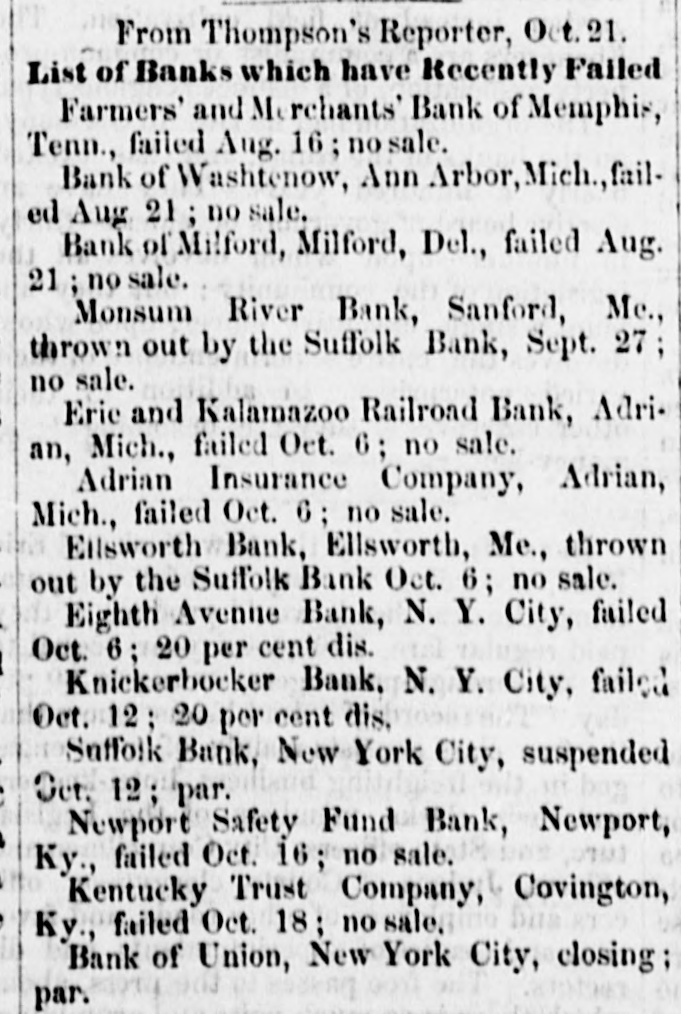
Eighth Avenue Bank, New York City, failed Oct. 6; 20 per cent dis. (listed among failed/suspended banks).
Source
newspapers
2. October 6, 1854 Suspension
Cause
Bank Specific Adverse Info
Cause Details
Large loans/negotiations not returned and other adverse loan exposures discovered.
Newspaper Excerpt
The Eighth Avenue Bank, which has been in an embarrassed condition for some days, suspended yesterday.
Source
newspapers
3. April 8, 1856 Receivership
Newspaper Excerpt
Judge E. P. Cowles, we understand, has been appointed Receiver of the Eighth Avenue Bank.
Source
newspapers

Newspaper Articles (21)

Article from Kenosha Telegraph, October 12, 1854

Click image to open full size in new tab

Article Text

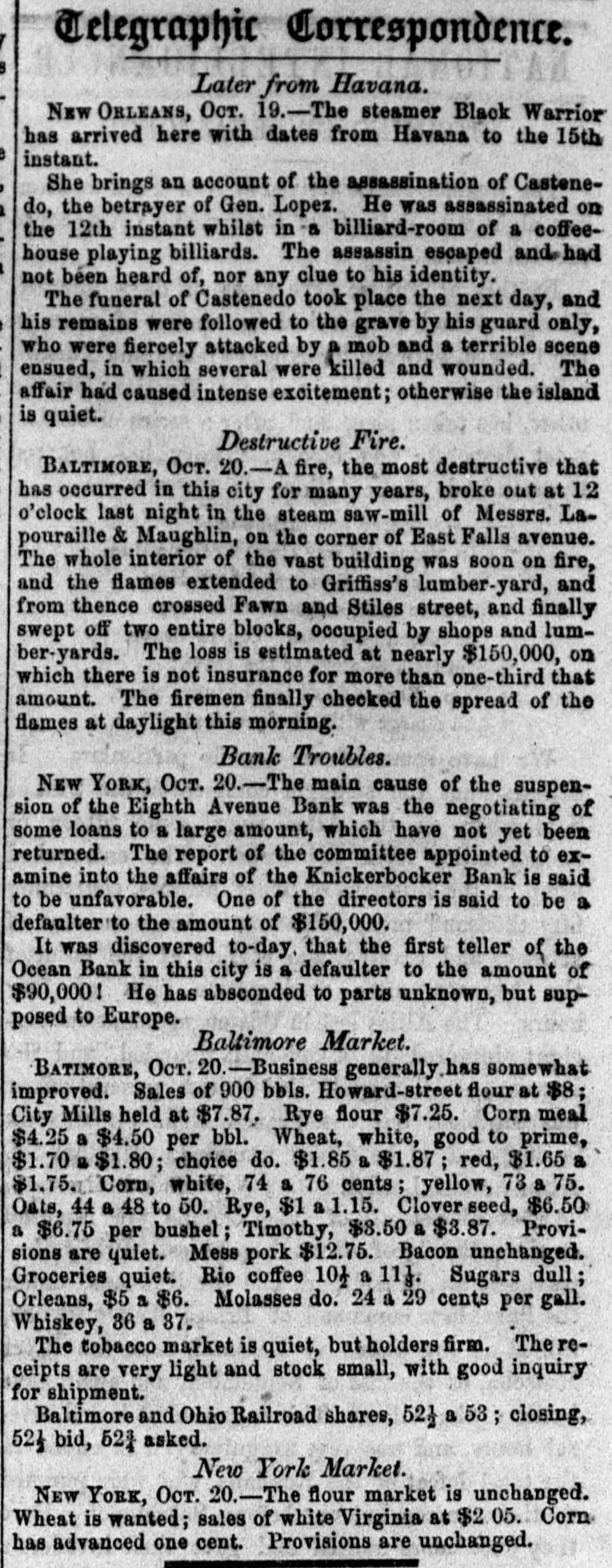
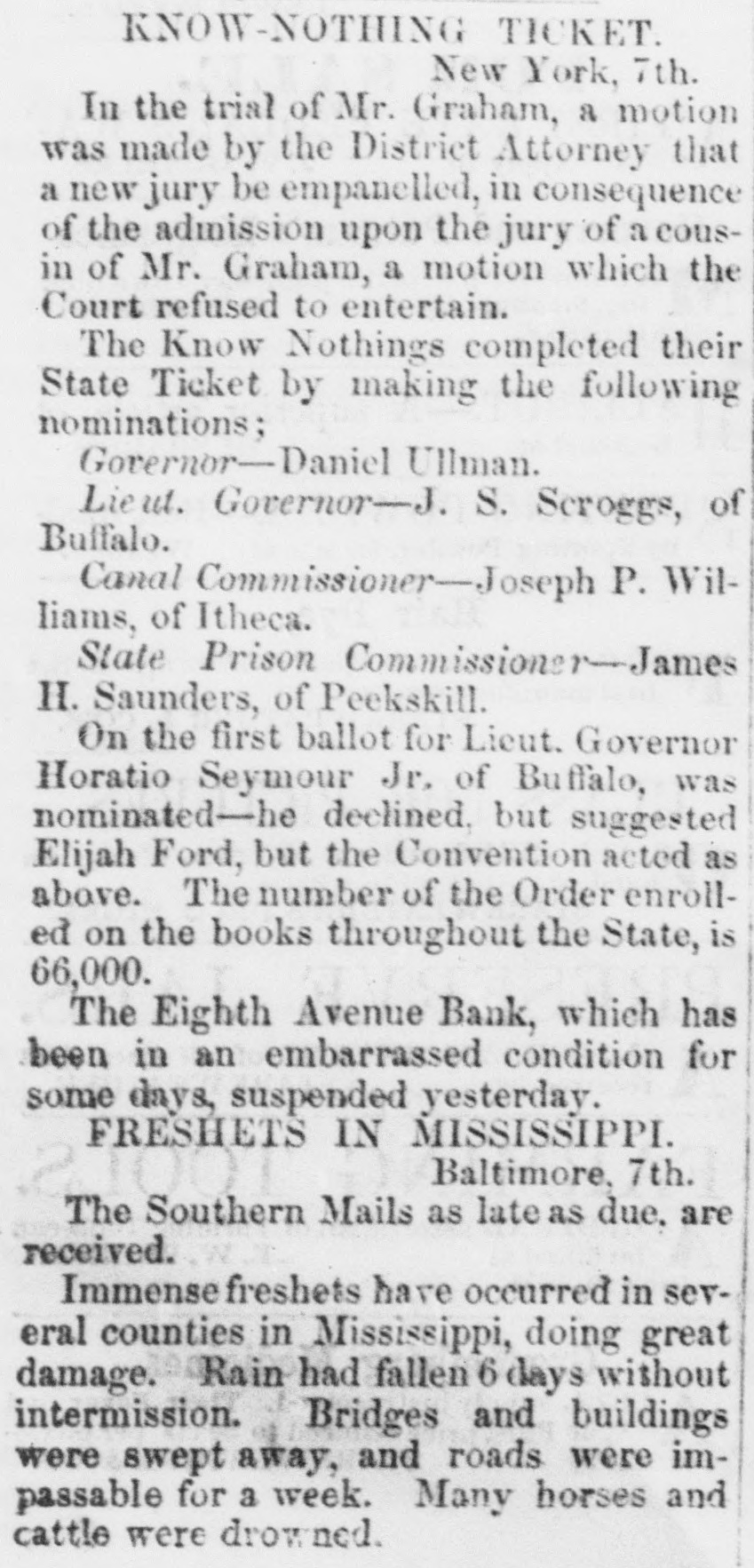
KNOW-NOTHING TICKET. New York, 7th. In the trial of Mr. Graham, a motion was made by the District Attorney that a new jury be empanelled, in consequence of the admission upon the jury of a cousin of Mr. Graham, a motion which the Court refused to entertain. The Know Nothings completed their State Ticket by making the following nominations; Governor-Daniel Ullman. Lieut. Governor-J. S. Scroggs, of Buffalo. Canal Commissioner-Joseph P. Williams, of Itheca. State Prison Commissioner-James H. Saunders, of Peekskill. On the first ballot for Lieut. Governor Horatio Seymour Jr. of Buffalo, was nominated-he declined, but suggested Elijah Ford, but the Convention acted as above. The number of the Order enrolled on the books throughout the State, is 66,000. The Eighth Avenue Bank, which has been in an embarrassed condition for some days, suspended yesterday. FRESHETS IN MISSISSIPPI. Baltimore, 7th. The Southern Mails as late as due, are received. Immense freshets have occurred in several counties in Mississippi, doing great damage. Rain had fallen 6 days without intermission. Bridges and buildings were swept away, and roads were impassable for a week. Many horses and cattle were drowned.


Article from The Hillsdale Standard, October 17, 1854

Click image to open full size in new tab

Article Text

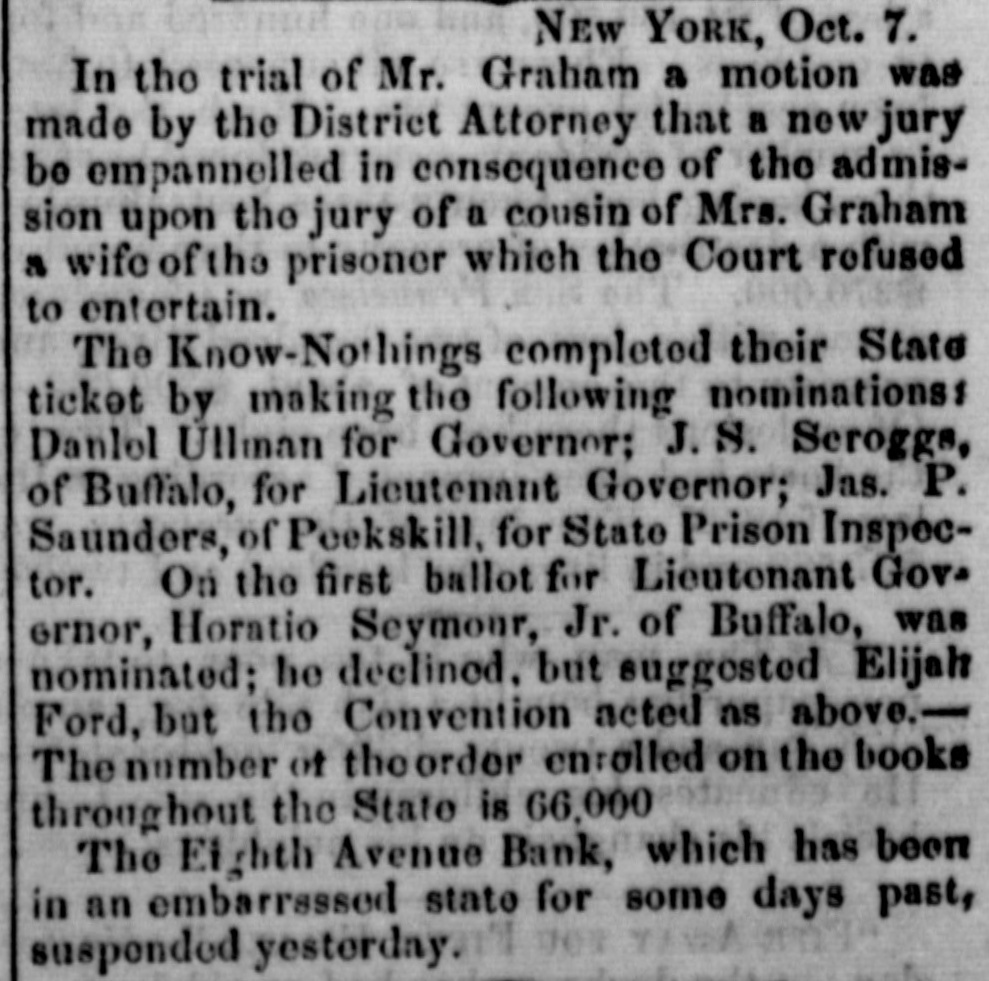
NEW YORK, Oct. 7. In the trial of Mr. Graham a motion was made by the District Attorney that a new jury be empannelled in consequence of the admission upon the jury of a cousin of Mrs. Graham a wife of the prisoner which the Court refused to entertain. The Know-Nothings completed their State ticket by making the following nominations Danlol Ullinan for Governor; J.S. Serogga, of Buffalo, for Lieutenant Governor; Jas. P. Saunders, of Peekskill, for State Prison Inspector. On the first ballot for Lieutonant Gov. ernor, Horatio Seymour, Jr. of Buffalo, was nominated; he declined. but suggested Elijah Ford, but the Convention acted as above.The number of theorder enrolled on the books throughout the State is 66,000 The Eighth Avenue Bank, which has been in an embarrassed state for some days past, DOB suspended yesterday.


Article from Demoine Courier, October 19, 1854

Click image to open full size in new tab

Article Text

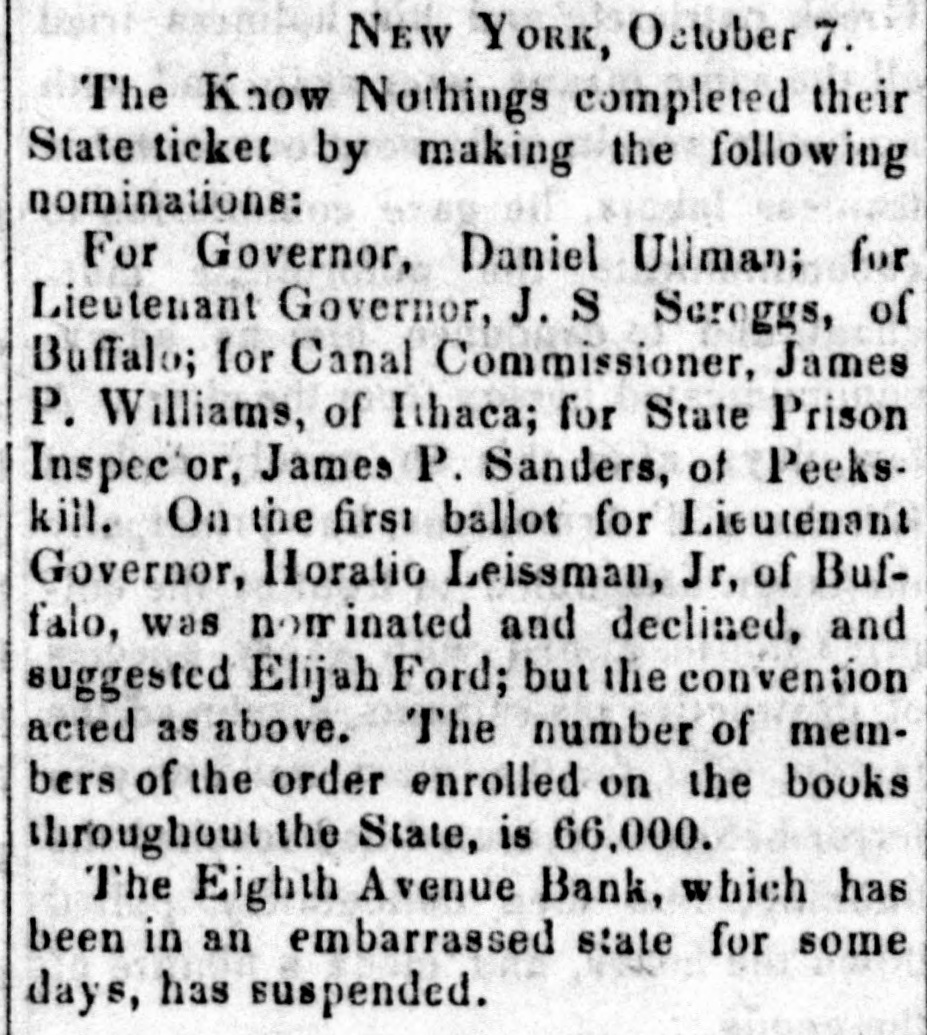
NEW YORK, October 7. The Know Nothings completed their State ticket by making the following nominations: For Governor, Daniel Uliman; for Lieutenant Governor, J. S Scroggs, of Buffalo; for Canal Commissioner, James P. Williams, of Ithaca; for State Prison Inspec'or, James P. Sanders, of Peekskill. On the first ballot for Lieutenant Governor, Horatio Leissman, Jr, of Buffalo, was nominated and declined, and suggested Elijah Ford; but the convention acted as above. The number of members of the order enrolled on the books throughout the State, is 66,000. The Eighth Avenue Bank, which has been in an embarrassed state for some days, has suspended.


Article from Richmond Daily Whig, October 23, 1854

Click image to open full size in new tab

Article Text

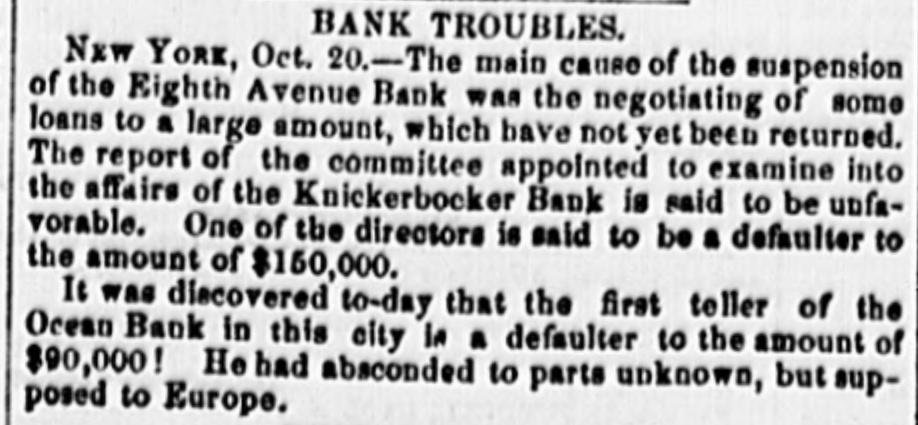
BANK TROUBLES. NEW YORK, Oct. 20.-The main cause of the suspension of the Eighth Avenue Bank was the negotiating of some loans to a large amount, which have not yet been returned. The report of the committee appointed to examine into the affairs of the Knickerbocker Bank is said to be unfavorable. One of the directors is said to be a defaulter to the amount of $150,000. It was discovered to-day that the first teller of the Ocean Bank in this city in a defaulter to the amount of $90,000! He had absconded to parts unknown, but supposed to Europe.


Article from Plymouth Banner, October 26, 1854

Click image to open full size in new tab

Article Text

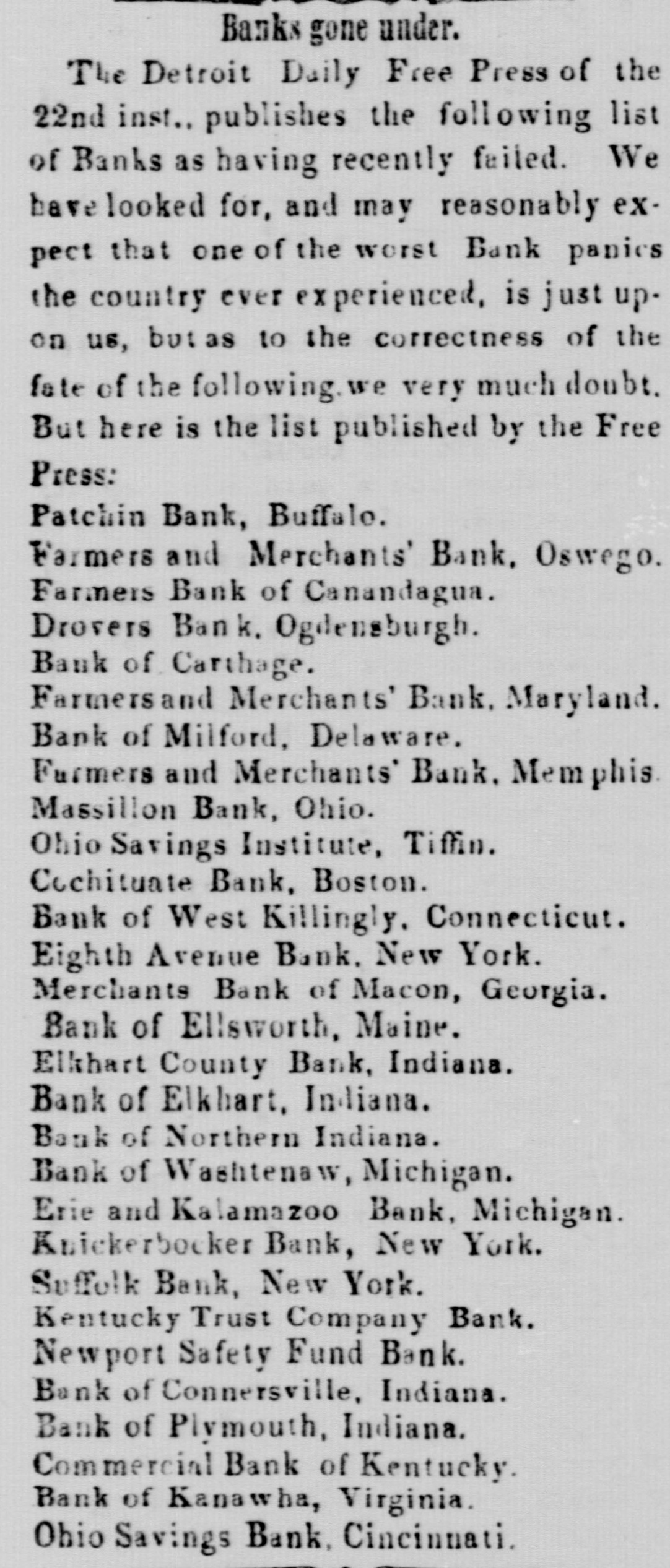
Banks gone under. The Detroit Daily Free Press of the 22nd inst., publishes the following list of Banks as having recently failed. We have looked for, and may reasonably expect that one of the worst Bank panics the country ever experienced, is just upon us, butas to the correctness of the fate of the following we very much doubt. But here is the list published by the Free Press: Patchin Bank, Buffalo. Farmers and Merchants' Bank, Oswego. Farmers Bank of Canandagua. Drovers Bank. Ogdensburgh. Bank of Carthage. Farmersand Merchants' Bank, Maryland. Bank of Milford, Delaware, Furmers and Merchants' Bank, Memphis. Massillon Bank, Ohio. Ohio Savings Institute, Tiffin. Cochituate Bank, Boston. Bank of West Killingly, Connecticut. Eighth Avenue Bank. New York. Merchants Bank of Macon, Georgia. Bank of Ellsworth, Maine. Elkhart County Bank, Indiana. Bank of Elkhart, Indiana. Bank of Northern Indiana. Bank of Washtenaw, Michigan. Erie and Kalamazoo Bank, Michigan. Knickerbocker Bank, New York. Suffolk Bank, New York. Kentucky Trust Company Bank. Newport Safety Fund Bank. Bank of Connersville, Indiana. Bank of Plymouth, Indiana. Commercial Bank of Kentucky. Bank of Kanawha, Virginia. Ohio Savings Bank, Cincinnati.


Article from The Weekly Lancaster Gazette, October 26, 1854

Click image to open full size in new tab

Article Text

-A return just issued of the population of Ireland shows that the number of inhabitants has fallen off two millions in the past five years. In the year 1805 the population was oevr five millions; in 1814 six millions; in 1824, seven millions; in 1837, eight millions; in 1846, 8,386,950 and in 1851, only 6,551,970. -The Eighth Avenue Bank in New York suspended payment on Friday. --Oft the one hundred and thirty thousand paupers in the United States, sixtyeight thousand are foreigners,and sixty-six thousand natives. -The Assay office at New York is now ready to receive deposits on the same terms as the mint, giving bars of coin in exchange for all gold received, as soon as the value can be ascertained. -The Rev. Mr. Hanson, author of the "Lost Prince," a book written to prove that Rev. Eleazor Williams is a Bourbon, and the Dauphin of France, died in New York a few days since. -A man named Neal was murdered in Mississippi by another one named Browning, who supposed Neal had willed him $4000. On openingthe will the Murderer's name was not found.


Article from The National Era, November 2, 1854

Click image to open full size in new tab

Article Text

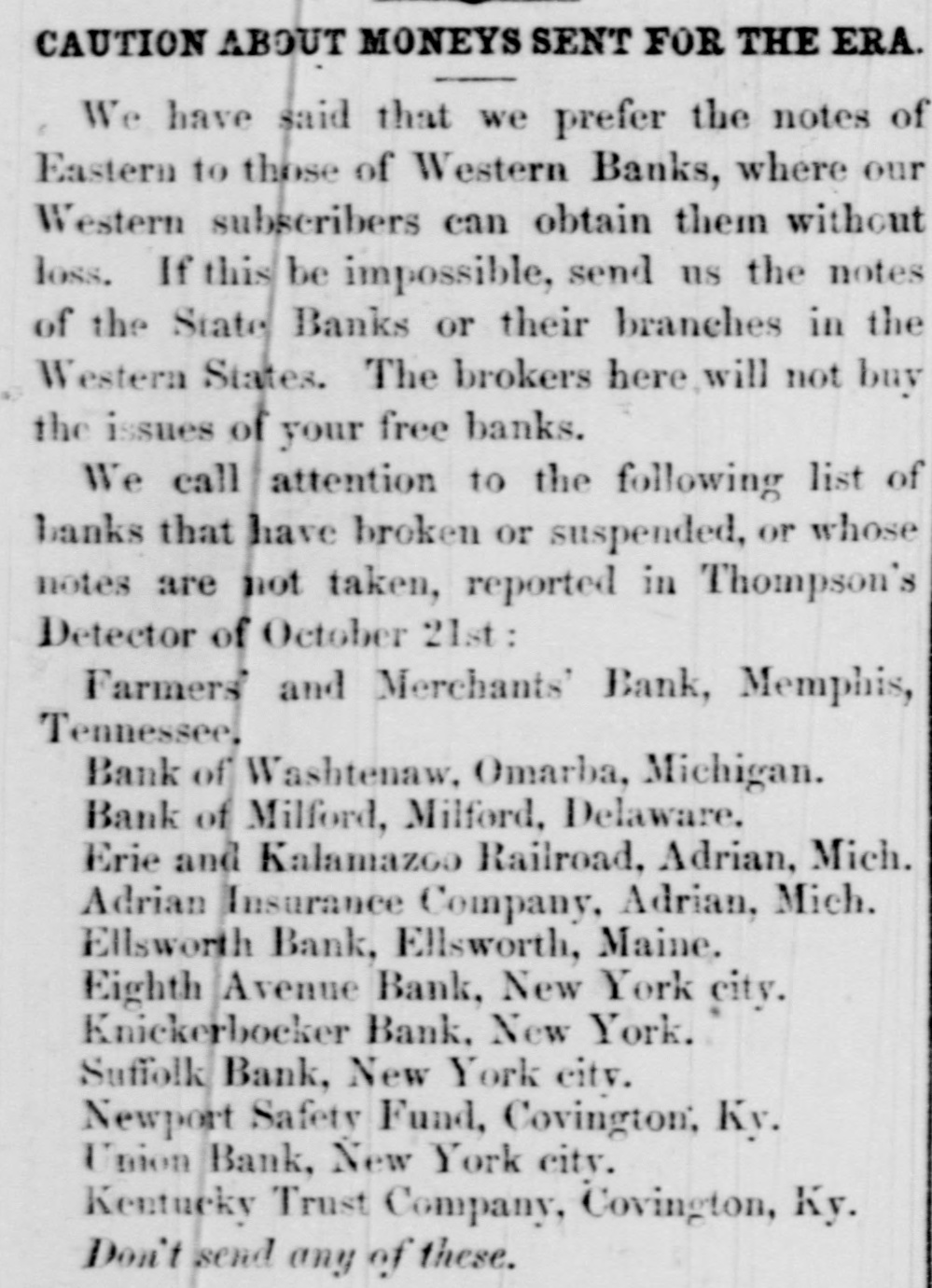
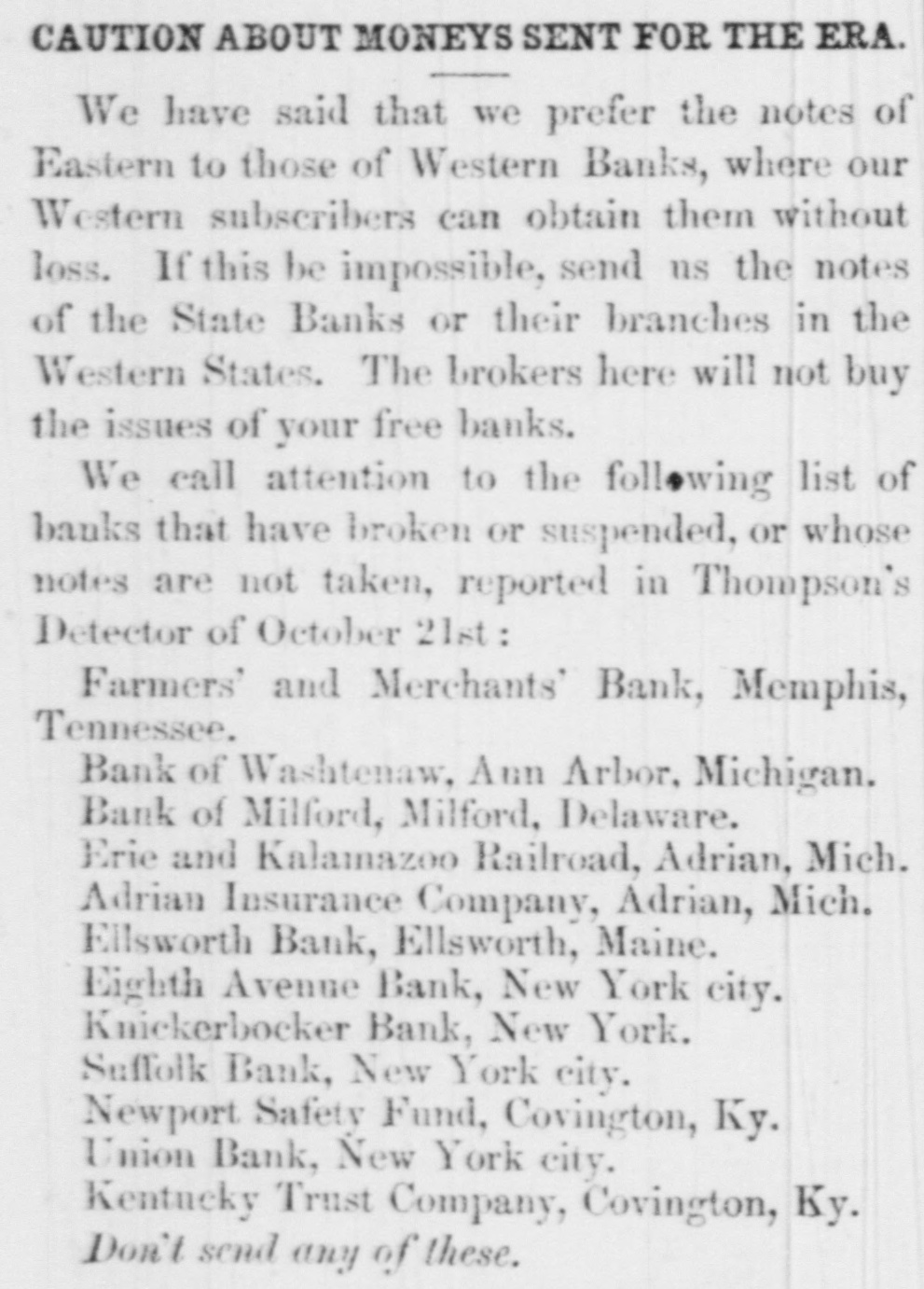
CAUTION ABOUT MONEYS SENT FOR THE ERA. We have said that we prefer the notes of Eastern to those of Western Banks, where our Western subscribers can obtain them without loss. If this be impossible, send us the notes of the State Banks or their branches in the Western States. The brokers here will not buy the issues of your free banks. We call attention to the following list of banks that have broken or suspended, or whose notes are not taken, reported in Thompson's Detector of October 21st: Farmers' and Merchants' Bank, Memphis, Tennessee. Bank of Washtenaw, Omarba, Michigan. Bank of Milford, Milford, Delaware. Erie and Kalamazoo Railroad, Adrian, Mich. Adrian Insurance Company, Adrian, Mich. Ellsworth Bank, Ellsworth, Maine. Eighth Avenue Bank, New York city. Knickerbocker Bank, New York. Suffolk Bank, New York citv. Newport Safety Fund, Covington, Ky. Union Bank, New York city. Kentucky Trust Company, Covington, Ky. Don't send any of these.


Article from The Ottawa Free Trader, November 4, 1854

Click image to open full size in new tab

Article Text

From Thompson's Reporter, Oct. 21. List of Banks which have Recently Failed Farmers' and Mc rehants' Bank of Memphis, Tenn., failed Aug. 16; no sale. Bank of Washtenow, Ann Arbor, Mich., failed Aug 21 ; no sale. Bank of Milford, Milford, Del., failed Aug. 21 ; no sale. Monsum River Bank, Sanford, Me., thrown out by the Suffolk Bank, Sept. 27; no sale. Erie and Kalamazoo Railroad Bank, Adrian, Mich., failed Oct. 6; no sale. Adrian Insurance Company, Adrian, Mich., failed Oct. 6; no sale. Ellsworth Bank, Ellsworth, Me., thrown out by the Suffolk Bank Oct. 6; no sale. Eighth Avenue Bank, N. Y. City, failed Oct. 6; 20 per cent dis. Knickerbocker Bank, N. Y. City, failed Oct. 12 ; 20 per cent dis. Suffolk Bank, New York City, suspended Oct. 12; par. Newport Safety Fund Bank, Newport, Ky., failed Oct. 16; no sale. Kentucky Trust Company, Covington, Ky., failed Oct. 18; no sale. Bank of Union, New York City, closing; par.


Article from The National Era, November 9, 1854

Click image to open full size in new tab

Article Text

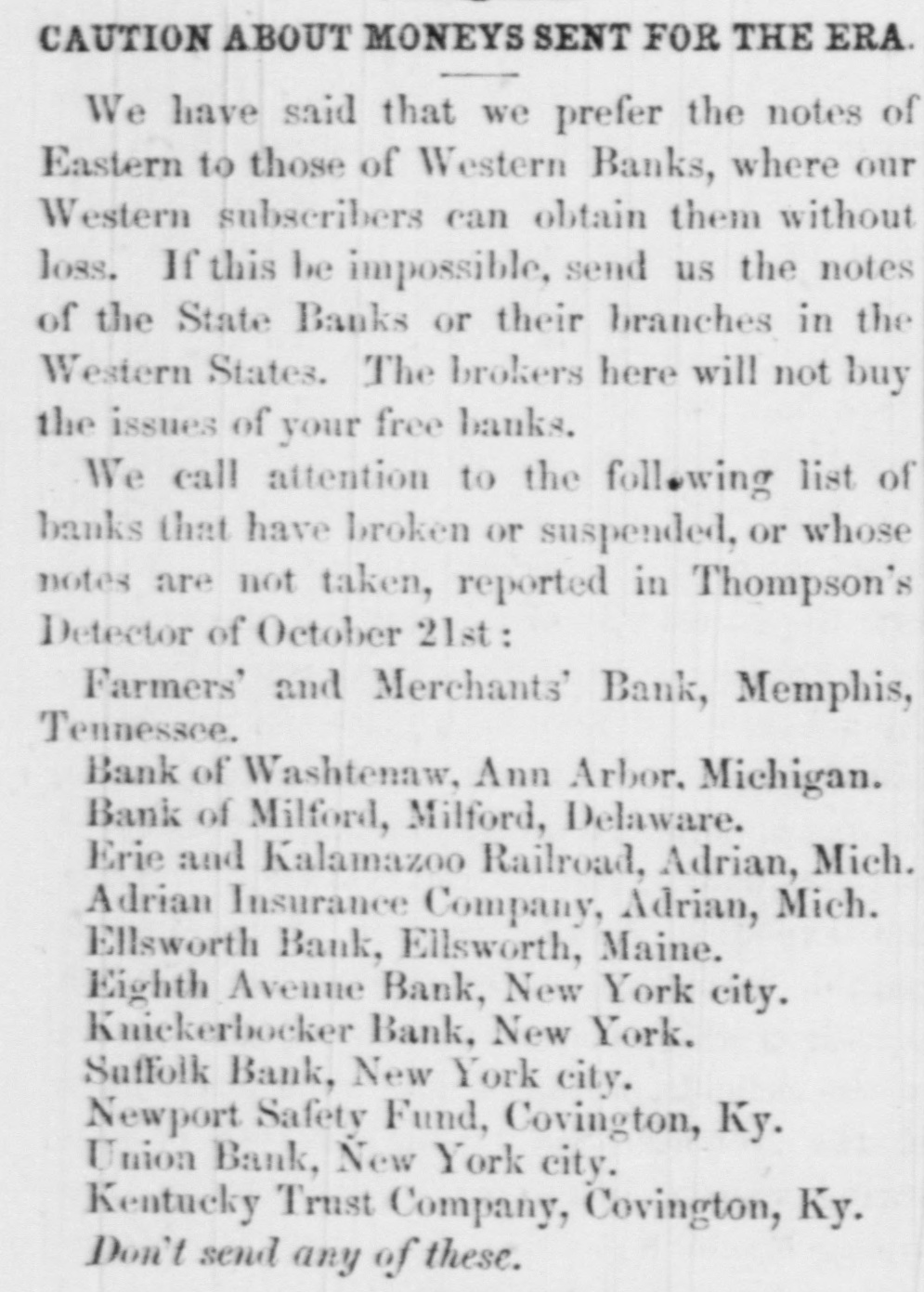
CAUTION ABOUT MONEYS SENT FOR THE ERA. We have said that we prefer the notes of Eastern to those of Western Banks, where our Western subscribers can obtain them without loss. If this be impossible, send us the notes of the State Banks or their branches in the Western States. The brokers here will not buy the issues of your free banks. We call attention to the following list of banks that have broken or suspended, or whose notes are not taken, reported in Thompson's Detector of October 21st: Farmers' and Merchants' Bank, Memphis, Tennessee. Bank of Washtenaw, Aun Arbor, Michigan. Bank of Milford, Milford, Delaware. Erie and Kalamazoo Railroad, Adrian, Mich. Adrian Insurance Company, Adrian, Mich. Ellsworth Bank, Ellsworth, Maine. Eighth Avenue Bank, New York city. Knickerbocker Bank, New York. Suffolk Bank, New York city. Newport Safety Fund, Covington, Ky. Union Bank, New York city. Kentucky Trust Company, Covington, Ky. Don't send any of these.


Article from The National Era, November 16, 1854

Click image to open full size in new tab

Article Text

CAUTION ABOUT MONEYS SENT FOR THE ERA. We have said that we prefer the notes of Eastern to those of Western Banks, where our Western subscribers can obtain them without loss. If this be impossible, send us the notes of the State Banks or their branches in the Western States. The brokers here will not buy the issues of your free banks. We call attention to the following list of banks that have broken or suspended, or whose notes are not taken, reported in Thompson's Detector of October 21st: Farmers' and Merchants' Bank, Memphis, Tennessee. Bank of Washtenaw, Ann Arbor. Michigan. Bank of Milford, Milford, Delaware. Erie and Kalamazoo Railroad, Adrian, Mich. Adrian Insurance Company, Adrian, Mich. Ellsworth Bank, Ellsworth, Maine. Eighth Avenue Bank, New York city. Knickerbocker Bank, New York. Suffolk Bank, New York city. Newport Safety Fund, Covington, Ky. Union Bank, New York city. Kentucky Trust Company, Covington, Ky. Don't send any of these.


Article from The Belmont Chronicle, and Farmers, Mechanics and Manufacturers Advocate, November 24, 1854

Click image to open full size in new tab

Article Text

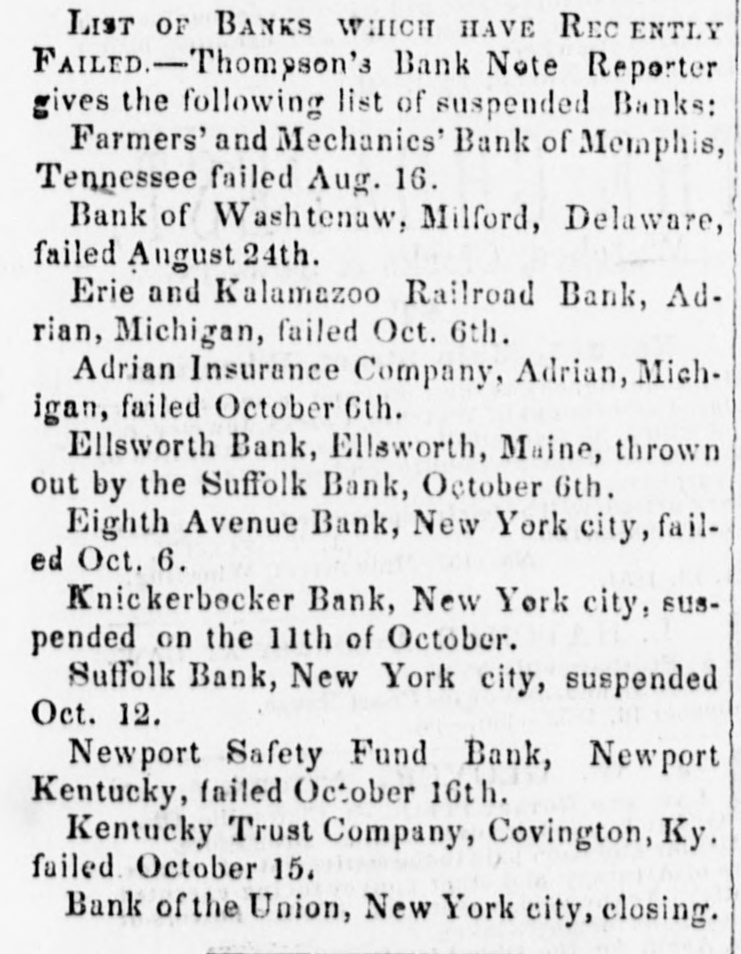
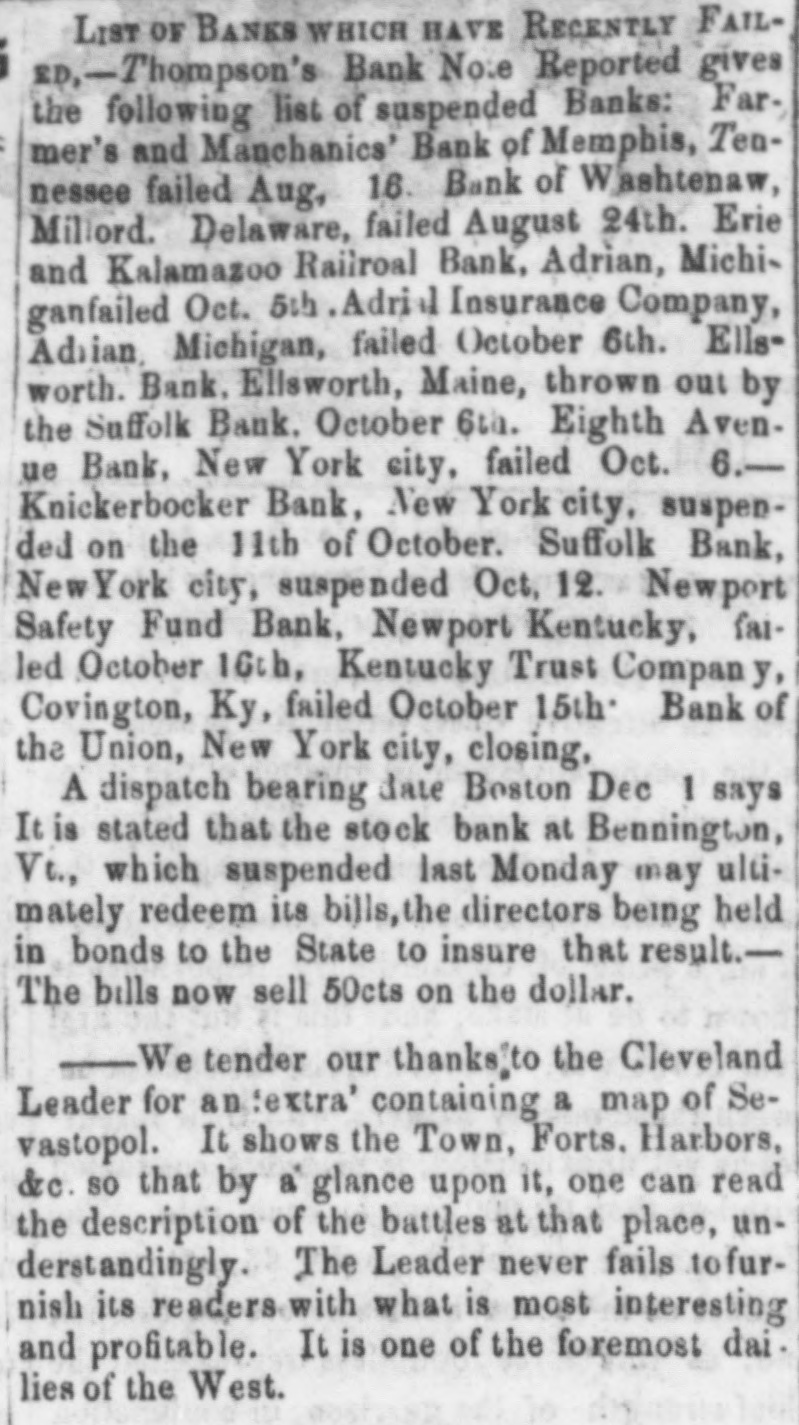
LIST OF BANKS WHICH HAVE REC ENTLY FAILED.-Thompson's Bank Note Reporter gives the following list of suspended Banks: Farmers' and Mechanics' Bank of Memphis, Tennessee failed Aug. 16. Bank of Washtenaw, Milford, Delaware, failed August 24th. Erie and Kalamazoo Railroad Bank, Adrian, Michigan, failed Oct. 6th. Adrian Insurance Company, Adrian, Michigan, failed October 6th. Ellsworth Bank, Ellsworth, Maine, thrown out by the Suffolk Bank, October 6th. Eighth Avenue Bank, New York city, failed Oct. 6. Knickerbocker Bank, New York city, suspended on the 11th of October. Suffolk Bank, New York city, suspended Oct. 12. Newport Safety Fund Bank, Newport Kentucky, failed October 16th. Kentucky Trust Company, Covington, Ky. failed October 15. Bank of the Union, New York city, closing.


Article from The Weekly Portage Sentinel, November 29, 1854

Click image to open full size in new tab

Article Text

# Broken Banks. The following is a list of Banks, that have suspended within a few months past. For the benefit of our readers, we shall keep it standing, and make weekly additions thereto, of such failures as come within our knowledge: Patchin Bank, Buffalo. Farmers' and Merchants' Bank, Oswego. Farmers' Bank of Canadaigua. Drovers' Bank, Ogdensburg. Bank of Carthage. Farmers' and Merchants' Bank, Maryland, Massillon Bank, Ohio. Farmers' and Merchants' Bank, Memphis. Ohio Savings Institute, Tiffin Cochituate Bank, Boston. Bank of West Killingly, Connecticut. Eighth Avenue Bank, New York. Bank of Ellsworth, Maine. Elkhart County Bank Indiana. Bank of Northern Indiana. Bank of Washlenaw, Michigan. Erie and Kalamazoo Bank, Michigan. Newport Safety Fund Bank Kentucky. Kentucky Trust Company. Bank of Kanawha, Virginia, Arlington Bank, Washington, D. C. Farmers' and M. Bank, Washington, D. C. Bank of Connersville, Indiana. Bank of Hallowell, Maine. The Shipbuilders' Bank, Maine. Lewis County Bank, New York. Akron Branch, Akron. Merchants and Traders Branch, Cin. Exchange Bank, Buffalo. Farmers' Joint Stock Bank, Buffalo. Woodbury Bank, Connecticut. Circleville Bank, Circleville. The City Bank, Columbus, Miami Valley Bank, Dayton, and the CanalBank of Cleveland have suspended payment so far as depositors and time draft holders are concerned, but the bill holders are secured by State and United States Stocks.


Article from Carroll Free Press, December 7, 1854

Click image to open full size in new tab

Article Text

LIST OF Banks WHICH HAVE RECENTLY FAILED,-Thompson's Bank Note Reported gives the following list of suspended Banks: Farmer's and Manchanics' Bank of Memphis, Tennessee failed Aug, 16. Bank of Washtenaw, Millord. Delaware, failed August 24th. Erie and Kalamazoo Railroal Bank, Adrian, Michiganfailed Oct. 5th. Adrial Insurance Company, Advian, Michigan, failed October 6th. Ellsworth. Bank, Ellsworth, Maine, thrown out by the Suffolk Bank. October 6th. Eighth Avenue Bank, New York city, failed Oct. 6.Knickerbocker Bank, New York city, suspended on the 11th of October. Suffolk Bank, New York city, suspended Oct, 12. Newport Safety Fund Bank, Newport Kentucky, failed October 16th, Kentucky Trust Compan Covington, Ky, failed October 15th Bank of the Union, New York city, closing, A dispatch bearing date Boston Dec I says It is stated that the stock bank at Bennington, Vt., which suspended last Monday may ultimately redeem its bills, the directors being held in bonds to the State to insure that result.The bills now sell 50cts on the dollar. We tender our thanksito the Cleveland Leader for an 'extra' containing a map of Sevastopol. It shows the Town, Forts. Harbors, &c. so that by a glance upon it, one can read the description of the battles at that place, understandingly. The Leader never fails tofurnish its readers with what is most interesting and profitable. It is one of the foremost dailies of the West.


Article from Minnesota Weekly Times, March 6, 1855

Click image to open full size in new tab

Article Text

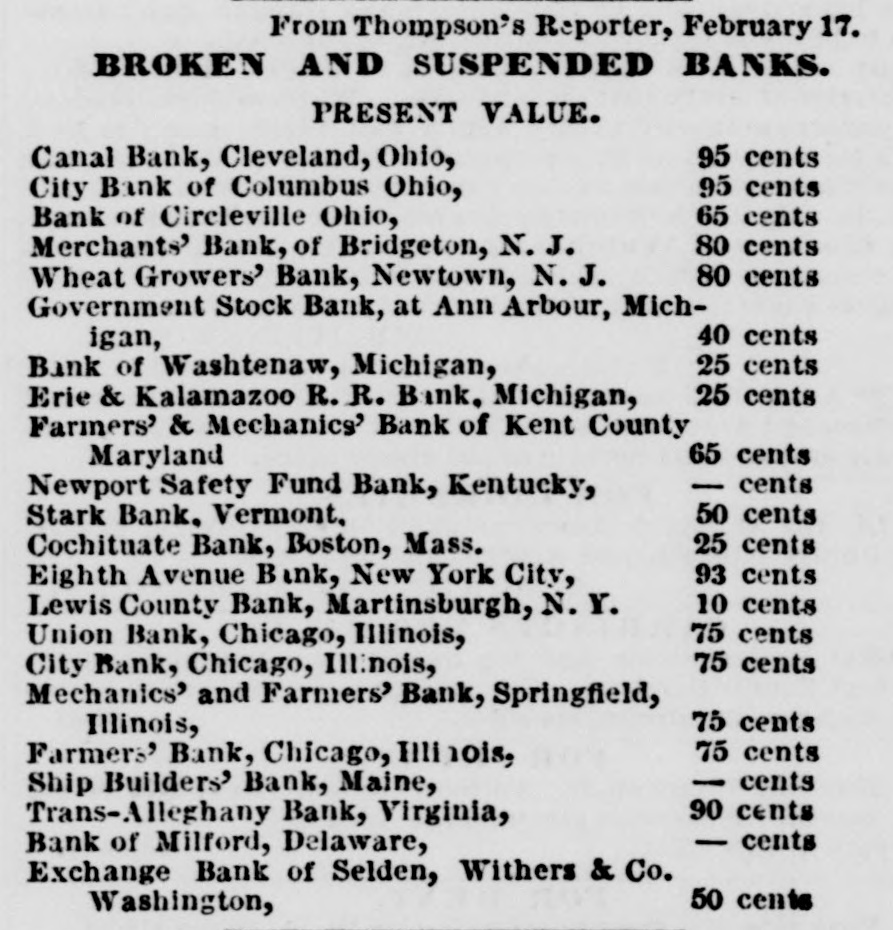
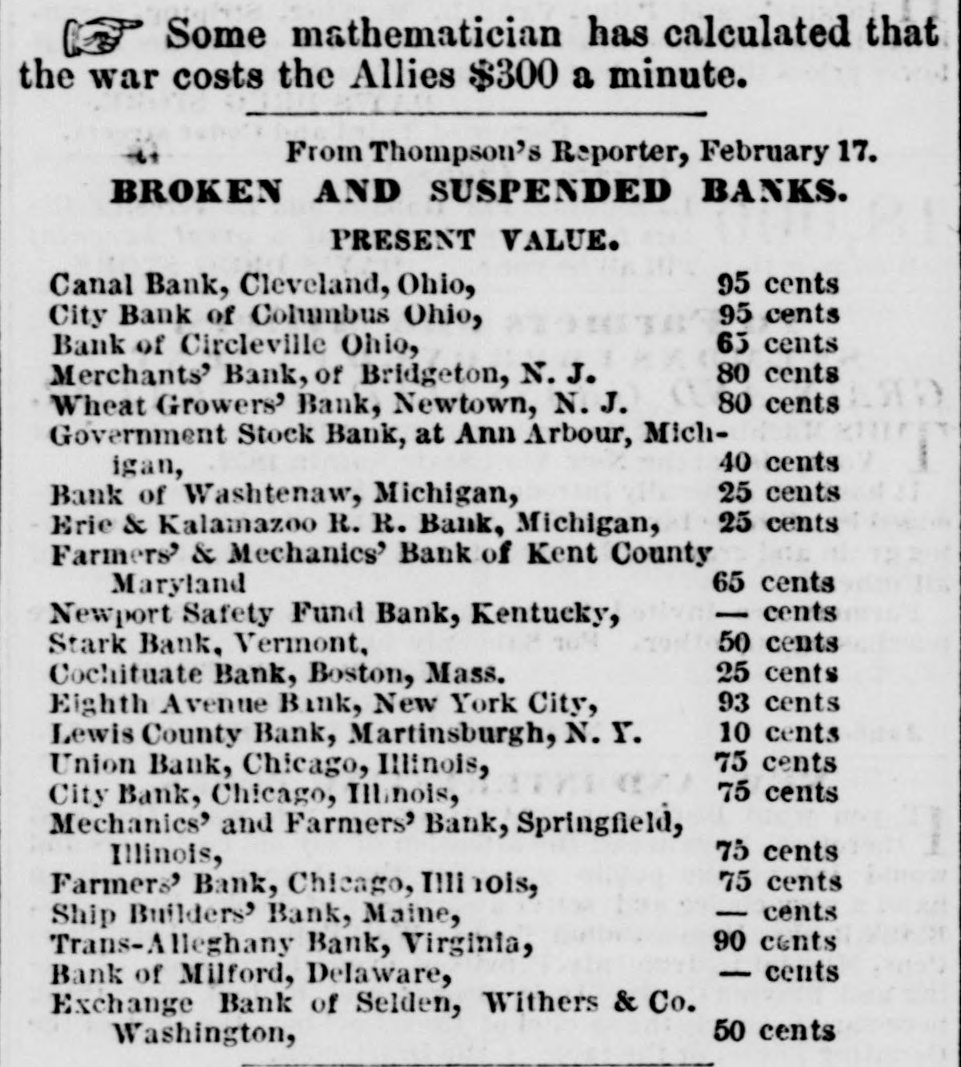
From Thompson's Reporter, February 17. BROKEN AND SUSPENDED BANKS. PRESENT VALUE. 95 cents Canal Bank, Cleveland, Ohio, 95 cents City Bank of Columbus Ohio, 65 cents Bank of Circleville Ohio, 80 cents Merchants' Bank, of Bridgeton, N. J. 80 cents Wheat Growers' Bank, Newtown, N. J. Government Stock Bank, at Ann Arbour, Mich40 cents igan, 25 cents Bank of Washtenaw, Michigan, 25 cents Erie & Kalamazoo R. R. Bank, Michigan, Farmers' & Mechanics' Bank of Kent County 65 cents Maryland - cents Newport Safety Fund Bank, Kentucky, 50 cents Stark Bank, Vermont, 25 cents Cochituate Bank, Boston, Mass. 93 cents Eighth Avenue Bank, New York City, 10 cents Lewis County Bank, Martinsburgh, N. Y. 75 cents Union Bank, Chicago, Illinois, 75 cents City Bank, Chicago, Illinois, Mechanics' and Farmers' Bank, Springfield, 75 cents Illinois, 75 cents Farmers' Bank, Chicago, Illi nois, - cents Ship Builders' Bank, Maine, 90 cents Trans-Alleghany Bank, Virginia, - cents Bank of Milford, Delaware, Exchange Bank of Selden, Withers & Co. 50 cents Washington,


Article from Minnesota Weekly Times, March 13, 1855

Click image to open full size in new tab

Article Text

Some mathematician has calculated that the war costs the Allies $300 a minute. # BROKEN AND SUSPENDED BANKS. PRESENT VALUE. Canal Bank, Cleveland, Ohio, 95 cents City Bank of Columbus Ohio, 95 cents Bank of Circleville Ohio, 65 cents Merchants' Bank, of Bridgeton, N. J. 80 cents Wheat Growers' Bank, Newtown, N. J. 80 cents Government Stock Bank, at Ann Arbour, Mich-igan, 40 cents Bank of Washtenaw, Michigan, 25 cents Erie & Kalamazoo R. R. Bank, Michigan, 25 cents Farmers & Mechanics' Bank of Kent County Maryland 65 cents Newport Safety Fund Bank, Kentucky, โ€” cents Stark Bank, Vernont, 50 cents Cochituate Bank, Boston, Mass. 25 cents Eighth Avenue Bank, New York City, 93 cents Lewis County Bank, Martinsburgh, N. Y. 10 cents Union Bank, Chicago, Illinois, 75 cents City Bank, Chicago, Illinois, 75 cents Mechanics' and Farmers' Bank, Springfield, Illinois, 75 cents Farmers' Bank, Chicago, Illinois, 75 cents Ship Builders' Bank, Maine, โ€” cents Trans-Alleghany Bank, Virginia, 90 cents Bank of Milford, Delaware, โ€” cents Exchange Bank of Selden, Withers & Co. Washington, 50 cents


Article from New-York Daily Tribune, April 8, 1856

Click image to open full size in new tab

Article Text

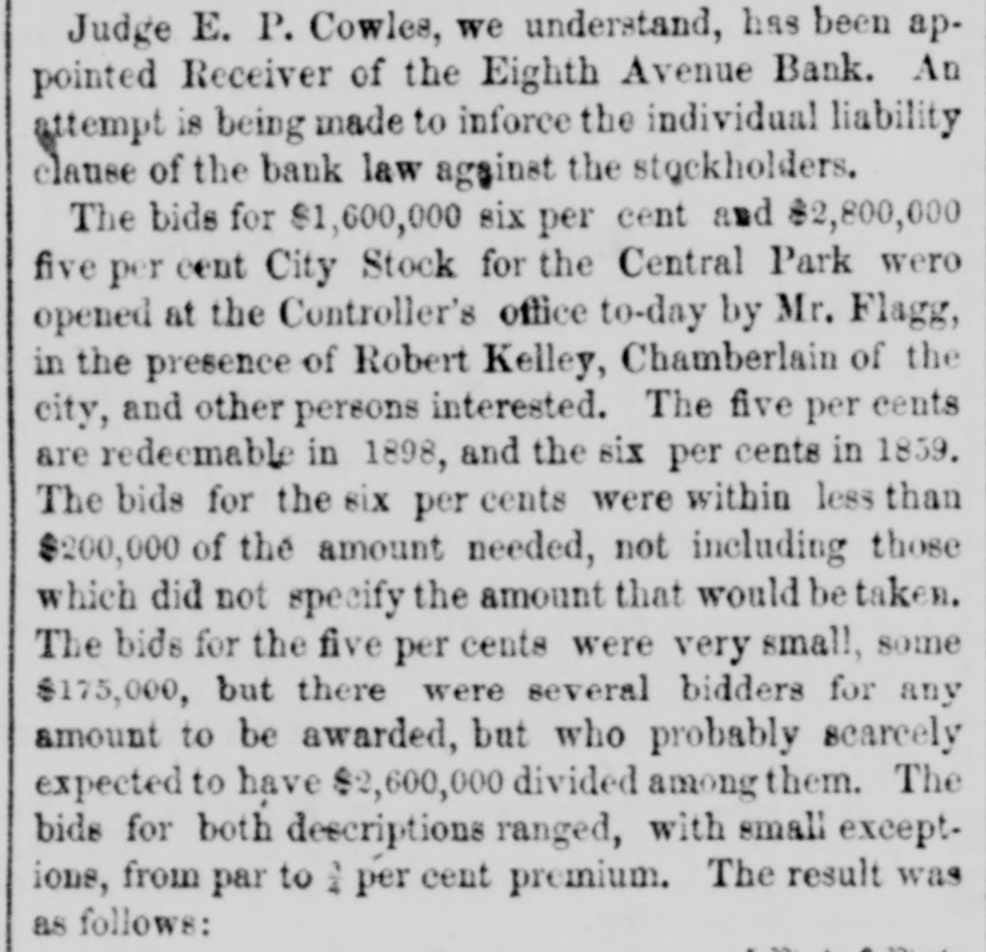
Judge E. P. Cowles, we understand, has been appointed Receiver of the Eighth Avenue Bank. An attempt is being made to inforce the individual liability clause of the bank law against the stockholders. The bids for $1,600,000 six per cent and $2,800,000 five per cent City Stock for the Central Park wero opened at the Controller's office to-day by Mr. Flagg, in the presence of Robert Kelley, Chamberlain of the city, and other persons interested. The five per cents are redeemable in 1898, and the six per cents in 1859. The bids for the six per cents were within less than $200,000 of the amount needed, not including those which did not specify the amount that would be taken. The bids for the five per cents were very small, some $175,000, but there were several bidders for any amount to be awarded, but who probably scarcely expected to have $2,600,000 divided amongthem. The bids for both descriptions ranged, with small exceptions, from par to 1 per cent premium. The result was as follows:


Article from The New York Herald, January 21, 1857

Click image to open full size in new tab

Article Text

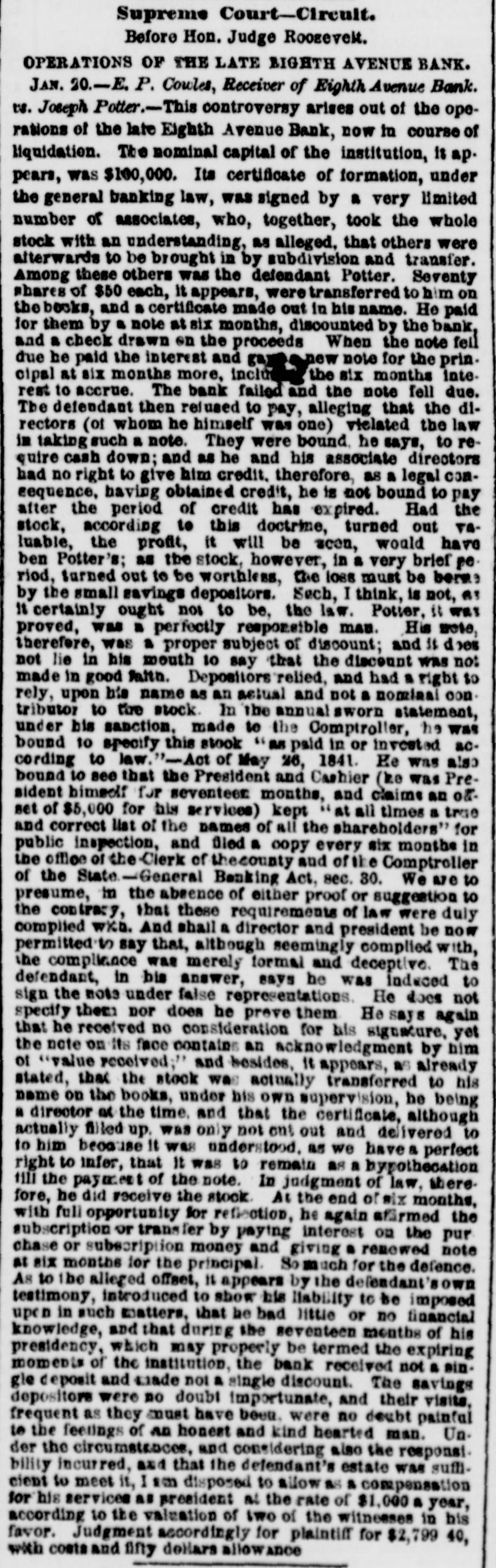
Supreme Court-Circult. Before Hon. Judge Roosevelt. OPERATIONS OF THE LATE BIGHTH AVENUE BANK. JAN. 20.-E. P. Cowles, Receiver of Eighth Avenue Bank. us. Joseph Potter.-This controversy arises out of the operations of the late Eighth Avenue Bank, now in course of liquidation. The nominal capital of the institution, it ap. pears, was $100,000. Its certificate of formation, under the general banking law, was signed by a very limited number of associates, who, together, took the whole stock with an understanding, as alleged, that others were alterwards to be brought in by subdivision and transfer. Among these others was the defendant Potter. Seventy shares of $50 each, it appears, were transferred to him on the becks, and a certificate made out in his name. He paid for them by a note at six months, discounted by the bank, and a check drawn en the proceeds When the note feil due he paid the interest and game - new note for the prin. cipal at six months more, include the six months interest to accrue. The bank failed and the note fell due. The defendant then rejused to pay, alleging that the directors (of whom he himself was one) vielated the law in taking such a note. They were bound. he says, to require cash down; and as he and his associate directors had no right to give him credit. therefore, as a legal comsequence, having obtained credit, he is not bound to pay after the period of credit has expired. Had the stock, according to this doctrime, turned out valuable, the profit, it will be seen, would have ben Potter's; as the stock, however, in a very brief pe. riod, turned out to be worthless, the loss must be berme by the small savings depositors. Sech, I think, is not, as 18 certainly ought not to be, the law. Potter, it was proved, was a perfectly responsible man. His mete, therefore, was a proper subject of discount; and it nes not lie in his mouth to say that the discount was not made in good Faith. Depositors relied, and had a right so rely, upon his name as an actual and not a nominal contributor to the stock. In the annual sworn statement, under his sanction, made to the Comptroller, he was bound to specify this stock "as paid in or invested according to law."-Act of May 26, 1841. Ee was also bound to see that the President and Cashier (ke was President himself for seventeem months, and claims an offset of $5,000 for his services) kept at all times a true and correct list of the names of all the shareholders" for public inspection, and filed a copy every six months in the office of the Clerk of the county and of the Comptroller of the State-General Benking Act, sec. 30. we are to presume, in the absence of either proof or suggestion to the contrary, that these requirements of law were duly complied wkb. And shall a director and president be now permitted to say that, although seemingly complied with, the compliance was merely formal and deceptive. The defendant, in bis answer, says he was induced to sign the note under false representations. He does not specify them nor does he preve them He says again that he received no consideration for his signature, yet the note on Its face contains an acknowledgment by him ot "value received;" and besides, It appears, as already stated, that the stock was actually transferred to his name on the books, under bis own supervision, he being a director at the time. and that the certificate, although actually filled up. was only not out out and delivered to to him because It was understood, as we have a perfect right to infer, that It was to remain as a hypothecation till the payment of the note. In judgment of law, therefore, he did receive the stock. At the end of six months, with full opportunity for reflection, he again affirmed the subscription or transfer by paying interest on the pur chase or subscription money and giving a remewed note at six months for the principal. Somuch for the defence. As to the alleged offset, 11 appears by the defendant's own testimony, introduced to show his liability to be imposed upon in such matters, that be bad little or no financial knowledge, and that during the seventeen months of his presidency, which may properly be termed the expiring moments of the institution, the bank received not a single deposit and made not a single discount. The savings depositors were no doubt importunate, and their visits, frequent as they must have been. were no deubt painful to the feelings of AD honest and kind hearted man. Under the circumstances, and considering also the responsi. bility incurred, and that the defendant's estate was sufficient to meet it, I am disposed to allow as a compensation for his services as president at the rate of $1,000 a year, according to the valuation of two of the witnesses in his favor. Judgment accordingly for plaintiff for $2,799 40, with costs and fifty dellars allowance


Article from New-York Daily Tribune, February 18, 1857

Click image to open full size in new tab

Article Text

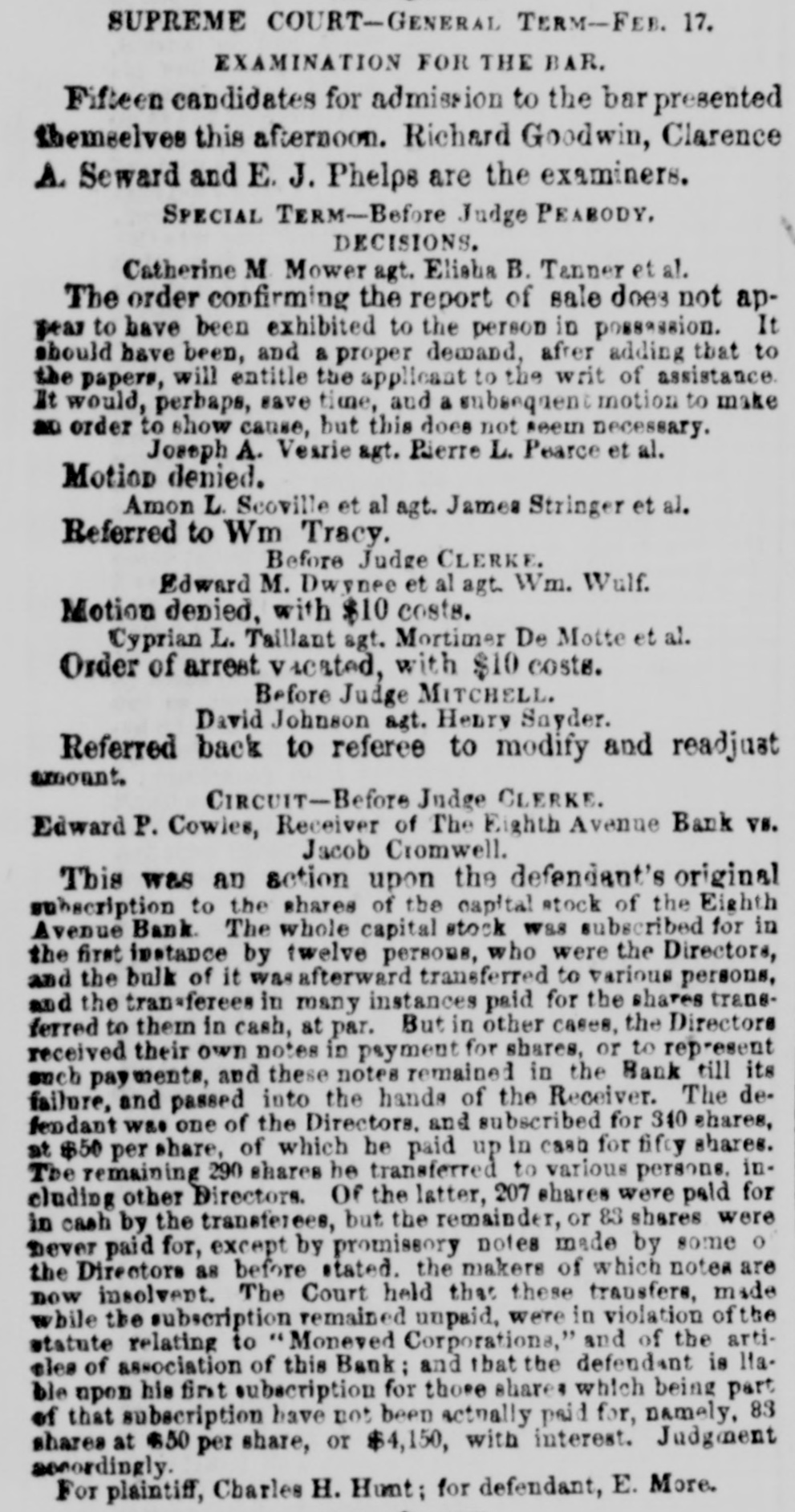
SUPREME COURT-GENERAL TERM-FEB. 17. EXAMINATION FOR THE BAR. Fifteen candidates for admission to the bar presented themselves this afternoon. Richard Goodwin, Clarence A. Seward and E. J. Phelps are the examiners. SPECIAL TERM-Before Judge PEABODY. DECISIONS. Catherine M. Mower agt. Elisha B. Tanner et al. The order confirming the report of sale does not appear to have been exhibited to the person in possession. It should have been, and a proper demand, after adding that to the papers, will entitle the applicant to the writ of assistance. It would, perbaps, save time, and a subsequent motion to make an order to show cause, but this does not seem necessary. Joseph A. Vesrie agt. Pierre L. Pearce et al. Motion denied. Amon L. Scoville et al agt. James Stringer et al. Referred to Wm Tracy. Before Judge CLERKE. Edward M. Dwynee et al agt. Wm. Wulf. Motion denied, with $10 costs. Cyprian L. Taillant agt. Mortimer De Motte et al. Order of arrest vacated, with $10 costs. Before Judge MITCHELL. David Johnson agt. Henry Sayder. Referred back to referee to modify and readjust amount. CIRCUIT-Before Judge CLERKE. Edward P. Cowles, Receiver of The Eighth Avenue Bank VS. Jacob Cromwell. This was an action upon the defendant's original subscription to the shares of the capital stock of the Eighth Avenue Bank. The whole capital stock was subscribed for in the first instance by twelve persons, who were the Directors, and the bulk of it was afterward transferred to various persons, and the tran=ferees in many instances paid for the shares transferred to them in cash, at par. But in other cases, the Directors received their own notes in payment for shares, or to represent such payments, and these notes remained in the Bank till its failure, and passed into the hands of the Receiver. The defendant was one of the Directors. and subscribed for 340 shares, at $50 per share, of which he paid up in cash for fifty shares. The remaining 290 shares be transferred to various persons. including other Directors. Of the latter, 207 shares were paid for in cash by the transferees, but the remainder, or 83 shares were never paid for, except by promissory notes made by some 0 the Directors as before stated. the makers of which notes are now insolvent. The Court held that these transfers, made while the subscription remained unpaid, were in violation of the statute relating to "Moneved Corporations," and of the articles of association of this Bank; and that the defendant is llable upon his first subscription for those shares which being part of that subscription have not been actually paid for, namely, 83 shares at $50 per share, or $4,150, with interest. Judgment accordingly. For plaintiff, Charles H. Hunt; for defendant, E. More.


Article from The New York Herald, March 28, 1857

Click image to open full size in new tab

Article Text

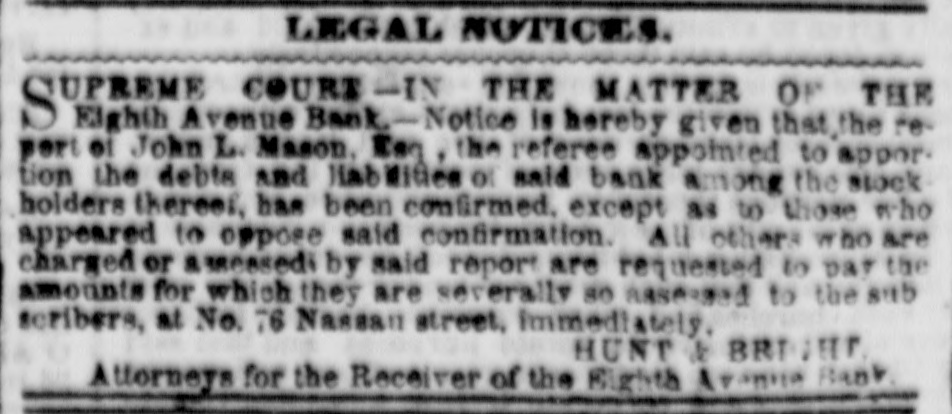
LEGAL NOTICES. CUPREME COURT -IN THE MATTER OF THE Eighth Avenue Bank- Notice is hereby given that, the report of John L. Mason. Esq, the referee appointed to apportion the debta and liabilities 0: said bank among the stock holders thereef, has been confirmed. except as to those who appeared to oppose said confirmation. All others who are charged or assessedi by said report are requested to DAT the amounts for which they are severally so assessed to the sub scribers, at No. 76 Nassau street, immediately. HUNT s BRIVHT Attorneys for the Receiver of the Eights Avenue Bank


Article from The New York Herald, June 8, 1857

Click image to open full size in new tab

Article Text

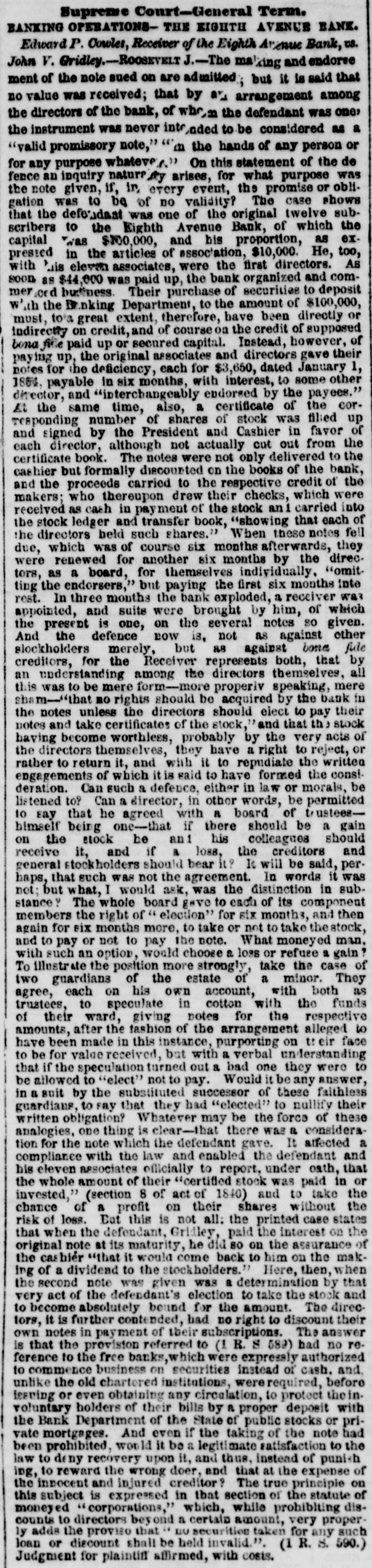
BANKING OPERATIONS- THE EIGHTH AVENUE BANK. Edward P. Cowles, Receiver of the Eighth Avenue Bank, us. John V. Gridley.--ROOSEVELT J.-The making and endorse- ment of the note sued on are admitted; but it is said that no value was received; that by a arrangement among the directors of the bank, of when the defendant was one, the instrument was never intended to be considered as a "valid promissory note," "in the hands of any person or for any purpose whatever." On this statement of the de- fence an inquiry natursty arises, for what purpose was the note given, if, in, every event, the promise or obli- gation was to be of no validity? The case shows that the defendant was one of the original twelve sub- scribers to the Eighth Avenue Bank, of which the capital was $30,000, and his proportion, as ex- pressed in the articles of association, $10,000. He, too, with his eleven associates, were the first directors. As soon as $44,000 was paid up, the bank organized and com- mer.ord burtiness. Their purchase of securities to deposit with the Banking Department, to the amount of $100,000, must, to a great extent, therefore, have been directly or Indirectly on credit, and of course on the credit of supposed bona fice paid up or secured capital. Instead, however, of paying up, the original associates and directors gave their A for the deficiency, each for $3,650, dated January 1, 1854, payable in six months, with interest, to some other director, and "interchangeably endorsed by the payees." At the same time, also, a certificate of the cor- responding number of shares of stock was filled up and signed by the President and Cashier in favor of each director, although not actually cut out from the certificate book. The notes were not only delivered to the cashier but formally discounted on the books of the bank, and the proceeds carried to the respective credit of the makers; who thereupon drew their checks, which were received as cash in payment of the stock an i carried into the stock ledger and transfer book, "showing that each of the directors beld such shares." When these notes fell due, which was of course six months afterwards, they were renewed for another six months by the direc- tors, as a board, for themselves individually, "omit- ting the endorsers," but paying the first six months inte- rest. In three months the bank exploded, a receiver wa appointed, and suits were brought by him, of which the present is one, on the several notes so given. And the defence now is, not as against other slockholders merely, but as against bona fide creditors, for the Receiver represents both, that by an understanding among the directors themselves, all this was to be mere form-more properiv speaking, mere sham "that no rights should be acquired by the bank in the notes unless the directors should elect to pay their notes and take certificates of the stock," and that the stock having become worthless, probably by the very acts of the directors themselves, they have a right to reject, or rather to return it, and with it to repudiate the written engagements of which it is said to have formed the consi- deration. Can such a defence, either in law or morals, be listened to? Can a director, in other words, be permitted to say that he agreed with a board of trustees- himself being one-that if there should be a gain on the stock he an 1 his colleagues should receive it, and if loss, the creditors and general stockholders should bear it? It will be said, per- haps, that such was not the agreement. In words it was not; but what, I would ask, was the distinction in sub- stance? The whole board gave to each of its component members the right of "election" for six six months, and then again for six months more, to take or not to take the stock, and to pay or not to pay the note. What moneyed man, with such an option, would choose a loss or refuse a gain? To illustrate the position more strongly, take the case of two guardians of the estate of a minor. They agree, each on his own account, with both as trustees, to speculate in cotton with the funds of their ward, giving notes for the respective amounts, after the fashion of the arrangement alleged to have been made in this instance, purporting on their face to be for value received, but with a verbal understanding that if the speculation turned out a bad one they were to be allowed to "elect" not to pay. Would it be any answer, in a suit by the substituted successor of these faithless guardians, to say that they had "elected" to nullify their written obligation? Whatever may be the force of these analogies, one thing is clear-that there was a considera- tion for the note which the defendant gave. It atfected a compliance with the law and enabled the defendant and his eleven associates officially to report, under oath, that the whole amount of their "certified stock was paid in or invested," (section 8 of act of 1840) and to take the chance of a profit on their shares without the risk of loss. Eut this is not all: the printed case states that when the defendant, Gridley, paid the interest on the original note at its maturity, he did so on the assurance of the cashier "that it would come back to him on the mak- ing of a dividend to the stockholders." Here, then, when the second note was given was a determination by that very act of the defendant's election to take the stock and to become absolutely bound for the amount. The direc- tors, it is further contended, had no right to discount their own notes in payment of their subscriptions. The answer is that the provision referred to (1 R. S. 589) had no re- ference to the free banks, which were expressly authorized to commence business on securities instead of cash, and, unlike the old chartered institutions, were required, before issuing or even obtaining any circulation, to protect the in- voluntary holders of their bills by a proper deposit with the Bank Department of the State of public stocks or pri- vate mortgages. And even if the taking of the note had been prohibited, would it be a legitimate satisfaction to the law to deny recovery upon it, and thus, instead of punish- ing, to reward the wrong doer, and that at the expense of the innocent and injured creditor? The true principle on this subject is expressed in that section of the statute of moneyed "corporations," which, while prohibiting dis- counts to directors beyond a certain amount, very proper- ly adds the proviso that no securition taken for any such loan or discount shall be held invalid.". (1 R. S. 590.) Judgment for plaintiff affirmed, with costs. as
Article from The Sun, January 16, 1861

Click image to open full size in new tab

Article Text

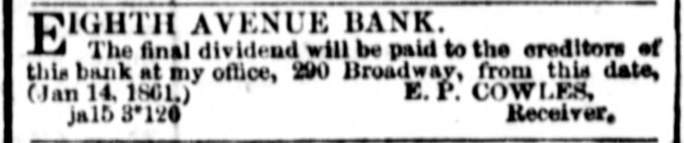
IGHTH AVENUE BANK. E The final dividend will be paid to the creditors of this bank at my office, 290 Broadway, from this date, E.P. COWLES. (Jan 14. 1861,) Receiver. ja15 3*120