District National Bank (Washington, DC)

Episode Information

Episode UID
954501599
Episode Type
Run β†’ Suspension β†’ Closure
Bank Type
national
Bank ID
95450 national
Charter Number
9545
Start Date
March 1, 1933
Location
Washington, District of Columbia (38.895, -77.036)

Metadata

Model
gpt-5-mini (chosen from majority vote of a three-model LLM ensemble)
Short Digest
6404f78497025295

Response Measures

Accommodated withdrawals, Borrowed from banks or large institutions, Fed/other loan, Capital injected, Partial suspension, Full suspension, Books examined

Clearinghouse involved: Yes (loan, examination, or other measures)

Receivership Details

Depositor recovery rate
85.0%
Date receivership started
1933-11-06
Share of assets assessed as good
49.2%
Share of assets assessed as doubtful
39.5%
Share of assets assessed as worthless
11.3%

Description

Bank went on 5% withdrawal limit March 1, 1933, was placed in conservatorship in early March and never resumed normal operations.

Events (6)

1. September 18, 1909 Chartered
Source
historical_nic
2. March 1, 1933 Run
Cause
Macro News
Cause Details
Heavy withdrawals associated with the nationwide March 1933 banking crisis and holiday; banks limited withdrawals to protect depositors.
Measures
Limited withdrawals to 5% of balances; savings banks invoked 60-day clause and limits on larger withdrawals.
Newspaper Excerpt
the board of directors has passed a resolution allowing depositors to withdraw 5 per cent of their balances
Source
newspapers
3. March 3, 1933 Suspension
Cause
Government Action
Cause Details
Placed in hands of conservators in the aftermath of the March 1933 bank holiday and Treasury/Controller actions; did not receive license to reopen on March 14.
Newspaper Excerpt
The 13 banks in the hands of conservators virtually were closed on Friday night, March 3
Source
newspapers
4. June 20, 1933 Other
Newspaper Excerpt
receivers for the Wardman Real Estate Properties petitioned ... to use $20,000 assets in the closed District National Bank for purchase of stock in the proposed new Hamilton National Bank; hearing continued or later denied by court; assets involved in reorganization efforts
Source
newspapers
5. November 6, 1933 Receivership
Source
historical_nic
6. November 6, 1933 Receivership
Newspaper Excerpt
Norman R. Hamilton, receiver for the District National was granted a default judgment ... (receiver references in later articles). Receivership date per government records 1933-11-06 was used as authoritative for receivership timing as noted in bank metadata.
Source
newspapers

Newspaper Articles (24)

Article Text

ST. LOUIS BANKS PUT 5 PCT. LIMIT ON WITHDRAWALS Continued From Page opened as usual. In Ashland and several nearby towns banks announced they would not observe the holiday, but would restrict withdrawals to per cent until further notice. Eighteen banks in two Kentucky counties adjoining Cincinnati went on restricted basis yesterday along with the Cincinnati banks. Washington Bank Limits Withdrawals to Pct. By the Associated Press. WASHINGTON, March tation of withdrawals to per cent of balances on account was imposed today by the District NationBank, officers announcing that was to protect the interest of depositors. Several savings banks invoked the right to require 60-day notices on withdrawals. Gov. McAlister Calls Moratorium Through Next Monday. By the Associated Press. NASHVILLE, Tenn., March Gov. Hill McAlister today declared bank suspension in Tennessee, beginning immediately and extending through next Monday. The Governor's proclamation, issued at m., after an all night meeting of bankers, called attention to bank holidays declared elsewhere in order that beneficial bank legislation might be enacted. "These temporary holidays," it was set out, "are seemingly becoming and have been declared in states with which the people of Tennessee daily have business transactions and it would be exceedingly unfair for our citizens and their banks to have to honor commitments from such territory where cash is not now immediately available, with the consequent disturbance in Tennessee and apprehension on the part of the people which is wholly unnecessary proper and timely action is taken.' West Virginia Legislature Passes Bill to Legalize Action. CHARLESTON, W. Va., March bill permitting bank holiday in West Virginia was enacted by the Legislature yesterday. Legislation giving the Governor and Banking Commissioner authority to limit operations of banks was passed by both Houses without dissenting vote. 10-Day Bank Holiday Proclaimed by Alabama Governor. the Associated Press. MONTGOMERY, Ala., March of the State Superintendent of Banks, Gov. M. Miller today proclaimed 10day banking holiday in Alabama to "protect the interests of the public, bank depositors and bank stockholders.'


Article from Evening Star, March 1, 1933

Click image to open full size in new tab

Article Text

LOCAL BANKS ACT TO PROTECT FUNDS District National Limits Withdrawals-Others Invoke 60Day Clause on Savings. The District National Bank opened today on a 5 per cent withdrawal basis, following action taken by the directors early this morning, for the protection of depositors. President Joshua Evans, jr., announced. (The following notice was addressed today to the depositors in the bank: "Owing to heavy withdrawals of deposits during the last few days, and in order to safeguard all of our depositors, the board of directors has passed a resolution allowing depositors to withdraw 5 per cent of their balances in this bank at the close of business February 28, 1933, until further notice. All new deposits and new accounts opened March 1, 1933, and thereafter are subject to 100 per cent withdrawal at any time after actual realization cf funds by the bank." 60-Day Clause Invoked. The officials stressed the fact that all deposits made today and after this date can be withdrawn in full at any time. It was announced in the financial district that most of the local building and loan associations have invoked their time clauses on withdrawals, limiting the amount to $100. For larger amounts notice must be given in advance. Officials said the rule would be in force for the present. Several savings banks here invoked the 60-day clause on withdrawal of savings accounts. Some of these banks permit the withdrawal of 10 per cent up to $100. Above that amount, the 60day or two-month notice, is being required. Protective Measure. Among the local banks which have adopted this rule-the same plan which has been adopted extensively in other cities-are: United States Savings Bank, Chevy Chase Savings Bank, Security Savings & Commercial Bank, Park Savings Bank, Seventh Street Savings Bank, Washington Savings Bank, Anacostia Bank, Mount Vernon Savings Bank and the Northeast Savings Bank. (In an earlier edition of The Star the name of the Washington Mechanics' Savings Bank was included with those involking the 60-day clause. This was incorrect.) Officials said the action was taken merely as a protective measure, both for the banks and for the depΓ³sitors. The Commercial National Bank. which closed yesterday, has been placed in the hands of Robert C. Baldwin, a receiver of the office of the controller of the currency. Mr. Baldwin has taken over the receivership from J. L. Bailey, who took charge when the bank was closed. It was explained that Mr. Bailey will remain for a while in his capacity as a national Bank examiner to assist Mr. Baldwin. Has Considerable Experience. In the meantime, it was said at the Treasury Department, the new receiver probably will use a large part of the staff of the bank for his work. The new receiver. before Joining the office of the Controller of th Γ¨ Currency, had considerable liquidating experience. Under the auspices of the Government he has been receiver for e bank at Lynn, Mass., since the latter part of 1931, and has been directing its liquidation. An official of the Treasury said in regard to Mr. Baldwin: "By reason of his ability in liquidating that bank, the Treasury Department saw fit to transfer him to the Commercial National Bank. We have every confidence that he will administer the affairs of the institution in a manner satisfactory to all concerned."


Article from The Washington Times, March 9, 1933

Click image to open full size in new tab

Article Text

Banks Free Money For Essentials Washington banks today started granting withdrawals by depositors who need the money for the purchase of food, medicine, and other essentials-and found few persons taking advantage of the service. Each depositor who came to draw money was required to sign a printed form to the effect that the money withdrawn was to be used for necessities. No limit was set by the banks, but those making the withdrawais were asked to explain their needs and the sum was determined by this method. Amounts paid out ranged from $5 to $25. Withdrawals Are Light Bank officials in all parts of the District said that the number of withdrawals was running exceedingly light, an indication that the four-day bank holiday has worked little if any hardship in Washington. The withdrawal of money was made possible through instructions issued by the Washington Clearing House Association to its members, based on regulation No. 10, the "humanitarian" regulation issued by Secretary of the Treasury William H. Woodin. Reversal of Position In taking this stand the clearing house reversed its position of yesterday when it recommended against any action on Regulation No. 10 pending further clarification of the ruling which was termed as vague and too broad. While this action releases a certain amount of funds from the banks, no action will be taken on another section of the regulation providing that the banks may meet payrolls. Bankers pointed out that if they did this they would jeopardize their own position, by paying out money while they are unable to take any in. No bank, no matter how strong its position and reserve, can long do this, they said. Under restrictions placed on the banks by Secretary Woodin, banks may receive new deposits, but these deposits must be kept in trust. So far all local banks (Continued on Page 2, Col. 3)


Article from The Washington Times, March 10, 1933

Click image to open full size in new tab

Article Text

PAYROLLS HERE MET BY BANKS (Continued from Page One) certificates may be withdrawn, however. The local banks also continued allowing their depositors to withdraw funds up to $25 for purchases of food, medicine, and other essentials permitted under Regulation No. 10. Those making the withdrawls must sign statements that the money is to be expended in accordance with the regulations of the department. Padded Payrolls Alleged Several banks reported they had detected several instances of business men trying to pad their payrolls to get larger amounts of cash on hand in their establishments. To check this, the banks were requiring the business men to present their payroll books as proof of their needs. Some banks, however, not sure of the authority to issue money to meet payrolls, were asking the business men to sign 10-day notes for the money they withdraw to meet the payrolls. In this manner, they said, they would be protected if it was learned afterward that they did not have authority to issue the money. Rent Not Considered Banks do not consider payment of rent one of the essentials covered in the regulation, several being reported as refusing to honor withdrawals for rent payments, holding that the landlord must wait payment as do stores and other business concerns. The Clearing House last night advised its members to prepare to reopen on short notice, and it was believed that all banks will be opened for business in full by next Monday. Some banks may be reopened tomorrow, it was indicated. At Upper Marlboro, Md., the First National Bank today started cashing pay roll checks and also cashed checks for county employes whose offices carry accounts in the bank. Exchange to Open The Washington Stock Exchange, closed following the proclamation of the bank holiday, will also open again Monday, it is believed, and local brokers are looking for a rising market.


Article from The Washington Times, March 13, 1933

Click image to open full size in new tab

Article Text

BANKS PREPARE FOR OPENING TOMORROW All to Resume at Same Time If Reserve Board 0. K's Clearing House Plea Washington banks today were awaiting word from the Federal Reserve Bank at Richmond for permission to resume activities tomorrow. It is expected that the Federal Reserve will honor the request of the Washington Clearing House Association and send out notification simultaneously, so that all banks here which are members of the system will receive licenses and open at the same time. The Clearing House made this request, pointing out that failure of any bank to open at the same time as the others might be misconstrued by depositors. While the local banks are expected to reopen tomorrow morning. Secretary of the Treasury William H. Woodin issued instructions to banks that they guard against hoarders. Withdrawals Limited Until more normal conditions have been established. the Secretary instructed, withdrawals should be limited at the discretion of the bank to necessary funds. This will permit the banks to restrict withdrawals of, in their judgment, the money to be taken out of circulation. Warning was again issued that 3 o'clock Friday is the deadline for those who have been hoarding gold or gold certificates to turn them in. Names to Be Listed At the close of the banking lists of those who sums or 1 will be have gold day February Friday withdrawn gold certificates large sent Reserve to since the of governor of the Federal at Richmond for such action as the Government may deem advisable in view of the President's edict against hoarding. It is believed that few persons will fail to turn in their gold as the President asked, bankers pointing out that in the past few days many thousands of dollars have already been turned in at local banks and at the Treasury. Today, the last of the bank holiday proclaimed by President Roosevelt, found Washington banks carrying on limited business and prepared for general reopening tomorrow. The reopening is expected to give a bc m to local business. Savings banks and other institutions here which are not members of the Federal Reserve System have applied to the Comptroller of the Currency for licenses to reopen, and it is expected that they will be given permission to resume on Wednesday.


Article from Evening Star, May 7, 1933

Click image to open full size in new tab

Article Text

SECOND D. MOVES TO REOPEN District National Outlines Reorganization Basis to Stockholders, (Continued From First Page equal to one-half of the par value of their present holdings in the District National Bank R. F. C. Would Take $500,000 'It is assumed that as the Reconstruction Finance Corporation will own $500,000 preferred stock, it will be represented on the new board of directors and it is hoped that other banks which have not yet opened on a 100 per cent basis will adopt similar plans which may result in much larger institution through the merging of interests and the supplying of such additional capital as the enlarged organization may require Manifestly the management of the new institution will be chosen by the stockholders In addition to Chairman Wells. the other members of the Reorganization Committee are Robert N. Harper, Joseph P Tumulty. Charles J. Brand. E J. Murphy, Horace G Smithy and Charles C. Rogers, who are all stock holders and directors in the present District National Bank Wharton E. Lester is counsel for the committee. On the date of the Controller of the Currency's last bank call, December 31, 1932. the District National reported total deposits of $7,075,718.17 When the institution failed to receive its Government license to reopen on March 14, the bank had about 5.000 depositors The main office is located at 1406 G street, and the bank has maintained branches at 939 Ninth street and at Connecticut avenue and K street This was the second one of Washington's 13 closed banking inst: itutions to take steps during the last week toward reopening, the Franklin National having made a similar move. The District's announcement indicates that the new bank also would have a new name. This matter, as well as the official personnel would be decided by the board of directors. Treasury Continues Work. Meantime, the Treasury Department has continued its study of the whole bank situation in the District of Columbia with a view to reopening banks as soon as possible. Rights of the depositors, it is understood, are being given primary consideration been Careful examinations have completed of every one of the 13 closea banks. Reports on these examinations are in the hands of experts of the Treasury Department Personal conferences have been held between Walter Cummin executive assistant to the Secretary of the Treasury, his aides and conse rators of local banks Serious study has been made by the Treasury Department, not only of the individual banks which are closed. but also of the entire picture of the bank situation in the District of Columb Several of the closed banks have drawn up plans for reopening some have sold stock and others have prepared plans for strengthening their capital structure If these banks can succeed in providing a sufficient capital structure to reopen as part of the general picture of the bank situation, and fit into the bank needs of this city it is understood they would be permitted to go ahead The Treasury has broad authority under the act of Congress. passed during the emergency giving the controller of the currency virtually absolute control over all financial institutions in the District of Columbia At the same time It is known to be the policy of the Treasury Department to take into consideration so far as possible the proposals which originate voluntarily out of each of the closed banks. Evidently however they must not only be satisfactory to the Treasury as regards the individual bank itself but also satisfactory as a part of the general picture of the financial situation in the District of Columbia. Other Problems Pressing Among the factors which apparently have delayed consideration of the District of Columbia banks is the amount of time officials have had to devote to trying to reopen banks in other parts of the country This idea presumably was one of the outstanding reasons behind the only official tement ever issued from the office of Mr Cummings at the Treasury Department The statement pointed to the fact. backed up by statistics, that only 12 1/2 per cent of the deposits of this city were tied up in the closed banks Mr Cummings big waiting room on the first floor of the Treasury Depart ment filled almost to overflowing all day long The assistance of two of the Capital's leading trade bodies was offered to Mr to Cummings yesterday in his efforts A reopen banks and free deposits. delegation calling at the Treasury included Claude G Owen president of the Board of Trade Thomas P Littlepage president of the Chamber of Commerce, and Robert J Cottrell. executive secretary of the Trade Board After the conference Mr Cummings said they had offered to assist in whatway could. they While it is known that some of the local banks have shown a willingness to go along with any general plan agreed to, others have been resisting a merger and wish to reopen under their old names The 13 banks in the hands of conservators virtually were closed on Friday night. March 3. just before the inauguration The President's famous bank holiday order closing all institutions in the country was issued the next night. Twenty Washington banks were licensed to reopen 100 per cent on Tuesday, March 14. and 13 banks were placed in the hands of conservators on the same day They have been virretually closed since, doing only stricted business. such as making t change. giving access to safety deposit vaults and handling so-called 'baillee accounts' for checking An order for the liquidation of the insolvent Commercial National Bank 2 has come from Justice James M Proctor of the District Supreme Court officially authorizing the receiver. Robert C Baldwin, to proceed and conclude i the reg ivership and to sell assets of the itution for the benefit of its creditors.


Article from The Washington Times, June 20, 1933

Click image to open full size in new tab

Article Text

RECEIVERS ASK RIGHT TO BUY BANK STOCK Minority Wardman Bandholders Protest Move of Peyser and Tumulty Julius I. Peyser and Joseph P. Tumulty, as receivers for the Wardman Real Estate Properties, petitioned Justice Jesse C. Adkins today in District Supreme Court for instructions as to whether they had power to use $20,000 assets in the closed District National Bank for purchase of stock in the proposed new Hamilton National Bank. Vigorous opposition to the investment came from W. Bissell Thomas, representing minority Wardman bondholders. He contended the court was without authority to grant the power of investment, and that a full accounting of all assets in the bank should be made before any of the assets were removed. Justice Adkins continued the hearing until next Tuesday to give all parties interested an opportunity of submitting authorities in support of their opinions. The receivers made no recommendation regarding the instructions.


Article from The Washington Times, June 27, 1933

Click image to open full size in new tab

Article Text

Court Blocks Purchase Of Stock in New Bank The petition of Julius I. Peyser and Joseph P. Tumulty, as receivers for the Wardman Real Estate Properties, Inc., to subscribe $20,000 assets now on deposit in the closed District National Bank for stock in the newly proposed Hamilton National Bank was denied today by Justice James M. Proctor in District Supreme Court. Hearing on the petition started last Tuesday and was continued until today. All parties interested in the proposal were invited to voice their sentiments to the court. None spoke in favor of the proposal. The receivers took a neutral stand on the petition, declaring it had been brought before the attention of the court in the nature of a test case.


Article from Evening Star, July 19, 1933

Click image to open full size in new tab

Article Text

HAMILTON BANK'S OPENING DELAYED Complications Involving Two Member Institutions Hinder Plans. Letters from the eight member banks of the proposed Hamilton National Bank to their thousands of depositors have been further delayed by complications involving the two banks which were on a 5 per cent withdrawal basis before the banking holiday. These two banks. the District National Bank and the United States Savings Bank, had restrictions in effect allowing depositors to withdraw only 5 per cent of their deposits. The question now has arisen as to how the bank will handle the various groups of depositors which have made different kinds of withdrawals. For instance. supposing a depositor in the District National Bank had $100 on deposit. and withdrew $5 after the bank went on a 5 per cent restriction. Would this man be allowed to withdraw a full 50 cents on his dollar. or would he be credited only with 45 cents. making a total of 50 cents in withdrawal since the bank went on a restricted basis? Letter Revised Several Times. As soon as this point can be settled it is believed the long-delayed letter to depositors of the eight member banks will be ready for mailing out by the conservator The letter has been revised several times. Meantime an important work of examination by the Treasury Department on the two banks retaining trust departments is being completed. The finished Bank now trict examiner National has and with is the wind- Dising up an examination of the Federal American National Bank and Trust company When this is concluded it will open the way for final reorganization of loans between the Reconstruction Finance Corporation and the member banks. This reorganization of loans has been going on for some time already but more remains to be done before the Hamilton Bank can open. May Borrow Cash. When the Hamilton Bank gets ready to apply for its charter. after raising its complete quota of subscriptions. for a capital structure of $1,250,000. it is thought likely that using the subscriptions for collateral, the Hamilton will borrow cash from other banks in order to present to the Treasury Department a certified check This check would accompany the application for a charter. Edwin C. Graham, president: Roger J. Whiteford. general counsel. and other officials of the Hamilton were busy today on numerous details of the new bank organization. including by-laws, forms and many others. Meantime at the Park Savings Bank. which is now in the hands of a receiver. the board of directors plan to hold a meeting tonight. The Depositors' Committee of this bank has called a mass meeting of all depositors at Central High School auditorium tomorrow night at 8 o'clock to explain the law suit it has filed and to tell the depositors about plans for the future by the committee.


Article from Evening Star, September 25, 1933

Click image to open full size in new tab

Article Text

HAMILTON BANK'S OPENING MARKED BY NEW DEPOSITS One Receipt of $100,000 and Another for $50,000 Reported. BALANCE EXPECTED TO GROW DURING DAY President Graham and Other Officers Recipients of Many Congratulations With its headquarters and seven branches decorated with flowers and comfortably filled with customers, the new Hamilton National Bank opened today, releasing about $8,000,000 in deposits. To the surprise of both officials of the bank and police who had been stationed at each of the buildings. no lines formed before the opening hour of 8:30 and early crowds were small. The number of customers increased, however, during the morning hours until just before noon most of the lobbies were fairly well filled. Some persons were withdrawing while some others were making new deposits. President E C. Graham of the Hamilton merger and other officers were flooded with congratulations arriving by mail and by wire and there was a spectacular floral exhibit of baskets of flowers at headquarters. Deputy Controller of the Currency Lioyd G. Awalt called at the Hamilton Bank shortly after noon to greet President Graham and congratulate the officers on the opening of the new institution. Awalt was acting controller of the currency when the movement for merger of the Hamilton Bank was first started He came to the bank in the company of Maj. W Irving Shuman of the Treasury Department. who had handled the Government's negotiations for opening the new merger Most of the withdrawals were said to be small while there were many substantial new accounts. officials said Among the deposits at Hamilton headquarters at Fourteenth and G streets were one for $100,000 and another for $50,000. Larger Deposits Seen. While some bank officials were too conservative to make a prediction about the net business for the day. it was freely predicted in some quarters where the flow of business was being watched closely that by the end of the day the Hamilton would have ,larger deposits than when it opened for business this morning. The first customer at Hamilton headquarters arrived at 7:15 a m. with a request to make a deposit. He was George Tait. 421 Fifteenth street southeast He was admitted and made a deposit While the formal opening hour was 8 :30. the front doors of the Hamilton headquarters were actually opened for a little group of about four women who were there at 8:15. and from then on the customers came in a small but seadily increasing stream during the morning Established with a capital stock of $1,000,000, with $250,000 surplus. the Hamilton had on hand this morning to meet the demands of its depositors $2,500,000 in cash, President Graham said Most of this had been delivered to headquarters and to four of the member branches Saturday, but some of it was distributed to the three branches of the old Federal-American National Bank & Trust Co. early this morning President Graham. in an official statement on the financial set-up of the bank today said With a capital structure of $1.250.000, the Hamilton National Bank eniovs the unique position of being practically without liabilities beyond its deposits. Unencumbered by Loans, "In respect to assets. the Hamilton is a particularly model example We are unencumbered by loans or real estate All assets taken over by the bank consist of cash Government bonds, listed bonds at Saturday's selling prices. and loans on which schedules are checked up to date by the United States Treasury and Federal Reserve Board. This statement plainly shows that the Hamilton Bank has nothing but prime assets upon which depend the security and financial integrity of an institution of this kind. The value of equipment for the several banks comprising the Hamilton institution amounts to less than $50,000 The Hamilton has not borrowed a dollar from the R. F. C. or from any other source. Meantime, the Treasury Department had no appointed new conservators to take the place of four men who were taken over by the Hamilton National Bank for its official staff What the Treasury will do in this respect remains to be seen, although the business of conservatorship was moving forward today in these four banks- the District National. the Washington Savings, the Northeast Savings and the WoodridgeLangdon Savings and Commercial Bank. Some kind of action by the Treasury is anticipated soon in this respect as the situation regarding these in old member banks is now left "up the air." This, however, does not affect in any way the operation of the new Hamilton merger and it is anticipated that the Treasury will clear up the inservatorship question shortly Reports received at Hamilton headquarters from its seven branches pointed to a situation in the outlying houses very similar to that at headquarters. Many persons were making withdrawal (Continued on Page 3. Column 5.)


Article Text

Advanced by RFC During August WASHINGTON, Sept. Finance Corporation Monday reported to Congress that during August it authorized advances aggregating $111,495,529. The report, made public by South of the House, showed was authorized loans banks, companies, railroads and institutions. total turned to Federal Relief for distressed States. That brought the amount under act to Aug. 31. Of loans to financial institutions, $36,178,287 went banks trust companies. This included $17,aid the liquidation of banks closed or in process liquidation. Other advances were listed as follows: To building and loan associations, insurance companies, $650, mortgage companies, $3.Federal Land Bank Omaha, $2,000,000 : Agricultural Credit Corporations, stock Credit Corporations, Corpothe cago Northwestern ComApplications for loans filed by fed institutions August totaled 221, as follows: 148 from banks and trust three each from building and loan and surance companies: 20 from mortgage companies: each from credit union, Federal Land Bank, Joint Stock Land Bank, railroad and from State insurance fund from Agricultural Credit Corporations and from Regional Agricultural Credit Corporations. Of the other advances authorized, $3,500,000 went the Agriculture for 500,000 the Secretary of the Treasmake payments Federal ury Home Loan stocks; $3,200,000 the Land Bank Commissioner facilitate loans on farm mortgages. The corporation sold $70,000,000 making total $1,690,000,000 notes outstanding at the close of business on Aug. Among some of the larger leads au thorized Federal National Bank Trust Washington, the Commercial Bank of Washington (receiver), $1,885,000 District National Bank, conservator, Washington, the City Savings Bank Trust Company ShrevePresque Isle National Bank, conservator, Presque Maine, $1,378,000; Dearborn State Bank, Mich. $2,539,000; Guardian Bank Dearborn, Mich., $2,000,000; Grand Rapids National Bank, conservator, Grand Rapids, Mich., Highland Park State Bank, Highland Park, Mich., Peoples Bank of Highland authorized includ$1,000,000 to the East Tennessee National Bank receiver, Knoxville: the County Corporation of Cambridge, Md., $1,600,000 New Mexico Corporation, Albuquer$400,000: Lebanco Realty Investment Company of Louis, $2,048,000. Loans previously authorized and withdrawn canceled during August totaled Receipts the corporation during the month amounted expenditures totaled $149,064,634.


Article Text

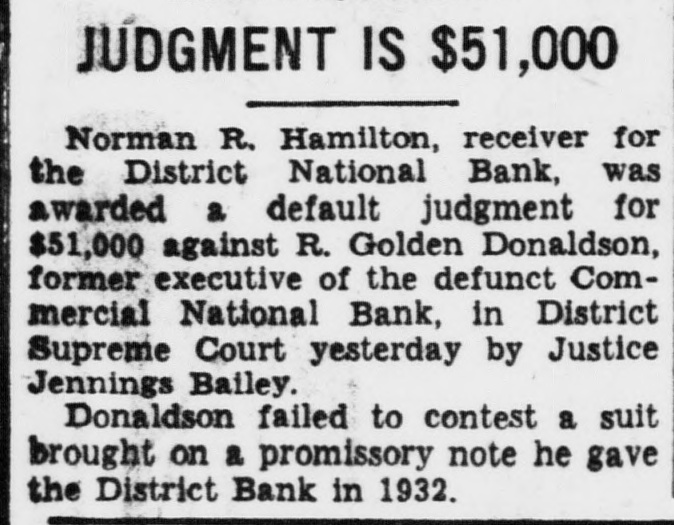
Bank Receiver Wins Judgment default judgment of against Golden Donaldson, former president of the Commercial National Bank, in favor of Norman Hamilton. receiver of the District National was granted yesterday in District Su preme Court by Justice Jennings Bailey. Donaldson failed to contest the which was based demand note made in the bank's favor for The tition cited that the banker had posted 330 shares of the closed Commercial Bank collateral.


Article from Evening Star, June 15, 1934

Click image to open full size in new tab

Article Text

JUDGMENT IS $51,000 Norman R. Hamilton, receiver for the District National Bank, was awarded a default judgment for $51,000 against R. Golden Donaldson, former executive of the defunct Commercial National Bank, in District Supreme Court yesterday by Justice Jennings Bailey. Donaldson failed to contest a suit brought on a promissory note he gave the District Bank in 1932.


Article from The Washington Times, July 20, 1934

Click image to open full size in new tab

Article Text

Creditors of Rheem To Receive $60,000 Approximately 1,400 creditors of Edmund D. Rheem, Washington real estate broker now serving a sentence at Lorton Reformatory, will receive about $60,000 when his bankrupt estate is closed a month from now, Norman R. Hamilton, receiver for the District National Bank, has announced.


Article Text

Dern Seeking Dismissal of District Bank Action A motion for dismissal of a suit by District National Bank stockholders against Treasury officials and War Secretary Dern, was filed in District Supreme Court today on behalf of Dern. The stockholders had asked for an accounting from Dern who, as trustee of the Philippine Island Gold Standard Fund. withdrew about $750,000 from the bank when it closed. Government attorneys contended that Dern cannot be rightfully sued by the stockholders and that if any action exists it must be brought by the bank's receiver.


Article Text

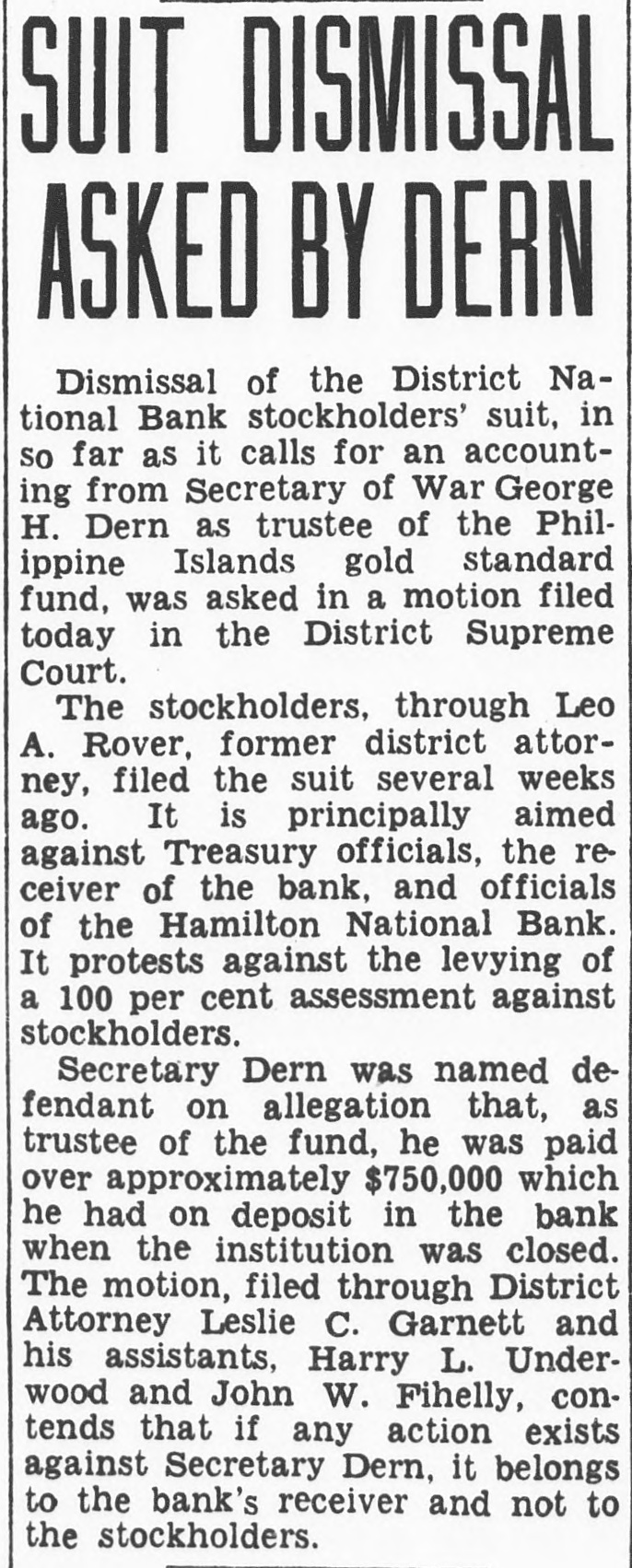
Dismissal of the District National Bank suit, far as calls for an accountfrom Secretary of War George Dern trustee of the Phil ippine Islands gold standard fund, was asked in motion filed today the District Supreme Court. The stockholders. through Leo Rover. former district attorfiled the suit several weeks ago. principally aimed against officials, the ceiver the bank. and the Hamilton National Bank protests against the levying of 100 per cent assessment against Secretary Dern was named fendant on allegation that, trustee of the fund. he was paid which had on deposit in the bank when the institution was closed. The motion, filed through District Attorney Leslie Garnett and assistants. Harry Under wood and John Fihelly, tends that any action exists against Secretary belongs the bank's receiver and not the stockholders.


Article from The Washington Times, August 31, 1934

Click image to open full size in new tab

Article Text

# SUIT DISMISSAL # ASKED BY DERN Dismissal of the District National Bank stockholders' suit, in so far as it calls for an accounting from Secretary of War George H. Dern as trustee of the Philippine Islands gold standard fund, was asked in a motion filed today in the District Supreme Court. The stockholders, through Leo A. Rover, former district attorney, filed the suit several weeks ago. It is principally aimed against Treasury officials, the receiver of the bank, and officials of the Hamilton National Bank. It protests against the levying of a 100 per cent assessment against stockholders. Secretary Dern was named defendant on allegation that, as trustee of the fund, he was paid over approximately $750,000 which he had on deposit in the bank when the institution was closed. The motion, filed through District Attorney Leslie C. Garnett and his assistants, Harry L. Underwood and John W. Fihelly, contends that if any action exists against Secretary Dern, it belongs to the bank's receiver and not to the stockholders.


Article from The Washington Times, September 11, 1934

Click image to open full size in new tab

Article Text

EARLY DIVIDEND BY C. BANK UNLIKELY By EUGENE A. KELLY Prospects for early payment of another dividend to depositors in the closed District National Bank are exceedingly gloomy, it was learned from official sources today. This prediction is based on the fact that the assets now held by the bank are only secondary. the prime assets having been taken over by the Hamilton National Bank. These secondary assets, while normally good, would be sold at a great loss if thrown on the market today. RFC Loans Blocked Furthermore, the receiver of the bank is not authorized to ask the Reconstruction Finance Corporation for additional loans on the assets he now holds because of a contract made with the Hamilton National Bank. This contract expires September 25. Under its terms the Hamilton National Bank can throw back any assets it has taken over and take others in their place. The defunct institution still owes the RFC approximately $600,000. This debt, it is believed, will be liquidated before additional relief is granted the depositors. Assessments Delayed While some relief is anticipated from the assessments levied against the stockholders, it was learned today that much of this money will be collected through court procedure, which means protracted legal battles and consequent delay in relief. The receiver of the District National Bank probably will ask for a reappraisal of the assets given as security for the loan from the RFC. If there are sufficient assets, the receiver will be cnabled also to ask for new loans.


Article from Evening Star, July 12, 1935

Click image to open full size in new tab

Article Text

Receiver's Collections Grow. Receiver Norman R. Hamilton reports that in the last three months $155,748 has been added in collections for the District National Bank. $50,000 has been added to the cash balance of the Potomac Savings Bank and $36,415 collected from amounts due the old Seventh Street Savings Bank.


Article from Evening Star, May 23, 1936

Click image to open full size in new tab

Article Text

SUPREME COURT RULING SOUGHT Robert N. Harper Asks Decision on Validity of Bank Stock Deal. By the Associated Press. The Supreme Court was asked yesterday to rule on the validity of the action of Robert N. Harper, former president of the District National Bank, and other officers of the bank in attempting to maintain the price of the bank's stock by buying and selling it on the Washing Stock Exchange. The ruling was requested by Harper in connection with his $17,600 suit against other former officers and directors of the bank, which failed to reopen after the 1933 banking one holiday. tion is Harper of national contended importance the queswhich should be settled by the Supreme Court. He explained that officers of the bank agreed in 1928 to "maintain a reasonable market price for the capital stock" by preventing dumping of large blocks of the bank's stock and that bank officials contributed $250 each to an account to be used in buying and selling of the stock. When additional funds were needed in 1932 for this account. Harper said he and Christian J. Gockeler obtained a $17,600 loan from the Commercial National Bank, putting up 90 shares of the District Bank stock and personal securities owned by Harper. When both banks closed, the Commercial receiver threatened sale, of Harper's securities and Harper brought suit to collect from his former associates. He appealed from a 3-to-2 decision by the Court of Appeals for the District of Columbia, in which the majority ruled the agreement was to fix "a fictitious price on the bank's stock" and that such a contract was not enforceable.


Article from The Washington Times, October 1, 1938

Click image to open full size in new tab

Article Text

Bank Property Sale Authorized Chief Justice Alfred A. Wheat in District Court yesterday authorized the sale of the District National Bank Building to the Syldon Properties, Inc., for $325,000. Sale of the property, of which Justus Wardel is receiver, will be effective October 14 unless any objections are filed.


Article from Evening Star, May 16, 1941

Click image to open full size in new tab

Article Text

Receiver of 3 Banks Moves His Office Justus S. Wardell, receiver for three closed banks, has moved his office from 1614 K street N.W. to 1429 I street N.W., he announced today. Mr. Wardell is winding up the receiverships of the District National Bank, which has paid 85 per cent to depositors; the Potomac Sav-


Article from Evening Star, July 14, 1941

Click image to open full size in new tab

Article Text

Signed.) JUSTUS S. WARDELL. Receiver. The District National Bank of Washington. D. C.


Article from Evening Star, November 29, 1942

Click image to open full size in new tab

Article Text

District National Bank Receivership Closed; $50,000 Unclaimed 2,000 Remaining Checks Are Turned Over to Controller of Currency Receivership of the District National Bank was closed yesterday and more than 2,000 uncalled-for checks were sent to the office of the Controller of the Currency at the Treasury Department. Justus S. Wardell, receiver, said