Merchants Bank (Atlanta, GA)

Episode Information

Episode UID
9653675291162
Episode Type
Run β†’ Suspension β†’ Closure
Bank Type
trust
Bank ID
965367529 hash
Start Date
October 6, 1896
Location
Atlanta, Georgia (33.749, -84.388)

Metadata

Model
gpt-5-mini (chosen from majority vote of a three-model LLM ensemble)
Short Digest
f4fda0ae2ca9a497

Response Measures

None

Description

Contemporary reports identify the institution as a state bank and describe an assignment/receivership after a run caused by a rumor.

Events (3)

1. October 6, 1896 Run
Cause
Rumor Or Misinformation
Cause Details
Rumor that Tax Collector A. P. Stewart (with $49,000 deposit) had been asked not to check out his funds, prompting heavy withdrawals.
Measures
None reported other than attempted withdrawals by depositors; crowd gathered at closed doors.
Newspaper Excerpt
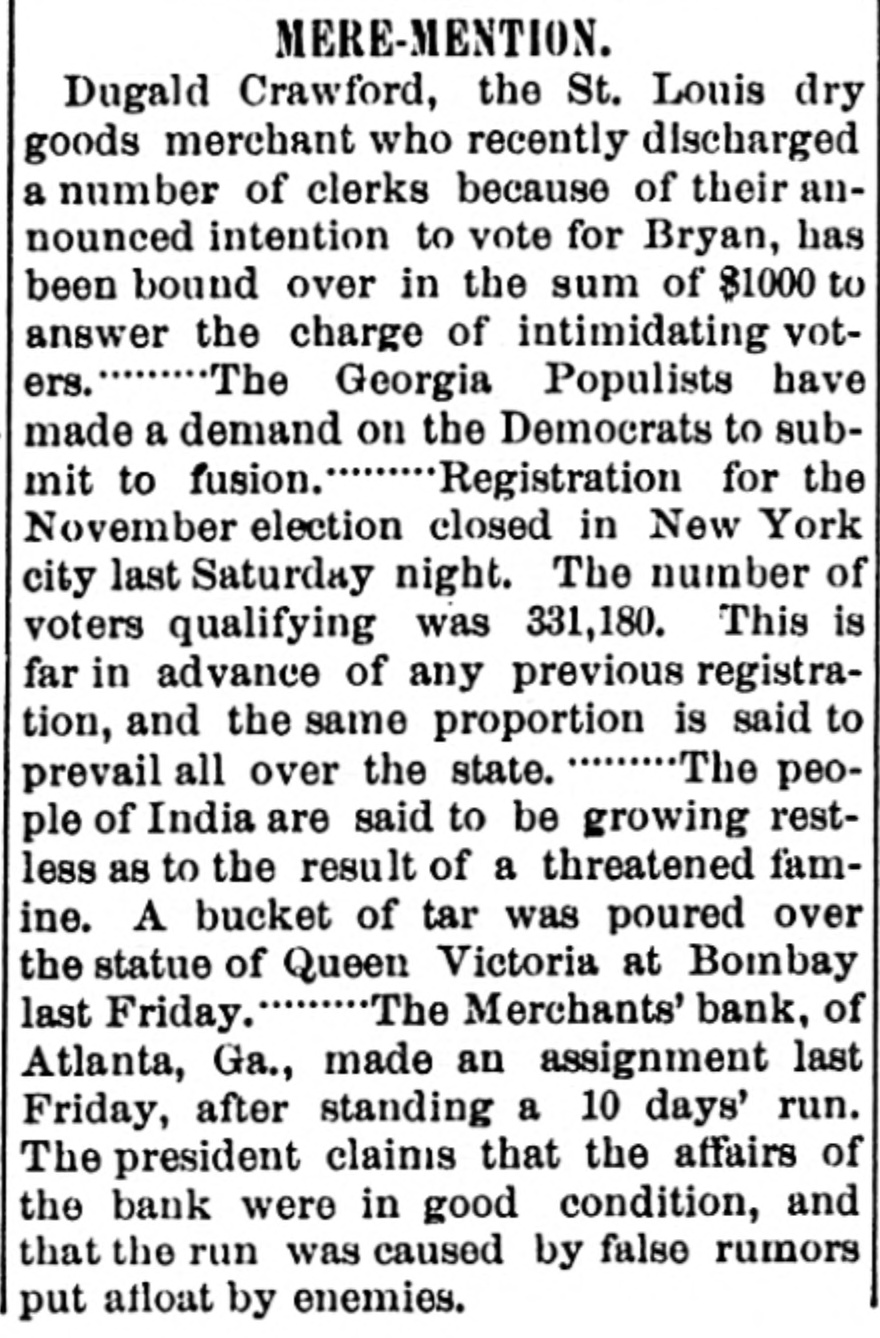
the Merchants' bank ... after standing a 10 days' run.
Source
newspapers
2. October 16, 1896 Receivership
Newspaper Excerpt
J. G. Oglesby and Geo. W. Scott are named assignees. The sum of $275,000 is due the depositors, but the bank claims that it will pay all depositors in full.
Source
newspapers
3. October 16, 1896 Suspension
Cause
Bank Specific Adverse Info
Cause Details
Assignment/closure followed heavy withdrawals caused by the rumor and the withdrawal of $49,000 by Tax Collector A. P. Stewart.
Newspaper Excerpt
The Merchants' bank ... closed its doors this morning, having made an assignment for the benefit of its creditors.
Source
newspapers

Newspaper Articles (20)

Article from Las Vegas Daily Optic, October 16, 1896

Click image to open full size in new tab

Article Text

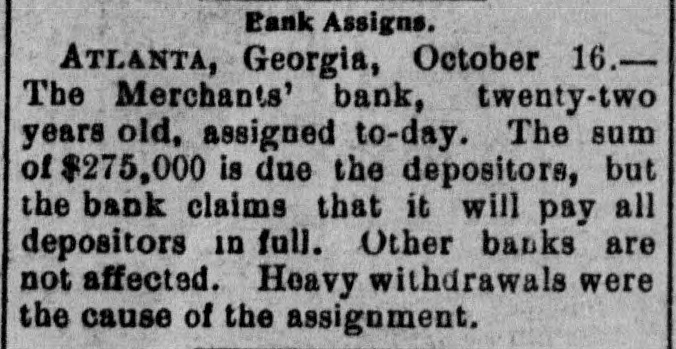
Bank Assigns. ATLANTA, Georgia, October 16.The Merchants' bank, twenty-two years old, assigned to-day. The sum of $275,000 is due the depositors, but the bank claims that it will pay all depositors in full. Other banks are not affected. Heavy withdrawals were the cause of the assignment.


Article from The Herald, October 17, 1896

Click image to open full size in new tab

Article Text

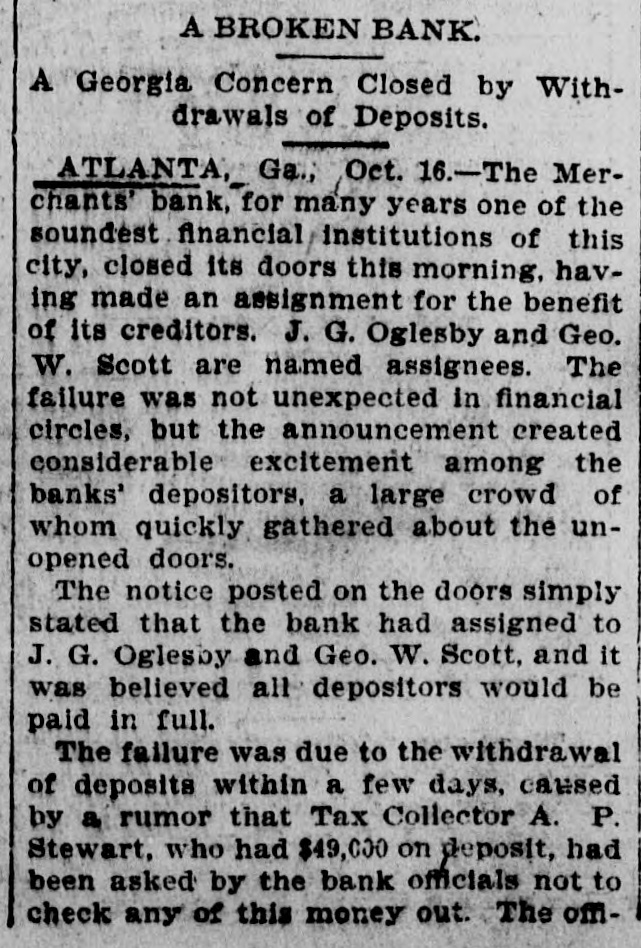
A BROKEN BANK. A Georgia Concern Closed by Withdrawals of Deposits. ATLANTA, Ga., Oct. 16.-The Merchants' bank, for many years one of the soundest financial institutions of this city, closed its doors this morning, having made an assignment for the benefit of its creditors. J. G. Oglesby and Geo. W. Scott are named assignees. The failure was not unexpected in financial circles, but the announcement created considerable excitement among the banks' depositors, a large crowd of whom quickly gathered about the unopened doors. The notice posted on the doors simply stated that the bank had assigned to J. G. Oglesby and Geo. W. Scott, and it was believed all depositors would be paid in full. The failure was due to the withdrawal of deposits within a few days, caused by a rumor that Tax Collector A. P. Stewart, who had $49,000 on deposit, had been asked by the bank officials not to check any of this money out. The off-


Article from The Roanoke Daily Times, October 17, 1896

Click image to open full size in new tab

Article Text

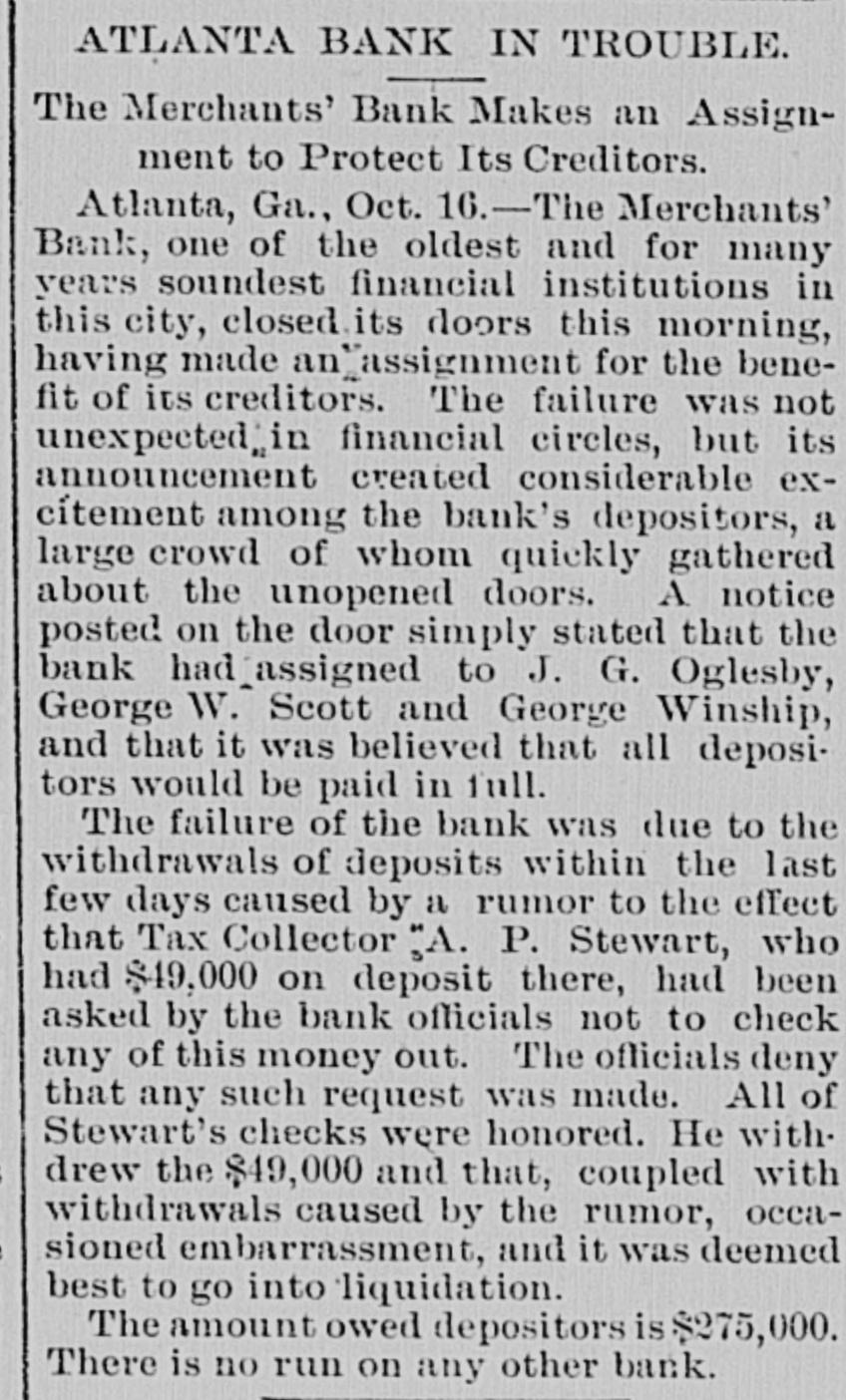
ATLANTA BANK IN TROUBLE. The Merchants' Bank Makes an Assignment to Protect Its Creditors. Atlanta, Ga., Oct. 16.-The Merchants' Bank, one of the oldest and for many years soundest financial institutions in this city, closed its doors this morning, having made an"assignment for the benefit of its creditors. The failure was not unexpectedjin financial circles, but its announcement created considerable excΓ­tement among the bank's depositors, a large crowd of whom quickly gathered about the unopened doors. A notice posted on the door simply stated that the bank had_assigned to J. G. Oglesby, George W. Scott and George Winship, and that it was believed that all depositors would be paid in full. The failure of the bank was due to the withdrawals of deposits within the last few days caused by a rumor to the effect that Tax Collector "A. P. Stewart, who had $49,000 on deposit there, had been asked by the bank officials not to check any of this money out. The officials deny that any such request was made. All of Stewart's checks were honored. He with. drew the $49,000 and that, coupled with withdrawals caused by the rumor, occasioned embarrassment, and it was deemed best to go into liquidation. The amount owed depositors is $275,000. There is no run on any other bank.


Article from The Indianapolis Journal, October 17, 1896

Click image to open full size in new tab

Article Text

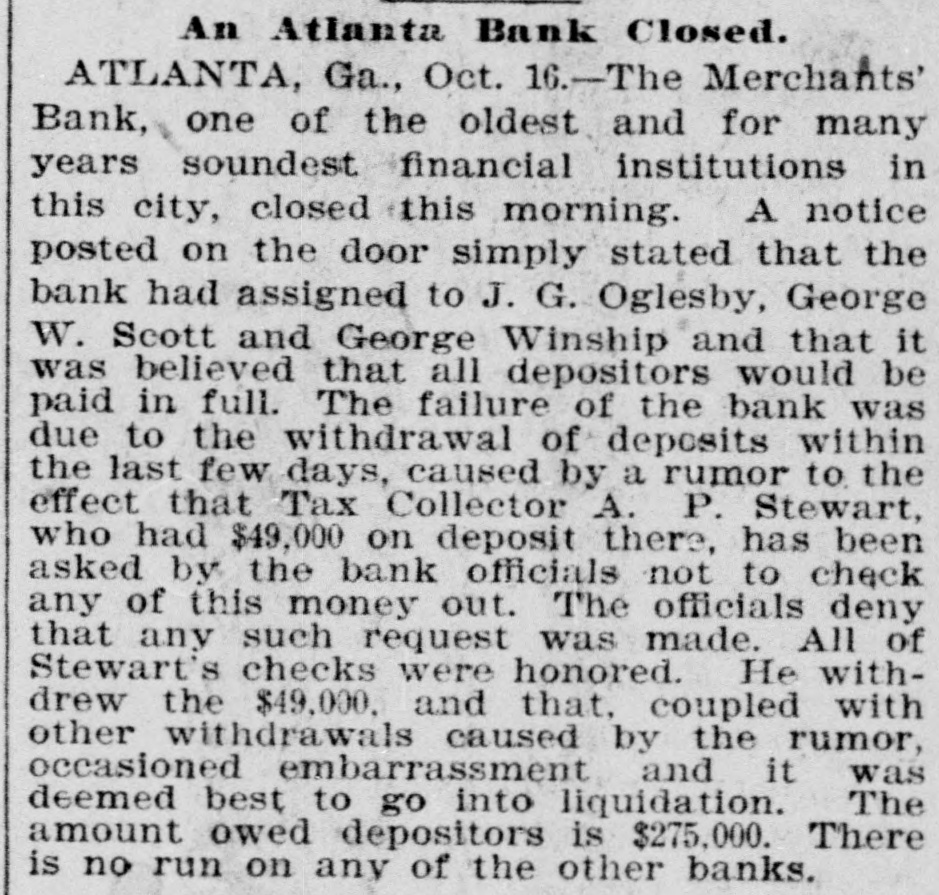
An Atlanta Bank Closed. ATLANTA, Ga., Oct. 16.-The Merchants' Bank, one of the oldest and for many years soundest financial institutions in this city, closed this morning. A notice posted on the door simply stated that the bank had assigned to J. G. Oglesby, George W. Scott and George Winship and that it was believed that all depositors would be paid in full. The failure of the bank was due to the withdrawal of deposits within the last few days, caused by a rumor to the effect that Tax Collector A. P. Stewart, who had $49,000 on deposit there, has been asked by the bank officials not to check any of this money out. The officials deny that any such request was made. All of Stewart's checks were honored. He withdrew the $49,000, and that, coupled with other withdrawals caused by the rumor, occasioned embarrassment and it was deemed best to go into liquidation. The amount owed depositors is $275,000. There is no run on any of the other banks.


Article from Omaha Daily Bee, October 17, 1896

Click image to open full size in new tab

Article Text

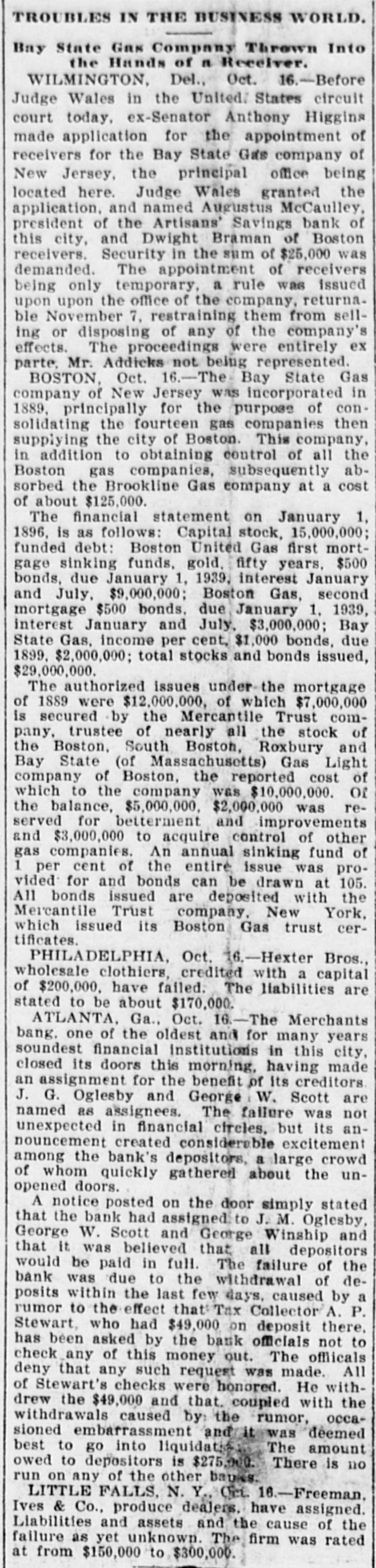
TROUBLES IN THE BUSINESS WORLD. Bay State Gas Company Thrown Into the Hands of n Receiver. WILMINGTON, Del., Oct. 16.-Before Judge Wales in the United. States circuit court today, ex-Senator Anthony Higgins made application for the appointment of receivers for the Bay State Gas company of New Jersey, the principal office being located here. Judge Wales granted the application, and named Augustus McCaulley, president of the Artisans' Savings bank of this city, and Dwight Braman of Boston receivers. Security in the sum of $25,000 was demanded. The appointment of receivers being only temporary, a rule was issued upon upon the office of the company, returnable November 7. restraining them from selling or disposing of any of the company's effects. The proceedings were entirely ex parte, Mr. Addicks not being represented. BOSTON, Oct. 16.-The Bay State Gas company of New Jersey was incorporated in 1889, principally for the purpose of consolidating the fourteen gas companies then supplying the city of Boston. This company, in addition to obtaining control of all the Boston gas companies, subsequently absorbed the Brookline Gas company at a cost of about $125,000. The financial statement on January 1, 1896, is as follows: Capital stock, 15,000,000; funded debt: Boston United Gas first mortgage sinking funds, gold, fifty years, $500 bonds, due January 1, 1939, interest January and July, $9,000,000; Boston Gas, second mortgage $500 bonds, due January 1, 1939, interest January and July, $3,000,000; Bay State Gas, income per cent, $1,000 bonds, due 1899, $2,000,000; total stocks and bonds issued, $29,000,000. The authorized issues under the mortgage of 1889 were $12,000,000, of which $7,000,000 is secured by the Mercantile Trust company, trustee of nearly all the stock of the Boston, South Boston, Roxbury and Bay State (of Massachusetts) Gas Light company of Boston, the reported cost of which to the company was $10,000,000. Of the balance, $5,000,000, $2,000,000 was reserved for betterment and improvements and $3,000,000 to acquire control of other gas companies. An annual sinking fund of 1 per cent of the entire issue was provided for and bonds can be drawn at 105. All bonds issued are deposited with the Mercantile Trust company, New York, which issued its Boston Gas trust certificates. PHILADELPHIA, Oct. 16.-Hexter Bros., wholesale clothiers, credited with a capital of $200,000. have failed. The liabilities are stated to be about $170,000. ATLANTA. Ga., Oct. 16.-The Merchants bang. one of the oldest and for many years soundest financial institutions in this city, closed its doors this morning, having made an assignment for the benefit of its creditors. J. G. Oglesby and George W. Scott are named as assignees. The failure was not unexpected in financial circles, but its announcement created considerable excitement among the bank's depositors, a large crowd of whom quickly gathered about the unopened doors. A notice posted on the door simply stated that the bank had assigned to J. M. Oglesby, George W. Scott and George Winship and that it was believed that all depositors would be paid in full. The failure of the bank was due to the withdrawal of deposits within the last few days, caused by a rumor to the effect that Tax Collector A. P. Stewart. who had $49,000 on deposit there. has been asked by the bank officials not to check any of this money out. The officals deny that any such request was made. All of Stewart's checks were honored. He withdrew the $49,000 and that. coupled with the withdrawals caused by: the rumor, occasioned embarrassment and it was deemed best to go into liquidatis The amount owed to depositors is $275,000. There is no run on any of the other banks. LITTLE FALLS, N. Y., One 16.-Freeman. Ives & Co., produce dealers, have assigned. Liabilities and assets and the cause of the failure as yet unknown. The firm was rated at from $150,000 to $300,000.


Article from San Antonio Daily Light, October 17, 1896

Click image to open full size in new tab

Article Text

FOREIGN AND DOMESTI LATEST OFF THE WIRES FRO OVER THE WORLD. A Complete Epitome of the Day's Happe ings, Briefed and Boiled Down, up to Time of Going to Press. The attempt of the Popocrat to pull Watson off the Populis ticket is not yet accomplished. Effort is still being made un successfully to have Watso withdraw, in the interests . Sewall. Butler is satisfied with Pop cratic and Populist fusion, in a but four states. Watson takes his name off th Popocratic fusion ticket in Kar sas, but it remains on the middl of the road ticket. Watson leaves it with Butle to make public his letter of a ceptance. Butler is in a hole. Watson is ready to receive th Populist committee at any time. Michigan Furniture factory Holland, destroyed by fire; los $300,000. Tennessee Pops and Popocrat are to consider fusion today. Merchants bank of Atlant: closes doors. Deposits $270,000 No statement given. Carlisle urged to address the wage-earners of Baltimore, by : deputation of workmen. but can not go. Palmer and Buckner have : great reception down in Mobile. Watson says that Butler should have had his letter in his hand by this time. Iowa and New York get the name "National Democracy" or the sound money ticket. Rev. D. A. McRae is electe moderator of the Texas Presby terian Synod sitting in Houston Typographical union assume complete control of machinist and linotype men in printing offices and only union men car work in union offices. Receiver asked for the Butt Bros. dry goods house at For Worth. John D. Flewellen assigns a .


Article from Twice-A-Week Plain Dealer, October 20, 1896

Click image to open full size in new tab

Article Text

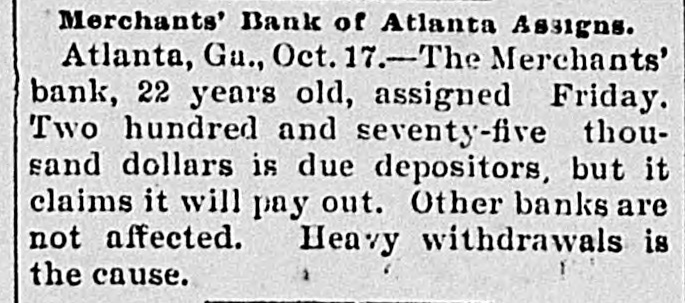
Merchants' Bank of Atlanta Assigns. Atlanta, Ga., Oct. 17.-The Merchants' bank, 22 years old, assigned Friday. Two hundred and seventy-five thousand dollars is due depositors, but it claims it will pay out. Other banks are not affected. Heavy withdrawals is the cause.


Article from The Daily Herald, October 20, 1896

Click image to open full size in new tab

Article Text

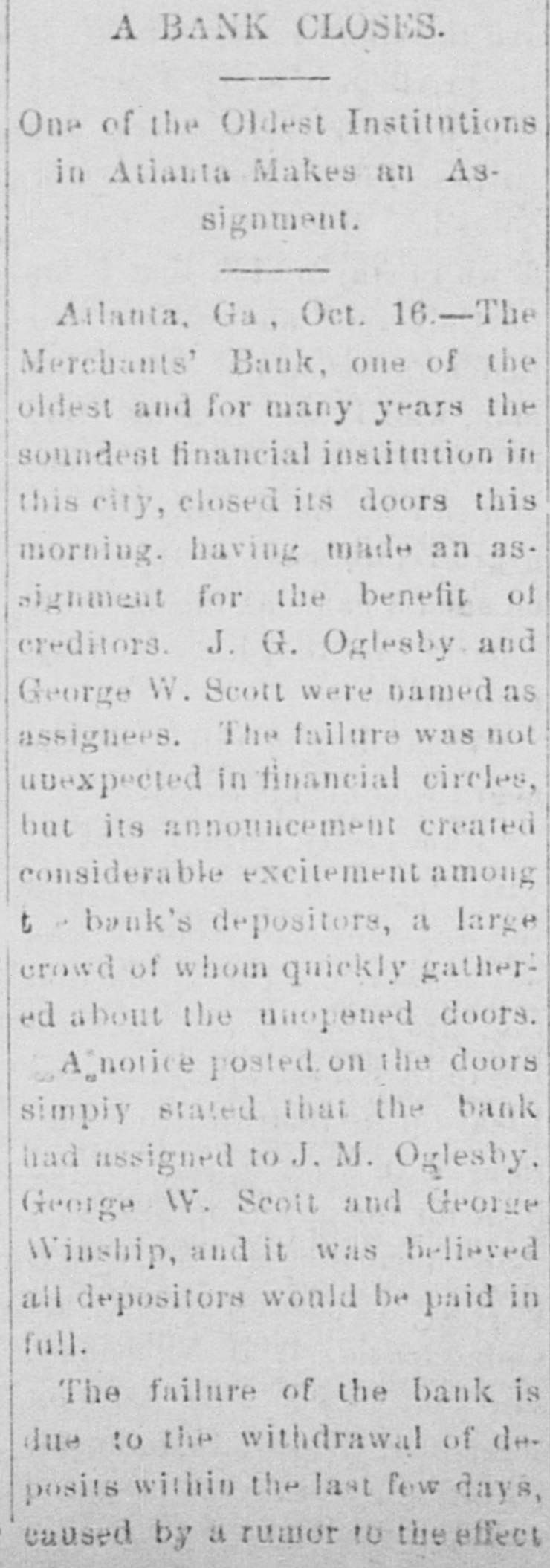
A BANK CLOSES. One of the Oldest Institutions in Atlanta Makes an Assignment. Ailanta, Ga, Oct. 16.-The Merchants' Bank, one of the oldest and for many years the soundest financial institution in this city, closed its doors this morning. having made an as. signment for the benefit of creditors. J. G. Oglesby and George W. Scott were named as assignees. The failure was not unexpected in financial circles, but its announcement created considerable excitement among t - bank's depositors, a large crowd of whom quickly gathered about the unopened doors. A.notice posted. on the doors simply stated that the bank had assigned to J. M. Oglesby, George W. Scott and George Winship, and it was believed all depositors would be paid in full. The failure of the bank is due to the withdrawal of deposits within the last few days, caused by a rumor 10 the effect


Article from Yorkville Enquirer, October 21, 1896

Click image to open full size in new tab

Article Text

MERE-MENTION. Dugald Crawford, the St. Louis dry goods merchant who recently discharged a number of clerks because of their announced intention to vote for Bryan, has been bound over in the sum of $1000 to answer the charge of intimidating voters. The Georgia Populists have made a demand on the Democrats to submit to fusion. Registration for the November election closed in New York city last Saturday night. The number of voters qualifying was 331,180. This is far in advance of any previous registration, and the same proportion is said to The peoprevail all over the state. ple of India are said to be growing restless as to the result of a threatened famine. A bucket of tar was poured over the statue of Queen Victoria at Bombay The Merchants' bank, of last Friday. Atlanta, Ga., made an assignment last Friday, after standing a 10 days' run. The president claims that the affairs of the bank were in good condition, and that the run was caused by false rumors put afloat by enemies.


Article from The Weiser Signal, October 22, 1896

Click image to open full size in new tab

Article Text

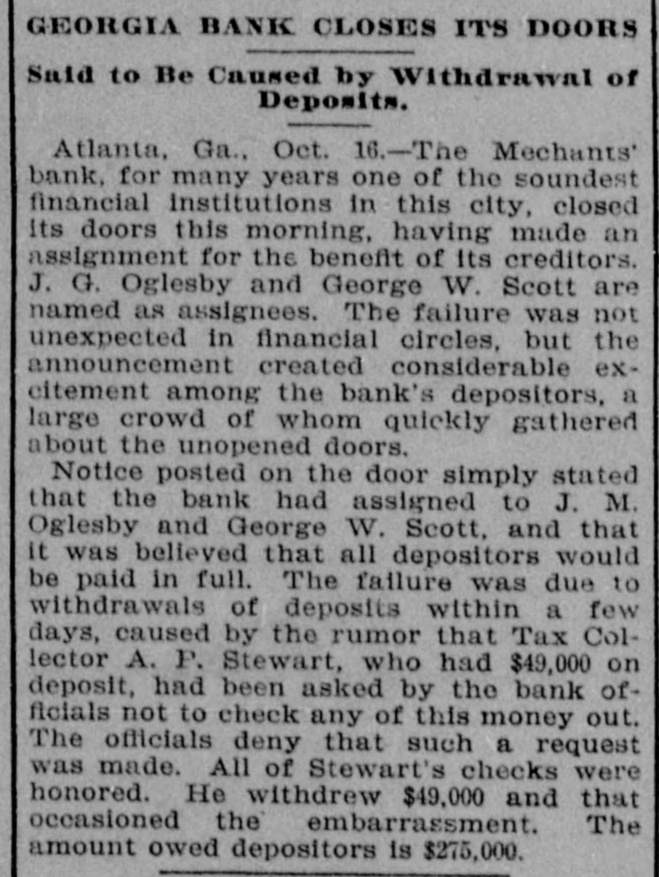
GEORGIA BANK CLOSES ITS DOORS Said to Be Caused by Withdrawal of Deposits. Atlanta, Ga., Oct. 16.-The Mechants' bank, for many years one of the soundest financial institutions in this city, closed Its doors this morning, having made an assignment for the benefit of Its creditors. J. G. Oglesby and George W. Scott are named as assignees. The failure was not unexpected in financial circles, but the announcement created considerable excitement among the bank's depositors, a large crowd of whom quickly gathered about the unopened doors. Notice posted on the door simply stated that the bank had assigned to J. M. Oglesby and George W. Scott, and that it was believed that all depositors would be paid in full. The failure was due to withdrawals of deposits within a few days, caused by the rumor that Tax Collector A. P. Stewart, who had $49,000 on deposit, had been asked by the bank officials not to check any of this money out. The officials deny that such a request was made. All of Stewart's checks were honored. He withdrew $49,000 and that occasioned the embarrassment. The amount owed depositors is $275,000.


Article from The Red Cloud Chief, October 23, 1896

Click image to open full size in new tab

Article Text

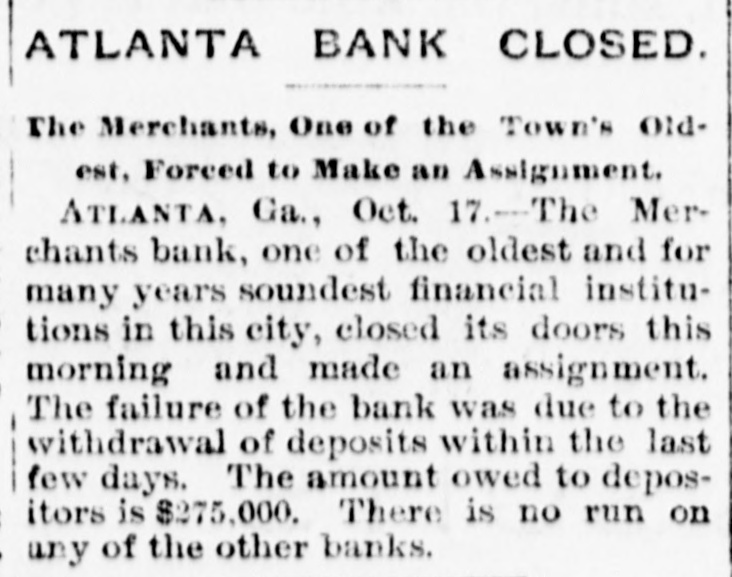
ATLANTA BANK CLOSED. The Merchants, One of the Town's Oldest, Forced to Make an Assignment. ATLANTA, Ga., Oct. 17.-The Merchants bank, one of the oldest and for many years soundest financial institutions in this city, closed its doors this morning and made an assignment. The failure of the bank was due to the withdrawal of deposits within the last few days. The amount owed to depositors is $275,000. There is no run on any of the other banks.


Article from Cottonwood Report, October 23, 1896

Click image to open full size in new tab

Article Text

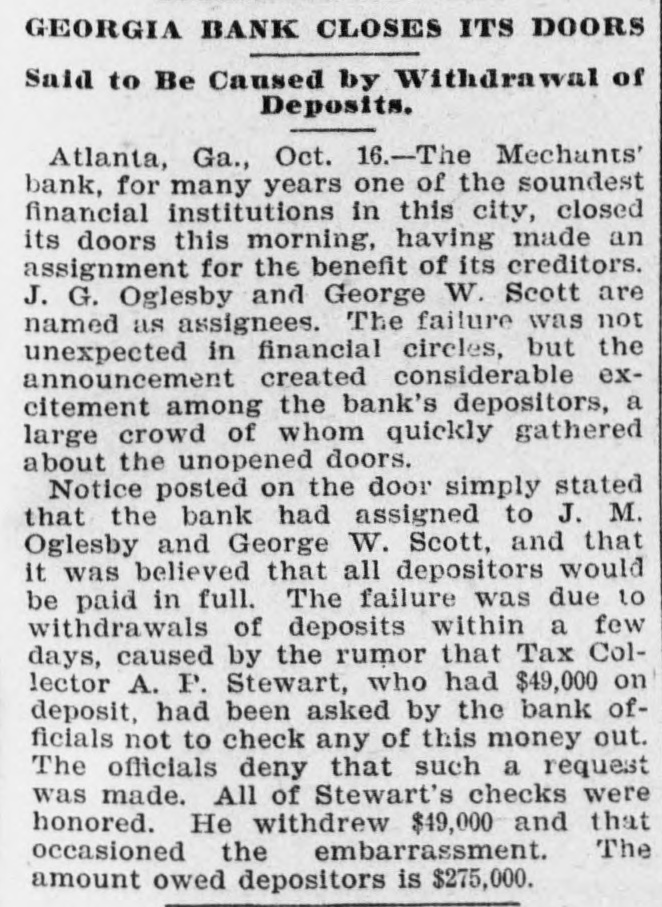
GEORGIA BANK CLOSES ITS DOORS Said to Be Caused by Withdrawal of Deposits. Atlanta, Ga., Oct. 16.-The Mechants' bank, for many years one of the soundest financial institutions in this city, closed its doors this morning, having made an assignment for the benefit of its creditors. J. G. Oglesby and George W. Scott are named as assignees. The failure was not unexpected in financial circles, but the announcement created considerable excitement among the bank's depositors, a large crowd of whom quickly gathered about the unopened doors. Notice posted on the door simply stated that the bank had assigned to J. M. Oglesby and George W. Scott, and that it was believed that all depositors would be paid in full. The failure was due to withdrawals of deposits within a few days, caused by the rumor that Tax Collector A. P. Stewart, who had $49,000 on deposit, had been asked by the bank officials not to check any of this money out. The officials deny that such a request was made. All of Stewart's checks were honored. He withdrew $49,000 and that occasioned the embarrassment. The amount owed depositors is $275,000.


Article from The Universalist, October 24, 1896

Click image to open full size in new tab

Article Text

TWENTY years have past since the wheat market has seen any such activity. Europeans have been accustomed to wait for war times before expecting such market excitement as seen in Liverpool yesterday. Their uniform cablegrams to Chicago agents were: "Wheat ex cited and 5d higher." On the continent the excitement was still greater. Paris and Antwerp felt the tremendous bulge of Saturday in the Berlin market. Berlin, which set the pace Saturday, advanced 31/2 cents yesterday. On the Pacific coast the net gain for the day was but 5 cents per cental, although at one time it was 8 cents. New York's opening gain was 5 cents, and of this it re. tained 3 cents until the close. December wheat in Chicago waswithin one-fourth of a cent of 80 cents at 11 o'clock Monday morning. This was the highwater mark of the day. Two years ago on October 19, December wheat sold at closing at 60% cents. The closing price was 77%, or 17 cents higher than two years ago. The biggest bear on the market could not take cheer out of that comparison, especially since the foreign demand continues strong and without a sign of letting up. The advance was not checked by the posted figures showing an increase in the visible supply of 2,500,000 bushels, making a grand total in sight of 55,000,000. Europe wanted wheat-wants it still-and that badly. America has the grain. Chicago is the great distributing point. No one better explains the situation or makes it more plain why the eyes of the whole world are now turned to the wheat stores of America than John Hyde, expert special agent of the eleventh census, in his statement: "It is worthy of note that in 1867 and 1868 the failure of crops in Great Britain, which the United States was unable to make good out of its own surplus, caused an advance in price of no less than 42 cents a bushel. Wheat during the last ninety days, owing to deficient harvests in other countries, has advanced from 64 cents to 78 cents per bushel." THE Bay State Gas Company was last week placed in the hands of receivers by the United States Court at Wilmington, Delaware, on the application of William Buchanan, a New York stockholder. A rule was issued upon the officers of the company, returnable, No_ vember 7, restraining them from disposing of any of the company's effects. The Merchants' Bank of Atlanta, Georgia, closed its doors. It is said the failure was "due to a persistent fight made by outsiders on President J. H. Porter." The President says that depositors will get every dollar back. The Willimantic, Conn, Savings Institute suspended payment of deposits yester. day requiring the four months' notice allowed by law. This action was determined upon by the directors owing to recent heavy withdrawals and in order to prevent the sacrifice of the bank's securities. Freman Ives & Co., produce dealers of Little Falls, New York, have assigned. The firm's capital was rated at from $150,000 to $300,000. The assets and liabilities are unknown. A Houghton, Michigan, despatch says that the Sturgeon River Lumber Company, the largest and oldest lumbering concern in the copper district, is in financial difficulties. A DISPATCH on Friday from Juneau,


Article from The Abbeville Press and Banner, November 4, 1896

Click image to open full size in new tab

Article Text

Domestic. Wheat fell in American markets owing to sales of long stock, but the foreign demand was not lessened. Bradstreet's, too, announced 5,000,000 bushels increase in the world's visible stock. W. T. Rambusch, the absconding banker from Juneau, Wis., committed suicide in the National Cemetery at Fredericksburg, Va. A farmer named Buttks, who has a large income from oil leases, was murdered on his farm, about seventeen miles south of Toledo, Ohio, by robbers, and his wife seriously injured. The robbers obtained little booty. The total registration of Chicago is 383,515, an increase of 36,000 over 1894. Mr. Bryan spoke in twenty Indiana towns in one day. At Muncie gold men and silver men armed with clubs nearly had a collision. Dr. W. H. Gidding, Superintendent of the Vermont State Insane Asylum, was arrested, charged with maltreating female patients. Illinois Day was observed in Canton, Ohio, and Major McKinley received more than 9000 visitors. There was a great parade of horsemen. Mr. McKinley made seven speeches. Two men were killed and three injured while working on repairs to the University of Virginia building at Charlottesville, Va. A battle which occurred at Belle Ellen mines, Bibb County. Alabama, between white and colored miners, resulted in the death of two men and the wounding of two others. Major McKinley addressed at Canton, Ohio, delegations from Sewickley, Penn., and Summit County, Ohio. W. J. Bryan made a journey from Detroit to Zanesville, Ohio, making speeches at way stations. The town of Enfield, Mass., was visited by a fire which wiped out the whole business part. The fire started in a bakery, presumably from an overheated oven. Richard Sandow, three years old, living at Landisville, N. J., was accidentaily shot and instantly killed at his home. Sandow's brother picked up a shotgun to examine it and it was accidentally discharged. The boy stood looking at it and the full charge entered his breast. Harman Calaman shot and killed David Pearl and seriously wounded John Beidelman at Pond Bank, Penn. Pearl and Beidelman were drunk and had raised a disturbance at a neighboring church. The sixteen-year-old son of John Swan, a carpenter, of Belleville, N. J., who sought in vain to get work, died of starvation. Mustapha Bey, the new Turkish Minister to the United States, arrived at New York. W. T. Rambusch, banker and real estate dealer, disappeared from Juneau, Wis., defaulting to the extent of $250,000. At Suffolk. Va, Merritt Briggs, one of Eastern Virginia's leading criminal lawyers, died while pleading do case in the Circuit Court room. Owing to the fact that the drought damaged to a considerable extent the wheat crop of Mexico, and that the Mexican Government has removed the duty on grain for a period of several months, Kansas grain is now on the move into Mexico. The Bank of Commerce, Buffalo, N. Y., closed its doors. Colonel Spillman, aclub man. of Connectieut, was garroted and robbed by women in front of the Union League Club of Chicago. While the United States battleship Indiana was on her way from Hampton Roads to the Port of New York all of her eight-inch turrets broke from their gearing at once, seriously menacing the safety of the ship. The sum of $800,000 in gold coin was withdrawn from the Sub-Treasury, New York City. and deposited in the Chase National Bank. The Second National Bank, the oldes financial institution of Rockford, III., has gone into voluntary liquidation. The result is due to a steady shrinkage of deposits since July 1. Two freight trains on the Northeastern Road came into collision fifty-three miles from New Orleans, La. Both engines were wrecked and the cars were burned. The killed were Engineer Fulcher and Fireman Alexander (colored), of the north-bound train. Thomas E. Watson mailed from Thomson, Ga., his letter of acceptance of the Populist nomination for Vice-President to Senator Marion Butler at Chicago. The Merchants' Bank, Atlanta, Ga., has closed. The bank is a State institution, with B. paid-up capital of $200,000; surplus, $25,000: deposits, $555,000; loans and discounts, $430,000. Mrs. Janet Finley Weir Little, of Huntington, N. J., has surprised that community by marrying her farm hand, named Drake. Temporary receivers were appointed by the United States Court at Wilmington, Del., for the Bay State Gas Company, of which J. Edward Addicks is President, and former Senator Higgins, as counsel for Willlam Buchanan, the complainant, forcibly opened the office desk. There was great excitment in the wheat pit. New York City. and prices advanced two cents, touching 81% cents a bushel. Adolphus Coles, the banker who disappeared from New York in 1894, leaving depositors to whom he owed half a million dollars, has been arrested in Philadelphia. Foreign Notes. Li Hung Chang has arrived at Pekin, China, and will shortly present his report to the Emperor. The Ecuador Government has submitted to the Convention a scheme for a return to the gold standard. A despatch from Paris announces that the wedding of the Marquis des Monstiers-
Article from The Morning News, November 21, 1896

Click image to open full size in new tab

Article Text

A BANK SEEKS A COMPROMISE. DEPOSITORS OFFERED NOTES IN PAYMENT. Stockholders and Directors Come Forward With 885,000 to Make the Proposition Possible-Rumors That Certain Depositors Were on the Point of Beginning Proceedings on the Criminal Side of the Court. Atlanta, Ga., Nov. 20.-The receivers of the 'Merchants' Bank this afternoon announced a proposition for the payment of the depositors. Since the failure of the bank, a month ago, the receivers have been hard at work on the assets. They found that there was not enough available to meet all of the depositors at once. but in order to insure the final payment of all, dollar for dollar, an arrangement was made with certain stockholders and directors of the bank by which the latter agreed to put up additional money and give indorsements amounting to approximately $100,000 for the purpose of effecting a settlement. Under the proposition made by the receivers to the depositors, the latter are to receive their money in installments, receivers' certificates to be issued for the deferred payments, and these certificates to bear 4 per cent. interest from the date of the failure of the bank. The proposition is to pay the depositors 20 per cent. in December next, 20 per cent. May 1, 1897, 10 per cent. Aug. 1, 1897, 10 per cent. Nov. 1, 1897, 20 per cent. Feb. 1, 1898, and 20 per cent. May 1, 1898. Those who put in the additional money and made possible this proposition are President Porter, who comes forward with $35,000; Vice President Wiley, $10,000; T. L. Langston, $10,000; George Winship, $10,000; A. D. Adair, $10,000, and J. C. Veach, $10,000. The proposition will have to be accepted by all the depositors before it goes into effect. The receivers believe that it will be accepted. The only condition attached to it is that all suits brought by the creditors be withdrawn. Under this head it is said that some sensational developments were about to be made when the offer for settlement came to-day. It is said that criminal prosecution was about to be instituted against the officers of the bank by certain depositors. It is known that preliminary steps in this direction were taken and it may be that this had an important bearing on the putting up of the extra assets by which the bank was enabled to make the proposition for a settlement.


Article from The Morning News, December 13, 1896

Click image to open full size in new tab

Article Text

ATLANTA'S DEFUNCT BANK. Creditors to Be Paid 30 Per Cent. on Next Tuesday. Atlanta, Ga., Dec. 12.-The receivers of the Merchants Bank announce that they will pay 30 per cent to creditors on next Tuesday. This will be the first payment. The receivers say that the bank will pay every dollar it owes in time.


Article from The Morning News, January 27, 1897

Click image to open full size in new tab

Article Text

IN GEORGIA AND FLORIDA. NEWS OF THE TWO STATES TOLD IN PARAGRAPHS. GEORGIA. A deal is now on foot which, if it proves successful, will take the Barnesville knitting mills to Atlanta. A colored woman of Atlanta named Lillie Williams has lost her mind through the excessive use of snuff, which she chewed. Dublin correspondence Morning News: Dublin continues to grow. New dwellings are being built on every hand. L. C. Beacham is having a two-story building built in West End. The Pritchett Grocery Company is having the lumber put on the ground for the construction of a building for their bookkeeper. M. E. Land of Abbeville has been appointed temporary receiver of the business of H. L. Manne & Co., who sold and transferred their large stock of dry goods and groceries to preferred creditors on Jan. 20. Judge Littlejohn granted an injunction and appointed the receiver in response to a plea by unsatisfied creditors. At Carrollton Sunday afternoon the prisoners confined in the county jail made a desperate effort to escape, two of them succeeding in getting about a mile from the town before being recaptured. There was no one about the jail at the time of the attempt and the prisoners had several minutes the start. They were run down by dogs. The Security Mutual Life Insurance Company of Atlanta is going out of business. The reasons given for the retirement of the company are that more money is necessary for the company to transact a large business, and that the time required for a southern company to build up a business equaling the established old line companies is too long for the promoters to wait. The body of a white man was found Monday near the railroad track at Melrose. The clothing was badly torn and one shoe was found ten or twelve feet from the body. It is believed that he was killed by the north-bound passenger train Sunday night. The dead man was a turpentine hand and came to Georgia a short time since in company with another white man. His name has not been learned. John Faulk, with several other names, according to the charges preferred by Ginn & Co., of Atlanta, on whose complaint he was arrested, is behind the bars in Floyd county jail, charged with cheating and swindling. He reached Rome about the first of the month and secured a school and began teaching in the country. He represented the book firm of Ginn & Co., it is claimed, and he was arrested by order of Manager Robertson of the firm. Mrs. Sessions, wife of Judge W. M. Sessions, died at Marietta Friday morning. The Southern Age wants the negroes of Atlanta to organize a cotton factory company, with $25,000 of stock. The enterprise is intended to be an ocular demonstration of the fact that negro labor is competent to do the work in cotton mills. It has been contended that negroes are not fit for this business, even after training, and the negroes propose to show that this is not true. For twenty-five years George Huntsingle of Lumpkin county has served in the capacity of inspector for the Yahoola Hydraulic Company. His duty has been to daily inspect the supply pipe from the Yahoola river to the gold fields, a distance of twenty-five miles. For twenty-five years, in all sorts and conditions of weather, Huntsinger has walked the length of this pipe one day and back again the next. When he recently gave up the job on account of failing health he calculated that he had covered -a distance of 35,550 miles on foot. Shortly after a Sam Jones' meeting at Columbus last fall it was announced that a prohibition election would be called in Muscogee county, and a petition, asking that the election be ordered, was circulated and received several hundred signatures. It was the original intention to hold the election at the first of this year, but it now appears that it will not be called in several months yet, hardly before next fall. This postponement is due to the uncertainty and confusion existing regarding the meaning and provisions of the present registration law. Lawrenceville News: On Jan. 14, 1880, the firm of Brown Bros., at Gainesville, in rectifying an error, sent W. L. Vaughan, of Lawrenceville, a check for $10 on the Merchants' Bank of Atlanta. Mr. Vaughan received the check and carelessly laid it aside, when it got mixed with a lot of old papers. Last Sunday Mr. Vaughan was looking through these old papers when he came across the check, which had never been cashed. He had, of course, neglected to send it in for collection. The Merchants' Bank of Atlanta suspended a few months ago, so Mr. Vaughan will probably lose his money.


Article from The Morning News, January 14, 1898

Click image to open full size in new tab

Article Text

BANK BUILDING SOLD. It Brings $21,380 While the Receivers Expected to Get $30,000. Atlanta, Ga., Jan. 13.-The building of the defunct Merchants' Bank on Alabama street, between Whitehall and Pryor, was sold at auction this morning, and was purchased by L. F. Blalock of Jonesboro, for $21,380.50. The price paid was $710 per front foot on Alabama street, the building having a frontage of 30 feet and 6 inches, It was an old two-story structure with a new marble front. The receivers of the bank regarded the price so poor that they decliend to sell other property of the defunct bank which had been advertised. They thought the bank was worth $1,000 a foot.


Article from The Morning News, January 20, 1898

Click image to open full size in new tab

Article Text

SALE OF BANK BUILDING STANDS. It Brought Only $21,000 When at Least $30,000 Was Expected. Atlanta, Ga., Jan. 19.-Judge J. H. Lumpkin to-day confirmed the recent sale of the Merchants' Bank building on Alabama street, despite the efforts to prevent it, because of the low price bid. The building is in the heart of the business district on Alabama street, It brought only $21,000, while the receiver thought it should fetch $30,000 at the lowest.


Article from The Morning News, February 2, 1898

Click image to open full size in new tab

Article Text

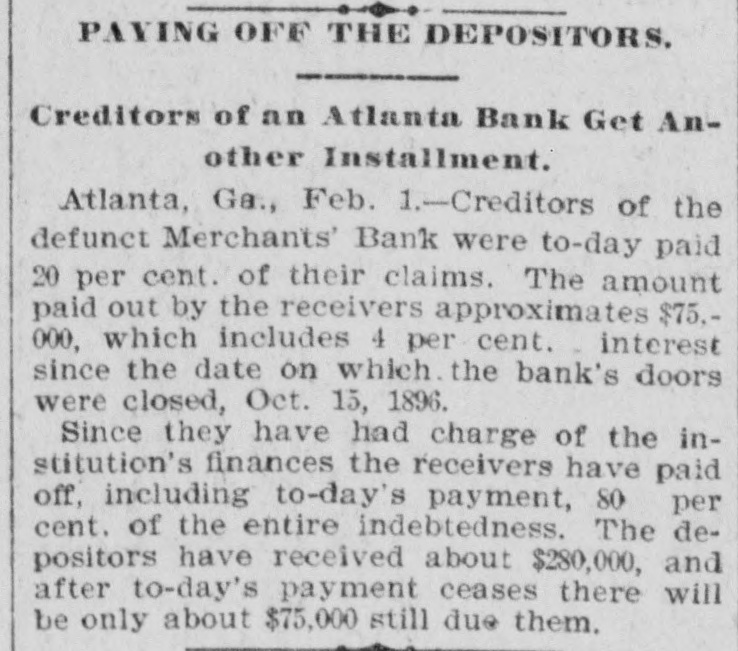
PAYING OFF THE DEPOSITORS. Creditors of an Atlanta Bank Get Another Installment. Atlanta, Ga., Feb. 1.-Creditors of the defunct Merchants' Bank were to-day paid 20 per cent. of their claims. The amount paid out by the receivers approximates $75.000, which includes 4 per cent. interest since the date on which. the bank's doors were closed, Oct. 15, 1896. Since they have had charge of the institution's finances the receivers have paid off, including to-day's payment, 80 per cent. of the entire indebtedness. The depositors have received about $280,000, and after to-day's payment ceases there will be only about $75,000 still due them.