Bank of Lyons (Lyons, NY)

Episode Information

Episode UID
9730830390513
Episode Type
Suspension → Closure
Bank Type
state
Bank ID
973083039 hash
Start Date
September 16, 1842
Location
Lyons, New York (43.064, -76.990)

Metadata

Model
gpt-5-mini (chosen from majority vote of a three-model LLM ensemble)
Short Digest
79d367b47c77d15a

Response Measures

None

Description

Bank was enjoined by the Vice Chancellor and later placed in liquidation with a receiver.

Events (3)

1. September 16, 1842 Suspension
Cause
Government Action
Cause Details
Enjoined by the Vice Chancellor on application of the Bank Commissioners (injunction preventing payments/operations).
Newspaper Excerpt
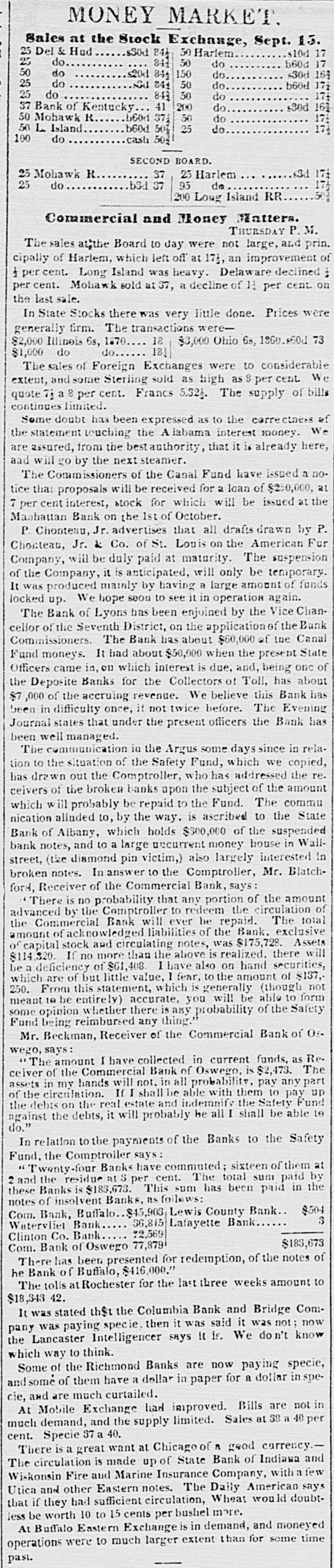
The Bank of Lyons has been enjoined by the Vice Chancellor of the Seventh District, on the application of the Bank Commissioners.
Source
newspapers
2. December 21, 1842 Receivership
Newspaper Excerpt
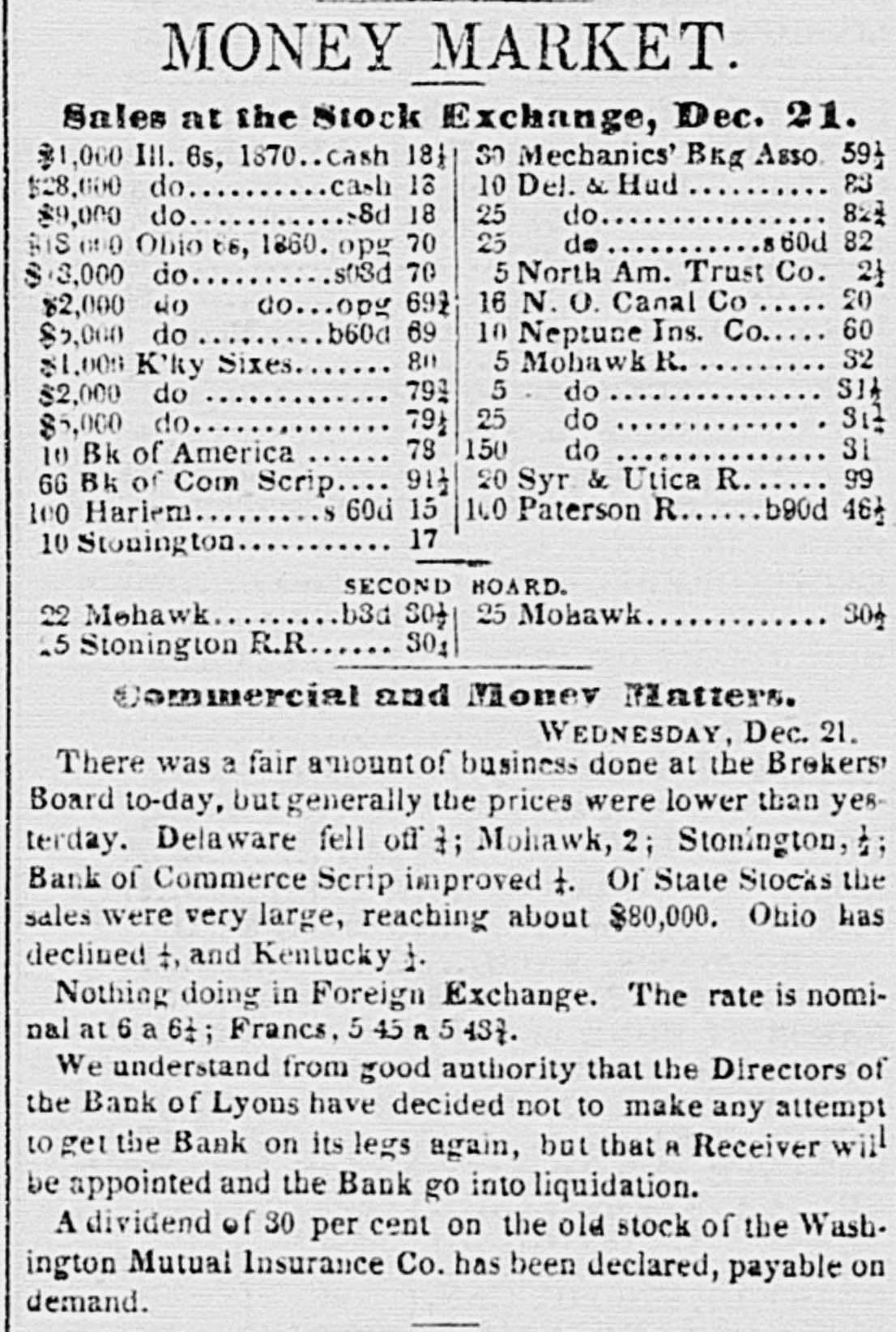
We understand from good authority that the Directors of the Bank of Lyons have decided not to make any attempt to get the Bank on its legs again, but that a Receiver will be appointed and the Bank go into liquidation.
Source
newspapers
3. June 6, 1845 Other
Newspaper Excerpt
COMPTROLLER ... hereby gives notice, that he will redeem at par, the outstanding circulating bills of ... the Bank of Lyons.
Source
newspapers

Newspaper Articles (13)

Article from New-York Daily Tribune, September 16, 1842

Click image to open full size in new tab

Article Text

# MONEY MARKET, Sales at the Stock Exchange, Sept. 15. 25 Del & Hud. 530d 241 50 Harlem... ...sl0d 17 25 do.. 841 50 do b60d 17 50 do s20d 84 150 do. $30d 164 25 do .. 844 50 do b60d 171 25 do 843 50 do 174 37 Bank of Kentucky... 41 200 do. $300 164 50 Mohawk R.b60d 37 50 do 174 50 L. Island, .b60d 504 25 do. 174 100 do ..caslı 50% SECOND BOARD. 25 Mohawk R.. 37 25 Harlem .s3d 17 25 do .b3d 37 95 de 174 200 Long Island RR.50 # Commercial and Money Matters. THURSDAY P. M. The sales at the Board to day were not large, and prin- cipally of Harlem, which left off at 171, an improvement of per cent. Long Island was heavy. Delaware declined per cent. Mohawk sold at 37, a decline of 14 per cent. on the last sale. In State Stocks there was very little done. Prices were generally firm. The transactions were- $2,000 Illinois 6s, 1870.... 18 $3,000 Ohio 6s, 1860.660d 73 $1,000 do do. 18 The sales of Foreign Exchanges were to considerable extent, and some Sterling sold as high as 8 per cent. We quote 7 a 8 per cent. Francs 5.321. The supply of bills continues limited. Some doubt has been expressed as to the correctness of the statement touching the A labama interest money. We are assured, from the best authority, that it is already here, aad will go by the next steamer. The Commissioners of the Canal Fund have issued a no- tice that proposals will be received for a loan of $250,000, at 7 per cent interest, stock for which will be issued at the Manhattan Bank on the 1st of October. P. Chonteau, Jr. advertises that all drafts drawn by P. Chonteau, Jr. & Co. of St. Louis on the American Fur Company, will be duly paid at maturity. The suspension of the Company, it is anticipated, will only be temporary. It was produced mainly by having a large amount of funds locked up. We hope seon to see it in operation again. The Bank of Lyons has been enjoined by the Vice Chan- cellor of the Seventh District, on the application of the Bank Commissioners. The Bank has about $60,000 of the Canal Fund moneys. It had about $50,000 when the present State Officers came in, on which interest is due, and, being one of the Deposite Banks for the Collectors of Toll, has about $7,000 of the accruing revenue. We believe this Bank has been in difficulty once, it not twice before. The Evening Journal states that under the present officers the Bank has been well managed. The communication in the Argus some days since in rela- tion to the situation of the Safety Fund, which we copied, has drawn out the Comptroller, who has addressed the re- ceivers of the broken banks upon the subject of the amount which will probably be repaid to the Fund. The commu- nication alluded to, by the way, is ascribed to the State Bank of Albany, which holds $300,000 of the suspended bank notes, and to a large uncurrent money house in Wall- street, (the diamond pin victim,) also largely interested in broken notes. In answer to the Comptroller, Mr. Blatch- ford, Receiver of the Commercial Bank, says: There is no probability that any portion of the amount advanced by the Comptroller to redeem the circulation of the Commercial Bank will ever be repaid. The total amount of acknowledged liabilities of the Bank, exclusive of capital stock and circulating notes, was $175,728. Assets $114,320. If no more than the above is realized, there will be a deficiency of $61,408. I have also on hand securities, which are of but little value, I fear, to the amount of $137,- 250. From this statement, which is generally (though not meant to be entirely) accurate, you will be able to form some opinion whether there is any probability of the Safety Fund being reimbursed any thing." Mr. Beckman, Receiver of the Commercial Bank of O- wego, says: "The amount I have collected in current funds, as Re- ceiver of the Commercial Bank of Oswego, is $2,473. The assets in my hands will not, in all probability, pay any part of the circulation. If I shall be able with them to pay up the debts on the real estate and indemnify the Safety Fund against the debts, it will probably be all I shall be able to do." In relation to the payments of the Banks to the Safety Fund, the Comptroller says: "Twenty-four Banks have commuted; sixteen of them at 2 and the residue at 3 per cent. The total sum paid by these Banks is $183,673. This sum has been paid in the notes of insolvent Banks, as follows: Com. Bank, Buffalo.. $45,903, Lewis County Bank.. $504 Watervliet Bank 36,815 Lafayette Bank. Clinton Co. Bank... 22,569 3 $183,673 Com. Bank of Oswego 77,879 There has been presented for redemption, of the notes of he Bank of Buffalo, $416,000." The tolis at Rochester for the last three weeks amount to $18,343 42. It was stated thit the Columbia Bank and Bridge Com- pany was paying specie, then it was said it was not; now the Lancaster Intelligencer says it is. We don't know which way to think. Some of the Richmond Banks are now paying specie, and some of them have a dollar in paper for a dollar in spe- cie, and are much curtailed. At Mobile Exchange had improved. Bills are not in much demand, and the supply limited. Sales at S8 a 40 per cent. Specie 37 a 40. There is a great want at Chicago of a geod currency.- The circulation is made up of State Bank of Indiawa and Wiskonsin Fire and Marine Insurance Company, with a few Utica and other Eastern notes. The Daily American says that if they had sufficient circulation, Wheat would doubt- less be worth 10 to 15 cents per bushel more. At Buffalo Eastern Exchange is in demand, and moneyed operations were to much larger extent than for some time past.
Article from New-York Daily Tribune, September 30, 1842

Click image to open full size in new tab

Article Text

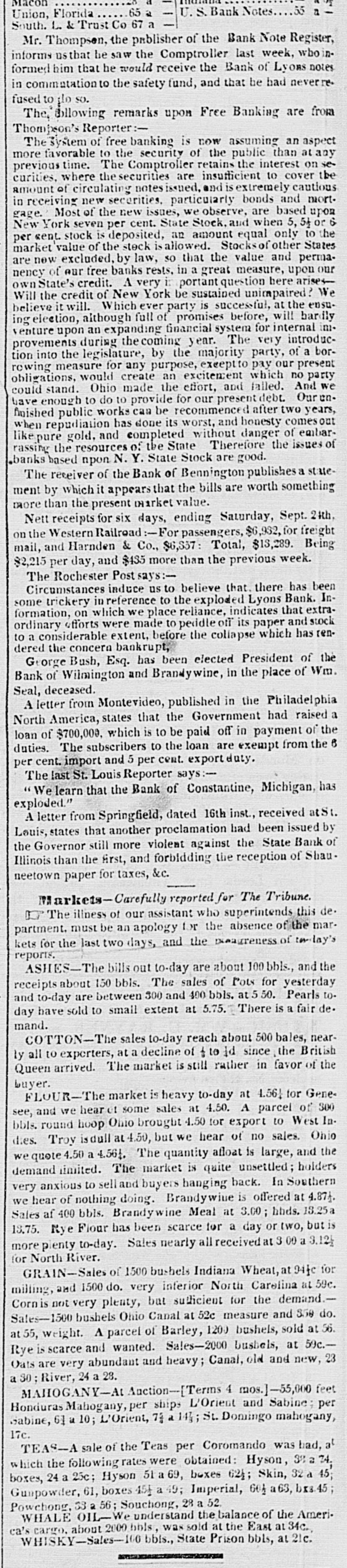
Macon .28 a — Union, Florida .65 a — South. L. & Trust Co 67 a — U. S. Bank Notes....55 a- Mr. Thompson, the pablisher of the Bank Note Register, informs us that he saw the Comptroller last week, who in- formed him that he would receive the Bank of Lyons notes in commatation to the safety fund, and that he had never re- fused to do so. ### The Following Remarks Upon Free Banking Are From Thompson's Reporter:- The system of free banking is now assuming an aspect more favorable to the security of the public than at any previous time. The Comptroller retains the interest on se- curities, where the securities are insufficient to cover the amount of circulating notes issued, and is extremely cautious in receiving new securities, particularly bonds and mort- gage. Most of the new issues, we observe, are based upon New York seven per cent. State Stock, and when 5, 5 or 6 per sent. stock is deposited, an amount equal only to the market value of the stock is allowed. Stocks of other States are now excluded, by law, so that the value and perma- nency of our free banks rests, in a great measure, upon our own State's credit. A very in portant question here arises- Will the credit of New York be sustained unimpaired? We believe it will. Which ever party is successful, at the ensu- ing election, although full of promises before, will hardly venture upon an expanding financial system for internal im- provements during the coming year. The very introduc- tion into the legislature, by the majority party, of a bor- rowing measure for any purpose, except to pay our present obligations, would create an excitement which no party could stand. Ohio made the effort, and failed. And we have enough to do to provide for our present debt. Our un- finished public works can be recommenced after two years, when repudiation has done its worst, and honesty comes out like pure gold, and completed without danger of embar- rassing the resources of the State Therefore the issues of banks based npon N. Y. State Stock are good. The receiver of the Bank of Bennington publishes a state- ment by which it appears that the bills are worth something more than the present market value. Nett receipts for six days, ending Saturday, Sept. 24th, on the Western Railroad :-For passengers, $6,932, for freight mail, and Harnden & Co., $6,557: Total, $13,289. Being $2,215 per day, and $435 more than the previous week. The Rochester Post says:- Circumstances induce us to believe that, there has been some trickery in reference to the exploded Lyons Bank. In- formation, on which we place reliance, indicates that extra- ordinary efforts were made to peddle off its paper and stock to a considerable extent, before the collapse which has ren- dered the concera bankrupt, George Bush, Esq. has been elected President of the Bank of Wilmington and Brandywine, in the place of Wm. Seal, deceased. A letter from Montevideo, published in the Philadelphia North America, states that the Government had raised a loan of $700,000, which is to be paid off in payment of the duties. The subscribers to the loan are exempt from the 8 per cent. import and 5 per cent. export duty. The last St. Louis Reporter says:-- "We learn that the Bank of Constantine, Michigan, has exploded." A letter from Springfield, dated 16th inst., received at St. Louis, states that another proclamation had been issued by the Governor still more violent against the State Bank of Illinois than the first, and forbidding the reception of Shau- neetown paper for taxes, &c. ### Markets-Carefully Reported For The Tribune. The illness of our assistant who superintends this de- partment, must be an apology for the absence of the mar- kets for the last two days, and the eagreness of to-day's reports. ASHES-The bills out to-day are about 100 bbls., and the receipts about 150 bbls. The sales of lots for yesterday and to-day are between 300 and 400 bbls. at 5 50. Pearls to- day have sold to smail extent at 5.75. There is a fair de- mand. COTTON-The sales to-day reach about 500 bales, near- ly all to experters, at a decline of ¼ to ½d since the British Queen arrived. The market is still rather in favor of the buyer. FLOUR-The market is heavy to-day at 4.56¼ for Gene- see, and we hear et some sales at 4.50. A parcel of 300 bbis, round hoop Ohio brought 4.50 for export to West In- dies. Troy is dull at 4.50, but we hear of no sales. Onio we quote 4.50 a 4.56¼. The quantity afloat is large, and the demand imited. The market is quite unsettled; holders very anxious to sell and buyers hanging back. In Southern we hear of nothing doing. Brandywine is offered at 4.87½. Sales af 400 bbls. Brandywine Meal at 3.00; hhds. 18.25 a 18.75. Rye Flour has been scarce for a day or two, but is more plenty to-day. Sales nearly all received at 3 00 a 3.12½ for North River. GRAIN-Sales of 1500 bushels Indiana Wheat, at 94½c for milting, and 1500 do. very inferior North Carolina at 59c. Corn is not very plenty, but sutlicient for the demand.- Sales-1500 bushels Ohio Canal at 52c measure and 350 do. at 55, weight. A parcel of Barley, 1200 bushels, sold at 56. Rye is scarce and wanted. Sales-2000 busbels, at 59c.- Oats are very abundant and heavy; Canal, old and new, 23 a 30; River, 24 a 28. MAHOGANY-At Auction-[Terms 4 mos.]-55,000 feet Honduras Mahogany, per ships L'Orient and Sabine; per Sabine, 6¼ a 10; L'Orient, 7½ a 14½; St. Domingo mahogany, 17c. TEAS-A sale of the Teas per Coromando was bad, at which the following rates were obtained: Hyson, 3½ a 74, boxes, 24 a 25c; Hyson 51a 69, boxes 62½; Skin, 32 a 45; Gunpowder, 61, boxes 45¼ a 49; Imperial, 60¼ a 63, bx3.45; Powchong, 33 a 56; Souchong, 28 a 52. WHALE OIL-We understand the balance of the Ameri- ca's cargo, about 2000 bbls, was sold at the East at 34c. WHISKY-Sales-100 bbis., State Prison bbls, at 21c.


Article from New-York Daily Tribune, October 24, 1842

Click image to open full size in new tab

Article Text

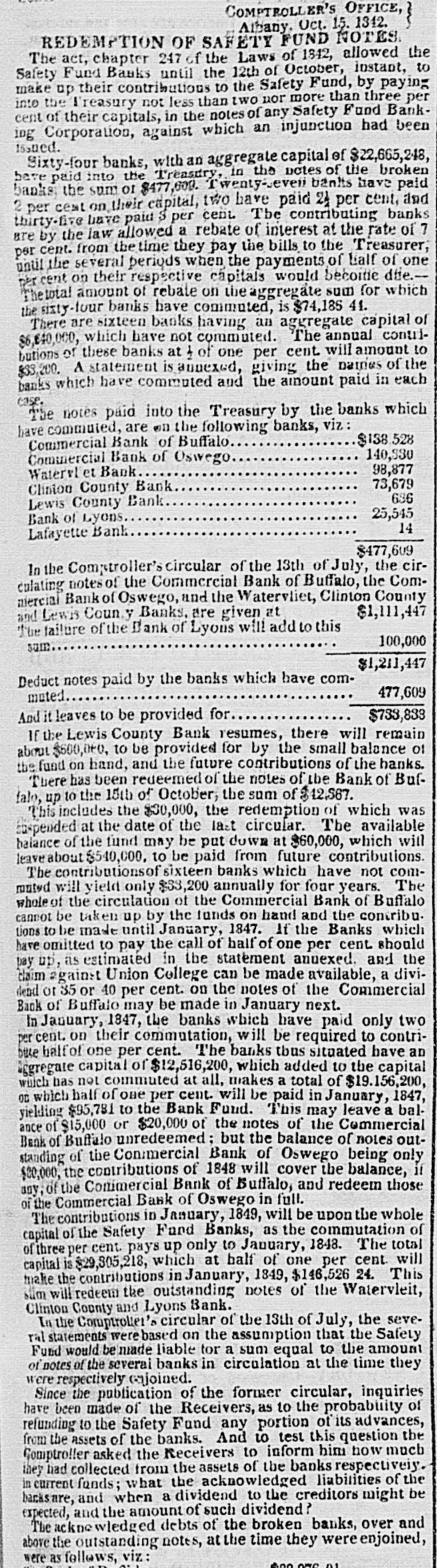
COMPTROLLER'S OFFICE, Albany. Oct. 15. 1342. REDEMPTION OF SAFETY FUND NOTES. The act, chapter 247 of the Laws of 1842, allowed the Safety Fund Banks until the 12th of October, instant, to make up their contributions to the Safety Fund, by paying into the Treasury not less than two nor more than three per cent of their capitals, in the notes of any Safety Fund Banking Corporation, against which an injunction had been issued. Sixty-four banks, with an aggregate capital of $22,665,248, have paid into the Treasdry, in the notes of the broken banks the sum of $477,600. Twenty-Jeveli banks have paid 2 per cest on their capital, two have paid 24 per cent, and thirty-five have paid per cent. The contributing banks are by the law allowed a rebate of interest at the rate of 7 per cent. from the time they pay the bills to the Treasurer, until the several periods when the payments of half of one cent on their respective capitals would becorile dtle.Theirtal amount of rebate on the aggregate sum for which the sixty-lour banks have commuted, is $74,185 41. There are sixteen banks having an aggregate capital of $6,£40,000, which have not commuted. The annual contributions of these banks at 4 of one per cent. will amount to $33,200. A statement is annexed, giving the names of the banks which have commuted and the amount paid in each case. The notes paid into the Treasury by the banks which have commuted, are will the following banks, viz: $138.528 Commercial Bank of Buffalo 140,530 Commercial Bank of Oswego 98,877 Watervl et Bank 73,679 Clinton County Bank 636 Lewis County Bank 25,545 Bank of Lyons 14 Lafayette Bank $477,609 In the Comptroller's circular of the 13th of July, the circulating notes of the Commercial Bank of Buffalo, the Commirrcrai Bank of Oswego, and the Watervliet, Clinton County $1,111,447 and Lewis County Banks. are given at The failure of the ank of Lyons will add to this 100,000 sum $1,211,447 Deduct notes paid by the banks which have com477,609 muted $733,833 And it leaves to be provided for If the Lewis County Bank resumes, there will remain about $600,000, to be provided for by the small balance of the fund on hand, and the future contributions of the banks. There has been redeemed of the notes of the Bank of Buffalo, up to the 15th of October, the sum of $12,587. This includes the $30,000, the redemption of which was suspended at the date of the last circular. The available balance of the fund may be put down at $60,000, which will leave about $540,000. to be paid from future contributions. The contributions of sixteen banks which have not comrouted will yield only $33,200 annually for four years. The whole of the circulation of the Commercial Bank of Buffalo cannot be taken up by the funds on hand and the contributions to be made until January, 1847. If the Banks which have omitted to pay the call of half of one per cent. should pay up, as estimated in the statement annexed. and the claim against Union College can be made available, a dividend or 35 or 40 per cent. on the notes of the Commercial Back of Buffalo may be made in January next. In January, 1847, the banks which have paid only two cent. on their commutation, will be required to contribute half of one per cent. The banks tbus situated have an Cggregate capital of $12,516,200, which added to the capital which has not commuted at all, makes a total of $19.156,200, 00 which half of one per cent. will be paid in January, 1847, yielding $95,781 to the Bank Fund. This may leave a balance of $15,000 or $20,000 of the notes of the Commercial Bank of Buffalo unredeemed; but the balance of notes outstanding of the Con:mercial Bank of Oswego being only $20,000, the contributions of 1848 will cover the balance, if any, of the Commercial Bank of Buffalo, and redeem those of the Commercial Bank of Oswego in full. The contributions in January, 1849, will be uponti whole capital of the Safety Fund Banks, as the commutation of of three per cent. pays up only to January, 1848. The total capital is $29,805,218, which at half of one per cent will make the contributions in January, 1849, $146,526 24. This stim will redeem the outstanding notes of the Watervleit, Clinton County and Lyons Bank. In the Comptrolier's circular of the 13th of July, the several statements were based on the assumption that the Safety Fund would be nade liable for a sum equal to the amount of notes of the several banks in circulation at the time they were respectively cojoined. Since the publication of the former circular, inquiries have been made of the Receivers, as to the probability of refunding to the Safety Fund any portion ot its advances, from the assets of the banks. And to test this question the Comptroller asked the Receivers to inform him how much they had collected from the assets of the banks respectively. in current funds; what the acknowledged liabilities of the backs are, and when a dividend to the creditors might be expected, and the amount of such dividend? The ackne wledged debts of the broken banks, over and above the outstanding notes, at the time they were enjoined, were as follows, viz: 000


Article from New-York Daily Tribune, December 22, 1842

Click image to open full size in new tab

Article Text

# MONEY MARKET. Sales at the Stock Exchange, Dec. 21. $1,000 Ill. 6s, 1870..cash 18½ 30 Mechanics' Bkg Asso. 59½ $28,000 docash 18 10 Del. & Hud 83 $9,000 do.8d 18 25 do. 82½ $18 000 Ohio 6s, 1860. opg 70 25 do.860d 82 $3,000 do.s03d 70 5 North Am. Trust Co. 2½ $2,000 do do...opg 69½ 16 N. O. Canal Co 20 $5,000 do...b60d 69 10 Neptune Ins. Co 60 $1,000 K'ky Sixes.. 80 5 Mohawk R. 32 $2,000 do .. 79½ 5 do .. 31¼ $5,000 do.. 79½ 25 do .. 31½ 10 Bk of America ... 78 150 do .. 31 66 Bk of Com Scrip.... 91½ 20 Syr & Utica R. 99 100 Harlem.s 60d 15 100 Paterson R.b90d 46½ 10 Stonington.. 17 SECOND HOARD. 22 Mohawk....b3d 30¼ 25 Mohawk. 30¼ 5 Stonington R.R. 30¼ Commercial and Money Matters. WEDNESDAY, Dec. 21. There was a fair amount of business done at the Brokers' Board to-day, but generally the prices were lower than yes- terday. Delaware fell off ¼; Mohawk, 2; Stonington, ½; Bank of Commerce Scrip improved ¼. Of State Stocks the sales were very large, reaching about $80,000. Ohio has declined ¼, and Kentucky ¼. Nothing doing in Foreign Exchange. The rate is nomi- nal at 6 a 6½; Francs, 5 45 a 5 43. We understand from good authority that the Directors of the Bank of Lyons have decided not to make any attempt to get the Bank on its legs again, but that a Receiver will be appointed and the Bank go into liquidation. A dividend of 30 per cent on the old stock of the Wash- ington Mutual Insurance Co. has been declared, payable on demand.


Article from New-York Daily Tribune, February 16, 1843

Click image to open full size in new tab

Article Text

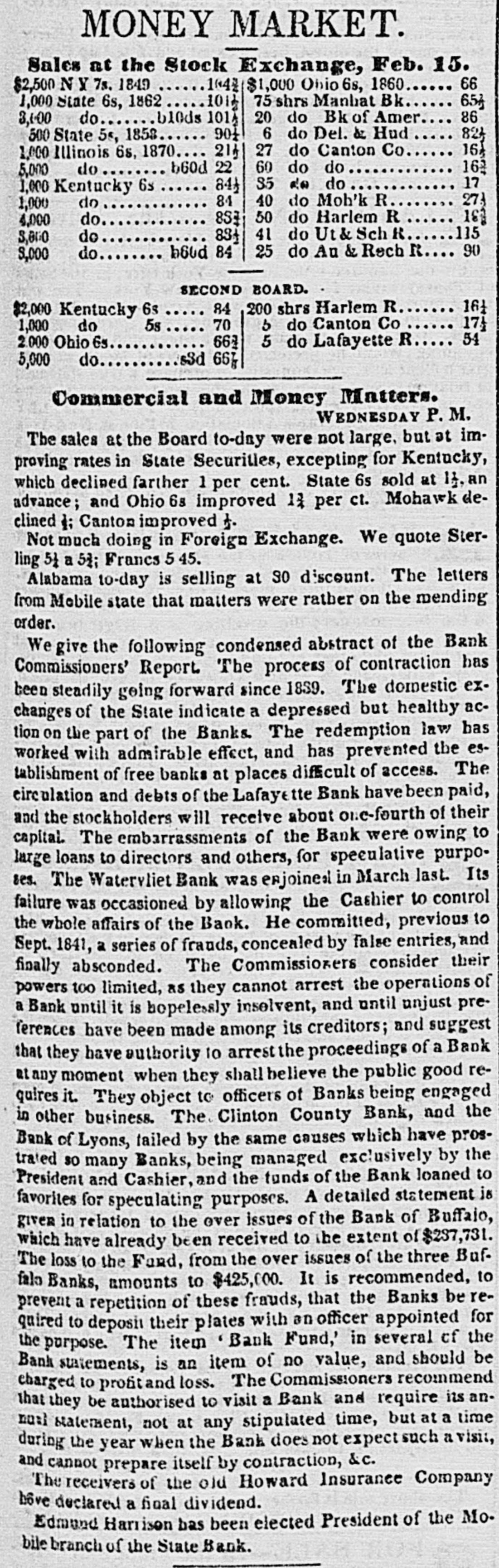
# MONEY MARKET. Sales at the Stock Exchange, Feb. 15. $2,500 N Y 7s. 1849 .164½ $1,000 Ohio 6s, 1860. 66 1,000 State 6s, 1862101½ 75 shrs Manhat Bk. 65¾ 3,000 do..blods 101¼ 20 do Bk of Amer.... 86 500 State 5s, 1858. 90¼ 6 do Del. & Hud 82½ 1,000 Illinois 6s, 1870.... 21½ 27 do Canton Co. 16¼ 5,000 do..b60d 22 60 do do. 16½ 1,000 Kentucky 6s.. 84 35 do do 17 1,000 do 84 40 do Moh'k R.... 27½ 4,000 do 85¾ 50 do Harlem R 16¾ 3,000 do 83¼ 41 do Ut & Sch R.115 5,000 do... b6od 84 25 do Au & Rech R.... 90 SECOND BOARD. $2,000 Kentucky 6s 84 200 shrs Harlem R.. 16½ 1,000 do 5s 70 5 do Canton Co. 17¼ 2.000 Ohio 6s. 66½ 5 do Lafayette R 54 5,000 dossd 66½ # Commercial and Money Matters. WEDNESDAY P. M. The sales at the Board to-day were not large, but at im- proving rates in State Securities, excepting for Kentucky, which declined farther 1 per cent. State 6s sold at 1½, an advance; and Ohio 6s improved 1½ per ct. Mohawk de- clined ¼; Canton improved ½. Not much doing in Foreign Exchange. We quote Ster- ling 5¼ a 5½; Francs 5 45. Alabama to-day is selling at 30 discount. The letters from Mobile state that matters were rather on the mending order. We give the following condensed abstract of the Bank Commissioners' Report. The process of contraction has been steadily going forward since 1839. The domestic ex- changes of the State indicate a depressed but healthy ac- tion on the part of the Banks. The redemption law has worked with admirable effect, and has prevented the es- tablishment of free banks at places difficult of access. The circulation and debts of the Lafayette Bank have been paid, and the stockholders will receive about one-fourth of their capital. The embarrassments of the Bank were owing to large loans to directors and others, for speculative purpo- ses. The Watervliet Bank was erjoined in March last. Its failure was occasioned by allowing the Cashier to control the whole affairs of the Bank. He committed, previous to Sept. 1841, a series of frauds, concealed by false entries, and finally absconded. The Commissioners consider their powers too limited, as they cannot arrest the operations of a Bank until it is hopelessly insolvent, and until unjust pre- ferences have been made among its creditors; and suggest that they have authority to arrest the proceedings of a Bank at any moment when they shall believe the public good re- quires it. They object to officers of Banks being engaged in other business. The Clinton County Bank, and the Bank of Lyons, failed by the same causes which have pros- trated so many Banks, being managed exclusively by the President and Cashier, and the funds of the Bank loaned to favorites for speculating purposes. A detailed statement is given in relation to the over issues of the Bank of Buffalo, which have already been received to the extent of $287,731. The loss to the Fund, from the over issues of the three Buf- falo Banks, amounts to $425,000. It is recommended, to prevent a repetition of these frauds, that the Banks be re- quired to deposit their plates with an officer appointed for the purpose. The item 'Bank Fund,' in several of the Bank statements, is an item of no value, and should be charged to profit and loss. The Commissioners recommend that they be authorised to visit a Bank and require its an- nual statement, not at any stipulated time, but at a time during the year when the Bank does not expect such a visit, and cannot prepare itself by contraction, &c. The receivers of the old Howard Insurance Company have declared a final dividend. Edmund Harrison has been elected President of the Mo- bile branch of the State Bank.


Article from The New York Herald, June 10, 1845

Click image to open full size in new tab

Article Text

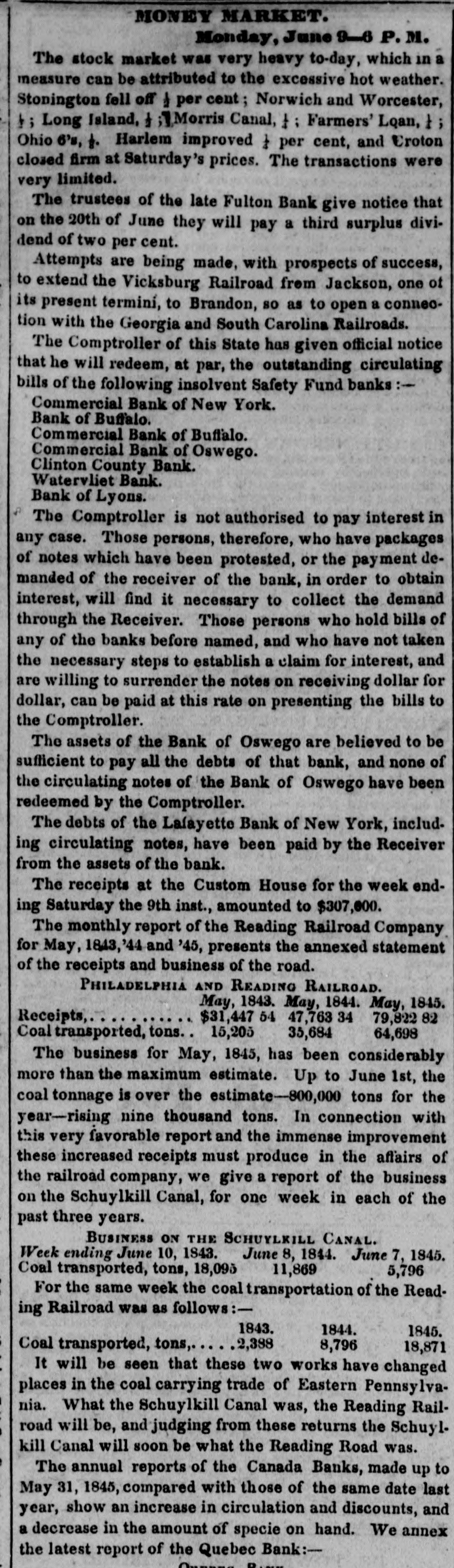
MONEY MARKET. Monday, June 9-6 P.M. The stock market was very heavy to-day, which in a measure can be attributed to the excessive hot weather. Stonington fell off 1 per cent; Norwich and Worcester, 1; Long Island, I Morris Canal, 1; Farmers' Lqan, Ohio 6's, 1. Harlem improved 1 per cent, and Eroton closed firm at Saturday's prices. The transactions were very limited. The trustees of the late Fulton Bank give notice that on the 20th of June they will pay a third surplus dividend of two per cent. Attempts are being made, with prospects of success, to extend the Vicksburg Railroad from Jackson, one of its present termini, to Brandon, so as to open a conneotion with the Georgia and South Carolina Railroads. The Comptroller of this State has given official notice that he will redeem, at par, the outstanding circulating bills of the following insolvent Safety Fund banks:Commercial Bank of New York. Bank of Buffalo. Commercial Bank of Buffalo. Commercial Bank of Oswego. Clinton County Bank. Watervliet Bank. Bank of Lyons. The Comptroller is not authorised to pay interest in any case. Those persons, therefore, who have packages of notes which have been protested, or the payment demanded of the receiver of the bank, in order to obtain interest, will find it necessary to collect the demand through the Receiver. Those persons who hold bills of any of the banks before named, and who have not taken the necessary steps to establish a claim for interest, and are willing to surrender the notes on receiving dollar for dollar, can be paid at this rate on presenting the bills to the Comptroller. The assets of the Bank of Oswego are believed to be sufficient to pay all the debts of that bank, and none of the circulating notes of the Bank of Oswego have been redeemed by the Comptroller. The debts of the Lafayette Bank of New York, includ. ing circulating notes, have been paid by the Receiver from the assets of the bank. The receipts at the Custom House for the week ending Saturday the 9th inst., amounted to $307,000. The monthly report of the Reading Railroad Company for May, 1843,44 and '45, presents the annexed statement of the receipts and business of the road. PHILADELPHIA AND READING RAILROAD. May, 1843. May, 1844. May, 1845. Receipts $31,447 47,763 34 79,822 82 15,205 Coal transported, tons. 35,684 64,698 The business for May, 1845, has been considerably more than the maximum estimate. Up to June 1st, the coal tonnage is over the estimate-800,000 tons for the year-rising nine thousand tons. In connection with this very favorable report and the immense improvement these increased receipts must produce in the affairs of the railroad company, we give a report of the business on the Schuylkill Canal, for one week in each of the past three years. BUSINESS ON THE SCHUYLKILL CANAL. Week ending June 10, 1843. June 8, 1844. June 7, 1845. Coal transported, tons, 18,095 11,869 5,796 For the same week the coal transportation of the Reading Railroad was as follows:1843. 1844. 1845. 2,388 Coal transported, tons, 8,796 18,871 It will be seen that these two works have changed places in the coal carrying trade of Eastern Pennsylvania. What the Schuylkill Canal was, the Reading Railroad will be, and judging from these returns the Schuyl. kill Canal will soon be what the Reading Road was. The annual reports of the Canada Banks, made up to May 31, 1845, compared with those of the same date last year, show an increase in circulation and discounts, and a decrease in the amount of specie on hand. We annex the latest report of the Quebec Bank:-


Article from New-York Daily Tribune, June 11, 1845

Click image to open full size in new tab

Article Text

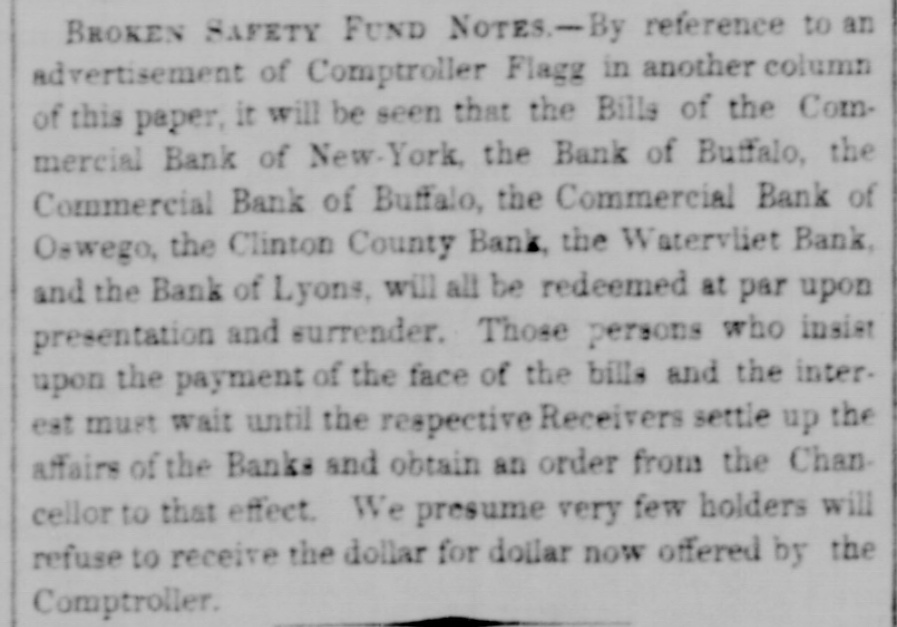
BROKEN SAFETY FUND NOTES. - By reference to an advertisement of Comptroller Flagg in another column of this paper, it will be seen that the Bills of the Commercial Bank of New-York, the Bank of Buffalo, the Commercial Bank of Buffalo, the Commercial Bank of Oswego, the Clinton County Bank the Watervliet Bank, and the Bank of Lyons, will all be redeemed at par upon presentation and surrender. Those persons who insist upon the payment of the face of the bills and the inter. est must wait until the respective Receivers settle up the affairs of the Banks and obtain an order from the Chan cellor to that effect. We presume very few holders will refuse to receive the dollar for dollar now offered by the Comptroller.


Article from The New York Herald, June 11, 1845

Click image to open full size in new tab

Article Text

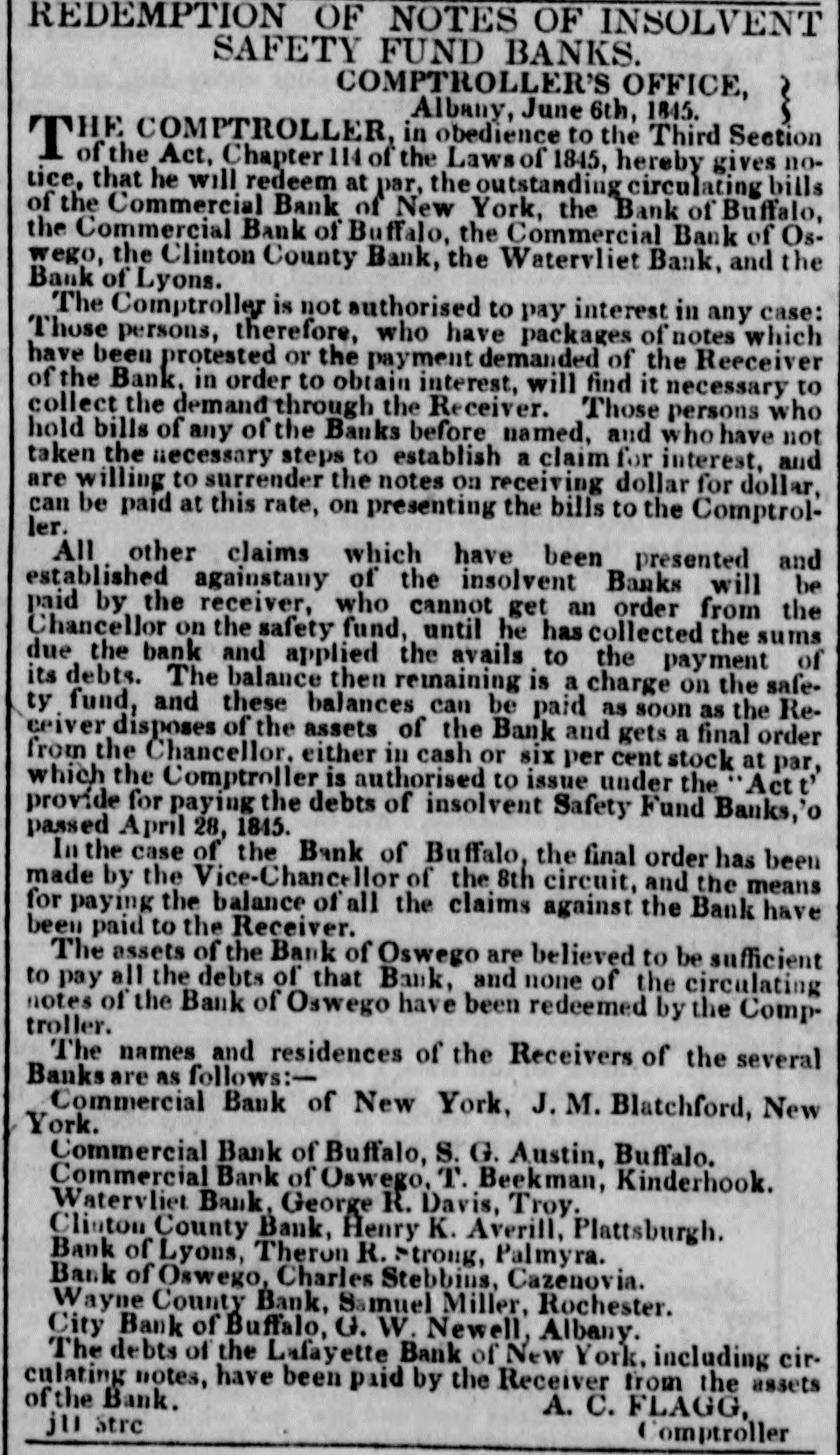
REDEMPTION OF NOTES OF INSOLVENT SAFETY FUND BANKS. COMPTROLLER'S OFFICE, Albany, June 6th, 1845. COMPTROLLER, in obedience to the Third Section THE of the Act, Chapter 114 of the Laws of 1845, hereby gives notice, that he will redeem at par, the outstanding circulating bills of the Commercial Bank of New York, the Bank of Buffalo, the Commercial Bank of Buffalo, the Commercial Bank of Oswego, the Clinton County Bank, the Watervliet Bank, and the Bank of Lyons. The Comptroller is not authorised to pay interest in any case: Those persons, therefore, who have packages of notes which have been protested or the payment demanded of the Reeceiver of the Bank. in order to obtain interest, will find it necessary to collect the demand through the Receiver. Those persons who hold bills of any of the Banks before named, and who have not taken the necessary steps to establish a claim for interest, and are willing to surrender the notes on receiving dollar for dollar, can be paid at this rate, on presenting the bills to the Comptroller. All other claims which have been presented and established againstany of the insolvent Banks will be paid by the receiver, who cannot get an order from the Chancellor on the safety fund, until he has collected the sums due the bank and applied the avails to the payment of its debts. The balance then remaining is a charge on the safety fund, and these balances can be paid as soon as the Receiver disposes of the assets of the Bank and gets a final order from the Chancellor. either in cash or six per cent stock at par, which the Comptroller is authorised to issue under the 'Act t' provide for paying the debts of insolvent Safety Fund Banks,'o passed April 28, 1845. In the case of the Bank of Buffalo, the final order has been made by the Vice-Chancellor of the 8th circuit, and the means for paying the balance of all the claims against the Bank have been paid to the Receiver. The assets of the Bank of Oswego are believed to be sufficient to pay all the debts of that Bank, and none of the circulating notes of the Bank of Oswego have been redeemed by the Comptroller. The names and residences of the Receivers of the several Banks are as follows:Commercial Bank of New York, J. M. Blatchford, New York. Commercial Bank of Buffalo, S. G. Austin, Buffalo. Commercial Bank of Oswego, T. Beekman, Kinderhook. Watervliet Bank, George R. Davis, Troy. Clipton County Bank, Henry K. Averill, Plattsburgh. Bank of Lyons, Theron R. >trong, Palmyra. Bank of Oswego, Charles Stebbins, Cazenovia. Wayne County Bank, Samuel Miller, Rochester. City Bank of Buffalo, G. W. Newell, Albany. The debts of the Lafayette Bank of New York, including circulating notes, have been paid by the Receiver from the assets of the Bank. A. C. FLAGG, jll Stre Comptroller


Article from The New York Herald, June 14, 1845

Click image to open full size in new tab

Article Text

MUSIC. LADY, who has a thorough knowledge of music, being A taught by the first masters in Europe, and feeling heself fully competent to instruct in thataccomplishment, would wish to devote her time to the instruction of young ladies, on moderate terms. A note addressed to A B. C., at the office of jell 1w*re this paper, shall be punctually attended to. ANTED-By a French young woman, a situation to take W charge of children, or as lady S maid, with a family going to France. She can give the best of references. Address by letter, to M. P. A.. Herald Office. ju10 lw*m FOLLOWING STATEMENT is from one lof the THE most eminent Physicians of New Jersey, and well and favorably known to very many of the citizens of New York. Having seen in the New York papers certain advertisements emanating from P. S. Beekman, I would beg to inform the public that I am acquainted with J. H. Scheuck, and have been so since 1834-that in 1839 he commenced the manufacture of Schenck's Pulmonic Syrup in Flemington. I have seen several persons of this vicinity who have been cured of Pulmonary disease by this Syrup when all other means had failed. I am acquainted with P. S. Beekman, and know that the original Pulmonic Syrup had been established several years before he heard of it, and that Beekman has said that it was Schenck's Pulmonic Syrup that cured him. Beekman has told me that he acted as Agent for Mr. Schenck, and had no interest in the business further than the agency. I know, also, that Mr. Schenck is the originator of the Pulmonic Syrup, and believe that Beekinan knows nothing of its composition, and is using every eadeavor to deceive the public. I am a practising physician, residing near Flemington, Hunterdon county, N.J., and am utterly opposed to all Empericism; but having seen the good effects of the Pulmonic Syrup, and believing that an effort is now being made, by every unpiincipled means, to injure an honest and honorable man, it is from a sense of duty that I make the above statement. GEORGE P. REX. M. D. Office exclusively for the sale of Schenck's Pulmonic Syrup, No. 4 Courtla d street New York. P.S. Beekman, of 491/2 Courtland street, is no longer Agent j14 3t*rh for the sale of Schenck Pulmonic Syrup. REDEMPTION OF NOTES OF INSOLVENT SAFETY FUND BANKS. COMPTROLLER'S OFFICE, Albany, June 6th, 1845. THE COMPTROLLER. in obedience to the Third Section of the Act. Chapter 114 of the Laws of 1345, hereby gives notice, that he will redeem at par, the outstanding circulating bills of the Commercial Bank of New York, the Bank of Buffalo, the Commercial Bank of Buffalo, the Commercial Bank of Oswego, the Clinton County Bank, the Watervliet Bank, and the Bauk of Lyons. The Comptroller is not authorised to pay interest in any case: Those persons, therefore, who have packages of notes which have been protested or the payment demanded of the Reeceiver of the Bank. in order to obtain interest, will find it necessary to collect the demand through the Receiver. Those persons who hold bills of any of the Banks before named. and who have not taken the necessary steps to establish a claim for interest. and are willing to surrender the notes on receiving dollar for dollar, can be paid at this rate, on presenting the bills to the Comptroller. All other claims which have been presented and established againstany of the insolvent Banks will be paid by the receiver, who cannot get an order from the Chancellor on the safety fund, until he has collected the sums due the bank and applied the avails to the payment of its debts. The balance then remaining is a charge on the safety fund, and these balances can be paid as soon as the Receiver disposes of the assets of the Bank and gets a final order from the Chancellor. either in cash or six per cent stock at par, which the Comptroller is authorised to issue under the Act t provide for paying the debts of insolvent Safety Fund Banks,'o passed April 28, 1845. In the case of the Bank of Buffalo, the final order has been made by the Vice-Chancellor of the 8th circuit, and the means for paying the balance of all the claims against the Bank have been paid to the Receiver. The assets of the Bank of Oswego are believed to be sufficient to pay all the debts of that Bank, and none of the circulating notes of the Bank of Oswego have been redeemed by the Comptroller. The names and residences of the Receivers of the several Banks: are as follows:Commercial. Bank of New York, J. M. Blatchford, New York. Commercial Bank of Buffalo, S. G. Austin, Buffalo. Commercial Bank of Oswego, T. Beekman, Kinderhook. Watervliet Bank, George R. Davis, Troy, Clinton County Bank, Henry K. Averill, Plattsburgh. Bank of Lyons, Theron R. Strong, Palmyra. Bank of Oswego, Charles Stebbins, Cazepovia. Wayne County Bank, Samuel Miller, Rochester. City Bank of Buffalo, G. W. Newell, Albany. The debts of the Lafayette Bank of New York, including circulating notes, have been paid by the Receiver from the as sets A. C. FLAGG, of the Bank Comptrolle j11 Stre


Article from The New York Herald, May 27, 1846

Click image to open full size in new tab

Article Text

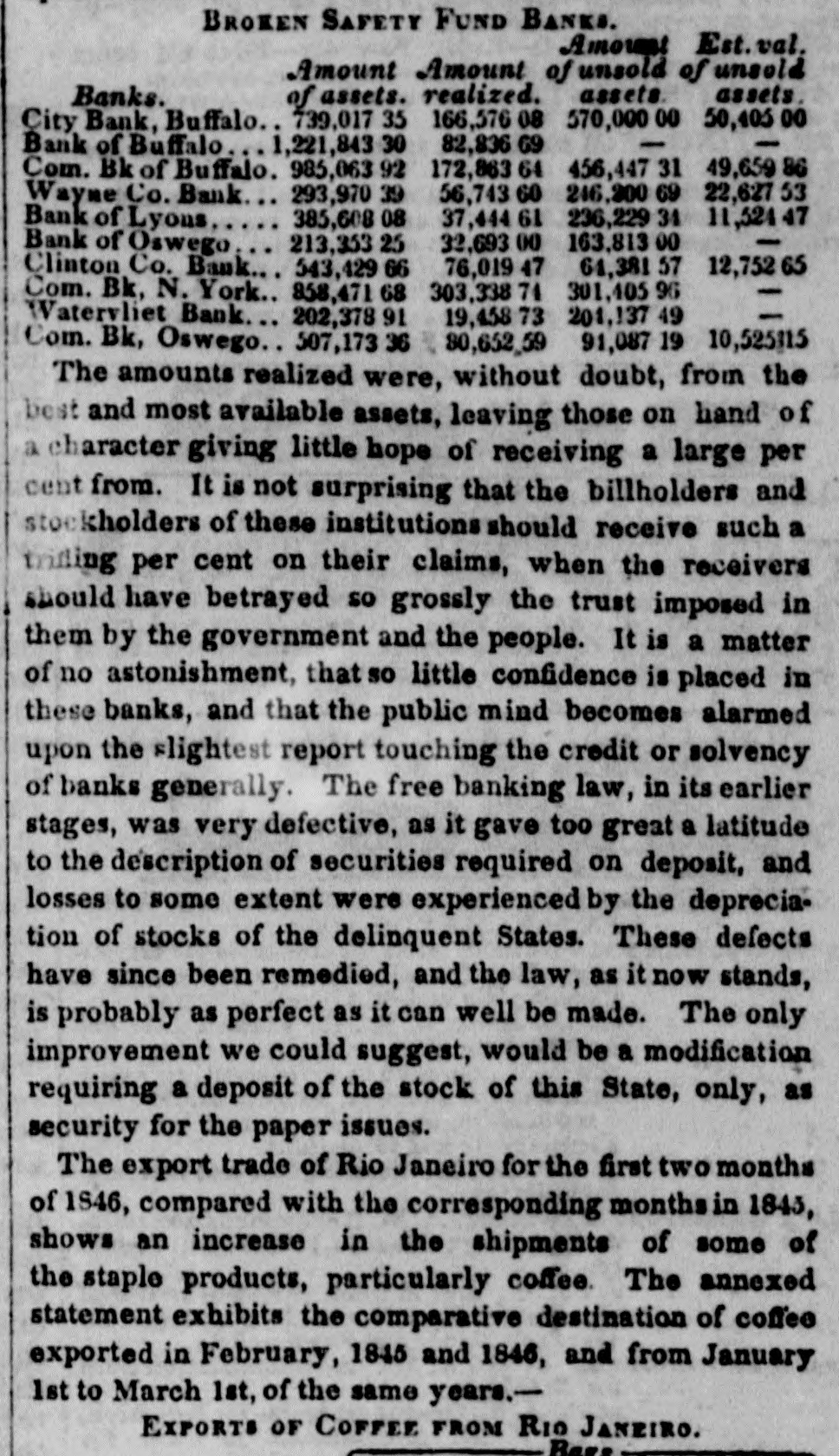
BROKEN SAFETY FUND BANKS. | Banks. | Amount of assets. | Amount realized. | Amount of unsold assets. | Est.val. of unsold assets. | | -------------------- | ----------------- | ----------------- | -------------------------- | -------------------------- | | City Bank, Buffalo.. | 739,017 35 | 166,576 08 | 570,000 00 | 50,405 00 | | Bank of Buffalo... | 1,221,843 30 | 82,836 69 | | | | Com. Bk of Buffalo. | 985,063 92 | 172,863 64 | 456,447 31 | 49,659 86 | | Wayne Co. Bank... | 293,970 39 | 56,743 60 | 246,200 69 | 22,627 53 | | Bank of Lyons. | 385,608 08 | 37,444 61 | 236,229 34 | 11,524 47 | | Bank of Oswego... | 213,353 25 | 32,693 00 | 163,813 00 | | | Clinton Co. Bank... | 543,429 66 | 76,019 47 | 64,381 57 | 12,752 65 | | Com. Bk, N. York.. | 858,471 68 | 303,338 74 | 301,405 96 | | | Watervliet Bank... | 202,378 91 | 19,458 73 | 201,137 49 | | | Com. Bk, Oswego.. | 507,173 36 | 80,652.59 | 91,087 19 | 10,525315 | The amounts realized were, without doubt, from the best and most available assets, leaving those on hand of a character giving little hope of receiving a large per cent from. It is not surprising that the billholders and stockholders of these institutions should receive such a trifling per cent on their claims, when the receivers should have betrayed so grossly the trust imposed in them by the government and the people. It is a matter of no astonishment, that so little confidence is placed in these banks, and that the public mind becomes alarmed upon the slightest report touching the credit or solvency of banks generally. The free banking law, in its earlier stages, was very defective, as it gave too great a latitude to the description of securities required on deposit, and losses to some extent were experienced by the deprecia-tion of stocks of the delinquent States. These defects have since been remedied, and the law, as it now stands, is probably as perfect as it can well be made. The only improvement we could suggest, would be a modification requiring a deposit of the stock of this State, only, as security for the paper issues. The export trade of Rio Janeiro for the first two months of 1846, compared with the corresponding months in 1845, shows an increase in the shipments of some of the staple products, particularly coffee. The annexed statement exhibits the comparative destination of coffee exported in February, 1845 and 1846, and from January 1st to March 1st, of the same years. EXPORTS OF COFFEE FROM RIO JANEIRO. Rare


Article from New-York Daily Tribune, August 5, 1846

Click image to open full size in new tab

Article Text

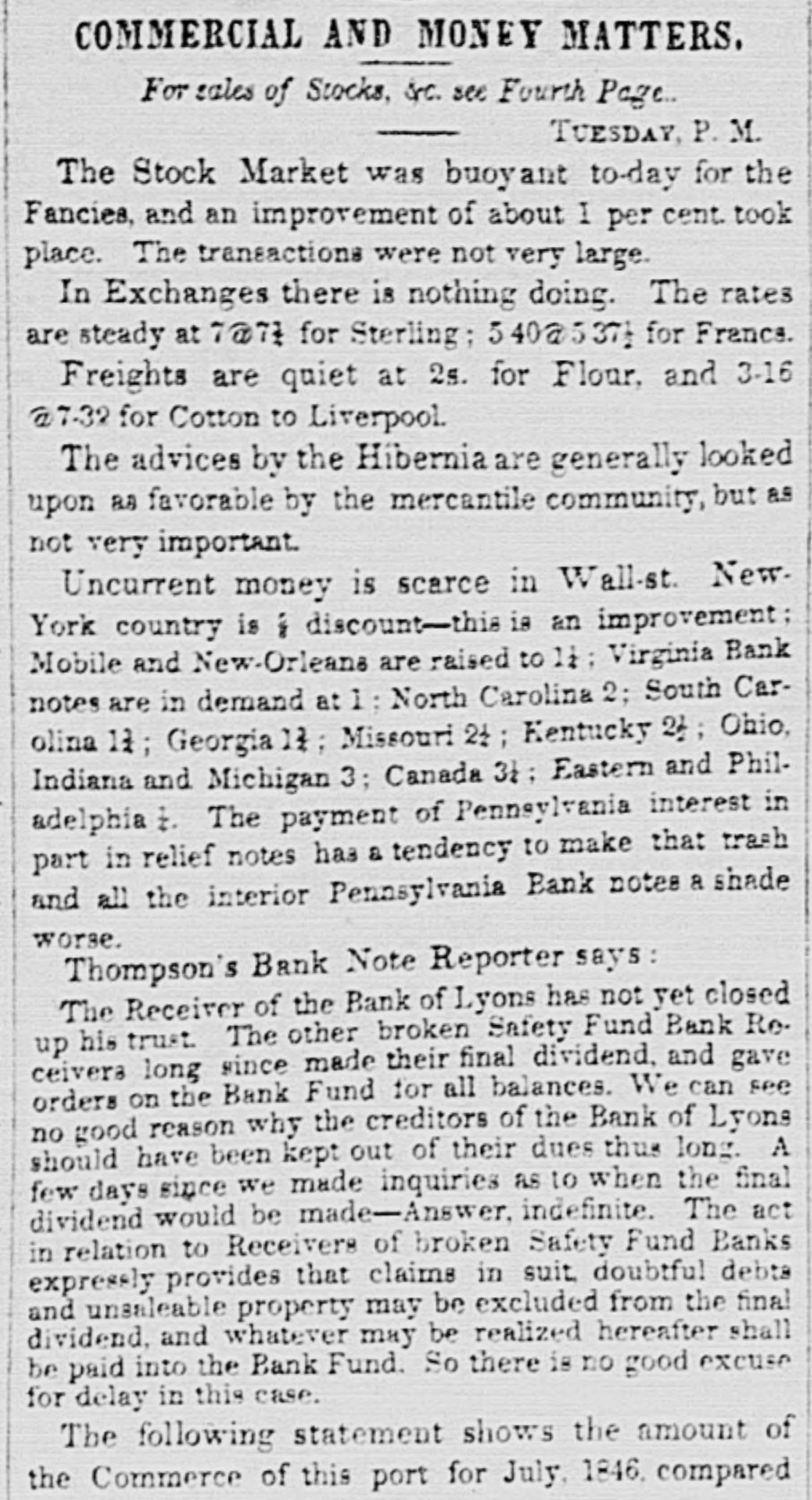
COMMERCIAL AND MONEY MATTERS. For sales of Stocks, Src. see Fourth Page TUESDAY, P. M. The Stock Market was buoyant to-day for the Fancies, and an improvement of about I per cent. took place. The transactions were not very large. In Exchanges there is nothing doing. The rates are steady at 7@7 for Sterling ; 540@537} for France. Freights are quiet at 2s. for Flour, and 3-16 @7-32: for Cotton to Liverpool. The advices by the Hibernia are generally looked upon as favorable by the mercantile community, but as not very important. Uncurrent money is scarce in Wall-st. New. York country is i discount-this is an improvement: Mobile and New-Orleans are raised to 11 : Virginia Bank notes are in demand at 1: North Carolina 2; South Carolina 11; Georgia 17: Missouri 21 Kentucky 21; Ohio, Indiana and Michigan 3; Canada 31 : Eastern and Philadelphia t. The payment of Pennsylvania interest in part in relief notes has a tendency to make that trash and all the interior Pennsylvania Bank notes a shade worse. Thompson's Bank Note Reporter says The Receiver of the Bank of Lyons has not yet closed up his trust. The other broken Safety Fund Bank Re. ceivers long since made their final dividend, and gave orders on the Bank Fund for all balances. We can see no good reason why the creditors of the Bank of Lyons should have been kept out of their dues thus long A few days since we made inquiries as to when the final dividend would be made-Answer. indefinite. The act in relation to Receivers of broken Safety Fund Banks expressly provides that claims in suit doubtful debta and unsaleable property may be excluded from the final dividend, and whatever may be realized hereafter shall be paid into the Bank Fund. So there is no good excuse for delay in this case. The following statement shows the amount of the Commerce of this port for July 1846 compared


Article from The New York Herald, August 19, 1846

Click image to open full size in new tab

Article Text

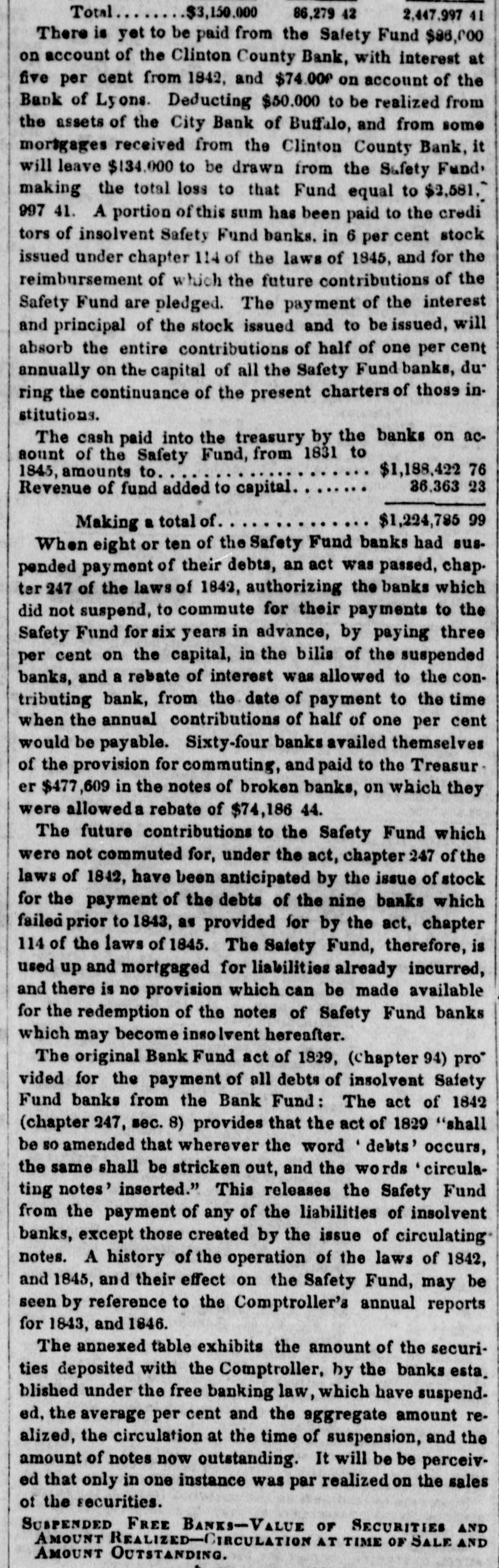
Total $3,150.000 86,279 42 2,447,997 41 There is yet to be paid from the Safety Fund $86,000 on account of the Clinton County Bank, with interest at five per cent from 1842, and $74.00 on account of the Bank of Lyons. Deducting $50.000 to be realized from the assets of the City Bank of Buffalo, and from some mortgages received from the Clinton County Bank, it will leave $134.000 to be drawn from the Safety Fund making the total loss to that Fund equal to $2,581, 997 41. A portion of this sum has been paid to the credi tors of insolvent Safety Fund banks. in 6 per cent stock issued under chapter 114 of the laws of 1845, and for the reimbursement of which the future contributions of the Safety Fund are pledged. The payment of the interest and principal of the stock issued and to be issued, will absorb the entire contributions of half of one per cent annually on the capital of all the Safety Fund banks, du ring the continuance of the present charters of those institutions. The cash paid into the treasury by the banks on acaount of the Safety Fund, from 1831 to $1,188,422 76 1845, amounts to 36.363 23 Revenue of fund added to capital $1,224,795 99 Making a total of When eight or ten of the Safety Fund banks had suspended payment of their debts, an act was passed, chap. ter 247 of the laws of 1842, authorizing the banks which did not suspend, to commute for their payments to the Safety Fund for six years in advance, by paying three per cent on the capital, in the bills of the suspended banks, and a rebate of interest was allowed to the contributing bank, from the date of payment to the time when the annual contributions of half of one per cent would be payable. Sixty-four banks availed themselves of the provision for commuting, and paid to the Treasur er $477,609 in the notes of broken banks, on which they were allowed a rebate of $74,186 44. The future contributions to the Safety Fund which were not commuted for, under the act, chapter 247 of the laws of 1842, have been anticipated by the issue of stock for the payment of the debts of the nine banks which failed prior to 1843, as provided for by the act, chapter 114 of the laws of 1845. The Safety Fund, therefore, is used up and mortgaged for liabilities already incurred, and there is no provision which can be made available for the redemption of the notes of Safety Fund banks which may become insolvent hereafter. The original Bank Fund act of 1829, (chapter 94) pro* vided for the payment of all debts of insolvent Safety Fund banks from the Bank Fund: The act of 1842 (chapter 247, sec. 8) provides that the act of 1829 "shall be so amended that wherever the word debts' occurs, the same shall be stricken out, and the words circulating notes' inserted." This releases the Safety Fund from the payment of any of the liabilities of insolvent banks, except those created by the issue of circulating notes. A history of the operation of the laws of 1842, and 1845, and their effect on the Safety Fund, may be seen by reference to the Comptroller's annual reports for 1843, and 1846. The annexed table exhibits the amount of the securities deposited with the Comptroller, by the banks esta. blished under the free banking law, which have suspended, the average per cent and the aggregate amount realized, the circulation at the time of suspension, and the amount of notes now outstanding. It will be be perceived that only in one instance was par realized on the sales of the securities. SUSPENDED FREE BANKS-VALUE OF SECURITIES AND AMOUNT REALIZED-CIRCULATION AT TIME OF SALE AND AMOUNT OUTSTANDING.


Article from New-York Daily Tribune, August 27, 1846

Click image to open full size in new tab

Article Text

COMMERCIAL AND MONEY MATTERS. For Sales of Stocks. & see Fourth Page WEDNESDAY. Counterfeit Bank notes. purporting to be 820 bills on the Farmers' Bank of Amsterdam, 83 on the Cumberland Bank and 810billson the Schenectady Bank, of this State have been detected Persons having received such bills are requested to call at the Essex Mar ket Police Office, and make the fact known. The business on the Mohawk Railroad continues to increase. The receipts from the 15th to the 21st of August were $3,174.77. Same time last year, $2,601 It is understood that a loan of $100,000 has been obtained by the Norwich and Worcester Railroad. for the payment of its purchase from the Long Island Road of steamboats, besides the $40,000 paid in cash. The new steamer Atlantic is said to have cost $150,000 and all who have seen. admire and praise her without qualification. Regular trains of cars are now running from Boston to Lexington via Fitchburg Railroad To-day is the first day of running upon the four miles of the Fall River Railroad between South Brain tree and Randolph. The trains will run in connection with the Old Colony Railroad, leaving their dépôt twice a day. A list of subscribers to the Atlantic and St. Law rence Railroad is given in the Portland Bulletin, from which it appears that Bostonians took 177 shares in that enterprise. The charter of another Railroad from Port land, to run through the interior of York County and connect with the Maine, has affected the Portland Saco and Portsmouth stock, but there is great doubt if another line of Railroad can be subscribed for, while that now existing pays so moderate a dividend. The Boston Post says the transactions in divi dend Railroads and Manufacturing Corporations are still very small and prices to a great extent nominal without, however, any indications of yielding on the part of holders to fears that lower rates must be sub mitted to. A lessening of engagements has to a great extent been the rule for some months past, and those who could do so have cut off all speculative operations, 50 88 to be prepared for any reduction of currency or change of Government policy. Lowell Railroad stock is not so much sought for at high rates of premium as before the new Tariff passed. Capital is already devi I ated from trade to a very material extent, by the pay ment for stock in Railroad and Manufacturing Corpora tions, so that, in case of prolonged War with Mexico. 8 revulsion consequent upon the forced withdrawal of these investments might be attended with disastrous consequences. Such revulsion. or any extensive re action, may not take place, but the panic in England from this cause should not be without good effect in preventing excessive and speculative action. Meetings of stockholders in the Nashua and Concord Ronds are called. to ascertain if they favor sub. scriptions to Branch Roads from their own lines, which may, if made, not only aid those now without Railroad facilities, but add to their present large income. There is, however, a doubt with many. who are largely interested, if the extension of Railroads beyond those now in existence or subscribed for. would not be just now an experiment of unfavorable issue. The Suffolk Manufacturing Co. divides eight and the Tremont Mills six per cent. for six months. both payable on the 27th inst. The total receipts of Canal tolls up to 1st August at Geneva, was $24,287.23 same time last year. $16,965 84 excess this year. $7,321.39. The St. Louis Republican of the 19th inst. says For the last ten days, there has been an increased demand for money on good real estate, At ten per cent per annum, without being able to get the loans. Out door rates for good paper from 10 to 15 per annum We have heard of temporary loans as high as one and half ! per cent. per month. Business continues dull, and ne gotiations difficult to make predicated upon shipments of produce to the South. Currency (which constitutes the various Bank notes circulating in this city) has be come quite scarce, and for ordinary purposes is within to 1) of Missouri Bank notes. The Banks and Brokers are drawing freely At per cent. on New-York. Boston and Philadelphia, although the latter cannot be said to be making much at these rates. The amount of property assessed in Lowell for the year 1846, is, real estate, $9,695,346; personal, $5.443.580-total, $15,138,926. being an increase of about half million over 1845. The tax is $115,637 98-70 cents on the $100. Number of polls, 6,437. an increase of 1.040 over 1845. The number of individuals and firms in that city, who pay tax of $50 and upward, is over 140. The total valuation of the Corporations is $9,222,600-INN, $64,558 20. as follows $833 Locks and Canals $3,360 Appleton Company 6,740 Mass. Cotton Mills 6,720 Boott Cotton Mills 11,200 Merrimac o 6,720 Hamilton Company 4,200 Middlesex Co 8,400 Lawrence Company 1,740 588 Prescott Co Lowell Bleachery 3.360 Lowell Machine Shop 2,660 Suffolk Co 3,360 Tremont Mills 3,535 Lowell Company In looking over a Report by the Comptroller. in answer to call from the Convention, we note the follow. ! ing interesting items $17,660,046 June 1, 1846-Canal Debt 1,713,000 Contingent Debt 5,885,549 Treasury Debt $25,258,597 Total liabilities of the State The contingent debt, as above, is for Bonds of the State, loaned to Railroad Companies, which are yet solvent. The largest portion of the Treasury debt madeup by loans to insolvent Railroad Companies. During the year ending June 1. 1846. the State had borrowed $300,000. and paid of principal $2,329,972 and on the 1st of July last, $571,304 more: thus reducing the debt in thirteen months. $2,600,000. In 1842 N law was passed for paying a bounty on salt coal. &c. which has drawn from the Treasury, $377,180 for three years, ending 30th September last. 83 Ordinary expenses of Gov'nt for the year $380.218 Special appropriations and temptry expenses. 368.839.75 Interest on insolvent Railroad stock 237,321.76 The net revenue of the Erie and Champlain Canals, for the last five years, averages a fraction over a million and a half dollars for each year. Unavailable deposits in broken Banks 00 Bk of Brockport $3,715 Lewis Co. Bank 20,000 Bank of Lvons 19,113 S6 Watervliet Bank 42,480 20,912 Bank Co. Clinton Co. Bank 86,200 00 Wayne Lockport Bank 29,700 00 $254,211.6 Total LockptBk&TCo.32,072: 31 The Canal Fund has also in stock issued for I the payment of balances due on account of Ca nal Fund moneys deposited in the Bank of Butfalo, Commercial Bank of Buffalo, and Commercial Bank of Oswego, $314,449.02 Total unavailable loans made to Banks $568,659 [Thompson's Reporter. Carefully reported for The Tribune. Markets WEDNESDAY, August 25. ASHES-The markets for Pots and Pearls is as noticed for long time past: steady at $3 56 for Pots and $4 12) for Pearls. COTTON-The sales to-day have only amounted to some 500 bales at full prices, chiefly to spinners. Export of Cotton from the Ports of the United States, commencing 1st September, IS45. Stock Stock Rec'd