Article Text
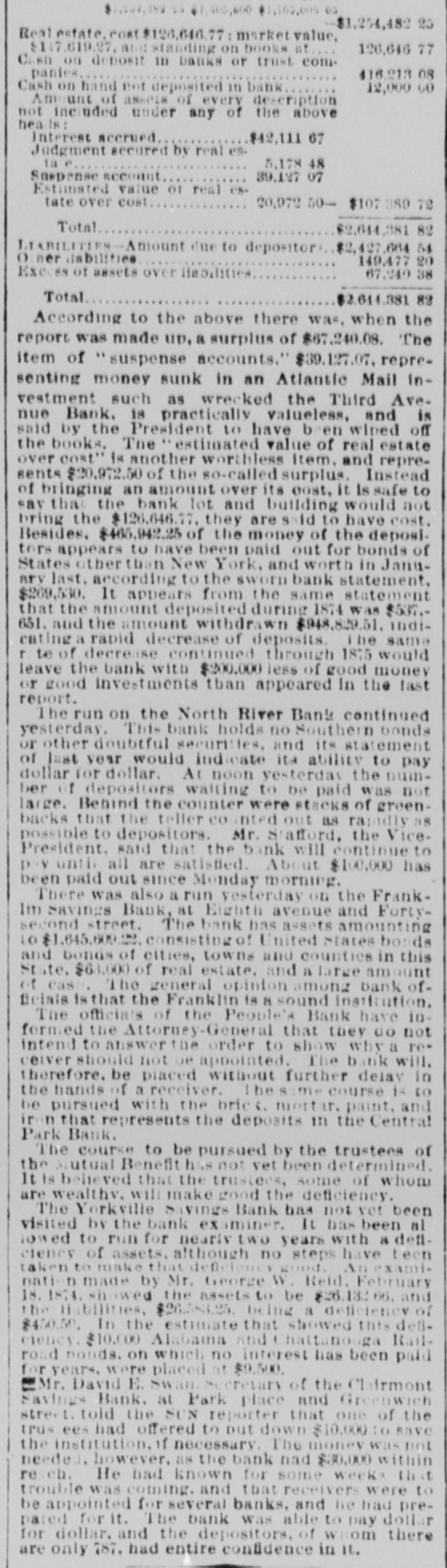
Real estate, cost $126,646.77; market value, $117,619.27, and standing on books at 126,646 77 Cash on deposit in banks or trust companies 416,213 08 Cash on hand not deposited in bank 12,000 00 Amount of assets of every description not included under any of the above heads: Interest accrued $42,111 67 Judgment secured by real estate 5,178 48 Suspense account 39,127 07 Estimated value of real estate over cost 20,972 50— $107,389 72 Total $2,644,381 82 LIABILITIES—Amount due to depositors.. $2,427,664 54 Other liabilities 149,477 20 Excess of assets over liabilities 67,240 08 Total $2,644,381 82
According to the above there was, when the report was made up, a surplus of $67,240.08. The item of "suspense accounts," $39,127.07, representing money sunk in an Atlantic Mail investment such as wrecked the Third Avenue Bank, is practically valueless, and is said by the President to have been wiped off the books. The "estimated value of real estate over cost" is another worthless item, and represents $20,972.50 of the so-called surplus. Instead of bringing an amount over its cost, it is safe to say that the bank lot and building would not bring the $126,646.77, they are said to have cost. Besides, $465,942.25 of the money of the depositors appears to have been paid out for bonds of States other than New York, and worth in January last, according to the sworn bank statement, $269,530. It appears from the same statement that the amount deposited during 1874 was $537,651, and the amount withdrawn $948,829.51, indicating a rapid decrease of deposits. The same rate of decrease continued through 1875 would leave the bank with $200,000 less of good money or good investments than appeared in the last report.
The run on the North River Bank continued yesterday. This bank holds no Southern bonds or other doubtful securities, and its statement of last year would indicate its ability to pay dollar for dollar. At noon yesterday the number of depositors waiting to be paid was not large. Behind the counter were stacks of greenbacks that the teller counted out as rapidly as possible to depositors. Mr. Stafford, the Vice-President, said that the bank will continue to pay until all are satisfied. About $100,000 has been paid out since Monday morning.
There was also a run yesterday on the Franklin Savings Bank, at Eighth avenue and Forty-second street. The bank has assets amounting to $1,645,609.22, consisting of United States bonds and bonds of cities, towns and counties in this State, $63,000 of real estate, and a large amount of cash. The general opinion among bank officials is that the Franklin is a sound institution.
The officials of the People's Bank have informed the Attorney-General that they do not intend to answer the order to show why a receiver should not be appointed. The bank will, therefore, be placed without further delay in the hands of a receiver. The same course is to be pursued with the bricks, mortar, paint, and iron that represents the deposits in the Central Park Bank.
The course to be pursued by the trustees of the Mutual Benefit has not yet been determined. It is believed that the trustees, some of whom are wealthy, will make good the deficiency.
The Yorkville Savings Bank has not yet been visited by the bank examiner. It has been allowed to run for nearly two years with a deficiency of assets, although no steps have been taken to make that deficiency good. An examination made by Mr. George W. Reid, February 18, 1874, showed the assets to be $26,132.66, and the liabilities, $26,583.25, being a deficiency of $450.59. In the estimate that showed this deficiency, $10,000 Alabama and Chattanooga Railroad bonds, on which no interest has been paid for years, were placed at $9,500.
Mr. David E. Swan, Secretary of the Clairmont Savings Bank, at Park place and Greenwich street, told the SUN reporter that one of the trustees had offered to put down $10,000 to save the institution, if necessary. The money was not needed, however, as the bank had $30,000 within reach. He had known for some weeks that trouble was coming, and that receivers were to be appointed for several banks, and he had prepared for it. The bank was able to pay dollar for dollar, and the depositors, of whom there are only 787, had entire confidence in it.