Williams County State Bank (Williston, ND)

Episode Information

Episode UID
9831925391482
Episode Type
Suspension → Closure
Bank Type
state
Bank ID
983192539 hash
Start Date
June 12, 1923
Location
Williston, North Dakota (48.147, -103.618)

Metadata

Model
gpt-5-mini (chosen from majority vote of a three-model LLM ensemble)
Short Digest
28f9d795ddd78a70

Response Measures

None

Description

Bank voluntarily suspended June 12, 1923; receiver appointed later in June and bank remained closed.

Events (3)

1. June 12, 1923 Suspension
Cause
Bank Specific Adverse Info
Cause Details
Depleted reserves and inability to meet obligations; board voluntarily suspended operations to obtain more capital and reorganize.
Newspaper Excerpt
Depleted reserve today was given as the cause for the voluntary closing this morning of the Williams County State Bank of this city.
Source
newspapers
2. June 14, 1923 Other
Newspaper Excerpt
There is a rumor current around town today that the Williams County State Bank of Williston did not open its doors yesterday morning, but The Herald is not in possession of any of the facts concerning the matter, and does not know whether or not this is merely a temporary suspension.
Source
newspapers
3. June 29, 1923 Receivership
Newspaper Excerpt
G. B. Everson of this city has been appointed receiver of the Williams County State bank, which was closed two weeks ago by the board of directors.
Source
newspapers

Newspaper Articles (19)

Article from The Bismarck Tribune, June 12, 1923

Click image to open full size in new tab

Article Text

WILLISTON BANK SUSPENDS Williston, N. D., June 12. ---- Depleted reserve today was given as the cause for the voluntary closing this morning of the Williams County State Bank of this city. The business of the bank was temporarily suspended by the board of directors. President L. J. Rodman of the institution said this afternoon. to enable officers to bring more capital into the bank. Reorganization work already is under way, Mr. Rodman said, but it is difficult to say at this time whether reopening will be effected and if so not the amount of loss that will be sustained by depositors.


Article from The Wolf Point Herald, June 14, 1923

Click image to open full size in new tab

Article Text

RUMOR SAYS WILLISTON BANK IS CLOSED There is a rumor current around town today that the Williams County State Bank of Williston did not open its doors yesterday morning, but The Herald is not in possession of any of the facts concerning the matter, and does not know whether or not this is merely a temporary suspension.


Article from Great Falls Tribune, June 30, 1923

Click image to open full size in new tab

Article Text

Name Bank Receiver While Stockholders Move for Reopening Special to The Tribune. Williston, N. D., June 29.—G. B. Everson of this city has been appointed receiver of the Williams County State bank, which was closed two weeks ago by the board of directors. There is a movement on foot, sponsored by the Williston Commercial club, to reorganize the bank so as to protect the depositors, and a committee of five is now working out the plan as outlined. It is proposed by this plan to get the stockholders and directors of the bank to pledge approximately $100,000 to the new bank, if reorganized, in lieu of their statutory liability as stockholders and to relieve them of all liability as guarantors of public deposits—a liability two or three times as great as the sum sought to be pledged for the reorganization. The next step would be to secure concessions from a few of the largest unsecured creditors, pledging all depositors of $500 or over to permit their deposits to remain for one, two and three years, if necessary, and then try to find someone with adequate capital to take over the bank and protect the depositors and to assume responsibility for all public funds. The plan has the approval of many of the stockholders and a number of the directors most heavily interested have signed pledges as outlined, and work on this first step of the program is now in progress.


Article from The Bismarck Tribune, July 2, 1923

Click image to open full size in new tab

Article Text

WOULD OPEN BANK AGAIN Party of Williston Men Seek Aid from State Officials A party of Williston men, here in the interest of the Williams County State Bank, which they hope may be reopened, received word while here that stockholders in Williston had pledged $75,000 in the refinancing plan for the bank. The party, including Sheriff Carl Erickson of Williams county; Robert Ruteledge, deputy; Earl Swinley, county treasurer, interviewed Attorney-General G. F. Shafer, State Examiner, Gilbert Semingson and C. R. Green, manager of the Bank of North Dak., with a view of seeking assistance in preventing appointment of a permanent receiver. They said that Judge Moellring of district court had named a receiver on Friday. Previously the bank had been in the hands of a deputy examiner. State officials are favorable toward reopening of the bank if a satisfactory plan can be worked out, it was said.


Article from The Bismarck Tribune, July 27, 1923

Click image to open full size in new tab

Article Text

DEPUTY'S TRIAL FOR, CONTEMPT TO BE SOON Minot, N. D., July 27.-A second continuance until, Sept. 4 09113 was ordered by Judge George H. Moellring in district court Tuesday in the hearing on an order to show cause why R. S. See, deputy state bank examiner, should not be cited for contempt of court for resistance to an order of the court issued June 28, appointing George B. Everson as temporary receiver of the Williams County State bank of Williston. During the meantime interrogatories dealing with the case will be submitted to Judge Moellring. It is the contention of counsel for See, that the court did not have jurisdiction to issue a restraining order preventing See from interfering with the receivership. The assets of the institution are being checked and other details are being considered and belief has been expressed in some quarters that the bank may again engage in business, Judge Moellring said yesterday.


Article from Grand Forks Herald, August 11, 1923

Click image to open full size in new tab

Article Text

$400,000 In Unbankable Paper In Williams Bank, Receiver's Report Says Williston, N. D., Aug. 10.—A report prepared by Receiver George B. Everson of the Williams County State bank on the liabilities and assets of the institution, for presentation to the district court, states that there is the sum of approximately $400,000 which the receiver considers unbankable paper. This paper, in the opinion of those making the appraisal of the assets is practically worthless. No mention of irregularities in the operation of the bank is made in the examiner's report. One proposal given to effect reopening of the bank is for all depositors to agree to leave 60 per cent of their deposits in the bank for three years. The balance of 40 per cent, it is proposed, would be underwritten by the guaranty fund commission and paid by them sooner or later.


Article from The Bismarck Tribune, August 14, 1923

Click image to open full size in new tab

Article Text

Unbankable Papers Amount to $400,000 Williston, N. D., Aug. 14.-A report prepared by Receiver George B. Everson of the Williams County State bank on the liabilities and assets of the institution, for presentation to the district court, states that there is the sum of approximately $400,000 which the receiver considers unbankable paper. This paper, in, the opinion of those making the appraisal of the assests is practically worthless. No mention of irregularities in the operation of the bank is made in the examiner's report. One proposal given to effect reopening of the bank is for all depositors to agree to leave 60 per cent of their deposits. in the bank for three years. The. balance of 40 per cent, it is proposed, would be underwritten by the guaranty fund commission and paid by them sooner or later.


Article from The Bismarck Tribune, April 17, 1924

Click image to open full size in new tab

Article Text

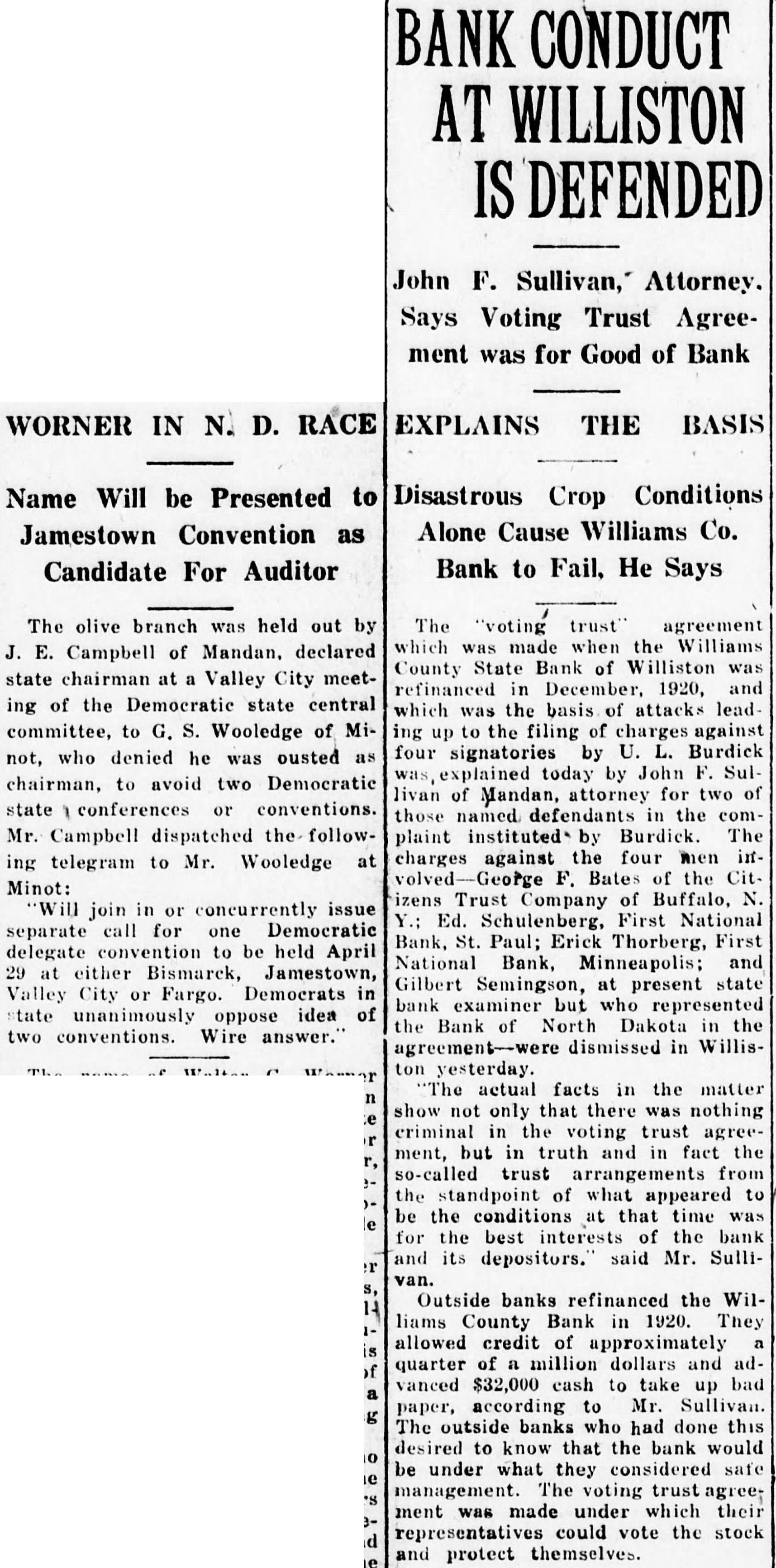
BANK CONDUCT AT WILLISTON IS DEFENDED John F. Sullivan, Attorney, Says Voting Trust Agreement was for Good of Bank EXPLAINS THE BASIS Disastrous Crop Conditions Alone Cause Williams Co. Bank to Fail, He Says The "voting trust" agreement which was made when the Williams County State Bank of Williston was refinanced in December, 1920, and which was the basis of attacks leading up to the filing of charges against four signatories by U. L. Burdick was explained today by John F. Sullivan of Mandan, attorney for two of those named defendants in the complaint instituted by Burdick. The charges against the four men involved—George F. Bates of the Citizens Trust Company of Buffalo, N. Y.; Ed. Schulenberg, First National Bank, St. Paul; Erick Thorberg, First National Bank, Minneapolis; and Gilbert Semingson, at present state bank examiner but who represented the Bank of North Dakota in the agreement—were dismissed in Williston yesterday. "The actual facts in the matter show not only that there was nothing criminal in the voting trust agreement, but in truth and in fact the so-called trust arrangements from the standpoint of what appeared to be the conditions at that time was for the best interests of the bank and its depositors," said Mr. Sullivan. Outside banks refinanced the Williams County Bank in 1920. They allowed credit of approximately a quarter of a million dollars and advanced $32,000 cash to take up bad paper, according to Mr. Sullivan. The outside banks who had done this desired to know that the bank would be under what they considered safe management. The voting trust agreement was made under which their representatives could vote the stock and protect themselves.


Article from The Fargo Forum, Daily Republican, and Moorhead Daily News, April 18, 1924

Click image to open full size in new tab

Article Text

WILLISTON BANK TRUST PACK HELD MADE WITH BEST RESULT IN VIEW Nothing Criminal, Says Sullivan, Bad Times Blamed For Closing Bismarck, N. D., April 18.—The "voting trust" agreement which was made when the Williams County State bank of Williston was refinanced in December, 1920, and which was the basis of attacks leading up to the filing of charges against four signatories by U. L. Burdick, was explained today by John F. Sullivan of Mandan, attorney for two of those named defendants in the complaint instituted by Burdick. The charges against the four men involved—George F. Bates of the Citizens Trust company of Buffalo, N. Y.; Ed. Schulenberg, First National bank, St. Paul; Erick Thorberg, First National bank, Minneapolis; and Gilbert Semingson, at present state bank examiner, but who represented the Bank of North Dakota in the agreement—were dismissed in Williston yesterday. "The actual facts in the matter show not only that there was nothing criminal in the voting trust agreement, but in truth and in fact the so-called trust arrangements, from the standpoint of what appeared to be the conditions at that time, was for the best interests of the bank and its depositors," said Mr. Sullivan. Allowed $250,000 Credit Outside banks refinanced the Williams County State bank in 1920. They allowed credit of approximately $250,000 and advanced $32,000 cash to take up bad paper, according to Mr. Sullivan. The outside banks who had done this desired to know that the bank would be under what they considered safe management. The voting trust agreement was made under which their representatives could vote the stock and protect themselves. "The result of the trust agreement was that twin city banks advanced the credit," said Mr. Sullivan. "If conditions in the Williston territory had subsequently been anything other than absolutely disastrous, the Williston bank today would have been one of the big banks of the state." The voting trust agreement did not require that the outside bankers be permitted to run the bank, Mr. Sullivan said, "but was simply for the purpose of assuring the banks who
Article from The Bismarck Tribune, May 10, 1924

Click image to open full size in new tab

Article Text

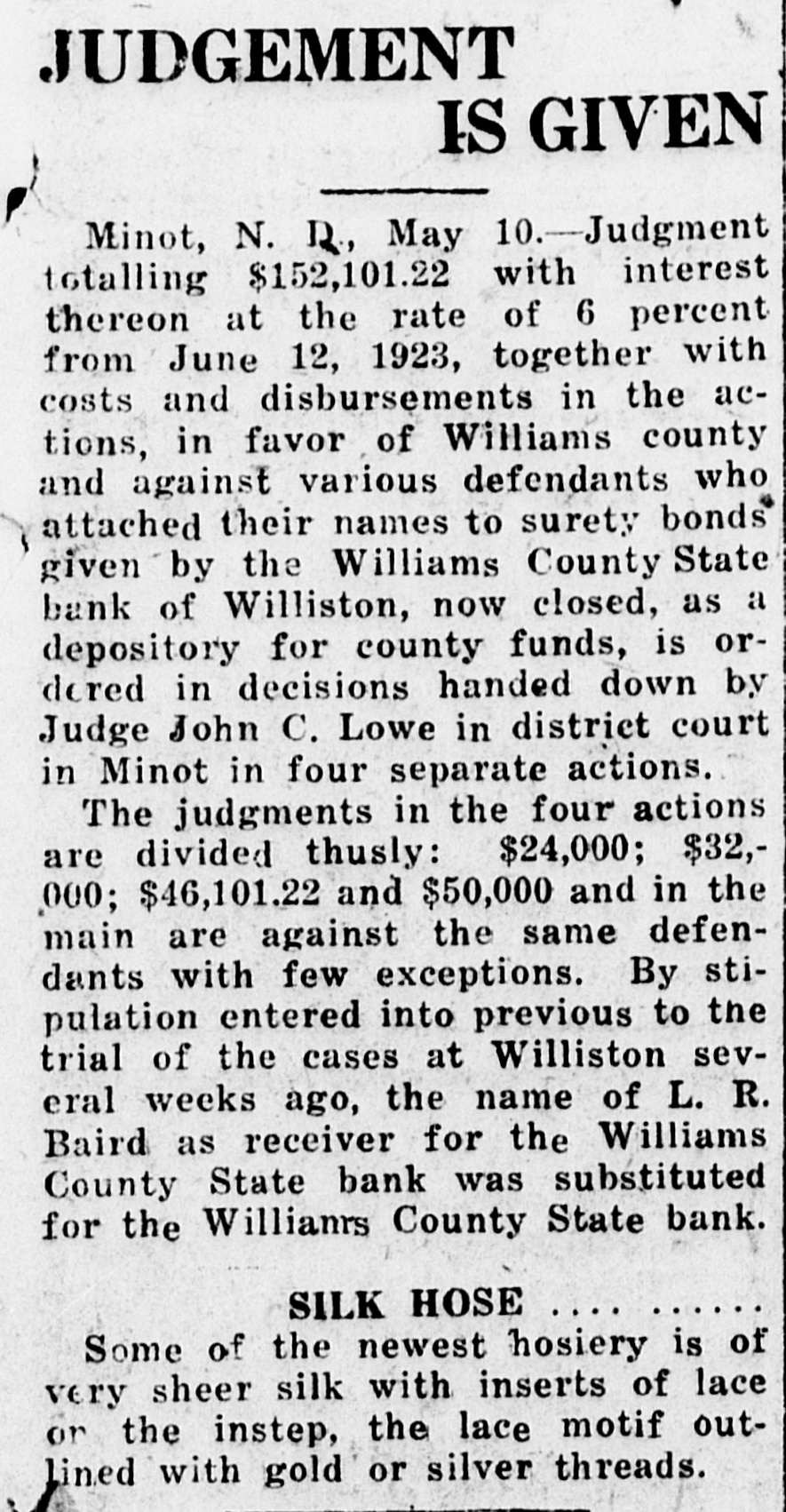
# JUDGEMENT # IS GIVEN Minot, N. R., May 10. Judgment totalling $152,101.22 with interest thereon at the rate of 6 percent from June 12, 1923, together with costs and disbursements in the actions, in favor of Williams county and against various defendants who attached their names to surety bonds given by the Williams County State bank of Williston, now closed, as a depository for county funds, is ordered in decisions handed down by Judge John C. Lowe in district court in Minot in four separate actions. The judgments in the four actions are divided thusly: $24,000; $32,000; $46,101.22 and $50,000 and in the main are against the same defendants with few exceptions. By stipulation entered into previous to the trial of the cases at Williston several weeks ago, the name of L. R. Baird as receiver for the Williams County State bank was substituted for the Williams County State bank. # SILK HOSE Some of the newest hosiery is of very sheer silk with inserts of lace or the instep, the lace motif outlined with gold or silver threads.


Article from The Albert Lea Tribune, November 20, 1924

Click image to open full size in new tab

Article Text

BANK RECEIVER TRIAL WITNESS (By Associated Press.) Williston, N. D., Nov. 29.—C. R. Vansickle, of Minot, receiver of closed banks in this district, was on the witness stand practically all of today in the trial of L. J. Rodman, former president of the Williams County State bank on trial in the William district on a charge of receiving deposits with knowledge that the bank was insolvent.


Article from The Bismarck Tribune, April 15, 1925

Click image to open full size in new tab

Article Text

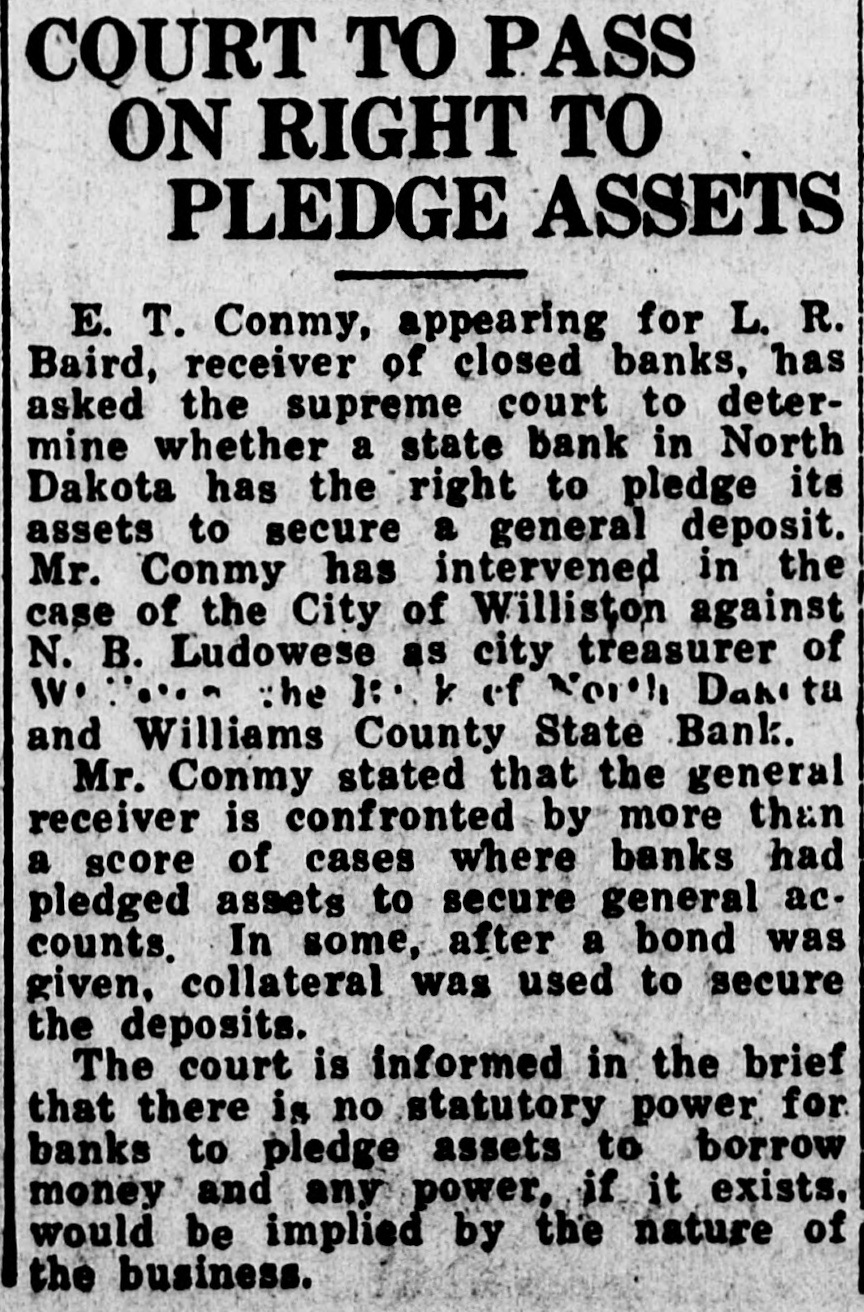
COURT TO PASS ON RIGHT TO PLEDGE ASSETS E. T. Conmy, appearing for L. R. Baird, receiver of closed banks, has asked the supreme court to determine whether a state bank in North Dakota has the right to pledge its assets to secure a general deposit. Mr. Conmy has intervened in the case of the City of Williston against N. B. Ludowese as city treasurer of IV. he }: V. of Dahita and Williams County State Bank. Mr. Conmy stated that the general receiver is confronted by more than a score of cases where banks had pledged assets to secure general accounts. In some, after a bond was given, collateral was used to secure the deposits. The court is informed in the brief that there is no statutory power for banks to pledge assets to borrow money and any power, if it exists. would be implied by the nature of the business.


Article from The Bismarck Tribune, October 21, 1925

Click image to open full size in new tab

Article Text

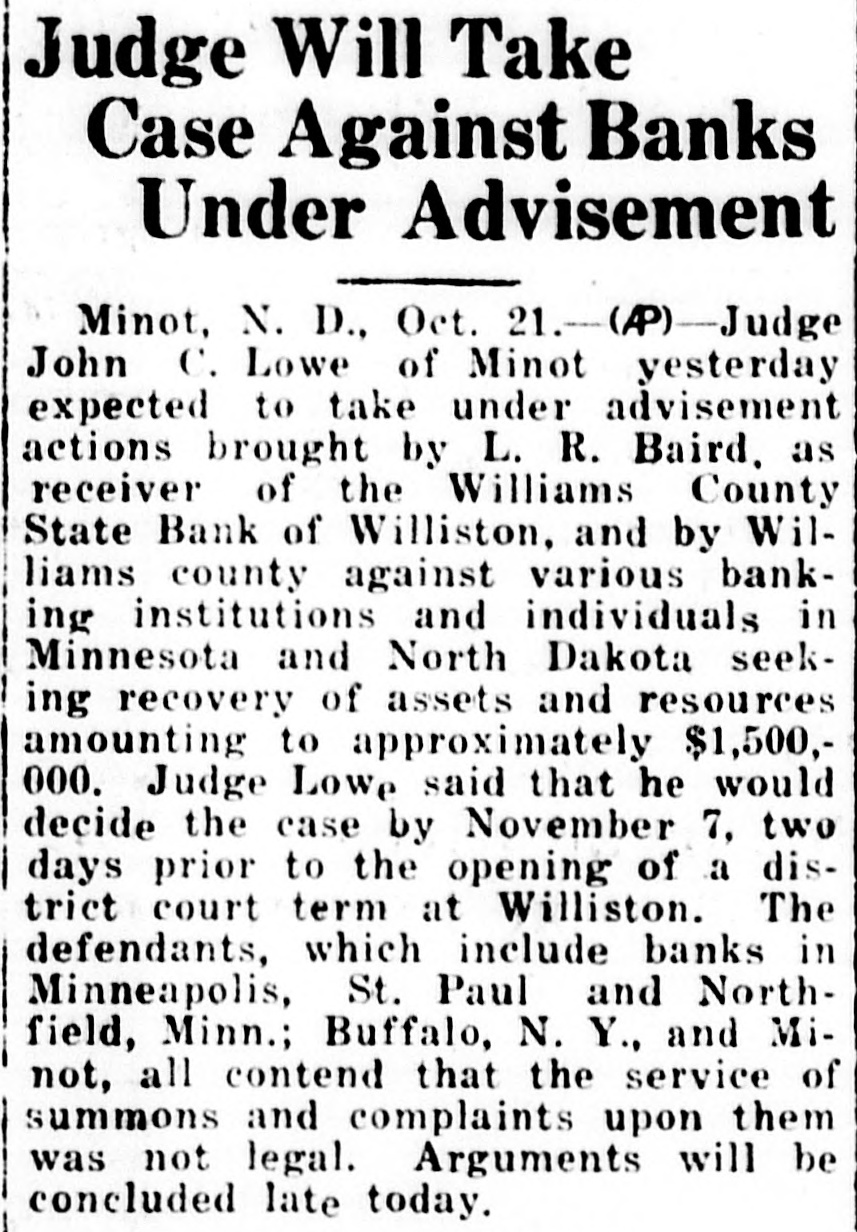
Judge Will Take Case Against Banks Under Advisement Minot, N. D., Oct. 21.-(P)-Judge John C. Lowe of Minot yesterday expected to take under advisement actions brought by L. R. Baird. as receiver of the Williams County State Bank of Williston, and by Williams county against various banking institutions and individuals in Minnesota and North Dakota seeking recovery of assets and resources amounting to approximately $1,500,000. Judge Lowe said that he would decide the case by November 7, two days prior to the opening of a district court term at Williston. The defendants, which include banks in Minneapolis, St. Paul and Northfield, Minn.; Buffalo, N. Y., and Minot, all contend that the service of summons and complaints upon them was not legal. Arguments will be concluded late today.


Article from The Bismarck Tribune, April 17, 1926

Click image to open full size in new tab

Article Text

Guaranty Fund Body Takes No Action on Proposal of Banks No action was taken by the state guaranty fund commission on a proposal by numerous banks, creditors of the closed Williams County State Bank of Williston, whereby the banks would turn over to the state receiver of closed banks assets now held by them in return for the promise of the guaranty fund commission not to prosecute any action against them in connection with the bank's affairs. Although no formal expression was made by the guaranty fund commission it was indicated that they did not consider the offer substantial enough to warrant its acceptance. The guaranty fund commission has contended that the banks in question, located in Minot. Duluth, Buffalo, N. Y., and the Twin Cities were trustees for the Williams County State Bank at the time it closed and had been for some time prior to its closing. As such trustees, it is claimed, they were responsible for the safety of deposits made while they acted in that capacity. A statement of the case by state officials shows that the banks loaned money to the Williston institution in an effort to tide it over and otherwise aided it in its unsuccessful fight for existence. The proposal of the banks was to turn over to the receiver part of the assets turned over to them by the Williams County state bank as secu-


Article from The Bismarck Tribune, August 26, 1926

Click image to open full size in new tab

Article Text

Baird Files Suit in Williston Case Minneapolis, Aug. 26-(AP)-L. R. Baird, receiver for the Williams County State Bank of Williston. N. D., field suit in Henepin county district court today against menry A. Thoeny of Glencoe and C. O. Lundquist of Minneapolis as administrators of the estate of Harry L. Simons of Williston, in which recovery of approximately $150,000 in bank collateral is sought. The complaint alleges that Simons and other creditors of the bank obtained from the stockholders and directors of the bank a trust agreement "with the intent to gain control of the bank." The trust agreement, it is alleged,


Article from The Bismarck Tribune, May 17, 1927

Click image to open full size in new tab

Article Text

Baird Starts Suit Against Williston for an the City by Williston of erty taken over from liams County State bank that institution closed, been Instituted by Baird, state Baird here today. The City of also asked notes, estimated $4,500, the bank secure deposit city funds. The suit predicated upon the supreme court the bank case in which that banks may not pledge their secure deposits public funds.


Article from Grand Forks Herald, May 24, 1927

Click image to open full size in new tab

Article Text

BANK CASE IMPORTANT Baird's Suit Against City Of Williston Involves Big Principle What the supreme court meant by its decision in the Wildrose bank case, or at least the application to be made of the principle laid down in that probably will be determined in suits, pending or prospective, in connection with the affairs the Williams County State Bank of Williston. After deliberating for more than year and inviting attorneys to reargue points the supreme decided the Wildrose bank case an opinion which that pledge their sets deposits that which lies at the bot. of the over the affairs of the Williaton institution. Gave City Deeds Before bank closed it gave the city deeds to certain property in the of Williston and certain notes as security for deposit of public money Later the Bank North Dakota was given mortgage property. When Williams County State Bank closed the Bank of North Da kota and City of Williston became involved lawsuit which should get the and the courts that the city had the best Now L. R. Baird, as state bank recelver. is contending in view of the that the claim the City of Williston illegal and that title of the property should revert to as of the bank affairs. If his claim held the property among the bank's assets and used to pay the of its The contemplated action would be one to quiet title to Williston and the city to give an account of the receiv ed from while in the city's hands.


Article from The Bismarck Tribune, May 24, 1927

Click image to open full size in new tab

Article Text

PROPERTY HELD BY WILLISTON BEING SOUGHT Baird Says City's Claim Is Illegal in View of Decision in Wildrose Case What the supreme court meant by its decision in the Wildrose bank case, or at least the application to be made of the principle laid down in that decision, probably will be determined in suits, pending or prospective, in connection with the affairs of the Williams County State Bank of Williston. After deliberating for more than a year and inviting attorneys to reargue certain points involved, the supreme court decided the Wildrose bank case in an opinion which held that banks may not pledge their assets to secure public deposits. It is that principle which lies at the bottom of the dispute over the affairs of the Williston institution. Gave City Notes Before the bank closed it gave the city of Williston deeds to certain property in the city of Williston and certain notes as security for a deposit of public money. Later the Bank of North Dakota was given a mortgage on the same property. When the Williams County State Bank closed the Bank of North Dakota and city of Williston became involved in a lawsuit to see which should get the property and the courts held that the city had the best claim. Now L. R. Baird, as state receiver, is contending, in view of the Wildrose decision, that the claim of the city of Williston is illegal and that title of the property should revert to him as the administrator of the bank's affairs. If his claim is upheld the property will be listed among the bank's assets and used to pay the accounts of its creditors. The contemplated action would be one to quiet title to the Williston property and force the city to give an account of the rents it has received from it while in the city's hands.


Article from The Bismarck Tribune, August 14, 1929

Click image to open full size in new tab

Article Text

ceedings to determine rights to certain property formerly owned by the Williams County State Bank of Williston. L. R. Baird, as receiver for the bank, claimed certain property awarded. to the city of Williston after a previous trial. The Bank of North Dakota also sought to obtain an interest in the property which had been assigned to the city prior to the bank's closing in 1923, to secure a deposit of city money. The court held that the matters at issue had been determined in a suit by the city against the bank and could not be reopened.