gpt-5-mini (chosen from majority vote of a three-model LLM ensemble)
Short Digest
c5256e1baaf7d3fe
Response Measures
None
Description
Suspension tied to the Oct. 1907 panic and the failure/suspension of the International Trust Company.
Events (4)
1.October 25, 1907Run
Cause
Local Banks
Cause Details
Runs followed the suspension/failure of the International Trust Company and related local bank distress during the 1907 panic.
Measures
No specific emergency measures noted beyond suspension and later reorganization; depositors' committee and merger/reorganization plans pursued.
Newspaper Excerpt
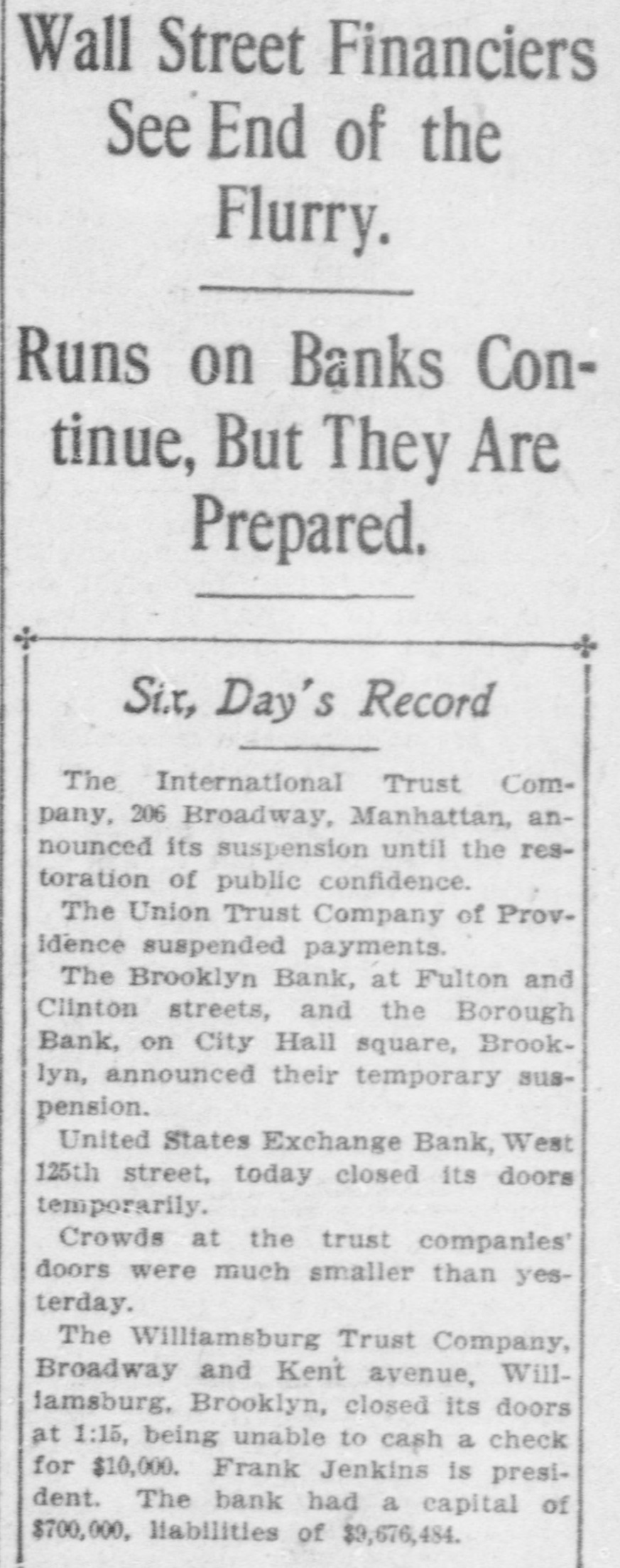
The Brooklyn Bank, at Fulton and Clinton streets, and the Borough Bank... announced their temporary suspension.
Source
newspapers
2.October 25, 1907Suspension
Cause
Local Banks
Cause Details
Temporary suspension triggered by inability to meet large withdrawals after the International Trust Company and other institutions suspended during the 1907 panic.
Newspaper Excerpt
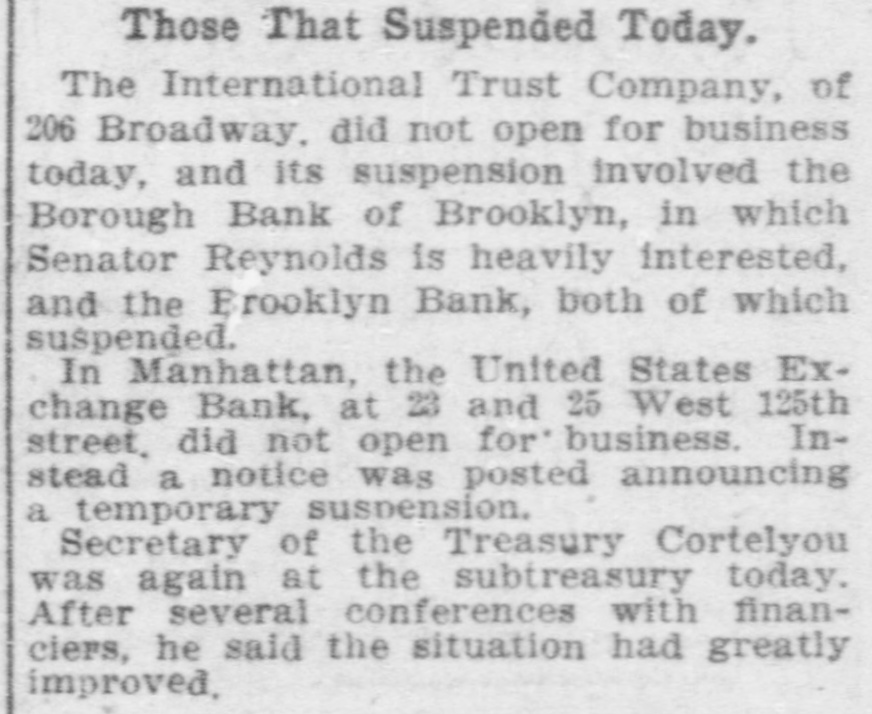
did not open for business today... the suspension involved the Borough Bank of Brooklyn, in which Senator Reynolds is heavily interested, and the Brooklyn Bank, both of which suspended.
Source
newspapers
3.November 16, 1907Receivership
Newspaper Excerpt
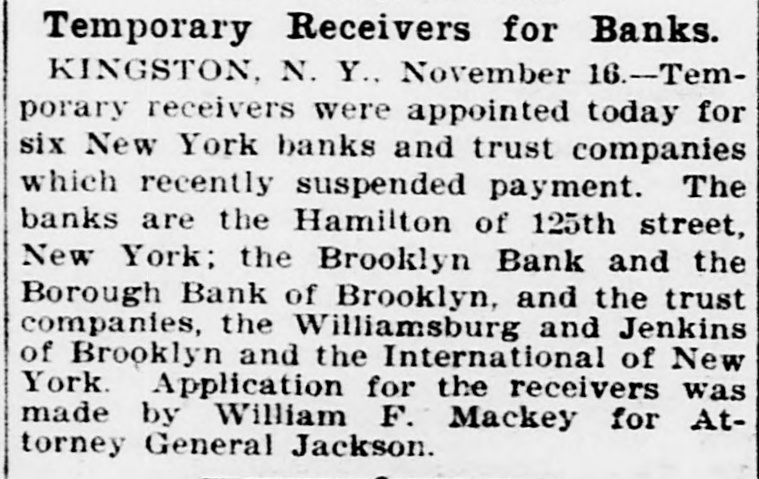
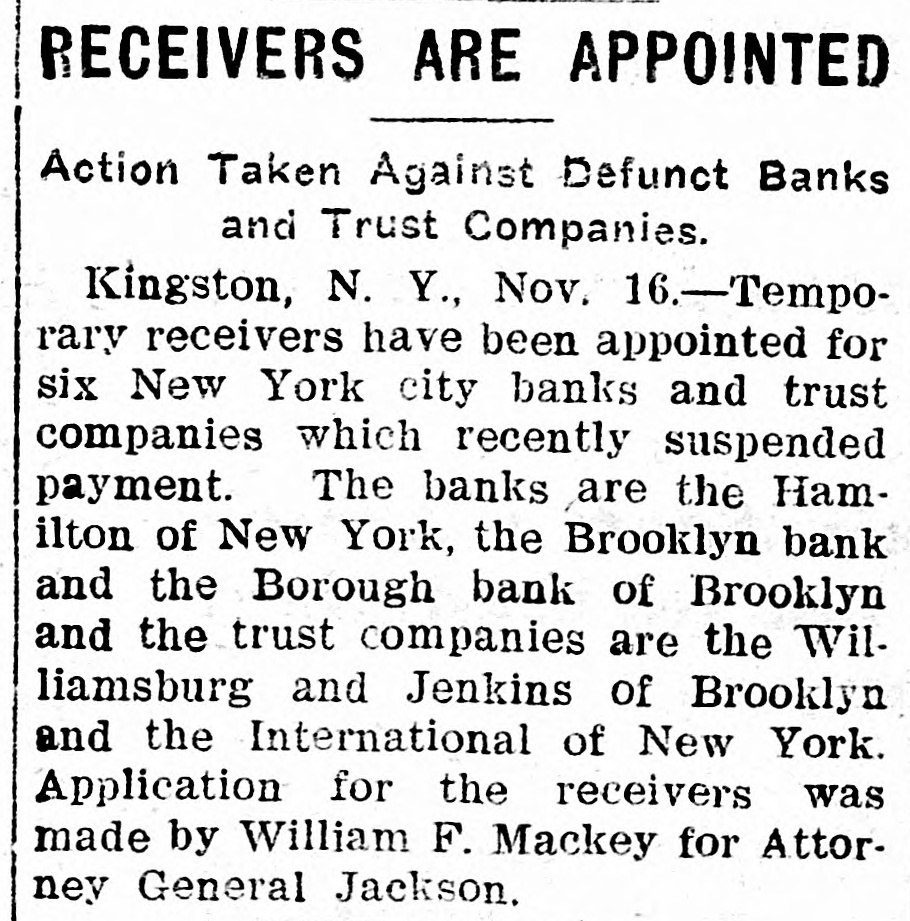
Temporary receivers were appointed today for six New York banks ... the Brooklyn Bank and the Borough Bank of Brooklyn were named.
Source
newspapers
4.June 23, 1908Reopening
Newspaper Excerpt
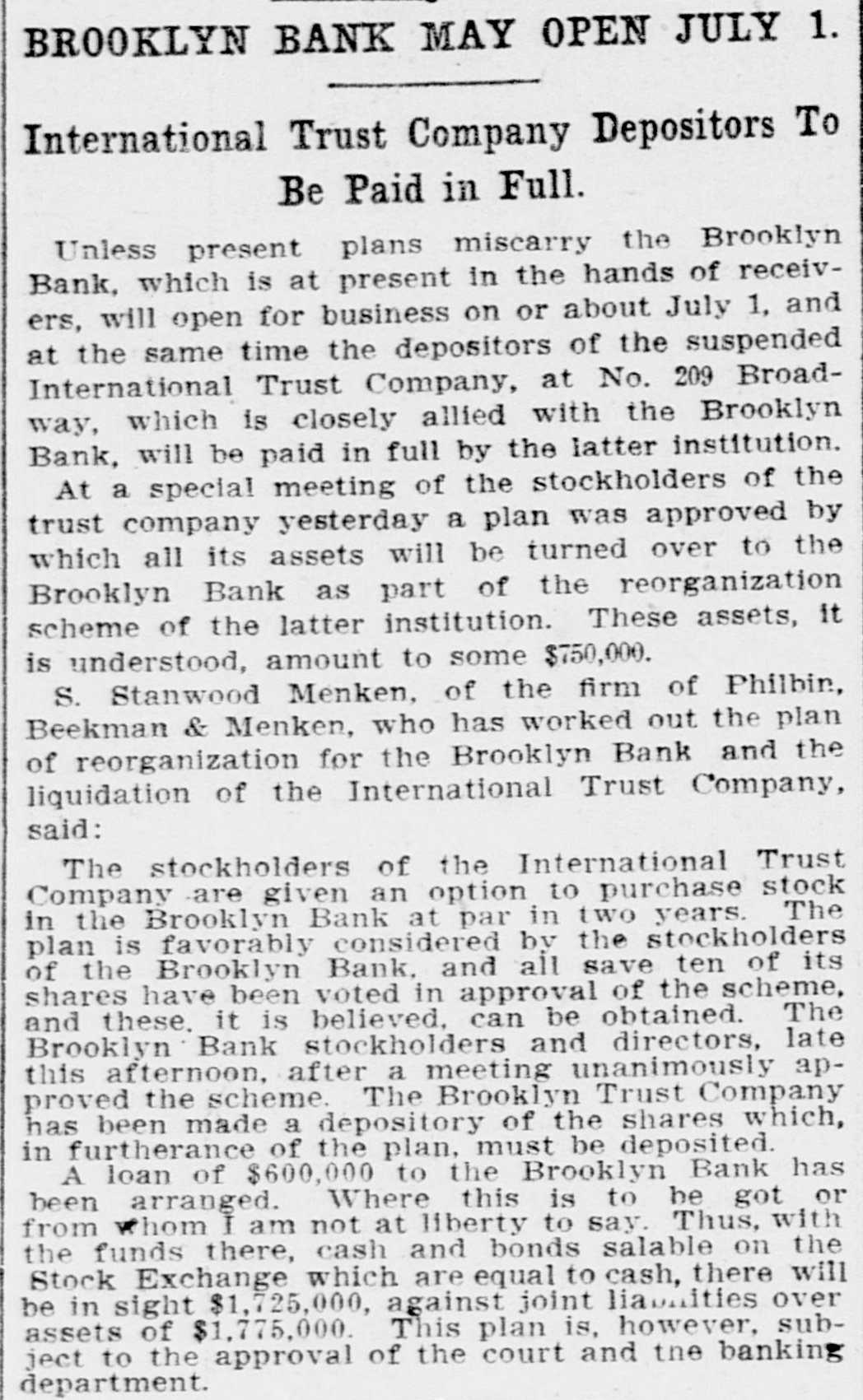
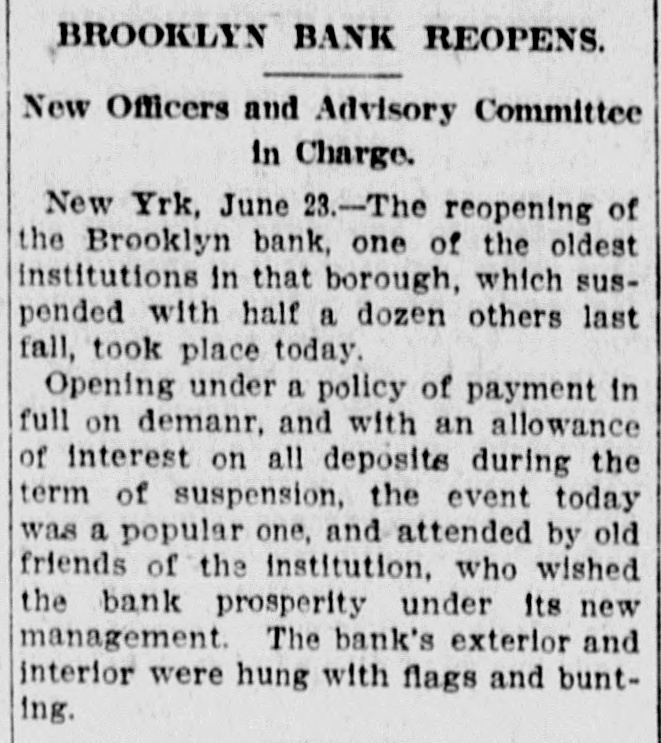
The reopening of the Brooklyn Bank ... which suspended with half a dozen others last fall, took place today. Opening under a policy of payment in full on demand...
Source
newspapers
Newspaper Articles (24)
1.October 25, 1907The Washington TimesWashington, DC
Click image to open full size in new tab
Article Text
Those That Suspended Today. The International Trust Company, of 206 Broadway. did not open for business today, and its suspension involved the Borough Bank of Brooklyn, in which Senator Reynolds is heavily interested, and the Brooklyn Bank, both of which suspended. In Manhattan, the United States Exchange Bank, at 23 and 25 West 125th street, did not open for business. Instead a notice was posted announcing a temporary suspension. Secretary of the Treasury Cortelyou was again at the subtreasury today. After several conferences with financiers, he said the situation had greatly improved.
2.October 25, 1907The Washington TimesWashington, DC
Click image to open full size in new tab
Article Text
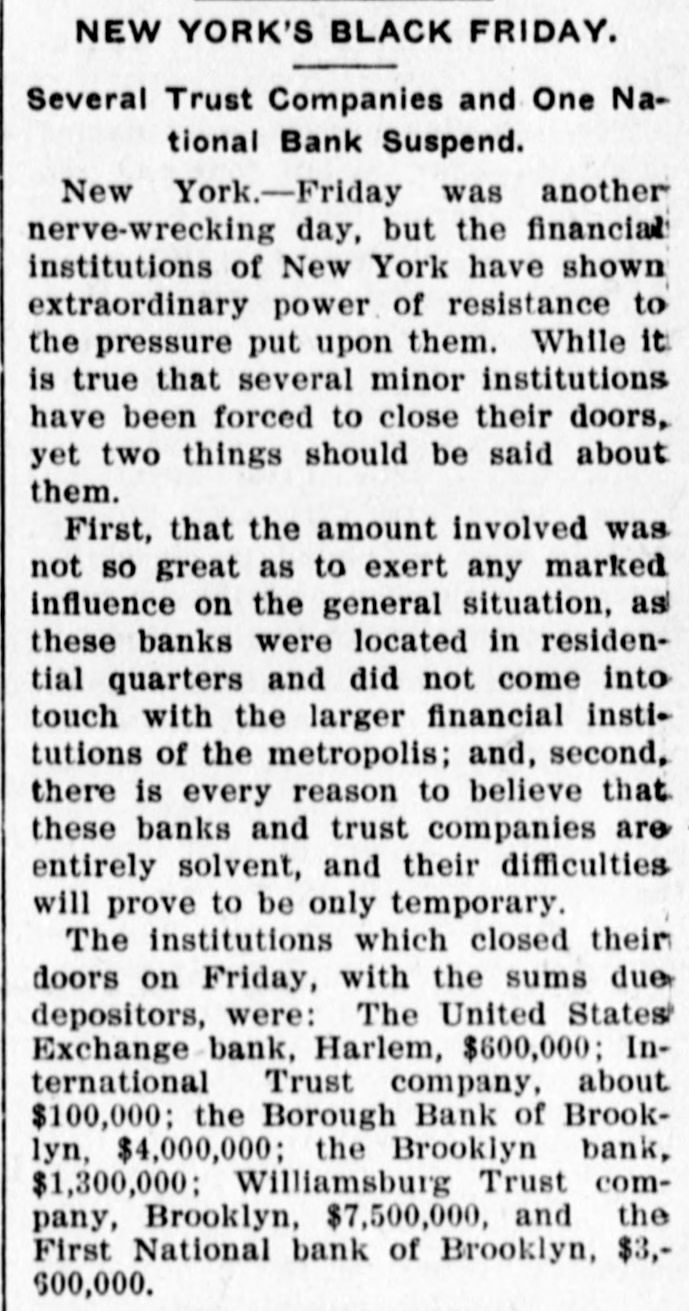
Wall Street Financiers See End of the Flurry. Runs on Banks Continue, But They Are Prepared. Six, Day's Record The International Trust Company, 206 Broadway, Manhattan, announced its suspension until the restoration of public confidence. The Union Trust Company of Providence suspended payments. The Brooklyn Bank, at Fulton and Clinton streets, and the Borough Bank, on City Hall square, Brooklyn, announced their temporary suspension. United States Exchange Bank, West 125th street, today closed its doors temporarily. Crowds at the trust companies' doors were much smaller than yesterday. The Williamsburg Trust Company, Broadway and Kent avenue, Willlamsburg, Brooklyn, closed its doors at 1:15, being unable to cash a check for $10,000. Frank Jenkins is president. The bank had a capital of $700,000, liabilities of $9,676,484.
3.October 26, 1907Americus Times-RecorderAmericus, GA
Click image to open full size in new tab
Article Text
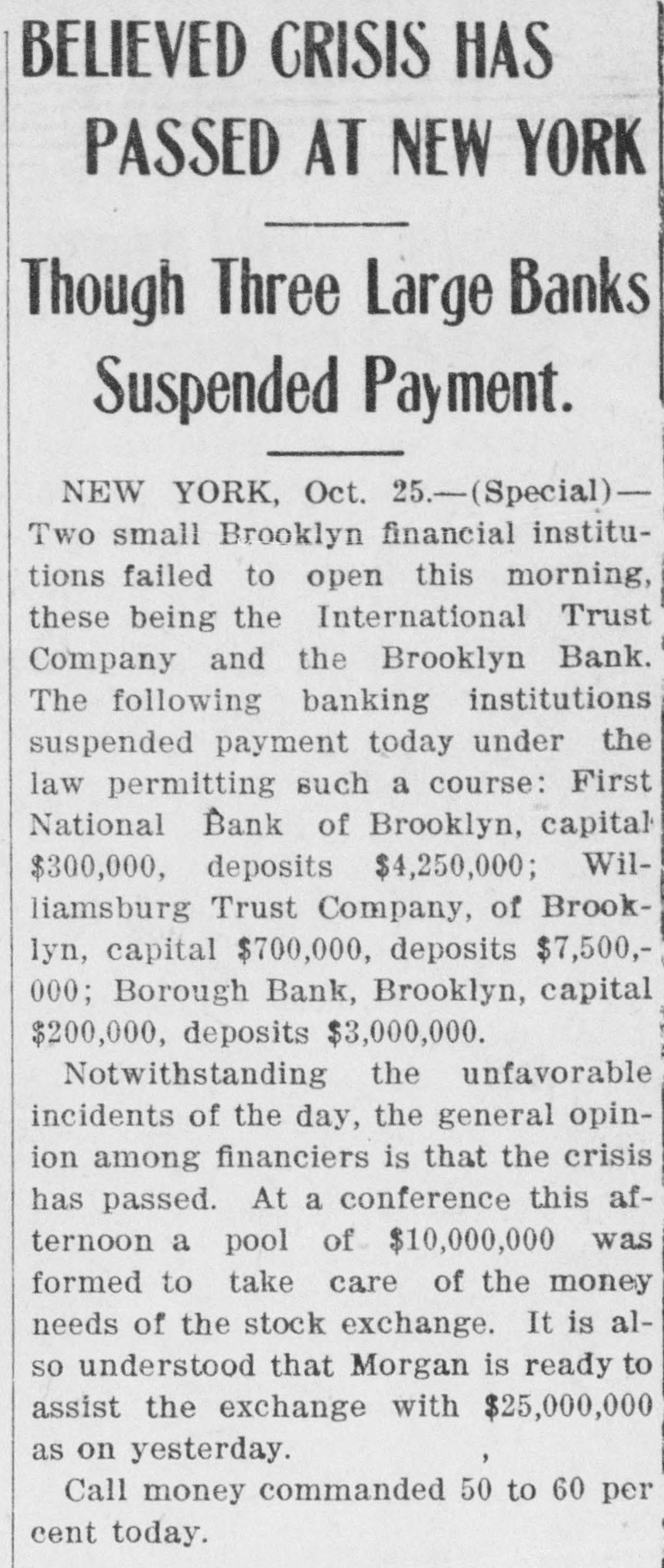
BELIEVED CRISIS HAS PASSED AT NEW YORK Though Three Large Banks Suspended Payment. NEW YORK, Oct. 25. -(Special)Two small Brooklyn financial institutions failed to open this morning, these being the International Trust Company and the Brooklyn Bank. The following banking institutions suspended payment today under the law permitting such a course: First National Bank of Brooklyn, capital $300,000, deposits $4,250,000; Williamsburg Trust Company, of Brooklyn, capital $700,000, deposits $7,500,000; Borough Bank, Brooklyn, capital $200,000, deposits $3,000,000. Notwithstanding the unfavorable incidents of the day, the general opinion among financiers is that the crisis has passed. At a conference this afternoon a pool of $10,000,000 was formed to take care of the money needs of the stock exchange. It is also understood that Morgan is ready to assist the exchange with $25,000,000 as on yesterday. Call money commanded 50 to 60 per cent today.
4.October 26, 1907The Washington HeraldWashington, DC
Click image to open full size in new tab
Article Text
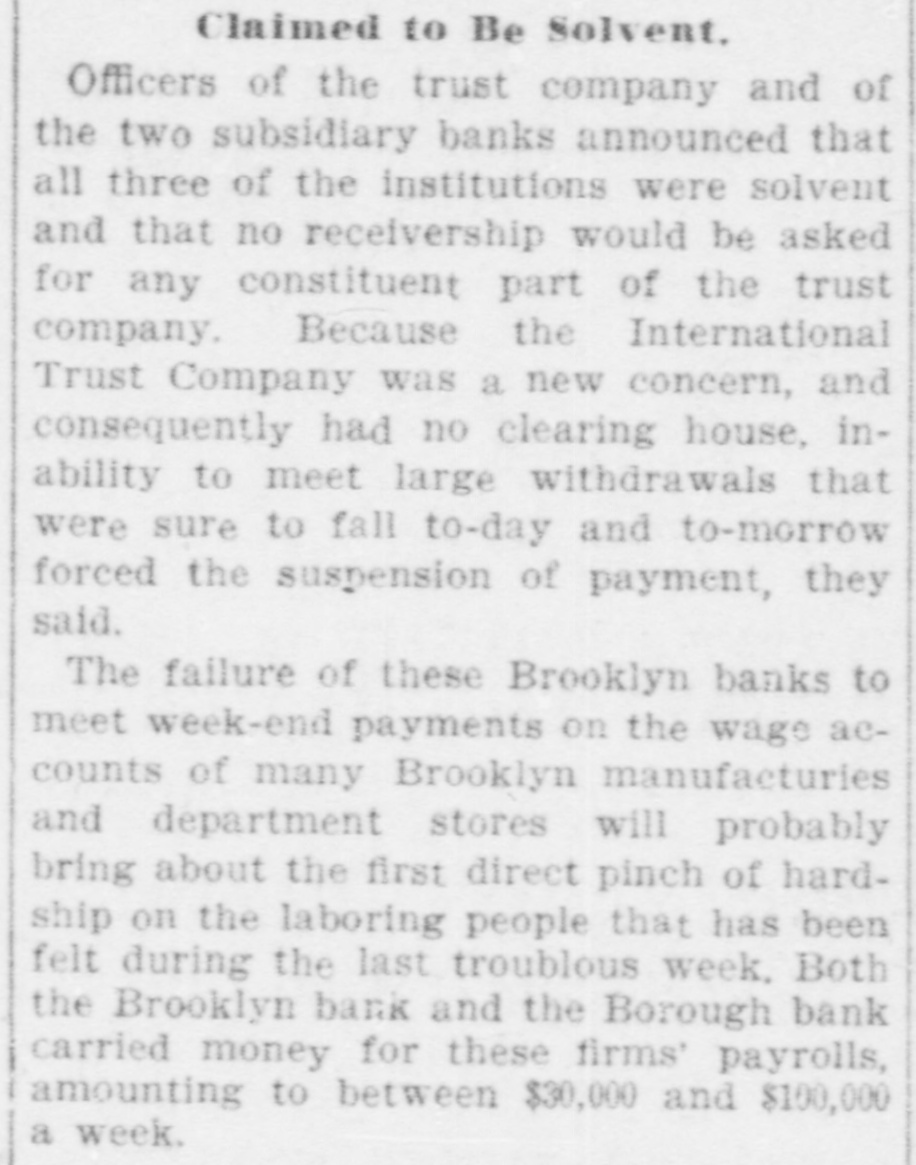
Claimed to Be Solvent. Officers of the trust company and of the two subsidiary banks announced that all three of the institutions were solvent and that no receivership would be asked for any constituent part of the trust company. Because the International Trust Company was a new concern, and consequently had no clearing house, inability to meet large withdrawals that were sure to fall to-day and to-morrow forced the suspension of payment, they said. The failure of these Brooklyn banks to meet week-end payments on the wage accounts of many Brooklyn manufacturies and department stores will probably bring about the first direct pinch of hardship on the laboring people that has been felt during the last troublous week. Both the Brooklyn bank and the Borough bank carried money for these firms' payrolls, amounting to between $30,000 and $100,000 a week.
5.November 16, 1907Evening StarWashington, DC
Click image to open full size in new tab
Article Text
Temporary Receivers for Banks. KINGSTON. N. Y., November 16.-Temporary receivers were appointed today for six New York banks and trust companies which recently suspended payment. The banks are the Hamilton of 125th street, New York; the Brooklyn Bank and the Borough Bank of Brooklyn, and the trust companies, the Williamsburg and Jenkins of Brooklyn and the International of New York. Application for the receivers was made by William F. Mackey for Attorney General Jackson.
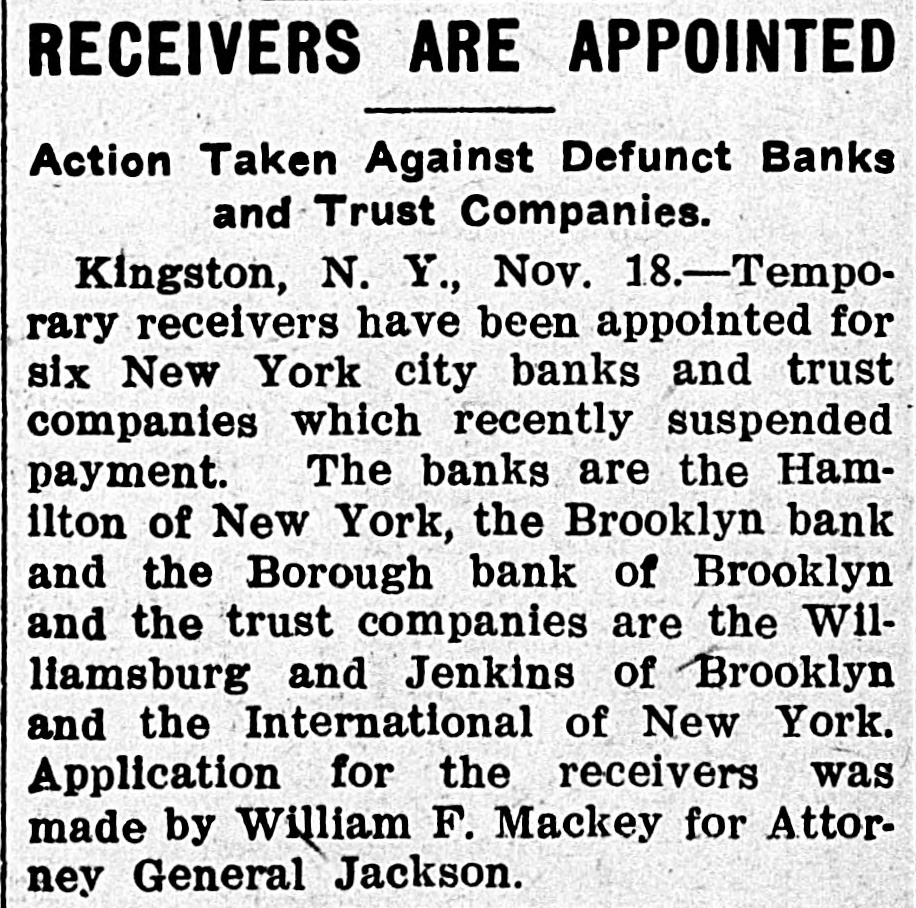
RECEIVERS ARE APPOINTED Action Taken Against Defunct Banks and Trust Companies. Kingston, N. Y., Nov. 18.-Temporary receivers have been appointed for six New York city banks and trust companies which recently suspended payment. The banks are the Hamilton of New York, the Brooklyn bank and the Borough bank of Brooklyn and the trust companies are the Williamsburg and Jenkins of Brooklyn and the International of New York. Application for the receivers was made by William F. Mackey for Attorney General Jackson.
7.November 20, 1907New Ulm ReviewNew Ulm, MN
Click image to open full size in new tab
Article Text
RECEIVERS ARE APPOINTED Action Taken Against Defunct Banks and Trust Companies. Kingston, N. Y., Nov. 16.-Temporary receivers have been appointed for six New York city banks and trust companies which recently suspended payment. The banks are the Hamilton of New York, the Brooklyn bank and the Borough bank of Brooklyn and the rust companies are the Williamsburg and Jenkins of Brooklyn and the International of New York. Application for the receivers was made by William F. Mackey for Attorney General Jackson.
8.November 21, 1907Reporter and FarmerWebster, SD
Click image to open full size in new tab
Article Text
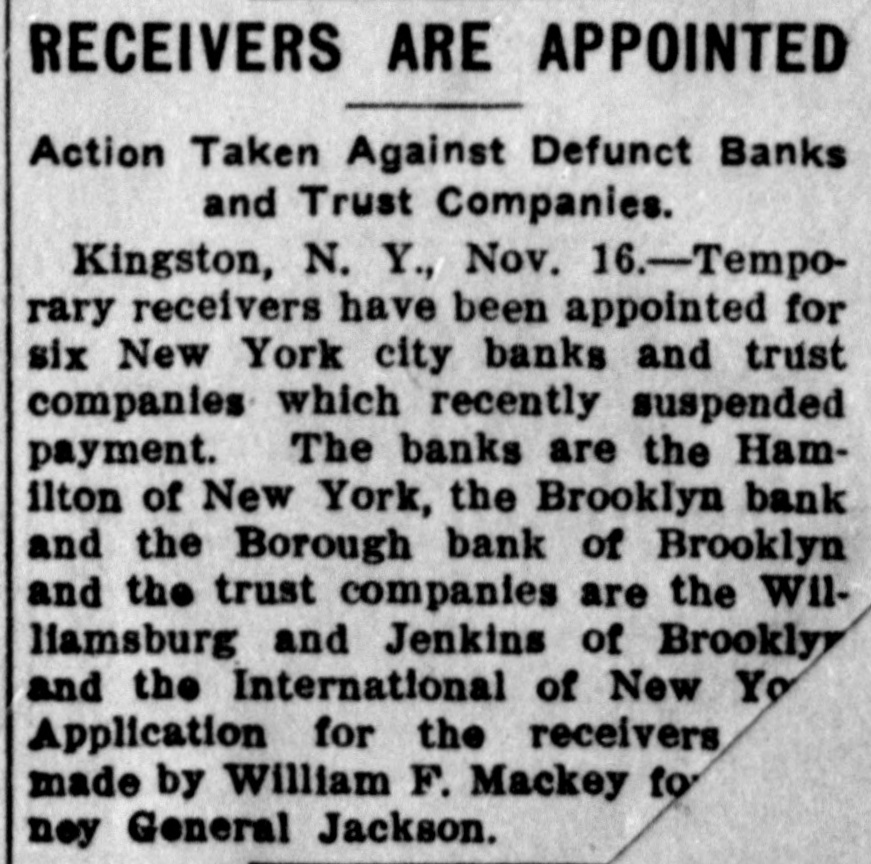
RECEIVERS ARE APPOINTED Action Taken Against Defunct Banks and Trust Companies. Kingston, N. Y., Nov. 16.-Temporary receivers have been appointed for six New York city banks and trust companies which recently suspended payment. The banks are the Hamilton of New York, the Brooklyn bank and the Borough bank of Brooklyn and the trust companies are the Williamsburg and Jenkins of Brookly and the International of New Yo Application for the receivers made by William F. Mackey to ney General Jackson.
9.November 21, 1907Reporter and FarmerWebster, SD
Click image to open full size in new tab
Article Text
RECEIVERS ARE APPOINTED Action Taken Against Defunct Banks and Trust Companies. Kingston, N. Y., Nov. 16.-Temporary receivers have been appointed for six New York city banks and trust companies which recently suspended payment. The banks are the Hamilton of New York, the Brooklyn bank and the Borough bank of Brooklyn and the trust companies are the Williamsburg and Jenkins of Brooklyn and the International of New York. Application for the receivers was made by William F. Mackey for Attorney General Jackson.
11.November 22, 1907Little Falls HeraldLittle Falls, MN
Click image to open full size in new tab
Article Text
RECEIVERS ARE APPOINTED Action Taken Against Defunct Banks and Trust Companies. Kingston, N. Y., Nov. 16.-Temporary receivers have been appointed for six New York city banks and trust companies which recently suspended payment. The banks are the Hamilton of New York, the Brooklyn bank and the Borough bank of Brooklyn and the trust companies are the Williamsburg and Jenkins of Brooklyn and the International of New York. Application for the receivers was made by William F. Mackey for Attorney General Jackson.
12.November 30, 1907The Seattle StarSeattle, WA
Click image to open full size in new tab
Article Text
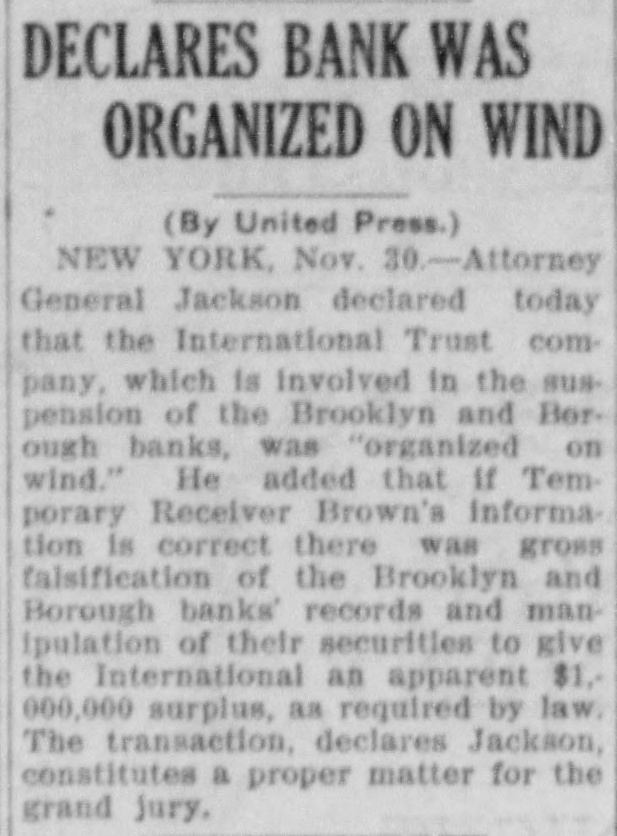
DECLARES BANK WAS ORGANIZED ON WIND (By United Press.) NEW YORK, Nov. 30.-Attorney General Jackson declared today that the International Trust company, which is Involved in the suspension of the Brooklyn and Borough banks, was "organized on wind." He added that if Temporary Receiver Brown's information is correct there was gross falsification of the Brooklyn and Borough banks' records and manipulation of their securities to give the International an apparent $1,000,000 surplus, as required by law. The transaction, declares Jackson, constitutes a proper matter for the grand jury,
13.December 9, 1907New-York TribuneNew York, NY
Click image to open full size in new tab
Article Text
INDICTMENTS THIS WEEK. Brooklyn Bank Inquiry May Show Results To-day. Two separate sets of indictments have been prepared by the Kings County grand jury as a result of its investigation of closed Brooklyn banking institutions last week. One of the sets will be handed down to-day. it is thought, and it was said yesterday that some of the men already indicted are those against whom some of the new indictments are drawn. The first set of indictments was prepared as a result of the investigation of the affairs of the Williamsburg Trust Company. of which Frank Jenkins, already under indictment, is the deposed president. The secend set was prepared as a result of the preliminary investigation of the Brooklyn Bank and conjointly with it of the International Trust Company. Brooklyn branch. of which William Gow. already facing five indictments, was the organizer The grand jury this week will prosecute a searching and thorough investigation of the last named institutions. It was only a few weeks before the International Trust Company closed its doors that it was announced the Brooklvn Bank had been merged with it. As a result of the failure of the International Trust Company, the appointment of receivers and of counsel for the depositors and the directors as well. and their investigations of the affairs of the two banks, a poculiar situation has arisen. The depositors are opposing the merger. They assert that it was never legally consummated, and they have announced their intention to fight any twelfth hour attempt to make the merger legal. On the other hand. the directors of the two institutions express themselves as favorable to the merger. although acknowledging that it may not have been legally brought about. They will use every effort to make it legal. The transactions of the Brooklyn Bank and the International Trust Company are interesting the grand jury, and will be carefully looked into by that body. These are The alleged "shaving of collateral." The transfer of $254,000 of stocks and bonds of the Borough Bank to the International Trust Company. which deposited said stocks and bonds with the First National Bank of Manhattan to secure 2 loan of $150,000 from that institution. From information obtained from the District Attorney's office it would appear that good collateral was put up to secure certain loans made by the Brooklyn Bank and that later. through the alleged connivance of certain persons in the bank. this collateral was removed and replaced by poorer collatteral, the "good" collateral being used, presumably. as security for more loans from other sources. This is the transaction referred to as "shaving collateral." S. S. Menken. of counsel for the Brooklyn Bank and the International Trust Company, has been working with directors of both institutions to prepare a plan to make the merger legal. It is understood that the so called merger was never really legal, because notice of the proposed merger was not published in two newspapers in Brooklyn and Manhattan at least two weeks before the stockholders voted on the question of the merger. as required by law. and because no application was made to a justice of the Supreme Court, as is also required by law. In talking of the merger Mr. Menken said: "According to the plan, the International Trust Company was to buy the assets of the Brooklyn Bank, including $1,300,000 of the depositors' money and $300,000 capital stock. It was to take over the accounts of the depositors. It should have set to pay the stockholders. but money paid to the over not aside done. $300,000 The Borough this Bank, was $500,000. was principally depositors' money. All that is necessary is to legalize the merger. Then if we get back what the Borough Bank owes US we will have $900,000 over and above all liabilities. The International Trust Company is not hampered by any bad loans. Gow has paid his $25,000 is all realizable, and have promised to loan. of both The institutions collateral directors advance money to put the plan through. W. R. Jones, jr., deposed president of the Oriental, has two small loans." It was learned yesterday that of the depositors' Sparks. chairman Frederick committee W. of twenty-five of the Borough Bank, had given Howformer president of the to the purchase of four ard help Maxwell. finance bank. hundred a note lots at Holliswood, Queens County. Both of these men were members of a syndicate formed to speculate in these lots, and each had a sixth interest in the speculation. Mr. Sparks made out a note in favor of the Borough Bank, and this note Mr. Maxwell discounted. Mr. Maxwell in his confession to the directors told them the note was good and would be paid when it fell due. Title to the lots was taken in Mr. Sparks's name and he signed a declaration of trust acknowledging that each member of the syndicate had a sixth interest in the property, Subsequently he transferred his Interest either to Mr. Maxwell or Mr. Doolittle, Mr. Gow's secretary. for at any rate Maxwell and Doolittle conveyed a third interest in the property to the bank. and this, by appraisal, will net the bank $20. 000 or $25.000 over and above the mortgage liens that are on the property, which amount to about $50,000 at least. The District Attorney's office is still receiving daily reports of the physical condition of W. R. Jones. jr., and as soon as he is well enough to testify he will appear before the grand jury. The depositors' committee of twenty-five of the Borough Bank met at the Assembly, Brooklyn, last night and discussed the report of the experts who have been examining the books of the bank during the last week. Plans were arranged for a mass meeting to-morrow night of depositors at the Columbia Theatre. THE mann arean
14.May 13, 1908The Star and Newark AdvertiserNewark, NJ
Click image to open full size in new tab
Article Text
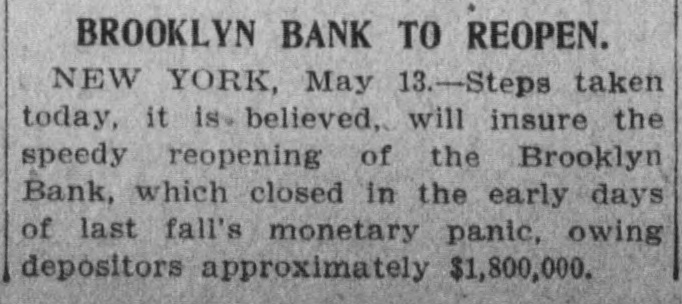
BROOKLYN BANK TO REOPEN. NEW YORK, May 13.-Steps taken today, it is believed, will insure the speedy reopening of the Brooklyn Bank, which closed in the early days of last fall's monetary panic, owing depositors approximately $1,800,000.
15.May 23, 1908New-York TribuneNew York, NY
Click image to open full size in new tab
Article Text
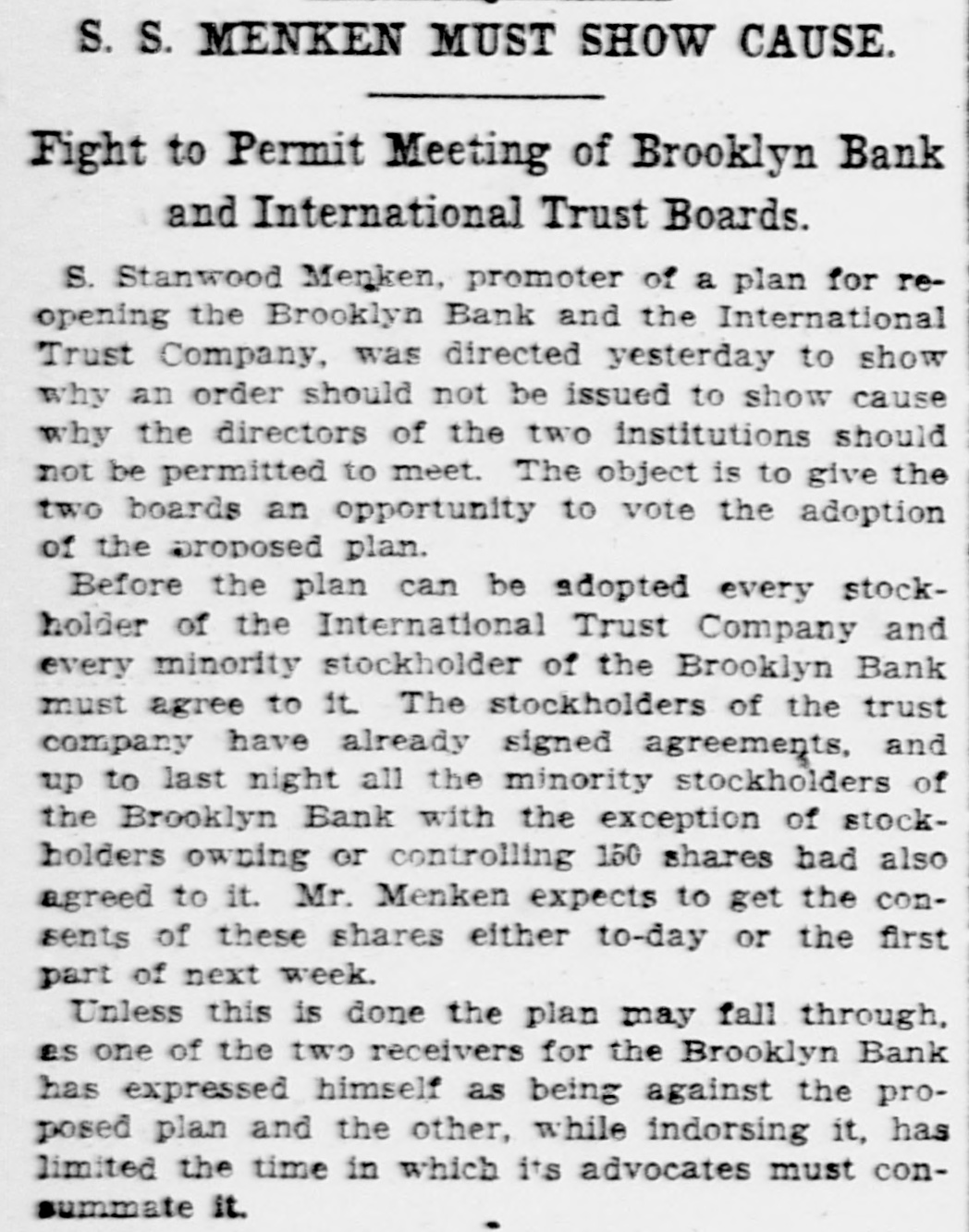
S. S. MENKEN MUST SHOW CAUSE. Fight to Permit Meeting of Brooklyn Bank and International Trust Boards. S. Stanwood Menken, promoter of a plan for reopening the Brooklyn Bank and the International Trust Company, was directed yesterday to show why an order should not be issued to show cause why the directors of the two institutions should not be permitted to meet. The object is to give the two boards an opportunity to vote the adoption of the proposed plan. Before the plan can be adopted every stockholder of the International Trust Company and every minority stockholder of the Brooklyn Bank must agree to it. The stockholders of the trust company have already signed agreements, and up to last night all the minority stockholders of the Brooklyn Bank with the exception of stockholders owning or controlling 150 shares had also agreed to it. Mr. Menken expects to get the consents of these shares either to-day or the first part of next week. Unless this is done the plan may fall through, es one of the two receivers for the Brooklyn Bank has expressed himself as being against the proposed plan and the other, while indorsing it, has limited the time in which its advocates must consummate it.
16.June 17, 1908The SunNew York, NY
Click image to open full size in new tab
Article Text
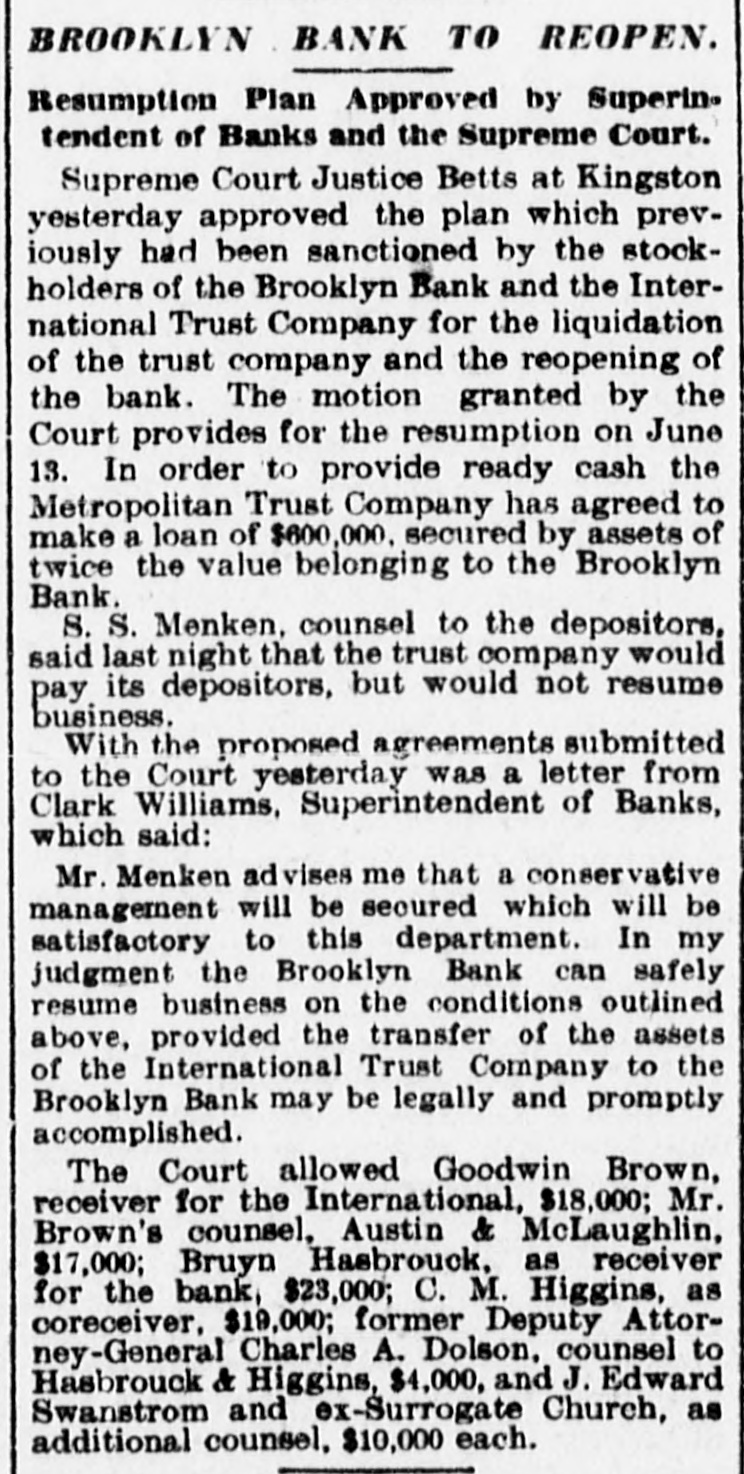
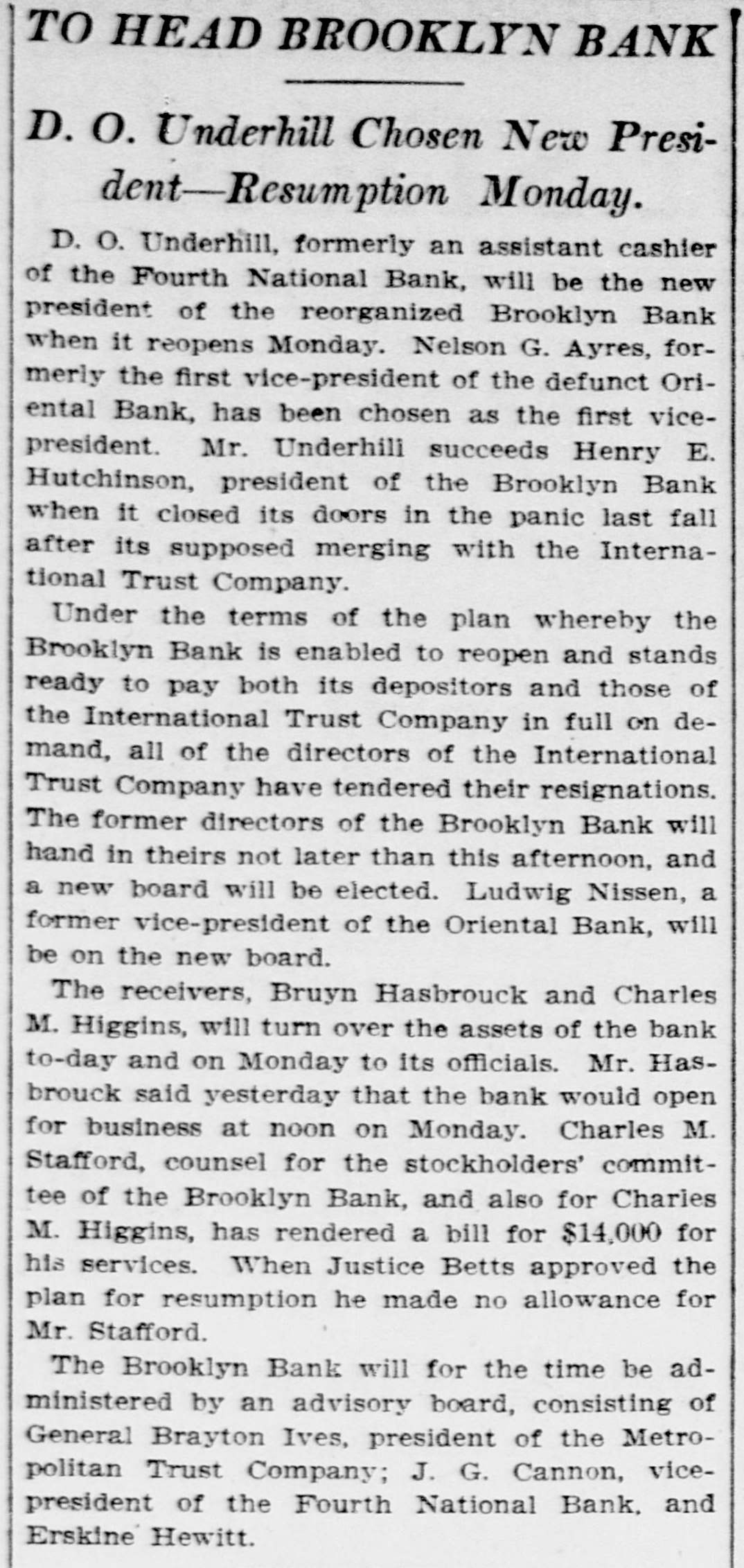
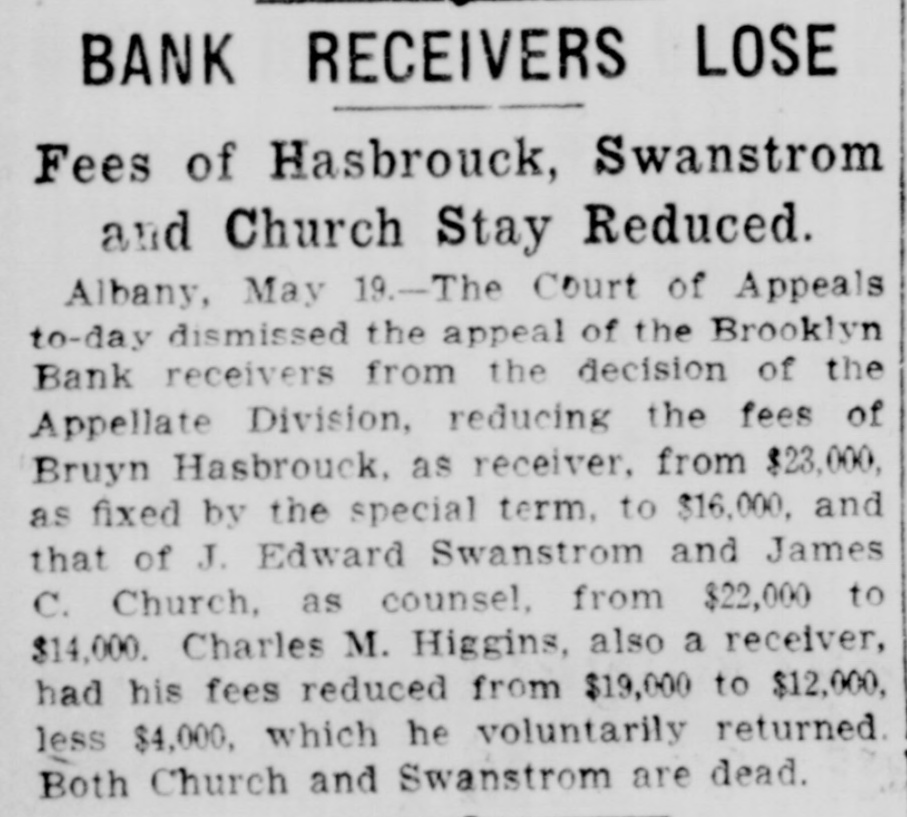
BROOKLYN BANK TO REOPEN. Resumption Plan Approved by Superintendent of Banks and the Supreme Court. Supreme Court Justice Betts at Kingston yesterday approved the plan which previously had been sanctioned by the stockholders of the Brooklyn Bank and the International Trust Company for the liquidation of the trust company and the reopening of the bank. The motion granted by the Court provides for the resumption on June 13. In order to provide ready cash the Metropolitan Trust Company has agreed to make a loan of $600,000. secured by assets of twice the value belonging to the Brooklyn Bank. S. S. Menken, counsel to the depositors, said last night that the trust company would pay its depositors, but would not resume business. With the proposed agreements submitted to the Court yesterday was a letter from Clark Williams, Superintendent of Banks, which said: Mr. Menken advises me that a conservative management will be secured which will be satisfactory to this department. In my judgment the Brooklyn Bank can safely resume business on the conditions outlined above, provided the transfer of the assets of the International Trust Company to the Brooklyn Bank may be legally and promptly accomplished. The Court allowed Goodwin Brown, receiver for the International, $18,000; Mr. Brown's counsel, Austin & McLaughlin, $17,000; Bruyn Hasbrouck, as receiver for the bank, $23,000; C. M. Higgins, as coreceiver, $19,000; former Deputy Attorney-General Charles A. Dolson, counsel to Hasbrouck & Higgins, $4,000, and J. Edward Swanstrom and ex-Surrogate Church, as additional counsel, $10,000 each.
BROOKLYN BANK REOPENS. New Officers and Advisory Committee in Charge. New Yrk, June 23.-The reopening of the Brooklyn bank, one of the oldest institutions in that borough, which suspended with half a dozen others last fall, took place today. Opening under a policy of payment in full on demanr, and with an allowance of interest on all deposite during the term of suspension, the event today was a popular one, and attended by old friends of the institution, who wished the bank prosperity under its new management. The bank's exterior and interior were hung with flags and bunting.
18.July 2, 1908Lewiston Evening TellerLewiston, ID
Click image to open full size in new tab
Article Text
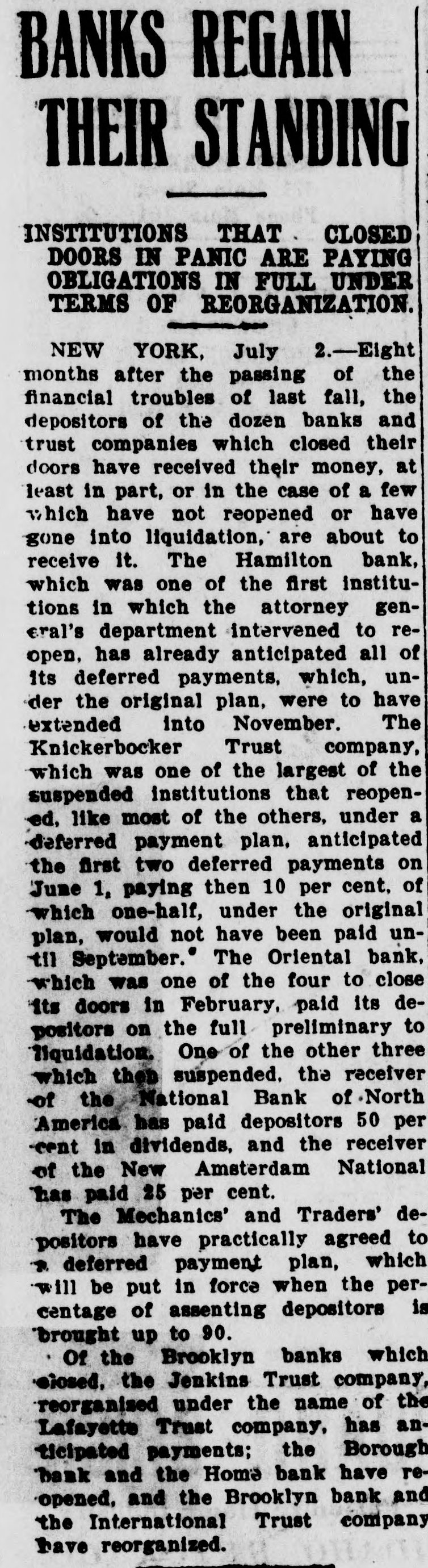
BANKS REGAIN THEIR STANDING INSTITUTIONS THAT CLOSED DOORS IN PANIC ARE PAYING OBLIGATIONS IN FULL UNDER TERMS OF REORGANIZATION. NEW YORK, July 2.-Eight months after the passing of the financial troubles of last fall, the depositors of the dozen banks and trust companies which closed their doors have received their money, at least in part, or in the case of a few which have not reopened or have gone into liquidation, are about to receive it. The Hamilton bank, which was one of the first institutions in which the attorney general's department intervened to reopen, has already anticipated all of its deferred payments, which, under the original plan, were to have extended into November. The Knickerbocker Trust company, which was one of the largest of the suspended institutions that reopened, like most of the others, under a deferred payment plan, anticipated the first two deferred payments on June 1, paying then 10 per cent, of which one-half, under the original plan, would not have been paid until September. The Oriental bank, which was one of the four to close its doors in February, paid its depositors on the full preliminary to liquidation. One of the other three which then suspended. the receiver of the National Bank of -North America has paid depositors 50 per -cent in dividends, and the receiver of the New Amsterdam National has paid 25 per cent. The Mechanics' and Traders' depositors have practically agreed to s deferred payment plan, which will be put in force when the percentage of assenting depositors is brought up to 90. Of the Brooklyn banks which elosed, the Jenkins Trust company, reorganized under the name of the Lafayette Trust company, has anticipated payments; the Borough 'hank and the Homa bank have reopened, and the Brooklyn bank and the International Trust company have reorganized.
19.July 2, 1908Lewiston Evening TellerLewiston, ID
Click image to open full size in new tab
Article Text
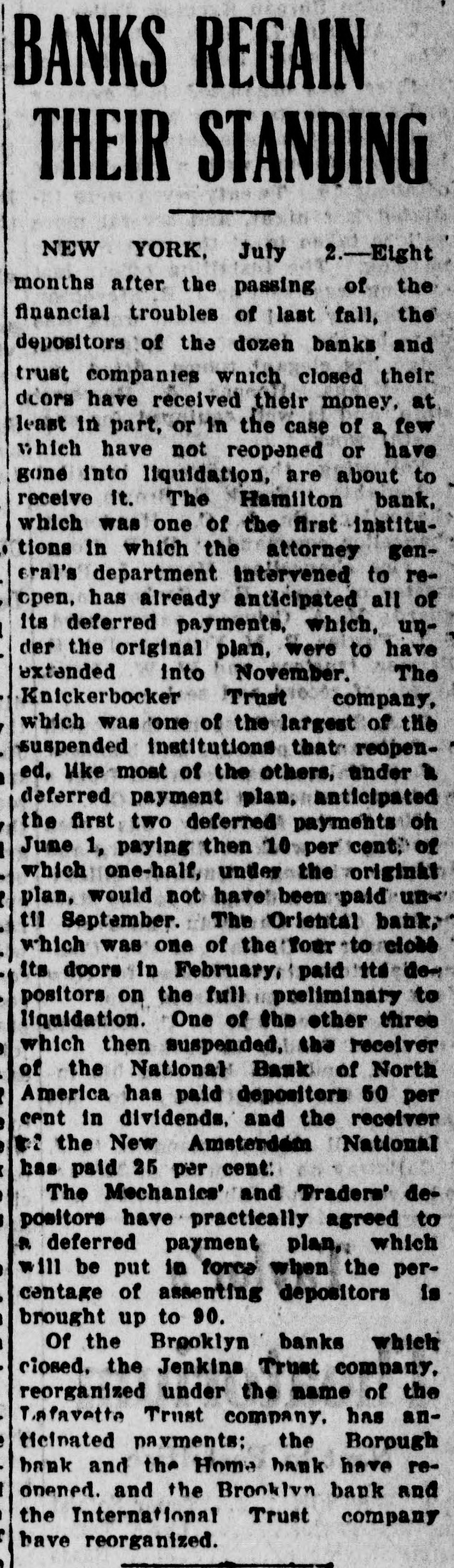
BANKS REGAIN THEIR STANDING NEW YORK, July 2.-Eight months after the passing of the financial troubles of last fall, the depositors of the dozen banks and trust companies which closed their doors have received their money, at least in part, or in the case of a few which have not reopened or have gone into liquidation, are about to receive it. The Hamilton bank, which was one of the first institutions in which the attorney general's department Intervened to reopen, has already anticipated all of its deferred payments, which, under the original plan, were to have extended into November. The Knickerbocker Trust company, which was one of the largest of the suspended institutions that reopened, like most of the others, under in deferred payment plan, anticipated the first two deferred payments oh June 1, paying then 10 per cent, of which one-half, under the original plan, would not have been paid until September. The Oriental bank, which was one of the four to close its doors in February, paid its de-: positors on the full preliminary to liquidation. One of the other three which then suspended, the receiver of the National Bank of North America has paid depositors 50 per cent in dividends, and the receiver to: the New Amsterdam National has paid 25 per cent: The Mechanics' and Traders' depositors have practically agreed to R. deferred payment plan, which will be put in force when the percentage of assenting depositors is brought up to 90. Of the Brooklyn banks which closed. the Jenkins Trust company, reorganized under the name of the T.afavette Trust company. has anticinated payments: the Borough bank and the Home bank have reonened. and the Brooklyn bank and the International Trust company have reorganized.
20.July 3, 1908The Julesburg Grit-AdvocateJulesburg, Big Springs, CO
Click image to open full size in new tab
Article Text
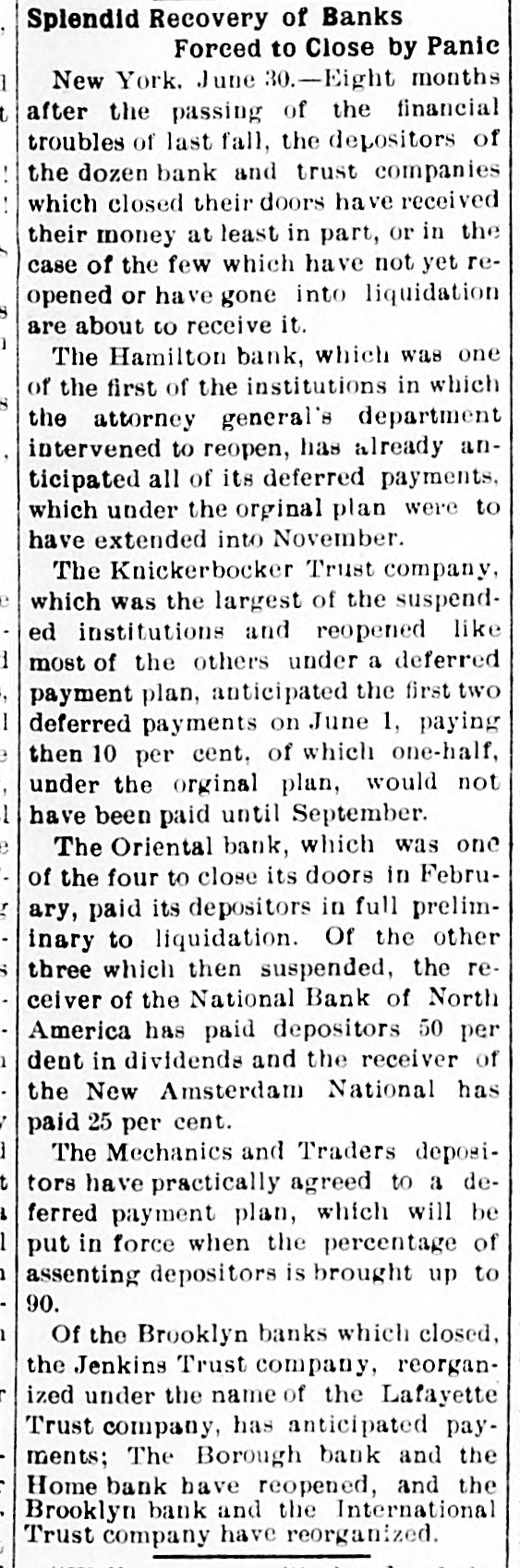
Splendid Recovery of Banks Forced to Close by Panic 1 New York. June 30.-Eight months t after the passing of the financial troubles of last fall, the depositors of the dozen bank and trust companies which closed their doors have received their money at least in part, or in the case of the few which have not yet reopened or have gone into liquidation are about to receive it. The Hamilton bank, which was one of the first of the institutions in which the attorney general's department intervened to reopen, has already anticipated all of its deferred payments, which under the orginal plan were to have extended into November. The Knickerbocker Trust company, e which was the largest of the suspended institutions and reopened like 1 most of the others under a deferred payment plan, anticipated the first two deferred payments on June 1, paying then 10 per cent, of which one-half, under the orginal plan, would not have been paid until September. The Oriental bank, which was one of the four to close its doors in February, paid its depositors in full preliminary to liquidation. Of the other three which then suspended, the receiver of the National Bank of North America has paid depositors 50 per 1 dent in dividends and the receiver of the New Amsterdam National has paid 25 per cent. The Mechanics and Traders depositors have practically agreed to a de1 ferred payment plan, which will be put in force when the percentage of assenting depositors is brought up to 90. Of the Brooklyn banks which closed, the Jenkins Trust company, reorganized under the name of the Lafayette Trust company, has anticipated payments; The Borough bank and the Home bank have reopened, and the Brooklyn bank and the International Trust company have reorganized.
21.December 22, 1908New-York TribuneNew York, NY
Click image to open full size in new tab
Article Text
MR. HIGGINS'S COUNSEL GOT $12,000. Brooklyn Bank Receiver Had Objected to Other Attorney's Bills for $11,000. Charles M. Stafford, the personal counsel of Charles M. Higgins, as receiver of the Brooklyn Bank. received $12,000 for the work which he did. Mr. Higgins objected a few days ago to the payment of $11,000 each to J. Edward Swanstrom and James C. Church. official counsel for the receiver. "Mr. Stafford worked from October, when the bank closed. until the following June, when it reopened. part of the time for the depositors' committee and part of the time for me," said Mr. Higgins last right. "He probably did more work than any other man in connection with the reopening of the institution. For his fees be worked eight months. while Mr. Church and Mr. Swanstrom worked only two and one-half months, and want $11,000 for their efforts. They were really entitled to about $3.500 each." Mr. Higgins said that he would issue a statement in a few days regarding the expenditures in connection with his receivership. The depositors' committee will also issue a statement.
22.December 31, 1908New-York TribuneNew York, NY
Click image to open full size in new tab
Article Text
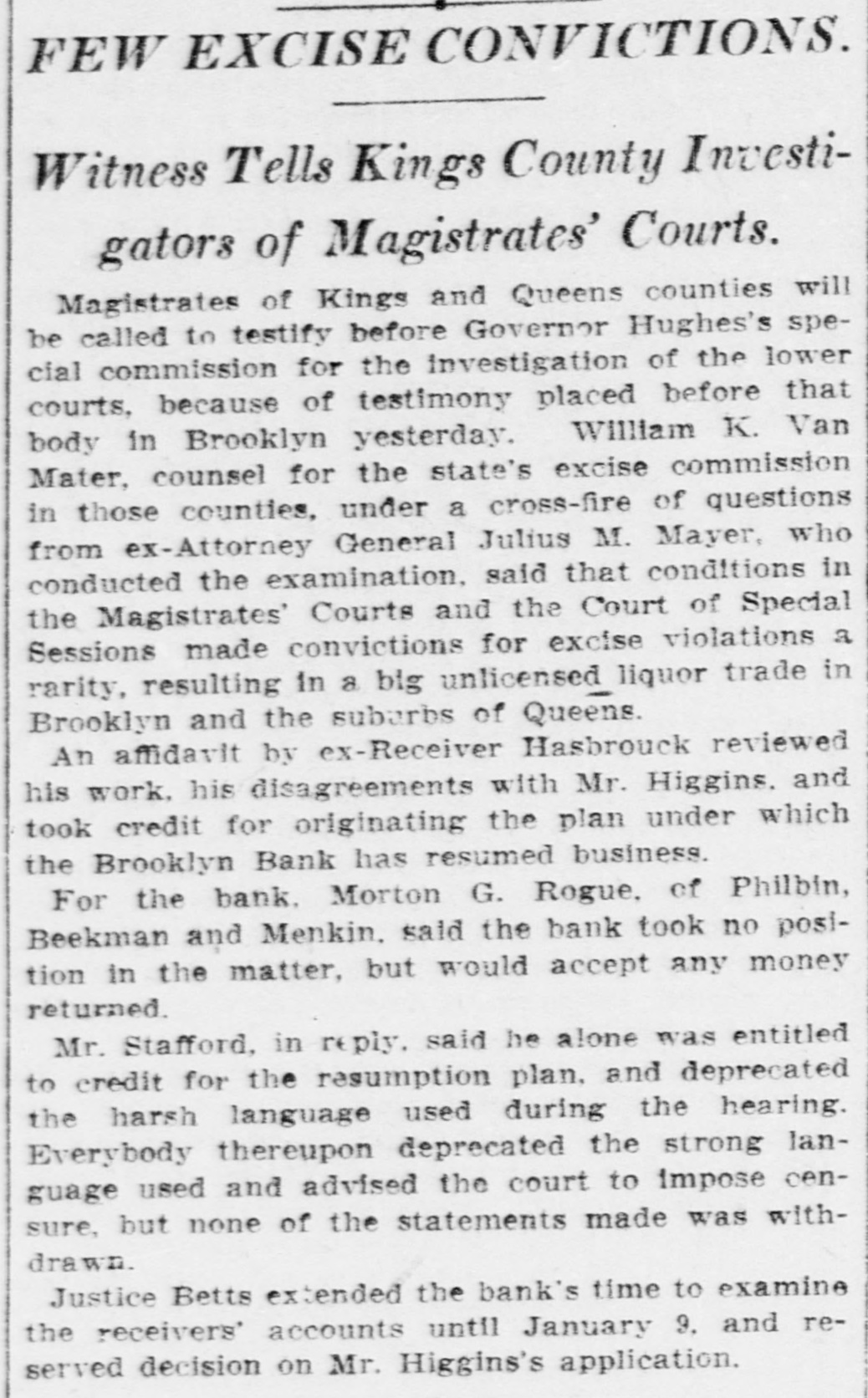
FEW EXCISE CONVICTIONS. Witness Tells Kings County Investigators of Magistrates' Courts. Magistrates of Kings and Queens counties will be called to testify before Governor Hughes's special commission for the investigation of the lower courts, because of testimony placed before that body in Brooklyn yesterday. William K. Van Mater, counsel for the state's excise commission in those counties, under a cross-fire of questions from ex-Attorney General Julius M. Mayer, who conducted the examination, said that conditions in the Magistrates' Courts and the Court of Special Sessions made convictions for excise violations a rarity, resulting in a big unlicensed liquor trade in Brooklyn and the subarbs of Queens. An affidavit by ex-Receiver Hasbrouck reviewed his work. his disagreements with Mr. Higgins. and took credit for originating the plan under which the Brooklyn Bank has resumed business. For the bank. Morton G. Rogue. of Philbin, Beekman and Menkin. said the bank took no position in the matter, but would accept any money returned. Mr. Stafford, in reply. said he alone was entitled to credit for the resumption plan. and deprecated the harsh language used during the hearing. Everybody thereupon deprecated the strong language used and advised the court to impose censure, but none of the statements made was withdrawn. Justice Betts extended the bank's time to examine the receivers' accounts until January 9. and reserved decision on Mr. Higgins's application.
IS VICTIM OF MONEY TRUST So Testifies R. W. Jones, Sound Banks Closed. New York, June 8.-R. W. Jones, former president of the Oriental bank, which was closed during the panic of 1907, produced on the witness stand at the "money trust" inquiry a letter from Hugh Kelly, the succeeding president. to the effect that the acton of the Clearing House committee in forcing the bank to close blasted the career of Jones. Mr. Jones also said that the order of the committee to him to refuse to clear for the Borough bank and the Brooklyn bank of Brooklyn was the cause of their failure. Following this the district attorney of Brooklyn prose. cuted officials of these institutions. The letter of Mr. Kelly created something of a sensation at the hearing. From the position of president of an important bank in this city Jones had gone to a small brokerage office. He did not look prosperous while on the stand.
24.March 16, 1914The SunNew York, NY
Click image to open full size in new tab
Article Text
ECHO OF 1907 PANIC HEARD. International Trust Co. Stockholdera May Dissolve Concern. A special meeting of the stockholders of the International Trust Company, which was organized in October. 1907. and closed a few weeks afterward in the panic, will be held to-day in the offices of Beekman, Menken & Griscom, 52 William street, to vote on the question of dissolution. Other questions will be considered. The International Trust Company was organized by William Gow of the advertising firm of Ward & Gow and several omers and directors of the Brooklyn Bank. It absorbed the Brooklyn Bank. Howard Maxwell was chosen president. The bank could not stand the straip of the first days of the panic and went to the wall. Goodwin Brown was appointed receiver. The Brooklyn Bank took over the assets of the International Trust Company and opened its doors in June, 1908, and paid all the depositors.
Bank runs are almost always and everywhere a deterioration of bank fundamentals.
But not for you.
You are the measure-zero exception: great fundamentals, solid bank, and yet the Diamond Dybvig fairy spread its rumor. Depositors woke up. Your collateral was not prepositioned. The Clearinghouse had it for you.
Do not pass Go. Do not collect $200. Go directly to jail… or worse.