Guardian Savings Institution (New York, NY)

Episode Information

Episode UID
9926978490863
Episode Type
Suspension β†’ Closure
Bank Type
savings
Bank ID
992697849 hash
Start Date
November 18, 1871
Location
New York, New York (40.714, -74.006)

Metadata

Model
gpt-5-mini (chosen from majority vote of a three-model LLM ensemble)
Short Digest
5ea4968fc81f07f8

Response Measures

None

Events (2)

1. November 18, 1871 Suspension
Cause
Bank Specific Adverse Info
Cause Details
Bank stopped payment and was insolvent/failed; petition later filed alleging fraudulent stoppage of payments and insolvency.
Newspaper Excerpt
The Guardian Savings Institution on Chatham street, New York, has failed.
Source
newspapers
2. November 21, 1871 Receivership
Newspaper Excerpt
A petition was filed ... in the United States District Court, to have it declared a bankrupt; the acts of bankruptcy charged are that it fraudulently stopped payment ... The petition is filed at the instance of Julius Ascher, a depositor in the bank, and is made returnable next Saturday.
Source
newspapers

Newspaper Articles (13)

Article from Knoxville Daily Chronicle, November 19, 1871

Click image to open full size in new tab

Article Text

LATEST BY TELEGRAPH. -0 FOREIGN NEWS BY THE CABLE. o Miscellaneous and Washington News. J HOME NEWS. HARDWARE WORKS BURNED. Marine Disasters-Beveridge's Majority. WASHINGTON, Nov. 18.-Penfield & Son's hardware works at Middletown, Conn., were burned last night, loss $50,000. There were two deaths from cholera at the New York quarantine yesterday. The schooner Alice Mary was lost in Petite Passage. The French ship of war Bouvett was lost on Folly Reef. The crew were saved. The 78th regiment leaves Halifax for Queenstown this week. The majority for Beveridge, Congressman at Large in Illinois, is only 19,000. The disguised men who hung three nogroes for the murder of the Park family, met no serious resistance. The assailants beat down two doora of the Charleston, Indiana jail, when the Sheriff Save them the key to the third door. It is understood that the negroes made additional confessions before their execution. Three counties contributed to the men engaged in the execution. The Reporters of New York publish a letter complaining of continued abstraction of goods coming through the custom house, At Prospect Park, Kingston and mate beat Hornet Allen and mate for two thousand dollare. Time-2:19}; 2:17: 20. PPILADELPHIA, Nov, 18.-The Athletics Base Ball Club has received notice from the Champion Committee that the Athletics have been declared champion, and that the white pennant awaits their orders. The Guardian Savings Institution on Chatham street, New York, has failed. Tweed was the President. The Trustees say the assets were abundant, though not immediately available. The crew of the vessel P. C. Sperman are wrecked on Lake Erie. All are safe except the chambermaid, who died from exposure. The crew drifted twenty hours in an open boat. Several of the crew of the City Mexico, from Havana, have been arrested at New Yord for smuggling cigars. NEW YORK, Nov. 18.-Judge Gilbert has de nied the application for a writ to compel the Brooklyn Board of Canvassers to reject the returns of certain districts of Brooklyn. An extensive run on the Bowling Green Savings Bank was caused by its rumored connection with the Guardian Savings Bank. SAVANNAH, Nov. 18.-Heavy frost this morming, the fourth of the season. Weather decidedly cool. The fair of the Industrial Exposition which opens here next Tuesday, promèses the 8 complete success within all departments. The very full attendance promises to be unusually large. NORFOLK, Nov. 18.-The steamship Equator, from Galveston to New York, putin here short of coal. She sails' in the morning. She experienced stormy northeast gales the whole passage. NEWBERN, N. C., Nov. 18.-The steamer Mary Sanford, on a voyage from Wilmington for Philadelphia, sprung a leak and was beached at Cape Hatteras, with sixty feet of water in the hold. She took fire immediately after reaching beach and burned to the water's edge. The vessel is a total loss. A small portion of the cargo was saved. No lives were lost.
Article from New-York Tribune, November 21, 1871

Click image to open full size in new tab

Article Text

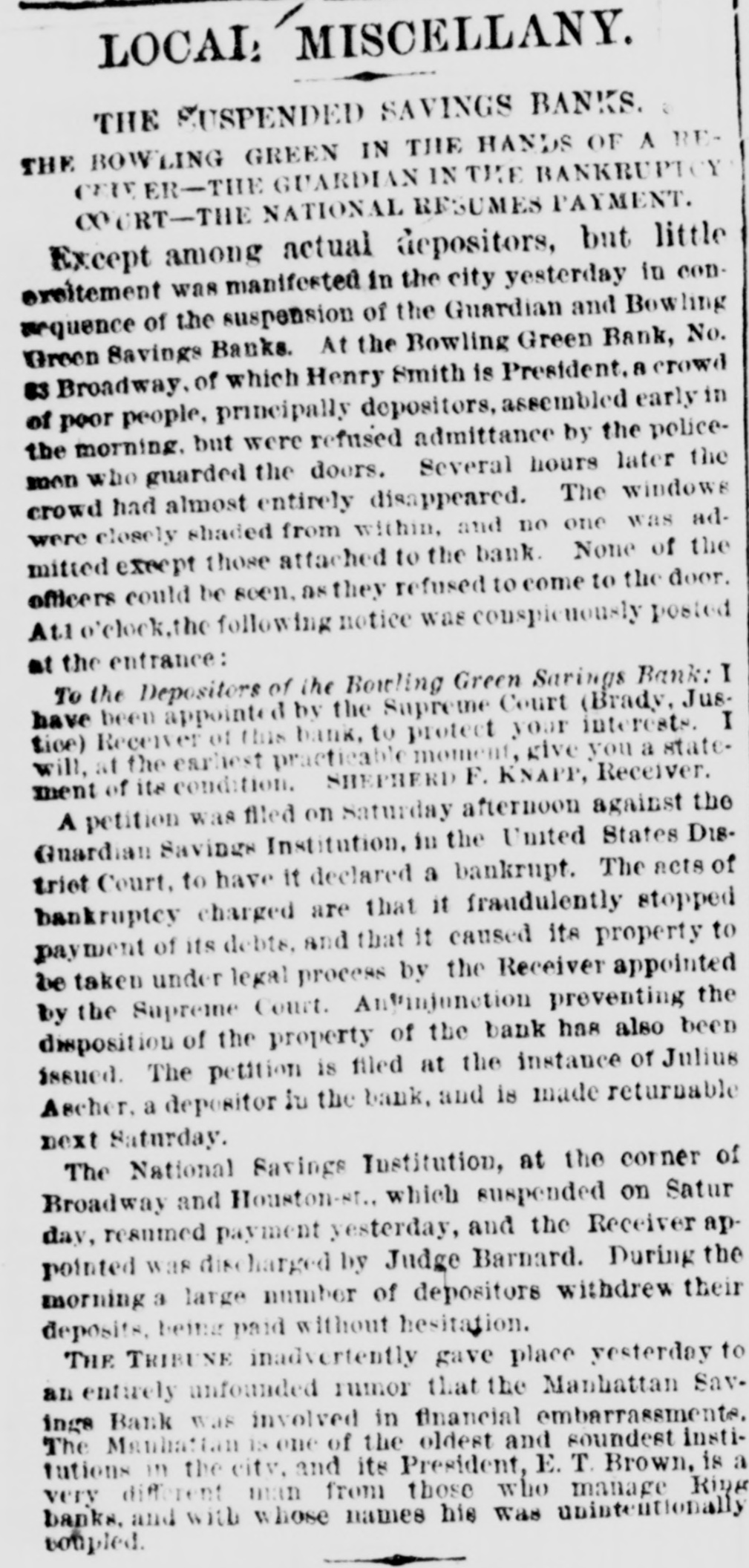
MISCELLANY. LOCAL THE SUSPENDED SAVINGS BANKS. THE BOWLING GREEN IN THE HANDS OF A RECENTER-THE GUARDIAN IN THE BANKRUPIC COURT-THE NATIONAL RESUMES PAYMENT. Except among actual depositors, but little exeitement was manifested in the city yesterday in consequence of the suspension of the Guardian and Bowling Green Savings Banks. At the Bowling Green Bank, No. 83 Broadway. of which Henry Smith is President. A crowd of poor people, principally depositors, assembled early in the morning. but were refused admittance by the policemen who guarded the doors. Several hours later the crowd had almost entirely disappeared. The windows were closely shaded from within, and no one was admitted except those attached to the bank. None of the officers could be seen, as they refused to come to the door. Atl o'clock. the following notice was conspienously posted at the entrance: To the Depositors of the Bowling Green Sarings Bank: I have been appointe d by the Supreme Court (Brady, Justice) Receiver of this bank, to protect your interests. I will, at the earliest practicable moment, give you a state. ment of its condition. SHEPHERD F. KNAPP, Receiver. A petition was filed on Saturday afternoon against the Guardian Savings Institution. in the United States Distriot Court, to have If declared a bankrupt. The acts of bankruptcy charged are that it frandulently stopped payment of its debts, and that it caused its property to be taken under legal process by the Receiver appointed by the Supreme Court. Anyinjunction preventing the disposition of the property of the bank has also been issued. The petition is filed at the instance of Julius Ascher. a depositor in the bank, and is made returnable next Saturday. The National Savings Institution, at the corner of Broadway and Houston-st. which suspended on Satur day, reanmed payment yesterday, and the Receiver appointed was discharged by Judge Barnard. During the morning a large number of depositors withdrew their deposits, bettur paid without hesitation. THE TRIBUNE inadvertently gave place yesterday to an entirely unfounded rumor that the Manhattan Savings Bank was involved in financial embarrassmente. The Manhattan is one of the oldest and soundest institutions in the city, and its President, E. T. Brown. is a very different man from those who manage Ring banks. and with whose names his was unintentionally coupled.


Article from New-York Tribune, November 29, 1871

Click image to open full size in new tab

Article Text

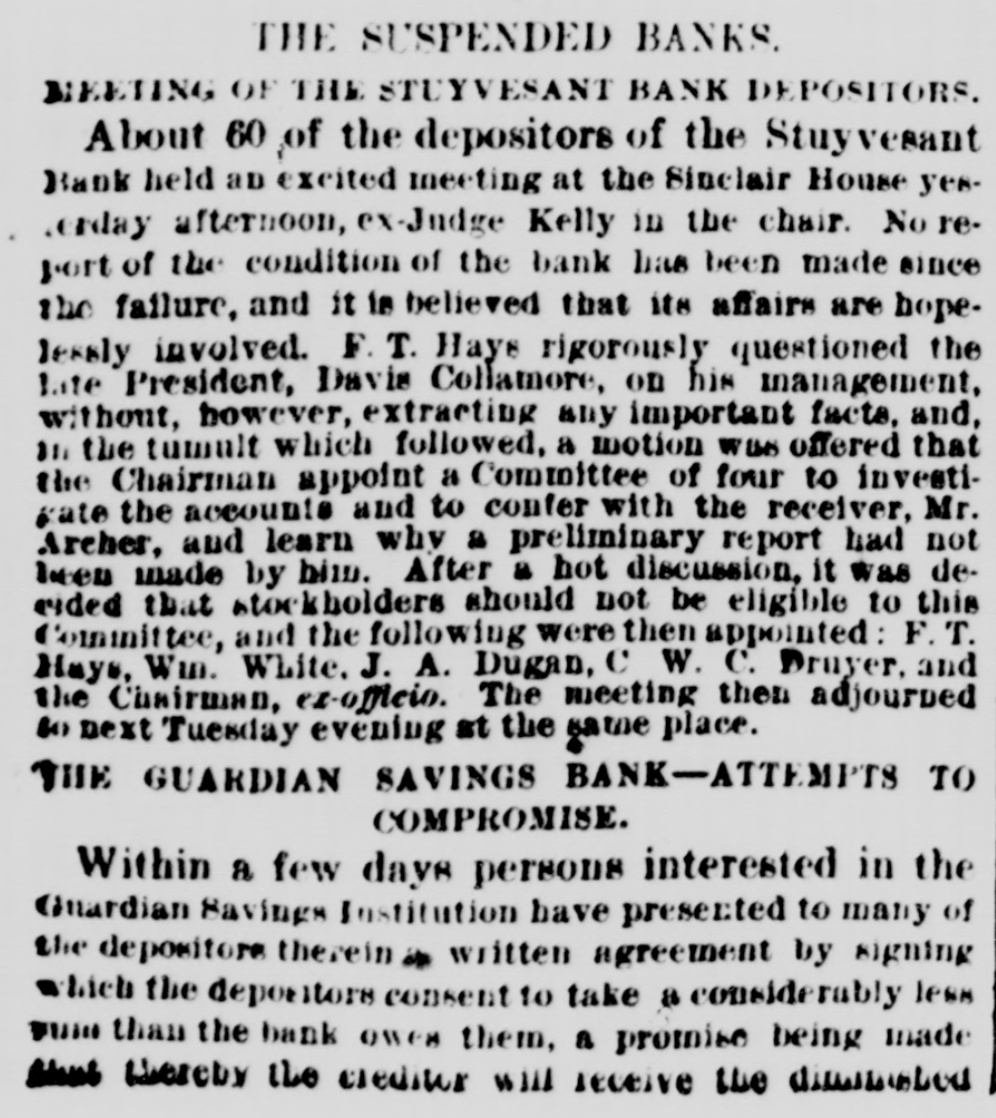
THE SUSPENDED BANKS BEETING OF THE STUYVESANT BANK DEPOSITORS. About 60 of the depositors of the Stuyvesant Bank held aD excited meeting at the Sinclair House yes.coday afternoon, ex-Judge Kelly in the chair. No report of the condition of the bank has been made since the failure, and it is believed that its affairs are hopelearly involved. F. T. Hays rigorously questioned the lite President, Davis Collamore, on his management, without, however, extracting any important facts, and, 11. the tumult which followed, a motion with offered that the Chairman appoint a Committee of four to investigate the accounts and to confer with the receiver, Mr. Arches, and learn why a preliminary report had not Icen made by him. After a hot discussion, it was deeided that stockholders should not be eligible to this Committee, and the following were then appointed: F.T. Hays, Win. White, J. A. Dugan, C W. C. Druyer. and the Chairman, ex-officio. The meeting then adjourned w next Tuesday evening at the game place. THE GUARDIAN SAVINGS BANK-ATTEMPTS TO COMPROMISE. Within a few days persons interested in the Guardian Savings Institution have presented to many of the depositore therein of written agreement by signing which the deporitors consent to take a considerably less than the bank owen them, a promise being made abus Wereby the cledits will receive the dissessions


Article from The New York Herald, January 23, 1872

Click image to open full size in new tab

Article Text

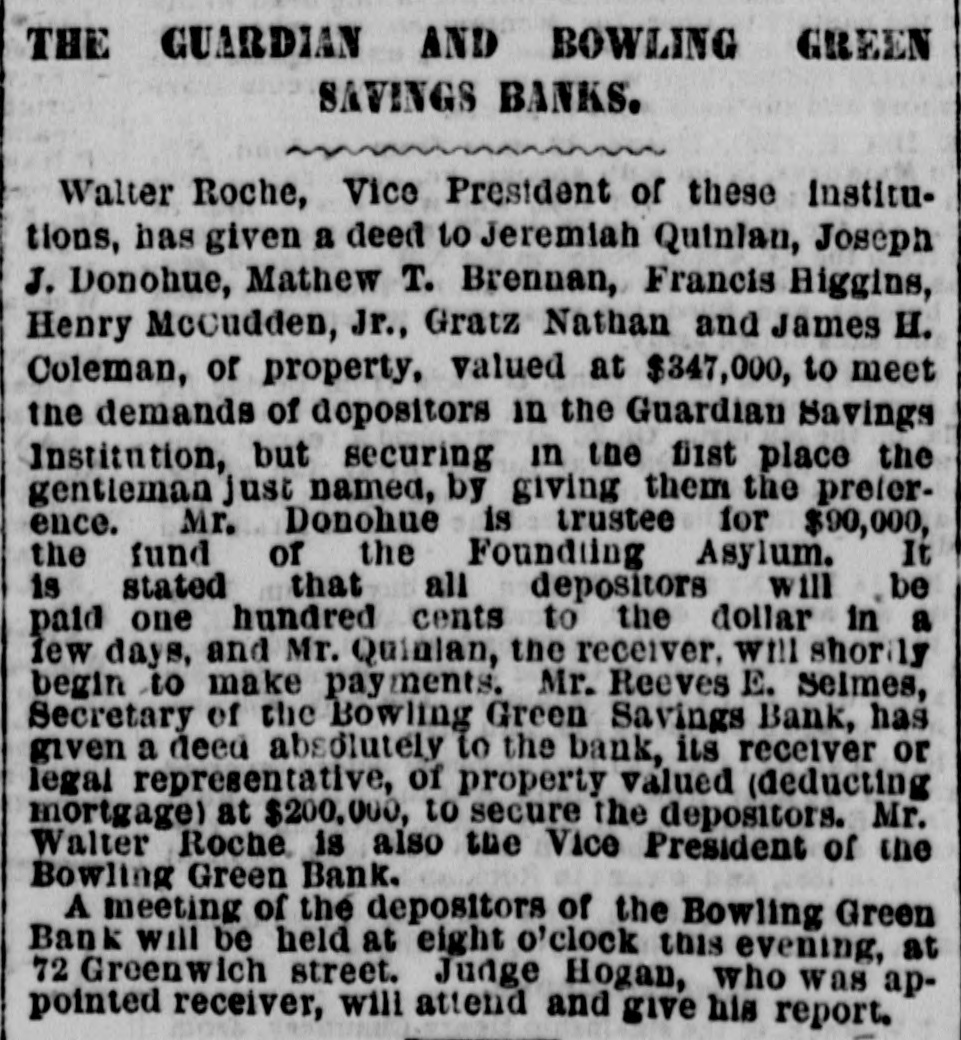
THE GUARDIAN AND BOWLING GREEN SAVINGS BANKS. Walter Roche, Vice President of these Institutions, has given a deed to Jeremiah Quinian, Joseph J. Donohue, Mathew T. Brennan, Francis Higgins, Henry Mccudden, Jr., Gratz Nathan and James H. Coleman, of property, valued at $347,000, to meet the demands of depositors in the Guardian Savings Institution, but securing in the first place the gentleman just named, by giving them the preierence. Mr. Donohue is trustee for $90,000, the fund of the Founding Asylum. It is stated that all depositors will be paid one hundred cents to the dollar in a few days, and Mr. Quinian, the receiver. will shortly begin to make payments. Mr. Reeves E. Seimes, Secretary of the Bowling Green Savings Bank, has given a deed absolutely to the bank, its receiver or legal representative, of property valued (deducting mortgage) at $200,000, to secure the depositors. Mr. Walter Roche is also the Vice President of the Bowling Green Bank. A meeting of the depositors of the Bowling Green Bank will be held at eight o'clock this evening, at 72 Greenwich street. Judge Hogan, who was appointed receiver, will attend and give his report.


Article from New-York Tribune, February 10, 1872

Click image to open full size in new tab

Article Text

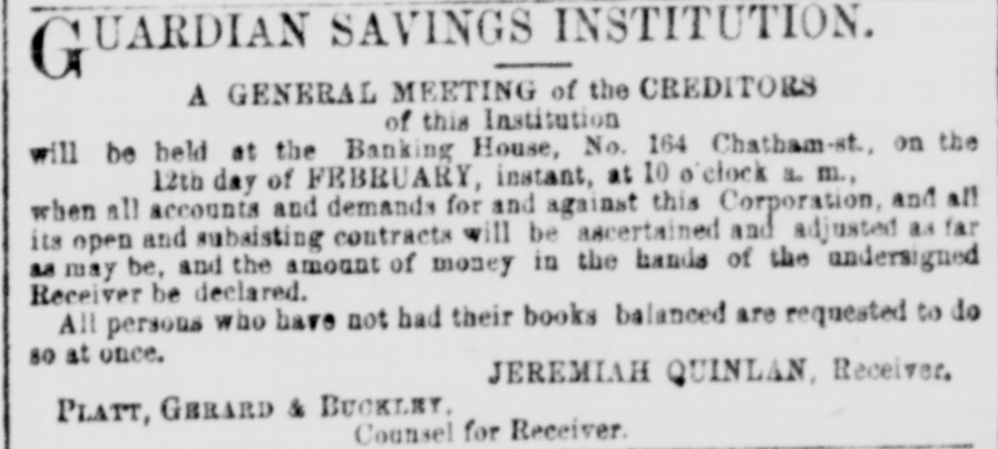
UARDIAN SAVINGS INSTITUTION. A GENERAL MEETING of the CREDITORS of this Institution will be held at the Banking House, No. 164 Chatham-st. on the 12th day of FEBRUARY, instant, at 10 o'clock a m., when all accounts and demands for and against this Corporation, and all its open and subsisting contracts will be agcertained and adjusted as far as may be, and the amount of money in the hands of the undersigned Receiver be declared. All persons who have not had their books balanced are requested to do 80 at once. JEREMIAH QUINLAN Receiver. PLATT, GERARD & BUCKLEY. Counsel for Receiver.


Article from The Sun, March 7, 1876

Click image to open full size in new tab

Article Text

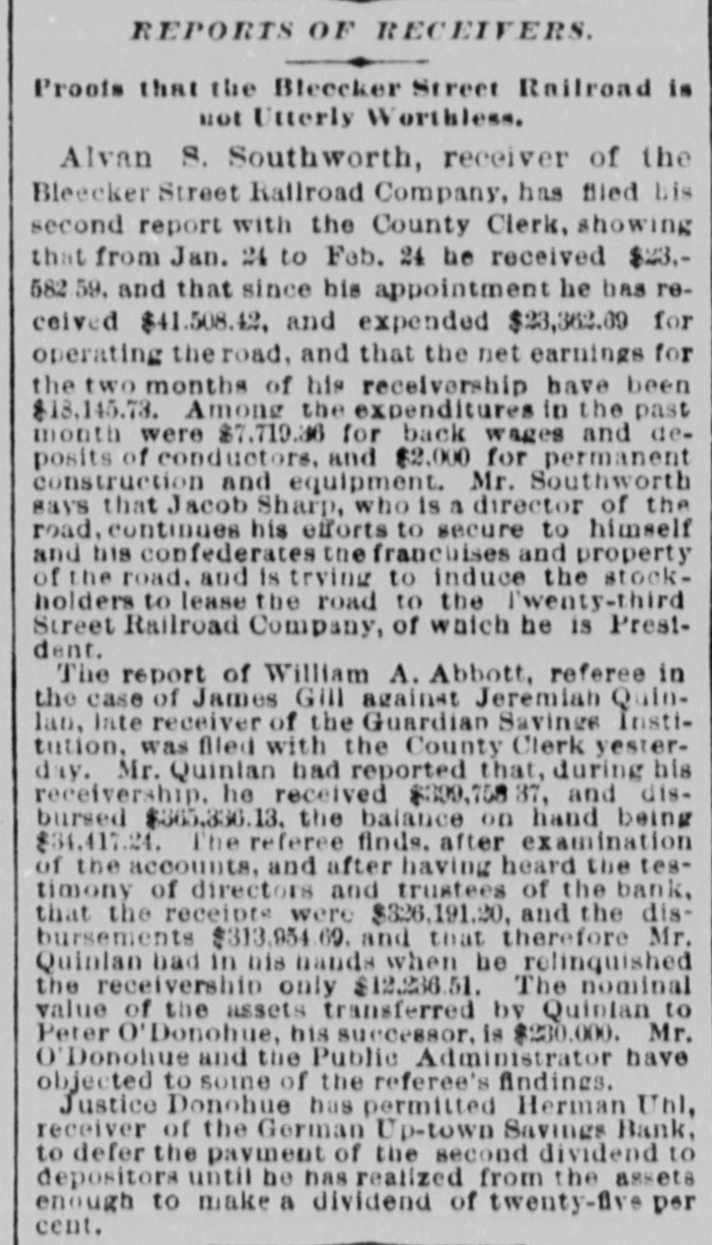
REPORTS OF RECEIVERS. Proofs that the Bleecker Street Railroad is not Utterly Worthless. Alvan S. Southworth, receiver of the Bleecker Street Railroad Company, has filed his second report with the County Clerk, showing that from Jan. 24 to Feb. 24 be received $23.582 59. and that since his appointment he has recelved $41.508.42, and expended $23,362.69 for operating theroad, and that the net earnings for the two months of his receivership have been $18,145.73. Among the expenditures in the past month were $7,719.36 for back wages and deposits of conductors, and $2,000 for permanent construction and equipment. Mr. Southworth says that Jacob Sharp, who is a director of the road. continues his efforts to secure to himself and his confederates the francuises and property of the road. and is trying to induce the stockholders to lease the road to the l'wenty-third Street Railroad Company, of which he is Prestdent. The report of William A. Abbott, referee in the case of James Gill against Jeremiah Quinlan, late receiver of the Guardian Savings Institution, was filed with the County Clerk yesterday. Mr. Quinlan had reported that, during his receivership, he received $399,758.37, and disbursed $365,336.13. the balance on hand being $34,417.24. The referee finds. after examination of the accounts. and after having heard the testimony of directors and trustees of the bank, that the receipts were $326,191.20. and the disbursements $313,954.69. and that therefore Mr. Quinlan had in his hands when be relinquished the receivership only $12,236.51. The nominal value of the assets transferred by Quintan to Peter O'Donobue, his successor. is $230.000. Mr. O'Donohue and the Public Administrator have objected to some of the referee's findings. Justice Donohue has permitted Herman Uhl, receiver of the German Up-town Savings Bank, to defer the payment of the second dividend to depositors until be has realized from the assets enough to make a dividend of twenty-five per cent.


Article from New-York Tribune, April 12, 1876

Click image to open full size in new tab

Article Text

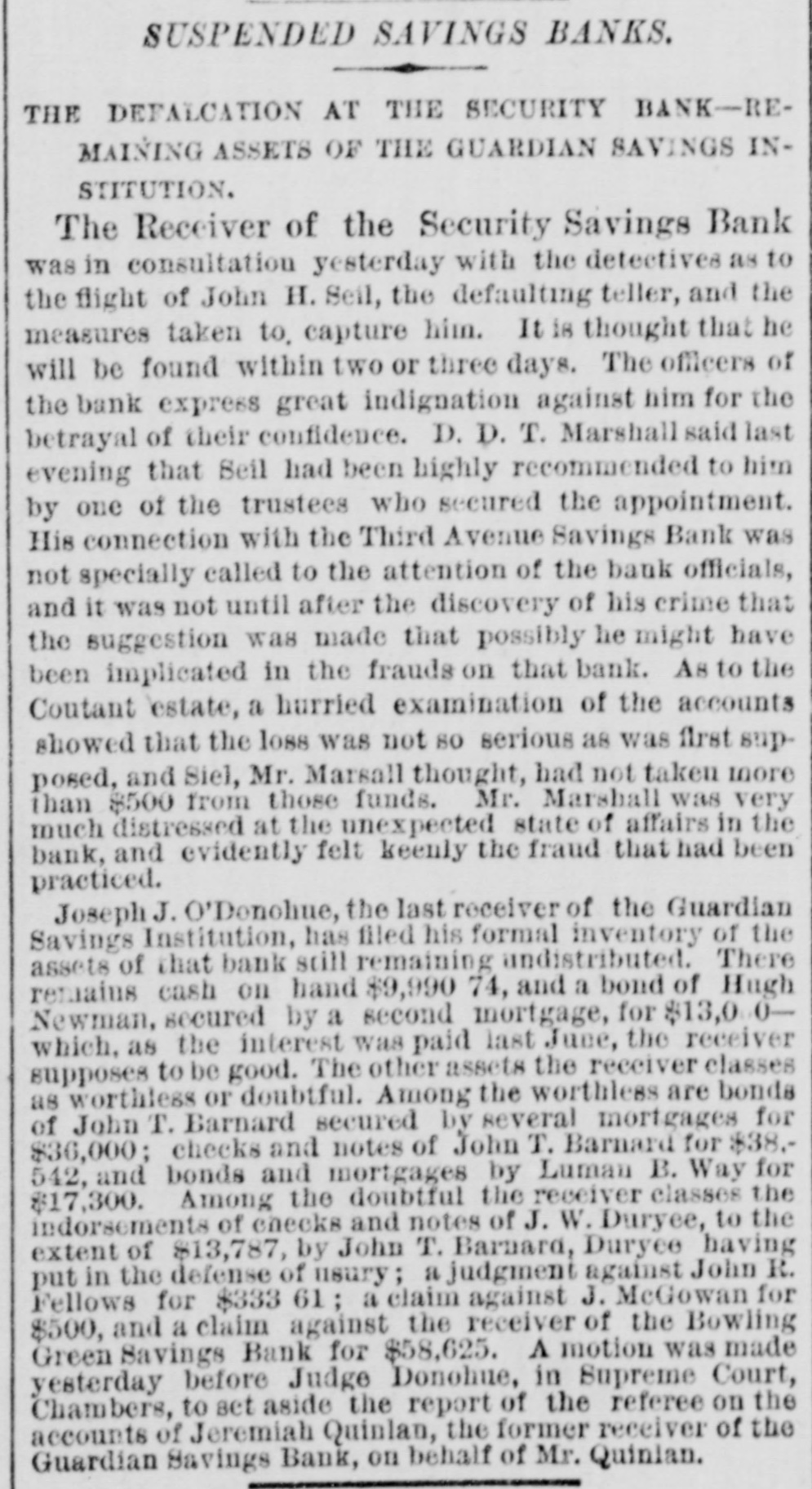
SUSPENDED SAVINGS BANKS. THE DEFALCATION AT THE SECURITY BANK-REMAINING ASSETS OF THE GUARDIAN SAVINGS INSTITUTION. The Receiver of the Security Savings Bank was in consultation yesterday with the detectives as to the flight of John H. Seil, the defaulting teller, and the measures taken to, capture him. It is thought that he will be found within two or three days. The officers of the bank express great indignation against him for the betrayal of their confidence. D. D. T. Marshall said last evening that Beil had been highly recommended to him by one of the trustees who secured the appointment. His connection with the Third Avenue Savings Bank was not specially called to the attention of the bank officials, and it was not until after the discovery of his crime that the suggestion was made that possibly he might have been implicated in the frauds on that bank. As to the Coutant estate, a hurried examination of the accounts showed that the loss was not SO serious as was first supposed, and Siel, Mr. Marsall thought, had not taken more Than $500 from those funds. Mr. Marshall was very much distressed at the unexpected state of affairs in the bank, and evidently felt keenly the fraud that had been practiced. Joseph J. O'Denohue, the last receiver of the Guardian Savings Institution, has filed his formal inventory of the assets of that bank still remaining undistributed. There remains cash on hand $9,990 74, and a bond of Hugh Newman, secured by a second mortgage, for $13,000which, as the interest was paid last June, the receiver supposes to be good. The other assets the receiver classes as worthless or doubtful. Among the worthless are bonds of John T. Barnard secured by several mortgages for $36,000; checks and notes of John T. Barnard for $38.542, and bonds and mortgages by Luman B. Way for $17,300. Among the doubtful the receiver classes the indorsements of checks and notes of J. W. Duryee, to the extent of $13,787, by John T. Barnard, Duryee having put in the defense of insury; a judgment against John R. Fellows for $333 a claim against J. McGowan for $500, and a claim against the receiver of the Bowling Green Savings Bank for $58,625. A motion was made yesterday before Judge Donohue, in Supreme Court, Chambers, to act aside the report of the referee on the accounts of Jeremiah Quinlan, the former receiver of the Guardian Savings Bank, on behalf of Mr. Quinian.


Article from The New York Herald, May 10, 1876

Click image to open full size in new tab

Article Text

THE GUARDIAN SAVINGS BANK. In the matter of the receivership of the Guardian Savings Institution, proceedings in which are pending in the Supreme Court, the interests of the city are involved to a large amount. The bank failed in December, 1872, and at that date the Public Administrator's deposits were made therein. The balance to that account was $58,845 37, upon which the receiver has made paym DIS from time to time to Judge Alker and to Isaac Dayton as Public Administrators. Algernon S. Sulhvan, the present Public Administrator, is seeking to recover the balance due, which he ascertains to be $ 4 233 60, with interest from January 1, 1875. The present proceeding is to see how much can be obtained from the assets of the bank or from the receiver's bonds. The deficiency must be made up by the city treasury. so that Mr. Sullivan can settle the estate, the funds of which were in the savings bank when it failed. The matter is expected to come up in Supreme Court, Ch mbers, within a day or two.


Article from The New York Herald, October 12, 1876

Click image to open full size in new tab

Article Text

BANK'S. SAVINGS THE FAVINGS GUREDIAN MR. JOSEPH 'DONOHUE. To THE THE EDITOR HERALD:of The by made report Judge Bosworth the a of affairs relating referee and the evings comments Guardian Institution, to the an call for HERALD thereon explanation IS the fact the not case that me, from of the nor the yet finally ultimate decided judgment will of my give plain Court statement of to the the from bank first affairs last. In the by held 1870 York Foundling Sub. over. yielded Asylum, sum. and the $90,000, scriptions to I used was build entire asylum. the the the and Fair held Committee it with the The decided money. my proearnest Savings Guardian Institution of in the and office test conscresigned was the The with Institumoney quence. deposited tion there aithough in of 10 1871, have manager, n Bank. Savings Emigrant the The under PresiSavings Guardian M. of was its and Tweed Roche dency Walter William in bank When Vice failed November, 11 of on had this and 1871, deposit to or 81, the more than $94, belonged one-sixth aid the not that know sylum. Foundling did nor have bank insolvent anything to do the of with appointment its The Mr. Arst receiver. on 17, November intimation to came 1871. Quinian then his surety. become whatever Quinlan these as facts to was and me of me his of was the late alarmed 11 to be and the Fund, believing Founding If to duty my become consented possible, 1 the no had him bond. surely of that doing. except motive securing it to me from occurred Asylum. Foundling in bad that some whom then person confidence of in the the was office under charge placed receiver 1 of its more could affairs thorough knowledge than the better otherwise, the Mr. Quinian employ in law, her-in such ment brother In said this that, Quiulan to right stances, me. with nything and and of Mr. Riley, connection action my he Mr. would think told him " hatever at ouce to capacity. por have agree with Quinlan long faith time mose divide under not take I cent did DOL did know Riley or was of the 1 to would do with salary of them Kiley, wa nor believe performed Mr. giving control it the his the compelenter salary person. Mr. (Riley) Quinian did care not and attention bank jui and of DUL Mr. he Kiley creditors of claims. the and personal labor been of that per the of have their Dg been Asylute paid of to money the business ninety of live than due the $200 The Foundi, entire mount 09 only. this have uil full. creditors ot the 09 remain amount unpaid. paid sufficiented recognized $ 338, to the pay drew jact only bledness $7,364 of assets the to for when amount. he ince and there Mr. Quiniau seems the one labor, half of witness them, in O.T. the and with sum that Riley recei be Quinlar draw # Thomas such I fees, cerpad nothing to his fees $6. as 500, testined to Riley. that had his A right had to or not, to me keep money ing 10 and advised he him be whether no Riley handed be has since de it case, Buckley. the quests to do. for Mr. him, on and the same. had given him, referee, in Quinlan and tainly $6,000 of only this a portion time of Quinian case, has Another nian) decided, kas en in equal told drawn me the he was of the that $13,000. Quin Surely that the of may another. and another accounts, allows him authority be 10 the law subject transaction dollar, I should. litled passing to one referce rate, is and of profited whatever by ever the any matter agree. subject decision any never nor was there As the to the 10 the says: what upon the of landing Lold that the to money, Quinia difficult righ to per- his receiver ment now, I shall the Court as can claim delauiter. and good final stands decision Judge of BOSWORTH principal Mr. can Riley be entitled large in ISSIONS equity time jees. colve on unle-s same a time to be full nim com at the Abboll, and money the conscience bad belore of Mr. had A. been balance reBosworlh Boswoman the report showed alter the charging him Judge he wrote to whom 51 only. law to charge him my that he jerred referee. Quinketting De postie mossive He had in surety, also before offered the to only pay him against including interest by injunction him was that issued ordiwith, evidence to the not by an the law, to an or myself of this way it was from so Joing may be that Quinian. Kevery dollar are able With reason June. 1875. would Whelever clear to the bank of ection the rece cred- that 10 of my and that nors bond, to to pary in mind surely connec there the is not AB loss the the them. second 1 to this have part Judge report a the made dividend the he could upon city of 1872 were all three third and and the thers rethem. He Billeen in Among which was not price due offered them was cent, The He to and realize one of They were The best to me and with told the me money. sell them the look the ceiver second buy discount them at ten such mortgages and to bad been the drew be and needed for authority was granted. McGowan him who he good, examine and busi- be Mr ness. such Court John bank, T. and the 10 the the this of the my counsel, he the person who procured the in of full, IRRALD, the He did buy titles the Mctiowan Judge man Boswors in court. did mortgages, adeed, doing wrong. suppose the per and live fund lieved, ai the was the sole my cent object time. to is of the third report. Judge part the the iacts before 1869 In Mr. be would needed. and in store street, William IC 000, three purchase but the property. n my taken my conveyed mm unian no him toward a his be paid The me had liberty loaned 10 have that the In 1873 one property that from the of the he sums. instead my security. to him to WAH include taken good faith where money name and Scient othat th s mocoy doubt not on Know it came from thought any eree essicion no not brows, only do not did believe that which my security would money far do suppreement this the BADK from but know, the to matter me retch well have paid me to case KOOKB business doing for the been very was shadow and upon was in ID 1873 and the money bank. debt under unlikely was had me vidence WHA that


Article from The Sun, October 13, 1876

Click image to open full size in new tab

Article Text

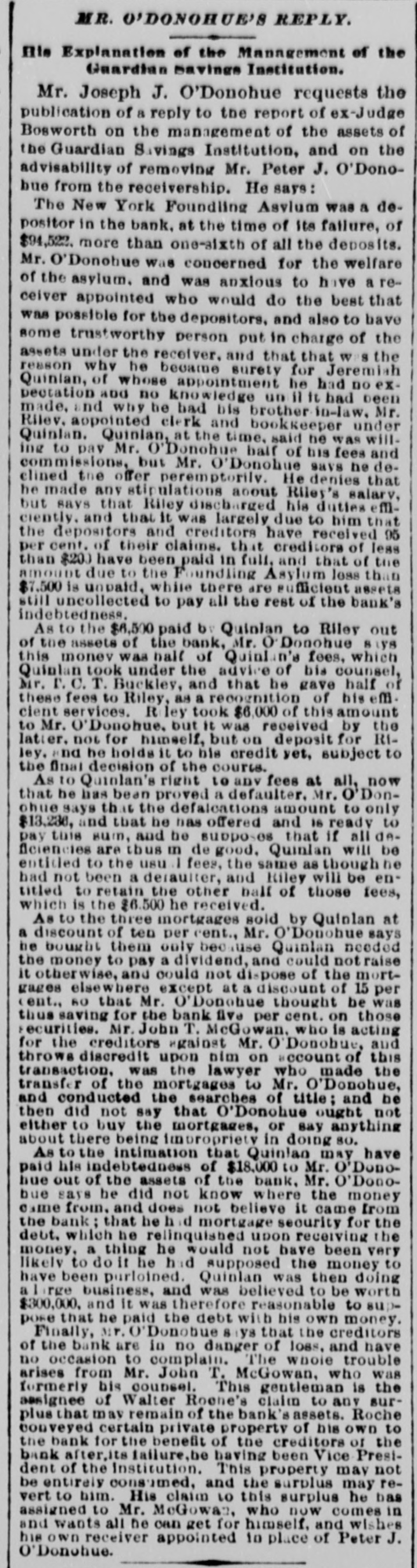
# MR. O'DONOHUE'S REPLY. His Explanation of the Management of the Guardian Savings Institution. Mr. Joseph J. O'Donohue requests the publication of a reply to the report of ex-Judge Bosworth on the management of the assets of the Guardian Savings Institution, and on the advisability of removing Mr. Peter J. O'Donohue from the receivership. He says: The New York Foundling Asylum was a depositor in the bank, at the time of its failure, of $94,522, more than one-sixth of all the deposits. Mr. O'Donohue was concerned for the welfare of the asylum, and was anxious to have a receiver appointed who would do the best that was possible for the depositors, and also to have some trustworthy person put in charge of the assets under the receiver, and that that was the reason why he became surety for Jeremiah Quinian, of whose appointment he had no expectation and no knowledge un il it had been made, and why he had bis brother-in-law, Mr. Riley, appointed clerk and bookkeeper under Quinlan. Quinlan, at the time, said he was willing to pay Mr. O'Donohue baif of his fees and commissions, but Mr. O'Donohue says he declined the offer peremptorily. He denies that he made any stipulations about Riley's salary, but says that Riley discharged his duties efficiently, and that it was largely due to him that the depositors and creditors have received 95 per cent, of their claims. that creditors of less than $20) have been paid in full, and that of the amount due to the Foundling Asylum less than $7,500 is unpaid, white there are sufficient assets still uncollected to pay all the rest of the bank's indebtedness. As to the $6,500 paid by Quinlan to Riley out of the assets of the bank, Mr. O'Donohue says this money was half of Quinlan's fees, which Quinlan took under the advice of bis counsel, Мг. Π“. Π‘. Π’. Buckley, and that he gave half of these fees to Riley, as a recognition of his efficient services. Riley took $6,000 of this amount to Mr. O'Donohue, but it was received by the latter, not for himself, but on deposit for Riley, and be holds it to his credit yet, subject to the final decision of the courts. As to Quinlan's right to any fees at all, now that he has bean proved a defaulter, Mr. O'Donohue says that the defalcations amount to only $13,236, and that he has offered and is ready to pay this sum, and he supposes that if all deficiencies are thus m de good, Quinlan will be entitled to the usu I fees, the same as though he had not been a derauiter, and Kiley will be entitled to retain the other half of those fees, which is the $6.500 he received. As to the three mortgages sold by Quinlan at a discount of ten per cent., Mr. O'Donohue says he bought them only because Quinlan needed the money to pay a dividend, and could not raise it otherwise, and could not dispose of the mortgages elsewhere except at a discount of 15 per cent., so that Mr. O'Donohue thought he was thus saving for the bank five per cent. on those Fecurities. Mr. John T. McGowan, who is acting for the creditors against Mr. O'Donohue, and throws discredit upon him on account of this transaction, was the lawyer who made the transfer of the mortgages to Mr. O'Donohue, and conducted the searches of title; and he then did not say that O'Donohue ought not elther to buy the mortgages, or say anything about there being impropriety in doing s0. As to the intimation that Quinlan may have paid his indebtedness of $18,000 to Mr. O'Donohue out of the assets of the bank, Mr. O'Donohue says he did not know where the money came from, and does not believe it came from the bank; that he had mortgage security for the debt, which he relinquished upon receiving the money, a thing he would not have been very likely to do it he had supposed the money to have been purloined. Quinlan was then doing a lerge business, and was believed to be worth $300,000, and it was therefore reasonable to suppose that he paid the debt with his own money. Finally, Mr. O'Donobue sys that the creditors of the bank are in no danger of loss, and have no occasion to complain. The whole trouble arises from Mr. John T. McGowan, who was formerly his counsel. This gentleman is the assignee of Walter Roene's claim to any surplus that may remain of the bank's assets. Roche conveyed certain private property of his own to the bank for the benefit of the creditors of the bank after, its failure, be having been Vice President of the Institution. This property may not be entirely consumed, and the surplus may revert to him. His claim to this surplus he bas assigned to Mr. McGowan, who now comes in and wants all he can get for himself, and wishes his own receiver appointed in place of Peter J. O'Donohue.


Article from The New York Herald, June 2, 1877

Click image to open full size in new tab

Article Text

THE COURTS. Decisions by the Supreme Court, General Term. SUIT FOR A DENTISTS BILL. Disciplining Members of the Bar. A number o! decisions were handed down yesterday m Supreme Couri, General Term, but very tew of which, however, appear to be of public or general im sortance. John Herlich brought suit against Matthew T. Bren. san, late Sheriff, to recover the value of goods seized by the latter. The delence wag that the sale was traudulent as against creditors, and that plaintiff had knowledge of that fraud. On the trial the Judge was asked on the part of plaintiff to charge the jury "that to establish notice to a purchaser of the fraudulent in. tent of his vendor it is sufficient to prove that the facts and circumstances are such as ought reasonably to have excited his suspicion and led him to inquiry." The Judge refused to so charge, the suit went against the plannifill, and from the judgment an appeal was taken on his behalf to the General Term. In the decision on the appeal reudered yesterday the refusal of the Judge at Circuit to charge as requested is held to have been error, and on that ground the judgment Is reversed and a new trial ordered. Edward Russell, who was a student at Columbia College, after 11 seventeen months' attendance, was given the degree of Bachelor of Laws. The Court relused to admit him on the ground that be had not shown an actual attendΓ’nce of eighteen months, as required by statute. The General Term decides that the applicant shows no right under the act and donies his application. In the suit of James Gill against the Guardian Savings Institution, all the tacts of which have already up. peared in the HERALD, the General Term rendered a decision yesterday, sustaining the previous decision of Judge Lawrence confirming the report of ex-Judge Bosworth, ID which a substitution of the receiver of the bank was recommended. In the suit of the Home Insurance Company against the Pennsylvania Railroad Company, in which a judgmeut was recovered against the latter company for damages by fire to a barn situated adjacent to the railroad track, which are originated from sparks emitted from the engine of one of the trains, a decision confirming the judgment was rendered by the Suprome Court, General Term.


Article from New-York Tribune, October 22, 1878

Click image to open full size in new tab

Article Text

CIVIL NOTES. Louis Richards, a child, was run over and killed by & truck belonging to P. Ballantine & Sons in Bayard-st., May 5, 1877. His father, as his administrator, began a suit for $5,000 in the Supreme Court, which was discontinued, and he then began a new suit in the Court of Common Pleas. Judge J. F. Daly granted yesterday an order staying the father's suit in the Court of Common Pleas until the costs in the previous suit were paid. In the suit of John T. McGowan, the present receiver of the Guardian Savings Institution, against Joseph J. O'Donohue, the surety for the first two receivers of the Institution, the jury in Superior Court, Trial Term, before Judge Curtis, gave yesterday a verdict for the plaintiff for $8,769 66. The claim was for $24,000 received by the defendant, $18,000 from Jeremiah Quinlan, the first receiver, and $6,000 from his clerk. The defence as to the first sum was that it was a payment on a mortgage entirely independent of the Savings Bank, and as to the second that the money was held ID trust for the clerk. It is on the smaller sum, with interest, that the verdiet is based.


Article from The Indianapolis Journal, December 17, 1886

Click image to open full size in new tab

Article Text

A Receiver Who Received. NEW YORK, Dec. 16.-Attorneys representing creditors of the defunct Guardiau Savings Instition have made a motion before Judge Barrett to have John T. McGowan, the receiver of that bank, removed. The motion is based upon certain facts regarding assets of the bank which McGowan had paid to himself and to others illegally, and which disbursements were not alowed by the referee on the final accounting of the receiver. The Guardian Savings Institution failed in 1871, and McGowan was appointed receiver July 2, 1877. Quinlan and O'Donohue, receivers before McGowan, were removed. McGowan's accounts show payments to himself as creditor aggregating $45,338, and other smaller sums. The receiver charged himself in his account with receipts of money aggregating $102,021, and showed a balance in his hands of only $152. The referee finds that McGowan made payments to himself and others in violation of the court's orders, and that he should be held to account for nearly $75,000 to the creditors of the bank. instead of the $152, which he claimed was all the assets he had in his hands.