Article Text
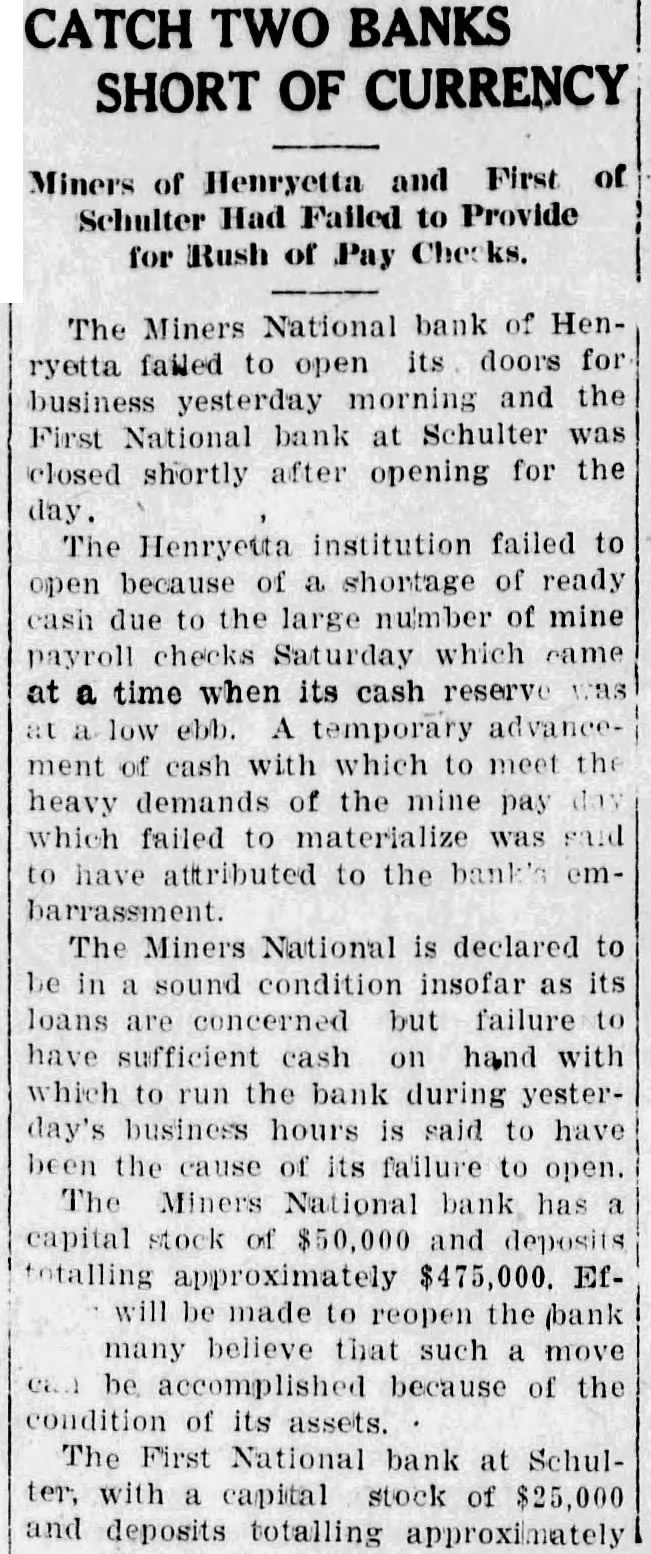
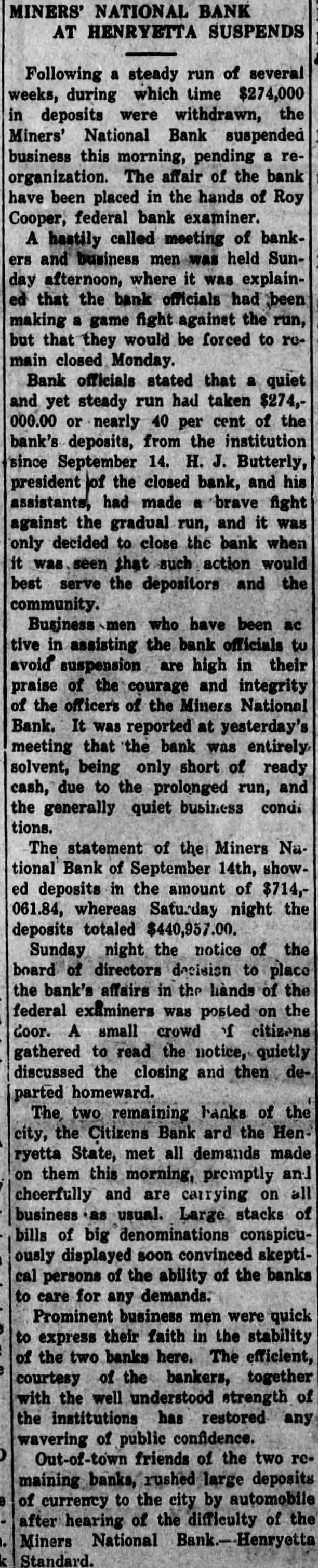
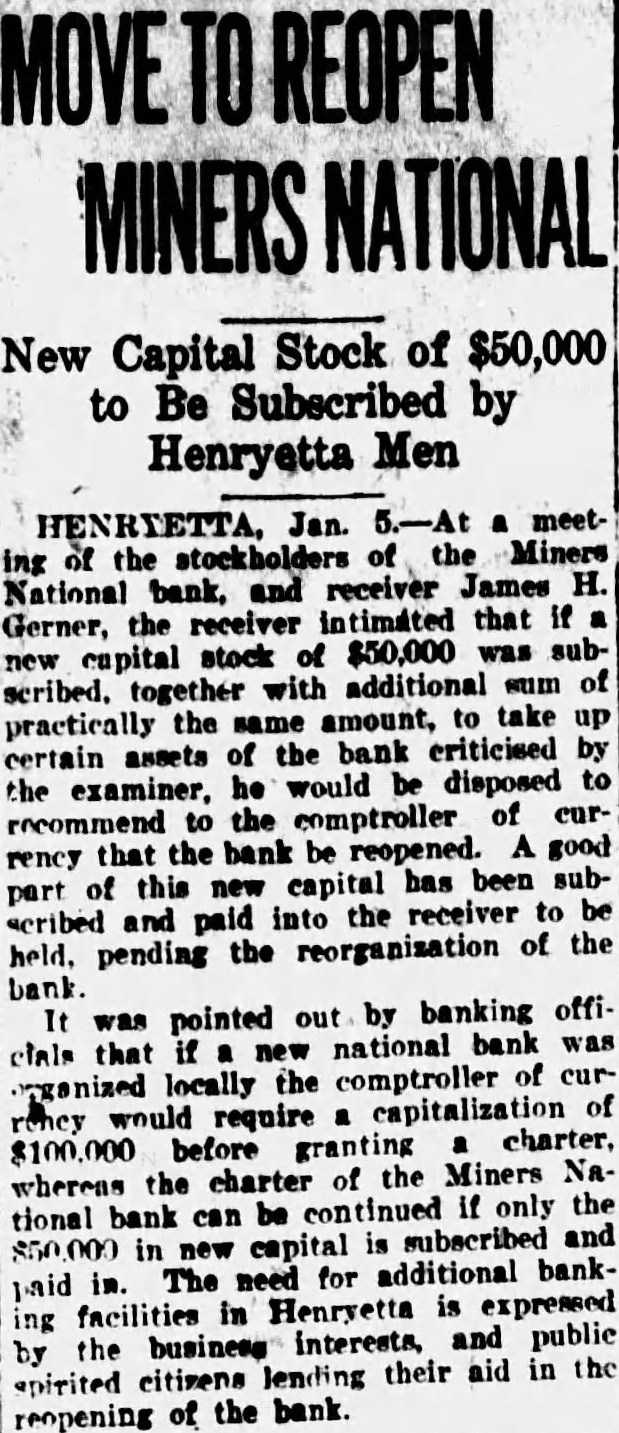
MINERS NATIONAL BANK SUSPENDED
Steady Withdrawals Finally Forced Bank Officials To Suspend For Reorganization.
Following a steady run of several weeks, during which time $274,000 in deposits were withdrawn, the Miners National Bank suspended business this morning, pending a reorganization. The affairs of the bank have been placed in the hands of Roy Cooper, federal bank examiner.
A hastily called meeting of bankers and business men was held Sunday afternoon, where it was explained that the bank officials had been making a game fight against the run, but that they would be forced to remain closed Monday.
Bank officials stated that a quiet and yet steady run had taken $274,000 or nearly 40 per cent of the bank's deposits, from the institution since September 14. H. J. Butterly, president of the closed bank, and his assistants, had made a brave fight against the gradual run, and it was only decided to close the bank when it was seen that such action would best serve the depositors and the community.
Business men who have been active in assisting the bank officials to avoid suspension are high in their praise of the courage and integrity of the officers of the Miners National Bank. It was reported at yesterday's meeting that the bank was entirely solvent, being only short of ready cash, due to the prolonged run, and the generally quiet business conditions.
The statement of the Miners National Bank of September 14th, showed deposits in the amount of $714,061.84, whereas Saturday night the deposits totaled $440,957.00.
Sunday night the notice of the board of directors decision to place the bank's affairs in the hands of the federal examiners was posted on the door. A small crowd of citizens gathered to read the notice, quietly discussed the closing and then departed homeward.
The two remaining banks of the city, the Citizens Bank and the Henryetta State, met all demands made on them this morning, promptly and cheerfully and are carrying on all business as usual. Large stacks of bills of big denominations conspicuously displayed soon convinced skeptical persons of the ability of the banks to care for any demands.
Prominent business men were quick to express their faith in the stability of the two banks here. The efficient, courtesy of the bankers, together with the well understood strength of the institutions has restored any wavering of public confidence.
Out-of-town friends of the two remaining banks, rushed large deposits of currency to the city by automobile after hearing of the difficulty of the Miners National Bank.
Henryetta Coal Field Has Wonderful Future
Testimony of J. M. Johnson, Katy Railroad Fuel Inspector, Develops Fact That Katy Desires To Extend Line Into This Field To Secure Coal Supply.
The following is a further installment of the testimony of J. M. Johnson, fuel agent of the Katy railroad in the hearing recently held at Okmulgee before the Corporation commission. Mr. Johnson's testimony shows the wonderful possibilities of the Henryetta field as a coal producing district. The hearing was held following the application of the Katy railroad for permission to build a line into the Henryetta coal district.
This information will help give Henryetta people a better idea of the extent of the coal resource of the district. The first installment of this testimony was printed Sunday in the Daily Standard. Other installments will follow from day to day until the entire story has been told.
Mr. Johnson is answering the questions asked by the court as follows:
Q. Do you know anything about the use of coal by glass companies? A. I am not familiar with that.
Q. Do you know about refineries using coal? A. I know that Cosdon at Tulsa is using coal. We are just putting in big trackage for coal mines that they have at Broken Arrow.
Q. State whether or not the development of this field would benefit users in this territory, and give your views about the development of that new field as soon as the Katy can reach it? A. Well, just for our railroad lines I am not sure, but I think I could use about 150 tons per day, or pretty nearly a half million tons per year. That would mean, roughly, about $500,000.00 any way to labor, and I don't know now just how much capital would get out of it.
Q. State whether or not the mines on the K. O. & G. are capable of furnishing the Katy coal? A. No sir.
Q. Why not? A. The coal is very poor quality for the reason that it is crop coal.
Q. Do you try to buy that kind of coal? A. I did during the war, and stored it, and we had an awful time getting rid of it.
Q. Well, state whether or not, at the present time, this coal you have discovered will be satisfactory? A. Yes, sir. There is other coal on the Frisco, good coal, for instance the Creek Coal Mining Co., which have it at 126 feet deep, but those shafts on the extension out here will average 50 feet each, which, naturally, the deeper the coal the better the coal.
Q. State whether or not in the exercise of good judgment the Katy ought to be allowed to build this extension and develop the field? A. I would hate to be an operating executive of a railroad as big as the Katy without having a coal field like this to provide fuel for it if the oil should play out or get too expensive.
Q. What about the development of this field other industries on the Katy? A. I would say that it would mean the serving of other industries on the line with coal when the fuel oil gets scarce.
Q. State whether or not all competing lines with the Katy in this territory have coal deposits and surplus on their lines? A. Yes, sir, the Missouri Pacific has a great coal acreage, the Santa Fe has a great coal acreage, the Frisco has a big coal acreage in Kansas.
Q. Is or not the Katy railroad the only trunk line that has not available an adequate coal reserve on its line in this territory? A. Yes, sir.
Q. State whether on not, in your judgment it is necessary that these extensions be built from the standpoint of the Katy Railroad? A. It is very, very essential that the Katy be permitted to get into this coal field like we were just talking about.
Comm. Cobb: You are general fuel agent for the Katy? A. Yes, sir.
Q. What mileage has the Katy—that they operate? A. I would say about 3400 miles.
Q. By Mr. Pierce, Who controls the Kansas coal fields, what railroads? A. The Frisco has the biggest part, I believe.
Q. Who controls the McAlester fields? A. As far as the McAlester fields are concerned, I guess we control that ourselves.
Q. Is that unsatisfactory or not, from a fuel standpoint, and has the Katy any reasonable expectation of an adequate fuel supply? A. As coal, it is good coal, but the mining cost is heavy, but that is the only supply we have, and should we go back to coal on our Texas lines that is the only supply we have.
Q. Would, or not, that be adequate? A. No, sir. During the war we were able to get considerable coal from our Kansas mines, and, of course, we drew heavily on the Illinois mines, which was foreign delivery to the Katy, and then the McAlester fields went entirely to Texas.
A. If conditions should occur that existed five or six years ago, I believe the commercial demand for coal would be possibly 100 per cent more than for company coal.
Q. State whether or not the development of this new field along the Southwest Extension would be cheaper to the smelter in this territory? A. Yes, sir.
Q. Give your views about that? A. To begin with, while the cost at the mine would be cheaper in Illinois and not very much cheaper, either we have the foreign freight charges to St. Louis and then the haul to the delivering point, which, after you leave Franklin Junction, where we stop, it is prohibitive to use Illinois coal, therefore I believe this coal would be cheaper to the commercial consumer that had to have it is Kansas City, Omaha, St. Joseph or Texas or some other place.
Q. If you had to get coal from Illinois, would you not have to store it—store a good deal of it? A. Yes, sir.
Q. How would that effect its chemical use? A. Our experience in storing coal has been very unsatisfactory both from the standpoint of cost in handling, resulting deterioration and it's firing.
Cross Examination
Q. (By Mr. Stuart): When did your road first commence to using oil? A. In December, 1919.
Q. A. In December, 1919? A. Yes sir.
Q. And you still use largely that fuel for your road at this time, do you not? A. In December, 1919, we commenced using oil from Mexico on a five year contract and we are still using that oil.
Q. You had a lot of coal mines at the time you commenced to use fuel oil, did you not? A. We had two coal mines of our own.
Q. And at the time the Frisco commenced to use oil as a fuel it had coal mines, did it not—plenty of them—I am speaking about railroad ownership? And the Santa Fe, too? A. These roads you speak of had coal mines in operation, the Santa Fe and Frisco, yes, sir.
Q. And they commenced using oil notwithstanding the fact? A. Yes, sir.
Q. And you had them in operation when you commenced to use oil as a fuel in your locomotives? A. Yes, sir.
Q. And you have some mines at McAlester? A. We have some at Atoka.
Q. You have perfect connection with the coal mines at Krebs, have you not? A. Yes, sir.
Q. And they furnish you lots of coal? A. They did, but not now, though.
Q. You have a connection at Wilburton, too, do you not? A. Not that I know of, no, sir.
Q. Isn't there a claim there of 25,000 acres under lease owned by the Central Coal & Coke Company? A. Well, they have claimed for the last quarter century that there is coal around Vinita, but I have never seen any there that was worth anything.
Q. Do you know this Henryetta field here? A. Very well, yes, sir.
Q. You have studied it thoroughly? A. Yes, sir.