Crothersville State Bank (Crothersville, IN)

Episode Information

Episode UID
8639272191485
Episode Type
Suspension β†’ Closure
Bank Type
state
Bank ID
863927219 hash
Start Date
September 12, 1923
Location
Crothersville, Indiana (38.801, -85.842)

Metadata

Model
gpt-5-mini (chosen from majority vote of a three-model LLM ensemble)
Short Digest
a5ddb1268f68e3ed

Response Measures

None

Description

Bank was closed by the Indiana banking department for insolvency and placed in receivership; later legal/receivership proceedings followed.

Events (7)

1. September 12, 1923 Suspension
Cause
Government Action
Cause Details
Closed by the Indiana state banking department/commissioner on orders after examination found large unbankable loans and insolvency.
Newspaper Excerpt
the two banks suspended business September 12
Source
newspapers
2. September 22, 1923 Receivership
Newspaper Excerpt
appointment of a receiver will be asked, Thomas Barr, deputy commissioner ... announced today. The Crothersville State Bank ... are insolvent, and appointment of a receiver will be asked
Source
newspapers
3. September 24, 1923 Receivership
Newspaper Excerpt
Assets of the Crothersville State Bank ... were to be transferred to Union State Bank of the same town today. The Union State Bank was appointed receiver by Judge Cox
Source
newspapers
4. October 22, 1923 Receivership
Newspaper Excerpt
Judge James A. Cox ... removed the Union State Bank as receiver for the defunct Crothersville State Bank
Source
newspapers
5. November 2, 1923 Receivership
Newspaper Excerpt
Frank L. Schornick ... appointed receiver for the Crothersville State Bank, which suspended business about a month ago
Source
newspapers
6. April 18, 1924 Other
Newspaper Excerpt
Five former officers and directors of the defunct Crothersville State Bank were arrested ... charging embezzlement and conspiracy. The bank was closed September 12, 1923
Source
newspapers
7. June 5, 1924 Other
Newspaper Excerpt
A distribution of twenty-five per cent on approximately 1,200 claims against the defunct Crothersville State Bank, will be made next week
Source
newspapers

Newspaper Articles (19)

Article from The Tribune, September 22, 1923

Click image to open full size in new tab

Article Text

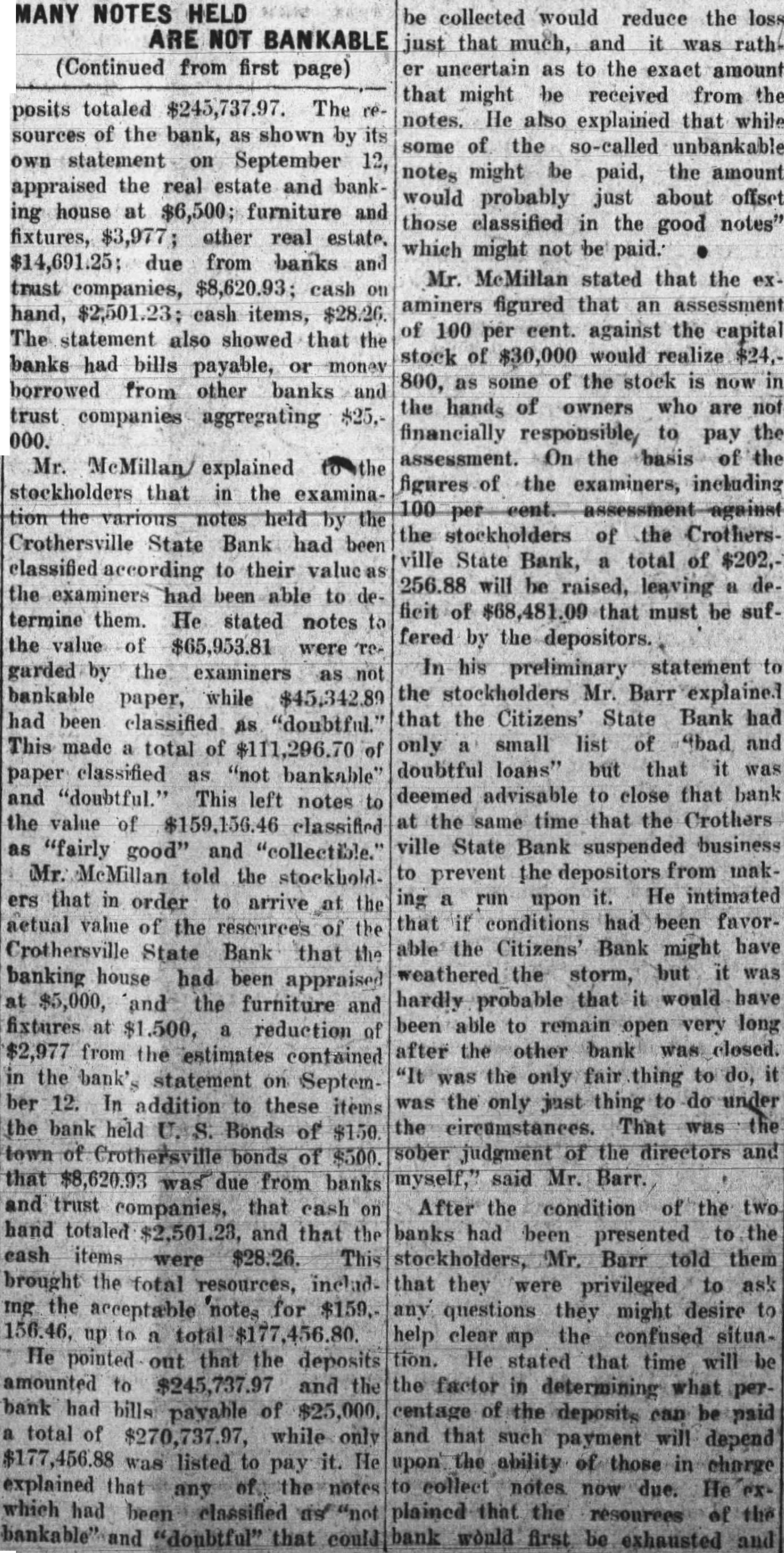
MANY NOTES HELD ARE NOT BANKABLE (Continued from first page) posits totaled $245,737.97. The resources of the bank, as shown by its own statement on September 12, appraised the real estate and banking house at $6,500; furniture and fixtures, $3,977; other real estate, $14,691.25; due from banks and trust companies, $8,620.93; cash on hand, $2,501.23; cash items, $28.26. The statement also showed that the banks had bills payable, or money borrowed from other banks and trust companies aggregating $25,000. Mr. McMillan explained to the stockholders that in the examination the various notes held by the Crothersville State Bank had been classified according to their value as the examiners had been able to determine them. He stated notes to the value of $65,953.81 were regarded by the examiners as not bankable paper, while $45,342.89 had been classified as "doubtful." This made a total of $111,296.70 of paper classified as "not bankable" and "doubtful." This left notes to the value of $159,156.46 classified as "fairly good" and "collectible." Mr. McMillan told the stockholders that in order to arrive at the actual value of the resources of the Crothersville State Bank that the banking house had been appraised at $5,000, and the furniture and fixtures at $1,500, a reduction of $2,977 from the estimates contained in the bank's statement on September 12. In addition to these items the bank held U. S. Bonds of $150, town of Crothersville bonds of $500, that $8,620.93 was due from banks and trust companies, that cash on hand totaled $2,501.23, and that the cash items were $28.26. This brought the total resources, including the acceptable notes for $159,156.46, up to a total $177,456.80. He pointed out that the deposits amounted to $245,737.97 and the bank had bills payable of $25,000, a total of $270,737.97, while only $177,456.88 was listed to pay it. He explained that any of the notes which had been classified as "not bankable" and "doubtful" that could be collected would reduce the loss just that much, and it was rather uncertain as to the exact amount that might be received from the notes. He also explained that while some of the so-called unbankable notes might be paid, the amount would probably just about offset those classified in the good notes which might not be paid. Mr. McMillan stated that the examiners figured that an assessment of 100 per cent. against the capital stock of $30,000 would realize $24,800, as some of the stock is now in the hands of owners who are not financially responsible to pay the assessment. On the basis of the figures of the examiners, including 100 per cent. assessment against the stockholders of the Crothersville State Bank, a total of $202,256.88 will be raised, leaving a deficit of $68,481.09 that must be suffered by the depositors. In his preliminary statement to the stockholders Mr. Barr explained that the Citizens' State Bank had only a small list of "bad and doubtful loans" but that it was deemed advisable to close that bank at the same time that the Crothersville State Bank suspended business to prevent the depositors from making a run upon it. He intimated that if conditions had been favorable the Citizens' Bank might have weathered the storm, but it was hardly probable that it would have been able to remain open very long after the other bank was closed. "It was the only fair thing to do, it was the only just thing to do under the circumstances. That was the sober judgment of the directors and myself," said Mr. Barr. After the condition of the two banks had been presented to the stockholders, Mr. Barr told them that they were privileged to ask any questions they might desire to help clear up the confused situation. He stated that time will be the factor in determining what percentage of the deposits can be paid and that such payment will depend upon the ability of those in charge to collect notes now due. He explained that the resources of the bank would first be exhausted and
Article from Evening Star, September 22, 1923

Click image to open full size in new tab

Article Text

TWO BANKS INSOLVENT IN SAME INDIANA TOWN Institutions in Crothersville Face Losses of $100,000-Receiver to Be Asked. By the Associated Press. SEYMOUR, Ind., September 22.The Crothersville State Bank and the Citizens' State Bank, two institutions at Crothersville, a town twelve miles south of here, are insolvent, and appointment of a receiver will be asked, Thomas Barr, deputy commissioner of the Indiana state banking department, announced today. The two banks face losses of approximately $100,000, Mr. Barr said.


Article from The Birmingham Age-Herald, September 23, 1923

Click image to open full size in new tab

Article Text

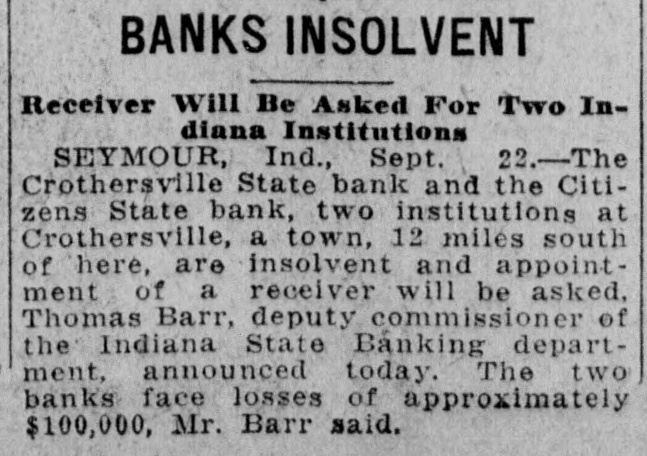
BANKS INSOLVENT Receiver Will Be Asked For Two Indiana Institutions SEYMOUR, Ind., Sept. 22.-The Crothersville State bank and the Citizens State bank, two institutions at Crothersville, a town, 12 miles south of here, are insolvent and appointment of a receiver will be asked, Thomas Barr, deputy commissioner of the Indiana State Banking department, announced today. The two banks face losses of approximately $100,000, Mr. Barr said.


Article from The Indianapolis Times, September 24, 1923

Click image to open full size in new tab

Article Text

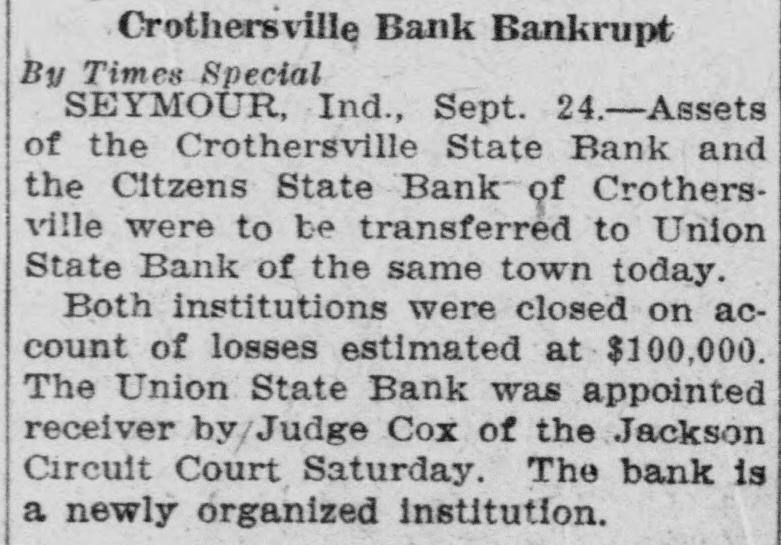
Crothersville Bank Bankrupt By Times Special SEYMOUR, Ind., Sept. 24.-Assets of the Crothersville State Bank and the Citzens State Bank of Crothersville were to be transferred to Union State Bank of the same town today. Both institutions were closed on account of losses estimated at $100,000. The Union State Bank was appointed receiver by Judge Cox of the Jackson Circuit Court Saturday. The bank is a newly organized institution.


Article from The Indianapolis News, September 24, 1923

Click image to open full size in new tab

Article Text

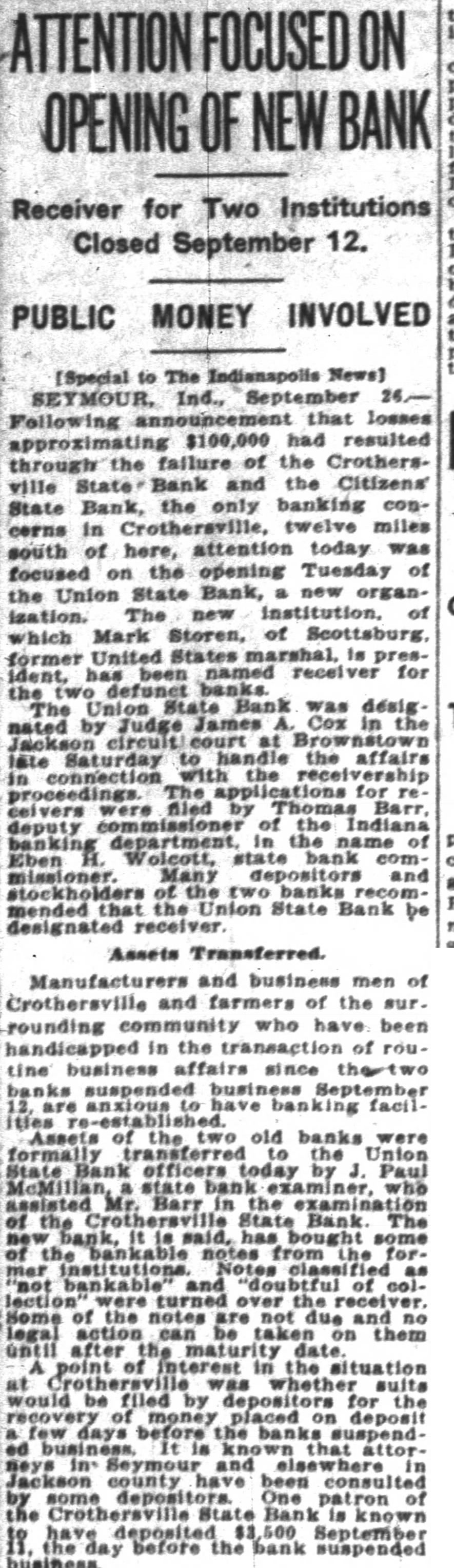
ATTENTION FOCUSED ON OPENING OF NEW BANK Receiver for Two Institutions Closed September 12. PUBLIC MONEY INVOLVED [Special to The Indianapolis News] SEYMOUR, Ind., September 26.β€”Following announcement that losses approximating $100,000 had resulted through the failure of the Crothersville State Bank and the Citizens' State Bank, the only banking concerns in Crothersville, twelve miles south of here, attention today was focused on the opening Tuesday of the Union State Bank, a new organization. The new institution, of which Mark Storen, of Scottsburg, former United States marshal, is president, has been named receiver for the two defunct banks. The Union State Bank was designated by Judge James A. Cox in the Jackson circuit court at Brownstown late Saturday to handle the affairs in connection with the receivership proceedings. The applications for receivers were filed by Thomas Barr, deputy commissioner of the Indiana banking department, in the name of Eben H. Wolcott, state bank commissioner. Many depositors and stockholders of the two banks recommended that the Union State Bank be designated receiver. Assets Transferred. Manufacturers and business men of Crothersville and farmers of the surrounding community who have been handicapped in the transaction of routine business affairs since the two banks suspended business September 12, are anxious to have banking facilities re-established. Assets of the two old banks were formally transferred to the Union State Bank officers today by J. Paul McMillan, a state bank examiner, who assisted Mr. Barr in the examination of the Crothersville State Bank. The new bank, it is said, has bought some of the bankable notes from the former institutions. Notes classified as "not bankable" and "doubtful of collection" were turned over the receiver. Some of the notes are not due and no legal action can be taken on them until after the maturity date. A point of interest in the situation at Crothersville was whether suits would be filed by depositors for the recovery of money placed on deposit a few days before the banks suspended business. It is known that attorneys in Seymour and elsewhere in Jackson county have been consulted by some depositors. One patron of the Crothersville State Bank is known to have deposited $3,500 September 11, the day before the bank suspended business.


Article from The Tribune, September 26, 1923

Click image to open full size in new tab

Article Text

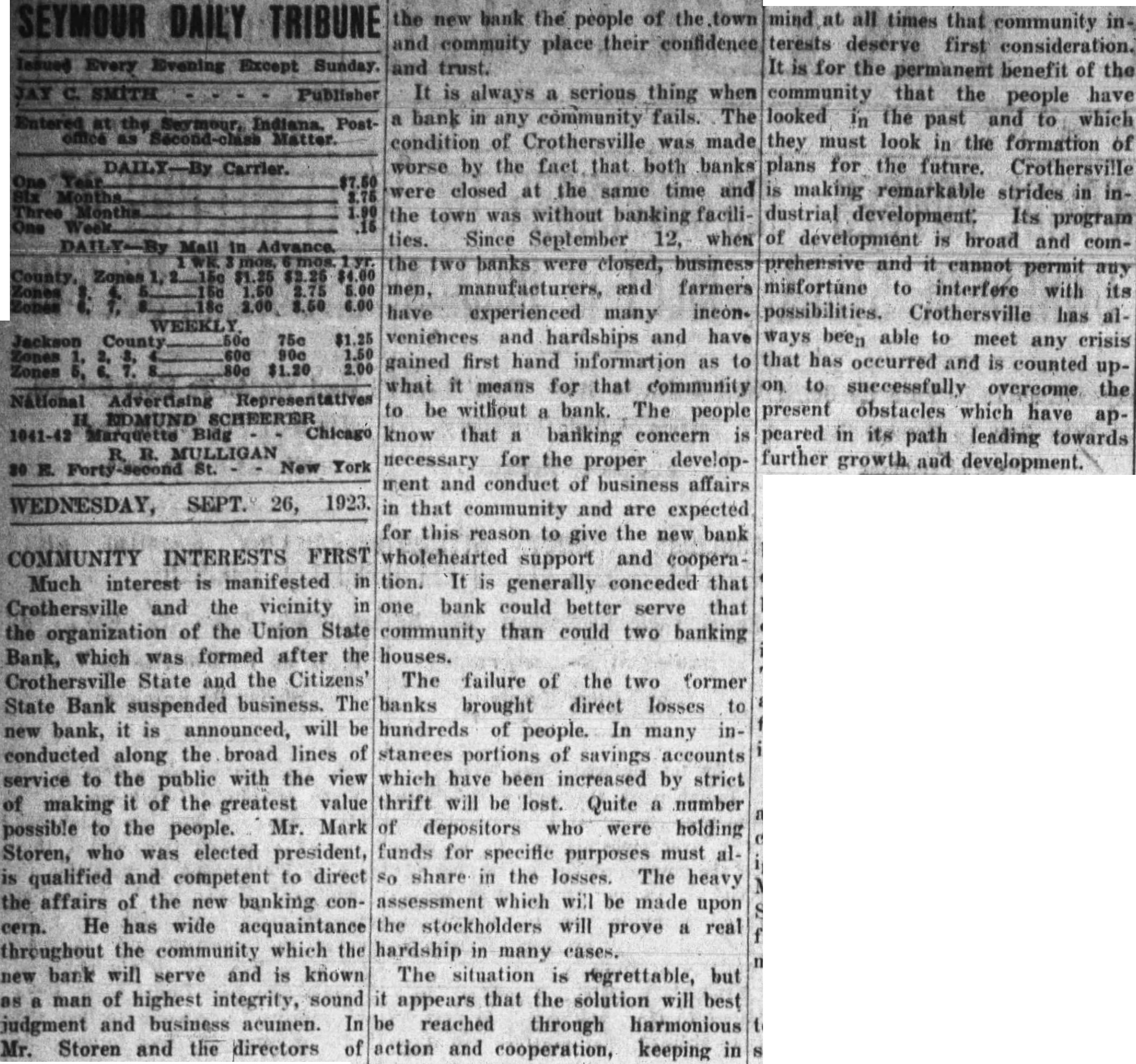
COMMUNITY INTERESTS FIRST Much interest is manifested in Crothersville and the vicinity in the organization of the Union State Bank, which was formed after the Crothersville State and the Citizens' State Bank suspended business. The new bank, it is announced, will be conducted along the broad lines of service to the public with the view of making it of the greatest value possible to the people. Mr. Mark Storen, who was elected president, is qualified and competent to direct the affairs of the new banking concern. He has wide acquaintance throughout the community which the new bank will serve and is known as a man of highest integrity, sound judgment and business acumen. In Mr. Storen and the directors of the new bank the people of the town and community place their confidence and trust. It is always a serious thing when a bank in any community fails. The condition of Crothersville was made worse by the fact that both banks were closed at the same time and the town was without banking facilities. Since September 12, when the two banks were closed, business men, manufacturers, and farmers have experienced many inconveniences and hardships and have gained first hand information as to what it means for that community to be without a bank. The people know that a banking concern is necessary for the proper development and conduct of business affairs in that community and are expected for this reason to give the new bank wholehearted support and cooperation. It is generally conceded that one bank could better serve that community than could two banking houses. The failure of the two former banks brought direct losses to hundreds of people. In many instances portions of savings accounts which have been increased by strict thrift will be lost. Quite a number of depositors who were holding funds for specific purposes must also share in the losses. The heavy assessment which will be made upon the stockholders will prove a real hardship in many cases. The situation is regrettable, but it appears that the solution will best be reached through harmonious action and cooperation, keeping in mind at all times that community interests deserve first consideration. It is for the permanent benefit of the community that the people have looked in the past and to which they must look in the formation of plans for the future. Crothersville is making remarkable strides in industrial development. Its program of development is broad and comprehensive and it cannot permit any misfortune to interfere with its possibilities. Crothersville has always been able to meet any crisis that has occurred and is counted upon to successfully overcome the present obstacles which have appeared in its path leading towards further growth and development.


Article from The Courier-Journal, October 23, 1923

Click image to open full size in new tab

Article Text

RECEIVER REMOVED FOR DEFUNCT BANK Special to The Courier-Journal. Seymour, Ind., Oct. 22. β€” Judge James A. Cox in Jackson Circuit Court today removed the Union State Bank as receiver for the defunct Crothersville State Bank at Crothersville twelve miles south of here. The action was taken as the result of a petition filed by thirty-seven stockholders and depositors of the insolvent bank. Judge Cox did not announce who would be appointed receiver.


Article from Jackson County Banner, October 24, 1923

Click image to open full size in new tab

Article Text

PETITION GRANTED FOR NEW BANK RECEIVER For Crothersville State Bankβ€”Temporary Receiver Ordered To Make Report In Ten Days. NEW RECEIVER NOT APPOINTED The petition for a new receiver for the Crothersville State Bank was heard by Judge Jas. A. Cox in the Jackson circuit court Monday morning and decided in favor of the petitioners. The Union State Bank, which was appointed temporary receiver when the Crothersville State Bank was closed, was ordered to file a report with the court within ten days. A large number of creditors and others interested from Crothersville and vicinity were in attendance at the hearing. The Union State Bank was appointed temporary receiver of the Crothersville State Bank by Judge Cox in vacation, at the time the Crothersville Bank was closed by the state banking department some weeks ago. In the petition for a new receiver it was alleged that four of the directors of the Union State Bank, viz: Judge J. H. Shea, of Indianapolis; Mark Storen, of Scottsburg, Sylvester Applegate and Howard Rider, of Crothersville, constituting a majority, were also directors of the old Crothersville State Bank and were therefore interested parties and could not be expected to act to the best interests of other creditors as receivers of that institution. In the hearing of the petition however, it was shown that only two of the directors of the Union State Bank, viz: Rider and Applegate, were directors of the Crothersville State Bank. When the case was called Monday, Attorney S. A. Barnes, for the petitioners, presented another petition, signed by more than a hundred creditors, in addition to the original petition for a new receiver. Attorneys for the Union State Bank, J. H. Shea and J. Ross Robertson, objected to the introduction of this petition at this time as it was not filed when the application for a new receiver was filed, and the objection was sustained. Later the defense presented a petition signed by a majority of the stockholders, and depositors holding about $50,000 of deposits, asking that the Union State Bank be continued as permanent receiver, to which the petitioners objected and this objection was also sustained. Only two witnesses were called on the stand to testify, viz: Mark Storen as president of the Union State Bank, and Frank Butler, as president of the Crothersville State Bank, as to the names of the directors of their respective banks, and the case was submitted to the court without argument by the attorneys. In giving his decision Judge Cox said that he appointed the Union State Bank as temporary receiver in vacation upon the recommendation of the state banking department, and that at the time he did not know who were the directors of either the Union State Bank or the Crothersville State Bank. He further said that while the directors of the Union State Bank did not constitute a majority of the directors of the Crothersville State Bank, yet the fact that two of them were the directors of the Union State Bank, as a body, they could not be considered wholly as disinterested parties and therefore his finding was in favor of the petitioners for a new receiver. Judge Shea gave notice of an appeal and pending the filing of a motion for an appeal and awaiting the report of the Union State Bank, Judge Cox withheld the appointment of a new receiver for the present.


Article from The Tribune, November 2, 1923

Click image to open full size in new tab

Article Text

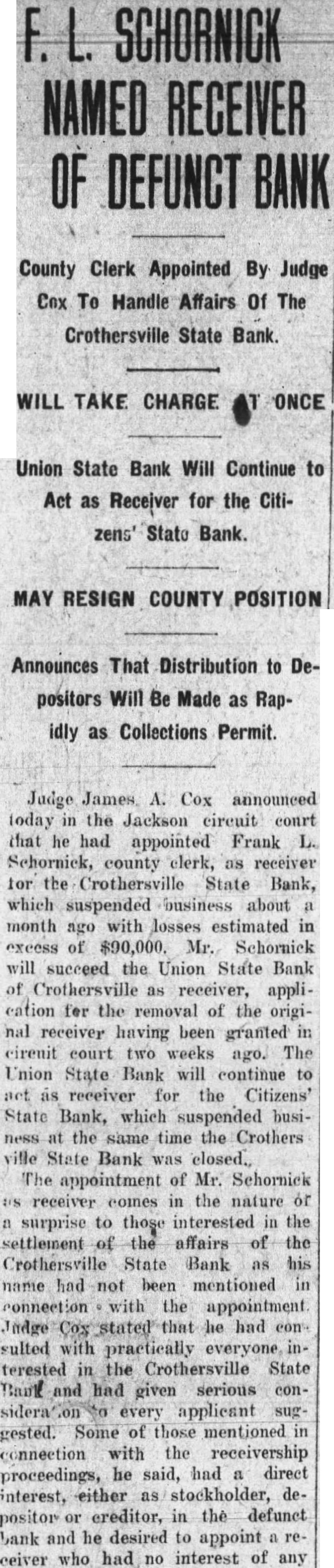
F. L. SCHORNICK NAMED RECEIVER OF DEFUNCT BANK County Clerk Appointed By Judge Cox To Handle Affairs Of The Crothersville State Bank. WILL TAKE CHARGE AT ONCE Union State Bank Will Continue to Act as Receiver for the Citizens' State Bank. MAY RESIGN COUNTY POSITION Announces That Distribution to Depositors Will Be Made as Rapidly as Collections Permit. Judge James A. Cox announced today in the Jackson circuit court that he had appointed Frank L. Schornick, county clerk, as receiver for the Crothersville State Bank, which suspended business about a month ago with losses estimated in excess of $90,000. Mr. Schornick will succeed the Union State Bank of Crothersville as receiver, application for the removal of the original receiver having been granted in circuit court two weeks ago. The Union State Bank will continue to act as receiver for the Citizens' State Bank, which suspended business at the same time the Crothersville State Bank was closed. The appointment of Mr. Schornick as receiver comes in the nature of a surprise to those interested in the settlement of the affairs of the Crothersville State Bank as his name had not been mentioned in connection with the appointment. Judge Cox stated that he had consulted with practically everyone interested in the Crothersville State Bank and had given serious consideration to every applicant suggested. Some of those mentioned in connection with the receivership proceedings, he said, had a direct interest, either as stockholder, depositor or creditor, in the defunct bank and he desired to appoint a receiver who had no interest of any


Article from The Indianapolis Times, November 3, 1923

Click image to open full size in new tab

Article Text

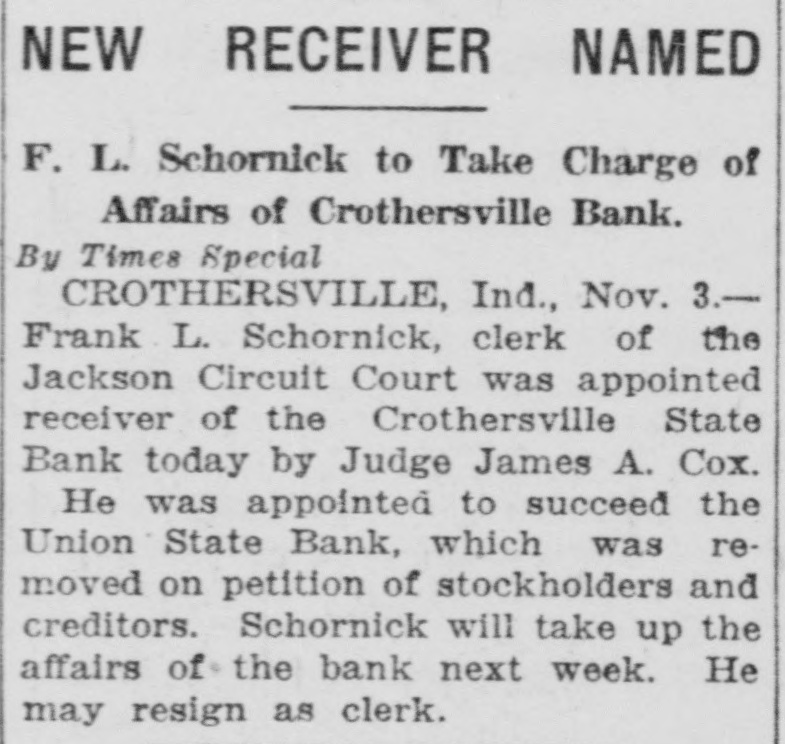
NEW RECEIVER NAMED F. L. Schornick to Take Charge of Affairs of Crothersville Bank. By Times Special CROTHERSVILLE, Ind., Nov. 3.Frank L. Schornick, clerk of the Jackson Circuit Court was appointed receiver of the Crothersville State Bank today by Judge James A. Cox. He was appointed to succeed the Union State Bank, which was removed on petition of stockholders and creditors. Schornick will take up the affairs of the bank next week. He may resign as clerk.


Article from Evening Star, April 18, 1924

Click image to open full size in new tab

Article Text

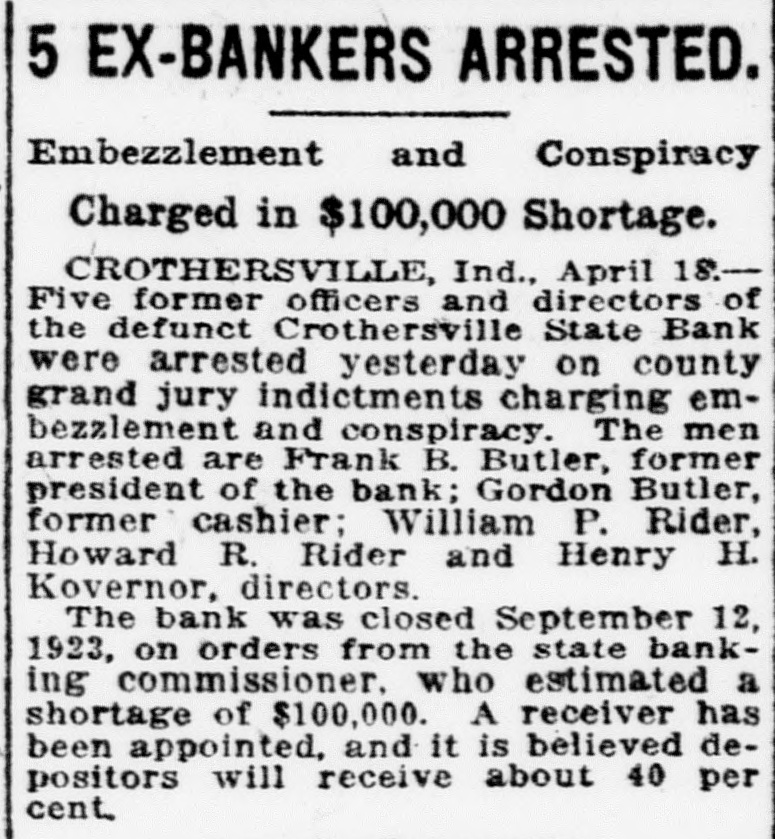
5 EX-BANKERS ARRESTED. Embezzlement and Conspiracy Charged in $100,000 Shortage. CROTHERSVILLE, Ind., April 18.Five former officers and directors of the defunct Crothersville State Bank were arrested yesterday on county grand jury indictments charging embezzlement and conspiracy. The men arrested are Frank B. Butler, former president of the bank; Gordon Butler, former cashier; William P. Rider, Howard R. Rider and Henry H. Kovernor, directors. The bank was closed September 12, 1923, on orders from the state banking commissioner. who estimated a shortage of $100,000. A receiver has been appointed, and it is believed depositors will receive about 40 per cent.


Article from Jackson County Banner, April 30, 1924

Click image to open full size in new tab

Article Text

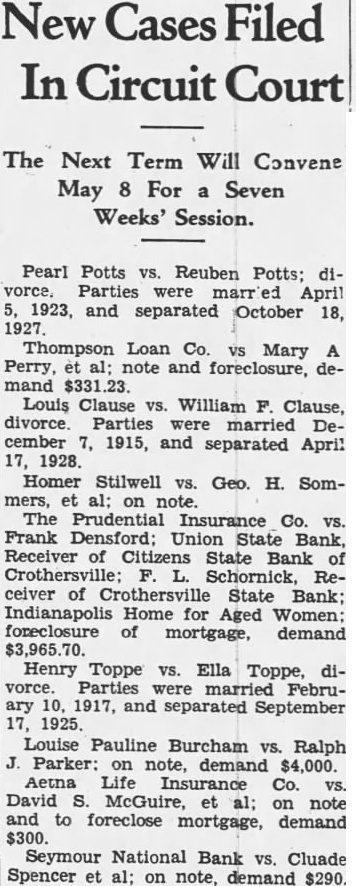
CIRCUIT COURT CONVENES MONDAY Larger Docket Than Usual For The May Term Of The Jackson Circuit Court. BIG INCREASE IN STATE CASES Owing To Indictments Returned By Last Grand Juryβ€”Divorce Docket Still Decreasing. The May term of the Jackson circuit court will convene next Monday, with an unusually large docket. There is an increase on all dockets except the divorce docket, on which there are only sixteen cases pending. There has been a gradual decrease in the number of divorce cases filed for almost a year. At the November term 43 divorce cases were on file, and 26 at the March term, against 16 on file this term. The state docket is larger than for some time owing to the indictments returned by the last grand jury, most of which have connection with the failure of the Crothersville State bank, last fall. There are a total of 51 cases on the state docket against 27 at the March term. There are 176 cases on the civil docket this term; at the March term there were 148. There are 22 cases on the claim docket and 43 on the probate docket, both of which are heavier than the March term. While a grand jury is drawn for every term of court, yet it is hardly likely that that body will be called this term, owing to the scope of investigations covered by the grand jury at the March term. Among the state cases, 23 are charges of embezzlement; assault and battery, 4; petit larceny, 4; liquor law violations, 4; kidnapping, 1; perjury, 1; issuing fraudulent check, 1; polluting stream, 1; carrying concealed weapons, 1; obtaining money by false pretense, 1; unlawful borrowing of bank, 1; overdrawing bank account, 1; breaking quarantine, 1; paternity proceedings, 1; burglary, 1; non support, 1; cutting tree on land of another, 1; failure to send child to school, 1.


Article from The Indianapolis Times, June 5, 1924

Click image to open full size in new tab

Article Text

Defunct Bank to Pay Off By Times Special SEYMOUR, Ind., June 5.-A distribution of twenty-five per cent on approximately 1,200 claims against the defunct Crothersville State Bank, will be made next week, Frank L. Schornick, receiver, announced today. The Indiana banking department closed the bank last September with a loss to stockholders and depositors exceeding $100,000.


Article from The Scott County Journal, June 18, 1924

Click image to open full size in new tab

Article Text

WILL WETZEL DEAD. Will Wetzel, one of the prominent and highly respected citizens of Jennings township, died Wednesday night at his home of nervous prostration, superinduced by worry over losses sustained by the failure of the Crothersville State Bank. He was a large land owner and prosperous farmer, and his death will be a distinct loss to the community. He leaves a widow and several children.


Article from The Tribune, March 12, 1925

Click image to open full size in new tab

Article Text

SCHORNICK HEADS BANK Receiver For One Elected President Of Another Crothersville Bank. Frank L. Schornick, receiver for the Crothersville State bank has been elected president of the Union State bank there, succeeding Mark Storen, of Scottsburg, wao recently resigned. It is understood that Schornick will conduct his business as re. ceiver at the Union State.


Article from The Tribune, March 27, 1925

Click image to open full size in new tab

Article Text

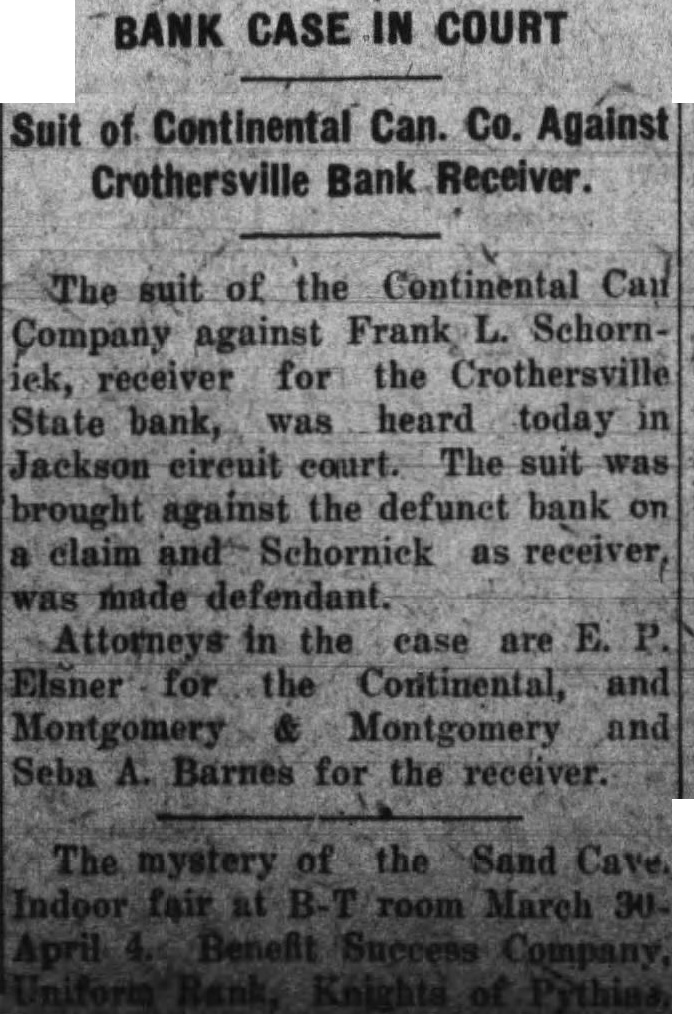
BANK CASE IN COURT Suit of Continental Can. Co. Against Crothersville Bank Receiver. The suit of the Continental Company against Frank Schornfor the Crothersville receiver State bank, was heard today Jackson circuit court. The suit brought against the defunct bank claim Schornick as receiver, made defendant. Attorneys in the case are Elsner for the Continental, and Montgomery Montgomery and Barnes for the receiver. mystery Sand Cave March


Article from Jackson County Banner, October 28, 1925

Click image to open full size in new tab

Article Text

SALE OF REAL ESTATE BY BANK RECEIVER L. Schornick, Receiver of the Crothersville State Bank today filed reports of the sale of real estate, known as the Keach properties, as follows: Residence in Brownstown to Mary business lot on Main Fountain, $1600; street in Brownstown, 35x40 feet, to Marietta Robertson, $310; store in Tampico, to Guy Sturbuilding $535; acre ground in Tamgeon, one Andy Duncan, sixtypico, farm, Grassy township, known as the Hezekiah Prince farm, Riley Cox, $610; residence Crothersville, to The acre tract in Vernon township, known the kirk farm and hundred acre tract Grassy Fork township, known the Bell farm, have not been sold.


Article from The Tribune, February 9, 1926

Click image to open full size in new tab

Article Text

SETTLED Schornick Case Against Directors of Defunct Crotitysville Institution Compromised. TO PAY $10,000 DAMAGES Agreement Reached After Case Called In Bartholomew County. The long drawn out suit by Frank Schornick, receiver, against the directors of the deffunet Crothersville State Bank for damages has been officially settled following compromise by which the defendants agreed the receiver $10,000, The case was settled Monday when called for trial in the Bartholomew circuit court at Columbus. The compromise was made legal and binding by being made matter of court record judgment for $10,000 against the defendants, of the attorneys stated today. The attorneys for the receiver greed to settlement of $10,000, understood, after they learned that the defendants became directors the bank in at time when was already insolvent. When the defendants were made directors of the institution held approximately $80,000 of uncollectible paper. Recovery against the defendants was limited to the payment of dividends after they went into office and other minor items. Court action staid for sixty days to give the defendants time arrange the details of paying the $10,000. said there is priarrangement between them as to the apportionment of the sum. The directors of the defunet bank Frank Butler, William Rider, the administratrix for the esof tafe of the Howard R. Rider, Henry Kovenor, Henry Beckman and Sylvester Applegate. The theory underlying the suit as expressed, was that the directors of the bank had been administering the negligent affairs of the bank and that this had resulted in large losses to the depositors. The suit was filed March 12, 1924, in the Jackson circuit eourt and was sent to the Bartholomew circuit court on change of venue, being set for trial Monday. The case was called before Judge Julian Sharpnack, and the compromise was reached before the jury called. Seba Barnes and Montgomery Montgomery, of this city, were attorneys for the receiver, while the defendants were represented by Shea & Hottel, of Indianapolis: Thomas M. Branaman and John Branaman, of Brownstown; Edward Elsner and Oscar Abel, this city, and Kollmeyer and dear, of Columbus. This is one of the most important cases filed in connection with the ceivership of the Crothersville State of Bank. The maze of legal actions rapidly being cleared away, looking towards final settlement of the ceivership, which started following failure of the bank September 12, 1923. The against Frank Butler, former president of the for $10,000 on personal bond, still pending. Sweet Sweet, contractors of Greencastle, also have pending against the receiver. contractors allege that posited $3,800 in the bank several before was closed, and seek days recovery upon the ground that offiof bank are liable when they cers receive deposits knowing bank is insolvent.


Article from The Tribune, March 9, 1926

Click image to open full size in new tab

Article Text

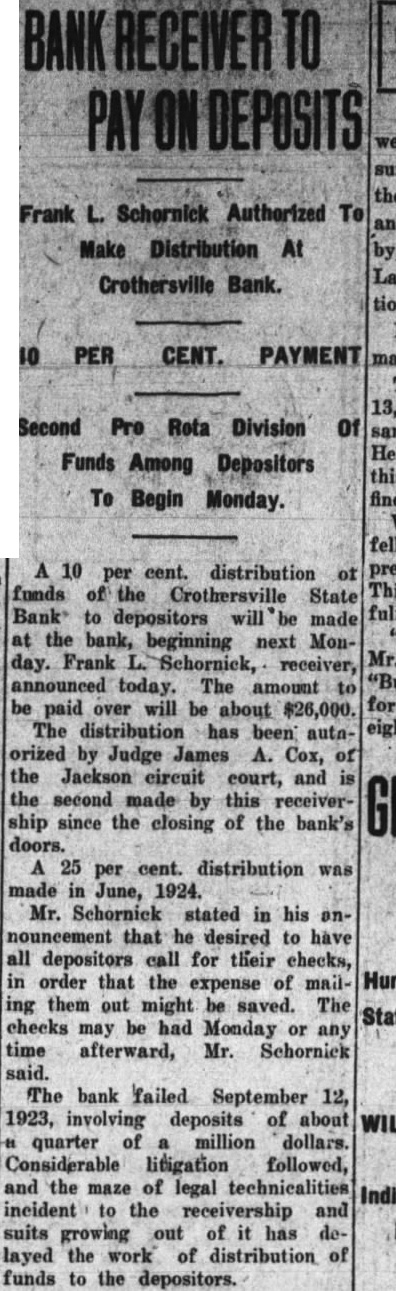
Frank Schornick Authorized To Make Distribution At Crothersville Bank. 10 PER CENT. PAYMENT Second Pro Rota Division Of Funds Among Depositors To Begin Monday. 10 per cent. distribution funds of the Crothersville State Bank to depositors made at the bank, beginning next Monday. Frank Schornick, receiver, "But announced today. The amount for be paid over will be about $26,000. The distribution has been autoorized by Judge James Cox, the Jackson circuit court, and the second made by this receivership since the closing of the bank's doors. A 25 per cent. distribution was made in June, 1924. Mr. Schornick stated in his onthat he desired to have all depositors call for their checks, in order that the expense of mailing them out might be saved. The checks may be had Monday or any time afterward, Mr. Schornick said. The bank failed September 12, 1923, involving deposits of about WILL quarter of million dollars. Considerable litigation followed, and the maze of legal technicalities incident to the receivership and suits growing out of it has delayed the work of distribution of funds to the depositors.