City National Bank (Miami, FL)

Episode Information

Episode UID
1315901572
Episode Type
Run β†’ Suspension β†’ Closure
Bank Type
national
Bank ID
131590 national
Charter Number
13159
Start Date
December 22, 1930
Location
Miami, Florida (25.774, -80.194)

Metadata

Model
gpt-5-mini (chosen from majority vote of a three-model LLM ensemble)
Short Digest
57b9e572793bd664

Response Measures

Full suspension, Books examined

Receivership Details

Depositor recovery rate
40.0%
Date receivership started
1930-12-23
OCC cause of failure
Governance
Share of assets assessed as good
44.6%
Share of assets assessed as doubtful
46.2%
Share of assets assessed as worthless
9.1%

Description

Receivership date Dec. 23, 1930 is referenced in articles and matches known receiver filings.

Events (5)

1. December 31, 1927 Chartered
Source
historical_nic
2. December 22, 1930 Run
Cause
Rumor Or Misinformation
Cause Details
Heavy withdrawals attributed by directors to malicious rumors about the bank's condition.
Measures
Board of directors closed the bank to protect assets.
Newspaper Excerpt
The board said heavy withdrawals, due to malicious rumors regarding the bank's condition, were responsible for the decision to close.
Source
newspapers
3. December 22, 1930 Suspension
Cause
Rumor Or Misinformation
Cause Details
Board closed the bank after heavy withdrawals driven by malicious rumors; bank did not open following the run.
Newspaper Excerpt
The closing of City National bank, Miami's second largest financial institution, was made early today by the board of directors.
Source
newspapers
4. December 23, 1930 Receivership
Source
historical_nic
5. December 23, 1930 Receivership
Newspaper Excerpt
receiver since Dec. 23, 1930, for the closed City National bank in Miami, has sent his resignation to the comptroller of the currency, to become effective April 15, he announced today.
Source
newspapers

Newspaper Articles (22)

Article from North Platte Daily Telegraph, December 22, 1930

Click image to open full size in new tab

Article Text

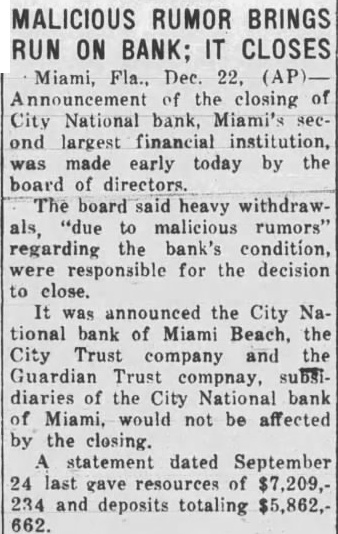
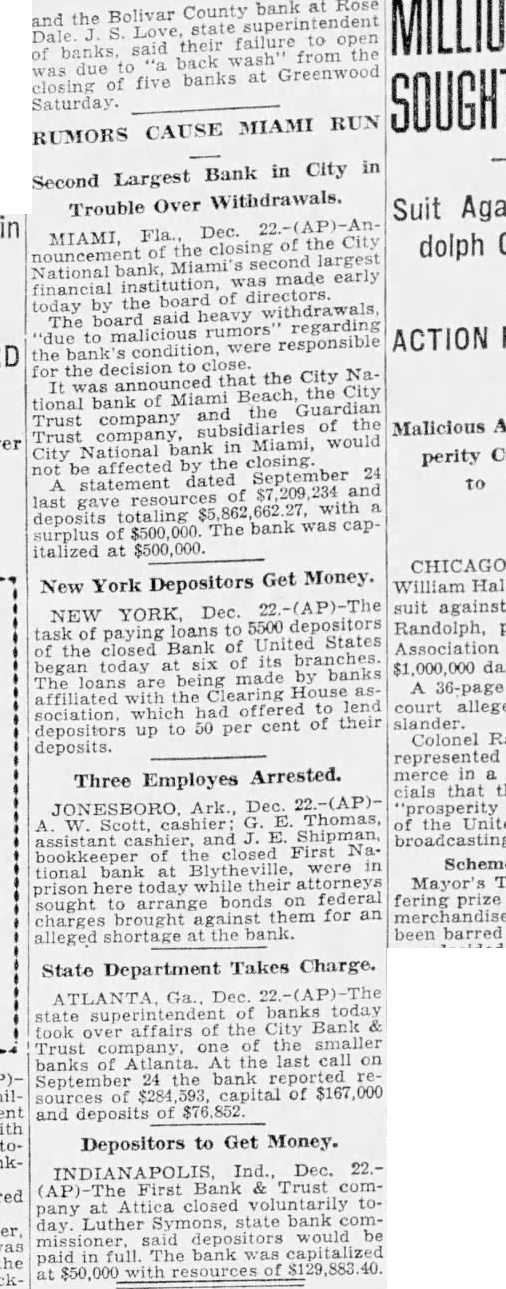
MALICIOUS RUMOR BRINGS RUN ON BANK; IT CLOSES Miami, Fla., Dec. 22. of the closing of City National bank, Miami's second largest financial institution, was made early today by the board of directors. The board said heavy withdrawals, "due to malicious rumors" regarding the bank's condition, were responsible for the decision to close. It was announced the City National bank of Miami Beach, the City Trust company and the Guardian Trust compnay, subsidiaries of the City National bank of Miami, would not be affected by the closing. statement dated September 24 last gave resources of $7,209,234 and deposits totaling $5,862,662.


Article from The News Journal, December 23, 1930

Click image to open full size in new tab

Article Text

Miami Beach Bank Closes. The Associated Fla. City Bank of Miami underwent heavy run following the closing of the City National Bank in Miami, did not this open


Article from The Daily Worker, December 23, 1930

Click image to open full size in new tab

Article Text

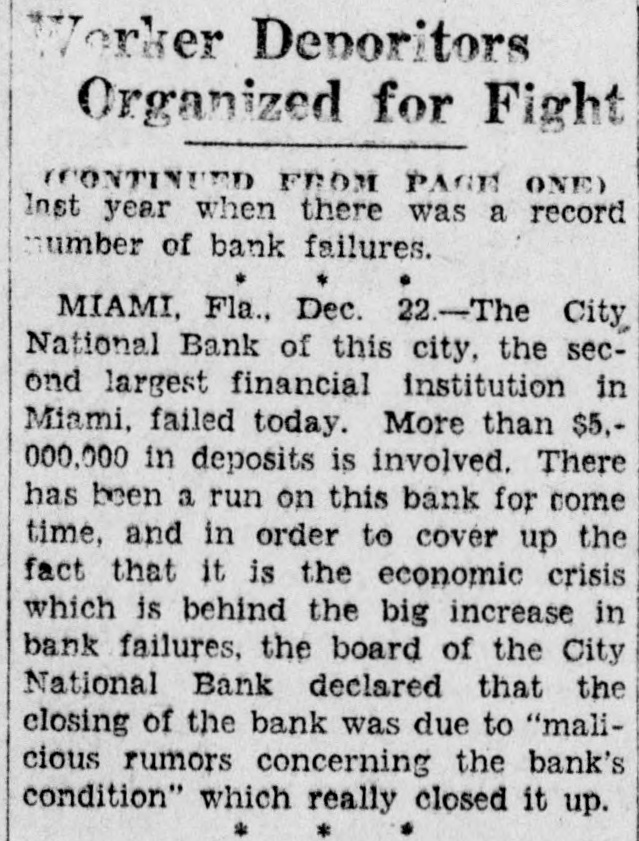
Worker Denoritors Organized for Fight (CONTINUED FROM PAGE ONE) Inst year when there was a record number of bank failures. * * MIAMI, Fla., Dec. 22-The City National Bank of this city, the second largest financial institution in Miami, failed today. More than $5,000,000 in deposits is involved. There has been a run on this bank for come time, and in order to cover up the fact that it is the economic crisis which is behind the big increase in bank failures, the board of the City National Bank declared that the closing of the bank was due to "malicious rumors concerning the bank's condition" which really closed it up.


Article from The Journal Times, December 23, 1930

Click image to open full size in new tab

Article Text

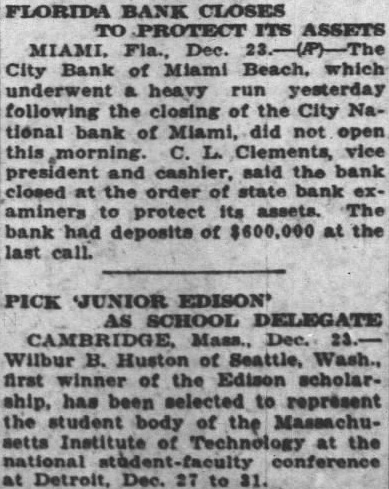
FLORIDA BANK CLOSES PROTECT ITS ASSETS MIAMI. Dec. City Bank of which underwent heavy yesterday following the closing of the City tional bank of Miami, not open this vice said the bank closed at the order state bank aminers protect assets. The bank had deposits of at the last call. PICK JUNIOR EDISON' SCHOOL DELEGATE CAMBRIDGE, Mass., Dec. Wilbur Huston of Seattle, Wash., first winner of the Edison scholarship, has been selected to represent the student of the MassachuInstitute of at the Detroit, Dec.


Article from The Richmond News Leader, December 23, 1930

Click image to open full size in new tab

Article Text

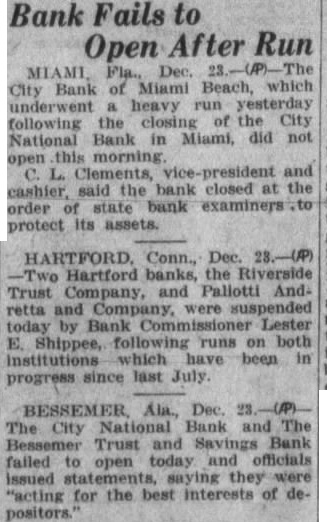
Bank Fails to Open Run City Bank of Miami Beach, which underwent heavy run yesterday following the the City National Bank in Miami, did not open this Clements, president and L. cashier, said the bank closed at the order of bank protect its assets. Conn., Dec. Hartford banks, the Riverside Trust Company, and Pallotti Andretta and were today by Bank Lester E. Shippee, runs on both Institutions progress since last July The National and The City Trust and Savings Bank failed to open today officials issued they "acting for the best interests of de-


Article from Sun-Journal, December 23, 1930

Click image to open full size in new tab

Article Text

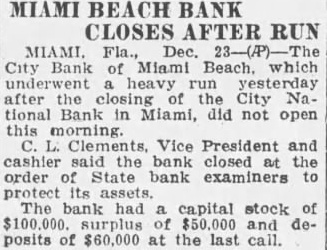
MIAMI BEACH BANK CLOSES AFTER RUN MIAMI. Dec. Miami Beach. after the City National Bank in Miami, did not open Clements, Vice President and cashier the bank closed the order State examiners The had capital stock of $50,000 and deposits of $60,000 the last


Article from New Britain Herald, December 23, 1930

Click image to open full size in new tab

Article Text

Miami Bank Fails to Open Doors to Public Bank of Miami Beach. which underwent a heavy run yesterday after the closing of the City National bank in Miami, did not open this morning. president and cashier the bank closed at the order of bank examiners 10 protect its assets The bank had capital stock of surplus of and deposits of $600,000 at the last call.


Article from Journal and Courier, December 24, 1930

Click image to open full size in new tab

Article Text

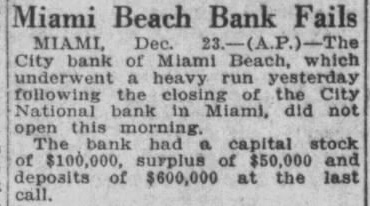
Miami Beach Bank Fails MIAMI, Dec. City bank of Miami Beach, which underw a heavy run yesterday following the closing of the City National bank in Miami, did not open this The bank had capital stock of $100,000, surplus of $50,000 and deposits of $600,000 at the last call.


Article from Rushville Republican, December 24, 1930

Click image to open full size in new tab

Article Text

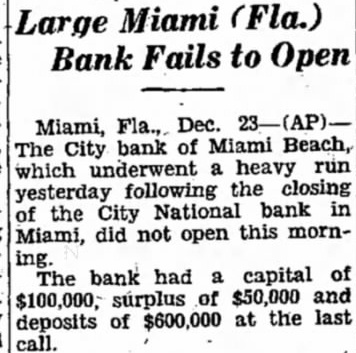
Large Miami (Fla.) Bank Fails to Open Miami, Fla., Dec. 23-(AP)The City bank of Miami Beach, which underwent a heavy run yesterday following the closing of the City National bank in Miami, did not open this morning. The bank had a capital of $100,000, surplus of $50,000 and deposits of $600,000 at the last call.


Article from The Times, December 24, 1930

Click image to open full size in new tab

Article Text

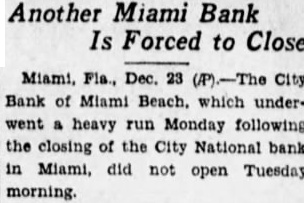
Another Miami Bank Is Forced to Close Miami, Fla., Dec. 23 (P).-The City Bank of Miami Beach. which underwent a heavy run Monday following the closing of the City National bank in Miami, did not open Tuesday morning.


Article from The McCook Daily Gazette, December 24, 1930

Click image to open full size in new tab

Article Text

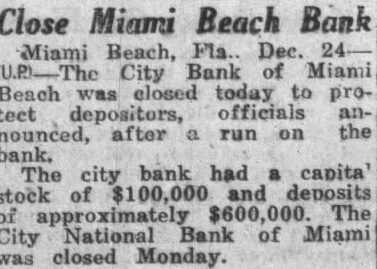
Close Miami Beach Bank Miami Beach, Fla. Dec. 24The City Bank of Miami Beach was closed today to protect depositors, officials announced, after a run on the bank. The city bank had a capita stock of $100,000 and deposits of approximately $600,000. The City National Bank of Miami was closed Monday.


Article from The Producers News, December 26, 1930

Click image to open full size in new tab

Article Text

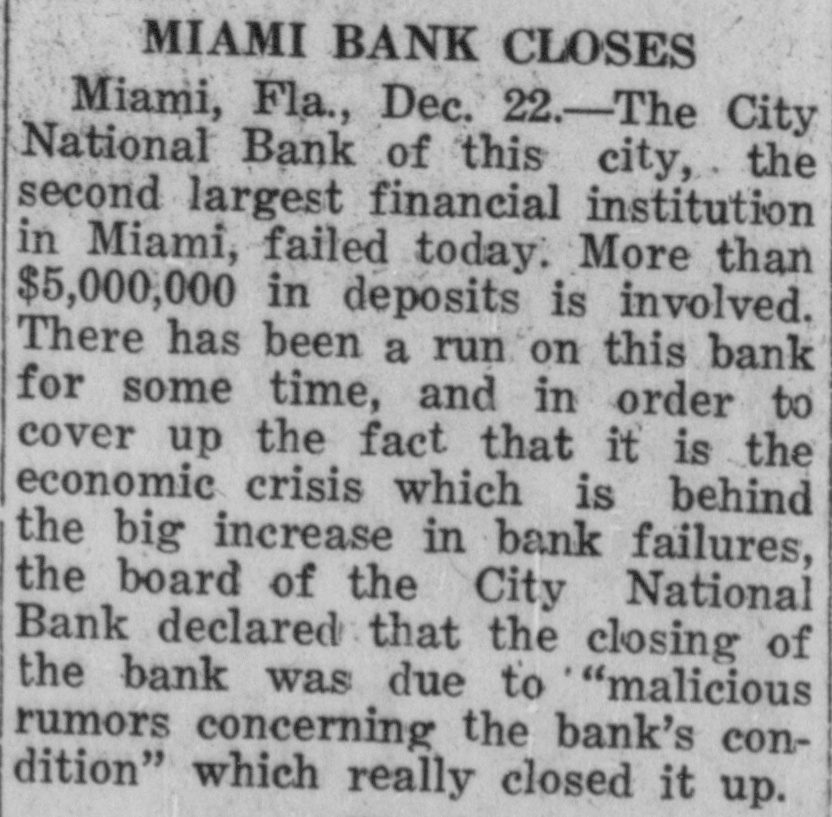
MIAMI BANK CLOSES Miami, Fla., Dec. 22.-The City National Bank of this city, the second largest financial institution in Miami, failed today. More than $5,000,000 in deposits is involved. There has been a run on this bank for some time, and in order to cover up the fact that it is the economic crisis which is behind the big increase in bank failures, the board of the City National Bank declared that the closing of the bank was due to "malicious rumors concerning the bank's condition" which really closed it up.


Article Text

FLORIDA BANK REOPENS MIAMI BEACH, Fla., Jan. 13State banking will be made here today when City Bank of Miami Beach which closed Dec. 23, opens ready to pay 100 cents on the dollar. It closed following run on City National Bank of Miami despite declaration of directors that bank was sound.


Article Text

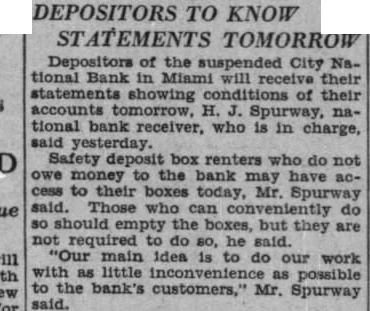
BANK'S RECEIVER SUES THREE ON NOTE FOR $1,000 H. Spurway, receiver of the closed City National Bank In Miami. filed suit for $2,000 against Andolph BodAmelia W. Bodmer and Robert W. Peck, 507 yesterday in United States District court. They are indorsers on $1,000 note due 8, it is alleged.


Article Text

BANK RECEIVER SUES FOR $125,000 ON NOTES Suit for $125,000 was started against the Empire Realty Securities Corporation, Huntington building. by H. J. Spurway, receiver of the closed City National Bank In Miami, yesterday, in United States District court. It was second similar action. the first for $20,000 damages being filed Wednesday.


Article Text

BANK RECEIVER GIVEN $110,372 IN JUDGMENTS H Spurway receiver for the closed City National Bank In Miami, was


Article Text

JUDGMENT RECOMMENDED AGAINST BANK RECEIVER Russell Yates, special master. recyesterday in United States District that entered against Silver Palm Groves, Inc., in favor Spurway receiver for the City National Bank Miami. The represents of interest and attorneys' fees and costs


Article Text

SPURWAY RESIGNS AS BANK RECEIVER Will Quit City National Post on April 15 Resignation of Spurway the City bank Miami, effective April 15, been submitted the the rency, statement issued by No reason for the and could reached either Miami residence his office for Named sponsored 23. paid have for prepared cent.


Article Text

BANK RECEIVER RESIGNS MIAMI, March J. Spurway, receiver since Dec. 23, 1930, for the closed City National bank in Miami, has sent his resignation to the comptroller of the currency, to become effective April 15, he announced today.


Article Text

Bank Receiver Resigns MIAMI, March H. Spurway, December 1930. for the closed City National Bank in Miami, has sent his resignation to the the currency, to effective April 15, he announced Saturday.


Article Text

BANK ANALYSIS SHOWED DANGER, SAYS PRESIDENT Penney Made No Immediate Reply After Report Was Sent Even after the City National Bank in Miami had disposed of $2,000,000 worth of "bad paper" it still had doubtful assets amounting to $1,032,489, although its capitalization at that time was only $500,000, Hugh H. Gordon, jr., former president of the bank, testified in today's session of depositions being taken in a suit of depositors against J. C. Penney, former chairman of the closed bank's board of directors. A few months after he accepted the presidency of the bank, Gordon said under examination by counsel for the depositors, he ordered an analysis made of the bank's assets in order to protect himself from criticism in the event of losses sustained later. This was done, he said, after the bank had offset $1,000,000 worth of doubtful assets by a 100 per cent capital stock assessment, and had sold another million of "bad paper" to the Tarrier Corp., a Penney interest, for cash. The analysis and report of it were kept secret, Gordon testified. "I knew I was playing with fire," he said, "for if the public had learned we were making such an investigation there would have been a run on the bank." Gordon sent the report, which showed the bank's bad assets to total $1,032,489 as of May 22, 1930, to Penney, and received a letter of acknowledgement in reply, but no comment, he declared, was immediately forthcoming. When Gordon was called from Athens, Ga., in 1929 and offered the presidency of the bank, Penney promised personally to furnish "all the money needed" to see the bank through. Gordon made this statement late yesterday as he took the witness stand in the depositions being taken in the suit against Penney. "I have no desire to persecute Mr. Penney," Gordon said, "but I do want to tell the whole truth."


Article Text

Penney Warned Gordon But Note Was Ignored Attorneys delved into the innermost affairs of the defunct City National bank in Miami yesterday as Hugh H. Gordon, Jr., former president of the bank, testified at the deposition session of the $3,000,000 suit brought by depositors against J. C. Penney, former chairman of the bank's board of directors. Gordon told of his manipulations to improve the condition of the bank and how he succeeded in wiping out $2,000,000 worth of bad paper. But even then, Gordon said, the bank was weighted down with bad assets totaling $1,032,489. This took place in the spring of 1930 prior to the time that the bank closed on December 20. Every effort was made, Gordon said, to straighten out the bank's affairs and place it on a sound footing. "I knew I was playing with fire," the former president said, "for if the public had learned we were making such an investigation there would have been a run on the bank." The high light in yesterday's testimony in the deposition session of the suit was when Gordon told of notifying Penney of the tremendous amount of bad accounts carried by the bank after the $2,000,000 worth of worthless paper had been disposed of. Gordon told of the thorough accounting of the bank as of May 22 and of the fact that it revealed more than a million dollars worth of bad paper. Penney was notified of the condition of the bank immediately, Gordon said, but only acknowledged receipt of the statement. through the pyramiding of values and juggling of stocks, Holt said: "In my own state we have a utility known as the Kentucky-West Virginia Gas and Electric company. This concern is owned in turn by a Philadelphia company which is controlled by the Standard Gas and Electric company. Standard Gas and Electric is controlled by Standard Power and Light corporation, which is controlled by the U. S. Power company and U. S. Power is owned and controlled by still another holding company." "It is this kind of pyramiding," Holt said, "that permits the top corporation to control as much as one and one-fifth billions of dollars in property values with only as little as a three million dollar investment, and this is worked out through the alphabetical classifications of stock." Assailing stock manipulations which make possible the pyramiding process and give holding companies voting control, Holt said that buying utility stocks was like "walking into a grocery storeβ€”you can buy any kind of stock you desireβ€”and there are many fine varieties to choose from." The senator said the varieties were divided into classifications with alphabetical designations and into preferred stocks, common stocks, bonds and debentures for the purpose of promoting huge selling schemes that will not involve the danger of giving the investor the right to vote in the company. "The only preferred issues," he said, "are those that carry with them voting power and they are not the stocks and bonds that reach the hands of the widows and orphans they cry upon my shoulder about." Concluding with a condemnation of the manner in which utilities fix their own appraised values, which are not used for fixing tax values, he said in his home state the system is called "horseback appraising." "A company owned and company paid appraiser rides over the property on horseback," he said. "When he comes to some company property he scans it and says, 'This is worth so much,' and goes on. When he has finished, ledger values have been disregarded and the net result is a write-up of many times actual worth." "The only remedy for this situation," Holt said, "is the complete abolition of holding companies and it is to this end that we are working in Washington." Senator Holt was followed by Baldwin Buckner Bane of Washington, director of registration division of the securities and exchange commission. He outlined the workings of the SEC as an organization, maintaining a file containing the names of "75 percent of all swindlers, crooks and others who have or are now operating in the securities business." Earlier in the day securities commissioners gathered here from all states in the Union heard Harold K. Bradford of Washington, president of the association, outline the needs of the securities organization. He described them as better and more uniform state certificate laws, more appropriation for the work and increased personnel. "For years we have needed better co-operation between the various state securities departments, and we are nearer the accomplishment of this today than ever before," he said. William V. Knott, state treasurer, welcomed the organization to say: "Florida is a pioneer in securities legislation. Our original act regulating the sales of securities dates from 1913. While it was not the first of this sort to be passed by any state, I believe our state Supreme court was the first high court to sustain what was then known as 'Blue Sky' legislation." The convention will be addressed today by Attorney-General Cary D. Landis. Other speakers will be Ambrose V. McCall, assistant attorney-general of New York; John M. Godfrey, securities commissioner of Ontario, Canada; Dean K. Worchester, executive vice president of the New York stock exchange; Russell Maloney, securities commissioner for Missouri; Judge Robert E. Healey, member of SEC. Election of new officers is scheduled for late in the afternoon.