gpt-5-mini (chosen from majority vote of a three-model LLM ensemble)
Short Digest
31322d1ee8d2c6e3
Response Measures
None
Description
State banking department took the bank into receivership Dec 22, 1930; later partial dividend/liquidation actions in 1931.
Events (4)
1.December 20, 1930Run
Cause
Rumor Or Misinformation
Cause Details
Heavy withdrawals/steady seepage of deposits in days before Dec. 22 prompted panic-like withdrawals
Measures
None specified other than public statements of solvency and officials/clearinghouse assurances
Newspaper Excerpt
a steady seepage' of deposits due to withdrawals in the last few days
Source
newspapers
2.December 22, 1930Receivership
Newspaper Excerpt
was taken over by the Pennsylvania state department of banking today. Announcement of the receivership was made by the bank in a notice posted on its doors at the opening of business today. The notice read: The business and properties... is in the possession of Peter G. Cameron, State secretary of banking.
Source
newspapers
3.December 22, 1930Suspension
Cause
Government Action
Cause Details
State Secretary of Banking took the bank into possession/closed it after withdrawals; state takeover ordered Dec. 22
Newspaper Excerpt
The business and properties of the Bankers Trust Company of Philadelphia is in the possession of Peter G. Cameron, State secretary of banking.
Source
newspapers
4.October 14, 1931Other
Newspaper Excerpt
prompt payment of $7,000,000 would be made to more than 125,000 depositors in three closed banks ... A 20 per cent dividend will be made to the depositors of each of the three banks, the Bankers Trust company ... payments will be made through the creation of a special liquidating private bank
Source
newspapers
Newspaper Articles (22)
1.December 22, 1930The Washington TimesWashington, DC
Click image to open full size in new tab
Article Text
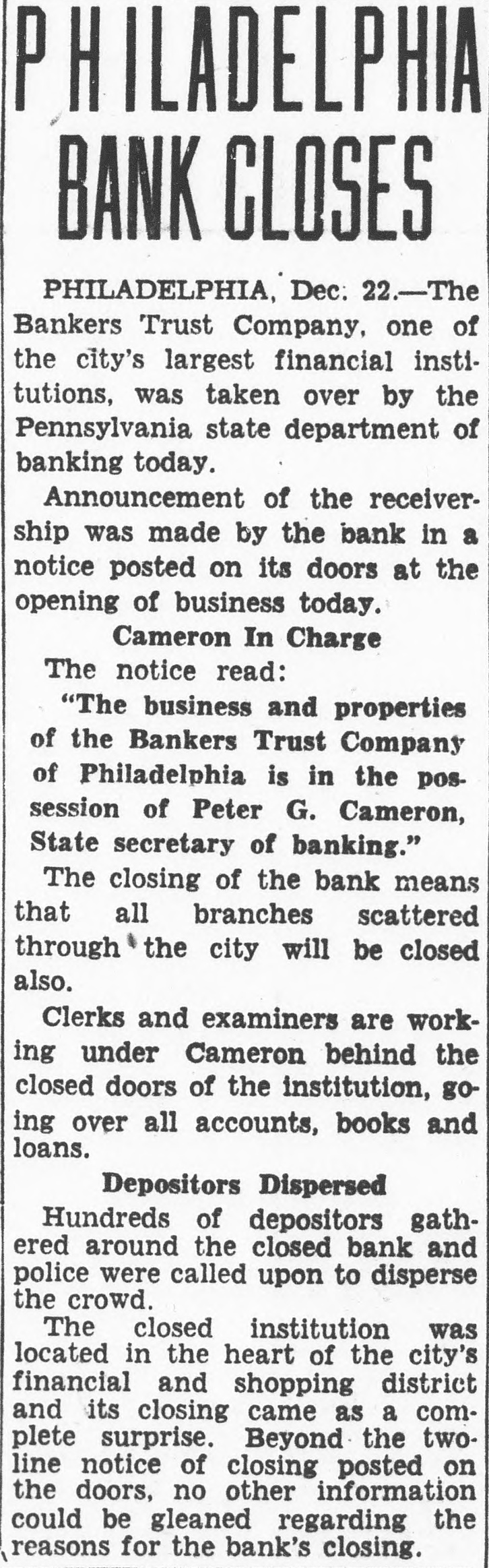
PHILADELPHIA BANK CLOSES PHILADELPHIA, Dec. 22.-The Bankers Trust Company, one of the city's largest financial institutions, was taken over by the Pennsylvania state department of banking today. Announcement of the receivership was made by the bank in a notice posted on its doors at the opening of business today. Cameron In Charge The notice read: "The business and properties of the Bankers Trust Company of Philadelphia is in the possession of Peter G. Cameron, State secretary of banking." The closing of the bank means that all branches scattered through the city will be closed also. Clerks and examiners are working under Cameron behind the closed doors of the institution, going over all accounts, books and loans. Depositors Dispersed Hundreds of depositors gathered around the closed bank and police were called upon to disperse the crowd. The closed institution was located in the heart of the city's financial and shopping district and its closing came as a complete surprise. Beyond the twoline notice of closing posted on the doors, no other information could be gleaned regarding the reasons for the bank's closing.
2.December 22, 1930The Miami NewsMiami, FL
Click image to open full size in new tab
Article Text
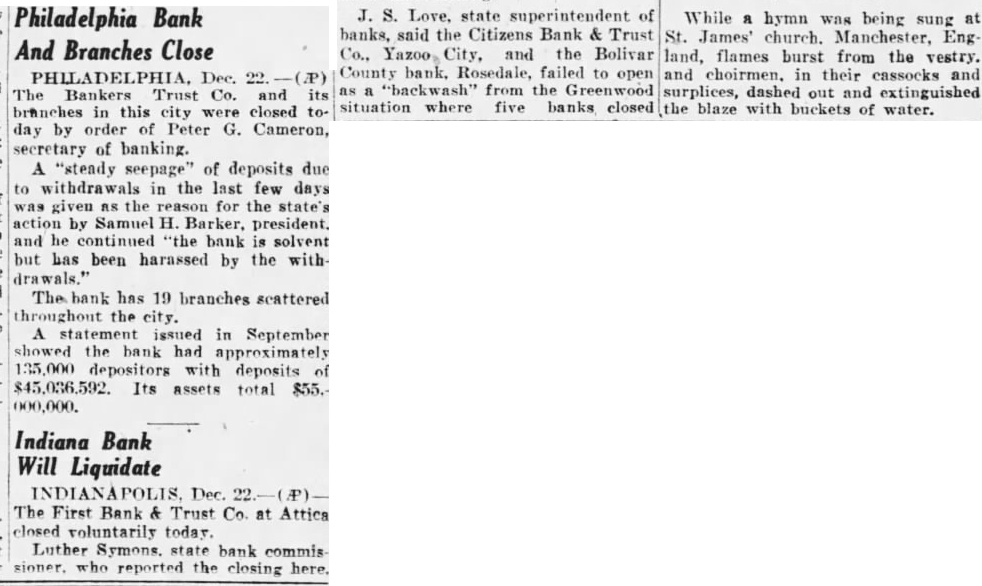
Philadelphia Bank And Branches Close
The Bankers Trust Co. and its branches in this city were closed today by order of Peter G. Cameron, secretary of banking. A "stendy seepage' of deposits due to withdrawals in the last few days was given the reason for the state's action by Samuel H. Barker, president. and he continued "the bank is solvent but has been harassed by the with has 19 branches scattered throughout the city A statement issued in September showed the bank had approximately 135,000 depositors with deposits of $45,036,592. Its assets total $55.
Indiana Bank Will Liquidate
INDIANAPOLIS Dec. The First Bank & Trust Co. at Attica closed voluntarily today. Luther Symons. state bank commis sioner. who reported the closing here
J. S. Love, state superintendent of While hymn was being sung at banks, said the Citizens Bank & Trust St. James' church. Manchester, Eng Co., Yazoo City, and the Bolivar land, flames burst from the vestry. County bank. failed to open and choirmen. in their cassocks and as from the Greenwood surplices, out and extinguished situation where five banks closed the blaze with buckets of water.
3.December 22, 1930Lincoln Journal StarLincoln, NE
Click image to open full size in new tab
Article Text
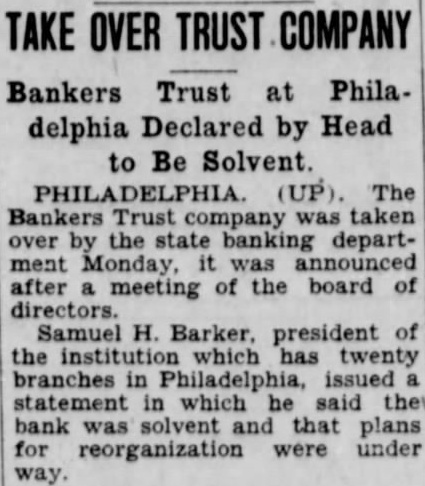
TAKE OVER TRUST COMPANY
Bankers Trust at Philadelphia Declared by Head to Be Solvent.
PHILADELPHIA. (UP). The Bankers Trust company taken over the state banking department Monday, was announced after meeting of the board of directors. Samuel H. Barker, president of the institution which twenty branches in Philadelphia, issued statement which the bank solvent that plans for reorganization were under way.
4.December 22, 1930North Platte Daily TelegraphNorth Platte, NE
Click image to open full size in new tab
Article Text
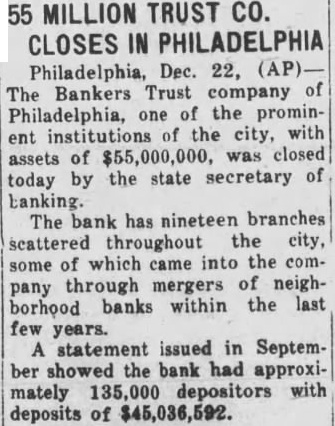
55 MILLION TRUST CO. CLOSES IN
Philadelphia, Dec. 22, (AP)The Bankers Trust company of Philadelphia, one of the prominent institutions of the city, with assets of was closed today by the state secretary of tanking. The bank has nineteen branches scattered throughout the city, some of which came into the company through mergers of neighborhood banks within the last few years. A statement issued in September showed the bank had approximately depositors with deposits of $45,036,592.
5.December 23, 1930The Courier-JournalLouisville, KY
Click image to open full size in new tab
Article Text
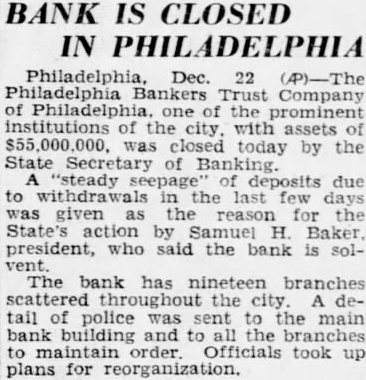
BANK IS CLOSED IN PHILADELPHIA
Philadelphia, Dec. 22 (A)-The Philadelphia Bankers Trust Company of Philadelphia. one of the prominent institutions of the city, with assets of $55,000,000, was closed today by the State Secretary of Banking. "steady seepage' deposits due to withdrawals in the last few days was given as the reason for the State's action by Samuel H. Baker president, who said the bank is solvent. The bank has nineteen branches scattered throughout the city. A detail of police was sent to the main bank building and to all the branches to maintain order Officials took up plans for reorganization.
6.December 23, 1930The Evening JournalWilmington, DE
Click image to open full size in new tab
Article Text
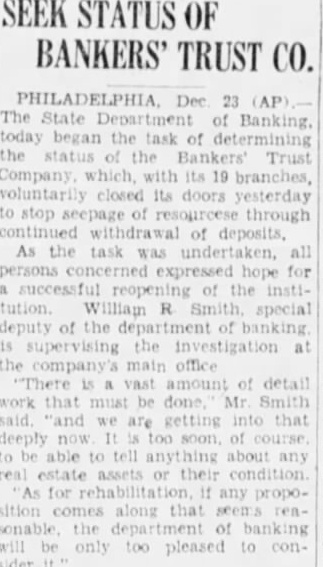
SEEK STATUS OF BANKERS' TRUST CO.
PHILADELPHIA, Dec 23 The State of Banking, began the task of status the Trust branches, closed doors yesterday stop through of deposits. As the undertaken, expressed hope successful of the instiWilliam special deputy of the department of banking supervising investigation the company's office "There vast amount of detail that be Mr Smith we are getting into that deeply of able anything about any assets or their any sition along that sonable department banking too pleased
7.December 23, 1930The Times-TribuneScranton, PA
Click image to open full size in new tab
Article Text
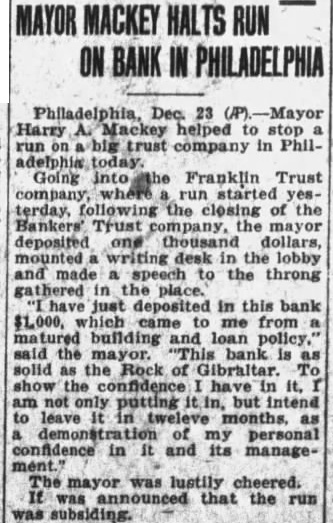
MAYOR MACKEY HALTS RUN ON BANK PHILADELPHIA
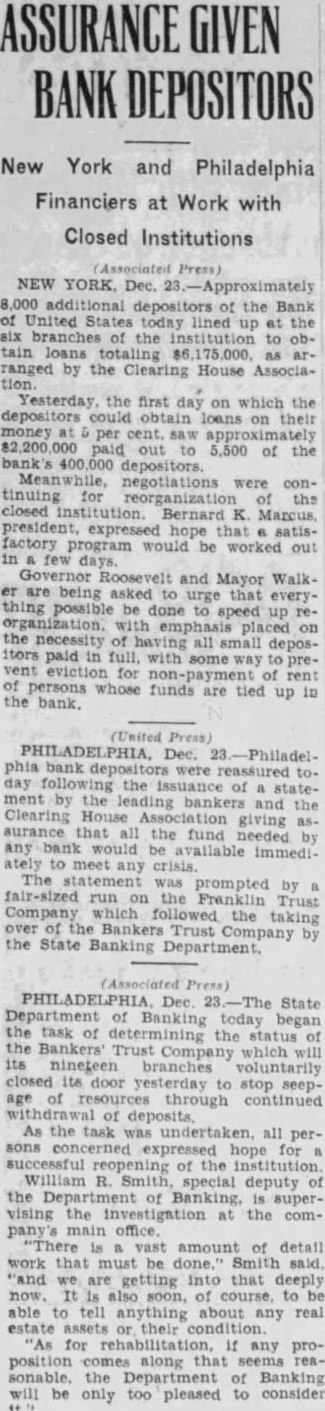
Philadelphia, Dec. 23 Harry A. Mackey to run trust company in Philtoday. Going into Franklin Trust company, where yesterday, following the closing of the Bankers' Trust company, the mayor deposited one thousand dollars, mounted writing desk in the lobby and made speech to the throng gathered the place. just deposited in this bank $1,000, which came to me from matured building and loan policy,' said the mayor. "This bank is solid as the Rock of Gibraltar. show the in it. am not only putting but to leave in months, as of personal confidence in and its manageThe mayor was lustily cheered. If was announced that the run was subsiding.
8.December 23, 1930The Capital JournalSalem, OR
Click image to open full size in new tab
Article Text
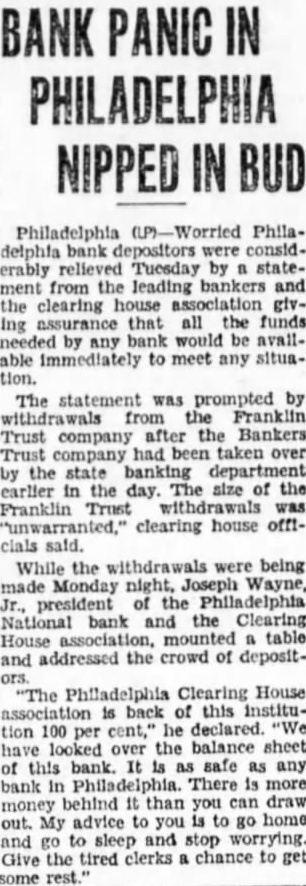
PANIC
Philadelphia Philadelphia bank depositors were considerably relieved Tuesday by statement from the leading bankers and the clearing house givIng assurance that all the funds needed by any bank would be available immediately to meet any situation. The statement was prompted by withdrawals from the Franklin Trust company after the Bankers Trust company had been taken by the state banking department earlier the day. The size of the Franklin Trust withdrawals was "unwarranted," clearing house offisald. While the withdrawals were being made Monday night, Joseph Wayne, of the National bank and the Clearing House mounted table and addressed the crowd of deposit"The Philadelphia Clearing House association is back of this institution 100 per cent," he declared. have looked over the balance sheet of this bank. safe any bank in Philadelphia. There is more money behind than you can draw My advice to is to go home out. you and go to sleep and stop worrying. Give the tired clerks chance to get rest."
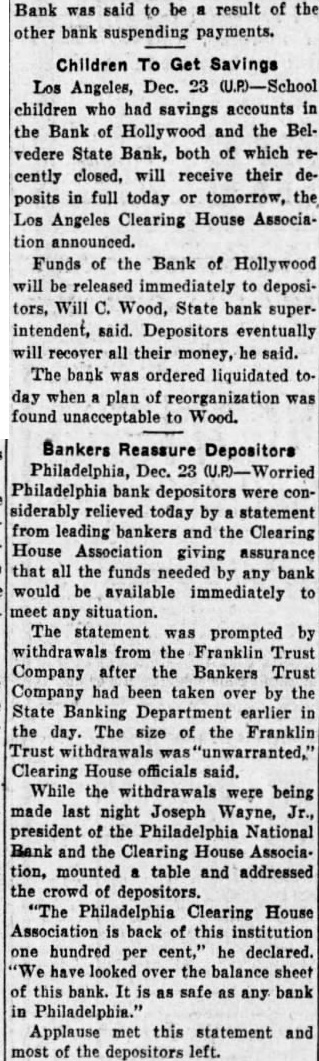
RELIEVE DEPOSITORS
Philadelphia bank erably yesterday by astatement from leading and Past the Clearing ing that all the funds needed by any bank would be available to meet any promptby the Trust Company. after the Bankers Trust Company had been taken over by the State Banking Department earlier in the day.
10.December 25, 1930The Daily WorkerNew York, Chicago, NY
Click image to open full size in new tab
Article Text
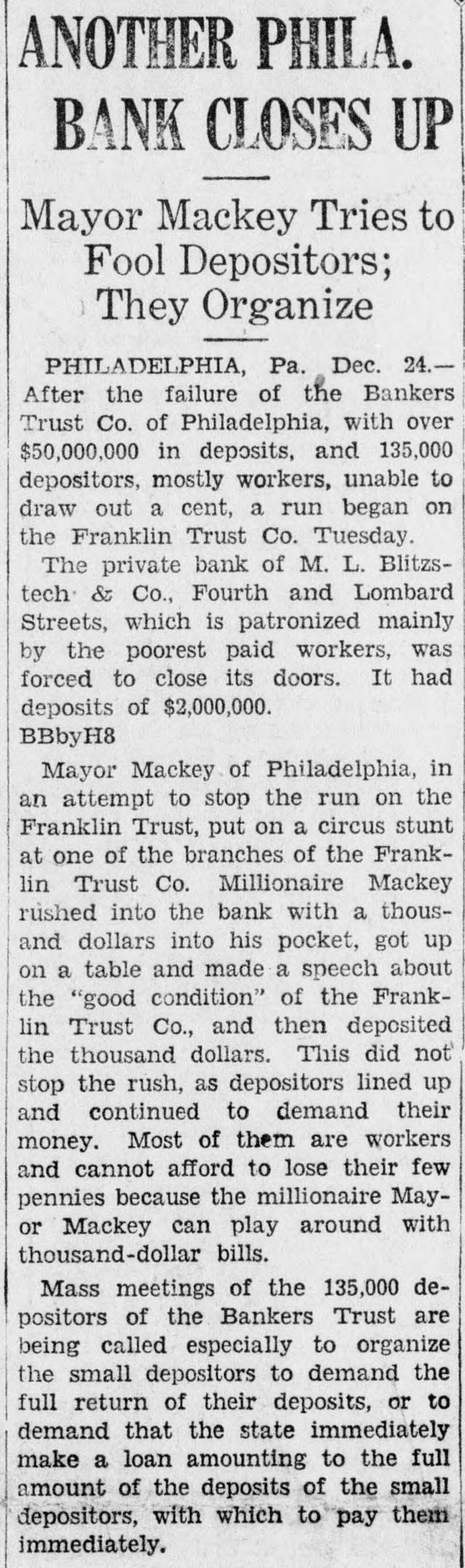
ANOTHER PHILA. BANK CLOSES UP Mayor Mackey Tries to Fool Depositors; They Organize PHILADELPHIA, Pa. Dec. 24.After the failure of the Bankers Trust Co. of Philadelphia, with over $50,000,000 in deposits, and 135,000 depositors, mostly workers, unable to draw out a cent, a run began on the Franklin Trust Co. Tuesday. The private bank of M. L. Blitzstech & Co., Fourth and Lombard Streets, which is patronized mainly by the poorest paid workers, was forced to close its doors. It had deposits of $2,000,000. BBbyH8 Mayor Mackey of Philadelphia, in an attempt to stop the run on the Franklin Trust, put on a circus stunt at one of the branches of the Franklin Trust Co. Millionaire Mackey rushed into the bank with a thousand dollars into his pocket, got up on a table and made a speech about the "good condition" of the Franklin Trust Co., and then deposited the thousand dollars. This did not stop the rush, as depositors lined up and continued to demand their money. Most of them are workers and cannot afford to lose their few pennies because the millionaire Mayor Mackey can play around with thousand-dollar bills. Mass meetings of the 135,000 depositors of the Bankers Trust are being called especially to organize the small depositors to demand the full return of their deposits, or to demand that the state immediately make a loan amounting to the full amount of the deposits of the small depositors, with which to pay them immediately.
11.December 25, 1930The Daily WorkerChicago, IL
Click image to open full size in new tab
Article Text
Fool Depositors; Organize
Dec. After the failure the Bankers Trust Co. Philadelphia, with over in deposits, and 135,000 depositors, mostly workers, unable to draw out cent, run began the Franklin Trust Co. Tuesday The private bank of Blitzstech Fourth and Lombard Streets, which patronized mainly the poorest paid was forced close its doors. had deposits of $2,000,000.
Mayor Mackey Philadelphia, attempt stop the run on the Franklin Trust, put circus stunt of the branches of the Franklin Trust Co. Millionaire Mackey rushed into the bank with thousand dollars into his pocket, got table and made speech about "good condition" of the Franklin Trust Co., and then deposited the thousand dollars. This did not the rush, as depositors lined up and continued to demand their Most of them are workers money. cannot afford to lose their few the millionaire MayMackey can play around with bills. Mass meetings of the positors of the Bankers Trust are being called especially to organize the small depositors to demand the full return of their deposits, demand that the state immediately make loan amounting to the full amount of the deposits of the small depositors, with which immediately.
12.December 29, 1930The Daily WorkerNew York, Chicago, NY
Click image to open full size in new tab
Article Text
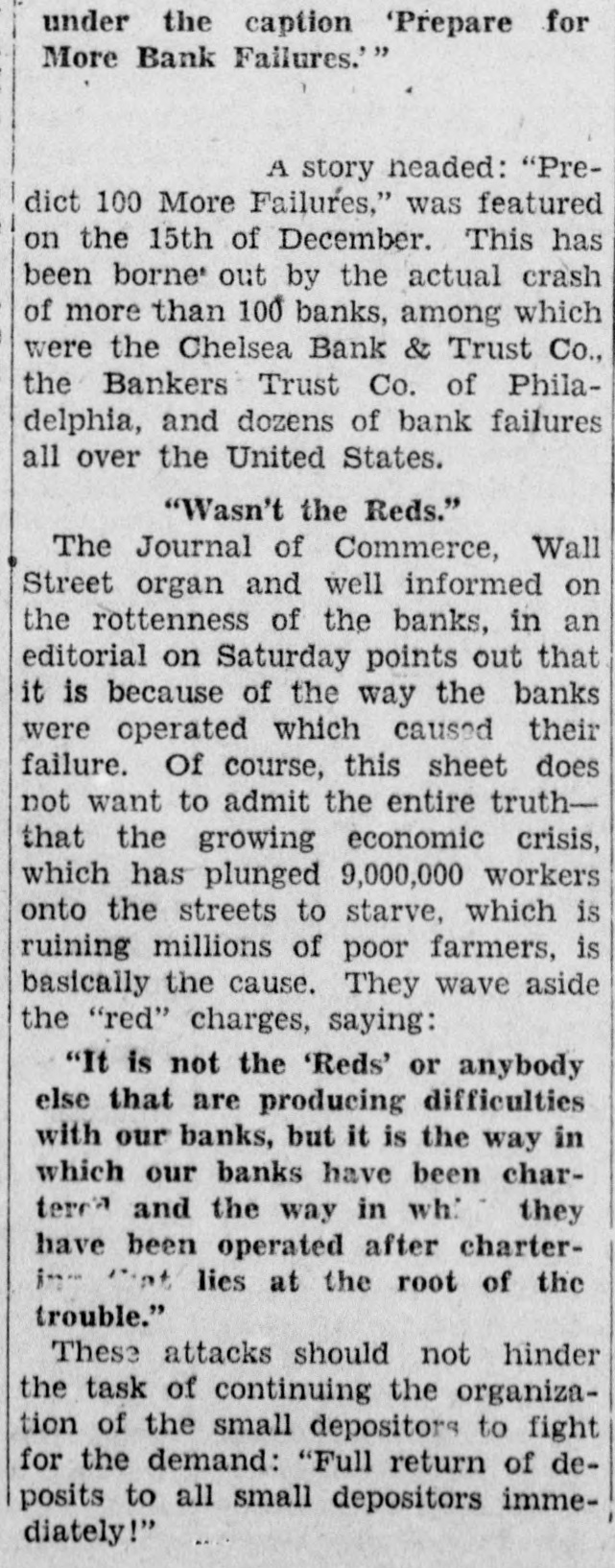
under the caption 'Prepare for More Bank Failures." A story headed: "Predict 100 More Failures," was featured on the 15th of December. This has been borne out by the actual crash of more than 100 banks, among which were the Chelsea Bank & Trust Co., the Bankers Trust Co. of Philadelphia, and dozens of bank failures all over the United States. "Wasn't the Reds." The Journal of Commerce, Wall Street organ and well informed on the rottenness of the banks, in an editorial on Saturday points out that it is because of the way the banks were operated which caused their failure. Of course, this sheet does not want to admit the entire truththat the growing economic crisis, which has plunged 9,000,000 workers onto the streets to starve, which is ruining millions of poor farmers, is basically the cause. They wave aside the "red" charges, saying: "It is not the 'Reds' or anybody else that are producing difficulties with our banks, but it is the way in which our banks have been chartere" and the way in wh: they have been operated after charterert lies at the root of the trouble." These attacks should not hinder the task of continuing the organization of the small depositors to fight for the demand: "Full return of deposits to all small depositors immediately!"
13.August 28, 1931Daily NewsNew York, NY
Article Text
HOOVER HOLDS PARLEY WITH 4 N. Y. BANKERS
Washington, D. C., Aug. 27 (U.P.). A conference among four leading New York bankers and President Hoover was held in the seclusion of the White House last night. It was described today as having dealt with "general business conditions." Those who met with Hoover were William C. Potter, president of the Guaranty Trust Company of New York; Charles S. McCain, president of the Chase National Bank; George W. Davison, president of the Central Hanover Bank and Trust Company, and James T. Lee, vice president of the Chase National Bank. Eugene Meyer, chairman of the Federal Reserve Board and Secretary of the Treasury Andrew W. Mellon also were present. This afternoon the White House denied the conference concerned international affairs, the cotton or wheat situations, and any specific, acute financial situations in this country. By the process of elimination many came to the opinion that proposals for relief of unemployment were largely concerned. Today Hoover was in conference for fifteen minutes with Samuel H. Barker and three associates, all bankers from Philadelphia. It was said they were discussing the possible reopening of the Bankers Trust Company of Philadelphia, which was closed some weeks ago, under charter as a national bank.
14.August 28, 1931Daily NewsNew York, NY
Article Text
HOOVER HOLDS PARLEY WITH 4 N. Y. BANKERS
Washington, D. C., Aug. 27 (U.P.). A conference among four leading New York bankers and President Hoover was held in the seclusion of the White House last night. It was described today as having dealt with "general business conditions." Those who met with Hoover were William C. Potter, president of the Guaranty Trust Company of New York; Charles S. McCain, president of the Chase National Bank; George W. Davison, president of the Central Hanover Bank and Trust Company, and James T. Lee, vice president of the Chase National Bank. Eugene Meyer, chairman of the Federal Reserve Board and Secretary of the Treasury Andrew W. Mellon also were present. This afternoon the White House denied the conference concerned international affairs, the cotton or wheat situations, and any specific, acute financial situations in this country. By the process of elimination many came to the opinion that proposals for relief of unemployment were largely concerned. Today Hoover was in conference for fifteen minutes with Samuel H. Barker and three associates, all bankers from Philadelphia. It was said they were discussing the possible reopening of the Bankers Trust Company of Philadelphia, which was closed some weeks ago, under charter as a national bank.
15.August 28, 1931Daily NewsNew York, NY
Article Text
HOOVER HOLDS PARLEY WITH 4 N. Y. BANKERS
Washington, D. C., Aug. 27 (U.P.). A conference among four leading New York bankers and President Hoover was held in the seclusion of the White House last night. It was described today as having dealt with "general business conditions." Those who met with Hoover were William C. Potter, president of the Guaranty Trust Company of New York; Charles S. McCain, president of the Chase National Bank; George W. Davison, president of the Central Hanover Bank and Trust Company, and James T. Lee, vice president of the Chase National Bank. Eugene Meyer, chairman of the Federal Reserve Board and Secretary of the Treasury Andrew W. Mellon also were present. This afternoon the White House denied the conference concerned international affairs, the cotton or wheat situations, and any specific, acute financial situations in this country. By the process of elimination many came to the opinion that proposals for relief of unemployment were largely concerned. Today Hoover was in conference for fifteen minutes with Samuel H. Barker and three associates, all bankers from Philadelphia. It was said they were discussing the possible reopening of the Bankers Trust Company of Philadelphia, which was closed some weeks ago, under charter as a national bank.
16.August 28, 1931Daily NewsNew York, NY
Article Text
HOOVER HOLDS PARLEY WITH 4 N. Y. BANKERS
Washington, D. C., Aug. 27 (U.P.). conference among four leading New York bankers and President Hoover was held in the seclusion of the White House last night. It was described today as having dealt with "general business conditions." Those who met with Hoover were William C. Potter, president of the Guaranty Trust Company of New York; Charles S. McCain, president of the Chase National Bank; George W. Davison, president of the Central Hanover Bank and Trust Company, and James T. Lee, vice president of the Chase National Bank. Eugene Meyer, chairman of the Federal Reserve Board and Secretary of the Treasury Andrew W. Mellon also were present. This afternoon the White House denied the conference concerned international affairs, the cotton or wheat situations, and any specific, acute financial situations in this country. By the process of elimination many came to the opinion that proposals for relief of unemployment were largely concerned. Today Hoover was in conference for fifteen minutes with Samuel H. Barker and three associates, all bankers from Philadelphia. It was said they were discussing the possible reopening of the Bankers Trust Company of Philadelphia, which was closed some weeks ago, under charter as a national bank.
17.August 28, 1931Daily NewsNew York, NY
Article Text
HOOVER HOLDS PARLEY WITH 4 N. Y. BANKERS
Washington, D. C., Aug. 27 (U.P.). A conference among four leading New York bankers and President Hoover was held in the seclusion of the White House last night. It was described today as having dealt with "general business conditions." Those who met with Hoover were William C. Potter, president of the Guaranty Trust Company of New York; Charles S. McCain, president of the Chase National Bank; George W. Davison, president of the Central Hanover Bank and Trust Company, and James T. Lee, vice president of the Chase National Bank. Eugene Meyer, chairman of the Federal Reserve Board and Secretary of the Treasury Andrew W. Mellon also were present. This afternoon the White House denied the conference concerned international affairs, the cotton or wheat situations, and any specific, acute financial situations in this country. By the process of elimination many came to the opinion that proposals for relief of unemployment were largely concerned. Today Hoover was in conference for fifteen minutes with Samuel H. Barker and three associates, all bankers from Philadelphia. It was said they were discussing the possible reopening of the Bankers Trust Company of Philadelphia, which was closed some weeks ago, under charter as a national bank.
18.August 28, 1931Daily NewsNew York, NY
Article Text
HOOVER HOLDS PARLEY WITH 4 N. Y. BANKERS
Washington, D. C., Aug. 27 (U.P.). A conference among four leading New York bankers and President Hoover was held in the seclusion of the White House last night. It was described today as having dealt with "general business conditions." Those who met with Hoover were William C. Potter, president of the Guaranty Trust Company of New York; Charles S. McCain, president of the Chase National Bank; George W. Davison, president of the Central Hanover Bank and Trust Company, and James T. Lee, vice president of the Chase National Bank. Eugene Meyer, chairman of the Federal Reserve Board and Secretary of the Treasury Andrew W. Mellon also were present. This afternoon the White House denied the conference concerned international affairs, the cotton or wheat situations, and any specific, acute financial situations in this country. By the process of elimination many came to the opinion that proposals for relief of unemployment were largely concerned. Today Hoover was in conference for fifteen minutes with Samuel H. Barker and three associates, all bankers from Philadelphia. It was said they were discussing the possible reopening of the Bankers Trust Company of Philadelphia, which was closed some weeks ago, under charter as a national bank.
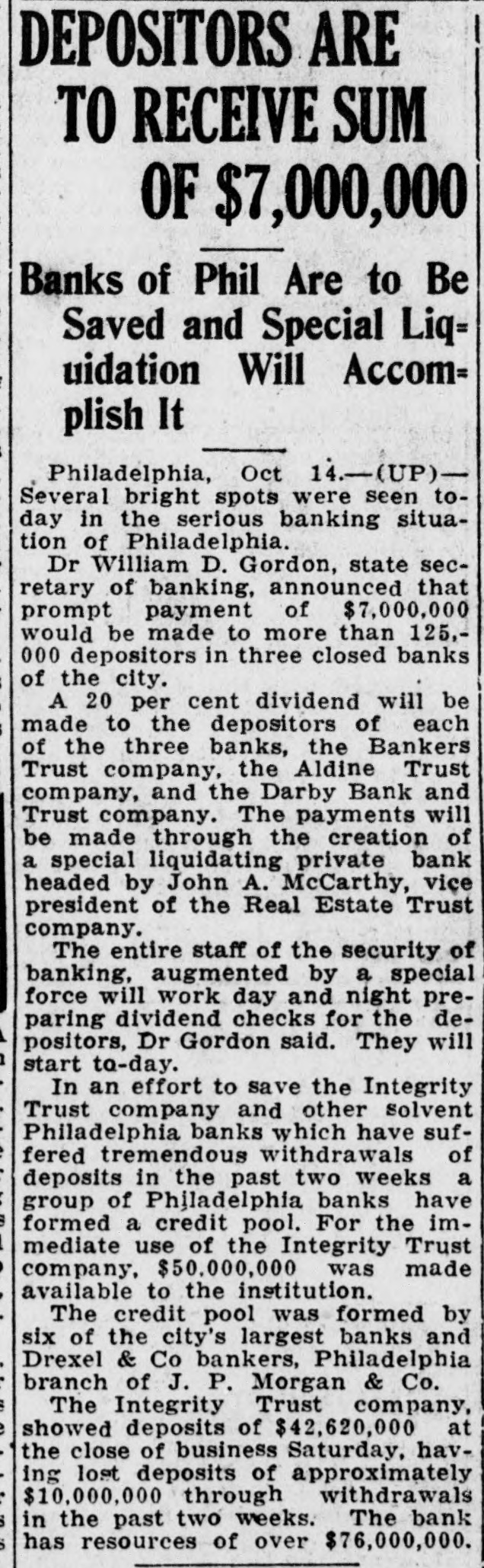
DEPOSITORS ARE TO RECEIVE SUM OF $7,000,000 Banks of Phil Are to Be Saved and Special Liq= uidation Will Accom= plish It Philadelphia, Oct 14. -(UP)Several bright spots were seen today in the serious banking situation of Philadelphia. Dr William D. Gordon, state secretary of banking, announced that prompt payment of $7,000,000 would be made to more than 125,000 depositors in three closed banks of the city. A 20 per cent dividend will be made to the depositors of each of the three banks, the Bankers Trust company, the Aldine Trust company, and the Darby Bank and Trust company. The payments will be made through the creation of a special liquidating private bank headed by John A. McCarthy, vice president of the Real Estate Trust company. The entire staff of the security of banking, augmented by a special force will work day and night preparing dividend checks for the depositors, Dr Gordon said. They will start ta-day. In an effort to save the Integrity Trust company and other solvent Philadelphia banks which have suffered tremendous withdrawals of deposits in the past two weeks a group of Philadelphia banks have formed a credit pool. For the immediate use of the Integrity Trust company, $50,000,000 was made available to the institution. The credit pool was formed by six of the city's largest banks and Drexel & Co bankers, Philadelphia branch of J. P. Morgan & Co. The Integrity Trust company, showed deposits of $42,620,000 at the close of business Saturday, having lost deposits of approximately $10,000,000 through withdrawals in the past two weeks. The bank has resources of over $76,000,000.
DEPOSITORS ARE TO RECEIVE SUM OF $7,000,000
Banks of Phil Are to Be Saved and Special Liq= uidation Will Accom= plish It
Philadelphia, Oct bright were day in the serious banking situaDr William D. Gordon, state secretary of that prompt payment of $7,000,000 would made more than 000 in three closed banks of the 20 per cent dividend will be made the depositors of the three the Bankers Trust company, the Aldine Trust and the Darby Bank and Trust payments will be made through the creation of special liquidating private bank headed by John McCarthy, vice president of the Real Estate Trust The entire staff of the security of banking. augmented by special force will work day and night paring dividend checks positors, Dr Gordon said. They will start In an effort to save the Integrity company and solvent banks which have suffered tremendous withdrawals deposits in the past two weeks group of banks have formed credit pool. For the mediate the Integrity Trust made available to the institution. The credit pool was formed by six of the banks and Drexel Co branch Morgan Co. The Integrity Trust showed deposits of $42,620,000 the close business Saturday, havlost deposits approximately through withdrawals in the past two weeks. The has of over $76,000,000.
21.August 1, 1933The Commercial AppealMemphis, TN
Article Text
RFC SUBMITS REPORT JUNE LOANS TOTAL
More Than 116 Millions Authorized in Month.
WASHINGTON, July Corporatoday reported President Roosevelt during June thorized 349 aggregating $116,and aggregating $3,253,045.83 loans authorized to June This makes total During $70,000,000 of the "Series 3ยฝ per cent sold the the making of notes outstanding June Among important loans made during Casco Mercantile Trust Co servator) Portland. $1,800,000 Fidelity (conservator) National Bank of Kentucky, LouisInterstate Trust Banking Co., New Orleans, $136,000 Baltimore Trust Baltimore Hopkins Savings Bank Baltimore, Federal National Bank of Boston American Exchange National Bank Louis, Twelfth Street Bank of St. Louis, Jersey Trust (receiver) Newark, Trust New York City, Standard Trust Bank (receiver). Cleveland, American Trust (conservator), Cleveland, Producers National Bank of Tulsa, Union Trust Co., Erie, Pa., $19,Bankers Trust Co., (receiver), Philadelphia, Bank NashTenn., HolstonUnion National Bank of Knoxville $525,000. Equitable Securities Co., Dallas, $1,000,000: Trust Bank, (receiver), Dallas, $200,000.
22.March 13, 1935The Birmingham PostBirmingham, AL
Article Text
EXTORTION NOTE LAID TO BIRMINGHAM MAN
George Thomas And Confederate Jailed In Philadelphia
George Thomas, 28, of Birmingham, was being held by police in Philadelphia today charged with attempted extortion of a Philadelphia bank receiver.
Thomas, who was arrested here in 1925 on charges of false pretense and in 1927 on charges of forgery, was detained with Albert Kawalski, 24, of Albany, N. Y. They are charged with sending an extortion note to William R. Smith, deputy receiver of the Banker's Trust Co.
Bank runs are almost always and everywhere a deterioration of bank fundamentals.
But not for you.
You are the measure-zero exception: great fundamentals, solid bank, and yet the Diamond Dybvig fairy spread its rumor. Depositors woke up. Your collateral was not prepositioned. The Clearinghouse had it for you.
Do not pass Go. Do not collect $200. Go directly to jail… or worse.