National Bank of the Commonwealth (New York, NY)

Episode Information

Episode UID
137200885
Episode Type
Run β†’ Suspension β†’ Closure
Bank Type
national
Bank ID
13720 national
Charter Number
1372
Start Date
September 19, 1873
Location
New York, New York (40.714, -74.006)

Metadata

Model
gpt-5-mini (chosen from majority vote of a three-model LLM ensemble)
Short Digest
740869bd51cecdb7

Response Measures

Accommodated withdrawals, Borrowed from banks or large institutions, Capital injected, Full suspension, Books examined

Clearinghouse involved: Yes (loan, examination, or other measures)

Receivership Details

Depositor recovery rate
100.0%
Date receivership started
1873-09-22
Date receivership terminated
1883-03-31
OCC cause of failure
Losses
Share of assets assessed as good
60.8%
Share of assets assessed as doubtful
20.0%
Share of assets assessed as worthless
19.2%

Description

Receivership date (1873-09-22) is reported in the sources and used as the closure date.

Events (5)

1. July 1, 1865 Chartered
Source
historical_nic
2. September 19, 1873 Run
Cause
Local Banks
Cause Details
Run on the Fourth National Bank (and wider panic) precipitated deposit withdrawals from the Commonwealth.
Measures
Bank attempted to obtain loans and called in collateral; cashier told not to accept deposits or pay out while seeking aid at Clearing House.
Newspaper Excerpt
The suspension of the National bank of the Commonwealth is attributed by its president, George Ellis, to the run on the Fourth national bank, the day before, which in turn caused a small run on the Commonwealth.
Source
newspapers
3. September 20, 1873 Suspension
Cause
Local Banks
Cause Details
Bank suspended payment amid runs and heavy withdrawals triggered by failures and runs at other local banks and Trust companies.
Newspaper Excerpt
The suspension of the National bank of the Commonwealth, which quickly followed that of the Trust company, is attributed by its president, George Ellis, to the run on the Fourth national bank...
Source
newspapers
4. September 22, 1873 Receivership
Source
historical_nic
5. September 22, 1873 Receivership
Newspaper Excerpt
On or about Sept. 22. 1873... the Controller of the Currency... appointed Isaac H. Bailey receiver of the bank.
Source
newspapers

Newspaper Articles (23)

Article from Memphis Daily Appeal, September 21, 1873

Click image to open full size in new tab

Article Text

THE MONEY PANIC. Continuation of the Excitement in Money Circles in New York, Philadelphia and Washington. Transactions in the Stock Ex change-Table of Comparative Fluctuations Et. erything Shaky. Additional Failures The Stock Exchange Closed, and Transactions Positively Prohibited. The Ten Million Sale of Bonds by the Government Fails Ut terly to Relieve the Panic. Secrefary-of-the-Treasury Richardson Coming Down with his Forty-Million Reserve. The Effect at Home and Abroad Business but Little Affected "Confidence" Coming, Etc., Etc. ADDITIONAL SUSPENSIONS NEW YORK, September 20. -The ded half at UnionTrust com pany past ten Ste are going up down and and lively, been made under the rules. which imply that failures taken place. though only one is known. that of firm of S. B. White & Co Western Union has touched sixty The suspension of the Union Trust likely, will make avoidable balances smaller brokers, and perhaps force them to relief from active business, for this day at least. Most of the sales of stocks are for cash and at two to three below cent regular G. White failed, not S. B. White as previously reported. The National bank of Commo wealth has ended. Saxe & Rogers have suspended, A meeting of the Jay Cooke & Co., will be held on Monday Rumors are circulating lively and one attributes the cause of the the Union Trust company to the defal cation. Edward Haight Co.,just ansuspended. Great crowds are in Wall and Broad and policemen are busy beeping free enti and exits the stock The failures of Ketchum & Belknap and E.C. Broadhead are the latest report New Louisig & Fisher, P M Myers, Miller Walsh. Lamens, Josephs, Fearing & Dellinger Williams & Bostwick. Rumor seems right this time, that defalcation exists the Union Trust company. The bank of Commonwealth run the the says National bank Fourth precipitated the run on that institution, and that Edward Haight Co their of two the account amount to hundred thousand dollars. which they did not make good to the extent one dred and eventy thousand dollars. Under the the bank thought it better to suspend. Stocks opened with an advance of from four to six per cent. but fell from two twenty-five cent the failthe Union Trust and the Bank of Com The eitement is so great that not possible the tly of the firms that have failed. Brodhead was the right name of the broker that failed not G Morehead and the proper name of White is now as White. The stock change closed subject the the president to enable the members to Vanderbilt accounts. their settle in with closeted Augustu Schell the Union Trust office immedi company ately after the suspension. More head has suspended, not Brodhead Brown Wadsworth & have failed The bank statement it said. will be ready before four o'clock then. give the usual quotations stocks possible to-day. The failures of brokers came in such quick that blocks of stock were thrown upon the market to realize PHILADELPHIA, September 20. The Union banking company has failed This company has a State charter. and bore heavy run yesterday. The bank did not open o-day and placard the stated that, owing mands suspension for few days had been resolved upon sustained run yeste heavy about out paying $700,000. State ing no notes, and the suspension only effects ST. LOUIS, September 19. Taussig this city closed their door the after ment of the failure their York house, Taussi Fischer & They confident of being able few days, and state that no lose a dollar by them. This in railroad pretty on their own account. BOSTON September 20 Wednesday last the firm of Horace Conn Wobourn, Massachus pay Their liabilities amount hundred thousand dollars, and mated their assets will reach one hundred and fifty thousand dollars. Since the suspension Horace Conn. senior partner, has disappeared, causing great saxiety to his family and friends Search has been made in all directions. ALBANY. September 20.-T. Squire & Co., bankers, have announced their temporary suspension until further ad vices from New York TORONTO. September 20.-H J Morse & Co. bankers and brokers in this city have suspended, owing to the failure Cooke & Co. and other prominent houses in New York. CHICAGO September 20. The Frank lin bank a private banking company situated on the corner of Madison and Dearborn streets, closed its doors to-day being unable to settle at the clearing house; the amount short was only nine dollars. Fernando thousand Jones is president the concern and A. Briggs The latter states that -president. their only temporary and as it is not known have been in any way connected with any of the suspended New York houses there would appear to be no reason why should not resume soon. It is stated that the majority of the teachers in the publicschools are depo sitors in the bank Its early resumption is, therefore, the more to be hoped for The suspen howement no or ever, creates feeling whatever in financial or cireles.


Article from New-York Tribune, September 22, 1873

Click image to open full size in new tab

Article Text

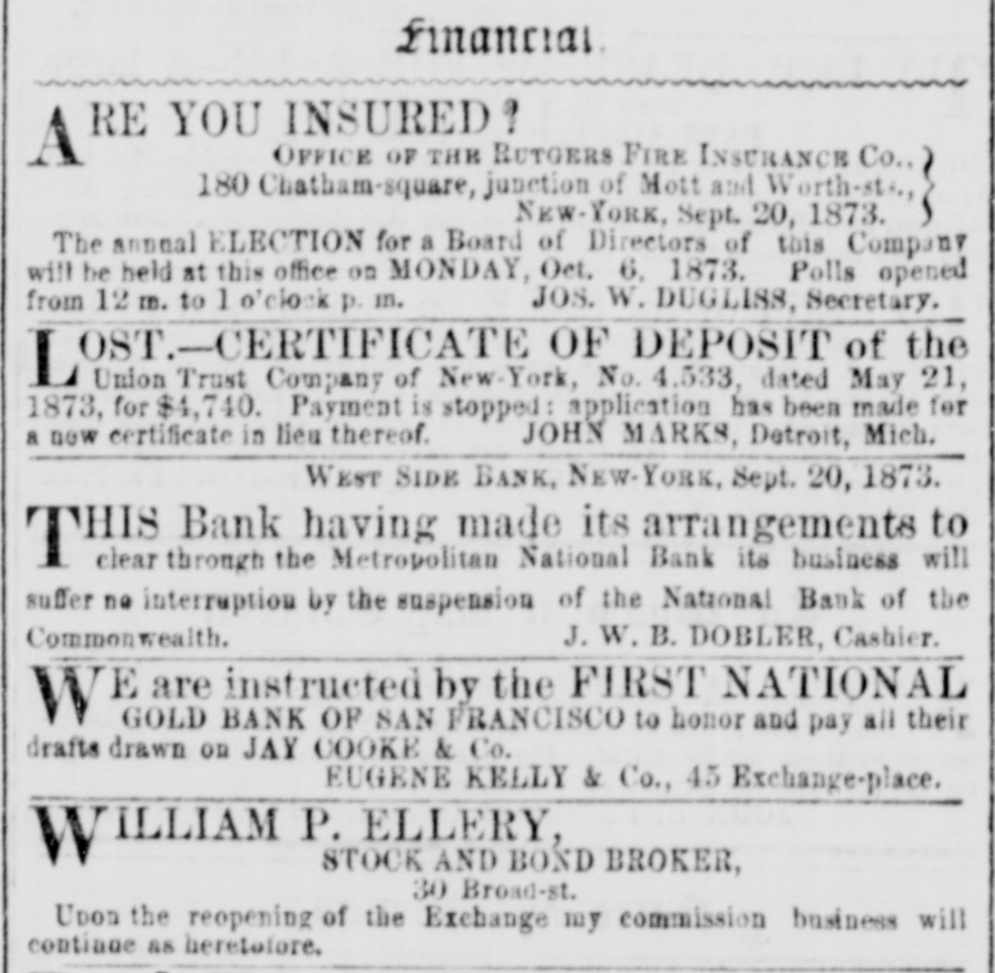
financial RE YOU INSURED ? A OFFICE OF THE RUTGERS FIRE INSURANCE Co., 180 Chatham-square, junction of Mott and Worth-st+., NEW-YORK, Sept. 20, 1873. The annual ELECTION for a Board of Directors of this Company will be held at this office on MONDAY, Oct. 6. 1873. Polls opened from 12 m. to 1 o'clock p. in. JOS. W. DUGLISS, Secretary. L OST.-CERTIFICATE OF DEPOSIT of the Union Trust Company of New-York, No. 4,533, dated May 21, 1873, for $4,740. Payment is stopped: application has been made for a now certificate in lieu thereof. JOHN MARKS, Detroit, Mich. WEST SIDE BANK, NEW-YORK, Sept. 20, 1873. THIS Bank having made its arrangements to clear through the Metropolitan National Bank its business will suffer no interruption by the suspension of the National Bank of the Commonwealth. J. W. B. DOBLER, Cashier. W E are instructed by the FIRST NATIONAL GOLD BANK OF SAN FRANCISCO to honor and pay all their drafts drawn on JAY COOKE & Co. EUGENE KELLY & Co., 45 Exchange-place. ILLIAM P. ELLERY, W STOCK AND BOXD BROKER, 30 Broad-st. UDOD the reopening of the Exchange my commission business will continue as heretofore.


Article from Wilmington Daily Commercial, September 22, 1873

Click image to open full size in new tab

Article Text

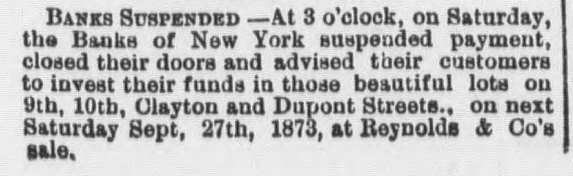
BANKS SUSPENDED β€” At 3 o'clock, on Saturday, the Banks of New York suspended payment, closed their doors and advised their customers to invest their funds in those beautiful lots on 9th, 10th, Clayton and Dupont Streets., on next Saturday Sept, 27th, 1873, at Reynolds & Co's sale.


Article from Wilmington Daily Gazette, September 22, 1873

Click image to open full size in new tab

Article Text

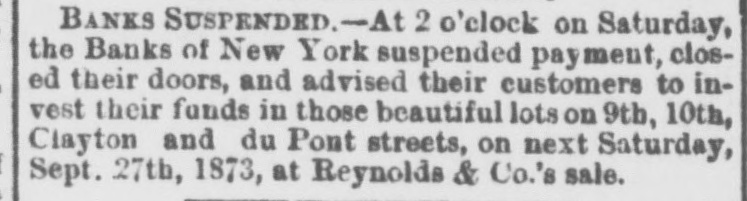
BANKS SUSPENDED.β€”At 2 o'clock on Saturday, the Banks of New York suspended payment, closed their doors, and advised their customers to invest their funds in those beautiful lots on 9th, 10th, Clayton and du Pont streets, on next Saturday, Sept. 27th, 1873, at Reynolds & Co.'s sale.


Article from Daily Kennebec Journal, September 23, 1873

Click image to open full size in new tab

Article Text

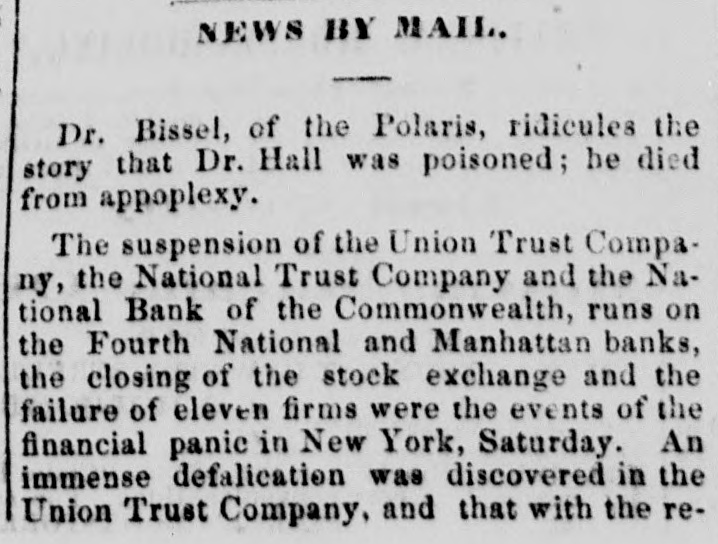
NEWS BY MAIL. Dr. Bissel, of the Polaris, ridicules the story that Dr. Hall was poisoned ; he died from appoplexy. The suspension of the Union Trust Company, the National Trust Company and the National Bank of the Commonwealth, runs on the Fourth National and Manhattan banks, the closing of the stock exchange and the failure of eleven firms were the events of the financial panic in New York, Saturday. An immense defalication was discovered in the Union Trust Company, and that with the re-


Article from Green-Mountain Freeman, September 24, 1873

Click image to open full size in new tab

Article Text

juncture the governing committee of the stock exchange held a meeting, and unanimously resolved upon the closing of the exchange. The hall was accordingly cleared at a quarter before 12, all members of the exchange having been first warned against dealings in the street or outside, on penalty of expulsion from the board, and business for the day was consequently closed. This action was received with general favor; cheer after cheer from the brokers followed the closing gong, and the grumblers were chiefly outsiders who had come to the city in the hope of making large purchases of stock at low figures. The general feeling was voiced by the Evening Express, when it said: "Too much praise cannot be awarded to the men who conceived and carried out this master stroke of policy. Bedlam was running loose, and the craze was rapidly communicating itself to the outside multitude. Nothing remained but to shut the door and try and bring back bulls and bears alike to their senses." The suspension of the National bank of the Commonwealth, which quickly followed that of the Trust company, is attributed by its president, George Ellis, to the run on the Fourth national bank, the day before, which in turn caused a small run on the Commonwealth. When the latter bank closed on Friday, it was discovered that the firm of Edward Haight & Co., the principal backers of the bankβ€”had overdrawn their account $225,000 which they were unable to return. The president consulted with other bank officials, some of whom proffered assistance and advised a continuance of business, but notwithstanding this and the added fact that immediate suspension was not absolutely necessary, it was deemed advisable to suspend at once rather than be subjected to the drain of a run. The suspension, however, did not affect other banks, the Commonwealth having been almost entirely a broker's bank and its capital being only $750,000. The suspension of the Union Trust Company was followed about noon, by that of the National Trust company, which was a matter of expediency rather than immediate necessity. The company had in its vaults a large amount of securities, including $800,000 in government bonds, but these could not be sold except at a discount of from 30 to 40 per cent.; and, rather than suffer such a loss, the directors decided to suspend temporarily. Among the minor suspensions of the day were the following: Edward Haight & Co., Brown, Wadsworth & Co., E. C. Morehead, C. G. White & Co., Ketchum & Belknap, Williams & Bostwick, Miller & Walsh, Lawrence Josephs, P. M. Myers & Co., Fearing & Delling and Taussig & Fisher. The run on the Fourth national bank, which commenced on Friday, continued through Saturday, but all demands were promptly met, about $500,000 being paid out during the day in bank notes. There was no run on any other bank. On Sunday President Grant and Secretary Richardson were in consultation with leading bankers. They refused to pay the legal tender reserve into the banks but promised to buy bonds at their market value to relieve the money market. On Monday the feeling was much better and it was believed that the worse of the panic is over. Saturday night the failures numbered thirty three firms and three banks. The only story of actual crime that has been developed by the breaking up in Wall st. is the defalcation of Charles T. Carleton, Secretary of the Union Trust Company. At the examination of the affairs of the institution on Friday night, rapid and general as it was, it was discovered that at least $350,000 worth of Government securities and railroad bonds, which had been kept in a new underground safe, had disappeared, and probably as much more. Mr. Carleton had left the office late in the forenoon, and though when he went out it was supposed he had gone to lunch, he has not yet returned. As evening approached, and the Secretary was still missing, rumors of distrust began to spread themselves among the officers and clerks. Late at night the surprising discovery was made known. Mr. Carleton has been connected with the bank for five years, and has not once until now been under suspicion. He is a son of the Rev. Dr. Carleton, formerly of the Methodist Book Concern, and it is stated that one loan of $20,000 was made to his father. Mr. Carleton lived in elegant style at No. 52 South Oxford-st., Brooklyn. Com. Vanderbilt's theory of the trouble as given to a reporter is as follows: The trouble is the people undertake to do four times as much business as they can legitimately undertake. Of course they get short, and have to bolster up their business as well as they can by robbing Peter to pay Paul. If people will carry on business in this mad-cap manner they must run a muck. There are a great many railroads started in this country without any means to carry them through. Respectable banking houses in New York, so called, make themselves agents for the sale of the bonds of the railroads in question and give a moral guarantee of genuineness. The bonds soon reach Europe and the markets of the commercial centers from the character of endorsers are flooded with them. Now mark the sequence. The road gets into difficulties and bad language is heard all round. These worthless roads prejudice the commercial credit of our country abroad. Building railroads from nowhere to nowhere at public expense is not a legitimate undertaking. I might make allusions to Texas, Midland and other new railroads, but you must excuse me, for I am a friend of the iron road, and like to see it stretching to every corner of the United States. They help to develop our commerce and civilization, and ought to be encouraged. All I have to say is, when railroads are to be built don't victimize the public to build them. When I have some money I buy railroad stock or something else, but I don't buy on credit. I pay for what I get. People who live too much on credit generally get brought up with a round turn in the long run. The Wall street "averages" ruin many a man there and is like faro. Mistrust will be engendered till we, as a nation, do our business on a more solid basis, and pay as we go. Tuesday afternoon the large banking house of Henry Clews & Co., failed, and the panic was fanned into new life. The Lamoille County Fair at Morrisville the 17th and 18th was very successful. Mr. A. W. Griswold's show of cattle was of course the best that anybody in the State could make. Robert Hill of Elmore had a fine flock of sheep. The baby show inaugurated by Hon. P. K. Gleed, came off as advertised. Thirteen mothers with their infants came upon the track in a carriage, accompanied by Mr. Gleed, and passed around the track and then to Floral Hall, where they were interviewed by the Committee. The first premium was awarded to Mrs. G. W. Doty of Morrisville.


Article from The Morristown Gazette, September 24, 1873

Click image to open full size in new tab

Article Text

Financial Crach.---Other Bank Suspensions. WASHINGTON, September, 20.--The following failures are reported : Union Banking Co., of Philadelphia, and Union Trust Co., A. R. White & Co, E.C. Broadhead, Kedpune & Belknap, New York. NEW ORLEANS, September. 20There is much anxiety in commercial circles regarding the failures in New York, but business among the banks is as quiet as usual. NEW YORK, September, 20.-Wall street was crowded at an early hour. There is less solicitude, however, and the resolutions of the banks to sustain each other, and the sale of ten millions, of bonds by the Treasury, nerves mat ters. Two of the members of the firm of Jay Cooke & Co. are coming on the Russia, which is expected on Monday, when a reliable statement of the affairs of the house will probably be presented to the public. WASHINGTON, September, 20-A. G. Cattell, agent of the Syndicate at London, telegraphs to Secretary Richardson that their accounts are all in perfect order. WASHINGTON, September, 20.-The following suspensions are added to the list : Saxe & Rodgers. National Bank of the commonweal h Quassig & Fisher, P. M. Myers, Miller & Walsh, Laurens & Josephs, Fearing & Dill inger. Brown, Wardsworth & Co.-all of New York. NEW YORK, September, 20.-The Bank of North America has sus pended. Western Union stock 57. PHILADELPHIA, September, 20.It is rumored that the Union Banking house has suspended. ALBANY, September, 20.-It is rumored that Squires & Sens have suspended. NEW YORK, Sept. 20.-Alluding to the SUST ension of operations by mem bers of the Stock Exchange, the Evening Express says: Too much praise cannot be awarded to the men who conceived and carried out this master stroke of policy. Bedlam was running loose and the craze was rapidly com municating itself to the outside multitude. Nothing remained, but to shut the door and try and bring back bulls and bears alike to their senses." The defalcation of the Union Trust Company amounts to a half million. The Clearing House announces its inability to make a general clearing on account, of dealers, inability to obtain properly certified checks. NEW York, September, 20.-The Bank Presidents, at their meeting this afternoon, passed a resolution to issue immediately $10,000,000 in loan certificates. WASHINGTON, September, 20.Westeru markets show a general halt in transactions, without any change in rates.


Article from Yorkville Enquirer, September 25, 1873

Click image to open full size in new tab

Article Text

MONEY PANIC IN NEW YORK. The extensive banking house of Jay Cooke & Co., failed to meet its engagements on the 18th instant. The immediate cause of the suspension is stated to be the large drawings on them by their Philadelphia house and their own depositors. During the two weeks preceeding the suspension, both houses had suffered a large drain upon their deposits in consequence of the uneasy feeling which has recently prevailed, and which has affected more or less all houses closely identified with new railroad enterprises. The Philadelphia house had been previously weakened by a large cash advance to the Northern Pacific Railroad Company of which they are financial agents. The next day after the suspension of Jay Cooke & Co., the following suspensions of New York banking houses were announced : Robinson & Snydam, Richard Schell, Fisk & Hatch, White, Dufrees & Rathbone, Burt & Edwards, Eugene Jackson, Thos. Reed & Co., W. H. Warren, Greenleaf & Norris, Geo. B. Alley, Theodore Biddle, A. M. Kidder, Whittemore & Anderson, Smith, Seaver & Co., Saxe & Rogers, National Bank of the Commonwealth, Quasig & Fisher, P. M. Meyers, Miller & Walsh, Laurens Joseph, Fearing & Dillenger and Brown, Wadsworth the houses in the northern cities ing & Co. Besides above, several have other closed bankdoors or suspended, including banks in Philadelphia, Albany, Washington City and Toronto, Canada. The panic in the cities north of Baltimore is general, and a run has been made by the depositors upon nearly all of the banks. In New York, on Friday, there was a crowd around every paying teller's desk. The panic has not as yet reached the South, nor is there any reason why it should. The grain and provision markets of the North and West are all unsettled, though the price of the southern staple in the New York market has not been materially affected, the panic having come at the most favorable time for the cotton planters-just at the commencement of the season-and before much of the crop had been put in market. The calamities which are threatened by the of the general can prospect suspension purchasing be partially averted by the government five millions dollars worth of bonds, which will furnish the banks with a sufficient amount of legal tenders to enable them to resume business. The latest rumor is to the effect that this plan will be resorted to, and that the government will buy half a million of bonds. The Bank Presidents have determined to issue immediately $10,000,000 in loan certificates. The latest intelligence from New York indicates an easier feeling among all classes,


Article from New-York Tribune, September 26, 1873

Click image to open full size in new tab

Article Text

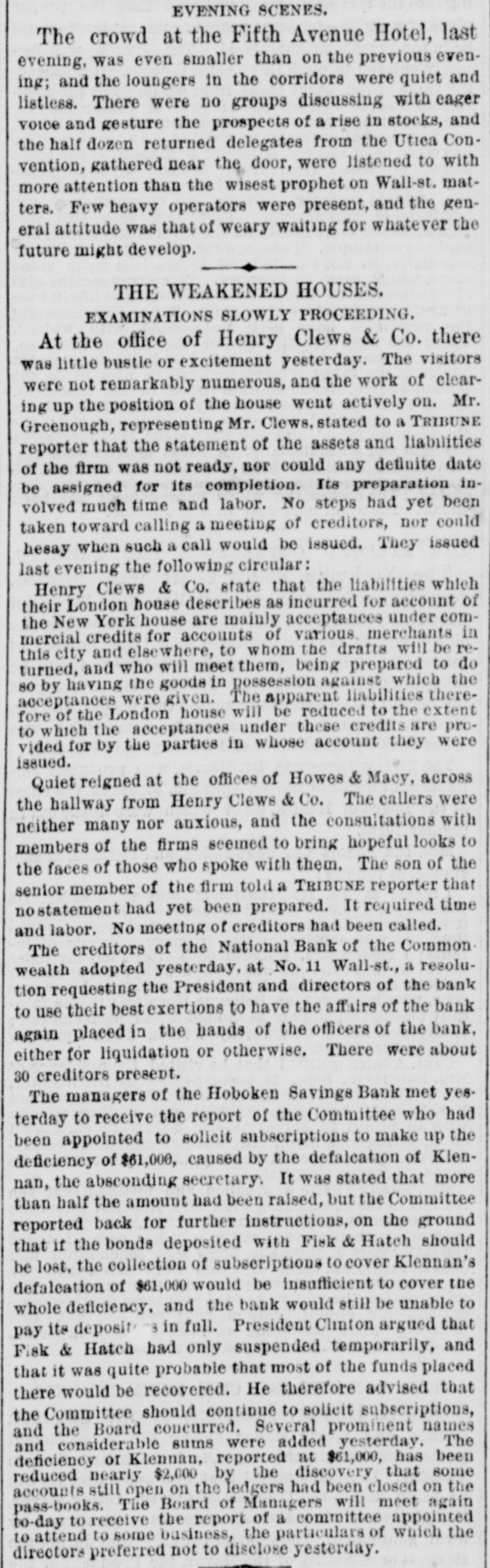
EVENING SCENES. The crowd at the Fifth Avenue Hotel, last evening, was even smaller than on the previous evening; and the loungers in the corridors were quiet and listless. There were no groups discussing with eager voice and gesture the prospects of a rise in stocks, and the half dozen returned delegates from the Utica Convention, gathered near the door, were listened to with more attention than the wisest prophet on Wall-st. matters. Few heavy operators were present, and the general attitude was that of weary waiting for whatever the future might develop. THE WEAKENED HOUSES. EXAMINATIONS SLOWLY PROCEEDING. At the office of Henry Clews & Co. there was little bustle or excitement yesterday. The visitors were not remarkably numerous, and the work of clearing up the position of the house went actively on. Mr. Greenough, representing Mr. Clews. stated to a TRIBUNE reporter that the statement of the assets and liabilities of the firm was not ready, nor could any definite date be assigned for its completion. Its preparation involved much time and labor. No steps had yet been taken toward calling a meeting of creditors, nor could hesay when such a call would be issued. They issued last evening the following circular: Henry Clews & Co. state that the liabilities which their London house describes as incurred for account of the New York house are mainly acceptances under commercial credits for accounts of various merchants in this city and elsewhere, to whom the dratts will be returned, and who will meet them, being prepared to do the in were given. The apparent acceptances 80 by having goods possession against liabilities to which the there- the London house will be fore of the these reduced credits extent proto which the acceptances under are vided for by the parties in whose account they were issued. Quiet reigned at the offices of Howes & Macy, across the hallway from Henry Clews & Co. The callers were neither many nor anxious, and the consultations with members of the firms seemed to bring hopeful looks to the faces of those who spoke with them. The son of the senior member of the firm told a TRIBUNE reporter that nostatement had yet been prepared. It required time and labor. No meeting of creditors had been called. The creditors of the National Bank of the Common wealth adopted yesterday, at No. 11 Wall-st., a resolution requesting the President and directors of the bank to use their best exertions to have the affairs of the bank again placed in the hands of the officers of the bank, either for liquidation or otherwise. There were about 30 creditors present. The managers of the Hoboken Savings Bank met yesterday to receive the report of the Committee who had been appointed to solicit subscriptions to make up the deficiency of $61,000, caused by the defalcation of Klennan, the absconding secretary. It was stated that more than half the amount had been raised, but the Committee reported back for further instructions, on the ground that if the bonds deposited with Fisk & Hatch should be lost. the collection of subscriptions to cover Klennan's defalcation of $61,000 would be insufficient to cover the whole deficiency. and the bank would still be unable to pay its deposit in full. President Clinton argued that Fisk & Hatch had only suspended temporarily, and that it was quite probable that most of the funds placed there would be recovered. He therefore advised that the Committee should continue to solicit subscriptions, and the Board concurred. Several prominent names and considerable sums were added yesterday. The deficiency of Klennan, reported at $61,000, has been reduced nearly $2,000 by the discovery that some accounts still open on the ledgers had been closed on the pass-books. The Board of Managers will meet again to-day to receive the report of a committee appointed to attend to some business, the particulars of which the directors preferred not to disclose yesterday.


Article from New-York Tribune, October 1, 1873

Click image to open full size in new tab

Article Text

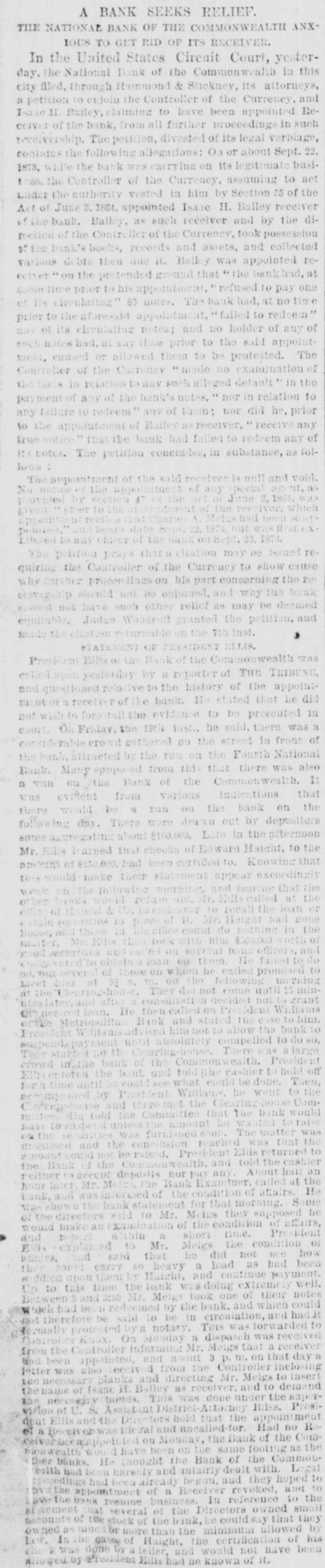
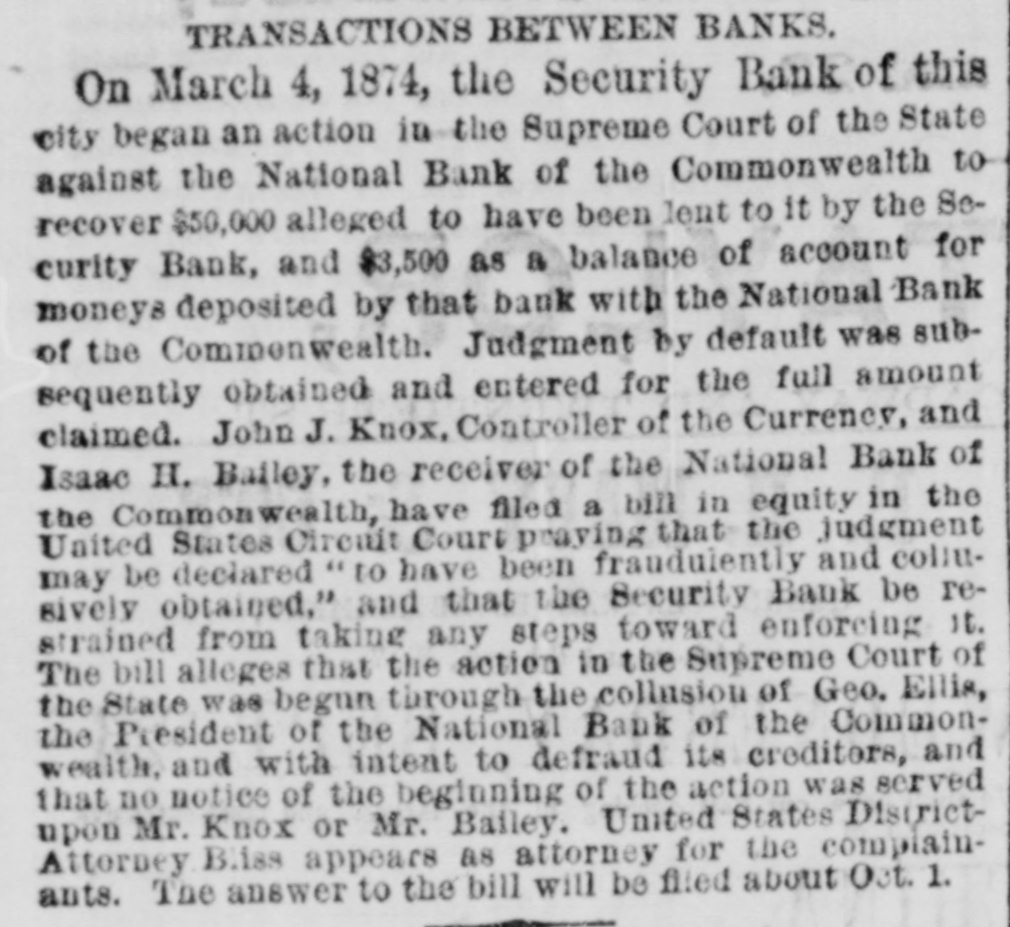
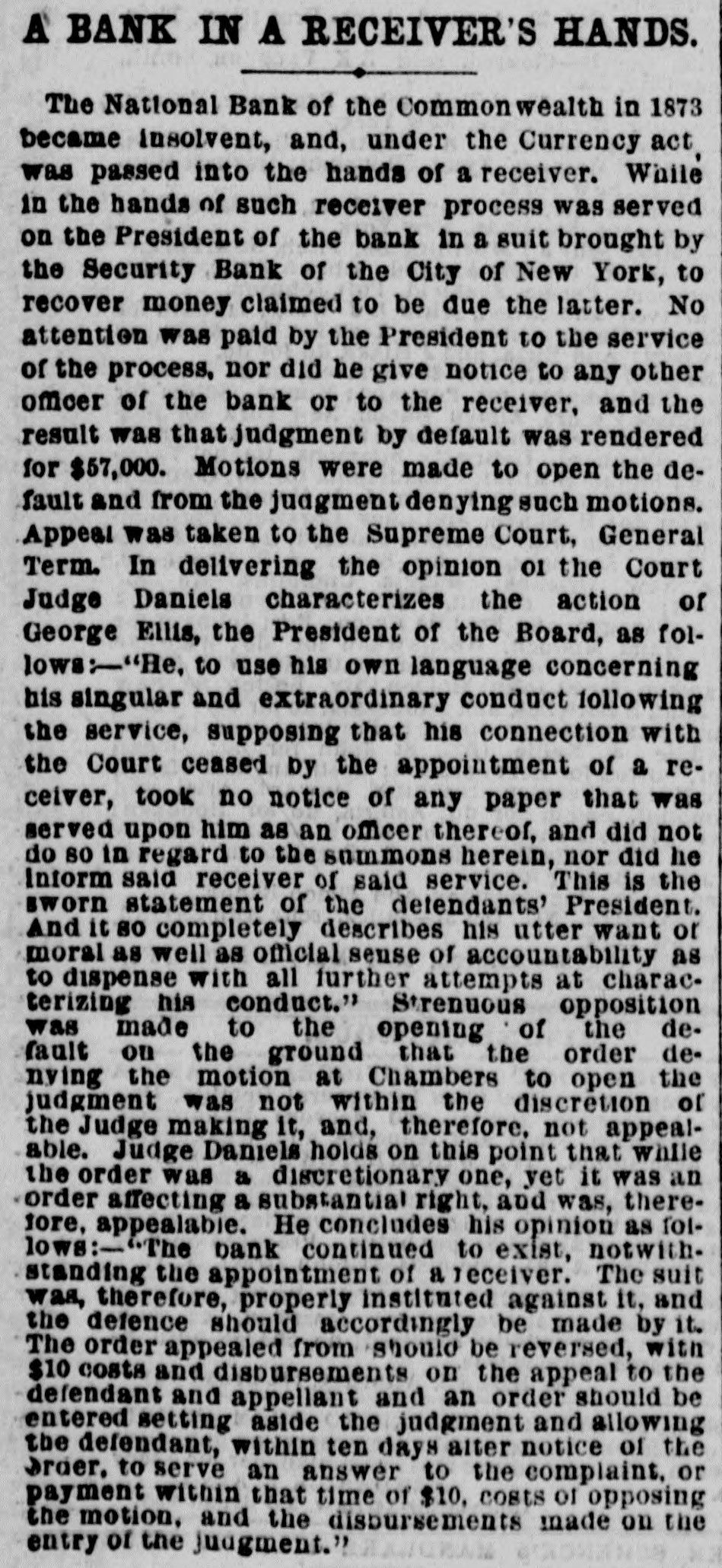
A BANK SEEKS RELIEF. THE NATIONAL BANK OF THE COMMONWEALTH ANXIOUS TO GET RID OF ITS RECEIVER. In the United States Circuit Court, yesterday, the National Bank of the Commonwealth in this city filed, through Hummond & Stickney, its attorneys, a petition to enjoin the Controller of the Currency. and Isaac II. Bailey, claiming to have been appointed Rerecever of the bank, from all further proceedings in such receivership. The petition, divested of its legal verbiage, contains the following allegations: Oa or about Sept. 22. 1873, while the bank was carrying on its legitimate busi1 888, the Controller of the Currency, assuming to act under the authority vested in him by Section 55 of the Act of June 3. 1804. appointed Isaac H. Balley receiver of the bank. Bailey, as such receiver and by the direction of the Controller of the Currency, took possession of the bank's books, records and assets, and collected various debts then are it. Ball y was appointed rereiver "on the pretended ground that the bank had, at same time prior to his appointment, refused to pay one of its circulating" 85 notes. The bank had, at no time prior to the aforesaid appointment at. "failed to redeem" any of its circulating notes; and no holder of any of such notes had. at any time prior to the said appointment, caused or allowed them to be protested. The Controller of the Currency made no examination of the facis in relation to any such alleged defant in the payment of any of the bank's notes. ** nor in relation to any failure to redeem" any of them; nor did he, prior to the appointment of Bailey as receiver, " receive any true notice that the bank had failed to redeem any of its notes. The petition concludes, in substance, as follows : The appointment of the said receives is null and void. No notice the appel of auy perial agent, as provided by section the June 3. 1861. was which the receiver, given to been had apponed policies." date 1873, but was first # Lib. ed to any officer of the bank on Sept. 23, 1873. The petition prays that a citation may be issued requiring the Controller of the Currency to show cause why further procee lings on his part concerning the redeivership should not 03 enjoried, and why the bank not have such other relief as may be deemed equitable. Judge Woodraft granted the petition, and made the citation returnable on the 7th inst. , STATEMENT OF PRESIDENT ELLIS. President Ellis O 180 Bank of the Commonwealth was called upon yesterday by a reporter of THE TRIBUNE, and questioned rela live to the history of the appointmost of is receiver of the bank. He stated that lie did not wish to fore stall the evidence to be presented in court. On Friday. the 19th lost., he said. there was a considerable crowd gathered on the street in front of the hank attracted by the run on the Fourth National Bank. Many supposed from this that there was also a THE ou the Bank of the Commonwealth. It was eviltent from various indications that there would be a run on the bank on the following day. There were drawn out by depositors sums aggregating about $100,000. Late in the afternoon Mr. Ellis 1 arned that checks of Edward Haight, to the amount of $250,000. had been certified to. Knowing that this would make their statement appear exceedingly weak its the following morning and fearing that the other banks would refase aid. His called at the of to recall the loan or obtain 111 place of it. Mr. Height had gone home, an those in office could do nothing in the mit Mr. Ellis too with him $300,000 worth o good securities and ei on several bana officers,and to obtain a loan on them. He failed do SO, nut severa of those on whom he eailed promised to weet birth at 93 R. 111. OIF the following morning at the Clearing-house They due not come until 15 minafte consultati III decided not to grant oned loan. He then called on President Williams or file Metropolitan Bank and stated the ease to him. President Williams advised him not to allow the bank to suspends payment until absolutely compelled to do 80. They state 103 th Clearing-botter There was a large crowd in the bank of the Commonwealth. President Einsecteted the bank and told the cashier hold off for time until could see what could be done. Then, acet impoined by President Williams, he went to the Cleftrig-1 and the Clearing house ComHig told the Committee that the bank would have to unless amount he wanted toraise ow the was furnisted soon. The matter was discussed and the conclusion reached was that the amount could not be raised. President Ellis returned to the Bank of the Commonwealth and told the cashier neither to accept deposits nor pay any. About half an hour later Mr. Motor the Bank Examiner. called at the bank, and s in formed of the condition of affairs. He washswown the bank statement for that morning. Some or the directors said to Mr. Meigs they supposed he would make au examination of the condition of affairs, and Deport within a short time. Pre ident Elite explai ed to Mr. Meigs the condition of annies, said that he did not see how the contri carry 80 heavy a load as had been ddidg upon them by Haight, and continue payment. Un. to this time the bank was doing extreme y well. Between 3 and 3:30 Mr. Melgs took one of their notes well had be is redeemed by the bank. and which could not therefore be said to be in circulation, and had it formally protested by a notary. This was forwarded to Controller Knox. On Monday a dispatch was received from the Controller information Mr. Meige that a receiver Mad been appointed, and about 3 p.m. on that day a letter was also eccive d from the Controller inclosing the necessary blanks and directing Mr. Meigs to insert the name of Isaac H. Bailey as receiver. and to demand the necessary bonds. This was done under the sape vision of U. S. Assistant District-Attorney Bilss. Presideut Ellis and the Directors hold that the appointment et a Receiver was lile ral and uncalled-for. Had no R Monday, the Bank of the ComNonwealth wou have been on the same footing as the ther blinks He thought the Bank of the Common ealth had been harshly and unfairly dealt with. Legal seelings had been already began. and they hoped to tov the appointment of a Receiver revoked, and to ave the bank resuine business. In reference to the st acument that several of the Directors owned small amounts of the stock of the bank, lie could say that they owned as much or more than the minimum allowed by Lew. In the gases of Haight, the certification of his the H was done by a teller. and would not have been allowed.us President Ellis had ne known of it.


Article from Spirit of the Age, October 2, 1873

Click image to open full size in new tab

Article Text

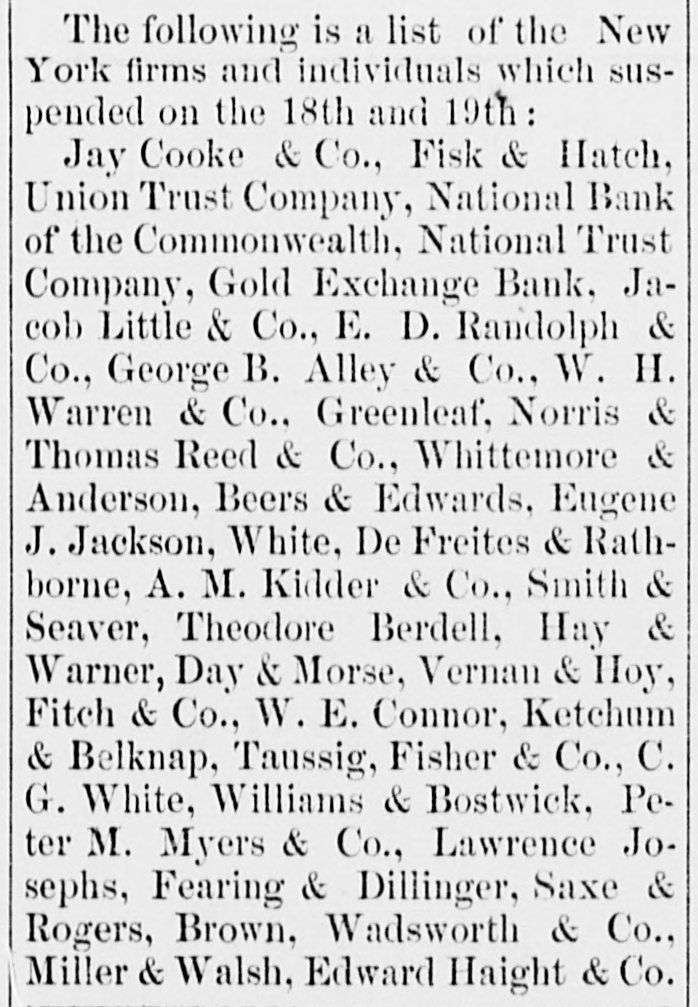
The following is a list of the New York firms and individuals which suspended on the 18th and 19th: Jay Cooke & Co., Fisk & Hatch, Union Trust Company, National Bank of the Commonwealth, National Trust Company, Gold Exchange Bank, Jacob Little & Co., E. D. Randolph & Co., George B. Alley & Co., W. H. Warren & Co., Greenleaf, Norris & Thomas Reed & Co., Whittemore & Anderson, Beers & Edwards, Eugene J. Jackson, White, De Freites & Rathborne, A. M. Kidder & Co., Smith & Seaver, Theodore Berdell, Hay & Warner, Day & Morse, Vernan & Hoy, Fitch & Co., W. E. Connor, Ketchum & Belknap, Taussig, Fisher & Co., C. G. White, Williams & Bostwick, Peter M. Myers & Co., Lawrence Josephs, Fearing & Dillinger, Saxe & Rogers, Brown, Wadsworth & Co., Miller & Walsh, Edward Haight & Co.


Article from Evening Star, October 4, 1873

Click image to open full size in new tab

Article Text

WANTS ME - our Ems, president or the Commonwealth N ational Bank, of New y ork cityowhich suspended during the panic, and to which a receiver was assigned, HBW Controller Knox to day and asked that the receive M w Indrawn, and the bank, which be represents able to cancel all obligations, be . towed to retaine No decision bis vet been made by the Controller, but if the institution is allowed to again proceed with its business, the e pitali 1008 will be reduce it from 81, 600,000 to $000,000.


Article from New-York Tribune, October 7, 1873

Click image to open full size in new tab

Article Text

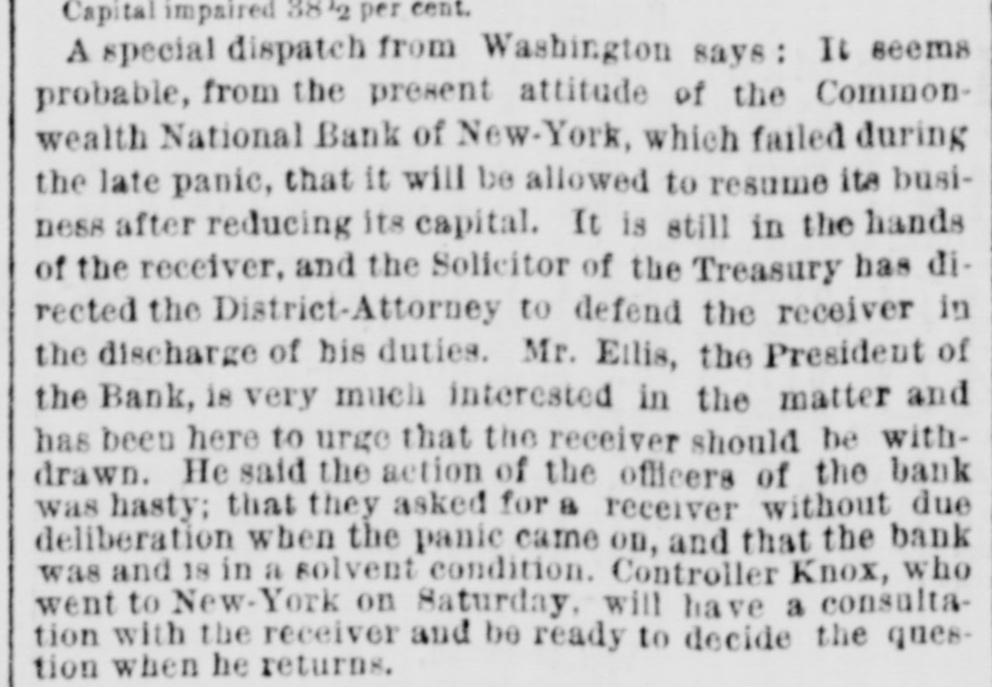
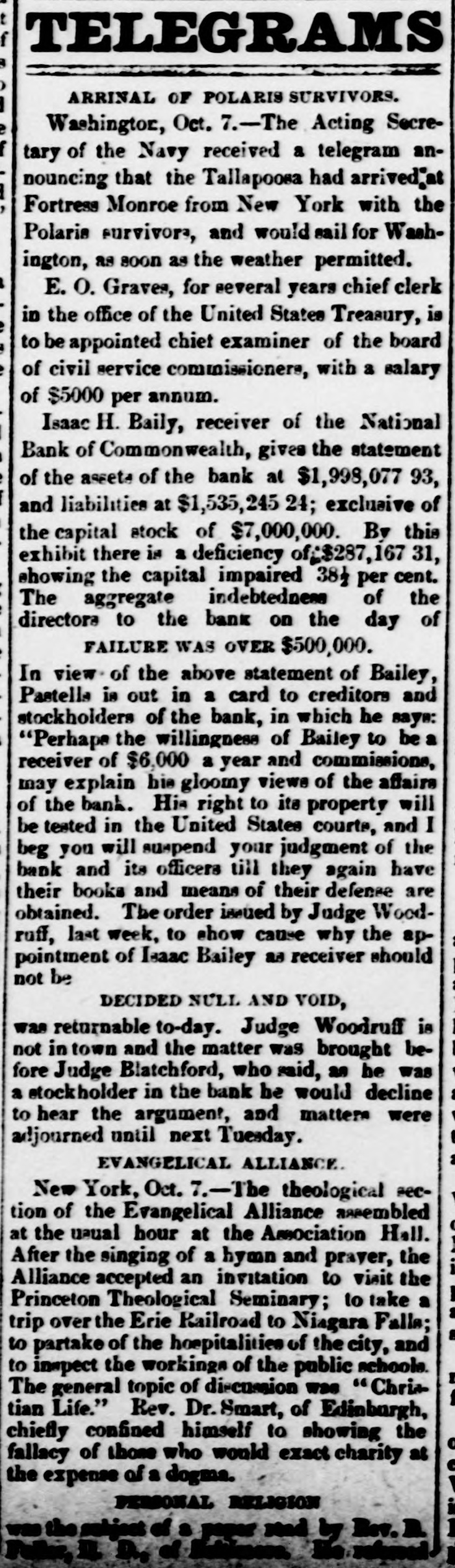
Capital impaired 3812 per cent. A special dispatch from Washington says: It seems probable, from the present attitude of the Commonwealth National Bank of New-York, which failed during the late panic, that it will be allowed to resume its business after reducing its capital. It is still in the hands of the receiver, and the Solicitor of the Treasury has directed the District-Attorney to defend the receiver in the discharge of his duties. Mr. Ellis, the President of the Bank, is very much interested in the matter and has been here to urge that the receiver should be withdrawn. He said the action of the officers of the bank was hasty; that they asked for a receiver without due deliberation when the panic came on, and that the bank was and 18 in a solvent condition. Controller Knox, who went to New-York on Saturday, will have a consultation with the receiver and be ready to decide the question when he returns.


Article from The Donaldsonville Chief, October 18, 1873

Click image to open full size in new tab

Article Text

Saturday, the third day of the financial panie, was an intensely N exciting one in Wall street-so much SO that it was found necessary to close the Stock Exchange, and to pass a rule forbidding the members from making any transactions in stocks either on the street or elsewhere prior to the regular session of the Board on Monday. A large number of additional failures were reported, among them the Union Trust Company (the cashier of which was said to be a defaulter to 'the amount of $600,000), the National Trust Company, and the National Bank of the Commonwealth. The excitement and panic which followed the announcement in the Stock Exchange of the suspension of these institutions were beyond description. The Stock Exchange resembled a mad-house, and the streets were blocked with people, all laboring under great excitement and frenzy. Prices tumbled from two to sixteen per cent., and stocks were slaughtered without any apparent regard to values. President Grant and Seeretary Richardson proceeded to New York on Saturday night, and on Sunday a conference was held with some of the leading financiers at the Fifth Avenue Hotel, to endeavor to arrange some plan for governmental relief. A proposition was made that the President authorize the Secretary of the Treasury to place $30,000,000 of legal reserve in the city banks, and Commodore Vanderbilt offered to add $10,000,000 more. This proposition was declined, the President stating his belief that he had no constitutional power to afford the relief asked for in this manner. It was finally determined that the Assistant Treasurer be instructed to purchase all the government bonds offered for sale to any amount, and as the


Article from The Sun, October 24, 1873

Click image to open full size in new tab

Article Text

the Me repolt no Bank Breaking no the Currency Equalization Pool. The second expulsion from the Stock Exchance during the present monetary troubles that of Edward Haight. Jr., was the subject of comment among financiers yesterday. It is regarded AR a case of the visitation of the sins of the father upon his children. The cause for the action was a charge of fraud against the Arm of Edward Haight & Co. by the Commonwealth National Bank. The senior partner of the firm vas formerly its President, and at the time of the alleged fraudulent action was A director of the Bank of the Commonwealth. On the second day of the panic he overdrew the firm's account by $226,000. Overdrawing is a matter of hourly occurrence during ordinary business times. and the firms making overdrafts are expected to make them good by either cash or collaterals at the end of each day. Mr. Halight was called upon to make his good but furnished only collaterals for $60,000. The day of the overdraft the bank had sustained a run that nearly exhausted Its resources. and next morning on ascertaining that Haight & Co.'s deficiency would not be fortheoming its doors were closed. Haleht & Co. themselves suspended the next day. Their dealings with the bank were investigated by the Governing Committee of the Stock Exchange. Rd ward Haight. Jr. was the only member of the firm that belonged to the Exchange. and after three weeks deliberation the committee prosented this resolution: Resolved That Edward Height Jr. the represe five in the stock Exchange of the firm of Enward Hat & Co.,hav ng. the judgment of the Govern Committee. oceanully of obvious fraud in " th the overdraft oy the Orin on the Bank of the Color to inwealth he expelled from this association n. The resolution WES read in the Exchange Yes. enday morning. It is said that the report upon which it is founded contains very damaging facts about the persons mentioned The action of the committee receives general commender tion. PRESIDENT GRANT'S LETTER. The topic next in interest was the letter upon the financial situation which Mr. John B. Will liams. President of the Metropolita an Bank save he received from President Grant. Mr. Williams accounts for the receipt of the letter thus : A few days ago one Mr. Anthony who awabout to go to Washington, asked Mr. Williams to make him bearer ofaletter to the President embody ing histWilliams) views of the best way to assist the merchants of the city during the money stringency. That, he thought. could best the be done by a weekly issue of a few millions of legal tender reserve. He at the sametimeurged upon the President the plan for the purchase of foreign exchange. which Mr. Anthony proposed to urge Some doubt was thrown upon the authenticity of the autograph letter said to have been re elved in reply by a despatch from Washing allezing that President Grant denies having full written any such letter Nevertheless a the associated bank Presidents asinbled In the Merchants' Bank r its consids eration. The letter which Mr. Williams read coversa pace and a half of note paper. After reading it he put it into his pocket and never took it out again. as far nΒ° could be ascertained The d cument acknowledged the receipt of letter from Mr. Williams, The President had vivea its contents earnest consideration. and felt 1110 lined to make the issue of LEGAL TENDER RESERVE n amounts of two or three milli weekly. the merchants needed Hefelt in offined more time to pro exconcerning the pur base of foreign hange. It concluded But cannot the bank Presidents be brought together and esolve to canaid each other and the business 64 erally. The Government then will do all stion p wer. To-tuor consider the w h the view of doing all in my power for the relief new somach needed. Mr. Williams presented resolutions that were of speedily withdrawn under manifestations di satisfaction. The following was adopted Resolved That the communication of the President New York of the United States to the associated banks of respectfully d gratefully acknowie ged. an i that we be curutally reciprocate his kind wishes and will act in the spirit be recommends. The question of eeasing the .. pooling of tenders. which has been the salvation of legal some of the weaker banks. was discussed, and the following was adopted: Resolved, That from and after Nov. 1 next association the equal zation of legal teaders by the banks of this e discontinued. A proposition to use legal tender notes In settement of Clearing House balances was also The action discussed. but discontinuing without result pooling" had de that indi rued the market at the close fact yet sales that confidence 111 the banks has not been entirely reatored. COMMODORE VANDERBILT'S DIFFICULTIES Rumors about the relations of Commodore Vanderbilt and the Union Trust Company und- were throughout the day. and were all unit a life to a sensati onal story in ed and traceable defalcation in which a further morning journal, prominent feature. by Cashier Carlton was a debt of all alleged about the They the Lake Shore Railroad Company to the Union Trust Company. In fact no such controversy any exists now. nor has there been at The time an act al difference of opinion Clark's that In Mr. H race F. facts are of Lake Shore effected is deadministr of $1,750,000 of the Trust Company for Hand loan account of Lake Shore. and when Commothe Mr. Clark he found dore Vanderbilt succeeded comhis loan among the obligations of the What The debt has never been di puted. weeks bady occasioned the talk hastreet for past is another sum of $2,250,000 in the sh of ape the of like Shore bonds They were a part of 00,000 debenture Issue legallyfauthorized. I to only have already been issued. Comi any became the transfer The Union time vet re Mr. hewith Mark's decease, agents of the issue Some Augustus Schell James I Banker Tref of Lake Shore. and seve( of others formed a pool of $15,000,000 10 BULL LAKE SHORE I and other stocks G.I B. Grinnell & Co. made in which the the MI Clark visa special partner. were two and a millions of bonds were transferr Treasurer Grinne arter & Co. by the Union Trust Company. ab part of by order of James Banker as they can have no pos pool Hence an offset he ble reference to the $1,750,000 loan as Commootherwise It le said. however. that Executive Vanderbilt holds that the transfer ore had no power to direct the j immittee bonds without giving the stockholders if the to vote. Hence the Union Trust opport unity instructed not to transfer the ompany was most of them were hypothecated by L onds. As & Co., those that hold them are natural er moved. y ;rinnell very desir us of having the bar to legal transI What President Grant Says. I WASHINGTON, Oct. 23. -The President tolav. on heing asked by a friend as to the conents of his recent letter to Mr. John E. Wil-


Article from Ottumwa Weekly Courier, February 19, 1874

Click image to open full size in new tab

Article Text

NEW YORK. NEW YORK, Feb. 14.-Jesse R. Clarke, aged 11, while playing with a pisto! last evening. at his home. at No. 17, Jones street, shot dead Jease Wicks, aged 15. Issac H. Bailey, receiver of the Commonwealth National Bank, has been authorized by the Comptroller to sell the banking house and real estate of the establishment for the benefit of creditors. NEW YORK, Feb. 14.-The bank statement shows nearly a million in. crease in loans. eight hundred thousand increase in legal tenders ; two hundred and eighty -four thousand decrease in deposits; two and one-half decrease in specie and R small decrease in circulation


Article from The New York Herald, February 28, 1874

Click image to open full size in new tab

Article Text

the valuable Banking House and Lot on the northwest corner of Nassau and Pine streets, to be sold on Tuesday, March 3, at 12 o'clock, at the salesroom No. 111 Broadway. By order of ISAAC H. BAILEY, Receiver of the National Bank of the Commonwealth.


Article from The New York Herald, March 2, 1874

Click image to open full size in new tab

Article Text

Attention is Called to the Sale of the valuable Banking House and Lot on the northwest corner of Nassau and Pine streets, to be sold on Tuesday. March 3, at 12 o'clock, at the salesroom No. 111 Broadway. By order of ISAAC H. BAILEY, Receiver of the National Bank of the Commonwealth.


Article from Evening Star, July 3, 1874

Click image to open full size in new tab

Article Text

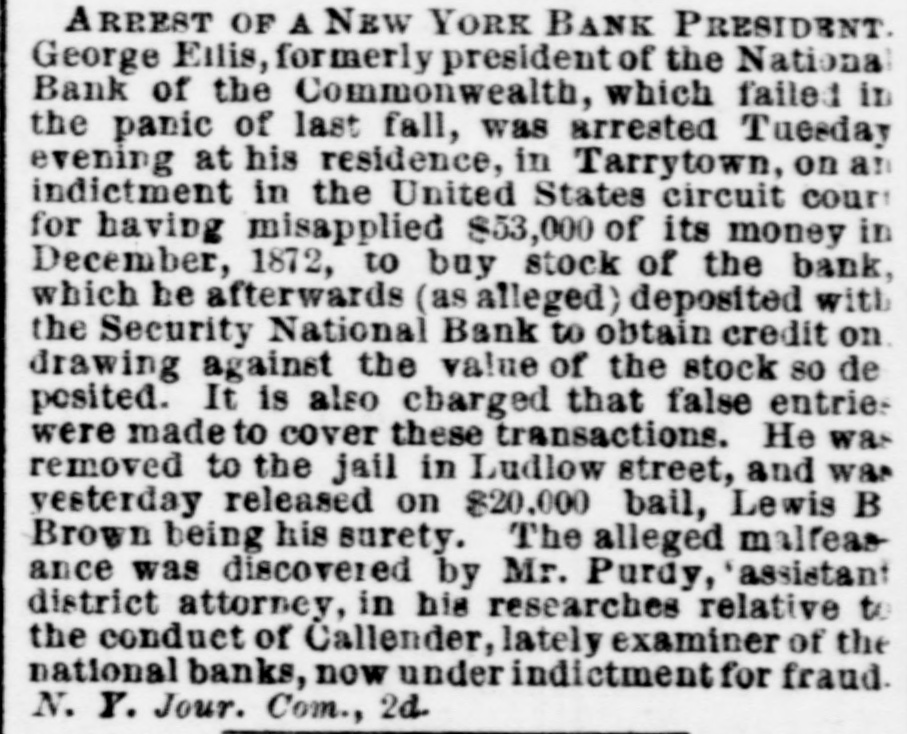
ARREST OF A NEW YORK BANK PRESIDENT. George Ellis, formerly president of the National Bank of the Commonwealth, which failed in the panic of last fall, was arrested Tuesday evening at his residence, in Tarrytown, on an indictment in the United States circuit court for having misapplied $53,000 of its money in December, 1872, to buy stock of the bank, which he afterwards (as alleged) deposited with the Security National Bank to obtain credit on. drawing against the value of the stock 80 de posited. It is also charged that false entriewere made to cover these transactions. He was removed to the jail in Ludlow street, and was vesterday released on $20,000 bail, Lewis B Brown being his surety. The alleged malfeasance was discovered by Mr. Purdy, 'assistant district attorney, in his researches relative to the conduct of Callender, lately examiner of the national banks, now under indictment for fraud. N. Y. Jour. Com., 2d.


Article from The Daily Phoenix, July 9, 1874

Click image to open full size in new tab

Article Text

George Ellis, formerly President of the National Bank of the Commonwealth, New York, which failed in the panic of last fall, was arrested Tuesday evening, at his residence in Tarrytown, on an indictment in the United States Circuit Court. for having misapplied $53,000 of its money, in December, 1S72, to buy stock of the bank, which stock he afterward (as alleged) deposited with the Security National Bank to obtain credit on, drawing against the value of the stock so depreciated. It is also charged that false entries were made to cover these transactions.


Article from The New York Herald, October 13, 1874

Click image to open full size in new tab

Article Text

Positive Sale, by Order of Receiver.β€” The National Bank of the Commonwealth Building wile be sold at auction. by E. H. LUDLOW & CO., this day at 12 o'clock, at the salesroom.


Article from The Star, May 21, 1875

Click image to open full size in new tab

Article Text

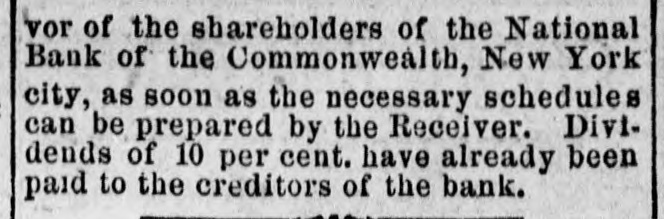
vor of the shareholders of the National Bank of the Commonwealth, New York city, as soon as the necessary schedules can be prepared by the Receiver. Dividends of 10 per cent. have already been paid to the creditors of the bank.


Article from The Rutland Daily Globe, May 22, 1875

Click image to open full size in new tab

Article Text

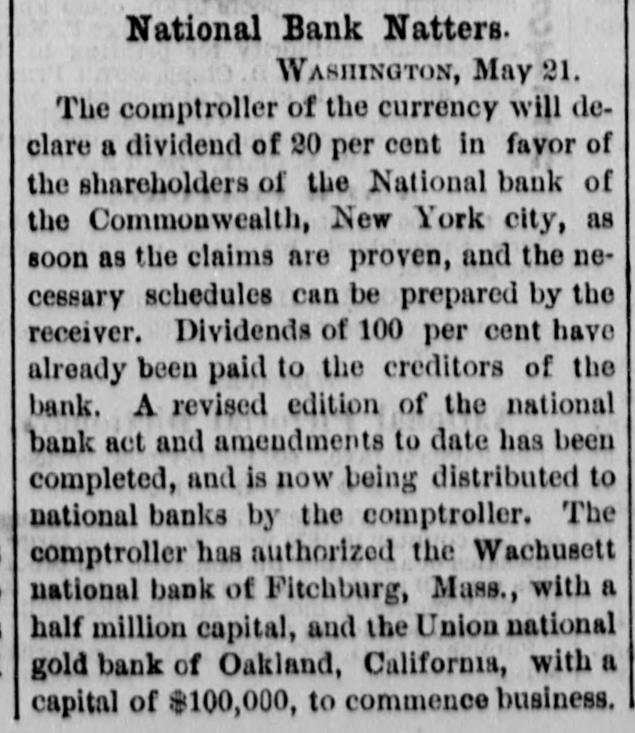
National Bank Natters. WASHINGTON, May 21. The comptroller of the currency will declare a dividend of 20 per cent in favor of the shareholders of the National bank of the Commonwealth, New York city, as soon as the claims are proven, and the necessary schedules can be prepared by the receiver. Dividends of 100 per cent have already been paid to the creditors of the bank. A revised edition of the national bank act and amendments to date has been completed, and is now being distributed to national banks by the comptroller. The comptroller has authorized the Wachusett national bank of Fitchburg, Mass., with a half million capital, and the Union national gold bank of Oakland, California, with a capital of $100,000, to commence business.