Fourth National Bank (New York, NY)

Episode Information

Episode UID
29000885
Episode Type
Run Only
Bank Type
national
Bank ID
2900 national
Charter Number
290
Start Date
September 20, 1873
Location
New York, New York (40.714, -74.006)

Metadata

Model
gpt-5-mini (chosen from majority vote of a three-model LLM ensemble)
Short Digest
55aeb7600c8f62b4

Response Measures

Accommodated withdrawals, Borrowed from banks or large institutions, Clearinghouse loan

Clearinghouse involved: Yes (loan, examination, or other measures)

Events (3)

1. February 27, 1864 Chartered
Source
historical_nic
2. September 20, 1873 Run
Cause
Macro News
Cause Details
Panic stemming from major financial failures (Jay Cooke & Co., Fisk & Hatch, Henry Clews & Co.) and general contagion in the money market.
Measures
Extended banking hours; met all demands promptly; received deposits after midday; used loan certificates as needed.
Newspaper Excerpt
The run on the Fourth National Bank which began on Friday was continued on Saturday... By 12 o'clock the run had lost all the elements of a panic... nearly $300,000 had been paid out.
Source
newspapers
3. June 18, 1914 Voluntary Liquidation
Source
historical_nic

Newspaper Articles (22)

Article from Memphis Daily Appeal, December 20, 1871

Click image to open full size in new tab

Article Text

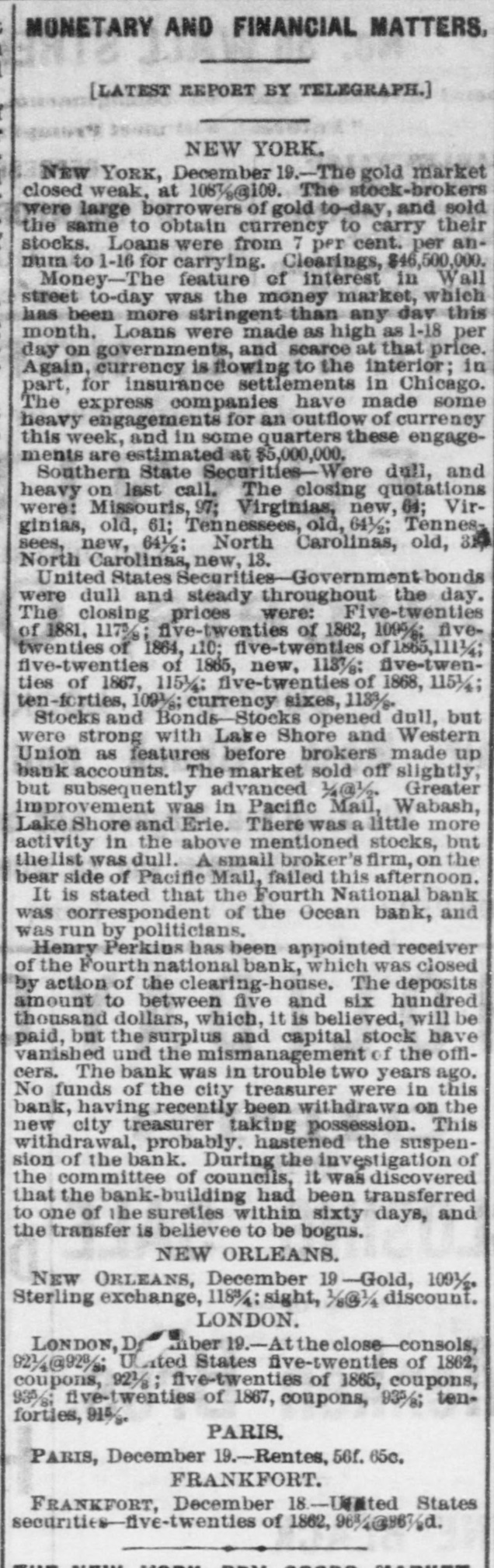
MONETARY AND FINANCIAL MATTERS, [LATEST REPORT BY TELEGRAPH.] NEW YORK. NEW YORK, December 19.-The gold market closed weak, at 108%/109. The stock-brokers were large borrowers of gold to-day, and sold the same to obtain currency to carry their stocks. Loans were from 7 per cent. per annum to 1-16 for carrying. Clearings, $46,500,000. Money-The feature of interest in Wall street to-day was the money market, which has been more stringent than any dav this month. Loans were made as high as 1-18 per day on governments, and scaree at that price. Again, currency is flowing to the interior; in part, for insurance settlements in Chicago. The express companies have made some heavy engagements for an outflow of currency this week, and in some quarters these engagements are estimated at $5,000,000. Southern State Securities-Were dull, and last call. The closing quotations new, heavy were: on Missouris, 97; Virginias, 64; Virgintas, old, 61; Tennessees, old, 641/2; Tennes sees, new, 641/2: North Carolinas, old, 31 North Carolinas, new, 13. United States Securities-Governmentbonds were dull and steady throughout the day. The closing prices were: Five-twenties of 1881, 117% five-twenties of 1862, 109% fivetwenties of 1864, 110; five-twenties of 1865,111 1/4; five-twenties of 1865, new, 113% five-twenties of 1867, 1151: five-twenties of 1868, 1151/; ten-forties, 1091/4: currency sixes, 1183/8 Stocks and Bonds Stocks opened dull, but were strong with Lake Shore and Western Union as features before brokers made up bank accounts. The market sold off slightly, but subsequently advanced Greater improvement was in Pacific Mail, Wabash, Lake Shore and Erie. There was a little more activity in the above mentioned stocks, but the list was dull. A small broker's firm, on the bear side of Pacific Mail, failed this afternoon. It is stated that the Fourth National bank was correspondent of the Ocean bank, and was run by politicians. Henry Perkins has been appointed receiver of the Fourth national bank, which was closed by action of the clearing-house. The deposits amount to between five and six hundred thousand dollars, which, it is believed, will be paid, but the surplus and capital stock have vanished und the mismanagement of the offlcers. The bank was in trouble two years ago. No funds of the city treasurer were in this bank, having recently been withdrawn on the new city treasurer taking possession. This withdrawal. probably. hastened the suspension of the bank. During the investigation of the committee of councils, it was discovered that the bank-building had been transferred to one of the sureties within sixty days, and the transfer is believee to be bogus. NEW ORLEANS. NEW ORLEANS, December 19 -Gold, 1091/ Sterling exchange, 1183/4: sight, 1/6/14 discount. LONDON. LONDON, D mber 19.-Atthe close -consols, 921/@92B/: U Lated States five-twenties of 1862, coupons, 921/8; five-twenties of 1865, coupons, 935/ five-twenties of 1867, coupons, 93% tenforties, 91% PARIS. PARIS, December 19.-Rentes, 56f. 65c. FRANKFORT. FRANKFORT, December 18.-United States securities -five-twenties of 1862,


Article from The Wheeling Daily Intelligencer, December 20, 1871

Click image to open full size in new tab

Article Text

NEW YORK CITY. NEW YORK, December 19.-The last city swindler exposed is the Collector of Assessments, who has pocketed half a million dollars in four years. The incumbent, one Starkweather, was appointed by Tweed in 1867. There was but a small audience at the Cooper Institute last night to celebrate the treaty of Washington. Addresses were made by J. B. Miles, Elihu Burritt and Dr. Brine. Resolutions were adopted hoping that the negotiations for the Washing treaty might be the present adjustment of the difficulties on a peaceful basis. It is rumored that the Grand Jury have found indictments against three or four newspaper editors for false vouchers; also that n prominent morning newspaper is indicted for libel on a city judge. The Times says the grand jury should investigate the facts concerning the claim of $5,000 paid by the Board of Auditors to Judge Bedford for extra legal services. The ball of the Tweed Association, which was advertised for last evening, did not take place. The Citizens' Reform Committee voted that hereafter the offices of mayor, aldermen and water commissioners should be elective. The immigration officers at Castle Garden have called the attention of the Gov. ernor and Secretary of State to the fact that parties in England are sending criminals to this country. Small-pox is spreading in Jersey City, Hoboken, Newark and Trenton, and special hospitals for the patients are being assigned in those places. At a meeting of the Federal Council of the Internationals last night, the Crispin, Jewelers' and Typographical Unions affiliated with and became part of the Internationals. It is confirmed that Heenan, Cook and Dumphry, minor Tammany thieves, have left for Europe. Warrants have been sent for their arrest. There was a large crowd at the Court of General Sessions early this morning in expectation that Mayor Hall would be put at the bar, but up to noon he was not known to be under arrest. His counsel held frequent consultations with the District Attorney yesterday and this morning. The Grand Jury summoned for the December term were discharged to-day, the body serving for November holding over till the 1st of January. The indictments presented yesterday were against Tweed, who will be rearrested thereunder. Also Hank Smith James M. Sweeney, a brother of Peter B. It is stated that the Fourth National Bank was a correspondent of the Ocean Bank, and was run by politicians.


Article from Wilmington Daily Commercial, September 20, 1873

Click image to open full size in new tab

Article Text

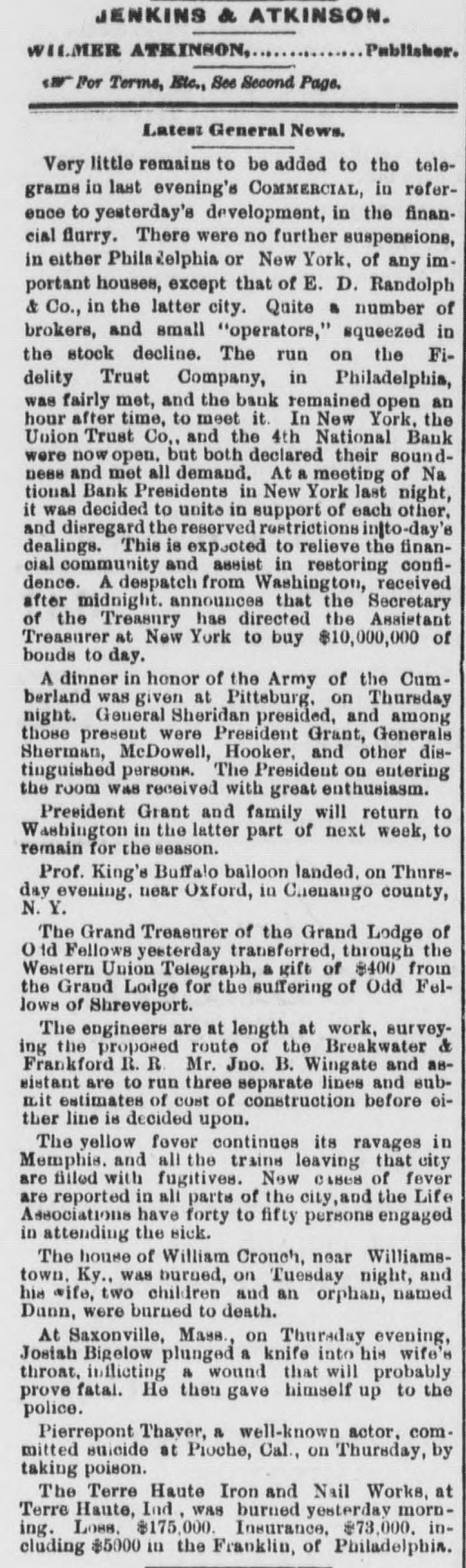
JENKINS & ATKINSON. Publisher. WILMER ATKINSON, w For Terms, Etc., See Second Page. Latest General News. Very little remains to be added to the telegrams in last evening's COMMERCIAL, in reference to yesterday's development, in the finanwere no in or cial either flurry. Philadelphia There New further York, suspensions, of any important houses, except that of E. D. Randolph & Co., in the latter city. Quite a number of brokers, and small "operators," squeezed in the stock decline. The run on the Fidelity Trust Company, in Philadelphia, was fairly met, and the bank remained open an hour after time, to meet it. In New York, the Union Trust Co,, and the 4th National Bank were now open. but both declared their soundness and met all demand. At a meeting of Na tional Bank Presidents in New York last night, it was decided to units in support of each other, and disregard the reserved restrictions into-day's dealings. This is expected to relieve the financial community and assist in restoring confidence. A despatch from Washington, received after midnight. announces that the Secretary of the Treasury has directed the Assistant Treasurer at New York to buy $10,000,000 of bonds to day. A dinner in honor of the Army of the Cumberland was at on given Pittsburg, Thursday night. General Sheridan presided, and among those present were President Grant, Generals Sherman, McDowell, Hooker, and other distinguished persons. The President on entering the room Was received with great enthusiasm. President Grant and family will return to Washington in the latter part of next week, to remain for the season. Prof. King's Buffalo bailoon landed. on Thursday evening. near Oxford, in Chenango county, N.Y. The Grand Treasurer of the Grand Lodge of O d Fellows yesterday transferred, through the Western Union Telegraph, a gift of $400 from the Grand Lodge for the suffering of Odd Fellows of Shreveport. The engineers are at length at work, surveying the proposed route of the Breakwater & Frankford R. R. Mr. Jno. B. Wingate and assistant are to run three separate lines and submit estimates of cost of construction before either line is decided upon. The yellow fever continues its ravages in Memphis. and all the trains leaving that city are filled with fugitives. New CASES of fever are reported in all parts of the city, and the Life Associations have forty to fifty persons engaged in attending the sick. The house of William Crouch, near Williamstown. Ky., was burned, on Tuesday night, and hie wife, two children and an orphan, named Dann, were burned to death. At Saxonville, Mass., on Thursday evening, Josiah Bigelow plunged a knife into his wife's throat. inflicting a wound that will probably prove fatal. He then gave himself up to the police. Pierrepont Thayer, a well-known actor. committed suicide at Pioche, Cal., on Thursday, by taking poison. The Terre Haute Iron and Nail Works, at Terre Haute, Ind. was burned yesterday morning. Loss. $175,000. Insurance. $73,000. including $5000 in the Franklin, of Philadelphia.


Article from Wilmington Daily Gazette, September 20, 1873

Click image to open full size in new tab

Article Text

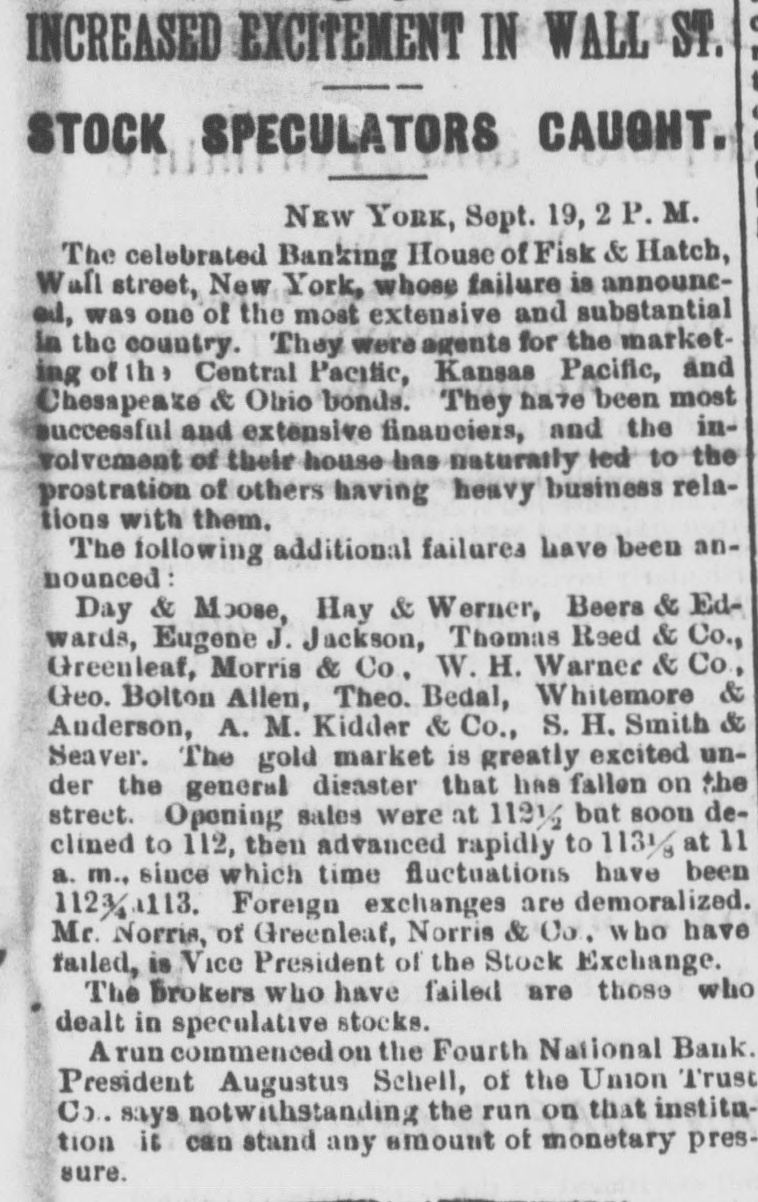
INCREASED EXCITEMENT IN WALL ST. STOCK SPECULATORS CAUGHT. NEW YORK, Sept. 19, 2 P. M. The celebrated Banking House of Fisk & Hatch, Wall street, New York, whose failure is announcod, was one of the most extensive and substantial in the country. They were agents for the marketing of h h Central Pacitic, Kansas Pacific, and Chesspeake & Ohio bonds. They have been most successful and extensive financiers, and the involvement of their house has naturally led to the prostration of others having heavy business relations with them. The following additional failures have been announced: Day & Moose, Hay & Werner, Beers & Edwards, Eugene J. Jackson, Thomas Reed & Co., Greenleaf, Morris & Co. W. H. Warner & Co, Geo. Bolton Allen, Theo. Bedal, Whitemore & Anderson, A. M. Kidder & Co., S. H. Smith & Seaver. The gold market is greatly excited under the general disaster that has fallen on the street. Opening sales were at 1191/2 but soon declined to 112, then advanced rapidly to 1131/4 at 11 a. m., since which time fluctuations have been 11234113. Foreign exchanges are demoralized. Mr. Norris, of Greenleaf, Norris & Co. who have failed, is Vice President of the Stock Exchange. The brokers who have failed are those who dealt in speculative stocks. A run commenced on the Fourth National Bank. President Augustus Schell, of the Union Trust Co. says notwithstanding the run on that institution is can stand any amount of monetary pres sure.


Article from The New York Herald, September 21, 1873

Click image to open full size in new tab

Article Text

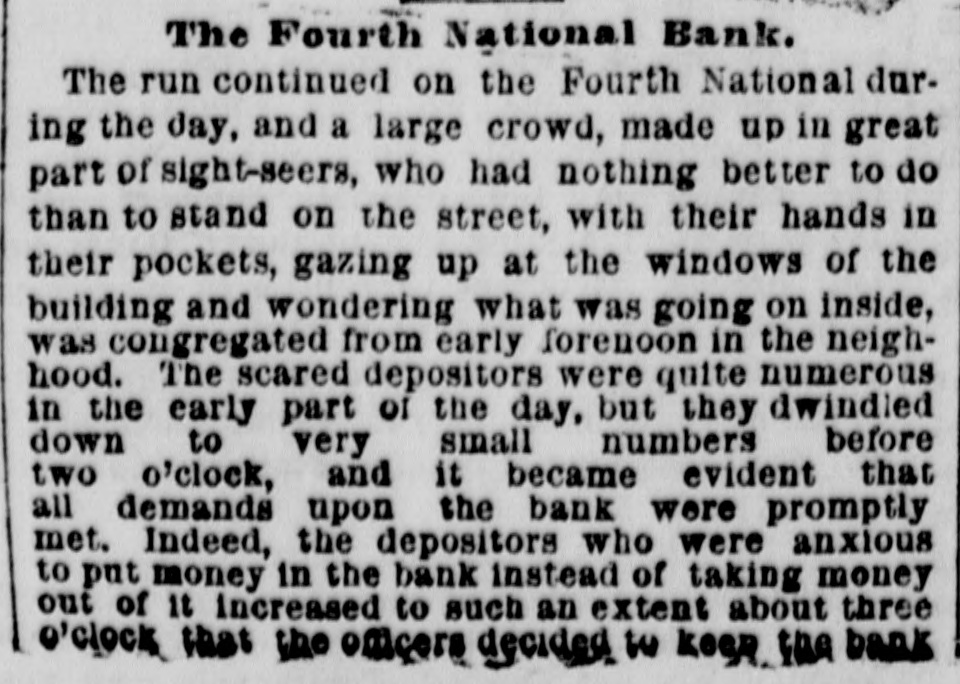
The Fourth National Bank. The run continued on the Fourth National during the day, and a large crowd, made up in great part of sight-seers, who had nothing better to do than to stand on the street, with their hands in their pockets, gazing up at the windows of the building and wondering what was going on inside, was congregated from early forenoon in the neighhood. The scared depositors were quite numerous in the early part of the day, but they dwindled down to very small numbers before two o'clock, and it became evident that all demands upon the bank were promptly met. Indeed, the depositors who were anxious to put money in the bank instead of taking money out of it increased to such an extent about three o'clock that the officers decided w KOOR tua bank


Article from Wilmington Daily Commercial, September 22, 1873

Click image to open full size in new tab

Article Text

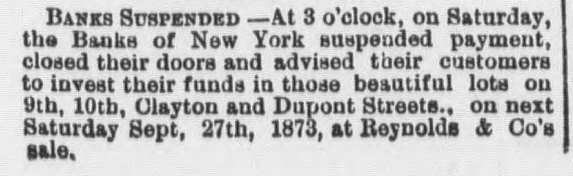
BANKS SUSPENDED β€” At 3 o'clock, on Saturday, the Banks of New York suspended payment, closed their doors and advised their customers to invest their funds in those beautiful lots on 9th, 10th, Clayton and Dupont Streets., on next Saturday Sept, 27th, 1873, at Reynolds & Co's sale.


Article from The Rutland Daily Globe, September 22, 1873

Click image to open full size in new tab

Article Text

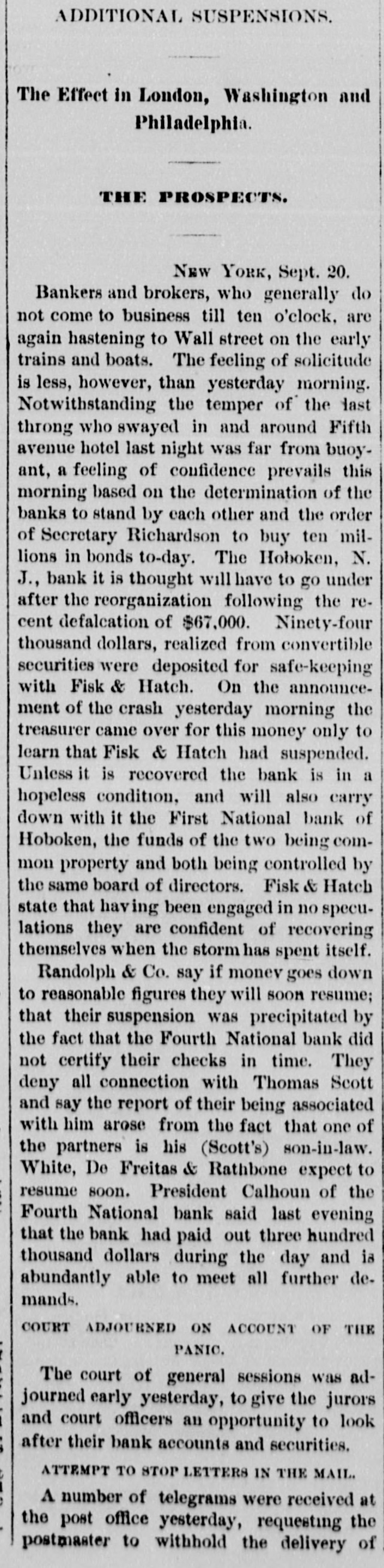
ADDITIONAL SUSPENSIONS. The Effect in London, Washington and Philadelphia. THE PROSPECTS. NEW YORK, Sept. 20. Bankers and brokers, who generally do not come to business till ten o'clock, are again hastening to Wall street on the early trains and boats. The feeling of solicitude is less, however, than yesterday morning. Notwithstanding the temper of the last throng who swayed in and around Fifth avenue hotel last night was far from buoyant, a feeling of confidence prevails this morning based on the determination of the banks to stand by each other and the order of Secretary Richardson to buy ten millions in bonds to-day. The Hoboken, N. J., bank it is thought will have to go under after the reorganization following the recent defalcation of $67,000. Ninety-four thousand dollars, realized from convertible securities were deposited for safe-keeping with Fisk & Hatch. On the announcement of the crash yesterday morning the treasurer came over for this money only to learn that Fisk & Hatch had suspended. Unless it is recovered the bank is in a hopeless condition, and will also carry down with it the First National bank of Hoboken, the funds of the two being common property and both being controlled by the same board of directors. Fisk & Hatch state that having been engaged in no speculations they are confident of recovering themselves when the storm has spent itself. Randolph & Co. say if money goes down to reasonable figures they will soon resume; that their suspension was precipitated by the fact that the Fourth National bank did not certify their checks in time. They deny all connection with Thomas Scott and say the report of their being associated with him arose from the fact that one of the partners is his (Scott's) son-in-law. White, De Freitas & Rathbone expect to resume soon. President Calhoun of the Fourth National bank said last evening that the bank had paid out three hundred thousand dollars during the day and is abundantly able to meet all further demands. COURT ADJOURNED ON ACCOUNT OF THE PANIC. The court of general sessions was adjourned early yesterday, to give the jurors and court officers an opportunity to look after their bank accounts and securities. ATTEMPT TO STOP LETTERS IN THE MAIL. A number of telegrams were received at the post office yesterday, requesting the postmaster to withhold the delivery of


Article from Wilmington Daily Gazette, September 22, 1873

Click image to open full size in new tab

Article Text

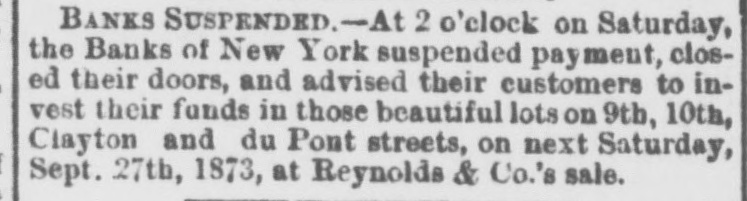
BANKS SUSPENDED.β€”At 2 o'clock on Saturday, the Banks of New York suspended payment, closed their doors, and advised their customers to invest their funds in those beautiful lots on 9th, 10th, Clayton and du Pont streets, on next Saturday, Sept. 27th, 1873, at Reynolds & Co.'s sale.


Article from New-York Tribune, September 22, 1873

Click image to open full size in new tab

Article Text

THE BANKS SECURE. FRUITLESS RUN ON THE FOURTH NATIONAL BANK. The run on the Fourth National Bank which began on Friday was continued on Saturday, with a smaller crowd, which decreased rapidly, as ready payments were made, and each satisfied depositor coming forth told the rest that the bank was "pretty safe." By 12 o'clock the run had lost all the elements of a panic, and the crowd had dwindled to a dozen men, who seemed convinced of having cast upon the bank a gratuitous insult in demanding their money at all. At 3 the run was over, and although the bank officers announced that they would extend bank hours to 4 o'clock, in order that every one might be satisfied, few profited by the permission. The suave bank tellers continued the business of the day as if the struggle had been of the most trifling character. Within these few hours, however, nearly $300,000 had been paid out. The Bank President, Mr. Calhoun, was found by THE TRIBUNE reporter in his office, apparently unruffled by the proceedings of the day. In reply to inquiries he said that the run was not one that frightened them in the least. The assets of the bank were as good as any on earth, and as they held them well in hand they would not fear any run that could be made on them. The panic he believed had spent itself. It came suddenly, and was likely in consequence to be merely a panic and not a convulsion. The failure of Jay Cooke & Co. had first created anxiety among the most substantial institutions because it was presumed to be one of the most substantial. With Fisk & Hatch, the fat was in the fire, and with other failures following hard upon, and rumors and wild suggestions coming upon that, the whole flame burst forth. But in fact, aside from the direct effects of the panic, mercantile business was never better than now. It is prosperous in every department. Merchants from the South and West are here in greater numbers, and are buying more liberally than for six or seven years before.


Article from New-York Tribune, September 23, 1873

Click image to open full size in new tab

Article Text

FINANCIERS IN HIGH SPIRITS. THE BANKS PERFECTLY SAFE-ALL 'DANGER PASTTHE GOVERNMENT'S ACTION GENERALLY APPROVED-THE MORAL OF THE PANIC DRAWN. Financiers, who croaked at the Fifth Avenue Hotel on Sunday, and predicted the failure of every bank in the city, chuckled over their folly yesterday. The banks were not besieged with depositors, as had been anticipated, and everywhere confidence had taken the place of despondency. A TRIBUNE reporter called upon a few of the leading bank presidents to learn their views and intentions regarding the present financial crisis. He found them, without exception, cheerful and busy. FOURTH NATIONAL BANK. Mr. Calhoun of the Fourth National Bank. upon which there has been the fiercest run of the panic, appeared suave and cheerful, and responded readily to the request for his views. Mr. Calhoun-" This bank does not propose to susSir. You see there is a at and remember the now, pend, you raid line of Friday the teller's and desk Satfurday, but we have no fear whatever, and have prepared ourselves for any demands that may come upon us." Q What do you think of the possibilities of a general prostration A. I think there is no fear of that. The worst is over, here. How it may be in the country I can hardly say, but we are safe, unless the panic should be great enough in the country to react upon us and renew the trouble. Q. Has the action of the Government been beneficial ? A. Very beneficial. I understand that two millions of bonds have already been taken, and that people are turning in their bonds very readily. The issue of a portion of the forty millions would have increased the good, if it could have been done legally. But as, according to the opinion of the officials, it could not be done, the next best thing was done. Q What is your own opinion. Mr. Calhoun, of the legality of the issue A. I defer to the authorities. The Treasury laws were enacted. you know. over 30 years ago, and were made very stringent. I am not familiar, enough with the Repealing act, of which Reverdy Johnson speaks, to say whether he is right or not. I should think, however, that he speaks by the card." Q. Have the bank Presidents found it necessary to take any further measures to relieve the smaller banks A. No, nothing whatever. The loan certificates'appear to be affording the needed relief very well for the present. We have taken a number ourselves because we had a run on us which somewhat diminished our currency, and we thought it would be well to have them on hand, BANK OF COMMERCE. Robert L. Kennedy, President of the Bank of Commerce, was so very busy that he found time to say only a few words on the important subject. "We feel strong as ever, Sir," he said. "We are not threatened by any financial complications with failing banks and have no fear whatever of a failure. The erisis is over. The Government is doing the best, probably, that it can do under the circumstances. The Five-Twenties are coming in very


Article from Daily Kennebec Journal, September 23, 1873

Click image to open full size in new tab

Article Text

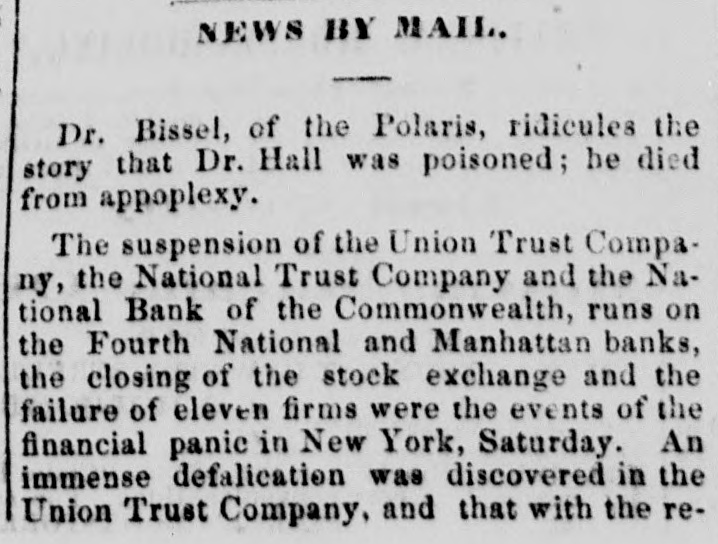
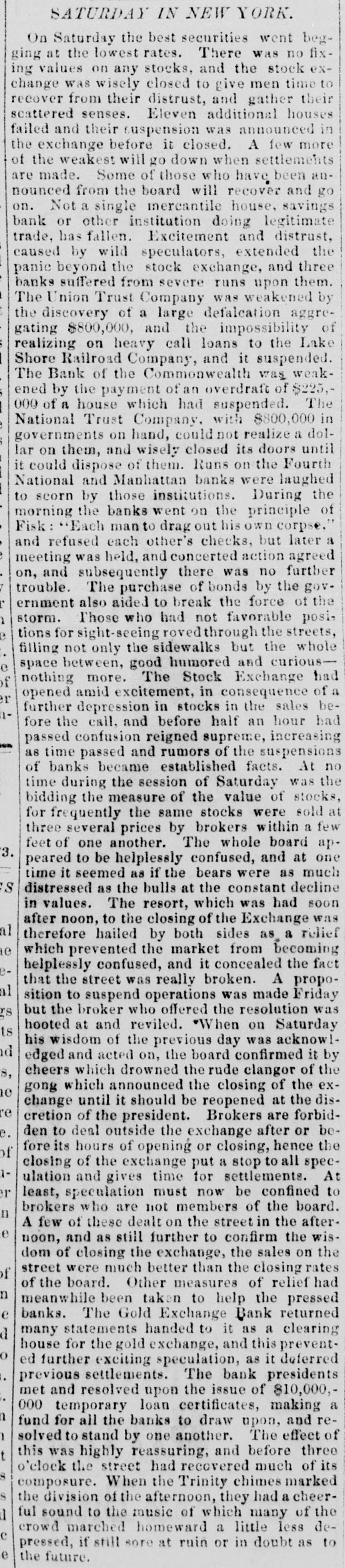
NEWS BY MAIL. Dr. Bissel, of the Polaris, ridicules the story that Dr. Hall was poisoned ; he died from appoplexy. The suspension of the Union Trust Company, the National Trust Company and the National Bank of the Commonwealth, runs on the Fourth National and Manhattan banks, the closing of the stock exchange and the failure of eleven firms were the events of the financial panic in New York, Saturday. An immense defalication was discovered in the Union Trust Company, and that with the re-


Article from The New York Herald, September 23, 1873

Click image to open full size in new tab

Article Text

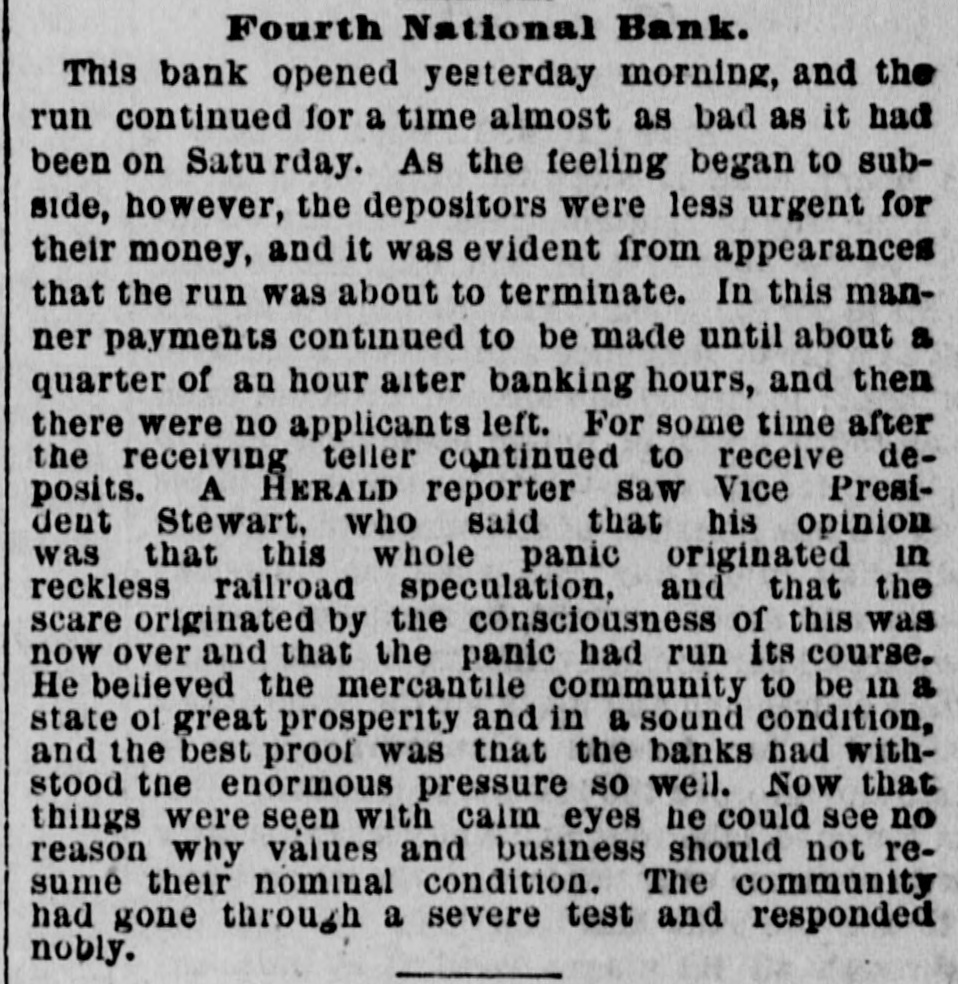
Fourth National Bank. This bank opened yeaterday morning, and the run continued for a time almost as bad as it had been on Saturday. As the feeling began to subside, however, the depositors were less urgent for their money, and it was evident from appearances that the run was about to terminate. In this manner payments continued to be made until about a quarter of an hour after banking hours, and then there were no applicants left. For some time after the receiving teller continued to receive deposits. A HERALD reporter saw Vice Presideut Stewart. who said that his opinion was that this whole panic originated in reckless railroad speculation, and that the scare originated by the consciousness of this was now over and that the panic had run its course. He believed the mercantile community to be in a state of great prosperity and in a sound condition, and the best proof was that the banks had withstood the enormous pressure so weil. Now that things were seen with calm eyes he could see no reason why values and business should not resume their nominal condition. The community had gone through a severe test and responded nobly.


Article from New-York Tribune, September 24, 1873

Click image to open full size in new tab

Article Text

PRESSURE UPON THE BANKS. CURRENCY EXCEEDINGLY SCARCE-DEMANDS FOR LOANS POURING IN FROM THE COUNTRY-THE CROPS MUST BE MOVED. upon of the downtown to ascertain their viewa. A reporter the banks Presidents of THE of TRIBUNE many called, leading The yesterday, questions asked had reference chiefly to the demand for loans from city customers and e drain from banks out of town. The reporter found a marked difference between the banks doing business for the brokers and those transacting a strictly mercantile business. Money was scarce everywhere, and discounts could not readily be obtained. The best commercial paper was offered at two per cent a day, but the money could not be had. OUTSIDE DEMAND FOR LOANS. W. K. Kitchen, President of the Park Bank, told the reporter that the calls on the bank were not very great from the city, as they paid large amounts only on certified checks from the Clearing-house, and the demand for loans was not so large as one might suppose. The demand from country banks, however, was simply enormous, and could be in the banks to country amounted to not be raised in an banks met. banks which could The in the deposits city hour. a belonging The vast not sum, haven't got it; they ought to have taken on Saturit day the action which they took on Monday, and was a great mistake that they failed to do so. To a customer who called for a loan-We will let you have the money as soon as we can. Send around to your customers and make them pay up. This is a good time to collect in money. THE COMMERCIAL WORLD NOT AFFECTED. Geo. S. Coe, President of the American Exchange Bank, said that his institution was not a brokers' bank, and the demands for loans from merchants were not greater than usual. The commercial world was not affected in the least as yet, and he saw no reason why they need be. The out-of-town demand for money is always large at this season of the year, but is larger now than usual owing to the panic. Their deposits are small in proportion to their capital, and they are meeting demands from all sources. He looked upon the trouble as a stock-brokers' affair which need not troubln outsiders. The stock gamblers, he said, were drawing money from the banks, and stood ready with it in their pockets to buy stocks whenever they could put them down low enough. MONEY NEEDED FOR MOVING CROPS. John E. Williams, President of the Metropolitan Bank, told the reporter that they did a strictly commercial business, and were not affected in any way by the panic. There was great demand from out of town for money with which to move the crops. That was the cause of the trouble. "Our wealth in us poor and when a sudden call for grain Wall-st. Cooke's made failure created in currency, money Jay in it was n't in the city. The wheat was nor one was in a good." never 80 Every large the foreign hurry demand crop to get so his crop to the sea, and his bank sent out $100,000 a day for five or six weeks. The demand had somewhat increased, and some of the country bankers had gone wild. One man was day or two ago who had $70,000 on deposit and $40,000 in greenbacks in his pockets, and still wanted to get a discount. Mr. Williams told him to go home and cool off. The national currency, Mr. Williams said, is all out of the city; there is probably not more than $1,000,000, and perhaps not more than half a million in the banks. If they had all been paying out gold they would have been compelled to suspend. The great trouble was caused by the large amounts of worthless railroad bonds and stocks forced on the market by false representations. A JUBILANT BANK. At the Fourth National Bank the aspect of things had greatly changed since Monday. There were few persons at the paying teller's desk, but there was a long line of depositors at the window of the receiving teller reaching half around the bank. At 3 o'clock the line had not been shortened, and half an hour later it numbered 26. Mr. Lane, the cashier. told the reporter that they had found themselves a creditor bank at the Clearing-house, and were feeling quite jubilant over it. Heretofore they had been on the debtor side. The worst of the trouble, he thought, was over; there would still be ruin among the bankers, but the trouble of the banks, he thought, was over. After the suspension of Henry Clews & Co. a report was circulated on the street that the Fourth National Bank had suspended. The reporter returned, and was told that the report had probably arisen from their refusal to clear for Henry Clews & Co., but that the situation was unchanged since the former visit. The cashier pointed to the line of depositors, as if this were a sufficient answer to all questions of their elvency. A THRUST AT BROKERS' BANKS. W. H. Scott. President of the Hanover National Bank, said that they kept no brokers' accounts, and there was no unusual city demand, while the number had increased from the not be met: pouring the of panic their in, began. depositors and could Demands largely country there was since were currency to meet no which did a who dealt in business; fears for enough the the bankers banks in the city strictly them. stocks banking He would had not probably have to go down before things became settled. BROKERS MAKING SETTLEMENTS. Tappan, President of the Gallatin National Bank, said that the demand for loans was light. The brokers seemed to be settling up their affairs, exchanging stocks, and getting rid of collaterals, rather than incurring new obligations. There was a process of liquidation going on all around. They had no correspondents except in Philadelphia, and the out-of-town demand was limited to that city, but the demand from there was heavy. NO UNUSUAL CITY DEMAND, The reporter found everything quiet at the Continental National Bank. T.G.S. Flint said that a report had been telegraphed all over the country on Saturday that the bank had suspended; and the result was that their out-of-town customers were calling in their deposits. There had been a tremendous run by letter telegraphal day Monday and yesterday, and they did not know what was the cause until yesterday. They had responded to all calls, and unless there were a change within a few days they would liquidate their entire out-of-town indebtedness. The false report was circulated in had been no unusual denot how much ruthem, but it had inthe mand. mor country, had He caused could and there say certainly harm been city the inrious to their customers and to many from whom


Article from Nashville Union and American, September 24, 1873

Click image to open full size in new tab

Article Text

The Shylocks May Precipitate a Panic Jay Cooke's London House Throwing out His Drafts. Four Bank Failures in Petersburg,Va The Ce-operative Plan.j NEW YORK, Sept. -Every banking institution in Brooklyn with single excep. tion was represented as the meeting of the presidents yesterday It was determ that in Case of run on any of the banks all of the others would come to its assistance. It was also resolved that the savings banks, if necessary, should take advantage of the thirty days clause in the charter. number of poor women and laboring men have gathered at the savings banks awaiting their opening, but nobody seems to think that anything like run will take place. The Priests Allaying Panie Wm. Quinn, Vicar General of New York, was at the Emigrant Savings Bank yesterday, advising depositors to leave their money with the bank where it was safe He promised to be on hand to-day. Gen. Hillhouse has declined to give the names of the sellers of bonds, on the ground that some sellers are connected with savings banks. To announce that they had sold bonds might bring discredit upon their banks, which the facts do not warrant, 10 A. M. The governing Committee of the Stock Exchage have decided not to open to day. 10:45. The Gold Exchange is opened and regular transactions being made. The excite ment on the street seems to be ceasing and wearing itself out, and better feeling ap pears to exist. The brokers have congregated in front of the Stock Exchange and formed street market, all the sales being for cash The following are the quotations Central 91 to 92 bid; Harlem 105 bid offered: Lake Shore bid; Wabash bid; Rock Islaud 88 bid: St. Paul 35 bid; Ohio and Mississippi 30 bid; Union Pacific and bid; C. 21 bide H annibal and Joseph 20 bid; Western Union Tel egraph 66 bid to offered; Pacific Mail 341 to 36 bid. Noon. Ten million of bonds have been bought Subat the -Treasury. The Process of Inflation. The Assistant Treasurer has received 20. 000.000 greenbacks from W hington, and is ready to buy all bonds offered. 2:80 P. M. The suspension of Henry Clems & Co. is announced They say that at present they have no statement to make, save that temporary suspension has been deemed advisable. This failure tends to revive eitement The paid $1,250,000 tenders to during the past days, and it was the general they would pull through, but to-day Fourth National bank refused to clear checks, aithough the firm had 800,000 securities against which 300,000 had been drawn. M. Assistant The Gold closed at 112 Treasurer day bought $3,205,000 bonds Henry Clews & Co. state that during the past four days they have paid out one and half millions in money, and made the most forts to-day to raise money on their securities, but finding it impossible to do 80 were compelled to suspend. The Ten Million Bank Pool Used Up. Mr Camp of the Clearing House, states that the ten million of loan certificates have been used up to to- -night. There will be meeting of associated bank rs to-morrow 10 o'clock at the Merchants' Bank [to debate the advisability of issuing more certificates.] Night Dispatches Another Surprise Like Jay Cooke's. Up to two o'clock this evening the monetary situation might have been summed sentence: Confidence restored and the backs are conducting business as usual. Just as the street was beginning to feel that the end of the panic had been reached painful rumor started at 20 minutes to o'clock, that the house of Henry Clews Co., had suspended payment. soon the was made clowd collected in front of the building. The word that their checks were refused payment the Fourth National Bank reached the banking house about half past o'clock. and the closing of the doors followed announcement It is stated that an rangement will be effected by which an early resumption will be secured,as there abundant securities in possession of house. Immediately after the closing of the doors number of prominent capitalists were eagerly seeking Mr. Clews, who was not in the office, and the assistance neces. sary to puli through the day would undoubdtly have been given had there been suspicion that the bank would refuse paymentof Henry Clews & Co.'s checks. The fact of the suspension created as much citement as the suspension of Jay Cooke Co. The news left the street at the close of business in condition of great excitement and the headway made in restoring confidence may great measure be lost. The Savings Banks, etc. The run on the Savings Banks continued to day. but most of them adopted the time rule for paying creditors, the excitement soon subsided Where ver a case necessity transpires or that person wishing to draw requires few hundred dollars business purpose, tbe banks accommodate ;where with excitement causes the them drawal the banks do not oblige. At some of the banks the oficers say that the forcement of the time rule regarding drawing of deposits is demanded by their largest depositors and in one case adopted in deference to such Several of the largest banks paying demands to of the poor people of Brooklyn became alarmed regarding their money in the various Saving banks there and drew Only one bank took advantage of the rule, the others paying as usual. The was not heavy Further Panic at the of the Option kylocks, The Post says the banks have gone through the panic far all right. It must be remembered, however since Saturday the business of the banks has been simply ith merchants. the active of stock exchange firms having by the claring up of the exchange pended. These firms probably 500 accounts with the banks. Friday aturday's business at the stock has to settled. money who have failed to get responses on loan called, might rush in and force sales under the rule which would thing into panic again and the banks. To prevent such state of affairs been recommended that the governing mittee appoint sub committee to prescribe regulations by which ments may be made before the Exchange opened. the duty the present time of lenders and borrowers to treat parties to contracts with as much liberality and forbearance as without absolutely sacrificing their legal rights. o There will undoubtedly be found merci-


Article from Daily Kennebec Journal, September 24, 1873

Click image to open full size in new tab

Article Text

Daily Brennebec Journal AUGUSTA. WEDNESDAY MORNING, Sept. 24. 1873. THE NATIONAL AND SAVINGS BANKS. The firm standing which the National and Savings banks maintained during the panic in New York is a matter to be gratefully remembered. Only one national bank suspended payment, and no savings bank refused to pay the demands of its depositors. Had the panic reached and linked them with the fate of the brokers, speculators and gamblers crushed by the disaster, there would have been a more direful story to tell than we now have. Then it would have widened the field of disaster, multiplied the victims by thousands, and made honest laborers suffer severely where now only gamblers in stocks, gold and bonds are reaping the fruits of their foolhardy ventures. The measures adopted by the officers of the national banks for mutual protection were salutary. They created confidence on the part of depositors, strengthened each individual bank and enabled them to render aid to break the force of the storm. The action of the government was discreet. While Secretary Richardson stood as firm as a rock against the pressure made upon him to loan the money of the government to prevent speculators from sinking, his offer to purchase all government bonds offered for sale was an assurance that did much to prevent the increase of the panic as well as to furnish actual relief by the supply of currency. Only one run of any consequence was made upon any national bank, the Fourth, and that paid every depositor who demanded his money, so that by noon of Saturday the run was over and the bank pronounced safe. In such a scare as swept the city in those two memorable days it is quite remarkable that the national banks maintained so good a record as they did. The position of the Savings banks was also SO well maintained that not an instance of failure is found amongst them. All paid their depositors when asked, and in many of them the deposits increased rather than fell off during the panic. Of those who thronged their doors more came with deposits to be left than with checks to be cashed. On Saturday night they reported business going on as usual, with little excitement existing among customers, and no signs of trouble impending. The ability to convert their government bonds, of which they doubtless had considerable amounts, was a strengthening appliance for which they must have felt thankful to Secretary Richardson. In such a whirlwind of fear and passion all available resources were gladly taken. With the national banks, savings banks, mercantile firms and general business untouched by the panic except indirectly, and manifesting no distress whatever, the


Article from Alexandria Gazette, September 24, 1873

Click image to open full size in new tab

Article Text

again in commotion. It was at length announc ed that the house of Henry Clews & Co., an institution that for supposed stability and the magnitude of its operations was equal to Jay Cooke & Co. and Fisk & Hatch, had failed. The feeling of alarm has begun to permeate the mercantile community, and the course of the New York banks in refusing accommodation to merchants upon reliable paper, while in a state of virtual suspension themselves, has tended to increase it. The Baltimore American says: "Our Baltimore banks have acted wisely in pooling their assets in the Clearing House and thus making ready for an emergency, but this must be regarded as a precautionary measure." The Baltimore Sun says "Though there is still much of a reassuring character, the continued run on Savings banks in New York, and the complications of yesterday mix the situation unpleasantly, and serve to intensify ap prehepsion. In regard to the Petersburg banks is thought that some of them at least have weak northern connections, or are the out growth of banking houses that have had too much to do with speculative railroad enterprises. So far as the herd of New York stock gamblers is concerned they seem to have resumed their wonted activity. to the suspension of Henry Clews the firm states In four & regard Co. days they that during and ahalf the past have paid one millions in money. They made the utmost efforts to raise money on securities, but finding it to do SO were compelled to sustheir as only and have no to temporary, pend. impossible They regard further suspension statement make save that they "deemed suspension advisable. The cashier of the Fourth National Bauk, which threw out Clews & Co's. checks to the amount of $200,000 says the bank did SO simply because their account was not good. There no over draft but would have been had allowed it. no remained on as they greenbacks the was bank The hand, firm and which paid until could DO securities, of they had amount, nothing susClews & Co. say they pension. a negotiate large remained National had $800.000 but Bank, in securities in the Fourth against which checks to the amount of $300,000 only had been drawn. The firm paid out $1,250,000 in degaltenders to depositors ing the past few days. everal capitalists offered assistance to Heury Clews, one alone over one hundred of the tendering The association Banks the thousand of Baltimore, of dollars. resolved to adopt the New banks for issuing 75 cent. of or representing yesterday York per bills loan plan bank certificates, payable with other securities deposited by any a committee appointed for the purpose, which certificates shall be used in settlements at the Clearing House and be received by creditor banks. The arrangement is not to extend be yond the 1st of November next, the certificates 6 cent. bonds, or are meantime government bearing Clearing gold per House gold interest. certificates certificates, When deposited, the are to represent the par. of Petersburg had over two hundred dollars in the of that one McIlwaine The commission thousand city & Co., city, State, suspended of the bauks largest firms in the are reported suspended. The directors of the Citizens Bank of Petersburg have decided to suspend. A dispatch from Richmond, dated yesterday afternoon, says: "The feeling here this safternoon has been one of the news DO nervousness, from Petersburg. resulting There principally fact have from been of them runs on any of the bauks; in some claim to have done more business in receiving deposits than usual. The directors of the Dollar Savings Bank have decided upon sospend ing to-morrow. The President states that the assets more than enough to pay all depositors. but being in are of not are immediately principally available. National collaterals, Banks A meeting and they four of the Bank of Virginia and and Insurance evening the Banking officers State of the Company They the this Merchants resolved to sustain each other. expect to have sufficient funds to-morrow to stand any run that may bc made.' Telegrams from various points indicate an improved feeling, though accompanied by some In Philadelphia all the that were under temporary tles the unfavorable State have banks resumed, reports. except Union and difficult the Citizens, which will soon resume. All the national banks stand firm. A dispatch from Wif mington, Del., states that Messrs. John McLear & Son, bankers, and Delaware agents for Cooke & Co., had suspended. Reports from Trenton, N. J., are favorable with no failures. The at N. hes failure of Clews & a news run of the Albany, Y. market Co. ceased. had in Chica- The depressing influence in the grain go, but there were no failures and no runs on banks of any kind, and all demands were paid without asking notice. There has been no disturbance in financial af Cincinnati, and nothing has occurred the routine, except millions city rumor there ffairs in outside that ten ordinary bonds for the South- the ern railroad had been negotiated in New York through a German house. A colored man named Buchanao, tried in Washington, yesterday, for killing his wife in May last, was acquitted. It is expected that the President and his family will return to Washington, and occupy the President's House, on Friday next. The New York Herald gives an illustration


Article from New-York Tribune, September 25, 1873

Click image to open full size in new tab

Article Text

# FLATTERING HOPES AT NIGHT. SCENES AT THE FIFTH AVENUE HOTEL AND THE CLUB ROOMS. The throng in the corridors of the Fifth Avenue Hotel was much smaller last evening than on any evening since the panie began. The general feeling was one of hopefulness, and the belief was that the worst was past. The action of the banks in standing by one another was strongly commended. It was said that if the panic were allayed and brighter times were soon entered upon It would be because of this combination of the banks to resist any pressure that might be brought to bear upon them. In proof of this, the manner in which the Fourth National Bank was enabled to withstand a run for several days was cited. There was an absence, too, of the leading financiers, with the serious faces they have worn since the beginning of the financial revulsion. In one corner, during the evening, were Col. McComb of CrΓ©dit Mobilier fame, Homer Ramsdell, and other railroad financiers, while in another group were Major-Gen. Hancock, Richard Schell, and several other notable men. Gen. Burnside and Eastern capitalists formed another group. A few representatives of dry goods houses were scattered through the crowd, discussing the situation with customers from the West and South. They acknowledged that on Monday and Tuesday the prospect seemed gloomy, but the outlook of yesterday had given them new heart, and they were now inclined to believe that the mercantile community in this city and throughout the country would not be seriously affected by the panic. Among those present at the Union Club last evening were August Belmont, Robert L. Cutting, Moses H. Grinnell, and a number of others. August Belmont strongly commended the course of the banks in standing so firmly by one another, and said he thought the panic had spent itself. One or two bank Presidents present said all the old established banks had early determined on that course, and it was well understood among them that they should continue to render one another all needful assistance. Their ability to do this was not in any respect to be endangered by excessive advances to doubtful houses, or indeed to any private institutions.


Article from Delaware State Journal, September 27, 1873

Click image to open full size in new tab

Article Text

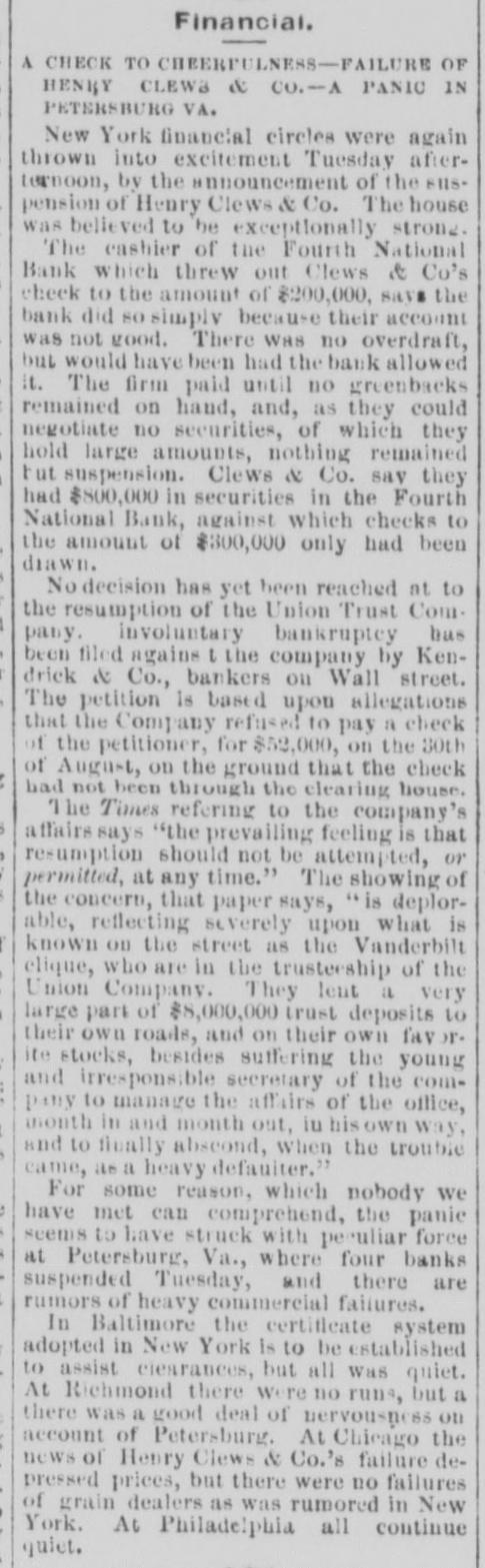
Financial. A CHECK TO CHEERPULNESS-FAILURE OF HENRY CLEWB & CO.-A PANIC IN PETERSBURG VA. New York financial circles were again thrown into excitement Tuesday afterternoon, pension of by Henry the announcement Clews & Co. of The the house suswas believed to be exceptionally strong. The cashier of the Fourth National Bank which threw out Clews & Co's check to the amount of $200,000, says the bank did so simply because their account was not good. There was no overdraft, but would have been had the bank allowed it. The firm paid until no greenbacks remained on hand, and, as they could negotiate no securities, of which they hold large amounts, nothing remained but suspension. Clews & Co. say they had $800,000 in securities in the Fourth National Bank, against which checks to the amount of $300,000 only had been drawn. No decision has yet been reached at to the resumption of the Union Trust Company. involuntary bankruptcy has been filed agains t the company by Kendrick & Co., bankers on Wall street. The petition is based upon allegations that the Company refused to pay a check of the petitioner, for $52,000, on the 30th of August, on the ground that the check had not been through the clearing house. The Times refering to the company's affairs says "the prevailing feeling is that resumption should not be attempted, or permitted, at any time." The showing of the concern, that paper says, "is deplorable, reflecting severely upon what is known ou the street as the Vanderbilt clique, who are in the trusteeship of the Union Company. They lent a very large part of $8,000,000 trust deposits to their own roads, and on their own fav orite stocks, besides suffering the young and irresponsible secretary of the company to manage the affairs of the office, month in and month out, iu bis own way, and to finally abscond, when the trouble came, as a heavy defaulter. " For some reason, which nobody we have met can comprehend, the panie seems to have struck with peguliar force at Petersburg, Va., where four banks suspended Tuesday, and there are rumors of heavy commercial failures. In Baltimore the certificate system adopted in New York is to be established to assist clearances, but all was quiet. At Richmond there were no runs, but a there was a good deal of nervousness on account of Petersburg. At Chicago the news of Henry Clews & Co.'s failure depressed prices, but there were no failures of grain dealers as was rumored in New York. At Philadelphia all continue quiet.


Article from National Republican, October 4, 1873

Click image to open full size in new tab

Article Text

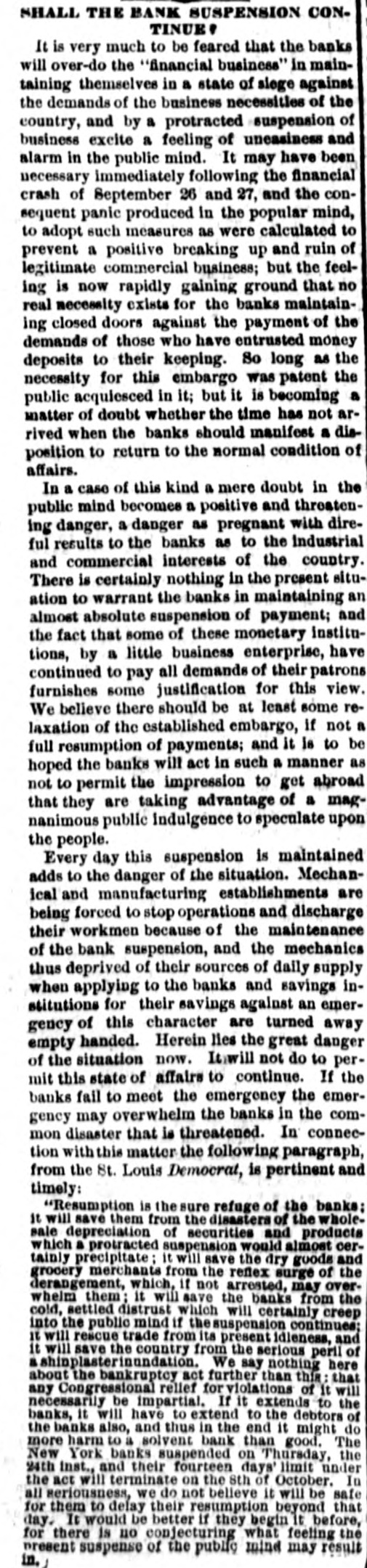
SHALL THE BANK SUSPENSION CONTINUE? It is very much to be feared that the banks will over-do the "financial business" in maintaining themselves in a state of siege against the demands of the business necessities of the country, and by a protracted suspension of business excite a feeling of uneasiness and alarm in the public mind. It may have been necessary immediately following the financial crash of September 26 and 27, and the consequent panic produced in the popular mind, to adopt such measures as were calculated to prevent a positive breaking up and ruin of legitimate commercial business; but the feeling is now rapidly gaining ground that no real necessity exists for the banks maintaining closed doors against the payment of the demands of those who have entrusted money deposits to their keeping. So long as the necessity for this embargo was patent the public acquiesced in it; but it is becoming a matter of doubt whether the time has not arrived when the banks should manifest a disposition to return to the normal condition of affairs. In a case of this kind a mere doubt in the public mind becomes a positive and threatening danger, a danger as pregnant with direful results to the banks as to the industrial and commercial interests of the country. There is certainly nothing in the present situation to warrant the banks in maintaining an almost absolute suspension of payment; and the fact that some of these monetary institutions, by a little business enterprise, have continued to pay all demands of their patrons furnishes some justification for this view. We believe there should be at least some relaxation of the established embargo, if not a full resumption of payments; and it is to be hoped the banks will act in such a manner as not to permit the impression to get abroad that they are taking advantage of a magnanimous public indulgence to speculate upon the people. Every day this suspension is maintained adds to the danger of the situation. Mechanical and manufacturing establishments are being forced to stop operations and discharge their workmen because of the maintenance of the bank suspension, and the mechanics thus deprived of their sources of daily supply when applying to the banks and savings institutions for their savings against an emergency of this character are turned away empty handed. Herein lies the great danger of the situation now. It will not do to permit this state of affairs to continue. If the banks fail to meet the emergency the emergency may overwhelm the banks in the common disaster that is threatened. In connection with this matter the following paragraph, from the St. Louis Democrat, is pertinent and timely: "Resumption is the sure refuge of the banks; it will save them from the disasters of the wholesale depreciation of securities and products which a protracted suspension would almost certainly precipitate; it will save the dry goods and grocery merchants from the reflex surge of the derangement, which, if not arrested, may overwhelm them; it will save the banks from the cold, settled distrust which will certainly creep into the public mind if the suspension continues; it will rescue trade from its present idleness, and it will save the country from the serious peril of a shinplaster inundation. We say nothing here about the bankruptcy act further than this; that any Congressional relief for violations of it will necessarily be impartial. If it extends to the banks, it will have to extend to the debtors of the banks also, and thus in the end it might do more harm to a solvent bank than good. The New York banks suspended on Thursday, the 24th inst., and their fourteen days' limit under the act will terminate on the 8th of October. In all seriousness, we do not believe it will be safe for them to delay their resumption beyond that day. It would be better if they begin it before, for there is no conjecturing what feeling the present suspense of the public mind may result in."


Article from Daily Kennebec Journal, October 16, 1873

Click image to open full size in new tab

Article Text

GENERAL NEWS. Frederick Chase Hutchinson, one of the family of singers, is dead. Pere Hyacinthe has been elected one of the three cures in Geneva by the Old Catholics. It is expected that the New York banks will resume currency payments next week. Newton has decided to cast off its swaddling clothes and become a city, the 17th in Massachusetts. The King of Italy has presented to the Empress of Austria a costly set of jewelry made in Rome. Christian Unity was practically illustrated in New York last Sunday. An Episcopal Bishop administered the Sacrament in a Presbyterian Church. T. Parkin Scott, Judge of the Supreme Bench of Maryland, died at Baltimore Monday morning, aged 70. The Chicago Post says that "if a son of Henry H. Wise is making speeches against his father, he must find himself compelled to change his politics several times a day." Many delegates to the Evangelical Alliance visited Philadelphia Monday and were entertained with a public reception and a banquet at the Continental Hotel, by the Philadelphia branch of the Alliance. The Cincinnati banks resumed payment of currency Monday. There were no runs and no excitement, and business men are very cheerful over the result. Most of the banks received more on deposits than they paid out. The republicans of the French Assembly paid M. Thiers a congratulatory visit Monday. The meetings of the several factions for the designation of members of the general committee of management will be held at various times next week. They have a calf out in Oregon who sports a nice little pair of wings. These ornamental appendages are about the size of turkey wings and crop out just behind the shoulders. Thomas A. Ridgely, formerly Medical Director on General Grant's Staff, was on Monday sentenced to three years' imprisonment in State Prison for breaking into a dwelling house in the daytime and stealing books, which he sold for liquor. "You ought to let me pass here free of charge, considering the benevolent nature of my profession," said a physician to a toll-gate keeper. "Not so," was the reply, "you send too many dead heads through here now." The doctor did not stop to argue the point, but paid his toll and passed on. In the naval battle off Cartagena thirteen men were killed and forty-seven wounded on the rebel fleet. Senor Mayer, a member of the Junta, was killed on board the Numancia. The Richmond Enquirer is attempting, at this late day, to fire the Virginia heart by printing, day after day, in capitals, such par-


Article from New-York Tribune, October 22, 1873

Click image to open full size in new tab

Article Text

CURRENCY RESUMPTION. P. OPINIONS OF W. K. KITCHEN, SHEPHERD KNAPP, APCALHOUN, AND _RESUMPTION MONEY PROACHING C. BY NATURAL PROCESSES PANIC ABUNDANT-WHOLESO EFFECTS OF THE ON THE BANKS. The question of an early resumption subject of payments by the banks was again the currency investigation by TRIBUNE reportere, yesterday, of an bank officials. W. K. Kitchen, said that while be believed was a bad one at the arrangement of among the Park the Bank. beginning, President the Park it pooling would Bank be.injudicious to break it up hastily. The rather no benefit from it, but on the contrary was to derives all the large banks must, but its effect distress amoug weaker institutions, a | reflex of distress among all. to freely, and would doubtless as save loses. quent ing in as prètty Currency continue and giving was conse- com involume. His own bank was able crease accommodation in to merchants as it was to, much but it had paid out a great part of its deposits. Further and not able to give as much as it would wish. The was this, there had been no practical suspension. ability than of currency according to each bank's doubtpayment the rule throughout. Bank reforms would would prove less was out of the trouble, and so far it was grow a beneficial panic. Over-certification he to evils which would be one the banks that had been in the habit had already learned caution. certifying believed have of the been remedied, that way. The of and over- Park Bank itself had never done business in 33 Shepherd Knapp of the Mechanics' Bank, No. Wallsaid he did not believe it best to force full resump banks st., of currency payments just now. Most of the tion had paid out a large proportion of their deposits some of them might be seriously depleted paid and the understanding that currency would be if freely should get abroad. It was better to let the the currency out work its way back gradually, and, with great influx of gold here from abroad, he thought specie payments might be the result. That, of course, would it be better for everybody. Although we could not use for currency, yet it afforded a solid foundation upon and which all values and all paper could stand steadily, a continued apparent suspension of currency seemed to up the event of a resumption of specie. had been entered The likely pooling hurry arrangement into endangered, by the solid banks because the weak ones were and it would be unwise to break it up before all are fully prepared. He knew of no intention on the part and of the large banks to withdraw from it, he certainly had formed no such intention himself As to the loan certificates. they were already being retired. The Mechanics Bank had purchased $300,000 of them at the beginning in order to relieve the merchants and to be ready in case of an emergency; but recently they had returned them and taken back their securities. There had, indeed, been more than twenty millions issued, for it was understood the Committee could issue ad libitum after the last ten million was issued. He (did not know, therefore, just how much therew to be redeemed, nor when they would all be redeemed. Other banks, doubtless. found the loan certificates very convenient. The Mechanics' had no use for them. It had continued to give merchants about as much accommodation as they demanded, and its discounts had increased $160,000 since the days before the panic. One reform likely to grow out of the erisis was a reform in the matter of over-certifying checks. His bank at present required full securities before it certified anything. P.C. Calhoun, President of the Fourth National Bank. said.there had never been any practical suspension. The banks have all paid National bank notes. and there is now an actual surplus of currency in all the banks. A man was there yesterday rushing about to sell $100,000 of National bank notes, and he could not find a buyer. The currency is coming in in great quantity, faster than it ever aid before, and because of the accommodation afforded by loan certificates. it accumulates in the bank If man comes with a check for $100, $400, or the counter, of course; if $500, vaults. he is paid over the amount is larger, $1,000 or $2,000, he is paid by certified check Reporter-As to the loan certificates, Mr. Calhoun, are they likely to soon redeemed if Mr. Calhoun-They could all be redeemed at once, the holders care to do it. We have been carrying $1,200,000 of them, merely to relieve the needs of our customers, but we could return them to-day, if we wished, take back our securities. But we do not think it We consider the loan a best and to so. certificates very good substitute for currency, and while they continue in use the actual currency accumulates. It is not drawback on any of us to make use of them. Brokers' checks are all certified, and always will be certified as long as there are any brokers' checks. The pool arrangement of the Associated Banks does no harm, and ittmay do good. The banks I believe could all draw out of it now, but it might strain some of the weak ones, and again threaten the mercantile interests. It is better to keep up the pool, although we larger banks suffer a little by it, than to break two or three mercantile houses, and have distrust and panic on us again. The accumulation of currency forms very desirable reserve to facilitate, when necessary, the movement of the various crops. But even in that particular, matters are exceedingly easy. A gentle man from the South was here to-day, who says that there is currency enough in the South to move the cotton crop provided we can give them slight advances on five and ten-day bills, due when the cotton arrives. So you may say that currency payments are resumed. There will be no formal proclamation of resumption by the Bank Compittee. Currency will simply assert itself. and in the course of the week every bank in the city will be paying currency as freely as ever. J. E. Williams, of the Metropolitan National Bank. had time only to say, when asked as to the prospects of an early resumption of currency payment, that he thought it best to let it come about naturally rather than to force it by any formal action by the banks. THE IRON TRADE SUFFERING FROM THE STRINGENCY. A TRIBUNE reporter yesterday conversed with several extensive dealers in iron, both American and imported, to obtain their opinions as to the present condition of business and the prospects for the future. Edward Oothout of the firm of W. Oothout & Co., No. 3 CHiff-st., said that the iron trade is now almost at a standstill. The transactions of the past month have been little over 50 per centrol those of the same time last year. Money does not come forward to set in motion the products of the mines and mills, and to move the crops. Moreover, dealers want both confidence and ready means to sustain them in giving orders. At the beginning of the panic collections came in pretty well, but as the alarm and the consequent monetary stringency spread over the country, the receipts stopped, and now there is little coming in. Many of the mills and employing firms are embarrassed to pay their MCD. and either defer full payment or give part of what is due in orders on some bank. In the case of the larger mills and houses this difficulty is chiefly due to the limitations put on currency payments by the banks. Mills and firms which have less resources, beside trouble from this cause, find difficulty also because they can little or and because their not meet their Merchants get their not more. Some usually sell money among obligations nothing, and the will promptly. trustworthy, buy debtors cannot now buyers, do most can only meet their bille with


Article from New-York Tribune, January 2, 1878

Click image to open full size in new tab

Article Text

JOHN BONNER'S FRAUDS. THE EXTENT OF HIS OPERATIONS. MILLION DOLLARS INVOLVED IN HIS BREACH OF TRUST-SEVERAL ATTACHMENTS OBTAINED-THE DEFAULTER'S MANNER OF LATE-NO LOSSES IN THE THEATRICAL PROFESSION. John Bonner's fraudulent operations are shown to involved a million dollars. It is expected that tensive irregularities in the books of the Bankers' Brokers' Association will be shown. Several atchments have been obtained by persons having on the securities repledged by Bonner. The latives of the defaulter say that he has long been cody and irascible, and has shown in various the effect of business troubles. Members of theatrical profession say that there are no losses actors and managers, as at first reported. MORE FACTS ABOUT THE DEFAULTER. The offices of the bankers and brokers were closed yesterday, as it was 8 general holiday, and further information of importance in regard the failure of John Bonner & Co. could obtained. The assignee did not visit his office the day. It is understood that great irgularities exist in the books of the Bankers' and BroAssociation, especially in the stock ledger. A ceiver of the Association will probably be apinted to-day. The total capital of the Asso($500,000) has been used by Bonner, and $50,000, as nearly as can be ascertained present. in addition. Placing the actual loss to the of John Bonner & Co. at $450,000, the total nount that has been misappropriated by Bonner will gregate $1,000,000. There are no assets of any value. Among the losers is A. B. Boardman, a son-in-law of Bonner, who had Union Pacific bonds $5,000 on deposit with the firm. A few weeks Bonuer asked Boardman to take them away. stating if anything should happen of an unpleasant nature, would beembarrassing to have the accounts of relamixed. Mr. Boardman declined, however. to rethe securities and subsequently, as it now appears, onner sold them. Charles J. Osborn & Co. who, through their attorneys erman & Sterling, obtained a writ ofattachment Mon evening in a writ for $22,000. Later, property which found in the bands of Russell Sage. the Fourth NaBank. ink of Commerce, J. S. Stout, Farmers' and Trust Company, and the Shoe and Leather NaBank, was attached. In the application for the it is alleged that the assignment was made clandeswith intent to-defraud. B. Boardman, the son-in-law of the missing broker a lawyer at No. 49 Wall-st., said For a conlerable time I have been aware that Mr. Bonner was worried about his business, and I have often him say that he wished he were out of all-st., and bad never had any dealings there. mday night I was informed that his failure be announced on Monday. 1 was astoundReferring to irregularities, Mr. Boardman said he had never heard any suggestion before failure that Mr. Bonner had done anything and he had frequently heard his credit of as exceptionally good, "and," Mr. Boardman "if he was guilty of anything improper or diseditable, which for the present I am still disposed to he was led into it by the general practice of okers, and be did no more than the rest of the Wall-st. who do a money business are accustomed to do day." Regarding Mr. Bonner's absence from his home, Mr ardman said that it was due entirely to his proud, nsitive nature, which would not permit him to face buke. For the past two years, according to the adstatements of his son-in-law, Mr. Bonner been at times distracted and moody. and has way to fits of melancholy and irascibility tirely foreign to his nature. He would sit at his without noticing his family and would be lost in ought. When the Netter failure was aunounced, Mr. remarked to a friend that their conduct in repothecating securities was no new thing, as it was a practice on Wall-st. among brokers. Boardman further stated that the news of Mr. onner's failure had been kept from his wife until the moment, and that she was in deep distress, and felt the disgrace attached to her husband's forced sence. No particular attention was paid to his absence home until he failed to appear on Sunday, when family became alarmed, and were then made aware his failure in business. Shortly before 5 o'clock Saturday, Mr. Bonner went the furnishing goods store of E.S. Allien, at No. 21 road-st. He bought a shirt and several small articlescest amounting to $7 20-and directed that should be sent to his office. As he leaving the store, a friend-a broker-sauntered and remarked jocularly, "You can't get credit here." Bonner smiled and left the store. Mr. Allien ought nothing of the transaction, as Mr. Bon. was an old customer, and frequently, when siness engagements prevented bim from going to his on Staten Island. he sent to the store for a change linen. Although Mr. Allien, who is familiar withmany had heard intimations of the probable failure of & Co,, he had no suspicion that Mr. Bonner was eparing to leave the city. In reply to the rumor on the that Mr. Bonner was a debtor of his for a considamount, Mr. Allien said emphatically that of his customers was more prompt in the payment accounts than Mr. Bonner, and that he had resettled all his indebtedness. The rumor grew of the jesting manner in which Mr. Allien sympathized with several brokers who were by the failure, declaring that he too was those who were victims. Several brokers came the store Monday afternoon and railied Mr. Allien bis loss, which, according to the report of the last rival, included a full Winter suit, a sealskin cap and