First National Bank (New Orleans, LA)

Episode Information

Episode UID
16200809
Episode Type
Run β†’ Suspension β†’ Closure
Bank Type
national
Bank ID
1620 national
Charter Number
162
Start Date
May 14, 1867
Location
New Orleans, Louisiana (29.955, -90.075)

Metadata

Model
gpt-5-mini (chosen from majority vote of a three-model LLM ensemble)
Short Digest
b108f4a7d65eb832

Response Measures

Full suspension, Books examined

Receivership Details

Depositor recovery rate
79.0%
Date receivership started
1867-05-20
OCC cause of failure
Fraud
Share of assets assessed as good
46.6%
Share of assets assessed as doubtful
15.1%
Share of assets assessed as worthless
38.3%

Description

Known receivership date (1867-05-20) aligns with newspaper reports of examiner/receiver; suspension followed heavy withdrawals after discovery of defalcations.

Events (5)

1. December 18, 1863 Chartered
Source
historical_nic
2. May 14, 1867 Run
Cause
Bank Specific Adverse Info
Cause Details
Heavy defalcations announced in the Sub-Treasury and First National Bank provoked widespread runs on New Orleans banks.
Measures
Assets examined by stockholders and capitalists; meetings of stockholders called; police/military precautions noted in city.
Newspaper Excerpt
This excitement has caused a run on all the banks in the city.
Source
newspapers
3. May 14, 1867 Suspension
Cause
Government Action
Cause Details
Controller of the Currency/ Treasury agents closed the Sub-Treasury and placed the First National Bank under examiner, suspending payments.
Newspaper Excerpt
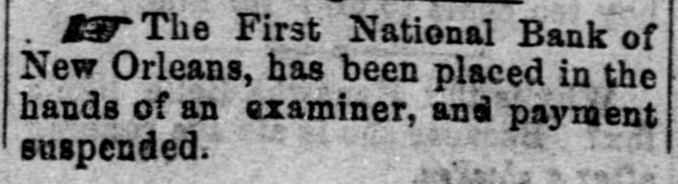
The First National Bank has been placed in the hands of an examiner, and all payments suspended.
Source
newspapers
4. May 20, 1867 Receivership
Source
historical_nic
5. May 20, 1867 Receivership
Newspaper Excerpt
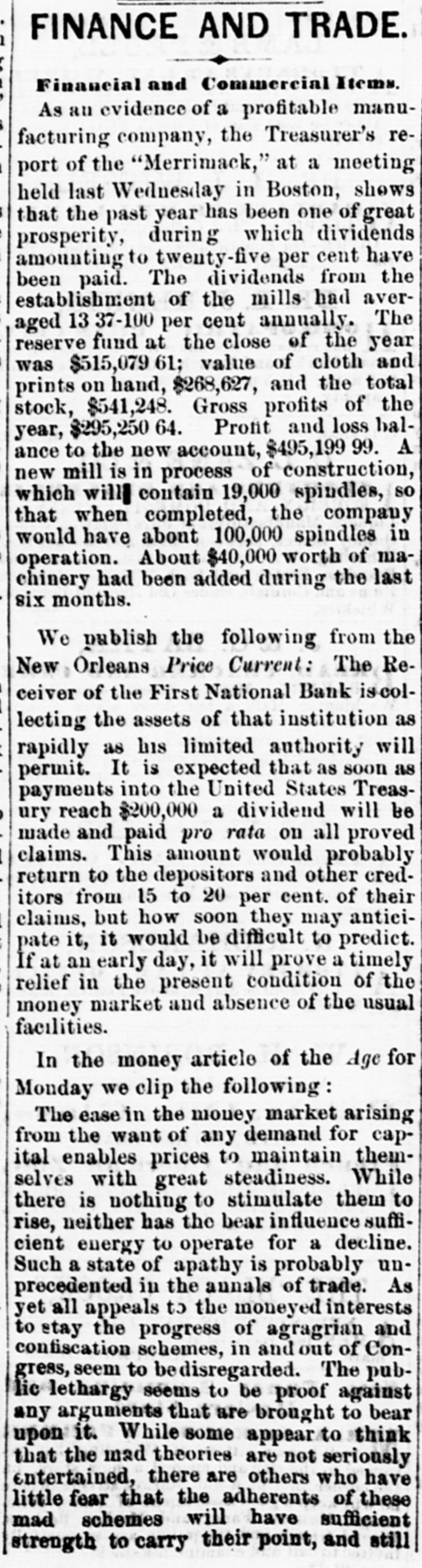
Colonel Charles Case, receiver of the First National Bank of New Orleans ... (receiver notices appear later). C. CASE. Receiver. Depositors ... present their bank books to be balanced. Creditors ... entitled to dividends. je27 6t C. CASE. Receiver (June notices). (Newspapers report receiver actions and later notices).
Source
newspapers

Newspaper Articles (25)

Article from The Daily Gate City, May 15, 1867

Click image to open full size in new tab

Article Text

FROM NEW ORLEANS. New ORLEANS, May 14. se ave BET 12 Two if portant decisions were rendered in the Sep Court of Louisiana yesterday. In the of Wainwright vs. Bridges, the, Court that no recovery can be had for for the purchase of slaves. In notes gime the case of Bowen vs. Racketlord, the Court holds, m previously, that no recovery could be had, as the notes were based on Confederate money, or in other words the money is illegal andfurther, the notes were signed before the passage of the stamp law and do Not a stamp to be usedas evidence. The First National Bank has been placed In the hands of the examiner, and all pay. ments suspended. Hon. Henry Wilson arrived to-day.


Article from Public Ledger, May 15, 1867

Click image to open full size in new tab

Article Text

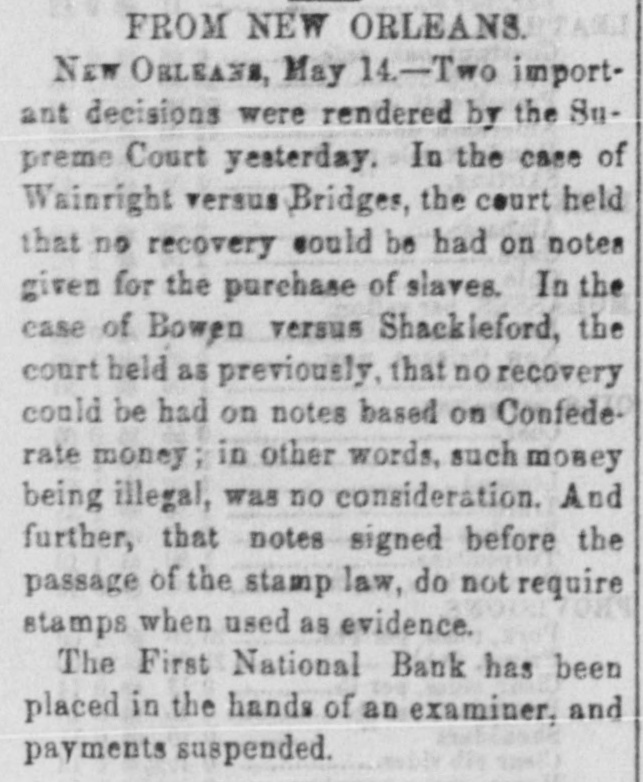
FROM NEW ORLEANS. New OBLEANS, May 14.-Two important decisions were rendered by the Supreme Court yesterday. In the case of Wainright versus Bridges, the court held that no recovery could be had on notes given for the purchase of slaves. In the case of Bowen versus Shackleford, the court held as previously, that no recovery could be had on notes based on Confederate money; in other words, such mosey being illegal, was no consideration. And further, that notes signed before the passage of the stamp law, do not require stamps when used as evidence. The First National Bank has been placed in the hands of an examiner. and payments suspended.


Article from Gold Hill Daily News, May 16, 1867

Click image to open full size in new tab

Article Text

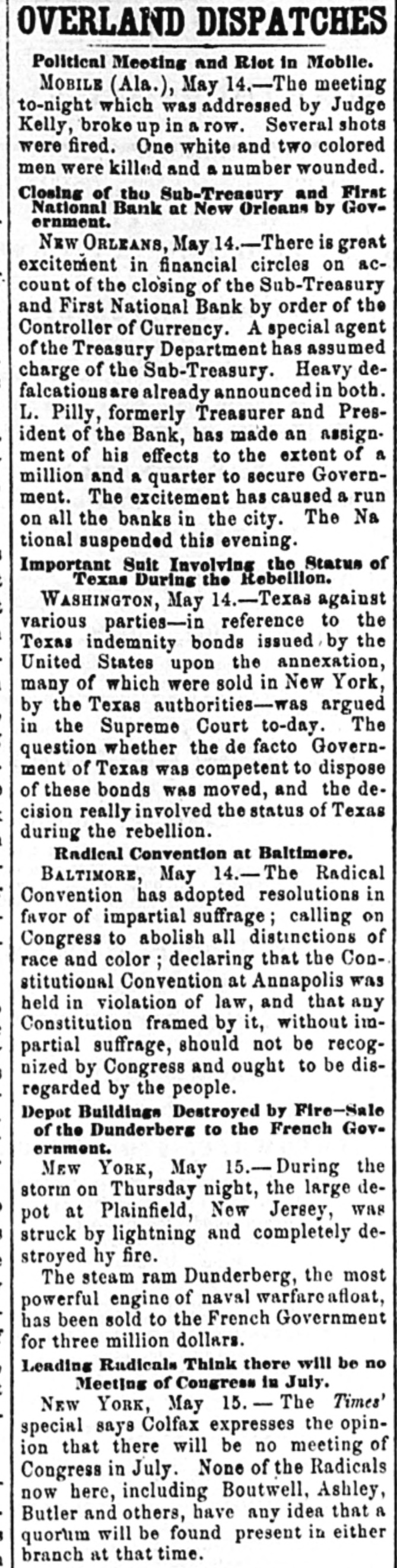
OVERLAND DISPATCHES Political Meeting and Riot in Mobile. MOBILE (Ala.), May 14.-The meeting to-night which was addressed by Judge Kelly, broke up in a row. Several shots were fired. One white and two colored men were killed and a number wounded. Closing of the Sub-Treasury and First National Bank at New Orleans by Government. NEW ORLEANS, May 14. -There is great excitement in financial circles on account of the closing of the Sub-Treasury and First National Bank by order of the Controller of Currency. A special agent of the Treasury Department has assumed charge of the Sub-Treasury. Heavy defalcationsare already announced in both. L. Pilly, formerly Treasurer and President of the Bank, has made an assignment of his effects to the extent of a million and a quarter to secure Government. The excitement has caused a run on all the banks in the city. The Na tional suspended this evening. Important Suit Involving the Status of Texas During the Rebellion. WASHINGTON, May 14.-Texas against various parties-in reference to the Texas indemnity bonds issued by the United States upon the annexation, many of which were sold in New York, by the Texas authorities-was argued in the Supreme Court to-day. The question whether the de facto Government of Texas was competent to dispose of these bonds was moved, and the decision really involved the status of Texas during the rebellion. Radical Convention at Baltimore. BALTIMORE, May 14.-The Radical Convention has adopted resolutions in favor of impartial suffrage; calling on Congress to abolish all distinctions of race and color; declaring that the Constitutional Convention at Annapolis was held in violation of law, and that any Constitution framed by it, without impartial suffrage, should not be recognized by Congress and ought to be disregarded by the people. Depot Buildings Destroyed by Fire-Sale of the Dunderberg to the French Government. MEW YORK, May 15.-During the storm on Thursday night, the large depot at Plainfield, New Jersey, was struck by lightning and completely destroyed hy fire. The steam ram Dunderberg, the most powerful engine of naval warfareafloat, has been sold to the French Government for three million dollars. Leading Radicals Think there will be no Meeting of Congress in July. NEW YORK, May 15. - The Times' special says Colfax expresses the opinion that there will be no meeting of Congress in July. None of the Radicals now here, including Boutwell, Ashley, Butler and others, have any idea that A quorum will be found present in either branch at that time.


Article from The Loyal Georgian, May 16, 1867

Click image to open full size in new tab

Article Text

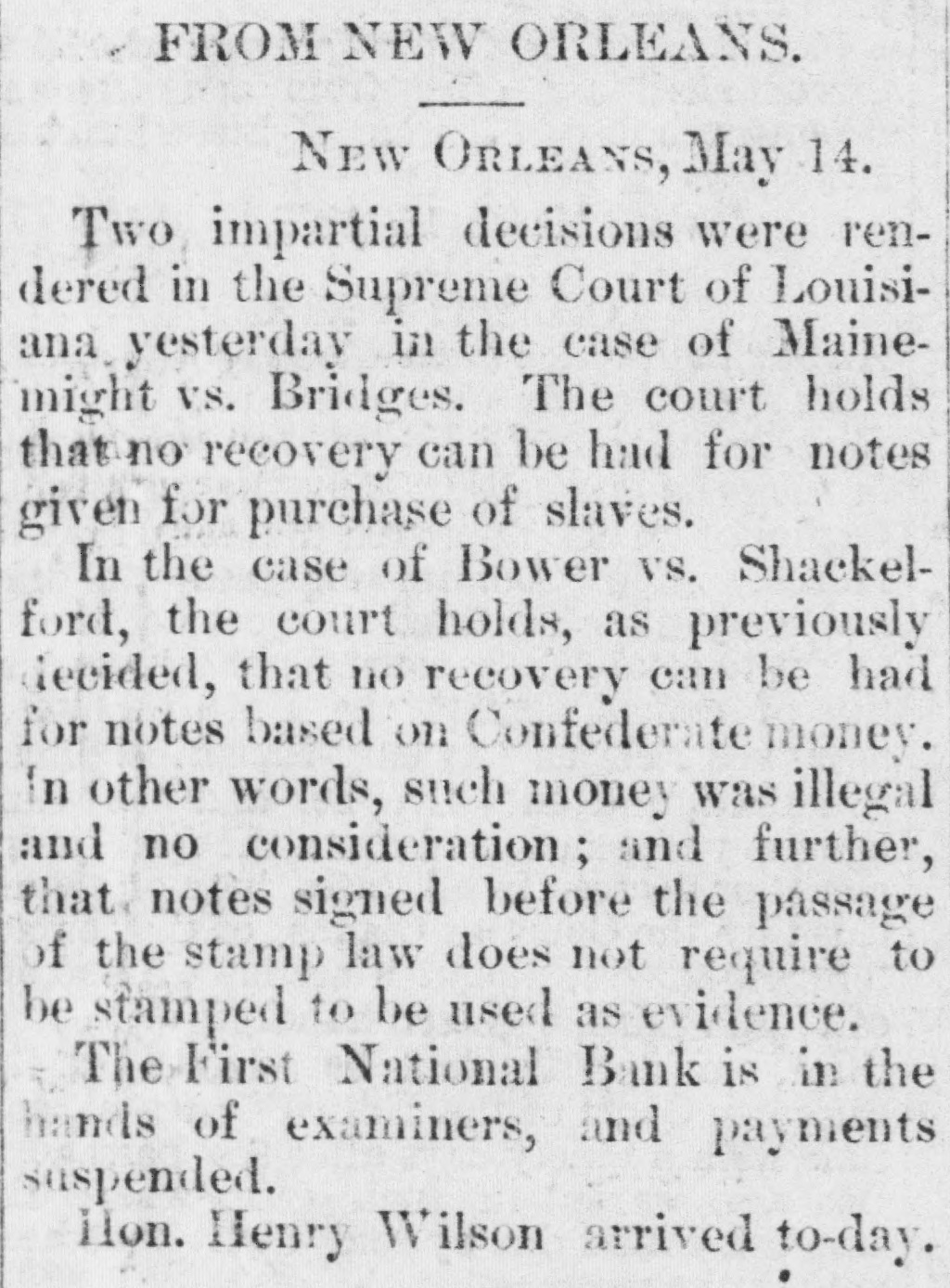
FROM NEW ORLEANS. NEW ORLEANS, May 14. Two impartial decisions were rendered in the Supreme Court of Louisiana yesterday in the case of Mainemight vs. Bridges. The court holds that no recovery can be had for notes given for purchase of slaves. In the case of Bower VS. Shackelford, the court holds, as previously decided, that no recovery can be had for notes based on Confederate money. In other words, such money was illegal and no consideration and further, that notes signed before the passage of the stamp law does not require to be stamped to be used as evidence. The First National Bank is in the hands of examiners, and payments suspended. ilon. Henry Wilson arrived to-day.


Article from The Portland Daily Press, May 16, 1867

Click image to open full size in new tab

Article Text

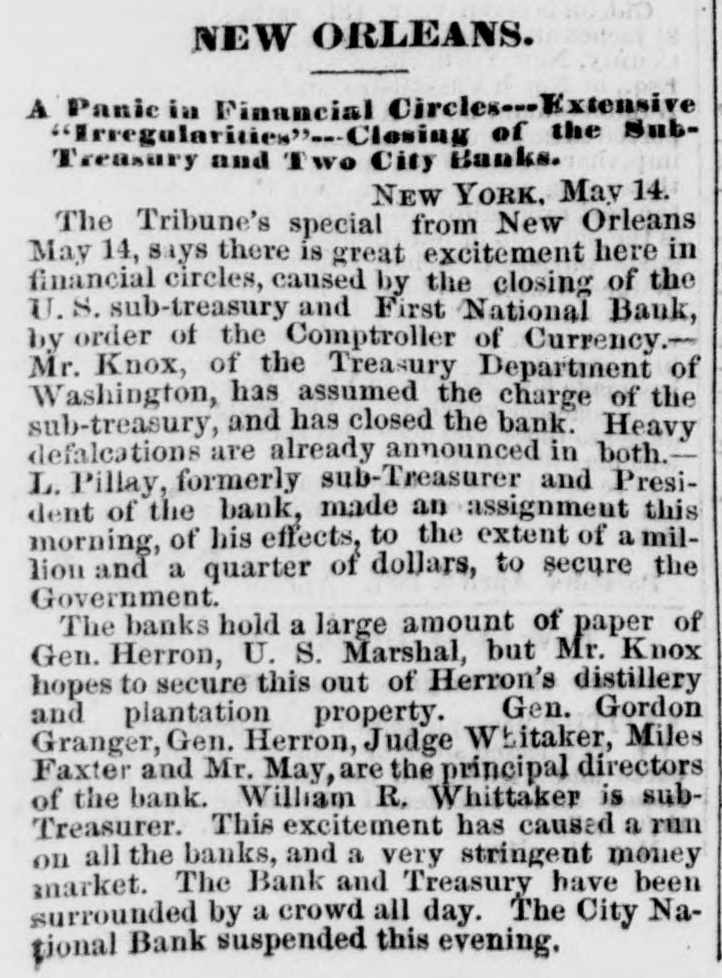
NEW ORLEANS. Extensive A Panic ia Financial Circles "Irregularities" Closing of the SubTreasury and Two City Banks. NEW YORK, May 14. The Tribune's special from New Orleans May 14, says there is great excitement here in financial circles, caused by the closing of the U. S. sub-treasury and First National Bank, by order of the Comptroller of Currency.Mr. Knox, of the Treasury Department of Washington, has assumed the charge of the sub-treasury, and has closed the bank. Heavy defalcations are already announced in both.L. Pillay, formerly sub-Treasurer and President of the bank, made an assignment this morning, of his effects, to the extent of a million and a quarter of dollars, to secure the Government. The banks hold a large amount of paper of Gen. Herron, U. S. Marshal, but Mr. Knox hopes to secure this out of Herron's distillery and plantation property. Gen. Gordon Granger, Gen. Herron, Judge Whitaker, Miles Faxter and Mr. May, are the principal directors of the bank. William R. Whittaker is subTreasurer. This excitement has caused a run on all the banks, and a very stringent money market. The Bank and Treasury have been surrounded by a crowd all day. The City National Bank suspended this evening.


Article from The Evening Telegraph, May 18, 1867

Click image to open full size in new tab

Article Text

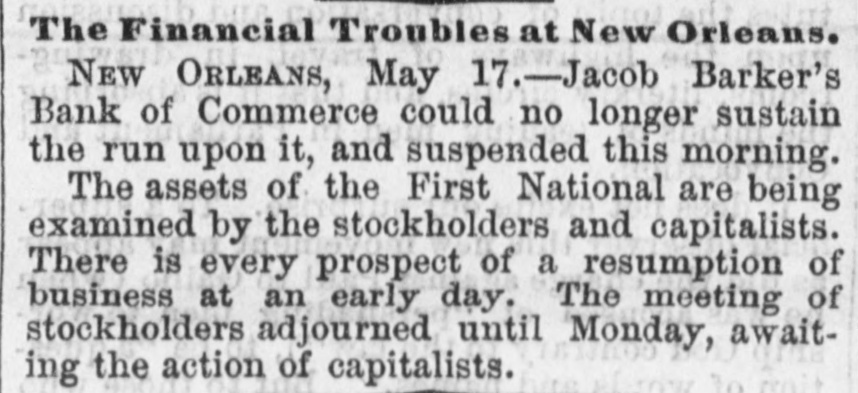
The Financial Troubles at New Orleans. NEW ORLEANS, May 17.-Jacob Barker's Bank of Commerce could no longer sustain the run upon it, and suspended this morning. The assets of the First National are being examined by the stockholders and capitalists. There is every prospect of a resumption of business at an early day. The meeting of stockholders adjourned until Monday, awaiting the action of capitalists.


Article from The New York Herald, May 18, 1867

Click image to open full size in new tab

Article Text

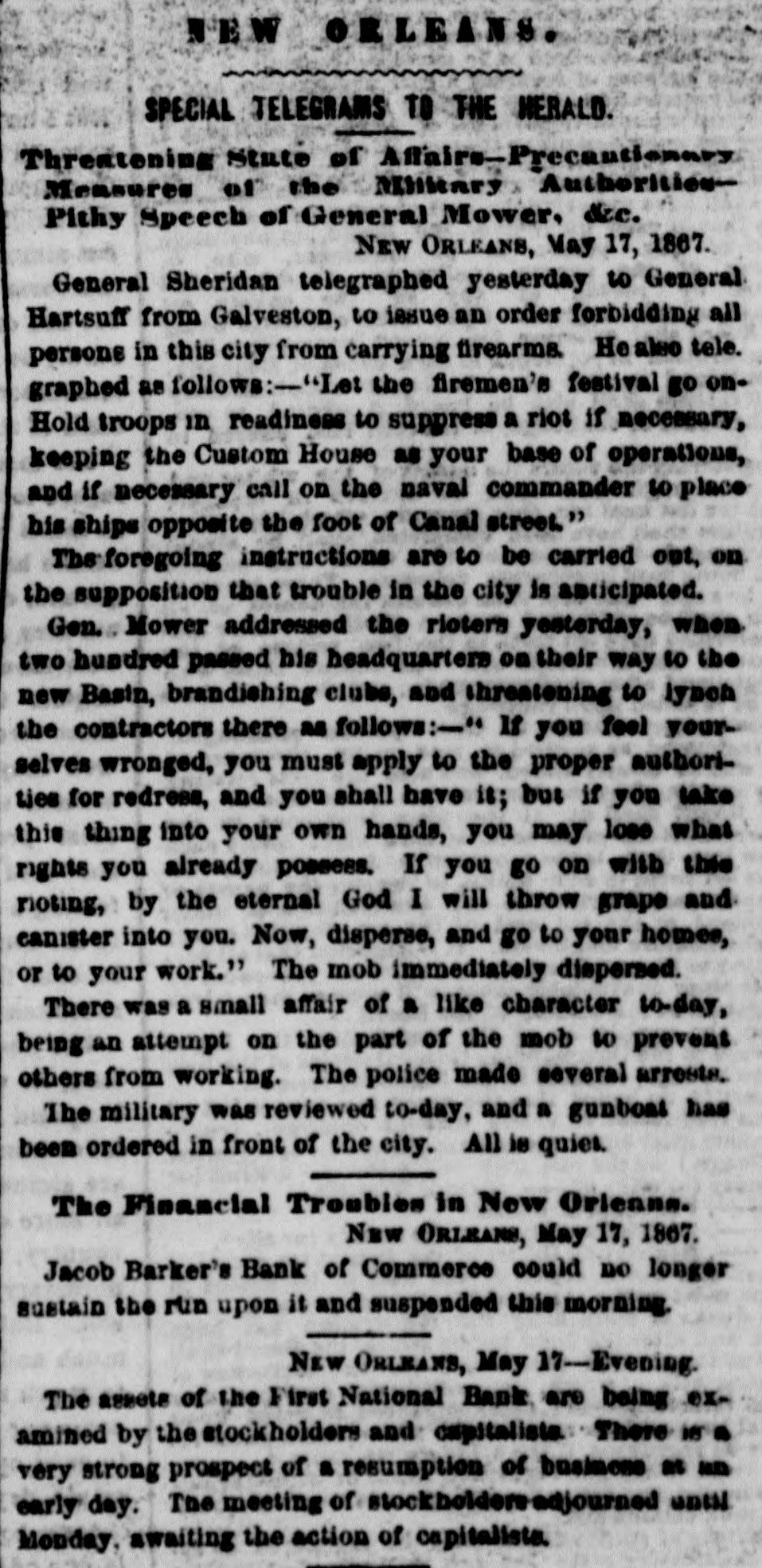
NEW ORLEANS. SPECIAL TELEGRAMS TO THE HERALD. Threatening State of Affairs-Precauciomary Measures of the AuthoritiesPithy Speech of General Mower. &cc. NEW ORLEANS, May 17, 1867. General Sheridan telegraphed yesterday to General Hartsuff from Galveston, to issue an order forbidding all persons in this city from carrying firearms. Healso tele. graphed as follows:--"Let the firemen's festival go onHold troops in readiness to suppress a riot If necessary, keeping the Custom House as your base of operations, and if necessary call on the naval commander to place his ships opposite the foot of Canal street" The foregoing instructions are to be carried out, on the supposition that trouble in the city is andicipated. Gen. Mower addressed the rioters yesterday, when two hundred passed his headquarters on their way to the new Basin, brandishing clubs, and threatening to lynch the contractors there as follows:- If you feel yourselves wronged, you must apply to the proper authorities for redress, and you shall have it; but if you take this thing into your own hands, you may lose what rights you already possess. If you go on with this noting, by the eternal God I will throw grape and canister into you. Now, disperse, and go to your homes, or to your work." The mob immediately dispersed. There was a small affair of a like character 10-day, being an attempt on the part of the mob to prevent others from working. The police made several arrests. The military was reviewed to-day, and a gunboat has been ordered in front of the city. All is quiet. The Financial Troubles in New Orienna. NEW ORLEANS, May 17, 1867. Jacob Barker's Bank of Commerce could DO longer sustain the run upon it and suspended this morning. New ORLEANS, May 17-Evening. The assets of the First National Bank are being examined by the stockholders and capitalists There HS a very strong prospect of a resumption of businose as MD early day. The meeting of stockholdereadjourned until Monday. awaiting the action of capitalista.


Article from The Ottawa Free Trader, May 18, 1867

Click image to open full size in new tab

Article Text

FINANCIAL AND COMMERCIAL Generally, at financial centers, matters are running in about the same grooves they have followed for a month or two past. The banks are nervous and distrustful about the prevailing prices in the grain markets, and loans to speculators are made only on very wide margins, but for "legitimate business," money is easy. At New Orleans there is a terrific financial excitement prevailing. Defalcations, to a large amount, have been brought to light in the United States Sub Treasury and the First National Bank. The Secretary of the Treasury has ordered them both closed. There was a run on all the banks on Tuesday, and the City National finally suspended. Eastern exchange is about 25c on $100 for buying, and 1 per cent. selling premium at our local banks. Gold has remained steady during the week at about 137.


Article from New Orleans Republican, May 19, 1867

Click image to open full size in new tab

Article Text

# OLD BLANKET, BRANDY. THE WHITE HOUSE, AND THE FIRST NATIONAL BANK. Jim, this is Saturday night; to-morrow is the day of rest to all who have sound constitutions and clear consciences. But, Jim, there is no rest for me. I cannot sleep, Jim. I cannot walk, Jim. I cannot even sit up erect in my chair, Jim, as I was wont to do in earlier days, and look my friends straight in the face. My eye seems to have grown askance in its glance upon everything; hideous visions flit before it, and all sorts of grinning creatures dance and gibber the moment I lift a lid. I cannot eat, Jim. Dyspepsia and indigestion seem to have taken possession of my stomach. My breath smells like the vat of a rum distillery just before seizure by those faithful guardians of the public interests, the whisky inspectors. I am afraid, Jim, that some day through mistake they may take me for a whisky vat, and seize me and put me under bonds, and oh! Heaven forbid, advertise me for sale among the marshal's monitions in the "mendicant loyalist." Jim, I am an unhappy wretch. I am satisfied that this damned gout will yet be the ruin of me. Jim, bring on the brandy-not a bottle, Jim, but a demijohn. This is Saturday night, Jim, and I have much to think of in reviewing my acts during the past week. Jim, I begin to believe you are a liar. You told me two or three days since I could get up a riot without any more danger to myself than the one I stirred up so beautifully last summer. You also said that my Creole friends on Exchange Alley would strike hands with me and rob the pockets of the poor freedmen as fast as I knocked them down. You are a liar, Jim; not a word you said proved to be true. You must not blame me, Jim, for I did all I could to keep my part of the contract. I really believe, Jim, that Exchange alley never for a moment entertained the thought of coming to my relief; and as a proof of it it still keeps up that radical banner which has so often rallied our enemies in solid phalanx to battle for our destruction. Jim, I really believe they suspect me of insincerity-they seem to think I have some other object in view than elevating one of their race to the mayoralty. One of them, a little shrewder than the rest, told me yesterday that all I really desired was to break up the Republican party, and, after breaking that up, to break the heads of every Creole and freedman in the South. Between ourselves, Jim, the little fellow hit the nail on the head so vigorously that I had another most infernal twinge of the gout, which silenced me for a day or two. Jim, I feel very bad to-night, and yet I have a crumb to comfort me and keep off remorse and despair a little longer. Jim, you have heard of the failure of the First national bank. That is my crumb of comfort, and not the least tiny bit of credit shall any one else have for it. You see, Jim, that just after my Yankee friends took me from the free lunch I deposited my earnings-which, through the aid of Northern capital and Northern credit, began to increase rapidly-in the bank. All my best friends in those days were directers and stockholders and indorsed my paper by thousands upon thousands, until I had become strong enough to go back upon both the bank and the individual directors. This step I did not take until I had consulted with Moses the lawgiver on Pennsylvania avenue. Moses said break up the banks whether they are sound or unsound, for Chase still looks toward my seat and will oust me unless I destroy that great national system of finance which so triumphantly carried us through the war. In vain I told him that the First National bank had made me a rich man, and had almost alone held up the commercial and planting interests from the moment General Butler arrived in this city to the present time. Upon this plea old Moses twisted his face into all sorts of contortions and grinned a fearful grin. What care I, said he, for individual or national prosperity. I must keep my seat here, and when I gave you the United States marshalship you sold me your soul and all you possess therein. Therefore do my bidding. You know that all commercial interests are depressed, and the least rumor will excite distrust and create a run on the soundest bank. We who have our pockets full cannot suffer-only the mendicant loyalists, who have all their hard earnings in its vaults, will be ruined. But beware, he said to me, as I was about leaving, beware lest while you are dragging down the First National you also ruin my highly valued friend and "old citizen," Jacob the Growler. And, Jim, it is the fact that I could not save my friend Jacob that deprives me of more than one-half the pleasure I derive from having ruined hundreds of worthy people in smashing up the First National bank. And not only Jacob, but, Jim, I hear others are about to follow; and who knows, Jim, that like Sampson of old I may have pulled down the temple over my own head, and before many weeks my mangled body may lie buried beneath its ruins. Jim, I begin to realize what my sweet, pretty Sabbath school teacher taught me in my youth that the "way of the transgressor is hard." Jim, it can't be that I have drank a demijohn of brandy while sitting here. The truth is, Jim, I learned the habit at the


Article from The Daily Dispatch, May 20, 1867

Click image to open full size in new tab

Article Text

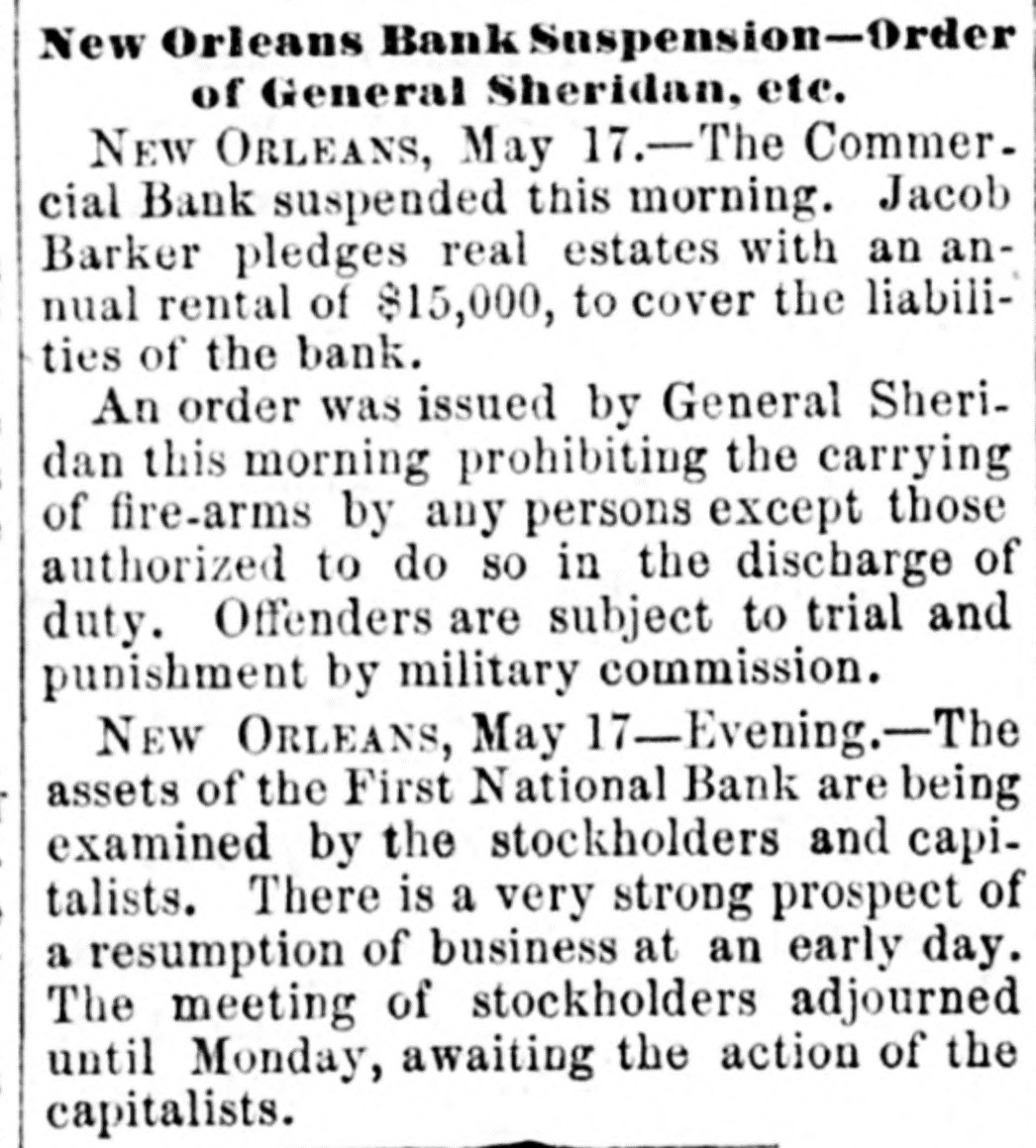
New Orleans Bank Suspension-Order of General Sheridan, etc. NEW ORLEANS, May 17.-The Commercial Bank suspended this morning. Jacob Barker pledges real estates with an annual rental of $15,000, to cover the liabilities of the bank. An order was issued by General Sheridan this morning prohibiting the carrying of fire-arms by any persons except those authorized to do SO in the discharge of duty. Offenders are subject to trial and punishment by military commission. NEW ORLEANS, May 17-Evening.-The assets of the First National Bank are being examined by the stockholders and capitalists. There is a very strong prospect of a resumption of business at an early day. The meeting of stockholders adjourned until Monday, awaiting the action of the capitalists.


Article from The South-Western, May 22, 1867

Click image to open full size in new tab

Article Text

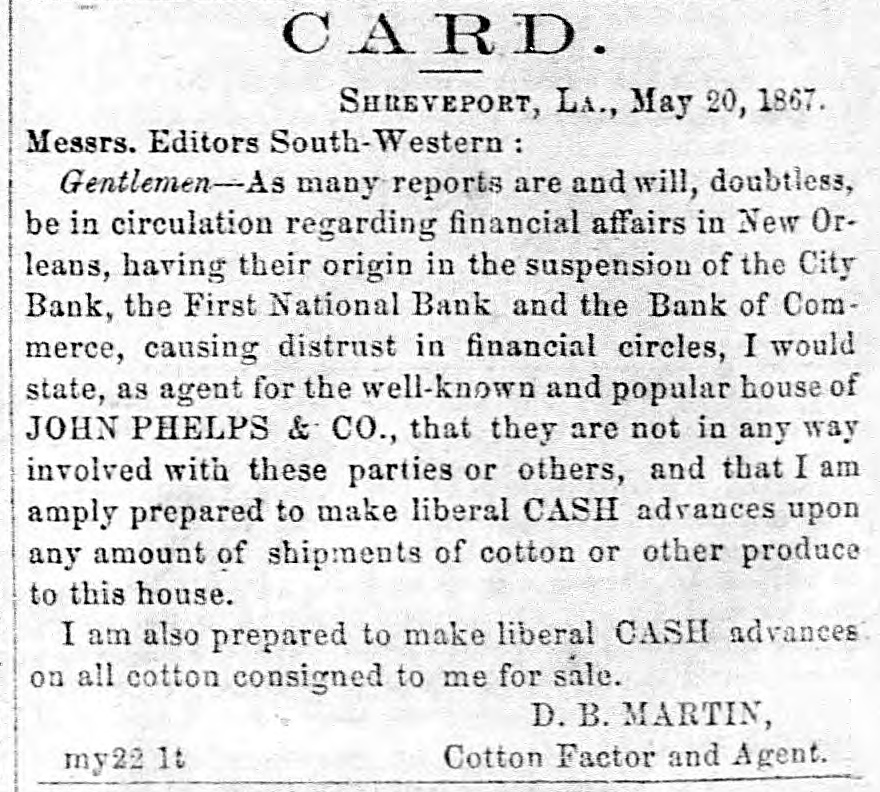
CARD. SHREVEPORT, LA., May 20, 1867. Messrs. Editors South-Western : Gentlemen-As many reports are and will, doubtless, be in circulation regarding financial affairs in New Orleans, having their origin in the suspension of the City Bank, the First National Bank and the Bank of Commerce, causing distrust in financial circles, I would state, as agent for the well-known and popular house of JOHN PHELPS & CO., that they are not in any way involved with these parties or others, and that I am amply prepared to make liberal CASH advances upon any amount of shipments of cotton or other produce to this house. I am also prepared to make liberal CASH advances on all cotton consigned to me for sale. D. B. MARTIN, Cotton Factor and Agent. my22 It


Article from Gallipolis Journal, May 23, 1867

Click image to open full size in new tab

Article Text

The First National Bank of New Orleans, has been placed in the hands of an examiner, and payment suspended.


Article from Ellsworth American, May 24, 1867

Click image to open full size in new tab

Article Text

LOCAL NEWS, &C. Eight hour laws have been passed in three States. -Pre-ident Day of Yale College is in his ninety third year. --Hor Geo. Baucroft will accept the Prussian Mission. According to the latest Mexican news Maximillian is the "sick man just now. - Knickerbocker lobsters were plenty in our market on Monday. The Democrats carried Kentucky in the election for members of Congress. The weather continues cold and the prevailing winds have been from the Eastward. The Boston banks do not receive State bank bills after June 1st. Horace Greeley made a speech at the African Church. Richmond, Tuesday Evening. -The Evening Post of last Saturday says that prices of breadstuff< are rapidly declining. -Jeff. Davis is the guest of Charles O. Conner Esq. of New York. The Bangor Whig says the Foundry of Messrs. Estes & Whittier in that City has been purchased by Messrs. Wood. Bishop & Co. Ve call attention to the notice for the Annual Maine State Soldiers and Sailors Union to meet in Portland the 4th and 5th of June. We call attention to the Musical Festival or Convention to be held at Machias commence ing June 17th and continuing four days Marge number of Maine Free masons are expecting to go to Boston to attend the dedication of the Masonic Temple. ---The Hotels of Boston have closed their bars, and the State Constables are satisfied that it a clear ease, -Judge Kelley addressed a large crowd of Whites and Blacksat Montgomery, Ala. the 20th. Hewas listened to attentively. -Judge Kellev of Pennsy Ivania made a speech in Mobile Tuesday, which ended in: a riot. A number were killed. HALLINCT.-0 market was applied with fresh hallibut on Monday. the first of the season. It sold readily for 12cts. per lb., short weight. The first vessel loading at the wharves with lumber sawed this Spring, was the Sch. Delaware Capt. Wood. last week. The last lingering hope of a steamer to run union river in connection with the City of Richmond has been dissipated. The Clarion and Falcon are both mold. -There is a financial panic in New Orleans, caused by heavy defalcations in the First National Bank and the Sub Treasury. -It is said that President Johnson will visit Bost on in June, by water. It is healthy to get off the track, now and then. Congressman Bingham, who conducted the conspiracy trials, been employ by the government to conduct the trial of Suratt. -The New York Tribune thinks we ought to ask Count Gortschkoff how much he, or his Government will give the United States for its debt. It'It is rumored that the citizens of Trenton purpose to give Major General J. G. Blunt now on visit to his native town, a public reception on Monday. May 27th. We believe that Mr. Greeler is one of the most honest men we have and therefore we can not. as some do, take this occasion abuse him. He may be wrong, but he doesnot play the part of demagogue. Our advice squarely and openly to the Democratic party is. that on the 3d day ofJune one and all stay away from the Polls, and the Republican party decide the imprisonment let clause to suit themselves Machias Union. -Just as we supposed. If we had the right to advise the Democratic party we should by all mems say to "one and all go to the polls and vote like men, one way or the other. This will be manly, and honorable. Sont Whe is Secretary Seward like the ga Because he wasted his substance Prodi- in a fur country, -It is said that there is man in Cheshire gets Whose hair is so red that when he the morning the roosters think it is daylight up and begin to crow. be Envoy Baneron President of New Johnson York has appointed George nary and Minister Plenipotentiari Extraordideceased. ted States at Berlin, vice Joseph A. of the Wright. Uniat -The Castine Argussays the Abbot school house into be remodeled for the to is dation of the Normal school which N convene this fall at that place. d of Society Congregationalists The Argus correspondent says that the remodel their church this season. Castine, are : church. have fine vestry with a modern They littled will May : est to the tweigh West was day of unusual interRev. W. 11. Kelton Waterville Baptist church. the hand of fellowship baptised eleven. and 1 Others are expected to be baptised new soon. members rWest,the -In the first number of new necessary : loaned him editor the returns thanks to paper those who out State, . t, debt Vout had thanks been to abolished heaven that in capital. that imprisonment and also de- for r, to base -The ball New York Ecening Post clubs because object matches. and they thus people bet on the gambling. against The same objection became may means be of bet preaching as people have urged d outhe time a minister been take known in the been GOOD.-Rufus K. Larabee of Durham a. at convicted before the supreme Co has y and cattle Auburn of mutilating and butchering sitting mou in that town, and continuing horses his de. . work for some time. Hope he will get Hong sentence. the -"We execution are in favor of the Constitution planks of the law." was and The in the old "Bell and Everett one of the the State Constabluary are for the execution platform. I law against liquor selling. dent The Harris Brunswick has assumed Telegraph says Presj made duties as his President first Bowdoin the discharge College. of Saturday evening. appearance in the Chapel on He of formally introduced prayers. where be was t ris B. Sewall. made Acting President. students by Prof. casion. few remarks appropriate President to the Harf --Cultivator seeds One ficulty sometimes in of annual getting flowers find a difreadily. ing the seed remedy may be found by vegetate clean fine sand. when sown The in the flowe coveror silver sand. In dry best variety is the white til they even board may be laid over weather cloth FOR begin to push the seeds unwishes to L.M.-The dispose of Editor title of the Journal. Independent e came accidentally into his of Reverend which months ago, while traveling through posession the few


Article from New Orleans Republican, June 7, 1867

Click image to open full size in new tab

Article Text

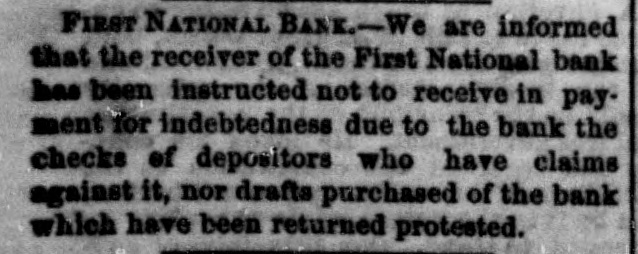
FIRST NATIONAL BANK.-We are informed that the receiver of the First National bank has been instructed not to receive in pay. ment for indebtedness due to the bank the checks of depositors who have claims against it, nor drafts purchased of the bank which have been returned protested.


Article from The New York Herald, June 11, 1867

Click image to open full size in new tab

Article Text

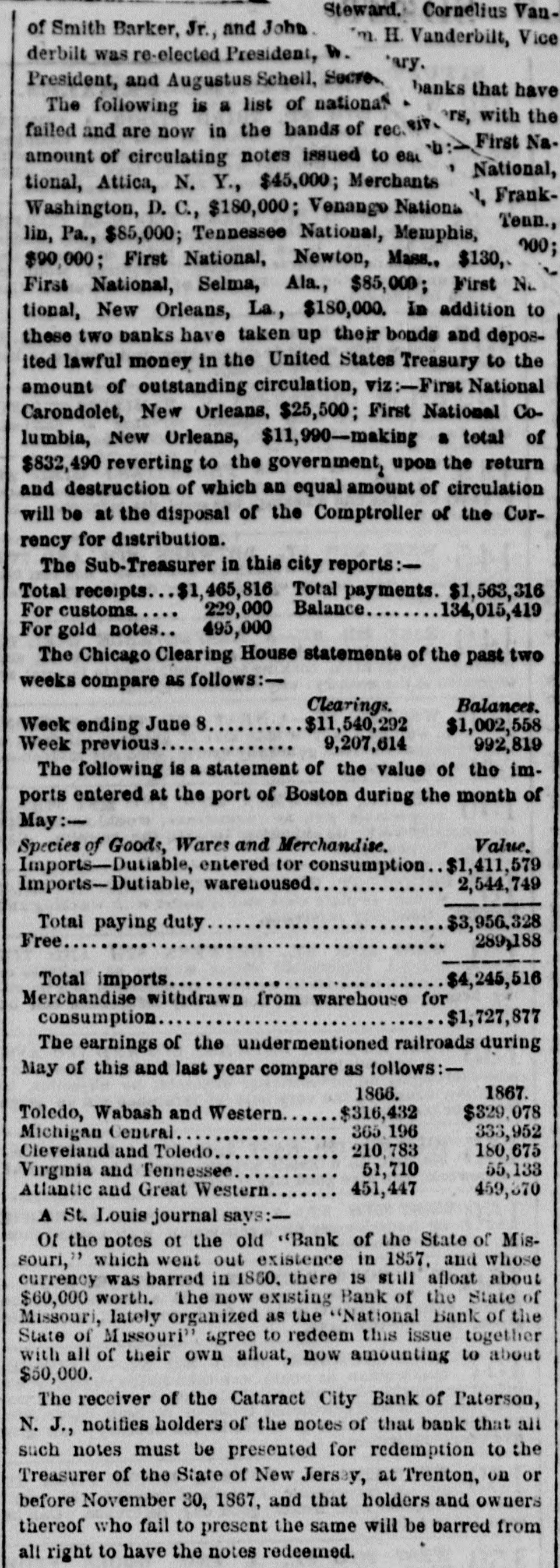
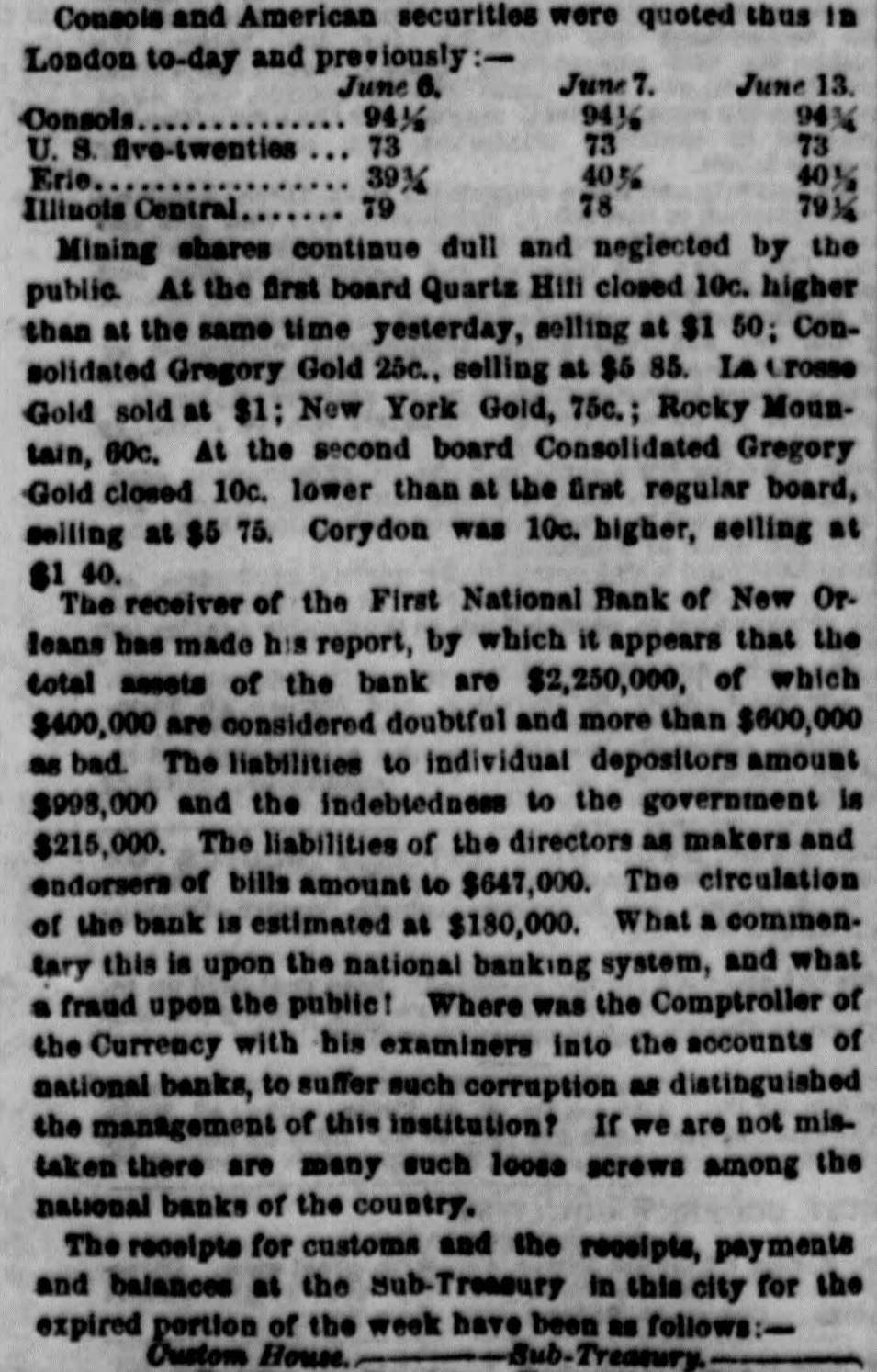
Steward. Cornelius Vanof Smith Barker, Jr., and John H. Vanderbilt, Vice derbilt was re-elected President, W. ary. President, and Augustus Scheil, Secre banks that have The following is a list of national rs, with the Bive failed and are now in the bands of rec. First Na. amount of circulating notes issued to eac National, tional, Attica, N. Y., $45,000; Merchants FrankWashington, D. C., $180,000; Venango Nationa Tenn., lin, Pa., $85,000; Tennessee National, Memphis, 200; $90,000; First National, Newton, Mass., $130, First National, Selma, Ala., $85,000; First N tional, New Orleans, La, $180,000. In addition to these two banks have taken up their bonds and deposited lawful money in the United States Treasury to the amount of outstanding circulation, viz:-First National Carondolet, New Orleans, $25,500; First National Columbia, New Orleans, $11,990-making a total of $832,490 reverting to the government, upon the return and destruction of which an equal amount of circulation will be at the disposal of the Comptroller of the Currency for distribution. The Sub-Treasurer in this city reports:Total receipts $1,465,816 Total payments. $1,563,316 For customs. 229,000 Balance 134,015,419 495,000 For gold notes The Chicago Clearing House statements of the past two weeks compare as follows:Balances. Clearings. $11,540,292 Week ending June 8 $1,002,558 9,207,614 Week previous 992,819 The following is a statement of the value of the imports entered at the port of Boston during the month of May:Value. Species of Goods, Wares and Merchandise. Imports-Dutiable, entered tor consumption $1,411,579 2,544,749 Imports-Dutiable, warehoused $3,956,328 Total paying duty Free 289,188 Total imports $4,245,516 Merchandise withdrawn from warehouse for $1,727,877 consumption The earnings of the undermentioned railroads during May of this and last year compare as follows:1867. 1866. $329,078 $316,432 Toledo, Wabash and Western 365,196 333,952 Michigan Central Cleveland and Toledo 210,783 180,675 51,710 55,133 Virginia and Tennessee Atlantic and Great Western 451,447 459,370 A St. Louis journal says:or the notes of the old "Bank of the State of Missouri, " which went out existence in 1857, and whose currency was barred in 1860, there 18 still afloat about $60,000 worth. The now existing Bank of the State of Missouri, lately organized as the "National Bank of the State of Missouri" agree to redeem this issue together with all of their own afloat, now amounting to about $50,000. The receiver of the Cataract City Bank of Paterson, N. J., notifies holders of the notes of that bank that all such notes must be presented for redemption to the Treasurer of the State of New Jersey, at Trenton, on or before November 30, 1867, and that holders and owners thereof who fail to present the same will be barred from all right to have the notes redeemed.


Article from The Evening Argus, June 15, 1867

Click image to open full size in new tab

Article Text

Discounted National Banks. The following is a list of national banks that have suspended, and whose paper goes at a discount. The paper, however, ought to be good, for the law requires them to deposit with the secretary of the treasury $100 United States bonds for every $93 issued : First National Bank, New Orleans. " City


Article from New Orleans Republican, June 29, 1867

Click image to open full size in new tab

Article Text

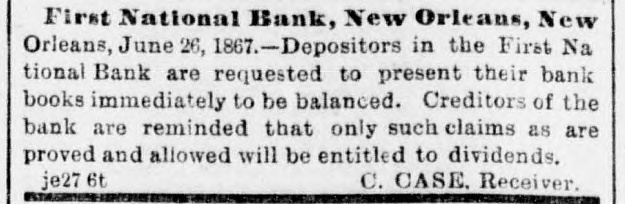
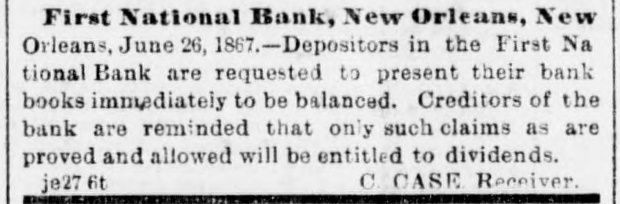
First National Bank, New Orleans, New Orleans, June 26, 1867.-Depositors in the First Na tional Bank are requested to present their bank books immediately to be balanced. Creditors of the bank are reminded that only such claims as are proved and allowed will be entitled to dividends. je27 6t C. CASE. Receiver.


Article from New Orleans Republican, July 2, 1867

Click image to open full size in new tab

Article Text

First National Bank, New Orleans, New Orleans, June 26, 1867.-Depositors in the First Na tional Bank are requested to present their bank books immediately to be balanced. Creditors of the bank are reminded that only such claims as are proved and allowed will be entitled to dividends. C CASE Receiver je27 6t


Article from The Wheeling Daily Register, July 3, 1867

Click image to open full size in new tab

Article Text

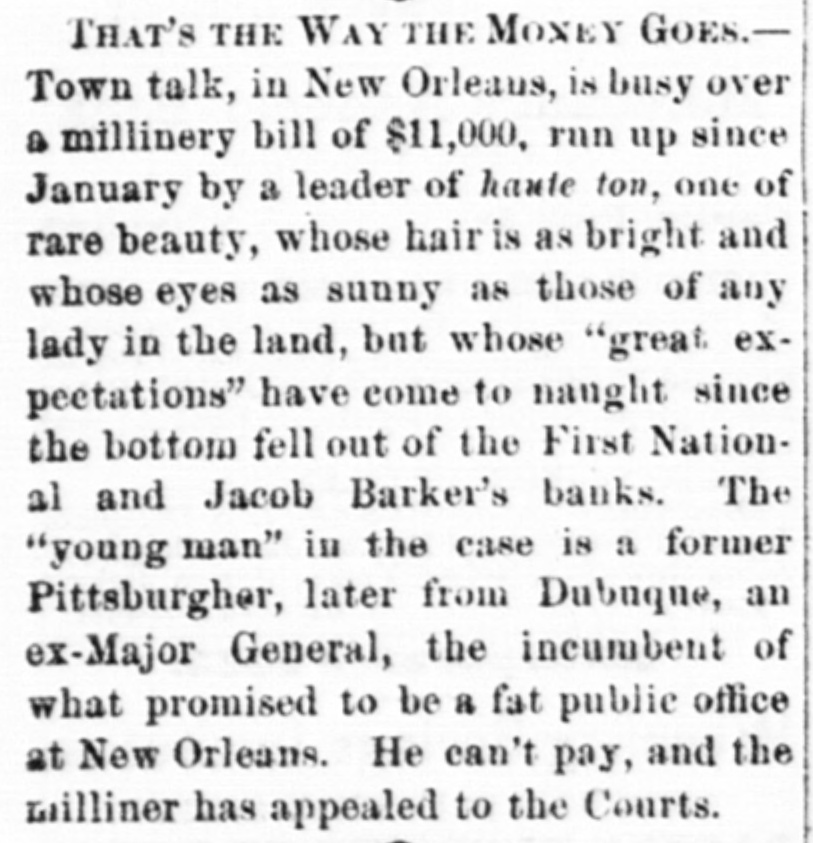
THAT'S THE WAY THE MOXEY GOES.Town talk, in New Orleaus, is busy over a millinery bill of $11,000, run up since January by a leader of haute ton, one of rare beauty, whose hair is as bright and whose eyes as sunny as those of any lady in the land, but whose "great expeetations" have come to naught since the bottom fell out of the First National and Jacob Barker's banks. The "young man" in the case is a former Pittsburgher, later from Dubuque, an ex-Major General, the incumbent of what promised to be a fat public office at New Orleans. He can't pay, and the milliner has appealed to the Courts.


Article from New Orleans Republican, April 17, 1868

Click image to open full size in new tab

Article Text

First National Bank. Colonel Chase, the receiver of the First National bank of New Orleans has forwarded to us for publication the following copy of a letter from the Controller of the Treasury:


Article from New Orleans Republican, January 6, 1872

Click image to open full size in new tab

Article Text

P< The creditors of the First National Bank are asked to call at the receiver's office. See notice in another column.


Article from New Orleans Republican, November 24, 1872

Click image to open full size in new tab

Article Text

Colonel Charles Case, receiver of the First National Bank of New Orleans, will leave this city to morrow for Washington, where he will remain about a month, his mission being to procure the passage in Congress of a bill for the relief of the creditors of the bank already mentioned.


Article from New-York Tribune, December 2, 1872

Click image to open full size in new tab

Article Text

curity, or as collateral security, for any loan of money, or for a consideration shall agreeAto withhold the same from use, or shall offer or receive the custod or promise of custody of such notes as security, or as collateral security or consideration, for any lloan of money." 5th of April last the Controller was advised that bank On the in the City of New-York, with a capital of $1,000,000, a and whose average exchanges at the Clearinghouse did not exceed $300,000, was that morning creditor at the Clearing-house for $4,770,000. A8 it was evident that this large credit was not the result of legitimate business, the examiner was directed to make an exam ination of the bank, which was immediately done, 114 connection with a member of the Clearing-house committee. From the examination, which was thoroughly and carefully conducted, it appeared that deposits had been made in that bank, by one individual, upon the morning of April 5 to the amount of $4,100,000, the whole of which was drawn out upon the same day, upon the checks of the depositor, in legal-tender notes. The president of the bank denied that the bank had any interest in these trans actions, and there was no evidence of any loan, or of ad. vances in any shape. upon these deposits. These traus actions were the subject, subsequently, of an investiga tion by the Bank Committee of the House of Represent tarives, and, although it was clear that the spirit of the law had been violated, no evidence could be obtained to warrant the commencement of a suit for the recovery of the penalty prescribed in the act referred to. The in vestigation undoubtedly had the effect to prevent the repetition of similar transactions; no offenses of this been kind, on the part of any national bank, having since brought to the attention of the Controller. The New-York Clearing house Association subse quently passed a resolution declaring "that the Clearinghouse Committee be and is hereby directed, whenever it appears, in its judgment, that legal-tender notes have been withdrawn from use through the agency of any bank, members of the association, to make an immediate examination of the bank in question, and should there appear to be complicity on the part of the bank or its officials, to suspend said bank from the Clearing house until action of the association shall be taken there on." The withdrawal of currency for illegitimate purposes has, however, since been accomplished without the assistance of the banks. The rigid enforcement of the resolution of the Clearing-house will prevent complicity on the part of banks in such transactions; and it the New-York Stock Board and the leading banking houses will unite with the Clearing-house, and refuse to transact business with unserupulous men. who do not hesitate to embarrass legitimate business for the parpose of increasing or diminishing the values of stocks or bonds in which they are temporarily interested, they can do more to prevent such operations team any Congress enactment. INSOLVENT BANKS. Twenty-one national banks, organized in 11 different States, with an aggregate capital of $1,236,100, have failed since the organization of the system in 1863 The total circulation of these banks was $2,942,793. of which $2,441,430 has been redeemed in full, leaving a belance still outstanding of $501,363, which will also be redeemed, upon presentation to the Treasurer of the United States, from the avails of United States bonds held as security for that purpose. Of these banks, five have been finally closed (two during the past year), baying paid dividends to their ereditors. Six national banks have fatted during the past year. New-York: Of these, the Union Square National Bank, the Fourth National Bank, Philadelphia, and the Waverley National Bank, New-York, have paid their creditors in full-a settlement, it is believed, without a precedent prior to the establishment of the national system. The Eighth National Bank, New-York, has paid dividend of 50 per cent; the Ocean National Bank, New-York, a dividend of 70 per cent; and the receiver of the Ocean National Bank, and of the First National Bank of Fort Smith, Ark., estimate that the creditors of both these banks will ΓΊltimately receive a dividend of 100 cents on the dollar. The Venango National Bank of Franklin, Penn.: the Merchants' National Bank of Washington. D. C. the First National Bank of Selma, Ala., and the First National Bank of New-Orleans, were United States depositories. e-final dividend in favor of the creditors of the First National Bank of Vicksburg has been unexpectedly delayed by the recent presentation of a claim of the United States for money alleged to have been illegally deposited by the Collector of Internal Revenue of that district, in the year 1868. Since that time no lesses have occurred to the Government by deposits made in the national banks, although many millions of dollars have been continually on deposit with banks which are designated as depositories. The three a first-named banks, at the time of their failure, had large amount of Government funds on deposit. SURPLUS AND SPECIE-EXTENDING THE LIMIT OF SURPLUS. The law requires that every national bank shall carry one-tenth part of its profits to surplus-fund account before the declaration of a dividend, until the same shall amount to 20 per cent of its capital stock. This wise provision has been generally observed. and the returns show that the banks now have a surplus of more than $100,000,000, and considerably more than onefifth of their capital in surplus account. The act also limits the liabilities of any association, person, com pany, or corporation, for money borrowed, to one-tenth of the capital stock paid in. The Controller recommends that this limit be extended to one-tenth of the capital and surplu. which will have a tendency to 10. crease the surplus fund beyond the limit required by the law. The following table will exhibit the aggregate amount of specie held by the national banks at the dates mentioned, the coin, coin certificates, and checks payable coin held by the national banks of the City of New York being stated separately. The country banks have not heretofore separated coin in their reports: -Held NationalsBanks in New- City.-
Article from New Orleans Republican, March 18, 1873

Click image to open full size in new tab

Article Text

THE COURTS. United States Circuit Court. William McCutcheon VS. S. Amanda Askey and her husband.-Judgment for defendant and costs. Charles Case. receiver of First National Bank of New Orleans, vs. J. McWilliams.On trial and continued until to-day.


Article from The New Orleans Daily Democrat, November 8, 1879

Click image to open full size in new tab

Article Text

THE FIRST NATIONAL BANK. Presidents and Its Liquidators-A Lon Looked-fer Dividend. Tothe Editor of the Democrat: In May, 1867, just twelve years and a he ago, the First National Bank of this city WI seized by John Jay Knox, the Controller he Currency, when It was placed in the han of Charles Case, as receiver, for liquidatio Benjamin F. Flanders was the first presiden and A. G. Graham cashier during his admi stration. Mr. Flanders retired from ti presidency of the bank, owing It about $800 which was never paid. Recently the claim was sold at public auction for the paltry sui of $1000. Mr. Flanders is now United Stat sub-treasurer for Louisiana. A. G. Graham, the cashier, was then el vated to the presidency of the bank. J. P. May was United States sub-treasur for Louisiana. resigned that position an was appointed president of the bank. J. 1 May le the one who was a defaulter to ti government of over a million dollars. 1 subsequently left the bank, owing It fro $80,000 to $ 00,000. John S. Walton, the next succeeding pres dent, was also United States sub-treasur for Louisiana: he who was city Administrate of Finance in Warmoth's time, and at la cashier of the bankrupt Leuisiana Saving Bank. Mr. Walton, when he left the pres dency of the First National Bank, owed f overdrafts between $8000 and $10,000. Dr. Forbes was the last president of t1 bank, for It was during his administratic that the bank was seized. Dr. Forbes hr also, like his predecessors, illegally abstract moneys from the bank, and left owing $15,00 The agents of the government came here I May, 1867, and after investigating the affati of the bank declared that it was injudicious managed and irregular in Its transaction Upon the agents' report the bank was selze During the years 1867 to 1874, a period seven years, three dividends were declared i avor of the depositors, amounting in all 1 about per cent. Since that time no furth dividends have been made, although Contro or Knox admitted more than eighteen month that he had funds sufficient to permit ai other dividend, but the unfortunate creditor of the bank have waited anxiously in the val hope that Mr. Controller Knox would pay 1 she depositors the money. 80 cruelly detaine him to their prejudice. It was vainly supposed that when the su against the Carrollton R allroad Company fo ver three hundred thousand dollars was de ided adversely to the bank, that there wa 10 reason to delay the final adjustment. I May last Judge Billings, he of the Unite States court, gave an order for the sale of a he remaining assets of the bank. On th 1fth day of July last the entire assets, in ao ordance with the order of the court, wer old at public outery; and yet up to this hou 10 dividend has been declared. The liquida has been meandering through a term o early thirteen years, at a gain to th iquidators of many thousands yearly and at a cost to the defrauded deposi ors of over $150,000, and independen this extravagant expenditure ther till remains in the hands of John J. Kno bout $100,000 to the credit of the liquidation addition to that sum be It known tha hecks for $60,000 to $70,000 were issued to cer ain persons for dividends, which checks, fo easons not easily explained, remain to thi lay unclaimed; consequently, in addition t he $100,000 before mentioned. there must b this time fully $170,000 in the hands o Mr. Knox that ought to be paid to the cred tors, and as the entire assets of the ban have been realized since May last, now ove six months, Mr. Controller Knox car have n valid excuse to withhold from the lawful cred tors the moneys which he appears 80 relue ant to part with. Before closing these re narks. I shall mention A single instance (on