Union Square National Bank (New York, NY)

Episode Information

Episode UID
169100864
Episode Type
Run β†’ Suspension β†’ Closure
Bank Type
national
Bank ID
16910 national
Charter Number
1691
Start Date
December 13, 1871
Location
New York, New York (40.714, -74.006)

Metadata

Model
gpt-5-mini (chosen from majority vote of a three-model LLM ensemble)
Short Digest
f521f8fda0e86c07

Response Measures

Borrowed from banks or large institutions, Fed/other loan, Full suspension, Books examined

Other: Comptroller Hurlbut took possession and a receiver (B. F. Beekman) was appointed; the bank was placed into receivership.

Clearinghouse involved: Yes (loan, examination, or other measures)

Receivership Details

Depositor recovery rate
100.0%
Date receivership started
1871-12-15
Date receivership terminated
1874-11-16
OCC cause of failure
Losses
Share of assets assessed as good
80.0%
Share of assets assessed as worthless
20.0%

Description

Comptroller took possession and a receiver was appointed; government-record receivership date used below.

Events (5)

1. March 13, 1869 Chartered
Source
historical_nic
2. December 13, 1871 Run
Cause
Local Banks
Cause Details
Run followed failure/stringency from other New York banks (Ocean Bank failure and clearing-house disruptions).
Measures
Sought clearing arrangement with Shoe and Leather Bank to cover clearings; directors attempted to obtain assistance from correspondent bank.
Newspaper Excerpt
the latter, after standing a run on it for two days
Source
newspapers
3. December 14, 1871 Suspension
Cause
Government Action
Cause Details
Comptroller of the Currency (Hurlbut) took possession and suspended the bank, appointing a receiver.
Newspaper Excerpt
Comptroller Hurlbut, who took possession and appointed B. F. Beekman as receiver
Source
newspapers
4. December 15, 1871 Receivership
Source
historical_nic
5. December 15, 1871 Receivership
Newspaper Excerpt
Comptroller Hurlburt has took possession of the Union Square National Bank, and has appointed B. F. Beekman receiver.
Source
newspapers

Newspaper Articles (23)

Article from The Charleston Daily News, December 13, 1871

Click image to open full size in new tab

Article Text

FAILURES IN NEW YORK. -NEW YORK, December 12. The Ocean Bank has been thrown out by the Clearing House. Win. M. Tweed, a director, stated that the failure was occasioned by the stringency in the money market. It is thought that above seventy-five per cent. of the deposits will be paid. A receiver has been appointed. The failure of the cotton firms of Wm. P. Wright & Co. and John Seaycroft are announced-sald to be in consequence of the stringency of money. There is an unauthenticated rumor that the Union Square National Bank had suspended.


Article from Knoxville Daily Chronicle, December 13, 1871

Click image to open full size in new tab

Article Text

HOME NEWS. SMALL POX IN BROOKLYN. The Internationalist Excitement. NEW YORK, Dec. 12.-Small pox is increasing in Brooklyn. Fifty-seven cases were reported during the past week. The meeting of the Internationalists last night was stormy. It adopted a resolution to parade next Sunday. Wild applause followed the adoption of the resolution. On motion, all workmen, women and citizens were invited to join the procession. A committee was appointed to wait on Gov. Hoffman to ask State protection; and another to inform the police of their determination to parade. The meeting adjourned amid wild cries of "Viva la Commune!" "Viva la Internationale!" It is stated that ex-Judge Edward Pierrepont and other eminent lawyers have volunteered to defend the Internationals, if arrested next Sunday. At ten o' clock this morning, by London time, the Prince of Wales was living. Julian has absconded with the proceeds of the late concert and ball to the Grand Duke, owing musicians $7,000. SALT LAKE, Dec. 12.-The Mormons continue to yield obedience to court processes. The roads leading to the mines are open. ANNAPOLIS, Dec. 12.-Professor - Aiken was subjected to severe cross-examination and some contradiction elicited. The druggist swears to having sold Mrs. Wharton sixty grains of tartar emetic for a plaster. CAIRO, Dec. 12.-A locomotive exploded near Centralia, Illinois, on the Central road, killing three persons, one of whom was thrown two hundred yards, ST. LOUIS, Dec. 12. - The Lower House of the a Government aid in day, Legislature requesting adopted concurrent resolution establishing toa yard for building iron ships at some point on the Western rivers, in conformity with the suggestions of the Secretary of the Treasury. CHILICOTHE, OHIO, Dec. 12.-The jury in the Blackburn case rendered a verdict of murder in the second degree. A motion has been made for a new trial. Dec. closed New York, 12.-The Ocean Bank has out. Wm. M. Tweed, a director, stated that the failure was occasioned by the stringency in the money market. It is thought about per will be A receiver has paid. seventy-five cent. been of the appointed. deposits of of Wm. P. & Co. is announced. Wright The failure and the cotton John Searycroft firms In conseq uence of the stringency of money it is announced, unauthenticatedly, that the Union Square National Bank has suspended.


Article from The Daily Phoenix, December 13, 1871

Click image to open full size in new tab

Article Text

generally ignored, both as regards the Mayor and both branches of the City Counoil. Alexis has remained quiet to day. suffering slightly from ague in the face. This overing, he gave a private banquet to some twenty-five gentlemen, including Gov. Olaflin and Mayor Gaston. NIGHT DESPATOHES. WASHINGTON, December 12.-The Supreme Court adjourne on the 22d of December to the 2d of January. There was a full Cabinet to-day. It 18 stated that four members of the Ways and Means Committee have as. sured tobacco men that they will favor au uniform tax of sixteen cents. The Republican Senators caucussed three hours o-day upon a joint committee of retrenchment and civil service. with no result. Iu the Senate, Sumner introduced a bill for mixed schools in the District, and larged early action. He hoped the example would be speedily followed in the States West. He introduced the following: Resolved, That the Committee on Finance be requested to inquire into the expediency of exempting from the payment of customs duties all materials, including iron ties imported into the United States, which are used for the purpose of baling or bagging cotton. Morton's motion to adjourn sine die on the third Monday in May was amended, with a proviso that no adjournment take place until the supplemental civil rights bill, reduction of tariff and civil service bills do pass. No action. In the House, the Committee on Expenditures was directed to examine into the financial condition of all departments. Farneworth's post office bill was passed. A bill for the relief of pur chasers of lands sold for taxes in the revolutionary States, was passed. A bill to pay the interest due to South Carolina was referred to the Claims Committee. The House went into committee of the whole on the apportionment bill. No action. Probabilities-The barometer will probably fall very generally on Wednesday in the Gulf and Atlantic State with clouds and rain to-night in the Gulf States, and threatening weather on Weduesday from the lower lakes to the middle and South Atlantic coasts. The low pressure in Illinois will probably move East and North-eastward, preceded by South-easterly winds in the Middle States, and followed to-night by inoreasing North-westerly winds on Lake Michigan. Areas of rain are apparently developing in Virginia, Pennsylvania, Illinois, Michigan and Louisiana. Cautionary signals are ordered for this evening at Chicago. HALIFAX, December 12.-The ship Farquer, of Greenock, was wrecked. All lost. CHARLESTON, December 12.--Arrivedsteamers Manhattan, New York; Falcon, Baltimore. ST. LOUIS, December 12.-The lower house of the Legislature adopted a concurrent resolution, requesting Government aid in establishing an iron shipbuilding yard at some point on the Western rivers, in conformity to the suggestions of the Secretary of the Treasury. HAVANA, December 12.-To-day and benceforward regular troops will occupy Moro, Onbana and Principe Forts. Valinaseda thanks the relieved volunteers for the manner in which they have performed service for the past two years. ANNAPOLIS, December 12.-Professor Aiken was subjected to a sworn crossexamination. Some contradictions were elicited. The druggist swears to having sold Mrs. Wharton sixty grains of tartar emetic for a plaster. NEW YORK, December 12.-The Ocean Bank was thrown out by the clearing house. Wm. M. Tweed, a director, stated the failure was occasioned by the stringency of the money market. It is thought above seventy-tive per cent. of deposits will be paid. A receiver has been appointed. The failure of the cotton firms of Wm. P, Wright & Co. and John Seaycroft has been announced, in consequence of the stringency of money. It 18 announced, but unauthenticated, that the Union Square National Bank has suspended. CAIRO, December 12.-A locomotive exploded near Centralia, Illinois, killing three persons. One was blown 200 yards. CHILLICOTHE, OHIO, December 12.The verdict in the Blackburn case was murder in the second degree. A motion was made for raw


Article from Alexandria Gazette, December 14, 1871

Click image to open full size in new tab

Article Text

From New York. New YORK. Dec. 14.-The - Grand Duke Alexis has sent 85,000 here for the relief of the poor. The Union Square National Bank was obliged to close yesterday by the action of United States Comptroller Hurlbut, who took possession and appointed B. F. Beekman as receiver. It had arranged with the Shoe and Leather Bank to cover its clearings, and it is alleged that the bank threw them out without notice. NEW YORK. Dec. 14. - The Times editorial ly denounces the bargain between the Committee of seventy and Mayor Hall, that the latter shall appoint persons recommended by the Committee in consideration of the Mayor being allowed to retain his position as Mayor. At a meeting of the Board of Health yesterday, Dr. Carnachan stated that there was no cause for a panic OD account of the small pox. and that the cry in the newspapers was to enable some one to have an excuse to ask for more money from the Treasury.


Article from The New York Herald, December 14, 1871

Click image to open full size in new tab

Article Text

BANK TROUBLES. - The failure of the-Orean. Bank has been followed by the suspension of two small concerns up town, the Eighth National and the Union Square National Banks. The latter, after standing a.run on it for two days, was hurriedly thrown into the hands of a receiver yesterday afternoon The trail of the "Ring" serpent is, traced more or less clearly in all instances.


Article from The Wheeling Daily Intelligencer, December 15, 1871

Click image to open full size in new tab

Article Text

NEW YORK CITY. NEW YORK, December 14.-The Cham ber of Commerce yesterday discontinued distributing money to persons made destitute by the Chicago fire, who have come to this city. At a meeting of the Police Commission ers yesterday, Mayor Hall, who is a member of the Commission, presented 11 communication announcing that he will vote for non-interference with the procession of the Internationalists by the police. The states that any antognism Mayor against the he does pending not procession The find or that it would lead to a riot. procession will take place next Sunday. It is considered probable that the Supreme Court at Albany will decide to reduce Connolly's bail. The Union Square National Bank was obliged to close yesterday by order of Comptroller Hurlbut. It had arranged with the Shoe and Leather Bank to cover its clearings, and it is alleged that the bank threw them out without notice. Unfounded rumors were in circulation yes. terday that various other banks had failed. The amount realized from the sale of Alexander White's collection of paintings from Chicago was $91,000. The depositors of the Ocean Bank had a meeting this alternoon, at which it was stated that the bank tailed only for $17, 000, while the Receiver asserts that its assets are over $1,000,000. The directors of the Bank of North America have been called to account for aiding the lock-up in money. The receiver of the Ocean Bank paid to-day $60,000 of the sum due the Clearing House the balance will be paid to day. He believes that $266,000 of the $326,000 discounted bills are good. The Communist General, W. A. Oblin ski, has arrived here from Paris. The small-pox is now said to be epidemic in Brooklyn. A challenge from Tom Kelly to Joe Coburn for a prize fight is published to day. At a special meeting of the Board of Public Commissioners this afternoon, a resolution was passed rescinding the order directed the Superintendent to the of on Societies which prevent Sunday parade and the another International resolution was adopted Instructing the Superintendent to take the necessary measures to prevent breach of the peace on the occasion of such procession, and to protect the public from disorder and vio lence. This afternoon Miss Tennie C. Claflin appeared at Jefferson Market Court, and complained to Justice Shandely that her father and mother were a source of conqual annoyance to her and Mrs. Woodhull. She complained specifically that they went to her residence Wednesday last and created a a evening ance. Justice Shandley issued great disturb- summons for their appearance to-morrow morning to answer the charge of their daughter. Wm. Wright settled to-day, on the basis of seventy-five cents on a dollar, and will resume shortly. A private letter from Havana, says it is that the believed brother there of Spanish late Gov. Minister Roberts, a the at caused the money dents Washington, for purpose the of arrest extorting of the stufrom their parents, and unexpectedly found himself unable to control the Spanish mob. The committee appointed by the Clearing House have made a thorough examination into the affairs and condition of the National Bank of the Commonwealth, and report said bank as perfectly solvent, and that they have entire confidence in the ability of the bank to pay all its lia bilities. Al a special meeting of cigar manufacturers to-day, a petition WAS adopted to ing of praying manufacturers Congress consider tobacco clearly the and law cigars, define tax and amend it so as to more the duties of the revenue offiers, who at present are in the habit of putting their own construction on the law, both to the detriment of the Government and the Trade. The petition also prayed for the abolition of the present system requiring manufacturers to furnish bondsmen.


Article from The Charleston Daily News, December 15, 1871

Click image to open full size in new tab

Article Text

NEW YORK ITEMS. -NEW YORK, December 14. The cotton firm of Wm. P. Wright settled to-day on the basis of seventy-five cents on the dollar, and will resume shortly. There is excitement in Brooklyn on account of the small-pox. It has broken out in the jall, and a cords of physicians have been detailed to vaccinate the citizens. Alexis sent five thousand dollars here for the relief of the poor. Comptroller Hurlbut to-day took possession of the Union Square National Bank, and appointed B. F. Beckman receiver.


Article from The Daily Dispatch, December 15, 1871

Click image to open full size in new tab

Article Text

GENERAL ITEMS. NEW YORK, December 11.-The Grand Duke Alexis has sent $5,000 here for the relief of the poor. Comptroller Hurlburt has taken possession of the Union Square National Bank and appointed B. K. Beckman receiver. NEW YORK. December 11.-The London correspondent of the World says: "I have the highest medical authority for giving the assurance that the Prince of Wales will recover."


Article from The New York Herald, December 15, 1871

Click image to open full size in new tab

Article Text

in this city and his connection with the banks is as much a surprise to me as to the Clearing House and banking circles. I think, though, that the press are entirely too severe in their criticisms of Mr. Callender. I am not a politician, and my office is one entirely removed from politics." " have heard," said the reporter, "that you have appointed a committee to inquire into Mr. Callender's relations to the banks. When will their report be ready P" "I have not appointed a committee, but the Clearing House will." "By your suggestion?" "Yes, at my request. I felt that it was proper that the most thorough inquiry be instituted, and asked the Clearing House to make it by a commit. tee.' "Have there been any further suspensions to-day i" "None. I think they are all right now." "How about the Tenth National? "Well, it is pretty certain that a run can't affect them." "You, doubtless, read in the HERALD this morning the statement of the directors of the Union Square National Bank. Is it correct?" is, probably. The bank was a good one, but when it was unable to meet its obligations through its clearing agents I had no alternative but to appoint a receiver. This is the case with all. When a bank 18 unable to meet its obligations, irona whatever cause, I am compelled to pul in a receiver." "What is your opinion of the condition of the banks, HO tar as you have investigated their affairs ?' "That the trouble is over, and no more suspensions are likely to occur. I leave for Washington to-night in consequence." "How far does Mr. Callender's district extendmerely New York city, or 18 Brooklyn included?" "He covers the banks of Brooklyn and New York." The Action of the Shoe and Lenther Bank. Mr. Stout, the President of the Shoe and Leather Bank, states that the directory of the Union Square National Bank have somewhat misstated to the HERALD the actual facts in reference to the action of the Shoe and Leather Bank. Mr. Stout says that the night previous to the suspension of the bank he was applied to to clear for them by the Unton. After certain inquiries he told them that If they would deposit $100,000 he would clear for them; they gave him $24,000 then and on the following morning (Wednesday) they sent him $23,000 more, making $47,000. The run was continuing, and he went to the Union Bank and saw the President and one of the directors. Mr. Stout made some inquiries or these gentlemen, and, having received what he thought were satisfactory answers, he told them that if they would give him their individual responsibility he would carry them through. These gentlemon declined to do this. Mr. Stout expressed his great surprise that they would not guarantee their own bank, and declined to render any assistance, except on full and satisfactory guarantees. The Clearing House and the National Bank of the Commonwealth. NEW YORK, Dec. 14, 1871. The undersighed have this afternoon, at the close of business, made a thorough examination of the affairs and condition of the National Bank of the Commonwealt and find said bank to be perfectly solvent, and have entire confidence in the ability of the bank to pay all of its liabilities. CHARLES P. LEVERICH, Clearing F. D. TAPPEN, House Committee. P. a. CALHOUN, } J. D. VERMILY E. Chairman of Clearing House Association.


Article from The New York Herald, December 16, 1871

Click image to open full size in new tab

Article Text

The Shaking Among the Banks. It is a fact well worth notice, that the shaky condition of several of our national banks makes no perceptible impression upon the general current of business, the stock market or financial matters generally-no not even in connection with the very questionable conduct of the government national bank examiner. Some few years ago the suspension or insolvency of one or two banks would have produced a little financial earthquake; but now three, four or more may fail, and scarcely anybody except a few depositors and bank officials is affected. The mass of business men and the community know little about such collapses beyond the little excitement given by the publicity of them through the ever vigilant press. The flurry about the Ocean Bank, the Bank of the Commonwealth, the Eighth National Bank and the Union Square National Bank is but a ripple on the great ocean of banking and financial affairs in this commercial metropolis. The mass of the people who hold the notes of these institutions are secure, because the United States government is bound to redeem the notes and has in its possession bonds for their redemption. Whatever may be said of the national bank system-and we are well aware of the evils connected with it-all must acknowledge this safe and beneficial feature in its operation. The note holders cannot lose unless there should be a great and general crisis and the government be unable to perform its obligations. This is not likely to occur. True, in case of such a crisis, and the bonds held by the government as security for the circulation of the banks should fall below the value of the notes to be redeemed, the loss would have to be made up by the Treasury and the taxpayers would have to bear the burden. But that state of things can hardly be anticipated. To make the community perfectly secure, however, and in view of the great privileges given to the banks by the government, has not the time come when these institutions should be required to redeem their own notes in specie? Should they not be forced to resume specie payments? With the low and constantly declining premium in gold that time has probably arrived. This is a matter that should receive the early consideration of Congress. As to depositors and others doing business with the banks, they must look out for their own interests. They should see that the banks with which they do business are in a sound condition. It will be the duty of the government still to watch these institutions, and to keep a sharp eye on its examining offcials in order to be sure the banks keep up their reserve of legal tenders or speole and do not exceed the operations allowed by law. Should Congress provide for the return to specie payments it may be necessary to amend the National Bank act so as to have a firmer grip on the banks. They have been invested with a national character by the government, and the people look to it for ample security. The difficuities that are occurring with these institutions may lead to a thorough overhauling of them and to an amended or better system.


Article from The Daily Dispatch, December 18, 1871

Click image to open full size in new tab

Article Text

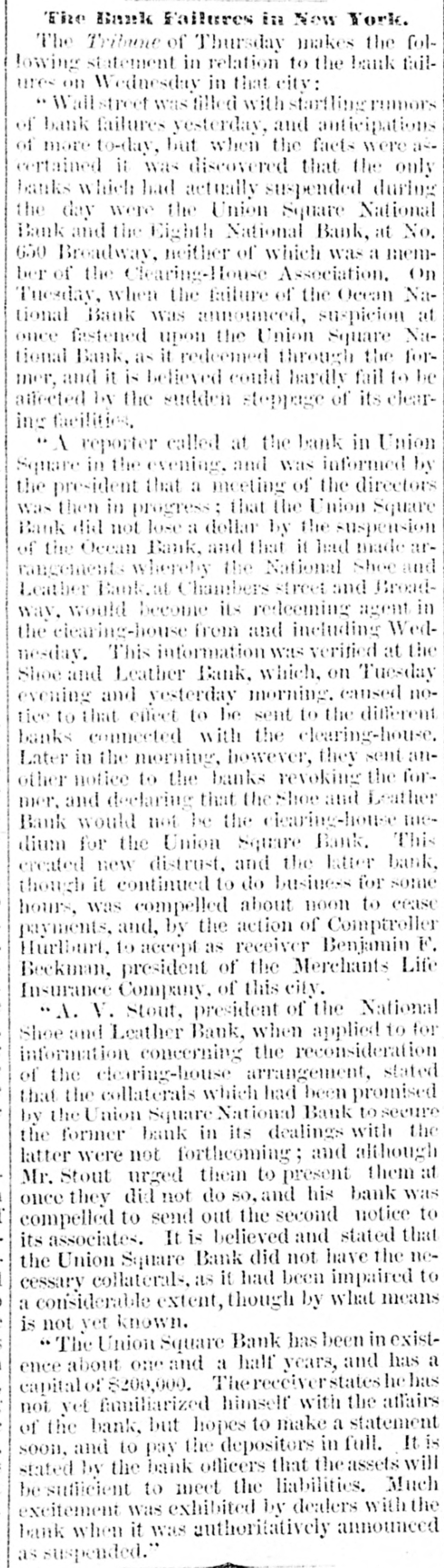
The Tribune of Thursday makes the 101!owing statement in relation to the bank failures on Wednesday in that city: Wallstreet was filled with startingrumors bank failures yesterday, and anticipations of of more to-day, but when the facts were ascertained it was discovered that the only had actually suspended during were the Union Square the banks day which Bank, National it No. Bank and the Eighth National 650 Broadway, neither of which was a memof the clearing-House Association. Na- on ber Tuesday, when the failure of the Ocean at was announced, fastened upon the Union tional once Bank suspicion Square the Nit- fortional Bank, as it redeemed through be and it is believed could hardly fail clear- to affected mer, by the sudden stoppage of its ing .A facilities reporter called at the bank in Union in the evening and was informed by Square that a meeting of the directors in progress; that the not lose a dollar by the the was Bank president then did Union suspension made Square arOcean Bank, and that it had whereby the Chambers street of rangements Leather the Bankat National and Shee agent Broad- and in would become its redeeming Wedfrom and This information was the nesday. way, clearing-house including verified Tuesday at the Leather Bank, which, on and yesterday morning. effect to be sent to evening tice Shoe to and that clearing-house. the caused different noconnected with the anhowever, to the banks other banks Later notice in the morning, revoking they and sent Leather the fordeclaring that the Shee menot be the the Union Square dium mer. Bank and would for clearing-house Bank. latter bank, This distrust, and the it continued to do was compelled about noon created hours, though new business Comptroller for to some cease and, by the action of F. payments, to accept as receiver Benjamin Life Beekman, Hurlburt, president of the Merchants Insurance Company. of this city. V. Stout, president of the National for A. and Leather Bank, when applied to information Shoe concerning the reconsideration stated the clearing-house arrangement, promised of collaterals which had been secure that the Union Square National Bank with to the by the former bank in its dealings the were not forthcoming; and although them at latter Stout urged them to present bank was Mr. did not do so. and his notice to once they to send out the second stated that compelled It is believed and the neits associates. Square Bank did not have to the Union collaterals, as it had been impaired means a cessary considerable extent, though by what is not yet Union known. Square Bank has been in has exist"The about one and a half years, and hebas a ence of $200,000. The receiverstates the affairs capital fimiliarized himself with statement not yet bank, but hopes to make a full. It is of the and to pay the depositors in assets will soon, the bank officers that the Much stated by to meet the liabilities. with the be sufficient was exhibited by dealers announced excitement bank when it was authoritatively suspended."


Article from The Fairfield Herald, December 20, 1871

Click image to open full size in new tab

Article Text

mony ; made tests to ascertain in what particular compound antimony ; there was of antimony was presence present certainly containing the the com merco known as tarter the particular compound ordinary obtained article ometic; of result of was sul. of the not have been less than phite antimony; quantity twenty grains, could and if call it tartar were twenty or The ten grains of sulphite fully you grains emotic, of antimony more. there present would make twenty grains of tartar emetic. The witness was examined concerning the sediment found in the tumbler at Mrs. Warton's A tumbler containing a sediin his hand. tested for tartar ments. was which placed he by Dr. emotic Chew, his and not of than verified ten grains test, tartar found twelve emetic grains less think that quantity was was no less than ten. NEW YORK, December 12.-The Bank was the house. a stated Ocean clearing the thrown Wm. failure M. out Tweed, was by the market. It is occasioned money director, by stringency thought of above the seventy five per cent. of Deposits will be paid. A receiver has been ap. pointed. The failure of the cotton firms of Wm. P. Wright & Co., and John has been in of Scaycroft consequence the stringency announced but of money. It is announced, unauthenticated, that the Union Square National Bank Las suspended. CAIRO, December 12.-A locomotive exploded near Centralia, Illinois, killing three persons. One was blown 200 yards. WASHINGTON, December 12.-The elections Clark Committee (Republican) on and decided Herdon, that from were sworn in on tled (Domocrat,) to be Texas, prima decis- facie entievidence of certificate. This ion does not affect the ultimate result in the House. Herdon was seated, but there being objection in Clark's case, it went over. NEW YORK, December 12-In cases are pox Brooklyn, reported fifty-seven during the week. of small Julian has abseouded, with the proceeds of the late concert and ball to the Grand Dake-owing his musicians $7,000. BOSTON, December 11-Gaston, the Democrat and citizens' candidate, vas re-re-elected to-day. NEW YORK, December 14.-The cotton firm of Wm. P. Wright settled to-day on the basis of seventy-five cents on the dollar, and will resume shortly. Great excitement exists in Brooklyn on of ken in the account out small-pox. jail. A corps It has of phy bro. sicians has been detailed for the vaccination of the citizens. A World special from Geneva says all the members of the board of arbitration under the Washington treaty are expected to arrive to-night. They will meet at the Hotel de Ville, to morrow. CAIRO, December 15.-One of the arrested in Indian Territory, rcon the of being the of cently, charge by Detective connected the Pinkerton, Southern with in a to escape, morn. Express during recent Company attempt robbery Tennessee, this made from the steamer under between here bus IIc ing, Ky. way snatched Illinois, and Pinkerton's Colum- while shot at and him, overboard and to jumped revolver, drowned. attempted missed swim ashore, but was NEW YORK, December 16.-John V. Norton, post office defaulter, has been arrested. Comptroller Con000. nelly's bail has been named at 1,000,Richard M. Blatchford was rob bed on the streets of $50,000 in bonds. Tweed was heartily cheered by his friends, when brought into court. Tweed was committed to the Tombs, without bail. A-later despatch says Tweed was before Judge Barnard on habeas corpus, who released him on $5,000 bail. ATLANTA, December16.--Governor Conley veteed the section of the apbill, propriation appropriating the $24.- gold 000 to pay interest on bonds. To-day, all parties charged with Ku Klux, were discharged, two from Dade county, were cept being bonds in who $2,500, exrequired to give for whipping a party charged with immoral conduct. Three men, arreated in Dade and brought in without warrant, were discharged to-day SAVANNAH, December Robb, of the Port, after a full and on part and prosecution, free Collector investigation under the the statement of the District Attorney and the


Article from Wilmington Journal, December 22, 1871

Click image to open full size in new tab

Article Text

NEW YORK. NEW YORK, Dec. 14. Alexis has sent five thousand dollars here for the relief of the poor. Comptroller Hurlburt has took possession of the Union Square National Bank, and has appointed B. F. Beekman receiver.


Article from New-York Tribune, December 25, 1871

Click image to open full size in new tab

Article Text

THE UNION SQUARE BANK. B. F. Beekman, Receiver of the Umon Square National Bank. has made the following statement of its affairs:


Article from New-York Tribune, December 27, 1871

Click image to open full size in new tab

Article Text

The exhibit made by the Receiver of the Union-square National Bank is a perfect illustration of the folly of attempting to conduct a bank in a great commercial city like ours upon so small a capital as $200,000. A suitable banking-room on almost any of the great thoroughfares can hardly be obtained at a less yearly rent than $4,000, and if the other expenses are in that proportion, the total would be at least $12,000, or the interest (at 6 per cent) of the entire capital of a two hundred thousand dollar bank. Add to this the losses sure to be sustained by the bad investments of incompetent managers-and any man is incompetent who supposes success possible to such an institution-and the result is certain bankruptey in the shortest space of time. The Union-square National Bank has been in business only two or three years, we believe, and, according to the Receiver's estimate, has suffered the following losses: $1,500 On over-dratts $66,000 On hills discounted


Article from New-York Tribune, December 28, 1871

Click image to open full size in new tab

Article Text

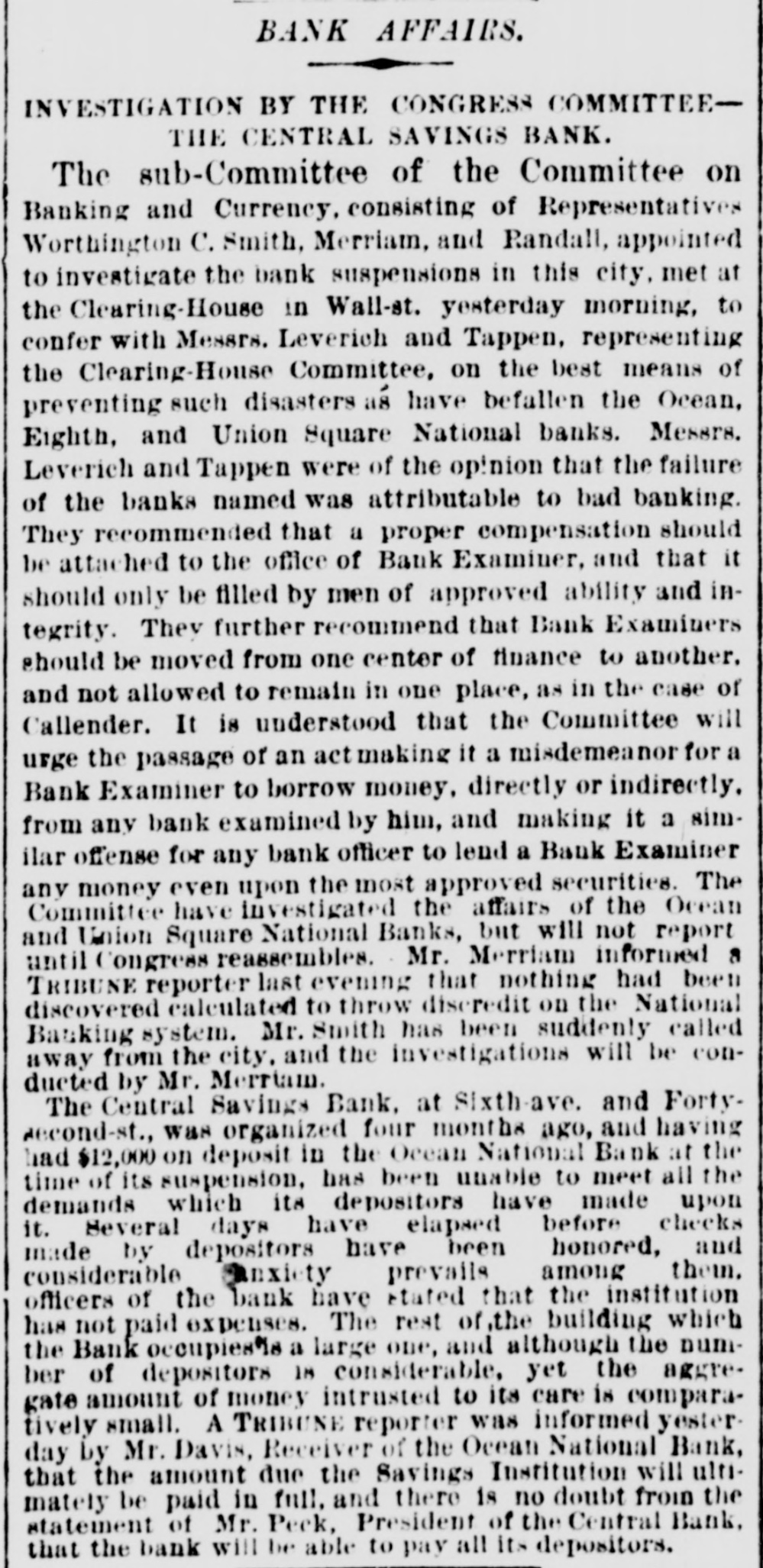
BANK AFFAIRS. INVESTIGATION BY THE CONGRESS COMMITTEETHE CENTRAL SAVINGS BANK. The sub-Committee of the Committee on Banking and Currency. consisting of Representatives Worthington C. Smith, Merriam, and Randall, appointed to investigate the bank suspensions in this city, met at the Clearing-House in Wall-st. yesterday morning, to confer with Messrs. Leverich and Tappen, representing the Clearing-House Committee, on the best means of preventing such disasters as have befallen the Ocean, Eighth, and Union Square National banks. Messrs. Leverich and Tappen were of the opinion that the failure of the banks named was attributable to bad banking. They recommended that a proper compensation should be attached to the office of Bank Examiner, and that it should only be filled by men of approved ability and integrity. They further recommend that Bank Examiners should be moved from one center of finance to another. and not allowed to remain in one place, as in the case of Callender. It is understood that the Committee will urge the passage of an act making it a misdemeanor for a Bank Examiner to borrow money. directly or indirectly. from any bank examined by him, and making it a similar offense for any bank officer to lend a Bank Examiner any money even upon the most approved securities. The Committee have investigated the affairs of the Ocean and Union Square National Banks, but will not report until Congress reassembles. Mr. Merriam informed 8 TRIBUNE reporter last evening that nothing had been discovered calculated to throw discredit on the National Banking system. Mr. Smith has been suddenly called away from the city, and the investigations will be conducted by Mr. Merriam. The Central Savings Bank. at Sixthave. and Fortysecond-st., was organized four months ago, and having had $12,000 on deposit in the Ocean National Bank at the time of its suspension, has been unable to meet all the demands which its depositors have made upon it. Several days have elapsed before checks made by depositors have been honored, and considerable Anxiety prevails among them. officers of the bank have stated that the institution has not paid expenses. The rest of the building which the Bank occupies*is a large one, and although the number of depositors IN considerable, yet the aggregate amount of money intrusted to its care is comparatively small. A TRIBUNE reporter was informed yester day by Mr. Davis, Receiver of the Ocean National Bank, that the amount due the Savings Institution will ulti. mately be paid in full. and there is no doubt from the statement of Mr. Peek, President of the Central Bank, that the bank will be able to pay all its depositors.


Article from The New York Herald, February 6, 1872

Click image to open full size in new tab

Article Text

THE UNION SQUARE BANK. Mr. Beekman, the Receiver of the Union Square National Bank, has issued a notice it.at all creditors and depositors having claims against the bank must prove them before next Saturday, on which date the first dividend of fifty per cent will be paid. The second dividend will be paid early in March, and the bank officers hope to pay all depositors in full by the 1st or April,


Article from The Weekly Panola Star, March 23, 1872

Click image to open full size in new tab

Article Text

BANK FAILURES IN NEW YORK.- The following banking institutions of the city of New York have failed during the winter: Market Savings Bank, Boling Green Savings Bank, Central Savings Bank; Stuyvesant Nationi Bank; Ocean Natonal Bank, Union Square National Bank and Eighth National Bank. A run has been in progress on the Third Av enue Savings Bank for more than a month, during which time upwards of $2,000,000 have been paid to its small depositors, at the rate of from 60 to 80 per day. At the commencement of the run the individual deposites in the institution amounted to about $5,000,000. It is supposed that it will finally break down.


Article from New-York Tribune, December 2, 1872

Click image to open full size in new tab

Article Text

curity, or as collateral security, for any loan of money, or for a consideration shall agreeAto withhold the same from use, or shall offer or receive the custod or promise of custody of such notes as security, or as collateral security or consideration, for any lloan of money." 5th of April last the Controller was advised that bank On the in the City of New-York, with a capital of $1,000,000, a and whose average exchanges at the Clearinghouse did not exceed $300,000, was that morning creditor at the Clearing-house for $4,770,000. A8 it was evident that this large credit was not the result of legitimate business, the examiner was directed to make an exam ination of the bank, which was immediately done, 114 connection with a member of the Clearing-house committee. From the examination, which was thoroughly and carefully conducted, it appeared that deposits had been made in that bank, by one individual, upon the morning of April 5 to the amount of $4,100,000, the whole of which was drawn out upon the same day, upon the checks of the depositor, in legal-tender notes. The president of the bank denied that the bank had any interest in these trans actions, and there was no evidence of any loan, or of ad. vances in any shape. upon these deposits. These traus actions were the subject, subsequently, of an investiga tion by the Bank Committee of the House of Represent tarives, and, although it was clear that the spirit of the law had been violated, no evidence could be obtained to warrant the commencement of a suit for the recovery of the penalty prescribed in the act referred to. The in vestigation undoubtedly had the effect to prevent the repetition of similar transactions; no offenses of this been kind, on the part of any national bank, having since brought to the attention of the Controller. The New-York Clearing house Association subse quently passed a resolution declaring "that the Clearinghouse Committee be and is hereby directed, whenever it appears, in its judgment, that legal-tender notes have been withdrawn from use through the agency of any bank, members of the association, to make an immediate examination of the bank in question, and should there appear to be complicity on the part of the bank or its officials, to suspend said bank from the Clearing house until action of the association shall be taken there on." The withdrawal of currency for illegitimate purposes has, however, since been accomplished without the assistance of the banks. The rigid enforcement of the resolution of the Clearing-house will prevent complicity on the part of banks in such transactions; and it the New-York Stock Board and the leading banking houses will unite with the Clearing-house, and refuse to transact business with unserupulous men. who do not hesitate to embarrass legitimate business for the parpose of increasing or diminishing the values of stocks or bonds in which they are temporarily interested, they can do more to prevent such operations team any Congress enactment. INSOLVENT BANKS. Twenty-one national banks, organized in 11 different States, with an aggregate capital of $1,236,100, have failed since the organization of the system in 1863 The total circulation of these banks was $2,942,793. of which $2,441,430 has been redeemed in full, leaving a belance still outstanding of $501,363, which will also be redeemed, upon presentation to the Treasurer of the United States, from the avails of United States bonds held as security for that purpose. Of these banks, five have been finally closed (two during the past year), baying paid dividends to their ereditors. Six national banks have fatted during the past year. New-York: Of these, the Union Square National Bank, the Fourth National Bank, Philadelphia, and the Waverley National Bank, New-York, have paid their creditors in full-a settlement, it is believed, without a precedent prior to the establishment of the national system. The Eighth National Bank, New-York, has paid dividend of 50 per cent; the Ocean National Bank, New-York, a dividend of 70 per cent; and the receiver of the Ocean National Bank, and of the First National Bank of Fort Smith, Ark., estimate that the creditors of both these banks will ΓΊltimately receive a dividend of 100 cents on the dollar. The Venango National Bank of Franklin, Penn.: the Merchants' National Bank of Washington. D. C. the First National Bank of Selma, Ala., and the First National Bank of New-Orleans, were United States depositories. e-final dividend in favor of the creditors of the First National Bank of Vicksburg has been unexpectedly delayed by the recent presentation of a claim of the United States for money alleged to have been illegally deposited by the Collector of Internal Revenue of that district, in the year 1868. Since that time no lesses have occurred to the Government by deposits made in the national banks, although many millions of dollars have been continually on deposit with banks which are designated as depositories. The three a first-named banks, at the time of their failure, had large amount of Government funds on deposit. SURPLUS AND SPECIE-EXTENDING THE LIMIT OF SURPLUS. The law requires that every national bank shall carry one-tenth part of its profits to surplus-fund account before the declaration of a dividend, until the same shall amount to 20 per cent of its capital stock. This wise provision has been generally observed. and the returns show that the banks now have a surplus of more than $100,000,000, and considerably more than onefifth of their capital in surplus account. The act also limits the liabilities of any association, person, com pany, or corporation, for money borrowed, to one-tenth of the capital stock paid in. The Controller recommends that this limit be extended to one-tenth of the capital and surplu. which will have a tendency to 10. crease the surplus fund beyond the limit required by the law. The following table will exhibit the aggregate amount of specie held by the national banks at the dates mentioned, the coin, coin certificates, and checks payable coin held by the national banks of the City of New York being stated separately. The country banks have not heretofore separated coin in their reports: -Held NationalsBanks in New- City.-


Article from Chicago Daily Tribune, December 3, 1872

Click image to open full size in new tab

Article Text

Of these banks, the Union Square National Bank, New York; the Fourth National Bank, Philadelphia, and the Waverly National Bank, New York, have paid their creditors in full, a settlement, it is believed, without precedent prior to the establishment of the national system. The Eighth National Bank, New York, has paid a dividend of 50 per cent; the Ocean National Bank, New York, a dividend of 70 per cent; and the receivers of the Ocean National Bank, and of the First National Bank of Fort Smith, Arkansas, estimate that the creditors of both of these banks will ultimately receive a dividend of 100 cents on the dollar. The remaining ten National Banks which have failed are as follows:


Article from The New York Herald, March 19, 1874

Click image to open full size in new tab

Article Text

THE COURTS. The Ocean Bank Case--Continnation of the Trial of Charles Callender. BUSINESS IN THE OTHER COURTS. A Verdict in Favor of the City-Action for Alleged Conspiracy-Decisions-Business in the Court of General Sessions. The Trial of Charles Callender-Further Testimony for the Prosecution. The trial of Charles Callender was resumed yesterday, in the United States Circuit Court, before Judge Benedict. The defendant 18 indicted for having accepted a pribe of $76,000 to influence his official action, as bank examiner, in making a report upon the affairs and condition of the Ocean National Bank. Mr. A. H. Purdy, United States Assistant District Attorney, appeared for the prosecution, and Mr. William Fullerton for the defendant. The Judge said, with regard to the question of evidence submitted yesterday, he would in this case, for the purposes of this trial, permit the Distriet Attorney. on the question of intent alone, to prove other similar transactions by the defendant at other national banks. It was only on the question of intent and for that purpose he would permit the evidence. TESTIMONY OF B. T. BRUNDIDGE CONTINUED. Mr. B.T. Brundidge, late cashier of the Union Square National Bank, was further examined by Mr. Purdy. He said:-At the time I was cashier of the Union Square National Bank Mr. Callender kept an account there: know that he borrowed money from the bank; the books of the bank are not here; there was a loan, several loans-I think five or six-made to Mr. Callender; 1 referred the loans to the President; the application for the loans was made to me remember tbat collaterals were left at the same time; the date of the last loan was November 3, 1871, for $4,000; the dates of the other loans were September and October, 1871, and before that: these loans have never been paid; the collaterals for the loan of November 3 were $10,000 of Portage Lake bonds; the other collaterals were stocks of $20,000 of the Albany and Brunswick Railroad, and a note of Alfred Wild with the endorsement of D. R. Martin; the grand total of the loans 18 $17,000, and they have not been paid; the Union Square National Bank failed December 13, 1871, the day after the failure of the Ocean National Bank; I was familiar with the affairs of the Union Square National Bank; the bank was not loaning money at that time 1 do not think the bank loaned money on collaterals except to Callender discounting paper was the business of the bank, not loaning money 1 think Mr. Callender's first application was made to me, and I turned him over to the President; I would have loaned money on that day to John Jacob Astor; I did not know the value of the collaterals at that time, or any thing about them: did not know anything of Mr. Callender's responsibility as it stood on that day-1 knew nothing about it. Q. Had you any knowledge that be bad any property? A.1 had no knowledge at all on that subject. I knew nothing of the value 01 these collaterals. Q. On that state of facts would you have loaned that money to Mr. Callender on those collaterals? Mr. Fullerton objected to the question. The operation upon the mind of the witness made no difference, and the evidence would be worth less for any purpose whatever. Q. Why did you refer this loan to the President of the bank Objected to. Judge Benedict-Ask him If Mr. Callender said anything. Q. Do you remember what was said by Mr. Callender in regard to the transaction A. knew of his making the application for the loan, and reterred him to the President: think some of the loans made to Mr. Callender prior to this time were paid; 1 do not think any loans on Portage Lake bonds were paid; there was an overdraft by Mr. Callender for $6,000 or $7,000; the bank had no collaterals for that money, not even Portage Lake bonds. Cross-examined-The overdraft was paid; it is not unusual for folks to overdraw their bank accounts: Mr. Callender kept an account in the bank; the collaterals left for the loan of $4,000 were $10,000 of Portage Lake bonds; do not think there was a note also left as security on that loan; think may say am quite certain of that; the collaterals were handed to the President, Mr. Henry Beekman, and he placed them in his tin box atd not see them after that: heard Mr. Callender say that for that loan he would leave $10,000 of Portage Lake bonds; he first preposed to me to get the loan; do not remember whether there was a note or not; do not think there was a note endorsed by D. R. Martin leit for that loan with the President :) could not say what securities the President had in his tin box think there were other loans to Mr. Callender of $8,000 and $5,000; I think that for one of those loans a note of Alfred Wild's, endorsed by D. R. Martin. was leit as security: think the application for the loan was made directly to the President: the collaterals were handed to the President; do not remember what transpired between the President and Mr. Callender regarding those loans; prior loans were paid by Mr. Callender: 1 cannot say the amount, probably $10,000, at three or four different times. Q. Do you mean to say that that was the only instance in which loans were made by the bank on collaterals A. think so; the loans of the bank were made mostly on paper; am not positive that money was loaned by the bank on collaterals to other parties besides Callender: do not think the President made loans on collaterals to other parties besides Callender the books would show 11 he did; the bank iailed on the 13th of December, 1871. Q. What was the occasion of its failure Objected to. Q. Where did the bank keep its account? Judge Benedict-That IS not material. The jury will not infer that the bank was broken by the 1088 of $17,000. Mr. Fullerton-Mr. Purdy thinks so. (Laughter.) Witness-This loan of $17,000 was never paid. My connection with the Union Square National Bank ceased in July, 1871. It IS from what saw in the ledger of the bank that state the loan has not been paid. Redirect-Either the President or the cashier allowed the overdrafts to Mr. Callender; very probably allowed them; do not taink Mr. Callender overdrew his account more than two or three times; $6,000 was an unusual overdraft on the Union Square Bank, but it was a usual thing allow to overdrafts. Q. You have said that there was a Wild note among these securities. Is It not a fact that all these securities were wild? (Laughter.) Judge Benedict-You had better avoid punning. This case has serious aspect. Q. You know that the bank holds these collaterals A. Yes; saw them yesterday in the hands of the receiver of the bank: they have not been sold: I do not know whether there was more than one note of Wild's; one Dote of Wild's was for $10,000. Judge Benedict-De you know how long it was prior to the failure of the bank that Callender made a report of its condition to the Comptroller A. could not tell; do not think that Mr. Callender made an examination or the affairs of the Union Square Bank for a year before its failure: he used to come into the bank. look over the statement book and take figures from the statement: he would not count the cash; the statement was made every day, and Mr. Callender was almost every day looking over the statement book. Mr. Fullerton- Was the statement correct?


Article from New-York Tribune, March 24, 1874

Click image to open full size in new tab

Article Text

THE COURTS. TRIAL OF CALLENDAR. EVIDENCE FROM VARIOUS SOURCES. At the resumption yesterday in the United States Circuit Court of the trial of ex-Bank-Examiner Charles Callendar for accepting a bribe for reporting favorably upon the condition of the Ocean National Bank, Edward Wolcott, a clerklin the office of the Controller of the Currency, produced certified copies of Callendar's reports upon the condition of the following banks in this city Union Square National Bank, American National Bank, Atlantic National Bank, and the Commonwealth National Bank. These reports were favorable to the banks, and, as they either failed or went into liquidation soon after they were made, Mr. Purdy claimed that they were 'blackmailing reports, or false reports, for the making of which Callendar received bribes." T. O. Edaugh, who is also a clerk in the office of the Controller of the Currency, produced Callendar's report upon the condition of the Fourth National Bank of Philadelphia, and his reports upon the condition of the following banks in this city: Continental National Bank, First National Bank, Third National Bank, Mechanics' National' Bank. National Currency Bank, Central National Bank, Ninth National Bank, Metropolitan National Bank, Broadway National Bank. None of these banks have failed, and only one of them, the Fourth National Bank of Philadelphia, went into liquidation. Mr. Purdy introduced the reports referred to only in connection with the fact that Callendar had borrowed money from the banks reported upon and the allegation that he had threatened to m ake unfavorable reports if the mony he wanted were not loaned to him. Mr. Stevenson, who was President of the Ocean National Bank when it failed. repeated his testimony to the effect that Callendar's first transaction with that bank took place in January, 1868; that the bank's reserve fund was not up to the standard on Oct. 3, 1871, and that to raise it to the required amount Callendar's checks for about $50,000 were counted as legal tenders. The recently-published matter of Callendar's indebtedness to the Ocean National Bank was again considered, but nothing was elicited from the witness, except that, as was claimed, the bank had, on Oct. 3, 1871, loaned Conant, Wild & Co. about $100,000 more than it had any right to loan, and that, at that time, it had $112,000 in Portage Lake bonds, and $100,000 in Decatur, Sullivan and Mattoon bonds. Au examination of the statement-book of the bank corroborated National Bank-Examiner Meigs's testimony that it was insolvent by over $1,000.000, and that it had on hand when it failed about $1,811,450 in unavailable bonds, stocks, and notes. It is claimed by the prosecution that the bank had that amount in such bonds, stocks, and notes on hand for two years before it failed, and that Callendar knew it when he reported that the bank was in a prosperous' condition. It also appeared that the unavailable paper referred to was supposed to be good security where money was loaned on it, and that since the failure of the bank over $152,000 worth of it had been paid. It was further shown from the books, that between July and October, 1871, the business of the bank had increased to the extent of $30,000, and ex-Judge Fullerton remarked that such increase corroborated Callendar's statement that the bank was in a prosperous condition. Isaao H. Bailey, the Receiver of the Common wealth National Bank. testified that he found in that bank notes showing that Callendar owed It about $30,000, and that the notes were indorsed by Wild, Avery & Conant, and Callendar, but that Callendar appeared as the borrower. The Court then adjourned till to-day, when Frank L. Taintor, who is serving out a term of seven years' imprisonment for embezzling the funds of the Atlantic National Bank, will be a witness for the prosecution.


Article from The New York Herald, March 28, 1878

Click image to open full size in new tab

Article Text

UNION SQUARE NATIONAL BANK. In pursuance of a notice issued of the date of February 21 from the office 01 the Comptroller of the Currency (Treasury Department) at Washington, the shareholders of the defunct Union Square National Bank, of which ex-State Senator Francis M. Bixby was receiver, met yesterday morning at the Fifth Avenue Hotel for the purpose of electing all agent to whom the assets of the bank should be transferred, in accordance with the provisions 01 the United States Jaws providing for such contingencies. Many of the prominent stockbolders were present and the meet11g was entrey barminous. It was Stated that all of the debts of the concern had been paid and that it only now remained to appoint an agent, according to the government order, to distribute the remainlog balance among those interested, the exact amount not being stated. The name of the receiver, Francis M. Bixoy, was proposed as agent and accepted. He will, therefore, close up the concern entirely according to law.