Article Text
MAY SAVE DEPOSITS
Director Says He Believes Customers Will Not Suffer.
Patrons of the West Side State bank, 1122 Broadway, found the bank closed today and this notice on the door:
This bank is in the hands of the state bank examiner.—L. A. Miller, 3131 Forest avenue, Jackson county representative of the state bank examiner.
At 10 o'clock this morning more than 25 persons gathered about the door of the bank, awaiting further information from the bank examiner or officials of the bank.
"Run" Started Yesterday.
Officers of the Kansas City Clearing House association said today that while the stockholders with their investment of $100,000 will be wiped out in the failure, the loss to depositors, if any, will be small.
John M. Moore, president of the Clearing House association said Louis A. Miller, deputy state bank examiner in charge of the Kansas City district, conferred with the clearing house officials late yesterday.
"We could have saved the bank by putting up $100,000," Mr. Moore said.
Kansas City bankers and clearing house officials closely in touch with the situation said today the state bank examiners had made the demand upon the West Side bank Tuesday night that it put up $60,000 in 24 hours or shut its doors.
A run on the bank started yesterday afternoon when Frankel, Frank & Co., wholesale millinery concern, withdrew its payroll deposit and also advised its employes to withdraw deposits.
This news spread rapidly and before closing time yesterday the bank examiners had heard of the run. The closing order followed.
Frank C. Millspaugh, state finance commissioner, said today at his office in Jefferson City that the bank was forced to close as a result of bad loans, which were covered from the capital stock.
Figures submitted to the clearing house yesterday shows that the West Side bank holds bad paper on loans amounting to $115,000—$15,000 in excess of its capital stock.
According to Mr. Moore, the figures showed the bank is holding $200,000 in bank paper of L. C. Smith, former president of the Commonwealth National bank, which failed in January, 1922.
Estimates as to Loss.
State bank examiners say there will be a salvage from this and the loss from the $200,000 will not exceed $40,000. Members of the Clearing house, however, believe the loss will be greater.
The bank also holds $60,000 in paper pledges of the Smith-Ricker stockyards firm, which failed at the same time as the old Commonwealth National bank. Granville M. Smith, partner in the Smith-Ricker firm, is a brother of L. C. Smith and was chairman of the board of directors of the Commonwealth National bank at the time of its failure.
The Smith-Ricker paper will be a total loss, the bank examiners say, according to Mr. Moore.
In addition to these losses, the bank holds $15,000 in other bad paper.
The West Side bank had capital stock of $100,000 and a surplus of $6,000. At the conference yesterday deposits were estimated at $500,000.
"The bank examiners demanded that the West Side bank replace its impaired capital stock by making good the $60,000 of the Smith-Ricker paper," a banker said today.
"When the bank failed to meet this demand, the state department closed its doors."
Before the Commonwealth National bank was reorganized last year the West Side State bank made its clearing through that bank. When Jo Zach Miller, jr., became president of the Commonwealth National the West Side bank transferred its clearings to the Commerce Trust company.
Ross President Two Weeks.
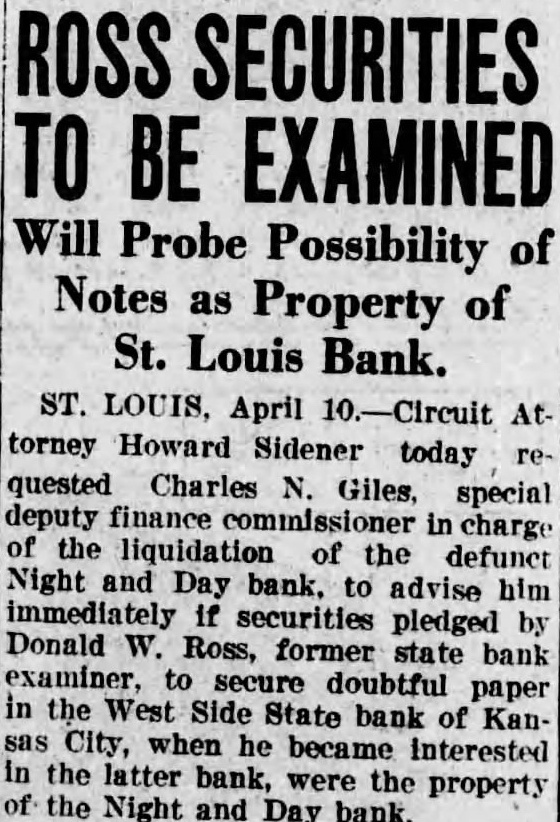
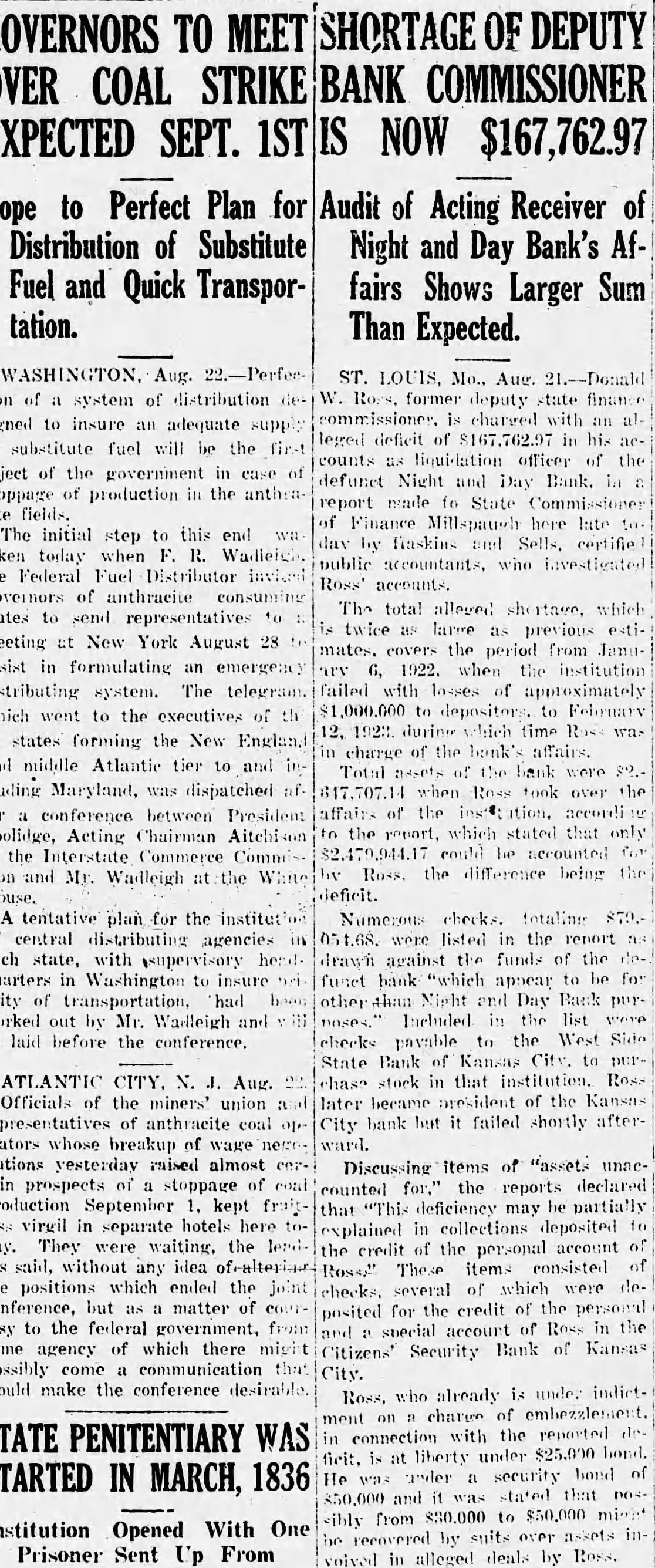
Don W. Ross, a member of the state finance department, has been president of the West Side bank for the last two weeks, following the resignation of Dan Wharton, who sold out his interest. Mr. Ross also is engaged
See Page 3, Number 1.