Mechanics & Merchants Bank (Philadelphia, PA)

Episode Information

Episode UID
1872069591478
Episode Type
Suspension → Closure
Bank Type
state
Bank ID
187206959 hash
Start Date
February 12, 1923
Location
Philadelphia, Pennsylvania (39.952, -75.164)

Metadata

Model
gpt-5-mini (chosen from majority vote of a three-model LLM ensemble)
Short Digest
58f17e998651af77

Response Measures

None

Description

Closed by examiners amid charges of manipulation by controller Joseph B. Marcino.

Events (2)

1. February 12, 1923 Receivership
Newspaper Excerpt
The failure of the Mechanics and Merchants bank in Philadelphia on February 12 added another $130,000 to the total.
Source
newspapers
2. February 12, 1923 Suspension
Cause
Government Action
Cause Details
Closed by state bank examiners after charges that controller Joseph B. Marcino manipulated the bank's funds and used securities/loans to benefit dummies and related parties.
Newspaper Excerpt
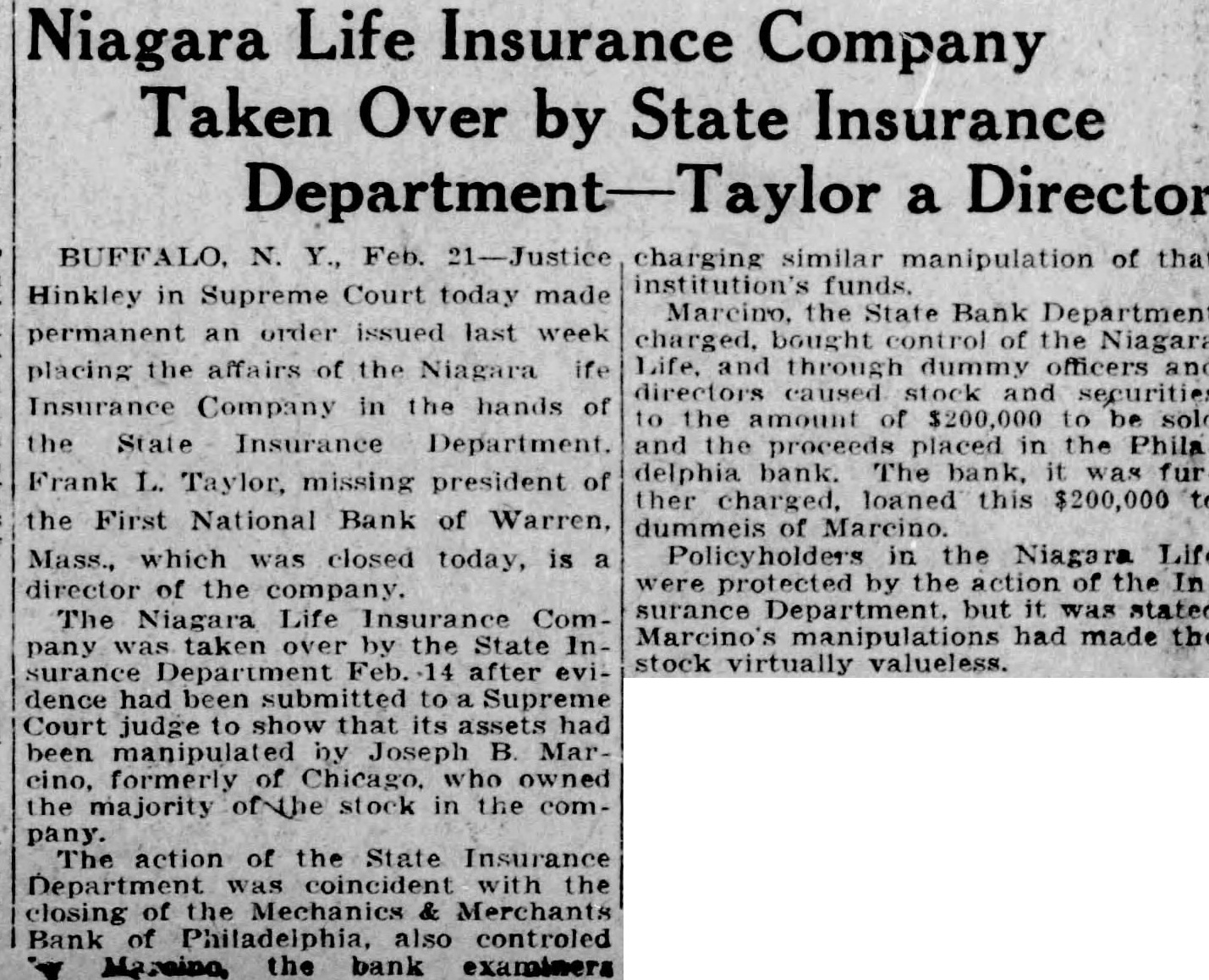
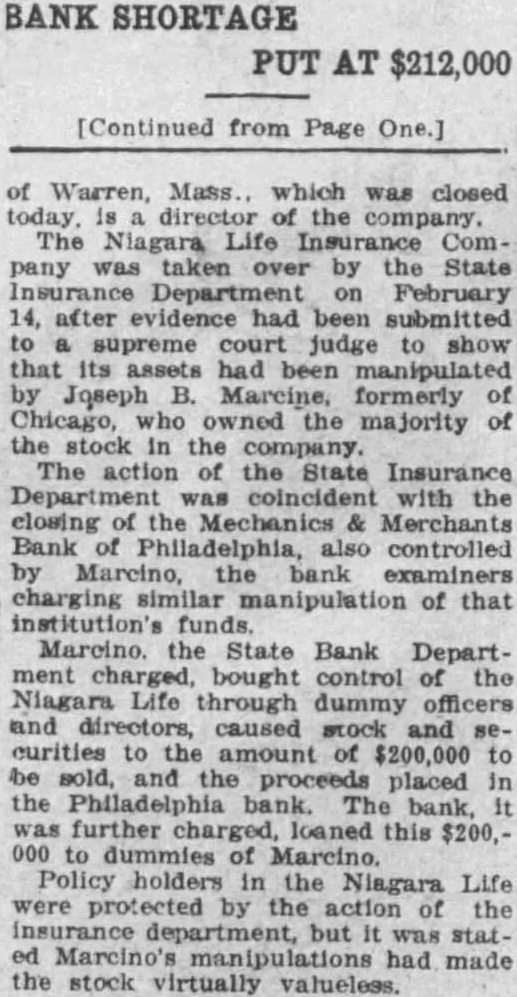
the closing of the Mechanics & Merchants Bank of Philadelphia, also controlled by Marcino, the bank examiners charging similar manipulation of that institution's funds.
Source
newspapers

Newspaper Articles (3)

Article from Springfield Evening Union, February 21, 1923

Click image to open full size in new tab

Article Text

Niagara Life Insurance Company Taken Over by State Insurance Department—Taylor a Director BUFFALO, N. Y., Feb. 21—Justice Hinkley in Supreme Court today made permanent an order issued last week placing the affairs of the Niagara Life Insurance Company in the hands of the State Insurance Department. Frank L. Taylor, missing president of the First National Bank of Warren, Mass., which was closed today, is a director of the company. The Niagara Life Insurance Company was taken over by the State Insurance Department Feb. 14 after evidence had been submitted to a Supreme Court judge to show that its assets had been manipulated by Joseph B. Marcino, formerly of Chicago, who owned the majority of the stock in the company. The action of the State Insurance Department was coincident with the closing of the Mechanics & Merchants Bank of Philadelphia, also controlled by Marcino, the bank examiners charging similar manipulation of that institution's funds. Marcino, the State Bank Department charged, bought control of the Niagara Life, and through dummy officers and directors caused stock and securities to the amount of $200,000 to be sold and the proceeds placed in the Philadelphia bank. The bank, it was further charged, loaned this $200,000 to dummies of Marcino. Policyholders in the Niagara Life were protected by the action of the Insurance Department, but it was stated Marcino's manipulations had made the stock virtually valueless.


Article from Fall River Daily Evening News, February 21, 1923

Click image to open full size in new tab

Article Text

BANK SHORTAGE PUT AT $212,000 [Continued from Page One.] of Warren, Mass., which was closed today, is a director of the company. The Niagara Life Insurance Company was taken over by the State Insurance Department on February 14, after evidence had been submitted to a supreme court judge to show that its assets had been manipulated by Joseph B. Marcino, formerly of Chicago, who owned the majority of the stock in the company. The action of the State Insurance Department was coincident with the closing of the Mechanics & Merchants Bank of Philadelphia, also controlled by Marcino, the bank examiners charging similar manipulation of that institution's funds. Marcino, the State Bank Department charged, bought control of the Niagara Life through dummy officers and directors, caused stock and securities to the amount of $200,000 to be sold, and the proceeds placed in the Philadelphia bank. The bank, it was further charged, loaned this $200,000 to dummies of Marcino. Policy holders in the Niagara Life were protected by the action of the insurance department, but it was stated Marcino's manipulations had made the stock virtually valueless.


Article from The Sioux City Journal, February 23, 1923

Click image to open full size in new tab

Article Text

BURNS SLEUTHS SEEK TRACE OF BARBER-BANKER J. M. Marcino Said to Have Wrecked Institution at Warren, Mass. (By the Associated Press.) Chicago, Feb. 22.—An immigrant from Italy of a dozen years ago, who later became a west side barber in Chicago, is being sought tonight along the Mexican border while bankers and state officials in the east and middle west trace his career of frenzied finance; a career which has already cost investors from $500,000 to $1,000,000 or more. The missing barber-banker is Joseph M. Marcino, or Joseph B. Biata, a dapper man, 27 years old, just a little over 5 feet tall and remarkably broad. "If you see a man about 5 feet 2 and almost 3 feet broad, it's Marcino," a Burns detective who is directing the search said today. While detectives are searching for Marcino, who disappeared in Buffalo, N. Y., last Friday, after he is alleged to have peddled nearly $200,000 worth of stolen securities, Frank L. Taylor, ex-railroad fireman, who rose to the position of $50 a week president of the First National bank, of Warren, Mass., when Marcino obtained control of the institution, is awaiting arraignment tomorrow on a charge of embezzlement of the bank's funds. Taylor told Burns operatives who arrested him that he at one time worked for the Burns agency and also had been a secret agent of the department of justice. Losses Over Half Million. Burns agents here figure the known losses from Marcino's operations at $591,000 and say that they expect much more to appear before the investigation is complete. Through manipulation of the funds of the Niagara Life Insurance company, of Buffalo, they say, investors have lost $248,000. The closing of the Warren, Mass., bank last week revealed a shortage of $213,000. Taylor claims Marcino cleaned out the bank's vault and later peddled the securities in and around Buffalo. The failure of the Mechanics and Merchants bank in Philadelphia on February 12 added another $130,000 to the total. A New York congressman is said by the detectives to have lost a sum estimated at from $150,000 to $200,000 through his faith in Marcino's schemes. The detectives are also investigating the connection between a bank at Weyauwega, Wis., and the Buffalo insurance company. Pledged as Security. Securities formerly owned by the Wisconsin bank, in which Marcino is said to have obtained a controlling interest about six months ago, have turned up in banks in and around Buffalo, where they are said to have been pledged by the insurance company as security on loans. Marcino's career as a financier, according to Burns men, who have been following him for several years, started about 1917 or 1918, when he fathered a scheme for starting a new bank at Ottawa, Ill., and buying out the existing bank. As a result of that scheme he was indicted by the grand jury there for operation of a confidence game, but disappeared. He was next heard from in California, where the Bank of Paris, Cal., failed for a large sum after he had become connected with it. Losses of approximately $130,000 to depositors there were repaid about July of last year, Burns men declared, when a well known Chicago attorney made a trip to the coast to square Marcino's accounts and save him from prosecution. The money used to repay the losses is said by the Burns men to have been obtained from Marcino's father-in-law, Abraham Goldman, a wealthy Chicagoan connected with the Furniture Exhibitors exchange.