Click image to open full size in new tab
Article Text
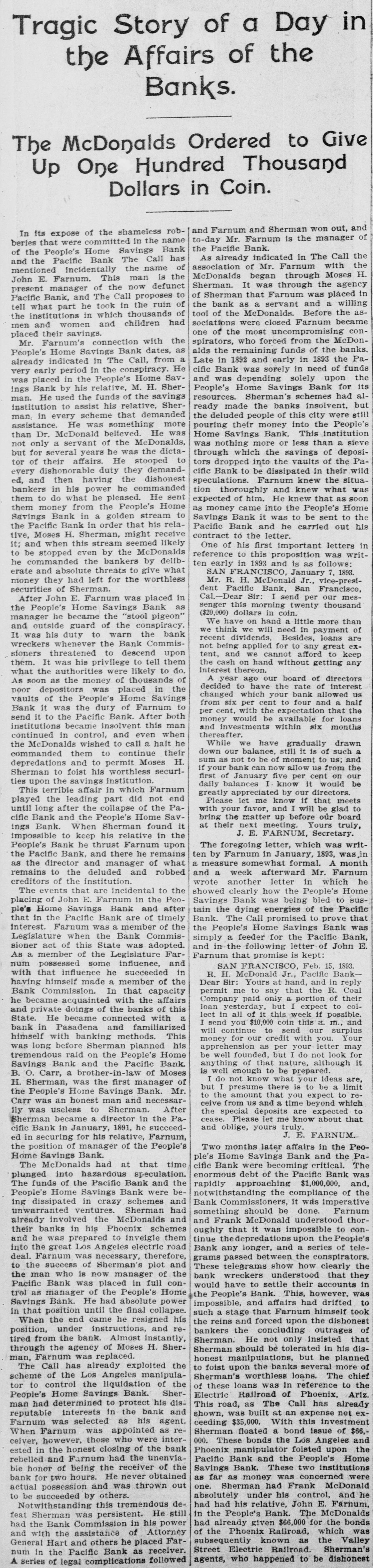
in Tragic Story of a Day the Affairs of the Banks. The McDonalds Ordered to Give Up One Hundred Thousand Dollars in Coin. and Farnum and Sherman won out, and of In its expose of the shameless robto-day Mr. Farnum is the manager beries that were committed in the name the Pacific Bank. of the People's Home Savings Bank As already indicated in The Call the and the Pacific Bank The Call has of association of Mr. Farnum with the mentioned incidentally the name the McDonalds began through Moses H. John E. Farnum. This man is Sherman. It was through the agency present manager of the now defunct of Sherman that Farnum was placed in Pacific Bank, and The Call proposes to of the bank as a servant and a willing tell what part he took in the ruin tool of the McDonalds. Before the asthe institutions in which thousands of sociations were closed Farnum became men and women and children had one of the most uncompromising conplaced their savings. spirators, who forced from the McDonMr. Farnum's connection with the alds the remaining funds of the banks. People's Home Savings Bank dates, as Late in 1892 and early in 1893 the Paalready indicated in The Call, from a cific Bank was sorely in need of funds very early period in the conspiracy. He and was depending solely upon the was placed in the People's Home SavPeople's Home Savings Bank for its ings Bank by his relative, M. H. Sherresources. Sherman's schemes had alman. He used the funds of the savings institution to assist his relative, Sherready made the banks insolvent, but the deluded people of this city were still man, in every scheme that demanded assistance. He was something more pouring their money into the People's Home Savings Bank. This institution than Dr. McDonald believed. He was was nothing more or less than a sieve not only a servant of the McDonalds, through which the savings of deposibut for several years he was the dictator of their affairs. He stooped to tors dropped into the vaults of the Pacific Bank to be dissipated in their wild every dishonorable duty they demanded, and then having the dishonest speculations. Farnum knew the situabankers in his power he commanded tion thoroughly and knew what was them to do what he pleased. He sent expected of him. He knew that as soon them money from the People's Home as money came into the People's Home Savings Bank in a golden stream to Savings Bank it was to be sent to the the Pacific Bank in order that his relaPacific Bank and he carried out his contract to the letter. tive, Moses H. Sherman, might receive it; and when this stream seemed likely One of his first important letters in to be stopped even by the McDonalds reference to this proposition was writhe commanded the bankers by delibten early in 1893 and is as follows: SAN FRANCISCO, January 7, 1893. erate and absolute threats to give what Mr. R. H. McDonald Jr., vice-presimoney they had left for the worthless dent Pacific Bank, San Francisco, securities of Sherman. Cal.-Dear Sir: I send per our mesAfter John E. Farnum was placed in senger this morning twenty thousand the People's Home Savings Bank as ($20,000) dollars in coin. manager he became the "stool pigeon" We have on hand little more than and outside guard of the conspiracy. we think we will need in payment of It was his duty to warn the bank recent dividends. Besides, loans are wreckers whenever the Bank Commisnot being applied for to any great exsioners threatened to descend upon tent, and we cannot afford to keep the cash on hand without getting any them. It was his privilege to tell them interest thereon. what the authorities were likely to do A year ago our board of directors As soon as the money of thousands of decided to have the rate of interest poor depositors was placed in the changed which your bank allowed us vaults of the People's Home Savings from six per cent to four and half Bank it was the duty of Farnum to per cent. with the expectation that the send it to the Pacific Bank. After both money would be available for loans institutions became insolvent this man and investments within six months thereafter. continued in control, and even when While we have gradually drawn the McDonalds wished to call a halt he down our balance, still is of such commanded them to continue their sum as not to be of moment to us: and depredations and to permit Moses H. if your bank can now allow us from the Sherman to foist his worthless securifirst of January five per cent on our upon the savings institution. daily balances I know it would be This terrible affair in which Farnum greatly appreciated by our directors. Please let me know if that meets played the leading part did not end with your favor, and will be glad to until long after the collapse of the Pabring the matter up before our board cific Bank and the People's Home Savat their next meeting. Yours truly, ings Bank. When Sherman found it J. E. FARNUM, Secretary. impossible to keep his relative in the The foregoing letter, which was writPeople's Bank he thrust Farnum upon ten by Farnum in January, 1893, was in the Pacific Bank, and there he remains measure somewhat formal. A month as the director and manager of what remains to the deluded and robbed and a week afterward Mr. Farnum creditors of the institution. wrote another letter in which he The events that are incidental to the showed clearly how the People's Home Savings Bank was being bled to susplacing of John E. Farnum in the Peotain the dying energies of the Pacific ple's Home Savings Bank and after that in the Pacific Bank are of timely Bank. The Call promised to prove that interest. Farnum was a member of the the People's Home Savings Bank was Legislature when the Bank Commissimply a feeder for the Pacific Bank, sioner act of this State was adopted. and in the following letter of John E. Farnum that promise is kept: As a member of the Legisiature Farnum possessed some influence, and SAN FRANCISCO, Feb. 15, 1893. with that influence he succeeded in R. H. McDonald Jr., Pacific BankDear Sir: Yours at hand, and in reply having himself made a member of the permit me to say that the R. Coal Bank Commission. In that capacity Company paid only a portion of their he became acquainted with the affairs loan yesterday, but expect to coland private doings of the banks of this lect in all of it this week if possible. State. He became connected with a send you $10,000 coin this a. m., and bank in Pasadena and familiarized will continue to send our surplus himself with banking methods. This money for our credit with you. Your was long before Sherman planned his apprehension as per your letter may tremendous raid on the People's Home be well founded, but do not look for anything of that nature, although it Savings Bank and the Pacific Bank. is well enough to be prepared. B. O. Carr, a brother-in-law of Moses do not know what your ideas are, H. Sherman, was the first manager of but presume there is to be limit the People's Home Savings Bank. Mr. to the amount that you expect to reCarr was an honest man and necessarceive from us and a time beyond which the special deposits are expected to ily was useless to Sherman. After cease. Please let me know about that Sherman became a director in the Paand oblige, yours truly. cific Bank in January, 1891. he succeedJ. E. FARNUM. ed in securing for his relative, Farnum, the position of manager of the People's Two months later affairs in the PeoHome Savings Bank. ple's Home Savings Bank and the PaThe McDonalds had at that time cific Bank were becoming critical. The enormous debt of the Pacific Bank was plunged into hazardous speculation. The funds of the Pacific Bank and the rapidly approaching $1,000,000, and, notwithstanding the compliance of the People's Home Savings Bank were beBank Commissioners, it was imperative ing dissipated in crazy schemes and unwarranted ventures. Sherman had something should be done. Farnum and Frank McDonald understood thoralready involved the McDonalds and their banks in his Phoenix schemes oughly that it was impossible to conand he was prepared to inveigle them tinue thedepredationsupon the People's Bank any longer, and a series of teleinto the great Los Angeles electric road deal. Farnum was necessary, therefore, grams passed between the conspirators. to the success of Sherman's plot and These telegrams show how clearly the the man who is now manager of the bank wreckers understood that they Pacific Bank was placed in full conwould have to settle their accounts in trol as manager of the People's Home the People's Bank. This, however, was Savings Bank. He had absolute power impossible, and affairs had drifted to in that position until the final collapse. such a stage that Farnum himself took When the end came he resigned his the reins and forced upon the dishonest position, under instructions, and rebankers the concluding outrages of tired from the bank. Almost instantly, Sherman. He not only insisted that through the agency of Moses H. SherSherman should be tolerated in his disman, Farnum was replaced. honest manipulations, but he planned The Call has already exploited the to foist upon the banks several more of scheme of the Los Angeles manipulaSherman's worthless loans. The chief tor to control the liquidation of the of these loans was in reference to the Electric Railroad of Phoenix, Ariz. People's Home Savings Bank. SherThis road, as The Call has already man had determined to protect his disreputable interests in the bank and shown, was built at an expense not exFarnum was selected as his agent. ceeding $35,000. With this investment Sherman floated a bond issue of $66.When Farnum was appointed as re000. These bonds the Los Angeles and ceiver, however, those who were interPhoenix manipulator foisted upon the ested in the honest closing of the bank Pacific Bank and the People's Home rebelled and Farnum had the unenviaSavings Bank. These two institutions ble honor of being the receiver of the as far as money was concerned were bank for two hours. He never obtained one. Sherman had Frank McDonald actual possession and was thrown out to be succeeded by others. absolutely under his control, and he had had his relative, John E. Farnum, Notwithstanding this tremendous dein the People's Bank. The McDonalds feat Sherman was persistent. He still had already given $66,000 for the bonds had the Bank Commission in his power of the Phoenix Railroad, which was and with the assistance of Attorney subsequently known as the Valley General Hart and others he placed FarStreet Electric Railroad. Sherman's num in the Pacific Bank as receiver. A series of legal complications followed agents, who happened to be dishonest