First National Bank (Albuquerque, NM)

Episode Information

Episode UID
261401490
Episode Type
Run Only
Bank Type
national
Bank ID
26140 national
Charter Number
2614
Start Date
February 5, 1924
Location
Albuquerque, New Mexico (35.084, -106.651)

Metadata

Model
gpt-5-mini (chosen from majority vote of a three-model LLM ensemble)
Short Digest
1bc8ab57baf3dd66

Response Measures

Accommodated withdrawals, Borrowed from banks or large institutions, Fed/other loan, Public signal of financial health

Events (3)

1. January 11, 1882 Chartered
Source
historical_nic
2. February 5, 1924 Run
Cause
Local Banks
Cause Details
Run was triggered by closing of the Citizens National Bank in Albuquerque and depositors' fears following that closure.
Measures
Requested and received $500,000 flown from the Federal Reserve in El Paso (additional funds by train) and paid depositors who demanded funds.
Newspaper Excerpt
Officers of the bank arranged for $500,000 to be brought here from El Paso, Texas, by aeroplane... The run on the bank continued until 3 p. m., the closing hour, and all who demanded their money were paid, bank officials announced. About $200,000 was withdrawn, they said.
Source
newspapers
3. February 7, 1934 Voluntary Liquidation
Source
historical_nic

Newspaper Articles (6)

Article from St. Louis Post-Dispatch, February 6, 1924

Click image to open full size in new tab

Article Text

$500,000 CARRIED BY PLANE Money to Meet Run on One Bank After Another Is Closed. By the Associated Press. ALBUQUERQUE, N. M., Feb. 6.β€”The Citizens' National Bank failed to open yesterday. Its directors issued a statement saying that heavy withdrawals during the last few days made their action necessary. The bank has a capital of $100,000. Its statement of Dec. 31 last showed deposits of $837,193. Before the First National Bank opened yesterday many were waiting at its doors and during the day scores of depositors withdrew their funds. Bank officials announced that $500,000 had been brought here by airplane from El Paso, Tex., and that an additional $500,000 would be sent from that city by train. They said the money would be furnished by the Federal Reserve Bank. First National officials said that about $200,000 was withdrawn yesterday. More than 200 business men met and pledged their faith in the institutions.


Article from Arizona Daily Star, February 6, 1924

Click image to open full size in new tab

Article Text

PLANE BRINGS HALF MILLION; ENDS BANK RUN Albuquerque Merchants in Mass Meeting Decide to Stand by Institutions El Paso, Tex., Feb. 5.β€”Carrying $500,000 in United States currency, Major Leo G. Heffernan, commander of the Twelfth Observance squadron, hopped off from Fort Bliss today at 11:15 a. m. The money was consigned by the federal reserve bank here to the First National Bank at Albuquerque, N. M., where it was delivered at 1:15 p. m. The rail distance between El Paso and Albuquerque is 254 miles. Albuquerque, N. M., Feb. 5.β€”This was a day of excitement for many Albuquerqueans following the announcement this morning that the Citizens National bank had closed its door and that the institution had been placed in the hands of the comptroller of the currency. Long before the doors of the First National Bank opened this morning depositors were lined up waiting to withdraw their money and all day long the lobby of the bank was filled almost to overflowing by those who had money deposited in the bank and were clamoring to withdraw it. Officers of the bank arranged for $500,000 to be brought here from El Paso, Texas, by aeroplane. They announced that another $500,000 would arrive tonight by train. This money, they said, was being supplied by the federal reserve bank. The run on the bank continued until 3 p. m., the closing hour, and all who demanded their money were paid bank officials announced. About $200,000 was withdrawn, they said. Fully 200 businessmen and firms at a meeting at the Chamber of Commerce this afternoon affirmed their faith in the going banking institutions of the city and pledged themselves to stick with the institutions, and urged the people to display sober judgment in the present situation.


Article from El Paso Times, February 6, 1924

Click image to open full size in new tab

Article Text

U. S. RESERVE SENDS HALF MILLION TO N. M. BANK Army Pilot Speeds 250 Miles With Huge Sum in 2 Hours, Leaving Here 11:15 A. M. Half a million dollars in cash was rushed by airplane yesterday from the Federal Reserve bank here to the First National Bank at Albuquerque. The money was requested following a run on the First National bank, which was the aftermath of the closing of the Citizens' National Bank at Albuquerque. The First National, of Albuquerque, it was announced, had plenty of cash on hand to meet all reasonable demands of its depositors, and the emergency appeal to the Federal Reserve bank was decided upon only after the heavy withdrawals of the morning hours assumed the proportions of a run. Total withdrawals during the day amounted to $200,000, leaving the institution with sufficient available cash to meet any conceivable demands should the run continue. The bank is one of the oldest and strongest institutions in New Mexico and, among well informed people, its solvency is considered beyond question. Piloted by Heffernan. The plane was piloted by Maj. Leo G. Heffernan, commanding officer of the Twelfth Observation Squadron, air service, and carried Lieut. Charles Douglas as a passenger. Two hours were required for the trip, the ship leaving here at 11:15 a. m. and arriving without incident. The distance is 250 miles. Heffernan averaged 125 miles an hour on the flight. Maj. Gen. Robert L. Howze was called into service when the urgency of the Albuquerque situation was reported. He was asked to send the half million by airplane so that no time would be lost. General Howze refused to comment on the affair last night beyond saying that "the matter was strictly confidential and the emergency met." Refuse to Talk. The huge sum was taken to Fort Bliss in the armored reserve bank truck and then transferred to the waiting plane with only a few knowing the value of character of the cargo. W. C. Weiss, manager of the El Paso branch of the Federal Reserve bank, is in New Mexico on a business trip and could not be located last night. W. P. Clarke, assistant reserve bank agent, could not be found and other officials refused to discuss the matter. DAY OF EXCITEMENT FOR ALBUQUERQUEANS. ALBUQUERQUE, N. M., Feb. 5. β€” This was a day of excitement for many Albuquerqueans, following the announcement this morning that the Citizens' National bank had closed its doors and that the institution had been placed in the hands of the controller of the currency. Long before the doors of the First National bank opened this morning depositors were lined up waiting to withdraw their money and all day long the lobby of the bank was filled almost to overflowing by those who had money deposited in the bank and were clamoring to withdraw it. Officers of the bank arranged for $500,000 to be brought here from El Paso, Texas, by airplane. They announced that another $500,000 would arrive tonight by train. This money, they said, was being supplied by the Federal Reserve bank at El Paso. The run on the bank continued until 3 p. m., the closing hour, and all who demanded their money were paid, bank officials announced. About $200,000 was withdrawn, they said. Fully 200 business men and firms at a meeting held at the Chamber of Commerce this forenoon affirmed their faith in the going banking institutions of the city and pledged themselves to stick with the institutions and urged the people to display sober judgment in the present situation. Directors of the Citizens' National bank at a meeting last night decided to close and gave out a statement saying heavy withdrawals of deposits in the last few days made the step necessary. The bank has a capital of $100,000. Its deposits at the time of its last statement December 31, last, were $837,122.
Article from Fort Collins Coloradoan, February 6, 1924

Click image to open full size in new tab

Article Text

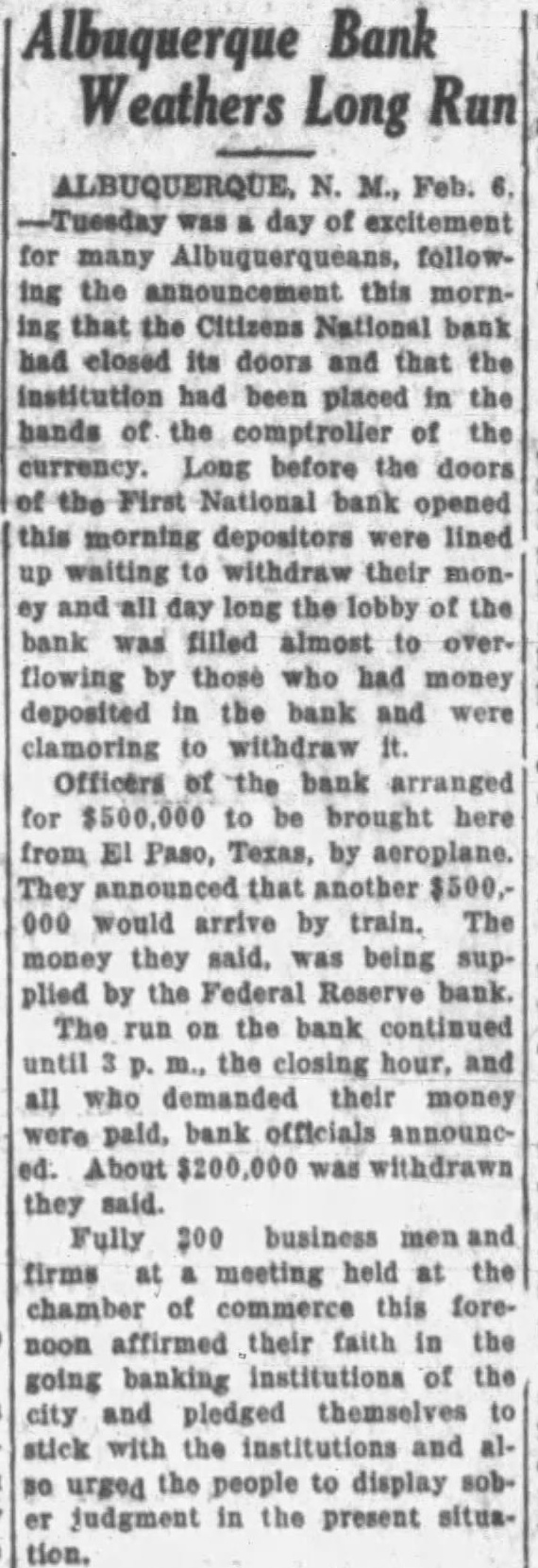
Albuquerque Bank Weathers Long Run ALBUQUERQUE, N. M., Feb. 6.β€”Tuesday was a day of excitement for many Albuquerqueans, following the announcement this morning that the Citizens National bank had closed its doors and that the institution had been placed in the hands of the comptroller of the currency. Long before the doors of the First National bank opened this morning depositors were lined up waiting to withdraw their money and all day long the lobby of the bank was filled almost to overflowing by those who had money deposited in the bank and were clamoring to withdraw it. Officers of the bank arranged for $500,000 to be brought here from El Paso, Texas, by aeroplane. They announced that another $500,000 would arrive by train. The money they said, was being supplied by the Federal Reserve bank. The run on the bank continued until 3 p. m., the closing hour, and all who demanded their money were paid, bank officials announced. About $200,000 was withdrawn they said. Fully 300 business men and firms at a meeting held at the chamber of commerce this forenoon affirmed their faith in the going banking institutions of the city and pledged themselves to stick with the institutions and also urged the people to display sober judgment in the present situation.


Article from Wilkes-Barre Times Leader, the Evening News, February 13, 1924

Click image to open full size in new tab

Article Text

MAJ. HEFFERNAN'S FLIGHT SAVES BANK WHEN RUN STARTS Major Leo G. Heffernan, a brother of John, Thomas F. and Dr. Andrew Heffernan, of this city, played a prominent part in the events which caused much excitement in the City of Albuquerque, N. M., yesterday. Notice that the Citizens National Bank of that town had closed its doors was the means of directing the footsteps of its depositors to the direction of the paying tellers window and the spread of the news was sufficient to cause a run on the bank. Officers of the bank immediately arranged for the delivery of $500,000 by aeroplane from El Paso and at 11:15 a. m. Major Heffernan, commander of the Twelfth Observation Squadron left Fort Bliss with the money. It was delivered two hours later to the First National Bank of Albuquerque, a distance of two hundred and thirty-four miles from Fort Bliss. The receipt of the money in such short order was the means of stopping the run. It continued until three o'clock the same day when the ability of the bank to pay off all who demanded their money was apparent. Major Heffernan has had a distinguished record as an army flier and this his latest achievement, is welcome news to his many friends in this city.


Article from The Palmyra Spectator, February 14, 1924

Click image to open full size in new tab

Article Text

AIRPLANE RUN ON BANK. Aug. Berghofer, who with his wife and son are spending the winter in Albuquerque, N. M., sends us a copy of the Morning Journal, of that city, containing an account of a bank run there and how the day was saved by the arrival of an airplane full of money. A part of an extended article reads as follows: As the result of the epidemic of bank failures which has swept over the west during the past year and which culminated in New Mexico with the closing of the Citizens National bank of this city, what was probably the most sensational run in the history of banking in many states was made on the First National Bank of Albuquerque on Tuesday. Throughout the day, from the hour of the opening of the bank until the usual hour of closing came, tellers were busily handing out money to anxious depositors. Even though at times the scene became tense and, as when men sought to allay the fears of those who stood in line by addressing reassuring words to them, it became dramatic, there were moments when the situation assumed a humorous aspect. Money Comes By Plane. The crowd in the bank lobby gave a cheer when, at 2 o'clock in the afternoon, Chief of Police Galusha and Sheriff Felipe Zamora, with a squad of policemen and deputy sheriffs armed with shotguns, cleared a path through which two army officers walked, carrying sacks containing $500,000 in currency. The army men had flown from El Paso in an airplane, bringing the money in the record time of two hours. The plane, in charge of Major Leo G. Hefferman, commander of the Twelfth Observation Squadron, hopped off from Fort Bliss, on order of General Howze, commander at the fort, at 11:15 a. m., and arrived here at 1:15 p. m., covering a distance of 254 miles.