Watervliet Bank (Watervliet, NY)

Episode Information

Episode UID
2694503390507
Episode Type
Suspension → Closure
Bank Type
state
Bank ID
269450339 hash
Start Date
March 1, 1842*
Location
Watervliet, New York (42.730, -73.701)

Metadata

Model
gpt-5-mini (chosen from majority vote of a three-model LLM ensemble)
Short Digest
e121c594515279be

Response Measures

None

Description

Bank was enjoined/put under a receiver after frauds by its cashier; Comptroller later redeemed its circulating notes.

Events (3)

1. March 1, 1842* Receivership
Newspaper Excerpt
sale of the assets of this bank by the receiver; At the sale of the assets of this bank by the receiver, the Comptroller sent an agent to bid on the assets. (WATERVLIET BANK.)
Source
newspapers
2. March 1, 1842* Suspension
Cause
Bank Specific Adverse Info
Cause Details
Cashier committed a series of frauds concealed by false entries and then absconded, prompting injunction and stoppage.
Newspaper Excerpt
The Watervliet Bank was enjoined in March last.
Source
newspapers
3. June 10, 1845 Other
Newspaper Excerpt
The Comptroller of this State has given official notice that he will redeem, at par, the outstanding circulating bills of the ... Watervliet Bank.
Source
newspapers

Newspaper Articles (11)

Article from New-York Daily Tribune, October 24, 1842

Click image to open full size in new tab

Article Text

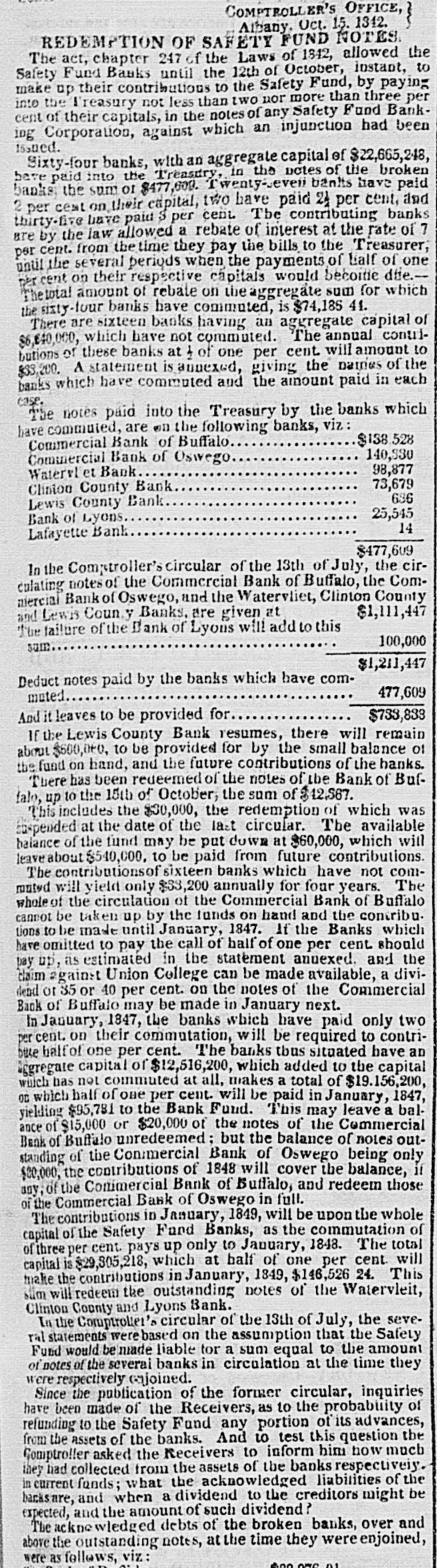
COMPTROLLER'S OFFICE, Albany. Oct. 15. 1342. REDEMPTION OF SAFETY FUND NOTES. The act, chapter 247 of the Laws of 1842, allowed the Safety Fund Banks until the 12th of October, instant, to make up their contributions to the Safety Fund, by paying into the Treasury not less than two nor more than three per cent of their capitals, in the notes of any Safety Fund Banking Corporation, against which an injunction had been issued. Sixty-four banks, with an aggregate capital of $22,665,248, have paid into the Treasdry, in the notes of the broken banks the sum of $477,600. Twenty-Jeveli banks have paid 2 per cest on their capital, two have paid 24 per cent, and thirty-five have paid per cent. The contributing banks are by the law allowed a rebate of interest at the rate of 7 per cent. from the time they pay the bills to the Treasurer, until the several periods when the payments of half of one cent on their respective capitals would becorile dtle.Theirtal amount of rebate on the aggregate sum for which the sixty-lour banks have commuted, is $74,185 41. There are sixteen banks having an aggregate capital of $6,£40,000, which have not commuted. The annual contributions of these banks at 4 of one per cent. will amount to $33,200. A statement is annexed, giving the names of the banks which have commuted and the amount paid in each case. The notes paid into the Treasury by the banks which have commuted, are will the following banks, viz: $138.528 Commercial Bank of Buffalo 140,530 Commercial Bank of Oswego 98,877 Watervl et Bank 73,679 Clinton County Bank 636 Lewis County Bank 25,545 Bank of Lyons 14 Lafayette Bank $477,609 In the Comptroller's circular of the 13th of July, the circulating notes of the Commercial Bank of Buffalo, the Commirrcrai Bank of Oswego, and the Watervliet, Clinton County $1,111,447 and Lewis County Banks. are given at The failure of the ank of Lyons will add to this 100,000 sum $1,211,447 Deduct notes paid by the banks which have com477,609 muted $733,833 And it leaves to be provided for If the Lewis County Bank resumes, there will remain about $600,000, to be provided for by the small balance of the fund on hand, and the future contributions of the banks. There has been redeemed of the notes of the Bank of Buffalo, up to the 15th of October, the sum of $12,587. This includes the $30,000, the redemption of which was suspended at the date of the last circular. The available balance of the fund may be put down at $60,000, which will leave about $540,000. to be paid from future contributions. The contributions of sixteen banks which have not comrouted will yield only $33,200 annually for four years. The whole of the circulation of the Commercial Bank of Buffalo cannot be taken up by the funds on hand and the contributions to be made until January, 1847. If the Banks which have omitted to pay the call of half of one per cent. should pay up, as estimated in the statement annexed. and the claim against Union College can be made available, a dividend or 35 or 40 per cent. on the notes of the Commercial Back of Buffalo may be made in January next. In January, 1847, the banks which have paid only two cent. on their commutation, will be required to contribute half of one per cent. The banks tbus situated have an Cggregate capital of $12,516,200, which added to the capital which has not commuted at all, makes a total of $19.156,200, 00 which half of one per cent. will be paid in January, 1847, yielding $95,781 to the Bank Fund. This may leave a balance of $15,000 or $20,000 of the notes of the Commercial Bank of Buffalo unredeemed; but the balance of notes outstanding of the Con:mercial Bank of Oswego being only $20,000, the contributions of 1848 will cover the balance, if any, of the Commercial Bank of Buffalo, and redeem those of the Commercial Bank of Oswego in full. The contributions in January, 1849, will be uponti whole capital of the Safety Fund Banks, as the commutation of of three per cent. pays up only to January, 1848. The total capital is $29,805,218, which at half of one per cent will make the contributions in January, 1849, $146,526 24. This stim will redeem the outstanding notes of the Watervleit, Clinton County and Lyons Bank. In the Comptrolier's circular of the 13th of July, the several statements were based on the assumption that the Safety Fund would be nade liable for a sum equal to the amount of notes of the several banks in circulation at the time they were respectively cojoined. Since the publication of the former circular, inquiries have been made of the Receivers, as to the probability of refunding to the Safety Fund any portion ot its advances, from the assets of the banks. And to test this question the Comptroller asked the Receivers to inform him how much they had collected from the assets of the banks respectively. in current funds; what the acknowledged liabilities of the backs are, and when a dividend to the creditors might be expected, and the amount of such dividend? The ackne wledged debts of the broken banks, over and above the outstanding notes, at the time they were enjoined, were as follows, viz: 000
Article from New-York Daily Tribune, February 16, 1843

Click image to open full size in new tab

Article Text

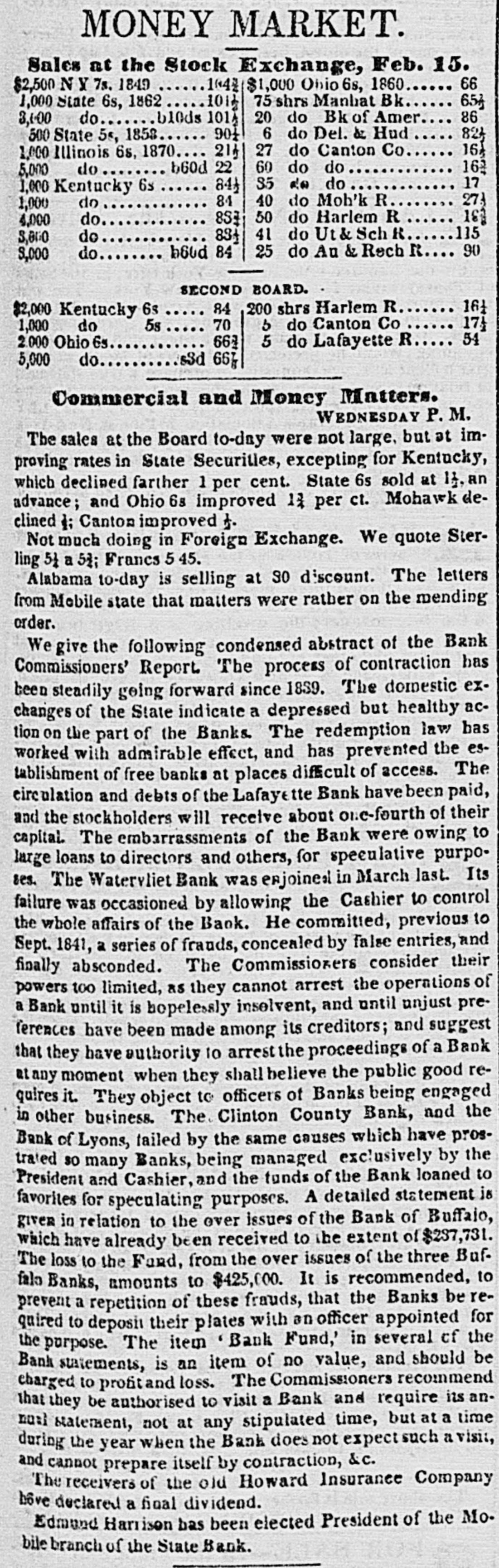
# MONEY MARKET. Sales at the Stock Exchange, Feb. 15. $2,500 N Y 7s. 1849 .164½ $1,000 Ohio 6s, 1860. 66 1,000 State 6s, 1862101½ 75 shrs Manhat Bk. 65¾ 3,000 do..blods 101¼ 20 do Bk of Amer.... 86 500 State 5s, 1858. 90¼ 6 do Del. & Hud 82½ 1,000 Illinois 6s, 1870.... 21½ 27 do Canton Co. 16¼ 5,000 do..b60d 22 60 do do. 16½ 1,000 Kentucky 6s.. 84 35 do do 17 1,000 do 84 40 do Moh'k R.... 27½ 4,000 do 85¾ 50 do Harlem R 16¾ 3,000 do 83¼ 41 do Ut & Sch R.115 5,000 do... b6od 84 25 do Au & Rech R.... 90 SECOND BOARD. $2,000 Kentucky 6s 84 200 shrs Harlem R.. 16½ 1,000 do 5s 70 5 do Canton Co. 17¼ 2.000 Ohio 6s. 66½ 5 do Lafayette R 54 5,000 dossd 66½ # Commercial and Money Matters. WEDNESDAY P. M. The sales at the Board to-day were not large, but at im- proving rates in State Securities, excepting for Kentucky, which declined farther 1 per cent. State 6s sold at 1½, an advance; and Ohio 6s improved 1½ per ct. Mohawk de- clined ¼; Canton improved ½. Not much doing in Foreign Exchange. We quote Ster- ling 5¼ a 5½; Francs 5 45. Alabama to-day is selling at 30 discount. The letters from Mobile state that matters were rather on the mending order. We give the following condensed abstract of the Bank Commissioners' Report. The process of contraction has been steadily going forward since 1839. The domestic ex- changes of the State indicate a depressed but healthy ac- tion on the part of the Banks. The redemption law has worked with admirable effect, and has prevented the es- tablishment of free banks at places difficult of access. The circulation and debts of the Lafayette Bank have been paid, and the stockholders will receive about one-fourth of their capital. The embarrassments of the Bank were owing to large loans to directors and others, for speculative purpo- ses. The Watervliet Bank was erjoined in March last. Its failure was occasioned by allowing the Cashier to control the whole affairs of the Bank. He committed, previous to Sept. 1841, a series of frauds, concealed by false entries, and finally absconded. The Commissioners consider their powers too limited, as they cannot arrest the operations of a Bank until it is hopelessly insolvent, and until unjust pre- ferences have been made among its creditors; and suggest that they have authority to arrest the proceedings of a Bank at any moment when they shall believe the public good re- quires it. They object to officers of Banks being engaged in other business. The Clinton County Bank, and the Bank of Lyons, failed by the same causes which have pros- trated so many Banks, being managed exclusively by the President and Cashier, and the funds of the Bank loaned to favorites for speculating purposes. A detailed statement is given in relation to the over issues of the Bank of Buffalo, which have already been received to the extent of $287,731. The loss to the Fund, from the over issues of the three Buf- falo Banks, amounts to $425,000. It is recommended, to prevent a repetition of these frauds, that the Banks be re- quired to deposit their plates with an officer appointed for the purpose. The item 'Bank Fund,' in several of the Bank statements, is an item of no value, and should be charged to profit and loss. The Commissioners recommend that they be authorised to visit a Bank and require its an- nual statement, not at any stipulated time, but at a time during the year when the Bank does not expect such a visit, and cannot prepare itself by contraction, &c. The receivers of the old Howard Insurance Company have declared a final dividend. Edmund Harrison has been elected President of the Mo- bile branch of the State Bank.


Article from The New York Herald, June 10, 1845

Click image to open full size in new tab

Article Text

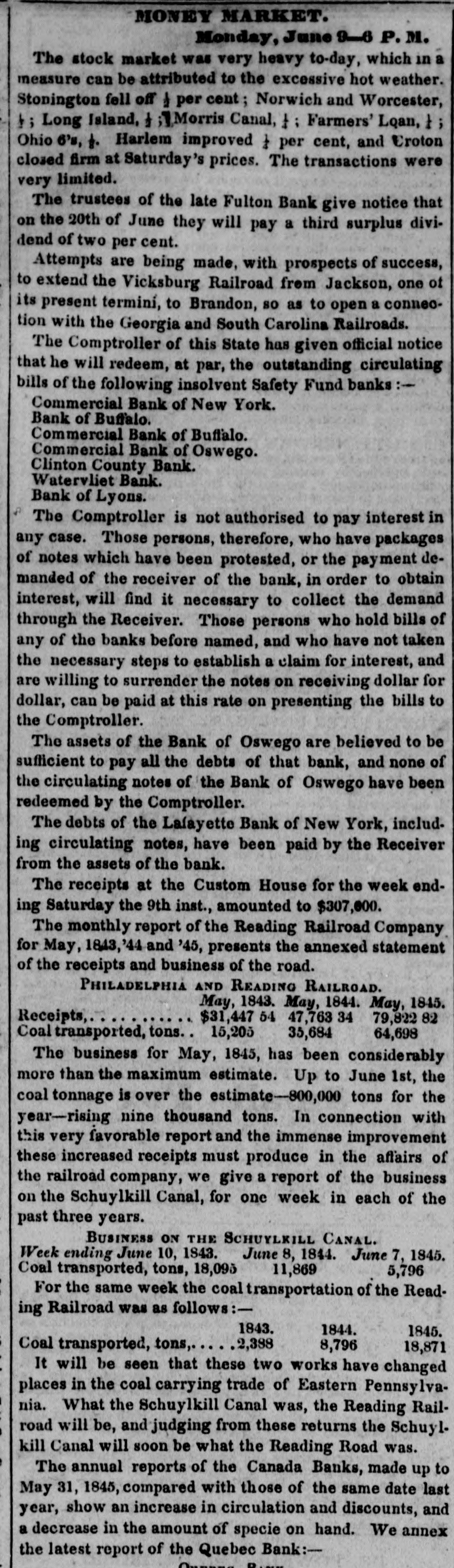
MONEY MARKET. Monday, June 9-6 P.M. The stock market was very heavy to-day, which in a measure can be attributed to the excessive hot weather. Stonington fell off 1 per cent; Norwich and Worcester, 1; Long Island, I Morris Canal, 1; Farmers' Lqan, Ohio 6's, 1. Harlem improved 1 per cent, and Eroton closed firm at Saturday's prices. The transactions were very limited. The trustees of the late Fulton Bank give notice that on the 20th of June they will pay a third surplus dividend of two per cent. Attempts are being made, with prospects of success, to extend the Vicksburg Railroad from Jackson, one of its present termini, to Brandon, so as to open a conneotion with the Georgia and South Carolina Railroads. The Comptroller of this State has given official notice that he will redeem, at par, the outstanding circulating bills of the following insolvent Safety Fund banks:Commercial Bank of New York. Bank of Buffalo. Commercial Bank of Buffalo. Commercial Bank of Oswego. Clinton County Bank. Watervliet Bank. Bank of Lyons. The Comptroller is not authorised to pay interest in any case. Those persons, therefore, who have packages of notes which have been protested, or the payment demanded of the receiver of the bank, in order to obtain interest, will find it necessary to collect the demand through the Receiver. Those persons who hold bills of any of the banks before named, and who have not taken the necessary steps to establish a claim for interest, and are willing to surrender the notes on receiving dollar for dollar, can be paid at this rate on presenting the bills to the Comptroller. The assets of the Bank of Oswego are believed to be sufficient to pay all the debts of that bank, and none of the circulating notes of the Bank of Oswego have been redeemed by the Comptroller. The debts of the Lafayette Bank of New York, includ. ing circulating notes, have been paid by the Receiver from the assets of the bank. The receipts at the Custom House for the week ending Saturday the 9th inst., amounted to $307,000. The monthly report of the Reading Railroad Company for May, 1843,44 and '45, presents the annexed statement of the receipts and business of the road. PHILADELPHIA AND READING RAILROAD. May, 1843. May, 1844. May, 1845. Receipts $31,447 47,763 34 79,822 82 15,205 Coal transported, tons. 35,684 64,698 The business for May, 1845, has been considerably more than the maximum estimate. Up to June 1st, the coal tonnage is over the estimate-800,000 tons for the year-rising nine thousand tons. In connection with this very favorable report and the immense improvement these increased receipts must produce in the affairs of the railroad company, we give a report of the business on the Schuylkill Canal, for one week in each of the past three years. BUSINESS ON THE SCHUYLKILL CANAL. Week ending June 10, 1843. June 8, 1844. June 7, 1845. Coal transported, tons, 18,095 11,869 5,796 For the same week the coal transportation of the Reading Railroad was as follows:1843. 1844. 1845. 2,388 Coal transported, tons, 8,796 18,871 It will be seen that these two works have changed places in the coal carrying trade of Eastern Pennsylvania. What the Schuylkill Canal was, the Reading Railroad will be, and judging from these returns the Schuyl. kill Canal will soon be what the Reading Road was. The annual reports of the Canada Banks, made up to May 31, 1845, compared with those of the same date last year, show an increase in circulation and discounts, and a decrease in the amount of specie on hand. We annex the latest report of the Quebec Bank:-


Article from New-York Daily Tribune, June 11, 1845

Click image to open full size in new tab

Article Text

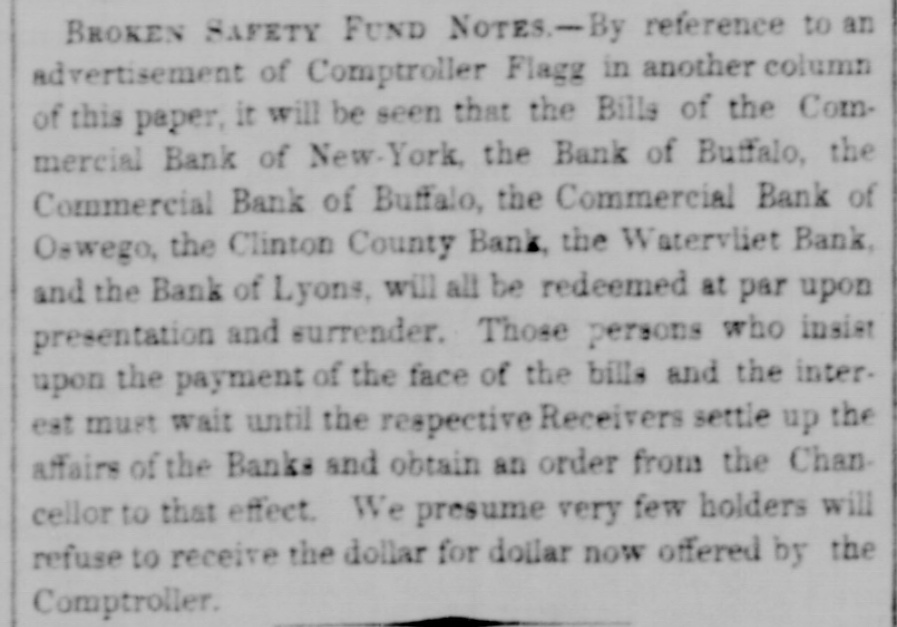
BROKEN SAFETY FUND NOTES. - By reference to an advertisement of Comptroller Flagg in another column of this paper, it will be seen that the Bills of the Commercial Bank of New-York, the Bank of Buffalo, the Commercial Bank of Buffalo, the Commercial Bank of Oswego, the Clinton County Bank the Watervliet Bank, and the Bank of Lyons, will all be redeemed at par upon presentation and surrender. Those persons who insist upon the payment of the face of the bills and the inter. est must wait until the respective Receivers settle up the affairs of the Banks and obtain an order from the Chan cellor to that effect. We presume very few holders will refuse to receive the dollar for dollar now offered by the Comptroller.


Article from The New York Herald, May 27, 1846

Click image to open full size in new tab

Article Text

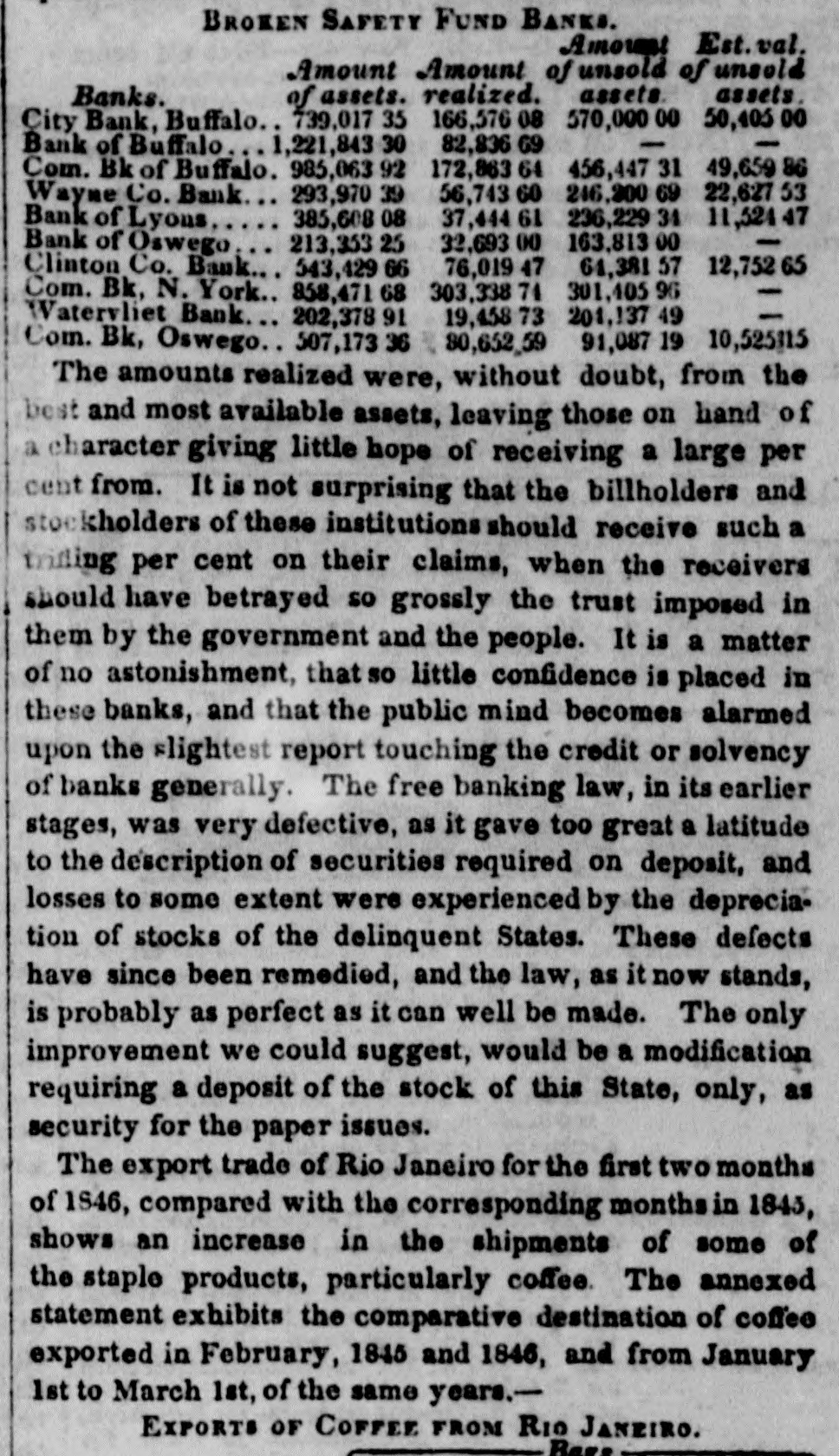
BROKEN SAFETY FUND BANKS. | Banks. | Amount of assets. | Amount realized. | Amount of unsold assets. | Est.val. of unsold assets. | | -------------------- | ----------------- | ----------------- | -------------------------- | -------------------------- | | City Bank, Buffalo.. | 739,017 35 | 166,576 08 | 570,000 00 | 50,405 00 | | Bank of Buffalo... | 1,221,843 30 | 82,836 69 | | | | Com. Bk of Buffalo. | 985,063 92 | 172,863 64 | 456,447 31 | 49,659 86 | | Wayne Co. Bank... | 293,970 39 | 56,743 60 | 246,200 69 | 22,627 53 | | Bank of Lyons. | 385,608 08 | 37,444 61 | 236,229 34 | 11,524 47 | | Bank of Oswego... | 213,353 25 | 32,693 00 | 163,813 00 | | | Clinton Co. Bank... | 543,429 66 | 76,019 47 | 64,381 57 | 12,752 65 | | Com. Bk, N. York.. | 858,471 68 | 303,338 74 | 301,405 96 | | | Watervliet Bank... | 202,378 91 | 19,458 73 | 201,137 49 | | | Com. Bk, Oswego.. | 507,173 36 | 80,652.59 | 91,087 19 | 10,525315 | The amounts realized were, without doubt, from the best and most available assets, leaving those on hand of a character giving little hope of receiving a large per cent from. It is not surprising that the billholders and stockholders of these institutions should receive such a trifling per cent on their claims, when the receivers should have betrayed so grossly the trust imposed in them by the government and the people. It is a matter of no astonishment, that so little confidence is placed in these banks, and that the public mind becomes alarmed upon the slightest report touching the credit or solvency of banks generally. The free banking law, in its earlier stages, was very defective, as it gave too great a latitude to the description of securities required on deposit, and losses to some extent were experienced by the deprecia-tion of stocks of the delinquent States. These defects have since been remedied, and the law, as it now stands, is probably as perfect as it can well be made. The only improvement we could suggest, would be a modification requiring a deposit of the stock of this State, only, as security for the paper issues. The export trade of Rio Janeiro for the first two months of 1846, compared with the corresponding months in 1845, shows an increase in the shipments of some of the staple products, particularly coffee. The annexed statement exhibits the comparative destination of coffee exported in February, 1845 and 1846, and from January 1st to March 1st, of the same years. EXPORTS OF COFFEE FROM RIO JANEIRO. Rare


Article from New-York Daily Tribune, August 27, 1846

Click image to open full size in new tab

Article Text

COMMERCIAL AND MONEY MATTERS. For Sales of Stocks. & see Fourth Page WEDNESDAY. Counterfeit Bank notes. purporting to be 820 bills on the Farmers' Bank of Amsterdam, 83 on the Cumberland Bank and 810billson the Schenectady Bank, of this State have been detected Persons having received such bills are requested to call at the Essex Mar ket Police Office, and make the fact known. The business on the Mohawk Railroad continues to increase. The receipts from the 15th to the 21st of August were $3,174.77. Same time last year, $2,601 It is understood that a loan of $100,000 has been obtained by the Norwich and Worcester Railroad. for the payment of its purchase from the Long Island Road of steamboats, besides the $40,000 paid in cash. The new steamer Atlantic is said to have cost $150,000 and all who have seen. admire and praise her without qualification. Regular trains of cars are now running from Boston to Lexington via Fitchburg Railroad To-day is the first day of running upon the four miles of the Fall River Railroad between South Brain tree and Randolph. The trains will run in connection with the Old Colony Railroad, leaving their dépôt twice a day. A list of subscribers to the Atlantic and St. Law rence Railroad is given in the Portland Bulletin, from which it appears that Bostonians took 177 shares in that enterprise. The charter of another Railroad from Port land, to run through the interior of York County and connect with the Maine, has affected the Portland Saco and Portsmouth stock, but there is great doubt if another line of Railroad can be subscribed for, while that now existing pays so moderate a dividend. The Boston Post says the transactions in divi dend Railroads and Manufacturing Corporations are still very small and prices to a great extent nominal without, however, any indications of yielding on the part of holders to fears that lower rates must be sub mitted to. A lessening of engagements has to a great extent been the rule for some months past, and those who could do so have cut off all speculative operations, 50 88 to be prepared for any reduction of currency or change of Government policy. Lowell Railroad stock is not so much sought for at high rates of premium as before the new Tariff passed. Capital is already devi I ated from trade to a very material extent, by the pay ment for stock in Railroad and Manufacturing Corpora tions, so that, in case of prolonged War with Mexico. 8 revulsion consequent upon the forced withdrawal of these investments might be attended with disastrous consequences. Such revulsion. or any extensive re action, may not take place, but the panic in England from this cause should not be without good effect in preventing excessive and speculative action. Meetings of stockholders in the Nashua and Concord Ronds are called. to ascertain if they favor sub. scriptions to Branch Roads from their own lines, which may, if made, not only aid those now without Railroad facilities, but add to their present large income. There is, however, a doubt with many. who are largely interested, if the extension of Railroads beyond those now in existence or subscribed for. would not be just now an experiment of unfavorable issue. The Suffolk Manufacturing Co. divides eight and the Tremont Mills six per cent. for six months. both payable on the 27th inst. The total receipts of Canal tolls up to 1st August at Geneva, was $24,287.23 same time last year. $16,965 84 excess this year. $7,321.39. The St. Louis Republican of the 19th inst. says For the last ten days, there has been an increased demand for money on good real estate, At ten per cent per annum, without being able to get the loans. Out door rates for good paper from 10 to 15 per annum We have heard of temporary loans as high as one and half ! per cent. per month. Business continues dull, and ne gotiations difficult to make predicated upon shipments of produce to the South. Currency (which constitutes the various Bank notes circulating in this city) has be come quite scarce, and for ordinary purposes is within to 1) of Missouri Bank notes. The Banks and Brokers are drawing freely At per cent. on New-York. Boston and Philadelphia, although the latter cannot be said to be making much at these rates. The amount of property assessed in Lowell for the year 1846, is, real estate, $9,695,346; personal, $5.443.580-total, $15,138,926. being an increase of about half million over 1845. The tax is $115,637 98-70 cents on the $100. Number of polls, 6,437. an increase of 1.040 over 1845. The number of individuals and firms in that city, who pay tax of $50 and upward, is over 140. The total valuation of the Corporations is $9,222,600-INN, $64,558 20. as follows $833 Locks and Canals $3,360 Appleton Company 6,740 Mass. Cotton Mills 6,720 Boott Cotton Mills 11,200 Merrimac o 6,720 Hamilton Company 4,200 Middlesex Co 8,400 Lawrence Company 1,740 588 Prescott Co Lowell Bleachery 3.360 Lowell Machine Shop 2,660 Suffolk Co 3,360 Tremont Mills 3,535 Lowell Company In looking over a Report by the Comptroller. in answer to call from the Convention, we note the follow. ! ing interesting items $17,660,046 June 1, 1846-Canal Debt 1,713,000 Contingent Debt 5,885,549 Treasury Debt $25,258,597 Total liabilities of the State The contingent debt, as above, is for Bonds of the State, loaned to Railroad Companies, which are yet solvent. The largest portion of the Treasury debt madeup by loans to insolvent Railroad Companies. During the year ending June 1. 1846. the State had borrowed $300,000. and paid of principal $2,329,972 and on the 1st of July last, $571,304 more: thus reducing the debt in thirteen months. $2,600,000. In 1842 N law was passed for paying a bounty on salt coal. &c. which has drawn from the Treasury, $377,180 for three years, ending 30th September last. 83 Ordinary expenses of Gov'nt for the year $380.218 Special appropriations and temptry expenses. 368.839.75 Interest on insolvent Railroad stock 237,321.76 The net revenue of the Erie and Champlain Canals, for the last five years, averages a fraction over a million and a half dollars for each year. Unavailable deposits in broken Banks 00 Bk of Brockport $3,715 Lewis Co. Bank 20,000 Bank of Lvons 19,113 S6 Watervliet Bank 42,480 20,912 Bank Co. Clinton Co. Bank 86,200 00 Wayne Lockport Bank 29,700 00 $254,211.6 Total LockptBk&TCo.32,072: 31 The Canal Fund has also in stock issued for I the payment of balances due on account of Ca nal Fund moneys deposited in the Bank of Butfalo, Commercial Bank of Buffalo, and Commercial Bank of Oswego, $314,449.02 Total unavailable loans made to Banks $568,659 [Thompson's Reporter. Carefully reported for The Tribune. Markets WEDNESDAY, August 25. ASHES-The markets for Pots and Pearls is as noticed for long time past: steady at $3 56 for Pots and $4 12) for Pearls. COTTON-The sales to-day have only amounted to some 500 bales at full prices, chiefly to spinners. Export of Cotton from the Ports of the United States, commencing 1st September, IS45. Stock Stock Rec'd


Article from The New York Herald, January 4, 1848

Click image to open full size in new tab

Article Text

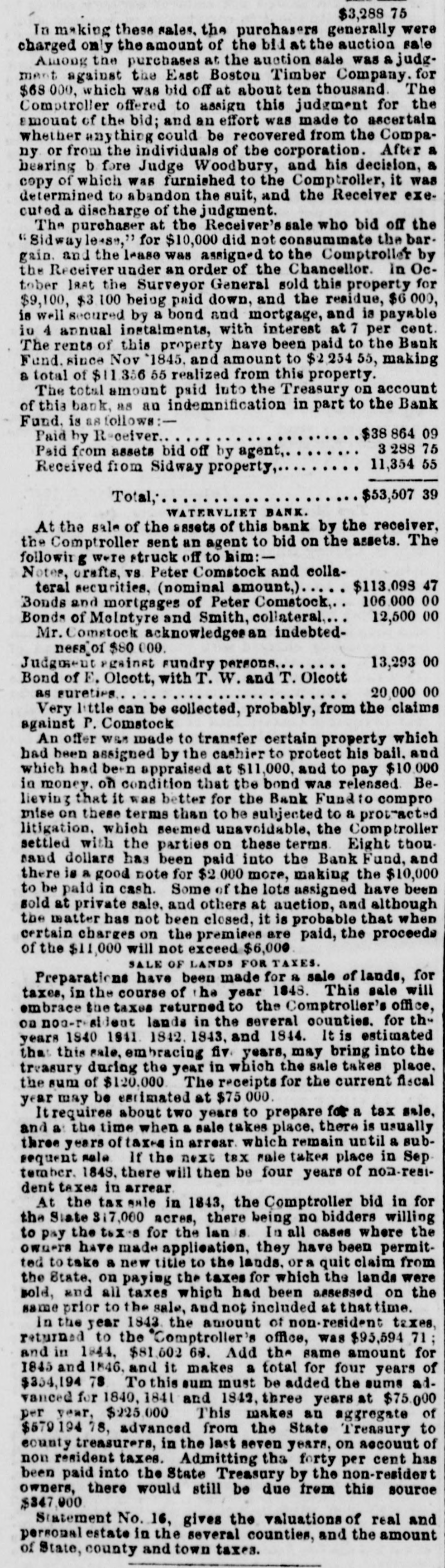
bearing b fore Judge Woodbury, and his decision, a copy of which was furnished to the Comptroller, it was determined to abandon the suit, and the Receiver executed a discharge of the judgment. The purchaser at the Receiver's sale who bid off the " Sidway lease," for $10,000 did not consummate the bargain. and the lease was assigned to the Comptroller by the Receiver under an order of the Chancellor. in October last the Surveyor General sold this property for $9,100, $3,100 being paid down, and the residue, $6 000, is well secured by a bond and mortgage, and is payable io 4 annual instalments, with interest at 7 per cent. The rents of this property have been paid to the Bank Fund. since Nov '1845, and amount to $2,254 55, making a total of $11.356 55 realized from this property. The total amount paid into the Treasury on account of this bank, as an indemnification in part to the Bank Fund, is as follows:$38 864 09 Paid by Receiver 328875 Paid from assets bid off by agent 11,354 Received from Sidway property $53,507 39 Total, WATERVLIET BANK. At the sale of the assets of this bank by the receiver, the Comptroller sent an agent to bid on the assets. The followir 5 were struck off to him:Notes, orafts, vs Peter Comstock and colla$113.098 47 teral securities, (nominal amount,) 106,000 0 Bonds and mortgages of Peter Comstock 12,500 00 Bonds of McIntyre and Smith, collateral Mr. Comstock acknowledgesan indebtedness[of $80 000. 13,293 00 Judgment against sundry persons Bond of E. Olcott, with T. W. and T. Olcott as sureties 20,000 00 Very little can be collected, probably, from the claims against P. Comstock An offer was made to transfer certain property which had been assigned by the cashier to protect his bail. and which had been appraised at $11,000, and to pay $10,000 in money. on condition that the bond was released. Believing that it was better for the Bank Fund to compro mise on these terms than to be subjected to a protracted litigation, which seemed unavoidable, the Comptroller settled with the parties on these terms. Eight thousand dollars has been paid into the Bank Fund, and there is a good note for $2.000 more, making the $10,000 to be paid in cash. Some of the lots assigned have been sold at private sale, and others at auetion, and although the matter has not been closed, it is probable that when certain charges on the premises are paid, the proceeds of the $11,000 will not exceed $6,000 SALE OF LANDS FOR TAXES. Preparations have been made for & sale of lands, for taxes, in the course of the year 1848. This sale will embrace the taxes returned to the Comptroller's office, on non-resident lands in the several counties. for the years 1840 1841. 1842. 1843, and 1844. It is estimated that this sale, embracing fiv. years, may bring into the treasury during the year in which the sale takes place. the sum of $120,000. The receipts for the current fiscal year may be esrimated at $75 000. It requires about two years to prepare for a tax sale, and a: the time when a sale takes place, there is usually three years of taxes in arrear. which remain until a subsequent sale If the next tex sale takes place in September. 1848, there will then be four years of non-restdent taxes in arrear. At the tax sale in 1843, the Comptroller bid in for the State $17,000 acres, there being no bidders willing to pay the texes for the lan 8. In all cases where the owners have made application, they have been permitted to take a new title to the lands, or a quit claim from the State, on paying the taxes for which the lands were sold, and all taxes which had been assessed on the same prior to the sale, and not included at thattime. In the year 1843 the amount of non-resident taxes, returned to the "Comptroller's office, was $95,594 71; and in 1844, $81,602 68. Add the same amount for 1845 and 1846, and it makes a total for four years of $354,194 78 To this sum must be added the sums advanced for 1840, 1841 and 1842, three years at $75.000


Article from New-York Daily Tribune, March 24, 1849

Click image to open full size in new tab

Article Text

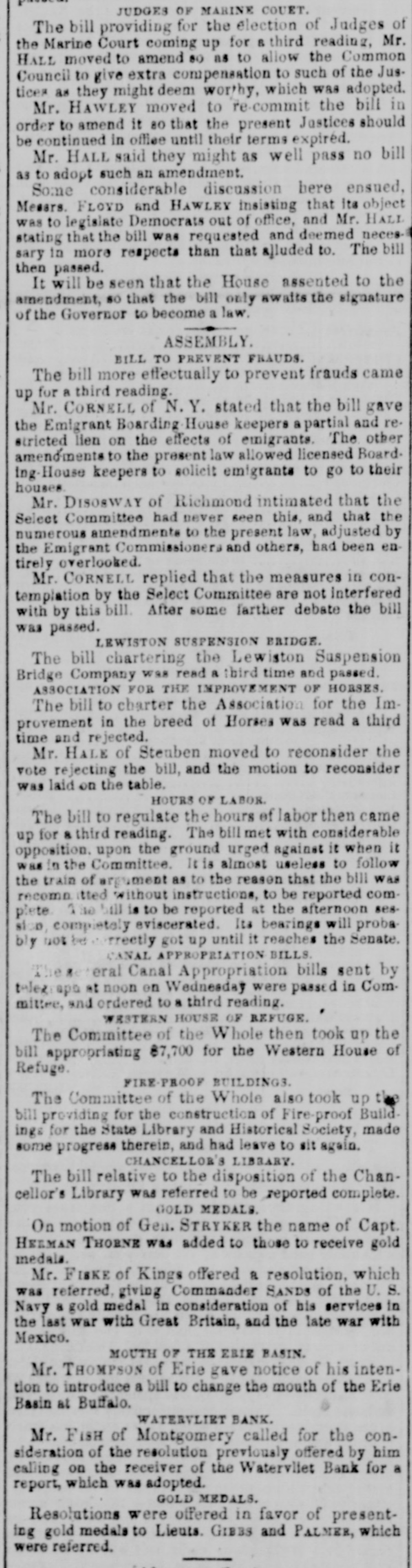
JUDGES OF MARINE COURT. The bill providing for the election of Judges of the Marine Court coming up for & third reading, Mr. HALL moved to amend so as to allow the Common Council to give extra compensation to such of the Justices as they might deem worthy, which was adopted. Mr. HAWLEY moved to re-commit the bill in order to amend it 80 that the present Justices should be continued in office until their terms expired. Mr. HALL said they might as well pass no bill as to adopt such an amendment. Some considerable discussion here ensued, Meters. FLOYD and HAWLEY insisting that its object was to legislate Democrats out of office, and Mr. HALL stating that the bill was requested and deemed necessary in more respects than that &jluded to. The bill then passed. It will be seen that the House assented to the amendment, so that the bill only awaits the signature of the Governor to become a law. ASSEMBLY. BILL TO PREVENT FRAUDS. The bill more effectually to prevent frauds came up for a third reading. Mr. CORNELL of N.Y. stated that the bill gave the Emigrant Boarding House keepers a partial and restricted lien on the effects of emigrants. The other amendments to the present law allowed licensed Board. ing-House keepers to solicit emigrants to go to their houses Mr. DISO&WAY of Richmond intimated that the Select Committee had never seen this. and that the numerous amendments to the present law, adjusted by the Emigrant Commissioners and others, had been entirely overlooked. Mr. CORNELL replied that the measures in contemplation by the Select Committee are not interfered with by this bill. After some farther debate the bill was passed. LEWISTON SUSPENSION BRIDGE. The bill chartering the Lewiston Suspension Bridge Company was read a third time and passed. ASSOCIATION FOR THE IMPROVEMENT OF HORSES. The bill to charter the Association for the Improvement in the breed of Horses was read a third time and rejected. Mr. HALE of Steuben moved to reconsider the vote rejecting the bill, and the motion to reconsider was laid on the table. HOURS OF LABOR. The bill to regulate the hours of labor then came up for & third reading. The bill met with considerable opposition. upon the ground urged against it when it was in the Committee. It is almost useless to follow the train of argument as to the reason that the bill was recome tted without instructions, to be reported complete The bill is to be reported at the afternoon sessico, completely eviscerated Its bearings will proba bly not be rreetly got up until it reaches the Senate. CANAL APPROPRIATION BILLS. The eral Canal Appropriation bills sent by telex apa at noon on Wednesday were passed in Committee, and ordered to a third reading. . WESTERN HOUSE OF REFUGE. The Committee of the Whole then took up the bill appropriating 87,700 for the Western House of Refuge. FIRE-PROOF BUILDINGS. The Committee of the Whole also took up the bill providing for the construction of Fire-proof Build ings for the State Library and Historical Society, made some progress therein, and had leave to sit again. CHANCELLOR'S LIBRARY. The bill relative to the disposition of the Chancellor's Library was referred to be reported complete. GOLD MEDALS. On motion of Gen. STRYKER the name of Capt. HERMAN THORNE was added to those to receive gold medals Mr. FIKKE of Kings offered a resolution, which was referred giving Commander SANDS of the U.S. Navy a gold medal in consideration of his services in the last war with Great Britain, and the late war with Mexico. MOUTH 07 THE ERIE BASIN. Mr. THOMPSON of Erie gave notice of his intention to introduce a bill to change the mouth of the Erie Basin at Buffalo. WATERVLIET BANK. Mr. FISH of Montgomery called for the consideration of the resolution previously offered by him calling on the receiver of the Watervliet Bank for a report, which was adopted. GOLD MEDALS. Resolutions were offered in favor of presenting gold medals to Lieuts. GIBBS and PALMER, which were referred.


Article from New-York Daily Tribune, April 9, 1849

Click image to open full size in new tab

Article Text

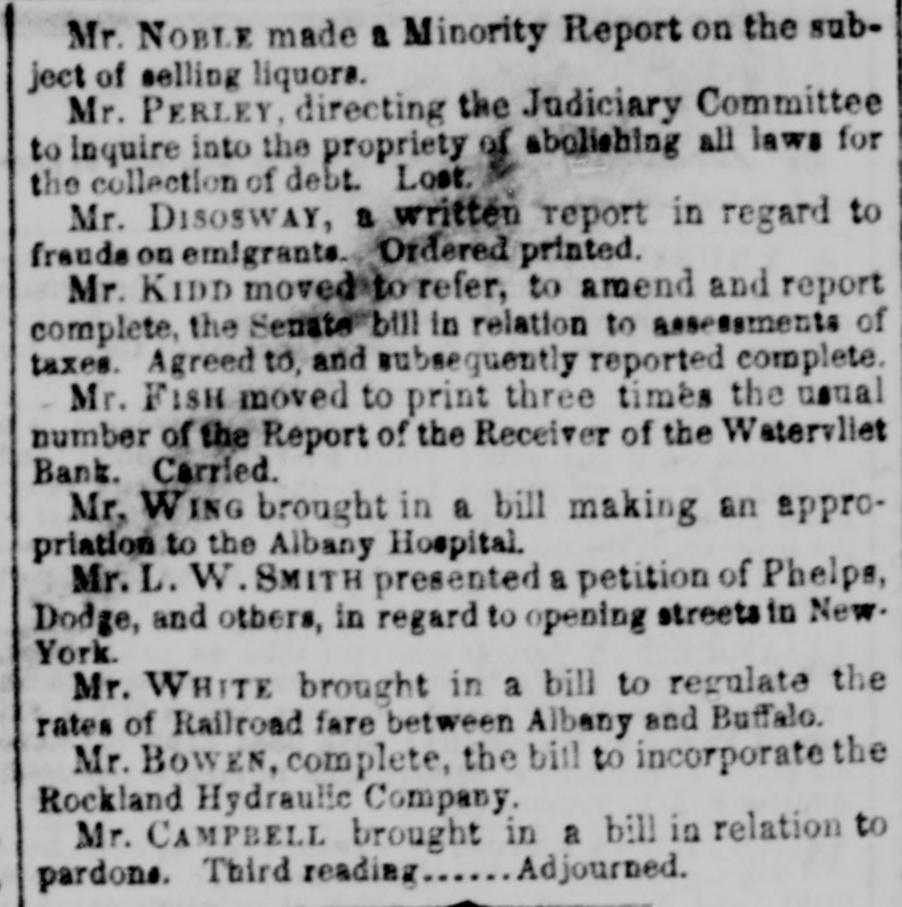
Mr. NOBLE made a Minority Report on the subject of selling liquors. Mr. PERLEY, directing the Judiciary Committee to inquire into the propriety of abolishing all laws for the collection of debt. Lost. Mr. DISOSWAY, a written report in regard to frauds on emigrants, Ordered printed. Mr. KIDD moved to refer, to amend and report complete, the Senate bill in relation to assessments of taxes. Agreed t to, and subsequently reported complete. Mr. FISH moved to print three times the usual number of the Report of the Receiver of the Watervliet Bank. Carried. Mr. WING brought in a bill making an appropriation to the Albany Hospital. Mr. L. W. SMITH presented a petition of Phelps, Dodge, and others, in regard to opening streets in New. York. Mr. WHITE brought in a bill to regulate the rates of Railroad fare between Albany and Buffalo. Mr. BOWEN, complete, the bill to incorporate the Rockland Hydraulie Company. Mr. CAMPBELL brought in a bill in relation to Adjourned. pardone. Third reading


Article from The New York Herald, January 9, 1851

Click image to open full size in new tab

Article Text

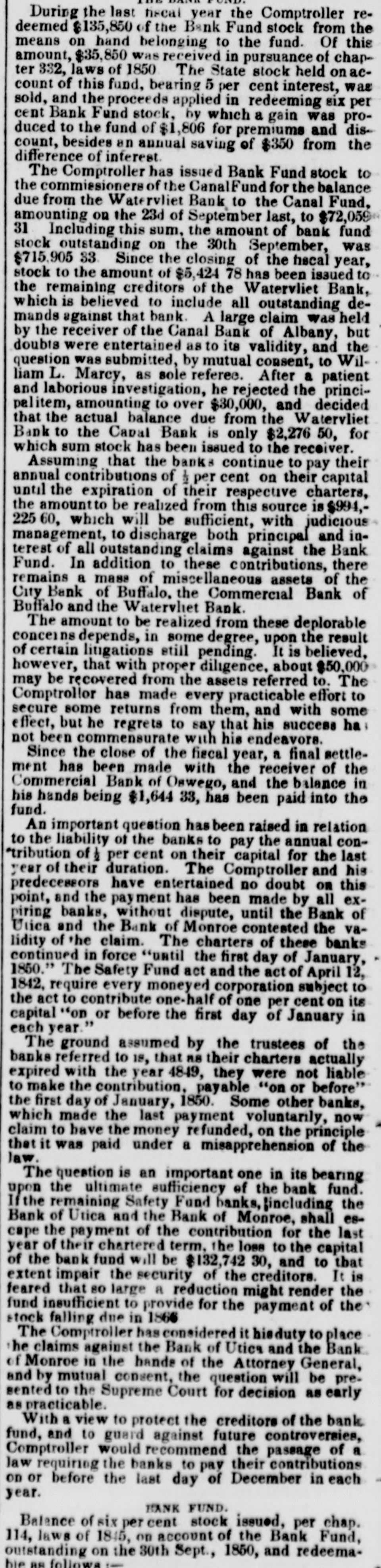
reDuring the last fiscal year the Comptroller deemed $135,850 of the Bank Fund stock from the means on hand belonging to the fund. Of this amount, $35,850 was received in pursuance of chapter 332, laws of 1850 The State stock held naccount of this fund, bearing 5 per cent interest, was sold, and the proceeds applied in redeeming six per cent Bank Fund stock, by which a gain was produced to the fund of $1,806 for premiums and discount, besides an annual saving of $350 from the difference of interest. The Comptroller has issued Bank Fund stock to the commissioners of the CanalFund for the balance due from the Watervliet Bank to the Canal Fund. amounting on the 23d of September last, to $72,059 31 Including this sum, the amount of bank fund stock outstanding on the 30th September, was $715,905 33 Since the closing of the fiscal year, stock to the amount of $5,424 78 has been issued to the remaining creditors of the Watervliet Bank, which is believed to include all outstanding demands against that bank. A large claim was held by the receiver of the Canal Bank of Albany, but doubts were entertained as to its validity, and the question was submitted, by mutual consent, to William L. Marcy, as sole referee. After a patient and laborious investigation, he rejected the principalitem, amounting to over $30,000, and decided that the actual balance due from the Watervliet Bank to the Capal Bank is only $2,276 50, for which sum stock has been issued to the receiver. Assuming that the banks continue to pay their annual contributions of 1/2 per cent on their capital until the expiration of their respective charters, the amountto be realized from this source is $994,225 60, which will be sufficient, with judicious management, to discharge both principal and interest of all outstanding claims against the Bank Fund. In addition to these contributions, there remains a mass of miscellaneous assets of the City Bank of Buffalo. the Commercial Bank of Buffalo and the Watervhet Bank. The amount to be realized from these deplorable conceins depends, in some degree, upon the result of certain litigations still pending. It is believed, however, that with proper diligence. about $50,000 may be recovered from the assets referred to. The Comptrollor has made every practicable effort to secure some returns from them, and with some effect, but he regrets to say that his success ha not been commensurate with his endeavors. Since the close of the fiscal year, a final settlement has been made with the receiver of the Commercial Bank of Oswego, and the balance in his hands being $1,644 33, has been paid into the fund. An important question has been raised in relation to the liability of the banks to pay the annual con"tribution of & per cent on their capital for the last year of their duration. The Comptroller and his predecessors have entertained no doubt OR this point, and the payment has been made by all expiring banks, without dispute, until the Bank of Ulica and the Bank of Monroe contested the validity of the claim. The charters of these banks continued in force "until the first day of January, 1850." The Safety Fund act and the act of April 12, 1842, require every moneyed corporation subject to the act to contribute one-half of one per cent on its capital "on or before the first day of January in each year." The ground assumed by the trustees of the banks referred to 18, that R8 their charters actually expired with the year 4849, they were not liable to make the contribution. payable "on or before" the first day of January, 1850. Some other banks, which made the last payment voluntarily, now claim to have the money refunded, on the principle that it was paid under a misapprehension of the law. The question is an important one in its bearing upon the ultimate sufficiency of the bank fund. f the remaining Safety Fund banks, including the Bank of Utica and the Bank of Monroe, shall escape the payment of the contribution for the last year of their chartered term, the loss to the capital of the bank fund will be $132,742 30, and to that extent impair the security of the creditors. It is feared that 80 large a reduction might render the fund insufficient to provide for the payment of the stock falling due in 1866 The Comptroller has considered it hisduty to place he claims against the Bank of Utica and the Bank of Monroe in the hands of the Attorney General, and by mutual consent, the question will be presented to the Supreme Court for decision as early practicable. With a view to protect the creditors of the bank fund, and to guard against future controversies, Comptroller would recommend the passage of a law requiring the banks to pay their contributions on or before the last day of December in each year. BANK FUND. Balance of six per cent stock issued, per chap. 114, laws of 1845, on account of the Bank Fund, outstanding on the 30th Sept., 1850, and redeemahie BR follows


Article from New-York Daily Tribune, January 10, 1851

Click image to open full size in new tab

Article Text

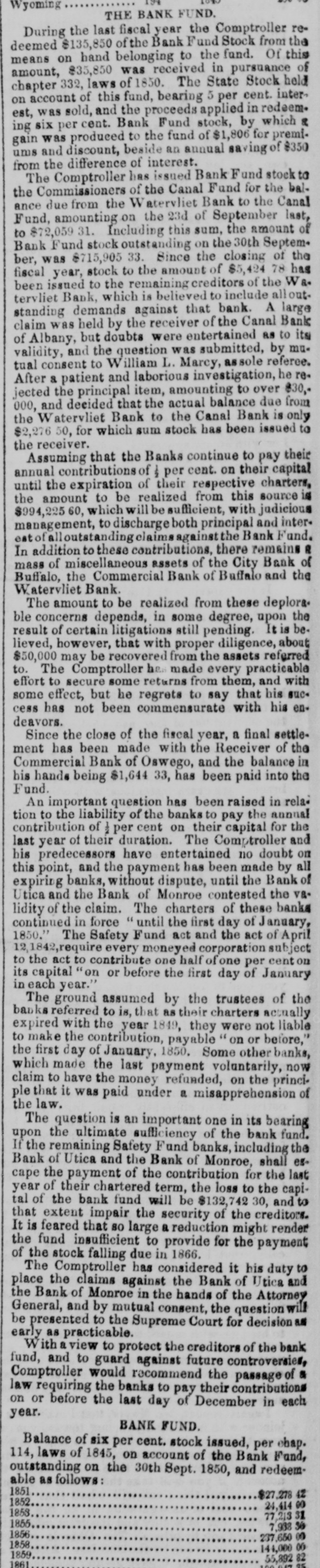
Wyoming THE BANK FUND. During the last fiscal year the Comptroller redeemed $135,850 of the Bank Fund Stock from the means on hand belonging to the fund. Of this of amount, $35,850 was received in pursuance chapter 332, laws of 1850. The State Stock inter hold account of this fund, bearing 5 per cent. on was sold, and the proceeds applied in redeem. ing est, six per cent. Bank Fund stock, by which & was produced to the fund of $1,806 for premigain ums and discount, beside an annual saving of $350 from the difference of interest. The Comptroller has issued Bank Fund stock to the Commissioners of the Canal Fund for the balance due from the Watervliet Bank to the Canal Fund, amounting on the 23d of September last, to $72,059 31. Including this sum, the amount of Bank Fund stock outstanding on the 30th Septem+ ber, was $715,905 33. Since the closing of the fiscal year, stock to the amount of $5,424 78 W& has been issued to the remaining creditors of the tervliet Bank, which is believed to include allout. standing demands against that bank. A large claim was held by the receiver of the Canal Bank of Albany, but doubts were entertained as to its validity, and the question was submitted, by mutual consent to William L. Marcy, ssole referee. After a patient and laborious investigation, he re. jected the principal item, amounting to over $30, 000, and decided that the actual balance due from the Watervliet Bank to the Canal Bank is only $2,276 50, for which sum stock has been issued to the receiver. Assuming that the Banks continue to pay their annual contributions of 1/2 per cent. on their capital until the expiration of their respective charters, the amount to be realized from this source is $994,225 60, which will be sufficient, with judicious management, to discharge both principal and inter. est of alloutstanding claims against the Bank Fund. In addition to these contributions, there remains R mass of miscellaneous assets of the City Bank of Buffalo, the Commercial Bank of Buffalo and the Watervliet Bank. The amount to be realized from these deplora. ble concerns depends, in some degree, upon the result of certain litigations still pending. It is be. lieved, however, that with proper diligence, about $50,000 may be recovered from the assets referred to. The Comptroller he made every practicable effort to secure some returns from them, and with some effect, but he regrets to say that his suc. cess has not been commensurate with his endeavors. Since the close of the fiscal year, a final settlement has been made with the Receiver of the Commercial Bank of Oswego, and the balance in his hands being $1,644 33, has been paid into the Fund. An important question has been raised in rela tion to the liability of the banks to pay the annual contribution of 1/2 per cent on their capital for the last year of their duration. The Comptroller and his predecessors have entertained no doubt on this point, and the payment has been made by all expiring banks, without dispute, until the Bank of Utica and the Bank of Monroe contested the VA. lidity of the claim. The charters of these banks continued in force " until the first day of January, 1850." The Safety Fund act and the act of April 12,1842, require every moneyed corporation subject to the act to contribute one half of one per centon its capital on or before the first day of January in each year." The ground assumed by the trustees of the banks referred to is, that as their charters actually expired with the year 1849, they were not liable to make the contribution, payable " on or before," the first day of January. 1850. Some other banks, which made the last payment voluntarily, now claim to have the money refunded, on the principle that it was paid under a misapprehension of the law. The question is an important one in its bearing upon the ultimate sufficiency of the bank fund. If the remaining Safety Fund banks, including the Bank of Utica and the Bank of Monroe, shall egcape the payment of the contribution for the last year of their chartered term, the loss to the capital of the bank fund will be $132,742 3 and to that extent impair the security of the creditors. It is feared that so large a reduction might render the fund insufficient to provide for the payment of the stock falling due in 1866. The Comptroller has considered it his duty to place the claims against the Bank of Utica and the Bank of Monroe in the hands of the Attorney General, and by mutual consent, the question will be presented to the Supreme Court for decision as early as practicable. With view to protect the creditors of the bank fund, and to guard against future controversies, Comptroller would recommend the passage of & law requiring the banks to pay their contributions on or before the last day of December in each year. BANK FUND. Balance of six per cent. stock issued, per obap. 114, laws of 1845, on account of the Bank Fund, outstanding on the 30th Sept. 1850, and redeemable as follows 1851 $27,278.42 1852 24,414 00 1858 77,213 31 1855 7,938 $ 30 1856 237,650 00 1858 144,000 00 1859 55,892 82 1861