Commercial Bank of Lake Erie (Cleveland, OH)

Episode Information

Episode UID
2257588190507
Episode Type
Suspension โ†’ Closure
Bank Type
state
Bank ID
225758819 hash
Start Date
March 1, 1842*
Location
Cleveland, Ohio (41.499, -81.695)

Metadata

Model
gpt-5-mini (chosen from majority vote of a three-model LLM ensemble)
Short Digest
2b2bec4d3a073a18

Response Measures

None

Description

Receivers appointed and commissioners wound up affairs; commissioners later prosecuted.

Events (3)

1. March 1, 1842* Suspension
Cause
Bank Specific Adverse Info
Cause Details
Bank closed permanently and placed in hands of receivers due to insolvency/failed condition.
Newspaper Excerpt
the Commercial Bank of Lake Erie closed its doors for the last time to day.
Source
newspapers
2. December 1, 1842* Receivership
Newspaper Excerpt
Cleveland Bank, and the Commercial Bank of Lake Erie, were put in the hands of receivers. The persons appointed as Commissioners, to wind up the concerns of the Commercial Bank of Lake Erie, at Cleveland, have lately been prosecuted for malpractices, ... the receivers were arrested and brought before ... Magistrate Benedict. (Jan 1843 article describes prosecutions.)
Source
newspapers
3. July 12, 1845 Other
Newspaper Excerpt
the affairs of the Commercial Bank of Lake Erie are now fully closed, and a distribution of its assets has been made to the stock-holders of nearly sixty cents on the dollar. The liabilities of the Bank, not paid by the Special Commissioners, have been assumed by Joseph S. Lake, of Cleveland, who has given bonds ...
Source
newspapers

Newspaper Articles (10)

Article from Richmond Enquirer, March 1, 1842

Click image to open full size in new tab

Article Text

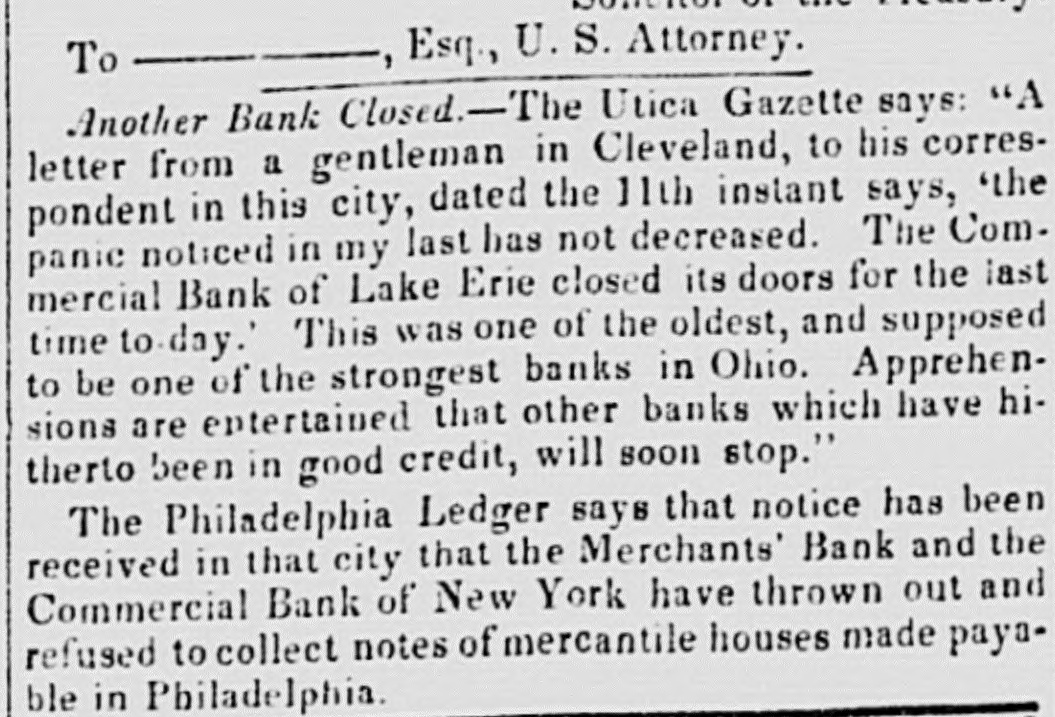
Esq., U. S. Attorney. To Another Bank Closed.-The Utica Gazette says: "A letter from a gentleman in Cleveland, to his correspondent in this city, dated the 11th instant says, 'the panic noticed in my last has not decreased. The Com. mercial Bank of Lake Erie closed its doors for the last time to day.' This was one of the oldest, and supposed to be one of the strongest banks in Ohio. Apprehensions are entertained that other banks which have hitherto been in good credit, will soon stop." The Philadelphia Ledger says that notice has been received in that city that the Merchants' Bank and the Commercial Bank of New York have thrown out and refused to collect notes of mercantile houses made payable in Philadelphia.


Article from Carroll Free Press, December 16, 1842

Click image to open full size in new tab

Article Text

BANKS AT CLEVELAND It will be remembered that Cleveland Bank, and the Commercial Bank of Lake Erie, were put in the hands of receivers. The office was a fat one, and there was among the faithful to It fell to the of a scramble Locos. lot of certain lead ers the and they went to the work of winding up these "swindling Banks," good honest men! under a sala. of $1,500. This was remonstrated at the of hard were ap against the money time. class But six receivers for pointed, receiving this amount on pay ser vices to be rendered. It would seem, however. that the 'apoilsmen" were not at peace among Complaints were made certain were against themselves. moved. receivers: revelations they Yet no were made arrived law, had to at the term at the they But Court-and the time report their late when, proceedings by held order was on were to Cleveland, this effect. Reports served made them and on the 22d the came up for or the from Judges instant, each Bank. acceptance, question Tuesday, rejection. before and "a to jection Judges Hayward filing protest" Coe for that their effect re-Bissell and Warren (or their acceptance. And now a fine scene was enacted in how men court-quite "spoils" dramatic withal feel, -illustrat- and of what will do H. one the Bank ing Commercial they receivers B Payne, stepped first boards. He denounced the proits authors. was on tests the and All charges The former false. its as to speculation and were thors of 11-a -liars. dishonesty Judge polite-man Hay base, ward this and Mr. responded the Payne au The must go on as to briefly. record-the public Protest could judge the its Meck as was reply, it soothe or correctness. did not satisfy Rice. the this offended of parties, and up rose II. one the receivers of the Cleveland Bank. who made a furious attack on Judges Hay matter, he said a was ward was, and Coe. Locofoco He The quarrel. whole It dog eat deg. meant to expose and disclose, and he did SO in manner and terms as follows: to the $1500 Mr. Rice "In relation charged salary that Judge H of the first to in other to agree to that each, ward duced was the judges suggest it, and sum-that after the Receivers had entered their about the of or was upon made duties and high much approached salaries clam the Receivers, they were and confidentially advised that in case theywould divide their salaries with cer the be the tain continued persons, by $1500 Court!-that salaries would said Receivers were advised and instructed to dismiss the Clerk of the Cleveland because he was a Whig! and an selected for this was to 10 secure other them. Bank, one and from be done the party' of certain secret caususes were the removal two bench--that the favor held, members of and of plot. the Re one and engag. ceivers substitute tings resolved appointed, upon. and his certainly bail ed, even before any proceedings were had to remove-that probably the objections of a member of the Court to certain compromises of the Bank. arose from the fact that he could not comprohe he would up. remisel his debt pay as it pleased; would holders. be and some that Judge the 'poor bill here saide, he owed lief made Hayward to to him, if the reference Bank noth. was ing. Mr. Rice rejoined, that his name wasir the Bank, and he had never heard that it was claimed forgery Such is a specimen of the language to. and the grave charges made of our Court this, while upon against, used Pleas, and judges sitting of Common the bench and in open court. His Honor, Judge Hayward, in anto Mr. Rice, said, among other that there was an rera between them which he the things. swer regretted issue he would of set of 80 much passion ba exhibition tle city elsewhere-that and that and that he felt chagrined should exist between such feeling. a controversy political brethren of the same faithshould do his duty to Bank pro that this insolvent he tearlessly, in relation and in lect the bill-holders as far as his power. That in relation to the $1500 salaries, first came to him, that the fixed ed him. Mr. Rice stockholders should And had not inform that sum-that he acoffice unless it was cept the upon allowed- the the Bank was able to pay bill the stockholders con this was and holders. trol as on point-and that should it all then insisted upon that sum, the yielding, high, save other that thought he judges although Judge Warren, they he en fix the salary, quarter deavor who wholly 10 objected-that each should bereafter, according 10 the services.


Article from Wheeling Times and Advertiser, January 27, 1843

Click image to open full size in new tab

Article Text

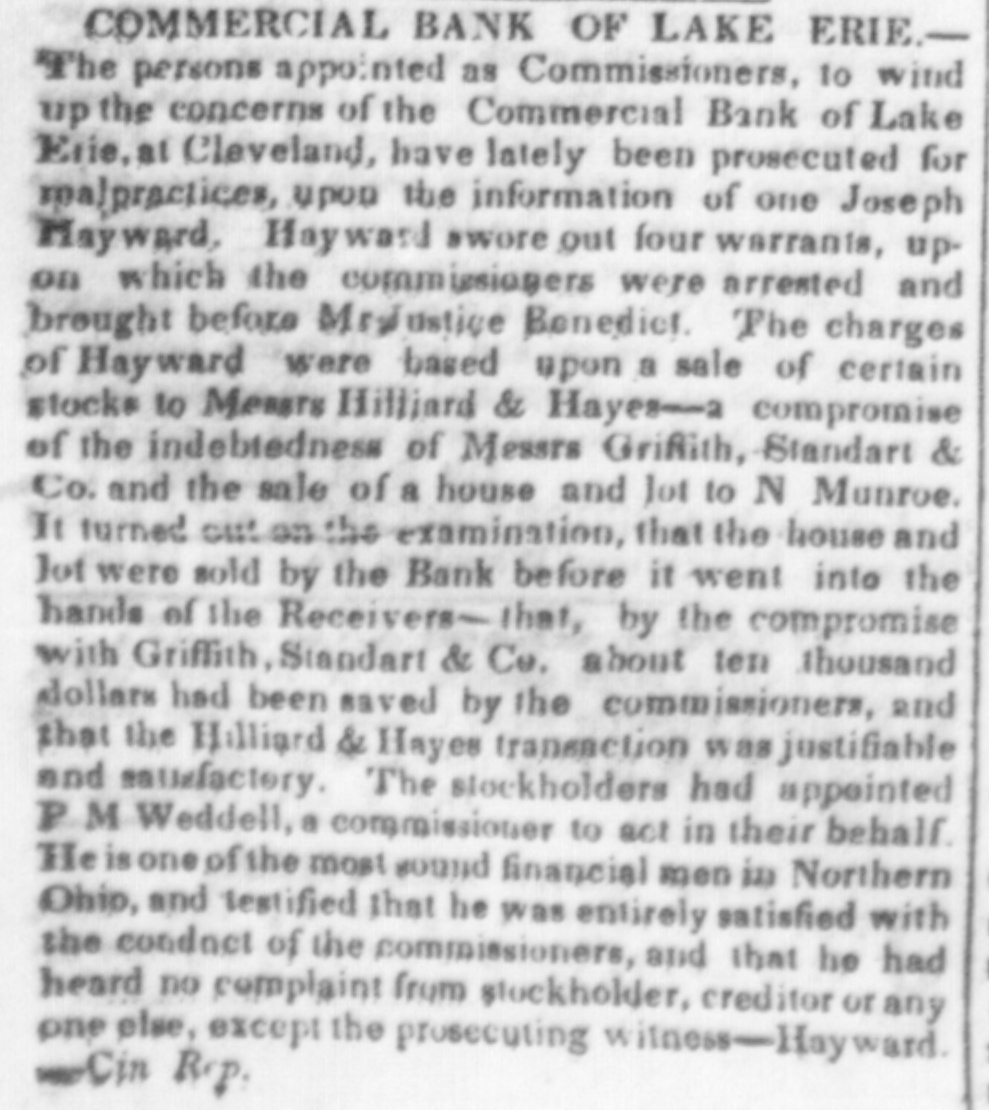
COMMERCIAL BANK OF LAKE ERIE.The persons appointed as Commissioners, to wind up the concerns of the Commercial Bank of Lake Erie, at Cleveland, have lately been prosecuted for malpractices, upon the information of one Joseph Mayward, Hayward swore out four warrants, upon which the commissioners were arrested and brought before Medulistice Benedict. The charges of Hayward were based upon a sale of certain stocks to Mears Hilliard & Hayes--a compromise of the indebtedness of Measts Grifith, Standart & Co. and the sale of a house and lot to N Munroe. It turned out on the examination, that the house and Jot were sold by the Bank before it went into the hands of the Receivers-that, by the compromise with Griffith, Standart & Co. about ten thousand dollars had been saved by the commissioners, and that the Hilliard & Hayes transaction was justifiable and satisfactory. The stockholders had appointed P M Weddell, a commissioner to act in their behalf He is one of the most sound financial men in Northern Ohip, and testified that he was entirely satisfied with the conduct of the commissioners, and that he had heard no complaint from stockholder, creditor or any one else, except the prosecuting witness-Hayward Cin Rep.


Article from New-York Daily Tribune, March 12, 1844

Click image to open full size in new tab

Article Text

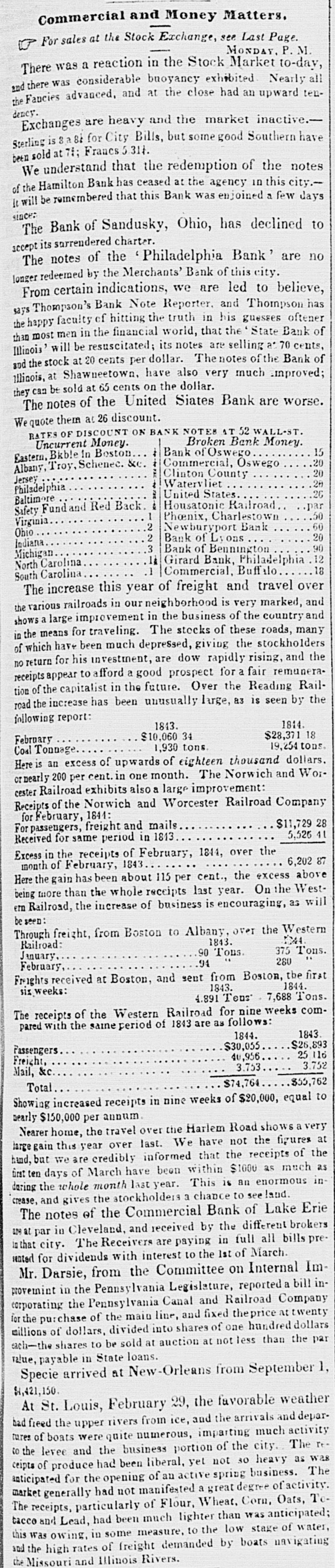
days The Bank of Sandusky, Ohio, has declined to accept its surrendered charter. The notes of the Philadelphia Bank' are no longer redeemed by the Merchants' Bank of this city. From certain indications, we are led to believe, says Thompson's Bank Note Reporter. and Thompson has the happy faculty of hitting the truth in his guesses oftener than most men in the financial world, that the State Bank of Illinoi3' will be resuscitated; its notes are selling a 70 cents, and the stock at 20 cents per dollar. The notes of the Bank of Illinois, at Shawneetown, have also very much improved; they can be sold at 65 cents on the dollar. The notes of the United Siates Bank are worse. Wequote them at 26 discount. RATES OF DISCOUNT ON BANK NOTE8 AT 52 WALL-ST. Broken Bank Money. Uncurrent Money. 15 Bank of Oswego Eastern. Bkble in Boston 20 Commercial, Oswego Albany, Troy, Schenec. &c. 20 Clinton County Jersey 20 Watervliet Philadelphia 26 SEA United States Baltimore : Housatonic Railroad par Safety Fund and Red Back 1 50 Phonex, Charlestown Virginia 60 2 Newburyport Bank Ohio 20 2 Bank of Lyons Indiana 90 3 Bank of Bennington Michigan 1: Girard Bank, Philadelphia .12 North Carolina 18 1 Commercial, Buffalo South Carolina The increase this year of freight and travel over the various railroads in our neighborhood is very marked, and shows a large improvement in the business of the country and in the means for traveling. The stocks of these roads, many of which have been much depressed, giving the stockholders no return for his investment, are dow rapidly rising, and the receipts appear to afford a good prospect for a fair remuneration of the capitalist in the future. Over the Reading Railroad the increase has been unusually large, a3 is seen by the following report: 1814. 1813. $28,371 18 $10,060 34 February 19,254 tons. 1,930 tons. Coal Tonnage Here is an excess of upwards of eighteen thousand dollars. or nearly 200 per cent. in one month. The Norwich and Wor cester Railroad exhibits also a large improvement: Receipts of the Norwich and Worcester Railroad Company for February, 1841: $11,729 28 passengers, freight and mails 5,526 41 Received for same period in 1813 Excess in the receipts of February, 1844, over the 6,202 87 month of February, 1843 Here the gain has been about 115 per cent., the excess above being more than the whole receipts last year. On the Western Railroad, the increase of business is encouraging, as will be seen: Through freight, from Boston to Albany, over the Western 1244 1843. Railroad: 375 Tons. 90 Tous January 280 94 February Freights received at Boston, and sent from Boston, tbe first 1844. 1843. six weeks: 4.891 Tour 7,688 Tons. The receipts of the Western Railroad for nine weeks compared with the same period of 1843 are as follows: 1843 1844. $26,893 $30,055 Passengers 25116 40,956 Freight, 3.752 3.753 Mail, &c $55,762 $74,764 Total Showing increased receipts in nine weeks of $20,000, equal to nearly $150,000 per annum Nearer home, the travel over the Harlem Road shows a very large gain this year over last. We have not the figures at hand, but We are credibly informed that the receipts of the first ten days of March have been within $1000 as much as during the whole month last year. This is an enormous in crease, and gives the stockholders a chance to seeland. The notes of the Commercial Bank of Lake Erie are at par in Cleveland, and received by the different brokers in that city. The Receivers are paying in full all bills presented for dividends with interest to the 1st of March Mr. Darsie, from the Committee on Internal Improvemint in the Pennsylvania Legislature, reported a bill incorporating the Pennsylvania Canal and Railroad Company for the purchase of the main line, and fixed the price at twenty millions of dollars, divided into shares of one hundred dollars each-the shares to be sold at auction at not less than the par value, payable in State loans. Specie arrived at New-Orleans from September 1, $4,421,150 At St. Louis, February 29, the favorable weather had freed the upper rivers from ice, and the arrivals and departures of boats were onite numerous, imparting much activity


Article from The New York Herald, March 17, 1844

Click image to open full size in new tab

Article Text

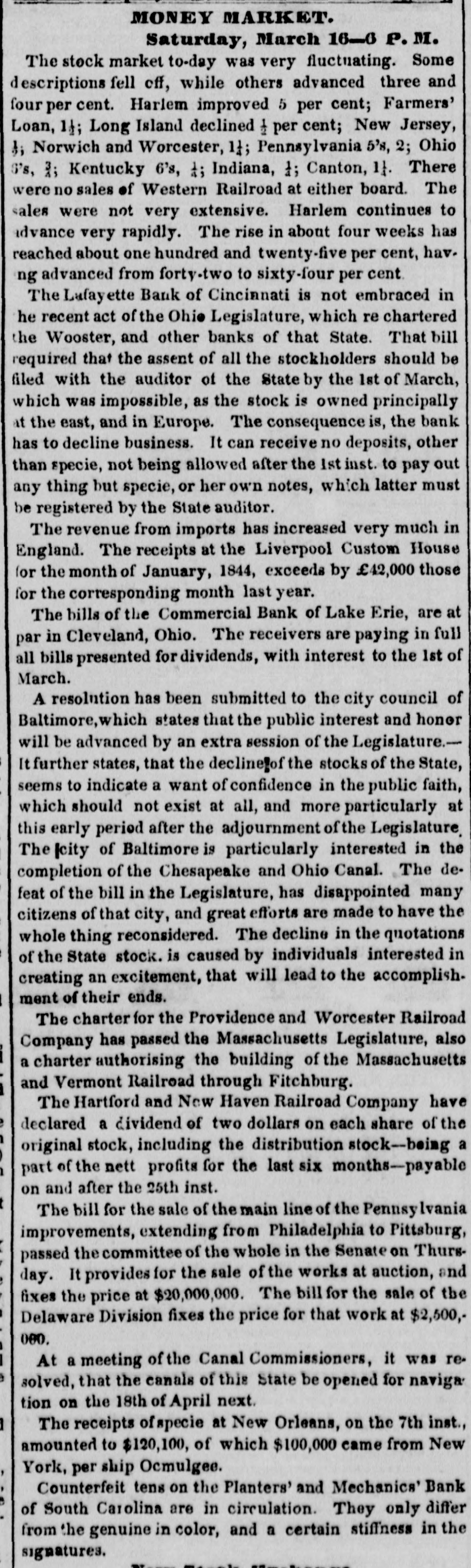
MONEY MARKET. Saturday, March 16-3 P. M. The stock market to-day was very fluctuating. Some descriptions fell off, while others advanced three and four per cent. Harlem improved 5 per cent; Farmers' Loan, 11; Long Island declined 1/2 per cent; New Jersey, 1, Norwich and Worcester, 11; Pennsylvania 5's, 2; Ohio S's, 3; Kentucky 6's, d; Indiana, 1; Canton, 1}. There were no sales of Western Railroad at either board. The sales were not very extensive. Harlem continues to advance very rapidly. The rise in about four weeks has reached about one hundred and twenty-five per cent, hav. ng advanced from forty-two to sixty-four per cent The Lufayette Bank of Cincinnati is not embraced in he recent act of the Ohio Legislature, which re chartered the Wooster, and other banks of that State. That bill required that the assent of all the stockholders should be filed with the auditor of the State by the 1st of March, which was impossible, as the stock is owned principally at the east, and in Europe. The consequence is, the bank has to decline business. It can receive no deposits, other than specie, not being allowed after the 1st inst. to pay out any thing but specie, or her own notes, which latter must be registered by the State auditor. The revenue from imports has increased very much in England. The receipts at the Liverpool Custom House for the month of January, 1844, exceeds by ยฃ42,000 those for the corresponding month last year. The bills of the Commercial Bank of Lake Erie, are at par in Cleveland, Ohio. The receivers are paying in full all bills presented for dividends, with interest to the 1st of March. A resolution has been submitted to the city council of Baltimore, which states that the public interest and honor will be advanced by an extra session of the Legislature.It further states, that the decline of the stocks of the State, seems to indicate a want of confidence in the public faith, which should not exist at all, and more particularly at this early period after the adjournment of the Legislature The Icity of Baltimore is particularly interested in the completion of the Chesapeake and Ohio Canal. The defeat of the bill in the Legislature, has disappointed many citizens of that city, and great efforts are made to have the whole thing reconsidered. The decline in the quotations of the State stock. is caused by individuals interested in creating an excitement, that will lead to the accomplishment of their ends. I The charter for the Providence and Worcester Railroad Company has passed the Massachusetts Legislature, also i a charter authorising the building of the Massachusetts and Vermont Railroad through Fitchburg. i The Hartford and New Haven Railroad Company have e declared a dividend of two dollars on each share of the h original stock, including the distribution stock-being a I part of the nett profits for the last six months-payable on and after the 25th inst. t The bill for the sale of the main line of the Pennsylvania improvements, extending from Philadelphia to Pittsburg, 5 passed the committee of the whole in the Senate on Thursday. It provides for the sale of the works at auction, and p fixes the price at $20,000,000. The bill for the sale of the Delaware Division fixes the price for that work at $2,500,I 000. I I At a meeting of the Canal Commissioners, it was re, solved, that the canals of this State be opened for naviga tion on the 18th of April next. I The receipts of specie at New Orleans, on the 7th inst., amounted to $120,100, of which $100,000 came from New York, per ship Ocmulgee. Counterfeit tens on the Planters' and Mechanics' Bank : of South Carolina are in circulation. They only differ from the genuine in color, and a certain stiffness in the signatures. States -


Article from The Radical, March 30, 1844

Click image to open full size in new tab

Article Text

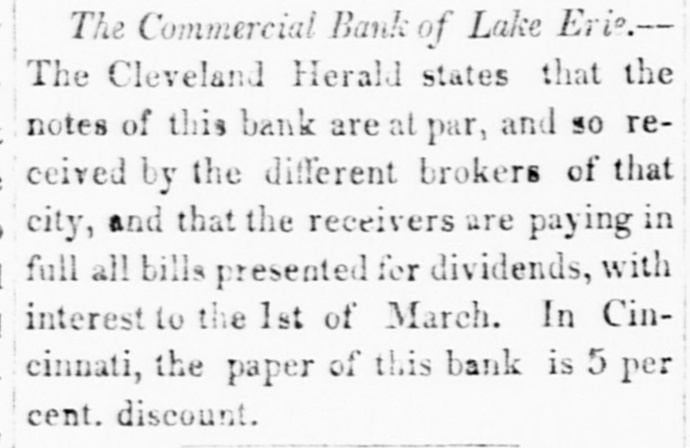
The Commercial Bank of Lake Eris.-The Cleveland Herald states that the notes of this bank are at par, and so received by the different brokers of that city, and that the receivers are paying in full all bills presented for dividends, with interest to the 1st of March. In Cincinnati, the paper of this bank is 5 per cent. discount.


Article from Richmond Palladium, April 5, 1844

Click image to open full size in new tab

Article Text

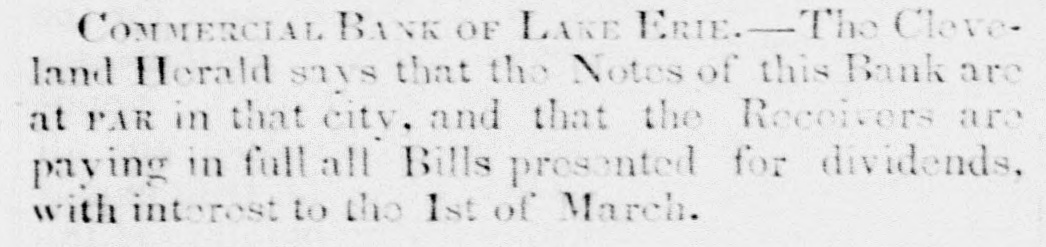
COMMERCIAL BANK OF LAKE ERIE. The Cleveland Herald says that the Notes of this Bank are at PAR in that city, and that the Receivers are paying in full all Bills presented for dividends, with interest to the 1st of March.


Article from Richmond Palladium, April 19, 1844

Click image to open full size in new tab

Article Text

COMMERCIAL BANK OF LAKE ERIE.- The Cleveland Herald says that the Notes of this Bank are at par in that city, and that the Receivers are paying in full all Bills presented for dividends, with interest to the 1st of March.


Article from New-York Daily Tribune, July 12, 1845

Click image to open full size in new tab

Article Text

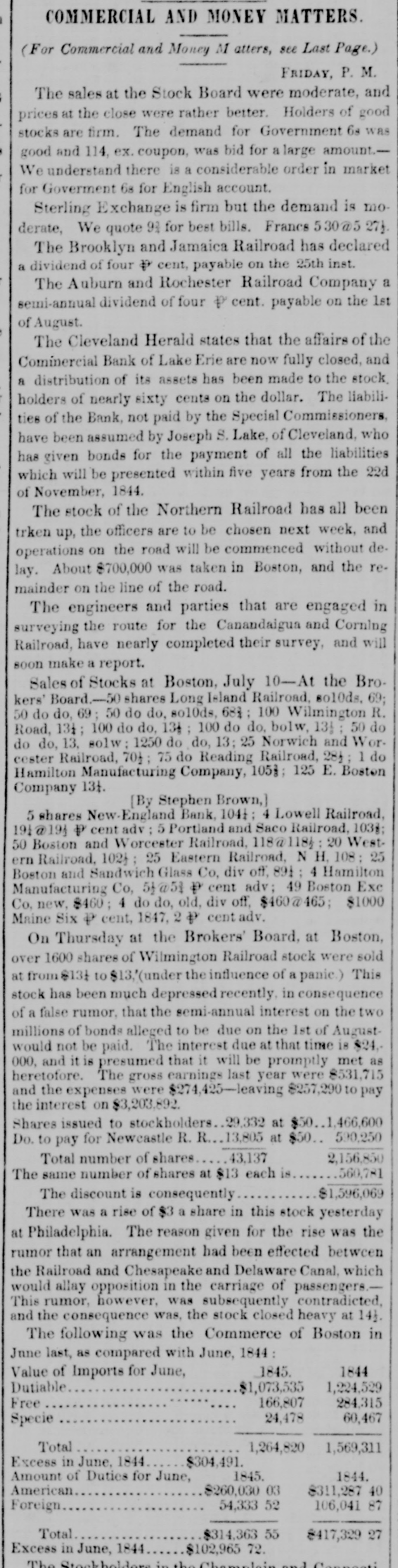
COMMERCIAL AND MONEY MATTERS. (For Commercial and Money M atters, see Last Page.) FRIDAY, P. M. The sales at the Stock Board were moderate, and prices at the close were rather better. Holders of good stocks are firm. The demand for Government 6s was good and 114, ex. coupon, was bid for a large amount.We understand there is a considerable order in market for Goverment 68 for English account. Sterling Exchange is firm but the demand is moderate, We quote 9% for best bills. Francs 530@5 27). The Brooklyn and Jamaica Railroad has declared a dividend of four โ‚ฝ cent, payable on the 25th inst. The Auburn and Rochester Railroad Company a semi-annual dividend of four P cent. payable on the 1st of August. The Cleveland Herald states that the affairs of the Cominercial Bank of Lake Erie are now fully closed, and a distribution of its assets has been made to the stock. holders of nearly sixty cents on the dollar. The liabilities of the Bank, not paid by the Special Commissioners, have been assumed by Joseph S. Lake, of Cleveland, who has given bonds for the payment of all the liabilities which will be presented within five years from the 22d of November, 1844. The stock of the Northern Railroad has all been trken up, the officers are to be chosen next week, and operations on the road will be commenced without delay. About $700,000 was taken in Boston, and the remainder on the line of the road. The engineers and parties that are engaged in surveying the route for the Canandaigua and Corning Railroad, have nearly completed their survey, and will soon make a report. Sales of Stocks at Boston, July 10-At the Brokers' Board.-50 shares Long Island Railroad, solOds. 69; 50 do do, 69: 50 do do, 8010ds, 681 : 100 Wilmington R. Road, 131; 100 do do, 13 100 do do, bolw, 13 50 do do do, 13. solw: 1250 do do, 13: 25 Norwich and Worcester Railroad, 701; 75 do Reading Railroad, 281; 1 do Hamilton Manufacturing Company, 105g: 125 E. Boston Company 13t. [By Stephen Brown,] 5 shares New-England Bank, 1041: 4 Lowell Railroad, 191@19} โ‚ฝ cent adv 5 Portland and Saco Railroad. 1031; 50 Boston and Worcester Railroad, 118@118} : 20 West. ern Railroad, 102) 25 Eastern Railroad, N H. 108: 25 Boston and Sandwich Glass Co, div off, 891 4 Hamilton Manufacturing Co, 51@51 P cent adv: 49 Boston Exc Co. new. $460; 4 do do, old, div off. $460@465; $1000 Maine Six โ‚ฝ cent, 1847, P centadv. On Thursday at the Brokers' Board, at Boston, over 1600 shares of Wilmington Railroad stock were sold at from 8131 to $13,"(under the influence of a panic.) This stock has been much depressed recently, in consequence of a false rumor. that the semi-annual interest on the two millions of bonds alleged to be due on the 1st of Augustwould not be paid. The interest due at that time is $24. 000, and it is presumed that it will be promptly met as heretofore. The gross earnings last year were $531,715 and the expenses were $274,425-leaving $257,290 to pay the interest on $3,203,892. Shares issued to stockholders 29,332 at $50 1,466,600 590,250 Do. to pay for Newcastle R. R 13,805 at $50 43.137 2,156,850 Total number of shares 560,781 The same number of shares at $13 each is $1,596,069 The discount is consequently There was a rise of $3 a share in this stock yesterday at Philadelphia. The reason given for the rise was the rumor that an arrangement had been effected between the Railroad and Chesapeake and Delaware Canal, which would allay opposition in the carriage of passengers.This rumor, however, was subsequently contradicted, and the consequence was, the stock closed heavy at 14}. The following was the Commerce of Boston in June last, as compared with June, 1844: 1844 1845. Value of Imports for June, Dutiable 1,224,529 $1,073,535 166,807 Free 284,315 24,478 60,467 Specie Total 1,264,820 1,569,311 Excess in June, 1844 $304,491. 1845. Amount of Duties for June, 1844. American 8260,030 03 $311,287 40 54,333 52 106,041 8 Foreign Total $314,363 55 $417,329 9 27 $102,965 7 Excess in June, 1844 The

Article from The Spirit of Democracy, January 24, 1846

Click image to open full size in new tab

Article Text

# FOR GOVERNOR OF OHIO, DAVID TOD, of Trumbull. # THE CONSTITUTIONAL CURRENCY. In our paper of last week, we published the proceedings of the Democratic 8th of January Convention, which put in nomination, as the Democratic candidate for Governor of Ohio, the able advocate of equal rights-DAVID TOD. On the first page of to-day's paper will be found the proceedings of the Democratic Editorial State Convention, for which we bespeak an attentive perusal. The democracy of this county are well aware, that, when the democratic party of Ohio raised the "bank reform" banner, in 1838, they were triumphantly victorious at the ensuing elections. The people were well satisfied, from past experience, that the old villanous banking system needed much reformation, in order to secure them from the almost daily loss of thousands of dollars; a loss resulting as well from the total failure of these rascally shaving shops, as from a partial depreciation in the nominal value of their "promises to pay." In accordance with the views and doctrines, at that time advocated, the democratic members of the General Assembly, at subsequent sessions of the Ohio legislature, passed laws which, it was supposed, would have the effect to make bankers honest men; or, in other words, to prevent the old system of bank swindling of "contractions to-day, and expansions to-morrow"- from ever being again fastened upon the people of this State. Laws were enacted making stockholders liable in their individual capacity for the debts of a bank, in case of failure, as well as other laws equally salutary. When these laws were passed, it was thought that the people would, thereafter, be secured from losses by bank failures, and bank suspensions; and that all banks thereafter chartered would have engrafted in their charters these salutary provisions. But how have the people been disappointed in their hopes and expectations? Would bankers accept of charters with the individual liability clause? No. The determination of the moneyed aristocracy of this State was to grind down the people by enormous taxes, by bank failures, and bank suspensions, until they should be brought to tamely submit to any banking proposition that might be brought forward. The result has been, that by "deception, corruption, and accident," the bank power of the State has once more gained the ascendency in our legislative halls. Immediately, all the salutary measures, demanded by the people, were repealed; and a system of banking enforced upon the people only equalled by the old defunct banks of Gallipolis, West Union, and a host of others. Who does not recollect, and, not only recollect, but, by experience, know the thousands, and we might safely say millions, lost to the people of Ohio, by the explosion of such dens of iniquity as the Bank of Cincinnati, German Bank of Wooster, Bank of Steubenville, Bank of Granville, Bank of Urbana, Bank of Gallipolis, Bank of West Union, Miami Exporting Company, new Bank of Circleville, Lebanon Miami Bank, Bank of Cleveland, Commercial Bank of Lake Erie, Commercial Bank of Scioto, and a long list of others in this State, together with the losses sustained by the failure of the banks of the States of Illinois, Michigan, and others; and we might particularly mention as "last though not least," the Bank of St. Clair, familiarly known as the *Red-dog* bank? Have the people, we ask, forgotten all their losses occasioned by the failure of these institutions? No. They feel that forbearance will soon cease to be a virtue; and will, ere long, speak in tones of thunder to those nabobs of the bank-paper-mills, whose only rule of action seems