gpt-5-mini (chosen from majority vote of a three-model LLM ensemble)
Short Digest
25475f853358f5a6
Response Measures
None
Description
Receivership placed the bank in permanent closure and assets were later sold; failure tied to bad loans and frozen building-and-loan notes.
Events (2)
1.May 5, 1925Receivership
Newspaper Excerpt
A temporary receiver was appointed late today for the Producers and Consumers' Bank, a State institution. No statement of its financial condition accompanied the application for the receiver. The concern is not a large one.
Source
newspapers
2.May 5, 1925Suspension
Cause
Bank Specific Adverse Info
Cause Details
Creditors petitioned for a receiver after the bank could not meet demands due to frozen securities, overextended/wild loans and bad real-estate-related advances
Newspaper Excerpt
A temporary receiver was appointed yesterday for the Producers' and Consumers' Bank... closed bank
Source
newspapers
Newspaper Articles (16)
1.May 5, 1925The Philadelphia InquirerPhiladelphia, PA
Click image to open full size in new tab
Article Text
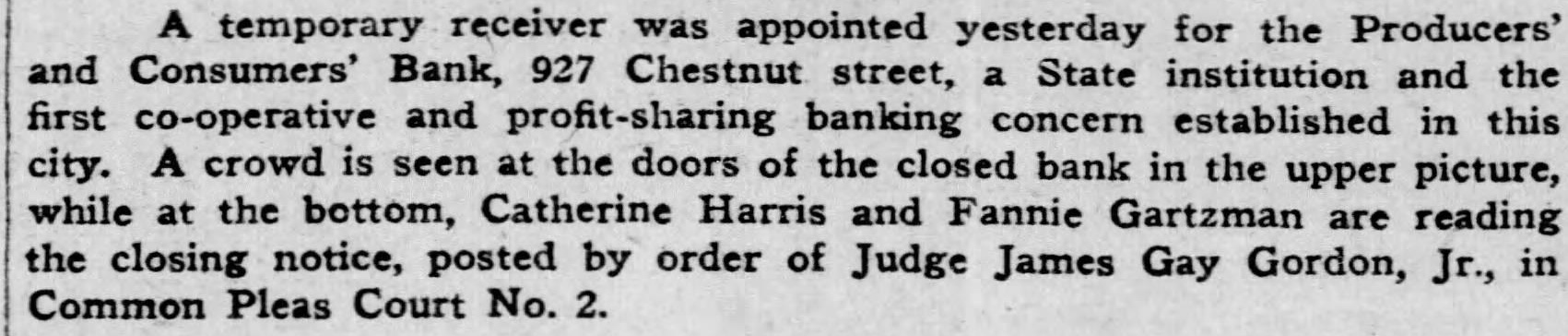
A temporary receiver was appointed yesterday for the Producers' and Consumers' Bank, 927 Chestnut street, a State institution and the first co-operative and profit-sharing banking concern established in this city. A crowd is seen at the doors of the closed bank in the upper picture, while at the bottom, Catherine Harris and Fannie Gartzman are reading the closing notice, posted by order of Judge James Gay Gordon, Jr., in Common Pleas Court No. 2.
2.May 5, 1925Evening StarWashington, DC
Click image to open full size in new tab
Article Text
BANK RECEIVER NAMED. Condition of Philadelphia Institution Is Withheld. PHILADELPHIA, May 5.-A tem. porary receiver was appointed late today for the Producers and Con. sumers' Bank, a State institution. No statement of its financial condition accompanied the application for the receiver. The concern is not a large one.
3.May 5, 1925The Idaho StatesmanBoise, ID
Click image to open full size in new tab
Article Text
Rhythmic Strains of Music Aids Flowers to Retain Beauty
WASHINGTON (AP)—Flowers will retain their original bloom for many days if subjected to rhythmic strains of music, F. C. Billings of Milwaukee, said Monday. He will present his conclusions along this line in an address before the silver jubilee convention of the music trades, to be held here June 8 to 11.
Prof. C. A. Shull of the plant physiology department of the University of Chicago said that "as yet there is no scientific basis for saying positively that sound waves do effect plants in the way they do animals, but it is a line of experimentation which will be taken up immediately if the proposed plant research institute is established in the university here."
BANK RECEIVER NAMED.
PHILADELPHIA (AP)—A temporary receiver was appointed late Monday for the Producers' and Consumers' bank, a state institution. No statement of its financial condition accompanied the petition for the receiver. The concern is not a large one.
4.May 8, 1925Youngstownské Slovenské Noviny = Youngstown Slovak NewsYoungstown, OH
Click image to open full size in new tab
Article Text
ROBOTNÍCKA BANKA BOLA ZAVRETÁ Vo Philadelphii zavreta bola po tieto dni Producers' and Consumers' Bank, ktorú kontrolovaly robotnieke unie. Kreditori banky poziadali o receivera, ked' nemohla vyplácat' poziadavky. Vkladatelia ale dostanú svoje peniaze nazad. Banka dl'a údajov kreditorov má majetku $2,732,607 a zaviazanosti $2,246,238. Vkladatel'ov má 7,500. Vyplácat' kreditorov preto nemohla, ze má kapitál uviaznuty V dlhodobych pôziekach.
5.May 9, 1925The Daily WorkerNew York, Chicago, NY
Click image to open full size in new tab
Article Text
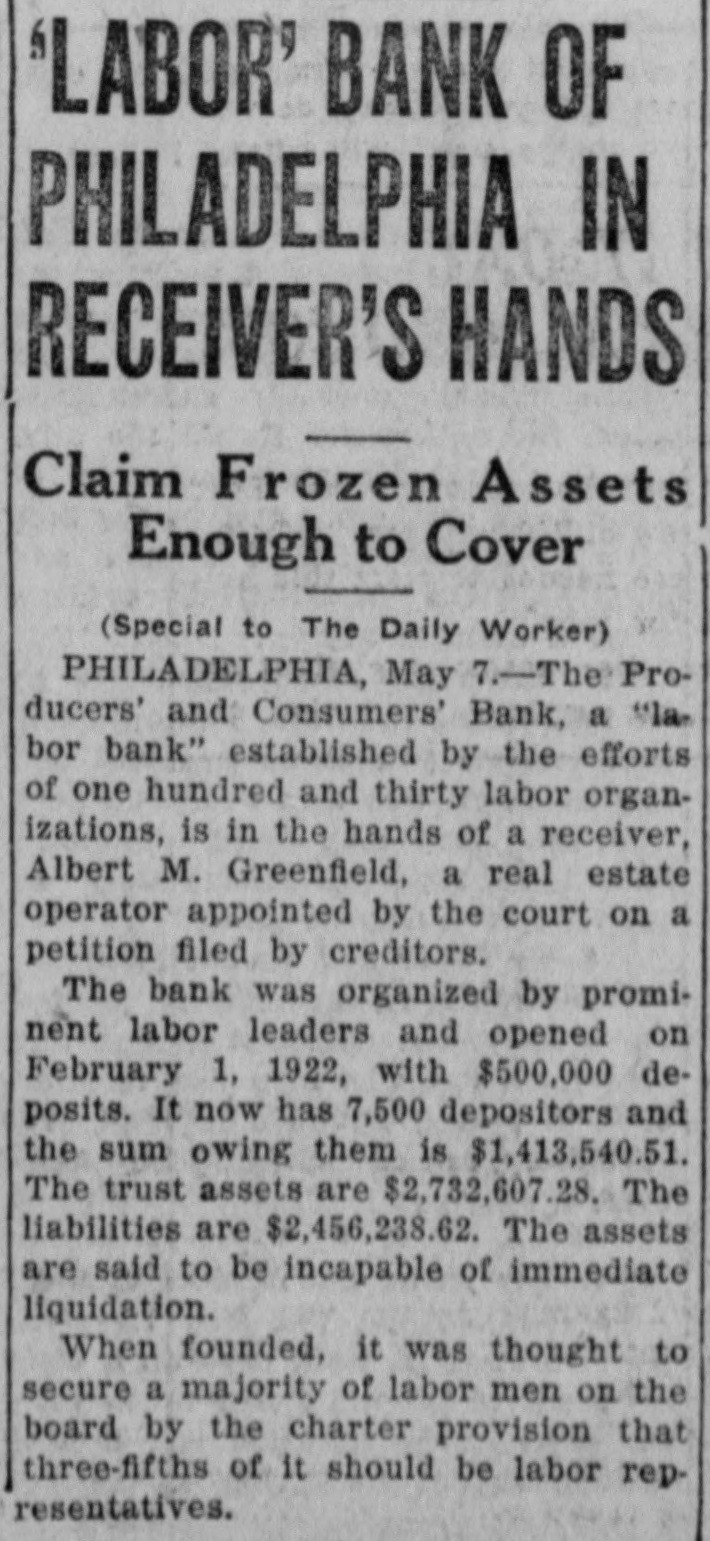
"LABOR" BANK OF PHILADELPHIA IN RECEIVER'S HANDS Claim Frozen Assets Enough to Cover (Special to The Daily Worker) PHILADELPHIA, May 7.-The Producers' and Consumers' Bank, a "labor bank" established by the efforts of one hundred and thirty labor organizations, is in the hands of a receiver, Albert M. Greenfield, a real estate operator appointed by the court on a petition filed by creditors. The bank was organized by prominent labor leaders and opened on February 1, 1922, with $500,000 deposits. It now has 7,500 depositors and the sum owing them is $1,413,540.51. The trust assets are $2,732,607.28. The liabilities are $2,456,238.62. The assets are said to be incapable of immediate liquidation. When founded, it was thought to secure a majority of labor men on the board by the charter provision that three-fifths of it should be labor representatives.
6.May 20, 1925The Daily WorkerNew York, Chicago, NY
Click image to open full size in new tab
Article Text
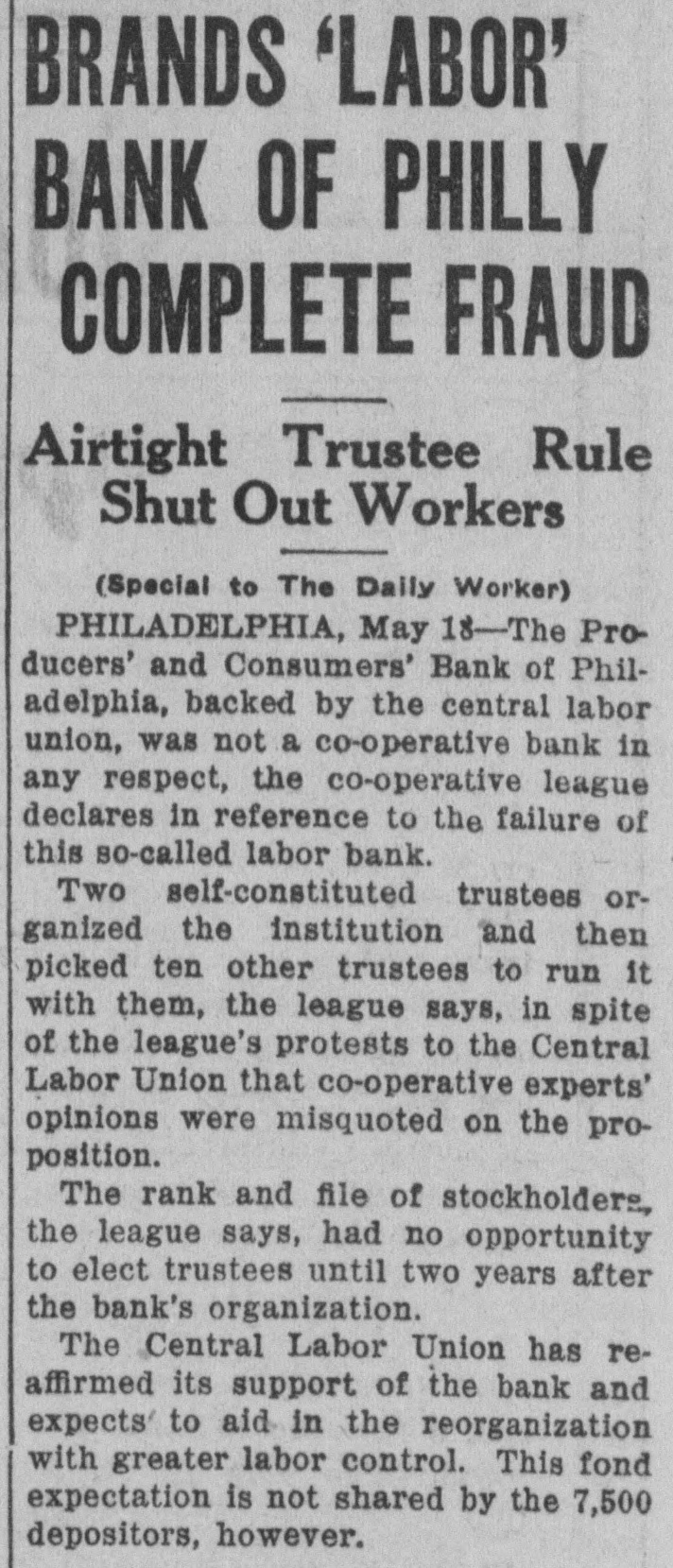
BRANDS 'LABOR' BANK OF PHILLY COMPLETE FRAUD Airtight Trustee Rule Shut Out Workers (Special to The Daily Worker) PHILADELPHIA, May 18-The Producers' and Consumers' Bank of Philadelphia, backed by the central labor union, was not a co-operative bank in any respect, the co-operative league declares in reference to the failure of this so-called labor bank. Two self-constituted trustees organized the institution and then picked ten other trustees to run it with them, the league says, in spite of the league's protests to the Central Labor Union that co-operative experts' opinions were misquoted on the proposition. The rank and file of stockholders, the league says, had no opportunity to elect trustees until two years after the bank's organization. The Central Labor Union has reaffirmed its support of the bank and expects' to aid in the reorganization with greater labor control. This fond expectation is not shared by the 7,500 depositors, however.
7.May 29, 1925Southwest Washington Labor PressHoquiam, WA
Click image to open full size in new tab
Article Text
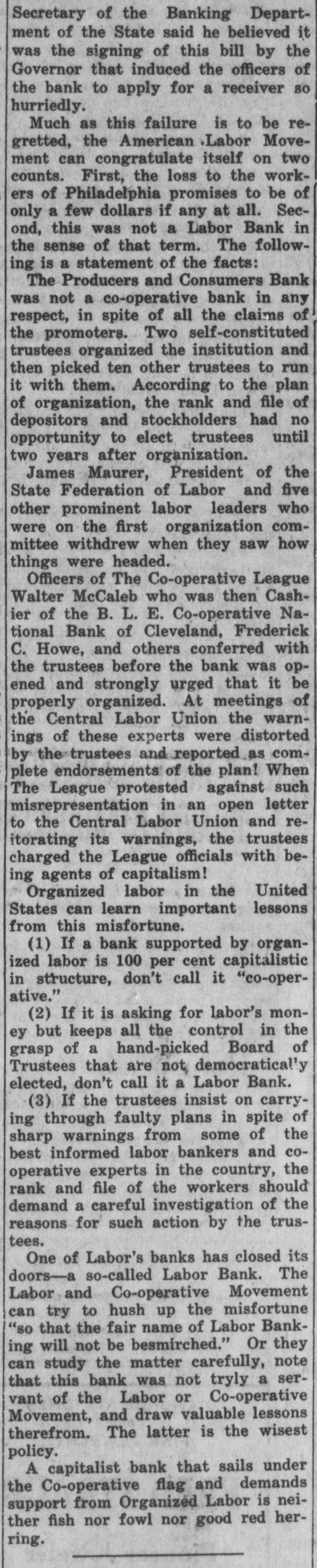
Secretary of the Banking Department of the State said he believed it was the signing of this bill by the Governor that induced the officers of the bank to apply for a receiver so hurriedly. Much as this failure is to be regretted, the American .Labor Movement can congratulate itself on two counts. First, the loss to the workers of Philadelphia promises to be of only a few dollars if any at all. Second, this was not a Labor Bank in the sense of that term. The following is a statement of the facts: The Producers and Consumers Bank was not a co-operative bank in any respect, in spite of all the claims of the promoters. Two self-constituted trustees organized the institution and then picked ten other trustees to run it with them. According to the plan of organization, the rank and file of depositors and stockholders had no opportunity to elect trustees until two years after organization. James Maurer, President of the State Federation of Labor and five other prominent labor leaders who were on the first organization committee withdrew when they saw how things were headed. Officers of The Co-operative League Walter McCaleb who was then Cashier of the B. L. E. Co-operative National Bank of Cleveland, Frederick C. Howe, and others conferred with the trustees before the bank was opened and strongly urged that it be properly organized. At meetings of the Central Labor Union the warnings of these experts were distorted by the trustees and reported as complete endorsements of the plan! When The League protested against such misrepresentation in an open letter to the Central Labor Union and reitorating its warnings, the trustees charged the League officials with being agents of capitalism! Organized labor in the United States can learn important lessons from this misfortune. (1) If a bank supported by organized labor is 100 per cent capitalistic in structure, don't call it "co-operative." (2) If it is asking for labor's money but keeps all the control in the grasp of a hand-picked Board of Trustees that are not democratically elected, don't call it a Labor Bank. (3) If the trustees insist on carrying through faulty plans in spite of sharp warnings from some of the best informed labor bankers and cooperative experts in the country, the rank and file of the workers should demand a careful investigation of the reasons for such action by the trustees. One of Labor's banks has closed its doors-a so-called Labor Bank. The Labor and Co-operative Movement can try to hush up the misfortune "so that the fair name of Labor Banking will not be besmirched." Or they can study the matter carefully, note that this bank was not tryly a servant of the Labor or Co-operative Movement, and draw valuable lessons therefrom. The latter is the wisest policy. A capitalist bank that sails under the Co-operative flag and demands support from Organized Labor is neither fish nor fowl nor good red herring.
8.May 29, 1925Southwest Washington Labor PressHoquiam, WA
Click image to open full size in new tab
Article Text
SO-CALLED LABOR BANK ASKS FOR RECEIVERSHIP One of the greatest blows to the banking aspirations of organized labor in recent years is the announcement in the press of May 5th of the closing of the doors of the Producers and Consumers Bank of Philadelphia and the appointment of a receiver on a petition of the creditors. The assets are said to be just short of 23/4 millions and the liabilities just under 2½ millions. There are 7500 depositors who have almost 1½ millions in the bank. If the figures given in the newspapers are correct, the institution is still solvent. 130 labor organizations are reported to have been behind the bank, and the majority of the Board of Trustees were labor representatives. Mr. Greenfield, the Receiver, according to the Philadelphia press, reports that although the purchase of the Chestnut Street building bought by the Bank was $1,000,000, that the deed conveying it to the Bank mentioned the value as $1,200,000. Examination showed that Mr. Kinsell, Vice-President of the Bank who acted as trustee, bought the building for $1,000,000 and paid Mr. O'Callaghan, President of the Bank, who acted as broker in the deal, $100,000 as brokerage fee. Later Mr. O'Callaghan, turned this $1000,000 back to the Bank. But the deed conveying the building to the Bank from Mr. Kinsell, the trustee, mentions the value as $1,200,000; as the trustees felt that the property was worth that much, and they wanted the books of the Bank to show a healthier conditions than actually existed. Early reports by some of the trustees also indicate that clients of the bank had borrowed heavily in order to speculate in Philadelphia real estate, and had lost heavily, forcing the bank to take over their holdings at advanced valuations. Perhaps it is such transactions as these which account for the present receivership. The bank has never been under the jurisdiction of the State Banking Department. On the very day that the Bank closed its doors, Governor Pinchot signed a bill bringing such banks as this under State supervision. The
9.July 18, 1925The Evening JournalWilmington, DE
Click image to open full size in new tab
Article Text
NOTES IN CLOSED BANK
Receiver Says They Are Among "Frozen Securities" Held By Co.
MORE ASSOCIATIONS ARE INVESTIGATED
PHILADELPHIA, Pa., July Notes floated by officers of several the seventeen building and loan associations taken over by the State Banking Department early this week were among the "frozen securities" which sent the Producers and Consumers' Bank crashing early May of this year, revealed Albert M. Greenfield, the receiver. yesterday. While that revelation was being discussed, Department ficials working on the case of the solvent associations in this city suddenly summoned to conference in Harrisburg with General Woodruff and Charles H. Graff, Acting Secretary of Banking. Legal representatives of the clations attended the according to Mr. Graff, and asked about plans they said they had for the rehabilitation of the associaThey are particularly eager to would be sued in the cases, to the Acting Secretary "They were said Mr. Graff "that according to the practice of the department would receive any offer rehabilitate the associations, the department's purpose primarfly to protect the shareholders." was disclosed the meeting that four other building and loan associations in this city have been investigation because of leged overloaning mortgages, but these four have all furnished ade. quate security, was said. there are to be prosecutions growing out the practices that caused the department take charge of the seventeen associations. come It was said that 22 per cent bonus feed were offered by some brok their efforts to notes associations, and that these ranging as high per cent the made by an finance company who had approached for loan Ascording him. one broker of the notes had staff of three salesmen on the street and four selling the promises to pay. Charges and tinued to fly following the the lists of officers of the seventeen insolvent of unauthorized carrying officers in certain names rolls were made of the men by disappointed noteCivil suits filed the holders recording to fewer than courts started against actions Indorsers of the defunct associations disclosed by Mr. Greenfield that Alexander Roseman. secretary of the Carlisle Realty Commore than had borrowed Producers and the Consumers' Bank prior to its dimGreenfield, as culties. of the Roseeffected settlement which was approved by loans said that good. He also the the indebtedness proportion of by the represented collected before they loans had been the Banking Decollapsed under partment's Harrisburg was The meeting in General dered by Attorney ordered Mr. had who previously work temporarily drop his Graff to scandal in the western on bank part the state, and remain in Harconference on the inrisburg for the solvent chief building and William whose loan investigations brought the state authorities down upon the seventeen attended the meeting. Murdoch Kendrick Also present were counsel for and James interested in the several men clations Revelation that ready money to rediscount being peddled about the streets commanded 22 per cent bonus and charges, figured on an annual basis, made by Harry Packman. Brothers, real estate of Packman brokers Packman said he was asked to buy $20,000 in notes dated for four months. and was offered $1525, pay. able advance, to go through with the that sum $1000 was be fee for his services in writing the check and the $575 was to represent 9-10 per cent rate of interest sundry charges L. Gouleon. who the day before filed the first of what observers predict will be flood of similar suits, yesterday entered in court records seven additional suits to recover money which he loaned on association notes. The Solvent Building and Loan Association. and the Amos M. Scott Building and Loan Association. two of the seized named in the The firms of Lush Ginsburg. Magee Rodgers. and an individual. Jacob Maiben, alleged be indorsers of the notes. also were named in the papers filed
10.October 9, 1925The Philadelphia InquirerPhiladelphia, PA
Click image to open full size in new tab
Article Text
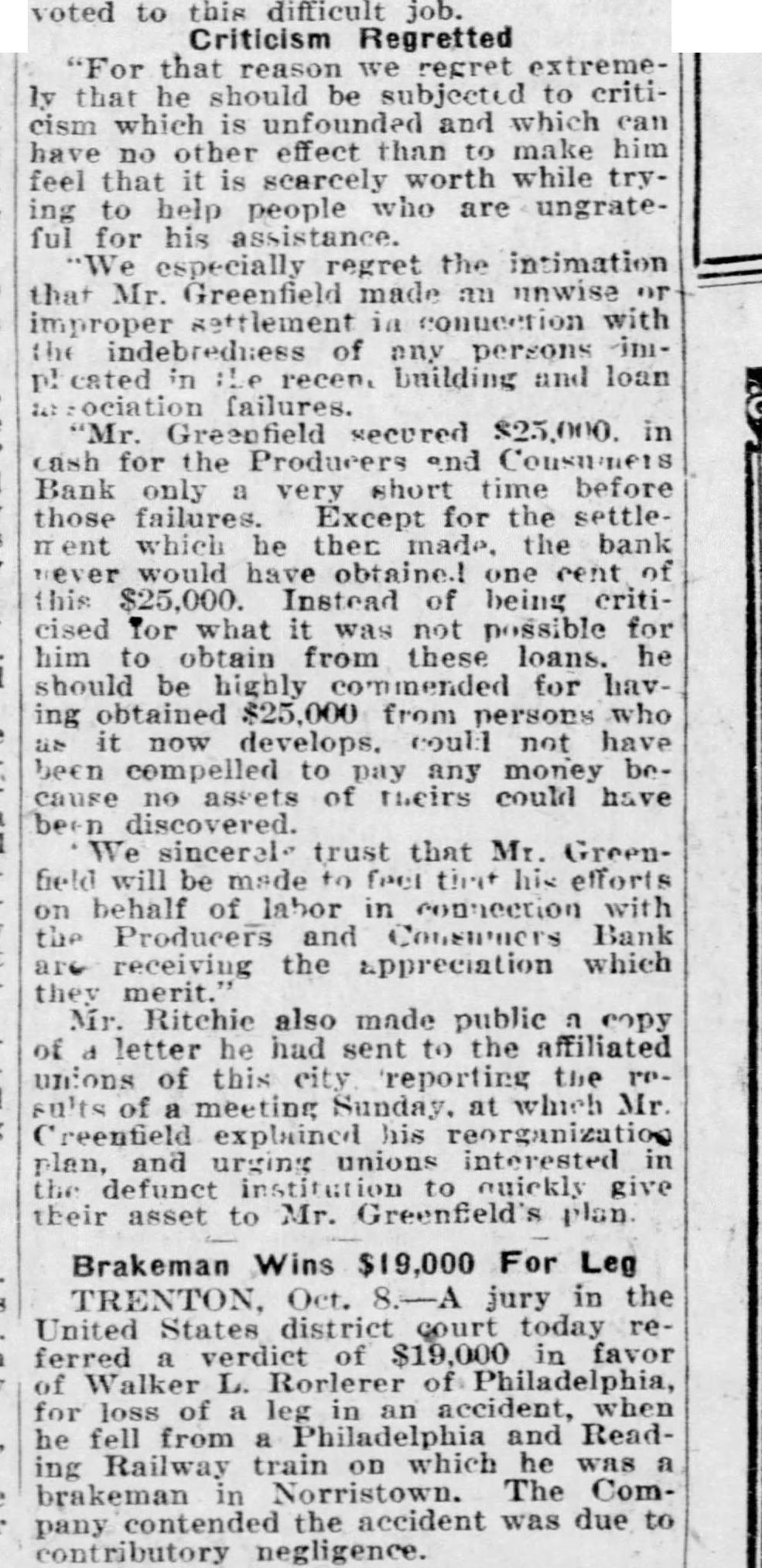
voted to this difficult job.
Criticism Regretted
"For that reason we regret extremely that he should be subjected to criticism which is unfounded and which can have no other effect than to make him feel that it is scarcely worth while trying to help people who are ungrateful for his assistance.
"We especially regret the intimation that Mr. Greenfield made an unwise or improper settlement in connection with the indebtedness of any persons implicated in the recent building and loan association failures.
"Mr. Greenfield secured $25,000 in cash for the Producers and Consumers Bank only a very short time before those failures. Except for the settlement which he then made, the bank never would have obtained one cent of this $25,000. Instead of being criticised for what it was not possible for him to obtain from these loans, he should be highly commended for having obtained $25,000 from persons who as it now develops, could not have been compelled to pay any money because no assets of theirs could have been discovered.
"We sincerely trust that Mr. Greenfield will be made to feel that his efforts on behalf of labor in connection with the Producers and Consumers Bank are receiving the appreciation which they merit."
Mr. Ritchie also made public a copy of a letter he had sent to the affiliated unions of this city, reporting the results of a meeting Sunday, at which Mr. Greenfield explained his reorganization plan, and urging unions interested in the defunct institution to quickly give their asset to Mr. Greenfield's plan.
Brakeman Wins $19,000 For Leg
TRENTON, Oct. 8.—A jury in the United States district court today referred a verdict of $19,000 in favor of Walker L. Rorlerer of Philadelphia, for loss of a leg in an accident, when he fell from a Philadelphia and Reading Railway train on which he was a brakeman in Norristown. The Company contended the accident was due to contributory negligence.
11.October 16, 1925The Philadelphia InquirerPhiladelphia, PA
Click image to open full size in new tab
Article Text
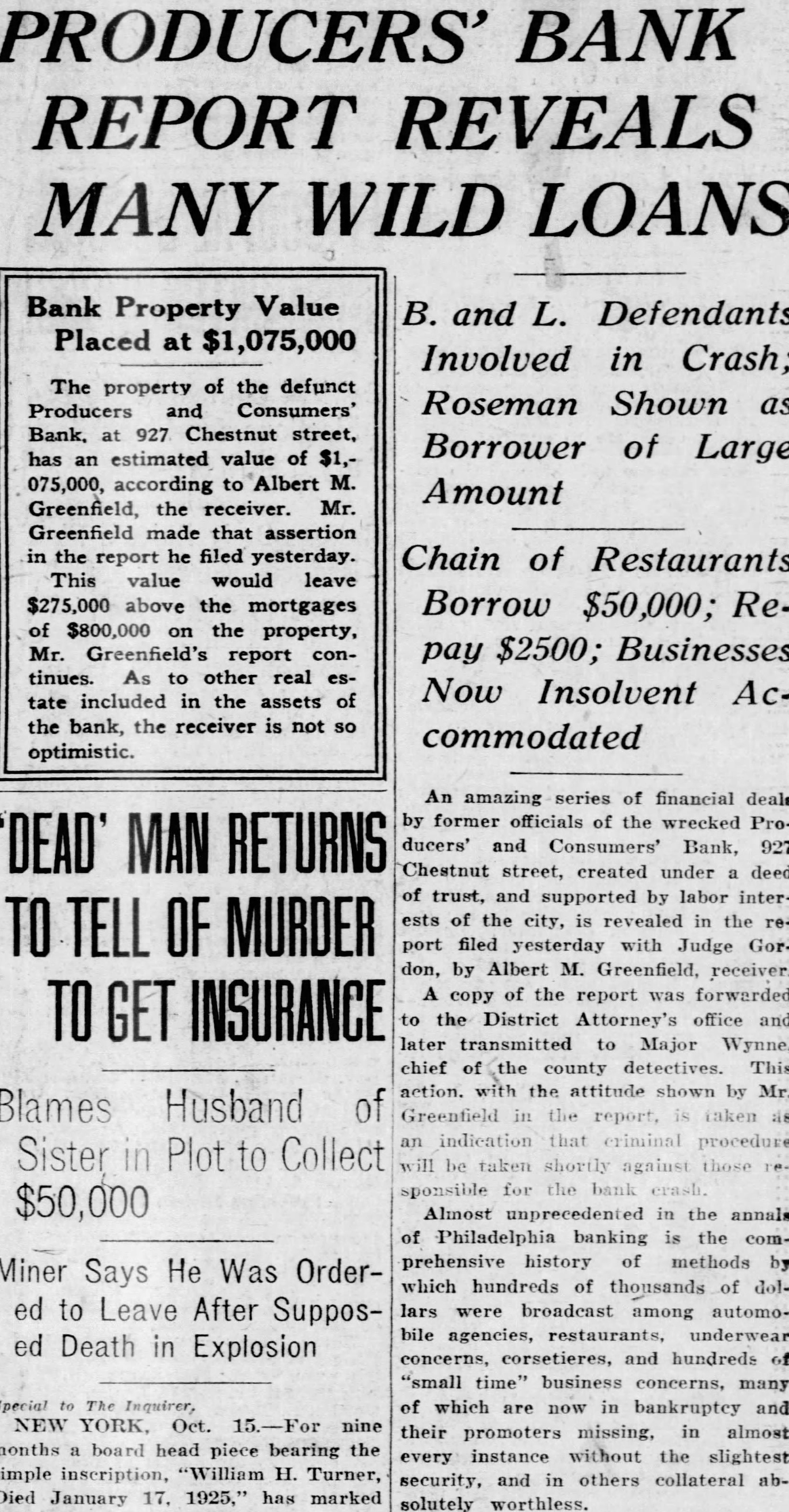
PRODUCERS' BANK REPORT REVEALS MANY WILD LOANS
Bank Property Value Placed at $1,075,000
The property of the defunct Producers and Consumers' Bank, at 927 Chestnut street, has an estimated value of $1,075,000, according to Albert M. Greenfield, the receiver. Mr. Greenfield made that assertion in the report he filed yesterday.
This value would leave $275,000 above the mortgages of $800,000 on the property, Mr. Greenfield's report continues. As to other real estate included in the assets of the bank, the receiver is not so optimistic.
B. and L. Defendants Involved in Crash; Roseman Shown as Borrower of Large Amount
Chain of Restaurants Borrow $50,000; Repay $2500; Businesses Now Insolvent Accommodated
An amazing series of financial deals by former officials of the wrecked Producers' and Consumers' Bank, 927 Chestnut street, created under a deed of trust, and supported by labor interests of the city, is revealed in the report filed yesterday with Judge Gordon, by Albert M. Greenfield, receiver.
A copy of the report was forwarded to the District Attorney's office and later transmitted to Major Wynne, chief of the county detectives. This action, with the attitude shown by Mr. Greenfield in the report, is taken as an indication that criminal procedure will be taken shortly against those responsible for the bank crash.
Almost unprecedented in the annals of Philadelphia banking is the comprehensive history of methods by which hundreds of thousands of dollars were broadcast among automobile agencies, restaurants, underwear concerns, corsetieres, and hundreds of "small time" business concerns, many of which are now in bankruptcy and their promoters missing, in almost every instance without the slightest security, and in others collateral absolutely worthless.
12.October 16, 1925The Philadelphia InquirerPhiladelphia, PA
Click image to open full size in new tab
Article Text
Bank Property Value Placed at $1,075,000
The property of the defunct Producers and Consumers' Bank, at 927 Chestnut street, has an estimated value of $1,075,000, according to Albert M. Greenfield, the receiver. Mr. Greenfield made that assertion in the report he filed yesterday.
This value would leave $275,000 above the mortgages of $800,000 on the property, Mr. Greenfield's report continues. As to other real estate included in the assets of the bank, the receiver is not so optimistic.
13.November 21, 1925The Philadelphia InquirerPhiladelphia, PA
Click image to open full size in new tab
Article Text
JOINT SETTLEMENT FOR BANK PROPOSED
Producers and Consumers Heavy Creditor of Defunct B. and L. Associations
Combining Rehabilitation Efforts Held to Promise Better Results for All
Numerous legal steps combined with a second conference between S. Tyson Kinsell and Assistant District Attorney Schofield marked yesterday's developments in the investigation of the defunct Producers' and Consumers' Bank, 927 Chestnut street. Kinsell was president of the bank.
Action was instituted by Sidney E. Smith, counsel for depositors and stockholders of the bank, to have set aside conveyances of properties by Samuel B. Lush, who is awaiting sentence for complicity in the recent $2,000,000 building and loan association swindle, to Albert M. Greenfield as rehabilitation trustee of the seventeen building associations taken over by the State. Turn-
YOUTH DIES IN PACT WITH SCHOOL CHUM
Students, 17, Shoot Themselves After Agreeing Life Is Not Worth Living
Aim of One Fails to Reach Vital Spot; Declare Disbelief in Hereafter
CINCINNATI, Nov. 20.—William Strauss and James Albert Rosenberg, seventeen-year high school boys, drove to a quiet spot in Clermont county late yesterday, and with a pistol shot themselves through the head.
They had signed a death pact in which it was declared "life is not worth the effort to live."
Strauss died almost instantly, but Rosenberg may recover.
A lengthy preamble and agreement was found in the pocket of Strauss' coat. At the bottom was written, "signing off."
Relatives said both had been of a cheerful turn of mind. Rosenberg is the son of a department store proprietor, and Strauss' father is president of a mortgage company.
Text of Pact
14.November 21, 1925The Philadelphia InquirerPhiladelphia, PA
Click image to open full size in new tab
Article Text
Producers and Consumers Heavy Creditor of Defunct B. and L. Associations
Combining Rehabilitation Efforts Held to Promise Better Results for All
Numerous legal steps combined with a second conference between S. Tyson Kinsell and Assistant District Attorney Schofield marked yesterday's developments in the investigation of the defunct Producers' and Consumers' Bank, 927 Chestnut street. Kinsell was president of the bank.
Action was instituted by Sidney E. Smith, counsel for depositors and stockholders of the bank, to have set aside conveyances of properties by Samuel B. Lush, who is awaiting sentence for complicity in the recent $2,000,000 building and loan association swindle, to Albert M. Greenfield as rehabilitation trustee of the seventeen building associations taken over by the State. Turning over the properties by Lush to Greenfield is in accordance with a restitution agreement.
Similar Action
The filing of the petition by Smith is a similar action to that taken by him last Friday when he asked to have set aside conveyances made by Alexander A. Roseman and William D. Rodgers, financial high-flyers now in the county prison, for restitution purposes. There will be a hearing on the two petitions Monday.
It was learned yesterday that the plan for rehabilitating the seventeen building associations will be ready shortly for definite action by Attorney General Woodruff.
Coincident with this, it was also learned that Mr. Greenfield, as receiver for the Producers' and Consumers' Bank, which is a heavy creditor of the wrecked associations, will make application to join in the plan.
15.February 24, 1926The Philadelphia InquirerPhiladelphia, PA
Click image to open full size in new tab
Article Text
PETITIONS ON DEFUNCT BANK
Receiver of Producers and Consumers Asks Permission to Sell Securities
Depositors, Through Counsel, Oppose Agreement to Dispose of Holdings
Hearings on two petitions involving the $100,000 surety bond filed by the defunt Producers Consumers Bank with State Banking protection depositors yesterday furnished the basis for another ble between attorneys representing A1bert M. Greenfield, receiver, and group of depositors. The petitions filed in Common Pleas Court which appointed Mr. receiver for bank, and the hearings before Edwin O. Lewis and Judge Horace W. Stern. petition had been authorized by collect penal of $100,000 posted prior to the bank opening for asking that he authorized to enter an agreement with the Royal nity which was on the for that company to sell the $50,000 securities given the bank security, and pay the proceeds to the
Extend Mortgage Two Years The petition forth that mortgage on the bank buildwhich appraised for $600,000. held by the Philadelphia Savings Fund, and second of $200,000, by George G. Melloy. No interest had been the latter mortgage since April 1925, date principal fell due. though Melloy had made demand both principal and accrued interest, petition stated that the mortgagor agreed to extend the mortgage for years, the pay all back interest $50,000 of principal. The pointed out that Melloy indemnify Royal against on the bond, the sought to make such
$50,000 Goes to Receiver Sidney E. for group of depositors, took the position that such because the condition central real estate market. might manner jeopardize the intereste the represented. Should plan bank through. the attorney said, would be but case contested tion that would $50 000 the holding bank, which future time placed on the block. The finally directed receiver be permitted to $50,000 from the the and over Mr. Melloy, after which latter amount to the The matter will merely keeping.
16.March 14, 1926The Philadelphia InquirerPhiladelphia, PA
Click image to open full size in new tab
Article Text
MITTEN WINS SUIT P.R.R'S NEW OFFICES TO CONTROL BANK READY LATE IN 1926
Labor Unions Offer Little Re- Huge 14-Story Structure sistance in Producer's Re- First Unit of W. Phila. ceiver Action Terminal Project
New Management Announces Centralizing of Clerical PerDepositors Will Be Paid 60 sonnel and Increased EfCents on Dollar ficiency Aimed At
The ill fated Producers and Consumers Bank, 927 Chestnut street, created and operated by organized Inbor. will pass into the hands of Mitten Men and Management, Inc., it was deyesterday. Approval of petition filed some time ago by Albert M. Greenfield, receiver for the bank, asking permission to sell the assets of the bank to the Mitten interests was given by Common Pleas Court Judges Gordon and Stern. The anticipated resistance to the sale by the Central Labor Union, because of the friction between Mitten policies and thore of organized labor, failed to materialize.
Mild Resistance Offered Michael Francis Doyle, general counsel for the union. who on January 26 last was instructed by resolution passed unanimously by the executive committee of the body to exert every effort to oppose the sale, offered mild resistance. He told the court that it "was the feeling of affiliated labor unions that inasmuch as the bank was organized as co-operative labor bank that they did not desire to see control of it pass to outside interests.' Judge Stern immediately overruled this objection. "In considering petition for the sale of the assets of the bank. commented the court, "and in determining the best nossible price be obtained, we can hardly pass on the feelings of the old proprietor towards the new "The Court appreciates that labor would naturally desire to retain the institution founded, continued Judge Stern. since they are unable resuscitate the bank. the receiver must carry out any plan most likely to be benefit to the stockholder and depositor
The assets of the bank were sold to the Mitten interests for $925,000. It was later announced by representative of Thomas E. Mitten that steps would be taken immediately toward opening the bank as the Mitten Men and Management Bank and Trust Company. He expressed the hope that depositors of the old bank would join the new venture and promised prelim inary return of sixty cents on the dol lar with share in the profits until they have received full return of their original deposits in the old bank Gratification at the amicable turn of the bank situation was expressed by Judge But two objections were registered by individual stockholders and depositors. Auguste Polston, an official of the Amalgamated Clothing workers, pointed out that the old stock was -assignable and protested that this was not fair to the small holders. He suggested that the new stock issued should be assignable. Morris Wolf, at. torney for Mr. Greenfield, assured the Court that this would be done. Frank McGarrity asserted that no assurance bad been given that the de positors who placed money in the bank on the day it closed would recover their claims in full. McGarrity was informed that this would be determined in another proceeding
Bank runs are almost always and everywhere a deterioration of bank fundamentals.
But not for you.
You are the measure-zero exception: great fundamentals, solid bank, and yet the Diamond Dybvig fairy spread its rumor. Depositors woke up. Your collateral was not prepositioned. The Clearinghouse had it for you.
Do not pass Go. Do not collect $200. Go directly to jail… or worse.