West Side Bank (St Paul, MN)

Episode Information

Episode UID
3307411091165
Episode Type
Run โ†’ Suspension โ†’ Reopening
Bank Type
state
Bank ID
330741109 hash
Start Date
January 4, 1897
Location
St Paul, Minnesota (44.944, -93.093)

Metadata

Model
gpt-5-mini (chosen from majority vote of a three-model LLM ensemble)
Short Digest
8d6538d00d8a3871

Response Measures

None

Description

Closed Jan 4, 1897 with assignee named; reorganized and reopened later in 1897.

Events (5)

1. January 4, 1897 Run
Cause
Correspondent
Cause Details
Clearings returned by the Allemania (a correspondent/clearing partner) and panic from nearby bank failures prompted heavy withdrawals.
Measures
Directors closed the bank's doors and called a meeting; filed deed of assignment to assignee.
Newspaper Excerpt
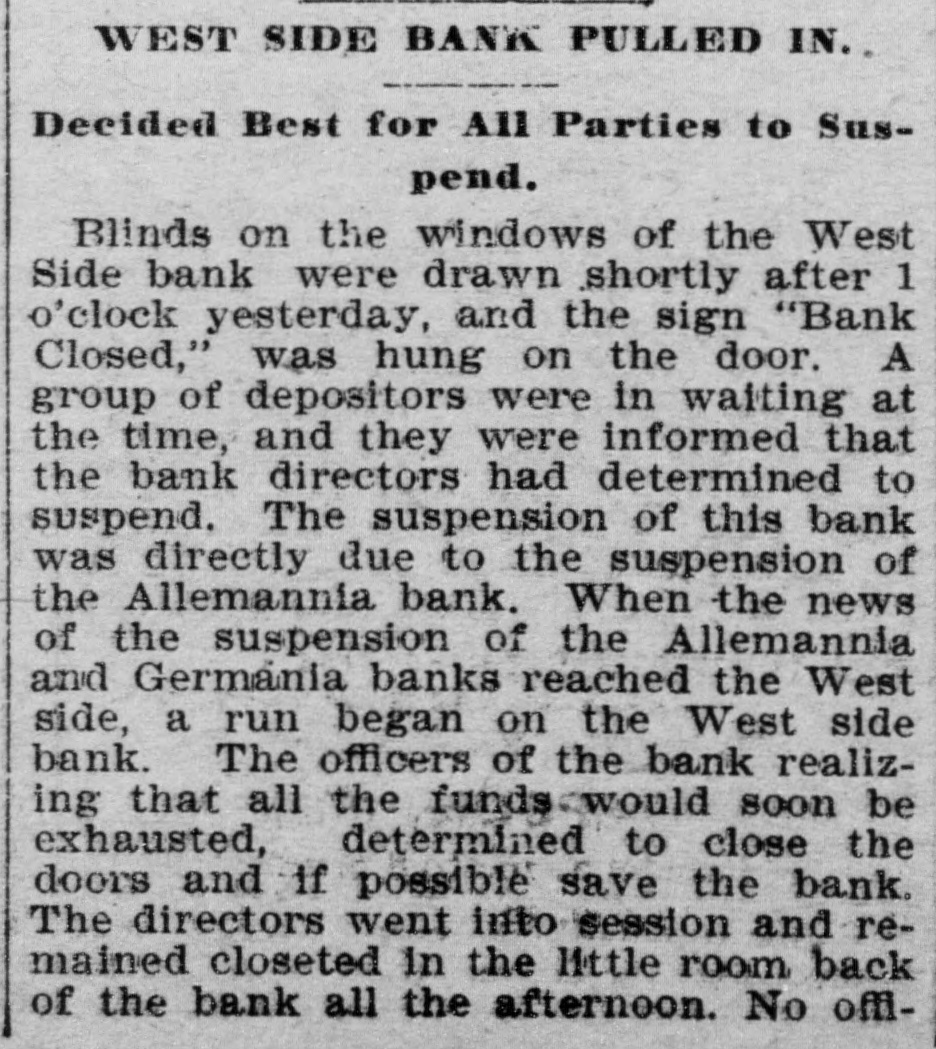
When the news of the suspension of the Allemannia and Germania banks reached the West side, a run began on the West side bank.
Source
newspapers
2. January 4, 1897 Suspension
Cause
Correspondent
Cause Details
Suspension directly due to failure/suspension of the Allemania (clearing partner) which returned West Side's clearings and precipitated a run.
Newspaper Excerpt
Blinds on the windows of the West Side bank were drawn shortly after 1 o'clock yesterday, and the sign 'Bank Closed,' was hung on the door.
Source
newspapers
3. January 6, 1897 Other
Newspaper Excerpt
Charles F. Staples was made assignee of the West Side Bank / the West Side bank will try to make arrangements with its creditors and re-open without the intervention of a receiver.
Source
newspapers
4. July 17, 1897 Reopening
Newspaper Excerpt
The bank expects to reorganize by cutting its capital stock...the reorganization plan is expected to be put into effect by an order of the district court on July 17.
Source
newspapers
5. November 25, 1897 Other
Newspaper Excerpt
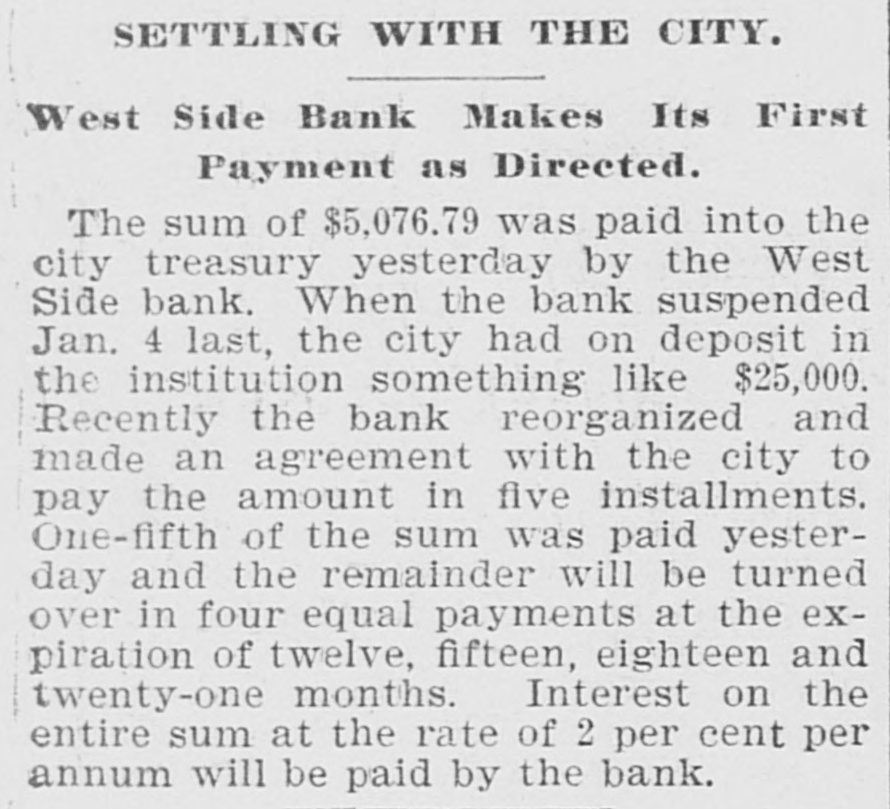
When the bank suspended Jan. 4 last, the city had on deposit in the institution something like $25,000. Recently the bank reorganized and made an agreement with the city to pay the amount in five installments. The sum of $5,076.79 was paid into the city treasury yesterday by the West Side bank.
Source
newspapers

Newspaper Articles (25)

Article from Daily Camera, January 4, 1897

Click image to open full size in new tab

Article Text

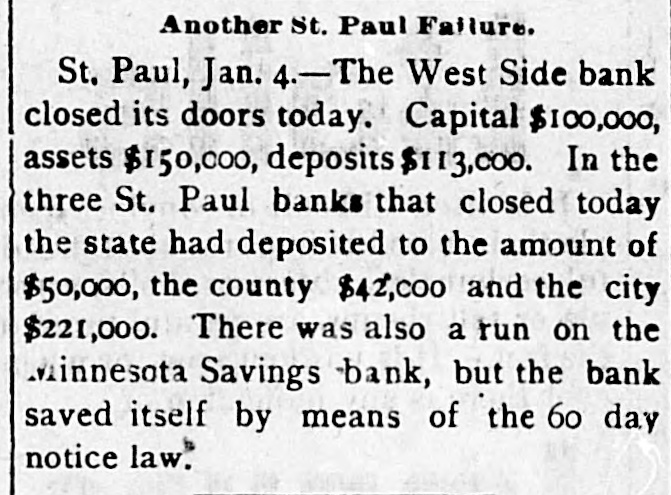
Another St. Paul Failure. St. Paul, Jan. 4.-The West Side bank closed its doors today. Capital $100,000, assets $150,000, deposits $113,000. In the three St. Paul banks that closed today the state had deposited to the amount of $50,000, the county $42,000 and the city $221,000. There was also a run on the Minnesota Savings bank, but the bank saved itself by means of the 60 day notice law."


Article from Las Vegas Daily Optic, January 4, 1897

Click image to open full size in new tab

Article Text

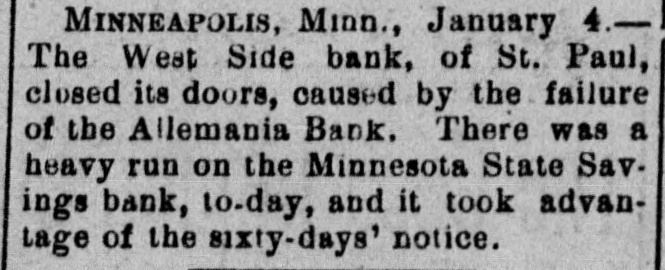
MINNEAPOLIS, Minn., January 4.The West Side bank, of St. Paul, closed its doors, caused by the failure of the Allemania Bank. There was a heavy run on the Minnesota State Savings bank, 10-day, and it took advantage of the sixty-days' notice.


Article from The Record-Union, January 5, 1897

Click image to open full size in new tab

Article Text

Demands Made Upon Them. Expected That They Will Soon be Reorganized and Reopened. The President of One of the Institutions Makes a Statement in Which He Charges That Evil Disposed Persons Maliciously Directed the Attempt to Break the Bank Over Which He Presided. ST. PAUL, Jan. 4.-The Germania, Allemannia and West Side Banks, all doing business as State Banks, to-day closed their doors. The failure of the Bank of Minnesota December 22d caused unrest in the community, and depositors withdrew their money from these banks to such an extent that they were forced to go to the wall because they had not Lunds enough on hand to meet the demands made upon them. Any of the three, however, is solvent, and they will be re-organized as soon as the money for that purpose can be put into use. The directors of the Germania met this afternoon and appointed a committee on re-organization. The Germania is in the hands of P. M. Kerst as assignee, and the other two are in the hands of Bank Examiner Kenyon. A receiver will be appointed for the Allemannia tomorrow, and the West Side Bank will try to make arrangements with its creditors and re-open without the intervention of receiver. The last official statement of the Germania Bank showed total resources of $1,625,768, $253,847 of this being in the building and $975,420 in loans and discounts. Liabilities $1,625,768, including $400,000 capital stock and $633,019 in time certificates of deposits. The deposits subject to check are $44,551. The closing of the Germania was in pursuance of the action of the directors on Saturday night, who concluded to protect their depositors by suspending. President Willius prepared a statement in which he said: "As soon as the result of the Presidential election became known matters began to improve in a remarkable degree. and there did not seem to be any doubt on May 1st the bank would be in so strong and impregnable condition that an assessment could successfully be made on the stock. This was the condition on the 22d of December, when the suspension of the Bank of Minnesota occurred, following immediately upon the failure of the National Bank of Illinois of Chicago, which came as unexpectedly as a stroke of lightning in midwinter. Failures of other Minnesota banks increased the panicky feeling, but I did not fear any disastrous outcome until it became apparent that certain eveil disposed persons maliciously directed the attempt toward the Germania Bank, circulating false and manufactured reports regardI ing it with systematic persistency. hoped from day to day that the excitement would subside and make room for better judgment, but it grew in intensity. The attack became bolder every day. After the close of business on Saturday, the 2d of January, we found that the withdrawal of deposits had assumed such dimensions that we did not feel justified to continue receiving deposits or to pay out money beyond that day without submitting the condition of affairs to the directors. Consequently we called a special meeting of the board on said day at 7:30 p. m. We had paid off nearly $225,000 deposits in nine business days, and kept on hand and in reserve fund $70,000. which shows the unreasonableness of the attack. The directors came immediately to the conclusion that the action of the officers had been correct, and however deplorable it might be, it became their duty, for the protection of depositors and other creditors, to close the doors and place the assets of the bank in charge of an assignee." The Allemannia closed a few minutes before 11 o'clock, with a crowd of depositors clamoring at the paying telJer's window for their money. President Scheffer said: "Our suspension is due to the large number of withdrawals this morning, and the fact that most of the new depositors withheld their deposits. The news of the suspension of our neighbor, the Germania, precipitated the run here, and of course with all the deposits being withheld, and the fact that there was a steady withdrawal we could not stem the tide. When the full force of the Germania's failure burst on them the crowd seemed to become panic-stricken, and they came down upon us like a wolf on the fold. When the Bank of Minnesota failed the business men fortunately were not disturbed, and few were caught. The feeling of ease returned shortly. and might have continued had it not beeen for the failure of the four banks in Minneapolis. Then the panicky feeling came back, and was intensified by the fact that the business men caught it very badly. The feeling naturally spread over here. and the people have not been easy since then. When the Germania closed its doors this morning that was the last straw in the case, and they came down upon us like a herd of wolves." The total resources of the Allemannia, according to their report of the same day. was $1,061,009. including $706,842 of loans and discounts. Liabilities also $1,061,009. including capital stock of $400,000 and deposits of $329, 789. Speaking of the failure of the West Side Bank, President Staples said: "Our suspension was due to the Allemannia. We did all of our clearing through the Allemannia. and this morning they failed to cover our clearings, and sent them all back to us. News of the suspension of the Germania and Allemannia spread through West St. Paul, and our depositors began scram-


Article from The Salt Lake Herald, January 5, 1897

Click image to open full size in new tab

Article Text

THREE MORE BANKS GONE TO PIECES St. Paul Is the Scene of the Crash This Time. ALL STATE CONCERNS GERMANIA, ALLEMANNIA AND WEST SIDE. Each of the Three Claim to Be Solvent and Promise to Meet All Their Obligations Dollar For DollarFailure of the Bank of Minnesota Caused a Panicky Feeling and the Panicky Feeling Did the Rest -Financial Notes.


Article from The Wilmington Daily Republican, January 5, 1897

Click image to open full size in new tab

Article Text

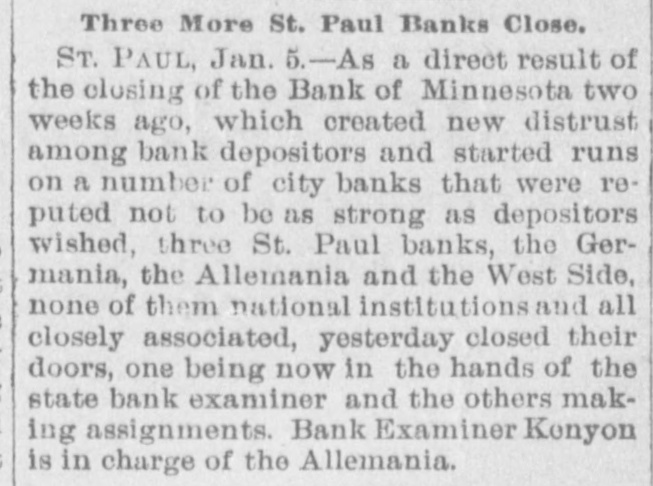
Three More St. Paul Banks Close. ST. PAUL, Jan. 5.-As a direct result of the closing of the Bank of Minnesota two weeks ago, which created new distrust among bank depositors and started runs on a number of city banks that were reputed not to be as strong as depositors wished, three St. Paul banks, the Germania, the Allemania and the West Side, none of them national institutions and all closely associated, yesterday closed their doors, one being now in, the hands of the state bank examiner and the others making assignments Bank Examiner Kenyon is in charge of the Allemania.


Article from The Daily Morning Astorian, January 5, 1897

Click image to open full size in new tab

Article Text

THREE BANKS HAVE CLOSED In St. Paul as a Result of Failure of the Bank of Minnesota. e / THE FRIGHTENED DEPOSITORS e : I Make a Lively Run for Their Money and Cause a Panic-Fight Each Other in the Lines. I I r St. Paul, January 4.-As a direct re: sult of the closing of the Bank of Minnesota two weeks ago, which created new distrust among depositors and started runs on a number of city banks that were reputed not to be as strong as depositors wished, three St. Paul r banks, the Germania, the Allemania a and the West Side, one of them nae tional institutions, all closely associat: ed, closed their doors today, one being in the hands of the state bank examiner e : and the others making assignments. . During the time that has intervened since the closing of the Bank of Minne e : sota, the Germania paid out $225,000 to i frightened depositors and early today i the directors concluded they would stop the drain and make an assignment to the cashier, Peter M. Kerst. The Allemania Bank, which like the Germania, had a large clientage among the Germans, and whose vice-president had formerly been president of the Germania, then became a target for a lively run. People crowded about the doors and fairly fought for a place in the line before the paying teller's window. The bank officials realized fully what such a run meant and promptly called on the bank examiner to take possession of the bank, and that official is now in charge. The West Side Bank, a small but possibly stronger bank, cleared through the Allemania and today its clearings were returned by the latter institution. Following this there was a decired run inaugurated on the bank and at 2 o'clock this afternoon the bank offlcials closed the doors and called a meeting of the directors to decide what action to take. Their decision was apparent late in the afternoon when they filed a deed of assignment to Cashier Staples, president of the bank. Considerable public money is tied up in the three institutions. Owing to the excitement caused by the closing of the Germania and Allemania Banks today, many depositors went after their money at one or two other banks, the Minnesota Savings Bank being the center of excitement. President William Bickel, Jr., is a son of the first vice-president of the Allemania. This bank was open for business but at 3 o'clock was taking advantage of the rule allowing sixty days' notice before allowing withdrawals of deposits. A few minutes before 2 o'clock the West Side Bank, organized in 1886, with a capital of $100,000, closed.


Article from The Salt Lake Herald, January 5, 1897

Click image to open full size in new tab

Article Text

THREE MORE BANKS GONE TO PIECES St. Paul Is the Scene of the Crash This Time. ALL STATE CONCERNS GERMANIA, ALLEMANNIA AND WEST SIDE. Each of the Three Claim to Be Solvent and Promise to Meet All Their Obligations Dollar For DollarFailure of the Bank of Minnesota Caused a Panicky Feeling and the Panicky Feeling Did the Rest -Financial Notes.


Article from The Evening Herald, January 5, 1897

Click image to open full size in new tab

Article Text

Three More St. Paul Banks Close. ST. PAUL, Jan. 5.-As a direct result of the closing of the Bank of Minnesota two weeks ago, which created new distrust among bank depositors and started runs on a number of city banks that were reputed not to be as strong as depositors wished, three St. Paul banks, the Germania, the Allemania and the West Side, none of them national institutions and all closely associated, yesterday closed their doors, one being now in the hands of the state bank examiner and the others making assignments. Bank Examiner Kenyon is in charge of the Allemania.


Article from The Saint Paul Globe, January 5, 1897

Click image to open full size in new tab

Article Text

WEST SIDE BANK PULLED IN. Decided Best for All Parties to Suspend. Blinds on the windows of the West Side bank were drawn shortly after 1 o'clock yesterday, and the sign "Bank Closed," was hung on the door. A group of depositors were in waiting at the time, and they were informed that the bank directors had determined to suspend. The suspension of this bank was directly due to the suspension of the Allemannia bank. When the news of the suspension of the Allemannia and Germania banks reached the West side, a run began on the West side bank. The officers of the bank realizing that all the funds would soon be exhausted, determined to close the doors and if possible save the bank. The directors went into session and remained closeted in the little room back of the bank all the afternoon. No offi-


Article from The Portland Daily Press, January 5, 1897

Click image to open full size in new tab

Article Text

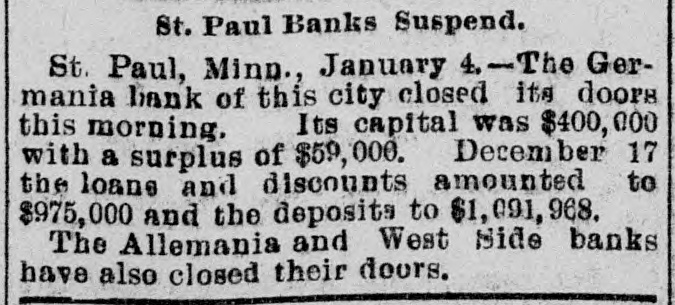
St. Paul Banks Suspend. St. Paul, Minn., January 4.-The Germania bank of this city closed its doors this morning. Its capital was $400,000 with a surplus of $59,000. December 17 the loans and discounts amounted to $975,000 and the deposits to $1,091,968. The Allemania and West Side banks have also closed their doors.


Article from Birmingham State Herald, January 5, 1897

Click image to open full size in new tab

Article Text

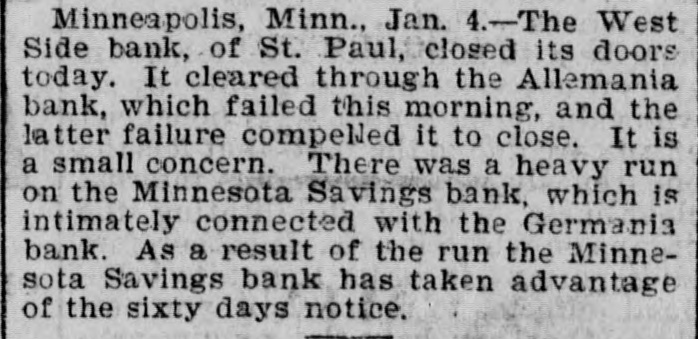
Minneapolis, Minn., Jan. 4.-The West Side bank, of St. Paul, closed its doors today. It cleared through the Allemania bank, which failed this morning, and the latter failure compelled it to close. It is a small concern. There was a heavy run on the Minnesota Savings bank, which is intimately connected with the Germania bank. As a result of the run the Minnesota Savings bank has taken advantage of the sixty days notice.


Article from Evening Journal, January 5, 1897

Click image to open full size in new tab

Article Text

More Minnesota Bank Failures. ST. PAUL, Jan. 5.-As a direct result of the closing of the Bank of Minnesota two weeks ago, which created new distrust among bank depositors and started runs on a number of city banks that were reputed not to be as strong as depositors wished, three St. Paul banks, the Germania, the Allemania and the West Side, none of them national institutions and all closely associated, have closed their doors, one being now in the hands of the state bank examiner and the others having made assignments.


Article from The Morning News, January 6, 1897

Click image to open full size in new tab

Article Text

ST. PAUL'S BROKEN BANKS. Steps Taken to Straighten Out Their Affairs. St. Paul, Minn., Jan. 5. -Maurice Auerbach, president of the Union Bank, was to-day appointed receiver of the Allemania Bank under bond of $200,000. The board of directors of the Germania held a special meeting and appointed a committee of seven stockholders to take measures for the speedy reorganization of the bank. Charles F. Staples was made assignee of the West Side Bank. Early in the day there was a slight run on a couple of banks, but everything quieted down quickly, and no further trouble is expected among the financial institutions here. St. Paul still has five national, six state and three savings banks, with deposits aggregating $20,000,000. Bad business methods wrecked the Bank of Minnesota, and the others were forced to close by panicky depositors.


Article from Richmond Dispatch, January 6, 1897

Click image to open full size in new tab

Article Text

ST, PAUL BANK SITUATION. Two Small Runs-No Further Trouble Anticipated. ST. PAUL, MINN., January 5.-Maurice Auerbach, president of the Union Bank, was to-day appointed receiver of the Allemania Bank, under a bond of $200,000. The Board of Directors of the Germania held a special meeting, and appointed a committee of stockholders to take measures for the speedy reorganization of the bank. Charles F. Staples was made assignee of the Westside Bank. Early in the day there were slight runs on a couple of banks, but everything quieted down quickly, and no further trouble is expected among the financial institutions here. St. Paul still has five national, six State, and three savings banks, with deposits aggregating $20,000,000. Bad. business methods wrecked the Bank of Minnesota, and the others were forced to close by panicky depositors.


Article from Connecticut Western News, January 7, 1897

Click image to open full size in new tab

Article Text

More Minnesota Bank Failures, ST. PAUL, Jan. 5.-As a direct result of the closing of the Bank of M innesota two weeks ago, which created new distrust among bank depositors and started runs on a number of city banks that were reputed not to be as strong as depositors wished, three St. Paul banks, the Germania, the Allemania and the West Side, none of them national institationsand all closely associated. have closed their doors, one being now in the hands of the state bank examiner and the others having made assignments.


Article from The Saint Paul Globe, January 7, 1897

Click image to open full size in new tab

Article Text

THE OTHER BANKS. Business Going Along as Usual-Talk of Reorganization, Business at the banks yesterday was done in the ordinary way and without a ripple of excitement. All the institutions reported increased business in the way of receiving new deposits. This is a sure indication that the feeling of distrust and panic is disappearing. It now seems probable that the Germania will be reorganized, and that very soon. The depositors seem to want it, and there seems to be no reason why, in the opinion of the directors, the reorganization should not take place at an early date. O. E. Holman, attorney for the bank, said that there was no doubt of the reorganization of the bank. "The depositors want it, and there is nothing in the way of prompt action as soon as the court will confirm the appointment of P. M. Kerst as assignee. The committee appointed by President Willius is ready to proceed." Maurice Auerbach, receiver of the Allemannia bank, is being assisted in his work by Capt. Owens, expert accountant, and the entire clerical force of the bank. All the checks that came into this bank on the day of the suspension have been listed by the receiver ,and it is probable that they will be returned. They amount to nearly $7,000. Receiver Staples, of the West Side bank, is preparing a statement that will be made public in a few days. It is generally believed that the bank will be reorganized.


Article from Abilene Weekly Reflector, January 7, 1897

Click image to open full size in new tab

Article Text

Three St. Paul Banks Go Under. ST. Paul, Minn., Jan. 5.-As a direct result of the closing of the Bank of Minnesota two weeks ago, which created new distrust among the banks, depositors started runs on a number of city banks yesterday that were reputed not to be as strong as depositors wished. Three St. Paul banks, the Germania, the Allemania and the West Side, none of them national institutions and all closely associated, were forced to close their doors. They are in the hands of the state bank examiner


Article from The Corvallis Gazette, January 8, 1897

Click image to open full size in new tab

Article Text

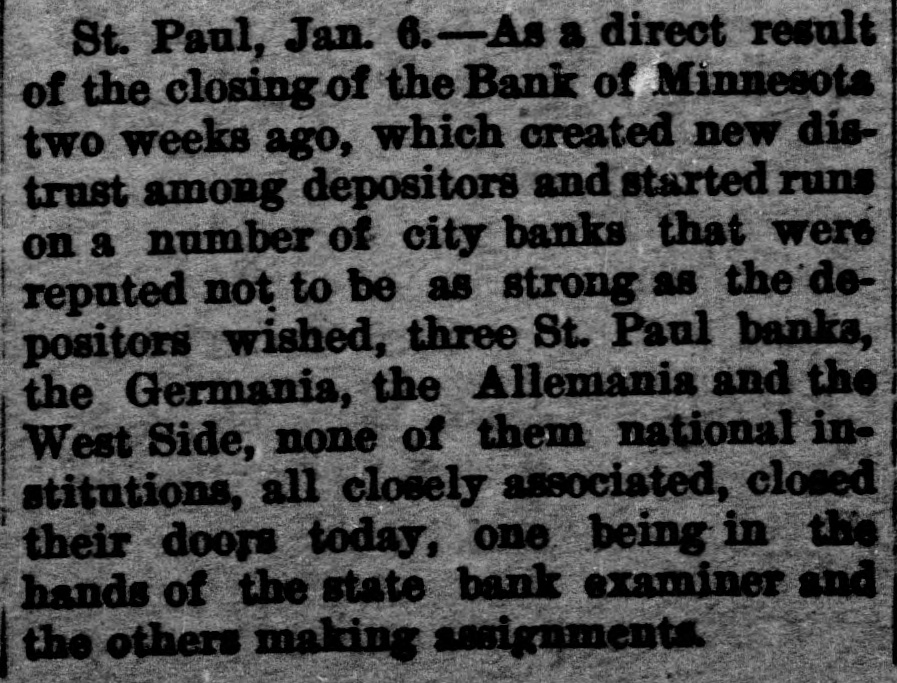
St. Paul, Jan. 6. -As - a direct result of the closing of the Bank of Minnesota two weeks ago, which created new distrust among depositors and started runs on a number of city banks that were reputed not to be as strong as the depositors wished, three St. Paul banks, the Germania, the Allemania and the West Side, none of them national institutions, all closely associated, closed their doors today, one being in the hands of the state bank examiner and the others making assignments.


Article from The New North-West, January 8, 1897

Click image to open full size in new tab

Article Text

THREE MORE ST. PAUL BANKS. Two Were Large Institutions, the Other Was Small. St. Paul, Minn., Jan. 4.-As a direct result of the closing of the Bank of Minnesota, two weeks ago, which created new distrust among depositors and started runs on a number of city banks that were reputed not to be as strong as the depositors wished, three St. Paul banks-the Germania, the Allemania and the Vest Side, none of them national institutions, all closely associated-closed their doors today, one being in the hands of the state bank examiner and the others making assignments. During the time that had intervened since the closing of the Bank of Minnesota, the Germania paid out $225,000 to frightened depositors, and early today the directors concluded they would stop the drain and make an assignment to the cashier, Peter M. Keerst. The Allemania bank, which, like the Germania, had a large clientage among the Germans, and whose vice president had formerly been vice president of the Germania, then became the target for a lively run. Crowds gathered about the doors and fairly fought for a place in the line before the paying teller's window. The bank officials realized fully what such a run meant, and promptly called on Bank Examiner Kenyon to take poss sion of the bank, and that official is now in charge. The West Side bank, a small but possibly stronger bank, cleared through the Allemania, and today its clearings were returned by the latter institution. Follows ing this there was a decided run inaugurated on the bank, and at 2 o'clock this afternoon the bank officials closed the doors and called a meeting of the directors to decide what action to take. Their decision was apparent late in the afternoon, when they filed a deed of assignment to S. H. Staples, president of the bank. Considerable public money is tied up in the three institutions, but there is an mple supply for all immodiate needs in the other banks of the city. The assignment of the Germania and West Side banks has brought up a somewhat new question in the banking laws of the state, and the courts will be called upon to settle it. The state bank examiner doubts their right to assign, holding that they should have, under the law, turned over their assets to him. The attorney general intimates that he will bring an action to test the matter as soon as papers can be issued. During the day numerous reports of trouble among the other banks were current, and a few banks suffered runs of greater or lesser intensity, but the savings banks were protected by the law that allows them to require 60 days' notice before paying out deposits; and the national banks are in strong condition, and have no fear of anything of the sort. The Germania Bank. The Germania bank was a state institution and had a capital of $400,000. The last official statement of the condition of the bank, December 21, gave loans and discounts as $975,420.53; total resources, $1,625,788. Among the liabilities were cap, ital stock, $400,000; surplus and undivided profits, $58,797; individual deposits subject to check, $345,191; demand certificates of deposit, $7899; time certificates of deposit, $633,019. The Germania bank has been organize. many years, ex-Governor Alexander Ram. say being a long time president, and William Bickell, cashier. When the governor retired, Mr. Bickell became president, but last spring Bickell retired, becoming vice president of the newly organized Alle, mania bank. He was succeeded by Gustav Willius. President Willius told an Associated Press representative that the closing was the result of an unreasonable panic, and the bank would be opened for business as soon as the people regained their usual cool sense. The bank, as a result of the panicky feeling, had paid the depositors $335,000 in the last nine days. Willius said he fully expected to have the bank reopened by the last of March. The Allemania. The Allemania bank has a capital of $400,000, and a clientage similar to that of the Germania. The Allemania was organized last year, as a successor of the Commercial, William Bickell, formerly pres. ident of the Germania, joining forces with Albert Scheffer, of the Commercial, to organize a new bank. The last official statement made, December 17, showed loans and discounts, $706,842; undivided profits, less expenses, $508,764; individual deposits, $329,789; interest certificates, $187,253. President Scheffer, of the Allemania, said the failure was due to combined withdrawal of deposits. A crowd of depositors gathered today demanding their money, and at 11 o'clock it was decided to close. f Runs on Other Banks. Owing to the excitement caused by the closing of the Germania and the Allemania banks, many depositors went after their money in one or two other banks.

Article from Iowa State Bystander, January 8, 1897

Click image to open full size in new tab

Article Text

St. Paul Banks Closed. ST. PAUL, Jan. 5.-The Germania bank, with deposits of $1,091,968 and the Allemania bank. with deposits of $602,305. have suspended payment. The trouble was caused by runs. Later the West Side bank closed its doors, and when a run on the Minnesota Savings bank began the officials decided to take advantage of the rule requiring sixty days' notice before withdrawing deposits.


Article from The Diamond Drill, January 9, 1897

Click image to open full size in new tab

Article Text

MORE BANKS FAIL. Three Institutions in St. Paul Close Their Doors. St. Paul, Minn., Jan. 5.-The Germania, the Allemania and West Side banks, all doing business as state banks, on Monday closed their doors, every one of them being literally pulled down by their depositors. The failure of the Bank of Minnesota December 22 caused unrest in the community and depositors withdrew their money from the three banks above to such an extent that they were forced to go to the wall because they had not funds enough immediately in hand to meet the demands made upon them. Each of the three, however, is solvent, and all of them will reorganize ns soon as the machinery for that purpose can be put into use. The directors of the Germania met Monday evening and appointed a committee on reorganization. The Germania is in the hands of P. M. Kerst as assignee and the other two are in the hands of Bank Examiner Kenyon. A receiver will be appointed for the Allemania to-day and the West Side bank will try to make arrangements with its creditors and reopen without the intervention of a receiver.


Article from The Islander, January 14, 1897

Click image to open full size in new tab

Article Text

St. Paul, Jan. 6.-As a direct result of the closing of the Bank of Minnesota two weeks ago, which created new distrust among depositors and started runs on a number of city banks that were reputed not to be as strong as the depositors wished, three St. Paul banks, the Germania, the Allemania and the West Side, none of them national institutions, all closely associated, closed their doors today, one being in the hands of the state bank examiner and the others making assignments.


Article from The Saint Paul Globe, January 29, 1897

Click image to open full size in new tab

Article Text

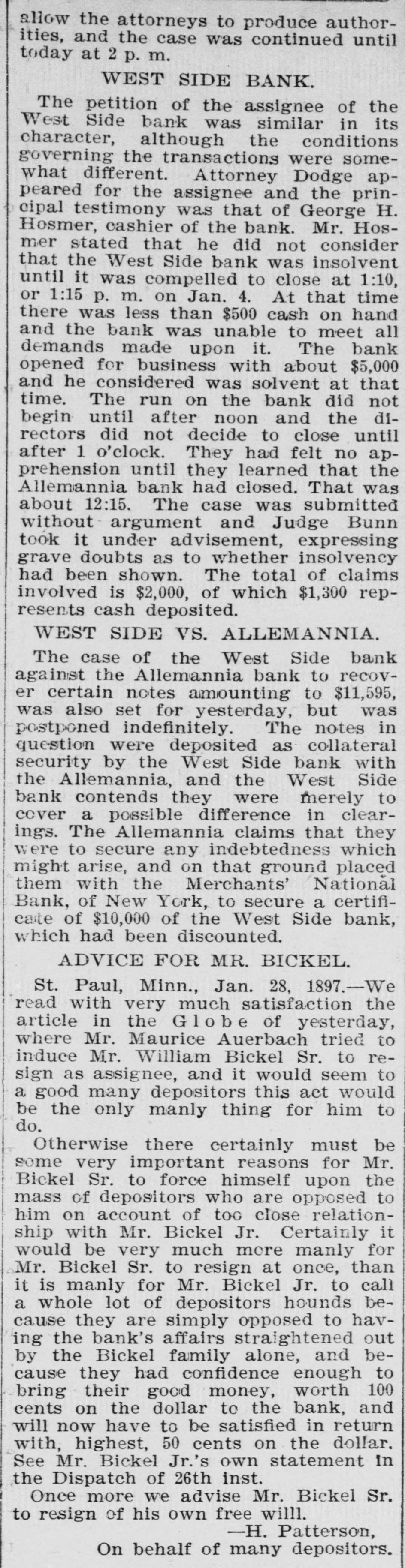
allow the attorneys to produce authorities, and the case was continued until today at 2 p. m. WEST SIDE BANK. The petition of the assignee of the West Side bank was similar in its character, although the conditions governing the transactions were somewhat different. Attorney Dodge appeared for the assignee and the principal testimony was that of George H. Hosmer, cashier of the bank. Mr. Hosmer stated that he did not consider that the West Side bank was insolvent until it was compelled to close at 1:10, or 1:15 p. m. on Jan. 4. At that time there was less than $500 cash on hand and the bank was unable to meet all demands made upon it. The bank opened for business with about $5,000 and he considered was solvent at that time. The run on the bank did not begin until after noon and the directors did not decide to close until after 1 o'clock. They had felt no apprehension until they learned that the Allemannia bank had closed. That was about 12:15. The case was submitted without argument and Judge Bunn took it under advisement, expressing grave doubts as to whether insolvency had been shown. The total of claims involved is $2,000, of which $1,300 represents cash deposited. WEST SIDE VS. ALLEMANNIA. The case of the West Side bank against the Allemannia bank to recover certain notes amounting to $11,595, was also set for yesterday, but was postponed indefinitely. The notes in question were deposited as collateral security by the West Side bank with the Allemannia, and the West Side bank contends they were merely to cover a possible difference in clearings. The Allemannia claims that they were to secure any indebtedness which might arise, and on that ground placed them with the Merchants' National Bank, of New York, to secure a certificaite of $10,000 of the West Side bank, which had been discounted. ADVICE FOR MR. BICKEL. St. Paul, Minn., Jan. 28, 1897.-We read with very much satisfaction the article in the Globe of yesterday, where Mr. Maurice Auerbach tried to induce Mr. William Bickel Sr. to resign as assignee, and it would seem to a good many depositors this act would be the only manly thing for him to do. Otherwise there certainly must be some very important reasons for Mr. Bickel Sr. to force himself upon the mass of depositors who are opposed to him on account of too close relationship with Mr. Bickel Jr. Certainly it would be very much more manly for Mr. Bickel Sr. to resign at once, than it is manly for Mr. Bickel Jr. to call a whole lot of depositors hounds because they are simply opposed to having the bank's affairs straightened out by the Bickel family alone, and because they had confidence enough to bring their good money, worth 100 cents on the dollar to the bank, and will now have to be satisfied in return with, highest, 50 cents on the dollar. See Mr. Bickel Jr.'s own statement In the Dispatch of 26th inst. Once more we advise Mr. Bickel Sr. to resign of his own free will. -H. Patterson, On behalf of many depositors.


Article from The Saint Paul Globe, July 7, 1897

Click image to open full size in new tab

Article Text

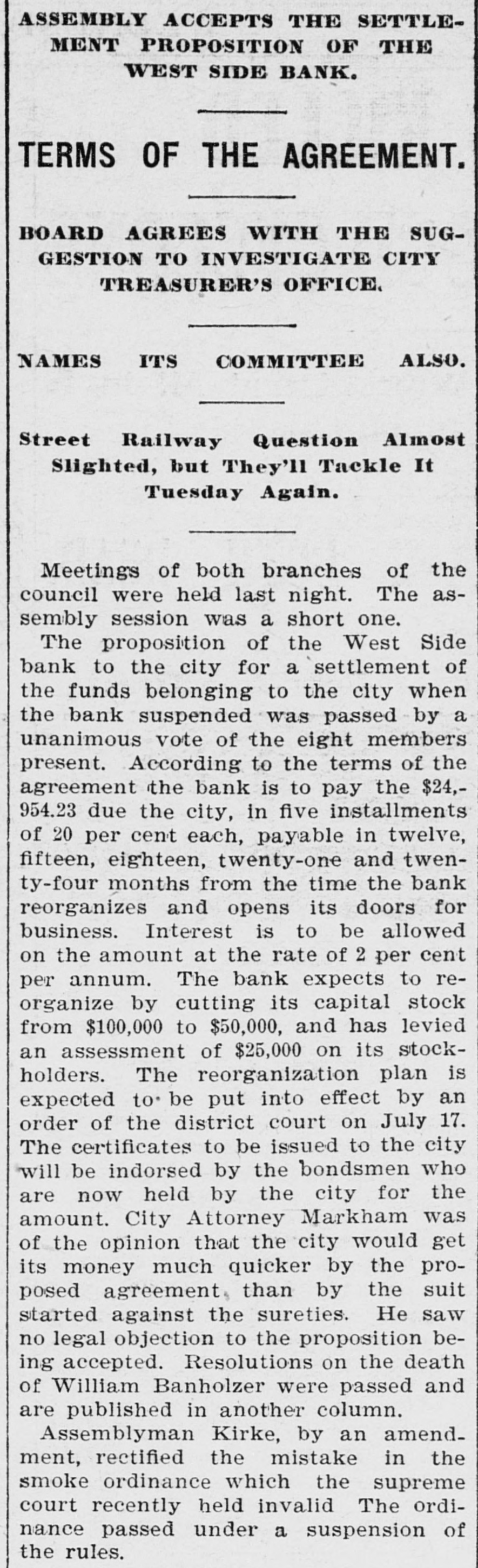
ASSEMBLY ACCEPTS THE SETTLEMENT PROPOSITION OF THE WEST SIDE BANK. TERMS OF THE AGREEMENT. BOARD AGREES WITH THE SUGGESTION TO INVESTIGATE CITY TREASURER'S OFFICE. NAMES ITS COMMITTEE ALSO. Street Railway Question Almost Slighted, but They'll Tackle It Tuesday Again. Meetings of both branches of the council were held last night. The assembly session was a short one. The proposition of the West Side bank to the city for a settlement of the funds belonging to the city when the bank suspended was passed by a unanimous vote of the eight members present. According to the terms of the agreement the bank is to pay the $24,954.23 due the city, in five installments of 20 per cent each, payable in twelve, fifteen, eighteen, twenty-one and twenty-four months from the time the bank reorganizes and opens its doors for business. Interest is to be allowed on the amount at the rate of 2 per cent per annum. The bank expects to reorganize by cutting its capital stock from $100,000 to $50,000, and has levied an assessment of $25,000 on its stockholders. The reorganization plan is expected to be put into effect by an order of the district court on July 17. The certificates to be issued to the city will be indorsed by the bondsmen who are now held by the city for the amount. City Attorney Markham was of the opinion that the city would get its money much quicker by the proposed agreement, than by the suit started against the sureties. He saw no legal objection to the proposition being accepted. Resolutions on the death of William Banholzer were passed and are published in another column. Assemblyman Kirke, by an amendment, rectified the mistake in the smoke ordinance which the supreme court recently held invalid The ordinance passed under a suspension of the rules.


Article from The Saint Paul Globe, November 25, 1897

Click image to open full size in new tab

Article Text

SETTLING WITH THE CITY. West Side Bank Makes Its First Payment as Directed. The sum of $5,076.79 was paid into the city treasury yesterday by the West Side bank. When the bank suspended Jan. 4 last, the city had on deposit in the institution something like $25,000. Recently the bank reorganized and made an agreement with the city to pay the amount in five installments. One-fifth of the sum was paid yesterday and the remainder will be turned over in four equal payments at the expiration of twelve, fifteen, eighteen and twenty-one months. Interest on the entire sum at the rate of 2 per cent per annum will be paid by the bank.