Minnesota Savings Bank (St Paul, MN)

Episode Information

Episode UID
3851930691165
Episode Type
Run โ†’ Suspension โ†’ Closure
Bank Type
savings
Bank ID
385193069 hash
Start Date
January 4, 1897
Location
St Paul, Minnesota (44.944, -93.093)

Metadata

Model
gpt-5-mini (chosen from majority vote of a three-model LLM ensemble)
Short Digest
cbf061ededf497c0

Response Measures

None

Description

Run began after nearby St. Paul bank failures; bank first invoked 60-day notice then was assigned and later placed in receivership.

Events (3)

1. January 4, 1897 Run
Cause
Local Banks
Cause Details
Runs at nearby St. Paul banks (Germania, Allemania, West Side) precipitated heavy withdrawals at Minnesota Savings Bank.
Measures
Invoked sixty-day/sixty and ninety-day notice rule to require withdrawal notice from depositors.
Newspaper Excerpt
There was also a run on the Minnesota Savings bank, but the bank saved itself by means of the 60 day notice law.
Source
newspapers
2. January 18, 1897 Suspension
Cause
Local Banks
Cause Details
Inability to obtain sufficient ready money to meet withdrawals after runs tied to other St. Paul bank failures; bank assigned/closed.
Newspaper Excerpt
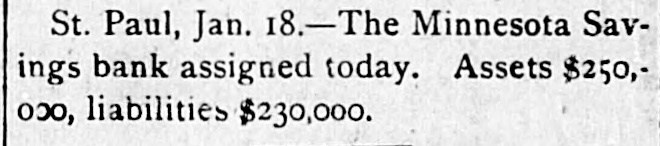
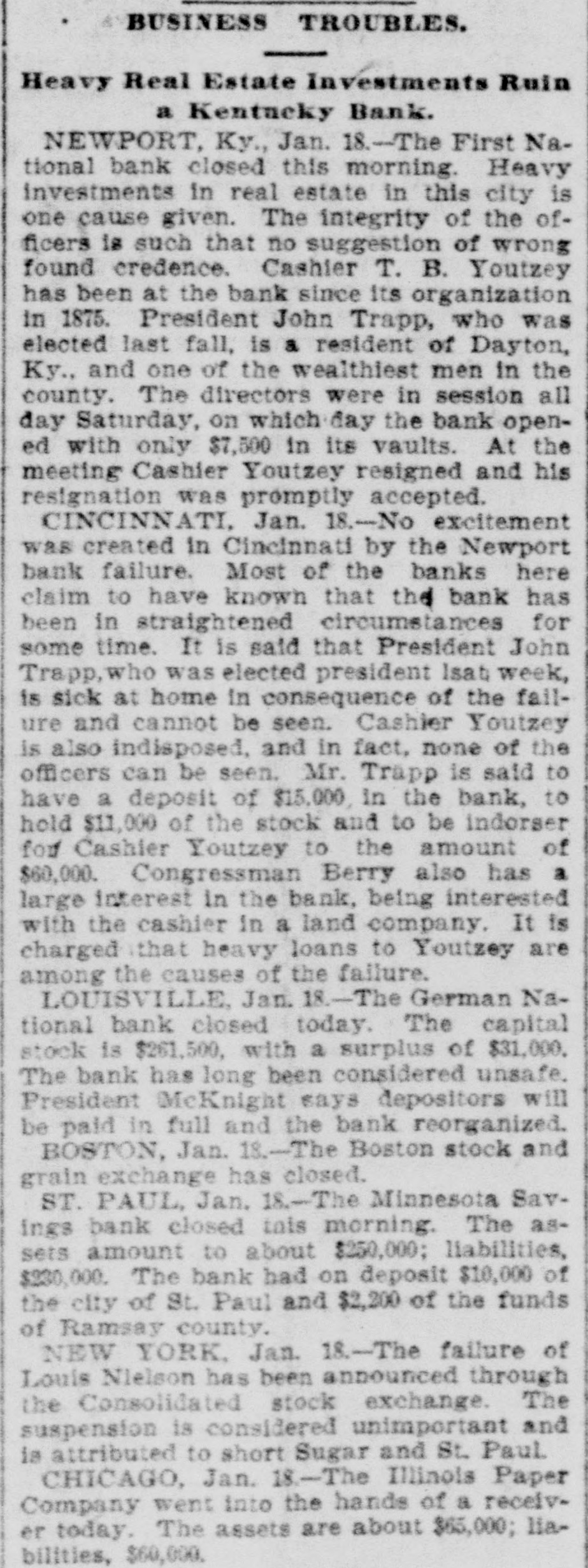
St. Paul, Jan. 18.-The Minnesota Savings bank assigned today. Assets $250,ooo, liabilities $230,000.
Source
newspapers
3. February 22, 1897 Receivership
Newspaper Excerpt
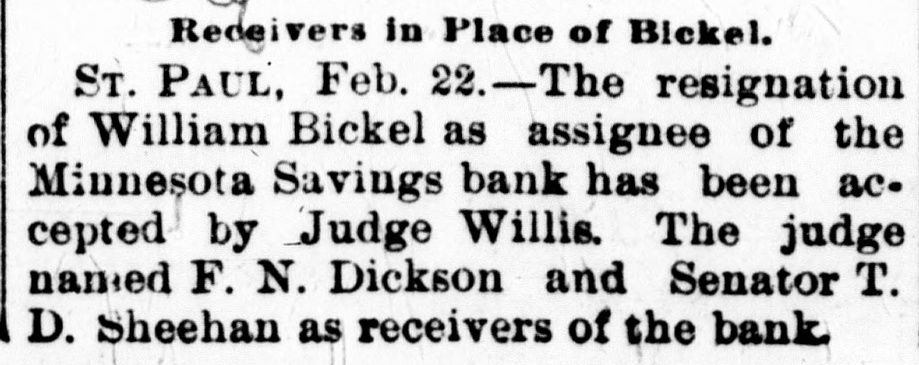
The resignation of William Bickel as assignee of the Minnesota Savings bank has been accepted by Judge Willis. The judge named F. N. Dickson and Senator T. D. Sheehan as receivers of the bank .
Source
newspapers

Newspaper Articles (24)

Article from Daily Camera, January 4, 1897

Click image to open full size in new tab

Article Text

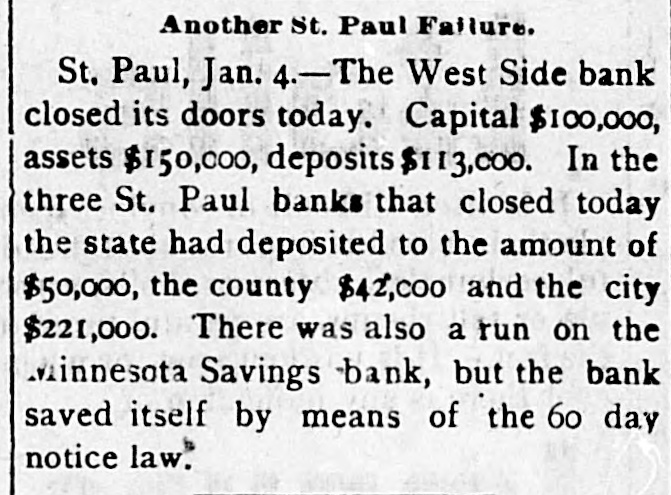
Another St. Paul Failure. St. Paul, Jan. 4.-The West Side bank closed its doors today. Capital $100,000, assets $150,000, deposits $113,000. In the three St. Paul banks that closed today the state had deposited to the amount of $50,000, the county $42,000 and the city $221,000. There was also a run on the Minnesota Savings bank, but the bank saved itself by means of the 60 day notice law."


Article from New-York Tribune, January 5, 1897

Click image to open full size in new tab

Article Text

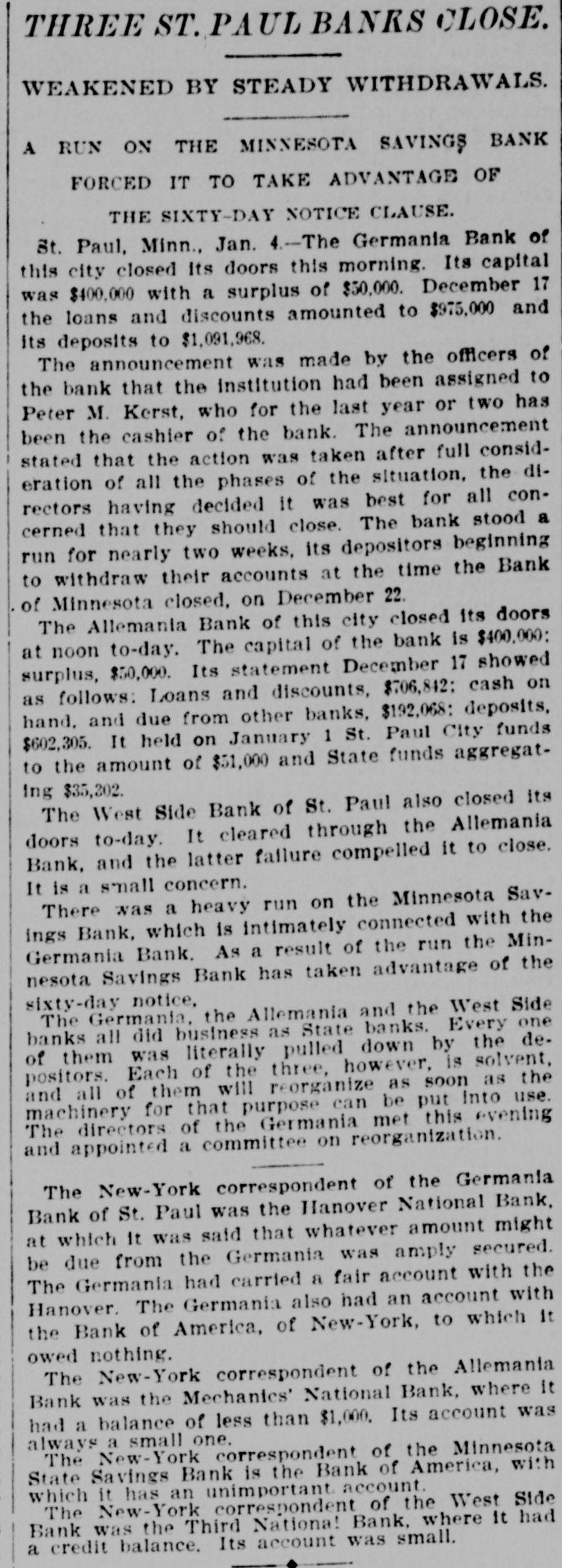
THREE ST. PAUL BANKS CLOSE. WEAKENED BY STEADY WITHDRAWALS. A RUN ON THE MINNESOTA SAVINGS BANK FORCED IT TO TAKE ADVANTAGE OF THE SIXTY-DAY NOTICE CLAUSE. St. Paul, Minn., Jan. 4.-The Germania Bank of this city closed its doors this morning. Its capital was $400,000 with a surplus of $50,000. December 17 the loans and discounts amounted to $975,000 and its deposits to $1,091,968. The announcement was made by the officers of the bank that the institution had been assigned to Peter M. Kerst, who for the last year or two has been the cashier of the bank. The announcement stated that the action was taken after full consideration of all the phases of the situation, the directors having decided it was best for all concerned that they should close. The bank stood a run for nearly two weeks, its depositors beginning to withdraw their accounts at the time the Bank of Minnesota closed. on December 22. The Allemania Bank of this city closed its doors at noon to-day. The capital of the bank is $400,000: surplus, $50,000. Its statement December 17 showed as follows: Loans and discounts, $706,842: cash on hand, and due from other banks, $192,068: deposits, $602,305. It held on January 1 St. Paul City funds to the amount of $51,000 and State funds aggregatIng $35,302. The West Side Bank of St. Paul also closed its doors to-day. It cleared through the Allemania Bank, and the latter failure compelled it to close. It is a small concern. There was a heavy run on the Minnesota Savings Bank, which is intimately connected with the Germania Bank. As a result of the run the Minnesota Savings Bank has taken advantage of the sixty-day notice, The Germania, the Allemania and the West Side banks all did business as State banks. Every one depositors. and of them all of Each was them literally of will the reorganize three, pulled however, down as soon by is the solvent, as the machinery for that purpose can be put into use. The directors of the Germania met this evening and appointed a committee on reorganization. The New-York correspondent of the Germania Bank of St. Paul was the Hanover National Bank, at which It was said that whatever amount might be due from the Germania was amply secured. The Germania had carried a fair account with the Hanover. The Germania also had an account with the Bank of America, of New-York, to which It owed nothing. The New-York correspondent of the Allemania Bank was the Mechanics' National Bank, where it had a balance of less than $1,000. Its account was always a small one. The New-York correspondent of the Minnesota State Savings Bank is the Bank of America, with which it has an unimportant account. The New-York correspondent of the West Side Bank was the Third National Bank, where it had a credit balance. Its account was small.


Article from The Norfolk Virginian, January 5, 1897

Click image to open full size in new tab

Article Text

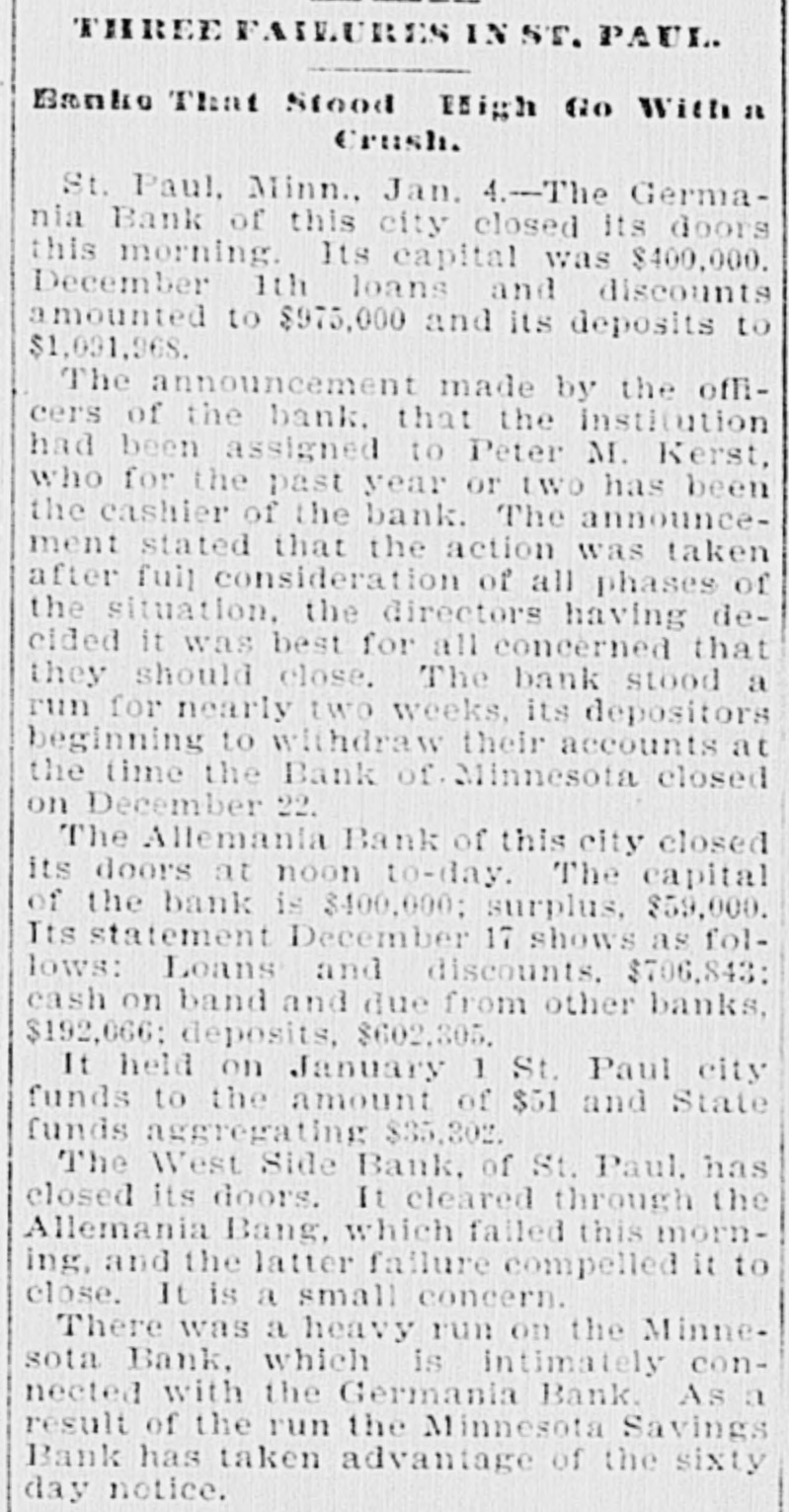
THREE PAUL. Banko That Stood High Go With a Crush. St. Paul. Minn.. Jan. 4.--The Germania Bank of this city closed its doors this morning. Its capital was $400,000. December 1th loans and discounts amounted to $975,000 and its deposits to $1,091,968. The announcement made by the officers of the bank. that the institution had been assigned to Peter M. Kerst, who for the past year or two has been the cashier of the bank. The announcement stated that the action was taken after full consideration of all phases of the situation. the directors having decided it was best for all concerned that they should close. The bank stood a run for nearly two weeks, its depositors beginning to withdraw their accounts at the time the Bank of Minnesota closed on December 22. The Allemania Bank of this city closed its doors at noon to-day. The capital of the bank is $400,000; surplus, $59,000. Its statement December 17 shows as follows: Loans and discounts. $706,843: cash on band and due from other banks, $192,066; deposits, $602.305. It held on January 1 St. Paul city funds to the amount of $51 and State funds aggregating $35,302. The West Side Bank, of St. Paul. has closed its doors. It cleared through the Allemania Bang, which failed this morning. and the latter failure compelled it to close. It is a small concern. There was a heavy run on the Minnesota Bank, which is intimately connected with the Germania Bank. As a result of the run the Minnesota Savings Bank has taken advantage of the sixty day notice.


Article from The Saint Paul Globe, January 5, 1897

Click image to open full size in new tab

Article Text

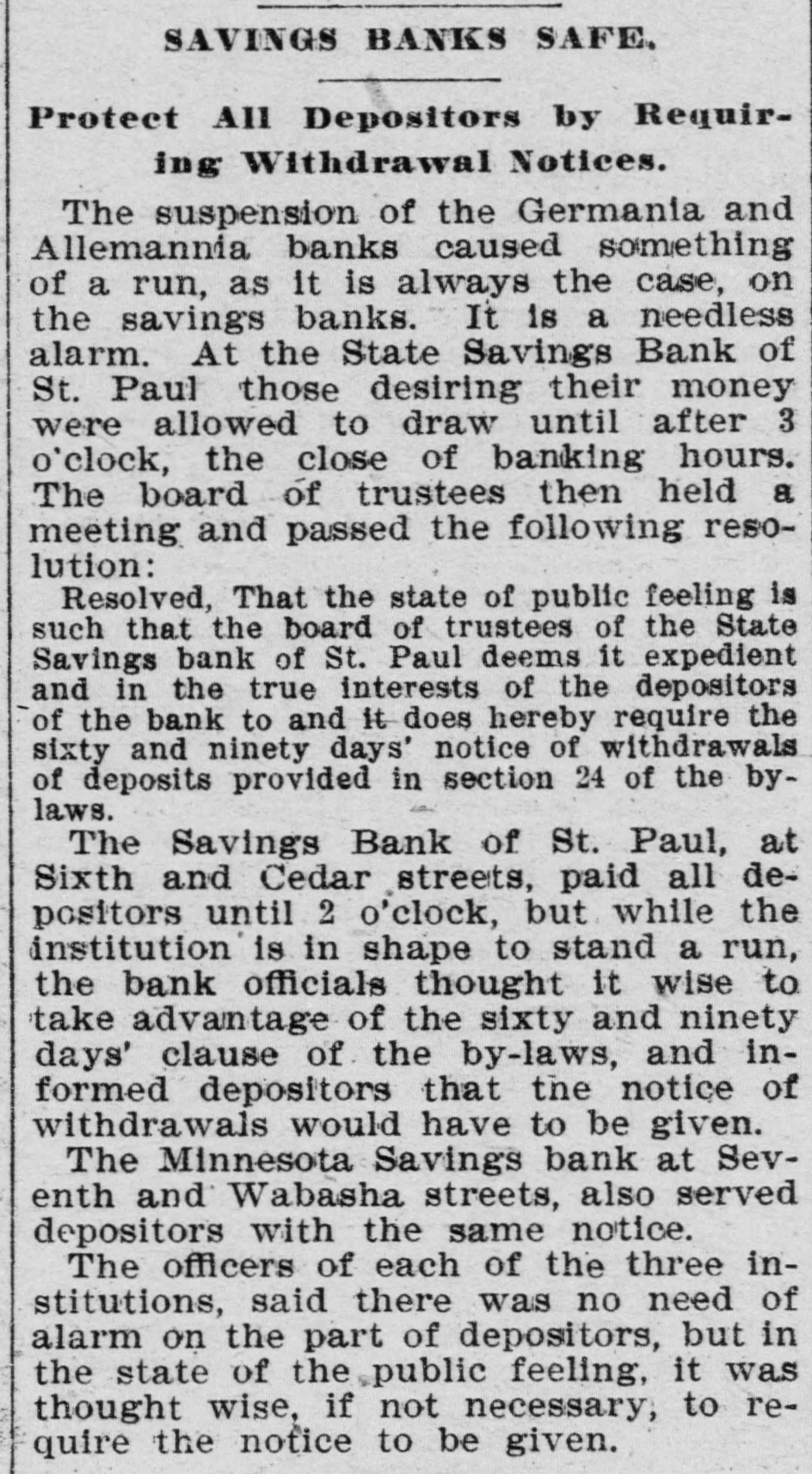
SAVINGS BANKS SAFE. Protect All Depositors by Requiring Withdrawal Notices. The suspension of the Germania and Allemannia banks caused something of a run, as it is always the case, on the savings banks. It is a needless alarm. At the State Savings Bank of St. Paul those desiring their money were allowed to draw until after 3 o'clock, the close of banking hours. The board of trustees then held a meeting and passed the following resolution: Resolved, That the state of public feeling is such that the board of trustees of the State Savings bank of St. Paul deems it expedient and in the true interests of the depositors of the bank to and it does hereby require the sixty and ninety days' notice of withdrawals of deposits provided in section 24 of the bylaws. The Savings Bank of St. Paul, at Sixth and Cedar streets, paid all depositors until 2 o'clock, but while the institution is in shape to stand a run, the bank officials thought it wise to take advantage of the sixty and ninety days' clause of the by-laws, and informed depositors that the notice of withdrawals would have to be given. The Minnesota Savings bank at Seventh and Wabasha streets, also served depositors with the same notice. The officers of each of the three institutions, said there was no need of alarm on the part of depositors, but in the state of the public feeling, it was thought wise, if not necessary, to require the notice to be given.


Article from Iowa State Bystander, January 8, 1897

Click image to open full size in new tab

Article Text

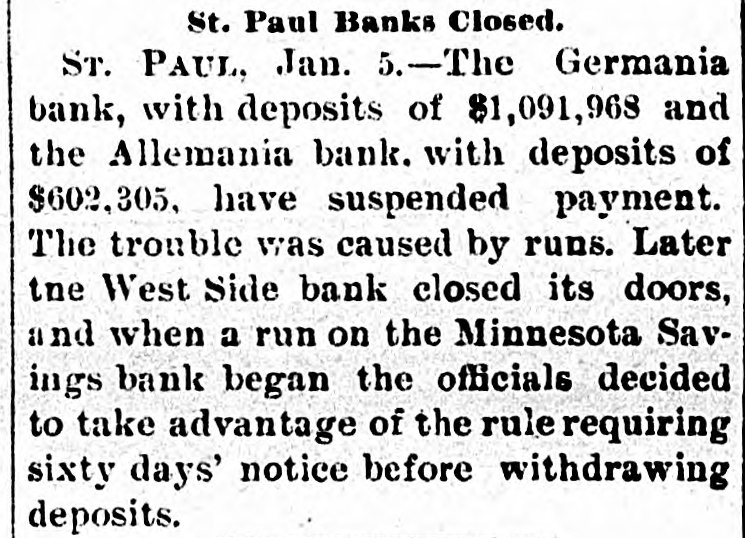
St. Paul Banks Closed. ST. PAUL, Jan. 5.-The Germania bank, with deposits of $1,091,968 and the Allemania bank. with deposits of $602,305. have suspended payment. The trouble was caused by runs. Later the West Side bank closed its doors, and when a run on the Minnesota Savings bank began the officials decided to take advantage of the rule requiring sixty days' notice before withdrawing deposits.


Article from Red Lodge Picket, January 9, 1897

Click image to open full size in new tab

Article Text

THREE MORE ST. PAUL BANKS. Two Were Large Institutions, the Other Was small. St. Paul, Minn., Jan. 4.-As a direct Minne- rethe closing of the Bank weeks ago, which sota, sult of two and created of started new distrust among depositors were a number of city banks not to be as strong as reputed runs on banks-the the that deposthree St. Paul the Allemania and of them national Germania, itors none wished, institutions, the doors Vest all Side, closely associated-closed their state today, one being in the hands of the asbank examiner and the others making signments. the time that had interv ened During closing of the Bank of Minne- to the Germania paid out sota, since the $225,000 today the frightened depositors, and early the directors concluded they would stop the drain and make an assignment to cashier, Peter M. Keerst. The Allemania bank, which, like the Germania, had a large clientage among and whose vice president the been vice president a the had Germans, formerly target of for Germania, then became the the run. Crowds gathered about the doors lively and fairly fought for a place window. in before the paying teller's such line bank officials realized fully what on The run meant, and promptly called a Bank Examiner Kenyon to take posses- now sion of the bank, and that official is in charge. The West Side bank, a small but possi- Alstronger bank, cleared through the rebly lemania, and today its clearings were turned by the latter institution. Follow~ this there was a decided run inaugu- this ing on the bank, and at 2 o'clock the rated the bank officials closed afternoon and called a meeting of the directors decisdoors decide what action to take. Their to was apparent late in the afternoon, to S. ion filed a deed of assignment H. president of the when Staples, they bank. tied Considerable public money is up m- in three institutions, but there is an in the ple the supply for all immediate needs other banks of the city. The assignment of the Germania and Side banks has brought up a laws some- of West new question in the banking called upwhat state, and the courts will be examiner the settle it. The state bank that on to their right to assign, holding turned doubts should have, under the law, they their assets to him. The attorney acover intimates that he will bring an general tion to test the matter as soon as papers be issued. of can the day numerous reports curDuring among the other banks were of trouble and a few banks suffered runs rent, or lesser intensity, but the that savings algreater were protected by the law before banks them to require 60 days' notice national lows out deposits; and the have no banks paying are in strong condition, and fear of anything of the sort. The Germania Bank. Germania bank was a state insti- The The and had a capital of $400,000. tution official statement of the condition and of last bank, December 21, gave loans resources, I discounts the as $975,420.53; total cap 1 Among the liabilities were undivided $1,625,788. stock, $400,000; surplus and subject ital $58,797; individual deposits certificates of 1 profits, check, $345,191; demand to deposit, $7899; time certificates of deposit, s 3633,019. Germania bank has been organized RamS The ex-Governor Alexander Wilmany being years, a long time president, and say Bickell, cashier. When the governor but liam Mr. Bickell became president, vice f retired, spring Bickell retired, becoming Alle2 last of the newly organized Gusmania president bank. He was succeeded by tav Willius. d Willius told an Associated President representative that the closing was and Press result of an unreasonable panic, the bank would be opened for business usua as the soon as the people regained their cool sense. it bank, as a result of the panicky in o The had paid the depositors $335,000 he fully 1 feeling, last nine days. Willius said by expected the to have the bank reopened the last of March. il The Allemania. r Allemania bank has a capital that of and a clientage similar to o The Allemania was $400,000, the The Germania. of the organ Com last year, as a successor G. ized mercial, William Bickell, formerly forces pres e ident of the Germania, joining Commercial with Albert Scheffer, of the last offl organize a new bank. The show y cial to statement made, December undivided 17, e loans and discounts, $706,842; individua e ed less expenses, $508,764; certificates profits, deposits, $329,789; interest cil n $187,253. President Scheffer, of the Allemania combine n the failure was due to of de twithdrawal said of deposits. A crowd the at positors gathered today demanding decide money, and at 11 o'clock it was to close. Runs on Other Banks. n, to the excitement caused by Alle th Owing of the Germania and the afte ht closing mania banks, many depositors went banks 'S. en their money in one or two other th the Minnesota Savings bank being
Article from Daily Camera, January 18, 1897

Click image to open full size in new tab

Article Text

St. Paul, Jan. 18.-The Minnesota Savings bank assigned today. Assets $250,ooo, liabilities $230,000.


Article from Morning Appeal, January 19, 1897

Click image to open full size in new tab

Article Text

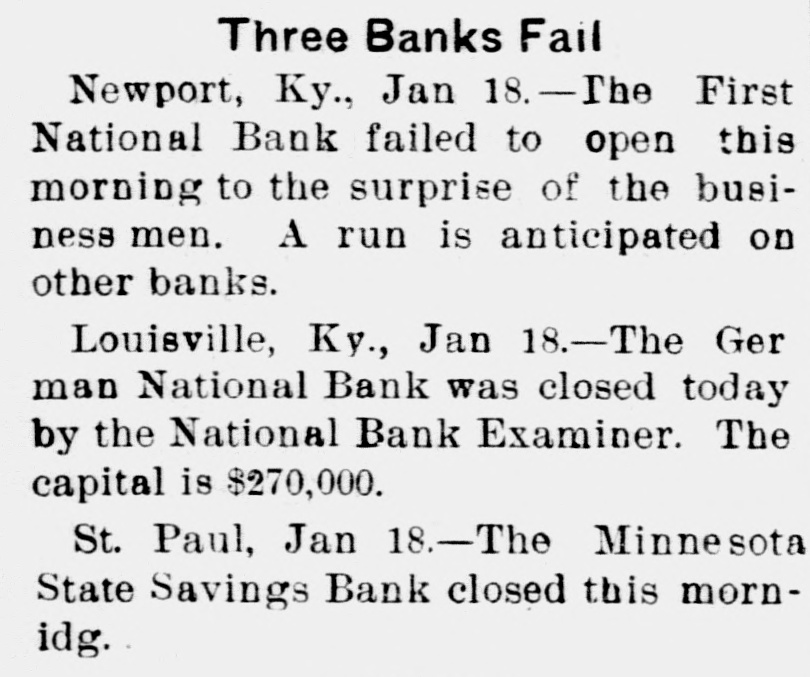
Three Banks Fail Newport, Ky., Jan 18.-The First National Bank failed to open this morning to the surprise of the business men. A run is anticipated on other banks. Louisville, Ky., Jan 18.-The Ger man National Bank was closed today by the National Bank Examiner. The capital is $270,000. St. Paul, Jan 18.-The Minnesota State Savings Bank closed this mornidg.


Article from Evening Journal, January 19, 1897

Click image to open full size in new tab

Article Text

TELEGRAPHIC BREVITIES. The Earl of Kimberly was chosen leader of the Liberal party for the house of lords. Seven persons have been killed by asphyxiation in Boston during the last 48 hours. The trial of Edward J. Ivory as an Irish dynamite conspirator began in the Old Bailey in London. The Countess de Castellane, formerly Anna Gould of New York, became the mother of a son at her home in Paris. The bubonic plague, which is ravaging the city of Bombay, is growing worse daily; 2,592 deaths have been reported. The Minuesoto Savings bank of St. Paul suspended owing to inability to obtain sufficient ready money to meet withdrawals. Two national banks failed in Kentucky -the German of Louisville and the First of Newport-owing, it is alleged, to poor management. Mrs. Delia Hoffman of West Hoboken, N J., was murdered in her bed. She had been hacked three times on the skull with an ax. The ax was found lying across her breast. Richard Hoffman, her son, and John Engelbrocht, a boarder, discovered the murder. They have been arrested on suspicion, but deny all knowledge of the murder.


Article from Saint Mary's Beacon, January 21, 1897

Click image to open full size in new tab

Article Text

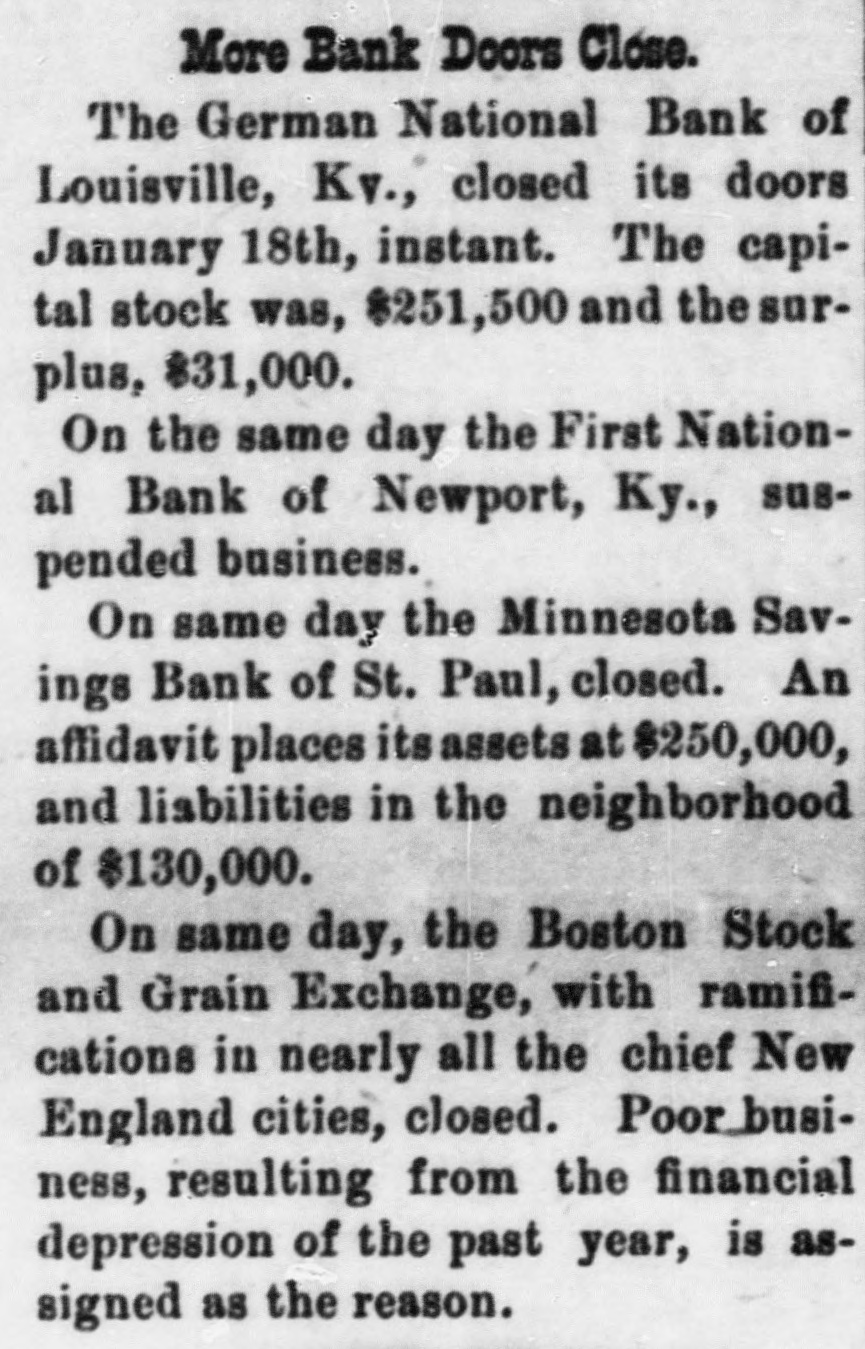
More Bank Doors Close. The German National Bank of Louisville, Kv., closed its doors January 18th, instant. The capital stock was, $251,500 and the surplus, $31,000. On the same day the First National Bank of Newport, Ky., suspended business. On same day the Minnesota Savings Bank of St. Paul, closed. An affidavit places its assets at $250,000, and liabilities in the neighborhood of $130,000. On same day, the Boston Stock and Grain Exchange, with ramifications in nearly all the chief New England cities, closed. Poor business, resulting from the financial depression of the past year, is assigned as the reason.


Article from The Saint Paul Globe, January 21, 1897

Click image to open full size in new tab

Article Text

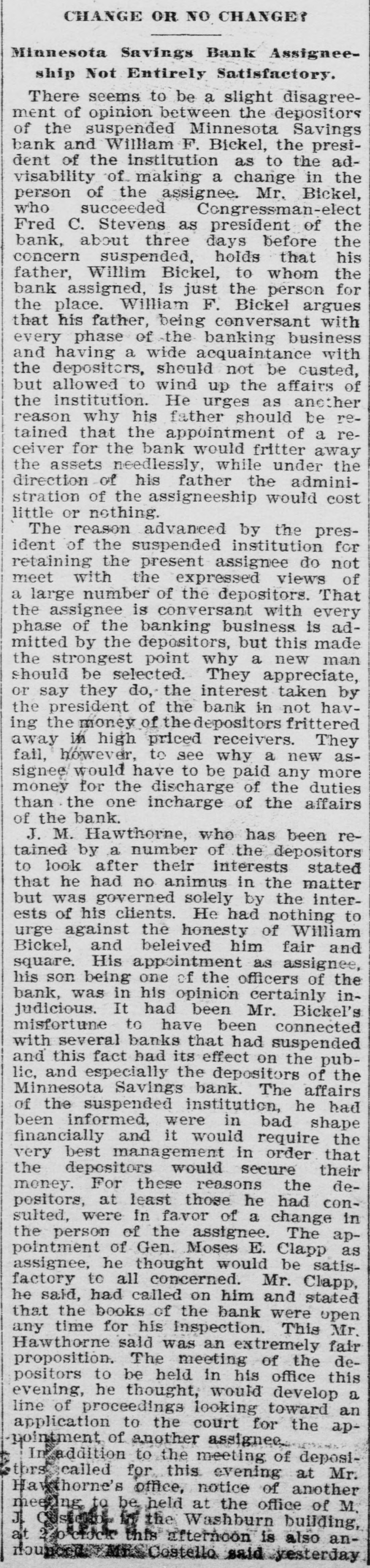
CHANGE OR NO CHANGE? Minnesota Savings Bank Assigneeship Not Entirely Satisfactory. There seems to be a slight disagreement of opinion between the depositors of the suspended Minnesota Savings bank and William F. Bickel, the president of the institution as to the advisability of making a change in the person of the assignee. Mr. Bickel, who succeeded Congressman-elect Fred C. Stevens as president of the bank, about three days before the concern suspended, holds that his father, Willim Bickel, to whom the bank assigned, is just the person for the place. William F. Bickel argues that his father, being conversant with every phase of the banking business and having a wide acquaintance with the depositors, should not be custed, but allowed to wind up the affairs of the institution. He urges as another reason why his father should be retained that the appointment of a receiver for the bank would fritter away the assets needlessly, while under the direction of his father the administration of the assigneeship would cost little or nothing. The reason advanced by the president of the suspended institution for retaining the present assignee do not meet with the expressed views of a large number of the depositors. That the assignee is conversant with every phase of the banking business is admitted by the depositors, but this made the strongest point why a new man should be selected. They appreciate, or say they do, the interest taken by the president of the bank in not having the money of the depositors frittered away in high priced receivers. They fail, however, to see why a new assignee would have to be paid any more money for the discharge of the duties than the one incharge of the affairs of the bank. J. M. Hawthorne, who has been retained by a number of the depositors to look after their interests stated that he had no animus in the matter but was governed solely by the interests of his clients. He had nothing to urge against the honesty of William Bickel, and beleived him fair and square. His appointment as assignee, his son being one of the officers of the bank, was in his opinion certainly injudicious. It had been Mr. Bickel's misfortune to have been connected with several banks that had suspended and this fact had its effect on the public, and especially the depositors of the Minnesota Savings bank. The affairs of the suspended institution, he had been informed, were in bad shape financially and it would require the very best management in order that the depositors would secure their money. For these reasons the depositors, at least those he had consulted, were in favor of a change in the person of the assignee. The appointment of Gen. Moses E. Clapp as assignee, he thought would be satisfactory to all concerned. Mr. Clapp, he said, had called on him and stated that the books of the bank were open any time for his Inspection. This Mr. Hawthorne said was an extremely fair proposition. The meeting of the depositors to be held in his office this evening, he thought, would develop a line of proceedings looking toward an application to the court for the appointment of another assignee Intaddition to the meeting of depositors called for this evening at Mr. thorne's office, notice of another meeting to be held at the office of M. J. in the Washburn building, ait this afternoon is also announced Costello said yesterday


Article from The Saint Paul Globe, February 12, 1897

Click image to open full size in new tab

Article Text

TWO TO PICK FROM CHOICE OF PLANS FOR THE REORGANIZATION OF MINNESOTA SAVINGS BANK TO BE OFFERED DEPOSITORS. PRESENT OFFICERS THINK THEY CAN REOPEN THE INSTITUTION VERY SOON. COMMITTEE'S REPORT HANGS FIRE. May Not Be Ready for a Week Yet0. Silberman Is Heard From. A report was circulated yesterday that the officers of the Minnesota Savings bank were taking steps with a view of reorganizing the bank. Will1am F. Bickel seen last evening said the report was correct, and that signatures of depositors were being secured with this end in view. The officers of the bank, he said, had prepared two plans, both of which were being submitted to depositors. The plan which first received the signatures of 100 of the depositors would be regarded as the more acceptable and would be taken as the one to submit to the depositors for their approval. Nothing, he said, would be determined upon until a conclusion, such as outlined above, had bsen reached. Mr. Bickel stated that his father, the present assignee of the bank, was ready and willing to step down and out as soon as his successor had been agreed upon by the de positors. Notwithstanding statements to the contrary, Mr. Bickel said the charter of the bank was still whole and entire, and was a valuable part of the assets of the suspended institution. The committee of seven appointed at a general meeting of the depositors to investigate as to the condition of the assets of the bank are still at work, and hard at work. A member of the committee seen yesterday said no one could have any idea of the mass of detail that had to be gone through in order to make an accurate and full report as to the condition of affairs. The report, the gentleman said, would probably be ready in about a week, and would be submitted at a general meeting of the depositors. Otto Silberman, who has taken great interest in the matter of securing the removal of the present assignee, writes to the Globe from Dubuque, Io., at which point he has been called on busi. ness. The following is Mr. Silberman's epistle: As Mr. George C. Lambert, chairman of the committee elected at the first meeting of the Minnesota Savings bank depositors, who wished the removal of Mr. William Bickel, is only working in the opposite direction, personally and through an evening paper and by bringing depositors to the assignee's office to sign for retaining William Bickel as assignee, I would like to call Mr. Lambert's attention that he personally and unsolicited had his name for himself also as trustee for the Ramsev County Abstract company the


Article from The Madison Daily Leader, February 22, 1897

Click image to open full size in new tab

Article Text

Receivers in Place of Bickel. ST. PAUL, Feb. 22.-The resignation of William Bickel as assignee of the Minnesota Savings bank has been ac. cepted by Judge Willis. The judge named F. N. Dickson and Senator T. D. Sheehan as receivers of the bank.


Article from Semi-Weekly Register, February 24, 1897

Click image to open full size in new tab

Article Text

Receivers in Place of Bickel. Sr. PAUL, Feb. 22.-The resignation of William Bickel as assignee of the Minnesota Savings bank has been accepted by Judge Willis. The judge named F. N. Dickson and Senator T. D. Sheehan as receivers of the bank.


Article from New Ulm Review, February 24, 1897

Click image to open full size in new tab

Article Text

Receivers in Place of Bickel. ST. PAUL, Feb. 23.-The resignation of William Bickel as assignee of the Minnesota Savings bank has been accepted by Judge Willis. The judge named F. N. Dickson and Senator T. D. Sheehan as receivers of the bank.


Article from The Saint Paul Globe, February 25, 1897

Click image to open full size in new tab

Article Text

RECEIVERS' BOND APPROVED. Minnesota Savings Bank Officials Qualify for $250,000. T. D. Sheehan and Frederick N. Dickson, the recontly appointed receivers of the Minnesota Savings bank, presented their bond for $250,000 to the district court yesterday for approval. The bond is signed by the representative of a surety company. Judge Willis approved the bond and the receivers were duly qualified.


Article from The Morning Times, March 3, 1897

Click image to open full size in new tab

Article Text

Assets Exceed Liabilities. St. Paul, Minn., March 2.-The receivers of the Minnesota Savings Bank, in their schedule of assets and liabilities filed yesterday in the district court, show the total assets to be $287,612 and total liabilities $254,681.


Article from New-York Tribune, April 8, 1897

Click image to open full size in new tab

Article Text

'TWAS A NEST OF BANK WRECKERS. SOME UNPLEASANT REVELATIONS IN THE TWIN CITIES. St. Paul, April 7.-The joint legislative committee investigating insolvent banks has made public the testimony secured during the last two months. The committee investigated banks in St. Paul and Minneapolis, and some of the disclosures are sensational in the extreme. As to the Bank of Minnesota, W. H. Lightner, one of the receivers, said that on October 7 $135,606 was due the bank from the Fort Dearborn National Bank, of Chicago. This balance was Incorrect. The accounts between these two banks were falsified to the extent of $100,000. At the time of the failure of the bank there was owing to it by the bank officials the following sums: William Dawson, sr., about $90,000; William Dawson, Jr., $59,950; R. A. Smith. $50,000. has since paid $35,000. William Dawson, jr., was guarantor of $53,000. of which $30,000 was overdrawn. As to the cause of the failure of the bank. it was testified that William Dawson, sr., owed it $281,000. As to the Scandia Bank, of Minneapolis, the committee says that its failure, according to the evidence, was honest, and it may yet pay in full. Taking up the case of the Washington Bank. of Minneapolis, the committee says that It went under for want of paid-up capital, direct and indirect loans to its officers and from a lack of supervision. Dwelling upon the affairs of the Allemania Bank, of St. Paul, the report says that the assets or a large portion of them are worthless. The directors were heavy borrowers and were guilty of misstatements. Of the affairs of the Minnesota Savings Bank, of St. Paul, directly or incirectly the committee says the officers were borrowers to an amount more than double the capital stock. The schedules of assets and liabilities of William Dawson, jr., insolvent cashier of the Bank of Minnesota, whose failure started the crash in financial circles here three months ago, have been filed in the District Court. The assets are placed at $239.168 78, and the liabilities $868,452 47. The face value of the assets is much higher. By far the largest portion of Mr. Dawson's direct liabilities consists of individual notes. A few of these notes are secured. but the larger portion of them are either unsecured or secured only by the indorsement of William Dawson, sr., ex-president of the defunct bank.


Article from The Times, April 8, 1897

Click image to open full size in new tab

Article Text

SENSATIONAL DISCLOSURES MADE A Legislative Committee Investigating Bank Failures. St. Paul, Minn., April 7.-The jointlegislative committee investigating insolvent banks in this city and Minneapolis has made public the testimony secured during the past two months. Some of the disclosures are highly sensational. As to the Bank of Minnesota, of which William Dawson, Sr., was the president, and William Dawson, jr., cashier, W. H. Lightner, one of the receivers, stated that on October 7 $135,606 was due to the bank from the Fort Dearborn National Bank of Chicago. The balance, he said, was incorrect, accounts between these two banks being falsified to the extent of $100,000. At the time of the failure of the bank there was owing to it by the officials the following sums: William Dawson, sr., about $90,000; William Dawson, jr., $59,950: R. A. Smith, $50,000, of which he has since paid $35,000. In addition to that, William Dawson, jr., was guarantor of $53,000, of which $30,000 was overdrawa. As to thecause of the failure of the bank, it was testified that William Dawson, sr., owed it $281,000. The schedules of assets and liabilities of William Dawson, jr., have been filed in the district court. The assets are placed at $239,168.78, and the liabilities, $868,452.47. The face value of the assets is much higher. By far the largest portion of Mr. Daw. son's direct liabilities consists of in dividual notes. A few of these are secured, but most of them only by the indorsement of William Dawson, sr. As to the Scandia Bank, of Minneapolis, the committee states that its failure, according to the evidence, was honest, and it may yet pay in full. The committee says that the Washington Bank, of Minneapolis, went under for want of paid-up capital, direct and indirect loans to its officers, and from a lack of supervision. Dwelling upon the affairs of the Allemania Bank, of St. Paul, the report says that the assets, or a large portion of them, were worthless. The directors, it states, were heavy borrowers, and were guilty of misstatements. As to the affairs of the Minnesota Savings Bank, of St. Paul, the committee states the officers were borrowers. directly or indirectly. to an amount more than double the capital stock.


Article from The Madison Daily Leader, May 1, 1897

Click image to open full size in new tab

Article Text

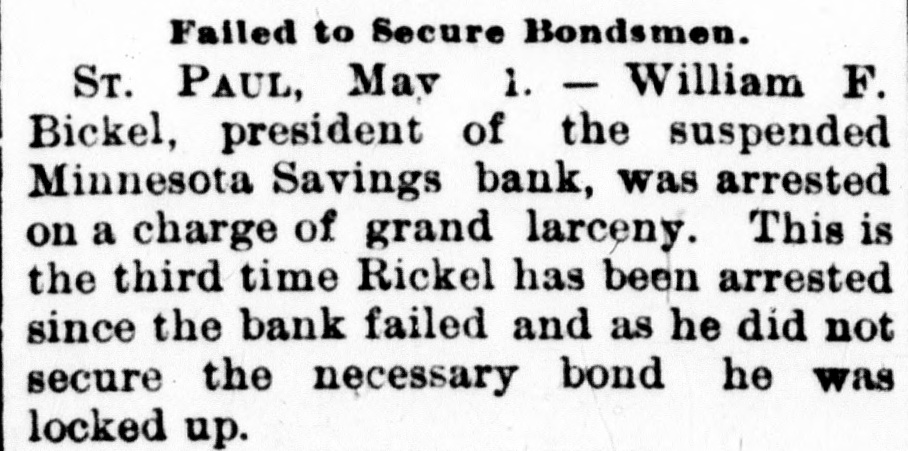
Failed to Secure Bondsmen. Sr. PAUL, May 1. - William F. Bickel, president of the suspended Minnesota Savings bank, was arrested on a charge of grand larceny. This is the third time Rickel has been arrested since the bank failed and as he did not secure the necessary bond he was locked up.


Article from The Saint Paul Globe, May 8, 1897

Click image to open full size in new tab

Article Text

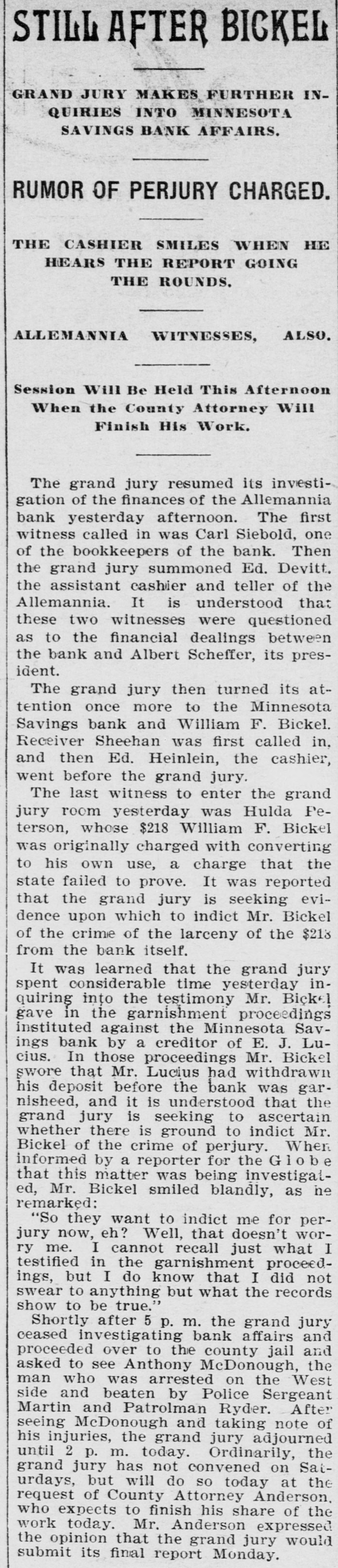
NOTES MARKED PAID REPORTED THAT THE GRAND JURY WAS INVESTIGATING SOME PAPER OF MINNESOTA SAVINGS BANK. ONE NOTE SAID TO HAVE FOUND ITS WAY TO MANKATO. HAS NOT YET BEEN TAKEN UP. Other Matters Which the Body Now Examining Bank Affairs Are Said to Have Considered. It was reported last night that the grand jury spent most of its time yesterday investigating the course of a number of notes which were held by the Minnesota Savings bank. One of these notes, it was reported, was for $150, and had been drawn payable in ninety days. It was said that the grand jury was told that the books of the bank showed the note had been marked paid, but Clarence Saulspaugh, who is said to have been a witness, told the grand jury that he had seen the note in Mankato, and that it was sent there to raise money at a bank at that place. It was also said the grand jury was told that, if they found a note had been marked paid and that it had not been actually paid but sent out for the purpose of raising money, or otherwise disposed of, that the crime of marking the note "paid" was an act of forgery on the part of somebody. Two other notes were reported to have gone the same way, but they did not find their way to Mankato. The grand jury convened promptly at 2:15 p. m. yesterday and remained in session until 4:30, when they adjourned until 2:15 p. m. Monday. In addition to Mr. Saulspaugh, P. D. Street, the Minnesota Savings bank note teller, was called in before, the jury. Considerable attention was also bestowed upon the Bank of Minnesota, as Receiver Frank A. Seymour was in attendance as was also Assistant State Bank Examiner Lonegren. MICHAELS' BAIL MONEY. Judge Kelly Says Clerk Conroy Is Responsible for It. The clerk of the municipal court and the sureties on his bond are liable absolutely for public moneys deposited with the clerk the


Article from The Evening Herald, May 25, 1897

Click image to open full size in new tab

Article Text

A Congressman indicted. St. Paul, May 25.-The grand jury yesterday afternoon returned another sensational indictment, Congressman F. C. Stevens being named and charged with an overdraft of $2,2 in his account with the Minnesota Savings bank at the time when he was a trustee and acting president of the bank. The receivers explain that the technichal overdraft was repaid within one month of the time when called to Mr. Stevens' attention. Mr. Stevens will demand an immediate trial.


Article from The Pioneer Press, May 27, 1897

Click image to open full size in new tab

Article Text

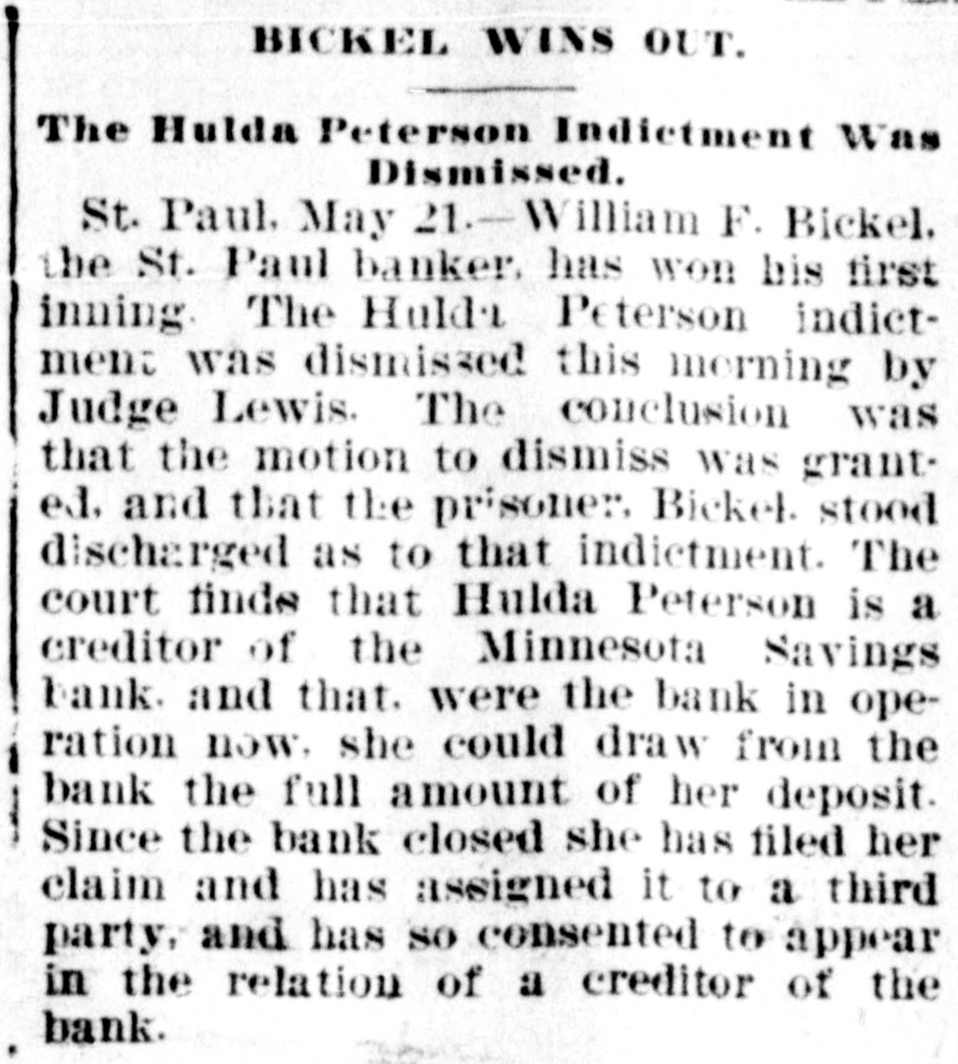
BICKEL WINS OUT. The Hulda Peterson Indictment Was Dismissed. St. Paul. May 21.- William F. Bickel. the St. Paul banker. has won his first inning. The Hulda Peterson indictment was dismissed this morning by Judge Lewis. The conclusion was that the motion to dismiss was granted. and that the prisoner. Bickel. stood discharged as to that indictment. The court finds that Hulda Peterson is a creditor of the Minnesota Savings bank. and that. were the bank in operation now. she could draw from the bank the full amount of her deposit. Since the bank closed she has filed her claim and has assigned it to a third party, and has SO consented to appear in the relation of a creditor of the bank.


Article from The Saint Paul Globe, March 15, 1900

Click image to open full size in new tab

Article Text

WILLIAM BICKEL DEAD. FORMER ST. PAUL MAN PASSED AWAY AT SEATTLE. William Bickel, formerly of the Allemannia bank, died Tuesday in Seattle, according to a telegram received by Albert Bickel, a nephew, a member of the fire department and attached to Chemical Engine No. 1. The remains of the deceased will reach St. Paul Sunday by way of the Great Northern railway and will be interred in the family lot at Oakland. Mr. Bickel was about sixty-five years old, and for many years lived in St. Paul and was at one time president of the council. He was interested in banking, and organized the Germania bank, of which he was president, and was later in the Allemannia bank. He was a Mason. When the Minnesota Savings bank closed in January, 1897, Mr. Bickel became the assignee of that institution, and when he was superseded by receivers appointed by the court went West, Mrs. Bickel and two daughters joined him at Seattle. His son, William F. Bickel, formerly president of the Minnesota Savings bank, and another son, Harry Bickel, live at Forest Lake.