State Bank (New Bloomfield, MO)

Episode Information

Episode UID
3793870291489
Episode Type
Run β†’ Suspension β†’ Closure
Bank Type
state
Bank ID
379387029 hash
Start Date
January 29, 1924
Location
New Bloomfield, Missouri (38.720, -92.091)

Metadata

Model
gpt-5-mini (chosen from majority vote of a three-model LLM ensemble)
Short Digest
9caf8210c203b904

Response Measures

None

Description

Closure in Jan 1924 followed by final winding-up in Dec 1926 is documented.

Events (3)

1. January 29, 1924 Run
Cause
Bank Specific Adverse Info
Cause Details
Panic tied to indebtedness assumed from the failed old bank plus misapprehension over cashier's retirement and local economic distress.
Measures
Directors requested state commissioner take charge; attempted to stop withdrawals but closed doors.
Newspaper Excerpt
A run on the bank by depositors precipitated the action.
Source
newspapers
2. January 29, 1924 Suspension
Cause
Bank Specific Adverse Info
Cause Details
Directors requested closure after sustained withdrawals driven by inherited debts from the old bank and local panic.
Newspaper Excerpt
The State Bank of New Bloomfield was closed Tuesday noon by direction of F. C. Millspaugh, state commissioner of finance, and D. R. Harrison ... was directed to take charge.
Source
newspapers
3. December 9, 1926 Receivership
Newspaper Excerpt
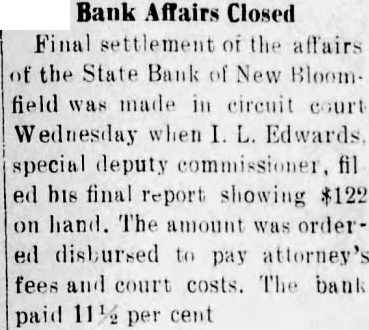
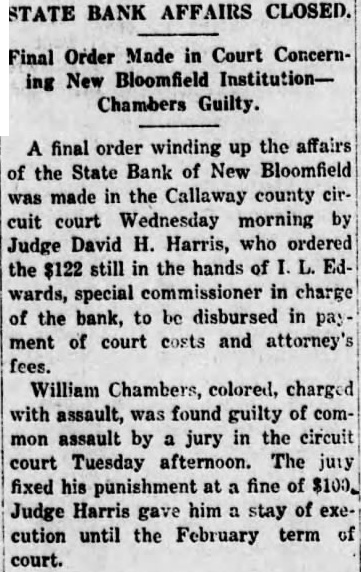
Final settlement of the affairs of the State Bank of New Bloomfield was made in circuit court Wednesday when I.L. Edwards, special deputy commissioner, filed his final report showing $122 on hand.
Source
newspapers

Newspaper Articles (5)

Article from The Fulton Gazette, January 31, 1924

Click image to open full size in new tab

Article Text

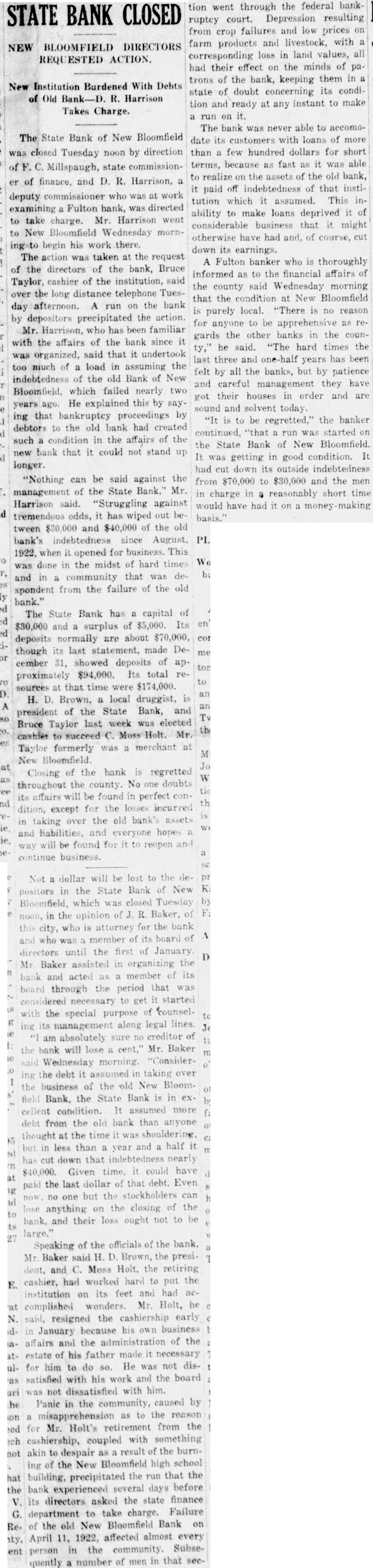
STATE BANK CLOSED NEW BLOOMFIELD DIRECTORS REQUESTED ACTION. New Institution Burdened With Debts of Old Bankβ€”D. R. Harrison Takes Charge. The State Bank of New Bloomfield was closed Tuesday noon by direction of F. C. Millspaugh, state commissioner of finance, and D. R. Harrison, a deputy commissioner who was at work examining a Fulton bank, was directed to take charge. Mr. Harrison went to New Bloomfield Wednesday morning to begin his work there. The action was taken at the request of the directors of the bank, Bruce Taylor, cashier of the institution, said over the long distance telephone Tuesday afternoon. A run on the bank by depositors precipitated the action. Mr. Harrison, who has been familiar with the affairs of the bank since it was organized, said that it undertook too much of a load in assuming the indebtedness of the old Bank of New Bloomfield, which failed nearly two years ago. He explained this by saying that bankruptcy proceedings by debtors to the old bank had created such a condition in the affairs of the new bank that it could not stand up longer. "Nothing can be said against the management of the State Bank," Mr. Harrison said. "Struggling against tremendous odds, it has wiped out between $30,000 and $40,000 of the old bank's indebtedness since August, 1922, when it opened for business. This was done in the midst of hard times and in a community that was despondent from the failure of the old bank." The State Bank has a capital of $30,000 and a surplus of $5,000. Its deposits normally are about $70,000, though its last statement, made December 31, showed deposits of approximately $94,000. Its total resources at that time were $174,000. H. D. Brown, a local druggist, is president of the State Bank, and Bruce Taylor last week was elected cashier to succeed C. Moss Holt. Mr. Taylor formerly was a merchant at New Bloomfield. Closing of the bank is regretted throughout the county. No one doubts its affairs will be found in perfect condition, except for the losses incurred in taking over the old bank's assets and liabilities, and everyone hopes a way will be found for it to reopen and continue business. Not a dollar will be lost to the depositors in the State Bank of New Bloomfield, which was closed Tuesday noon, in the opinion of J. R. Baker, of this city, who is attorney for the bank and who was a member of its board of directors until the first of January. Mr. Baker assisted in organizing the bank and acted as a member of its board through the period that was considered necessary to get it started with the special purpose of counseling its management along legal lines. "I am absolutely sure no creditor of the bank will lose a cent," Mr. Baker said Wednesday morning. "Considering the debt it assumed in taking over the business of the old New Bloomfield Bank, the State Bank is in excellent condition. It assumed more debt from the old bank than anyone thought at the time it was shouldering, but in less than a year and a half it has cut down that indebtedness nearly $40,000. Given time, it could have paid the last dollar of that debt. Even now, no one but the stockholders can lose anything on the closing of the bank, and their loss ought not to be large." Speaking of the officials of the bank, Mr. Baker said H. D. Brown, the president, and C. Moss Holt, the retiring cashier, had worked hard to put the institution on its feet and had accomplished wonders. Mr. Holt, he said, resigned the cashiership early in January because his own business affairs and the administration of the estate of his father made it necessary for him to do so. He was not dissatisfied with his work and the board was not dissatisfied with him. Panic in the community, caused by a misapprehension as to the reason for Mr. Holt's retirement from the cashiership, coupled with something akin to despair as a result of the burning of the New Bloomfield high school building, precipitated the run that the bank experienced several days before its directors asked the state finance department to take charge. Failure of the old New Bloomfield Bank on April 11, 1922, affected almost every person in the community. Subsequently a number of men in that section went through the federal bankruptcy court. Depression resulting from crop failures and low prices on farm products and livestock, with a corresponding loss in land values, all had their effect on the minds of patrons of the bank, keeping them in a state of doubt concerning its condition and ready at any instant to make a run on it. The bank was never able to accommodate its customers with loans of more than a few hundred dollars for short terms, because as fast as it was able to realize on the assets of the old bank, it paid off indebtedness of that institution which it assumed. This inability to make loans deprived it of considerable business that it might otherwise have had and, of course, cut down its earnings. A Fulton banker who is thoroughly informed as to the financial affairs of the county said Wednesday morning that the condition at New Bloomfield is purely local. "There is no reason for anyone to be apprehensive as regards the other banks in the county," he said. "The hard times the last three and one-half years has been felt by all the banks, but by patience and careful management they have got their houses in order and are sound and solvent today. "It is to be regretted," the banker continued, "that a run was started on the State Bank of New Bloomfield. It was getting in good condition. It had cut down its outside indebtedness from $70,000 to $30,000 and the men in charge in a reasonably short time would have had it on a money-making basis."
Article from Fulton Daily Sun-Gazette, January 31, 1924

Click image to open full size in new tab

Article Text

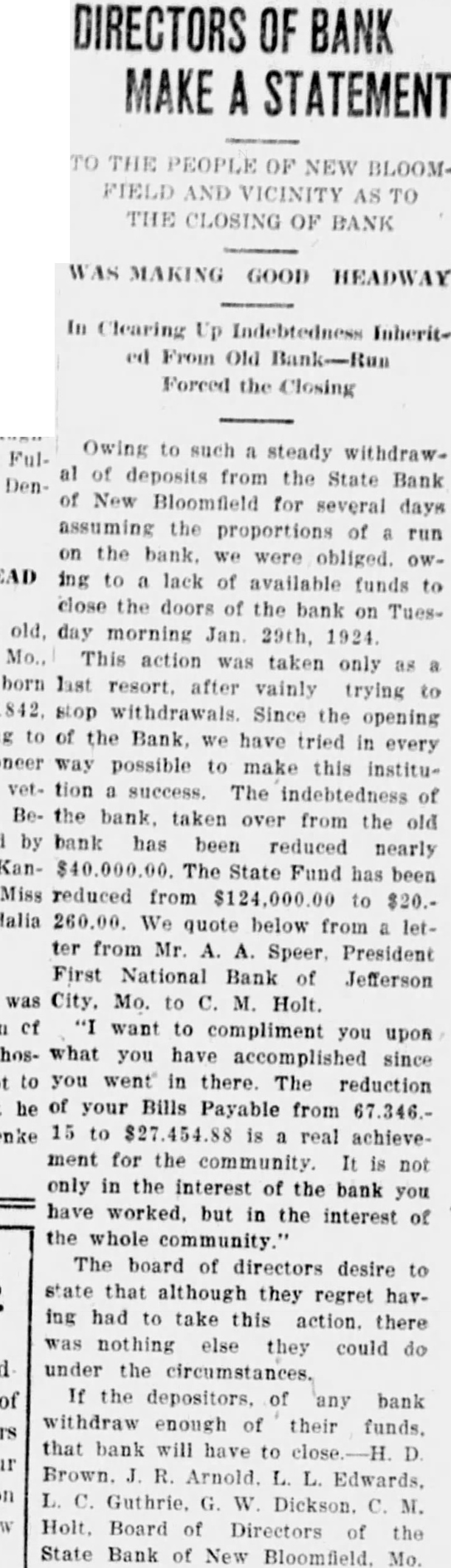
DIRECTORS OF BANK MAKE A STATEMENT TO THE PEOPLE OF NEW BLOOMFIELD AND VICINITY AS TO THE CLOSING OF BANK WAS MAKING GOOD HEADWAY In Clearing Up Indebtedness Inherited From Old Bankβ€”Run Forced the Closing Owing to such a steady withdrawal of deposits from the State Bank of New Bloomfield for several days assuming the proportions of a run on the bank, we were obliged, owing to a lack of available funds to close the doors of the bank on Tuesday morning Jan. 29th, 1924. This action was taken only as a last resort, after vainly trying to stop withdrawals. Since the opening of the Bank, we have tried in every way possible to make this institution a success. The indebtedness of the bank, taken over from the old bank has been reduced nearly $40,000.00. The State Fund has been reduced from $124,000.00 to $20,260.00. We quote below from a letter from Mr. A. A. Speer, President First National Bank of Jefferson City, Mo. to C. M. Holt. "I want to compliment you upon what you have accomplished since you went in there. The reduction of your Bills Payable from 67,346.15 to $27,454.88 is a real achievement for the community. It is not only in the interest of the bank you have worked, but in the interest of the whole community." The board of directors desire to state that although they regret having had to take this action, there was nothing else they could do under the circumstances. If the depositors of any bank withdraw enough of their funds, that bank will have to close.β€”H. D. Brown, J. R. Arnold, L. L. Edwards, L. C. Guthrie, G. W. Dickson, C. M. Holt, Board of Directors of the State Bank of New Bloomfield, Mo.


Article from The Fulton Gazette, February 7, 1924

Click image to open full size in new tab

Article Text

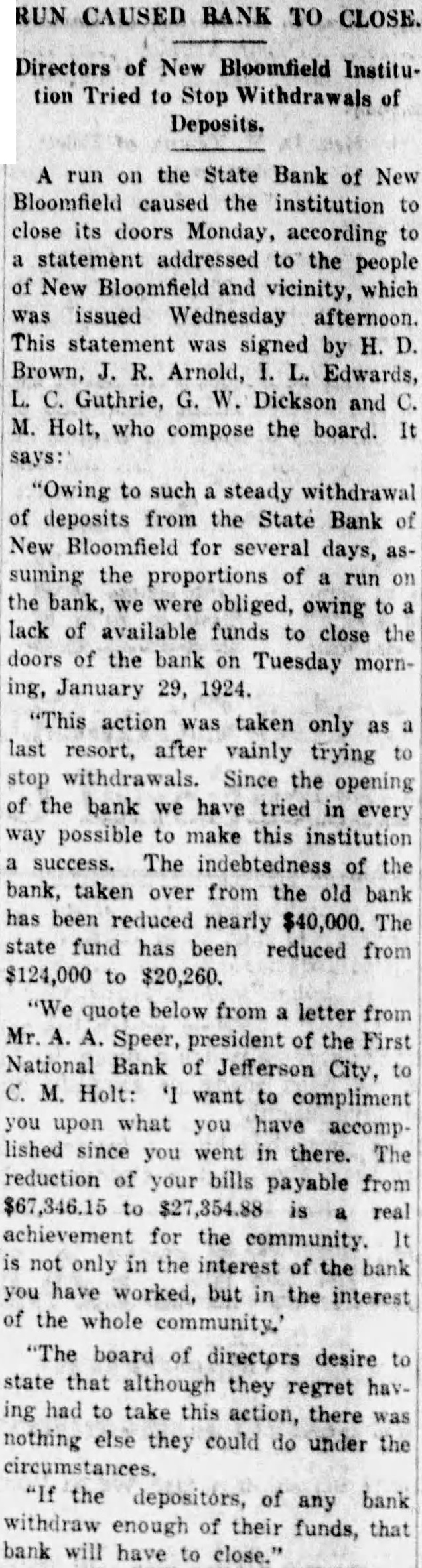
RUN CAUSED BANK TO CLOSE. Directors of New Bloomfield Institution Tried to Stop Withdrawals of Deposits. A run on the State Bank of New Bloomfield caused the institution to close its doors Monday, according to a statement addressed to the people of New Bloomfield and vicinity, which was issued Wednesday afternoon. This statement was signed by H. D. Brown, J. R. Arnold, I. L. Edwards, L. C. Guthrie, G. W. Dickson and C. M. Holt, who compose the board. It says: "Owing to such a steady withdrawal of deposits from the State Bank of New Bloomfield for several days, assuming the proportions of a run on the bank, we were obliged, owing to a lack of available funds to close the doors of the bank on Tuesday morning, January 29, 1924. "This action was taken only as a last resort, after vainly trying to stop withdrawals. Since the opening of the bank we have tried in every way possible to make this institution a success. The indebtedness of the bank, taken over from the old bank has been reduced nearly $40,000. The state fund has been reduced from $124,000 to $20,260. "We quote below from a letter from Mr. A. A. Speer, president of the First National Bank of Jefferson City, to C. M. Holt: 'I want to compliment you upon what you have accomplished since you went in there. The reduction of your bills payable from $67,346.15 to $27,354.88 is a real achievement for the community. It is not only in the interest of the bank you have worked, but in the interest of the whole community.' "The board of directors desire to state that although they regret having had to take this action, there was nothing else they could do under the circumstances. "If the depositors, of any bank withdraw enough of their funds, that bank will have to close."


Article from The Fulton Gazette, December 9, 1926

Click image to open full size in new tab

Article Text

STATE BANK CLOSED. Order Made in Court ConcernFinal ing New Bloomfield Chambers Guilty. final order winding up the affairs the State Bank of New Bloomfield made in the Callaway county court Wednesday morning Judge David Harris, who ordered the still in the hands of wards, special commissioner in charge the bank, to be disbursed in ment of court costs and attorney's fees. William Chambers, colored, charged with assault, was found guilty of assault by jury in the circuit Tuesday afternoon. The fixed his punishment fine of Judge Harris him stay of cution until the February term court.


Article from New Bloomfield News, December 9, 1926

Click image to open full size in new tab

Article Text

Bank Affairs Closed Final settlement of the affairs of the State Bank of New Bloomfield was made in circuit court Wednesday when I.L. Edwards. special deputy commissioner, fil ed his final report showing $122 on hand. The amount was ordered disbursed to pay attorney's fees and court costs. The bank paid 11Β½ per cent