Article Text
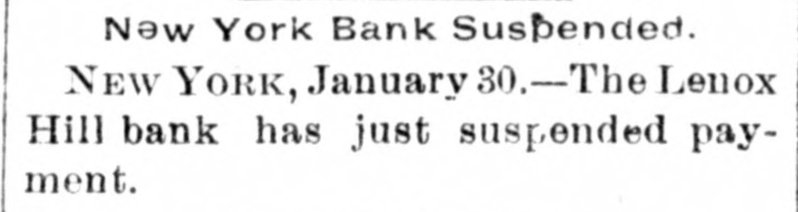
New York Bank Suspended
NEW YORK, January 30.-The Lenox Hill bank has just suspended payment.
Click image to open full size in new tab
NEW YORK, January 30.-The Lenox Hill bank has just suspended payment.
Click image to open full size in new tab
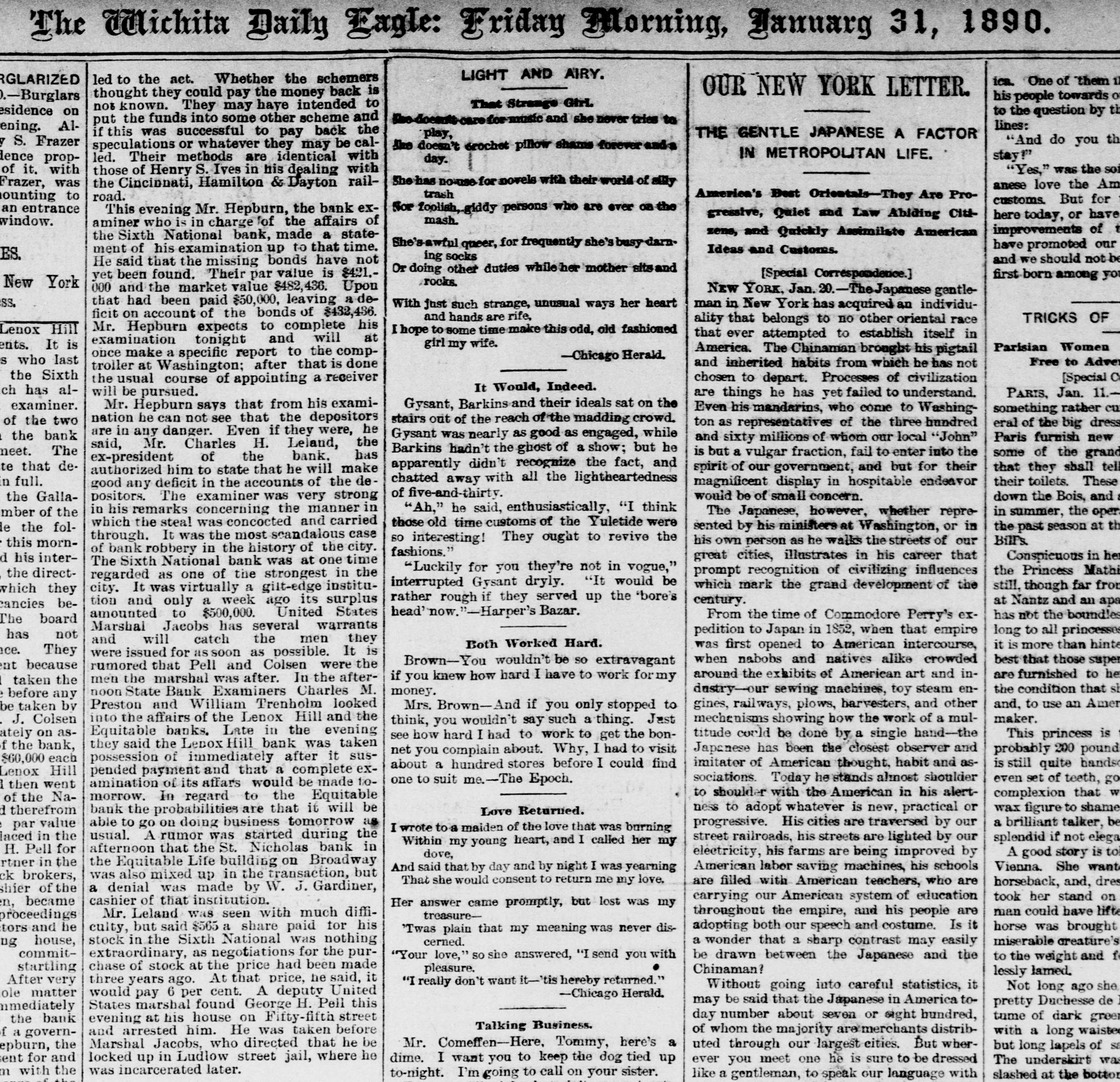
Friday Morning, Januarg 31, 1890. LIGHT AND AIRY. led to the act. Whether the schemers RGLARIZED ica. One of them 1l OUR NEW YORK LETTER. thought they could pay the money back is .-Burglars his people towards o That Strange Glrl. not known. They may haye intended to on esidence to the question by th the care for music and she never tries to put the funds into some other scheme and lines: Alening. if this was successful to pay back the THE GENTLE JAPANESE A FACTOR play, S. Frazer "And do you th the doesn't erochet pillow shame forever and speculations or whatever they may be calIN METROPOLITAN LIFE. stay led. Their methods are identical with propday. of with it. "Yes," was the soi those of Henry S. Ives in his dealing with She has no-use for novels with their world of silly was Frazer, the Cincinnati, Hamilton & Dayton railanese love the Am trash to America's Best Orientals-They Are Proroad. ounting customs. But for entrance Nor foolish giddy persons who are over OB the This evening Mr. Hepburn, the bank exgressive, Quiet and Law Abiding Citihere today, or have mash. window. aminer who is in charge of the affairs of improvements of t zens, and Quickly Assimilate American the Sixth National bank, made a stateShe's awful queer, for frequently she's busy darnhave promoted our ment of his examination up to that time. Ideas and Customs. ing socks and we should not be He said that the missing bonds have not Or doing other duties while her mother site and [Special Correspondence.] first born among you yet been found. Their par value is $421.rocks. New York 000 and the market value $482,436. Upon NEW YORK, Jan. 20.-TheJapanese gentlethat had been paid $50,000, leaving a deWith just such strange, unusual ways her heart man in New York has acquired an individuficit on account of the bonds of $432,436. and hands are rife, TRICKS OF ality that belongs to no other oriental race Mr. Hepburn expects to complete his Hill Lenox I hope to some time make this odd, old fashioned that ever attempted to establish itself in examination tonight and will at is It girl my wife. Parisian Women America. The Chinaman brought his pigtail once make a specific report to the comp-Chicago Herald. who last Free to Adver and inherited habits from which be has not troller at Washington; after that is done the Sixth [Special a chosen to depart. Processes of civilization the usual course of appointing a receiver It Would, Indeed. alhas will be pursued. PARIS, Jan. 11.are things he has yet failed to understand. examiner. Gysant, Barkins and their ideals sat on the Mr. Hepburn says that from his examiEven his mandarins, who come to Washingsomething rather cu nation he can not see that the depositors stairs out of the reach of the madding crowd. two of the ton as representatives of the three hundred eral of the big dress are in any danger. Even if they were, he Gysant was nearly as good as engaged, while the bank Paris furnish new and sixty millions of whom our local "John" said, Mr. Charles H. Leland, the Barkins hadn't the ghost of a show; but he The is but a vulgar fraction, fail to enter into the some of the grand ex-president of the bank. has apparently didn't recognize the fact, and dethat that they shall tell spirit of our government, and but for their authorized him to state that he will make chatted away with all the lightheartedness their toilets. These full. magnificent display in hospitable endeavor good any deficit in the accounts of the deof five-and-thirty. would be of small concern. positors. The examiner was very strong Gallathe down the Bois, and s "Ah," he said, enthusiastically, "I think in his remarks concerning the manner in of the in summer, the oper The Japanese, however, whether reprewhich the steal was concocted and carried those old time customs of the Yuletide were folthe sented by his ministers at Washington, or in the past season at th through. It was the most scandalous case so interesting! They ought to revive the Bill's. his own person as he walks the streets of our this mornof bank robbery in the history of the city. fashions." great cities, illustrates in his career that interhis Conspicuous in her The Sixth National bank was at one time "Luckily for you they're not in vogue," the Princess Mathi prompt recognition of civilizing influences directthe regarded as one of the strongest in the interrupted Gysant dryly. "It would be which mark the grand development of the still, though far from which city. It was virtually a gilt-edge instituthey rather rough if they served up the 'bore's century. at Nantz and an apa tion and only a week ago its surplus becancies head'"now."-Harper's Bazar. amounted to $500,000. United States has not the boundles From the time of Commodore Perry's exboard The Marshal Jacobs has several warrants pedition to Japan in 1852, when that empire long to all princesses not has and will catch the men they Both Worked Hard. it is more than hinte was first opened to American intercourse, They were issued for as soon as possible. It is when nabobs and natives alike crowded best that those super Brown-You wouldn't be so extravagant because rumored that Pell and Colsen were the around the exhibits of American art and inare furnished to he if you knew how hard I have to work for men the marshal was after. In the afterthe taken the condition that sh dustry-our sewing machines, toy steam ennoon State Bank Examiners Charles M. money. before any Preston and William Trenholm looked and, to use an Amer gines, railways, plows, harvesters, and other taken be Mrs. Brown-And if you only stopped to by into the affairs of the Lenox Hill and the maker. Colsen J. mechenisms showing how the work of a multhink, you wouldn't say such a thing. Jast ason Equitable banks. Late in the evening titude could be done by a single hand-the This princess is see how hard I had to work to get the bonthe they said the Lenox Hill bank was taken bank, Japanese has been the closest observer and probably 200 pound net you complain about. Why, I had to visit each possession of immediately after it sus$60,000 about a hundred stores before I could find imitator of American thought, habit and asis still quite hands Hill Lenox pended payment and that a complete exsociations. Today he stands almost shoulder even set of teeth, go one to suit me.-The Epoch. amination of its affars would be made tothen went to shoulder with the American in his alertcomplexion that W Nathe of morrow. In regard to the Equitable ness to adopt whatever is new, practical or wax figure to shame therefrom Love Returned. bank the probabilities are that it will be value progressive. His cities are traversed by our a brilliant talker, be able to go on doing business tomorrow as par I wrote to a maiden of the love that was burning the in usual. A rumor was started during the street railroads, his streets are lighted by our splendid if not elega Within my young heart, and I called her my afternoon that the St. Nicholas bank in for Pell H. electricity, his farms are being improved by A good story is to dove, the in the Equitable Life building on Broadway Vienna. She want And said that by day and by night I was yearning American laber saving machines, his schools was also mixed up in the transaction, but brokers, That she would consent to return me my love. are filled with American teachers, who are horseback, and, dres the of a denial was made by W. J. Gardiner, took her stand on carrying our American system of education cashier of that institution. became Her answer came promptly, but lost was my man could have lifte throughout the empire, and his people are Mr. Leland was seen with much diffitreasureproceedings and he adopting both our speech and costume. Is it horse was brought culty, but said $565 a share paid for his "Twas plain that my meaning was never disstock in the Sixth National was nothing miserable creature's cerned. house, a wonder that a sharp contrast may easily commitextraordinary, as negotiations for the pur"Your love," SO she answered, "I send you with be drawn between the Japanese and the to the weight and f chase of stock at the price had been made startling Chinaman? pleasure. lessly lamed. After very three years ago. At that price, he said, it "I really don't want it-'tis hereby returned." Without going into careful statistics, it Not long ago she matter would pay 6 per cent. A deputy United -Chicago Herald. ] may be said that the Japanese in America topretty Duchesse de States marshal found George H. Pell this nmediately day number about seven or eight hundred, tume of dark green bank the evening at his house on Fifty-fifth street Talking Business. and arrested him. He was taken before of whom the majority are merchants distriba with a long waisted governthe Mr. Comeffen-Here, Tommy, here's a Marshal Jacobs, who directed that he be uted through our largest cities. But wherepburn, but long lapels of sa and for locked up in Ludlow street jail, where he dime. I want you to keep the dog tied up The underskirt was ever you meet one he is sure to be dressed the was incarcerated later. with slashed at the bottor to-night. I'm going to call on your sister. like a gentleman, to speak our language with the

Click image to open full size in new tab
Hill Bank of New Yor 4q pes K, Jan. 30.-The Lenox st suspended payments. It y the same parties who it the control of the nk of this city, which has losed by the bank examiner lge of therelations of the caused a run on the ban 1 not be able to meet. ves of the bank state that certainly be paid in full. appen, president of the Galla 1 bank and a member of se committee, made the ment to a reporter this morn Mr. Leland has sold his inter xth National bank, the direct uested to resign, which the by one, the vacancies be by new men. The board ors, however, has y organized since. The gally elect a president becaus new directors had taken : which is requisite before of any kind could be taken Their election of P. J. Colser re, void. Immediately on ffice of president of the bank nade three loans of $60,000 each he stock of the Lenox Hil / poor security) and then went safe deposit vaults of the bank and abstracted therefron ilroad bonds of the par value These bonds he placed in an named George H. Pell as formerly a partner in veston & Pell, stock brokers in 1887. The cashier of al bank, Mr. Colsen, became he extraordinary proceeding resident and directors and 1 to the clearing house clearing house commit gave them the startling already narrated. After very peration of the whole matte house committee immediately conclusion that the govern R Jo spurt 1he 111 past at once. A. R. Hepburn, nk examiner. was sent for mmunitated to him with he would take charge of following morning and inves arge made by Mr. Colsen, nst the officers and the is examination took place yes fully confirmed the statement e cashier. I may state here shier, Mr. Colsen, has acted in this matter thoroughly for of depositors and minority and we owe it largely to enabled to act SO promptly is certainly deserving of the
Click image to open full size in new tab
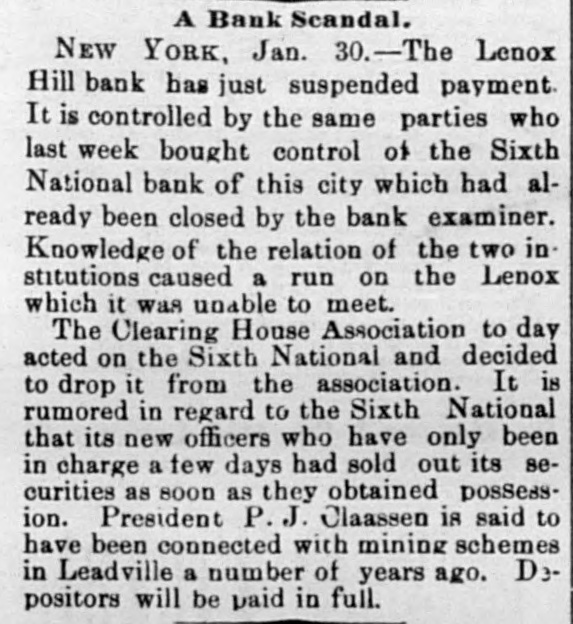
NEW YORK, Jan. 30.-The Lenox Hill bank has just suspended payment. It is controlled by the same parties who last week bought control of the Sixth National bank of this city which had already been closed by the bank examiner. Knowledge of the relation of the two institutions caused a run on the Lenox which it was unable to meet. The Clearing House Association to day acted on the Sixth National and decided to drop it from the association. It is rumored in regard to the Sixth National that its new officers who have only been in charge a few days had sold out its securities as soon as they obtained possession. President P.J. Claassen is said to have been connected with mining schemes in Leadville a number of years ago. D₃positors will be paid in full.

Click image to open full size in new tab
FINANCIAL A of Syndicate in Speculators Succeeds Wrecking TWO Banks. of The Ives Schemes Gigantic Are Totally Eclipsed. of Giltand the Steal in and one SevJail NOW Be Will eral Others soon. of the bank of The the of the run to the The in Wall but The on acted the to drop Sixth are the from There the Sixth regard its that one new being in only been charge had few its secur posthey Its sident, who have sold out obtained Claato con been have Chemes Lead The has bank the other resident makes the of two The banks but in Wall street widels the that think effect the bear the the and marke Wall decided advers the upon this the of by the of bank, high bery Presends from to simply that bonds them over to ting his Mr. of the the bank leartified Claasen and bank house the The latter began afternoo the in the bonds of bank Claase These of of the the short value $ 10,000. None been this the ban of fairs bank, up the that bonds FOUND. the Their He loan bank by bar which and was 000 of doubtured bank Gas and in Orlea ComOcean in of pany and $50,000 pantral The third on Mr. Hep these loans, In addi prob M to tion these found loans. on in 308 000 Hepated of the and others of alleged the Hill bank Sixth cleared. and for being his make specton the be his that that that the they H the has see Even the ex him bank, he ANY GOOD in of his ing the the to his was the most in the It the The of liable an the the While Miltation recobus and into hour and were where held. an very the was and their came When talkebled the he was coming his the object he first bank would he had made any to but finally the catch Way men ble. How he they the Charles came Late Trenho: affairs banks the of liam into Faultable the said, sion bank after was it look and evening theire they taken posnded lately
Click image to open full size in new tab
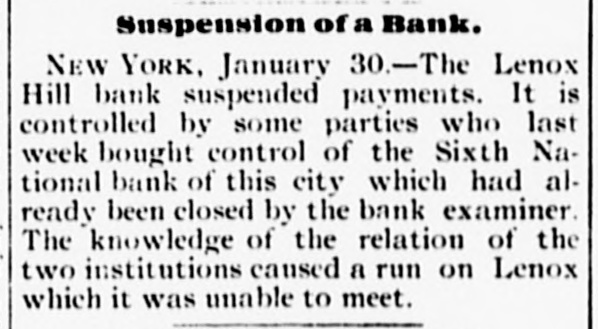
NEW YORK, January 30.-The Lenox Hill bank suspended payments. It is controlled by some parties who last week bought control of the Sixth National bank of this city which had already been closed by the bank examiner. The knowledge of the relation of the two institutions caused a run on Lenox which it was unable to meet.

Click image to open full size in new tab
The Wrecked Banks The Chief Conspirator Has Probably Escaped. NEW YORK, February 1.-One fact that appears most prominent to-day, amid the complex and not yet fully explained story of the wreck of three banks is the fact that the chief conspirator has probably escaped. Pell, the peddler of the stolen securities of the Sixth National Bank, and Claassen, the president of that institu tion, who is under arrect, seem now to have been only small partners of the boss conspirator. James A. Simmons. the contractor, who had many stupendous financial and contracting schemes on hands, has skipped, and SO has Wallack, the president of the ruined Lenox Hill Bank, and Pell's partner. Simmons is said to have been the chief manipulator of the scheme to get possession of the Sixth National Bank and that Claassen was hisagent. Simmons took 785 shares of the 1,035 purchased from President Leland. It is known that he has been pressed by his creditors for money, and the gutting of the Sixth National Bank is regarded as abold scheme for relief from his financial difficulties. THE EIGHTH STREET TUNNEL. One of Mr. Simmons, schemes was the Richmond Tunnel Construction and Rail. road Company, which is building a tunnel under Eighth street, in Richmond, Va. He was the manager of the company, and had charge of the finances, It was bonded for $1,500,000, and he claimed that nearly onehalf of the amount had been sold and used in constructing the work. Mr. Leland former president of the Sixth National Bank, has advanced funds sufficient to guarantee payment depositors in full at as early a date as proper arrangements can be made For a week past State Insurance Examiners Michael Shannon and John A. Horan have been examining into the condition of three insurance companies organized under the laws of this State, and doing business in this city on the assessment plan. If their surmises are true, the Guaranty Mutual, the Security Mutual, and the Mercantile Mutual, of this city, are practically insolvent. THE WASHINGTON CENTENNIAL The Plan and Scope Committee of the Washington Centennial celebration have voted the unexpected balance of the fund amounting to $4,741 in publishing a memorial volume detailing the'work done by the various committees. etc. Most of the members of the General Committee wish the, balance turned over to the arch fund, as the best possible way in which the centennial celebration could be perpetuated and the occasion commemorated. THE WORLD'S FAIR SCANDAL. The real secret of the World's Fair scandal is said to be that Depew and Belden have locked horns with Platt and Hiscock. That's the whole sum and substance of it. Platt's interference with the fair bill has raised a new difficulty. The question has been asked, "Can subscribers to the guarantee fund be compelled to make their subscriptions it they do not wish to do 80, in case Platt's men are added to the incorporators ?" The finance committee, under the terms of the subscription heading, has power to withhold the guarantee fund from the corporation formed if it 80 desires, and it was intimated to-day that such action would be taken it necessary. A trust among the hat manufacturers is being negotiated by a British syndicate. Last Tuesday evening, Cella Luther. fourteen years old, was sent out from her home in Delmonico place. Brooklyn, to buy a loat of bread at a baker's not half a block away. She has not since been seen or heard from Three years ago another girl disappeared almost this time of the year in this same neighborhood. RICHMOND TERMINAL There has been considerable talk about Richmond Terminal in Wall street for the past week in expectation of an advance The following figures were supplied the street by the parties in control: The company now controls 7.521 miles of road and water lines, an increase of 211 within the past year. Last year was the first in which the company had a surplus over fixed charges; in every year before that since its organizatian its interest charges and running expenses exceeded its income, and there were years in which its only income was the proceeds of loans That for the first time there is credit to the profit and loss account is due to the fact that the losses of previous years will be nominally offset by charging up $7,500,000 capital as full paid, although previously carried on the books as half paid. The net revenue for the past year was $668,356, the increase in the bonded debt $4,306,000, the decrease in the floating debt $1,199,193.84. and the net increase in the total debt $2,506,817.16. This net increase se in debt is recommended by an excess of o curities acquired over securities sold $4,175,930. It is probable that during the current yea k the floating debt of a little over $2,000,00 I net can be further reduced by the with drawal of some securities. The company has now left a comparatively small amount of securities which it could withdraw advantage. and it will require an expensive t development of the properties which it con d trols before their surplus earning power car . be largely increased. e or these the Virginia Midland is by fa to the most important. Although it now earn e, but little over its fixed charges, its busines th to is growing as fast as that of any road in e South, and it can hardly fail to keep o d doing so, for the Piedmont Air Line is th Id main trunk line of the South, and its equip P= ment has been largely added to and it 1. motive power largely increased during th past year by the demand of its in reasin it business. ed RZERY'GRIEF.

Click image to open full size in new tab
] NEW YORK, February 1.-The depositors of the Sixth National Bank were comforted to-day by hearing that they would get their money. The assurance was backed up by a check for half a million dollars from Charles K. Leland, the ex-President of the bank, who sold his shares in the bank for $650,000, and turned over the bank and its assets to the enterprising financiers who emptied its safe. A syndicate of five powerful banks has come to the front, and will make advances on the bank's quick assets, in the shape of bonds and other securities now in the possession of A. B. Hepburn, the National Bank Examiner. According to the best authority the face value of these securities is $1,774,000, so that with the aid of Mr. Leland's check for $500,000, it is pretty certain that the obligations to the depositors, amounting to $1,800,000, will be met. It will take several months to bring about this liquidation, and as it is scarcely to be presumed that the syndicate of banks has come to the rescue from purely philanthropic motives, it may be that Mr. Leland will be called on for a further contribution. A RECEIVER TO COME. The Controller of the Currency said at Washington to-day that Examiner Hepburn, in a letter sent on Friday, had pronounced the bank insolvent, and had advised the appointment of a receiver. A receiver would be appointed early next week, alter the Controller had received Mr. Hepburn's report, which will hardly reach him before Monday. This was probably said, however, before to-day's news had reached the Controller, and it may be that the expenses of a receivership will be avoided. It is not yet definitely known how the minority stockholders will come out. Mr. Leland and his friends say that everything possible will be done for the stockholders alter the depositors have been taken care of. F. D. Tappen, President of the Gallatin Bank, who says he has worn out a set of teeth talking about this case, is authority for the statement that Mr. Leland's check for $500,000 is only preliminary, and that more will be forthcoming from him, if it is necessary. SOMETHING SOOTHING. Early in the day there were indications at the Sixth National that something interesting and soothing was to happen. The Bank Examiner had passed half the night locked up in the bank with his assistants, and had completed his investigation and sent his report to Washington. With him at the bank, to-day, were Mr. Tappen and Mr. Wetmore, the latter counsel for Mr. Leland, At 11:30 this notice was put up: Mr. Leland has advanced funds sufficient to guarantee payments of depositors in full, at as early a date as proper arrangements can be made for that purpose. A. B. HEPBURN, Bank Examiner. The banks in the syndicate formed to take the assets and pay depositors are the Gallatin, the American Exchange, the Chemical, the Merchants and the Bank of Commerce. They are to make advances on the securities now in the possession of the Bank Examiner, taking the securities as collateral. It is the intention that, as fast as the depositors are paid, they shall sign a release of all claims against Mr. Leland. Mr. Tappen says that under the arrangement, as at present agreed upon, Mr. Leland will take everything that is left after the syndicate has settled with the depositors, and the syndicate itself has been settled with, and with other advances, if necessary, from bis own bank account, make a just and equitable settlement with the minority stockholders. Mr. Tappen's figures make the actual loss of the bank to be $700,000, as it was given in THE DISPATCH on Friday. MIDNIGHT STATEMENT. At midnight the following statement of the affairs of the Equitable Bank was given out by Chief Examiner Lawrence F. Cahill: I find commercial paper, commonly called loans and discounts, amounting to $151,823, a portion of which seems to be secured by nominal collaterals, at the value of which I have not yet determined. Also, United States bonds deposited with the banking department, as a guarantee of good faith, the market value of which is $1,240. The cash on hand is $2,295, and the furniture and fixtures, including the safe, estimated to be worth $500. There is due from banks the sum of $234 50, making a total assests of $160.593. There are said to be 300 shares of Sixth National Bank stock hypothecated with another bank, the par value of which is $30,000, the market value of which I have not yet determined. This will make the total $190,593. The liabilities are: Capital, $100,000; certified checks, $4,435; due depositors. $31,118; due banks a (items not yet proven), $198,593. This shows deficit of $143,553. There is also evidence of an actual liability which does not appear ou the books of the bank of $150,000 certification. The examination is incomplete, and will be continued Monday. LENOX BANK FIGURES. At the same hour Examiner Henry C. Covell announced that he had that evening reported an examination of the Lenox Hill Bank. The liabilities are $549,292 55; the total assets, $370,675 94, leaving a deficit of $178,616 61. "The liabilities, said Mr. Covell, "include the capital stock of $100,000. The assets on hand I have reduced to a conservative point, and feel confident that the depositors will receive 70 to 75 per cent on their claims. There have been found in the bank $145,000 in checks made by James A. Simmons, and certified to by the Lenox Hill Bank, which I consider worthless." An Albany paper this evening says: P.J. Claassen, the wrecker of the Sixth National Bank, in New York, is a former Albanian, at one time keeping a saloon on Upper Broadway, near the New York Central Railroad viaduct. When he went to New York. some 20 years ago. he had little or no money, and gave no promise of unusual financial genius. WOMEN AT WEDDINGS.

Click image to open full size in new tab
OF KIND FOUR GETHER CLAASSEN, PELL, IVES AND STAYNER TO IN . STORY OF THEIR SUPPOSED CARD PARTY THE ADAMS, STATE- OF COMMERCIAL BANK, MAKES A MENT-MEETINGS OF LENOX HILL DEPOSITORS TO BE HELD. spent interesting quartet of They financiers were Henry in Ludlow Street Finance," Sunday young Napoleon of are accused of An Ives, the Stayner, Jail. who Peter and J. his S. aide, George H. railroad General H. Claassen, of having having wrecked soldier a and banker. and wrecked George three Pell, broker, accused all acquainted with one anbanks. They began living Ives's other before any were of them together in in Mr. Ludlowthey all came it was like st., and when on Saturday night whom comfortable reunion of rooms jovial and congenial spirits Fate, a for a time Mr. had Ives kept remarked apart. to General there, It is said that glad to see him Claassen that he was bristled up and felt offended. whereat the soldier there scarcely long enough from to un- an derstand uttered He had been that a remark of that inside kind the buildof old boarder in Ludlow-st., a different meaning from citizen one ing, had quite made by an ordinary did similar phrasing Mr. Stayner laughed much and so of a on the outsde. General Claassen, too Jacobus Mr. Pell, and United States Marshal community, gentleman, create as discord in a happy smiled knows, Oh, feebly to no, not and at said all,' replied Thank Mr. you.' Ives; 'you're welcome, I assure you. few very conversation became general too for subdued a The General Claassen was just yet. minutes, and thoughtful but to be a real good companion Mr are you thinking about ?" for asked a moment What after General Claassen had hand. sat Ives, his head resting on his soldier. was with Oh, merely nothing wondering much," when replied you the and Stayner This Just are going was to a get cruel out.' sabre slash, and then both an Ives evilly and Stayner fell back aghast. with a mouth organ struck inspired When the Swallows Nest answer up boy in the in street Ludlow-st. to Again. civil It is polite even Ives exhibited his of the ways and words of wild Damph ino. answered in on time began questions, he and Mr. Choctaw Western knowledge men to when hang As the evening hands wore of the quartet. According some heavily on that the was Hoating about yesterday draw to while to story proposed a little pasteboards game of were produced, away body the hours. took The positions around the General table and By virtue the quartet of his recent banker, achievements so runs the tale, Mr. Ives, and 2 of, hold get could Claassen was made because the of his record as was keeper made needed. of anything the he kitty." No chips deal, were and Mr keeper of Claassen's first share of It was General Mr. Stayner put up dealt. a Mr Stayner's ante. The cards were C.H. & D. stock. with one share of Sixth C. National & D. and Bank Pell came stock, in and Mr Claassen Ives put also up came two in with Mr. share shares. of General Sixth National share Bank of stock C. H. & D. to Stayner put up another Stayner drew one his ante good. Mr. Mr. Ives stood pat. make card, Mr. Pell took drew two, three cards to pair It was Hill Bank and General Claassen Mr. Pell's first bet, and stock he of aces. three shares of Lenox of five C. H. & D wagered him to the extent bettered his Mr. Ives raised Claassen had not caught shares. General out. Mr. Stayner and hand, and dropped Mr. Ives's left eye, This wink deftly the bet winked by ten by shares of C. H Ives & had stood puzzled raised Mr. Pell, who raised had the threes. bet, so Stayner, which he pat. yet Stayner better than a pat hand, argued. must have Like a good poker would beat threes. Ives then raised of player itsel he threw up shares his hand of C. H. & D., and the bet by twenty his hand, whereupon Ives Stayner also threw laughed up fiendishly as he tossed took the pot. He deck Pell his queen high hand on the When Claassen or So the game, either went Ives on. or Stayner would and raise toward the would bet. they bluffed them out securities, midnight wagers until Ives and Stayner had all interesting the ex and the newcomers meantime, had had an the "kitty had waxed perience. fat, and In the Mr. Ives suddenly kept on keep ing it. gloomy on Sunday outside of Ludlow to conthat Street was Jail so that those inside they had were reason in out of the breakfast gratulate themselves financiers had an excellent to find out had how not much wet. after which The they read been the found newspapers out about their operations. About o'clock Mrs. Claassen the jail. and her The daugh- ladies ter and Mrs. hour Pell in their visited husbands apartments mood and No spent an away in apparently a happy day, and the other then went callers appeared during to the receive reporters The prisoners day refused was spent posit in vely reading newspapers and books and in playing Jail has cards. few terrors for financiers necessity Ludlow discovered Street methods lead to the more like whose for their temporary seclusion it not It for is the fact that inmates hotel than a jail, cannot and come were and go at comfort will, there bewould the be little difference of detention as regard and first-class hostelry to tween this One big house can dine there pay as well for what as any he where if William he has M. the Tweed money spent years Jacob there Sharp and wants. died there surrounded by he luxuries. made his ahode there lived like a prince have while been there so long that it would Ives and seem Stayner to them like breaking How up long housekeep; Ives and ing to be compelled remain to is move. something no one can tell Stayner Ludlow Street will is better than Sing Equitable Sing. banks of The Sixth National and the by any of the ticers were not or others visited in yesterday charge of of the the Equitable affairs of those Bank institutions At the door a Jonely On the policeman window of kept the watch. Sixth National the last notice posted statement reads: of the condition of this bank H. will E No made. further A report will be sent to Controller for information Lacey, should be be at made Washington. to him. All demand B. HEPBURN, National Bank Examiner further Mr. Hepburn said information yesterday from that Washington he had received in regard no to the statement suspended was bank. brought to The The following late last night by Mr. McDonald, of Tribune friend office of Charles H. Leland, the -president the Sixth National arranged to enable the Sixth National as Mr. Leland resume has business, which will be done with. as soon EDWARD KING. Bank the necessary to formalities can be gone through Mr. King is president of the Union Trust Company. T. Meyer, one of the directors of home, the Siegmund who was seen yesterday at he his wished Equitable. 8 East Fifty v-seventh-st., said that his connection to No. deny the statements Hill Bank's concerning affairs which were made in papers, with the Lenox several newspapers of said Saturday Mr. Meyer, and his yesterday quoted President "These William saying that Dowd, of bank the cleared weeks, Bank of North America, às Bank for about two the that for the Lenox Hill were interested in the who Mevers.
Click image to open full size in new tab
The Wreck of the Sixth National Mended and the Others Likely to Resume. Matters are looking up in the wrecked New York banks. Besides paying out $640,000 for the recovery of his stock Mr. Leland paid to Examiner Hepburn $280,000 to cover the liabilities of the bank, including the $200,000 capital stock, and $79,000 besides. President Tappen of the Gallatin national bank informed Mr. Hepburn that $692,200 had been placed to his credit as United States bank examiner in the Gallatin national bank. In accordance with the results of his investigations into the condition of the bank's affairs and the new aspect which the contributions of Mr. Leland and the efforts of his friends have put upon them Mr. Hepburn was in a position yesterday to declare the bank solvent and ready to do business. He accordingly telegraphed to the controller of the currency, under whose authority he is acting, informing him that the Sixth national bank was now solvent, the capital unimpaired, and asked for instructions to deliver the bank to the new board of directors. Pending the answer the examiner gave his consent for the bank to open its doors, and this was done. The officers of the Lenox Hill bank have retained the firm of Newcomb, Donohue & Cardozo as legal advisers. Application was made in supreme court chambers for the appointment of a receiver for the Lenox Hill bank, but Lawyer Newcomb succeeded in getting the motion delayed. He said that arrangements are being made to meet all obligations, and if successful the appointment of a receiver will be avoided. He asked for time to complete these arrangements, and stated that in all probability the bank will be able to resume in a few days. He said that the resumption of the Sixth national will enable the Lenox also to resume, but that it will take several days to accomplish it. The announcement that the Equitable bank would open its doors yesterday and pay all demands brought many of the depositors to the bank at 10 o'clock. The doors were closed, however, and Examiner Trenholm was in charge. Shortly after 10 o'clock Conrad N. Jordan, president of the Western national bank, accompanied by Arthur Meyer, a son of Siegmund T. Meyer, arrived at the bank. They had a satchel with them full of cash and came for the purpose of opening the bank. Mr. Jordan told Examiner Trenholm what he was there for and tendered the money, which he stated was sufficient to pay all demands. Mr. Trenholm refused to admit Mr. Jordan and Mr. Meyer without a permit from the Attorney General. He said he had no authority to open the bank or to receive the money. Mr. Jordan and Mr. Meyer went away. but returned in half an hour and again demanded admittance. They stated that $200,000 had been raised and the bank could meet all obligations, but Mr. Trenholm was firm and they went off in search of State Superintendent of Banks Preston. They said they would return later in the day and open the bank, but they did not return. The wreckers Claasen and Pell spent most of the day in the office of the United States marshal waiting for bail. They were visited by several friends and their counsel, but did not secure bail. In the afternoon they were returned to jail.
Click image to open full size in new tab
The indications are that no receiver will be appointed for the Lenox Hill Bank. A notice posted on the doors of the bank, bearing the signature of Bank Examiner Henry C. Covell, advising depositors not to sacrifice their claims, stimulated the feeling of confidence created by Monday evening's meeting, and by nightfall nearly 800 of the 875 creditors, constituting a large majority in amount of their claims, as well as in numbers, had placed their affairs in Mr. Jordan's hands by signing a thirty-days' assignment. During the day Mr. Covell made the following statement: I am now willing to state that there are $31,000 of miscellaneous bonds which ought to be in the possession of this institution that we cannot find. and for which we have "kiting" checks. These cheeks, of course, were uttered by some person as a simple nover to, the extraction of the bonds by some person, presumably c. E. Wallack. These checks are from

Click image to open full size in new tab
WOOSTER, On Jan. 81,-Karl Merz, di rector of the musical department Wooster University, died yesterday after noon at 4:20 o'clock of pneumonia, H was taken down on Saturday with grippe, which rapidly developed into the fatal disease, Neither of his children, Dr Charles H. Merz, of Sandusky and Mis Bessie Merz, of St. Charles, Mo., were a home. His sudden death has caused profound sensation. COLUMBUS, Jan. 81,-[Special.]-The verdiet of the coroner's jury on the five victims of the recent gasexplosion charges it was due to gross negligence of the con tractor, J. C. Gibney, in leaving one joint in the pipes uncalked. ST. LOUIS, Mo., Jan. 31,-[Special.] Mrs. Nora Dunn of this city and Captain James Cargbett of Gardner, Maine, were remarried here this morning after a seperation of 45 years. He married her near ly half a century ago at Gardner, Maine, and then went to sea, He was reported lost. She married again. After a long time he returned and married again. Her husband and his wife have since died. Both are very wealthy. NEW YORK, ner Hessburn is still in possession of the Sixth National Bank. No receiver has yet been appointed. The numbers on the bonds missing from the bank cannot be ascertained as no entry was made on the books. If nothing can be collected from the protested notes the total loss will be about $750,000. It is believed that President Classen, of the Sixth National, and President Walter, of the Lenox Hill bank, have both skipped. LONDON, Jan. 81.-1 Special. ]-The French Line steamer La Normandie, from Havre for New York, January 25, was sighted three days later in 49 degrees northern latitude 23 degrees west longitude with her machinery partly disabled. She did not signal for assistance. COLUMBUS, Jan. was no trouble in the senate this morning. President pro tem Adams took the chair in the absence of Lieut. Gov. Marquis. Lampson did not try to take the chair as he said he would last night. Later he left for his home in Asthabula. KANSAS CITY, Mo., Jan. 31 [Special.] During his absence from home last evenmasked burglars bound and gagged the wife of Charles Roonan on Mercier street. They tied her by the neck to a bedpost and then robbed the house. The woman is in a precarious condition. Not much booty was secured. SAN FRANCISCO, Jan. 31.-[Special.]The amount realized from the sale of single season tickets to the Patti opera season, of two weeks, aggregated $25.000. This, with the amount realized from the box sales, makes a total of $34,000. CHARLESTON, West Va., Feb. 1,-[Spe cial.]-Delegate Horr, of the Union-Labor party created a great sensation here today in the Legislative Court investigation involving the question of the election of Governor, by filing a written statement that he had been offered a bribe of $1,800 and the State Mine Inspectorship, if he would vote for Goff (Rep for Governor of West Virginia. The affair has created a most profound sensation, as Horr in believed to be an honorable man. An investigating committee of five has been appointed to hunt the rascals down. WASHINGTON, Feb. 1. Special. World's Fair Committee of the Housemet to-day and concluded two bills as proposed by the sub-committee, and while they did not complete the work, they progressed sufficiently to show that two bills will be reported. One making no appropriation and leaving the place for holding the Exposition blank, to be filled by the House, and the other making an appropriation and providing for holding the Exposition at Washington. WASHINGTON, February [Special.] There was a great crowd at the Capitol to-day. The House galleries filled early and the crowd overflowed into the corridors of the main floor. On the conclusion of the reading of the Journal McKinney moved its approval and pending that motion Springer of Illinois moved an adjournment and demanded a roll call on his motion. It is evident the Democrats intend to continue yesterday's tactics. The motion to adjourn was defeated yeas 135, nays 158. WICHITA, Kan., Feb. 1.-[Special.]George Black, a young man doing business here, became violently insane, a raving maniac, yesterday and attacked his sister with a poker inflicting probably fatal injuries. He thenattacked his brother-inlaw injuring him so that he will die. He was arrested only after a terrible fight with the officers. LOUISVILLE, Ky., Feb. 1.-[Special.] Bill Nye, the humorist, and James Whitcomb Riley, the poet, havedissolved partnership, owing, it is said, to the convivial habits of the latter. Riley broke loose on a bender yesterday and he has since been in a dazed condition. YOUNGSTOWN, Jan. 31.-The series of meetings being held here under the auspices of Evangelist C. H. Yatman have been very successful, and $40,000 of the which he started out to raise for building for the Young Men's Christian Association has already been subscribed. WASHINGTON, Feb. 1.-[Special.]-ExSergeant-at-Arms Leedom has received a dispatch from the Mayor of Gerrelbonne, Canada, denying that Silcott is or has been in that place as reported. KANSAS CIUY, Feb. 1,- Special.]-The plant of the Kansas City Packing and Provision house was destroyed by fire last night. The loss is $200,000, insurance $300,000. WASHINGTON, Feb. 1.-[Special.]-The condition of Mrs. Coppinger, Secretary Blaine's daughter, is reported greatly improved to-day, and she will probably recover. WASHINGTON, Jan. 31.-The Washington Post, the Republican newspaper of the capital, edited by Frank Hatton, the Postmaster General of a former Republican administration, has a double-leaded leading editorial in which it calls loudly for precisely what the Democrats in the House of Representatives have been calling for, namely, rules of procedure. Under the heading, "Report the Rules," the editorial says: There is one way out of the disgraceful tangle in which the House found itself yesterday, and that is for the committee charged with the duty of formulating the rules for the government of that body to make a prompt report. Rules are what is needed-rules that give to the majority every right it is entitled to, and rules that protect to the fullest extent the rights of the minority. Until this is done there is little show for the harmonious and effective prosecution of public business. Precedents, to apply to the House of Representatives, should be found inside and not outside of that body. The country at large has rights in this controversy that rise superior to the wild and frantic antics of partisanship. The people know what is right, aud they will be satisfled with nothing short of what is right. Let the rules be reported. Let them be fair and just to both majority and minority. The sooner this is done the more creditable it will be
Click image to open full size in new tab
closure of a second mortgage on the stock farm at Pine Island. N.Y., which Simmons bought from C. P. Huntington. Simmons made & bad bargain with the farm. He sold it to Latiner E. Jones, the lumber merchant, who disappoared about two years ago, and who assumed the mortgage. If the matter is settled as agreed upon Simmons will own two. thirds of the mortgage. The case was adjourned until Wednesday. CLAASSEN NOT YET FREE. Bank Wrecker Peter J. Classen made his regular daily trip from Ludlow Street Jail to the United States Marshal's office in the Post-Office building this morning. arriving in company with two United States deputy marshals at 10.15 o'clock. His faithful wife met him, and the usual affectionate greetings were exchanged. Classen's wife qualified as his surety for $25,000 yesterday. and he hopes today to find another surety for $5,000. his bail being fixed at $30,000. His examination will be begun at 1 P. M. to-morrow, before U. S. Commissioner Shields. Bank Wrecker Pell's examination has been adjourned until next Tlfursday. at 11 A. M. ELECTING LENOX HILL OFFICERS. A meeting of stockholders of the Lenox Hill Bank was held at the office of the Western National Bank in the Equitable Building this afternoon for the election of a President and Board of Directors of the Lenox Hill. There was no opposition to the election of Conrad N. Jordan as President. After the meeting Mr. Jordan started uptown to open the bank. He was accompanied by Superintendent Pres. ton of the State Banking Department. Cashier Smith of the Western National Bank, Mr. Woolff of the committee representing the deposito 'S, and Lawyer Goodheart. Cashier Smith carried a hand valise, in which were funds sufficient to reopen the bank. It was just 1.50 o'clock when the party left the bank and President Jordan said that it was his intention to begin business this afternoon. "I have been elected President, he said, and have enough money to begin operations at once. I intend to pay off all ciaims against the bank. which have not already been assigned to me."
Click image to open full size in new tab
A Worthy Rival of "Napoleqn" Ives Found in New York-Candidates For Stripes. NEW York, Jan. 31.-The Lenox Hill Bank has suspended payments. It is controlled by the same parties who last week bought the control of the Sixth National Bank of this city, which has since been closed by the bank examiner. The knowledge of the relation of the two institutions caused run on the bank which it was unable to meet. The Clearing House Association yes terday acted on the Sixth National and decided to drop it from the association. The Equitable Bank has also beer mentioned in connection with the other two institutions. Its president makes the following statement: "The owners of the Sixth National have a minority. interest in the Equitable only, and the bank is not affected." Wall street looks upon the attempt to dispose of the $622,000 in bonds owned by the Sixth National Bank as simply 8 case of highway robbery. President Classen, after abstracting the bonds from the safe deposit vault turned them over to George H. Pell, n broker of un savory reputation, who attempted to dispose of them on the street, representing them to be the property of his wife. Mr. Colsen. the cashier of the bank, learning of the action of Classen, notifled the clearing house and the bank examiner. The latter soon learned enough to cause him to close the bank and call on Classen for the return of the $633,000 in securities. By his prompt action he succeeded in getting back $201.000 of the bonds. In lieu or on account of the rest of the abstracted bonds Classen handed the bank examiner checks for $383,000. These checks fell short of the market value of the abstracted securities $140,000. The checks are being protested. The United States District Attorney has issued warrants for the arrest of President Classon and Broker Pell. George H. Pell, the broker implicated in the wrecking of the Sixth National Bank, was arrested last night and locked up in Ludlow street jail.
Click image to open full size in new tab
New York's Wrecked Banks Open Their Doors-Business Resumed at the Sixth National and the Equitable. NEW YORK, Feb. 5.-The Sixth National Bank reopened its doors Tuesday morning and rapidly paid out money to those who cared to draw it. There were, however, no signs of a run on the bank. When the bank was turned over by Bank Examiner Hepburn to Presiden Leland's counsel the latter said not only were there sufficient funds to pay the depositors, but the surplus was now as large as before and stock worth just as much. About 1 o'clock Tuesday afternoon the Equitable Bank threw open its doors for business. The Lenox Hill Bank depositors are rapidly signing papers giving President Jordan, of the Western National Bank, power to act for them. The latter has hopes of arranging the bank's affairs so that a receiver will not be necessary. C. N. Jordan made the following statement in regard to the condition of the Lenox Hill Bank late Tuesday evening: "The total amount of capital due depositors is $130,000. The bank has $200,000 assets to pay them with. It is expected now that we will open for business on Thursday morning."

Click image to open full size in new tab
The health of Congressman Randall is reported to be greatly improved. Tea thousand colored people in Canada have seas the Governor-General a loyal address Charles Connagham, general merchant at Niantic, III., has failed for $15,000, with assets of $7,000. Barrie. Ont. has much ice. and Buffale, New York, and Cincinnati are there arranging for supplies. Andrew Gallagher was sentenced Friday at Indianapolis to seven years imprisonment for burglary. At Jacksonville, Ala., Sam Dill (oolared) was hanged for the murder of Joe Smith (eolored) last August. Sam Morgan, of Rhinebeck, N. Y., was blown by dynamite into such fine pieces that they can't find any of him. Sister Mary Baptiste, a Sister of Providence at St. Charles Catholic school at Peru, Ind., died Friday morning. On Thursday evening next President Harrison will participate in the dedication of the Carnegie Library at Allegheny City, Pa. P.J. Claassen, accused of causing the suspension of the Sixth National Bank, of New York, was released Friday evening on $80,000 bail. S. W. Yeagley, the defaulting clerk of Hillsdale County, Mich., has fied the country after securing his bondsmen against further loss. Postmaster Gauntt as received notice from the Post-Office Department that the free-delivery system has been extended to Marion, Ind. It is reported that English capitalists have purchased a two-third interest in the Forepaugh circus, the estate retaining the remaining third. Business failures for the week reported by R. G. Dun & Co. are 821. as compared with 291 last week. One year ago the failures were 303. Charles Miller, son of a farmer living near Lebanon, Ind., was arrested Friday charged with having shot and killed George Purdy in October, 1888. The 2-year-old child of Simon Anderson, of Black River Falls, Wis., while playing with some fire Thursday, ig nited its clothing and was fatally burned. The general store of Harding & Woolsey, at Vincent, Ia., was entered by burglars Thursday night and several hundred dollars' worth of silk goods and groceries stolen. At Hamilton. O., on Friday George Lummis, aged 23 years, made an unsuccessful effort to murder Eflie Longnecker, aged 16 years, because she rejected his suit, and then killed himself. The Lenox Hill Bank at New York was reopened for business Friday afternoon under the presidency of Mr. Conrad Jordan, of the Western National Bank, but only deposits were received. The flooded condition of the Lower Mississippi has caused uneasiness regarding the levees. The water is rising rapidly, and the New Omega levee in Madison Parish, La., seriously threatened. White Caps are troubling the little city of Knoxville, III. Four prominent citizens of the place have been notified by placard hung in the city hall to change the error of their ways or their evil ways will be made known. An appeal has been sent to medical colleges throughout the country asking them to send delegates to the approaching convention of the American Medical Association at Nashville, Tenn., with a view of securing reforms touching the granting of diplomas.
Click image to open full size in new tab
Foreign. Kaiser William's health is completely restored. The Kaiser has gone to sea again. The dory Mermaid was spoken August 10 in latitude 47 north, longitude 35 west. Captain Andrews said he was still having a bad time of It, but he hadn't lost courage or hope. Of course, he didn't know then how badly the Sea Serpent had beaten him. The Porte denies that he has signed a protocol recognizing Prince Ferdinand. France will need 82,500,000 bushels of wheat to supply the deficiency of the home cron. At the National Capital. A movement is afoot here to demand that President Harrison should send a negro to Hayti in place of Fred Douglass. Dispatches from Samoa say that Mataafa is restless, but everybody and everything else is quiet. A letter from Mrs. R. L. Stevenson says the outlook for Europeans is very bad. There is but one warship there, and that is German. Doings in New York. The directors of the Lenox Hill Bank have decided to liquidate the business of the institution made famous by the PellWallack-Claassen "kiting" syndicate. The assets will pay the stockholders be tween seventy-five and eighty cents. The New York Health Board yesterday decided to arrest Ong Moy Toy and Tsang Ding, the Chinese lepers who were released from the Charity Hospital. Oug Mov Toy was put under guard, but Tsang Ding could not be found. Both Nat Goodwin and his wife claim the Queen Anne house at No. 226 West End avenue, New York. Goodwin gives up trying to gain possession by force, but the house will be kept barricaded unti: he leaves the city. Burgiars are prowling about Astoria. Miss Beulah Hipwell, who discovered three of them in her brother's house, Was knocked down and badly hurt. The men escaped. Hugo Eitel, the lad who is at the New York Presbyterian Hospital suffering from symptoms of hydrophobia, is improving. The strait jacket has been removed and his spasms have ceased. Elsewhere. The eruption of the volcano at Colina, Mexico, has ceased, but the lava is still ruuning. Balmaceda has removed all the old court judges in Chili and appointed new ones to suit himself. The full story of the Canadian scandals shows that Pacand got $100,000 of the railroad subsidy fund and that Merceir used a part of the money to pay his private debts. Members of the Haytien Cabinet resigned after they had been censured for corruption and incapacity by the Chamber of Deputies., There is great excitement at Port au Prince, and a new outbreak is feared. Mrs. James K. Polk, widow of the eleventh President of the United States, is dead.
Click image to open full size in new tab
The Bank WIII Close Because It Has Made No Money Since It Was Wrecked. The Lenox Hill Bank. at Seventy-second street and Third avenue. which was made famous by the doings of Pell. Wallack. Classsen. and Fimmons, 14 going out of business. Since Wednesday last the institution bas been quietly paying off its depositors. Last week the directors of the bank met and decided that. as the bank was not making money. the best thing to do was to close it. A circular letter was sent to the depositors informing them of this action and asking them to take out their money. Since the bank was put on its lega after the operations of the wreckers the main object of its officers has been to meet its obligations to its depositors. and to pay back to the rtockholders as much as possible of the money they had out into it. The depositors will receive every cent that they plac ed in the bank. with interest. but it is uncertain how the stockholders will fare. The bank has not been making money since its restoration." said a director yesterday to a SUN reporter. That is the reacon we decided to suspend business. Nearly all of the directors are d. wn-town business men. who haven't time to attend as closely as is desirable to this bank's affairs When we de. cided to shut up shop the bank was in as good condition as we could ever hope to have it. The capital stock of the bank was but $100.000. and the deposits did not amount to more than $125,000. The reason that the bank did a small business in the last year WAS that the President. Lee Wolff. always kept 60 or 70 per cent. of the bunk's funds on hand. fearing a run on account of the wreckers' connection with the institution.' There is now about $60,000 in deposits in the bank. The officers of the bank are: Lee Wolff. President: Conrad N. Jordan. VicePresident: Elias E. De Pima, Benjamin Russak, Herman Ridder. Edward Gogorza. Simon Ottenberg Jacob| Batz. and Francis J. behnugge. directors. It is said that If the stockholders wait until real estate and mortgages held by the bank are advantageously disposed of they will 1 e paid in full. but if not they will lose from 20 to 25 per cent. Whether the Lenox Hill will be succeeded by another up-town bank is not known yet. It is said that the mer hants in the neighborhood of the Lenox Hill need a bank. A direcfor of the Lenox Hill said yesterday that a number of np-town tradesmen offered to buy the Lenox Hil. but no notion was taken on their proposition. The hank was organized Aug. 8. 1887. with n canital of $100.000. After the crash in the Sixth National Bank in January. 1890. it was learned that the Lenox Hill had been clearing through that bank. Then the story of the wrecking operations of Peter J. Classen. George H. Pell. Charles F. Wallack, a son of Lester Wallack. and James A. Simmons came out. That brought H run on the Lenox Bill. which began or Jan. 30. In one hour $40,000 was paid out. The men connected with the downfall of the Lenox Hill were arrested. Some of them are in pri-on. On Feb. 7. 1890, the Lonox Hill was reopened with Conrad N. Jordan as President. & 00 Wolff. the present President. succeeded him on Feb. :0.
Click image to open full size in new tab
The Lenox Hill Bank of New York Winding Up Its Affiairs. The Lenox Hill Bank of New York. which was made famous by the doings of Pell, Wallack, Claassen and Simmons, is going out of business, and quietly paying its depositors. Last week the directors of the bank met and decided that, as the bank was not making money, the next best thing to do was to close it. A circular letter was sent to the depositors, informing them of this action, and asking them to take out their money. The bank was organized Aug. 8, 1887. After the crash in the Sixth National Bank in January, 1890, it was learned that the Lenox Hill had been clearing through that bank. Then the story of the wrecking operations of Peter J. Claassen, George H. Pell, Charles E. Wallack. a 8 m of Lester Wallack, and James A. Simmons came out. That brought a run on the L nox Hill which began on Jan. 30. In one hour $40,000 was paid out. The men connected with the downfall of the Lenox Hill were arrested. and some of them are in prison. On Feb. 7, 1890, the Lenox Hill was reopened. with Conrad N. Jordan as president. Lee Wolfe, the present president, succeeded him on Feb. 20.