Equitable Bank (New York, NY)

Episode Information

Episode UID
3988792091081
Episode Type
Run โ†’ Suspension โ†’ Reopening
Bank Type
state
Bank ID
398879209 hash
Start Date
January 30, 1890
Location
New York, New York (40.714, -74.006)

Metadata

Model
gpt-5-mini (chosen from majority vote of a three-model LLM ensemble)
Short Digest
f9af2e6f5587920d

Response Measures

None

Description

State bank examiners took charge and later allowed reopening after settlement.

Events (3)

1. January 30, 1890 Run
Cause
Local Banks
Cause Details
Run triggered by connection to the Sixth National wreck and protested certified checks linked to that bank's failure.
Measures
Depositors withdrew funds; bank officers and state examiners faced heavy depositors outside; examination ordered.
Newspaper Excerpt
A RUN ON THE EQUITABLE.
Source
newspapers
2. January 30, 1890 Suspension
Cause
Local Banks
Cause Details
Closed after the Sixth National's failure and related protested certified checks and suspected misappropriation; state examiner took charge.
Newspaper Excerpt
the keys and the books of the bank were turned over to him. The bank was then closed and the work of examining the accounts was begun.
Source
newspapers
3. February 4, 1890 Reopening
Newspaper Excerpt
the Equitable Bank to-day ... everything was in readiness for the public. ... the Equitable Bank threw open its doors for business.
Source
newspapers

Newspaper Articles (23)

Article from New-York Tribune, January 31, 1890

Click image to open full size in new tab

Article Text

A RUN ON THE EQUITABLE. STATE BANK EXAMINER PRESTON THINKS THAT THE INSTITUTION WILL WEATHER THE STORM. The bringing of the Equitable Bank into the Sixth National Bank trouble made a run on that bank, which, however, met all demands up to closing hours in the afternoon. P. J. Claassen is the vice-president of this bank, and the other officers are Jacob B. Tallman. president; Charles A. Gerlach, the owner of "The Gerlach" apartment house, in West Twenty-seventh-st.; James S. Harris, Sigmund T. Meyer, U. S. Bailey. of Brooklyn, and Eugene Ellery. The cashier of this bank said yesterday afternoon that the bank would be open for business this morning as usual. Early in the afternoon, however, State Bank secured Preston M. Charles Examiner States ex-United of assistance the Bank Examiner William Trenholm to take charge of the Equitable Bank. Mr. Trenholm did this at once, and the keys and the books of the bank were turned over to him. The bank was then closed and the work of examining the accounts was begun. Mr. Preston got into the city about 6 o'clock and held a long conference with Mr. Trenholm at the bank., Several of the checks which had been drawn on this bank in favor of Claassen were protested, and one for $150,000 in his favor personally was also protested. This bank was organized under the laws of this State in December last, and began business on December 12 with a capital of $100,000 and a surplus of $25,000. The last report of this bank was issued on January 11. It was as follows: RESOURCES.


Article from Alexandria Gazette, January 31, 1890

Click image to open full size in new tab

Article Text

NEWS OF THE DAY. Count Andrassy, formerly prime minister of Austria, is dying, The charity ball in Washington last night was a brilliant affairs. It is deemed pretty certain that Senater Gorman's harbor bill will not pass. The great statue of William Penn, 37 feet four inches high, is about to be cast in bror ZB at the Tacony Works, Philadelphia. Cardinal Gibbons yesterday entertained at dinner Bishop Keane and other members of the faculty of the Catholic University. Mr. Richard H. Edelen has declined Gov. Jackson's offer to appoint him as chief judge of the Southern Maryland circuit. A trust, which includes the absorption of all the cracker bakeries in and around New York, has been practically completed. The trial of the English cotton buyers for importing under contract English cotton graders is in progress in the United States Circuit Court at Norfolk. Sister Rose Gertrude, of England, who will take Father Damien's place in attendlog the unfortunate people afficted with leprosy on the island of Molokai, hasarrived in New York. The hearing in the Marquis Lampson contest case for the lieutenant governorship was concluded in the Ohio senate yesterday evening, and Lampson (republican) ousted by a strict party vote. The captain of a steamer which arrived at Bremen yesterday from New Orleans picked up on the Atlantic a life boat and a number of articles supposed to belong to the steamer Erin, reported as lost. Arthur Blake, the alleged adopted son of Arthur Gorham, the millionaire cattle dealer of Kineley, Kansas, on trial at Kinsley for attempting to blackmail Mr. Gorbam, pleaded guilty to the charge yesterday. On Thursday Lucia Zerate, the Mexican midget, said to be the smallest human being in the world, who was a passenger on one of the snow blockaded trains in the west, died at Truckee from grastric fever. Since the death of her son Rudolph the condition of the Empress of Austria has been very sad. She is subject to great depression, of mind and settled melancholy, and gives undoubted evidence of Insanity, hereditary in her family. In New York yesterday the Sixth Nation al Bank was closed and thrown out of the Clearing House; the Equitable Bank'schecks went to protest, and the Lenox Hill Bank suspended. Depositors will lose no money probably, but stockbolders will. Richard Goodwin, an old negro, cut his throat in court while on trial at Holly Hill, S. C., yesterday. ะžะดะต of his daughters swore out an affidavit against him for as. saulting her. At the conclusion of his daughter's evidence he drew his knife and out bis throat. An attempt was made last night to blow up the residence of Rev. Father Fleckinger, of St. Joseph's Catholic Church, of Mansfield, Pa., with dynamite. It is eupposed the object was to kill Father Fleckinger, and he says he believes the attempt was the work of anarchists. Assunta Porccuto. an Italian woman, who is on trial in New York for killing another woman, while giving her testimony yesterday suddenly threw up her hands and screamed in Italian: "Ob, my sister Amelia, come down from heaven and tell all that I am innocent." The wretched woman waved her hands in B delirious way, and finally swooned. Her action created something of a panic in the court room and Judge Fitzgerald at once suspended the proceedlogs of the trial.


Article from Waterbury Evening Democrat, January 31, 1890

Click image to open full size in new tab

Article Text

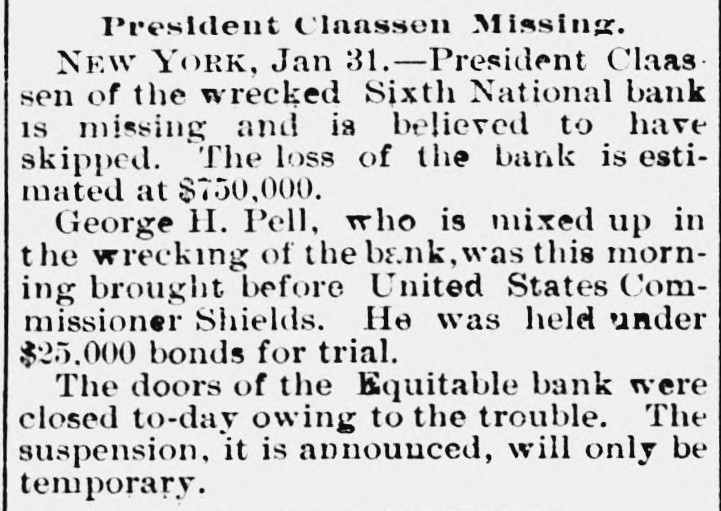
President Claassen Missing. NEW YORK, Jan 31.-President Claas sen of the wrecked Sixth National bank is missing and is believed to have skipped. The loss of the bank is estimated at $750,000. George H. Pell, who is mixed up in the wrecking of the bank, was this morning brought before United States Commissioner Shields. He was held under $25,000 bonds for trial. The doors of the Equitable bank were closed to-day owing to the trouble. The suspension, it is announced, will only be temporary.


Article from Wichita Eagle, February 2, 1890

Click image to open full size in new tab

Article Text

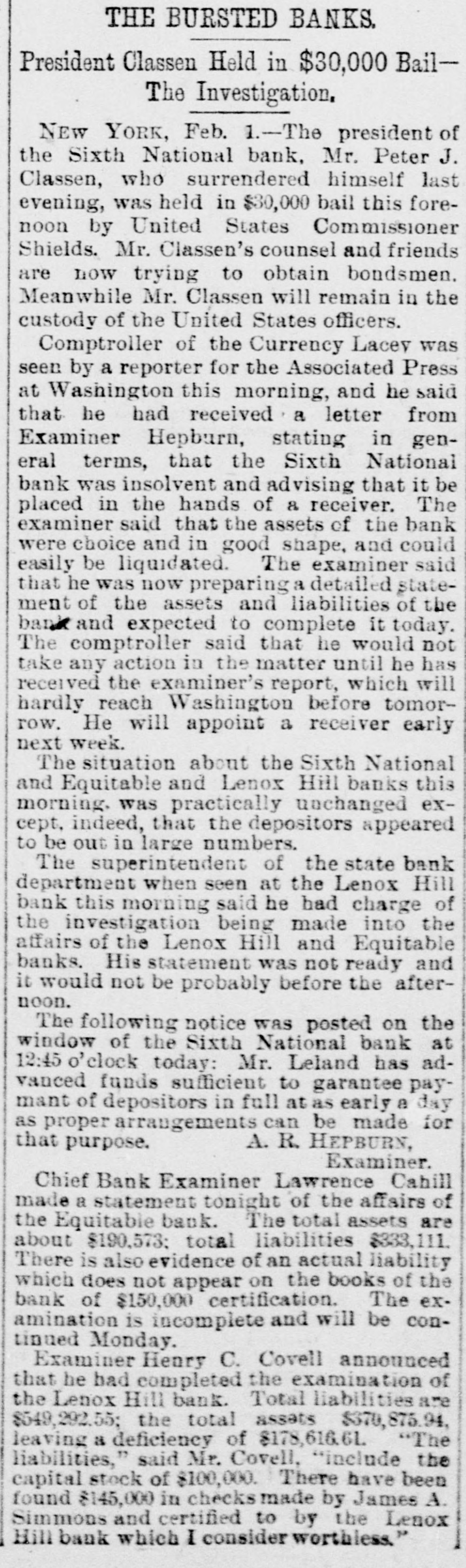
THE BURSTED BANKS. President Classen Held in $30,000 BailThe Investigation. NEW YORK, Feb. 1.-The president of the Sixth National bank, Mr. Peter J. Classen, who surrendered himself last evening, was held in $30,000 bail this forenoon by United States Commissioner Shields. Mr. Classen's counsel and friends are now trying to obtain bondsmen. Meanwhile Mr. Classen will remain in the custody of the United States officers. Comptroller of the Currency Lacev was seen by a reporter for the Associated Press at Washington this morning, and he said that he had received a letter from Examiner Hepburn, stating in general terms, that the Sixth National bank was insolvent and advising that it be placed in the hands of a receiver. The examiner said that the assets of the bank were choice and in good shape, and could easily be liquidated. The examiner said that he was now preparing a detailed statement of the assets and liabilities of the ban and expected to complete it today. The comptroller said that he would not take any action in the matter until he has received the examiner's report, which will hardly reach Washington before tomorrow. He will appoint a receiver early next week. The situation about the Sixth National and Equitable and Lenox Hill banks this morning, was practically unchanged except, indeed, that the depositors appeared to be out in large numbers. The superintendent of the state bank department when seen at the Lenox Hill bank this morning said he had charge of the investigation being made into the affairs of the Lenox Hill and Equitable banks. His statement was not ready and it would not be probably before the afternoon. The following notice was posted on the window of the Sixth National bank at 12:45 o'clock today: Mr. Leland has advanced funds sufficient to garantee paymant of depositors in full at as early a day as proper arrangements can be made for that purpose. A. R. HEPBURN, Examiner. Chief Bank Examiner Lawrence Cahill made a statement tonight of the affairs of the Equitable bank. The total assets are about $190,573: total liabilities $333,111. There is also evidence of an actual liability which does not appear on the books of the bank of $150,000 certification. The examination is incomplete and will be continued Monday. Examiner Henry C. Covell announced that he had completed the examination of the Lenox Hill bank. Total liabilities are $549,292.55; the total assets $370,875.94, leaving a deficiency of $178,616.61. "The liabilities," said Mr. Covell, "include the capital stock of $100,000. There have been found $145,000 in checks made by James A. Simmons and certified to by the Lenox Hill bank which I consider worthless."


Article from Pittsburg Dispatch, February 2, 1890

Click image to open full size in new tab

Article Text

(SPECIAL TELEGRAM TO THE DISPATCH.] NEW YORK, February 1.-The depositors of the Sixth National Bank were comforted to-day by hearing that they would get their money. The assurance was backed up by a check for half a million dollars from Charles K. Leland, the ex-President of the bank, who sold his shares in the bank for $650,000, and turned over the bank and its assets to the enterprising financiers who emptied its safe. A syndicate of five powerful banks has come to the front, and will make advances on the bank's quick assets, in the shape of bonds and other securities now in the possession of A. B. Hepburn, the National Bank Examiner. According to the best authority the face value of these securities is $1,774,000, so that with the aid of Mr. Leland's check for $500,000, it is pretty certain that the obligations to the depositors, amounting to $1,800,000, will be met. It will take several months to bring about this liquidation, and as it is scarcely to be presumed that the syndicate of banks has come to the rescue from purely philanthropic motives, it may be that Mr. Leland will be called on for a further contribution. A RECEIVER TO COME. The Controller of the Currency said at Washington to-day that Examiner Hepburn, in a letter sent on Friday, had pronounced the bank insolvent, and had advised the appointment of a receiver. A receiver would be appointed early next week, alter the Controller had received Mr. Hepburn's report, which will hardly reach him before Monday. This was probably said, however, before to-day's news had reached the Controller, and it may be that the expenses of a receivership will be avoided. It is not yet definitely known how the minority stockholders will come out. Mr. Leland and his friends say that everything possible will be done for the stockholders alter the depositors have been taken care of. F. D. Tappen, President of the Gallatin Bank, who says he has worn out a set of teeth talking about this case, is authority for the statement that Mr. Leland's check for $500,000 is only preliminary, and that more will be forthcoming from him, if it is necessary. SOMETHING SOOTHING. Early in the day there were indications at the Sixth National that something interesting and soothing was to happen. The Bank Examiner had passed half the night locked up in the bank with his assistants, and had completed his investigation and sent his report to Washington. With him at the bank, to-day, were Mr. Tappen and Mr. Wetmore, the latter counsel for Mr. Leland, At 11:30 this notice was put up: Mr. Leland has advanced funds sufficient to guarantee payments of depositors in full, at as early a date as proper arrangements can be made for that purpose. A. B. HEPBURN, Bank Examiner. The banks in the syndicate formed to take the assets and pay depositors are the Gallatin, the American Exchange, the Chemical, the Merchants and the Bank of Commerce. They are to make advances on the securities now in the possession of the Bank Examiner, taking the securities as collateral. It is the intention that, as fast as the depositors are paid, they shall sign a release of all claims against Mr. Leland. Mr. Tappen says that under the arrangement, as at present agreed upon, Mr. Leland will take everything that is left after the syndicate has settled with the depositors, and the syndicate itself has been settled with, and with other advances, if necessary, from bis own bank account, make a just and equitable settlement with the minority stockholders. Mr. Tappen's figures make the actual loss of the bank to be $700,000, as it was given in THE DISPATCH on Friday. MIDNIGHT STATEMENT. At midnight the following statement of the affairs of the Equitable Bank was given out by Chief Examiner Lawrence F. Cahill: I find commercial paper, commonly called loans and discounts, amounting to $151,823, a portion of which seems to be secured by nominal collaterals, at the value of which I have not yet determined. Also, United States bonds deposited with the banking department, as a guarantee of good faith, the market value of which is $1,240. The cash on hand is $2,295, and the furniture and fixtures, including the safe, estimated to be worth $500. There is due from banks the sum of $234 50, making a total assests of $160.593. There are said to be 300 shares of Sixth National Bank stock hypothecated with another bank, the par value of which is $30,000, the market value of which I have not yet determined. This will make the total $190,593. The liabilities are: Capital, $100,000; certified checks, $4,435; due depositors. $31,118; due banks a (items not yet proven), $198,593. This shows deficit of $143,553. There is also evidence of an actual liability which does not appear ou the books of the bank of $150,000 certification. The examination is incomplete, and will be continued Monday. LENOX BANK FIGURES. At the same hour Examiner Henry C. Covell announced that he had that evening reported an examination of the Lenox Hill Bank. The liabilities are $549,292 55; the total assets, $370,675 94, leaving a deficit of $178,616 61. "The liabilities, said Mr. Covell, "include the capital stock of $100,000. The assets on hand I have reduced to a conservative point, and feel confident that the depositors will receive 70 to 75 per cent on their claims. There have been found in the bank $145,000 in checks made by James A. Simmons, and certified to by the Lenox Hill Bank, which I consider worthless." An Albany paper this evening says: P.J. Claassen, the wrecker of the Sixth National Bank, in New York, is a former Albanian, at one time keeping a saloon on Upper Broadway, near the New York Central Railroad viaduct. When he went to New York. some 20 years ago. he had little or no money, and gave no promise of unusual financial genius. WOMEN AT WEDDINGS.
Article from New-York Tribune, February 4, 1890

Click image to open full size in new tab

Article Text

REOPENING THE BANKS. THE SIXTH NATIONAL WILL BEGIN BUSI. NESS TO-DAY. CHARLES H. LELAND CHOSEN PRESIDENT AFTER MAKING GOOD THE DEFICIENCY IN THE FUNDS-EXPECTATION THAT THE EQUI. TABLE AND LENOX HILL WILL RE. SUME ALSO-JAMES A. SIM. MONS TALKS WITH A TRIBUNE REPORTER. The reorganization of the Sixth National Bank, which fell into the hands of the Simmons-Claassen syndicate, was effected yesterday and its resump tion of business to-day is assured. Charles H. Leland, the former president, has made full contributions of money required to place the institution in a solvent condition and he has resumed ownership of the stock which he sold. The services of the five banks which on Saturday united to guarantee the protection of depositors in the Sixth National, under a money guarantee from Mr. Leland, will not now be required. Last night a conference was held at the Fifth 'Avenue Hotel between Conrad N. Jordan, Richard S. Newcombe, Bank Superintendent Charles H. Preston and Judge Maynard, Assistant Attorney-General, which will result in the opening of the Equitable Bank to-day and the probable resumption of business by the Lenox Hill Bank within short time. The modifications in the original plan for reorganizing and restoring the last mentioned institution were the result of conferences which were held on Saturday night and most of Sunday, ending at an early hour yesterday morning. The meetings were held at the New-York Club and at the houses of some of the bank officers who have interested themselves in arranging a settlement with the least amount of friction. Among those in consultation were legal representatives of Mr. Leland and James A. Simmons, the largest purchaser of the Leland stock: Conrad N. Jordan, president of the Western National Bank: F. D. Tappen, president of the Gallatin National Bank: Henry W. Cannon, president of the Chase National, who originally suggested the plan to enable the Sixth National to resume: National Bank Examiner Hepburn and others interested in a settlement Further conferences yesterday completed the details, which received the approval of the Controller of the Currency by telegraph. HOW THE ADJUSTMENT WAS MADE The principles of the adjustment are simple. Mr. Leland deposited funds in the Sixth National to an amount between $660,000 and $700,000, thereby making up to the bank the loss suffered by the abstraction of its railway bonds and the worthlessness of the certified checks which the Simmons syndicate had given to it, The Western National Bank, which had the custody of the 1,035 shares of Sixth National stock, restored these shares to Mr. Leland. A meeting of the minority stockholders in the Sixth National was held uptown, at which Mr. Leland was asked to resume the presidency. Directors were chosen as follows Charies H. Leland, Charles G. Landon, of C.G. Landon & Co., importers, at No. 421 Broome-st. W. J. Quinlan, jr., cashier of the Chemical Bank, formerly a director; F. D. Tappen, president of the Gallatin, and Joseph Park, of Park & Tilford. Then the new directors met downtown and selected Mr. Leland as president and Mr. Landon as vice-president, the old cashier, Andrew C. Colson, of course, holding his place. The last meeting was held at the Gallatin Bank, Mr. Hepburn being present, and W. Cryder Wetmore acting as counsel for Mr. Leland. To Tribune reporter Mr. Wetmore said Mr. Leland will return to the Sixth Na tional Bank every dollar of the money that was taken by Simmons, Claassen and the others. He had already handed over $500,000, a has been published, and has also handed over the cash to cover the rest of the loss. Just how much Simmons and the rest secured is not yet known, but the sum will be between $660,000 and $700,000. The exact amount will be learned to-morrow, when the value of certain securities left by Claassen is determined Mr. Leland has replaced every dollar of the missing funds, and the bank is in precisely the same condition as it was in on January 22, when the bank was turned over to the purchasers. The new board of directors are strong men, who ought to command the confidence of the community. HOW DID THE WESTERN GET THE STOCK The story of how the Western National Bank came into the custody of the Leland stock needs the illumination of statements from the officers of the bank and of Mr Simmons The former refused to talk to reporters, and Mr. Simmons was invisible except to the persons whom he has assisted in the work of bringing about coinpromise. It is believed that the Western National held the bulk of the stock to secure itself against either loans to Simmons or for clearing the checks on the Equitable, which were certified by that bank improperly The other banks or firms who concentrated the Sixth National stock which they held in the hands of the Western National are thought to be involved similarly, and the concentration was made to facilitate negotiations for settlement. How the release of the stock held by the Western National was effected could not be learned from its officers. It is thought that about $100,000 was raised on the 1,035 shares, forming only small part of the $700,000 made good to the Sixth National yesterday by Mr. Leland. A well-informed banker said that while the Sixth National had been restored solveney by Mr. Leland's action, there was doubt- to less an actual loss of $250,000 to $300,000, which would be so distributed among the institutions having dealings with Mr. Simmons as to have no important effect, even if it were not all assumed by him. Bank officers express doubt whether Mr. Simmons has performed any acts that would render him liable criminally. His friends assert that this is the case, but little doubt is expressed on the question of the responsibility of General Claassen and Pell for their conduct, There is still about $420,000 of the good securities which were taken from the Sixth National's treasury and hypothecated which have not been recovered. Where these securities are pledged information which the representatives of Mr. is land and others concerned will not divulge. Le. Hepburn says that all the assets of the Mr. National are in sight, and can and will be Sixth ered." Wall Street bankers interpret this recov. meaning that good grounds exist for legal as ceedings if the securities are not prothe process of be facilitated persons or reor bought ment achieve luctance money untarily, upon is of and believed those them will institutions peaceable them surrendered relinquish- by who the volnotoriety as being connected outright lent to of up of conducted, the troubles scandal tion privately may be the the three complete suspensions. clearing sentiment However with the slowly situa- Wall the Street is one of gratification that the bank in


Article from The Portland Daily Press, February 5, 1890

Click image to open full size in new tab

Article Text

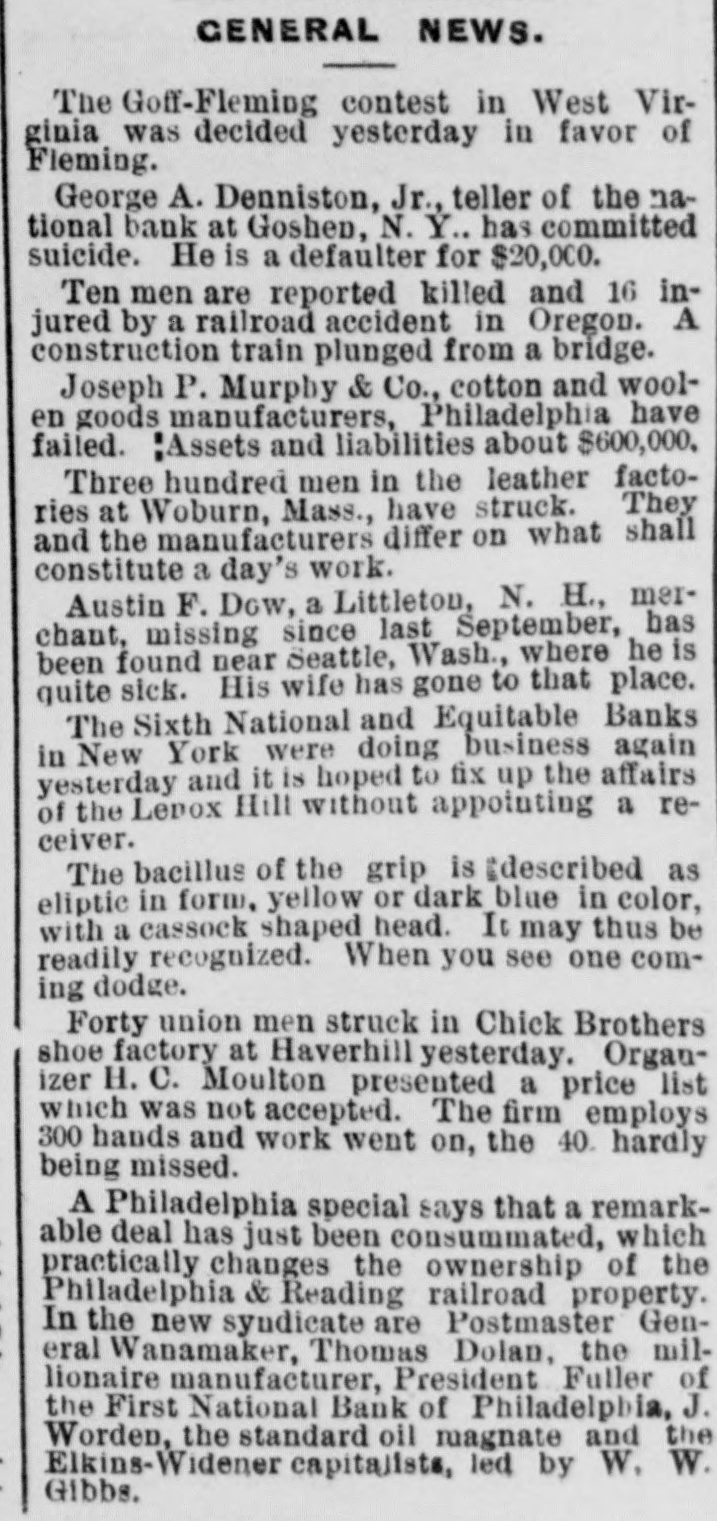
GENERAL NEWS. / The Goff-Fleming contest in West Virginia was decided yesterday in favor of Fleming. George A. Denniston, Jr., teller of the national bank at Goshen, N. Y.. has committed suicide. He is a defaulter for $20,000. Ten men are reported killed and 16 injured by a railroad accident in Oregon. A construction train plunged from a bridge. Joseph P. Murpby & Co., cotton and woolen goods manufacturers, Philadelphia have failed. Assets and liabilities about $600,000. Three hundred men in the leather factories at Woburn, Mass., have struck. They and the manufacturers differ on what shall constitute a day's work. Austin F. Dow, a Littleton, N. H., merchant, missing since last September, has been found near Seattle, Wash., where he is quite sick. His wife has gone to that place. The Sixth National and Equitable Banks in New York were doing business again yesterday and it is hoped to fix up the affairs of the Lepox Hill without appointing a receiver. The bacillus of the grip is described as eliptic in form. yellow or dark blue in color, with a cassock shaped head. It may thus be readily recognized. When you see one coming dodge. Forty union men struck in Chick Brothers shoe factory at Haverhill yesterday. Organizer H. C. Moulton presented a price list which was not accepted. The firm employs 300 hands and work went on, the 40. hardly being missed. A Philadelphia special says that a remarkable deal has just been consummated, which practically changes the ownership of the Philadelphia & Reading railroad property. In the new syudicate are Postmaster General Wanamaker, Thomas Dolan, the millionaire manufacturer, President Fuller of the First National Bank of Philadelphia, J. Worden, the standard oil magnate and the Elkins-Widener capitalists, led by W, W. Gibbs.


Article from Connecticut Western News, February 5, 1890

Click image to open full size in new tab

Article Text

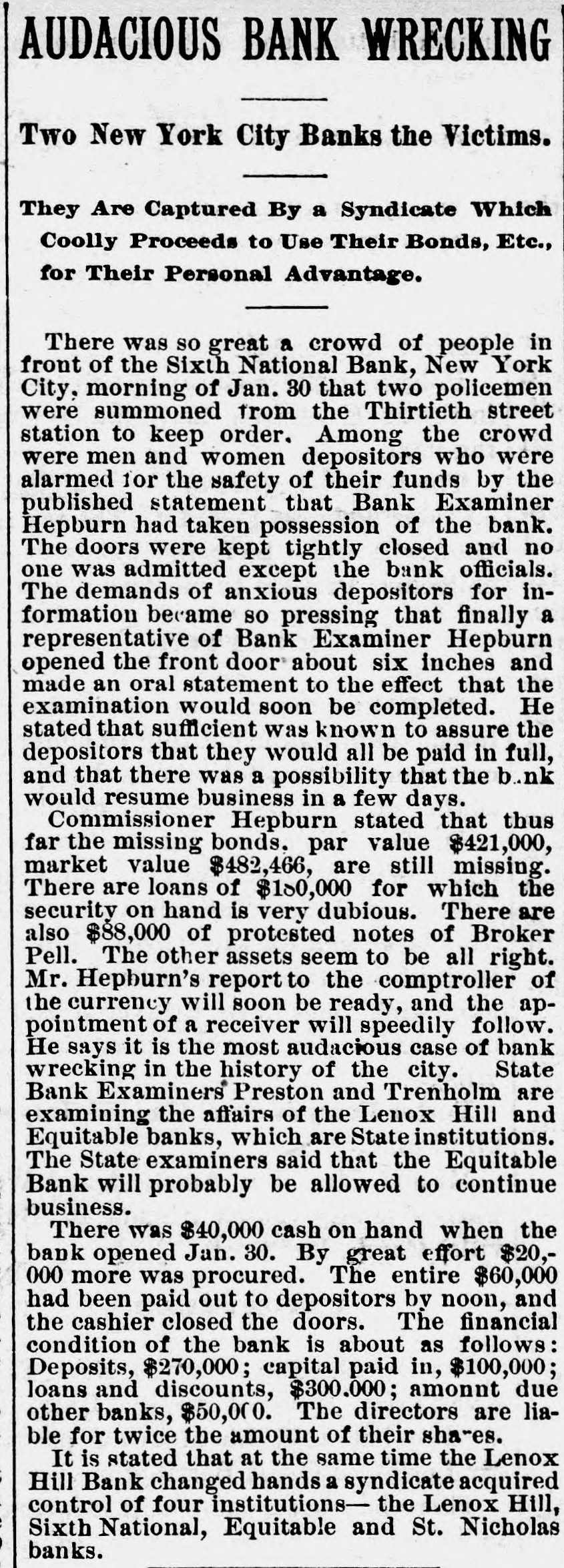
AUDACIOUS BANK WRECKING Two New York City Banks the Victims. They Are Captured By a Syndicate Which Coolly Proceeds to Use Their Bonds, Etc., for Their Personal Advantage. There was so great a crowd of people in front of the Sixth National Bank, New York City, morning of Jan. 30 that two policemen were summoned from the Thirtieth street station to keep order. Among the crowd were men and women depositors who were alarmed for the safety of their funds by the published statement that Bank Examiner Hepburn had taken possession of the bank. The doors were kept tightly closed and no one was admitted except the bank officials. The demands of anxious depositors for information became so pressing that finally a representative of Bank Examiner Hepburn opened the front door about six inches and made an oral statement to the effect that the examination would soon be completed. He stated that sufficient was known to assure the depositors that they would all be paid in full, and that there was a possibility that the b.nk would resume business in a few days. Commissioner Hepburn stated that thus far the missing bonds. par value $421,000, market value $482,466, are still missing. There are loans of $150,000 for which the security on hand is very dubious. There are also $88,000 of protested notes of Broker Pell. The other assets seem to be all right. Mr. Hepburn's report to the comptroller of the currency will soon be ready, and the appointment of a receiver will speedily follow. He says it is the most audacious case of bank wrecking in the history of the city. State Bank Examiners Preston and Trenholm are examining the affairs of the Lenox Hill and Equitable banks, which are State institutions. The State examiners said that the Equitable Bank will probably be allowed to continue business. There was $40,000 cash on hand when the bank opened Jan. 30. By great effort $20,000 more was procured. The entire $60,000 had been paid out to depositors by noon, and the cashier closed the doors. The financial condition of the bank is about as follows: Deposits, $270,000; capital paid in, $100,000; loans and discounts, $300.000; amonnt due other banks, $50,000. The directors are liable for twice the amount of their shares. It is stated that at the same time the Lenox Hill Bank changed hands a syndicate acquired control of four institutions- the Lenox Hill, Sixth National, Equitable and St. Nicholas banks.


Article from New-York Tribune, February 5, 1890

Click image to open full size in new tab

Article Text

TWO BANKS OPEN AGAIN. THE SIXTH NATIONAL AND THE EQUITABLE RESUME BUSINESS. MORE DEPOSITS THAN WITHDRAWALS - THE LENOX HILL'S DOORS STILL CLOSED-PELL FINDS BAIL AND IS RELEASED. Two of the three banks which since last Thursday have been closed to business because of the work of the Claassen-Pell syndicate were opened again yes. terday morning. The doors of the Sixth National Bank were thrown open a few minutes after 10 o'clock, but it was an hour later when the Equitable was open for customers. The Lenox Hill Bank was not so fortunate. however, and those who are interested in seeing it upon its feet again were disappointed. As affairs now stand it is not probable that this last institution will be open before Saturday at the earliest This will depend upon the efforts made by the board of directors and the will of the stockholders and depositors. Out of the 827 depositors 800 signed the petition asking Judge Maynard to put the affairs of this bank into the hands of Conrad N. Jordan, president of the Western National Bank. He will see to it. if possible, that the interests of all concerned are looked after. OPENING THE SIXTH NATIONAL About the busiest bank in this city yesterday was the Sixth National. From a few minutes after the usual hour when banks are opened for busi ness until the closing hour, 3 o'clock. the clerks and officials had not an instant's rest from work. Early in the day there was a much larger number of depositors on the sidewalk in front of the bank than there had been at any time during the tem porary suspension. Some of them looked anxious and expectant, while others appeared, or tried to appear, indifferent. Among those waiting were many women, each carrying a bank-book. When the hands on the clock in the Union Dime Savings Bank, at Thirty second-st. and Broadway, registered exactly 10 o'clock, all expected to see the doors fly open, and each individual depositor there was ready for the rush. The doors did not open, and for a few minutes there was some fear that another hitch had occurred. Within the building clerks could be seen hurrying to and fro, and away back in the president's office was a little group of substantial-looking men. They were F. D Tappen, C. W. Wetmore, Joseph Park. C. G. Landon, Conrad N. Jordan, Edward King and the National Bank Examiner. A. B. Hepburn. They were there formally to receive the securities and the custody of the institution from the National Bank Examiner. Charles H. Leland was confined to his home in Madison-ave. by sickness. Considerable time was consumed in signing the necessary receipts and papers, and when this had been done the bank was again ready for business, ex cept in a most important particular. Bills and specie amounting to $500,000, which were to come up from the Gallatin National Bank, had not yet reached the Sixth National. Mr. Tappen stepped to the telephone and rang up the Wall-st institution. and in a few minutes the money was on the way uptown in a carriage guarded by two of the Gallatin Bank's trusty clerks. The moment that this money was inside the bank the doors were opened and business began in good earnest. A RUSH OF DEPOSITORS. There was nothing like a serious run on the bank Although the paying teller was kept busy; he did not have to work one-half so hard as the receiving teller In the five hours which the bank was open less than $90,000 was drawn out by depositors, while the re ceiving tellers got within a few thousand dollars of $200,000. Those who put their money in the bank seemed to be more anxious to become depositors than those who had money in the bank were to draw their money out. Most of the sums paid out were in small amounts. Some drew out their entire deposits, but they were few. Cashier Colston was in a happy frame of mind. He was delighted with the results of the day's business. He said that it had been far beyond his expectations and he felt that entire confidence in the institution had been restored. C. G. Landon, vice president. was at the president's desk in the absence of Mr. Leland. He, too. expressed great satisfaction with the day's business. This notice was pasted in the window Mr. Leland has restored both capital and surplus to this bank. It is just as strong as it was before the sale of his stock, and depositors should feel in every respect A. B. HEPBURN the same security as before. Bank Examiner Mr. Hepburn said to a reporter When turned the bank over to the officers this morning, it is fact that its resources were equivalent to $2,700,000, which in cludes bills receivable and paper which I considered bad yesterday, but which Mr. Leland has made good this morning. He covered the $382.000 of bad checks with cash by payments to the bank through Mr. Leland. They are now held by Mr. Jordan and upon the liquidation of these depends the resumption of the Lenox Hill and Equitable banks. The Sixth National has now surplus of $1,000,000." The securities which were taken from the bank by Claassen will be in the possession of the rightful owners to-day or to-morrow, unless the negotiations now on foot fall through. The Equitable Bank was several hours behind the Sixth National in opening for business in fact. It was after 1 o'clock In the afternoon when the new cashier said that everything was in readiness for the public. Conrad N. Jordan, Slegmund T. Meyer, Presi dent Tallman and Charles Gerlach met at the bank at 11 o'clock in the morning. and for over an hour were in consultation. Mr. Jordan had with him a. permit from Bank Superintendent Charles H. Preston to open the bank under the condition that the certified checks which caused the suspension should be taken up and settled. The three leading directors agreed to do this and Mr. Jordan took the checks. While they were in consultation a clerk from the Western National Bank was driven to the door with a valise containing $150,000 in cash. State Bank Examiners Trenholm and Cahill were at the bank. and when the money arrived they allowed the doors to be opened again. The new management accepted gladly on Monday afternoon the resignation of A. A. Courter, who was the cashier who certified the checks. In his place Nathaniel A. Chapman, who for many years has been in the banking business, and who held a place of trust and responsibility in the Western National Bank. under Mr. Jordan, was elected cashier. This was at Mr Jordan's request. There was apparently no unusual amount of busi ness done at the bank during the short time which It was open. A few depositors drew out their money, and a number of business men and merchants demon strated that they had the utmost confidence in Mr. Jordan and the new Board of Directors by making de posits. The entire amount due to depositors was less than $20,000 when the bank opened. A WOMAN LOOKS FOR COURTER. Ex-Cashier Courter did not come to the bank until late in the afternoon. It was well for him that he did not, for an exceedingly angry woman who was ac companied by her lawyer was looking for him. They said that they had a warrant for his arrest. Pierre C. Tallman, the lawyer, explained that his client had deposited 8440 in the bank last Thursday afternoon after the doors had been closed, and he wanted to have Courter arrested unless the money was forthcoming Later in the day he found Mr. Courter, and the money was paid to him on a check drawn by his client. He went away saying that the payment of the money by the bank did not release the cashier from his responsibility, and that proceedings would be begun against him immediately Courter will hold no place under the new management, it said.


Article from West Virginia Argus, February 6, 1890

Click image to open full size in new tab

Article Text

THE NEWS EPITOMIZED. Eastern and Middle States. GENERAL LESTER B. FAULKNER the wellknown Democratic politician, died at Canaseraga, N. Y. GEORGE RITCHIE, of Moose Hill, Me., aged 16, was shot and killed by his cousin, Bernard Ritchie, who mistook him for a deer, while hunting in the woods. JOHN HAFFY, of Centralia, Penn., went home drunk and threatened to beat his wife. She gave him some laudanum to make him sleep, and it killed him. No one will prosecute. JAMES KNAPP, at Danbury, Conti., kicked his wife to death because she hid his supply of whisky THE Congregational Church at Danvers Centre, Boston, has been burned The church is a historic one. It was the successor of the ancient Salem village parish church in which the witchcraft troubles began. JOHN VOTOZIL, a Bohemian cigarmaker, of New York city, in a flt of insanity flung his boy through a window and killed him. W. H. McHENRY and Alexander Carmen were blown up by nitro-glycerine near Bradford, Penn., while preparing to torpedo a well. HAMILTON HALL, at Salem, Mass., built in the Revolutionary times under the name of Assembly Hall, and named Hamilton Hall in 1805, in honor of Alexander Hamilton, has been gutted by fire. WILLIAM MESSTENHEFFER, foreman of the stone quarries near Lancaster, Penn., was killed by an explosion of dynamite. THE first annual meeting and banquet of the United States Navy Veteran Association has been hold at Boston. Admiral Porter was elected Commander. THE Sixth National Bank in New York city has been closed by the United States Bank Examiner and thrown out of the Clearing House; the Equitable Bank is in the hands of n State Bank Examiner, and its checks have gone to protest; and the Lenox Hill Bank has suspended. All those Institutions lately came under the control of a clique, of which one P. J. Clansson was the head. Warrants were out for the arrest of Claasson, who was illegally elected President of the Sixth National, and George H. Poll, a broker. Depositors will lose no money probably, but stockholders will. About $700,000 were misappropriated.


Article from Wood County Reporter, February 6, 1890

Click image to open full size in new tab

Article Text

upon the property of Theodore Gatchill, late secretary of the company, for the sum of $9,000. Mr. Gatchill resigned his position a few days ago. Since then the books have been examined, and it is charged that he has drawn unauthorized warrants to the extent of the sum named above. PETER J CLAUSEN, who as the alleged President of the Sixth National Bank of New York is accused of wrecking that institution, was arrested Friday. Pell, the broker involved in the crookedness, was held in $25,000 bail for examination next Thursday, and rests in Ludlow Street Jail. The Equitable Bank, a state concern, the officers of which are interested in the Lenox Hill and the Sixth National, has suspended temporarily. Statements are made that the depositors in the embarrassed concern will not suffer. INDIANAPOLIS, Ind.-Burglars entered President Harrison's house, on North Delaware street at 7 o'clock Thursday evening. Although it is occupied by Henry S. Frazer and family, much of the president's property is still in the house. Much of it, with jewelry belonging to Mrs. Fraser, was stolen, the loss all told amounting to nearly $1,000. The burglars secured an entrance by climbing to a secondstory window. TRAP HILL, W. Va.-The shooting affray in which C. B. Trump was killed and two others wounded was a most desperate and bloody revolver duel. The scene of the murder was the house of Hugh Davis. Trump applied a foul epithet to a man named Tom Snuffer and shot at him. The ball struck Eldridge Smith, wounding him badly. Snuffer then fired at Trump, and then the two men caught each other with their left hands and each fired two shots. Snuffer was hit in the head, while Trump was shot through the body and through one arm, and died in twenty minutes. Eldridge Smith may die.


Article from Grant County Herald, February 6, 1890

Click image to open full size in new tab

Article Text

THE BANK WRECKERS. President Claassen and Cashier Van Zandt Arrested in New York. NEW YORK, Jan. 31.-The Lenox Hill and the Sixth National banks of New York suspended payment yesterday owing to the operations of President Claassen, of the latter concern, who tried to dispose of $600,000 worth of bonds belonging to the bank. NEW YORK, Feb. 1.-As a result of the failures of the Sixth National and Lenox Hill banks the Equitable Bank closed its doors yesterday morning. In the afternoon President Claassen, of the Sixth National, Cashier Van Zandt, of the Lenox llill, and George H. Pell, a broker, were arrested.


Article from The Columbian, February 7, 1890

Click image to open full size in new tab

Article Text

The Equitable Falls, Too. NEW YORK, Feb. 1.-As a natural sequel to the sensational chapter in the history of bank wrecking the Equitable bank in West Twenty-eighth street suspended yesterday. It was hoped and believed that this bank would be able to weather the storm which has involved the Sixth National and the Lenox Hill banks in ruin. Classen Under Arrest. About 6 o'clock last night President Clas sen appeared before the United States commissioner with his counsel and two dentity


Article from The Great West, February 7, 1890

Click image to open full size in new tab

Article Text

IN GENERAL. The affairs of the three wrecked New York banks have been straightened and will resume business. The United States revenue cutter Rush took a large amount of mail from San Francisco to Portland, Or., the regular line of steamers refusing the compensation offered by thegovernment. La grippe has reached the reserves in the Canadian Northwest, and the Indians are simply terrorized. The disease is reported to be very bad on the Sarcee river south of Calgary. More than thirty persons died of meningtis, which is epidemic near Gainesville. Tex., and many others are beyond the hope of recovery. Out of the whole number attacked by the disease not a single person has recovered. Capt. Balls, of the steamer Brampton, re ported that on Jan. 23, in latitude 33.44 north, longitude 51 west, he observed a loaded steamer a mile away during a gale. For about ten minutes the gale was 80 furious he could see nothing, but when the gale went down he could see nothing of her, and supposed she foundered with all on board. The house committee on Indian affairs has practically decided upon the recommendation of Mr. Gifford that the Yankton Indian reservation in South Dakota should be reduced, and have requested the commissioner of Indian affairs to furnish some facts relating to the reservation, and the advisibility of appointing a commission to treat with the Indians for the cession of a portion of their lands. The Lennox Hill bank of New York City has suspended payment. It is controlled by the same parties who bought the control of the Sixth National bank of New York, which had already been closed by the bank examiner. The knowledge of the relation of the two institutions caused a run on the Lennox, which it was unable to meet. The representatives of the bank examiner state that depositors will certainly be paid in full. The Equitable bank has also been affected in connection with the other two institutions. Wall street looks upon the attempt to dispose of the $600,000 in bonds owned by the Sixth National bank as simply a case of highway robbery. It seems that President Claasen, after abstracting the bonds from the safe deposit vault, turned them over to George H. Pell, a broker of unsavory reputation. who attempted to dispose of them on the street, representing them to be the property of his wife. Mr. Colson, the cashier of the bank, learning of the action of Claasen, notified the clearing house and bank examiner. He soon learned enough to cause him to close the bank and call on Claas on for the return of the $622,000 in securities.


Article from Perrysburg Journal, February 8, 1890

Click image to open full size in new tab

Article Text

AFLOAT AGAIN. New York's Wrecked Banks Open Their Doors-Business Resumed at the Sixth National and the Equitable. NEW YORK, Feb. 5.-The Sixth National Bank reopened its doors Tuesday morning and rapidly paid out money to those who cared to draw it. There were, however, no signs of a run on the bank. When the bank was turned over by Bank Examiner Hepburn to Presiden Leland's counsel the latter said not only were there sufficient funds to pay the depositors, but the surplus was now as large as before and stock worth just as much. About 1 o'clock Tuesday afternoon the Equitable Bank threw open its doors for business. The Lenox Hill Bank depositors are rapidly signing papers giving President Jordan, of the Western National Bank, power to act for them. The latter has hopes of arranging the bank's affairs so that a receiver will not be necessary. C. N. Jordan made the following statement in regard to the condition of the Lenox Hill Bank late Tuesday evening: "The total amount of capital due depositors is $130,000. The bank has $200,000 assets to pay them with. It is expected now that we will open for business on Thursday morning."


Article from The Wheeling Daily Intelligencer, February 14, 1890

Click image to open full size in new tab

Article Text

Envy Loves a Shining Mark. Certain small but not good agents, of small but good companies, have tried to connect The Equitable with small institutions of the same name. The most successful and widely known life assurance company in the world is the "Equitable." Hence, its name is popular throughout the country and has been appropriated by others. We have never been asked if we had any connection with Equitable manufacturing or mercantile organizations, although there are a number, but we have been asked if we were identified in any way with the Equitable Fire Insurance Company or an obscure co-operative association entitled the "Equitable Reserve Fund." We now observe that a small bank in New York, which suspended business for a few days recently, is known as the Equitable Bank, and we have had an inquiry as to whether it had any connection with us. We may as well announce, therefore, once for all, that the Equitable Life Assurance Society of the United States has no connection, directly or indirectly, with any other organization of any kind or description bearing the name Equitable, but that it is now, as it has been for some years, the largest, strongest safest and best Life Insurance Company in the world. SWEENEY & EDWARDS, General Agents, 1308 Market street.


Article from The Wheeling Daily Intelligencer, February 15, 1890

Click image to open full size in new tab

Article Text

USE Famous Flour, with Liberty Bell on the sack. The only genuine. Envy Loves a Shining Mark. Certain small but not good agents, of small but good companies, have tried to connect The Equitable with small institutions of the same name. The most successful and widely known life assurance company in the world is the "Equitable." Henoe, its name is popular throughout the country and has been appropriated by others. We have never been asked if we had any connection with Equitable manufacturing or mercantile organizations, although there are a number, but we have been asked if we were identified in any way with the Equitable Fire Insurance Company or an obscure co-operative association entitled the "Equitable Reserve Fund." We now observe that a small bank in New York, which suspended business for a few days recently, is known as the Equitable Bank, and we have had an inquiry as to whether it had any connection with us. We may as well announce, therefore, once for all, that the Equitable Life Assurance Society of the United States has no connection, directly or indirectly, with any other organization of any kind or description bearing the name Equitable, but that it is now, as it has been for some years, the largest, strongest, safest and best Life Insurance Company in the world. SWEENEY & EDWARDS, General Agents, 1308 Market street.


Article from The Wheeling Daily Intelligencer, February 17, 1890

Click image to open full size in new tab

Article Text

Envy Loves a Shining Mark. Certain small but not good agents, of small but good companies, have tried to connect The Equitable with small institutions of the same name. The most successful and widely known life assurance company in the world is the "Equitable." Hence, its name is popular throughout the country and has been appropriated by others. We have never been asked if we had any connection with Equitable manufacturing or mercantile organizations, although there are a number, but we have been asked if we were identified in any way with the Equitable Fire Insurance Company or an obscure co-operative association entitled the "Equitable Reserve Fund." We now observe that a small bank in New York, which suspended business for a few days recently, is known as the Equitable Bank, and we have had an inquiry as to whether it had any connection with us. We may as well announce, therefore, once for all, that the Equitable Life Assurance Society of the United States has no connection, directly or indirectly, with any other organization of any kind or description bearing the name Equitable, but that it is now, as it has been for some years, the largest, strongest, safest and best Life Insurance Company in the world. SWEENEY & EDWARDS, General Agents, 1308 Market street.


Article from The Abbeville Press and Banner, February 19, 1890

Click image to open full size in new tab

Article Text

THE NEWS EPITOMIZED. Eastern and Middle States. THE first annual meeting and banquet of the United States Navy Veteran Association has been held at Boston. Admiral Porter was elected Commander. THE Sixth National Bank in New York city has been closed by the United States Bank Examiner and thrown out of the Clearing House; the Equitable Bank is in the hands of a State Bank Examiner, and its checks have gone to protest; and the Lenox Hill Bank has suspended. All these institutions lately came under the control of a clique, of which one P. J. Claassen was the head. Warrants were out for the arrest of Claassen, who was illegally elected President of the Sixth National, and George H. Pell, a broker. Depositors will lose no money probably, but stockholders will. About $700,000 were misappropriated. THE debate in the New York Presbytery on the revision of the Confessional of Faith was closed by a lively tilt between Dr. Hall on one side and Dr. Hastings on the other. WHILE Frank B. Wilson and Benjamin Townsend were fooling with a revolver at New Brighton, Penn!, Wilson's brains were blown out. The boys were sixteen years old. Townsend was a son of Congressman Townsend. DURING the dress parade of the school regiment at the Latin school, Boston, when an American flag was presented, five of the young boy soldiers fainted in the ranks and were carried off by their comrades. A TRAIN wreck occurred six miles from Lancaster, N. H. The engineer, L. F. Crouch, was killed, and the fireman and brakeman badly injured. A STATEMENT signed by Edward King, President of the Union Trust Company, annonnced that Charles H. Leland, ex-President of the Sixth National Bank, of New York city, made arrangements by which the bank would resume business. DANBURY, Conn., had the most destr nctive fire in the history of the place. Several Wocks of stores were destroyed and many t nants had narrow escapes. Explosions occurred during the fire. Loss, about $300,000. THE steamer Waseland had a rough passage to New York from Antwerp. Her fourth officer and a quartermaster were swept overboard and lost. ALFRED BROWN, a "professor of medicine," at Westchester, Penn., was convicted of practicing medicine without a diploma and using incantations and "voudoo" methods, and sentenced to three years' imprisonment and $70 fine. REV. T. DE WITT TALMAGE, the noted Brooklyn divine, has returned from his pilgrimage to the Holy Land. HON. SETH Low, ex-Mayor of Brooklyn, was installed eleventh President of Columbia College at the Metropolitan Opera House in New York, with impressive ceremonies. THE Gloucester fishing schooner Alice M. Stouple was reported lost at sea with a crew of fourteen souls. THE New York Presbytery, by a vote of 93 to 43, accepted the report by the special committee in favor of revision of the Confession of Faith. THE New England Agricultural Society met at Boston. GENERAL JOHN D. ANDERSON, of Augusta, Me., has been elected Commander G. A. R., Department of Maine.


Article from Fisherman & Farmer, February 21, 1890

Click image to open full size in new tab

Article Text

THE NEWS EPITOMIZED. Eastern and Middle States. HAMILTON HALL, at Salem, Mass, built in the Revolutionary times under the name of Assembly Hall, and named Hamilton Hall in 1805, in honor of Alexander Hamilton, has been gutted by fire. WILLIAM MESSTENHEFFER, foreman of the stone quarries near Lancaster, Penn, was killed by an explosion of dynamite. THE first annual meeting and banquet of the United States Navy Veteran Association has been held at Boston. Admiral Porter was elected Commander. THE Sixth National Bank in New York city has been closed by the United States Bank Examiner and thrown out of the Clearing House: the Equitable Bank is in the hands of a State Bank Examiner, and its checks have gone to protest; and the Lenox Hill Bank has suspended. All these institutions lately came under the control of & clique, of which one P. J. Claassen was the head. Warrants were out for the arrest of Claassen, who was illegally elected President of the Sixth National, and George H. Pell, a broker. Depositors will lose no money probably, but stockholders will. About $700,000 were misappropriated. THE debate in the New York Presbytery on the revision of the Confessional of Faith was closed by a lively tilt between Dr. Hall on one side and Dr. Hastings on the other. WHILE Frank B. Wilson and Benjamin Townsend were fooling with a revolver at New Brighton, Penn., Wilson's brains were blown out. The boys were sixteen years old. Townsend was a son of Congressman Townsend. DURING the dress parade of the school regiment at the Latin school, Boston, when an American flag was presented, five of the young boy soldiers fainted in the ranks and were carried off by their comrades. A TRAIN wreck occurred six miles from Lancaster, N. H. The engineer, L F. Crouch, was killed, and the fireman and brakeman badly injured. A STATEMENT signed by Edward King, President of the Union Trust Company, annonnced that Charles H. Leland, ex-President of the Sixth National Bank, of New York city, made arrangements by which the bank would resume business. DANBURY, Conn., had the most destructive fire in the history of the place. Several blocks of stores were destroyed and many tenants had narrow escapes. Explosions occurred during the fire. Loss, about $300,000. THE steamer Waseland had a rough pas' sage to New York from Antwerp. Her fourth officer and a quartermaster were swept overboard and lost. ALFRED BROWN, a "professor of medicine," at Westchester, Penn., was convicted of practicing medicine without a diploma and using incantations and "voudoo" methods, and sentenced to three years' imprisonment and $70 fine.


Article from Wessington Springs Herald, March 21, 1890

Click image to open full size in new tab

Article Text

SPARKS FROM THE WIRES. BROWN & WINGROVE, melters and refiners and dealers in bullion in London have failed. Liabilities, ยฃ300,000. A MINISTERIAL crisis is imminent in Italy. Signor Brancheri, president of the chamber of deputies, has resigned. THE losses by Sunday night's fire at Detroit, Mich., amount to $150,000-over $100,000 less than was at first estimated. AT Hamilton, O., the jury in the case of Elmer Sharkey, the boy matricide, returned a verdict of murder in the first degree. HERR VOHSEN, German consul at Zanzibar, acting for the East Africa company, has concluded a new treaty favorable to the Germans. GEORGE P. TJADEN, the treasurer and general manager of Charter Oak camp, Modern Woodmen, of Peoria, Ill., has left with about $1,000 of the lodge funds. AT Bristol, England, Canon Baynes pleaded guilty to stealing a trunk from the railway station and was sentenced to four months' imprisonment at hard labor. IN an encounter at Elassona between Turks and a band of brigards over twenty of the former were killed and six of the latter. The brigands were dispersed. NEVILLE H. PICKTHALL, who was supposed to have been murdered by Burchell, under arrest charged with the murder of Bennell, has been heard from in Arizona. By a rear end collision on the Burlington & Missouri River road near Harvard, Neb., Conductor Norton and Brakeman Miller were instantly killed. A number of cars were wrecked. THE Clinton foundry of Troy, N. Y., the largest stove manufactory in the country, will soon be removed to Joliet, Ill. The company employs 1,200 men, and their pay roll amounts to more than $1,000,000 a year. A. A. COURTER, cashier of the Equitable Bank of New York. has heen charged with forgery and with having received deposits after he knew that his bank was insolvent. He pleaded not guilty to the charges. PHILIP SELLERS, of Londonville, o., has confessed that he was the accomplice of George M. Daviney, the burglar, who was shot and killed by Farmer Justin F. Frengle near Crestline, Feb. 16. IN the Musicians' National league convention now being held in Cincinnati the Baltimore league was suspended for employing a musician who had been dismissed from the Pittsburg league. THE directors of the Western Union Telegraph company have declared a quarterly dividend of 11 per cent. William Waldorf Astor was elected a director to fill the vacancy caused by the death of his father.


Article from Indian Chieftain, April 10, 1890

Click image to open full size in new tab

Article Text

ADDITIONAL DISPATCHES. IT was reported that General Bou= o langer would return to France. CARPENTERS in Massachusetts have decided upon demanding an eight-hour day, commencing May 1. t GEORGE K. SISTARE & SONS, of the New York Exchange, have failed. Liabilities, $250,000. CHICAGO carpenters to the number of 7,000, struck on the 7th for 40 cents per hour. HENRY M. STANLEY left Cairo, Egypt, on the 7th for Brussels. THE Southern trip of the Pan-American delegates will begin April 18 and end May 10. THE Montana election case was again before the Senate on the 7th. The Morrill Pension bill was before the House. A motion to suspend the rules and pass it was lost for want of the necessary two-thirds majority. The House then went into committee on the Army Appropriation bill. THE directors of the Equitable Bank, of New York, have decided to close its doors. One of the directors claims that of late the bank has been losing money. The deposits have dropped down to a figure where there is very little profit for the concern. NEWS from Honduras is that Major Burke is living there in clover. He is the defaulting ex-Treasurer of Louisiana. JUDGE HUGHES, of the United States Court at Richmond, Va., has declared the State Meat Inspection law unconstitutional. THE lower house of the Iowa Legislature has passed a resolution against the passage of the Union Pacific Funding bill. A SPECIAL department of education has been established in Portugal. Among its duties will be the regulation of the right of public meeting. THIRTEEN horses were suffocated by a fire in Morse's livery stable, Chicago, the other morning. THE Senate Committee on Public Lands has ordered a favorable report on the House bill to convey Lake Contrary to the city of St. Joseph, Mo. THE children of Washington had possession of the White House grounds on the 7th and indulged in the annual Easter egg rolling. In the afternoon the Marine band played for the little ones. THE House Railways and Canals Committee has ordered a favorable report on the bill for the construction by the United States of a ship canal around Niagara Falls It is to cost $23,600,000 and be 201/2 feet deep.


Article from The Dickinson Press, January 3, 1891

Click image to open full size in new tab

Article Text

IN THE FINANCIAL WORLD. JANUARY. 12 Bank of South Dakota at Madison assigned; assets, $150,000; liabilities not stated; as a result the La Belle Ranch Horse Importing company assigned; liabilities. 300,000; assets, $150,000. 16. L. H. Stone, San Francisco harness dealer, as signed: liabilities, $204,000; assets small. 28. John B. Lalande, cotton factor, assigned in New Orleaus: liabilities, $764.000: assets, $514,000. 80. The First National bank, the Lenox Hill bank, and the Equitable bank, all in New York, closed by order of the United States bank examiner; George II. Pell, a broker, and P. J. Claassen, president of the Sixth National, arrested. MARCH. 7. Monroe Eckstein and Leopold Wertheimer, New York brewers, assigned: liabilities, $000,000. Belloe freres, bankers, San Francisco. failed; liabilities large. 19. John F. Plummer & Co., one of the largest dry goods commission firms in the business, assigned in New York; liabilities, $1,00,000; assets about the same. APRIL. 8. Manha:tan bank, of Manhattan, Kan., failed; liabilities, $600,000. 17. Louis Francke & Co., silk importers, assigned in New York; liabilities, $900,000. 30. The Bank of America, a state institution, at Philadelphia. suspended. MAY. 1 The Gloucester City National bank At Glouces. ter City, N.J., carried under by failure of Bank of America. Fechheimer, Rau & Co., shirt makers, failed in