United States Bank of Pennsylvania (Philadelphia, PA)

Episode Information

Episode UID
4026293690493
Episode Type
Run β†’ Suspension β†’ Closure
Bank Type
state
Bank ID
402629369 hash
Start Date
January 15, 1841
Location
Philadelphia, Pennsylvania (39.952, -75.164)

Metadata

Model
gpt-5-mini (chosen from majority vote of a three-model LLM ensemble)
Short Digest
7aa7a28130252ad4

Response Measures

None

Description

Institution resumed on Jan 15, 1841, then suffered a run and suspended in early Feb 1841 and later made partial assignment (asset assignment) in Sept 1841.

Events (4)

1. January 15, 1841 Reopening
Newspaper Excerpt
RESUMPTION DAY ... All the Banks of our city paid out their own notes yesterday. ... The U. S. Bank is about to resume specie payments.
Source
newspapers
2. February 6, 1841 Run
Cause
Rumor Or Misinformation
Cause Details
A sudden report that the bank failed to meet large drafts (rumored refusal of payment on drafts) sparked heavy specie withdrawals.
Measures
Other city banks held conferences and briefly rallied; some banks limited redemptions to $5 notes before full suspension.
Newspaper Excerpt
a rumor ... a failure on the part of the U. S. Bank. ... a heavy draft presented ... which the Bank failed to meet ... rumors of these facts soon spread abroad ... the streets of our city were filled with a clamorous multitude ... poured into all our banks, but particularly into the portals of the U.S. Bank for specie.
Source
newspapers
3. February 6, 1841 Suspension
Cause
Bank Specific Adverse Info
Cause Details
Unable to meet heavy demands after the run and facing large foreign liabilities and maturing drafts, the U.S. Bank (and most Philadelphia banks) suspended specie payments.
Newspaper Excerpt
All the Banks of the City, with two or three exceptions, have just suspended specie payments except for Five Dollar Notes.
Source
newspapers
4. September 8, 1841 Other
Newspaper Excerpt
the Directors of the Bank ... made an assignment of most of the valuable assets of that institution ... the assignment is called a 'partial assignment' ... proceeds ... for the benefit of the general creditors, the note holders, depositors, &c.
Source
newspapers

Newspaper Articles (24)

Article from True American, April 18, 1839

Click image to open full size in new tab

Article Text

s Β£18,000,000 sterling in 1838. WE DON'T LIKE to see a lady on a bright sun-shiny day, as was yesterday, promenading the banquette when she exhibits such a want of taste as we shall describe. We saw one, who had rather a pretty face, and a passing fair person-some might exclaim in their admiration, quel taille! but the arrangement of her attire was rather outre. Imprimis, she wore a white bonnet and black veil-2dly, a black dress, with black cape, fringed with black lace-3dly, white shoes, and lastly walked under a snuff-colored parasol. Black shoes are becoming with a white dress, but not vice versa. We looked at the lady's face, and hoped she was ugly. We were disappointed, for it had a sweet expression, and as if a better display of taste would have helped it considerably. A heavy black veil is no more fit to accompany a thin, white summer bonnet, than while satin shoes to set off a coarse black bombazet dress. COMMERCIAL AFFAIRS.-Referring to the present condition of commercial affairs, the N. Y. Commercial Advertiser saya: It is not to be denied that the present is a time of severe commercial triel-especially in this city, and also at the South. The banks have been curtailing, stocks are depressed, money is scarce, and there have been a few suspensions. A variety of causes have contributed to this pressure-and among them not a little, the senseless panic that has existed in connexion with the Maine boundary question. Another cause may be found by looking back a few months, in the premature resumption of specie payments by the Bank of the United States. The bank was forced into that resumption by the late executive of Penneylvania. to serve a political object, before, in the sound judgment of Mr Biddle, it ought to have been. Not, however, because of the condition of the bank itself, because, as the event proved, the bank was abundantly able to resume. But it was the desire of the direction of that bank, that the resumption at the south and southwest should be simultaneous, and the Bank of the U. States was then exerting its energies, as it had been for months before, to enable the banks in those directions 10 resuine with it. 'I he consequences of this forced measure are now seen at the south, where the banks are again yielding to the pressure. Yet another cause of the pressure, both in this eity and at the south, is found in the fact that we have too much cotton on hand. The south western banks as well as individuals, have been playing at the hazardous game of monopoly, and in order to effect a rise in the market afroad, tog much of the article has been bought up and kept back at home. Weare informed that there are 90,00 hales on hand. One of two things must take place-either the cotton or the specie must be sent forward.


Article from Richmond Enquirer, October 25, 1839

Click image to open full size in new tab

Article Text

Answers of the Philadelphia Banks. The Letter of Messrs Barton and Brooke, the Depu ties of the Attorney General, to the Banks of Philadel phia, warning them against a fraudulent issue of small notes, has received due notice from those In. stitutions Replies have been published from the Cashiers of the Farmers' and Mechanics' Bank, the West. ern Bank of Philadelphia, the Bank of Penn Township, the Schuylkill Bank, Bank of North America, Moya. mensing Bank, Southwark Bank, Mechanics' Bank, Bank of the Northern Liberties, the Girard, the Com. mercial, and Southwark Banks; the Bank of Pennsyl. vania, and the President of the United States' Bank Some of them say at once, that they have not issued any notes under $5. and all of them pledge themselves to observe the law and to make no such issues hereafter The following is the reply from the Mammoth Bank - which exceeds in its length any of the others : "THE U. S BANK, Oct. 19th, 1839. "To George W. Barton, and C. Wallace Brooke, Esqs, acting for the Attorney General. "Gentlemen- have had the honor to receive and submit to the Board of Directors of this Bank, your official communication on behalf the Attorney General of the Commonwealth. In reply you will permit me to state that the information therein stated to have been received by you, that 'since the present suspension of specie payments this Bank has issued, paid out, or trans. ferred notes of a less denomination than five dollars, is inaccurate. In no instance since the suspension has a note of less denomination than five dollars been paid out here, and prohibitory provisions of the law in that res. pect have been and will be complied with. So long as it was supposed useful or practicable, sums under five dollars were paid in coin, but the convenience of the community was not promoted thereby, nor can it be. whilst such coin is made an article of merchandise and sold to be shipped elsewhere. Great inconvenience, if not sufferiug. must ensue amongst our people for the want of small amounts-but the requirements of the law must be observed by this Institution as heretofore. To the Government of the commonwealth must it be submitted to provide a remedy or substitute, as it is perfectly certain, under the existing circumstances, with every desire on the part of the Banks to lend their aid, that the issue by them of coin would only tend to pro mote its instant sale and exportation. I am, gentlemen, Very respectfully, your ob't. T DUNLAP, President." The Bank of Pennsylvania confesses, that it has paid out such small notes " hisherto, in the belief that the public convenience was thereby promoted, and that the law was not violated, received and paid notes of less denomination than five dollars : but (adds) that in consequence of the communication received from you, the proper officers of the Institution have been instructed not to circulate or ISSUC any such paper.


Article from Richmond Enquirer, November 12, 1839

Click image to open full size in new tab

Article Text

VIEWS on the Bank Suspension. EXTRACTS from a late Letter of an intelligent Observer. "The Banks of Philadelphia would have suspended sooner than they did, but for the election of the 8th Oc. tober. There were various little signs and hints in the Whig papers, which satisfied me the Bank of the U S was waiting for a fair pretence to stop payment, which I thought would be afforded by the return of the Liverpool. But its necessities were so great, that it could not wait for that event. The notes of the Schuylkill Bank had been rejected at the Bank counters, on the 7th or 8th, and great distrust was entertained of the Girard Bank. It was known, that the post notes of the U. S. Bank were falling due, and it was thought by the judicious, that it never would have resorted to such an expedient to raise money, but from the failure of other means to provide for their liabilities in Europe. Hence, R suspen. sion ought to have been anticipated as to that Bank and its affiliated institutions, if indeed the system itself were not so radically vicious as to justify an anticipation of danger from every fluctuation of the money market in Europe. "What sort of a system is that, which its advocates admit may be utterly deranged by a bad crop in England or by the prohibition of the Opium trade in China? The Experiment has now, at least, been fairly tried. The action of the Government has, for the last 12 months, been altogether favorable to the Banks. Its issue of Treasury notes aided the merchants in paying their duty bonds, and prevented the withdrawal of so much specie from their vaults. It has extended credit to the spec ie. paying Banks, and given extraordinary indulgences. It has employed the Banks to a very considerable extent, as the depositories of the public money, in consequence of the neglect of Congress to provide for its security in the hands of the public officers, and it it had not been for the great securities they have taken, it might have incurred serious losses from the confidence it has been forced to repose in them. In short. 88 the Globe save,


Article from Morning Herald, April 15, 1840

Click image to open full size in new tab

Article Text

cupied by the Pennsy Ivania institutions. Those banks with the U. S. Bank at their head, remain in a non specie paying attitude, not able to pay their own debts, but watching the movements of the sound banks, and stand ready to take adyantage of any indiscretion. to wrest their specie from them and reduce all to the same level of bankruptcy This one fact is the chief ressonthat trade remains so dull, and the masses of produce continue inactive throughout the country. The growers of the produce generally neither the means nor facilities of sending it to market. Those who were the shippers last year canno obtain the means to purchase this, because the institutions find that the moment they issue their bills they are returned upon them by the brokers or bank agents for specie, and the amount carried to Philadelphia. Many of the banks in Ohio have, it is well known, sold their own specie to the U. S. Bank at a premium, in the hope that suspension would be legalized in Ohio. In this way the iniquitous proceedings of the Pennsylvania legislatare have deranged the business of the whole Union.The only remedy for this state of things the pxblic has to look to, is the proposed General Bankrupt Law but even this is likely to be defeated by the pernicious influence of the banks. The bankrupt institutions and the speculators have, it appears, 80 much influence in Congress, that unless corporations are expressly excluded from its action, no bankrupt law can pass. This influence which the banks possess over the needy is one of the most objectionable features in the paper system. The regular, prudent, upright merchant, who lives within his means, and is not dependant upon the Banks, cannot be dictated to, or governed by them. With speculators, spendthrifts, and upstarts ofail kinds, who know no industry and appreciate no labor, the Banks have supreme control, and they do their master's bidding. Unless, therefore, the Bill is passed, allowing the institutions to defraud whom they please, and obliging individuals to pay, there will be no Bankrupt Law. sales at the Stock Exchange.


Article from The Columbia Democrat, May 9, 1840

Click image to open full size in new tab

Article Text

Bank of the United States.-"Bicknell's [Philadelphia] Reporter says: "The Philadelphia banks continue the system of marking checks, although some of them pay out their own notes with more freedom than they did a fortnight ago. All checks except those on the Bank of the United States, are now received on deposite and in payments of debts, so that the system is not attended with so much inconvenience as formerly." The above article should be remembered by every candid man who now is, or ever has been, in favor of the Bank of the United States. It is a pregnant commentary upon the great Regulator, both upon itself, and the banks in Philadelphia which have had the greatest share of its regulation. They are all now in the miserable condition of using unpaid checks as a circulating medium! And while this resource is mortifying and degrading enough to those who use it, yet the great Regulator is at too low an ebb itself to have its checks admitted into this class of circulation! Her unpaid checks though marked "good," are not receivable at any bank in Philadelphia! Yet this is the bank which has had the power to make two suspensions of specie payments in three years, and the audacity to charge the whole upon the Government. Checks on her are not now received in deposite at other Philadelphia banks, or in payment of debts! In other words, the Bank of the United States is outlawed in Philadelphia! Great will be the loss to the American stockholders. Globe.


Article from Morning Herald, May 20, 1840

Click image to open full size in new tab

Article Text

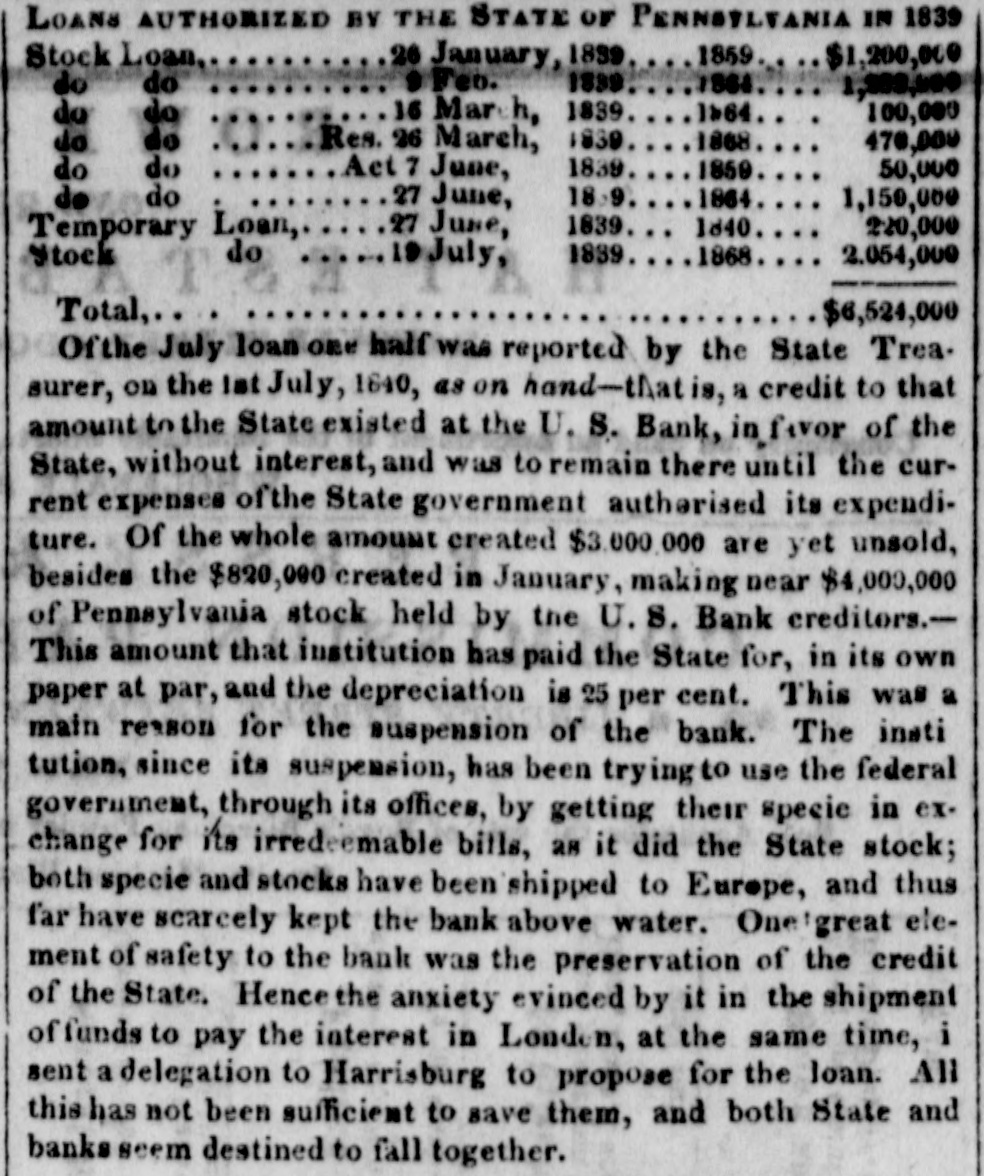
LOANS AUTHORIZED BY THE STATE OF PENNSYLVANIA IN 1839 1859 Stock Loan 26 January, 1839 $1,200,000 ,Feb. 1839 1864 do do 1,989,600 16 Mar 1839 1>64 do 100,000 1839 do 1868 do Res. 26 March, 470,000 1839 do 1859 do Act 7 June, 50,000 18.9 do 1864 do 27 June, 1,150,000 1839 1840 27 June, 220,000 Temporary Loan, do 1839 1868 Stock 19 July, 2.054,000 Total, $6,524,000 Of the July loan OR# half was reported by the State Trea. surer, on the 1st July, 1640, as on hand-that is, a credit to that amount to the State existed at the U. S. Bank, in fivor of the State, without interest, and was to remain there until the current expenses of the State government authorised its expenditure. Of the whole amount created $3.000.000 are yet unsold, besides the $820,000 created in January, making near $4,000,000 of Pennsylvania stock held by the U. S. Bank creditors.This amount that institution has paid the State for, in its own paper at par, and the depreciation is 25 per cent. This was a main reason for the suspension of the bank. The inati tution, since its suspension, has been trying to use the federal government, through its offices, by getting their specie in exchange for its irredeemable bills, as it did the State stock; both specie and stocks have been shipped to Europe, and thus far have scarcely kept the bank above water. One'great element of safety to the bank was the preservation of the credit of the State. Hence the anxiety evinced by it in the shipment of funds to pay the interest in Londen, at the same time, i sent a delegation to Harrisburg to propose for the loan. All this has not been sufficient to save them, and both State and banks seem destined to fall together.


Article from Morning Herald, October 9, 1840

Click image to open full size in new tab

Article Text

MONEY MARKET. Thursday, Oct. 8.--P. The Stock market was again heavy this morning, and prices of most descriptions declined. United States Bank I cent; Delaware and Hudson 1 per cent; Stonington Sales of cent. Farmer's Trust avanced 2 per cent. per Illinois 6 per cent, 1860, were made at 801; Indiana Fives, 76 The sales of New York Erie Railroad Stock, advertised for sale at auction this morning, were again indefinitely postponed. The United States Bank has, it appears, directly acknow- from the its inability to resume without assistance solicitledged suspended banks, from which she has directly other ed aid. In consequence of this application, the following notice has been circulated: BANK OF NORTH AMERICA, October 5, 1840. Sir-At a meeting of Directors, this day, the adopted- followDear Preamble and Resolution was unanimously solicited the ing Bank of the United States has Institution to Whereas the City Banks, to enable that and it beaid of the other pay ments upon the 15th January it will be resnme ing understood specie that, without such assistance, unable to effect That the President be to entertained of the several Banks the sense and the Presidents of the necessity of some Atwood by Resolved, this Board, that object, application;andt requested that Messrs. immediate express to and united action Robins be upon a committee the to represent subject, this Bank which in is here- ge neral conference on at the Office of the Board of on by to next, at half past 7 Thursday invited evening be held this importar o'clock. Trade, Pres't. Very respectfully, JNO. RICHARDSON, fourteen banks of Philadelphia wish to the avoid endea the If the of the United States Bank, which was retten institutions, they will usefulness to individual safety. The period forever. chieferror ver bolster of look only En- ex- on to their own the United States Bank, is gone be at the the part of protract her existence, can only the discredit of deavors to stockholders, and redound to of the U.States pense of the generally. The credit resusitated American so securities far gone, that it can scarcely ever be loss, and Bank is at a disadvantage, and consequent successfully It is working National Bank is proposed, the of the new as it is a new wound up, the smoother will be the operation the bank. which have transpired since the nature arrival as of to inEvents from Europe, are of such a the last the probability of the establishment crease steamer since Mr. dissolution Jaudon's of institution. stay.- in It is well known that Bank, he has been its main Europe, Jaudon's as agent first of the arrival in Lendon, those he who was the were object forOn Mr. The petty jealousies of monied of dislike. of the bank, and the powerful there would merly agents imagined his establishment in opposition to interest, who were arrayed In a very short habits, and the gradual him. of conflict with their business interests, time, however, his great urbanity him deve- the manner, strict resources of mind, gained of for Europe.lopement of admiration immense of the mercantile men destruction last respect and saved the Bank from to Phila had occasion to the last year, in delphia, year, His high and he qualities sustained it since. Bank express On for his his late disapprobation return Cowper- which of the management has been of the seconded by Mr. left Biddle, the concern, Mr. and opinion he and other officers, who have new Directors, and serious breach no longer disposed to One of a thwaite, ny has arisen. The investigate. take assertion three ma the Stockholders, and are are determined to satisfaction, spent for Stockholders facts, recently, for affairs his of own the bank, and found every in examining utter the confusion, that satisfied no correct himself decision be arrived at, and the most tion could thing days in such He, however, judicious cents-not applica- that, has Mr. Jaudon with of the the best assets, management, the stock might be worth 80 become more. Under all with these the circumstances, state of things, and the it is institution highly proba- lives a disgusted the Bank. Whether former position as ble he will quit can no longer occupy it this country and Euor dies, of it communication opening between for a new money power, rope. means This construction will leave of an which materials of men with re already large capitals organfor the in this city ;a company of a house, the European Such agent a ising propose the organization Jandon, resident in London. by the of which is to immediately be Mr. fill the space left open powerful concern will the United States Bank, and the form rivalry a of the failure of which will put down which Mr. Jaucombination, other houses. The reputation last year, places him Primes and for himself in Europe the age. Mr. Biddle coming was a don earned first financiers of financier, and among theoretical the rather than Bank a practical at a time of great prosperity for time, into the control magnificent of the theories successfully speculation was a folhe carried out from the task when find Mr. Jaudon's he shrank It is then that we and cool judgment great practical and surmounting a season difficulties Amidst talents, but lowed by revulsion. knowledge no control. obstacles, admiration over of rising of which he he has won causes and discredit, His the other general above revulsion European had world. and representative appearance.on the of and new unembarrassed be two the may and respect side of the now as the concern, agent through which renewed the countries effect. happiest The following of Illinois OF with intercourse a perfect between confidence, is statement will have of the the finances of the State THE STATE ILLINOIS:7,960,500 $ 990,000 00 FINANCES Internal OF Michigan vement Canal. 1,190,049.13 On account of Revenue Illinois and and State House Total $12,140,648 13 Improve. $3,778,500.00 50,000 Available means meantristing belonging Bank to and Internal stock, Reilroad und Iron. debts Available ment that will Fund, meaus proba obably belonging be paid. to Canal Total $3,829,500 first makes the available means. her LandsThis Inst entire account indebtedness deducted of from the state, the above hr $3,812,048 to the 279,192 Her unavailable m Internal means Improve- 40.332) acres. Belon," Belonging ment ing system... to the Canal Total 910,514 acres. $1,047,541 552,000 due 125,000 0 Unavailable debts due Revenue Internal due to the Improve F und Canal for Fund eat State Fund. House.
Article from The Hawk-Eye and Iowa Patriot, October 15, 1840

Click image to open full size in new tab

Article Text

and worn through the streets, the man being followed by a troop of hurrahing Vanites. This insult to the ladies and to every American heart, was treated by it the whigs with that contempt which merited. From the fact of his appearing at his hotel we leave the public to judge whether there is not ground for the belief that Allen suggested or approved of it. Mo. Republican. BANK.-Resumption of Specie Payments.-The Philadelphia Inquirer of Saturday say: We learn. with pleasure, that an arrangement is now in progress between the U.S. Bank and other Banks of Philadelphia, which is likely to have a considerable effect in reviving public confidence. In order to facilitate and render certain a general resumption of specie the Philadelphia loan the U. S. Bank payments, fered to Bank $1,000,000; has ofof a the Bank Pennsylvania has made the similar offer, and a proposition to was yesterday the Farmers' and same rectors effect of before Mechanics' the Dibank. The U. S. bank is indebted to each of the others. both in bank notes held by them and balances. The plan is, smaller banks to return payto the extent for the on demand, of notes $1,000,and to receive in able 000 each, exchange if post in a year, or longer, neThis will, of course, notes, cessary. payable bank, and reduce great the liabilities of the U. S. ly assist her in the resumption of specie payments. It is believed that the other of Philadelphia will also particiin this generous work, in about a sist pate banks bringing condition and of thus things well asearnestly desired by all who wish to so and character of PhiladelThe details of the have not, as yet, been phia. the business thoroughly arrangement arranged, but we believe it is contemplated to effect a reduction of the immediate liabilof the larger bank, to the extent of millions. The Eastern great to ities four have or professed five willingness resumption, banks assist Pennsylvania in the work of it is to be hoped that, if necessary, will now act in the spirit The best ex- of and they professions. understanding institutions of their ists among the moneyed the Philadelphia at the present time, and Cur prospect is certainly encouraging. money market continues easy. The keenness with which the Presi- the dential contest is carried on, all over Union, says the St. Louis Gazette, New may be judged from the excitement in are York. The people, on both sides, collecting en masse. Meeting after meetBennet says: ing is the order of both, day and night. The political excitement of the country closincreases every day. The week just to has added masses of fresh elements thousand ing conflagration, just like a fire the cords of dry hickory thrown upon a in Broadway. Mr Webster's remarkable, curious, has oriShaksperian at Patchogue, and asionished ginal and bewildered every body, and the democracy almost insane his hufrantic made with vexation. His wit, set the his flashes of sarcasm have mor, Custom House beside themselves-given of the fresh dash of vinegar to the poet a Post-and called forth the strongest'e down. of Silas Wright to sober them excitaYork was never in an the country rewide so ble forts New condition-nor such far and crazy. Distinguished of men Queen the good old language and turn to call their opponents "come Bess, flog them if they will and threaten arm's to length"--while leading return reinto officers of the government sink a and threaten to as the the forehead of the foe, ligious compliment, in General Har- little in stone David did to big Goliah. thing ( General Jackson, every abroad, runrison, of man or beast, is singing the shape races, speaking writing, highest ring and electioneering. The have alsongs, lowest of both parties lost their most and the lost their senses-and some sobriety. JONSING ON BANKING SAM two old friends, Sam Jonsing Com- and The Gumbo, met last night at the their disPete Bank. The burden of and mercial appeared to be upon banking, throwing course of which we published as has nea part light upon this subject which new ver been touched by Gouge.


Article from The Ohio Democrat and Dover Advertiser, October 23, 1840

Click image to open full size in new tab

Article Text

Some curious movements are taking place ingPhiladelphia. While Mr. Webster is travel ling the country delivering speeches in favor of a national bank, the United States Bank itself 18 not inactive. It has made application to the other banks of the city of Philadelphia, to enas ble it to resume the payment of its notes on the 25th of January. and HH we inter from the fol. lowing circular of the Bank of North America, which has been published in the newspapers its application has been favorably received. Bank of North America, October 5, 1840. Dear sir. -At a meeting of Directors this day, the following preamble and resolution was un. animously adopted : Whereas the Bank of the United States has solicited the aid of the other City Banks, to enable that institution to resume specie payments on the 15th January, and it being understood, that without such assistance, it will be unable to effect that object. Resolved, That the President he requested to express to the Presidents of the several Banks the sense entained by this Board, of the necessi ty ofsome immediate & united action upon the application : and that Messrs. Atwood and Roh ins be a committee to represent this Bank in gen eral conference upon this important subject, which 18 hereby invited to be held at the office f the Board of Trade, on Thursday evening next, at half past 7 clock. Very respectfully. J. RICHARDSON president. The city banks of Philadelphia in fact, are so much entangled in the affairs of that great institution and so much in its power that they cannot refuse to do almost any thing it asks. If Harrison, therefore. should succeed in his canvass for the presidency, we shall see the Penn. sylvania Bank of the United States made, by the solvent banks, as good as new, a perfectly sol. went institution, ready to receive a new charter from Congress. That it will renew its applica tion for a national charter there can be little doubt. That it will -occeed with a whig major ity in Congress there can be as little. That pow erful institution understands how to influence legislatures; it has carried a majority in Con gress before now, and would have been a national bank still, but for the veto of General Jackson, it also carried a majority, in the Penn sylvania state legislature in direct opposition to the wishes of the people of Pennsylvania, and received from that state a charter which ena bled it to run its career of mischief to the pre sent moment. No power overa legislature is so strong as that of corporations. Besides, there is the argument which will be used with great force, that if a new bank a chartered by Congress, it will be difficult if no impossible in the present state of the publi mind to find subscribers to the stock. The co venience of taking an institution already organ ized will be dwelt upon and will doubtless b the pretext by which the friends of the measur will attempt to justify themselves to the public H. Y, Evening Post,


Article from The Ohio Democrat, December 18, 1840

Click image to open full size in new tab

Article Text

VOLUME2 NUMBER 67. soverign power,in ridding the country, eas far as practicable, of the existing vil. Ite power to act as a regulator is no. more, as is proved by experience, a to induce the as it expands, and 10 than thing expand power local compal banks But them to contract when it contracts the experience proves that it stands full as much in need of a regulator as banks themeelves. And why Its object is should it not? the local its the stock- same make large dividends for Its temptations are & to the same laws holders. -to is subject the firade. same It was organized on the same principles, and subject to the same impulse the with like institutions created by States. It ie, therefore, unreasonable expect, that in its administration there to would be more safety than in similar be state institutione; or, that it would banks capable of regulating the local be beneficially, when it has proved to incapable of regulating itself. THE STATE BANK. The late Bank of the United States, the expiration of its charter in 1836, ou a new one from the centering not received Pennsylvania, equal, State than if the of greater powers and privileges, its former. Its capital was the same; stockholders the same, and its managein the hands of the same It was said, by the officers. ment continued charter President It of the Bank, when the new their was presented 10 the stockholders for e acceptance, that it was then in a safer, r stronger, and in more prosperous con- the dition than it ever was; and that exisconnection which had previously In a ted between the Bank and the General ben Government was an unnatural one, e eficial neither to the Bank or the GovS ernment, The stockholders were pres to accept of the new charter from in on the ground that it was to In more sed the State, respect desirable than the granted by the Yet, every vernment. old charter, no withs anding General Go. all n n these boasted advantages under the new to 80 far from its being able y the exchanges and currenregulate charter, banks the in and to keep the other proin of e cy, check, it is now univereally admit- and ted per to have been one of the leading agents in k under which the most active ficulties producing country the has difD, of been for the last eighteen So far from 118 it months. laboring the first, regulating unhe other banks, it was we former charter, to expand its cirnd and engage in ed culation der its hazardoustrade the firet and speculation. It was among as 11 to suspend specie payments, and the last of to resume. We have seen it, instead pa exerting its power to restore to the coun iniltry a sound currency, using all its fluence to prevent the other banks from its their notes in institution now, after d, redeeming this specie.-We having five see hetween four and al under its new, and, as was e; years been in operation utterly claim- proe advantageous character, al, in a state of sus to from surrounding 'he trated, ed, king aid pension, institutions, and asin order to save it from bankruptcy. id. What reason have we to believe that the ng influence of this institution ere have been different be its corporate powers eal would fate ceived or if and it had privil= re- inis eges from the General Government stead of the State of Pennsylvania As nal before remarked, the source from il. I it derived its charter could neithwhich take ly from or add to its means to meet ing or have it any that course of ion it in its present uch we are the er from its Whether,therefore, involved engagements, pursuing guided b prevented difficultic policy drawn by that the of experience, or by opinions bes critical investigation pative tendencies of a eaa believe United that we are foreed to exwould but add to the ural ligh from an Bank, institution and, of by the the States' such of the curreucy. is a the paper in ate, du specie basis, tend to it rangement ly the out increasing increasingr corresponding circulation, involve ratio, great with de- the whole paper system, eooner or later, in eacommon ruin. It is not, therefore, ren one of a U States Bank o Terthe multiplication of paper money very by by the creation the present that the evils attendaut on its we banking system, are to be remedied. The danger to be apprehended from one all an institution, in a political poin dis is not to be or onIte friends exsuch of view. regarded. overlooked claim, that would possess the power of regulating tate the nine hundred and fifty=four loca ion with their capital of three hun 10 twenty-fou the that it would possess late, dred and banks, ting millions. this Admit power what would be the political consequent ered if it should act in friendly allianc this es, with the National Executive, and wield althis vast money power for political pur. taxthe poses? If is claimed, that the is patron aires of the National Executive bor. subage dy too great and dangerous to publi OZ but tended executive natronage the entir liberty. If we add to the already


Article from The Pilot and Transcript, January 8, 1841

Click image to open full size in new tab

Article Text

UNITED STATES BANK. We have forborne to comment on the late report of the affairs of the Bank of the United States, because, believing that although wise legislation may recusitate its credit, a premature resumption will be followed by another suspension, and a consequent loss of credit and a sacrifice of its assets. We are aware that the question of resumption depends upon politicians, who may misconstrue our motives, and charge our remarks to hostility to the Bank.We have no desire to injure that or any other institution. We would sustain all, and have therefore awaited the action of public opinion on the report on the money market of N. York and Philadelphia, as indicated by the sale of stocks. We have now re ceived this-a fall of ten per cent. in New York, and of fifteen per cent. in Philadelphia!! And that fall produced by the bank's own exhibit! Does any one believe that, with this demonstration of public sentiment, the bank can stand resumption before she has realised on her asseis in Europe? U.S. BANK.-In New York on Wednesday the U. Bank stock fell? per cent. making, with 3 per cent. on Tuesday, a fall of 10 per cent. since the Report of its condition. The last sales were at 55. In Philadelphia, on Wednesday, a sale was made as low as 502. The Inquirer of yesterday saysOur Stock Market wassadly depressed yesterday, and quite a panic prevailed, especially in the early part of the day. A few shares of United States Bank stock were sold as low as 502; but it afterwards rallied to 51 1/2 bid and 52asked. It is believed that the panic in relation to the U.S Bank stock is already subsiding, and that in the course of a few day saffairs will assume a more cheerful appearance. There is no doubt as to resumption being carried into full effect on the 15th. Money is still scarce, and will doubtless so continue until after resumption. The Philadelphia Standard of yesterday says There is a complete panic pervading the market, attributed to the statement of the U. S. Bank, but it can be with more propriety charged upon the bears in stocks, who before the statement was known, commenced the work of detraction, and have ever since been exerting all their energies to affect confidence in the stock of the U. S. Bank particularly, and thereby depreciate its price. IMPORTANT SERVICE PERFORMED BY THE ICE BOATS.-The sudden breaking up of the ice in the Falls, consequent upon the heavy rains of Wednesday night, caused large quantities of it yesterday to obstruet the mouth of that stream, and so completely choked up the vent into the basin, that the water rose to a considerable height, overflowing the Fish Market Space, filling the cellars in the neighborhood, and threatening extensive danger. "At this juncture," says the American of this morning, "the Mayor, who had been informed of the circumstance, sent to Captain Turner of the steamboat Patapsco, and Captain Sanner of the steamboat Relief, requesting them to make an effort to clear the stream. Both gentlemen repaired with alacrity to their boats, and in a few minutes the Relief was brought to the mouth of the Falls, which she entered with no little difficulty, the ice being piled from the bottom of the stream to the height of several feet above the deck of the boat. A passage however was soon effected, the boat making her way as far up as the bridge. The water, which had now begun to sweep off every thing from the ship yards on the Falls Avenue, immediately fell, and passed off without doing further mischief. The size of the Patapsco did not allow her to enter the Falls, butshe was actively employed in forcing the ice away from the mouth of the stream far into the Basin. The boats did not cease their efforts until noon yesterday. There is no doubt that the services of these boats prevented a very heavy loss of property by the inundation which would have inevitably ensued. The promptness and boldness of the two gentlemen who undertook the performance of a dangerous service, entirely new and in a dark and stormy night, entitle them to the highest meed of praise, and we have no doub our citizens will duly appreciate their valuable exertions."


Article from Staunton Spectator, and General Advertiser, January 14, 1841

Click image to open full size in new tab

Article Text

The Philadelphia Enquirer of Saturday says: "We understand that the U. S. Bank has now in her vaults more than $4,000,000 in specie. All doubts as to a general resumption have disappeared, and we begin to indulge a hope that our community will glide so gradually from suspension into resumption that the affair will not create a momentary sensation. The truth is, very little difficulty is experienced even now with regard to small change."


Article from Daily Richmond Whig, January 15, 1841

Click image to open full size in new tab

Article Text

, For THE WHIG. U. S. Bank-Bank of Virginia. t The Enquirer continues its insidious assaults S upon the United States' Bank of Pennsylvania, by S covert isuendo, based upon the interested attacks of e its New York enemies, which find their way to the public through that common sewer, the New York Herald. In the teeth, however, of the sinister pren dictions of the enemies of that Institution, and of . the solid columns of figures which they daily ema ploy for the purpose of demonstrating its inselvency, it is about to resume specie payments, and thereby to test its capacity to meet its obligations. This Bank, Messra. Editors, is no favorite of mine,more especially shall I not attempt to defend the policy it has pursued, and by which, unquestionably, it has been greatly embarrassed in its operations, but I not the less heartily condemn the efforts which are so industriously made by a political faction, backed by local enmity, still farther to impair its usefulness by instilling into the public mind doubts of its solvency, for the purpose of producing the catastrophe which they so confidently predict. Especially should the Enquirer, at this particular moment, when the condition of another Bank, nearer home, is undergoing a sifting scrutiny, beware how it provokes comparisons which may not reflect very high honor upon its "relation"-the great financier and banker, whose luminous career throws even Nicholas Biddle into the shade! If the Editor of the Enquirer was in the House of Delegates on Wednesday, and heard Jadge May's excoriating speech, and I fear not more excoriating than just;if he heard the detailed and clear statement of the present condition of the Bank of Virginia-its heavy, and apparently increasing "suspended debt"-its ruinous and illegal speculations in slocks-the vast disparity between its liabilities and its available resources-its butt of sack to a bare pennyworth of bread.-he would have perceived that he might find employment nearer home than Philadelphia, in exposing the mal-administration of "Monsters," under the guidance and control of "the first bankers and financiers of the age!!" Can the Bank of Virginia now safely resume specie payments? Dare it follow the example of the Pennsylvania Institution? Dare it go out to sea with all the leakages in its hull which the recent investigation has exposed? Nous Verrons. The writer of this, Messrs. Editors, is opposed to the removal of Dr. Brockenbrough from the Bank of Virginia, upon the grounds assumed to justify that removal, because he believes that the neglect of duty imputed to that officer, in connection with the late defalcation, does not call for so harsh a process. But he doubts, most seriously, whether, upon other grounds-to wit: the mal-administration of the Bank, as evidenced by its present condition-hig removal be not demanded by the public. interest. But the writer will not so assert. He leaves that question to be decided when that issue shall be made. He will rejoice, indeed, if the Bank shall, hereafter, by the Doctor's superior sklll, be rescued from the perilous condition which it now occupies, and be restored to its former prosperity and to public confidence. He is willing at least to test once more that boasted skill. If it be equal to the occasion, which will tax its utmost powers, he will rejoice at the decision which retains Dr Brockenbrough at the head of the institution. If, as he fears, the genius of that gentleman shall fail him in the trial, still he thinks it but just that the pilot who has conducted the ship among breakers and quicksands shall share her fate. FIAT JUSTITIA.


Article from Martinsburg Gazette, January 21, 1841

Click image to open full size in new tab

Article Text

From the Philadelphia North American, Jan. 16. RESUMPTION DAY. It would puzzle the pencil of Hogarth to sketch the motley acene presented at the counter of the U. S. Bank yesterday. First you would see some active sharp sighted broker, very polite, and asking for only some fifty thousand; then would follow a distrustful depositor, half doubting whether it was best after all to burthen himself with the specie, and when he had got it looking for all the world as if he knew not where to go or what to do with it, and quite ready to accuse his stars for his fully. Not so with the next one, be is a gaunt tall figure, with a face so thin that only one person can look at it at a time, pinching a few bills in his long bony fingers, and quite determined to hold on to it with one hand, for fear of some cheat, till the specie shall rattle in the other. Then comes a hostes Quickly with her full red face and go-a-head manger, shaking her bills and determined to take ample revenge for all the shinplasters and counterfeit notes which her roguish customers have palmed off on her. Then comes up a sailor, and taken all aback when he sees the piles of gold and silver, and looking as if ready to knock down the man who had told him the bank was not safe and sound. Then strides up a huge Irishman, bringing his own bill and those of some dozen others. But what shall he do with the dol. lars? he finds a hole, or suspects there is one, in each of his pockets. So he off's hat and has them thrown into that, when out drops the crown, and the dollars roll around the floor to the merriment of all save the son of Erin. Then approaches a spare laundress with her ten dollar bill, asks for go'd, takes the eagle and deposits it in bersnuff box before she has stirred an inch from the counter. Then comes the Ethiopian, with his white ivory flashing through the curl of his dark lips: be has some how got a ten dollar bill, wants it all in fifty cent pieces, ahoves the shiners into his pockets, ejaculating as he turns away "I guess we II empty a their big box for them to-day." Then strictes up Locofuco with his elbows out, and his nose red enough to illuminate his footsteps in the darkest night, "here Mister, is a shinplaster of yours, if it's good for any thing give US the hard stuff." Then comes wheasing along a countryman with a bag on his back filled with specie, rolls it from his shoulder upon the counter, and requests its amount in bank bills. Had a man sprung out of his grave the astonishment of the motley group could not have been greater. The women dropped their specie, the loco foco stood speechless, the pickpocket forgot he had fingers, and hostess Quickly was pale and still as Lot's wife in monumental salt. IJ All the Banks of our city paid out their own notes yesterday. except two, and one of these partially The reason assigned by one of these two for this extraordinary course was that she had none of her own bills ready. The community have the deepast interest in this matter of resumption, and will require that each institution, as the fate of all is at issue, should faithfully perform its portion of the duty. Any other course will be unjust, impolitic and hazardous.


Article from The Madisonian, February 9, 1841

Click image to open full size in new tab

Article Text

PHILADELPHIA, Feb. 7, 1841. U. S. Bank Stock fluctuated yesterday between 39 and 36. Considerable sales were made for cash by those whose necessities compelled, or whose fears prompted them to sell for the best price they could get. Girard sold at 29, and all others declined. Our Banks may all be said to have suspended, though one or two of them still endeavor to keep up the semblance of paying specie, and all redeem their five dollar notes. I said in my last that the U. S. Bank was reported to have paid out seven millions in specie and its equivalent since its resumption ; the cashier states it to be six millions. I understand from good authority that she has now only about two millions of immediate liabilities. No bank, even in ordinary times, could have done more than she has done, namely, pay in three weeks, three fourths of her circulation deposits, and other immediate liabilities. The fact is, she has been crippled by the inveterate hostility of her foes, who have been goaded on by the Journal of Commerce, the New York Evening Post, and other kindred journals. I admit that she has been badly mΓ­anaged, and has thus been exposed to the shafts of her enemies, but had she bean treated with indulgence, or even fairness, she might have sustained herself, and eventually have recovered a portion at least of her former strength. What course she will now takewhether she will go into a liquidation and final settlement of her claims, or whether she will attempt to realize what she can from her assets, and resume business again at some future day, is not known, and in regard to what she sought to do, there is a contrariety of opinion. Her course will probably be governed by the action of our Legislature. One of our Banks-the Pennsylvania-it is understood, has sent a committee to Harrisburg with orders that, in case the Governor and Legislature shall legalize the present suspension, to surrender her charter at once. In this bank the State is a large stockholder. This is right, and I hope every bank in the State will pursue the same course; for it is vain for them to attempt to do business and meet all the demands against them, in specie, in the present deranged and depressed condition of the country,-when not only individuals cannot meet their engagements, but the State and National Governments are bankrupt and have to depend on borrowing to save their honor The evils under which we are suffering are too deeply seated to be much affected by state legislation :nothing short of Congressional action can reach and remove the cause of these evils. The General Government has brought them upon us, and the General Government, including Congress, can alone remove them. X.Y.


Article from Richmond Enquirer, February 9, 1841

Click image to open full size in new tab

Article Text

The great Bubble has burst again, and probably forever. The U. S. Bank has stopped-its stock is down to 40, and it will probably descend lower.-The Philadelphia Public Ledger of Friday last, traces the proximate causes, of the suspension, to the following circumstances: "A great degree of excitement prevailed in this city yesterday afternoon and evening, in consequence of a rumor which prevailed in regard to the U. S. Bank.The cause which gave rise to this excitement was, as we learn, a failure on the part of the Bank to meet certain demands against it. As far as we could best ascertain the facts, there was a heavy draft presented about 21 o'clock, by the runner of the Brokers between this city and New York, we hear the sum stated as high as three hundred thousand dollars, which the Bank failed to meet, the officer saying "it could not be paid," and the officer withdrew. Two other drafts, one for twenty thousand dollars, presented by a broker in Third street, and another for about the same amount, by another broker was also refused payment. As may be imagined the rumors of these facts soon spread abroad, and the Exchange last evening was crowded with anxious inquirers into the truth of them; and opinions were various as to the probable consequences of this unexpected measure, and a meeting of the other city banks was held lastevening in relation to the matter." These Banks rallied for a few hours-but it is now believed, that they have with few exceptions virtually suspended-and - those of Maryland have followed suit. From the Philadelphia National Gazette.) I "P. S. Saturday, One o'clock - All the Banks of the City, with two or three exceptions, have just suspended specie payments except for Five Dollar Notes. The apprehension expressed above is thus already realized." From the New York Correspondent of the N. Intelligencer, Feb. 6.] U. S. Bank stock sold at the Brokers' Board to-day


Article from The Illinois Free Trader, February 19, 1841

Click image to open full size in new tab

Article Text

Later The Bank Exploded ! Last evening we received the Times of Feb. 6, which fully establishes the above, and places the insolvency of the Bank beyond question. The Times says: "Yesterday morning the streets of our city were filled with a clamarous multitude, that poured like a living stream into all our banks, but particularly into the portals of the U.S. Bank for specie. The news that this latter institution had suspended specie payments for the third, and probably final time, had spread like wildfire among our citizens the night before, filling them with apprehension, and changing the exultation and confidence of even its warmest friends into utter consternation. Public opinion which was fast verging in its favor was at once shocked. A change came o'er its spirit, and now, such is the mutability of greatness, there is none so devoid of indignation as to do it reverence. The run upon all the banks was tremendous, and before noon all of them except the Western, Philadelphia, Commercial, Southwork and North America banks, had ceased redeeming in specie their notes over the denomination of Five Dollars. A greater excitement was never witnessed. The streets were fairly alive with people, and nothing could be heard but a confused hum of inquiry, wonder, anxiety and lamentation. One bank paid out about $90,000 in specie for $5 notes before 3 o'clock, and we have no doubt many were much more severely run."


Article from Democratic Standard, February 23, 1841

Click image to open full size in new tab

Article Text

THE SUSPENSION.- / On the day after the passage of the resolution of the smaller Banks of Philadelphia to continue specie payments, a run was commenced by their creditors as soon as the banks opened in the morning, and continued until the time of closing doors in the afternoon; du ing which time the banks were crow. ded, and a large amount of specie was drawn from them. Finding themselves unable longer to hold oui, the banks then followed the lead of the great regulator, and again suspended. Great excitement is said to have prevailed among the cilizens throughout the day. After the suspension of the U. S. Bank, one of its creditors cited it to appear by attorney and show cause why its charler should not be forfeited for refusing to pay specie for its notes. A bill has been introduced into the Pennsylvania Legislature to authorize another suspension until the 25th Februa ry, 1842.


Article from Rutland Herald, March 30, 1841

Click image to open full size in new tab

Article Text

The Judges of the Court of Common Pleas [Philadelphia] have given their opinion that the U. S. Bank has not forfeited its charter by the late suspension. It is thought the question whether it is liable to pay an interest of 12 per cent on refused notes, will be carried up to the highest court.


Article from Richmond Enquirer, April 20, 1841

Click image to open full size in new tab

Article Text

POLITICAL. Bank, "The made awful THE by disclosures" the AWFUL late report enough DISCLOSURES relative of the created to Investigating the a United deal of States Com- will exmittee have naturally community. The effect abroad councitement electrical. in the The friends of the to credit Bank the may serious contempt, the mis-managers brought an array of such charges be terfeit with against and refuse astounding insinuate of the itself. Insti- facts tution, but truth will gradually genthem, more permanent impression. and fremake the have been so before the familiarly The tleinen whose into the report are A. G. Jauquently Bevan and Humphreys, Dunlap, the and introduced names favored terribly public disturbed. Nicholas Biddle, have all that the don, and " explanations tending to show, to be-not not that with better than it is described transactions Bank is any engaged in the most villainous of the W1has not been has not squandered the money schemes and -not that it in the most extravagant been in the dow and orphan speculations-not that it has not its millions to visionary the "pipe-layers, and lavished hands of election of a Federal Administration-but the purchase the virtuous of men, and done that they are citizens! the most That every thing they degree have of honhas injured been of marked with an extraordinary they individually approand the community! esty; priated and were that ultimately the half millions expended for the benefit of the Bank second letter, as pointing of the out the Bank, causes is Mr. Biddle's humiliating position of the present Soon after the late could worthy of notice. Bank felt that its course statespecie-payments and the that it must suspend. By were the be Mr. Cowperthwaite, the first fall on of maintained, of should directors resumption anx- New not ious ment however that this the a storm rusc was attempted, by Ex. the York. To effect amount of foreign exchange. wanted sale, change to an on immense Paris was to in demand-that is, Paris, and therefore people greedily Acto transmit premium money bills payable in that city. New bought at a of exchange were sent bank to had cordingly and large sold without masses limit, although the Here York, dollar in the hunds of its foreign agents! full of bills, not a downright knavery! A large book exhausted. Apwas signed in blank, then wassent made on, to the and soon Agent of considerable the Paris plication was New York, who drew also a sales created House at The proceeds of these but amount besides. the New York balances against Banks, the desimmense admirably; and notwithstanding trick failed they perate stood efforts it of the U. S. Bank, the whole in its contemplated result effects! of such measures upon this inNow came the The bills of exchange had not been the stitution itself. even regularly advised: i. bills e. had provided Hottinguers for, nor of Paris, upon whom funds the to pay Messrs. had not been supplied with even been been drawn, they became due, nor had they them informed them when that the Bank Of was course about the to bills draw were upon protestfor such an amount. once struck a death-blow at the foreign of all cd. credit This of the at Bank, and disgraced it in the proverb, eyes are Curses, says an Arabian to roost. Europe. chickens-they always cor other home schemes like young sometimes with financial and and injured So it is by the Bank recoiled the trick itself. Its attempt to bring but resulted only its own to York banks, and bursting in gun was Mr. Jaudon, who was then negoits none The overcharged,! planned destruction. contrived down drafts, Europe, New The kill in owner. sustain the Bank, and protect its stocks order ciated to loans at an immense These sacrifice, stocks were and thus pledged locked up, in every direction. has rendered them almcst useless. and The until resumption depreciation of specie payments next occurred, of we all know what remarks was the that consequence. such was the have vitality Mr. Biddle it might, even crippled as His it was, would been the Bank, proper management. policy the revived by to have made it of necessity once new more Adhave been of the Government under the effected. fiscal agent This he thinks could have been Bank to ministration. would have recommended the Adminis-Then he it appeared what relief the new concurring pause until inclined to afford the country, have been tration was a permanent resumption might was not comwith which, He reasons that the Bank with the other attempted. resume on the 10th January was pelled to and cunningly adds, that the Legislature be made to in Banks; of the Banks! and could do was it for the banks to say breaks to the on the first anything: "How the power easy dollars-the State Governor, lend you of to borrow 800,000 can borrow it only from us-and if break we to February want you and unless resume you specie neither payments, shall we break. nevitably Authorize on a our- sus- the selves. beyond Let us agree the 15th that January, and been we wise will and protect easy. you But iiistead of this course pension 1st of February. This the would banks have resumed-then lent the 800,000and then broke down immediately." more. The last paragraph clearWe need what quote no have always averred, that the Bank ly proves S. has we been thereal Governor of Pennsylvania; and that were of the U. extent it still governs us; in consethat to some confidence not withdrawn from it, been dethe public of the "awful disclosures that have would govern quence for the last four or five years, it interest in veloping iron sceptre, and make every to the us with an no matter how important, this give way but We have more to say on must its defer it until Spirit of the own. community, [Philadelphia another day. Agony subject over.-Pre- Times. and HOUSE.- The Long thousand THE has settled the fate of the The sident for the Custom House in applicants Tyler CUSTOM this announcement city. one thus disposed of in an official Roberts, to be spoils in the are National the Intelligencer: room of Calvin Jonathan Blythe, removed. W. J. Collector, in Tyson, to be Surveyor, vice George Officer, in Washington removed. Bela Badger, to be Naral Roberts Riter, of John Horn, removed. Mr. $4,400 is the place county Collector's salary the Nafrom er annum. Montgomery That of the Surveyor $2,900, and l officer's $3,000. the N. Y. Standard.) The Investigating From Committee who have recently


Article from Mobile Daily Commercial Register and Patriot, August 16, 1841

Click image to open full size in new tab

Article Text

Bank In stocks very little was doing. United States had declined to 144 a 14}. This is said to be owing to the immense quantities forced on the market by foreign holders. In Foreign Exchange, for the Great Western, which was to leave on the 7th, bills were rather scarce, and prices of some descriptions improved a shade : Sterling is quoted at 8 a 82, with some at 9 per cent prem; French f5 25. There was only one million and a half of the twelve million loan thrown into the market. Of this amount $300,000 WHS obtained in Boston, at from 5 to 5 2-5ths interest-and $500,000 in New York at 5 per cent, through Messrs. Ketchum, Rogers and Bement, to whom the Secretary had addressed himself, and who made him a prompt offer at the samerate for the twelve millions.This was declined. At Philadelphia there was quite a panic among the holders of the notes of the U. .S. Bank. The correspondent of the Journal of Commerce anys "The discount upon them in the last three or four days have run up from 18 to 23 per cent, and indeed few purchasers are found at the latter price-some of the brokers refuse to buy them at less than 25 per cent off for currency, or 28 for specie. There are many who, under the favorable representations put forth by the managers of the bank and its retainers, that it would pay not only all its debts, but leave something like half its capital, invested their money in its notes under the system which the bank adopted of funding its circulation at 6 per cent interest. payable at any time in the same currency. Many of these funders are now frightened and are drawing their deposites and crowding them on the market for whatever they will bring. "In short there is a general fall of prices. U. States Bank is down to'14) which is lower than it ever before sold in this market." On the 7th, in Baltimore, there was a sale of 40 b Mobile cotton at 121c. NEW COTTON.-The steamboat Kansas brought down two bales of new crop on Saturday-the first of the sexson. The qualities are different, one classing fair to good fair,' and the other 'fair.' They were grown by Mr. T. Gilliard, Monroe co,, and are consigned to B. Boykin, Esq., at whose office, we learn, they will be exposed for sale to-day. It has been well handled, but somewhat cut in ginning. The color and staple are both good,though the latter is not so lively as we should like to see cotton of that quality. Upon the whole, we consider these samples as very favorable specimens of the coming crop; certainly much superior to the first arrivals last season. The first cotton last year (six hales) arrived here on the 22d Augnst, and sold for 84c. The year previous, the first two bales was received 14th August.-(Journal. The above mentioned cotton has been sold to-day at 114 cents. Wm. McK. Ball, Cashier of the Branch of the State Bank of Arkansas and Fayetteville, recently absconded to Texas, leaving the bank minus some $64,000. The quantity of lumber brought into market from the forests of Maine for the year, is estimated in the Portland Advertiser, to be one hundred and sixty millions of feet, which on an average is worth $10 per thousand feet, and yielded $1.600,000. It is added that the other rivers in the state yielded sixty-five millions more, which will make the aggregate product of the year $2,250,000. On the 2d inst., the citizens of the county of Coweta, (Gs.) met, and after the reading of a preamble, setting forth the inconvenience and loss attending the depreciated currency of the state, adopted the following resolutions, and pledged its members to adhere to them : 1st. Resolved, That after the first day of Nov. next, we will receive in payment of debts due us, none other than the bills of promptly specie paying banks. or the bills of suspended banks at their specie value, specie being the basis. "2d. Resolved, That we urge upon our Legislature rigorous legislation on the subject of Bank suspensions in a time of peace." We have already noticed similar proceedings of meetings held in other parts of Georgia. The consequence of this determination to repudiate the ragged currency of worthless money manufactories, has been to make the bankers of the state look sharp to their affairs. They scent the storm in the distance, and already like discreet mariners, are beginning to prepare for it. These are about the first indications we have had that


Article from Daily Richmond Whig, September 9, 1841

Click image to open full size in new tab

Article Text

From the Baltimore American. U. S. BANK ASSIGNMENT. stated yesterday that the U. S. Bank had We an assignment of its assets, for the benefit of made creditors generally. We find in the Philadel its U. S. Gazette of yesterday the following with arti phia explanatory of the particulars connected this cle, final step in the existence of the institution: of On Saturday, the Directors of the Bank the States made an assignment of most of the valuable United assets of that institution to the following J named gentlemen:-James Robertson, President, S Newbold, a Director; Richard Bayard, of DelaAssistant Cashier. ware; Thomas S Taylor, Cashier; Herman Cope, The preferences, if they can be so denominated, or two small demands; next, those indivi are duals one are to be secured who have made themselves responsible for any liabilities of the Bank, particuthose who have entered security on judgelarly recently obtained against the Bank on is ments amounting, we think, to nearly two hundred notes, thousand dollars. The proceeds of the remaining of the assets are to be appropriated for de- the benefit portion of the general creditors, the note holders, positors, With reference &c. to this assignment, we may rethat it is called a "partial assignment," not general, mark because a general assignment would not for be valid without the assignees entering security of the nominal amount assigned, and no set this or other city of the men twice in any Union would could accept find a such security, or, at any rate, none trust of such little profit upon such an onerous con- and The assignment is, therefore, PARTIAL, the dition. authorised by an act of Assembly granting Bank is power to make partial assignments without knowsecurity from the assignees. Without asking we presume the schedule of property assigned of the contains ing, nearly all the valuable property Bank not included in the two former assignments, the viz: the one for the benefit of the city banks, and o her for the benefit of the note holders. One condition of this assignment is well worthy remark, viz: the assignees may receive notes or of of U. S. Bank for any bills receivable, notes the bonds due; and they have, besides, power granted thereto sell any of the assets, taking in payments for notes of the U.S. Bank. It iF thought by some that notes of the Bank will be of more value, as they are likely to either to pay liabilities or to we would take occasion to any sets; called now be and for, purchase that of it the as is probable that the want of some provision kind in a former assignment for the exclusive benefit of the note holders, has led to the non-fulfilment the general expectation that the assignment would of tend to keep the notes nearly at par. Though in THAT partial assignment (for the benefit of the notes note holders) the assignees are allowed to receive of the bank for the payment of bills and accounts due, yet such a provision has proved unavailing, becoming inasmuch as it is probable that the best of of class of assets were assigned for the benefit that and another class of securities were to the who act for the note were not allowed to sell the while given they Lanks, assignees those assets for holders, Uni- for thing but par money, at any rate, not any ted States Bank notes. That assignment, therefore, without any fault in the assignees, fails of one great We object may here proposed, remark that this assignment does interfere with or supercede the other two spccial not assignments to which we have referred. The course now adopted by the Board of Direc. has been rendered necessary by the great numtors ber of suits instituted against the Bank, on some of which judgment had been rendered and security while others were rapidly maturing for judggiven, and the numbers constantly increasing. These ment, suits were absorbing the funds of the Bank, it may, therefore, be fairly inferred that the Directors have consulted and protected the interests of both noteholders and stockholders as well as they could under existing circumstances. We le rn that in the whole of the business connected with this assignment, the utmost harmony and entire unanimity prevailed at the Board of Directors, the old and new members heartily concurring in the general plan and in its details. e With reference to the assignees, we may add for of our readers who do not reside in this neigh I those borhood, that their character and standing are such ( as to insure confidence in whatever they under9 take. Of course the Board of Directors continue e meet, though the banking business necessarily , e closes. The assignment allows to Messra. Robinson I. Bayard and Newbold fifteen hundred dollars a year I each for their services, and to Messra Taylor and e Cope four thousands dollars a year each. This is e diminution than an increase expenses as Mr Robinson rather inasmuch a relinquishes of his salary n of five thousand dollars a year as President, and in Taylorg and Cope have received as Cashier and Ase sistant Cashier the same salary which is now given is to them. The new arrangement will, of course e cause the dismissal of most of the clerks hicherto d employed in the institution. Mr Robinson contin h ues to act as President, while he discharges the du y of trustee. 1.


Article from Sunbury American and Shamokin Journal, March 26, 1842

Click image to open full size in new tab

Article Text

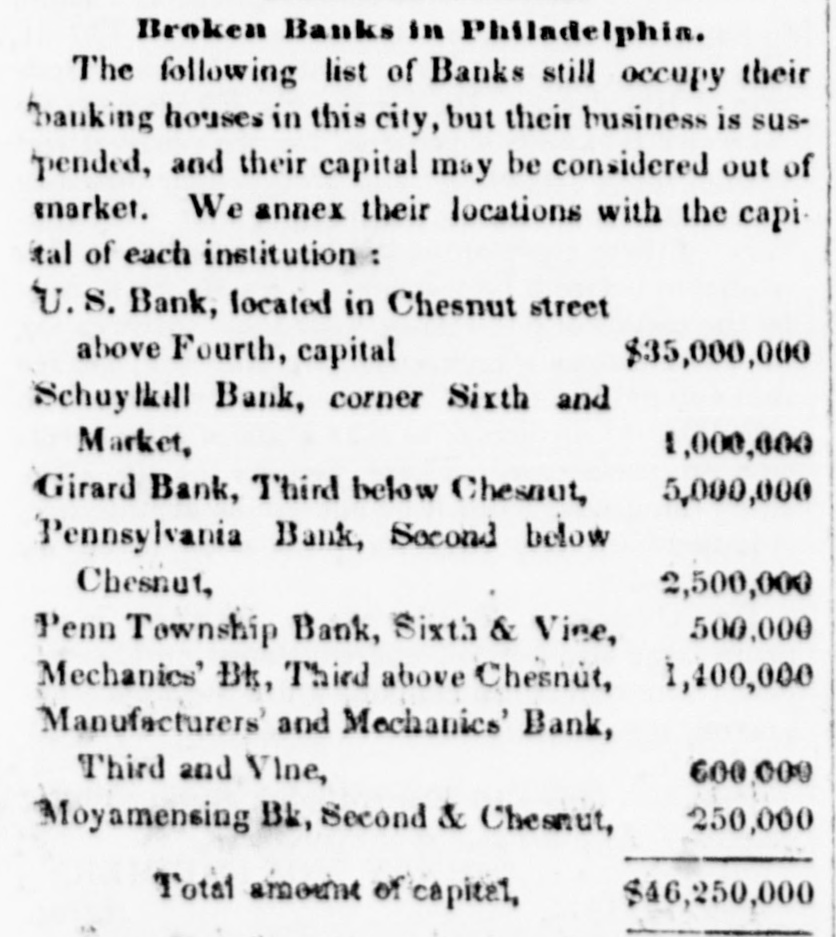
Broken Banks in Philadelphia. The following list of Banks still occupy their banking houses in this city, but their business is suspended, and their capital may be considered out of market. We annex their locations with the capital of each institution : U. S. Bank, located in Chesnut street $35,000,000 above Fourth, capital Schuylkill Bank, corner Sixth and Market, 1,000,000 Girard Bank, Third below Chesnut, 5,000,000 Pennsylvania Bank, Second below Chesnut, 2,500,000 500,000 Penn Township Bank, Sixth & Viee, Mechanics' Bts, Third above Chesnut, 1,400,000 Manufacturers' and Mechanics' Bank, 600.000 Third and Vlne, 250,000 Moyamensing Bk, Second & Chesnut, $46,250,000 Total amount of capital,


Article from Indiana State Sentinel, March 5, 1846

Click image to open full size in new tab

Article Text

# THE UNITED STATES BANK Commenting upon a statement that the stock of the U. S. Bank having got into the hands of English Bankers, and that they have it in contemplation to resuscitate the defunct monster, the Philadelphia Ledger says: "The charter of the Bank is whole and sound as ever it was. It makes its regular statements to the Auditor General, holds its annual elections of officers, and does every other thing that a bank in credit does, saving and excepting the payment of its debts. But in this last particular it is better than many other institutions of the State; for, though it does not pay what it owes, it runs no more in debt, being out of credit. When the U. S. Bank stopped payment, application was made to the Legislature, and an act, authorizing a special assignment, was obtained, and thus the charter was saved."