Article Text
doors for business The First National bank of Carnegie closed by crder of the directors after had opened for the day's business. John Bell Pittsburgh is president of both
Click image to open full size in new tab
doors for business The First National bank of Carnegie closed by crder of the directors after had opened for the day's business. John Bell Pittsburgh is president of both
Click image to open full size in new tab
PITTSBURGH Pa., April 27.-State and Federal officials today be. gan investigating the affairs of two Carnegie banks. the Carnegie Trust Company and the First National bank of Carnegie, which closed their doors this morning The trust company was the first to close on orders from Peter G. Cameron, state secretary of banking In statement Mr. "The reserve fund of Carnegie Trust Company has been below legal requirements for some days. The First National closed few minutes after opening this morning. officials stating later they took action "on their prevent run bank Both institutions, of which John Bell is president, are located in Carnegie, Pa.

Click image to open full size in new tab
Failures at Carnegie, Pa.. Blamed on High Mine Wages.
CHICAGO, April Commenting on the closing of two banks in the Pittsburgh coal region, the Black Diamond, coal trade publication, today said that the situation throughout the union bituminous coal fields is precarious "Every day the wage scale agreement, signed in February of last year. remains in effect It adds to the complications every unionized bituminous mining company and those financial interests back of it," said the Black Diamond. The central competitive district, consisting of western Pennsylvania, Illinois, Ketucky, Indiana and Ohio, is at a 35 per cent. labor disadvantage in competing with the nonunion fields, under the present wage agreement, says the publication, which has resulted in two-thirds of the former business going over to non-union fields, which produce at 35 or 40-cent-a ton advantage. A typical example, says the Black Diamond, is the Pittsburgh Coal Co. of Pittsburgh, which owns fiftyeight mines. For fifteen months only eighteen mines have been working and last month sixteen mines were dismantled, meaning a cash loss of millions It recently was announced that of the eighteen mines in operation six would be closed.
Fulfill Its Contracts.
To continue in business and ful. fill its contracts, the Pittsburgh company went into the non-union fields and purchased 2,000,000 tons of coal at a cheaper price than It could have produced, says the pubOf 300 mines in Illinois large enough to merit the term "mine, says the Black Diamond, fewer than 100 are working today, and of 200.000 Illinois miners. more than 100.000 are out of work, and have been for many months.
PITTSBURGH April 27.-State and federal banking officials today began investigating the affairs of two Carnegie banks the Carnegie Trust Co and the First National bank of Carnegie, which closed their doors this The trust company was the first to close on orders from Peter G. Cameron, state secretary of bank. ing. The First National closed a few minutes after opening Officials later said they acted "on their own accord to prevent run on the bank." Both institutions of which John Bell is president are in CarDeclaring that the reserve funds of the Carnegie Trust Co. were below requirements, Secretary Cameron said: "Although every effort has been made by the company to build up the reserve to the required amount It has failed to do so owing to the frozen condition of its assets which, in turn is direct result of the stagnation that has obtained in the bituminous coal industry in Pennsylvania for some months, the pany being the holder of obligations of coal companies aggregating considerable sum." Mr. Bell said meeting of officials of the First National may be held in few days and that the bank was sound. He said the bank would be reopened, but did not indicatea when The Carnegie Trust Co. has capital and surplus of $700,000. its last financial report of April 9, 1925 showed, with deposits of more than $4,000,000 and assets listed at $5,664,550. The First National has capacity of $100,000 and surplus and undivided profits of $165,000 Its report of April 1925, showed deposits of $1,759,932 and total assets $2,127,881.
Click image to open full size in new tab
First National Bank of Carnegie Closes to Avert Run On Funds.
Associated Pittsburgh made today the property Carnegie original H. and Stoneroad by John Bell. of banks suburb. closed their At the time Bell purchased the coal propyears company at The terms announced of the Carnegie Trust their books the request of state banking has charge First National Bank of remained officers an. douncing the board directors had taken their to prevent the bank
Click image to open full size in new tab
PITTSBURGH, April and federal banking officials today began Investigating the affairs the Carnegie banks, the Carnegie Trust pany and the First National Bank com- of Carnegie, morning. which closed their doors this The trust company was the first to close on orders from Peter Cameron. state secretary of banking. statement, Cameron said: reserve fund of the Carnegie Trust company has been below legal for some days." minutes The First National closed few after opening this morning, officials stating later that they took action their accord prevent run the Both institutions. of which John Bell are located in Carnegie,
Click image to open full size in new tab
State and Federal Officials are Both Investigating Their Affairs
ORDERED TO CLOSE BY STATE MANDATE
Trust Company Closes First Quickly Followed by First National Bank
PITTSBURG, Pa., April 27.—State and federal banking officials began investigating the affairs of two Carnegie banks, the Carnegie Trust Co., and the First National Bank of Carnegie, which closed their doors this morning.
Click image to open full size in new tab
PITTSBURG, Pa., April 27.—State and federal banking officials began investigating the affairs of two Carnegie banks, the Carnegie Trust Co., and the First National Bank of Carnegie, which closed their doors this morning.
The trust company was the first to close on orders from Peter G. Cameron, state secretary of banking. In a statement Mr. Cameron said “the reserve fund of the Carnegie Trust Company has been below the legal requirements for some days.”
Click image to open full size in new tab
PITTSBURGH. April and federal officials today began Carnegie Trust Company and the First National Bank Carnegie, which closed their doors this morning. The trust was the first to close on orders from Peter Camerstate Mr. said, reserve the Carnegie Trust Company been below legal refor some days." quirements The First National closed few minutes opening officials later they took action "on accord prevent run on the bank." Both institutions, of which John T. Bell president. are located Carnegie, Pa. Adding his that the refunds Trust Company were below legal require-
Click image to open full size in new tab
President Says Institutions Are Sound Financially.
INDUSTRY BLAMED
By Associated Press PITTSBURGH, Apr. 27. State and federal banking officials today began Investigating the affairs of the Carnegie banks, the Carnegie Trust company and the First National Bank of Carnegie, which closed their doors this morning. The Trust company was the first to close, on orders from Peter G. Cameron, state secretary of banking. Mr. Cameron said "the reserve fund of the Carnegie Trust company has been below legal requirement for some days." The First National closed B few injuctes after opening this morning, officials stating later that they took Action QD their own accord to prevent a run on the bank. Both institutions, of which John A. Bell la president, Rre located in Carnegie, Pa. Secretary Camoron sald "although selection of the famous every effort has been made by the company to build up the reserve to the required amount, It has fulled to do 80 owing to the frozen conditions of Its assets which, In turn, is a direct result of the stagnation which has obtained in the bittiminous coal industry in Penusylvania for several months the company being the hold. era of obilgations of coal companies aggregating a considerable suni. Be cause of these conditions, it WGS the duty of the secretary of banking to take possession of the business and property of the Trust company in order that the interest of the depositors and ed." other creditors might be protectreach of everyone.
Late today Secretary Cameron ap pointed Frank Jackson, Apollo, Pa., special deputy agent to assist la con. Unuing or liquidating the affairs of In " statement, Mr. Bell said a meeting of the officials of the First National may be held in a few days and that the bank was sound financial ly. He said the bank would be reopened for business but he did not indicate when. The Carnegle Trust company has a capital and surplus of $700,000, its financial report of April 9, 1925, show ed with deposits of more than $4,000,000 and assets listed M8 $5,664,650. The First National has & capital $100,000 and surplus and undivided of profits of $185,000. It's report of April 6, 1925, showed deposits of $1,759,932 and total assets $2,127,881. SITUATION IS PRECARIOUS CHICAGO, April 27. Commenting on the closing of two banks In the Pittsburgh coal region the Black Dta mond, coal trade publication, today said that the situation throughout the union carlous. bituminous coal fields is pre. Every day the wage scale agree ment signed in February of last year remains in effect It adds to the com plication of every unionized bitu minous mining companies and those financial Black interests back of It, said the Diamond. The central competitive district consisting of Western Pennsylvania, Illinois, Kentucky, Illinois and In diana is at a 35 per cent labor die adventage in competing with the nonunion field under the present wage agreement says the publication which has resulted In two-thirds of the for. mer business going over to non-union fields which produces at 40 cents a ton advantage.
Click image to open full size in new tab
Stagnation In Coal Industry Is Blamed For Closing of Two Banks at Carnegie, Pa.
Associated April and federal banking officials vestigating the affairs of two the Carnegie Trust company and the First National of which closed their doors this morning. The trust company was the first close orders of the has the few minutes that stitutions of which John T. Bell president, are located in Carnegie. statement the reserve the Trust company the legal said: has the failed frozen which in direct stagnation the coal the being the holder of and other might be
Click image to open full size in new tab
Trade publication says operators are losing money due to high union wages.
Pittsburgh, Pa., April 27.—State and federal banking officials today began investigating the affairs of two Carnegie banks, the Carnegie Trust company and the First National bank of Carnegie, which closed their doors this morning.
The trust company was the first to close on orders from Peter G. Cameron, state secretary of banking. In a statement, Mr. Cameron said the "reserve fund of the Carnegie Trust company has been below legal requirements for some days."
Click image to open full size in new tab
(By The affairs two negie Carnegie the First National Bank Carnegie which closed this The the first to ron said: reserve fund the CarTrust has equirements for some National closed minutes officials action took "on vent run the are located in Adding his reserve Secretary though made failed to do owing frozen condition of assets is of the nation that has the minous Pennsyl. some being the aggregating
Click image to open full size in new tab
An aged mother had all her savings in the Trust Co. Her children have not told her of the bank disaster because she has weak heart, and she can't read English so she won't read it in the Signal Item. A school teacher who had her savings in the Trust Co., sent a check to her mother for her birthday. The check came back, so cost the teacher twice the amount she sent. Many business men had to redeem checks given their employes. Carnegie Borough répairs and improvements have to be partially suspended this year owing to the bank failure. A woman who sold her home had all her savings in the Trust Co. and is now penniless. Scores of similarly distressing cases are reported. Last Friday the cash in the First National Bank of Carnegie was transferred to the large steel vaults in the Mellon National Bank of Pittsburgh. Receiver R. F. Marburger did this in compliance with instructions from the Treasury Department at Washington. SO as to assure absolute safety of the funds pending the liq uilation of the bank, which probably will require some time.-Carnegie
Click image to open full size in new tab
(Continued from Page such action being taken this week. Those who conferred with the Attorney General were Maj. C. C. McGovern, special investigator for the Governor; Frank L Gollmar, deputy attorney general; W. L McGee, accountant; Maj. E. Lowry Humes, special counsel for the banking department and Frank W. Jackson, bank receiver. He also talked with seven members of the committee and counsel for the small depositors' protective of Carnegie, who laid their case before him. The first suits growing out of the closed First National Bank of Carnegle, also a Bell institution, were filed in common pleas court to-day by R. F. Marburger, receiver for the bank, against George W. Wood and P. M. Chidester. Defendants are with delivering notes amounting to $30,000 to the bank in 1922 and failing to pay them.
Click image to open full size in new tab
Pinchot's Investigators Want Actions Started in Bell Bank
Finally Blocks Move
By Associated Press to The Patriot Pittsburgh, July for and against the filing of criminal suits in connection with the recent failure of the Carnegie Trust Company, of which John Bell was president, marked an allday here today Attorney General George W Woodruff and the various investigators inquiring into the bank's affairs. Investigators for GoverPinchot urged that suits filed, while representatives of the State Banking Department insisted that banking code be adhered and that no hasty action be taken. No reached. State representatives intended to file suits today tomorrow but the Attorney General learned the conference that the proposed charges had not been checked.
May Act This Week
After the conference Mr. Woodruff said the investigation had not reached the stage to bring criminal suits, although there was possibility of such action being taken this week. Those who ferred with the attorney general were Maj. C. McGovern, special investigator for the Governor; Frank Gollmar, deputy attorney general; L. McGee, accountant; Maj. E. Lowry Humes, special counsel for the Banking Department, and Frank W Jack son, bank receiver. He also talked with seven members of the tive committee and counsel for the small depositors protective organization of Carnegie, who laid their case before him. The first suits growing out of the closed First National Bank of Carnegie, also Bell institution, were filed in Pleas Court by Marburger today ceiver for the bank, against George W. Wood and Chidester. Defendants are charged with delivering notes to $30,000 to the bank in 1922 and failing to pay them.
Click image to open full size in new tab
Woodruff Hears Arguments For and Against Immediate Arrests
PITTSBURGH, July 28 (A. P.).—Arguments for and against the filing of criminal suits in connection with the recent failure of the Carnegie Trust Company, of which John A. Bell was president, marked an all-day conference here today between Attorney General George Woodruff and the various investigators inquiring into the bank's affairs. Investigators for Governor Pinchot urged that suits be filed, while representatives of the State Banking Department insisted that the banking code be adhered to and that no hasty action be taken. No decision was reached.
State representatives intended to file suits today or tomorrow, but the Attorney General learned at the conference that the proposed charges had not been checked.
After the conference Mr. Woodruff said the investigation had not reached the stage to bring criminal suits, although there was a possibility of such action being taken this week. Those who conferred with the Attorney General were Major C. C. McGovern, special investigator for the Governor; Frank I. Gollmar, deputy Attorney General; W. L. McGee, accountant; Major E. Lowry Humes, special counsel for the banking department, and Frank W. Jackson, bank receiver. He also talked with seven members of the executive committee and counsel for the small depositors' protective organization of Carnegie, who laid their case before him.
The first suits growing out of the closed First National Bank of Carnegie, also a Bell institution, were filed in Common Pleas Court today by R. F. Marburger, receiver for the bank, against George W. Wood and P. M. Chidester. Defendants are charged with delivering notes amounting to $30,000 to the bank in 1922 and failing to pay them.
Click image to open full size in new tab
ARGUE ON CRIMINAL SUITS IN BANK CASE
Pinchot Probers Want Suits Filed-Banking Department Insists on Banking Code.
HARRISBURG, July 29.-Appointment of B. B. Blackburn, president of the First National Bank, Oakmont, and J. H. McGinnity, trust officer and secretary of the Pittsburgh Trust Company, Pittsburgh, to appraise the assets of the Carnegie Trust Company, Carnegie, was announced today at the Department of Banking. The institution was taken over by the Department last April.
PITTSBURG. July 29. Arguments for and against the filing of criminal suits in connection with the recent failure of the Carnegie Trust Company, of which John A. Bell, was president. marked an allday conference here today between Attorney General George W. Woodruff and the various investigators inquiring into the bank's affairs. Investigators for Governor Pinchot urged that suits be filed. while representatives of the State Banking Department insisted that the banking code be adhered to and that no hasty action be taken. No decision was reached.
State representatives intended to file suits today or tomorrow, but the Attorney General learned at the conference that the proposed charges had not been checked. After the conference Mr. Woodruff said the investigation had not reached the stage to bring criminal suits, although there was a possibility of such action being taken this week. Those who conferred with the Attorney General were Major C. C. McGovern. special investigator for the Governor: Frank I. Gollmar. deputy attorney general; W. L. McGee, accountant: Major E. Lowry Humes, special counsel for the Banking Department and Frank W. Jackson. bank receiver. He also talked with seven members of the executive committee and counsel for the small depositors' protective organization of Carnegie, who laid their case before him. The first suits growing out of the closed First National Bank of Carnegle, also a Bell institution. were filed in common pleas court today by R. F. Marburger, receiver for the bank, against, George W. Wood and P. M. Chidester. Defend-
Click image to open full size in new tab
Furthermore, it was learned from a reliable source that the $560,000 of coal bonds given to Christy originally were the property of the First National Bank of Carnegie, another defunct Bell institution. The informant declared that Bell showed evidence of fearing the stringency of the National banking laws when he transferred the coal bonds from the First National Bank of Carnegie to the Carnegie Trust Company, giving the National bank in payment $560,000 of the best assets of the trust company.
It is known that the state banking department considers the bonds the property of the bank. They never have been listed among the personal assets of Bell with the Bell creditors' committee, to which he turned over all of his property, real and personal, according to information gained yesterday.
When George W. Woodruff, state attorney general, made his report to Governor Pinchot on the progress of the state investigation into the bank's collapse, Woodruff listed $1,060,000 of Carnegie Coal Company bonds as being in the possession of the Carnegie Trust Company.
Click image to open full size in new tab
Furthermore, it was learned from a reliable source that the $560,000 of coal bonds given to Christy originally were the property of the First National Bank of Carnegie, another defunct Bell institution. The informant declared that Bell showed evidence of fearing the stringency of the National banking laws when he transferred the coal bonds from the First National Bank of Carnegie to the Carnegie Trust Company, giving the National bank in payment $560,000 of the best assets of the trust company.
It is known that the state banking department considers the bonds the property of the bank. They never have been listed among the personal assets of Bell with the Bell creditors' committee, to which he turned over all of his property, real and personal, according to information gained yesterday.
Click image to open full size in new tab
ASSETS DISTRIBUTED Carnegie Bank Receiver Sends Checks To Depositors
PITTSBURGH, Aug. 21 (AP).—Checks aggregating approximately $50,000 were being distributed today by Receiver R. L. Marburger to depositors of the closed First National bank, of Carnegie. Marburger said the payment, the first to be made to depositors since the bank was closed in April, represented about 40 per cent of the total deposits. The First National bank, of Carnegie, closed its doors the same day the Carnegie Trust company was closed by the state banking department. John A. Bell was president of both banks.
BOSTONIAN SHOES FOR MEN
Footwear of quality for Ladies, Misses and Children.
School shoes for Boys and Girls at W. H. MILLER & SON 20-2t
NOTICE Mr. C. W. Mann has closed studio, 40 S. George for period three weeks while undergoing new studies in New York city 17,19,21.
BIG RUMMAGE SALE in basement of the 2nd U. B. church, corner Duke and South street, Saturday afternoon and evening, Aug. 22nd, also Monday evening, Aug. 24th. 20-2t
MR. MOTORIST
Click image to open full size in new tab
Bell Bank Receiver Sues for $1,800 Note
R. Marburger, receiver for the closed First National Bank of Carnegie, formerly headed by John A. Bell, filed suit yesterday in Common Pleas Court against Thomas from whom he recover $1,800 said to be due the bank on dated March last. The averred that a loan was at the bank the amount sought and that 60-day was given in When the note fell due at the expiration the 60 payment defaulted Mr Marburger alleged in his action.
Click image to open full size in new tab
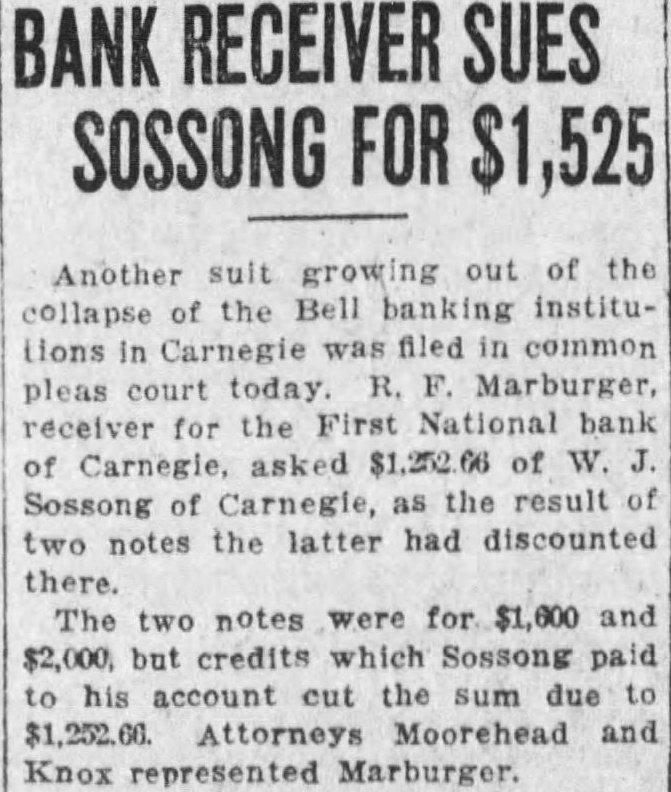
BANK RECEIVER SUES SOSSONG FOR $1,525
Another sult the collapse the Bell lions Carnegie common pleas receiver for the First National bank Carnegie, asked $1,252.06 of W. Sossong of Carnegie, the result two notes the latter had there. The two notes were for and $2,000, but credits which Sossong to his account cut the sum due $1,252.60. Attorneys Moorehead and Knox represented Marburger.
Click image to open full size in new tab
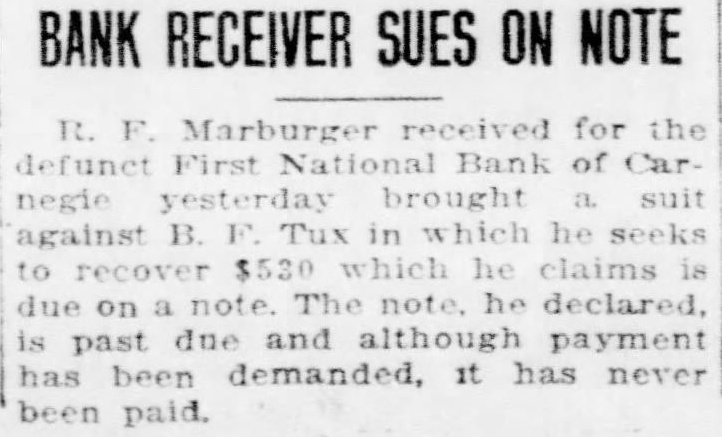
R. F. Marburger receiver for the defunct First National Bank of Carnegie yesterday brought a suit against B. F. Tux in which he seeks to recover $530 which he claims is due on a note. The note, he declared, is past due and although payment has been demanded, it has never been paid.
Click image to open full size in new tab
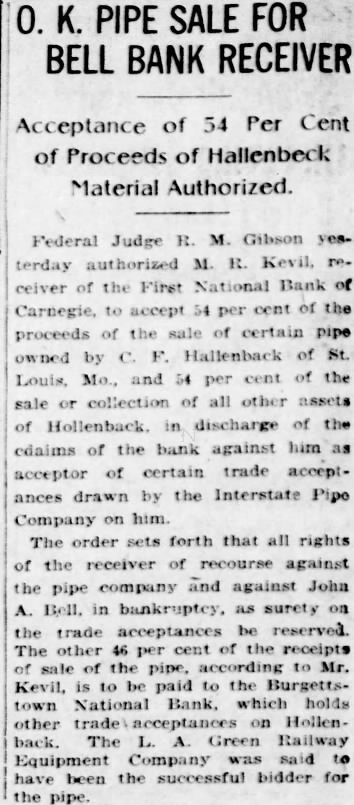
0. K. PIPE SALE FOR BELL BANK RECEIVER
Acceptance of 54 Per Cent of Proceeds of Hallenbeck Material Authorized.
Federal Judge R. M. Gibson terday M. R. Kevil, ceiver of the First National Bank of Carnegie, accept 54 per cent of the proceeds of the of certain pipe Hallenback of owned by Louis, and 54 per cent of the collection of all other assets sale of discharge of the edaims of the bank against him as acceptor of certain trade acceptances drawn by the Interstate Pipe Company on him. The order forth that all rights of the receiver of against the company and against John pipe A. in as surety on the trade acceptances be reserved. The other cent of the receipts the pipe, to Mr. Kevil, paid the town National Bank, which holds other on Hollenback. The Railway Equipment have the successful bidder for the pipe.