Article Text
Pittsburgh Bank Fails
Pittsburgh. April Carnegie Trust company of Carnegie, suburb, failed to open its
60-0477
Click image to open full size in new tab
Pittsburgh. April Carnegie Trust company of Carnegie, suburb, failed to open its
Click image to open full size in new tab
PITTSBURG. April 27 (By A. State and Federal Banking Officials today began investigating the affairs of two Carnegie Banks, The Garnegie Trust and The First National Bank of Carnegie. which closed their doors this morning. The Trust Company was the first to close on orders from Peter G. Cameron, State Secretary of Banking. In a statement Mr. Cameron said:
"The reserve fund of the Carnegie Tinst Company has been below legal requirements for some days." The First National closed a few minutes after opening this morning, officials stated later that they took action "on their own accord to pre vent a run on the bank." Both institutions of which John T. Bell is Pres ident. are located at Carnegie, Penna
Click image to open full size in new tab
PITTSBURGH Pa., April 27.-State and Federal officials today be. gan investigating the affairs of two Carnegie banks. the Carnegie Trust Company and the First National bank of Carnegie, which closed their doors this morning The trust company was the first to close on orders from Peter G. Cameron, state secretary of banking In statement Mr. "The reserve fund of Carnegie Trust Company has been below legal requirements for some days. The First National closed few minutes after opening this morning. officials stating later they took action "on their prevent run bank Both institutions, of which John Bell is president, are located in Carnegie, Pa.
Click image to open full size in new tab
Pittsburgh, April 28 (A.P.)—Announcement was made today that the property of the Carnegie Coal company had been returned to its original owners, J. H. Sanford and J. T. M. Stoneroad, by John A. Bell, president of the two banks at Carnegie, a suburb, which closed their doors yesterday. At the time Mr. Bell purchased the coal property, two years ago, the company was capitalized at $8,000,000. The terms of the transfer were not announced.
Depositors of the Carnegie Trust company today began leaving their passbooks at the bank in response to a request from Peter G. Cameron, secretary of the state banking department, who has taken charge of the bank's affairs. The First National Bank of Carnegie also remained closed today, officers announcing the board of directors had taken this action "on their own account to prevent a run on the bank." Mr. Bell said the First National Bank of Carnegie is "financially sound and may throw its doors open to depositors within a few days."
Click image to open full size in new tab
PITTSBURGH, April and federal banking officials today began Investigating the affairs the Carnegie banks, the Carnegie Trust pany and the First National Bank com- of Carnegie, morning. which closed their doors this The trust company was the first to close on orders from Peter Cameron. state secretary of banking. statement, Cameron said: reserve fund of the Carnegie Trust company has been below legal for some days." minutes The First National closed few after opening this morning, officials stating later that they took action their accord prevent run the Both institutions. of which John Bell are located in Carnegie,
Click image to open full size in new tab
State and Federal Officials are Both Investigating Their Affairs
ORDERED TO CLOSE BY STATE MANDATE
Trust Company Closes First Quickly Followed by First National Bank
PITTSBURG, Pa., April 27.—State and federal banking officials began investigating the affairs of two Carnegie banks, the Carnegie Trust Co., and the First National Bank of Carnegie, which closed their doors this morning.
Click image to open full size in new tab
PITTSBURG, Pa., April 27.—State and federal banking officials began investigating the affairs of two Carnegie banks, the Carnegie Trust Co., and the First National Bank of Carnegie, which closed their doors this morning.
The trust company was the first to close on orders from Peter G. Cameron, state secretary of banking. In a statement Mr. Cameron said “the reserve fund of the Carnegie Trust Company has been below the legal requirements for some days.”
Click image to open full size in new tab
PITTSBURGH. April and federal officials today began Carnegie Trust Company and the First National Bank Carnegie, which closed their doors this morning. The trust was the first to close on orders from Peter Camerstate Mr. said, reserve the Carnegie Trust Company been below legal refor some days." quirements The First National closed few minutes opening officials later they took action "on accord prevent run on the bank." Both institutions, of which John T. Bell president. are located Carnegie, Pa. Adding his that the refunds Trust Company were below legal require-
Click image to open full size in new tab
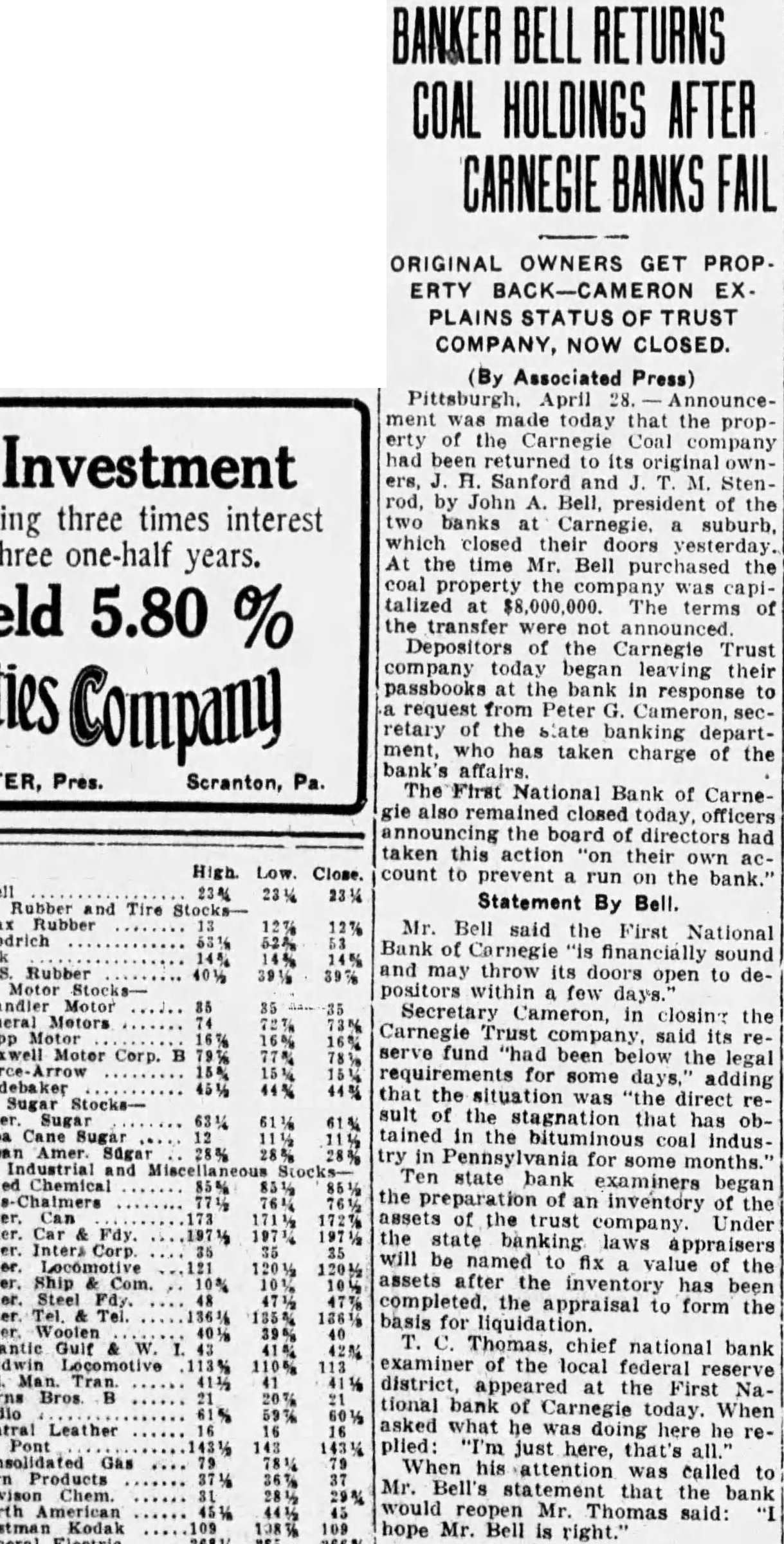
ORIGINAL OWNERS GET PROP. ERTY BACK-CAMERON EX. PLAINS STATUS TRUST COMPANY, NOW CLOSED.
(By Associated Press)
April ment today that the property of the Carnegie company been returned to its original ownand M. Stenby Bell, the three times interest suburb, which closed yesterday. At the time Mr. Bell purchased the coal the was talized $8,000,000. The terms of the transfer not Depositors the Carnegie Trust company began their passbooks in request from Peter retary of the ment, who has taken charge of the bank's Scranton, Pa. First National Bank of Carnegie today, officers the had taken acrun bank. Statement By Bell.
Mr. Bell said the First National may throw open to deSecretary in closing the Carnegie Trust said its fund "had been below the legal requirements for some adding that the "the direct the has obtained the coal indusfor Ten state began the inventory the assets of the trust Under banking laws appraisers fix of the assets the inventory has completed. appraisal to form the basis for Thomas, chief national bank examiner the local federal reserve district, appeared the First National bank of Carnegie today. When what he here he rejust his was called Mr. Bell's statement that the would hope Bell is right.
Click image to open full size in new tab
PITTSBURGH, April 28.-State and federal banking officials yeAterday began investigating the affairs of two Carnegie banks, the Carnegie Trust Co. and the First National bank of Carnegie which closed their doors yesterday morning
The trust company was the first to close on orders from Peter G. Cameron, state secretary of banking. Mr. Cameron said "the reserve fund of the Carnegie Trust company has been below legal requirements for some
The First National closed a few minutes after opening this morning, officials stating later that they took action "on their own accord to prevent run on the bank." Both institutions of which John T. Bell is presiden are located in Carnegie, Pa.
Click image to open full size in new tab
President Says Institutions Are Sound Financially.
INDUSTRY BLAMED
By Associated Press PITTSBURGH, Apr. 27. State and federal banking officials today began Investigating the affairs of the Carnegie banks, the Carnegie Trust company and the First National Bank of Carnegie, which closed their doors this morning. The Trust company was the first to close, on orders from Peter G. Cameron, state secretary of banking. Mr. Cameron said "the reserve fund of the Carnegie Trust company has been below legal requirement for some days." The First National closed B few injuctes after opening this morning, officials stating later that they took Action QD their own accord to prevent a run on the bank. Both institutions, of which John A. Bell la president, Rre located in Carnegie, Pa. Secretary Camoron sald "although selection of the famous every effort has been made by the company to build up the reserve to the required amount, It has fulled to do 80 owing to the frozen conditions of Its assets which, In turn, is a direct result of the stagnation which has obtained in the bittiminous coal industry in Penusylvania for several months the company being the hold. era of obilgations of coal companies aggregating a considerable suni. Be cause of these conditions, it WGS the duty of the secretary of banking to take possession of the business and property of the Trust company in order that the interest of the depositors and ed." other creditors might be protectreach of everyone.
Late today Secretary Cameron ap pointed Frank Jackson, Apollo, Pa., special deputy agent to assist la con. Unuing or liquidating the affairs of In " statement, Mr. Bell said a meeting of the officials of the First National may be held in a few days and that the bank was sound financial ly. He said the bank would be reopened for business but he did not indicate when. The Carnegle Trust company has a capital and surplus of $700,000, its financial report of April 9, 1925, show ed with deposits of more than $4,000,000 and assets listed M8 $5,664,650. The First National has & capital $100,000 and surplus and undivided of profits of $185,000. It's report of April 6, 1925, showed deposits of $1,759,932 and total assets $2,127,881. SITUATION IS PRECARIOUS CHICAGO, April 27. Commenting on the closing of two banks In the Pittsburgh coal region the Black Dta mond, coal trade publication, today said that the situation throughout the union carlous. bituminous coal fields is pre. Every day the wage scale agree ment signed in February of last year remains in effect It adds to the com plication of every unionized bitu minous mining companies and those financial Black interests back of It, said the Diamond. The central competitive district consisting of Western Pennsylvania, Illinois, Kentucky, Illinois and In diana is at a 35 per cent labor die adventage in competing with the nonunion field under the present wage agreement says the publication which has resulted In two-thirds of the for. mer business going over to non-union fields which produces at 40 cents a ton advantage.
Click image to open full size in new tab
(CONTINUED FROM PAGE ONE)
tional Bank of Carnegie, which closed their doors this morning.
The trust company was the first to close on orders from Peter G. Cameron, state secretary of banking. In a statement Mr. Cameron said:
"The reserve fund of the Carnegie Trust Company has been below legal requirements for some days."
The First National closed a few minutes after opening this morning. Officials stated later that they took action "on their own accord to prevent a run on the bank." Both institutions, of which John T. Bell is president, are located at Carnegie, Pennsylvania.
Secretary Cameron said: "Although every effort has been made by the company to build up the reserve to the required amount, it has failed to do so owing to the frozen conditions of its assets, which in turn is a direct result of the stagnation that has obtained in the bituminous coal industry in Pennsylvania for some months. Because of these conditions it was the duty of the secretary of banking to take possession of the business and property of the trust company in order that the interests of the depositors and other creditors might be protected." In a statement Mr. Bell said that a meeting of officials of the First National may be held in a few days and that the bank was sound financially. He said the bank would be reopened for business, but he did not indicate when.
Click image to open full size in new tab
Stagnation In Coal Industry Is Blamed For Closing of Two Banks at Carnegie, Pa.
Associated April and federal banking officials vestigating the affairs of two the Carnegie Trust company and the First National of which closed their doors this morning. The trust company was the first close orders of the has the few minutes that stitutions of which John T. Bell president, are located in Carnegie. statement the reserve the Trust company the legal said: has the failed frozen which in direct stagnation the coal the being the holder of and other might be
Click image to open full size in new tab
Trade publication says operators are losing money due to high union wages.
Pittsburgh, Pa., April 27.—State and federal banking officials today began investigating the affairs of two Carnegie banks, the Carnegie Trust company and the First National bank of Carnegie, which closed their doors this morning.
The trust company was the first to close on orders from Peter G. Cameron, state secretary of banking. In a statement, Mr. Cameron said the "reserve fund of the Carnegie Trust company has been below legal requirements for some days."
Click image to open full size in new tab
(By The affairs two negie Carnegie the First National Bank Carnegie which closed this The the first to ron said: reserve fund the CarTrust has equirements for some National closed minutes officials action took "on vent run the are located in Adding his reserve Secretary though made failed to do owing frozen condition of assets is of the nation that has the minous Pennsyl. some being the aggregating
Click image to open full size in new tab
Pinchot's Investigators Want Actions Started in Bell Bank
Finally Blocks Move
By Associated Press to The Patriot Pittsburgh, July for and against the filing of criminal suits in connection with the recent failure of the Carnegie Trust Company, of which John Bell was president, marked an allday here today Attorney General George W Woodruff and the various investigators inquiring into the bank's affairs. Investigators for GoverPinchot urged that suits filed, while representatives of the State Banking Department insisted that banking code be adhered and that no hasty action be taken. No reached. State representatives intended to file suits today tomorrow but the Attorney General learned the conference that the proposed charges had not been checked.
May Act This Week
After the conference Mr. Woodruff said the investigation had not reached the stage to bring criminal suits, although there was possibility of such action being taken this week. Those who ferred with the attorney general were Maj. C. McGovern, special investigator for the Governor; Frank Gollmar, deputy attorney general; L. McGee, accountant; Maj. E. Lowry Humes, special counsel for the Banking Department, and Frank W Jack son, bank receiver. He also talked with seven members of the tive committee and counsel for the small depositors protective organization of Carnegie, who laid their case before him. The first suits growing out of the closed First National Bank of Carnegie, also Bell institution, were filed in Pleas Court by Marburger today ceiver for the bank, against George W. Wood and Chidester. Defendants are charged with delivering notes to $30,000 to the bank in 1922 and failing to pay them.
Click image to open full size in new tab
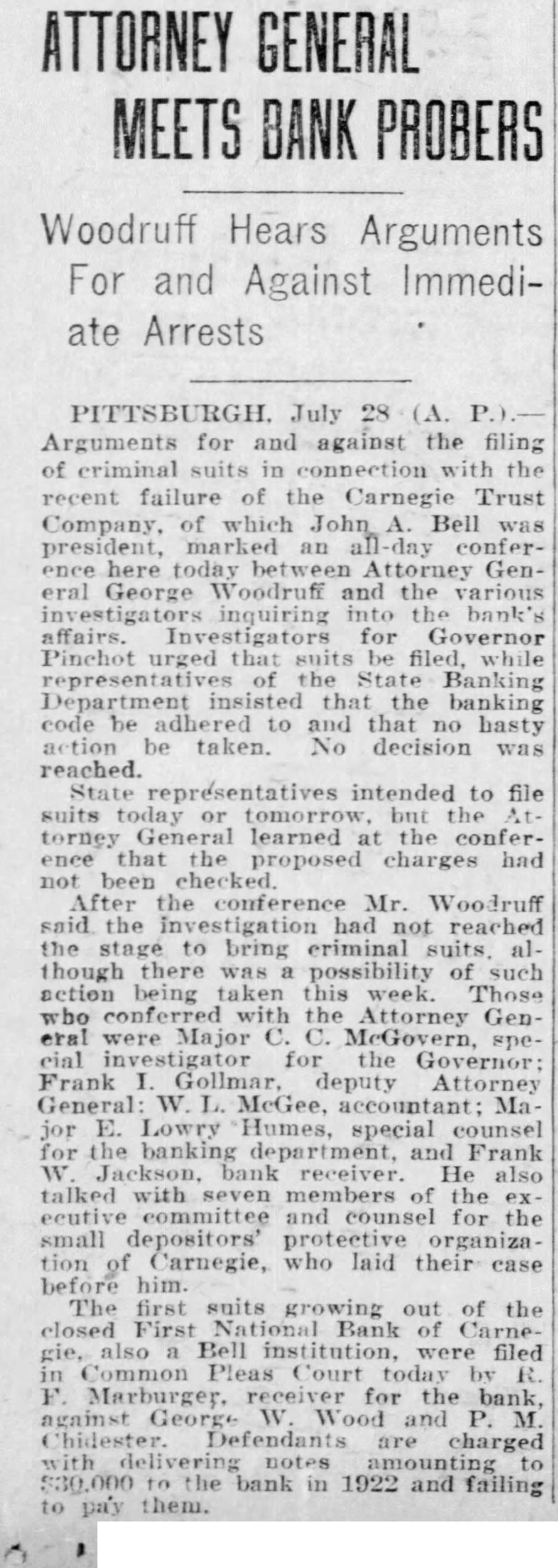
Woodruff Hears Arguments For and Against Immediate Arrests
PITTSBURGH, July 28 (A. P.).—Arguments for and against the filing of criminal suits in connection with the recent failure of the Carnegie Trust Company, of which John A. Bell was president, marked an all-day conference here today between Attorney General George Woodruff and the various investigators inquiring into the bank's affairs. Investigators for Governor Pinchot urged that suits be filed, while representatives of the State Banking Department insisted that the banking code be adhered to and that no hasty action be taken. No decision was reached.
State representatives intended to file suits today or tomorrow, but the Attorney General learned at the conference that the proposed charges had not been checked.
After the conference Mr. Woodruff said the investigation had not reached the stage to bring criminal suits, although there was a possibility of such action being taken this week. Those who conferred with the Attorney General were Major C. C. McGovern, special investigator for the Governor; Frank I. Gollmar, deputy Attorney General; W. L. McGee, accountant; Major E. Lowry Humes, special counsel for the banking department, and Frank W. Jackson, bank receiver. He also talked with seven members of the executive committee and counsel for the small depositors' protective organization of Carnegie, who laid their case before him.
The first suits growing out of the closed First National Bank of Carnegie, also a Bell institution, were filed in Common Pleas Court today by R. F. Marburger, receiver for the bank, against George W. Wood and P. M. Chidester. Defendants are charged with delivering notes amounting to $30,000 to the bank in 1922 and failing to pay them.
Click image to open full size in new tab
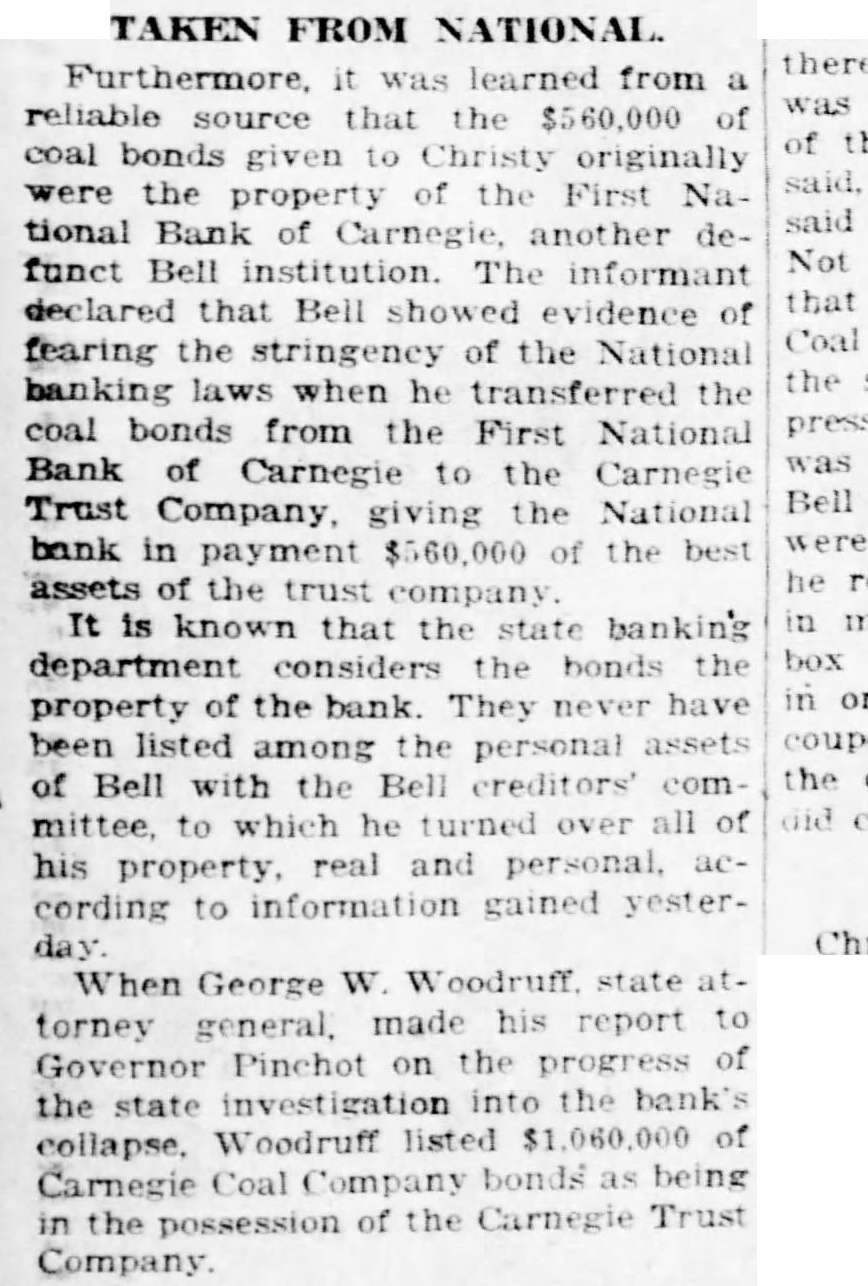
Furthermore, it was learned from a reliable source that the $560,000 of coal bonds given to Christy originally were the property of the First National Bank of Carnegie, another defunct Bell institution. The informant declared that Bell showed evidence of fearing the stringency of the National banking laws when he transferred the coal bonds from the First National Bank of Carnegie to the Carnegie Trust Company, giving the National bank in payment $560,000 of the best assets of the trust company.
It is known that the state banking department considers the bonds the property of the bank. They never have been listed among the personal assets of Bell with the Bell creditors' committee, to which he turned over all of his property, real and personal, according to information gained yesterday.
When George W. Woodruff, state attorney general, made his report to Governor Pinchot on the progress of the state investigation into the bank's collapse, Woodruff listed $1,060,000 of Carnegie Coal Company bonds as being in the possession of the Carnegie Trust Company.
Click image to open full size in new tab
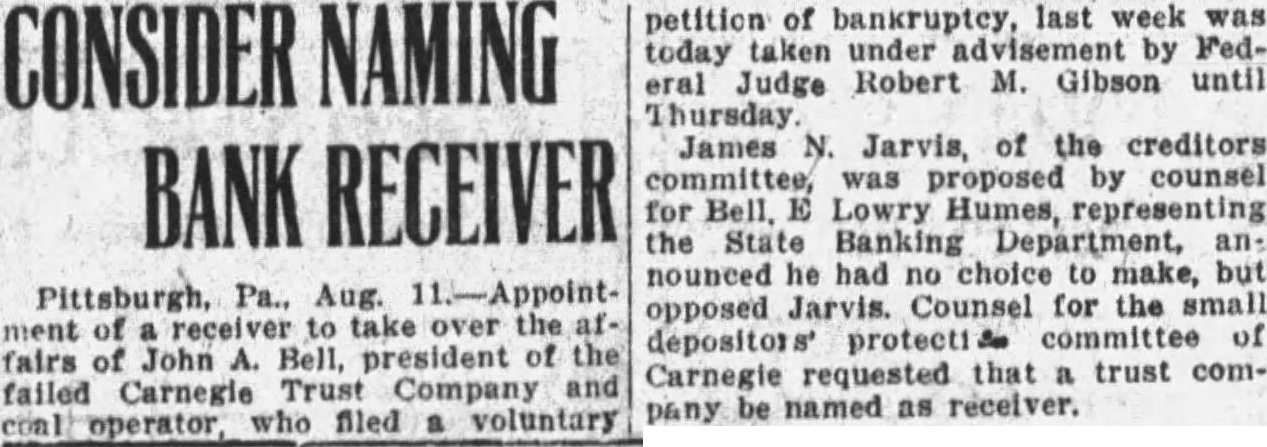
CONSIDER NAMING BANK RECEIVER ment receiver take the fairs John Bell, president of the failed Carnegie Trust Company and operator, who filed voluntary petition of bankruptcy, last week was today taken under Federal Judge Robert M. Gibson until Thursday James N. Jarvis, of the creditors was proposed by counsel for Bell, Lowry Humes, the State Banking Department, nounced he had to make, but opposed Jarvis. Counsel for the small depositors protecti committee of Carnegie requested that trust company be named as receiver.
Click image to open full size in new tab
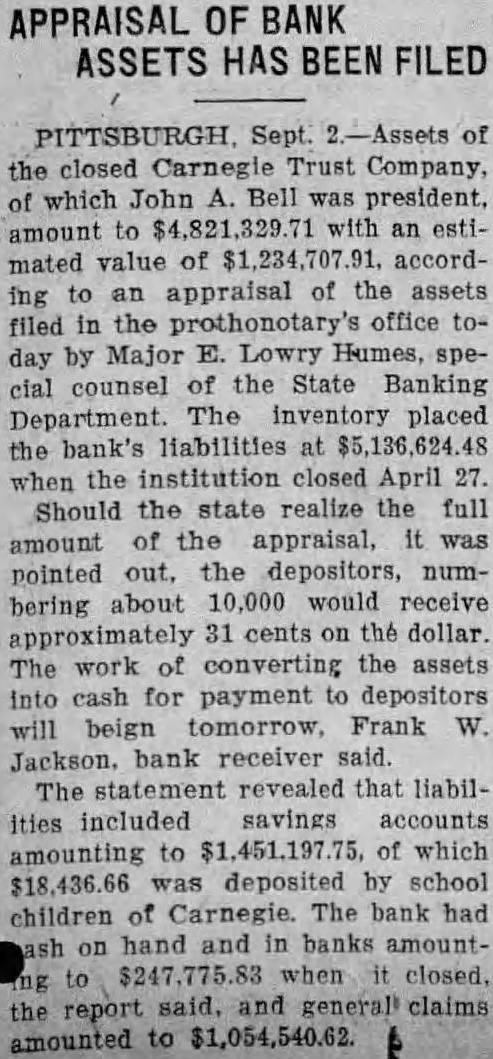
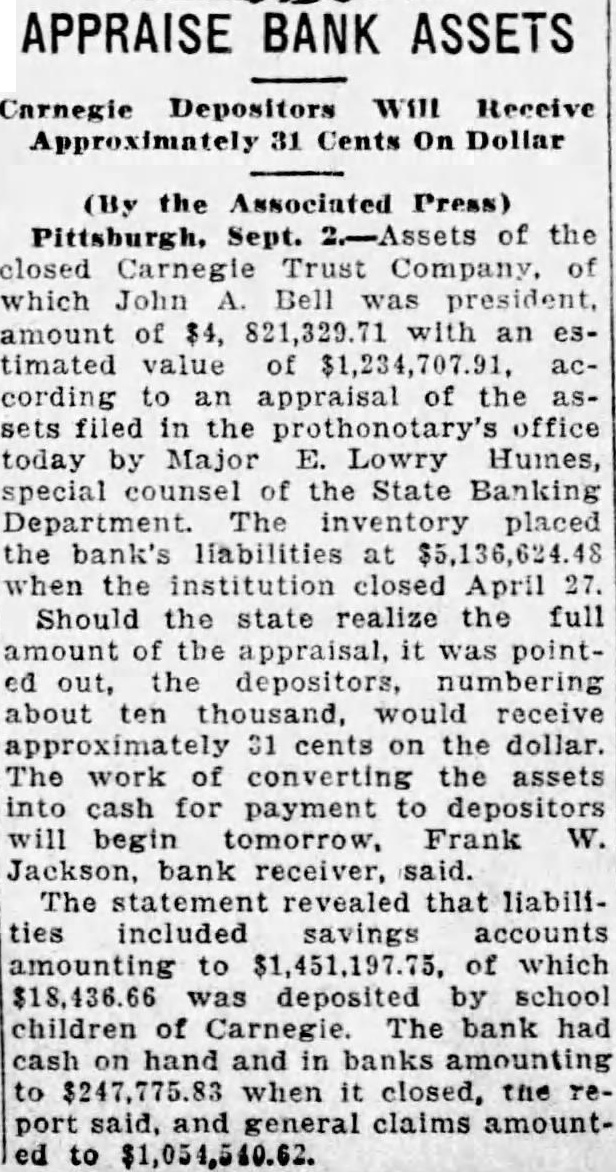
Sept. closed Carnegie Trust Company, which John Bell president. amount an mated value of accordappraisal of the ing filed the office Major Lowry Humes, day counsel the State Banking Department. The inventory placed liabilities when the institution closed Should the state realize the full amount the appraisal, pointed the depositors, bering about 10,000 would receive cents dollar. work converting cash for payment depositors beign tomorrow, Frank bank receiver said. statement revealed included savings accounts amounting to which deposited by school children Carnegie. bank had hand and banks $247,775.83 when closed. report $1,054,540.62.
Click image to open full size in new tab
Carnegie Depositors Receive Approximately Cents On Dollar
(By the Associated Press) closed Carnegie Trust which Bell amount of with an timated value cording appraisal of filed the office today Major Lowry Humes, special the State Banking Department. The at institution closed April Should the the full appraisal, pointout, depositors, about thousand, would receive cents on the dollar. The converting the assets cash for payment depositors begin tomorrow, Frank W. receiver, statement revealed that liabiliincluded savings accounts amounting of which deposited by school children of Carnegie. The bank had cash hand and banks amounting to $247,775.83 when closed, the claims amount$1,054,540.62.
Click image to open full size in new tab
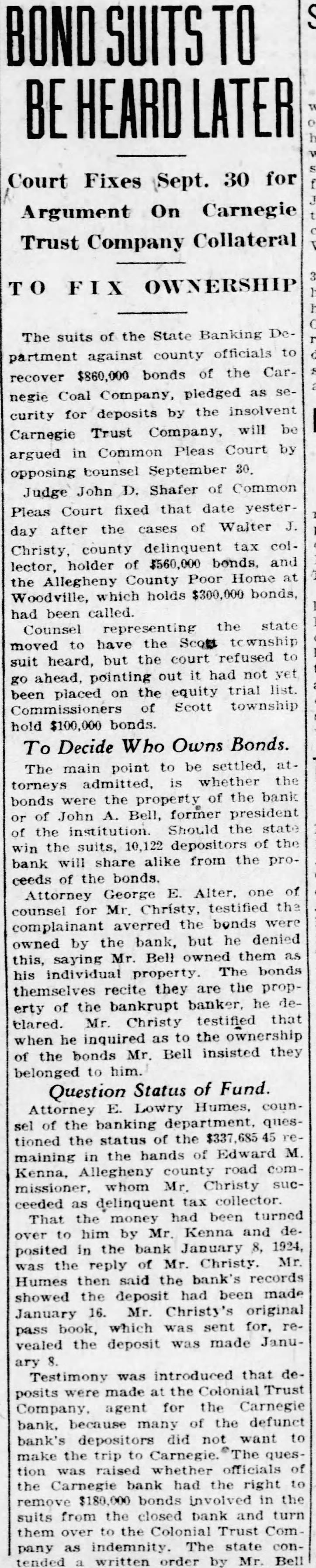
Court Fixes Sept. 30 for Argument On Carnegie Trust Company Collateral
TO FIX OWNERSHIP
The suits of the State Banking Department against county officials to recover $860,000 bonds of the Carnegie Coal Company, pledged as security for deposits by the insolvent Carnegie Trust Company, will be argued in Common Pleas Court by opposing bounsel September 30. Judge John D. Shafer of Common Pleas Court fixed that date yester day after the cases of Walter J. Christy county delinquent tax collector, holder of $560,000 bonds. and the Allegheny County Poor Home at Woodville, which holds $300,000 bonds, had been called. Counsel representing the state moved to have the Scott wnship suit heard, but the court refused to go ahead, pointing out it had not yet been placed on the equity trial list. Commissioners of Scott township hold $100,000 bonds.
To Decide Who Owns Bonds. The main point to be settled, attorneys admitted. is whether the bonds were the property of the bank or of John A. Bell, former president of the institution Should the state win the suits, 10,122 depositors of the bank will share alike from the proceeds of the bonds. Attorney George E. Alter. one of counsel for Mr. Christy. testified the complainant averred the bonds were owned by the bank, but he denied this, saying Mr. Bell owned them as his individual property The bonds themselves recite they are the property of the bankrupt banker. he declared. Mr. Christy testified that when he inquired as to the ownership of the bonds Mr. Bell insisted they belonged to him.
Question Status of Fund. Attorney E. Lowry Humes, counsel of the banking department. questioned the status of the 45 maining in the hands of Edward M Kenna, Allegheny county road commissioner, whom Mr. Christy succeeded as delinquent tax collector. That the money had been turned over to him by Mr. Kenna and de. posited in the bank January 8, 1924, was the reply of Mr. Christy. Mr. Humes then said the bank's records showed the deposit had been made January 16. Mr. Christy's original pass book, which sent for, revealed the deposit was made January Testimony was introduced that deposits were made at the Colonial Trust Company. agent for the Carnegie bank. because many of the defunct bank's depositors did not want to make the trip to Carnegie. *The question was raised whether officials of the Carnegie bank had the right to remove $180,000 bonds involved in the suits from the closed bank and turn them over to the Colonial Trust Com. pany as indemnity. The state contended written order by Mr. Bell
Click image to open full size in new tab
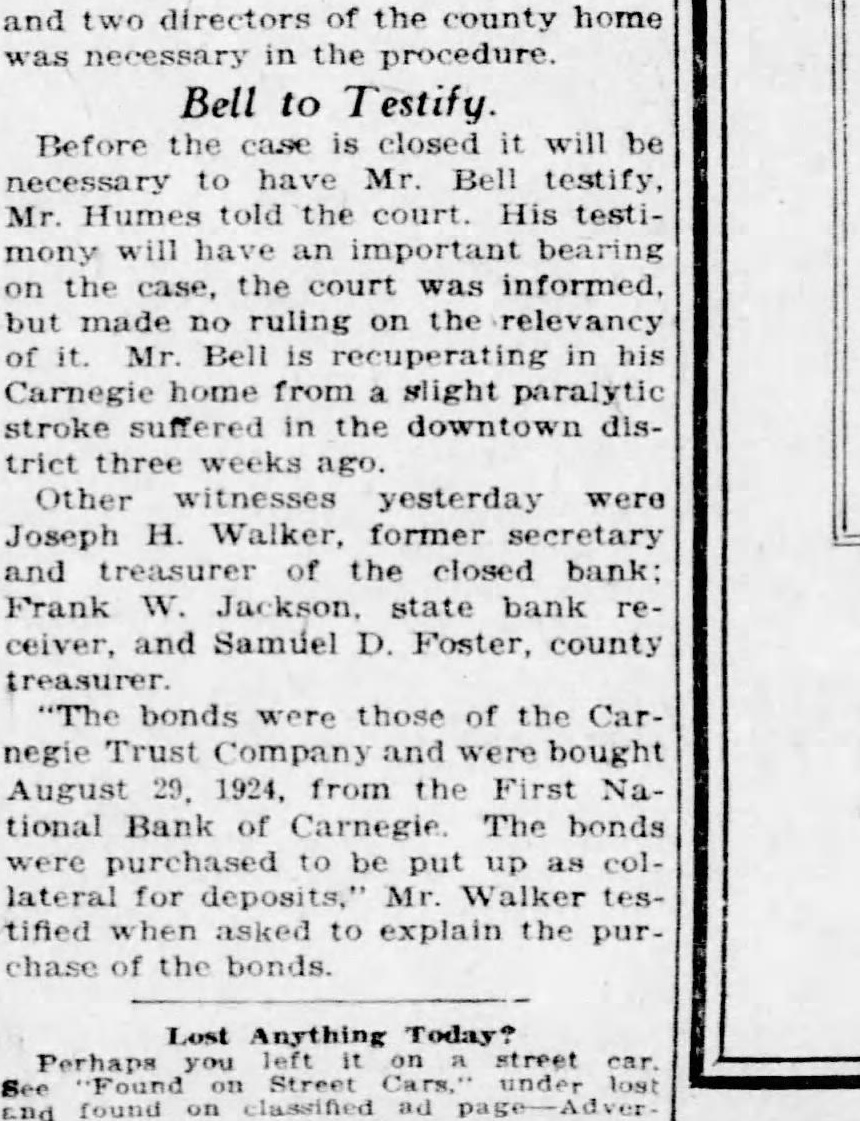
and two directors of the county home was necessary in the procedure. Bell to Testify.
Before the case is closed it will be necessary to have Mr Bell testify. Mr. Humes told the court His testimony will have an important bearing on the case, the court was informed. but made no ruling on the relevancy of it. Mr Bell is recuperating in his Carnegie home from slight paralytic stroke suffered in the downtown district three weeks ago. Other witnesses yesterday were Joseph H. Walker, former secretary and treasurer of the closed bank: Frank W. Jackson. state bank receiver, and Samuel D. Foster, county treasurer "The bonds were those of the Carnegie Trust Company and bought August 29. 1924. from the First National Bank of Carnegie. The bonds were purchased to be put up as collateral for deposits," Mr. Walker testified when asked to explain the purchase of the bonds.
Lost Anything Today? Perhaps street found
Click image to open full size in new tab
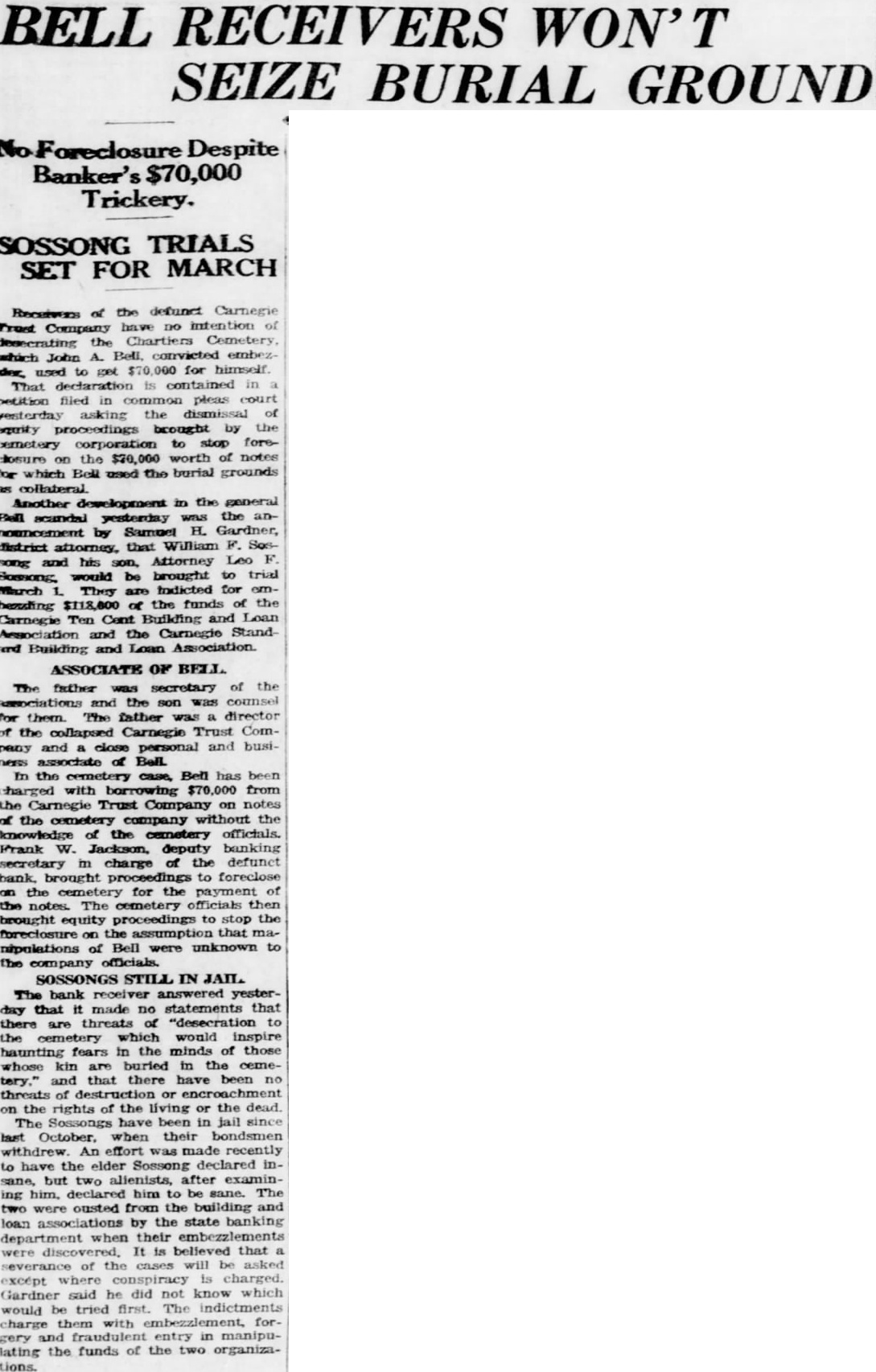
Banker's $70,000 Trickery.
SOSSONG TRIALS SET FOR MARCH
Receivers of the defunct Carnegie Trust Company have no intention of desecrating the Chartiers Cemetery. which John A. * used to get $70,000 for himself That contained petition filed in pleas court asking the of yesterday equity proceedings brought by the cemetery corporation to stop foreclosure on the $70,000 worth of notes for which Bell used the burial grounds collateral Another development in the general Bell scandal yesterday was the annonncement by Samuel H. Gardner, district attorney, that William F. SesAttorney Leo F. song and his Sussong, would be brought to trial March 1. They are Indicted for emhearting $118,800 of the funds of the Carnegie Ten Cent Building and Loan Association and the Carnegie Standand Building and Loan Association
ASSOCIATE OF BELL
The father was secretary of the and the son counsel for them. The father was director of the collapsed Carnegie Trust Company and a close personal and business associate of Bell. In the case, Bell has been charged with borrowing $70,000 from the Carnegie Trust Company on notes of the cemetery company without the knowledge of the cemetery officials. Frank W. Jackson, deputy banking secretary m charge of the defunct bank, brought proceedings to foreclose on the cemetery for the payment of the notes. The cemetery officials then brought equity proceedings to stop the foreclosure on the assumption that manipulations of Bell were unknown to the company officials. SOSSONGS STILL IN JAIL The bank receiver answered yesterday that it made no statements that there are threats of "desecration to the cemetery which would inspire haunting fears in the minds of those whose kin are burled in the cemetery," and that there have been no threats of encroachment on the rights of the living or the dead. The Sessongs have been in jail since last October, when their bondsmen withdrew. An effort was made recently to have the elder Sossong declared insane, but two alienists, after examining him, declared him to be sane. The two were ousted from the building and loan associations by the state banking department when their embezzlements discovered, It is believed that a severance of the cases be asked where is charged. Gardner said he did not know which would be tried first. The indictments charge them with forgery and entry in manipulating the funds of the two organizations.