Closed by the state bank commissioner Sept 25, 1920; later dividend payments in 1927 indicate liquidation rather than reopening.
Events (3)
1.September 8, 1920Run
Cause
Bank Specific Adverse Info
Cause Details
Large withdrawals driven by the bank's slow/bad loans and resulting loss of confidence; withdrawals of >$3,000,000 between Sept. 8 and Sept. 24.
Newspaper Excerpt
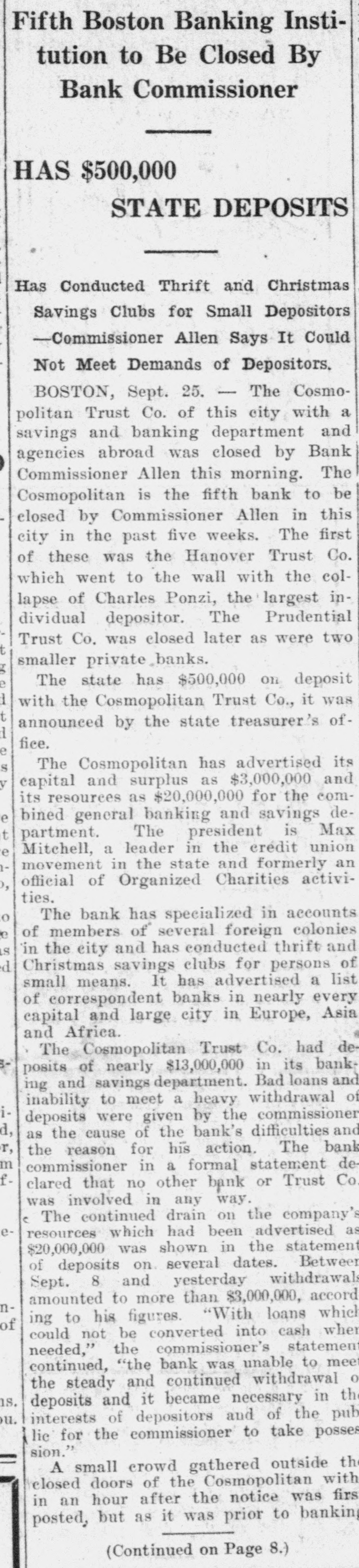
Between Sept. 8 and yesterday withdrawals amounted to more than $3,000,000, according to his figures.
Source
newspapers
+17 days
2.September 25, 1920Suspension
Cause
Government Action
Cause Details
State Bank Commissioner Joseph C. Allen took possession and closed the bank after steady withdrawals and inability to meet demands due to slow and doubtful loans.
Newspaper Excerpt
The Cosmopolitan Trust Co. ... was closed by Bank Commissioner Allen this morning.
Source
newspapers
+6.5 years
3.March 10, 1927Other
Newspaper Excerpt
Hub bank pays dividends ... commercial depositors of the Cosmopolitan Trust (Boston) closed 1920 by the commissioner of banks ... This dividend makes total of returned depositors ... at expiration year these must be turned into the state treasury.
Fifth Boston Banking Institution to Be Closed By Bank Commissioner HAS $500,000 STATE DEPOSITS Has Conducted Thrift and Christmas Savings Clubs for Small Depositors -Commissioner Allen Says It Could Not Meet Demands of Depositors. BOSTON, Sept. 25. - The Cosmopolitan Trust Co. of this city with a savings and banking department and agencies abroad was closed by Bank Commissioner Allen this morning. The Cosmopolitan is the fifth bank to be closed by Commissioner Allen in this city in the past five weeks. The first of these was the Hanover Trust Co. which went to the wall with the collapse of Charles Ponzi, the largest individual depositor. The Prudential Trust Co. was closed later as were two smaller private banks. The state has $500,000 on deposit I with the Cosmopolitan Trust Co., it was announced by the state treasurer's of fice. The Cosmopolitan has advertised its capital and surplus as $3,000,000 and its resources as $20,000,000 for the comle bined general banking and savings det partment. The president is Max e Mitchell, a leader in the crédit union movement in the state and formerly an official of Organized Charities activi, ties. o The bank has specialized in accounts e of members of several foreign colonies is in the city and has conducted thrift and d Christmas savings clubs for persons of small means. It has advertised a list of correspondent banks in nearly every capital and large city in Europe, Asia and Africa. The Cosmopolitan Trust Co. had deposits of nearly $13,000,000 in its banking and savings department. Bad loans and inability to meet a heavy withdrawal of deposits were given by the commissioner d, as the cause of the bank's difficulties and r, the reason for his action. The bank m commissioner in a formal statement def clared that no other bank or Trust Co. was involved in any way. c The continued drain on the company's resources which had been advertised as $20,000,000 was shown in the statement of deposits on several dates. Between Sept. 8 and yesterday withdrawals amounted to more than $3,000,000, accord ning to his figures. "With loans which of could not be converted into cash when needed," the commissioner's statement continued, "the bank was unable to meet the steady and continued withdrawal o deposits and it became necessary in th interests of depositors and of the pub lic for the commissioner to take posses sion." A small crowd gathered outside th closed doors of the Cosmopolitan with in an hour after the notice was firs posted, but as it was prior to bankini (Continued on Page 8.)
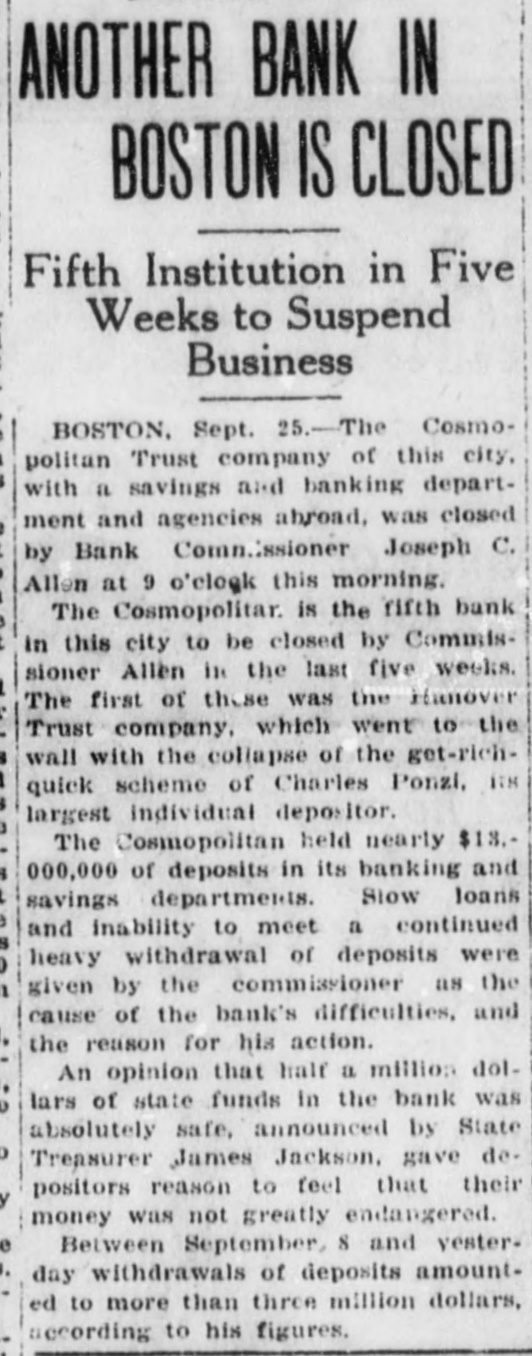
ANOTHER BANK IN BOSTON IS CLOSED Fifth Institution in Five Weeks to Suspend Business BOSTON, Sept. 25.-The Cosmopolitan Trust company of this city, with a savings and banking department and agencies abroad, was closed by Bank Comn.ssioner Joseph C. Allen at 9 o'clogk this morning. The Cosmopolitar. is the fifth bank in this city to be closed by Commissioner Allen in the last five weeks. The first of those was the Hanover Trust company, which went to the wall with the collapse of the get-richquick scheme of Charles Ponzi, 118 largest individual depositor. The Cosmopolitan held nearly $13.000,000 of deposits in its banking and savings departments. Slow loans and inability to meet a continued heavy withdrawal of deposits were given by the commissioner as the cause of the bank's difficulties, and the reason for his action. An opinion that half a million dollars of state funds in the bank was absolutely safe, announced by State Treasurer James Jackson, gave depositors reason to feel that their money was not greatly endangered. Between September, 8 and yesterday withdrawals of deposits amounted to more than three million dollars, according to his figures.
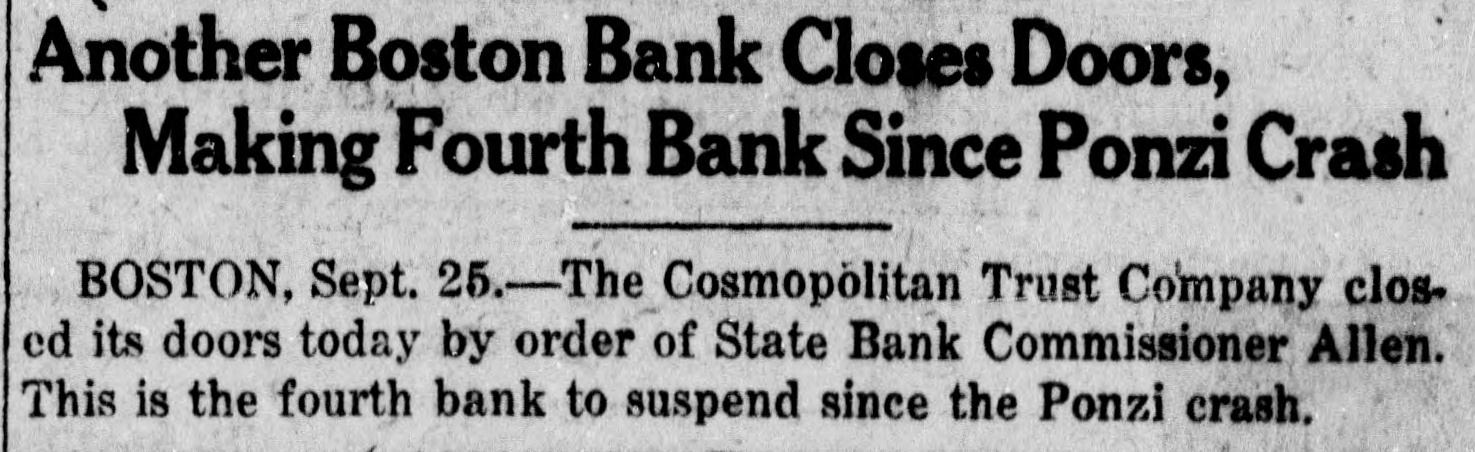
Another Boston Bank Closes Doors, Making Fourth Bank Since Ponzi Crash BOSTON, Sept. 25.-The Cosmopolitan Trust Company closed its doors today by order of State Bank Commissioner Allen. This is the fourth bank to suspend since the Ponzi crash.
4.September 26, 1920Great Falls Daily TribuneGreat Falls, MT
Click image to open full size in new tab
Article Text
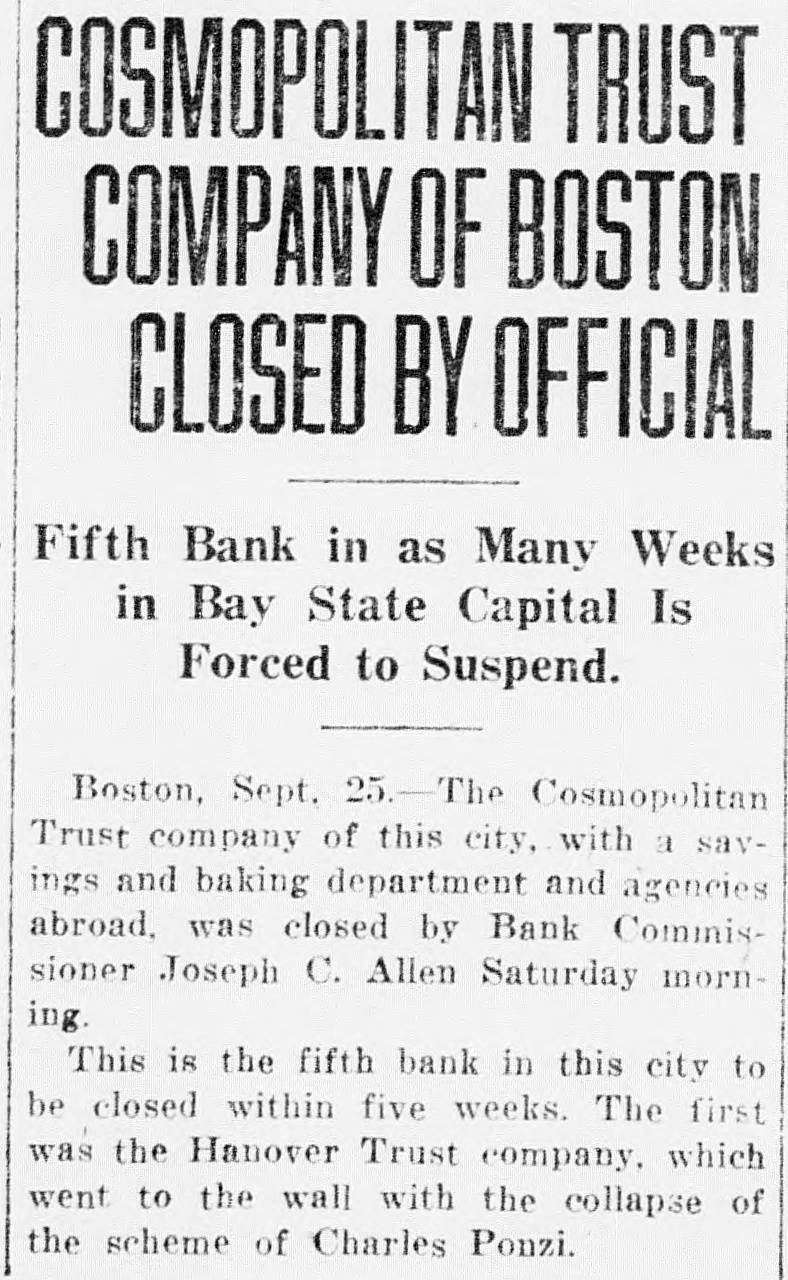
COSMOPOLITAN T TRUST COMPANY OF BOSTON CLOSED BY OFFICIAL Fifth Bank in as Many Weeks in Bay State Capital Is Forced to Suspend. Boston, Sept. 25.-The Cosmopolitan Trust company of this city, with a savings and baking department and agencies abroad. was closed by Bank Commissioner Joseph C. Allen Saturday morning. This is the fifth bank in this city to be closed within five weeks. The first was the Hanover Trust company. which went to the wall with the collapse of the scheme of Charles Ponzi.
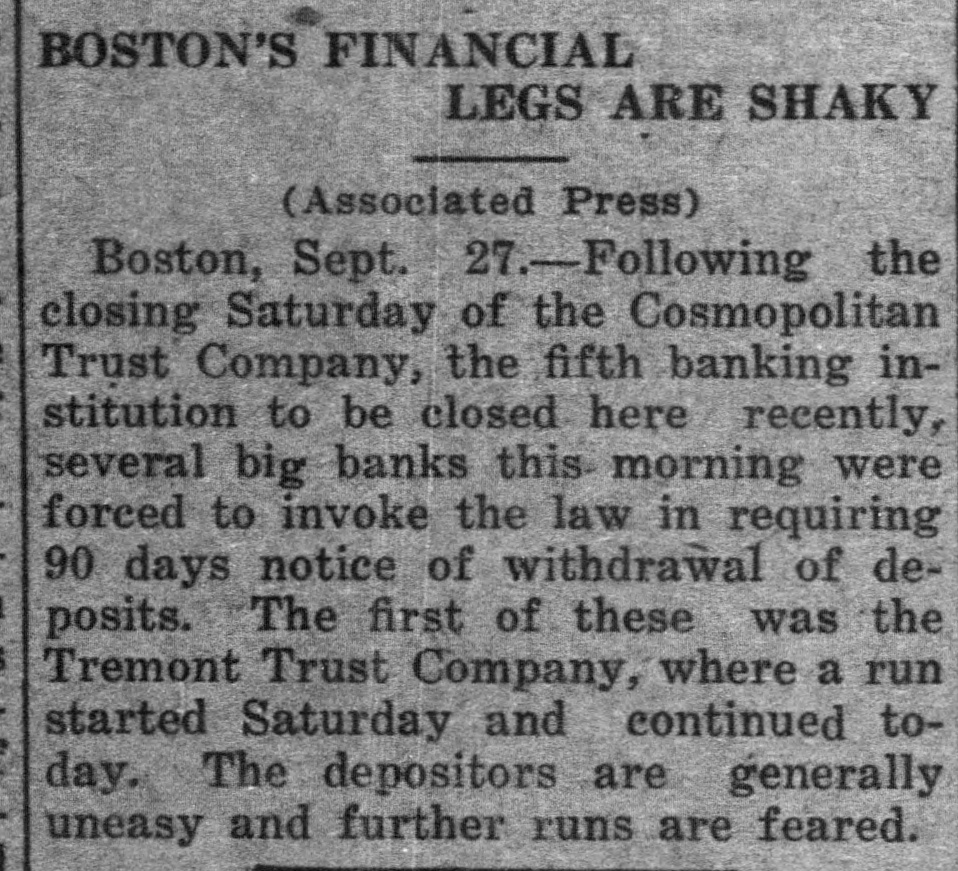
BOSTON'S FINANCIAL LEGS ARE SHAKY (Associated Press) Boston, Sept. 27.-Following the closing Saturday of the Cosmopolitan Trust Company, the fifth banking institution to be closed here recently, several big banks this morning were forced to invoke the law in requiring 90 days notice of withdrawal of deposits. The first of these was the Tremont Trust Company, where a run started Saturday and continued today. The depositors are generally uneasy and further runs are feared.
6.September 27, 1920Evening Times-RepublicanMarshalltown, IA
Click image to open full size in new tab
Article Text
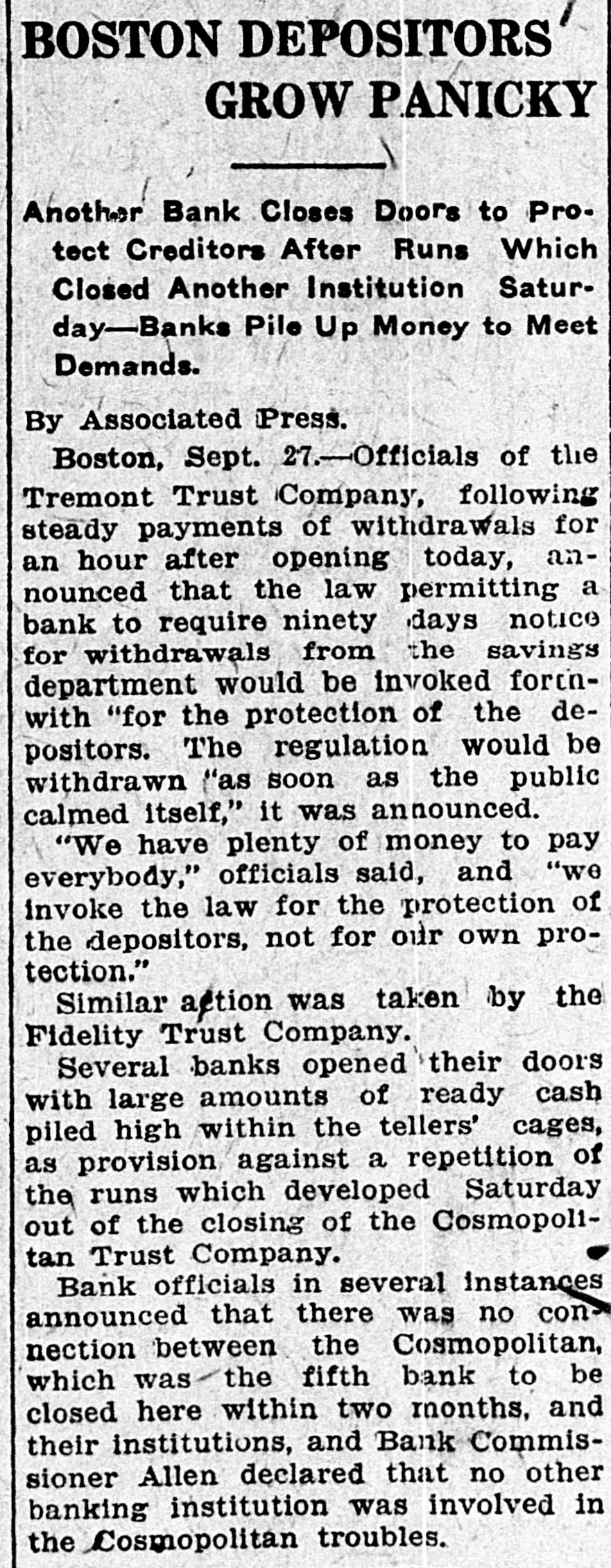
BOSTON DEPOSITORS GROW PANICKY Another Bank Closes Doors to Pro. tect Creditors After Runs Which Closed Another Institution Saturday-Banks Pile Up Money to Meet Demands. By Associated Press. Boston, Sept. 27.-Officials of the Tremont Trust Company, following steady payments of withdrawals for an hour after opening today, announced that the law permitting a bank to require ninety days notice for withdrawals from the savings department would be invoked forcnwith "for the protection of the depositors. The regulation would be withdrawn "as soon as the public calmed itself," it was announced. "We have plenty of money to pay everybody," officials said, and "we invoke the law for the protection of the depositors, not for our own protection." Similar action was taken by the Fidelity Trust Company. Several banks opened their doors with large amounts of ready cash piled high within the tellers' cages, as provision against a repetition of the runs which developed Saturday out of the closing of the Cosmopolitan Trust Company. Bank officials in several instances announced that there was no con nection between the Cosmopolitan, which was the fifth bank to be closed here within two months, and their institutions, and Bank Commissioner Allen declared that no other banking institution was involved in the Cosmopolitan troubles.
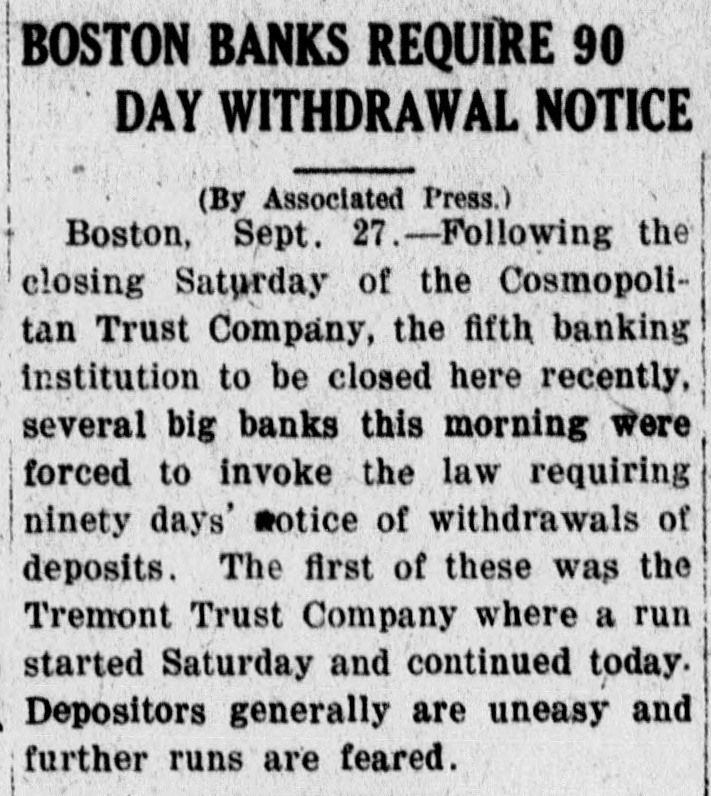
BOSTON BANKS REQUIRE 90 DAY WITHDRAWAL NOTICE (By Associated Press.) Boston, Sept. 27.-Following the closing Saturday of the Cosmopolitan Trust Company, the fifth banking institution to be closed here recently, several big banks this morning were forced to invoke the law requiring ninety days' notice of withdrawals of deposits. The first of these was the Tremont Trust Company where a run started Saturday and continued today. Depositors generally are uneasy and further runs are feared.
8.September 27, 1920East Oregonian : E.OPendleton, OR
Click image to open full size in new tab
Article Text
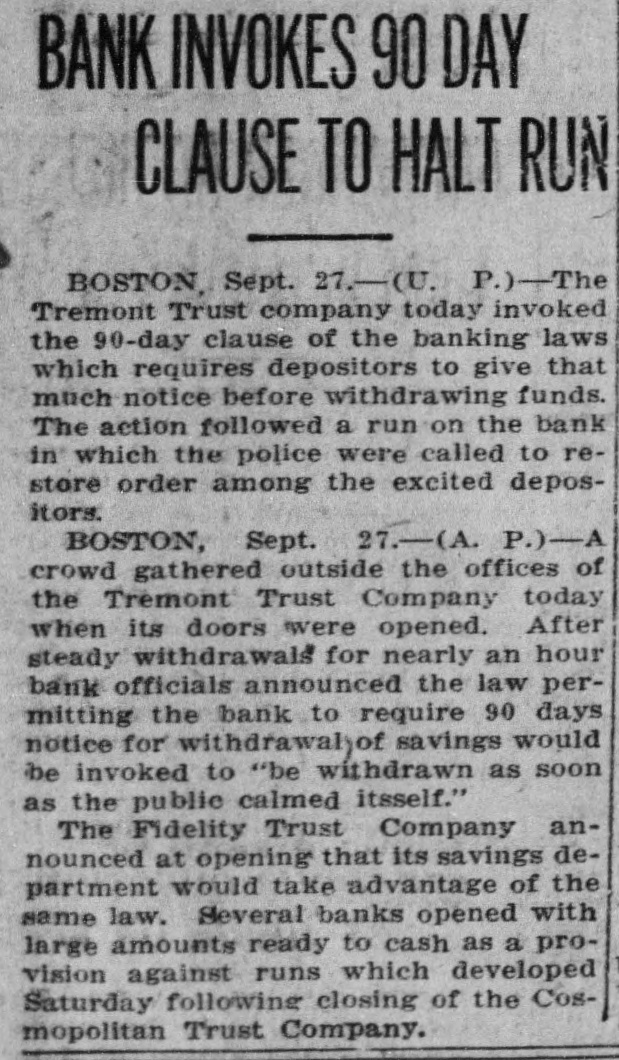
BANK INVOKES 90 DAY CLAUSE TO HALT RUN BOSTON, Sept. 27.-(U. P.)-The Tremont Trust company today invoked the 90-day clause of the banking laws which requires depositors to give that much notice before withdrawing funds. The action followed a run on the bank in which the police were called to restore order among the excited depositors. BOSTON, Sept. 27.-(A. P.)-A crowd gathered outside the offices of the Tremont Trust Company today when its doors were opened. After steady withdrawals for nearly an hour bank officials announced the law permitting the bank to require 90 days notice for withdrawaly of savings would be invoked to "be withdrawn as soon as the public calmed itsself." The Fidelity Trust Company announced at opening that its savings department would take advantage of the same law. Several banks opened with large amounts ready to cash as a provision against runs which developed Saturday following closing of the Cosmopolitan Trust Company.
9.September 28, 1920The Bismarck TribuneBismarck, Mandan, ND
Click image to open full size in new tab
Article Text
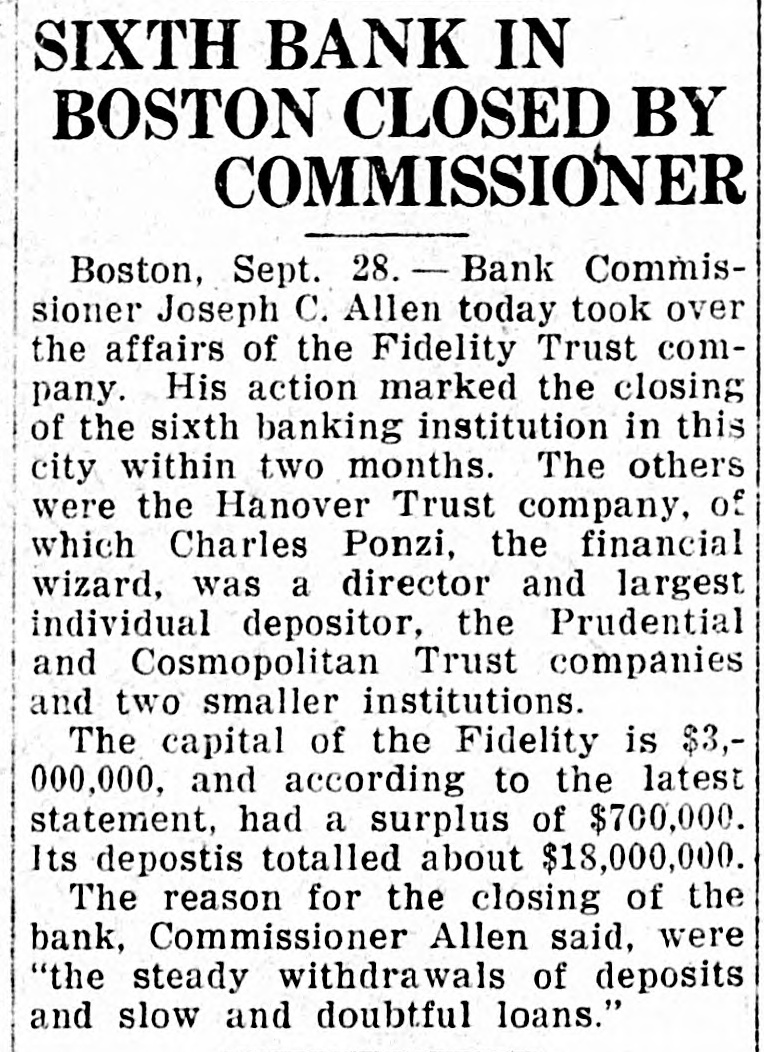
SIXTH BANK IN BOSTON CLOSED BY COMMISSIONER Boston, Sept. 28. - Bank Commissioner Joseph C. Allen today took over the affairs of the Fidelity Trust company. His action marked the closing of the sixth banking institution in this city within two months. The others were the Hanover Trust company, of which Charles Ponzi, the financial wizard, was a director and largest individual depositor, the Prudential and Cosmopolitan Trust companies and two smaller institutions. The capital of the Fidelity is $3,000,000, and according to the latest statement, had a surplus of $700,000. Its depostis totalled about $18,000,000. The reason for the closing of the bank, Commissioner Allen said, were "the steady withdrawals of deposits and slow and doubtful loans."
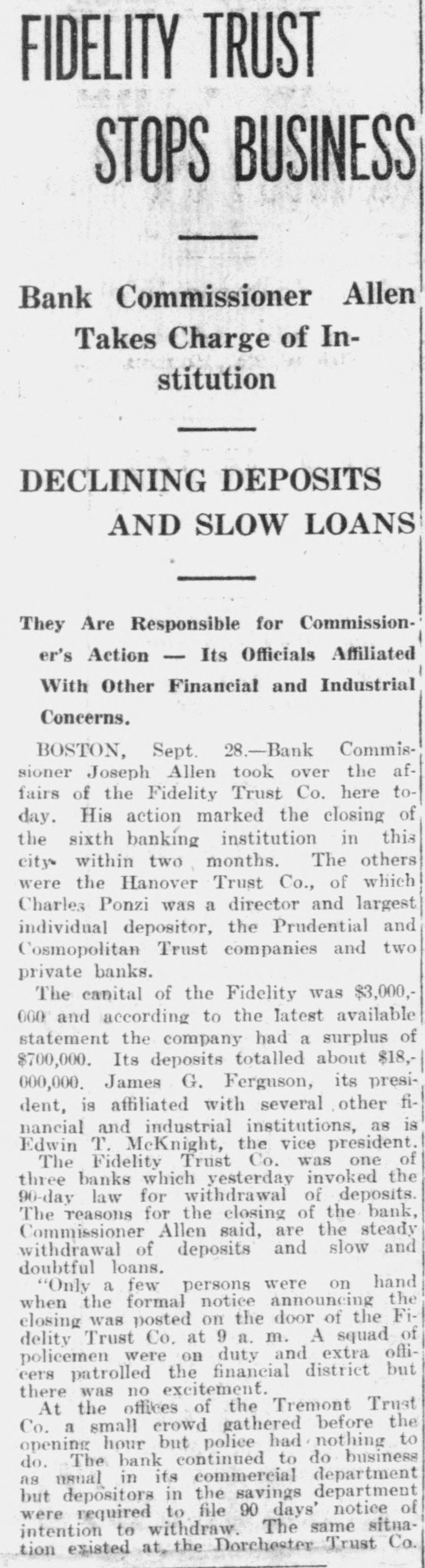
FIDELITY TRUST STOPS BUSINESS Bank Commissioner Allen Takes Charge of Institution DECLINING DEPOSITS AND SLOW LOANS They Are Responsible for Commissioner's Action - Its Officials Affiliated With Other Financial and Industrial Concerns. BOSTON, Sept. 28.-Bank Commissioner Joseph Allen took over the affairs of the Fidelity Trust Co. here today. His action marked the closing of the sixth banking institution in this city= within two months. The others were the Hanover Trust Co., of which Charles Ponzi was a director and largest individual depositor, the Prudential and Cosmopolitan Trust companies and two private banks. The canital of the Fidelity was $3,000,000 and according to the latest available statement the company had a surplus of $700,000. Its deposits totalled about $18,000,000. James G. Ferguson, its president, is affiliated with several other financial and industrial institutions, as is Edwin T. McKnight, the vice president. The Fidelity Trust Co. was one of three banks which yesterday invoked the 90-day law for withdrawal of deposits. The reasons for the closing of the bank, Commissioner Allen said, are the steady withdrawal of deposits and slow and doubtful loans. 'Only a few persons were on hand when the formal notice announcing the closing was posted on the door of the Fidelity Trust Co. at 9 a. m. A squad of policement were on duty and extra officers patrolled the financial district but there was no excitement. At the offices of the Tremont Trust Co. a small crowd gathered before the opening hour but police had nothing to do. The bank continued to do business as usual in its commercial department but depositors in the savings department were required to file 90 days' notice of intention to withdraw. The same sitnation existed at. the Dorchester Trust Co.
11.September 29, 1920The Watchman and SouthronSumter, SC
Click image to open full size in new tab
Article Text
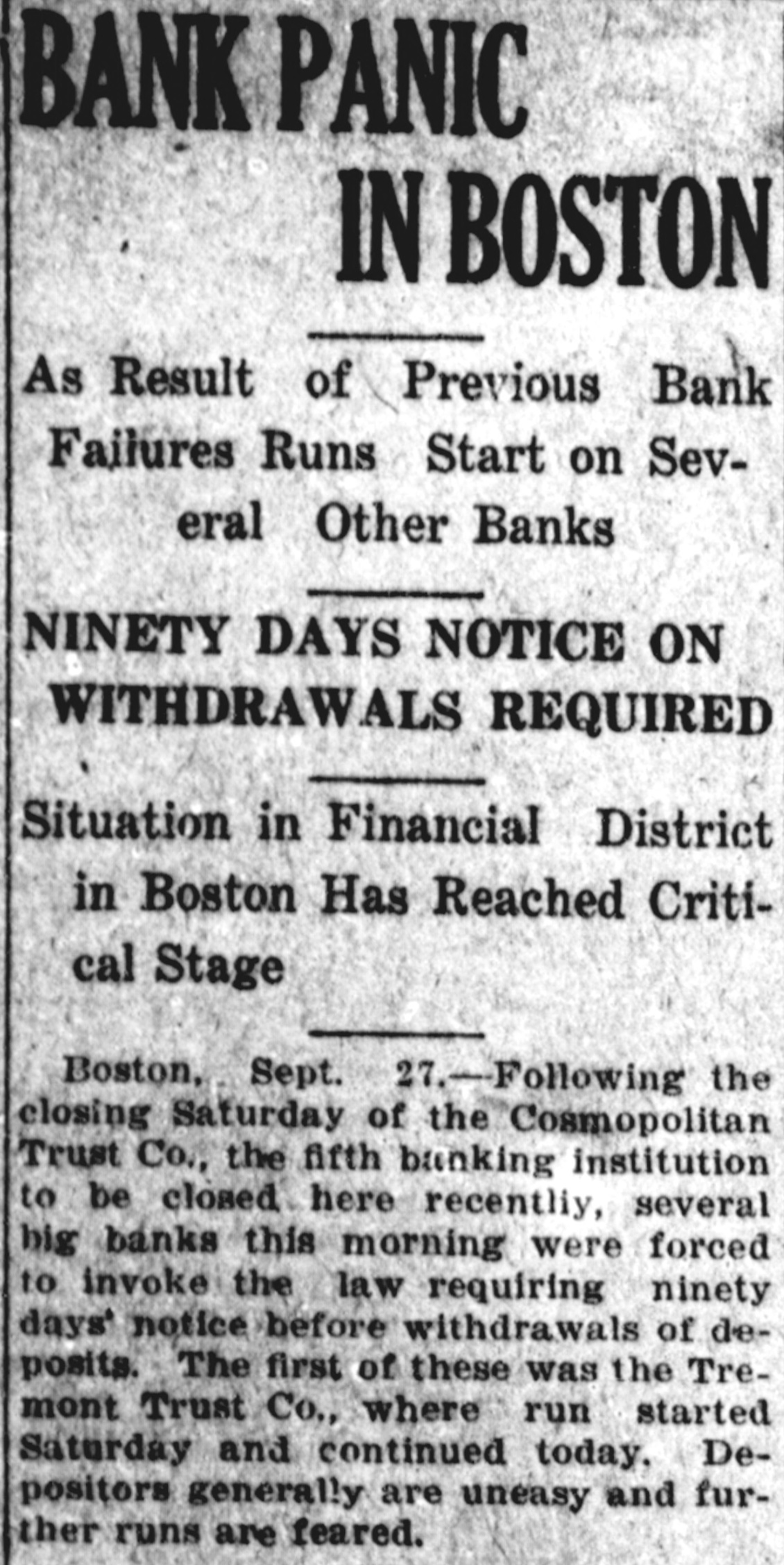
BANK PANIC IN BOSTON As Result of Previous Bank Failures Runs Start on Several Other Banks NINETY DAYS NOTICE ON WITHDRAWALS REQUIRED Situation in Financial District in Boston Has Reached Critical Stage Boston, Sept. 27.-Following the closing Saturday of the Cosmopolitan Trust Co., the fifth banking institution to be closed here recentliy, several hig banks this morning were forced to invoke the law requiring ninety days' notice before withdrawals of deposits. The first of these was the Tremont Trust Co., where run started Saturday and continued today. Depositors generally are uneasy and further runs are feared.
12.September 30, 1920The Telegraph-CourierKenosha, WI
Click image to open full size in new tab
Article Text
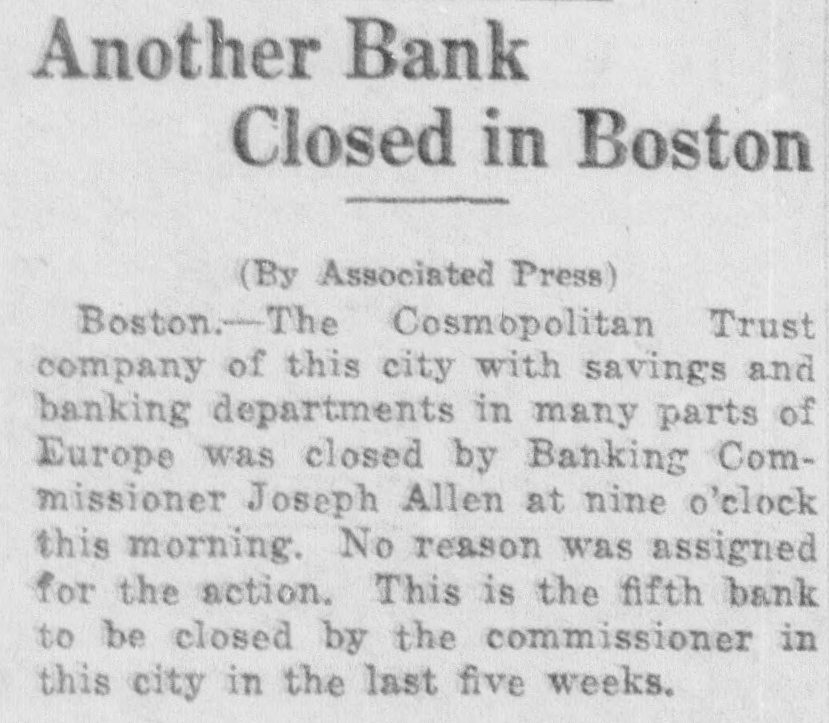
Another Bank Closed in Boston (By Associated Press) Boston.-The Cosmopolitan Trust company of this city with savings and banking departments in many parts of Europe was closed by Banking Commissioner Joseph Allen at nine o'clock this morning. No reason was assigned for the action. This is the fifth bank to be closed by the commissioner in this city in the last five weeks.
13.October 1, 1920Clearwater RepublicanOrofino, ID
Click image to open full size in new tab
Article Text
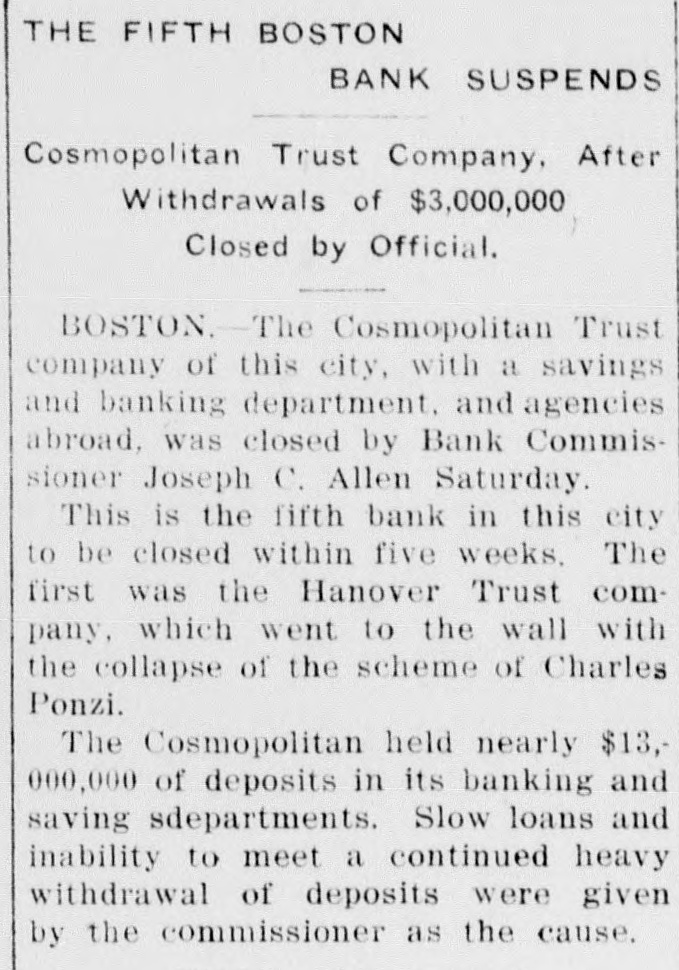
THE FIFTH BOSTON BANK SUSPENDS Cosmopolitan Trust Company, After Withdrawals of $3,000,000 Closed by Official. BOSTON.-The Cosmopolitan Trust company of this city, with a savings and banking department, and agencies abroad, was closed by Bank Commissioner Joseph C. Allen Saturday. This is the fifth bank in this city to be closed within five weeks, The first was the Hanover Trust company, which went to the wall with the collapse of the scheme of Charles Ponzi. The Cosmopolitan held nearly $13,000,000 of deposits in its banking and saving sdepartments. Slow loans and inability to meet a continued heavy withdrawal of deposits were given by the commissioner as the cause.
14.March 10, 1927Springfield Weekly RepublicanSpringfield, MA
Click image to open full size in new tab
Article Text
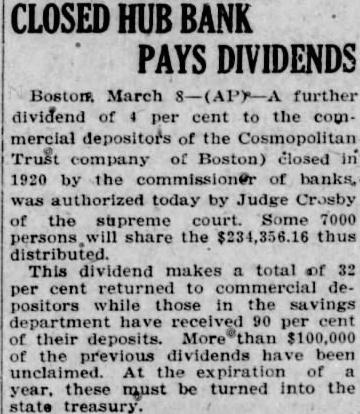
HUB BANK PAYS DIVIDENDS
Boston March further dividend cent the commercial depositors of the Cosmopolitan Trust Boston) closed 1920 by the commissioner of banks, today by Judge Crosby of the supreme Some share the This dividend makes total of returned positors while those the received cent their deposits. dividends been unclaimed. At expiration year. these must be turned into the state treasury.
Bank runs are almost always and everywhere a deterioration of bank fundamentals.
But not for you.
You are the measure-zero exception: great fundamentals, solid bank, and yet the Diamond Dybvig fairy spread its rumor. Depositors woke up. Your collateral was not prepositioned. The Clearinghouse had it for you.
Do not pass Go. Do not collect $200. Go directly to jail… or worse.
Flag Article for Review
Flag Episode for Review
Cosmopolitan Trust Company · Episode ID 5015071449