Prudential Trust Company (Boston, MA)

Episode Information

Episode UID
5015971449
Episode Type
Suspension → Closure
Bank Type
trust
Bank ID
501597 routing
Routing Number
5-0159
Start Date
September 10, 1920
Location
Boston, Massachusetts (42.358, -71.060)

Metadata

Model
gpt-5-mini (chosen from majority vote of a three-model LLM ensemble)
Short Digest
a376b496dabc3428

Response Measures

None

Events (1)

1. September 10, 1920 Suspension
Cause
Government Action
Cause Details
Taken over by Massachusetts Bank Commissioner after steady withdrawals and many bad and slow loans disclosed in a special examination.
Newspaper Excerpt
Under the authority vested in me by law, I hereby take possession of the affairs and business of the Prudential Trust Co.
Source
newspapers

Newspaper Articles (15)

Article from Evening Public Ledger, September 10, 1920

Click image to open full size in new tab

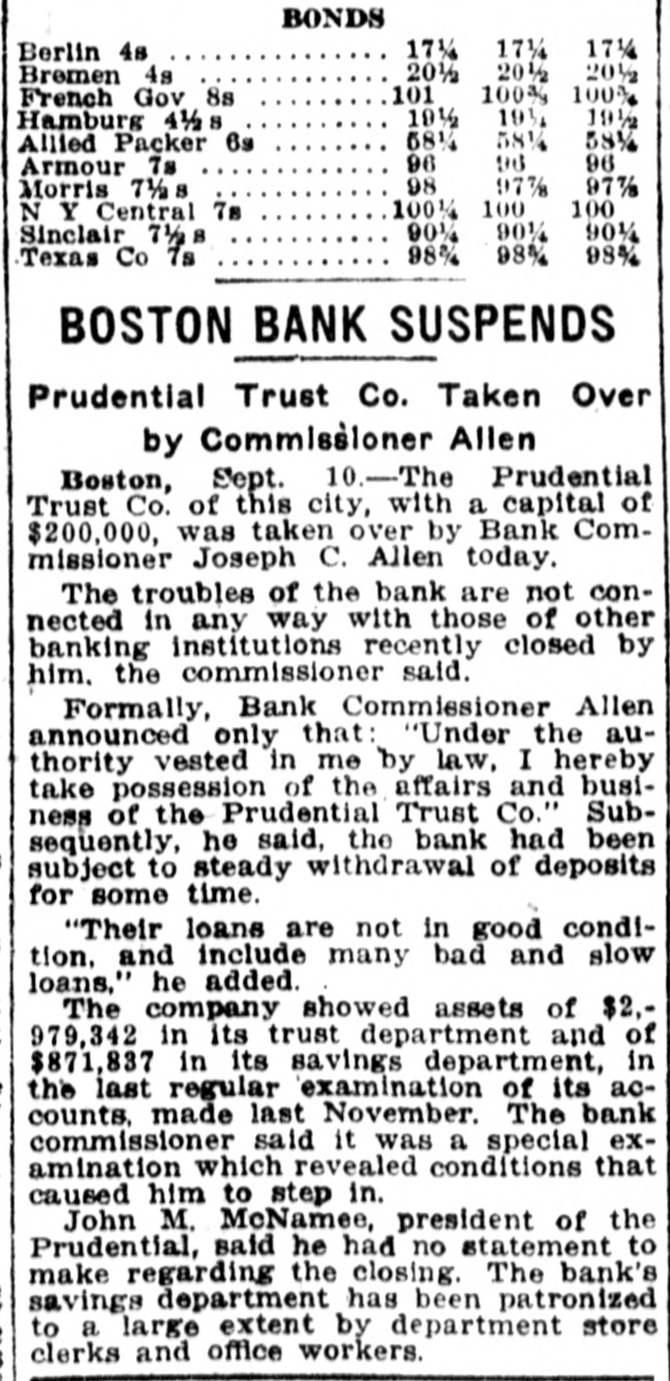
Article Text

BONDS 17½ 17½ 17½ Berlin 4s 20½ 20½ 20½ Bremen 4s 101 100% 100% French Gov 8s 19½ 19½ 19½ Hamburg 41/28 58½ 58% 58% Allied Packer 6g 96 96 96 Armour 7a 98 97% 97% Morris 7½ 100 100 1001/4 N Y Central 7s 90% 901/4 901/4 Sinclair 7½8 98% 98% 98% Texas Co 7s BOSTON BANK SUSPENDS Prudential Trust Co. Taken Over by Commissioner Allen Boston, Sept. 10.-The Prudential Trust Co. of this city, with a capital of $200,000, was taken over by Bank Commissioner Joseph C. Allen today. The troubles of the bank are not connected in any way with those of other banking institutions recently closed by him. the commissioner said. Formally, Bank Commissioner Allen announced only that: "Under the authority vested in me by law, I hereby take possession of the affairs and business of the Prudential Trust Co." Subsequently, he said, the bank had been subject to steady withdrawal of deposits for some time. "Their loans are not in good condition. and include many bad and slow loans," he added. The company showed assets of $2,979,342 in its trust department and of $871,837 in its savings department, in the last regular examination of its accounts, made last November. The bank commissioner said it was a special examination which revealed conditions that caused him to step in. John M. McNamee, president of the Prudential, said he had no statement to make regarding the closing. The bank's savings department has been patronized to a large extent by department store clerks and office workers.

Article from The Brattleboro Daily Reformer, September 10, 1920

Click image to open full size in new tab

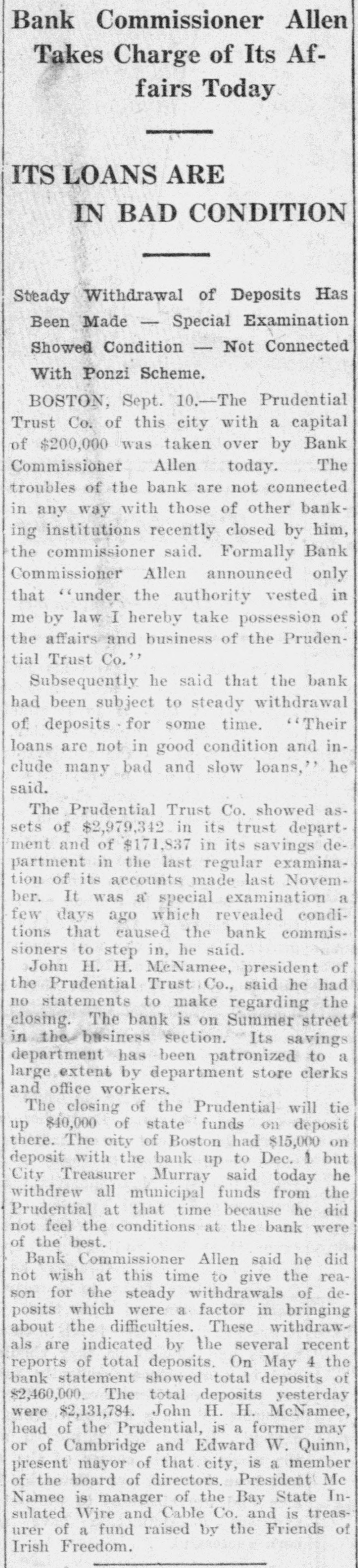
Article Text

Bank Commissioner Allen Takes Charge of Its Affairs Today ITS LOANS ARE IN BAD CONDITION Steady Withdrawal of Deposits Has Been Made - Special Examination Showed Condition - Not Connected With Ponzi Scheme. BOSTON, Sept. 10.-The Prudential Trust Co. of this city with a capital of $200,000 was taken over by Bank Commissioner Allen today. The troubles of the bank are not connected in any way with those of other banking institutions recently closed by him, the commissioner said. Formally Bank Commissioner Allen announced only that "under the authority vested in me by law I hereby take possession of the affairs and business of the Prudential Trust Co.'' Subsequently he said that the bank had been subject to steady withdrawal of deposits for some time. "Their loans are not in good condition and include many bad and slow loans," he said. The Prudential Trust Co. showed assets of $2,979,342 in its trust department and of $171,837 in its savings department in the last regular examination of its accounts made last November. It was a' special examination a few days ago which revealed conditions that caused the bank commissioners to step in. he said. John H. H. McNamee, president of the Prudential Trust Co., said he had no statements to make regarding the closing. The bank is on Summer street in the business section. Its savings department has been patronized to a large extent by department store clerks and office workers. The closing of the Prudential will tie up $40,000 of state funds on deposit there. The city of Boston had $15,000 on deposit with the bank up to Dec. 1 but City Treasurer Murray said today he withdrew all municipal funds from the Prudential at that time because he did not feel the conditions at the bank were of the best. Bank Commissioner Allen said he did not wish at this time to give the reason for the steady withdrawals of deposits which were a factor in bringing about the difficulties. These withdrawals are indicated by the several recent reports of total deposits. On May 4 the bank statement showed total deposits of $2,460,000. The total deposits yesterday were $2,131,784. John H. H. McNamee, head of the Prudential, is a former may or of Cambridge and Edward W. Quinn, present mayor of that city, is a member of the board of directors, President Mc Namee is manager of the Bay State Insulated Wire and Cable Co. and is treasurer of a fund raised by the Friends of Irish Freedom.

Article from The Barre Daily Times, September 10, 1920

Click image to open full size in new tab

Article Text

BANK'S LOANS SLOW AND BAD So Massachusetts Bank Commissioner Closed Prudential Trust CONDITIONS WERE UNSATISFATORY Prudential Trust Co. Had No Connections With Banks Recently Closed Boston, Sept. 10.-The Prudential Trust Co. of this city, with a capital of $200,000, was taken over by Bank Commissioner Joseph C. Allen to-day. The troubles of the bank are not connected in any way with those of other banking institutions recently closed by him. the commissioner said. Formally, Bank Commissioner Allen announced only that "under the authority vested in me by law, I hereby take possession of the affairs and business of the Prudential Trust Co." Subsequently, he said that the bank had been subject to steady withdrawal of deposits for some time. "Their loans are not in good condition, and include many bad and slow loans," he said. The Prudential Trust Co. showed as sets of $2,979,342 in its trust depart ment, and of $871,837 in its savings department on the last regular examination of its accounts made last No. vember. It was a special examination 1 a few days ago, which revealed conditions that caused the bank commissioner to step in, he said. John H. H. McNamee, president of a the Prudential Trust Co., said he had a no statement to make regarding the r h closing. The bank is on Summer street, in the business section. Its savings dei partment has been patronized to a t large extent by department store clerks and office workers. e The closing of the Prudential will I e tie up $40,000 of state funds on den posit there. The city of Boston had $15,000 on deposit with the bank up to a last December, but City Treasurer b u Murray said to-day that he withdrew all municipal/ funds from the PrudenIf tial at that time because he did not a feel that conditions at the bank were o of the best. M Bank Commissioner Allen said he did in not wish at this time to give the rea P son for the steady withdrawals of de o posts which were a factor in bringing about the bank's difficulties. t These withdrawals are indicated by li the several recent reports of deposits. M to On May 8 the bank's statement to the commissioner showed total deposits of o $2,460,000. On June 30. the last staten ment filed by the bank gave total deu posits as $2,270,174. The total deposits tr yesterday were $2,131,784. b John H. H. McNamee, head of the a Prudential. is a former mayor of Cam bridge, and Edward W. Quinn, present al in mayor of that city, is a member of the board of directors. President Me b Namee is manager of the Bay State Inw sulated Wire and Cable company, and A is treasurer of a fund raised by the of Friends of Irish Freedom. Other direcdr tors of the bank include Michael A. th O'Leay, chairman of the Democratic state comittee.


Article from Evening Star, September 10, 1920

Click image to open full size in new tab

Article Text

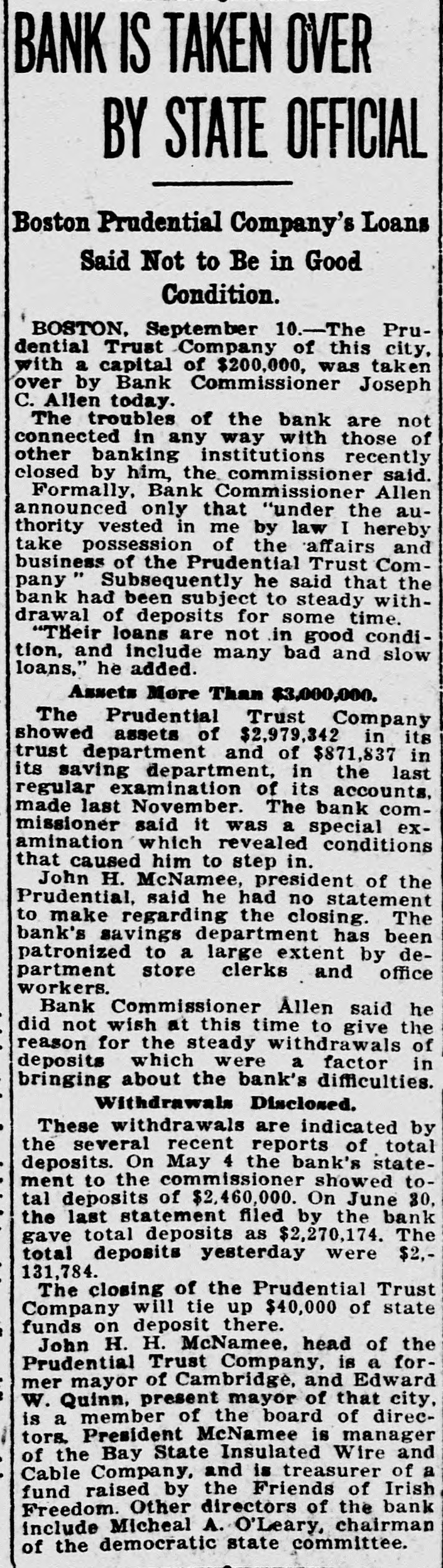
BANK IS TAKEN OVER BY STATE OFFICIAL Boston Prudential Company's Loans Said Not to Be in Good Condition. BOSTON, September 10.-The Prudential Trust Company of this city, with a capital of $200,000, was taken over by Bank Commissioner Joseph C. Allen today. The troubles of the bank are not connected in any way with those of other banking institutions recently closed by him, the commissioner said. Formally, Bank Commissioner Allen announced only that "under the authority vested in me by law I hereby take possession of the affairs and business of the Prudential Trust Company Subsequently he said that the bank had been subject to steady withdrawal of deposits for some time. "Their loans are not in good condition, and include many bad and slow loans," he added. Assets More Than $3,000,000. The Prudential Trust Company showed assets of $2,979,342 in its trust department and of $871,837 in its saving department, in the last regular examination of its accounts, made last November. The bank commissioner said it was a special examination which revealed conditions that caused him to step in. John H. McNamee, president of the Prudential, said he had no statement to make regarding the closing. The bank's savings department has been patronized to a large extent by department store clerks and office workers. Bank Commissioner Allen said he did not wish at this time to give the reason for the steady withdrawals of deposits which were a factor in bringing about the bank's difficulties. Withdrawals Disclosed. These withdrawals are indicated by the several recent reports of total deposits. On May 4 the bank's statement to the commissioner showed total deposits of $2,460,000. On June 30, the last statement filed by the bank gave total deposits as $2,270,174. The total deposits yesterday were $2,131,784. The closing of the Prudential Trust Company will tie up $40,000 of state funds on deposit there. John H. H. McNamee, head of the Prudential Trust Company, is a former mayor of Cambridge, and Edward W. Quinn, present mayor of that city, is a member of the board of directors. President McNamee is manager of the Bay State Insulated Wire and Cable Company, and is treasurer of a fund raised by the Friends of Irish Freedom. Other directors of the bank include Micheal A. O'Leary, chairman of the democratic state committee.

Article from New-York Tribune, September 11, 1920

Click image to open full size in new tab

Article Text

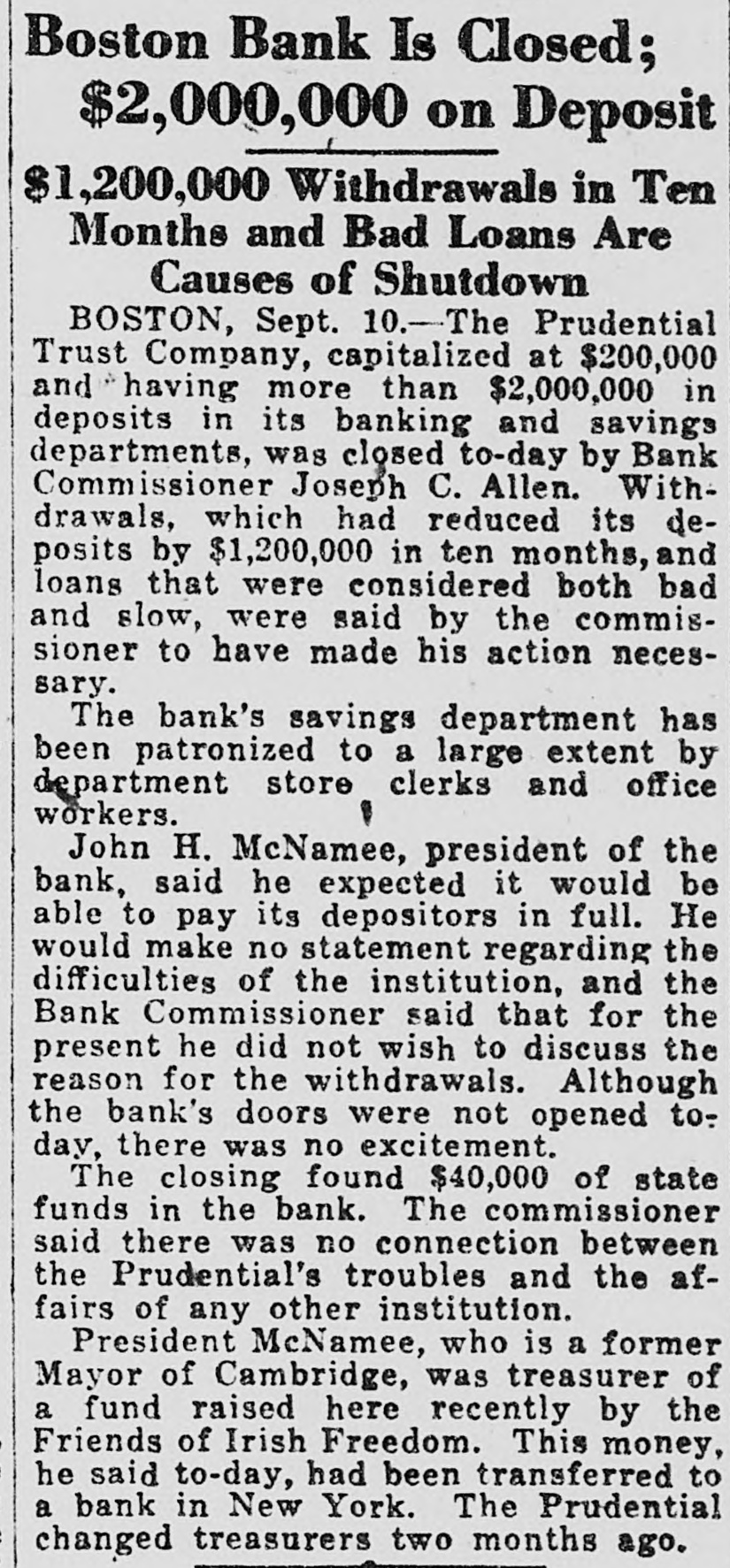
Boston Bank Is Closed; $2,000,000 on Deposit $1,200,000 Withdrawals in Ten Months and Bad Loans Are Causes of Shutdown BOSTON, Sept. 10.-The Prudential Trust Company, capitalized at $200,000 and having more than $2,000,000 in deposits in its banking and savings departments, was closed to-day by Bank Commissioner Joseph C. Allen. Withdrawals, which had reduced its deposits by $1,200,000 in ten months, and loans that were considered both bad and slow, were said by the commissioner to have made his action necessary. The bank's savings department has been patronized to a large extent by department store clerks and office workers. John H. McNamee, president of the bank, said he expected it would be able to pay its depositors in full. He would make no statement regarding the difficulties of the institution, and the Bank Commissioner said that for the present he did not wish to discuss the reason for the withdrawals. Although the bank's doors were not opened today, there was no excitement. The closing found $40,000 of state funds in the bank. The commissioner said there was no connection between the Prudential's troubles and the affairs of any other institution. President McNamee, who is a former Mayor of Cambridge, was treasurer of a fund raised here recently by the Friends of Irish Freedom. This money, he said to-day, had been transferred to a bank in New York. The Prudential changed treasurers two months ago.

Article from The Bennington Evening Banner, September 13, 1920

Click image to open full size in new tab

Article Text

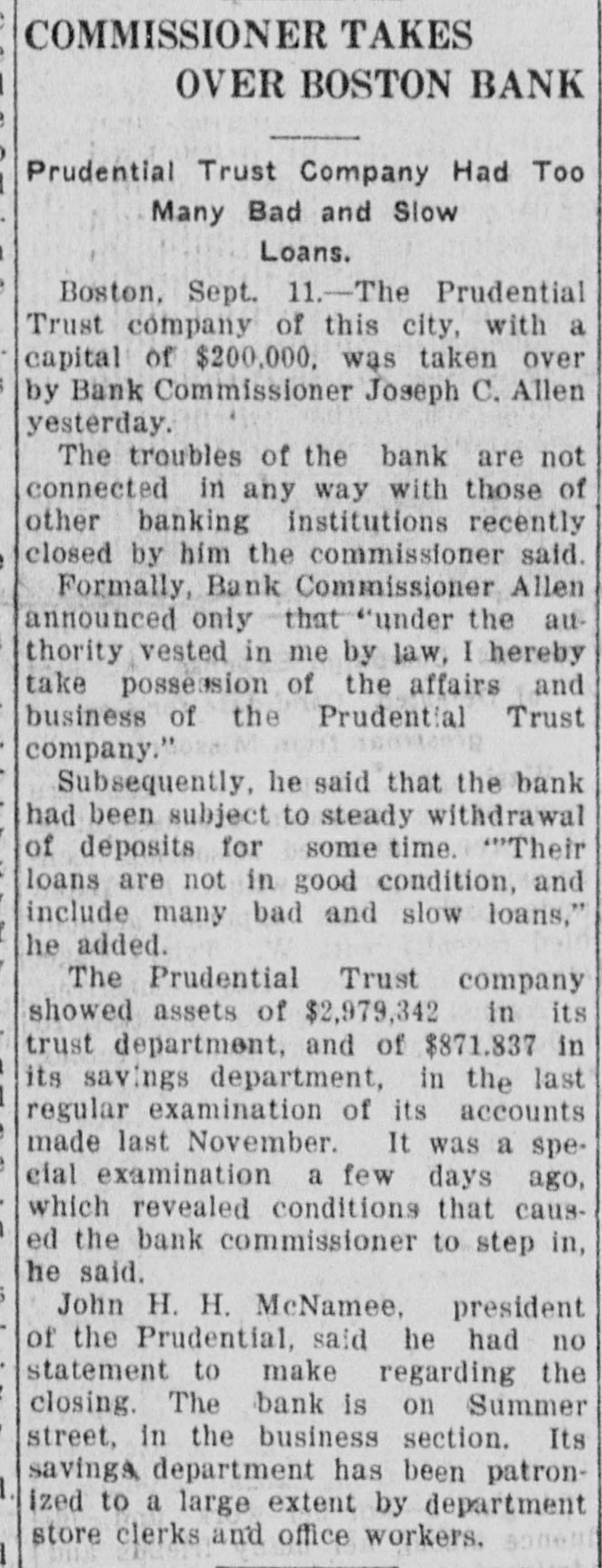
COMMISSIONER TAKES OVER BOSTON BANK Prudential Trust Company Had Too Many Bad and Slow Loans. Boston, Sept. 11.-The Prudential Trust company of this city, with a capital of $200,000. was taken over by Bank Commissioner Joseph C. Allen yesterday. The troubles of the bank are not connected in any way with those of other banking institutions recently closed by him the commissioner said. Formally, Bank Commissioner Allen announced only that "under the authority vested in me by law, I hereby take possession of the affairs and business of the Prudential Trust company." Subsequently, he said that the bank had been subject to steady withdrawal of deposits for some time. "Their loans are not in good condition, and include many bad and slow loans," he added. The Prudential Trust company showed assets of $2,979,342 in its trust department, and of $871.837 in its savings department, in the last regular examination of its accounts made last November. It was a special examination a few days ago, which revealed conditions that caused the bank commissioner to step in, he said. John H. H. McNamee, president of the Prudential, said he had no statement to make regarding the closing. The bank is on Summer street, in the business section. Its savings department has been patronized to a large extent by department store clerks and office workers.

Article from Burlington Weekly Free Press, September 16, 1920

Click image to open full size in new tab

Article Text

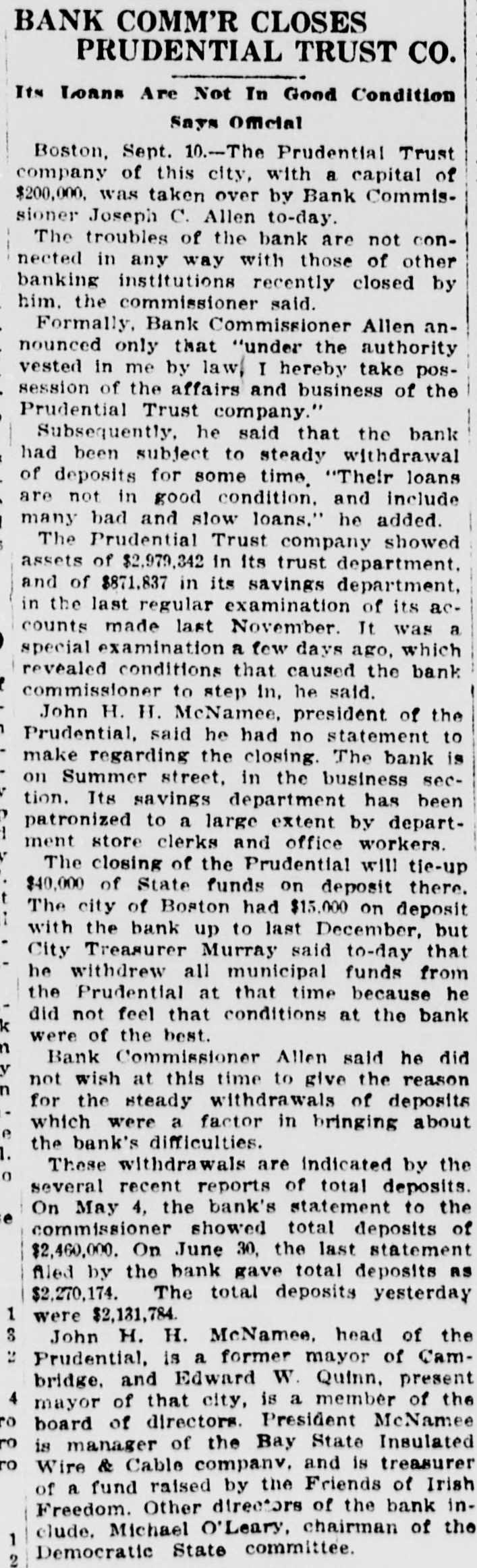
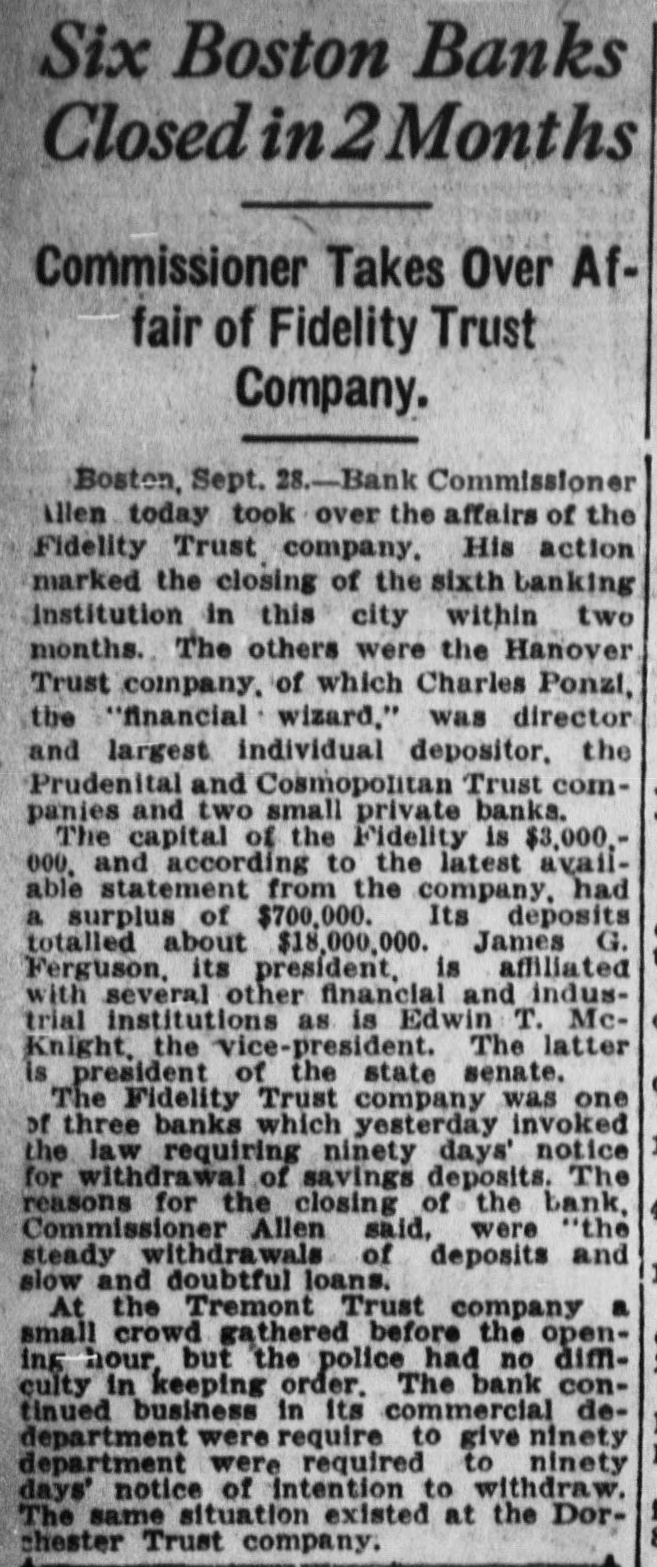
BANK COMM'R CLOSES PRUDENTIAL TRUST CO. Its Loans Are Not In Good Condition Says Official Boston, Sept. 10.-The Prudential Trust company of this city, with a capital of $200,000. was taken over by Bank Commissioner Joseph C. Allen to-day. The troubles of the bank are not connected in any way with those of other banking institutions recently closed by him. the commissioner said. Formally, Bank Commissioner Allen announced only that "under the authority vested in me by law I hereby take possession of the affairs and business of the Prudential Trust company." Subsequently, he said that the bank had been subject to steady withdrawal of deposits for some time. "Their loans are not in good condition. and include many bad and slow loans." he added. The Prudential Trust company showed assets of $2,979,342 in its trust department. and of $871.837 in its savings department, in the last regular examination of its accounts made last November. It was a special examination a few days ago, which revealed conditions that caused the bank commissioner to step in, he said. John H. H. McNamee, president of the Prudential, said he had no statement to make regarding the closing. The bank is on Summer street, in the business section. Its savings department has been patronized to a large extent by department store clerks and office workers. The closing of the Prudential will tie-up $40,000 of State funds on deposit there. The city of Boston had $15,000 on deposit with the bank up to last December, but City Treasurer Murray said to-day that he withdrew all municipal funds from the Prudential at that time because he did not feel that conditions at the bank were of the best. n Bank Commissioner Allen said he did y not wish at this time to give the reason = for the steady withdrawals of deposits which were a factor in bringing about e the bank's difficulties. 1. These withdrawals are indicated by the 0 several recent reports of total deposits. On May 4, the bank's statement to the commissioner showed total deposits of $2,460,000. On June 30, the last statement filed by the bank gave total deposits as $2,270,174. The total deposits yesterday 1 were $2,131,784. 3 John H. H. McNamee, head of the 2 Prudential, is a former mayor of Cambridge. and Edward W. Quinn. present 4 mayor of that city, is a member of the to board of directors. President McNamee TO is manager of the Bay State Insulated ro Wire & Cable company. and is treasurer of a fund raised by the Friends of Irish Freedom. Other directors of the bank include. Michael O'Leary, chairman of the 1 Democratic State committee. 2

Article from The Chattanooga News, September 28, 1920

Click image to open full size in new tab

Article Text

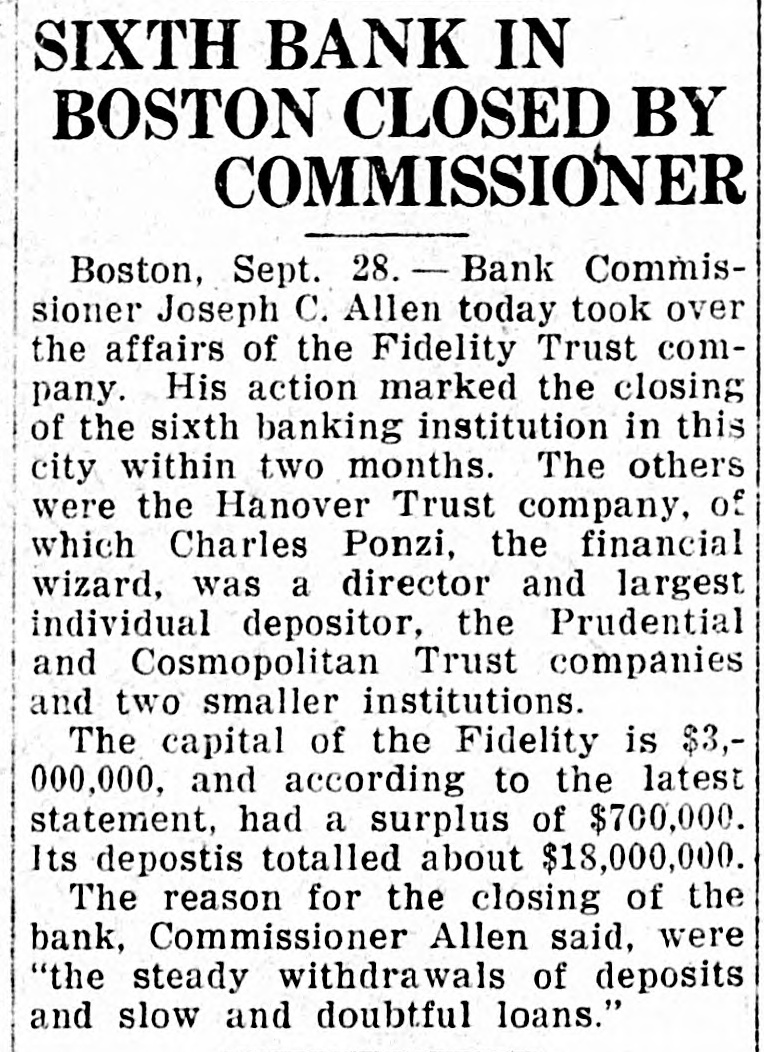
Six Boston Banks Closed in 2 Months Commissioner Takes Over Affair of Fidelity Trust Company. Boston, Sept. 28.-Bank Commissioner Allen today took over the affairs of the Fidelity Trust company. His action marked the closing of the sixth banking Institution in this city within two months. The others were the Hanover Trust company. of which Charles Ponzl, the "financial wizard." was director and largest individual depositor. the Prudenital and Cosmopolitan Trust companies and two small private banks. The capital of the Fidelity is $3,000.000. and according to the latest available statement from the company. had a surplus of $700,000. Its deposits totalled about $18,000,000. James G. Ferguson, its president. is affiliated with several other financial and industrial institutions as is Edwin T. McKnight. the vice-president. The latter is president of the state senate. The Fidelity Trust company was one of three banks which yesterday invoked the law requiring ninety days' notice for withdrawal of savings deposits. The reasons for the closing of the bank, Commissioner Allen said, were "the steady withdrawals of deposits and slow and doubtful loans. At the Tremont Trust company a small crowd gathered before the opening hour, but the police had no dimculty in keeping order. The bank continued business in its commercial dedepartment were require to give ninety department were required to ninety days' notice of intention to withdraw. The same situation existed at the Dorchester Trust company.


Article from The Bismarck Tribune, September 28, 1920

Click image to open full size in new tab

Article Text

SIXTH BANK IN BOSTON CLOSED BY COMMISSIONER Boston, Sept. 28. - Bank Commissioner Joseph C. Allen today took over the affairs of the Fidelity Trust company. His action marked the closing of the sixth banking institution in this city within two months. The others were the Hanover Trust company, of which Charles Ponzi, the financial wizard, was a director and largest individual depositor, the Prudential and Cosmopolitan Trust companies and two smaller institutions. The capital of the Fidelity is $3,000,000, and according to the latest statement, had a surplus of $700,000. Its depostis totalled about $18,000,000. The reason for the closing of the bank, Commissioner Allen said, were "the steady withdrawals of deposits and slow and doubtful loans."


Article from The Brattleboro Daily Reformer, September 28, 1920

Click image to open full size in new tab

Article Text

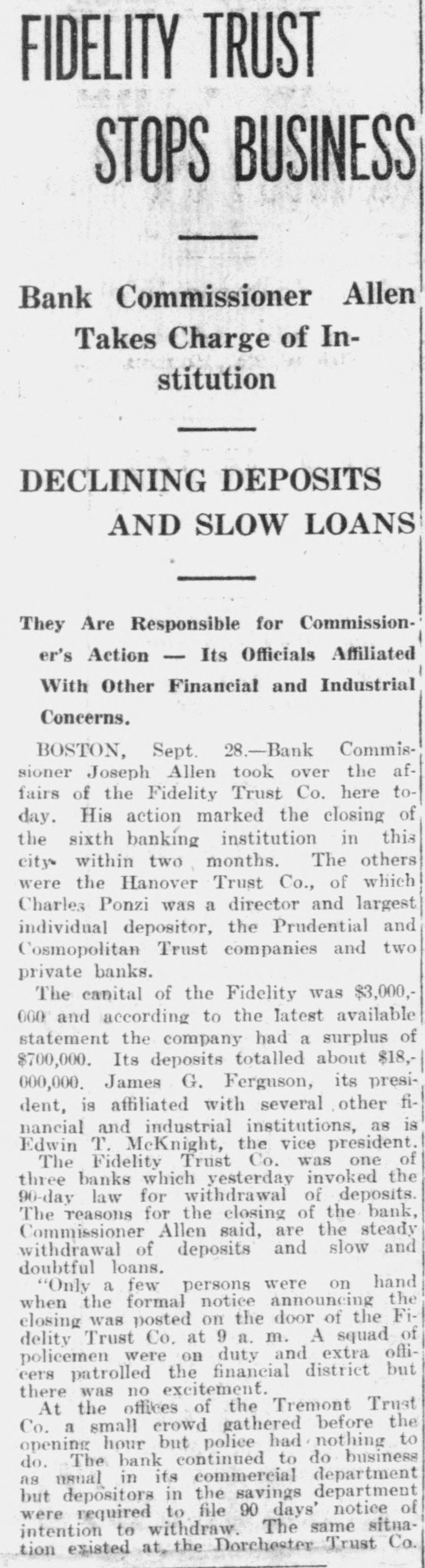
FIDELITY TRUST STOPS BUSINESS Bank Commissioner Allen Takes Charge of Institution DECLINING DEPOSITS AND SLOW LOANS They Are Responsible for Commissioner's Action - Its Officials Affiliated With Other Financial and Industrial Concerns. BOSTON, Sept. 28.-Bank Commissioner Joseph Allen took over the affairs of the Fidelity Trust Co. here today. His action marked the closing of the sixth banking institution in this city= within two months. The others were the Hanover Trust Co., of which Charles Ponzi was a director and largest individual depositor, the Prudential and Cosmopolitan Trust companies and two private banks. The canital of the Fidelity was $3,000,000 and according to the latest available statement the company had a surplus of $700,000. Its deposits totalled about $18,000,000. James G. Ferguson, its president, is affiliated with several other financial and industrial institutions, as is Edwin T. McKnight, the vice president. The Fidelity Trust Co. was one of three banks which yesterday invoked the 90-day law for withdrawal of deposits. The reasons for the closing of the bank, Commissioner Allen said, are the steady withdrawal of deposits and slow and doubtful loans. 'Only a few persons were on hand when the formal notice announcing the closing was posted on the door of the Fidelity Trust Co. at 9 a. m. A squad of policement were on duty and extra officers patrolled the financial district but there was no excitement. At the offices of the Tremont Trust Co. a small crowd gathered before the opening hour but police had nothing to do. The bank continued to do business as usual in its commercial department but depositors in the savings department were required to file 90 days' notice of intention to withdraw. The same sitnation existed at. the Dorchester Trust Co.


Article from The Washington Herald, September 28, 1920

Click image to open full size in new tab

Article Text

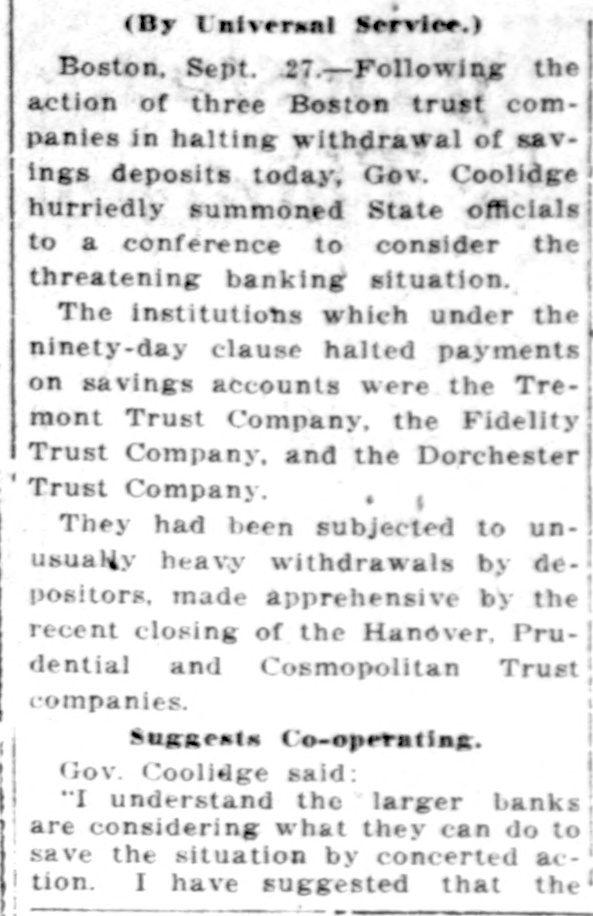
(By Universal Service.) Boston, Sept. 27.-Following the action of three Boston trust companies in halting withdrawal of savings deposits today, Gov. Coolidge hurriedly summoned State officials to a conférence to consider the threatening banking situation. The institutions which under the ninety-day clause halted payments on savings accounts were the Tremont Trust Company, the Fidelity Trust Company, and the Dorchester Trust Company. They had been subjected to unusually heavy withdrawals by depositors, made apprehensive by the recent closing of the Hanover. Prudential and Cosmopolitan Trust companies. Suggests Co-operating. Gov. Coolidge said: "I understand the larger banks are considering what they can do to save the situation by concerted action. I have suggested that the


Article from The Morning Union, June 8, 1923

Click image to open full size in new tab

Article Text

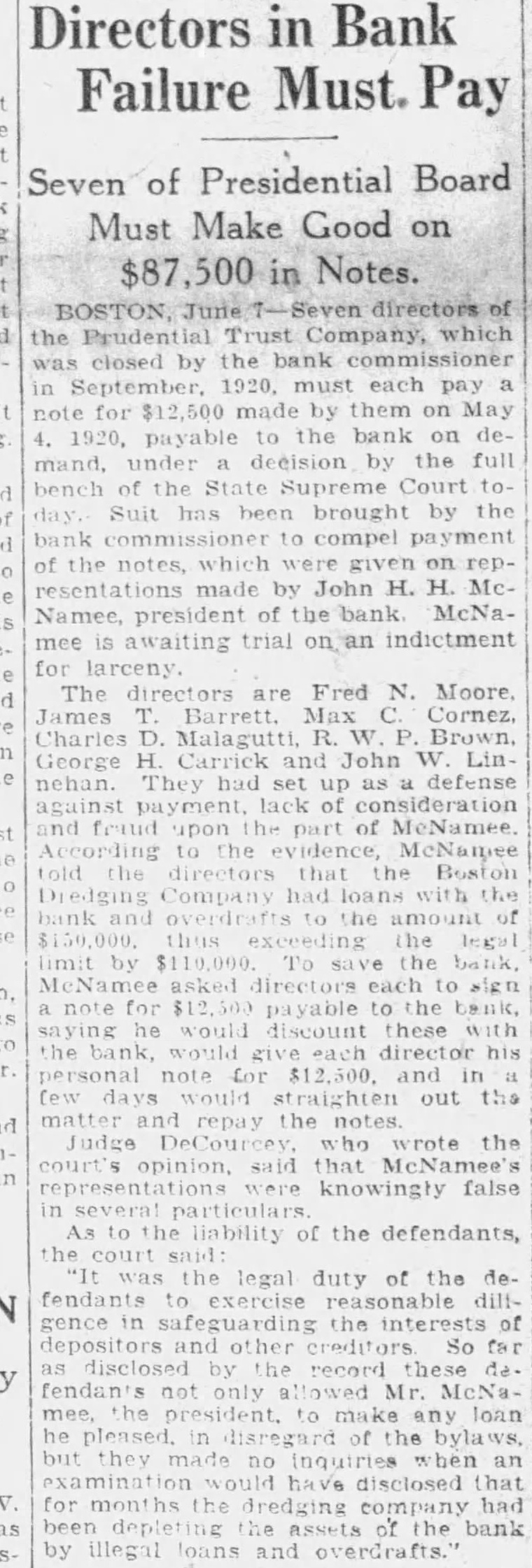
Directors in Bank Failure Must Pay Seven of Presidential Board Must Make Good on $87,500 in Notes. BOSTON, June 7—Seven directors of the Prudential Trust Company, which was closed by the bank commissioner in September, 1920, must each pay a note for $12,500 made by them on May 4, 1920, payable to the bank on demand, under a decision by the full bench of the State Supreme Court today. Suit has been brought by the bank commissioner to compel payment of the notes, which were given on representations made by John H. H. McNamee, president of the bank. McNamee is awaiting trial on an indictment for larceny. The directors are Fred N. Moore, James T. Barrett, Max C. Cornez, Charles D. Malagutti, R. W. P. Brown, George H. Carrick and John W. Linnehan. They had set up as a defense against payment, lack of consideration and fraud upon the part of McNamee. According to the evidence, McNamee told the directors that the Boston Dredging Company had loans with the bank and overdrafts to the amount of $150,000, thus exceeding the legal limit by $110,000. To save the bank, McNamee asked directors each to sign a note for $12,500 payable to the bank, saying he would discount these with the bank, would give each director his personal note for $12,500, and in a few days would straighten out the matter and repay the notes. Judge DeCourcey, who wrote the court's opinion, said that McNamee's representations were knowingly false in several particulars. As to the liability of the defendants, the court said: "It was the legal duty of the defendants to exercise reasonable diligence in safeguarding the interests of depositors and other creditors. So far as disclosed by the record these defendants not only allowed Mr. McNamee, the president, to make any loan he pleased, in disregard of the bylaws, but they made no inquiries when an examination would have disclosed that for months the dredging company had been depleting the assets of the bank by illegal loans and overdrafts."


Article from The Lewiston Daily Sun, June 8, 1923

Click image to open full size in new tab

Article Text

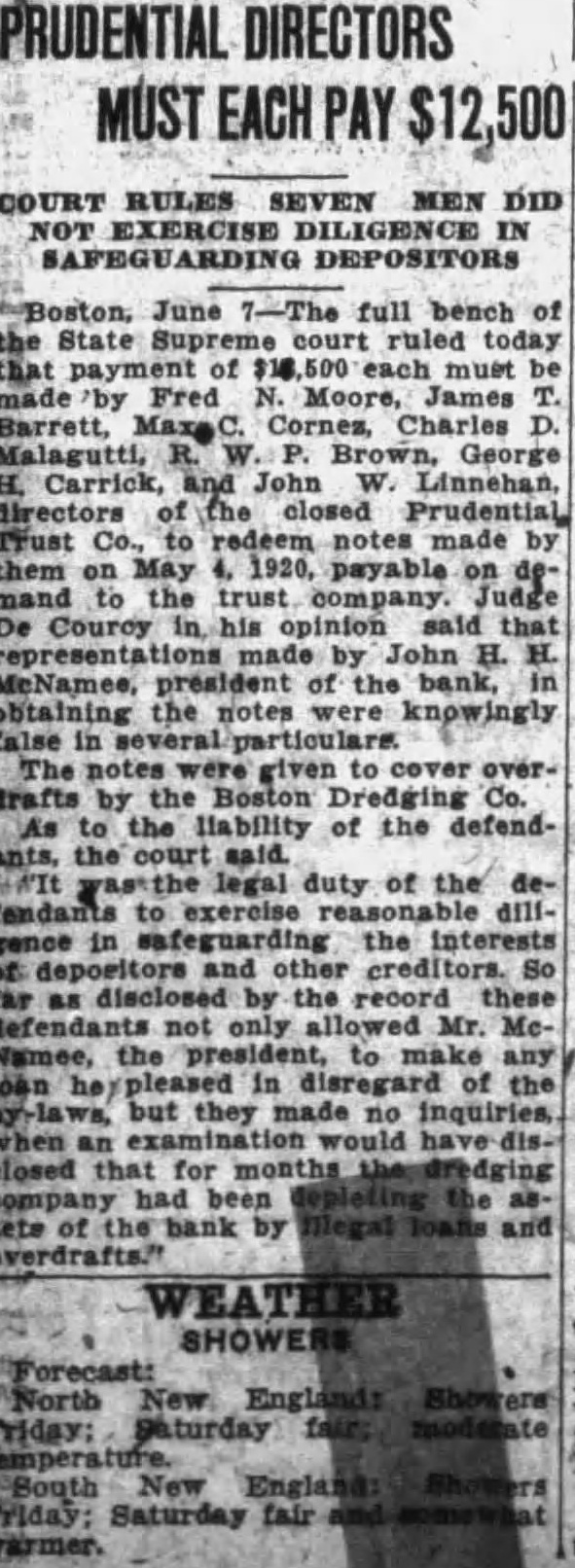
PRUDENTIAL DIRECTORS MUST EACH PAY $12,500 COURT RULES SEVEN MEN DID NOT EXERCISE DILIGENCE IN SAFEGUARDING DEPOSITORS Boston, June 7—The full bench of the State Supreme court ruled today that payment of $12,500 each must be made by Fred N. Moore, James T. Barrett, Max C. Cornez, Charles D. Malagutti, R. W. P. Brown, George H. Carrick, and John W. Linnehan, directors of the closed Prudential Trust Co., to redeem notes made by them on May 4, 1920, payable on demand to the trust company. Judge De Courcy in his opinion said that representations made by John H. H. McNamee, president of the bank, in obtaining the notes were knowingly false in several particulars. The notes were given to cover overdrafts by the Boston Dredging Co. As to the liability of the defendants, the court said: "It was the legal duty of the defendants to exercise reasonable diligence in safeguarding the interests of depositors and other creditors. So far as disclosed by the record these defendants not only allowed Mr. McNamee, the president, to make any loan he pleased in disregard of the by-laws, but they made no inquiries, when an examination would have disclosed that for months the dredging company had been depleting the assets of the bank by illegal loans and overdrafts."


Article from Morning Sentinel, June 8, 1923

Click image to open full size in new tab

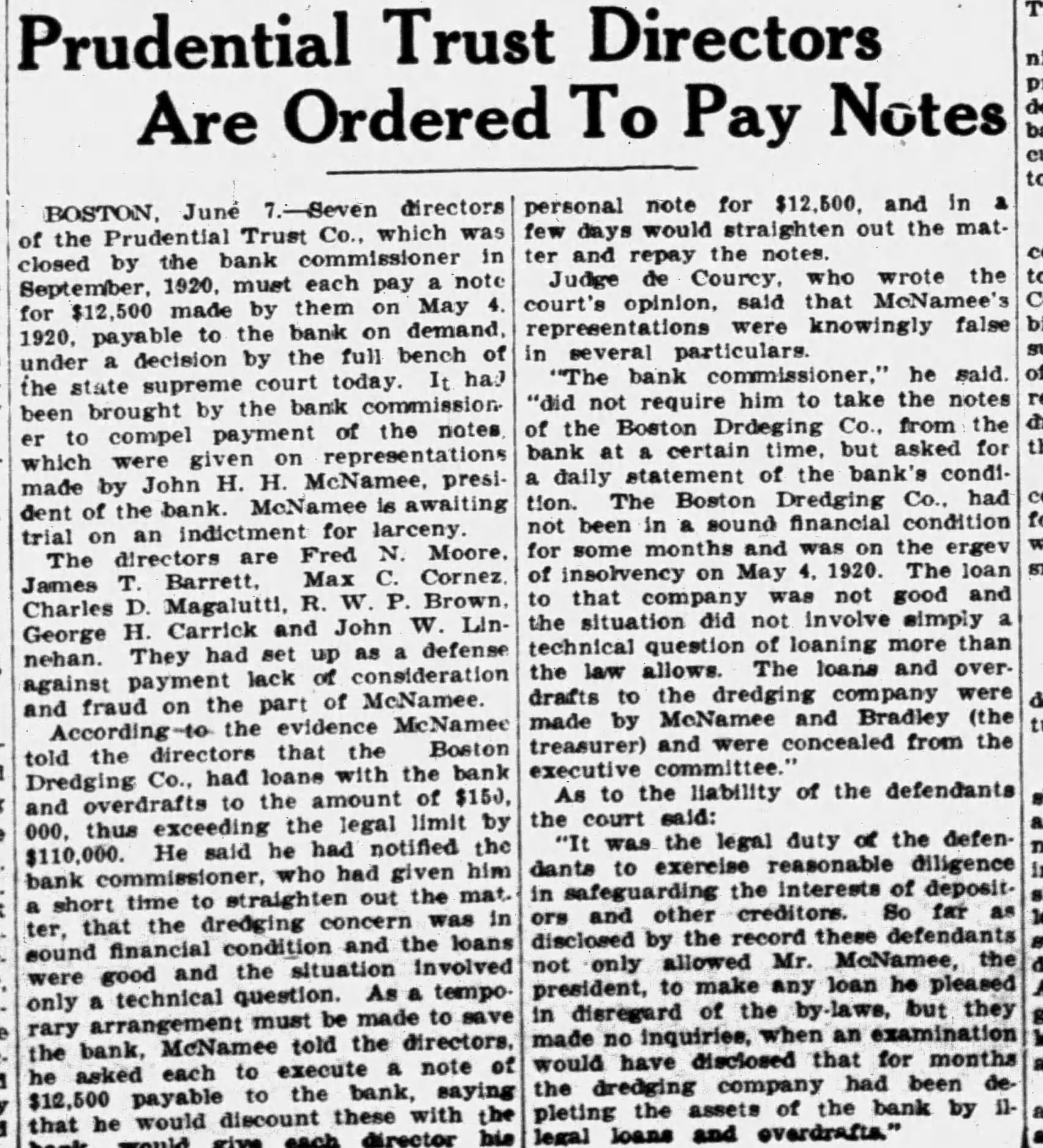
Article Text

Prudential Trust Directors Are Ordered To Pay Notes BOSTON, June 7.—Seven directors of the Prudential Trust Co., which was closed by the bank commissioner in September, 1920, must each pay a note for $12,500 made by them on May 4, 1920, payable to the bank on demand, under a decision by the full bench of the state supreme court today. It had been brought by the bank commissioner to compel payment of the notes, which were given on representations made by John H. H. McNamee, president of the bank. McNamee is awaiting trial on an indictment for larceny. The directors are Fred N. Moore, James T. Barrett, Max C. Cornez, Charles D. Magalutti, R. W. P. Brown, George H. Carrick and John W. Linnehan. They had set up as a defense against payment lack of consideration and fraud on the part of McNamee. According to the evidence McNamee told the directors that the Boston Dredging Co., had loans with the bank and overdrafts to the amount of $150,000, thus exceeding the legal limit by $110,000. He said he had notified the bank commissioner, who had given him a short time to straighten out the matter, that the dredging concern was in sound financial condition and the loans were good and the situation involved only a technical question. As a temporary arrangement must be made to save the bank, McNamee told the directors, he asked each to execute a note of $12,500 payable to the bank, saying that he would discount these with the bank, would give each director his personal note for $12,500, and in a few days would straighten out the matter and repay the notes. Judge de Courcy, who wrote the court's opinion, said that McNamee's representations were knowingly false in several particulars. "The bank commissioner," he said, "did not require him to take the notes of the Boston Dredging Co., from the bank at a certain time, but asked for a daily statement of the bank's condition. The Boston Dredging Co., had not been in a sound financial condition for some months and was on the verge of insolvency on May 4, 1920. The loan to that company was not good and the situation did not involve simply a technical question of loaning more than the law allows. The loans and overdrafts to the dredging company were made by McNamee and Bradley (the treasurer) and were concealed from the executive committee." As to the liability of the defendants the court said: "It was the legal duty of the defendants to exercise reasonable diligence in safeguarding the interests of depositors and other creditors. So far as disclosed by the record these defendants not only allowed Mr. McNamee, the president, to make any loan he pleased in disregard of the by-laws, but they made no inquiries, when an examination would have disclosed that for months the dredging company had been depleting the assets of the bank by illegal loans and overdrafts."


Article from Morning Sentinel, June 8, 1923

Click image to open full size in new tab

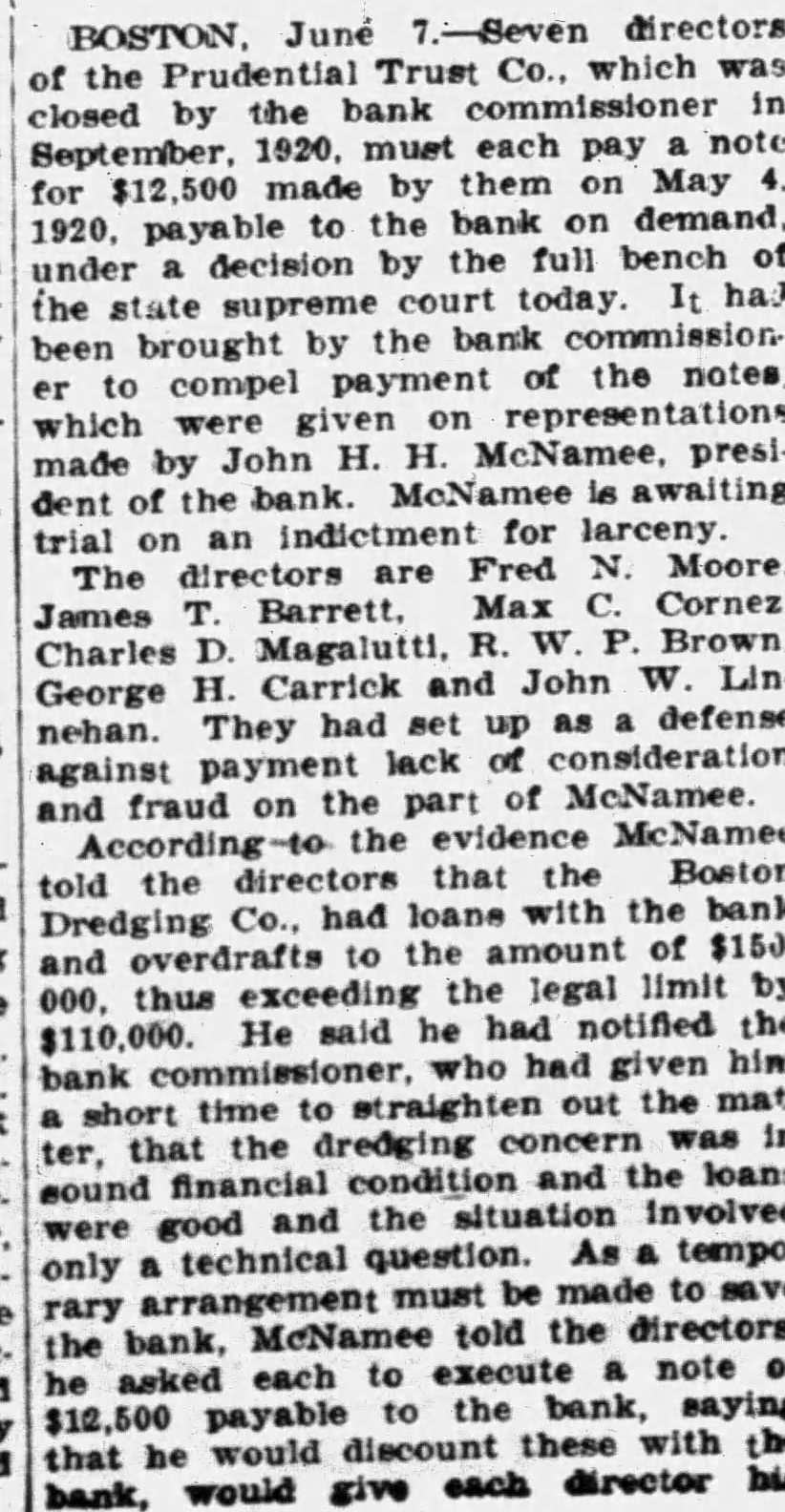
Article Text

BOSTON, June 7.—Seven directors of the Prudential Trust Co., which was closed by the bank commissioner in September, 1920, must each pay a note for $12,500 made by them on May 4, 1920, payable to the bank on demand, under a decision by the full bench of the state supreme court today. It had been brought by the bank commissioner to compel payment of the notes, which were given on representations made by John H. H. McNamee, president of the bank. McNamee is awaiting trial on an indictment for larceny. The directors are Fred N. Moore, James T. Barrett, Max C. Cornez, Charles D. Magalutti, R. W. P. Brown, George H. Carrick and John W. Linnehan. They had set up as a defense against payment lack of consideration and fraud on the part of McNamee. According to the evidence McNamee told the directors that the Boston Dredging Co., had loans with the bank and overdrafts to the amount of $150,000, thus exceeding the legal limit by $110,000. He said he had notified the bank commissioner, who had given him a short time to straighten out the matter, that the dredging concern was in sound financial condition and the loans were good and the situation involved only a technical question. As a temporary arrangement must be made to save the bank, McNamee told the directors he asked each to execute a note of $12,500 payable to the bank, saying that he would discount these with the bank, would give each director his