German Savings Bank (New York, NY)

Episode Information

Episode UID
5198763090910
Episode Type
Run Only
Bank Type
savings
Bank ID
519876309 hash
Start Date
October 8, 1875
Location
New York, New York (40.714, -74.006)

Metadata

Model
gemini-3-flash-preview (chosen from majority vote of a three-model LLM ensemble)
Short Digest
c34c9d652e0a9866

Response Measures

None

Description

The articles describe two distinct banks: the German Savings Bank (New York City) and the German Savings Bank of Morrisania. The Morrisania bank failed in 1877, while the New York City bank survived multiple runs in 1875 and 1878.

Events (3)

1. October 8, 1875 Run
Cause Details
General financial nervousness in New York following other bank failures.
Measures
Invoked the sixty days' notice rule for withdrawals.
Newspaper Excerpt
There were runs today on the German Savings Bank, Fourth avenue and Fourtconth street... The former took advantage of the sixty days' notice
Source
newspapers
2. July 1, 1877* Other
Newspaper Excerpt
The German Savings Bank of New York suspended on the 7th... liabilities about $830,000... The bank was put in the hands of a receiver in July, 1877 [referring to Morrisania branch/bank]., notes: This refers to the German Savings Bank of Morrisania, a separate entity from the main German Savings Bank of NYC mentioned in the runs.
Source
newspapers
3. April 27, 1878 Run
Cause Details
Systemic nervousness affecting multiple New York savings banks.
Measures
Paid all depositors on demand without enforcing the sixty-day rule.
Newspaper Excerpt
The runs on the Dry Dock and German Savings Banks had considerably decreased to-day... The German Savings Bank is paying all depositors who ask for their money, without the customary sixty days' notice.
Source
newspapers

Newspaper Articles (22)

Article from Alexandria Gazette, October 9, 1875

Click image to open full size in new tab

Article Text

There were runs yesterday on the German Savings Bank, and the German Uptown Savings Bank, New York. The former took advantage of the sixty days' notice, but the run on the latter being slight, it paid all drafts on demand. The officers of both banks are confident that the "runs" will subside, and affirm that the banks can pay all drafts on demand on brief notice.


Article from Chicago Daily Tribune, October 9, 1875

Click image to open full size in new tab

Article Text

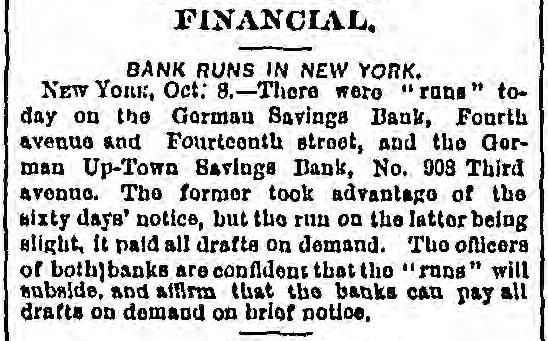
FINANCIAL, BANK RUNS IN NEW YORK. NEW YORK, Oct: 8.-There were "runs" today on the German Savings Bank, Fourth avenue and Fourtconth street, and the Gorman Up-Town Savings Bank, No. 908 Third avenue. The former took advantage of the sixty days' notice, but the run on the latter being elight, it paid all drafts on demand. The officers of bothjbanks are confident that the "runs" will subside, and affirm that the banks can pay all drafts on demand on brief notice,


Article from The Anti-Monopolist, December 16, 1875

Click image to open full size in new tab

Article Text

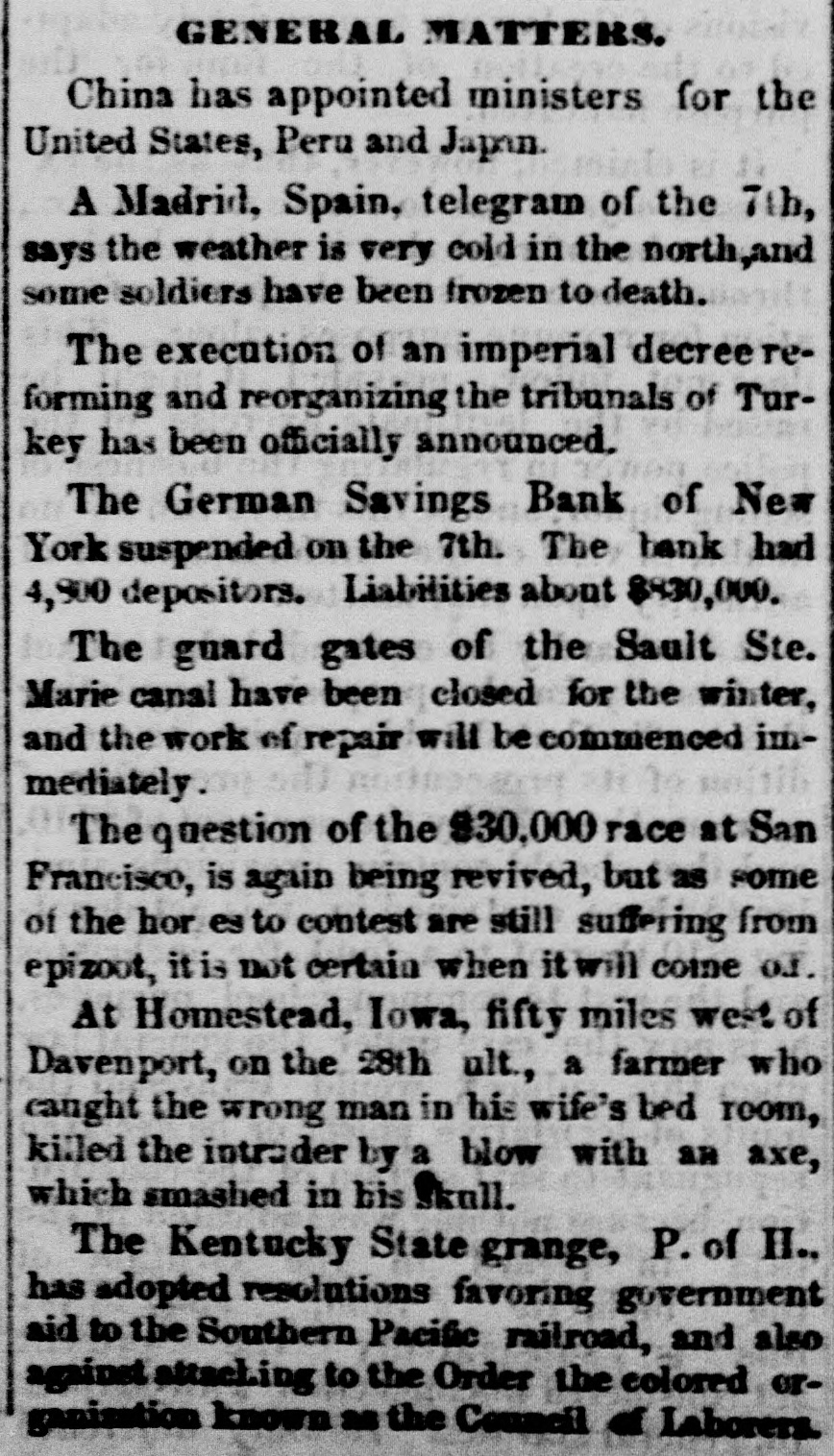
GENERAL MATTERS. China has appointed ministers for the United States, Peru and Japan. A Madrid, Spain, telegram of the 7th, says the weather is very cold in the north,and some soldiers have been frozen to death. The execution of an imperial decree reforming and reorganizing the tribunals of Turkey has been officially announced. The German Savings Bank of New York suspended on the 7th. The bank had 4,900 depositors. Liabilities about $830,000. The guard gates of the Sault Ste. Marie canal have been closed for the winter, and the work of repair will be commenced immediately. The question of the $30,000 race at San Francisco, is again being revived, but as some of the hor es to contest are still suffering from epizoot, it is not certain when it will come of. At Homestead, Iowa, fifty miles west of Davenport, on the 28th ult., a farmer who caught the wrong man in his wife's bed room, killed the introder by a blow with an axe, which smashed in his skull. The Kentucky State grange, P. of H.. has adopted resolutions favoring government aid to the Southern Pacific railroad, and also against attaching to the Order the colored organization known as the Council of Laborers.


Article from The New York Herald, February 1, 1877

Click image to open full size in new tab

Article Text

SUMMARY OF LAW CASES. In the suit of Merrick Plummer and Isaac M. Corts against E. P. Belden and others Judge Lawrence yesterday denied the motion to vacate the order of arrest. James McGuinness has finally come off the victor in his long contested suit against the city for $350, the value of his horse, which was lost by backing over a pier into the East River. Judge Lawrence yesterday gave judgment for the plaintiff. Nine cases or burglary and grand larceny were disposed of yesterday by Julge Gildersleeve and Assistant District Attorney Rollius. They did not, however, possess any special features of interest. William H. Bundy claims $10,000 damages from John Delaney, growing out of the sale of the "Excelsior Hay Carrier and Lifter." The suit was brought in this county and a motion was made yesterday to change the venue to Dutchess county. Charles L. Halberstadt, the lawyer committed to jail for contempt of court, was yesterday discharged by Judge Donohue. The discharge was on account of his sickness, and inability, therefore, to comply with the order of the Court. W. Z. Morton, referee in the case of the volunMr. dissolution of the Harlem and Spuyten Duyvil Navigation tary Company, submitted yesterday his report hands Donohue. He reports $10.230 in his to for Judge distribution to the holders of the 1,000 shares of the company, being $10 33 per share. the suit of George J. Luxton against the Howe to Machine In Company. a motion was recently made the amount required as security for reduc- costs. Judge reduce J. F. Daly yesterday rendered a decision ing the amount from $750 to $500. Charles A. Eaton and William V. King are ordered cotton Nicholas Mairazi, as they allege, brokers. to purchase ou his account 500 bales of cotton, them of which has not been paid. A MOLIOD de- to the make price the compiaint more specific was yesterday nied by the Judge'J. suit brought F. Daly. by Herman Uhl, receiver of Mill- the In German Savings Bank, against Betts mortUptown which was for a foreclosure of a $10,000 the dehauser, Judge Van Vorst yesterday decided that reduced gage, lendant's claim that the mortgage had been ordered $5,000 was substantiated. and judgment was accordingly. thirteen suits brought against the Lake Shore Of Southern Railroad Company, the partichave been published in have been tried and two remain to and eleven ulars Michigan of which the HERALD, be granted, tried. who has tried all the suits. au adjournment in the the ground of the sickyesterday, Judge S. Barrett, Prouty, adjournment suit brought being by John the absence of one counsel in Washington and of another. ness injunction suit of Augustin Daly against Sam- of In French the and another to restrain the publication have uel entitled "Lemons," " the facts of which Judge a play heretofore pubhshed in the HERALD, J. been yesterday, upon application of ex-Judge order A. Speir counsel for the defendants, gave an Dittenhoeler, to Mr. J. V. B. Lewis to take the allidavits Neuendorff and one J. Coggswell took a lease for years, of of reference Adolph Mary Heubener. three 26 Mrs. a year, of the turnished house No. Being West at $5,000 street, troin William P. Earl. for Twenty-third in rent Mr. Earl has brought suit attending its in arrears She says that through neglect of inmates recovery. plumbing, as promised, several of the and the to the last year taken III with typhoid fever has were vacated. She says, further, that the lease Donobue house been cancelled by mutual consent. Judge the matter before a referee. sent Horace Andrews has brought a suit against Corne- City Farley to recover on his official bond while a dislius There was a motion recently made to Marshal. the action unless the plaintiff tile security motion for miss Judge J F. Daly yesterday granted the unless costs. the case is brought to trial in the February term. Catharine McCarthy, who owned the house No. Mrs. East Forty-uith street. arranged to exchange the Eighty232 with Seigel Bernard for No. 328 East titles same street. When they came to exchange false refused to do so, claiming as Mrs. had been made to her by fourth representations McCarthy Beroard that Barrett value and rental of his house. Judge to the decision yesterday sustaining Mrs. McCarthy gave ordering a a dismissal of the complaint. and of administration were yesterday granted Calvin to the following by M. White, OD the estate of Letters Surrogate named Augustus persons:- Gilles- D. Elizabeth Julia Healey, on the estate of William WallWhite; Jacob Wallbacn, on the estate of Ellen Isaac Bern. p:c; Morris Bernstein. on the estate of bacn; Elizabeth Lewis, on the estate of William Emilio Ludovici. stein; Lewis and Julius Ludovici on the estate of Jones of Zeiss and others against the German in The Association case came up before Judge Donohue motion Press Court, Chambers, yesterday, on a 10 pay to Supreme the receiver of the defunct association positions compel the plaintifs, who tormerly occupied the over to and compositors of the as in his hands. The answer amount editors now association, has of collected the rethat since his appointment he over as coiver is which amount he IS willing to turn being only soon $200, as the referee before whom the case is now heard thes record his report. of business transacted in the Marine exThe of this city for the month of January, 1877, and zeal Court a most favorable light the industry of in dispensing of the heavy of that come continually before them for hibits the judges in calendars adjudica- Clerk cases Mr. John Savage, the efficient and zealous Termtion. the Court, compiles the following:-Trial of, 49. of tried and otherwise disposed 99. Part 1.-Culisos -Causes tried and otherwise disposed of, 60. Part 3--Causes tried and otherwise disposed of, moPart Special Term, Chambers-Contested Total, 208. 444; in which written opinions were parte filed, orders 32; opinions tions, indorsed on papers, 392; ex 1,102 658. Total business in Chambers, of Augusta E. Marsters against motion In Insurance Company there was a for the signed, Life the suit ago the Eclectic before Judge Van Hoesen some time the Supermade of judgement is the action requiring distributo intendent entry a of the Insurance Department to
Article from The New York Herald, April 28, 1877

Click image to open full size in new tab

Article Text

BOTTOMLESS MONEY BOXES. LOST PLEIADS OF OUR SAVINGS BANK SYSTEMNEW MATTERS FOR THE ELLIS INVESTIGATING COMMITTEE-HOW TO PREVENT FRAUDS. It is claimed by many influential merchants and others who have been interviewed on the subject that the present investigation of the official course pursued by Superintendent Ellis will clearly show that his neglect of duty has caused much of the suffering resulting from recent failures of savings banks. It is also contended that, in addition to the banking institu. tions named in Governor Robinson's late message to the investigating committee, there are other corporations whose cases have not been cited. but which furnish new prima facie evidence against the Bank Superintendent. Among these may be cited the Loaners' Bank of New York. About November, 1875, the Bank Superintendent was asked for a report upon the condition of this establishment, but it appeared that, the bank never having been examined, Mr. Eltis could furnish no information about its status. At the same time a lawyer wrote to the Superintendent asking to have the Loaners' Bank examined, but no examination took place, and the institution failed in May, 1876. A gentleman acquainted with its affairs says:"Its operations were worse than those of a low class pawnshop." The community lost $500,000 by the failure, much 01 which, it is claimed, might have been saved had the Banking Department held the corporation to strict account when required to do so. ANOTHER STARTLING CASE. In relation to the New York State Loan and Trust Company responsible parties state that about March, 1875, Mr. Ell's was officially informed by Mr. George W. Reid, examiner, and Mr. William T. Aidrich and others, that the capital stock had suffered an impairment equal to at least twenty per cent. It was the Bank Superintendent's duty to have caused this deneit to be made good, or to have closed the doors of the company under instructions from the Attorney General. No steps were taken by Mr. Exis and the concern was allowed to remain in the hands of the same parties until January 29, 1876, when the impairment of the capital amounted 10 about ninety per cent, and the trustees voluntarily relinquished the remaining ten conts on the dollar to a receiver. The loss 10 the public was about nine hundred thousand dollars. The wretched condition of this company was known to all persons familiar with us general operations at the time. By the statute of 1874 the superintendence of trust companies chartered by the State was placed under the charge of Mr. Ellis, and the condition of this concern was or should have been well known to him. A FRIGHTFUL LIST OF LOSSES. In conversation with Mr. John Mack, of No. 365 Fifth avenue, that gentleman gave the following estimates of the losses suffered by depositors 10 the suspended savings banks, and says that he believes the greater part of the immense sums which are given below migot have been saved if Bank Superintendent Eths bad properly discharged his important duties:$150,000 Abingdon Square Bank 1,730,000 Bona Street Savings Bank 500,000 German Savings Bank, Morrisanta 2,000,000 Mechanics and Traders' Savings Bank 450,000 Mutual Benefit Savings Bank 750,000 New Amsterdam Savings Bank 200,000 People's Savings Bank 400,000 Security Savings Bank 1,440,000 Third Avenue Savings Bank. 120,000 Traders' Savings Bank 1,000,000 Bank of Lainsburg 1,000,000 New York State Loan and Trust Company Loaner's Rauk 500,000 500,000 Security Bank Manufacturers and Builders' Bank. 460,000 Total $11,200,000 HOW TO PREVENT FRAUDS


Article from New-York Tribune, May 18, 1877

Click image to open full size in new tab

Article Text

NEW-YORK CITY. Amber ornaments are coming into fashion. The .. gentle Spring" organ has but one stop-at night. Pastoral scenes painted on ivory fans are new and pretty. Goats are fashionable pets because they are fond of bunting. Oixdized silver cloak-clasps are all the rage for dolmans this Spring. Conductors complain of the large numbers of pewter five-cent pieces in circulation. Wild strawberries were sold in market yesterday. They are much cheaper than the cultivated varieties. Stealing lunch from children while on their way to school is the latest form of meanness practiced by tramps. The steamship Frisia, which sailed yesterday, carried foreign mail consisting of 29,594 letters and 67 bags of papers. It may be suggested to suburban farmers that the way to cure potato bugs is to discover just what is the matter with them. The wards of city hospitals are now made attractive by the bouquets placed there by members of the Flower Mission A harp made of forget-me-nots, with gold tinsel strings, was a design for souveair to all artist in music, made by a Broadway florist yesterday. People are beginning to owe for a lodge in some vast wilderness, relieved by the thought that the proprietor does not require pay in advance. A enrious feature of a Fourteenth-st. oyster house is a miniature giant composed entirely of oyster-shells It is the work of a fisherman in Stamford, Conn. The Aldermen's Committee on Streets will meet this afternoon to hear persons interested in having freight cars run by steam on the Belt Railroa with coance ing tracks on the wharves and piera. The steamship Huntsville, which arrived here yesterday, passed a ship on fire in la.itude 349 57' longitad 72 58. The name could not be ascertained The vessel ap peared to have been burning two or three days. By the light of the moon last evening Murrayst., near Broadway, presented a festive appearance. The broad sidewalk furnished a platform, an accordeon all that was required is the way of music, and 15 or 20 couples de spite the heat, danced until a late hour. A paeamatic engine is housed in the stables of the Second Avenue Railroad near Harlem River. It is propelled solely by atmospheric pressure, and can carry at a rapid ratΓ© a number of cars It will soon run between Sixty third- st. and the upper end of the Island. A large number of friends were present at the funeral of the Hon. Charles H. Wheelan, ex Member of Assem. biy from the XVIIth District, which took place yesterday at his late residence, No. 126 East Fourth-st. The pall-bearers were John Keily, Thomas J. Creamer, M. C. Gross, S. Mont. gomery, L. J. Leonari, Edward Lambert, Thomas Smith, and L. Hennessy, Mayor Ely, Jackson S. Schultz, and Daniel O'Brien were among the callers. Attorney-General Fairchild sent a representative yesterday to the banking-house of the suspended German Savings Bank in Morrisania. to consult with depositors in re gard to the appointment of a receiver. Each depositor was required to show his pass-book and indicate his preference in riting. There was but little interest manifested Mr. Hoeland, the late cashier said that if harmony should prevail among the creditors of the bank they would get at least 75 cents on the dollar. The police of the Eighth Precinet were informed yesterday that Mary Robertson, age 37, was dy ing at No. 197 South Fifthave, Capt. McDonnell proceeded at once to the place, and found the woman suffering greatly She said that she quarreled on Saturday with Sarah Feeny, who threw her down stairs. The injured woman was taken to the Chambers Street Hospital, and it wasfound that her ribs and arms were broken, and she was much bruised on the head and body. She was afterward removed to Bellevue Hospital, where thought that she will recover. Her assailant has not been arrested. Songs, piano solos and duets, recitations. and other exercises filled up the programme at the anniversary exhibition of the New York Institution for the Blind, last evening, in the presence of a large audience, at Steinway Hall. On the stage were seated the pupils of the school Calisthenic exer elses, performed by a dozen boys and girls, called forth much applause. The recitation in arithmette was also well received. The multiplication of large numbers was performed by the use of a blackboard, on which letters representing figures were placed, and the calculation of intereston a large sum of money for any number of years, months, and days was made with ease and rapidity. The instructor of this class was blind. Geography was also illustrated by means of dissected maps. L. E. Howard, brother of James M. Howard, who committed suicide at the Vanderbilt House on Wednesday morning, saysthat his brother had not been drinking liquor on that day, as reported, and that he W38 temperate man. He believed that the loss of his watch had depressed his brother's spirits 80 greatly that he took his own life. The police had re covered the watch and arrested the pickpockets before the suicide was committed, but Mr. Howard did not know this when he killed himself. Michael Norton, John Harrington, John White, and William White, the men accused of stealing the watch, were yesterday before Justice Fiammer, at the Fitty-seventh Street Police Coart William White was dis charged, the evidence being insufficient to convict,him The others case. were remanded to enable the officers to complete the BROOKLYN. The summing up in the Kingsley & Keeney resrvoir reference suit against the city was postpolied yesterday for one week on account of the absence of the senior counsel for the city. Some of the florists whose shops are near Greenwood are hired by the season to keep crosses of flowers on graves. These crosses are placed dat on the mounds, and are just the length of the graves. Justice Guck yesterday held for the Grand Jury Mary Scott and Nellie Page. two pretty shoplifters, each about 20 years old, who were arrested for stealing a number of valuable articles from Eastern District stores. The Police Commissioners yesterday dismissed from the force Michael Devlin of the Tenth Precinct for drunkenness. They also fined Michael Boyle of the Twelfth Precinct and Richard A. Daryea of the Ninth Precinct one day's pay each for being their posts. Messrs. Price and Farrell were appointed last Monday by the Common Council as clerks of the Aldermen's Committees, and on Wednesday took the oath of office. Isaac o rane, the former clerk, declines to surrender his office to the new appointees until next week.on the ground that ananimous consent was not obtained from the Aldermen. The Mayor de clines to interfere. Thomas E. Cable's $10,000 four-in-hand and English drag will make the first trip of the season from the Pierrepont House, on the Hights, to Coney Island. It will run from the Pierrepout House and the Astor House on alter nate days. The coach will carry four inside and twelve out and side the Ocean passengers Parkway, The route will be through Prospect Park The sixteenth anniversary of the Howard Mission and Home for Little Wanderers, of No. 40 Bowery, New York, was celebrated at the Academy of Music last evening About little waifs, nearly all dressed in white, were seated on the stage and gave songs and declamations Addresses were made by the Rev. Dr. Reuben Jeffrey of Brooklyn and the Rev. M. H. Posgen of St. Louis, Mo. Contributions were taken for the assistance of the mission. Sheriff Daggett of Kings County receives35cents a day for the board of each prisoner in the Raymond Street Jail. Local politicians have lately been discussing the pro priety of reducing this amount The Supervisors' Jall Com mittee were directed yesterday to report at the next meeting the proper rate that the Sheriff should receive. The Commit tee on Salaries were also instructed to report as to the advisability of reducing the salaries of other county official.


Article from The New York Herald, August 3, 1877

Click image to open full size in new tab

Article Text

# SUPERINTENDENT ELLIS' TRIAL. EVIDENCE ELICITED BEFORE THE STATE SENATE-WORTHLESS TOWN BONDS AS BANK ASSETS. ALBANY, N. Y., August 2, 1877. The Senate this morning examined Marcus T. Hunt, Deputy Attorney General, who said he put the word "zettled" on the register of the suit commenced against the People's Bank, testified to some days since; did so on the general understanding that the trustees would put up securities; did not remember being instructed by Ellis. Lemuel Clark, bookkeeper of the Loaners' Bank and of the receiver, was called. Mr. Chapman objected to his testimony The question was more whether Ellis could enforce the law to make this bank report than whether he was negligent. He finally withdrew his objection and the examination went on. Witness said the bank had large transactions with the Continental Insurance Company, pledging $201,000 worth of railroad bonds and stocks for $45,000. On his cross-examination he said he saw a man called an examiner in the bank several times; never remember seeing him at the bank or hearing that he had been there for the purpose of testing his power over the bank. To Senator Woodin-Understood the bank failed because of trouble among the trustees; they proposed to sell the charter. To Senator Prince-They expected to receive $150,000 for the charter on account of the extraordinary privileges it contained; it was a largo pawn-broking establishment. The prosecution produced the opinion of William Tracy, heretofore referred to. The witness identified it, and read from it that Mr. Tracy did not consider the Loaners' Bank subject to chapter 324 of the Laws of 1874. Mr. Warner, general clerk in the Bank Department, testified that a commission was issued to Reid as Bank Examiner March 31, 1876; it was returned May 12, with a note that the bank refused to be examined. (The commission, which was missed from the tiles of the department, has since been produced before the Senate Committee.) To Mr. McGuire-The commission is a printed form and can be duplicated. THE GERMAN SAVINGS BANK. Deputy Superintendent Lamb produced the semi-annual report of the German Savings Bank at Morrisania, dated January 1, 1875, showing an excess of assets amounting to $27,352 81; on April 24, 1875, Mr. Reid made a special examination and found a deficiency of $77,314 68; a difference in the estimated value of town bonds and railroad stocks caused this; on December 25, 1875, Ellis notified the trustees that the deficiency must be made up; on January 1, 1876, the bank reported an excess of $11,877, and on January 1, 1877, an excess of $12,091; a committee of trustees came up during the latter part of February, 1877, and held an interview with Ellis; don't know what he said; a letter from Hall, attorney of the bank, January 6, 1876, said they had put in bonds and mortgages and made the deficiency good; no other letters wore on file, excepting one from Ellis to the Attorney General, February 24, 1877, recommending that the bank be closed and explaining that it had on hand a large amount of town bonds which had been repudiated and in default of interest for several years; the bank was put in the hands of a receiver in July, 1877; the depositors petitioned against putting it into the hands of a receiver. In reply to Senator Gerard, witness said there was no evidence in department of examination except by Reid; Ellis made no statement of his visit. In reply to Senator St. John, he said there was no proof of the deficiency being made good except from reports of the bank. Isaac Smith, clerk of the department, testified to the examination of the report of January 1, 1877; he valued the bonds less than the trustees did, and thus made the deficiency. WHAT THE RECEIVER FOUND. William J. Best, receiver of the German Savings Bank, Morrisania, testified that the amount of assets he found was $171,022 21; he did not estimate $41,000 in town bonds; the trustees had put in bonds and mortgages $33,500 and cash $18,850 to make up the deficiency; the bank made a loan to the Montclair Railroad, New Jersey, in September, 1872, taking first mortgage bonds as security, and made further loans to the same road in February and September, 1873; only $10,000 were paid on these bonds; he read from the trustees' book of minutes from December 29, 1875, noting the visit of Reid and showing the anxiety of the trustees to make up the deficiency; in their efforts to save the assets several of the trustees contributed to that end; on February 20 1877, counsel and one trustee were sent to Albany to consult Ellis; they reported that Ellis said the deficiency must be made up; said he would pay the depositors fifty per cent if the securities of the trustees were good, and if the town bonds were paid he could pay sixty or seventy per cent. On cross-examination he said that he found all the assets reported January 1, 1877; the deficiency was due to the difference in the inflation of bonds; he found there were $230,000 due to depositors; during the last two months $70,000 were drawn out by the trustees and others. At the request of Senator Harris the receiver read from the minutes the cost of lunch, $75, and wines, $174, when the bank building was finished, which was added to the building account. Adjourned.


Article from The Sun, August 9, 1877

Click image to open full size in new tab

Article Text

to Several Banks. SARATOGA, Aug. 8.-At the opening of the Senate to-day. Mr. Ellis said that in his judgment the closing of the Third Avenue Savings Bank at the time he consulted Mr. Cisco, John A. Dix, and others. after the failure of Duncan, Sherman & Co., would have been very disastrous to the city of New York. On the cross-examination he said: The mischief would have been a run on the other banks and moneyed institutions It was about Aus. 1, 1875, that he consulted the financiers. There was more or less run in the fall of 1875. closing six banks in which there were deficiencies, and putting them into the hands of receivers. The depositors cannot get their money back. I had some faith that the trustees would help some banks. It hurts a bank to stop payment. When they resume and cannot pay at once, dΓ©positors are certain to suffer. The Third Avenue Bank's real estate realized only twenty per cent. on its cost. The banking house was sold for thirty per cent on its cost. It was afterward sold for more privately. I foresaw this result, but was forced to put it in the hands of a receiver. All the depositors in the banks named suffered If the depositors of the Bond Street Bank had not lost confidence, and the bank had kept on until real estate became better. they would not have lost so much. In the case of the German and Security Banks, it would have been better for the depositors if receivers had not been appointed. I felt bound to take into consideration the interests of all depositors, I might find a bank with a deficiency of assets, and not hand it over to the Attorney-General Again. I might deem it advisable to do so at ofice. I WAS influenced by the advice of financiers, and formed opinions of my own. I was preparing a communication to the Attorney-General about the Third Avenue Bank when the committee called to see me. The recommendation to the Attorney. General was based on all the facts in my possession. When, in 1875, the report of the Third Avenue Bank came to the department, I had a conversation with Deputy Lamb. We agreed that closing that bank would close a number of smallerbanks. 1 favored the law of 1875, which allowed smaller banks to consolidate with larger and stronger ones. Some financiers I consulted agreed with me, and others did not. I visited the Trades Savings Bank several times in regard to its report of November, 1875, and called the attention of the Secretary to the mortgages and the deficiencies, and told him the deficiency must be made up. The Secretary said the trus. tees proposed paying in the money. Reid wrote that the money had not been paid. and the books were in such a I condition that he could not find out about the bank went to the People's Savings Bank with Reid in the fall of 1874. and Reid examined it. but did not know that he made a written report until it was produced on the trial. From conversation with the officers formed an idea that the reports made by the bank were correct. I was aware in 1874 that the charter of the Loaners' Bank required them to report to the department The President claimed that his bank had made a statement every year. I never SILW any reports. I never sent them blanks to All up. When I went into office I tried to inform myself about all the laws relating to banks I o examined reports and consulted clerks. I found one hundred and sixty five exsavings banks, with deposits of $350,000,000 The penses allowed by the Legislature for my department were about $170,000. In the direct examination, Mr. Ellis said that after the report about the bogus checks in the Abingdon Square Bank. July 19. 1876, he left the papers on the table with Deputy Lamb, and went out of town on a vacation. He couldn't remember giving Lamb any directions regarding it. To Senator Gerard-I refused to receive personal secu. rity from the trustees of the German Savings Bank of Morrisania, because I did not consider it expedient. The personal securities of the Third Avenue Bank were received by my predecessor. The law of 1875 made a change regarding such securities. I did not analyze the reports of banks to see who ther items of accrued interest were of interest running for the current yeur or dead interest overdue I had not wound up any banks before September 1875. had exexperience. To Mr. MeGuire-Abstracts of the reports of banksshow. ing their assets are made out for the Legislature every year. When any question of doubt as to the construction of the law arises, it always goes to the Attorney-General for advice I think if the law reducing the interest to be paid by banks from 6 to 5 per cent. had been passed earlier, some of these banks could have gone on.


Article from New-York Tribune, March 16, 1878

Click image to open full size in new tab

Article Text

# SUITS AGAINST BANK TRUSTEES. Three suits of William J. Best, receiver of the German Savings Bank, of Morrisania, against trustees, were tried yesterday before Judge Van Brunt, in Supreme Court, Chambers. All were foreclosure suits on mortgages given by the trustees in January, 1876, to make up deficiencies. The defence was substantially that these differed from the Third Avenue Savings Bank cases, in that the security then was given in 1872, and in 1875 the Legislature passed an act expressly for-bidding a trustee of a savings bank froin becoming an indorser or in duy manner an obligor for moneys loaned by or borrowed of the bank. Judge Van Brunt reserved his decision.


Article from The New York Herald, March 16, 1878

Click image to open full size in new tab

Article Text

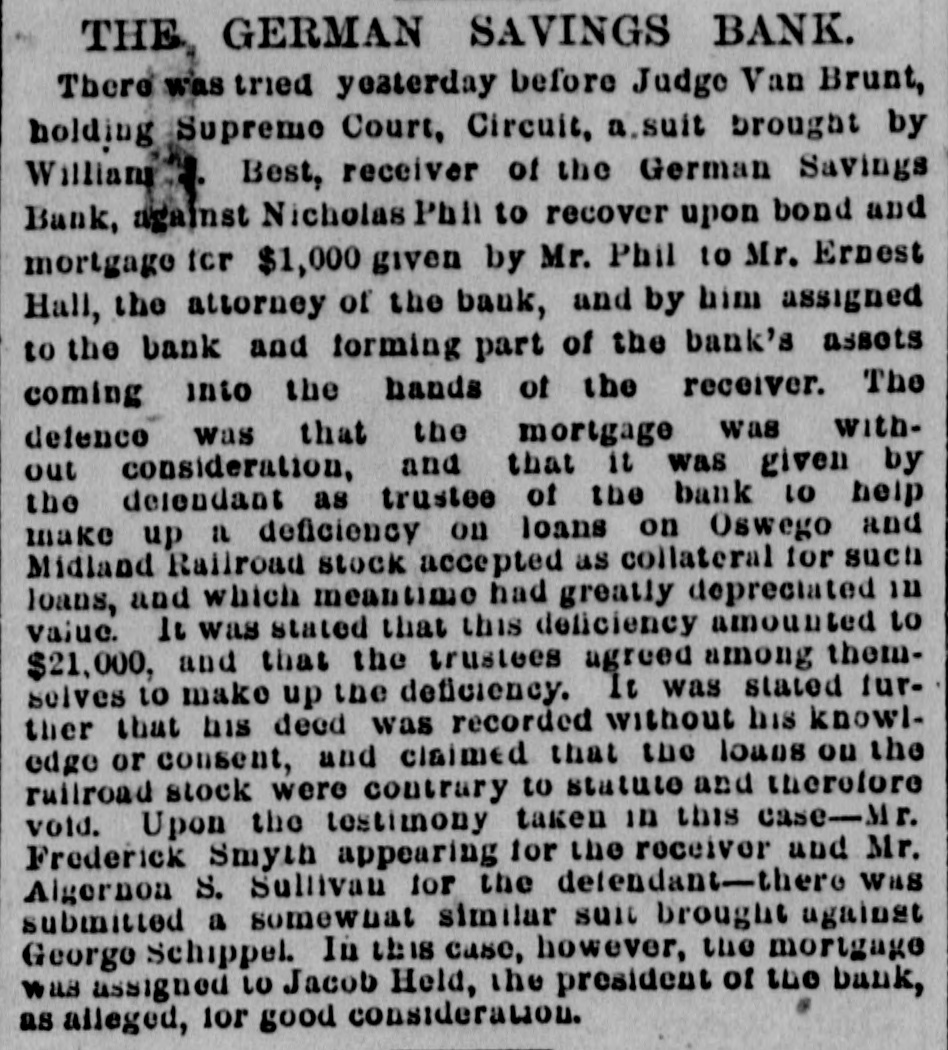
THE GERMAN SAVINGS BANK. There was tried yesterday before Judge Van Brunt, holding Supreme Court, Circuit, a. suit brought by Williams J. Best, receiver of the German Savings Bank, against Nicholas Phil to recover upon bond and mortgage for $1,000 given by Mr. Phil to Mr. Ernest Hall, the attorney of the bank, and by him assigned to the bank and forming part of the bank's assets coming into the hands of the receiver. The defence was that the mortgage was without consideration, and that it was given by the defendant as trustee of the bank to help make up a deficiency on loans on Oswego and Midland Railroad stock accepted as collateral for such loans, and which meantime had greatly depreciated in value. It was stated that this deliciency amounted to $21,000, and that the trustees agreed among themsolves to make up the deficiency. It was stated turther that his deed was recorded without his knowledge or consent, and claimed that the loans on the ruilroad stock were contrary to statute and therefore void. Upon the testimony taken in this case-Mr. Frederick Smyth appearing for the receiver and Mr. Algernon S. Sullivan for the detendant-there was submitted a somewhat similar suit brought against George Schippel. In this case, however, the mortgage was assigned to Jacob Held, the president of the bank, as alleged, for good consideration.


Article from New-York Tribune, April 3, 1878

Click image to open full size in new tab

Article Text

CIVIL NOTES. Judgement in foreclosure was entered in the Kings County Supreme Court, yesterday, by the Mutual Benefit Life Insurance Company. against Dr. J. Cooper, for $22,551 49. The first legal step in the effort to break the will of the late Samuel Wood will be taken to-morrow in the Surrogate's office. The counsel for the contestant will then offer his objections to the probate of the will. Chief-Justice Daly, in Common Pleas, Special Term, granted, yesterday. leave to various petitioners, creditors of Greenleaf, Norris & Co., to the extent of about $10,000 in the aggregate, to sell collaterals held by them to secure their debts. The suit of Elias C. Benedict against the Western Union Telegraph Company and the Atlantic and Pacific Telegraph Company was to have been tried, yesterday, in Supreme Court, Special Term, before Judge Van Vorst, but after a brief discussion, was adjourned to Wednesday, April 10. Judge Donohue has referred the divorce suit of Frances Josephene Mora against Autonio Luigi Mora to W. A. Boyd. The plaintiff says she was married to the defendant February 21, 1863, and has two children, but that in November, 1873, he deserted her and went to Milan with one Mary Oakley. In the quo warranto proceedings of Andrew Zeiser against Charity Commissioner Moses Kessel, of Kings County, the defendant, as directed by the Supreme Court in Brooklyn, has furnished a bill of particulars. It alleges that 842 votes for Zeiser were not counted: that 317 more votes than belonged to Kessel were counted for him, and that 44 ballots on which Zeiser's name was wrongly printed were not counted for him. Amelia Weiterhold, of Brooklyn, yesterday obtained the arrest of Bernard King, a linen merchant. of No. 256 Canal-st., in a $10,000 suit for alleged sedue tion and breach of promise of marriage. The complainant alleges that under promise of marrying her, on September 1, 1876, the defendant betrayed her. She is now a mother. The defendant was held in $2,500 bail. It is said that be is engaged to marry a young lady of fortune and high social position soon. Two suits brought by William J. Best, as the receiver of the German Savings Bank, of Morrisania. were submitted yesterday to Judge Van Vorst. They are against John C. Friedman and William Hoelandt, former trustees of the bank, on bonds given by them to make up a deficiency. The testimony in a similar suit previously tried was accepted as the testimony in these suits, the only question being one of law. Frederick Smyth appeared for Mr. Best: A. Erbe for the defendants. The trial of the suit of Thomas C. Clark against the Mechanies' National Bank was begun, yesterday, in Common Pleas, Trial Term, before Judge J.F. Daly. The plaintiff claims that the bank owes him $27, 149 90, deposited with it in 1864. The bank says it was all drawn out on twenty-three checks drawn by the plaintiff in that year. These checks, the plaintiff says, were not drawn by or returned to him. The case is still on. William A. Beach appears for the plaintiff; John K. Porter for the bank. The trial of the suit of James B. Bond against Henry Welsh was begun, yesterday, before Judge Freedman, in Superior Court, Trial Term. The plaintiff represents the lessors of the warehouse at Washington and Franklin-sts., which fell. He asks $10,000 damages, claiming that the fall was cansed by the overloading and improper loading of goods in the ware. house. The defendant denies any overloading of the floors, and claims that the fall of the building was occasioned by its inherent defects. John M. Seribner appears for the plaintiff 8. P. Nash for the defendant.


Article from Evening Star, April 27, 1878

Click image to open full size in new tab

Article Text

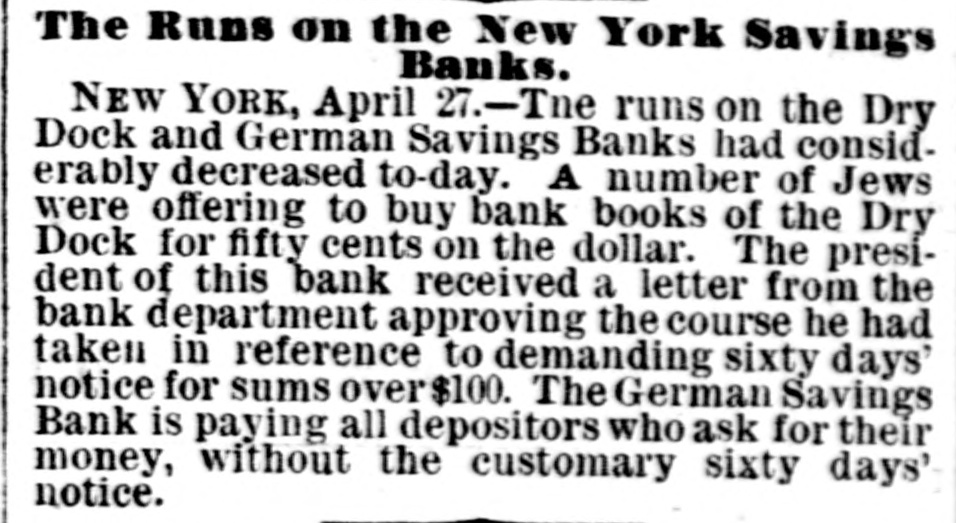
The Runs on the New York Savings Banks. NEW YORK, April 27.-Tne runs on the Dry Dock and German Savings Banks had considerably decreased to-day. A number of Jews were offering to buy bank books of the Dry Dock for fifty cents on the dollar. The president of this bank received a letter from the bank department approving the course he had taken in reference to demanding sixty days' notice for sums over$100. The German Savings Bank is paying all depositors who ask for their money, without the customary sixty days' notice.


Article from Public Ledger, April 29, 1878

Click image to open full size in new tab

Article Text

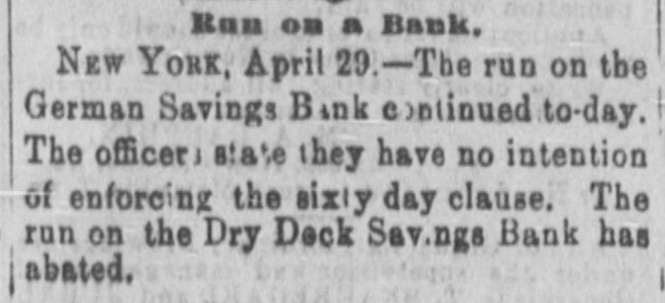
Run on a Bank. New YORK, April 29.-The run on the German Savings Bank continued to-day. The officers state they have no intention of enforcing the sixty day clause. The run on the Dry Deck Sav.ngs Bank has abated.


Article from The Dallas Daily Herald, April 30, 1878

Click image to open full size in new tab

Article Text

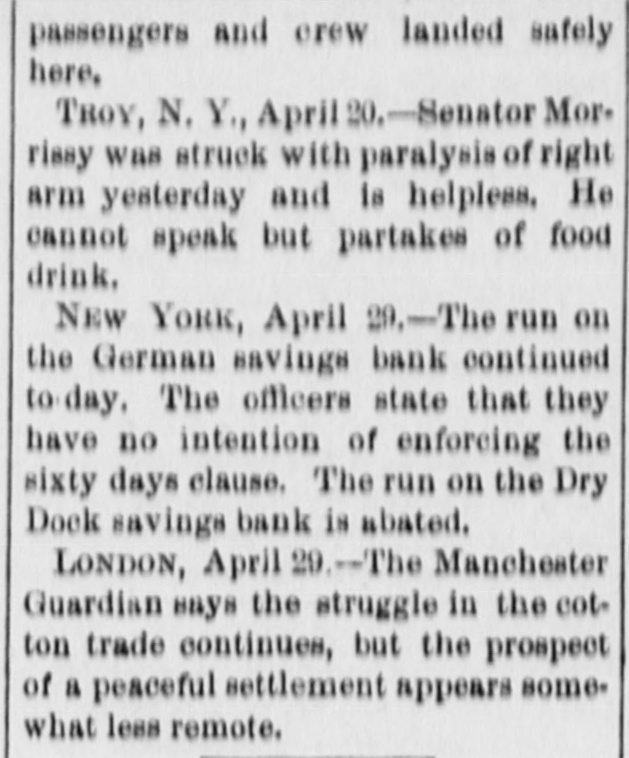
passengers and crew landed safely here. TROY, N. Y., April 20.-Senator Morrissy was struck with paralysis of right arm yesterday and is helpless. He cannot speak but partakes of food drink. NEW YORK, April 29.-The run on the German savings bank continued to-day. The officers state that they have no intention of enforcing the sixty days clause. The run on the Dry Dock savings bank is abated. LONDON, April 29.-The Manchester Guardian says the struggle in the cotton trade continues, but the prospect of a peaceful settlement appears somewhat less remote.


Article from Evening Star, April 30, 1878

Click image to open full size in new tab

Article Text

THE RUN on the German Savings Bank in New York continued yesterday, and the officers say they have no intention of enforcing the sixty-day rule. The run on the Dry Dock Savings Bank has abated.


Article from Daily Globe, April 30, 1878

Click image to open full size in new tab

Article Text

The W ork of Pirate Sherman. CHICAGO, April 29.-H. H. Walker has filed a petition in bankruptcy. Preferred debts, $10,000; unsecured, $194,000. Assets, land, $33,000; claims against Samuel J. Walker, also in bankruptcy, $200,000. NEW YORK, April 29.-The run on the German savings bank continued to-day. The officers state that they have no intention of enforcing the sixty days clause. The run on the bank has abated.


Article from The Daily Dispatch, April 30, 1878

Click image to open full size in new tab

Article Text

New York Savings Banks. NEW YORK, April 29.-The run on the German Savings Bank continued to-day. The officers state that they have no intention of enforcing the sixty-days clause. The run on the Dry-Dock Savings Bank has abated.


Article from The Indiana State Sentinel, May 1, 1878

Click image to open full size in new tab

Article Text

Runs on Savings Banks. NEW YORK, April 27.-The runs on the Dry Dock and German savings banks were sensibiy diminished to day. The German continues to pay all deposits on demand. Its liabilities are $10,000,000, and the surplus in January was $600,000.


Article from The Stark County Democrat, May 2, 1878

Click image to open full size in new tab

Article Text

NEW YORK BANK RUNS. New York, April 27.-The runs on the Dry Dock and German Savings Banks were sensibly diminished to-day. The German continues to pay all deposits on demand. The liabilities are ten millions, and the surplus in January was six hundred thousand dollars.


Article from The New York Herald, December 28, 1878

Click image to open full size in new tab

Article Text

PLEASANT FOR THE DEPOSITORS. THE OFFICE FURNITURE AND STATIONERY OF THE DEFUNCT GERMAN SAVINGS BANK DISPOSED OF FOR A SONG. A corkscrew and a revolver were put up at auction and sold yesterday in the building formerly occupied by the German Savings Bank, of Morrisania, of which Mr. Best is receiver. Other articles, too numerous to mention, were disposed of at the same time and place. Among other things, without which no financial institution is complete, the following may be quoted from the advertisement:-One counter, one money box, three slates, one table, one screen, one match box, five goblets, ten spittoons, two stoves." Together with the corkscrew and revolver already alluded to these various articles would constitute a tolerably fair outfit for a barroom, and a few half fed depositors who attended the sale yesterday were disposed to comment unfavorably on the coincidence. But then the bank building contained many things pertaining more strictly to the business once transacted within its walls, and these gave the premises an outward show of greater respectability. There were, for instance, twenty-six chairs, two benches, one table, three step ladders, a flag, a newspaper file, a directory and a map of the city, besides a variety of stationery. When the auctioneer took his elevated stand, a few moments after the stroke of noon, some thirty or more men were grouped before him. It was not difficult to detect, in the business-like severity of their countenances, a determination to buy or to die, and scarcely a single article offered for sale was allowed to go without competition. The liveliest bidding was on the counter, which, with its fixtures, fetched $132; a fair market price. A calendar was allowed to go for one cent and a second-hand broom for three. "Here you are," shouted the auctioneer, in stentorian tones; "here you are; a revolver, just as good as new, warranted to kill at twenty paces," and he flourished the deadly weapon in dangerous proximity to the heads of his hearers. The timid shrunk back in affright; but the auctioneer quieted their fears by taking the five-shooter to pieces and blowing through the empty chambers. Some one shouted "One dollar," more anxious to have the revolver put up than to carry it away himself. Ten cents more was the highest bid, and the spectators were next shown the corkstrew, which had been lying concealed on the stand. A suspicious looking cork, transfixed by the spiral instrument, occasioned a shout of laughter, which was redoubled when the auctioneer explained that it had just that instant been drawn from a bottle of pale ink. The earthenware spittoons brought about five cents a piece. A coal shovel was knocked down to a man who bid six cents, and the two scuttles together brought six times that amount. Pitchers, cups, basins, bowls, goblets, match boxes, dustpans, whisk brooms, paper files, pen racks, paper weights and paper cutters, all went for a tritle. Forty-two yards of carpet sold for $20; one stove brought about $3 and the other $2. Altogether the sale netted about $300. Two safes were to have been put up at auction in Bond street in the afternoon, but the sale was postponed till this morning. From these, it is thought, about $150 will be realized, 30 that the sale of furniture and stationery will add fully $450 to the funds already in the receiver's hands. Mr. Best said, last evening, that the prospects of a dividend had not materially changed since his report was made nearly three months since. The bank building and other real estate in Morrisania, beside a number of little houses in Melrose and West Farms were sold in November, and as soon as certain liens are removed by order of the Court, payments amounting to about $16,000, will be made for the property sold, and a dividend declared immediately thereafter.


Article from New-York Tribune, March 8, 1879

Click image to open full size in new tab

Article Text

A BROKEN BANK'S DIVIDEND. LETTER OF EXPLANATION FROM THE RECEIVER, WILLIAM J. BEST. To the Edrtor of The Tribune. SIR: In answer to inquiries from the depositors of the German Savings Bank of the town of Morrisania, I would state that I counted upon paying


Article from New-York Tribune, September 12, 1882

Click image to open full size in new tab

Article Text

stitution of this city, as well as of the National Trust Company. He received $125 a month for his services in the last-named institution and $1,000 a year was his salary in the other two institutions. The witness is the only clerk now employed by Mr. Best in the management of these trusts. After a recess, which was taken to allow Sergeant-at-Arma Corning to hunt up Mr. Best, who could not be subponned on Saturday, the receiver arrived and was put on the stand. He said that he was appointed by Judge Donohue as receiver of the National Trust Company on December 7, 1877. The appointment was made on the petition of several directors and stockholders of the company, who alleged that it was insoivent. About a year afterward he was again appointed under legal proceedings by the Attorney-General, but he could not remember the name of the Judge who issued the order. Recorder Smyth had been employed by him as counsel under the direction of the Court, but he had employed A. J. Vanderpoel in several instances. He could not say from recollection what sums he had paid for legal services, but all that had been paid was protected by orders of the Court. Between the time of his first and second appointment as receiver he had been paid 212 or per coat on his receipts and disbursements. The witness was appointed receiver of the Mechanics and Traders' Savings Institution by Judge Osborne in July, 1876, and receiver of the German Savings Bank by Judge Langdon in July or August, 1877. The depositors of the National Trust Company had been paid in full, but there was about $1,000,000 due to the stockholders. The amount which the stockholders would receive was dependent on the outcome of certain pending litigations. The witness did not think, however, that they would receive more than 10 per cent. He was now engaged in closing up the affairs of the company, but could not do so until these suits were settled. The committee adjourned until Saturday morning, when the examination of Receiver Best will be resumed. Chairman Kiernan will go to Albany to-day to induce the members of the cominittee who were not present at yesterday's session to come to New-York. There 18 a division of sentiment as to the advisability of the committee holding its sessions in this city or in Albany. Mr. Kiernan said yesterday that he would not, as chairman. hold any session except in New-York. Mr. Russell was also eniphatte in saying that he would not attend any except New-York sessions.