
Edward Haight & Company (New York, NY)

Episode Information

Episode UID
5632026590885
Episode Type
Suspension β†’ Closure
Bank Type
private
Bank ID
563202659 hash
Start Date
September 20, 1873
Location
New York, New York (40.714, -74.006)

Metadata

Model
gpt-5-mini (chosen from majority vote of a three-model LLM ensemble)
Short Digest
4142e265a2f00b24

Response Measures

None

Description

Sources state the firm suspended and had large overdrafts, but no clear article confirms reopening or receivership; additional articles could resolve final disposition.

Events (1)

1. September 20, 1873 Suspension
Cause
Bank Specific Adverse Info
Cause Details
Firm had overdrawn account at National Bank of the Commonwealth by about $225,000 and could not return funds.
Newspaper Excerpt
THIRD DESPATCH. New York, Sept 20. Edward Haight & Co. have suspended.
Source
newspapers

Newspaper Articles (3)

Article from Wilmington Daily Commercial, September 20, 1873

Click image to open full size in new tab

Article Text

SECOND EDITION. THE FINANCIAL TROUBLES. Situation in Philadelphia. QUIET AGAIN RESTORED. More Suspensions in New York. PHILADEDPHIA, Sept. 20. Third street is comparatively quiet, this morn ing. The run on the Fidelity Trust Co. has almost entirely subsided. The Union Banking Company at Fourth and Chestnut, did not open, to-day, but placed a placard on the door which stated that, owing to heavy demands, a suspension of a few days had been It a run, yesout about terdsy, resolved on. paying suetained seven heavy hundred thousand dollars. It is a State Institution, issuing no notes, and the suspension only affects depositors At Jay Cooke & Oo.'s bank, (matters are progreasing quietly. The clerks are busy in preparing a statement which before a members but un of will the be firm, laid this cannot meeting take of place the til after the arrival of the steamer Russia on board of which two members of the firm are passengers. The Russia is expected to arrive on Monday. SECOND DISPATCH-MORE SUBPENSIONS IN NEW YORK. NEW YORK, Sept. 20. The Union Trust Company has suspended until Monday, on account of money out on call loans not having been paid in. White and Co., also suspended. Stocks opened a little better, but declined a gain on the announcement of above suspensions. THIRD DESPATCH. New York, Sept 20. Edward Haight & Co. have suspended. The extensive leather firm of Horace Carr & Son, of Woodbury, Mass.. has suspended with liabilities of $100,000, and assets $15,000. The senior partner has disappeared. FOURTH DISPATCH. New YORK. Sept 20. E. Moorhead and K atchu n and Balkaap have suspended, Nothing is doing in Government securities and stocks are feverish. Saxo and Rogers have suspended. The National Bank of the Commonwealth has suspended and there is a rumored dafalcation in the Union Trust Co. FIFTH DESPATCH-SALES OF STOCK FORBIDDEN. NEW YORK, Sept 20. The President of the Stock Exchange has forbidden outside sales by members of the Board on the penalty of expulsion. Proposals to sell bonds to the government aggreated two million, six hundred thousand dollars, at 109 to 112. It is impossible to give stock quotations. SIXTH DISPATUH-THE STOCK EXCHANGE CLOSEDMORE FAILURES. New YORK, Sept 20, The Stock Exchange, was closed at noon by order of the President of the Board to avoid any further panic. Six additional broker firms are announced as suspended. Stooks opened at an advance, but fell from 2 to 25 per cent, on bank failures baing announce ed, SEVENTH DISPATCH-PHILADELPHIA STOCKS EXCITED. PHILADELPHIA, Sept. 20. Philadelphia Stocks are excited. Penna. 6's are quoted at 105; Reading, 99; Penna. R. R. 97; gold, 111. EIGHTH DISPATCH-MORE BANKS AFFECTED. NEW YORK, Sept, 20. The National Trust Company is closed, and the clearing house have thrown out certified checks of the Continental Bank and,Merchants Banking Association. NINTH DISPATCH-THE UNION TRUST co.'s DEFALCATION. NEW YORK, Sept. 20. The run on the 4th National Bank continues, but the institution still holds out. Notice has been given that no general clearance can be exto to pected day, certified dealers in finding manner. it impossible get checks a proper The Bank of North America has suspended at Albany. The defalcation in the Union Trust Company amounts to half a million. At Albany, Squires & Sons' Banking house has failed. TENTH DISPATCH-NO MORE FAILURES IN PHILADELPHIA. PHILADELPHIA, Sept. 20. There have been LO futher failures here. ELEVENTH DISPATCH-OOCE'S LONDON HOUSE. LONDON, Sept. 20. Cook's banking house continues to meet all its demand. The Lutherans.

Article from Delaware Republican, September 22, 1873

Click image to open full size in new tab

Article Text

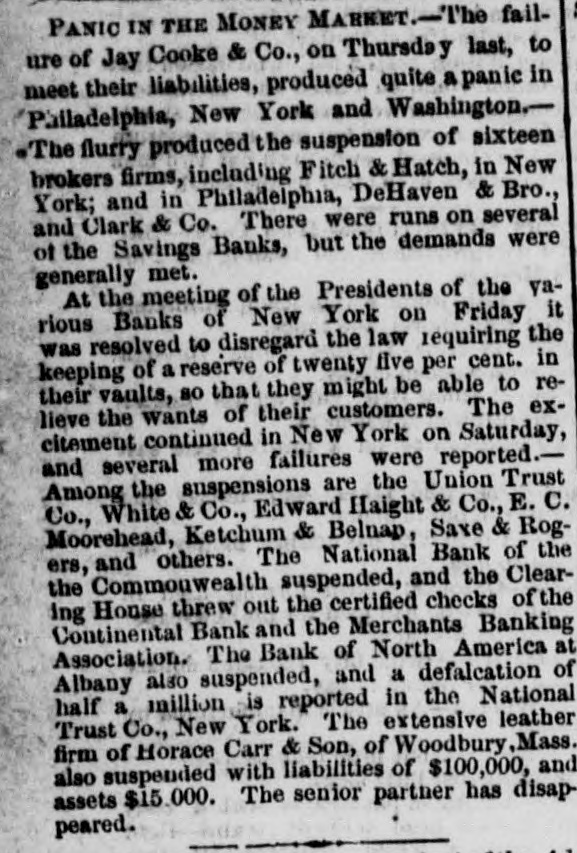
PANIC IN THE MONEY MARKET.-The failure of Jay Cooke & Co., on Thursday last, to meet their liabilities, produced quite a panic in Palladelphia, New York and Washington.The flurry produced the suspension of sixteen brokers firms, including Fitch & Hatch, in New York; and in Philadelphia, DeHaven & Bro., and Clark & Co. There were runs on several of the Savings Banks, but the demands were generally met. At the meeting of the Presidents of the yarious Banks of New York on Friday it was resolved to disregard the law requiring the keeping of a reserve of twenty five per cent. in their vaults, so that they might be able to relieve the wants of their customers. The excitement continued in New York on Saturday, and several more failures were reported.Among the suspensions are the Union Trust Co., White & Co., Edward Haight & Co., E.C. Moorehead, Ketchum & Belnap, Saxe & Rogers, and others. The National Bank of the the Commouwealth suspended, and the Clearing House threw out the certified checks of the Continental Bank and the Merchants Banking Association. The Bank of North America at Albany also suspended, and a defalcation of half a million is reported in the National Trust Co., New York. The extensive leather firm of Horace Carr & Son, of Woodbury, Mass. also suspended with liabilities of $100,000, and assets $15.000. The senior partner has disappeared.


Article from Green-Mountain Freeman, September 24, 1873

Click image to open full size in new tab

Article Text

juncture the governing committee of the stock exchange held a meeting, and unanimously resolved upon the closing of the exchange. The hall was accordingly cleared at a quarter before 12, all members of the exchange having been first warned against dealings in the street or outside, on penalty of expulsion from the board, and business for the day was consequently closed. This action was received with general favor; cheer after cheer from the brokers followed the closing gong, and the grumblers were chiefly outsiders who had come to the city in the hope of making large purchases of stock at low figures. The general feeling was voiced by the Evening Express, when it said: "Too much praise cannot be awarded to the men who conceived and carried out this master stroke of policy. Bedlam was running loose, and the craze was rapidly communicating itself to the outside multitude. Nothing remained but to shut the door and try and bring back bulls and bears alike to their senses." The suspension of the National bank of the Commonwealth, which quickly followed that of the Trust company, is attributed by its president, George Ellis, to the run on the Fourth national bank, the day before, which in turn caused a small run on the Commonwealth. When the latter bank closed on Friday, it was discovered that the firm of Edward Haight & Co., the principal backers of the bankβ€”had overdrawn their account $225,000 which they were unable to return. The president consulted with other bank officials, some of whom proffered assistance and advised a continuance of business, but notwithstanding this and the added fact that immediate suspension was not absolutely necessary, it was deemed advisable to suspend at once rather than be subjected to the drain of a run. The suspension, however, did not affect other banks, the Commonwealth having been almost entirely a broker's bank and its capital being only $750,000. The suspension of the Union Trust Company was followed about noon, by that of the National Trust company, which was a matter of expediency rather than immediate necessity. The company had in its vaults a large amount of securities, including $800,000 in government bonds, but these could not be sold except at a discount of from 30 to 40 per cent.; and, rather than suffer such a loss, the directors decided to suspend temporarily. Among the minor suspensions of the day were the following: Edward Haight & Co., Brown, Wadsworth & Co., E. C. Morehead, C. G. White & Co., Ketchum & Belknap, Williams & Bostwick, Miller & Walsh, Lawrence Josephs, P. M. Myers & Co., Fearing & Delling and Taussig & Fisher. The run on the Fourth national bank, which commenced on Friday, continued through Saturday, but all demands were promptly met, about $500,000 being paid out during the day in bank notes. There was no run on any other bank. On Sunday President Grant and Secretary Richardson were in consultation with leading bankers. They refused to pay the legal tender reserve into the banks but promised to buy bonds at their market value to relieve the money market. On Monday the feeling was much better and it was believed that the worse of the panic is over. Saturday night the failures numbered thirty three firms and three banks. The only story of actual crime that has been developed by the breaking up in Wall st. is the defalcation of Charles T. Carleton, Secretary of the Union Trust Company. At the examination of the affairs of the institution on Friday night, rapid and general as it was, it was discovered that at least $350,000 worth of Government securities and railroad bonds, which had been kept in a new underground safe, had disappeared, and probably as much more. Mr. Carleton had left the office late in the forenoon, and though when he went out it was supposed he had gone to lunch, he has not yet returned. As evening approached, and the Secretary was still missing, rumors of distrust began to spread themselves among the officers and clerks. Late at night the surprising discovery was made known. Mr. Carleton has been connected with the bank for five years, and has not once until now been under suspicion. He is a son of the Rev. Dr. Carleton, formerly of the Methodist Book Concern, and it is stated that one loan of $20,000 was made to his father. Mr. Carleton lived in elegant style at No. 52 South Oxford-st., Brooklyn. Com. Vanderbilt's theory of the trouble as given to a reporter is as follows: The trouble is the people undertake to do four times as much business as they can legitimately undertake. Of course they get short, and have to bolster up their business as well as they can by robbing Peter to pay Paul. If people will carry on business in this mad-cap manner they must run a muck. There are a great many railroads started in this country without any means to carry them through. Respectable banking houses in New York, so called, make themselves agents for the sale of the bonds of the railroads in question and give a moral guarantee of genuineness. The bonds soon reach Europe and the markets of the commercial centers from the character of endorsers are flooded with them. Now mark the sequence. The road gets into difficulties and bad language is heard all round. These worthless roads prejudice the commercial credit of our country abroad. Building railroads from nowhere to nowhere at public expense is not a legitimate undertaking. I might make allusions to Texas, Midland and other new railroads, but you must excuse me, for I am a friend of the iron road, and like to see it stretching to every corner of the United States. They help to develop our commerce and civilization, and ought to be encouraged. All I have to say is, when railroads are to be built don't victimize the public to build them. When I have some money I buy railroad stock or something else, but I don't buy on credit. I pay for what I get. People who live too much on credit generally get brought up with a round turn in the long run. The Wall street "averages" ruin many a man there and is like faro. Mistrust will be engendered till we, as a nation, do our business on a more solid basis, and pay as we go. Tuesday afternoon the large banking house of Henry Clews & Co., failed, and the panic was fanned into new life. The Lamoille County Fair at Morrisville the 17th and 18th was very successful. Mr. A. W. Griswold's show of cattle was of course the best that anybody in the State could make. Robert Hill of Elmore had a fine flock of sheep. The baby show inaugurated by Hon. P. K. Gleed, came off as advertised. Thirteen mothers with their infants came upon the track in a carriage, accompanied by Mr. Gleed, and passed around the track and then to Floral Hall, where they were interviewed by the Committee. The first premium was awarded to Mrs. G. W. Doty of Morrisville.