Bank of Cleveland (Cleveland, OH)

Episode Information

Episode UID
5794499790506
Episode Type
Suspension → Closure
Bank Type
state
Bank ID
579449979 hash
Start Date
February 22, 1842
Location
Cleveland, Ohio (41.499, -81.695)

Metadata

Model
gpt-5-mini (chosen from majority vote of a three-model LLM ensemble)
Short Digest
978dd5669e5a8c95

Response Measures

None

Description

Receivers were appointed and assets assigned; bank described as broken/suspended and being wound up.

Events (4)

1. February 22, 1842 Suspension
Cause
Bank Specific Adverse Info
Cause Details
Bank insolvency/financial failure leading to winding up and suspension of specie payments; notes discredited and heavy depreciation reported.
Newspaper Excerpt
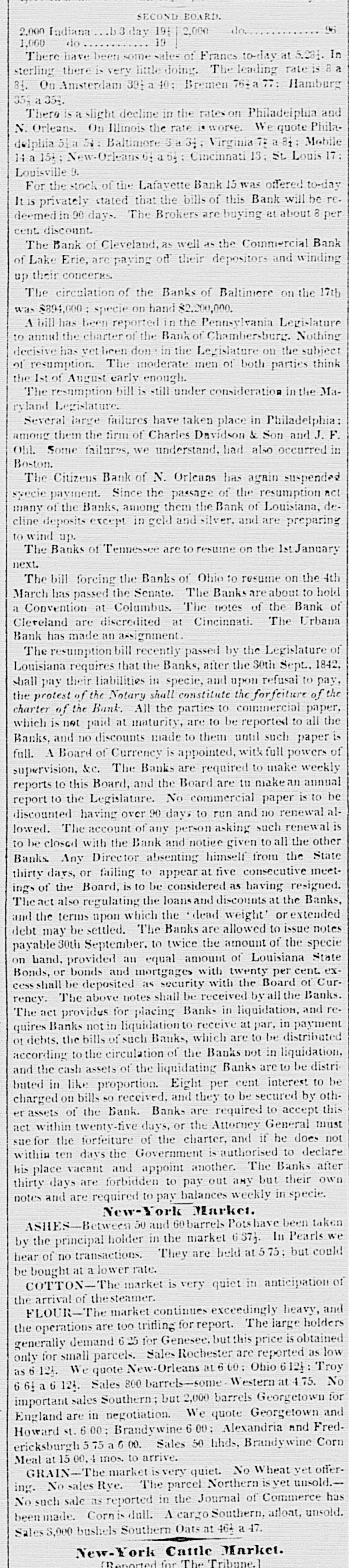
The Bank of Cleveland, as well as the Commercial Bank of Lake Erie, are paying off their depositors and winding up their concerns.
Source
newspapers
2. March 31, 1842 Other
Newspaper Excerpt
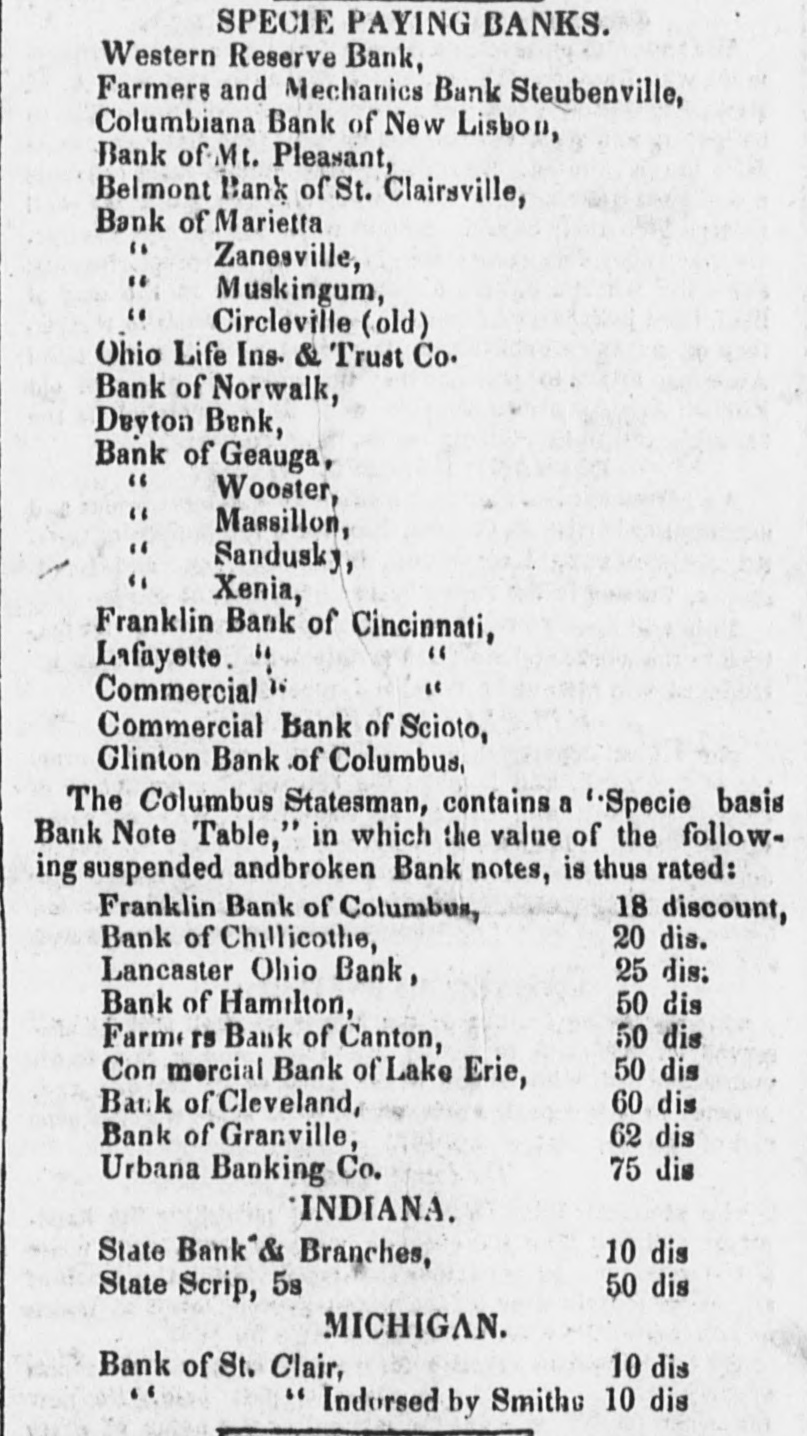
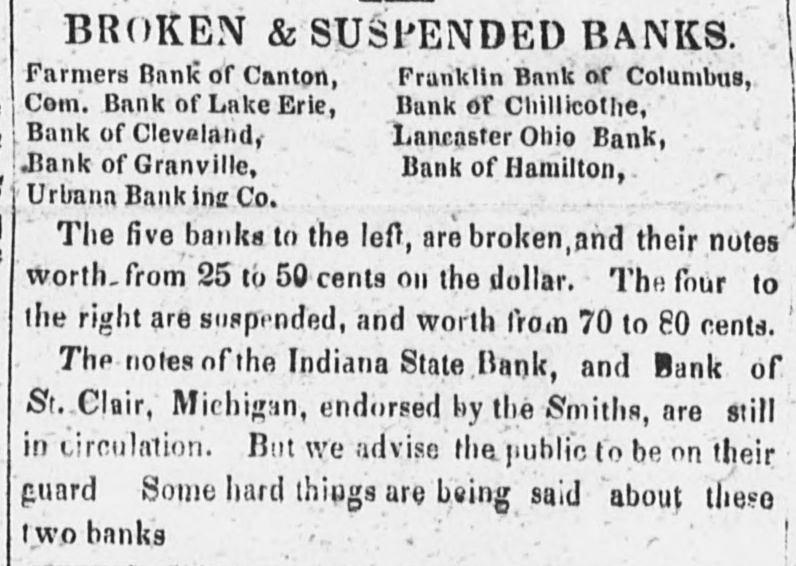
Bank of Cleveland, 62 dis (notes quoted at heavy discount) and listed among suspended/broken banks in local reports; notes worth deep discount or broken status reported in April lists and tables of suspended banks.
Source
newspapers
3. May 27, 1842 Other
Newspaper Excerpt
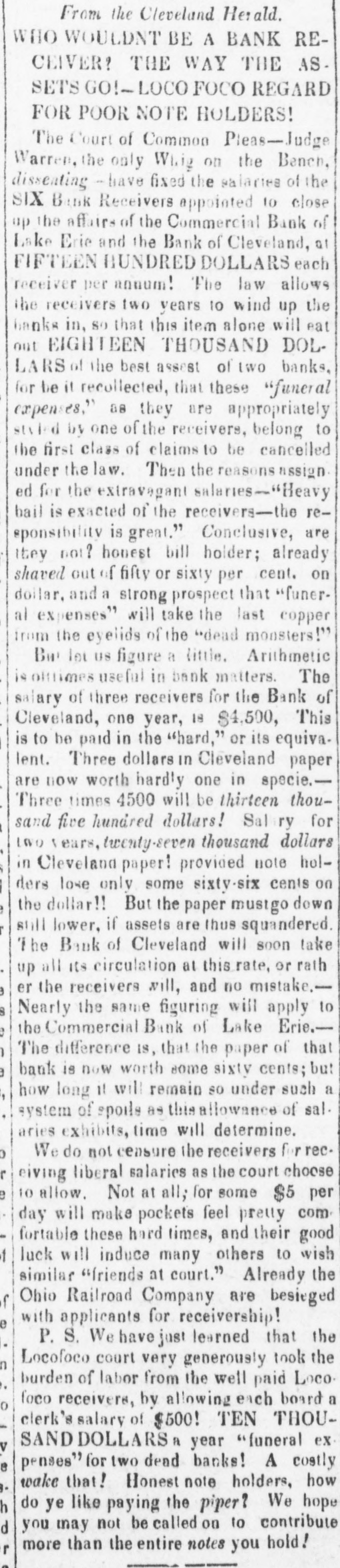
THE WAY THE ASSETS GO! ... fixed the salaries of the SIX Bank Receivers appointed to close up the affairs of the Commercial Bank of Lake Erie and the Bank of Cleveland, at FIFTEEN HUNDRED DOLLARS each receiver per annum!
Source
newspapers
4. December 16, 1842 Receivership
Newspaper Excerpt
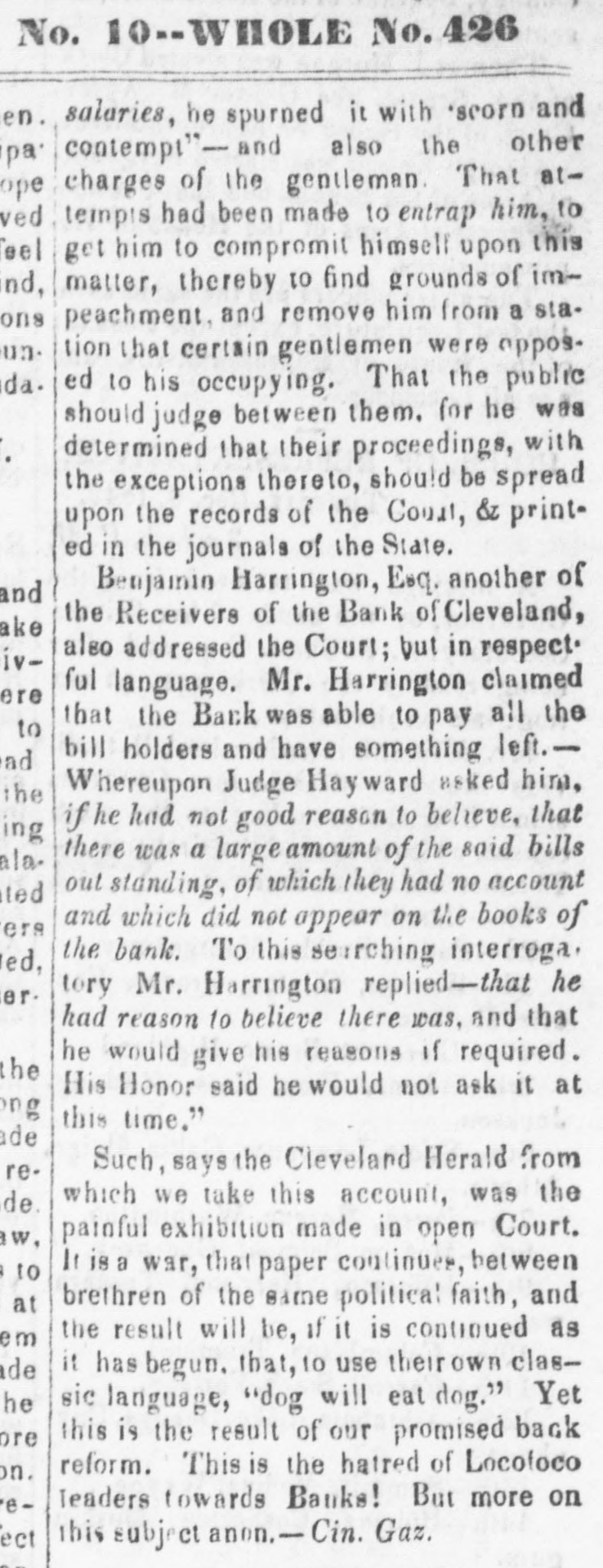
Benjamin Harrington, Esq. another of the Receivers of the Bank of Cleveland, ... Mr. Harrington claimed that the Bank was able to pay all the bill holders and have something left. ... the painful exhibition made in open Court.
Source
newspapers

Newspaper Articles (7)

Article from New-York Tribune, February 22, 1842

Click image to open full size in new tab

Article Text

SECOND BOARD. 2,000 Indiana...b 3 day 19 2,000 do 96 1,000 do 19 There have been some sales of Francs to-day at 5.281. In sterling there is very little doing. The leading rate is 8 a 31. On Amsterdam 391 a 40: Bremen 76 a 77: Hamburg 35, a 35. There is a slight decline in the rates on Philadelphia and N. Orleans. On Illinois the rate is worse. We quote Phila- delphia 5a 51: Baltimore sa 3, Virginia 75 a 81: Mobile 14 a 154; New-Orleans 65 a 6: Cincinnati 13, St. Louis 17: Louisville 9. For the stock of the Lafavette Bank 15 was offered to-day It is privately stated that the bills of this Bank will be re- deemed in 90 days. The Brokers are buying at about 8 per cent, discount. The Bank of Cleveland, as well as the Commercial Bank of Lake Erie, are paying off their depositors and winding up their conceres. The circulation of the Banks of Baltimore on the 17th was $894,000; specie on hand $2.200,000. A bill has been reported in the Pennsylvania Legislature to annul the charter of the Bank of Chambersburg. Nothing decisive has yet been done in the Legislature on the subject of resumption. The moderate men of both parties think the Ist of August early enough. The resumption bill is still under consideration in the Ma- ryland Legislature. Several large failures have taken place in Philadelphia; among them the firm of Charles Davidson & Son and J. F. Ohl. Some failures, we understand, had also occurred in Boston. The Citizens Bank of N. Orleans has again suspended specie payment. Since the passage of the resumption act many of the Banks, among them the Bank of Louisiana, de- cline deposits except in geld and silver, and are preparing to wind up. The Banks of Tennessee are to resume on the 1st January next. The bill forcing the Banks of Ohio to resume on the 4th March has passed the Senate. The Banks are about to hold a Convention at Columbus. The notes of the Bank of Cleveland are discredited at Cincinnati. The Urbana Bank has made an assignment. The resumption bill recently passed by the Legislature of Louisiana requires that the Banks, after the S0th Sept., 1842, shall pay their liabilities in specie, and upon refusal to pay, the protest of the Notary shall constitute the forfeiture of the charter of the Bank. All the parties to commercial paper, which is not paid at maturity, are to be reported to all the Banks, and no discounts made to them until such paper is full. A Board of Currency is appointed, witk full powers of supervision, &c. The Banks are required to make weekly reports to this Board, and the Board are tu make an annual report to the Legislature. No commercial paper is to be discounted having over 90 days to run and no renewal al- lowed. The account of any person asking such renewal is to be closed with the Bank and notice given to all the other Banks. Any Director absenting himself from the State thirty days, or failing to appear at five consecutive meet- ings of the Board, is to be considered as having resigned. The act also regulating the loans and discounts at the Banks, and the terms upon which the 'dead weight' or extended debt may be settled. The Banks are allowed to issue notes payable 30th September, to twice the amount of the specie on hand, provided an equal amount of Louisiana State Bonds, or bonds and mortgages with twenty per cent ex- cess shall be deposited as security with the Board of Cur- rency. The above notes shall be received by all the Banks. The act provides for placing Banks in liquidation, and re- quires Banks not in liquidation to receive at par, in payment of debts, the bills of such Banks, which are to be distributed according to the circulation of the Banks not in liquidation, and the cash assets of the liquidating Banks are to be distri- buted in like proportion. Eight per cent interest to be charged on bills so received, and they to be secured by oth- er assets of the Bank. Banks are required to accept this act within twenty-five days, or the Attorney General must sue for the forfeiture of the charter, and if he does not within ten days the Government is authorised to declare his place vacant and appoint another. The Banks after thirty days are forbidden to pay out asy but their own notes and are required to pay balances weekly in specie. ### New-York Market. ASHES-Between 50 and 60 barrels Pots have been taken by the principal holder in the market 6371. In Pearls we hear of no transactions. They are held at 575; but could be bought at a lower rate. COTTON-The market is very quiet in anticipation of the arrival of the steamer. FLOUR-The market continues exceedingly heavy, and the operations are too tritling for report. The large holders generally demand 625 for Genesee, but this price is obtained only for small parcels. Sales Rochester are reported as low as 6 124. We quote New-Orleans at 6 60: Ohio 6124: Troy 661a 6 121. Sales 800 barrels-some Western at 475. No important sales Southern; but 2,000 barrels Georgetown for England are in negotiation. We quote Georgetown and Howard st. 6.00; Brandywine 600; Alexandria and Fred- ericksburgh 5 75 a 6.00. Sales 50 hhds, Brandywine Corn Meal at 15.00,4 mos. to arrive. GRAIN-The market is very quiet. No Wheat yet offer- ing. No sales Rye. The parcel Northern is yet unsold.- No such sale as reported in the Journal of Commerce has been made. Corn is dull. A cargo Southern, afloat, unsold. Sales 8,000 bushels Southern Oats at 464 a 47. ### New-York Cattle Market. [Reported for The Tribune.l


Article from Carroll Free Press, February 25, 1842

Click image to open full size in new tab

Article Text

From the Ohio State Journal. BANK MATTERS. The resumption bill passed both houses and became a law on Monday.—On Tuesday it was announced upon the authority of the Statesman, that "things already began to exhibit a quieter aspect!" Oh, yes! "Order reigns in Warsaw!" was the despatch that announced the subjugation of Poland, to the Autocrat of the North, though in fearful strife the blood of her patriotic sons had saturated the soil. The banks are tumbling into ruins, and as despair settles upon the public mind, the chief of the gang who have strewn the State with the wrecks of its former prosperity exclaims, "THINGS ALREADY BEGIN TO ASSUME A QUIETER ASPECT!" We learn further through the same reliable source, "that the tide is already turning in our favor." Some specie came last week to Cincinnati, from the South, (probably some of the yellow boys, that were to flow up the Mississippi, as predicted eight or ten years since by Benton,) and that event is to be attributed to the magical influence of the passage of the resumption bill, although the effect seems to have preceded the cause by several weeks. How fortunate it is for the people of the State that this measure, after three months parturition, has finally come to such a glorious deliverance. No doubt double headed calves and eight legged pigs, will be abundant during the next dropping season—and allowing to the annihilation of the Banks and the Currency, by this superlatively "democratic" Legislature. A convention of Delegates from most of the Banks in the State, assembled here yesterday to consult upon the course which will be best to enable them to sustain each other during the approaching crisis. We had heard nothing last evening of the result of their deliberations. Intelligence reached the city yesterday, of the assignment of the assets of the Lancaster Bank. The Hamilton Bank was assigned a week or more since, as was also the Chillicothe bank. It is not improbable that some other banks have been assigned in anticipation of the passage of the resumption bill. We hear so many rumors about bank matters from day to day, that it is extremely difficult to know what to depend on. Yesterday, we learn, the way bill from Cleveland contained an endorsement unfavorable to the Bank of Cleveland, though there is nothing in the Herald of Monday on the subject. The Mansfield Shield and Banner says, in a postscript, on Wednesday, that the "Cleveland bank has bursted." People out of the State, particularly at the North, where specie is abundant, can form no conception of the deplorable condition of the currency of Ohio. Nearly the entire business of the provision market in this city, is transacted in shin plasters, and these so ragged and dirty as to be almost illegible. The Farmer's and Workingmen in the south part of the county, place the most confidence in the shinplasters of the Corporation of Lancaster—based upon nothing for their redemption, but the public faith of that town. They are preferred to most bank paper. At Dayton business on the Canal is almost entirely suspended, from the inability of the produce merchants to find any money that the collectors will receive for tolls. They even refuse the notes of the Franklin Bank of this city, though the State is indebted to the Bank in the sum of nearly half a million of dollars. Urbana money changes hands at abou


Article from The Ohio Democrat, March 31, 1842

Click image to open full size in new tab

Article Text

SPECIE PAYING BANKS. Western Reserve Bank, Farmers and Mechanics Bank Steubenville, Columbiana Bank of New Lisbon, Bank of Mt. Pleasant, Belmont Bank of St. Clairsville, Bank of Marietta " Zanesville, " Muskingum, " Circleville (old) Ohio Life Ins. & Trust Co. Bank of Norwalk, Deyton Benk, Bank of Geauga, " Wooster, " Massillon, Sandusky, Xenia, Franklin Bank of Cincinnati, Lafayette. is " Commercial Commercial Bank of Scioto, Glinton Bank of Columbus, The Columbus Statesman, contains a 'Specie basis Bank Note Table," in which the value of the following suspended andbroken Bank notes, is thus rated: Franklin Bank of Columbus, 18 discount, 20 dis. Bank of Chillicothe, 25 dis: Lancaster Ohio Bank, 50 dis Bank of Hamilton, 50 dis Farmers Bank of Canton, 50 dis Con mercial Bank of Lake Erie, 60 dis Bank of Cleveland, 62 dis Bank of Granville, 75 dis Urbana Banking Co. INDIANA. 10 dis State Bank'& Branches, 50 dis State Scrip, 5s MICHIGAN. 10 dis Bank of St. Clair, Indorsed by Smithe 10 dis


Article from The Ohio Democrat, April 21, 1842

Click image to open full size in new tab

Article Text

BROKEN & SUSPENDED BANKS. Farmers Bank of Canton, Franklin Bank of Columbus, Bank of Chillieothe, Com. Bank of Lake Erie, Bank of Cleveland, Lancaster Ohio Bank, Bank of Granville, Bank of Hamilton, Urbana Bank ing Co. The five banks to the left, are broken, and their notes worth. from 25 to 50 cents OII the dollar. The four to the right are suspended, and worth from 70 to 80 cents. The notes of the Indiana State Bank, and Bank of St. Clair, Michigan, endorsed by the Smiths, are still in circulation. But we advise the public to be on their guard Some hard things are being said about these wo banks


Article from Carroll Free Press, May 27, 1842

Click image to open full size in new tab

Article Text

From the Cleveland He:ald. WHO WOULDNT BE A BANK RECEIVER? THE WAY THE AS. SETS GO!-LOCO FOCO REGARD FOR POOR NOTE HOLDERS! The Court of Common Pleas-Judge Warren, the only White on the Bench, disseating have fixed the salaries of the SIX Bank Receivers appointed to close up the affairs of the Commercial Bank of Lake Erie and the Bank of Cleveland, at FIFTEEN HUNDRED DOLLARS each receiver per annum! The law allows the receivers two years 10 wind up the banks in, so that this item alone will eat out EIGHTEEN THOUSAND DOLLARS of the best assest of two banks, for be it recullected, that these "funeral expenses," 88 they are appropriately stvied by one of the receivers, belong to the first class of claims to be cancelled under the law. Then the reasons assign. ed for the extravegant salaries-"Heavy bail is exacted of the receivers-the reare sponsibility is great." Conclusive, itey not? honest bill holder; already shaved out of fifty or sixty per cent. on dollar. and a strong prospect that "funeral expenses" will take the last copper from the eyelids of the "dead monsters!" Bir lot US figure a little. Arithmetic oltimes useful in bank matters. The salary of three receivers for the Bank of Cleveland, one year, 18 $4,500, This is to be paid in the "hard," or its equivalent. Three dollars in Cleveland paper are now worth hardly one in specie.Three times 4500 will be thirteen thousand five hundred dollars! Sal ry for two years, twenty.seven thousand dollars in Cleveland paper! provided note holders lose only some sixty-six cents on the dollar!! But the paper mustgo down still lower, if assets are thus squandered. The Bank of Cleveland will soon take up all its circulation at this rate, or rath er the receivers will, and no mistake.Nearly the same figuring will apply to the Commercial Bank of Lake Erie.The difference is, that the paper of that bank is now worth some sixty cents; but how long il will remain so under such a system of spoils as thie allowance of sal. aries exhibits, time will determine. We do not ceasure the receivers for rec. 6 eiving liberal salaries as the court choose 10 allow. Not at all; for some $5 per day will make pockets feel pretty com fortable these hard times, and their good luck will induce many others to wish similar "friends at court." Already the Ohio Railroad Company are besieged with applicants for receivership! e P. S. We have just learned that the Locofoco court very generously tnok the burden of labor from the well paid Loco foco receivers, by allowing each board a 0 clerk's salary of $500! TEN THOUSAND DOLLARS a year "funeral ex penses" for two dead banks! A costly e wake that! Honest note holders, how do ye like paying the piper? We hope you may not be called on to contribute more than the entire notes you hold!


Article from Carroll Free Press, December 16, 1842

Click image to open full size in new tab

Article Text

No. 10--WHOLE No. 426 en. salaries, he spurned it with scorn and pa contempt"- - and also the other ope charges of the gentleman That atved tempts had been made to entrap him, to eel get him to compromit himself upon this nd, matter, thereby to find grounds of imons peachment, and remove him from a staun. tion that certain gentlemen were opposda. ed to his occupying. That the public should judge between them. for he was determined that their proceedings, with upon the records of the Court, & printthe exceptions thereto, should be april ed in the journals of the State. Benjamin Harrington, Esq. another of and the Receivers of the Bank of Cleveland, ake also addressed the Court; but in respect. ivful language. Mr. Harrington claimed are that the Back was able to pay all the to bill holders and have something left.ad Whereupon Judge Hay ward asked him. the if he had not good reason to believe, that ing there was a large amount of the said bills ala. out standing, of which they had no account ted and which did not appear on the books of ers the bank. To this seirching interroga. ed, tory Mr. Harrington replied-that he er. had reason to believe there was, and that he would give his reasons if required. the His Honor said he would not ask it at ong this time." de Such, says the Cleveland Herald from rewhich we take this account, was the de painful exhibition made in open Court. a W. 8 to It is a war, that paper continuer, between brethren of the same political faith, and at the result will be, if it is continued as em de it has begun. that, to use their own clashe sie language, "dog will eat dog." Yet this is the result of our promised back ore reform. This is the hatred of Locoloco on. leaders towards Banks! But more on ect this subject anon. - Cin. Gaz.


Article from The Spirit of Democracy, January 24, 1846

Click image to open full size in new tab

Article Text

# FOR GOVERNOR OF OHIO, DAVID TOD, of Trumbull. # THE CONSTITUTIONAL CURRENCY. In our paper of last week, we published the proceedings of the Democratic 8th of January Convention, which put in nomination, as the Democratic candidate for Governor of Ohio, the able advocate of equal rights-DAVID TOD. On the first page of to-day's paper will be found the proceedings of the Democratic Editorial State Convention, for which we bespeak an attentive perusal. The democracy of this county are well aware, that, when the democratic party of Ohio raised the "bank reform" banner, in 1838, they were triumphantly victorious at the ensuing elections. The people were well satisfied, from past experience, that the old villanous banking system needed much reformation, in order to secure them from the almost daily loss of thousands of dollars; a loss resulting as well from the total failure of these rascally shaving shops, as from a partial depreciation in the nominal value of their "promises to pay." In accordance with the views and doctrines, at that time advocated, the democratic members of the General Assembly, at subsequent sessions of the Ohio legislature, passed laws which, it was supposed, would have the effect to make bankers honest men; or, in other words, to prevent the old system of bank swindling of "contractions to-day, and expansions to-morrow"- from ever being again fastened upon the people of this State. Laws were enacted making stockholders liable in their individual capacity for the debts of a bank, in case of failure, as well as other laws equally salutary. When these laws were passed, it was thought that the people would, thereafter, be secured from losses by bank failures, and bank suspensions; and that all banks thereafter chartered would have engrafted in their charters these salutary provisions. But how have the people been disappointed in their hopes and expectations? Would bankers accept of charters with the individual liability clause? No. The determination of the moneyed aristocracy of this State was to grind down the people by enormous taxes, by bank failures, and bank suspensions, until they should be brought to tamely submit to any banking proposition that might be brought forward. The result has been, that by "deception, corruption, and accident," the bank power of the State has once more gained the ascendency in our legislative halls. Immediately, all the salutary measures, demanded by the people, were repealed; and a system of banking enforced upon the people only equalled by the old defunct banks of Gallipolis, West Union, and a host of others. Who does not recollect, and, not only recollect, but, by experience, know the thousands, and we might safely say millions, lost to the people of Ohio, by the explosion of such dens of iniquity as the Bank of Cincinnati, German Bank of Wooster, Bank of Steubenville, Bank of Granville, Bank of Urbana, Bank of Gallipolis, Bank of West Union, Miami Exporting Company, new Bank of Circleville, Lebanon Miami Bank, Bank of Cleveland, Commercial Bank of Lake Erie, Commercial Bank of Scioto, and a long list of others in this State, together with the losses sustained by the failure of the banks of the States of Illinois, Michigan, and others; and we might particularly mention as "last though not least," the Bank of St. Clair, familiarly known as the *Red-dog* bank? Have the people, we ask, forgotten all their losses occasioned by the failure of these institutions? No. They feel that forbearance will soon cease to be a virtue; and will, ere long, speak in tones of thunder to those nabobs of the bank-paper-mills, whose only rule of action seems